💥UPSC 2026, 2027, 2028 UAP Mentorship (March Batch) + Access XFactor Notes & Microthemes PDF

Search results for: “”

  • Free Live Webinar Today @ 7PM, Registrations Closing Soon|| Ask Me Anything Session on  UPSC Interview Round & DAF Analysis with Serving IRPS Officer, IIT Alumni & Civilsdaily Mentor Virendra Pratap Singh|| LINK INSIDE to Register For The Free Live Webinar

    Free Live Webinar Today @ 7PM, Registrations Closing Soon|| Ask Me Anything Session on UPSC Interview Round & DAF Analysis with Serving IRPS Officer, IIT Alumni & Civilsdaily Mentor Virendra Pratap Singh|| LINK INSIDE to Register For The Free Live Webinar

    Detailed Application Form (DAF) is one of the most important documents that you might have filled for UPSC interviews. A major part of the interview will revolve around the information and details provided in the DAF. It is more than your CV.

    Your ability to defend your DAF before the panel is going to decide your success. Anticipating and preparing for the questions based on your DAF is an essential part of the interview preparation.

    Free, Open to All Q & A session on UPSC Interview Round by Virendra Pratap Sir

    Candidates must ensure they research the relevant questions well enough. They must be able to interlink the questions in DAF to burning issues to national and international importance.

    That’s why we have organised this free live webinar where UPSC Mains qualified aspirants can get their doubts cleared and prepare a solid DAF for the interview panel.

    We make sure that no area of the DAF has been left untouched. This DAF-based questionnaire is an important tool which if used properly in your preparation may allow you to steer your interview in a particular direction.

    Below are some of the pictures and sample of the questions that you are going to get.

    Questions based on Graduation subject

    Questions based on Date of birth

    Questions based on optional subject

    Questions based on Hobbies

    What Will You Learn About UPSC Interview in this Free Live Q&A Webinar with Virendra Pratap Sir?

    1. Sir will answer doubts on how to fill out personal information/details in the DAF.

    2. Doubts regarding service and cadre preferences will be addressed.

    3. Clarification of doubts about hobbies and extracurricular activities.

    4. Sir will talk about the areas of your DAF-II from where the board will ask many questions?

    5. Sir will answer doubts regarding the DAF keywords.

    6. Sir will talk about the trend analysis based on last 6 years’ transcripts.

    7. Sir will talk about certain interview mistakes by other aspirants in the interview which costed them a rank in the final list.

    Free Live UPSC Interview Webinar Details

    Your marks in the personality round will definitely be a dominant deciding factor on whether you will get the service or cadre of your choice. So start practising for it and attend this free Q&A session with Virendra sir to clear your doubts!

    Date: 21st March, 2022 (Monday)

    Time: 7PM

    About Virendra Pratap Sir

    Virendra Pratap Singh is an IRPS officer of 2009 batch. He has completed B.Tech from IIT Kharagpur. Before joining Civil Services, he worked in different private sector organisations such as Tata Steel, Tata Motors and Maruti Suzuki India Ltd.

    He is associated with CivilsDaily in student mentoring program for UPSC interview since it’s inception.

  • Why the West should focus on China

    Context

    The Russian offensive on Ukraine on the night of February 23-34 shocked the world. The trigger for the conflict has been the rise of anti-Russia/Putin and pro-Europe lobby in Ukraine, led by President Volodymyr Zelenskyy and with the tacit support of the US and the West.

    Background of the conflict

    • The situation became deeply polarised after battle lines were drawn in 2015, with Ukraine’s breakaway Donbas region seeking a merger with Russia, after Crimea’s unification with the latter.
    • Russia has, over the years, quite correctly questioned the relevance of NATO — a grouping of the Cold War era — and its expansion eastwards. 
    • For instance, NATO included the Commonwealth of Independent States (CIS) countries of Georgia and Ukraine, earlier part of the Soviet Union, in its “Partnership for Peace” programme, despite Russian objections.

    Implications of war for geopolitics and role of China

    • Geopolitics will never be the same, especially with Germany and Japan announcing militarisation initiatives, polarisation in Europe and the strengthening of the anti-US nexus of China- Russia-Turkey-Iran.
    • Focus moves away from China: A matter of concern is that once again, the attention of the US and the West has been diverted from China, the main adversary, to a war that should not have taken place.
    • Possibility of annexation of Taiwan: In the current conflict, the ineptitude of the US/NATO to support Ukraine with “boots on the ground” is bound to embolden China in its nefarious design to annex Taiwan.
    • This could also lead to increased hostility by China in the resolution of land disputes with the neighbouring countries, as well as in the South and East China seas.

    Consider the question “With the Russian invasion of Ukraine, the geopolitics will never be the same again.”Comment. 

    Conclusion

    For India, the greatest lesson is that it will have to meet the Chinese challenge on its own. There is no likelihood of the US or any other nation getting involved in India’s fight with China. Let us focus on atmanirbharta in all its dimensions.

    UPSC 2022 countdown has begun! Get your personal guidance plan now! (Click here)

  • What is Reasonable Accommodation Principle?

    The Karnataka High Court decision effectively upheld the denial of entry to students wearing the hijab. The court rejected an argument in support of permitting Muslim girls wearing head-scarves that was based on the principle of ‘reasonable accommodation’.

    What is Reasonable Accommodation?

    • ‘Reasonable accommodation’ is a principle that promotes equality, enables the grant of positive rights and prevents discrimination based on disability, health condition or personal belief.
    • Its use is primarily in the disability rights sector.
    • The provision plays a major role in addressing these barriers and thus contributes to greater workplace equality, diversity and inclusion.

    Article 2 of the UN Convention on the Rights of People with Disabilities (UNCRPD) defines:

    • Reasonable accommodation is “necessary and appropriate modification and adjustments not imposing a disproportionate or undue burden, where needed in a particular case, to ensure to persons with disabilities the enjoyment or exercise on an equal basis with others of all human rights and fundamental freedoms”.

    International Labour Organization (ILO), in its recommendation on HIV/AIDS and the world of work, defines:

    • It is “any modification or adjustment to a job or to the workplace that is reasonably practicable and enables a person living with HIV or AIDS to have access to, or participate or advance in, employment”.

    How does the principle work?

    • The general principle is that reasonable accommodation should be provided, unless some undue hardship is caused by such accommodation.
    • A modified working environment, shortened or staggered working hours, additional support from supervisory staff and reduced work commitments are ways in which accommodation can be made.
    • Suitable changes in recruitment processes — allowing scribes during written tests or sign language interpreters during interviews — will also be a form of accommodation.

    What is the legal position on this in India?

    • In India, the Rights of People with Disabilities Act, 2016, defines ‘reasonable accommodation’ as “necessary and appropriate modification and adjustments, without imposing a disproportionate or undue burden in a particular case, to ensure to PwD the enjoyment or exercise of rights equally with others”.
    • The definition of ‘discrimination’ in Section 2(h) includes ‘denial of reasonable accommodation’.
    • In Section 3, which deals with equality and non-discrimination, sub-section (5) says: “The appropriate Government shall take necessary steps to ensure reasonable accommodation for persons with disabilities.”

    Judicial interpretation of Reasonable Accommodation

    • In Jeeja Ghosh and Another v. Union of India and Others (2016), the Supreme Court, awarded a compensation of ₹10 lakh to a passenger with cerebral palsy who was evicted from a flight after boarding.
    • It said: “Equality not only implies preventing discrimination …, but goes beyond in remedying discrimination against groups suffering systematic discrimination in society.
    • In concrete terms, it means embracing the notion of positive rights, affirmative action and reasonable accommodation.
    • The Supreme Court elaborated on the concept in Vikash Kumar v. UPSC (2021).
    • This was a case in which the court allowed the use of a scribe in the Union Public Service Commission examination for a candidate with dysgraphia, or writer’s cramp.
    • It said failure to provide reasonable accommodation amounts to discrimination.

    Context to the recent K’taka verdict

    • In the recent Karnataka verdict on wearing the hijab, the High Court did not accept the argument for allowing minor variations to the uniform to accommodate personal religious belief.
    • The HC meant that the court did not favour making any change or adjustment to the rule that could have enabled the students to maintain their belief or practice even while adhering to the uniform rule.
    • The appeal against the verdict in the Supreme Court provides an opportunity to see if the concept can be used in the realm of belief and conscience too.


    UPSC 2022 countdown has begun! Get your personal guidance plan now! (Click here)

  • What is the NPPA’s role in fixing drug prices?

    Consumers may have to pay more for medicines and medical devices if the National Pharmaceutical Pricing Authority (NPPA) allows a price hike of over 10% in the drugs and devices listed under the National List of Essential Medicines (NLEM), this coming month.

    Who regulates Drugs prices?

    • The NPPA was set up in 1997 to fix/revise prices of controlled bulk drugs and formulations and to enforce price and availability of the medicines in the country, under the Drugs (Prices Control) Order, 1995-2013.
    • Its mandate is:
    1. To implement and enforce the provisions of the DPCO in accordance with the powers delegated to it
    2. To deal with all legal matters arising out of the decisions of the NPPA
    3. To monitor the availability of drugs, identify shortages and to take remedial steps
    • The NPPA is also mandated to collect/maintain data on production, exports and imports, market share of individual companies, profitability of companies etc., for bulk drugs and formulations and undertake and/ or sponsor relevant studies in respect of pricing of drugs/ pharmaceuticals.

    How does the pricing mechanism work?

    • Prices of Scheduled Drugs are allowed an increase each year by the drug regulator in line with the Wholesale Price Index (WPI) and the annual change is controlled and rarely crosses 5%.
    • But the pharmaceutical players pointed out that over the past few years, input costs have flared up.
    • The hike has been a long-standing demand by the pharma industry lobby.
    • All medicines under the NLEM are under price regulation.

    Do you know?

    As per the Drugs (Prices) Control Order 2013, scheduled drugs, about 15% of the pharma market, are allowed an increase by the government as per the WPI while the rest 85% are allowed an automatic increase of 10% every year.

    How are the prices determined?

    • The ceiling price of a scheduled drug is determined by first working out the simple average of price to retailer in respect of all branded and generic versions of that particular drug formulation.
    • It should have a market share of more than or equal to 1%, and then adding a notional retailer margin of 16% to it.
    • The ceiling price fixed/revised by the NPPA is notified in the Gazette of India (Extraordinary) from time to time.

    When are the prices revised?

    • Prices are revised when there is a rise in the price of bulk drugs, raw materials, cost of transport, freight rates, utilities like fuel, power, diesel, and changes in taxes and duties.
    • The cost rises for imported medicines with escalation in insurance and freight prices, and depreciation of the rupee.
    • The annual hike in the prices of drugs listed in the NLEM is based on the WPI.
    • The NLEM lists drugs used to treat fever, infection, heart disease, hypertension, anaemia etc and includes commonly used medicines like paracetamol, azithromycin etc.

    Why are inputs costs high?

    • One of the challenges is that 60%-70% of the country’s medicine needs are dependent on China.
    • WPI is dependent on price rise in a basket of a range of goods that are not directly linked with the items that go into the cost of medicines.


    UPSC 2022 countdown has begun! Get your personal guidance plan now! (Click here)

  • Prelims Spotlight: Important Governor Generals and Viceroys

    Dear Aspirants,

    This Spotlight is a part of our Mission Nikaalo Prelims-2022.

    You can check the broad timetable of Nikaalo Prelims here

    Session Details

    Morning 12 PM  – Prelims Spotlight Session

    Evening 06:30  PM  – TIKDAM/MCQs Session

    Evening 08 PM  – Tests on Alternate Days

    Join our Official telegram channel for Study material and Daily Sessions Here


    21st Mar 2022

    • With almost absolute power the Governor-General and viceroy played a significant role in the shaping history of the country. Following are some of these important figures and significant events and major reforms carried out by them.

       Governor Generals of Bengal/India (Period)

        Important events/Reforms

          Warren Hastings

           (1773-1785)

      • Regulating Act of 1773.
      • First Governor-General of Bengal.
      • End of the dual system of administration (1765-1772).
      • Supreme Court at Calcutta.
      • Wrote Introduction to the first English translation of Gita.
      • Founded Madarasa Aliya at Calcutta.

           Lord Cornwallis

           (1786-1793)

      • Separation of three branches of service: commercial, judicial and revenue.
      • Permanent Land Revenue Settlement of Bengal-1793.
      • Reformed, modernised and rationalised the civil service.
      • Introduced the Cornwallis Code.
      • Sanskrit College, Varanasi.

           Lord Wellesley

           (1797-1805)

      • Introduction of Subsidiary Alliance System.
      • Fourth Anglo-Mysore war.
      • Fort William College, Calcutta.

           Lord Hastings

           (1813-1823)


      • Anglo-Nepal War (1814-16)
      • Third Anglo-Maratha War-(1817-19) and dissolution of Maratha confederacy.
      • Introduction of Ryotwari System of Thomas Munro, Governor of Madras-1820.

           Lord William Bentinck

           (1828-1835)

      • Charter Act of 1833.
      • Abolition of Sati-1829.
      • Resolution of 1835 and Education reforms and introduction of English as the official language.
      • The annexation of Mysore-1831, Coorg, and Central Cachar-1831.

           Lord Dalhousie

           (1848-1856)

      • Introduction of the Doctrine of Lapse and annexations of Satara-1848, Jaitpur and Sambhalpur-1849, Udaipur-1852, Jhansi-1853, Nagpur-1854 and Awadh-1856.
      • Wood’s Dispatch of 1854.
      • Railway Minute of 1853.
      • Telegraph and Postal reforms.
      • Widow Remarriage Act-1856.

           Lord Canning

           (1856-1857)

      • Establishment of universities at Bombay, Madras and Calcutta.
      • Mutiny of 1857.
      Governor-General and Viceroy of India (Period)                                Important events/Reforms
       Lord Canning


      (1858-1862)

      • First Voiceroy of India.
      • Transfer of control from East India Company to the Crown by the Government of India Act 1858
      • Indian Councils Act-1861

           Lord Mayo

           (1869-1872)

      • Opening of Rajkot College in Kathiawad and Mayo College at Ajmer for political training of Indian Princes.
      • Statistical Survey of India was established.
      • Department of Agriculture and Commerce was established.
      • Introduction of state railways.

           Lord Lytton

           (1876-1880)

      • The Great Famine of 1876 affecting Bombay, Madras, Mysore, Hyderabad, Central India and Punjab.
      • Appointment of Famine Commission under the presidency of Richard Strachey.
      • Vernacular Press Act was passed- 1878.
      • The Arms Act-1878.

           Lord Ripon

           (1880-1884)

      • Education Commission 1882 under William Hunter-1882.
      • Ilbert Bill controversy.
      • Repeal of Vernacular Press Act in 1882.
      • The First Factory Act in 1881 to improve labour conditions.
      • Government resolution on local self government-1882.

           Lord Dufferin

           (1884-1888)

      • Establishment of Indian National Congress.

           Lord Lansdowne

          (1888-1894)

      • The categorisation of civil services into imperial, provincial and subordinate.
      • Indian Councils Act-1892
      • Durand Commission (1893) was set up to define the Durand Line between India and Afghanistan.

           Lord Curzon

           (1899-1905)

      • Police Commission (1902) was appointed under Sir Andrew Frazer.
      • University Commission (1902) was appointed and Universities Act (1904) was passed.
      • Department of Commerce and Industry was established.
      • Calcutta Corporation Act-1899
      • Partition of Bengal (1905).

           Lord Minto-II

           (1905-1910)

      • Popularisation of anti-partition and Swadeshi Movements.
      • Split in Indian National Congress at Surat in 1907.
      • Indian Muslim League was established by Aga Khan (1907)
      • Morley-Minto reforms or Indian Councils Act 1909.

           Lord Hardinge-II

           (1910-1916)

      • Transfer of capital from Calcutta to Delhi (1911).
      • Establishment of Hindu Mahasabha (1915) by Madan Mohan Malviya.
           Lord Chelmsford


          (1916-1921)

      • Home Rule League was formed by Annie Besant and Tilak (1916)
      • Lucknow session of Congress (1916).
      • Lucknow Pact between Congress and Muslim League (1916).
      • Champaran Satyagraha (1918), and Satyagraha at Ahmadabad (1918).
      • Montague’s August Declaration.
      • Government of Indian Act- 1919
      • Jallianwalla Bagh massacre (1919).
      • Non-Cooperation and Khilafat Movements were launched.
      • Foundation of Women’s University at Poona (1916) and Saddler’s Commission was appointed for reforms in educational policy.
      • Appointment of S. P. Sinha as governor of Bihar first Indian to do so.

           Lord Reading

           (1921-1926)

      • The Chaura-Chauri Incident-Feb5, 1922 and withdrawal of Non-Cooperation movement.
      • Moplah rebellion in Kerala (1921).
      • Repeal of the Press Act of 1910 and Rowlatt Act of 1919.
      • Kakori train robbery (1925)
      • Establishment of Swaraj Party (1922).
      • The decision to hold a simultaneous examination for ICS in Delhi and London with effect from 1923.

           Lord Irwin

           (1926-1931)

      • Simon Commission-1928
      • Appointment of the Harcourt Butler Indian States Commission (1927)
      • Murder of Saunders and Bomb blast in the Assembly Hall of Delhi-1929
      • Lahore session of Congress 1929 and Purna Swaraj Resolution.
      • Dandi March (12 March, 1929) and launch of Civil Disobedience Movement.

          Lord Willingdon

          (1931-1936)

      • Second Round Table Conference and failure of the conference, resumption of the Civil Disobedience Movement.
      • Announcement of the Communal Award (1932).
      • Poona Pact (1932)
      • Third Round Table Conference 1932.
      • The Government of India Act, 1935.
      • Establishment of All India Kisan Sabha 1936.
      • Establishment of Congress Socialist Party by Acharya Narendra Dev and Jayaprakash Narayan (1934)

           Lord Linlithgow

           (1936-1944)

      • First general elections were held and Congress attained absolute majority (1936-1937).
      • Congress ministers resigned (1937) after the outbreak of WW-II
      • Subhash Chandra Bose elected as the president of Congress-1938.
      • Lahore Resolution by Muslim League for the demand of separate state for Muslims.
      • August Offer by the viceroy-1940.
      • Cripp’s Mission to India
      • Passing of the Quit India Resolution by Congress-1942

           Lord Wavell

           (1944-1947)

      • C Rajgopalachari’s CR Formula (1944) and Gandhi-Jinnah Talks failed.
      • Wavell Plan and the Shimla Conference (1942)
      • Cabinet Mission and Congress accepted its plan 1946
      • Observance of the ‘Direct Action Day’ (16 August 1946) by the Muslim League.
      • Elections to the Constituent Assembly and formation of Interim Government by the Congress (September 1946).
      • Announcement of the end of British rule in India by Clement Attlee on February 20, 1946

           Lord Mountbatten

           (1947-48)

      • June Third Plan (June 3, 1947) announced.
      • Introduction of Indian Independence Bill in the House of Commons.
      • Appointment of two boundary commissions under Sir Cyril Radcliff for the partition of Bengal and Punjab.

    UPSC 2022 countdown has begun! Get your personal guidance plan now! (Click here)

    Samanvaya: Free 1-to-1 mentorship for UPSC IAS

    Fill up this form to schedule a free on-call discussion with senior mentor from Civilsdaily. Once submitted we will call you within 24 hours.

    Civilsdaily Samanvaya 1-On-1 Mentorship Form

    Field will not be visible to web visitor
  • Re-introducing African Cheetahs to India

    The cheetah, which became extinct in India after Independence, is all set to return with the Union Government launching an action plan in Kuno National Park in Madhya Pradesh.

    According to the plan, about 50 of these big cats will be introduced in the next five years, from the Africa savannas, home to cheetahs, an endangered species.

    Distribution of cheetahs in India

    • Historically, Asiatic cheetahs had a very wide distribution in India.
    • There are authentic reports of their occurrence from as far north as Punjab to Tirunelveli district in southern Tamil Nadu, from Gujarat and Rajasthan in the west to Bengal in the east.
    • Most of the records are from a belt extending from Gujarat passing through Maharashtra, Madhya Pradesh, Uttar Pradesh, Chhattisgarh, Jharkhand and Odisha.
    • There is also a cluster of reports from southern Maharashtra extending to parts of Karnataka, Telangana, Kerala and Tamil Nadu.
    • The distribution range of the cheetah was wide and spread all over the subcontinent. They occurred in substantial numbers.
    • The cheetah’s habitat was also diverse, favouring the more open habitats: scrub forests, dry grasslands, savannahs and other arid and semi-arid open habitats.

    What caused the extinction of cheetahs in India?

    • The major reasons for the extinction of the Asiatic cheetah in India:
    1. Reduced fecundity and high infant mortality in the wild
    2. Inability to breed in captivity
    3. Sport hunting and
    4. Bounty killings
    • It is reported that the Mughal Emperor Akbar had kept 1,000 cheetahs in his menagerie and collected as many as 9,000 cats during his half century reign from 1556 to 1605.
    • The cheetah numbers were fast depleting by the end of the 18th century even though their prey base and habitat survived till much later.
    • It is recorded that the last cheetahs were shot in India in 1947, but there are credible reports of sightings of the cat till about 1967.

    Conservation objectives for their re-introduction

    • Based on the available evidence it is difficult to conclude that the decision to introduce the African cheetah in India is based on science.
    • Science is being used as a legitimising tool for what seems to be a politically influenced conservation goal.
    • This also in turn sidelines conservation priorities, an order of the Supreme Court, socio-economic constraints and academic rigour.
    • The issue calls for an open and informed debate.

    What is the officially stated goal?

    • To establish viable cheetah meta-population in India that allows the cheetah to perform its functional role as a top predator
    • To provide space for the expansion of the cheetah within its historical range thereby contributing to its global conservation efforts

    Issues in re-introduction

    • Experts find it difficult whether the African cheetahs would find the sanctuary a favorable climate as far as the abundance of prey is concerned.
    • The habitat of cheetahs needed to support a genetically viable population.

    Back2Basics: Asiatic Cheetah

    • Cheetah, the world’s fastest land animal was declared extinct in India in 1952.
    • The Asiatic cheetah is classified as a “critically endangered” species by the IUCN Red List, and is believed to survive only in Iran.
    • It was expected to be re-introduced into the country after the Supreme Court lifted curbs for its re-introduction.
    • From 400 in the 1990s, their numbers are estimated to have reached to 50-70 today, because of poaching, hunting of their main prey (gazelles) and encroachment on their habitat.


    UPSC 2022 countdown has begun! Get your personal guidance plan now! (Click here)

  • Defining who is ‘Assamese’: Attempts, Challenges

    Last week, the Assam government informed the Assembly that nearly 1.44 lakh illegal foreigners had been identified in the state this year based on the 1985 Assam Accord, and around 30,000 of them had been deported to their country of origin.

    Who is a foreigner under the Assam Accord?

    • The Assam Accord was signed in 1985 by the Centre and the Assam government with the All Assam Student Union (AASU) and the All Assam Gana Sangram Parishad.
    • This movement had spearheaded the 1979-85 Assam Movement against migration from Bangladesh.
    • It was against all migrants from Bangladesh, irrespective of religion.
    • The Accord set March 24, 1971 as a cut-off. (The Assam Movement had demanded 1951 as the cut-off.)
    • Anyone who had come to Assam before midnight on that date would be an Indian citizen, while those who had come after would be dealt with as foreigners.
    • The same cut-off was used in updating the National Register of Citizens (NRC).

    What are the expressions for which the definitions have not been determined? Why are they important?

    • The definitions of phrases mentioned in the Accord such as ‘Axomiya janagan’ (Assamese people), ‘khilonjia’ (indigenous) and ‘adi basinda’ (original inhabitants) were yet to be determined.
    • The context is Clause 6 of the Assam Accord, which promises “constitutional, legislative and administrative safeguards to protect, preserve and promote the cultural, social, linguistic identity and heritage of the Assamese people”.
    • However, it doesn’t  provide clear cut definitions to identify who would be the “Assamese people”.
    • Clause 6 is important because many felt the 1971 cut-off was inadequate.

    Issues with the cut-off date

    • The cut-off for the rest of India is 1948, many noted that the Assam Accord would grant citizenship to a section of migrants who would be counted as foreigners elsewhere in the country.
    • Clause 6 was, therefore, seen as a protective provision which would guarantee certain benefits to the Assamese people, while excluding some sections among those granted citizenship on the basis of the 1971 cut-off.

    Why is the ‘Assamese’ definition difficult?

    • Because Assam’s demography has been shaped by decades of migration.
    • Many of the migrants had settled here during the colonial era.
    • While they might not be native speakers of an indigenous language, such as Assamese or Bodo or Karbi, the question was whether the definition of “Assamese” could exclude someone, for example, whose family might have lived in Assam for 100 years.

    Have any definitions been proposed?

    • A key committee came in 2019, when Assam was rocked by protests against the Citizenship Amendment Act (CAA) which proposes to grant citizenship to various categories of foreigners including Hindus from Bangladesh.
    • The government set up the committee as a means to quell the protests.

    This committee recommended following persons as Assamese:

    1. All citizens who are part of the Assamese community
    2. Any person of indigenous tribal community of Assam
    3. Any other indigenous community of Assam
    4. Any other citizens of India residing in the territory or Assam on or before January 1, 1951 and
    5. Descendants of these categories
    • In essence, this definition includes not only the indigenous people but also all other Indian citizens, irrespective of mother tongue, as long as their ancestors were staying in Assam before 1951.


    UPSC 2022 countdown has begun! Get your personal guidance plan now! (Click here)

  • Par Tapi Narmada River-Linking Project

    The tribals in Gujarat held a public meeting in Kaprada in Valsad district to protest against the Centre’s Par Tapi Narmada (PTN) river-linking project.

    Par Tapi Narmada river-linking project

    • The PTN link project was envisioned under the 1980 National Perspective Plan under the former Union Ministry of Irrigation and the Central Water Commission (CWC).
    • The project proposes to transfer river water from the surplus regions of the Western Ghats to the deficit regions of Saurashtra and Kutch.
    • It proposes to link three rivers — Par, originating from Nashik in Maharashtra and flowing through Valsad, Tapi from Saputara that flows through Maharashtra and Surat in Gujarat, and Narmada originating in Madhya Pradesh and flowing through Maharashtra and Bharuch and Narmada districts in Gujarat.

    Components of the project

    • The link mainly includes the construction of seven dams (Jheri, Mohankavchali, Paikhed, Chasmandva, Chikkar, Dabdar and Kelwan), three diversion weirs and two tunnels.
    • Of these, the Jheri dam falls in Nashik, while the remaining dams are in Valsad and Dang districts of South Gujarat.

    Centre’s role

    • A Memorandum of Understanding (MoU) was signed between Gujarat, Maharashtra and the central government on May 3, 2010.
    • It envisaged that Gujarat would get the benefit of the Par Tapi Narmada link project through en-route irrigation from the link canal and in the drought-prone Saurashtra Kutch region by way of substitution.

    Issues with the Project

    • About 6065 hectares of land area will be submerged due to the proposed reservoirs.
    • A total of 61 villages will be affected, of which one will be fully submerged and the remaining 60 partly.
    • The total number of affected families would be 2,509 of which 98 families would be affected due to the creation of the Jheri reservoir, the only one in Maharashtra, spread over six villages.
    • The affected families may lose their lands or houses or both in the submergence when the reservoirs are created.
    • The districts where the project will be implemented are largely dominated, by tribals who fear displacement.


    UPSC 2022 countdown has begun! Get your personal guidance plan now! (Click here)

  • Kinzhal Advanced Hypersonic Missile

    Russia said that it had unleashed hypersonic missiles against an arms depot in Ukraine, the first use of the next-generation weapons in combat.

    Kinzhal Missile

    • It is a nuclear-capable air-launched ballistic missile that flies at 10 times the speed of sound and can overcome air-defence systems. Kinzhal means ‘dagger’.
    • The missile has a range of approximately 1,500-2,000km and can carry a nuclear payload or conventional payload of 480 kg.
    • The Kinzhal was one of an array of new weapons Russian President Vladimir Putin unveiled in his state-of-the-nation address in 2018. Putin had termed Kinzhal as “an ideal weapon”.
    • This is the first time that Russia has admitted to using the high-precision weapon in combat.
    • Following launch, the Kinzhal rapidly accelerates to Mach 4 (4,900 km/h), and may reach speeds of up to Mach 10 (12,350 km/hr).

    What is a hypersonic weapon?

    • They are normally defined as fast, low-flying, and highly manoeuvrable weapons designed to be too quick and agile for traditional missile defence systems to detect in time, according to Bloomberg.
    • Unlike ballistic missiles, hypersonic weapons don’t follow a predetermined, arched trajectory and can maneuver on the way to their destination.
    • The term “hypersonic” describes any speed faster than five times that of sound, which is roughly 760 miles (1,220 kilometers) per hour at sea level.
    • At hypersonic speeds, the air molecules around the flight vehicle start to change, breaking apart or gaining a charge in a process called ionization.
    • This subjects the hypersonic vehicle to “tremendous” stresses as it pushes through the atmosphere.

    Types of hypersonic weapons

    • There are two main types of these weapons — glide vehicles and cruise missiles.
    • Most of the attention is focused on the former, which are launched from a rocket before gliding to their target, because of the challenges of achieving hypersonic propulsion of missiles.
    • The missiles have engines called scramjets that use the air’s oxygen and produce thrust during their flight, allowing them to cruise at a steady speed and altitude.

    Who has these weapons?

    • US, China and Russia have the most advanced capabilities.
    • Several other countries are investigating the technology, including India, Japan, Australia, France, Germany and North Korea, which claims to have tested a hypersonic missile.
    • In fact, India is also closing in on having such weapons in its arsenal.
    • Last year, India successfully tested its hypersonic technology demonstrator vehicle (HSTDV), powered by a scramjet engine.
    • The HSTDV will serve as a crucial building block in the development of long-range hypersonic weapons, which will take at least another four to five years to become a reality.

    Back2Basics: Types of Missiles

    (1) Subsonic missiles

    • They travel at a rate slower than the speed of sound.
    • Most well-known missiles, such as the US Tomahawk cruise missile, the French Exocet, and the Indian Nirbhay, fall into this category.
    • These travel at about Mach-0.9 (705 mph), and are slower and easier to intercept, but they continue to play a significant role in modern battlefields.
    • They significantly less expensive to produce because the technological challenges have already been overcome and mastered.
    • Due to their low speed and small size, subsonic missiles provide an additional layer of strategic value.

    (2) Supersonic missiles

    • They are the one that travels faster than the speed of sound (Mach 1) but not faster than Mach-3.
    • Most supersonic missiles travel at speeds ranging from Mach-2 to Mach-3, or up to 2,300 mph.
    • The Indian/Russian BrahMos, currently the fastest operational supersonic missile capable of speeds of around 2,100–2,300 mph, is the most well-known supersonic missile.

    (3) Hypersonic Missiles

    Explained above


  • Ask Me Anything Session on  UPSC Interview Round & DAF Analysis with Serving IRPS Officer, IIT Alumni & Civilsdaily Mentor Virendra Pratap Singh|| LINK INSIDE to Register For The Free Live Webinar

    Ask Me Anything Session on UPSC Interview Round & DAF Analysis with Serving IRPS Officer, IIT Alumni & Civilsdaily Mentor Virendra Pratap Singh|| LINK INSIDE to Register For The Free Live Webinar

    Detailed Application Form (DAF) is one of the most important documents that you might have filled for UPSC interviews. A major part of the interview will revolve around the information and details provided in the DAF. It is more than your CV.

    Your ability to defend your DAF before the panel is going to decide your success. Anticipating and preparing for the questions based on your DAF is an essential part of the interview preparation.

    Free, Open to All Q & A session on UPSC Interview Round by Virendra Pratap Sir

    Candidates must ensure they research the relevant questions well enough. They must be able to interlink the questions in DAF to burning issues to national and international importance.

    That’s why we have organised this free live webinar where UPSC Mains qualified aspirants can get their doubts cleared and prepare a solid DAF for the interview panel.

    We make sure that no area of the DAF has been left untouched. This DAF-based questionnaire is an important tool which if used properly in your preparation may allow you to steer your interview in a particular direction.

    Below are some of the pictures and sample of the questions that you are going to get.

    Questions based on Graduation subject

    Questions based on Date of birth

    Questions based on optional subject

    Questions based on Hobbies

    What Will You Learn About UPSC Interview in this Free Live Q&A Webinar with Virendra Pratap Sir?

    1. Sir will answer doubts on how to fill out personal information/details in the DAF.

    2. Doubts regarding service and cadre preferences will be addressed.

    3. Clarification of doubts about hobbies and extracurricular activities.

    4. Sir will talk about the areas of your DAF-II from where the board will ask many questions?

    5. Sir will answer doubts regarding the DAF keywords.

    6. Sir will talk about the trend analysis based on last 6 years’ transcripts.

    7. Sir will talk about certain interview mistakes by other aspirants in the interview which costed them a rank in the final list.

    Free Live UPSC Interview Webinar Details

    Your marks in the personality round will definitely be a dominant deciding factor on whether you will get the service or cadre of your choice. So start practising for it and attend this free Q&A session with Virendra sir to clear your doubts!

    Date: 21st March, 2022 (Monday)

    Time: 7PM

    About Virendra Pratap Sir

    Virendra Pratap Singh is an IRPS officer of 2009 batch. He has completed B.Tech from IIT Kharagpur. Before joining Civil Services, he worked in different private sector organisations such as Tata Steel, Tata Motors and Maruti Suzuki India Ltd.

    He is associated with CivilsDaily in student mentoring program for UPSC interview since it’s inception.

  • [Closing in a few hours] Mission Ekalavya  – SCHOLARSHIP TEST for UPSC 2023 Foundation Course|| Register Now & Attend the Free Test || LINK INSIDE

    [Closing in a few hours] Mission Ekalavya – SCHOLARSHIP TEST for UPSC 2023 Foundation Course|| Register Now & Attend the Free Test || LINK INSIDE

    https://youtu.be/iweLHEs55GY

    Ultimate Assessment Program and Foundation Program includes – 

    • Mentorship (1:1, throughout the preparation till Interview stage)
    • Masterclasses (complete GS syllabus covered, Only provided in Foundation course)
    • Samachar Manthan (Current affairs Programme)
    • Decimate Prelims (Prelims Crash course)
    • Mains Answer Writing Initiative (On a weekly basis)
    • Smash Mains (upon Qualifying prelims 2023)
    • Essay Guidance Program (To score above 120+ in Essay Mains Paper)
    • Interview Guidance Program (more than 1 mock interview will be conducted with a panel)
    • Civilsdaily IAS Community for Peer to Peer Interaction
    Get all the Civilsdaily courses under Smash Foundation Course for 60% off after you attend our scholarship test and score above the cut-off marks!

    Are you a beginner who has no idea about UPSC, but want to check if you have the aptitude for the same? Do you want to assess your performance and interest in UPSC before targetting 2023 preparation?

    Then, we have got the perfect opporunity for you. Presenting, Civilsdaily’s UPSC CS 2023, Free-To-Register National Scholarship on 13th & 20th March 2022 . 

    Last year’s scholarship test by Civilsdaily has seen a phenomenal response and pan India interest for the test. Many toppers have emerged out of the test to be subsequently mentored in the Civilsdaily Foundation Program. So aspirants, ensure you don’t miss out on the benefits of the test.

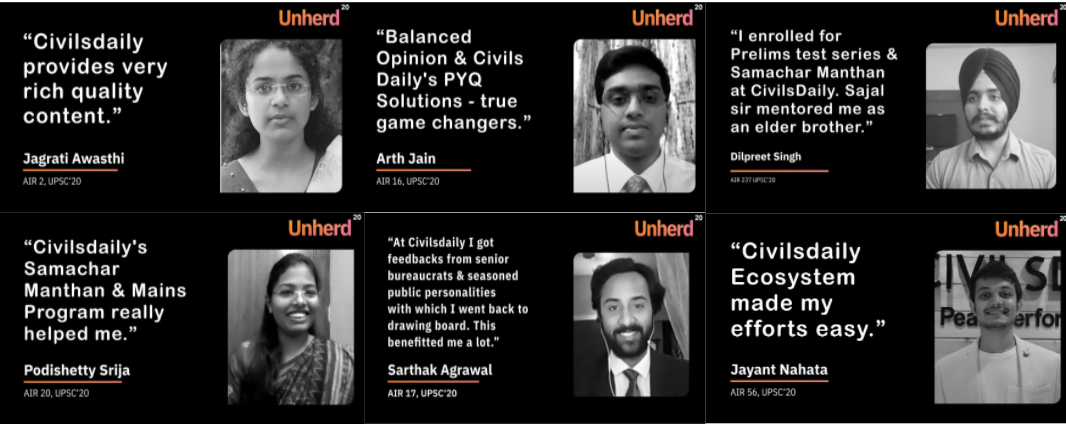
    Check Unherd, Topper’s Talk Series for Our Foundation Course Toppers

    https://youtu.be/DSwO38weHAA

    How is the Civilsdaily Flagship Foundational Course A One Stop Solution for UPSC Coaching?

    An average aspirant, pays for Prelims Course, Mains Program, Interview Guidance, Test Series & Study Materials all separately. The fees then comes up to 2-3 Lakhs for one attempt alone.

    Identifying this issue, Civilsdaily has designed the Flagship Foundation Course for 2023 aspirants. This course covers the entire 3-stage journey of a UPSC aspirant. From Prelims to Interview -1:1 Mentorship, Weekly Test Series, Classes & Study Materials will be provided.

    Another benefit of the program is that it’s an umbrella course wherein an aspirant can access other paid courses of Civilsdaily for FREE.

    The main objective of the program is to identify and nurture serious aspirants to become future UPSC toppers. And that’s why we have designed a scholarship test.

    Our foundation course will be intensive yet personalised. You will be getting individual coaching on how to conquer the basics, develop analytical skills, inculcate conceptual clarity and acquire the necessary knowledge to face the unpredictable and dynamic UPSC.

    Apart from conducting subject-wise classes that covers all the Prelims-Mains syllabus from scratch, aspirants will follow a customised timetable and will complete their revision on a daily basis to attempt our weekly prelims and mains tests. Once the test is over, they will get a strategy call from a mentor, who will clear their doubts and tell them how to improve their performance from next test onwards.

    Simply put, like Ekalavya you will be getting a unique coaching experience that eludes other UPSC aspirants. Even aspects like Essay, Ethics and CSAT which is ignored in other normal coaching programs, will be covered over here with tests, mentorship, classes and notes.

    If you take the upcoming free UPSC national scholarship test and come out with flying colours, you will get about 60% scholarship on the Civilsdaily Flagship Foundation Course.

    Details of the Civilsdaily Free National Scholarship Test

    Date – 13th March & 20th March, 2022.

    Please Click on Submit after finishing the Test.

    • Mode: Online
    • Registration Fee – Free
    • Language: English
    • Time: 2 Hrs
    • Syllabus: GS Paper 1 (Preliminary exam)
    • No. of Questions: 100
    • Date: 13th March & 20th March
    • Time: 10 AM
    • Result: 27/03/2022

    Why should you take the CD’s Scholarship Test? 

    1. Test your preparation on UPSC-CSE grade questions, at national level.

    2. Chance to compete against the best. See where you stand.

    3. Identify your subjectwise strengths, weak points, and problem areas before you start preparation.

    4. Mentors will provide personalised counselling based on your performance in the scholarship test. 

    5. A detailed discussion will help you navigate through the challenges during the preparation.

    6. Achieve up to 60% scholarship in our exclusive umbrella foundation course.

    As the program is rigorous and involves individual attention, we can take only limited enrollments. Hence, we are conducting a Scholarship Exam to identify serious UPSC aspirants on 13th and 20th of March. Depending on your relative score, you can get up to a 60% scholarship.

    We are looking for

    1. Serious and hardworking aspirants.

    2. Ready to dedicate a minimum of 5-8 hours daily.

    3. Can complete assigned targets and tests without fail.

    4. Only 1 thought in mind and that is – to clear UPSC Civil Services 2023.

    5. Willing to take constructive feedback from mentors after each test.

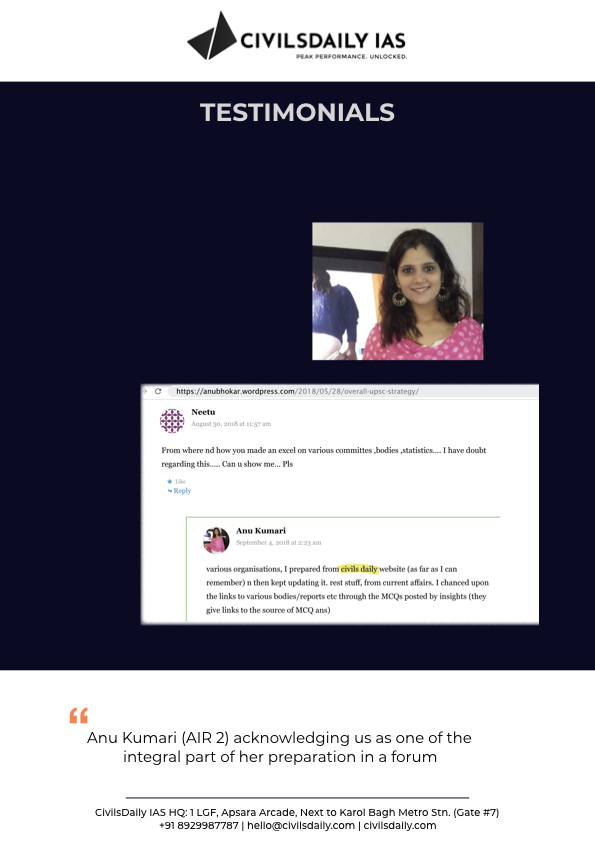
    Trusted by Rank 1 & 2:

  • MEETING LINK INSIDE, REGISTER & JOIN NOW|| How did I revise 2 years of UPSC preparation in the last 60 Days to  Prelims Exam? || By IAS Officer Yogesh Kapse || Limited Slots, Available, Register Now

    MEETING LINK INSIDE, REGISTER & JOIN NOW|| How did I revise 2 years of UPSC preparation in the last 60 Days to Prelims Exam? || By IAS Officer Yogesh Kapse || Limited Slots, Available, Register Now

    Ask Me Anything || How did I revise 2 years of UPSC preparation in the last 60 Days to Prelims Exam? || by IAS Officer Yogesh Kapse

    Date & Time: Mar 20, 2022 @04:00 PM (Start login by 03:45 PM) India

    Join Zoom Meeting
    https://zoom.us/j/92210583141?pwd=U3lXWGVDU05QcitMODh3cmdVK3FZdz09

    Meeting ID: 922 1058 3141
    Passcode: 384311

    With only 60 days remaining for UPSC 2022 Prelims, your preparation must revolve around revision and attempting tests. At this stage, aspirants become more stressed and anxious than when they first started their preparation. Having a foolproof strategy for the last two months can work wonders — especially for those falling on the borderline, scoring between 80-90 marks in the mock test series. Now is the time to focus on improving your performance and boosting your scores.  

    While many of you, would have felt easier following a timetable for an entire year, you might not be sure how to revise every topic in the syllabus along with test series and current affairs of 1.5 years within 60 days.

    Open to all, Free Live Webinar by IAS Officer Yogesh Kapse (2020 Batch)

    Neglecting the last 60 days of preparation can be counterproductive as you will miss the golden opportunity to strengthen the areas where you might be consistently scoring lower.

    Just practising test series alone for the entire two months or reading the textbooks is not going to help due to the unpredictable nature of the Prelims exam. Questions from most of the mock test series don’t actually feature in the real exam. However, it teaches one the art of intelligent guessing.

    Understanding the concern of 2022 UPSC aspirants, we have invited IAS Officer Yogesh Kapse to guide future civil servants on how he prepared for Prelims 2021 in his last 60 days. Was there a difference in the intensity of preparation? You can register for this webinar to find out.

    Yogesh Kapse IAS cleared the exam in 2020 with an All India Rank 249. He is the son of a farmer and had given four attempts previously. While he attended the mains thrice, he attended the interview twice and missed the final ranking by a whisker. His never-give-up attitude is the reason why he is an IAS officer today.

    What will you Learn in This Free Live Webinar by IAS Officer Yogesh Kapse?

    1. The ideal number of study hours Yogesh Kapse IAS maintained in the 60 Days of Prelims. How did he divide one day for static revision, current affairs revision and test series?

    2. Yogesh Kapse’s revision strategy for Prelims. What was the static-dynamic revision plan that made his preparation count in the exam?

    3. Is analysing previous year question papers required for UPSC Prelims? Yogesh Kapse IAS answers.

    4. How to finish 8 subjects in 8 weeks? Including NCERTs, standard books and test series.

    5. Making notes out of test series. How many test series one should take in the last 60 days and how to make notes out of test series?

    6. How did Yogesh Kapse make 1 page notes out of a chapter running 25 pages? The elements of your micro-notes from prelims perspective.

    7. Important current affairs topics for 2022. What to study and what to exclude right now?

    8. What did Yogesh Kapse IAS do to relax and unwind other than social media? Why is it important to take a break to gain better focus?

    Webinar Details

    This Ask me Anything session is free for all aspirants to attend but is perfect for anyone looking for a refreshing break from their grueling studies. Only limited slots are available, so register ASAP.

    Date: 20th March, 2022 (Sunday)

    Time: 4 PM

  • Free Live Webinar Today @ 4PM, Registrations Closing in 1 Hour|| How did I revise 2 years of UPSC preparation in the last 60 Days to  Prelims Exam? || Free Live Webinar by IAS Officer Yogesh Kapse || Limited Slots, Available, Register Now  Copy

    Free Live Webinar Today @ 4PM, Registrations Closing in 1 Hour|| How did I revise 2 years of UPSC preparation in the last 60 Days to Prelims Exam? || Free Live Webinar by IAS Officer Yogesh Kapse || Limited Slots, Available, Register Now Copy

    With only 60 days remaining for UPSC 2022 Prelims, your preparation must revolve around revision and attempting tests. At this stage, aspirants become more stressed and anxious than when they first started their preparation. Having a foolproof strategy for the last two months can work wonders — especially for those falling on the borderline, scoring between 80-90 marks in the mock test series. Now is the time to focus on improving your performance and boosting your scores.  

    While many of you, would have felt easier following a timetable for an entire year, you might not be sure how to revise every topic in the syllabus along with test series and current affairs of 1.5 years within 60 days.

    Open to all, Free Live Webinar by IAS Officer Yogesh Kapse (2020 Batch)

    Neglecting the last 60 days of preparation can be counterproductive as you will miss the golden opportunity to strengthen the areas where you might be consistently scoring lower.

    Just practising test series alone for the entire two months or reading the textbooks is not going to help due to the unpredictable nature of the Prelims exam. Questions from most of the mock test series don’t actually feature in the real exam. However, it teaches one the art of intelligent guessing.

    Understanding the concern of 2022 UPSC aspirants, we have invited IAS Officer Yogesh Kapse to guide future civil servants on how he prepared for Prelims 2021 in his last 60 days. Was there a difference in the intensity of preparation? You can register for this webinar to find out.

    Yogesh Kapse IAS cleared the exam in 2020 with an All India Rank 249. He is the son of a farmer and had given four attempts previously. While he attended the mains thrice, he attended the interview twice and missed the final ranking by a whisker. His never-give-up attitude is the reason why he is an IAS officer today.

    What will you Learn in This Free Live Webinar by IAS Officer Yogesh Kapse?

    1. The ideal number of study hours Yogesh Kapse IAS maintained in the 60 Days of Prelims. How did he divide one day for static revision, current affairs revision and test series?

    2. Yogesh Kapse’s revision strategy for Prelims. What was the static-dynamic revision plan that made his preparation count in the exam?

    3. Is analysing previous year question papers required for UPSC Prelims? Yogesh Kapse IAS answers.

    4. How to finish 8 subjects in 8 weeks? Including NCERTs, standard books and test series.

    5. Making notes out of test series. How many test series one should take in the last 60 days and how to make notes out of test series?

    6. How did Yogesh Kapse make 1 page notes out of a chapter running 25 pages? The elements of your micro-notes from prelims perspective.

    7. Important current affairs topics for 2022. What to study and what to exclude right now?

    8. What did Yogesh Kapse IAS do to relax and unwind other than social media? Why is it important to take a break to gain better focus?

    Webinar Details

    This Ask me Anything session is free for all aspirants to attend but is perfect for anyone looking for a refreshing break from their grueling studies. Only limited slots are available, so register ASAP.

    Date: 20th March, 2022 (Sunday)

    Time: 4 PM

  • Webinar Today @ 4PM, Registrations  Closing in 3 Hrs|| How did I revise 2 years of UPSC preparation in the last 60 Days to  Prelims Exam? || Free Live Webinar by IAS Officer Yogesh Kapse || Limited Slots, Available, Register Now  Copy

    Webinar Today @ 4PM, Registrations Closing in 3 Hrs|| How did I revise 2 years of UPSC preparation in the last 60 Days to Prelims Exam? || Free Live Webinar by IAS Officer Yogesh Kapse || Limited Slots, Available, Register Now Copy

    With only 60 days remaining for UPSC 2022 Prelims, your preparation must revolve around revision and attempting tests. At this stage, aspirants become more stressed and anxious than when they first started their preparation. Having a foolproof strategy for the last two months can work wonders — especially for those falling on the borderline, scoring between 80-90 marks in the mock test series. Now is the time to focus on improving your performance and boosting your scores.  

    While many of you, would have felt easier following a timetable for an entire year, you might not be sure how to revise every topic in the syllabus along with test series and current affairs of 1.5 years within 60 days.

    Open to all, Free Live Webinar by IAS Officer Yogesh Kapse (2020 Batch)

    Neglecting the last 60 days of preparation can be counterproductive as you will miss the golden opportunity to strengthen the areas where you might be consistently scoring lower.

    Just practising test series alone for the entire two months or reading the textbooks is not going to help due to the unpredictable nature of the Prelims exam. Questions from most of the mock test series don’t actually feature in the real exam. However, it teaches one the art of intelligent guessing.

    Understanding the concern of 2022 UPSC aspirants, we have invited IAS Officer Yogesh Kapse to guide future civil servants on how he prepared for Prelims 2021 in his last 60 days. Was there a difference in the intensity of preparation? You can register for this webinar to find out.

    Yogesh Kapse IAS cleared the exam in 2020 with an All India Rank 249. He is the son of a farmer and had given four attempts previously. While he attended the mains thrice, he attended the interview twice and missed the final ranking by a whisker. His never-give-up attitude is the reason why he is an IAS officer today.

    What will you Learn in This Free Live Webinar by IAS Officer Yogesh Kapse?

    1. The ideal number of study hours Yogesh Kapse IAS maintained in the 60 Days of Prelims. How did he divide one day for static revision, current affairs revision and test series?

    2. Yogesh Kapse’s revision strategy for Prelims. What was the static-dynamic revision plan that made his preparation count in the exam?

    3. Is analysing previous year question papers required for UPSC Prelims? Yogesh Kapse IAS answers.

    4. How to finish 8 subjects in 8 weeks? Including NCERTs, standard books and test series.

    5. Making notes out of test series. How many test series one should take in the last 60 days and how to make notes out of test series?

    6. How did Yogesh Kapse make 1 page notes out of a chapter running 25 pages? The elements of your micro-notes from prelims perspective.

    7. Important current affairs topics for 2022. What to study and what to exclude right now?

    8. What did Yogesh Kapse IAS do to relax and unwind other than social media? Why is it important to take a break to gain better focus?

    Webinar Details

    This Ask me Anything session is free for all aspirants to attend but is perfect for anyone looking for a refreshing break from their grueling studies. Only limited slots are available, so register ASAP.

    Date: 20th March, 2022 (Sunday)

    Time: 4 PM

  • Starting Today @ 4PM|| How did I revise 2 years of UPSC preparation in the last 60 Days to  Prelims Exam? || Free Live Webinar by IAS Officer Yogesh Kapse || Limited Slots, Available, Register Now

    Starting Today @ 4PM|| How did I revise 2 years of UPSC preparation in the last 60 Days to Prelims Exam? || Free Live Webinar by IAS Officer Yogesh Kapse || Limited Slots, Available, Register Now

    With only 60 days remaining for UPSC 2022 Prelims, your preparation must revolve around revision and attempting tests. At this stage, aspirants become more stressed and anxious than when they first started their preparation. Having a foolproof strategy for the last two months can work wonders — especially for those falling on the borderline, scoring between 80-90 marks in the mock test series. Now is the time to focus on improving your performance and boosting your scores.  

    While many of you, would have felt easier following a timetable for an entire year, you might not be sure how to revise every topic in the syllabus along with test series and current affairs of 1.5 years within 60 days.

    Open to all, Free Live Webinar by IAS Officer Yogesh Kapse (2020 Batch)

    Neglecting the last 60 days of preparation can be counterproductive as you will miss the golden opportunity to strengthen the areas where you might be consistently scoring lower.

    Just practising test series alone for the entire two months or reading the textbooks is not going to help due to the unpredictable nature of the Prelims exam. Questions from most of the mock test series don’t actually feature in the real exam. However, it teaches one the art of intelligent guessing.

    Understanding the concern of 2022 UPSC aspirants, we have invited IAS Officer Yogesh Kapse to guide future civil servants on how he prepared for Prelims 2021 in his last 60 days. Was there a difference in the intensity of preparation? You can register for this webinar to find out.

    Yogesh Kapse IAS cleared the exam in 2020 with an All India Rank 249. He is the son of a farmer and had given four attempts previously. While he attended the mains thrice, he attended the interview twice and missed the final ranking by a whisker. His never-give-up attitude is the reason why he is an IAS officer today.

    What will you Learn in This Free Live Webinar by IAS Officer Yogesh Kapse?

    1. The ideal number of study hours Yogesh Kapse IAS maintained in the 60 Days of Prelims. How did he divide one day for static revision, current affairs revision and test series?

    2. Yogesh Kapse’s revision strategy for Prelims. What was the static-dynamic revision plan that made his preparation count in the exam?

    3. Is analysing previous year question papers required for UPSC Prelims? Yogesh Kapse IAS answers.

    4. How to finish 8 subjects in 8 weeks? Including NCERTs, standard books and test series.

    5. Making notes out of test series. How many test series one should take in the last 60 days and how to make notes out of test series?

    6. How did Yogesh Kapse make 1 page notes out of a chapter running 25 pages? The elements of your micro-notes from prelims perspective.

    7. Important current affairs topics for 2022. What to study and what to exclude right now?

    8. What did Yogesh Kapse IAS do to relax and unwind other than social media? Why is it important to take a break to gain better focus?

    Webinar Details

    This Ask me Anything session is free for all aspirants to attend but is perfect for anyone looking for a refreshing break from their grueling studies. Only limited slots are available, so register ASAP.

    Date: 20th March, 2022 (Sunday)

    Time: 4 PM

  • 1:1 Mentorship

    What are features of Civilsdaily’s 1:1 Mentorship?

    Civilsdaily mentorship helps you in 6 key components of your preparation-

    1. Direction– the mentors at civilsdaily are highly experienced with 1/2 interview experience and minimum 1 year of mentorship experience. They are well aware of stages of preparation. These mentors will help you in preparing your comprehensive as well as micro schedule. They will prepare your schedule for every week with  mentorship calls every week. This schedule will be prepared based on intense analysis of importance of subjects as well as interlinking of the topics so that it becomes easier for students to better understand the topics.
    2. Discipline– student will be accountable to the mentor as every week he/she has to complete a target given by the mentor.
    3. Consistency– constant monitoring by the mentor as well as regular tests helps students in maintaining consistency in his/her preparation. Also, scientific planning of the schedule helps students in adopting an integrated approach in preparation.
    4. Value addition– mentors also helps students in their doubts as well as in resources. Considering the vast availability of material in the market, students get confused in which materials to follow. Mentors help you in identifying and referring to the most deserving materials. This helps students in resource consolidation and avoid content overload. Mentors will also provide video support. Remember- the mantra to clear upsc is MINIMUM RESOURCES, MAXIMUM REVISIONS.
    5. Evaluation– the UAP/foundation program also includes prelims and mains test series, Samachar Manthan provides weekly 10 mains questions. Your mentor will discuss each and every test with you and identify your strengths and weaknesses. So basically, if you follow this program sincerely then you will be provided one on one discussion for more than 40 mains tests(including SM) and more than 30 prelims tests. Further, your each test will be evaluated twice by experienced evaluators and later on by a mentor.
    6. Motivation– whenever you feel low or feel like not studying, you can directly reach out to your mentor, have a discussion, get motivated and resume studies. The relaxation methods suggested by mentors can help you in studying in the most efficient manner.

    (Kindly go through the civilsdaily channel on YouTube to understand how mentorship actually works. The expression on the face of students will tell you everything)

    Why do you need a Civildaily’s mentor for your UPSC preparation?

    1. Creating a strategy for finishing the curriculum on time

    It entails the following:

    • The procedure for making notes for topics on the curriculum.
    • On a regular basis, Samachar Manthan is a vital source to keep up with current events.
    • Setting aside time to go over each section of the syllabus.

    There is no such thing as a “one-size-fits-all” strategy to completing a course. Each student has his or her own set of time and availability constraints that must be accommodated. A mentor considers these aspects and connects with hopefuls to develop a strategy that works for them.

    2. Please assist me in making sense of it all.

    • There is a wealth of information available on subjects and themes for the IAS exam; however, the number of sources available and the fact that new data is uploaded on a daily basis makes it tough for aspirants to make sense of it all. However, with the help of a mentor, this effort becomes much more manageable.

    3. Understanding the IAS exam’s philosophy

    4. Advice on where to find the right sources

    • Certain features of this examination are only disclosed to individuals who have diligently studied its pattern over many years.
    • In terms of getting higher marks, an applicant who understands these aspects is in a better position than most others.

    5. Understanding the importance of each topic

    • A mentor can assist students in determining the importance of each topic in the civil service syllabus in terms of examination weighting.

    6. Developing a revision action plan

    • Mentors can assist students in developing an action plan for revising relevant sources and subjects as the exam date approaches.

    7. Guidance in selecting an optional subject

    • A mentor can assist in narrowing down the options when it comes to selecting an optional subject. A mentor assists applicants in being “exam-ready” from the first day of preparation, providing them a competitive advantage over others who do not have access to quality mentorship and rely on a “trial and error” approach to preparation that yields little to no results.

    Who shall take mentorship?

    • Mentorship under CivilsDaily is immensely helpful to all those Aspirants who want to overcome their shortcomings so as to enhance their probability for clearing the exam. However guidance provided under UAP is more focused towards those who have some foundation built for UPSC and inclined towards doing self-study. Aspirants such as college going students, Working professionals, who have other responsibilities to fulfill besides chasing their dream to be a Civil Servant, along with those Aspirants who are in state of confusion due to multiple unsuccessful Attempts at clearing the exam must join CivilsDaily’s mentorship program under UAP.
    • For those Aspirants who don’t have any foundational knowledge or don’t have any idea about this exam can Join CivilsDaily Foundation program in which they get Master Classes and other useful content along with Mentors insights.

    How to join the 1:1 mentorship of civilsdaily?

    Civilsdaily is not just the best but also the pioneer of providing dedicated personalized one-to-one Mentorship based on the requirements of an aspirant.

    To join the Civilsdaily Mentorship first of all you need to is WhatsApp us now. (Click here)

    • After you WhatsApp us, you will get a call within 24 hours where details and further procedure for enrollment will be discussed.
    • After the enrollment process is done you will get another form regarding orientation call with your mentor. Once you fill the form and now you are a part of Civilsdaily Mentorship Program.
    • Within a working day your mentor will connect with you and discuss about your Preparation, Program, Macro and Micro strategy.

    What’s SOP of civilsdaily’s mentorship?

    Right from the orientation call to the Personality Test of UPSC;  Mentor’s role or SOP can be broadly divided into two parts:

    Firstly, a mentor will give targets after discussing with you for a time period which you will agree upon, generally, it will be one week to two weeks. In targets, you will also be told the source from where to read. And mentors will be tracking you on your target regularly.

    Secondly, a mentor does an assessment of your progress. This will be done in multiple ways like assessing your evaluated copies of Mains-based tests which includes Samachar Manthan’s weekly tests and MEP or it may be prelims-based tests. Mentor finds a pattern of mistakes which you need to rectify to see an improvement.

    And then till the Personality Test mentor will be guiding you on how to answer questions, etiquettes of the interview, and her personal experience of the same with you.

    In this way, a mentor will be your friend, guide, teacher, or even counselor as you like.

    How many seasons will I get?

    Initially, the student receives a detailed orientation call from the mentor. During this call, the mentor tries to understand the current requirements of the student. This helps in devising a custom strategy for moving forward. After this, the mentor regularly stays in touch with the student for the first few weeks, judging his/her progress and tweaking strategies if needed. In the days going ahead, the student receives biweekly calls, with an option to connect with mentors in between for redressal of any academic doubts. During these sessions, apart from target setting, the mentor also discusses the approach to various pre-cum-mains based tests conducted at Civilsdaily.

    Can I get 1:1 Mentorship sessions on Sundays as well?

    Yes, you can book a session on Sunday, if your Mentor is available.

    Who are the mentors?

    Our mentors are highly qualified and experts in their domain. In order to maintain quality, we ensure that all our mentors have at least appeared for 2 interviews of UPSC CSE. This helps to identify the needs and lacunas of our students and decode methods to work on the stress points in order to achieve maximum results.

    What is the provision if one is not satisfied with his/her respective mentor?

    As we are very serious about our quality of the mentorship, on a monthly basis we take feedback from our mentees about his/her respective mentor. Moreover, our mentor head will also be in touch with you on a continuous basis, you can always share with him the honest feedback about our mentor. And, you can request our mentor-head to change the mentor, if required.

    WRITE TO US

    This is the official page where you can share all your queries, feedback, complaints, or any concerns you may have about Civilsdaily’s 1:1 Mentorship.

    Send emailmentorship@civildaily.com

    Our dedicated team will check and address your questions within the next 24 hours. This is our promise!

  • [REMINDER] Few hours to go for Mission Ekalavya  – SCHOLARSHIP TEST for UPSC 2023 Foundation Course|| Register Now & Attend the Free Test || LINK INSIDE

    [REMINDER] Few hours to go for Mission Ekalavya – SCHOLARSHIP TEST for UPSC 2023 Foundation Course|| Register Now & Attend the Free Test || LINK INSIDE

    https://youtu.be/iweLHEs55GY

    Ultimate Assessment Program and Foundation Program includes – 

    • Mentorship (1:1, throughout the preparation till Interview stage)
    • Masterclasses (complete GS syllabus covered, Only provided in Foundation course)
    • Samachar Manthan (Current affairs Programme)
    • Decimate Prelims (Prelims Crash course)
    • Mains Answer Writing Initiative (On a weekly basis)
    • Smash Mains (upon Qualifying prelims 2023)
    • Essay Guidance Program (To score above 120+ in Essay Mains Paper)
    • Interview Guidance Program (more than 1 mock interview will be conducted with a panel)
    • Civilsdaily IAS Community for Peer to Peer Interaction
    Get all the Civilsdaily courses under Smash Foundation Course for 60% off after you attend our scholarship test and score above the cut-off marks!

    Are you a beginner who has no idea about UPSC, but want to check if you have the aptitude for the same? Do you want to assess your performance and interest in UPSC before targetting 2023 preparation?

    Then, we have got the perfect opporunity for you. Presenting, Civilsdaily’s UPSC CS 2023, Free-To-Register National Scholarship on 13th & 20th March 2022 . 

    Last year’s scholarship test by Civilsdaily has seen a phenomenal response and pan India interest for the test. Many toppers have emerged out of the test to be subsequently mentored in the Civilsdaily Foundation Program. So aspirants, ensure you don’t miss out on the benefits of the test.

    Check Unherd, Topper’s Talk Series for Our Foundation Course Toppers

    https://youtu.be/DSwO38weHAA

    How is the Civilsdaily Flagship Foundational Course A One Stop Solution for UPSC Coaching?

    An average aspirant, pays for Prelims Course, Mains Program, Interview Guidance, Test Series & Study Materials all separately. The fees then comes up to 2-3 Lakhs for one attempt alone.

    Identifying this issue, Civilsdaily has designed the Flagship Foundation Course for 2023 aspirants. This course covers the entire 3-stage journey of a UPSC aspirant. From Prelims to Interview -1:1 Mentorship, Weekly Test Series, Classes & Study Materials will be provided.

    Another benefit of the program is that it’s an umbrella course wherein an aspirant can access other paid courses of Civilsdaily for FREE.

    The main objective of the program is to identify and nurture serious aspirants to become future UPSC toppers. And that’s why we have designed a scholarship test.

    Our foundation course will be intensive yet personalised. You will be getting individual coaching on how to conquer the basics, develop analytical skills, inculcate conceptual clarity and acquire the necessary knowledge to face the unpredictable and dynamic UPSC.

    Apart from conducting subject-wise classes that covers all the Prelims-Mains syllabus from scratch, aspirants will follow a customised timetable and will complete their revision on a daily basis to attempt our weekly prelims and mains tests. Once the test is over, they will get a strategy call from a mentor, who will clear their doubts and tell them how to improve their performance from next test onwards.

    Simply put, like Ekalavya you will be getting a unique coaching experience that eludes other UPSC aspirants. Even aspects like Essay, Ethics and CSAT which is ignored in other normal coaching programs, will be covered over here with tests, mentorship, classes and notes.

    If you take the upcoming free UPSC national scholarship test and come out with flying colours, you will get about 60% scholarship on the Civilsdaily Flagship Foundation Course.

    Details of the Civilsdaily Free National Scholarship Test

    Date – 13th March & 20th March, 2022.

    Please Click on Submit after finishing the Test.

    • Mode: Online
    • Registration Fee – Free
    • Language: English
    • Time: 2 Hrs
    • Syllabus: GS Paper 1 (Preliminary exam)
    • No. of Questions: 100
    • Date: 13th March & 20th March
    • Time: 10 AM
    • Result: 27/03/2022

    Why should you take the CD’s Scholarship Test? 

    1. Test your preparation on UPSC-CSE grade questions, at national level.

    2. Chance to compete against the best. See where you stand.

    3. Identify your subjectwise strengths, weak points, and problem areas before you start preparation.

    4. Mentors will provide personalised counselling based on your performance in the scholarship test. 

    5. A detailed discussion will help you navigate through the challenges during the preparation.

    6. Achieve up to 60% scholarship in our exclusive umbrella foundation course.

    As the program is rigorous and involves individual attention, we can take only limited enrollments. Hence, we are conducting a Scholarship Exam to identify serious UPSC aspirants on 13th and 20th of March. Depending on your relative score, you can get up to a 60% scholarship.

    We are looking for

    1. Serious and hardworking aspirants.

    2. Ready to dedicate a minimum of 5-8 hours daily.

    3. Can complete assigned targets and tests without fail.

    4. Only 1 thought in mind and that is – to clear UPSC Civil Services 2023.

    5. Willing to take constructive feedback from mentors after each test.

    Trusted by Rank 1 & 2:

  • [LIVE NOW] Mission Ekalavya  – FREE SCHOLARSHIP TEST for UPSC 2023 Foundation Course || Register Now & Attend the Test || LINK INSIDE

    [LIVE NOW] Mission Ekalavya – FREE SCHOLARSHIP TEST for UPSC 2023 Foundation Course || Register Now & Attend the Test || LINK INSIDE

    https://youtu.be/iweLHEs55GY

    Ultimate Assessment Program and Foundation Program includes – 

    • Mentorship (1:1, throughout the preparation till Interview stage)
    • Masterclasses (complete GS syllabus covered, Only provided in Foundation course)
    • Samachar Manthan (Current affairs Programme)
    • Decimate Prelims (Prelims Crash course)
    • Mains Answer Writing Initiative (On a weekly basis)
    • Smash Mains (upon Qualifying prelims 2023)
    • Essay Guidance Program (To score above 120+ in Essay Mains Paper)
    • Interview Guidance Program (more than 1 mock interview will be conducted with a panel)
    • Civilsdaily IAS Community for Peer to Peer Interaction
    Get all the Civilsdaily courses under Smash Foundation Course for 60% off after you attend our scholarship test and score above the cut-off marks!

    Are you a beginner who has no idea about UPSC, but want to check if you have the aptitude for the same? Do you want to assess your performance and interest in UPSC before targetting 2023 preparation?

    Then, we have got the perfect opporunity for you. Presenting, Civilsdaily’s UPSC CS 2023, Free-To-Register National Scholarship on 13th & 20th March 2022 . 

    Last year’s scholarship test by Civilsdaily has seen a phenomenal response and pan India interest for the test. Many toppers have emerged out of the test to be subsequently mentored in the Civilsdaily Foundation Program. So aspirants, ensure you don’t miss out on the benefits of the test.

    Check Unherd, Topper’s Talk Series for Our Foundation Course Toppers

    https://youtu.be/DSwO38weHAA

    How is the Civilsdaily Flagship Foundational Course A One Stop Solution for UPSC Coaching?

    An average aspirant, pays for Prelims Course, Mains Program, Interview Guidance, Test Series & Study Materials all separately. The fees then comes up to 2-3 Lakhs for one attempt alone.

    Identifying this issue, Civilsdaily has designed the Flagship Foundation Course for 2023 aspirants. This course covers the entire 3-stage journey of a UPSC aspirant. From Prelims to Interview -1:1 Mentorship, Weekly Test Series, Classes & Study Materials will be provided.

    Another benefit of the program is that it’s an umbrella course wherein an aspirant can access other paid courses of Civilsdaily for FREE.

    The main objective of the program is to identify and nurture serious aspirants to become future UPSC toppers. And that’s why we have designed a scholarship test.

    Our foundation course will be intensive yet personalised. You will be getting individual coaching on how to conquer the basics, develop analytical skills, inculcate conceptual clarity and acquire the necessary knowledge to face the unpredictable and dynamic UPSC.

    Apart from conducting subject-wise classes that covers all the Prelims-Mains syllabus from scratch, aspirants will follow a customised timetable and will complete their revision on a daily basis to attempt our weekly prelims and mains tests. Once the test is over, they will get a strategy call from a mentor, who will clear their doubts and tell them how to improve their performance from next test onwards.

    Simply put, like Ekalavya you will be getting a unique coaching experience that eludes other UPSC aspirants. Even aspects like Essay, Ethics and CSAT which is ignored in other normal coaching programs, will be covered over here with tests, mentorship, classes and notes.

    If you take the upcoming free UPSC national scholarship test and come out with flying colours, you will get about 60% scholarship on the Civilsdaily Flagship Foundation Course.

    Details of the Civilsdaily Free National Scholarship Test

    Date – 13th March & 20th March, 2022.

    Please Click on Submit after finishing the Test.

    • Mode: Online
    • Registration Fee – Free
    • Language: English
    • Time: 2 Hrs
    • Syllabus: GS Paper 1 (Preliminary exam)
    • No. of Questions: 100
    • Date: 13th March & 20th March
    • Time: 10 AM
    • Result: 27/03/2022

    Why should you take the CD’s Scholarship Test? 

    1. Test your preparation on UPSC-CSE grade questions, at national level.

    2. Chance to compete against the best. See where you stand.

    3. Identify your subjectwise strengths, weak points, and problem areas before you start preparation.

    4. Mentors will provide personalised counselling based on your performance in the scholarship test. 

    5. A detailed discussion will help you navigate through the challenges during the preparation.

    6. Achieve up to 60% scholarship in our exclusive umbrella foundation course.

    As the program is rigorous and involves individual attention, we can take only limited enrollments. Hence, we are conducting a Scholarship Exam to identify serious UPSC aspirants on 13th and 20th of March. Depending on your relative score, you can get up to a 60% scholarship.

    We are looking for

    1. Serious and hardworking aspirants.

    2. Ready to dedicate a minimum of 5-8 hours daily.

    3. Can complete assigned targets and tests without fail.

    4. Only 1 thought in mind and that is – to clear UPSC Civil Services 2023.

    5. Willing to take constructive feedback from mentors after each test.

    Trusted by Rank 1 & 2:

  • What Quad can learn from NATO’s blunders

    Context

    The Russian invasion of Ukraine offers several lessons to the Quad countries.

    Negligence on part of NATO

    • This article is admittedly written in hindsight, but there is a continuing thread to the western blunders in the approach to dealing with Moscow, particularly concerning Putin.
    • He has had a dramatic rise in the political hierarchy of Moscow, with many of his successes unexplained but for the strong behind-the-scenes backing of the FSB.
    •  Unfortunately, it was ignored in the West, and particularly in Europe, which was busy with civilianising and militarily downgrading NATO.
    • The western leaders were overcome with hubris and dismantled the military intellectual content of NATO headquarters, reducing NATO forces to a rapid reaction force under the political control of a civilian secretary-general.
    • The West, therefore, failed to connect Putin’s invasion of Georgia with his continuing vision to fight the regime change in Ukraine in 2015.

    What can Quad learn?

    • War in Indo-Pacific will be maritime war:  War in the Indo-Pacific will be a maritime war fought in accordance with maritime strategy and space assets.
    • The greatest difference is that peaceful maritime reconnaissance is a legitimate activity with the help of which situational awareness can be built up, enabling the delivery of a crippling conventional first strike in the first stages of a possible conflict.
    • Avoid making Quad a diplomatic grouping: To call the Quad a “diplomatic grouping” is a catastrophic error.
    • Implication of calling Quad a diplomatic grouping: In actual fact, the Quad, is all about maritime domain awareness, underwater domain awareness, and information sharing — all of them purely naval activities, which need continuous communication (that is catered for), a command organisation and a secretariat, neither of which we have because Quad is a diplomatic grouping.
    • The military is trained to think structurally, cast future scenarios, do contingent planning, find alternatives and plan for victory. Diplomats have no such background.
    • Confusing Beijing by calling it a diplomatic grouping will certainly lead to a misunderstanding of the Quad nations’ resolve and possible Chinese adventurism.

    Way forward

    • The Quad needs to be represented by the owners of the maritime assets used to obtain domain awareness and a staff with command communications and a depth of intellectual planning.
    • The great maritime strength of the Quad is its force of Maritime Patrol Aircraft.
    • Japan and the US are particularly rich in those resources.
    • India’s force of P-81s is substantial and with the help of Australia, a maritime domain awareness can be built up that denies the PLA navy the chance to hide in the vastness of the ocean.
    • The Indo-US communication agreement was presumably established to keep the four-nation search group on a common grid.
    • Quad meetings should be headed by naval officers, with diplomatic support.

    Conclusion

    West failed to read Putin’s ambitions and downgraded NATO. The same mistakes should not be repeated in Indo-Pacific by the Quad.

    UPSC 2022 countdown has begun! Get your personal guidance plan now! (Click here)

More posts