Mains Ready By December. Smash Mains & Smash PYQ Admissions Open

Search results for: “”

  • How common are cloudbursts in India?

    Why in the News?

    Flash floods triggered by a cloudburst struck Pahalgam in Anantnag on 12 July. Last week, the India Meteorological Department (IMD) rejected claims that cloudbursts caused the recent floods in Assam and Nagaland. The two events have renewed attention on the scientific definition of a cloudburst and its frequent misuse in public discourse.

    What counts as a cloudburst under the IMD’s definition?

    1. Threshold: The IMD defines a cloudburst as 10 centimetres or more of rainfall in an hour over a small area of around 20 to 30 square kilometres.
    2. Scale comparator: Indore receives about 1,062 millimetres of rain in an average year, so a single cloudburst can dump close to 10% of a full year’s rainfall in 60 minutes.
    3. Related category: Some scientists have proposed a mini cloudburst category for 5 centimetres of rain in an hour over the same area, since local topography can make even this devastating.

    How does a cloudburst form?

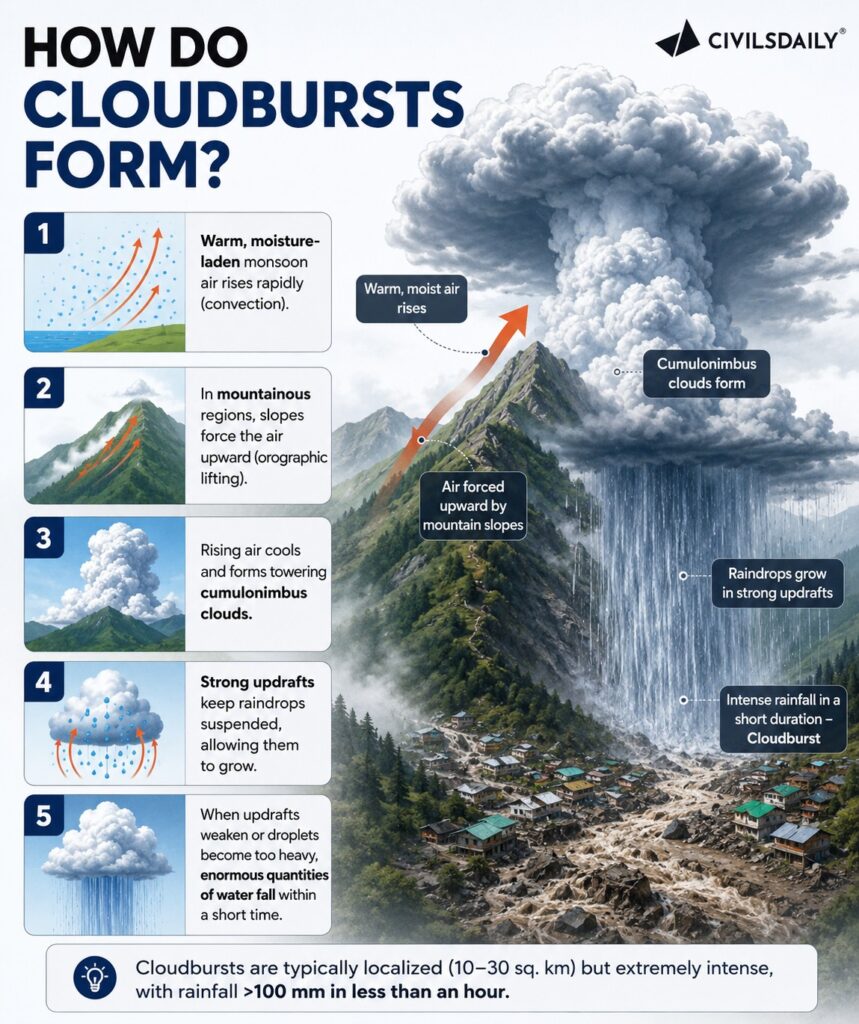
    1. Initial lift: Warm, moist air rises rapidly through convection, and in mountainous terrain this rise is intensified by orographic lifting, where monsoon winds are forced upward by steep slopes.
    2. Cloud growth: As the rising air cools, water vapour condenses into towering cumulonimbus clouds that can reach up to 15 kilometres in height.
    3. Suspension: Strong upward currents keep forming raindrops suspended in the cloud for longer instead of letting them fall immediately.
    4. Discharge: When the weight of accumulated water exceeds what the updraft can hold, or the updraft weakens, the suspended water falls in one release rather than as steady rain.

    How common are cloudbursts in India, and why are they hard to count?

    1. Historical count: Parliament was told in 2019 that the IMD recorded only around 30 cloudburst incidents between 1970 and 2016, a figure many experts consider an underestimate.
    2. Rising frequency: Global warming increases the amount of moisture the atmosphere can hold, making cloudbursts more frequent even though they remain rare compared with ordinary heavy rain.
    3. Monitoring gap: Most cloudbursts occur in remote, high altitude regions where rain gauges and weather stations are sparse, so an event even a few kilometres from a monitoring station may go officially unrecorded despite causing large scale destruction downstream.
    4. Regional concentration: Uttarakhand, Himachal Pradesh, and Jammu and Kashmir have reported a recent surge in events described locally as cloudbursts, particularly in July and August.

    Does the label obscure accountability for poor planning?

    1. Blame diffusion: Calling a heavy downpour a cloudburst turns it into a singular, unforeseeable act of nature, which is harder to do when the stated cause is heavy rain combined with poor drainage.
    2. Dharali precedent: During the 2025 Dharali floods in Uttarakhand, initial reports blamed a cloudburst, but meteorological data later showed the rainfall rate was well below the cloudburst threshold. The underlying causes were illegal construction on riverbeds, deforestation that left soil vulnerable to erosion, and the absence of drainage infrastructure along new all weather roads.
    3. Assam and Nagaland claims: The IMD last week rejected reports that cloudbursts caused recent floods in Assam and Nagaland, including the Upper Assam floods.
    4. Accountability questions avoided: Had the Dharali downpour genuinely been a cloudburst, officials could have avoided questions about why the state permitted construction in high risk zones and why early warning systems failed.

    Why are cloudbursts difficult to forecast?

    1. Model resolution: Weather models estimate average conditions across grid cells, while a cloudburst occurs over an area smaller than a single cell, so detecting one requires high resolution models needing computing power not always available.
    2. Speed of formation: Cloudbursts develop and strike quickly, unlike cyclones or monsoon systems that can be tracked for weeks, leaving forecasters far less data to work with.
    3. Terrain interference: Doppler weather radars emit and receive beams that mountains can block, creating blind spots in exactly the high altitude terrain where cloudbursts are most common.
    4. Sparse instrumentation: Rugged terrain also means fewer automatic weather stations, leaving fewer ground sensors to feed real time data into short term prediction.

    What is India doing to improve cloudburst forecasting?

    1. Nowcasting: The IMD is developing nowcasting technology to issue short term alerts every few hours rather than long range forecasts.
    2. Mission Mausam: Under the government’s Mission Mausam programme, India plans to more than double its radar network from about 40 radars currently and use artificial intelligence to better predict hyperlocal events.
    3. Persistent limits: Even with better technology, a cloudburst is expected to remain harder to predict than a typical rainstorm because of how localised and fast forming it is.

    Conclusion

    A cloudburst is a specific meteorological event defined by the IMD’s own rainfall threshold, not a synonym for any destructive downpour. Attributing flood damage to a cloudburst without checking recorded rainfall data lets authorities treat the disaster as an unforeseeable act of nature rather than examine illegal construction, deforestation and drainage failure. India’s forecasting improvements under Mission Mausam target the science of prediction, but they do not by themselves fix the planning failures the label has repeatedly been used to obscure.

    Back2Basics:

    Mission Mausam

    1. Nodal ministry: Ministry of Earth Sciences.
    2. Launch year: 2024.
    3. Aim: Improve weather and climate forecasting through expanded observation networks, high performance computing and artificial intelligence based prediction.
    4. Key features: Expansion of Doppler weather radar coverage, next generation satellites, and impact based forecasting for more precise, localised warnings.

    PYQ Relevance

    [UPSC 2024] What is the phenomenon of ‘cloudbursts’? Explain.

    Linkage: The PYQ explains cloudbursts, their causes, and forecasting challenges. It updates the topic with IMD clarifications, Mission Mausam, and disaster accountability.
  • India’s first private orbital launch marks a structural milestone

    Why in the News?

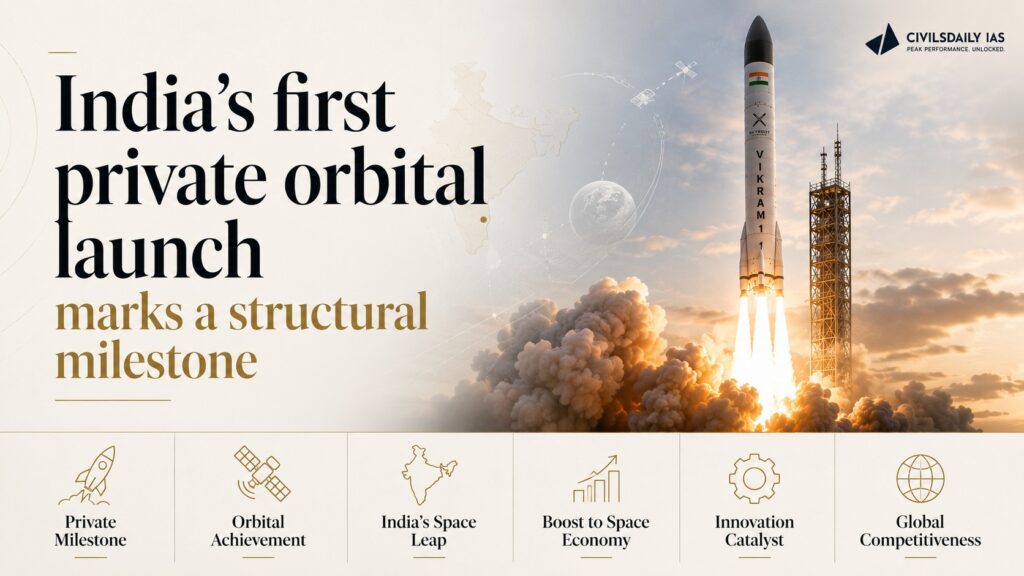
    Skyroot Aerospace’s Vikram-1 successfully reached orbit on 18 July 2026, becoming the first privately developed Indian rocket to achieve orbital launch. India is now among the few countries where a private company has independently built and launched an orbital rocket.

    What is Vikram-1?

    • Vikram-1 is Skyroot Aerospace’s orbital launch vehicle.
    • Built using carbon composite structures with solid and liquid propulsion stages.
    • Developed by Skyroot Aerospace, a Hyderabad-based startup founded in 2018 by former ISRO scientists.
    • Follows the successful launch of Vikram-S under Mission Prarambh (2022).

    Key Highlights

    • First privately built Indian rocket to reach orbit.
    • Demonstrates India’s growing commercial space capabilities.
    • Marks a major milestone after the 2020 space sector reforms.

    India’s Private Space Ecosystem

    • 285 space startups, with 274 active.
    • 72 startups have received equity funding.
    • Total funding reached $871 million across 241 funding rounds (July 2026).
    • Annual funding increased from $43 million (2021) to $200 million (2025).

    What is IN-SPACe?

    • Indian National Space Promotion and Authorisation Centre (IN-SPACe).
    • Established in 2020 under the Department of Space.
    • Acts as the single-window agency for authorising and promoting private participation in the space sector.
    • Facilitates private access to ISRO’s testing and launch facilities.

    Significance

    • Strengthens India’s commercial space industry.
    • Reduces dependence on government-led launch services.
    • Encourages innovation, investment, and private participation.
    • Enhances India’s competitiveness in the global launch market.

    Challenges

    • High capital requirement for launch vehicle development.
    • Need for a regular commercial launch cadence.
    • Dependence on imported critical components.
    • Evolving insurance and liability framework.
    • Competition from low-cost global launch providers like SpaceX.

    Skyroot Aerospace

    • Headquarters: Hyderabad, Founded: 2018, Founders: Former ISRO scientists
    • First Rocket: Vikram-S (Mission Prarambh, 2022)
    • Naming: Vikram rockets are named after Dr. Vikram Sarabhai.
    • Developed the Dhawan-II, India’s first privately developed 3D-printed cryogenic engine.

    2020 Space Sector Reforms

    • Opened the space sector to private players.
    • Created IN-SPACe.
    • Enabled private firms to build satellites, launch vehicles, and offer launch services.
    • Encouraged technology transfer and infrastructure sharing with ISRO.

    Key Space Institutions

    • ISRO: National space agency.
    • IN-SPACe: Promotes and authorises private participation.
    • NSIL (NewSpace India Limited): Commercial arm of ISRO for technology transfer and commercialisation.

    [2026] Consider the following statements about involvement of private entities in India’s space programme:

    1. IN-SPACe is an autonomous agency formed to facilitate participation of private entities.

    2. Agnikul Cosmos launched the world’s first flight using 3D-printed rocket engine.

    3. Skyroot Aerospace has developed liquid fuel for GSLV.

    (a) 1 only

    (b) 2 and 3 only

    (c) 1 and 2 only

    (d) 1, 2 and 3

  • ISRO and Japanese scientists review mission Chandrayaan 5 preparation

    Why in the News?

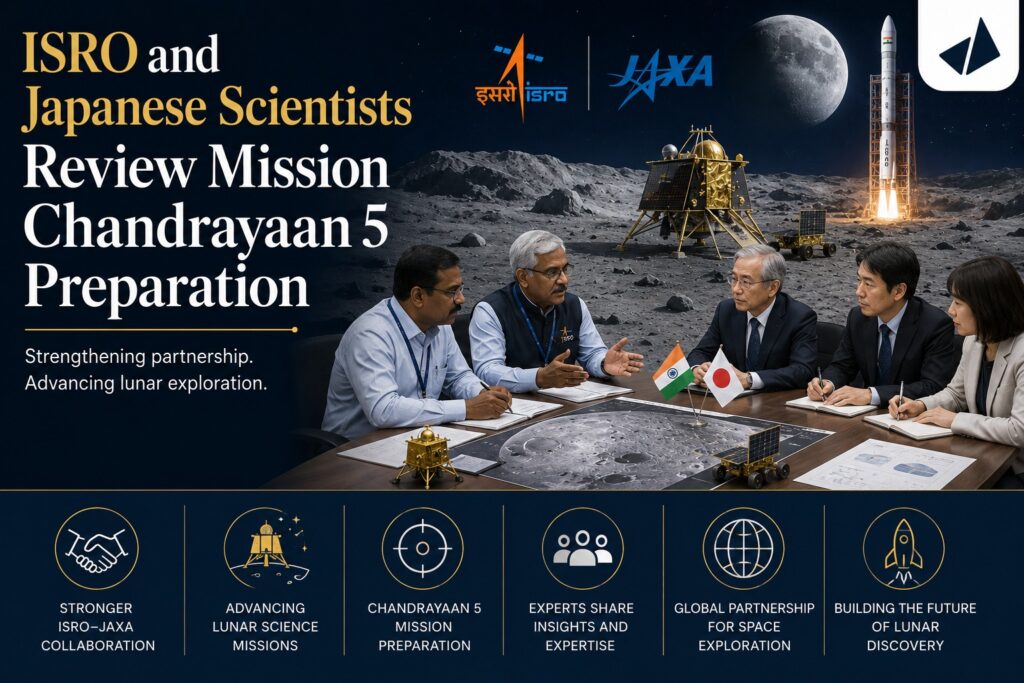
    An ISRO–JAXA delegation reviewed preparations for Chandrayaan-5 (LUPEX), India’s joint lunar mission with Japan, targeted for 2028. ISRO also informed Parliament that the Crew and Service Modules for the Gaganyaan-1 uncrewed mission are nearing completion.

    What is Chandrayaan-5 (LUPEX)?

    • Full Name: Lunar Polar Exploration Mission (LUPEX).
    • A joint lunar mission of ISRO and JAXA.
    • Target Launch: 2028.
    • Objective: Explore and study water and water ice at the Moon’s south polar region.

    Mission Components

    • Lander: Developed by ISRO.
    • Rover: Developed by JAXA.
    • Launch Vehicle: Japan’s H3 Rocket.
    • Scientific Payloads:
      • NASA: Neutron Spectrometer.
      • ESA: Mass Spectrometer.
    • Mission Duration: Around 100 days.
    • Scientific Instruments: 7 across the lander and rover.

    Mission Objectives

    • Detect and analyse surface and subsurface water ice.
    • Study the lunar south pole.
    • Support future human lunar exploration and resource utilisation.

    What is the status of Gaganyaan-1?

    • Gaganyaan-1 is an uncrewed precursor mission.
    • Crew and Service Modules are in the final stages of assembly and testing.
    • Intended to validate: Crew Module, Service Module, Crew Escape System, Life Support Systems
    • Launch has been delayed, and a revised schedule is yet to be announced.

    Significance

    • Strengthens India–Japan space cooperation.
    • Demonstrates multi-agency collaboration involving ISRO, JAXA, NASA, and ESA.
    • Advances lunar science and technologies for future exploration.
    • Supports India’s long-term human spaceflight ambitions under Gaganyaan.

    Challenges

    • Budget and resource constraints across multiple space missions.
    • Integration of ISRO’s lander with JAXA’s rover.
    • Dependence on Japan’s H3 launch vehicle.
    • Delays in the Gaganyaan programme.

    Chandrayaan Missions

    • Chandrayaan-1 (2008): Confirmed the presence of water molecules on the Moon.
    • Chandrayaan-2 (2019): Orbiter remains operational; lander hard-landed.
    • Chandrayaan-3 (2023): India became the first country to achieve a soft landing near the lunar south pole.
    • Chandrayaan-4: Planned Indian mission for lunar sample return.
    • Chandrayaan-5 (LUPEX): Joint ISRO–JAXA mission to explore lunar polar water ice.

    Gaganyaan Programme

    • India’s first human spaceflight mission.
    • Objective: Demonstrate the capability to send Indian astronauts to Low Earth Orbit (LEO) and return them safely.
    • Implemented by ISRO.

    ISRO’s Major International Collaborations

    • JAXA: Chandrayaan-5 (LUPEX).
    • NASA: NISAR mission and Chandrayaan payloads.
    • ESA: Scientific payloads and deep-space support.

    [2025] Consider the following space missions:
    I. Axiom-4
    II. SpaDeX
    III. Gaganyaan
    How many of the space missions given above encourage and support microgravity research?

    [A] Only one

    [B] Only two

    [C] All the three

    [D] None

  • RBI tightens transparency norms on bulk deposit rates, allows LCR linked pricing

    Why in the News?

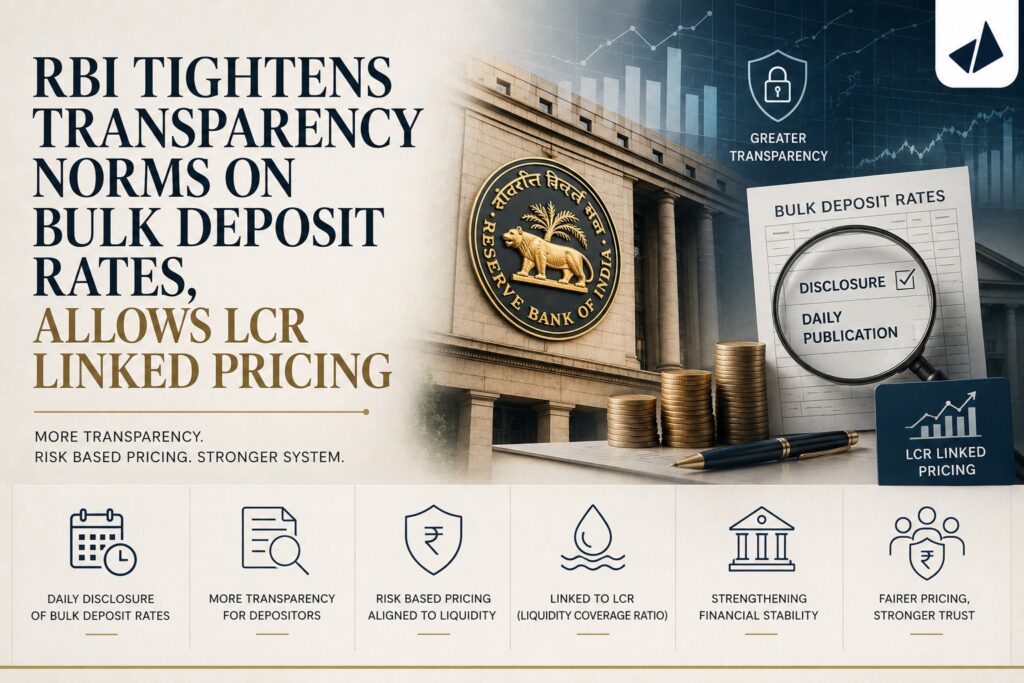
    The RBI has mandated daily disclosure of bulk deposit interest rates while allowing LCR-linked differential pricing. The move follows the MSRDC interest payment controversy, which exposed opaque pricing practices for large depositors.

    What are the new RBI norms?

    • Banks must publish bulk deposit rates daily.
    • Interest rates must be uniform for deposits of the same amount accepted on the same day.
    • Differential rates are allowed only under the Liquidity Coverage Ratio (LCR) framework.
    • Applicable to bulk deposits, wholesale funding, and rupee deposits of non-residents.

    What is the Liquidity Coverage Ratio (LCR)?

    • A Basel III liquidity standard ensuring banks hold sufficient High Quality Liquid Assets (HQLA) to meet 30-day stressed cash outflows.
    • Minimum LCR in India: 100%.
    • Current run-off rate: 12.5% (including 2.5% for digital deposits).

    What triggered the reform?

    • A bank allegedly disguised ₹45 crore paid to MSRDC as marketing expenditure during 2023–25.
    • The irregularity was detected through an internal audit, leading to a vigilance probe and the resignation of the bank’s chairman.

    Key Challenges

    • Hidden arrangements may still require internal audits to detect.
    • Daily disclosures cannot eliminate all off-book incentives.
    • Digital deposits may require periodic revision of run-off rates.
    • Stronger oversight of deposits by government entities is needed.

    Conclusion

    The RBI’s reforms improve transparency and fairness in bulk deposit pricing by replacing opaque negotiations with a rule-based disclosure system, though effective supervision remains critical.

    Value Addition

    • Liquidity Coverage Ratio (LCR) = High Quality Liquid Assets (HQLA) ÷ Net Cash Outflows (30 days) × 100. Minimum requirement: 100%
    • High Quality Liquid Assets (HQLA): Cash, RBI balances, and Government Securities (G-Secs)
    • Basel III: Introduced after the 2008 Global Financial Crisis. Strengthens capital adequacy, liquidity, and bank resilience.
    • Bulk Deposits: Large-value deposits accepted from corporates, institutions, trusts, and government entities, carrying higher liquidity risk than retail deposits.

    [2015] Basel III Accord’ or simply ‘Basel III’ often seen in the news, seeks to

    (a) develop national strategies for the conservation and sustainable use of biological diversity

    (b) improve banking sector’s ability to deal with financial and economic stress and improve risk management

    (c) reduce the greenhouse gas emissions but places a heavier burden on developed countries

    (d) transfer technology from developed countries to poor countries to enable them to replace the use of chlorofluorocarbons in refrigeration with harmless chemicals

  • National Advisory Board on Management of Genetic Resources (NABMGR)

    Why in the News?

    The reconstituted National Advisory Board on Management of Genetic Resources (NABMGR) held its first meeting on 29 July 2026 at ICAR–National Bureau of Plant Genetic Resources (NBPGR), New Delhi, to strengthen India’s agrobiodiversity conservation and promote the sustainable utilization of genetic resources for food security, climate resilience, and Viksit Bharat.

    What is NABMGR?

    • A national advisory body constituted by the Indian Council of Agricultural Research (ICAR).
    • First constituted: 2011. Reconstituted: 2026.
    • Chairman: Dr. R.S. Paroda. Co-Chairman: Dr. M.L. Jat (Secretary, DARE & DG, ICAR).

    Objectives

    • Recommend national policies on agrobiodiversity.
    • Promote integrated management of Plant genetic resources, Animal genetic resources, Fish genetic resources, Microbial genetic resources, and Insect genetic resources
    • Advise on national and international issues related to genetic resources.

    Key Recommendations

    • Strengthen pre-breeding programmes to utilize conserved germplasm.
    • Identify unexplored regions for systematic germplasm collection (2026–2031).
    • Develop an integrated national genetic resources management framework.
    • Mainstream traditional and underutilized crop varieties, animal breeds, fish species, microbes, and insects.
    • Strengthen implementation of Access and Benefit Sharing (ABS) under the Biological Diversity Act, 2002.
    • Expedite establishment of the National Safety Genebank (NSG) before ICAR’s centenary (2028–29).
    • Enhance international collaboration, especially with Central Asia and South-East Asia, for germplasm exchange.

    Significance

    • Conserves India’s rich agrobiodiversity.
    • Broadens the genetic base for developing climate-resilient, high-yielding crops and livestock.
    • Strengthens food, nutrition and livelihood security.
    • Supports sustainable agriculture and achievement of the Sustainable Development Goals (SDGs).
    • Promotes scientific collaboration and evidence-based policy making.

    Important Institutions Mentioned

    • ICAR – Indian Council of Agricultural Research
    • ICAR-NBPGR – National Bureau of Plant Genetic Resources
    • National Biodiversity Authority (NBA)
    • Department of Biotechnology (DBT)
    • Ministry of Environment, Forest and Climate Change (MoEFCC)
    • Botanical Survey of India (BSI)
    • National Medicinal Plants Board (NMPB)

    Value Addition

    • Agrobiodiversity: It refers to the variety and variability of plants, animals, fish, microorganisms and insects used directly or indirectly for food, agriculture and ecosystem services.
    • Germplasm: The hereditary genetic material (seeds, tissues, pollen, embryos, etc.) preserved for crop and livestock improvement.
    • Pre-breeding: The process of transferring useful genes from wild relatives or unadapted genetic resources into breeding materials to develop improved varieties.
    • Access and Benefit Sharing (ABS): A mechanism under the Biological Diversity Act, 2002, ensuring fair and equitable sharing of benefits arising from the use of biological resources and associated traditional knowledge.
    • National Safety Genebank (NSG): A secure backup repository for conserving valuable genetic resources against natural disasters or accidental loss.

    [2012] How does the National Biodiversity Authority (NBA) help in protecting the Indian agriculture?
    1. NBA checks the biopiracy and protects the indigenous and traditional genetic resources.
    2. NBA directly monitors and supervises the scientific research on genetic modification of crop plants.
    3. Application for Intellectual Property Rights related to resources genetic/biological cannot be made without approval of NBA.
    Which of the statements given above is/are correct?

    (a) 1 Only

    (b) 2 and 3 only

    (c) 1 and 3 only

    (d) 1, 2 and 3

  • ISRO’s NavIC System Can No Longer Provide Standalone Navigation Services

    Why in the News?

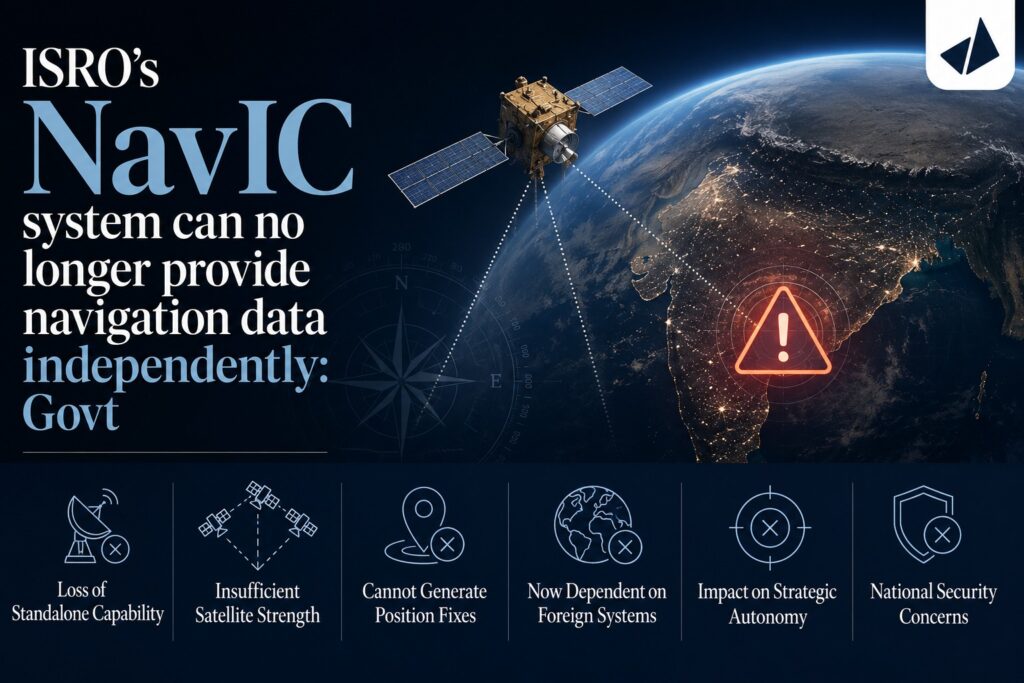
    For the first time, the Government has admitted in Parliament that India’s NavIC (Navigation with Indian Constellation) cannot currently provide standalone positioning services, as only 3 operational satellites are available for navigation, while at least 4 satellites are required.

    What is the issue?

    • IRNSS-1F, launched in March 2016, completed its mission life and its onboard atomic clock failed, reducing the operational navigation satellites.
    • At present, only IRNSS-1B, IRNSS-1I, and NVS-01 are providing Positioning, Navigation and Timing (PNT) services.
    • As a result, NavIC cannot independently provide positioning services, though its timing service remains functional.

    What is NavIC?

    • NavIC (Navigation with Indian Constellation) is India’s regional satellite navigation system, developed by ISRO under the Indian Regional Navigation Satellite System (IRNSS).
    • It provides Positioning, Navigation and Timing (PNT) services over:
      • India, and
      • up to 1,500 km beyond its borders.
    • The original constellation was designed with 7 satellites.

    Why are four satellites necessary?

    • A navigation receiver determines its position through trilateration.
    • At least 4 satellites are required to accurately calculate Latitude, Longitude, Altitude, and Time correction
    • Without four operational satellites, standalone navigation becomes unreliable.

    Does this affect users?

    • No major impact on most users.
    • Smartphones, aircraft, ships and vehicles use multi-constellation GNSS receivers, combining signals from GPS (USA), Galileo (European Union), GLONASS (Russia), BeiDou (China), and NavIC (India)
    • Hence, navigation services continue without significant disruption.

    Current status

    • Standalone positioning: Not available.
    • Timing service: Functional.
    • Emergency message broadcasting: Functional.
    • Armed Forces: Continue using NavIC as part of a multi-constellation GNSS framework.

    Future roadmap

    • NVS-03 is ready for launch.
    • NVS-04 and NVS-05 are in advanced stages of development.
    • These satellites are expected to restore NavIC’s independent navigation capability.

    Significance of NavIC

    • Enhances strategic autonomy by reducing dependence on foreign navigation systems.
    • Supports: Defence operations, Disaster management, Maritime navigation, Aviation, Railways, Road transport, Precision agriculture, and Surveying and mapping
    • Provides secure and reliable navigation during emergencies or geopolitical conflicts.

    [2023] Which one of the following countries has its own Satellite Navigation System?

    [A] Australia

    [B] Canada

    [C] Israel

    [D] Japan

  • Cloudbursts in India

    Why in News?

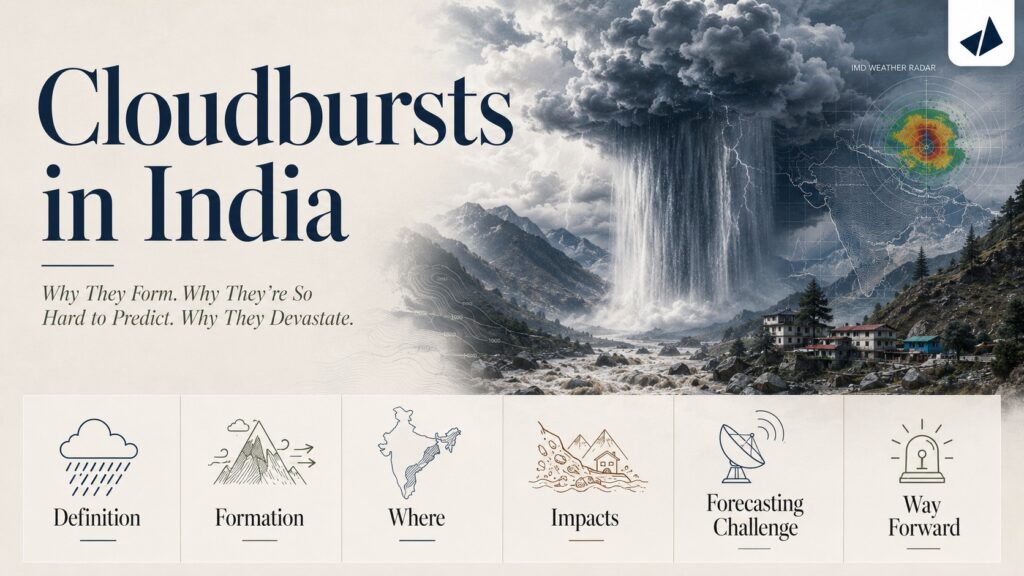
    Recent flash floods in Himalayan States have brought cloudbursts into focus. The IMD has clarified that many reported “cloudbursts” do not meet its scientific definition, highlighting the need for accurate terminology and better disaster planning.

    What is a Cloudburst?

    • According to the India Meteorological Department (IMD), a cloudburst is 100 mm (10 cm) or more rainfall in one hour over a 20 to 30 sq. km area.
    • Key Features
      • Highly localized and short-duration event.
      • Causes sudden flash floods and landslides due to rapid runoff.
      • Much rarer than normal heavy monsoon rainfall.
      • Mini-cloudburst (proposed): Some scientists suggest a category of 50 mm rainfall in one hour over the same area, as it can also cause severe damage.

    How Common are Cloudbursts in India?

    • Cloudbursts are rare, but their frequency is increasing due to global warming, as warmer air can hold more moisture.
    • IMD recorded around 30 cloudbursts between 1970 and 2016, though experts believe many events went unrecorded.
    • Most occur in remote Himalayan regions, where monitoring stations are sparse.
    • Frequently reported in Uttarakhand, Himachal Pradesh, Jammu & Kashmir, Assam, and the Northeast, especially during July-August.

    How Do Cloudbursts Form?

    Why are Cloudbursts Difficult to Forecast?

    • Highly localized, smaller than weather model grid sizes.
    • Develop rapidly, leaving very little lead time.
    • Mountains block Doppler Weather Radar signals, creating blind spots.
    • Limited Automatic Weather Stations (AWS) in high-altitude areas reduce real-time observations.
    • Hyperlocal prediction requires high-resolution models and massive computing power.

    What is India Doing?

    • IMD Nowcasting for short-term weather alerts.
    • Mission Mausam to strengthen hyperlocal forecasting.
    • Expansion of the Doppler Weather Radar (DWR) network.
    • Installation of more Automatic Weather Stations (AWS).
    • Use of Artificial Intelligence (AI) for improved weather prediction and early warnings.

    Challenges

    • Sparse observation network in mountainous terrain.
    • Radar blind spots due to topography.
    • Limited computing capacity for hyperlocal models.
    • Growing climate change-induced extreme rainfall.
    • Weak enforcement of land-use regulations.

    [2026] Which of the following statements with regard to India’s indigenous new high resolution weather model, the ‘Bharat Forecast System,’ is/are correct?
    1. Its objective is to generate forecasts at the Panchayats cluster level.
    2. It was developed by IIT Delhi.
    Select the answer using the code given below:

    [A] 1 only

    [B] 2 only

    [C] Both 1 and 2

    [D] Neither 1 nor 2

  • [UPSC Mains 2026] Registration Open: All India Smash Mains Open Test 2026

    [UPSC Mains 2026] Registration Open: All India Smash Mains Open Test 2026

    All India Smash Mains Open Test 2026 Dates and Schedule

    Register For All India Smash Mains Open Test 2026

    Civilsdaily’s All India Smash Mains Open Test 2026 is Civilsdaily’s national-level UPSC Mains simulation designed to help aspirants experience the actual pressure, pace, and performance demands of the UPSC Mains Examination. Built to mirror the real exam in structure and intensity, it gives aspirants a clear reality check before the actual test.

    Through these tests, aspirants get to refine their answer writing, manage time efficiently, and sharpen their thinking under exam-like conditions. Smash Mains isn’t just about testing knowledge. It’s about fine-tuning your strategy, stamina, and structure.

    Success in UPSC Mains is not just about content; it’s about how well you express that content in a structured, crisp, and impactful manner. Civilsdaily understands this. Smash Mains focuses on real-time answer writing practice and strategic exam simulation, not passive preparation.

    Conducted in both Offline (Delhi ) and Online (Live on Zoom) mode, Smash Mains gives aspirants the opportunity to test themselves against all Mains 2026 aspirants across India, helping them recalibrate their preparation with actionable insights and feedback.

    Test Format & Schedule –

    Papers Covered, Date, Time

    6 Aug: Essay | 09:00am-12:00pm

    7 Aug: GS 1 | 09:00am-12:00pm

    7 Aug: GS 2 | 02:30pm-05:00pm

    8 Aug: GS 3 | 09:00am-12:00pm

    8 Aug: GS 4 | 02:30pm-05:00pm

    Format: Full-length Mains mock tests

    Mode : Offline (Delhi ), Online (Live on Zoom)

    Smash Mains: Key Highlights

    1.⁠ ⁠Your Score Benchmarked Against Real UPSC Toppers + All India Percentile Ranking
    Aspirants will receive their percentile and rank based on national participation. See exactly where you stand among serious UPSC competitors.

    2.⁠ ⁠360° Evaluation of Answers
    Each paper undergoes holistic evaluation with attention to content depth, structure, clarity, and presentation. Expect detailed scorecards for General Studies and Essay papers.

    3.⁠ ⁠Actionable Feedback & Writing Enhancement
    Our expert mentors offer focused reviews that help you:

    • A. Spot conceptual gaps
    • B. Improve answer structure
    • C. Strengthen argumentation and flow using theme and demand approach
    • D. Polish language and articulation

    4. Full Syllabus Coverage
    Smash Mains covers the entire UPSC Mains syllabus, with a curated set of questions that test conceptual clarity, current affairs integration, and interdisciplinary approach.

    5.⁠ ⁠Live Discussions & Strategy Sessions
    Each paper will be followed by mentor-led discussions and strategy breakdowns to help aspirants understand ideal approaches, common pitfalls, and high-impact improvements.

    Why Smash Mains Is a Must-Take

    1.⁠ ⁠Real exam simulation to prepare mentally and strategically
    2.⁠ ⁠⁠National benchmarking of performance
    3.⁠ ⁠⁠Personalized guidance from top mentors
    4.⁠ ⁠⁠Answer writing mastery before the actual Mains
    5.⁠ ⁠⁠Enhanced confidence and exam readiness

    Register For All India Smash Mains Open Test 2026

  • A medical education more inclusive

    Why in the News

    The National Medical Commission (NMC) issued revised guidelines on 27 July 2026 for admitting persons with disabilities to MBBS courses, replacing certificate-based disqualification with a functional assessment of whether a candidate can acquire the competencies needed to practise medicine. The change follows repeated legal challenges, including before the Supreme Court, to the earlier guidelines’ blanket exclusions.

    Key Highlights

    • Shift to Functional Assessment
      • MBBS eligibility will now be based on an applicant’s functional ability rather than the disability certificate alone.
      • Assessment will determine whether the candidate can acquire the competencies required to practise medicine.
      • Designated medical boards will conduct individual functional assessments.
    • Recognition of Reasonable Accommodation
      • Disability itself is not a ground for disqualification.
      • The guidelines recognise that: Assistive technology. Institutional support. Accessible infrastructure can enable candidates to successfully complete medical education.

    Why Were the Earlier Guidelines Challenged?

    • Earlier guidelines relied on fixed disability categories and thresholds.
    • Candidates could be declared ineligible solely because of the nature or extent of disability.
    • Petitioners argued that such blanket exclusions violated the Rights of Persons with Disabilities (RPwD) Act, 2016.
    • The Supreme Court observed that systemic discrimination against persons with benchmark disabilities should be eliminated.

    Significance

    • Promotes inclusive medical education.
    • Aligns with the Rights of Persons with Disabilities (RPwD) Act, 2016.
    • Shifts from a disability-based to a competency-based admission framework.

    Rights of Persons with Disabilities (RPwD) Act, 2016

    • Replaced the Persons with Disabilities Act, 1995.
    • Expanded recognised disabilities from 7 to 21.
    • Provides 4% reservation in government jobs and 5% reservation in higher educational institutions for persons with benchmark disabilities.
    • Administered by the Department of Empowerment of Persons with Disabilities, Ministry of Social Justice and Empowerment.

    National Medical Commission (NMC)

    • Established under the National Medical Commission Act, 2019.
    • Replaced the Medical Council of India (MCI).
    • Regulates medical education and medical professionals in India.

    [2026] Which of the following statements with regard to the persons with disabilities in India is/are correct?
    1. The Rights of Persons with Disabilities Act, an Act passed by the Parliament of India in 2018, mandates reservation in education and employment, places a legal duty on Governments to ensure accessibility and non-discrimination.
    2. The Sugamya Bharat Abhiyan focuses on achieving universal accessibility for Persons with Disabilities across three key domains – built infrastructure, transport systems and information and communication technology.
    3. The National Divyangjan Finance and Development Corporation (NDFDC) is a public sector organization set up by the Ministry of Corporate Affairs as a not-for-profit company to promote entrepreneurship among Persons with Disabilities (PwDs).
    Select the answer using the code given below:

    [A] 1 and 2

    [B] 2 only

    [C] 1 and 3

    [D] 1 only

  • BS-III vehicles may require some modifications to use E20 fuel: govt.

    Why in the News

    The Union government told Parliament that some BS-III vehicles manufactured before 2016 may need rubber parts and gasket replacements to run on E20 fuel, even as the citizens’ advocacy group Team Bharat met the Petroleum Ministry demanding continued supply of E10 petrol and raised a conflict of interest allegation against a senior minister. The overlapping developments surface the same underlying dispute over who bears the cost of India’s ethanol blending programme.

    What is the Ethanol Blending Programme (EBP)?

    • The Ethanol Blending Programme (EBP) aims to blend ethanol with petrol to:
      • Reduce dependence on imported crude oil.
      • Lower vehicular emissions.
      • Support farmers by creating demand for sugarcane and other ethanol feedstocks.
      • Improve energy security and promote cleaner fuels.
    • India achieved the 20% ethanol blending (E20) target in 2025-26, ahead of schedule.

    Government Study on E20 Compatibility

    A study conducted by Indian Oil Corporation (IOC), Indian Institute of Petroleum (IIP), Society of Indian Automobile Manufacturers (SIAM) and Automotive Research Association of India (ARAI) found:

    • BS-III vehicles manufactured before 2016 may require replacement of Rubber hoses, Seals, and Gaskets.
    • The government stated that these replacements can generally be carried out during routine servicing.
    • No major engine modifications are required for most newer cars and two-wheelers compatible with E20.

    Why are Older Vehicles Affected?

    • Ethanol is more corrosive than petrol and can deteriorate older rubber and polymer components.
    • Older fuel systems were not designed for higher ethanol concentrations.
    • Some vehicle owners have reported: Engine misfiring, Fuel leakage, Starting problems, Performance issues (though some complaints may also be linked to contaminated fuel).

    [2025] Consider the following statements:
    Statement I: Of the two major ethanol producers in the world, i.e., Brazil and the United States of America, the former produces more ethanol than the latter.
    Statement II: Unlike in the United States of America where corn is the principal feedstock for ethanol production, sugarcane is the principal feedstock for ethanol production in Brazil.
    Which one of the following is correct in respect of the above statements?

    [A] Both Statement I and Statement II are correct and Statement II explains Statement I

    [B] Both Statement I and Statement II are correct but Statement II does not explain Statement I

    [C] Statement I is correct but Statement II is not correct

    [D] Statement I is not correct but Statement II is correct