Mains Ready By December. Smash Mains & Smash PYQ Admissions Open

Search results for: “”

  • The interlinking of rivers can provide viable solutions to the multi-dimensional inter-related problems of droughts, floods and interrupted navigation. Critically examine. (नदियों को आपस में जोड़ना सूखा, बाढ़ और बाधित जल-परिवहन जैसी बहु-आयामी अन्तर्सम्बन्धित समस्याओं का व्यवहार्य समाधान दे सकता है l आलोचनात्मक परिक्षण कीजिए l)

    Interlinking of Rivers refers to the transfer of water from surplus river basins to deficit basins through a network of canals and reservoirs. Proposed under the National Perspective Plan (1980), the project envisages 30 river links (14 Himalayan and 16 Peninsular).

    Significance of River Interlinking
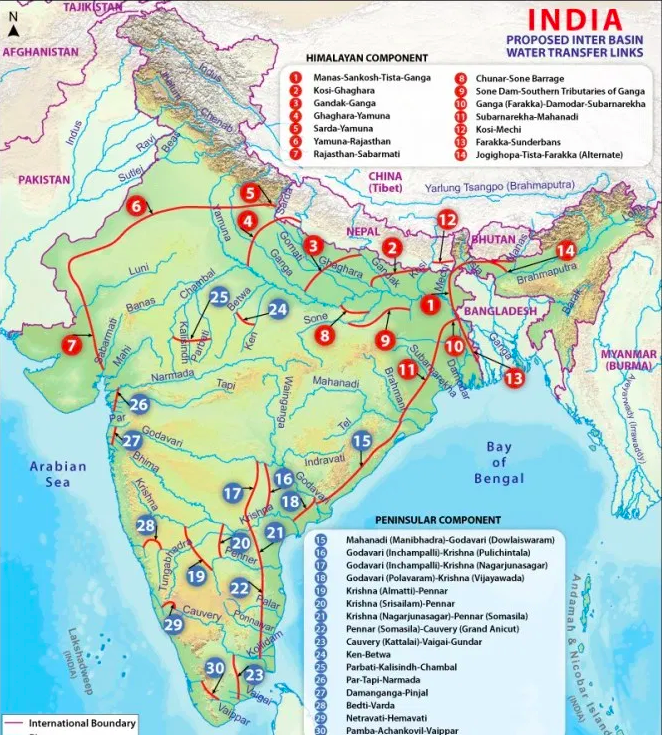
    Flood Control by diverting excess monsoon flows from “surplus” rivers. Eg- Diverting water from the Kosi-Mechi link can alleviate the annual “Sorrow of Bihar.”

    Year-round Navigation-Permanent water levels in canals can facilitate a network of inland waterways. Eg- Linking Godavari-Krishna rivers may improve navigation along peninsular waterways.

    Hydropower Generation-Eg- The ILR project is estimated to add 34,000 MW to the national grid.

    Drinking Water Security-Ensures a stable supply of potable water for growing urban and rural populations.

    Regional Water Balance – Redistribution helps address spatial inequality in water availability. Eg- Water from Mahanadi or Godavari basins could support water-deficit areas of TN and Karnataka.

    Groundwater Recharge-Increased surface water availability can reduce the “blind pumping” of aquifers.

    Agricultural Intensity-Allows for multiple cropping seasons (Kharif, Rabi, and Zaid) in previously single-crop areas. Eg- in Bundelkhand and Marathwada regions

    Fisheries and Livelihoods-Creation of new reservoirs provides opportunities for large-scale aquaculture.

    Salinity Control-Freshwater diversion to deltas can prevent the ingress of seawater during low-flow seasons.

    Climate Resilience-Acts as a “National Water Grid” to buffer against the erratic monsoons expected by 2026-2030.

    Challenges in River Interlinking

    Ecological Disruption-Altering natural river flows can destroy riverine habitats and aquatic biodiversity. Eg- The Ken-Betwa link will submerge 98 km^2 of the Panna Tiger Reserve.

    Questionable Surplus-Deficit Concept – Climate variability affects river flows. Eg- Changing monsoon patterns may reduce flows in so-called surplus rivers like the Brahmaputra

    Social Displacement-Massive land acquisition leads to the uprooting of indigenous and farming communities.

    Fiscal Burden-Estimated costs exceed ₹5.5 lakh crore, leading to concerns over debt-to-benefit ratios.

    Inter-State Disputes-Water is a “State Subject,” making consensus difficult between “donor” and “recipient” states.

    Sediment Starvation-Diverting water also diverts silt, which is essential for maintaining deltas and soil fertility downstream.

    Water-Logging and Salinity-Introduction of excess surface water in arid regions can lead to “alkalinization” of soil. Similar issues were seen after the Indira Gandhi Canal project in Rajasthan.

    International Complications-Interlinking Himalayan rivers requires treaties with neighbors. Eg- Indus water treaty with Pakistan.

    Project Delays-Long gestation periods often lead to massive cost overruns.

    Large projects may overshadow decentralized water management. Eg- Watershed development programmes in Maharashtra have effectively addressed drought without large river transfers.

    Way Forward

    Scientific Assessment of Water Surplus and Deficit – Basin-level hydrological studies considering climate change impacts.

    Intra-State Prioritization-Focus on smaller links within states (like Kosi-Mechi) to avoid federal and legal hurdles.

    Virtual Water Trade-Optimize crop patterns so that water-rich regions grow thirsty crops, effectively moving water through food trade.

    Implement rainwater harvesting and watershed management before resorting to inter-basin transfers.

    Mandatory drip and sprinkler systems (Israel model) to ensure transferred water is used efficiently.

    Independent EIA that goes beyond engineering feasibility.

    A balanced approach is essential to ensure long-term water security and environmental sustainability.

  • How will the melting of Himalayan glaciers have a far-reaching impact on the water resources of India? (हिमालय के हिमनदों के पिघलने का भारत के जल-संसाधनों पर किस प्रकार दूरगामी प्रभाव होगा ?)

    The Himalayan glaciers are termed as the “Water Towers of Asia.” However, as per UN report, these glaciers have lost approximately 30% of their mass since 1970.

    Short-Term Impacts of Himalayan Glacier Melting

    Accelerated glacier melting temporarily increases river flow. Eg- Enhanced summer discharge observed in Indus basin rivers dependent on glacial melt.

    Glacier lake areas expanded by over 22% between 2011 and 2025, raising severe GLOF risks.

    Chamoli disaster in Uttarakhand

    South Lhonak Lake outburst in Sikkim (2023)

    Melting glaciers release sediments affecting river morphology. Eg- Increased sediment deposition in upper Ganga and Brahmaputra tributaries.

    Over 33% of India’s hydropower is currently at risk from cascading “cryospheric” disasters. Eg- Tapovan-Vishnugad hydropower project in Uttarakhand damaged during the Chamoli disaster.

    Micro-climate Shifts-The loss of white ice (albedo) leads to more heat absorption, creating “heat islands” even at high altitudes.

    Long-Term Impacts

    Most Himalayan basins are expected to pass “Peak Water” by 2030-2050, after which river flows will permanently decline. Eg- Ganga and Yamuna may eventually become “seasonal”.

    Groundwater Depletion-As surface water vanishes, farmers will over-extract aquifers, accelerating the “Water Bankruptcy” of the Indo-Gangetic plain.

    Water Quality Crisis-Lower river volumes reduce the “self-purification” capacity, concentrating pollutants like Arsenic and Fluoride.

    Groundwater Recharge Reduction – Lower river flows reduce recharge in alluvial aquifers.

    Urban Water Supply Stress – Eg- Cities like Delhi depend heavily on Yamuna and Ganga river systems.

    Ecosystem Degradation – Altered flow regimes threaten aquatic biodiversity. Eg- Habitat of the Ganges river dolphin depends on stable river flow.

    Scarcity may intensify interstate and transboundary disputes. Eg- Indus water treaty dispute with Pakistan

    Reduced freshwater inflow affects sediment transport and delta stability. Eg- accelerating erosion in the Ganga-Brahmaputra delta.

    Glaciers act as natural reservoirs stabilizing river flows. Loss of glaciers makes river systems more dependent on erratic monsoon rainfall.

    Way Forward

    Deploying Glacial Lake Early Warning Systems using automated radar and satellite sensors at high-risk sites.

    Springshed Management-Rejuvenating “Dharas” (mountain springs) to provide alternative water sources as glaciers retreat.

    Artificial Glaciers-Scaling the “Ice Stupa” model to store winter meltwater for spring irrigation in arid high-altitude regions.

    Climate-Resilient Infrastructure-Mandating “Cryosphere Impact Assessments” for all new dams and highways in the Himalayas.

    Ecosystem-Based Adaptation – Protect Himalayan forests and wetlands that regulate water flows.

    A strategy combining climate mitigation, scientific monitoring and sustainable water management is essential to safeguard the vital water resources originating in the Himalayas.

  • Pala period is the most significant phase in the history of Buddhism in India. Enumerate. (भारत में बौद्ध धर्म के इतिहास में पाल काल अति महत्वपूर्ण चरण है l विश्लेषण कीजिए l)

    The Pala period (c. 8th-12th centuries CE) in eastern India marked the last great fluorescence of Buddhism in the Indian subcontinent.

    Significance of the Pala Period in the History of Buddhism

    The Pala era represents the final organised and state-supported phase of Buddhism in India before its decline after 12th century invasions.

    Royal Patronage – Eg- Dharmapala and Devapala patronised monasteries and scholars.

    The establishment of Great Mahaviharas attracted students from Tibet, China, and Southeast Asia. Eg- Nalanda, Vikramashila, Odantapuri, Somapura.

    Development of Vajrayana (Tantric Buddhism) as a dominant Buddhist tradition.

    The Pala phase saw the rise of the Sahajayana sect (“Easy Vehicle”), which simplified Buddhist practice

    Pala scholars transmitted Buddhism to Tibet and Southeast Asia. Eg- Atisha Dipankara’s role in Tibetan Buddhism.

    Growth of Buddhist Art and Architecture

    Evolution of Pala school of art. Eg- Black stone sculptures of Buddhas and Bodhisattvas.

    Construction of stupas and monasteries. Eg- Somapura Mahavihara (UNESCO site).

    Literary contribution – Compilation of Mahayana and Vajrayana texts. Eg- Charyapada, a collection of mystical poems composed by Buddhist Siddhas, represents the earliest form of Bengali, Assamese, and Odia literature.

    The Pala period standardized Buddhist iconography, institutionalized higher education, and internationalized the faith.

  • Has caste lost its relevance in understanding the multi-cultural Indian Society? Elaborate your answer with illustrations.

    Caste can be defined as a localized, hereditary, and endogamous group characterized by a fixed rank in a ritual hierarchy (Varna).

    Caste losing relevance

    Decline of Ritual Hierarchy – Notions of purity and pollution have weakened. Eg- Inter-caste dining in urban areas is common

    Occupational Mobility – Caste-occupation linkage has diluted. Eg- Dalits and OBCs in IT, civil services, academia.

    Urbanisation and Migration promote anonymity and mixed social spaces. Eg- Cosmopolitan life in metros like Mumbai and Bengaluru.

    Legal and Constitutional Framework has established equality before law irrespective of caste hierarchy. Eg- Article 14 and Article 17.

    Rise of Individualism – Personal choice gaining prominence over ascriptive identity. Eg- Love marriages, nuclear families.

    Growth of Class-Based Stratification in urban settings. Eg- rise of dalit and OBC Middle Class

    Relevance of caste

    Enduring Endogamy – NFHS-5 (2023-24) data confirms that over 90% of marriages remain intra-caste

    Political Mobilisation – Caste act as a “Political Vote Bank.” Eg- 2024-25 Bihar Caste Survey and announcement of “Caste Census”

    Caste remains a basis for welfare and representation. Eg- Reservations for SCs, STs, and OBCs.

    Economic inequalities along caste lines. Eg- 96% manual scavengers are Dalits

    Social Discrimination along caste lines persists. Eg- Hatras rape case or Rohith Vemula death.

    Intersectionality – Caste intersects with gender, religion, and region. Eg- Dalit women facing multiple marginalities.

    New associational forms. Eg- Maratha Kranti Morcha, Patidar Anamat Andolan.

    Caste based economic groups. Eg- Dalit Indian Chamber of Commerce and Industry (DICCI) promoting “Dalit Capitalism”

    Caste-Based Spatial Segregation (Ghettoization) in modern cities

    Inter-generational Wealth Gap – The Oxfam Inequality Report (2024) highlights that the average wealth of a General Category family is nearly triple that of a Dalit family.

    Understanding contemporary India therefore requires recognising caste not as a static relic, but as a dynamic and evolving social reality operating alongside class, gender, religion, and region.

  • Do you agree that regionalism in India appears to be a consequence of rising cultural assertiveness? Argue.

    Regionalism is political, social, or cultural mobilization around a specific region, rooted in language, culture, history, economy, or perceived neglect, seeking greater autonomy, recognition, or resources.

    Regionalism as a Consequence of Rising Cultural Assertiveness

    Linguistic assertiveness against cultural centralization– Eg- Anti-Hindi agitations in Tamil Nadu or the recent Kannada-first signage mandates in Karnataka.

    Ethno-cultural nationalism – Region imagined as a cultural nation.

    Tamil cultural nationalism emphasizing classical language and Dravidian heritage.

    Demand for Greater Nagalim rooted in the assertion of a unique Naga identity.

    Religious identity also acts as a base for regional assertiveness. Eg- demand for Khalistan

    Preservation of Folk Traditions- Eg- protests against Jallikattu Ban (2017) were framed as an assertion of Tamil “Veeru” (bravery) against “outsider” legal impositions.

    Cultural symbolism is used for political mobilization. Eg- renaming Bombay to Mumbai and Calcutta to Kolkata.

    Sons of the Soil Doctrine- Movements like the Shiv Sena’s initial “Marathi Manoos” campaign assert that locals must have the first right over the state’s resources.

    Sub-Regional Assertion- Eg- demand for Tulu Nadu based on the distinct Tulu language and culture.

    Resistance to “Mainstreaming”- Tribal regionalism in Jharkhand and Chhattisgarh began as an assertion of Adivasi culture against the “Diku” (outsiders).

    Other Factors Driving Regionalism in India

    Inter-State Disparities- widening economic gap between the prosperous South/West and the lagging East/North creates friction. Eg- violence against Bihari migrants in Gujarat

    Relative Deprivation

    Vidarbha in Maharashtra.

    Demand for Telangana before 2014

    Paul Brass argues that regionalism is politically constructed, where cultural markers are activated by elites for political benefits. Eg- invoking “bengal pride” by TMC

    Inter-state disputes over resources fuels regionalism. Eg- Krishna-Godavari water disputes between Telangana and Andhra Pradesh.

    Administrative Neglect- Large states become too big to govern, leading to the demand for smaller states. Eg- demand for the division of UP into Harit Pradesh, Purvanchal, Bundelkhand, and Awadh Pradesh

    Way Forward

    Cooperative Federalism- Strengthening the Inter-State Council (Article 263)

    Balanced Regional Development- Eg- aspirational district program

    Scaling the “Ek Bharat Shreshtha Bharat” program for promoting fraternity

    Administrative Decentralization- empowering Local Bodies

    A mature Indian federalism must promote inclusive development, autonomy with unity, and diversity with constitutional fraternity.

  • Besides domain knowledge, a public official needs innovativeness and creativity of a high order as well, while resolving ethical dilemmas. Discuss with a suitable example. (150 words)

    “In times of complexity, imagination is more important than knowledge.” – Albert Einstein

    Innovativeness and creativity enable officials to find morally acceptable and practically workable solutions.

    Ethical Dilemmas in Civil Services

    Development vs. Displacement- Narmada Bachao Andolan (Medha Patkar vs. State).

    Confidentiality vs. Transparency- Whistleblowing

    Political Pressure vs. Neutrality

    Freedom of Speech vs. Public Order

    Environment vs. Livelihood

    Efficiency vs. Equity

    Personal Ethics vs. Professional Duty

    Loyalty vs. Truth

    Importance of Domain Knowledge

    Policy Formulation- Dr. Manmohan Singh’s economic expertise during the 1991 reforms.

    Infrastructure Excellence- E. Sreedharan’s engineering mastery in the Delhi Metro.

    Economic Management- Raghuram Rajan’s knowledge of monetary policy at the RBI.

    Scientific Progress- Dr. A.P.J. Abdul Kalam’s aerospace knowledge in the Missile Program.

    Legal Accuracy- T.N. Seshan’s deep understanding of Constitutional Law as CEC.

    Health Administration- Dr. Gagandeep Kang’s virology expertise during vaccine development.

    Agricultural Transformation- Dr. M.S. Swaminathan in the Green Revolution.

    Digital Governance- Nandan Nilekani’s tech background in the creation of Aadhaar.

    Financial expertise- Vinod Rai’s auditing expertise as the CAG of India.

    Need for Innovation and Creativity to Resolve Ethical Dilemmas

    Resource optimization- Eg- Armstrong Pame (IAS) crowdfunded the “People’s Road”.

    Reformative justice- Kiran Bedi (IPS) introduced Vipassana in Tihar to reform rather than just punish.

    Prioritising social welfare by bypassing bureaucratic rigidity. Eg- Prashant Nair’s “Operation Sulaimani” – Use of crowdsourced coupons to feed hunger

    Innovative solutions for winning ‘hearts and minds’ and delegitimizing insurgency. Eg- Saurabh Kumar (IAS) built “Education City” in Dantewada.

    Finding ‘out of the box’ solutions. Eg- IPS chetan singh Rathore using National Anthem to manage protesting crowd.

    Helps in effective management of crisis situations. Eg- Dr. Syed Sehrish Asgar used her office as a “human call center” during communication blackouts in J&K

    Helps in collaborative problem solving rather than a top-down approach. Eg- S.R. Sankaran involved local community elders in identifying bonded laborers.

    Creativity and innovations facilitate adoption of technology to solve problems. Eg- Dr. Hari Chandana building pavements from recycled plastic in Hyderabad.

    Can help address social stigma associated with manual work. Eg- Ritu Sain (IAS) turned waste-pickers into “Green Commandos”.

    Ethical governance today requires not just knowledge of rules but moral imagination, contextual intelligence and creative problem-solving.

  • An independent and empowered social audit mechanism is an absolute must in every sphere of public service, including the judiciary, to ensure performance, accountability and ethical conduct. Elaborate. (150 words)

    A social audit is a democratic process where citizens directly review, evaluate, and verify the official records, expenditures, and actual field performance of public service institutions.

    Importance to Improve Performance of Public Service

    Optimizes Resource Utilization: Eg: social audits under MGNREGA reduced leakages and improved rural asset quality in Andhra Pradesh

    Enhances Service Delivery Timelines: Pressure from community monitoring forces officials to complete projects without bureaucratic delays.

    Improves Project Target Accuracy: Eg: Verification drives under the National Food Security Act removed thousands of fake ration cards.

    Boosts Quality Standards: Eg: Public scrutiny of rural school buildings and mid-day meals improves safety.

    Bridges Local Governance Gaps: Community audits identify specific, missing civic amenities that top-down government planning often misses.

    Improves Judicial Case Management: Citizen reviews of court functioning encourage registries to clear administrative delays and bottlenecks.

    Importance to Improve Accountability of Public Service

    Dismantles Bureaucratic Financial Opacity: Eg: Mazdoor Kisan Shakti Sangathan (MKSS) pioneered public hearings to expose hidden corruption.

    Enforces Strict Consequence Mechanisms: Clear evidence gathered during community audits forces authorities to penalize errant, corrupt officers.

    Checks Judicial Pendency Patterns: Reviewing administrative timelines makes institutional court registries strictly accountable for systemic listing delays.

    Restricts Executive Fund Diversions: Eg: Strict auditing of specialized Scheduled Caste Sub-Plan funds prevent diversion to general projects.

    Empowers Marginalized Civic Groups: Social audits give institutional platforms to poor citizens to question powerful government decision-makers.

    Validates Right to Information: Social audits turn passive information requests into an active, collective tool for community justice.

    Reduces Public Service Grievance Backlogs: Institutionalizing community verification forces departments to quickly resolve long-pending public utility complaints.

    Importance to Improve Ethical Conduct

    Institutionalizes Public Service Integrity: Regular public scrutiny conditions state officials to perform duties with high honesty and fairness.

    Discourages Conflict of Interest: Public disclosure of project details prevents officials from giving lucrative contracts to relatives.

    Maintains High Judicial Ethics: Reviewing court administration standards encourages judges to strictly follow codes of ethical conduct.

    Protects Citizen Dignity Rights: Equal opportunity during public hearings prevents officials from displaying discriminatory caste or gender biases.

    Promotes Empathy in Administration: Direct interactions with poor citizens during audits sensitive bureaucrats toward urgent field realities.

    Fosters Values of Truthfulness: Eg: Stopping fraudulent documentation of ghost beneficiaries.

    Implementing independent social audits across all public spheres, including the judiciary, is vital to achieving absolute transparency, institutional integrity, and democratic governance.

    Conscience

  • “Refugees should not be turned back to the country where they would face prosecution or human rights violation.” Examine the statement with reference to the ethical dimension being violated by the nation claiming to be democratic with an open society. (150 words)

    Violation of principle of non-refoulement creates a “Liberal Paradox,” where the values used to define the state are discarded at its borders.

    Refugee Rights

    Right to Asylum (Article 14 of the UDHR).

    Right to Life and Liberty

    Right to Non-Discrimination

    Freedom from Torture

    Right to Due Process

    Family unity

    Access to basic services

    Ethical Dimensions Violated by Refoulement

    Violation of Kantian Categorical imperative- treats refugees as mere “means” to a political end border security.

    Violation of Justice as Fairness (John Rawls) by sending refugees to face persecution or human right violation

    Breach of Universal values like liberty, right to life. Eg- Alyan Kurdi death

    Erosion of Human Dignity and an active denial of their Intrinsic Worth. Eg- Detention camps for asylum seekers.

    Loss of moral leadership and global solidarity– Undermines credibility in human rights advocacy

    Erosion of rule of law – Ignoring international refugee conventions. Eg- Violations of 1951 Refugee Convention.

    Failure of the “Good Samaritan” Principle i.e. preventing great harm (death) with comparatively small cost.

    Failure of humanitarian duty – Moral obligation to protect the vulnerable is ignored.

    Discrimination – Selective hospitality based on race, religion, or politics. Eg- Preferential treatment of Ukrainian refugees over African refugees in Europe.

    Epistemic Injustice- Refusing to believe or listen to the testimony of a persecuted person before deportation.

    Many refugee crises (Syria, Afghanistan, Myanmar) are linked to historical colonial or military interventions by democratic powers. Refoulement is a rejection of Restorative Justice.

    The “Slippery Slope” of Rights- Eg- devaluing the rights of its own marginalized citizens in future

    Failure of Communitarian Ethics as nations are seen as part of a global “International Society” with mutual duties.

    Causes long-term psychological and ethical decay in the host nation’s own moral fabric.

    Way Forward

    Individualized Screening- Eg-l “Credible Fear” interview.

    Judicial Oversight to ensure Procedural Justice.

    Principle of Proportionality. in Enforcement

    Burden Sharing. Eg- EU Migration Pact

    Enforcing “Responsibility to Protect” by UN

    The ultimate best practice for a democratic society is to apply the Rawlsian “Veil of Ignorance” to every policy.