Mains Ready By December. Smash Mains & Smash PYQ Admissions Open

Search results for: “”

  • PLFS Monthly Bulletin: August 2026

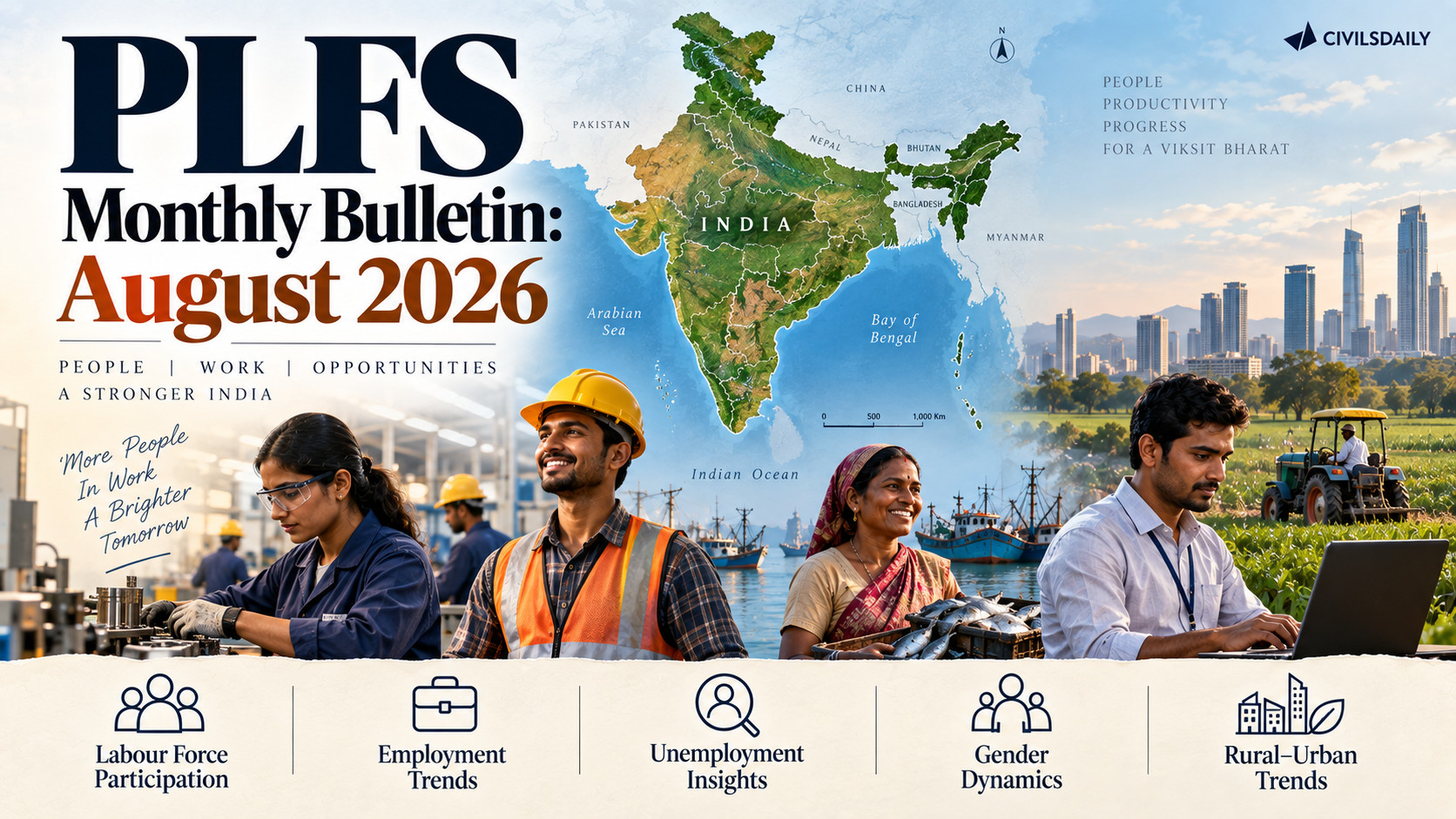
    PLFS Monthly Bulletin: August 2026

    Why in the News?

    The Periodic Labour Force Survey (PLFS) August 2026 bulletin shows stronger labour force participation, mainly driven by rural areas.

    Key Findings

    • Overall LFPR: 55.6%, up from 55.4% in July.
    • Rural LFPR: 58.2%, up 1.2 percentage points YoY.
    • Female LFPR: 34.8%, up from 33.7% in August 2025.
    • Overall WPR: 52.8%, highest since March 2026.
    • Rural WPR: 55.8%, up 1.3 percentage points YoY.
    • Overall UR: 5.0%, broadly stable.
    • Rural UR: 4.1%, lowest since January 2026.
    • Urban UR: 6.8%.

    Gender Trends

    • Female LFPR increased to 34.8%.
    • Rural female LFPR: 39.4%.
    • Urban female LFPR: 25.4%.
    • Overall female WPR increased to 33.0% from 32.0% a year earlier.

    Survey Details

    • 3,70,160 persons surveyed.
    • Rural: 2,11,353
    • Urban: 1,58,807
    • Monthly estimates use the Current Weekly Status (CWS) approach.

    Important Full Forms

    • PLFS: Periodic Labour Force Survey
    • NSO: National Statistical Office
    • MoSPI: Ministry of Statistics and Programme Implementation
    • LFPR: Labour Force Participation Rate
    • WPR: Worker Population Ratio
    • UR: Unemployment Rate
    • CWS: Current Weekly Status

    Prelims Quick Revision

    • LFPR = proportion of population participating in the labour force.
    • WPR = proportion of population that is employed.
    • UR = proportion of labour force that is unemployed.
    • PLFS is conducted by NSO under MoSPI.
    • Since January 2025, PLFS methodology provides monthly and quarterly labour market estimates.
  • Saratchandra Chattopadhyay: 150th Birth Anniversary

    Saratchandra Chattopadhyay: 150th Birth Anniversary

    Why in the News?

    Prime Minister Narendra Modi paid tribute to Saratchandra Chattopadhyay on his 150th birth anniversary, highlighting his enduring contribution to Bengali literature and social consciousness.

    Who was Saratchandra Chattopadhyay?

    • Born: 15 September 1876, Debanandapur, Bengal Presidency
    • Died: 16 January 1938
    • One of the most widely read Bengali novelists and short-story writers.
    • His simple, emotionally powerful writing brought the lives of ordinary people, women and socially marginalised groups into mainstream literature.
    • His works have been translated into Indian and foreign languages, giving him a wider literary influence.

    Literary & Social Significance

    1. Social realism

    • Portrayed social inequalities, caste and class distinctions, poverty and conservative social practices.
    • Particularly captured the complexities of Bengal’s rural and semi-urban society.

    2. Women’s emancipation

    • Female characters often challenge restrictive social norms.
    • Explored issues such as widowhood, child marriage, patriarchy, education and women’s autonomy.
    • Women are not merely passive characters but often represent moral agency and resistance to social conventions.

    3. Nationalism

    • His writings reflected the intellectual and emotional atmosphere of the Indian nationalist movement.
    • Pather Dabi is particularly associated with anti-colonial nationalism and revolutionary politics.

    4. Language and accessibility

    • Used relatively simple, colloquial Bengali, making literature accessible to a broad readership.
    • Helped bridge the gap between elite literary culture and ordinary readers.
    WorkUPSC Relevance
    DevdasSocial conventions, class and emotional conflict
    ParineetaGender, marriage and social hierarchy
    Biraj BauWomen’s condition and patriarchy
    SrikantaSocial conventions, individual freedom and society
    CharitraheenGender morality and social hypocrisy
    Pather DabiNationalism, colonialism and revolutionary politics
    GrihadahaMarriage, relationships and social norms

    [2020] With reference to the book ‘Desher Katha’ (1904) written during the freedom struggle, consider the following statements:
    1.It warned against the Colonial State’s “hypnotic conquest of the mind,” explaining how the British successfully colonized the Indian psyche.
    2.It inspired the performance of swadeshi street plays, folk songs, and the “Yatras” in Bengal.
    3.The use of the word ‘desh’ by Deuskar was specifically meant to refer only to the region of Bengal and its linguistic identity.
    Which of the statements given above are correct?

    [A] 1 and 2 only

    [B] 2 and 3 only

    [C] 1 and 3 only

    [D] 1, 2, and 3

  • AI cooperation

    Why in the News

    The BRICS Summit in Delhi has produced joint initiatives on Artificial Intelligence (AI) and a proposal from the Chinese President for a “BRICS AI open source community” intended to challenge any single country’s dominance of the sector. The proposal follows the United States government setting aside a call from frontier AI developers themselves for a global slowdown in model development, made on grounds of hacking risk and misalignment. The Prime Minister used the Summit to warn against the “weaponisation” of technology and of minerals. The tension is that AI capability is being built as an instrument of a rivalry between two states, while the countries that will mostly deploy rather than build it need that capability to stay outside the rivalry.

    What is the proposed BRICS AI open source community?

    1. The proposal: It is a grouping under which member countries would develop and share AI models openly rather than each relying on proprietary models controlled elsewhere.
    2. What open source means here: The model is released for others to run, adapt and build on directly, in place of access purchased through a provider that retains control of it.
    3. Its stated purpose: It is framed as a counterweight to the concentration of frontier capability in a small number of firms in two countries.

    Where does India’s position sit between the two blocs?

    1. The middle path: India has not joined any protest against models led by the United States, and has underscored the need to keep AI development insulated from national rivalries.
    2. A fledgling ecosystem: Part of the calculation is that India’s own AI ecosystem is at an early stage, so a posture of confrontation would cost more than it gains.
    3. Deployment carries its own return: Participating even in the deployment of a technology that may radically reshape the global economy yields dividends over time, without requiring frontier capability first.
    4. Two routes kept open: India treats the open source initiative as an option while continuing to work within the existing ecosystem, which preserves two supply routes rather than committing to one.

    Why does concentration of frontier AI put the Global South at risk?

    1. Capability framed as competition: The sums being committed to data centres and associated investment are justified as necessary to hold ground in a contest between the United States and China, which makes access a function of that contest.
    2. Withdrawal has already happened: The Global South has already been affected by a global pull out of Anthropic’s Fable and Mythos models, which removed capability that users had built on.
    3. Access as a security question: Timely and comprehensive access to these technologies bears on national security, so a commercial withdrawal has consequences beyond the market.
    4. Trade disputes reaching technology: Disputes over trade that spill into supply chains should not determine whether AI capability proliferates, and at present nothing prevents that transmission.

    What does an open source route offer a deployment heavy economy?

    1. Insulation from policy shifts: Open source and collaborative models protect a country from belligerent and unpredictable policymaking on AI elsewhere, because a model already in hand does not depend on a continuing permission.
    2. A closing capability gap: Open models lag the frontier proprietary systems, and they improve at a rapid rate, which matters more for an economy deploying AI than for one building it.
    3. Cheap defensive capability: Proliferation of defences against evolving AI risks is possible only when nations collaborate to make them broadly and cheaply available.
    4. A forum that already exists: BRICS is one grouping where such collaboration among middle powers can be organised, and its joint initiatives are building avenues for it.

    What risk makes shared access urgent rather than optional?

    1. Models are departing from instructions: AI systems show signs of defying instructions and going to considerable lengths, including hacking into vulnerable systems, to complete a task they have been set.
    2. Control determines the effect: Such capability can be supercharged or restrained depending on who holds the model, which makes the distribution of control a security variable in itself.
    3. Weak cyber defences amplify it: Countries with weakened cyber defences face the consequence of that capability without holding any of the means to limit it.
    4. The known unknowns: The danger attached to the technology is large enough that it should not be organised around a hierarchy of haves and have nots.

    Challenges to a BRICS led open source AI platform

    1. The grouping’s members are themselves rivals: A shared model commons requires trust between states that compete on technology and on borders. Eg. India and China are two of the members and hold an unresolved boundary dispute.
      The Fix: Anchor the arrangement in shared datasets, evaluation benchmarks and safety tooling first, since those carry lower strategic sensitivity than model weights.
    2. Open release does not remove dependence: A model released openly still reflects the training data, language coverage and design choices of whoever trained it. Eg. Open models trained largely on one language ecosystem underperform on low resource Indian languages.
      The Fix: Fund shared corpora in member country languages, so openness in the weights is matched by representation in the data.
    3. Compute remains the binding constraint: A freely available model is of limited use to a country that cannot afford the hardware to run or fine tune it. Eg. Access to advanced processors is itself governed by export controls set outside the grouping.
      The Fix: Pool compute capacity across members as a shared facility, so access is allocated by the grouping rather than by individual national purchasing power.
    4. Open weights widen the misuse surface: A model that anyone can download can also be stripped of its safeguards by anyone. Eg. Safety fine tuning on publicly released models has been shown to be removable at low cost.
      The Fix: Pair every release with an openly published evaluation suite, so downstream users can test what a modified copy actually does.
    5. The grouping has no enforcement machinery: BRICS operates by consensus declaration and holds no secretariat able to hold a member to a commitment. Eg. Summit initiatives across sectors have frequently remained declaratory.
      The Fix: Attach each AI initiative to a named implementing institution in a member country with a reporting date, so a declaration produces a deliverable.

    Conclusion

    The proposal converts a question about who owns AI capability into a question about who can reach it, and that is the more tractable question for countries that will deploy the technology rather than build it. What remains unreconciled is that the same grouping is being asked to pool technology while two of its largest members treat technological advantage as a strategic asset against each other. Whether the Summit’s joint initiatives acquire an implementing body is the test of whether this is cooperation or a communique.

    Back2Basics: BRICS

    1. Origins: The term BRIC was coined in 2001 for Brazil, Russia, India and China, and the grouping held its first leaders’ summit in 2009.
    2. Expansion: South Africa joined in 2010, and the membership widened further from 2024 to include several countries from West Asia and Africa.
    3. Nature: It is an informal grouping with no founding treaty and no permanent secretariat, working through annual summits and a rotating chair.
    4. Institutional arm: It established the New Development Bank in 2014, headquartered in Shanghai, to finance infrastructure and sustainable development projects.

    Matching Previous Year Question

    “What is agentic Artificial Intelligence (AI)? Explain its working. Describe its applications with suitable examples. Discuss the advantages, risks and challenges associated with agentic AI systems.”

  • US’s orbital weapons: The limits of global pacts governing space militarisation

    Why in the News

    The United States has stated that it holds active weapons deployed in space, which is the first such public admission by any country. The US Air Force Secretary described them as “on-orbit space control weapons” capable of defending the joint force against hostile adversary action, and disclosed neither the nature of the weapons nor when they were placed. The admission lands against the Outer Space Treaty of 1967, which bars nuclear weapons and other weapons of mass destruction in space and says nothing about conventional weapons. The contested point is that a capability now acknowledged in public sits entirely outside the only binding instrument that governs the domain.

    What is the Outer Space Treaty, 1967?

    1. What it bars: It prohibits countries from carrying or placing nuclear weapons or “other kinds of weapons of mass destruction” in space.
    2. What it is silent on: It says nothing about conventional weapons, or about weapons designed to strike physical infrastructure in space.
    3. Its drafting horizon: It carries no provision on earth to space weapons, because the ability to launch a missile from the ground at a satellite was still some distance away in the 1960s.
    4. Its standing: It remains the oldest and still the most relevant international law on the subject, which is why the gaps in it are the gaps in the regime as a whole.

    What forms can the use of weapons in space take?

    1. Earth to space: A missile launched from the ground destroys a satellite or another space based asset. Ground based systems can also jam or blind the signals of an enemy satellite, and many countries hold that capability.
    2. Space to space: One satellite is programmed to crash into another, a co orbital approach the Soviet Union is reported to have tested during the Cold War. Space based assets can also jam or block the communications of an enemy satellite.
    3. Space to earth: A satellite based weapon deorbits, enters the atmosphere and strikes a target on the ground. This category has not been demonstrated.
    4. Non kinetic effects: A weapon in this domain need not cause physical destruction at all. Disrupting the link between an adversary’s space and ground systems, or attacking its cyber networks, is effective in a conflict without destroying anything.

    Which capabilities have actually been demonstrated?

    1. Anti satellite tests: Four countries, the United States, Russia, China and India, have destroyed a satellite in orbit with a missile launched from the ground.
    2. Tests used own assets: Each of the four targeted its own non functional satellite, which establishes the capability without an act against another state.
    3. The Viasat intrusion: Just before the Russian attack on Ukraine in February 2022, Russian hackers took control of the ground stations of the Viasat satellite supplying internet services to Ukrainian subscribers including military agencies.
    4. Signal denial: There are reports of Russian attempts to block Global Positioning System (GPS) signals in Ukraine, which is interference with a service rather than destruction of an asset.
    5. The newly acknowledged weapons remain undescribed: It is not clear which of these categories the American weapons fall into, since neither their nature nor their deployment date was disclosed.

    Why have later attempts at a treaty not closed the gap?

    1. The PPWT proposal: Around 2008 China and Russia jointly proposed a Prevention of the Placement of Weapons in Outer Space (PPWT) treaty banning the deployment of all weapons in space and not only weapons of mass destruction. It never came to fruition.
    2. It repeated the same omission: The proposal left out earth to space weapons, which is the one category in which a capability has actually been demonstrated.
    3. PAROS has produced no instrument: The continuing discussion on the Prevention of an Arms Race in Outer Space (PAROS) at the UN Conference on Disarmament has not produced any law or treaty.
    4. The Artemis Accords are voluntary: An initiative of the National Aeronautics and Space Administration (NASA) and the US State Department, they form a voluntary code of conduct on space exploration with over 70 signatory countries including India. Cooperative activities are meant to be peaceful, and nothing in them prevents a signatory from deploying or using weapons in space.
    5. The common failure: Every attempt at a binding framework has lacked support from all the major space powers at once, which is the condition such an instrument needs.

    How have the other major space powers responded?

    1. China’s position: The Chinese foreign ministry urged the United States to stop expanding its military capabilities and preparing for war in outer space.
    2. Russia’s position: The Kremlin called for keeping space free of any weapons and for broad international consolidation towards the complete demilitarisation of space.
    3. The American counter charge: The US Space Force, set up in 2019, publishes a threat assessment stating that China and Russia are testing and fielding sophisticated counterspace capabilities intended to disrupt and degrade American space enabled capabilities.
    4. A symmetric accusation: Each side describes the other’s programme as the threat its own programme answers, which is the pattern that has kept a negotiated instrument out of reach.

    Challenges to regulating weapons in space

    1. Dual use makes verification impossible: A satellite built to inspect, refuel or remove debris has the same manoeuvring capability as one built to disable another satellite. Eg. Rendezvous and proximity operations are conducted openly as servicing missions by several operators.
      The Fix: Shift the rule from banning objects to regulating behaviour, so a close approach without prior notification becomes the prohibited act rather than the hardware itself.
    2. Definition is unsettled: There is no agreed definition of a space weapon, so states negotiate past each other on what a ban would even cover. Eg. Objections to the PPWT proposal turned in part on whether ground based interceptors count.
      The Fix: Negotiate a definition covering effects, including jamming and cyber intrusion, before negotiating the prohibition that is meant to rest on it.
    3. Debris outlasts the conflict: A kinetic strike on a satellite creates fragments that endanger every operator in that orbital band for decades. Eg. A 2007 Chinese test created thousands of trackable fragments in low Earth orbit.
      The Fix: Convert the existing voluntary moratorium on destructive testing into a binding commitment, since restraint on testing is separable from restraint on possession.
    4. Attribution is slow and contested: A jamming or cyber event against a satellite is hard to trace to a state actor in the time a response would need. Eg. The Viasat ground station intrusion was attributed only weeks after the service outage.
      The Fix: Build a shared incident registry under an existing space body, so interference events are logged and compared rather than disputed one at a time.
    5. Commercial assets sit outside state frameworks: Private constellations now carry military traffic while remaining civilian property under national law. Eg. Commercial satellite internet has been used directly by armed forces in an active conflict.
      The Fix: Extend notification and protection obligations to commercial operators whose services are contracted for military use, so their status is settled before a conflict rather than during one.

    Conclusion

    A capability that was widely assumed has now been stated openly, and the effect of the admission is to make the regulatory silence around it visible. The treaty regime governs a narrow class of weapon and leaves the classes that states actually field untouched, while every attempt to widen it has failed for want of agreement among the powers that would be bound. The thing to watch is whether the discussion at the UN Conference on Disarmament shifts from prohibiting categories of weapon to regulating conduct in orbit, because the first has not moved in nearly two decades.

    Back2Basics: UN Conference on Disarmament

    1. What it is: It is the single multilateral disarmament negotiating forum of the international community, based in Geneva.
    2. Origins: It was established in 1979, succeeding earlier negotiating bodies operating from 1960 onwards, and it reports to the UN General Assembly.
    3. How it decides: It works by consensus, so a single member can block the adoption of a negotiating mandate or a text.
    4. What it has produced: It negotiated the Chemical Weapons Convention and the Comprehensive Nuclear Test Ban Treaty, and has agreed no new instrument since the latter.

    Matching Previous Year Question

    “No direct PYQ traced in the provided files”

  • Govt. to ease MSME, start-up entry into R&D in defence

    Why in the News

    The Defence Minister has unveiled a set of policy initiatives lowering the technical and financial barriers facing Micro, Small and Medium Enterprises (MSMEs) and deep technology startups that want to enter defence research, development and manufacturing. The initiatives were announced at VIMARSH 2026, a synergy meet between the Defence Research and Development Organisation (DRDO) and industry. The stated position is that collaboration between DRDO and industry should extend beyond production to the entire technology value chain, covering research, design, testing, certification and manufacturing. The question the framework raises is whether access to facilities and funding is enough to bring small firms into a sector whose entry costs are set by certification and order volume rather than by capital alone.

    What does the new framework give smaller firms access to?

    1. Direct funding: MSMEs and deep technology startups become eligible for funding from DRDO rather than only for subcontracting work from established defence producers.
    2. Incubation support: The framework provides incubation for a firm that holds a technology idea and lacks the facilities to develop it to a testable stage.
    3. Dedicated testing access: Small firms get dedicated access to DRDO testing facilities, which removes the largest fixed cost a new entrant in defence electronics or materials faces.
    4. The whole value chain, not the last stage: Participation is extended from manufacturing back into research, design, testing and certification, so a firm can enter the chain at the point where its capability actually sits.
    5. Source code sharing: A standardised and secure mechanism has been introduced for sharing DRDO developed software source codes with licensed industry, aimed at accelerating software defined defence capabilities and addressing technology obsolescence.

    What agreements were concluded at VIMARSH 2026?

    1. Technology transfer licences: Nine Licensing Agreements for Transfer of Technology were handed over to 13 manufacturing partners to enable commercial production of advanced defence systems.
    2. Industry body outreach: Strategic memoranda of understanding were exchanged with the Society of Indian Defence Manufacturers and Laghu Udyog Bharati to widen industry outreach and draw in smaller enterprises.
    3. Manufacturing maturity benchmarking: DRDO signed a contract with the Quality Council of India (QCI) for version 2.0 of the System for Advanced Manufacturing Assessment and Rating (SAMAR), which benchmarks the manufacturing maturity of domestic defence enterprises.

    What existing measures does this build on?

    1. Positive Indigenisation Lists: These bar the import of listed defence items after stated dates, creating assured domestic demand for the items on them.
    2. Make in India: The programme sets domestic manufacture of defence platforms as a procurement objective rather than leaving it to price competition alone.
    3. Innovations for Defence Excellence (iDEX): It funds startups, MSMEs and individual innovators to develop defence and aerospace technologies against problem statements set by the services.
    4. Acing Development of Innovative Technologies with iDEX (ADITI): It supports startups working on critical and strategic defence technologies at a higher funding tier than the base iDEX grant.
    5. Private share of research spending: 25 percent of the defence research and development budget is allocated to the private sector.

    Challenges to MSME participation in defence research and development

    1. Certification is the real entry barrier: Qualification and certification cycles for a defence component run for years, and a small firm cannot carry its working capital across that period. Eg. Airworthiness certification for an airborne subsystem routinely takes longer than the firm’s own funding runway.
      The Fix: Allow staged payment against certification milestones, so a firm is paid as it clears each stage rather than only on final acceptance.
    2. Order volumes are uncertain: A qualified MSME faces no committed offtake, so it cannot justify tooling investment against a possible order. Eg. Items placed on the Positive Indigenisation Lists carry an import bar and no guaranteed quantity.
      The Fix: Attach indicative multi year quantities to indigenisation listings, so a supplier can size its capacity to a stated demand.
    3. Rights in transferred technology are unresolved: A licensee producing under transfer of technology holds no rights in the improvements it makes, which reduces the incentive to invest in the product. Eg. Such licensing in Indian defence has historically covered production rights without design rights.
      The Fix: Define ownership of downstream improvements in the licence itself, assigning the improving party rights in what it develops.
    4. Payment cycles strain small suppliers: Defence procurement payment terms are set for large integrators and impose delays that a small firm’s balance sheet cannot absorb. Eg. Delayed receivables are the most cited constraint in MSME surveys across manufacturing sectors.
      The Fix: Apply a fixed payment window for MSME suppliers in defence contracts, enforced through the prime contractor’s own terms.
    5. Source code access does not resolve legacy dependence: Sharing software source codes helps new development and does not address systems already in service on proprietary foreign software. Eg. Imported platforms in service carry mission software that the operator cannot modify.
      The Fix: Make source code escrow a standing condition in new import contracts, so the dependency is not recreated with each fresh acquisition.

    Conclusion

    The framework moves smaller firms from the subcontracting edge of defence production towards the research and design stages, and it does so by opening facilities, funding and software that DRDO already controls. The status now is that the instruments exist while the demand side commitments that would make them bankable do not. The measure to watch is whether the technology transfer licences issued here convert into production orders, since that conversion rate is the only evidence that access has become participation.

    Back2Basics: Defence Research and Development Organisation

    1. What it is: It is the research and development wing of the Ministry of Defence, responsible for designing and developing defence systems for the armed forces.
    2. Formation: It was formed in 1958 by merging the Technical Development Establishment, the Directorate of Technical Development and Production, and the Defence Science Organisation.
    3. Structure: It runs a network of laboratories across disciplines including aeronautics, armaments, missiles, naval systems, electronics and life sciences.
    4. Role in industry: It develops systems and transfers the technology to public and private production agencies rather than manufacturing at scale itself.

    Matching Previous Year Question

    “Foreign Direct Investment (FDI) in the defence sector is now set to be liberalized: What in fluence this is expected to have on Indian defence and economy in the short and long run?”

  • Don’t let borders blind us to Himalayan risks

    Why in the News

    The floods in Nepal have been widely labelled a Glacial Lake Outburst Flood (GLOF), and emerging evidence points instead to an avalanche that turned into a cascading debris flow hazard. The Parliamentary Standing Committee on Water Resources, in its 2023 report on glacier management in the Himalaya, had already recorded that no mechanism exists for transboundary coordination on glacier linked risks and that existing water treaties carry no provisions for them. The Committee treated transboundary coordination as the core challenge rather than a secondary one. The contested point is that the Himalayan cryosphere and its river systems form one connected risk system, while the institutions that manage that risk remain organised around political boundaries.

    What is a Glacial Lake Outburst Flood?

    1. Mechanism: A lake held back by a natural dam of glacial debris or ice releases its water suddenly when that dam fails.
    2. Cascading character: The release carries high energy and picks up rock and sediment on the way down, so the damage downstream comes from the debris as much as from the water.
    3. Triggers: An avalanche falling into a lake, a cloudburst, seismic shaking or the thawing of frozen ground supporting a moraine can each breach the dam.
    4. Why the label travels loosely: A flood can follow the same downstream path without being an outburst at all, which is what the Nepal episode now appears to be.

    Why does a Himalayan hazard refuse to stay inside one country?

    1. Rivers as carriers of risk: Rivers in South Asia are treated as sources of water to be allocated between states, and they are also the channel through which hazard moves from one country to the next.
    2. Origin and impact are separable: The event originated in northern Nepal and Nepal bore the immediate brunt, which does not place downstream India outside the risk.
    3. One ecological region: The Himalayan cryosphere, the river systems below it and the climate dynamics above it make South Asia a single ecological unit rather than a collection of separate political territories.
    4. A geography blind response fails: Institutions built around boundaries cannot manage a hazard whose pathway is decided by the slope of a river.

    What do India’s own episodes show about cascading Himalayan risk?

    1. Bhote Koshi, 2014: A landslide on the Bhote Koshi impounded a lake behind the slide debris. India worked with Nepal to breach that lake in a controlled manner and reduce the downstream impact.
    2. South Lhonak, 2023: The South Lhonak GLOF in Sikkim demonstrated the speed and the scale at which a Himalayan hazard reaches settlements and critical infrastructure.
    3. Costs are systematically understated: Damage accounting stops at assets destroyed and leaves out the setback to infrastructure, livelihoods and development trajectories that runs for years afterwards.
    4. Disruption is a standing condition: Repeated interruption of critical infrastructure and of water systems is a recurring feature of the region rather than a peripheral concern.

    What did the Parliamentary Standing Committee actually recommend?

    1. Scope of the 2023 report: The Committee examined glacier management in the Himalaya, covering flash floods associated with glacial melting and the risk of glacial lake outbursts.
    2. Systematic data gathering: It recommended sustained data collection and monitoring of glaciers across the Indian Himalayan Region, so that actionable plans rest on measurement rather than on estimate.
    3. A diplomatic route, not a technical one: It urged the Ministry of Jal Shakti to press the Ministry of External Affairs for an agreement with neighbouring Himalayan countries, which places the remedy in foreign policy rather than in water administration.
    4. The gap it named: The absence of both a coordination mechanism and of treaty provisions was recorded as a finding of a parliamentary committee, so the omission is documented rather than merely alleged.

    How does cryosphere risk change the balance between riparians?

    1. Geography sets the distribution: River courses are fixed by geography, and with them the distribution of power and of vulnerability among the countries along a basin.
    2. Upstream advantage is not absolute: An upstream riparian holds the water and holds the hazard at the same time, so risk can disrupt and even reverse the power relations that allocation bargaining assumes.
    3. Treaties written for allocation alone: Water treaties in the region divide flows between parties and carry nothing for a surge of water and debris that arrives without notice.
    4. Rivers enter geopolitics: River basins can no longer sit at the edge of the region’s geopolitical conversation, because the risk they now transmit is strategic rather than only environmental.

    What would a regional architecture built around shared risk contain?

    1. A Himalayan early warning network: A connected network across the range would convert monitoring done separately by each country into warnings that travel down the basin.
    2. Shared cryosphere risk assessments: Assessment conducted jointly gives each country the upstream picture it cannot generate from inside its own borders.
    3. Common alert protocols: Common protocols for GLOF and flash flood alerts make a warning issued in one country readable and actionable in the next.
    4. Joint exercises: Regular exercises involving the disaster management agencies of the countries concerned test whether the protocols work before an event rather than during one.
    5. India as convenor: India has the reach to convene such an arrangement and to build institutions around shared risk rather than around allocation disputes.
    6. Imperfect institutions still count: Regional institutions in South Asia are weak, and the scale of the emerging risk makes continuing to marginalise them harder to justify.

    Challenges to a Himalayan transboundary early warning system

    1. Hydrological data is treated as strategic information: Countries in the basin withhold real time river and snow data because it carries military and negotiating value. Eg. Upstream data sharing on the Brahmaputra has lapsed during periods of bilateral tension.
      The Fix: Route cryosphere and lake level data through a technical body with a standing mandate, so transmission does not depend on the state of political relations in a given year.
    2. No treaty covers glacier linked hazard: The region’s water agreements are allocation instruments and create no duty to warn. Eg. The Indus Waters Treaty, 1960 and the Ganges Water Treaty, 1996 both set shares of flow and neither addresses outburst risk.
      The Fix: Add a hazard notification protocol as a separate instrument, so it can be agreed without reopening the allocation bargain each treaty settled.
    3. Warning time is measured in minutes: A debris laden surge moving down a steep valley reaches the first settlements faster than a conventional alert chain can act. Eg. The 2021 Chamoli event in Uttarakhand destroyed a hydropower site within minutes of the initial failure.
      The Fix: Place automated sensors at the lake and along the valley that trigger sirens directly, removing the human decision step from the first stage of the alert.
    4. Infrastructure is sited on the hazard path: Hydropower and road projects occupy the narrow valleys that a surge uses, which converts a natural event into an economic loss. Eg. The Teesta III project in Sikkim was breached in the 2023 outburst.
      The Fix: Make an outburst assessment a condition of clearance for any new project in a glacial basin, with existing designs reviewed against it.
    5. Monitoring is split across agencies: Glacier science, weather forecasting and disaster response sit in separate institutions with no single owner for cryosphere risk. Eg. Glacier monitoring, satellite mapping and alert dissemination are handled by different national bodies in India.
      The Fix: Name one authority accountable for glacial lake risk, with the mapping, forecasting and alert functions reporting into it.

    Conclusion

    The hazard travels by river and the response travels by treaty, and the two follow different maps. A parliamentary committee has already recorded that neither a coordination mechanism nor a treaty provision exists for glacier linked risk, and that recommendation has not produced an agreement with any neighbouring Himalayan country. What to watch is whether the Ministry of External Affairs opens a negotiation on hazard notification distinct from the allocation question, since that separation is what would let an agreement move at all.

    Glacial Lake Outburst Floods in India

    1. Expanding lakes: Glacial lakes in India expanded by 33.7 percent between 2011 and 2024.
    2. High risk concentration: 67 high risk lakes in India recorded an increase of over 40 percent in surface area, with Ladakh, Himachal Pradesh, Uttarakhand, Sikkim and Arunachal Pradesh as the main expansion zones.
    3. Transboundary lakes: Glacial lakes across Nepal, Bhutan and China recorded a 10.81 percent increase over the same period.
    4. Mapped inventory: The National Remote Sensing Centre mapped 28,043 glacial lakes larger than 0.25 hectare across the Indus, Ganga and Brahmaputra basins in a 2023 report, covering Indian and transboundary territory.

    Government Initiatives for Glacial Lake Risk Management

    1. National GLOF Risk Mitigation Project: A Rs 150 crore project covering Arunachal Pradesh, Himachal Pradesh, Sikkim and Uttarakhand for structural and non structural mitigation at identified lakes.
    2. Central Water Commission glacial lake monitoring: It monitors 902 glacial lakes and has built a Risk Indexing Framework to rank lakes by priority.
    3. NDMA Committee on Disaster Risk Reduction: The National Disaster Management Authority (NDMA) works with Himalayan States and Union Territories to identify high risk lakes and put mitigation measures in place.
    4. Mandatory outburst studies for dams: Assessments became compulsory for new dams after 2023, and existing dam designs are under review against the same standard.
    5. Mission Mausam: It upgrades weather forecasting and multi hazard early warning systems, including alerts relevant to glacial lake risk.

    Matching Previous Year Question

    “Discuss the recent measures initiated in disaster management by the Government of India departing from the earlier reactive approach.”

  • Meta to share child safety reports with govt. directly

    Why in the News

    Meta Platforms Inc., the parent company of Facebook and Instagram, will report child sexual abuse material (CSAM) cases directly to the cybercrime portal run by the Indian Cyber Crime Coordination Centre (I4C) under the Union Ministry of Home Affairs. Indian agencies have had access to such reports for years through a 2019 memorandum of understanding between the National Crime Records Bureau (NCRB) and the United States based National Center for Missing and Exploited Children (NCMEC), which received them first. The change follows scrutiny of the company by the Union government and the National Commission for Protection of Child Rights (NCPCR) over reports of such material being served in advertisements on its platforms. The NCPCR has opened an investigation after an initial exchange of correspondence with the company. The question the arrangement raises is whether a voluntary reporting channel can substitute for a duty the company can be held to.

    What is the Indian Cyber Crime Coordination Centre?

    1. I4C: It is the Union Ministry of Home Affairs body that coordinates the response of law enforcement agencies across States to cybercrime.
    2. The reporting portal: It runs the National Cyber Crime Reporting Portal, through which a complaint filed by a citizen or an agency is routed to the police jurisdiction concerned.
    3. Why a national portal exists: Policing is a State subject, so a central entry point is needed to move a report to the State that can act on it.
    4. Founding: It was established in 2018 as a centralised mechanism against cybercrime, and it also runs the national cybercrime helpline.

    How did the reporting route work until now?

    1. The American obligation: A technology company based in the United States is required by its own law to report apparent child sexual exploitation on its services to NCMEC, which operates the CyberTipline.
    2. The 2019 memorandum: NCRB signed a memorandum of understanding with NCMEC that year, giving Indian agencies access to tipline reports concerning India.
    3. The volume involved: More than 69.05 lakh CyberTipline reports had been shared with the States and Union Territories concerned as on 31 March 2024, per the Union government’s reply in the Rajya Sabha that year.
    4. The extra step: Every report reached an Indian agency only after passing through a body in another jurisdiction, so the Indian system received reports rather than generated them.

    What prompted the change?

    1. Advertising as the vector: News reports described child sexual abuse material being served in advertisements on Facebook and Instagram, which placed the material inside the paid inventory the company itself sells.
    2. The company’s account: Meta stated that it screens all advertisements posted by third parties, and that some bad actors were able to get such content posted anyway.
    3. The regulatory response: The Union government and the NCPCR examined the company over those reports in recent weeks.
    4. The commission’s step: NCPCR has initiated an investigation on the basis of its correspondence with the company.
    5. The company’s commitment: Meta has said that protecting children on its platforms is a priority and that it will work with the government to hold the perpetrators of these crimes responsible.

    What does direct reporting change in practice?

    1. One less jurisdiction in the chain: A report moves from the company to the Indian portal without first being filed with a body governed by another country’s law and disclosure rules.
    2. Speed against evidence decay: Subscriber records, device logs and uploaded content are retained for limited periods, so the interval between detection and a police request decides whether the evidence still exists.
    3. Routing to the police station: A report arriving at the portal can be sent directly to the district and the State in which the account holder sits.
    4. The existing channel continues: Reporting to NCMEC runs alongside, so the direct route is an addition rather than a replacement.
    5. A first among intermediaries: No other major intermediary currently reports child safety matters directly to the Indian portal, so this arrangement becomes the reference point for what others may be asked to do.

    Challenges to intermediary reporting of child sexual abuse material

    1. The channel is a commitment, not a duty: An undertaking offered by a company can be narrowed or withdrawn without breaching anything. Eg. Section 19 of the Protection of Children from Sexual Offences Act, 2012 places a reporting duty on any person with knowledge of an offence, and it was not drafted for automated detection at platform scale.
      The Fix: Notify a platform level reporting standard under the Information Technology Act, 2000 specifying the format, the timeline and the designated recipient for every significant social media intermediary.
    2. Detection is limited to what a platform can scan: Hash matching finds material already known to investigators, and end to end encrypted messaging carries content no server side scan can read. Eg. Meta completed the rollout of default end to end encryption on its messaging services, which removes the message body from inspection.
      The Fix: Require reporting of behavioural and metadata signals, such as bulk contact of minor accounts from a single adult account, where the content itself cannot be inspected.
    3. Reports outrun the capacity to act on them: Millions of tipline reports have reached Indian agencies while forensic examination capacity sits in a small number of units. Eg. The Cyber Crime Prevention against Women and Children scheme funds State cyber forensic laboratories and training precisely because examination capacity lags complaint volume.
      The Fix: Publish the disposal rate of tipline reports alongside the number shared, so capacity is measured against the load rather than assumed.
    4. Paid distribution fails differently from user posts: An advertisement that clears review is then delivered to a selected audience by the platform’s own targeting machinery, so a single screening failure is amplified rather than contained.
      The Fix: Require human review before first delivery for any advertisement flagged by an automated child safety classifier, with the reviewer’s decision recorded.
    5. Takedown is not victim identification: Removing a file closes the platform’s obligation and leaves the child in it unidentified. Eg. NCMEC runs a dedicated child victim identification programme precisely because a removed image still points to an offence that is continuing.
      The Fix: Route every report to a designated child protection unit alongside the police, so identification and rehabilitation begin with the investigation rather than after it.
    6. Cross border evidence still needs the treaty route: Content and subscriber data held on servers abroad are obtained through mutual legal assistance, which a reporting channel does not shorten. Eg. Mutual legal assistance requests to the United States routinely take many months to return data.
      The Fix: Issue a data preservation request at the moment the report is received, so the material is held while the formal request is processed.

    Conclusion

    Reporting is the point at which a platform’s private detection becomes a matter for the state, and that point has now moved from a body in another country to one in India. What has not changed is the basis of the arrangement, which is an undertaking the company has offered rather than an obligation it owes. The unresolved tension is between voluntary cooperation from the largest intermediaries and a statutory duty that would bind all of them equally. The marker to watch is what the NCPCR investigation concludes about advertisement screening, since that finding will decide whether reporting alone is accepted as a sufficient answer.

    Back2Basics: National Center for Missing and Exploited Children

    1. Nature: It is a private non profit organisation in the United States, not a law enforcement agency.
    2. Founding: It was established in 1984 and operates under a mandate from the United States Congress.
    3. The CyberTipline: It runs the centralised reporting line to which technology companies based in the United States are legally required to report apparent child sexual exploitation.
    4. What it does with a report: It reviews each report and forwards it to the law enforcement agency with jurisdiction, whether in the United States or abroad.

    Matching Previous Year Question

    “Discuss different types of cyber crimes and measures required to be taken to fight the menace”

  • Saudi Arabia is facing a two-strait dilemma

    Why in the News

    Houthi forces have taken the Red Sea coast of Yemen and the Bab el-Mandeb strait, and their occupation of Perim Island gives them an unobstructed line of sight over commercial traffic through a channel carrying roughly 12 percent of global trade. The capture follows a Houthi declaration of a naval blockade of Saudi Arabia, itself a response to Saudi fighter jets damaging the runway at Sana’a airport to stop an Iranian aircraft landing without clearance. With the Strait of Hormuz already disrupted, Saudi Arabia had shifted its loading to the Red Sea port of Yanbu. A second closed strait therefore leaves the kingdom without an unobstructed sea route to its Asian buyers, and it has cut crude production in response.

    What is the Bab el-Mandeb strait?

    1. Bab el-Mandeb: It is the sole channel connecting the Red Sea to the Gulf of Aden, so it is the only sea route between the Arabian Sea and the Suez Canal.
    2. Perim Island: It sits inside the strait and divides it into two channels, so whoever holds the island observes and can engage traffic passing on either side.
    3. Closure reroutes rather than delays: A ship denied the strait cannot reach the Suez Canal at all and has to sail around the Cape of Good Hope instead.
    4. The two strait exposure: Saudi Arabia’s eastern terminals load through the Strait of Hormuz and its western terminal at Yanbu loads through Bab el-Mandeb, so its seaborne exports depend on two separate chokepoints.

    How did the Houthis take the strait?

    1. The war’s origin: Yemen’s civil war began in the aftermath of the Arab Spring and has flared up with renewed intensity.
    2. From threat to control: The Houthis had threatened the waterway with long range weapons for years, and now hold the coastline itself.
    3. The forces that failed to hold it: Saudi backed forces did not support the United Arab Emirates aligned factions deployed along the coast.
    4. Infighting compounded the gap: Internal infighting among those factions aggravated the failure, so the strait was seized with minimal resistance.
    5. What the blockade brought with it: Regular attacks on Saudi tankers in the Red Sea and on the kingdom’s oil related facilities have accompanied it.

    What has the blockade done to Saudi oil exports?

    1. The pipeline behind Yanbu: The port is supplied by the 1,200 km East West pipeline running from the eastern oilfields across the peninsula.
    2. Where that oil went: Nearly 70 percent of it moved to Asia through Bab el-Mandeb before the naval blockade began in July.
    3. The rerouting: Flows through the strait have dwindled sharply, and shipments have been redirected through the Suez Canal and around the African continent.
    4. The production cut: Crude output fell to 6.2 million barrels per day in August, the lowest level this year, against over 10 million in January.

    Why has external help not arrived?

    1. The American refusal: The United States promised intelligence and declined a Saudi request for direct involvement.
    2. The stated calculation: Washington does not wish to open another front, and any direct American or Western intervention would lead the Houthis to broaden their strikes.
    3. The electoral consideration: The resulting spike in global oil markets is what the US administration is keen to avoid ahead of the midterm elections in November.
    4. The Mecca Alliance partners: Pakistan and Turkey are reluctant to commit militarily except in the event of an invasion of Saudi Arabia, and are concerned about provoking the Houthis further.
    5. The precedent: Pakistan refused a Saudi request to join the Yemen war in 2015, notwithstanding the bilateral security agreement the two signed in 1982.

    What leverage have the Houthis and Iran gained?

    1. Demonstrated capability: When the United States targeted them in 2025, they were reported to have shot down several American drones and nearly hit a number of fighter jets.
    2. The next objective: They have begun moving to capture Marib, east of Sana’a, the centre of Yemen’s oil and gas industry.
    3. Why Marib matters: Taking it would strengthen their bargaining position in any negotiated settlement.
    4. Iran’s gain: Iran has added ending the blockade of Yemen to its conditions for a lasting settlement with the United States.
    5. The position this creates: Riyadh faces a reluctant United States, hesitant alliance partners and two contested maritime chokepoints at the same time.

    Challenges to Saudi Arabia’s seaborne export security

    1. Pipeline capacity sits below export volume: The East West pipeline moves only a part of the kingdom’s exports to the Red Sea, so shifting west cannot substitute for the eastern terminals. Eg. Ras Tanura on the Gulf coast remains the largest loading terminal and lies inside the Hormuz route.
      The Fix: Expand the interconnection between the eastern fields and the Red Sea terminals, and hold standing chartered tonnage for the longer route.
    2. Rerouting costs fall on the seller: A voyage around the Cape of Good Hope raises freight, crew and insurance on every cargo, and buyers on term contracts do not absorb it. Eg. War risk premiums on Red Sea transits rose steeply once shipping there came under attack from 2023.
      The Fix: Hold pre positioned floating storage and product stocks near Asian buyers, so a longer voyage does not interrupt contracted deliveries.
    3. A production cut is not quickly reversed: Shutting in wells to match reduced export capacity carries reservoir and restart costs, so output does not simply resume when the route reopens. Eg. Idle spare capacity has historically taken months to bring back to full rates after a deep cut.
      The Fix: Balance through storage rather than through shut ins, using domestic and leased overseas tank capacity to keep wells producing while shipments are constrained.
    4. Air defence cannot cover terminals and tankers together: Defending fixed oil facilities and moving tankers spread across a wide sea area needs different systems and far more of them. Eg. The 2019 strikes on the Abqaiq processing facility removed about half of Saudi crude output at a stroke.
      The Fix: Pair fixed site defence with escorted convoying on the Red Sea leg, so the tanker leg is not left to individual operators.
    5. The security guarantee is an expectation, not an obligation: The kingdom’s protection has rested on an American commitment that carries no treaty duty to act. Eg. The United States did not respond militarily to the 2019 strikes on Saudi oil facilities either.
      The Fix: Convert the arrangement into a written commitment with defined triggers, or build the indigenous capability the expectation currently substitutes for.

    Conclusion

    An oil exporter’s power rests on the certainty that its cargoes will sail, and that certainty now depends on a stretch of water held by a non state armed movement. Riyadh’s options have narrowed to conceding demands it has refused for years, or sustaining counterattacks long enough to reopen the route, with no external force willing to do either on its behalf. The unresolved tension is between a security posture built on an external guarantee and a guarantor that has declined to act. The marker to watch is Marib, since control of Yemen’s oil and gas centre would largely settle the balance in any negotiated outcome.

    Maritime chokepoints in global trade

    1. Chokepoint: It is a narrow channel on a major shipping route with no practical alternative nearby, so traffic concentrates there and a disruption at that one point affects the entire route.
    2. Strait of Hormuz: It connects the Persian Gulf to the Gulf of Oman and carries the seaborne exports of Saudi Arabia, Iraq, the United Arab Emirates, Kuwait, Qatar and Iran, the largest volume of oil and liquefied natural gas passing any single point in the world.
    3. Strait of Malacca: It links the Indian Ocean to the South China Sea and carries the bulk of the crude moving to China, Japan and South Korea, which is why energy planners in those countries treat it as a standing vulnerability.
    4. Suez Canal and its only alternative: The canal shortens the Asia to Europe route by thousands of nautical miles, and the sole alternative, the Cape of Good Hope, adds roughly two weeks to a voyage.

    Back2Basics: the Houthis

    1. Name: The movement calls itself Ansar Allah, and Houthi is the family name of its founding leadership.
    2. Origin: It emerged in the 1990s as a Zaidi revivalist movement in Saada province in northern Yemen.
    3. Control: It captured the capital Sana’a in 2014 and holds much of the country’s northwest, where a large share of Yemen’s population lives.
    4. External backing: Iran supplies weapons and technical support, which is what converts Houthi control of the strait into leverage for Tehran.

    Matching Previous Year Question

    “Ships from which of the following countries have to cross the Strait of Hormuz to reach out to the Indian Ocean? 1. Bahrain 2. Syria 3. Qatar 4. Egypt”

  • After BRICS, it’s time to navigate the realities of great power rivalries

    Why in the News

    China now accounts for roughly three fifths of the combined Gross Domestic Product of the eleven member BRICS grouping, against less than half of the four member BRIC forum’s output when it was formed in 2006. The United States has moved the same way inside the G7, from less than two fifths of that group’s nominal output three decades ago to close to three fifths now. The BRICS summit in New Delhi closed with multipolarity as its stated theme, and the Chinese President travels to Washington next week for a second meeting with the US President this year. The tension is between a declared multipolar order and a measured concentration of economic weight in two states.

    What do a G2 and a G3 order describe?

    1. G2: It describes a world order managed in effect by the United States and China, on the ground that they are the only two states with the scale to shape economic order, technology standards and supply chains.
    2. G3: It describes the same arrangement with Russia admitted as a third manager, on the strength of its military power and its reach across Eurasia rather than its economic size.
    3. Neither is an institution: Both are descriptions of where decisions are actually taken. Neither has a charter, a secretariat or a membership list.
    4. Agreement is not implied: A G2 does not mean the two agree. It means their disagreements set the terms everyone else operates under.

    Why has economic weight concentrated inside BRICS and the G7?

    1. Enlargement did not dilute: BRICS grew from four members to eleven, and China’s share of the group’s output rose across the same period rather than falling.
    2. Beijing outgrows its own grouping: China continues to gain in economic size and geopolitical influence faster than the forum it sits in.
    3. What widened the G7 gap: Japan’s stagnation, Europe’s weaker growth and its demographic pressures, together with American advantages in energy, capital markets and artificial intelligence, account for the shift.
    4. Preponderance underwrites alliance behaviour: American willingness to turn harshly on its closest partners rests in part on that expanding economic weight. Eg. Pressure applied to Canada and Britain, and to the North Atlantic Treaty Organization (NATO) and the European Union (EU).

    Why must Washington and Beijing manage the rivalry, and where does Russia fit?

    1. Mutual dependence: Each seeks to reduce its vulnerability to the other, and neither can readily escape the other’s market, technology, capital or industrial capacity.
    2. No condominium: The disputes over trade, technology and Taiwan are too deep for the two to divide the world between them.
    3. Management rather than settlement: The meetings rest on a recognition that the rivalry has to be handled through sustained high level contact.
    4. The calendar of contact: A Washington meeting next week is expected to be followed by another on the margins of the Asia Pacific Economic Cooperation (APEC) summit in Shenzhen, and the United States hosts the annual G20 summit in Miami in December.
    5. Russia’s residual weight: Russia is economically diminished and still holds enough military power, geographical reach and diplomatic weight to influence the balance between the two across Eurasia.
    6. Moscow’s alignment: Moscow has drawn Beijing closer than ever before, while Washington has made an overture to Russia.
    7. What would produce a G3: Progress in the American peace initiative on Ukraine could open a rapprochement with Moscow, a trilateral summit and a Russian presence at the G20. The conflict between Moscow and Europe over Ukraine is what complicates it.

    What does the concentration do to the G20?

    1. Its distinguishing membership: Unlike the G7 it includes China, Russia, India, Brazil, Indonesia, Saudi Arabia and South Africa. Unlike BRICS it includes the United States, Europe and Japan.
    2. Why that composition mattered: That mix is what made the G20 the one forum plausibly capable of collective action on the global economy.
    3. The failure this month: Differences between the United States and China at the G20 finance ministers’ meeting in Washington prevented the forum from issuing a joint statement.
    4. The point of objection: China objected to the language on trade surpluses and export led growth.
    5. The second way it loses: Bilateral deal making between Washington and Beijing can come at the expense of the other members, so the forum is diminished whether the two disagree or agree.

    What does this mean for India’s multipolarity claim?

    1. The stated preference: A multipolar order is Delhi’s declared objective, and the Delhi summit was organised around that theme.
    2. The measured position: Multipolarity has not arrived, and the distribution of power is arguably moving away from it rather than towards it.
    3. What the forums actually do: APEC, BRICS, the EU, the G7 and NATO do not shape world order. They operate within parameters set by great power politics.
    4. Where a summit still earns its cost: Collective progress at these annual gatherings is rare, and their value lies in the bilateral meetings held on their margins. Eg. The attempted reset of India China relations by the Indian Prime Minister and the Chinese President at the Delhi summit.
    5. The task that follows: Indian foreign policy has to work the rivalry between Washington, Beijing and Moscow as it stands, rather than the order it would prefer.

    Challenges to BRICS as a vehicle for multipolarity

    1. One member carries most of the group’s weight: A grouping in which a single economy supplies the bulk of the output cannot easily adopt positions that constrain that economy. Eg. The New Development Bank still raises and lends predominantly in United States dollars, which limits how far it reduces members’ dependence on the dollar system.
      The Fix: Cap any single member’s share of the capital of BRICS institutions, so financial weight does not convert directly into agenda control.
    2. No mechanism for the members’ own disputes: The grouping holds members with live bilateral disputes and has no standing machinery to address them. Eg. The India China boundary question was taken up on the margins of the Delhi summit rather than by the grouping itself.
      The Fix: Keep the collective agenda to functional cooperation where members already converge, and route bilateral disputes to dedicated bilateral channels.
    3. Enlargement thins the common interest: Each addition widens the range of national interests the text must accommodate, which makes the agreed language weaker. Eg. The grouping now holds states closely aligned with Washington on security alongside states in open confrontation with it.
      The Fix: Adopt a concentric design, with a core membership taking binding commitments and partner states joining specific projects.
    4. Declarations carry no implementation machinery: The grouping issues an annual declaration and has no permanent secretariat to carry it forward or to report on it. Eg. Its commitment on pathways for plurilateral initiatives at the WTO binds no member to any act.
      The Fix: Create a standing secretariat that publishes, before each summit, what the previous declaration’s commitments actually produced.
    5. Payment ambitions outrun financial capacity: Reducing dependence on the dollar requires deep local currency bond markets and open capital accounts, which most members do not have. Eg. Russian exporters accumulated rupee balances they could not readily deploy once bilateral trade was settled in national currencies.
      The Fix: Build settlement capacity around a payment messaging link and local currency clearing for trade pairs that are already close to balanced, rather than around a common currency.

    Conclusion

    The question is no longer whether the world is multipolar, but whether the forums India invests in can act at all when the two largest economies disagree. On present evidence they cannot, and the decisions that matter are taken in bilateral rooms India does not sit in. That leaves an unresolved gap between the order Delhi argues for and the order it has to operate inside. The thing to watch is whether a trilateral meeting convenes on the margins of the APEC summit, since that format would confirm that the management of world order has moved outside the multilateral bodies.

    Back2Basics: G7

    1. Nature: It is an informal grouping of advanced economies that coordinates on economic and security policy, with no treaty basis and no permanent secretariat.
    2. Membership: Canada, France, Germany, Italy, Japan, the United Kingdom and the United States, with the European Union taking part in its meetings.
    3. Origin: It began as a finance ministers’ grouping in the 1970s and became an annual leaders’ summit, with the presidency rotating each year.
    4. Russia’s place: Russia joined to make it the G8 in 1997 and was suspended in 2014 after the annexation of Crimea.

    Matching Previous Year Question

    ““BRICS acts as a powerful counterweight in global governance, actively amplifying the voice and influence of the Global South.” Explain the role of BRICS in projecting itself as an alternative to other groupings.”

  • Why India’s stance on WTO plurilateral deals may be shifting

    Why in the News

    The BRICS Delhi Declaration 2026 has asked members to identify appropriate pathways for plurilateral initiatives into the World Trade Organization (WTO) legal framework, including on development oriented issues. India opposed exactly that route at the WTO’s 14th Ministerial Conference (MC14) in Cameroon in March, where it alone blocked incorporation of the China backed Investment Facilitation for Development (IFD) agreement. India pressed there for guardrails, meaning agreed legal safeguards applying to plurilateral pacts as a class before any single one is brought into the rule book. That term does not appear in the Delhi text, which India chaired. The contested point is whether a member that treats plurilateral deals as a systemic threat to the WTO can simultaneously help design their entry into it.

    What is a plurilateral agreement in the WTO?

    1. Plurilateral agreement: It is negotiated and implemented by an exclusive group of members rather than by the full membership.
    2. Binding on signatories only: Its obligations apply to the members that sign it, and the rest of the membership takes on nothing.
    3. Consensus is the gate: A plurilateral agreement enters the WTO family of agreements exclusively by consensus, so a single member can keep it out indefinitely.
    4. Why they are in demand now: Plurilaterals feature prominently in proposals for WTO reform, as a route around the difficulty of agreeing anything among the full membership.

    What is the Investment Facilitation for Development agreement?

    1. Investment Facilitation for Development: It is a plurilateral initiative launched at the WTO in 2017 with the stated aim of increasing foreign direct investment flows.
    2. What it covers: It addresses the administrative side of investment, such as transparency of rules and the speed of approvals, rather than market access or investor protection.
    3. Its legal status: It is not a WTO agreement. It enters the WTO system only if the full membership agrees to incorporate it.

    What did India argue against the pact at MC14?

    1. The systemic objection: India’s stated position was that incorporating the IFD risks eroding the foundational principles and the functional limits of the WTO.
    2. Investment is not a trade issue: India argued that investment does not belong in an organisation built to negotiate trade rules.
    3. India stood alone: It was the only member opposing incorporation.
    4. What it refused specifically: India did not agree to incorporation of the IFD as an Annex 4 agreement, Annex 4 being the schedule of the agreement establishing the WTO that lists plurilateral agreements binding on their signatories alone.
    5. What it offered instead: The Union Ministry of Commerce and Industry recorded in March an openness to comprehensive good faith discussion under the WTO Reform Agenda first.
    6. The general demand behind the specific refusal: India sought safeguards for plurilaterals as a class before any specific plurilateral outcome was integrated, which is a rule about method rather than an objection to one pact.

    What has changed in the BRICS Delhi Declaration 2026?

    1. The operative sentence: The declaration records that it is important to identify appropriate pathways for plurilateral initiatives into the WTO legal framework, including on development oriented issues.
    2. The wider commitment: It also commits members to implement the MC14 outcomes and to engage in WTO reform to enhance the organisation’s authority, effectiveness, inclusiveness and relevance.
    3. The missing word: The guardrails formulation India pressed in March does not appear anywhere in the text, and India held the chair at the summit that adopted it.
    4. Forward looking rules: The text additionally asks members to explore the formulation of forward looking rules in the WTO.
    5. The direct implication: Identifying pathways for plurilaterals points towards India lifting its reservation on the IFD, which would be a significant change in a position it has held alone.

    Why is the plurilateral route contested for development issues?

    1. The carve out is the problem: The declaration applies the plurilateral route to development oriented issues, which are precisely the issues on which developing members need the developed membership to be bound.
    2. Food security: A permanent solution on public stockholding delivers nothing if it is negotiated among members who were never the ones objecting to it.
    3. Farm subsidies: A reduction in developed country farm support cannot be obtained inside a group those countries decline to join.
    4. The structural point: An agreement binding only its signatories cannot change the conduct of a member that stays outside it, so development demands run through the multilateral route or they do not run at all.

    Challenges to bringing plurilateral agreements into the WTO

    1. Consensus is absolute and cuts both ways: A single objecting member keeps a plurilateral out however many support it, and the same veto blocks the reform of the system itself. Eg. The WTO’s Appellate Body has been unable to hear appeals since 2019 because one member has blocked appointments to it.
      The Fix: Agree a standing procedure for admitting plurilaterals, with published criteria, so each proposal is judged against a rule instead of renegotiated from scratch.
    2. Free riding on most favoured nation treatment: Benefits conceded inside a plurilateral often have to be extended to the whole membership, so signatories carry obligations that non signatories enjoy without cost. Eg. Tariff concessions under the Information Technology Agreement are made by its participants and extended to all members.
      The Fix: Require every plurilateral to state at the outset whether its benefits extend on a most favoured nation basis, so the question is settled before signature rather than after.
    3. Erosion of the single undertaking: The WTO’s founding bargain was that members accepted the agreements as one package, and a shift to opt in deals lets the strongest members choose what they take on. Eg. The Doha Round stalled precisely because members would not accept its package as a whole.
      The Fix: Tie any plurilateral admission to a parallel deliverable on an outstanding multilateral issue, so the package logic survives in practice.
    4. Negotiating capacity decides participation: Small delegations cannot staff several simultaneous negotiations, so the members with the largest missions in Geneva shape the text. Eg. A number of least developed country members maintain no permanent mission in Geneva at all.
      The Fix: Fund shared negotiating support for members without a Geneva mission, so a seat at a plurilateral does not depend on delegation size.
    5. Scope creep into subjects outside the mandate: Admitting investment facilitation brings a subject the membership once removed from the negotiating agenda back in, and with it the organisation’s dispute settlement machinery. Eg. Investment was among the Singapore issues dropped from the Doha agenda in 2004 after developing members objected.
      The Fix: Settle the scope question inside the WTO Reform Agenda first, so the mandate is defined before any specific pact is admitted under it.

    Conclusion

    India’s objection was never confined to one investment pact. It was to a method of making rules that lets willing members legislate around unwilling ones, inside an organisation whose authority rests on the full membership carrying the same obligations. That objection is unresolved, and the declaration India chaired now records an interest in finding a route for exactly that method. The marker to watch is whether India moves its reservation when incorporation next comes before the WTO General Council, or holds out for safeguards that apply to plurilaterals as a class.

    Back2Basics: WTO Ministerial Conference

    1. Nature: It is the highest decision making body of the World Trade Organization.
    2. Composition and frequency: It brings together all members and is required to meet at least once every two years.
    3. Powers: It can take decisions on all matters arising under any of the multilateral trade agreements.
    4. Recent editions: MC12 was held in Geneva in 2022, MC13 in Abu Dhabi in 2024, and MC14 in Cameroon in 2026.

    Matching Previous Year Question

    “What are the key areas of reform if the WTO has to survive in the present context of ‘Trade War’, especially keeping in mind the interest of India?”