A peer-reviewed study estimates India’s 2025 launch cost to Low Earth Orbit (LEO) at $13,302/kg, the highest among major spacefaring nations and far above the global average of $3,868/kg.
The key distinction is between low mission cost and low cost per kilogram. India is efficient in spacecraft and mission design, but low launch frequency and limited payload capacity raise its per-kg cost.
Cost per kg to LEO
Meaning: Launch cost divided by payload mass delivered to LEO.
Why important: A low-cost mission can still have a high per-kg cost if it carries a small payload.
What it measures: Launch vehicle efficiency and utilisation, rather than spacecraft-design frugality.
Experience Curve
An experience curve shows declining unit costs as cumulative production or launch volume increases.
Since 2010, the study finds a significant experience curve mainly for the US and Europe.
Higher launch frequency allows fixed costs to be distributed across more missions.
Comparative Cost
India: $13,302/kg, Europe: $9,897/kg, Russia: $6,682/kg, China: $5,809/kg, Japan: $5,287/kg, USA: $3,225/kg, and Global average: $3,868/kg
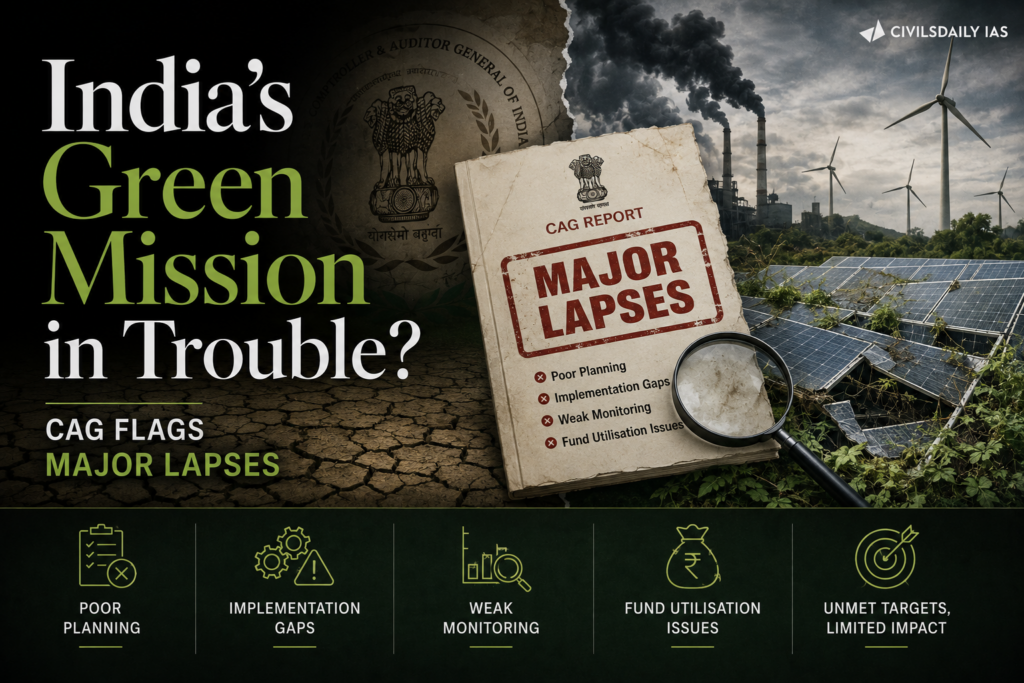
A Comptroller and Auditor General audit of the Green India Mission across 16 states and union territories found a 91.87 per cent shortfall against its forest quality improvement target and a 97.57 per cent shortfall against its forest cover target over ten years. The mission received Rs 1,149.14 crore, or 47.88 per cent, of the budgetary support it was to get. The tension is between a mission carrying India’s forest carbon sink commitment and a funding and convergence design that never materialised.
What is the Green India Mission?
About: The Green India Mission is one of the eight missions under the National Action Plan on Climate Change, launched in 2014 by the Ministry of Environment, Forest and Climate Change.
Twin targets: Increasing forest and tree cover on 5 million hectares, and improving the quality of forest cover on another 5 million hectares.
Design principle: The mission was to work through convergence with existing schemes rather than through a large standalone budget.
Climate function: It carries the forestry component of India’s Nationally Determined Contribution under the Paris Agreement.
What did the audit find on physical targets?
Quality improvement: Forest cover quality improved on only 0.11384 million hectares against a 1.4 million hectare target, a shortfall of 91.87 per cent.
Cover increase: Forest cover increased on only 0.03409 million hectares against a 1.4 million hectare target, a shortfall of 97.57 per cent.
Audit period: The audit covered 2015-16 to 2024-25 across 16 states and union territories.
Accounting failure:Eight states and union territories did not maintain annual accounts for the mission.
Why did the funding architecture fail?
Proposed requirement: The mission’s proposed funding requirement was Rs 40,600 crore.
What was approved: The Cabinet Committee on Economic Affairs approved Rs 2,000 crore for the first four years, alongside Rs 400 crore from Thirteenth Finance Commission grants.
What was received: Only Rs 1,149.14 crore, or 47.88 per cent of even that reduced budgetary support, reached the mission over ten years.
Structural consequence: A mission funded at under 3 per cent of its assessed requirement could not deliver targets set against the full requirement.
Why did convergence not happen?
Intended partners: Convergence was planned with the Compensatory Afforestation Fund Management and Planning Authority, the Mahatma Gandhi National Rural Employment Guarantee Scheme, the Nagar Van Yojana and the School Nursery Yojana.
What the audit found: These schemes operated in silos, and convergence was not achieved.
Design dependence: The mission’s low budget was justified on the assumption that convergence would supply the resources, so the failure of convergence removed the funding basis entirely.
Accountability gap: No single authority was answerable for delivering convergence across ministries.
What does this mean for India’s climate commitment?
The commitment: India’s Nationally Determined Contribution includes creating an additional carbon sink of 2.5 to 3 billion tonnes of carbon dioxide equivalent by 2030 through additional forest and tree cover.
Delivery vehicle: The Green India Mission is the principal instrument for the forestry component of that commitment.
Arithmetic problem: Cover added on 0.03409 million hectares cannot support a sink target premised on 5 million hectares.
Reporting risk: The gap between the reported forest cover figures and the audited mission achievement raises a measurement question about what counts as forest cover.
Challenges to India’s afforestation programmes
Plantation survival rates: Trees planted are counted, trees surviving are not. e.g. audits repeatedly finding low survival in compensatory afforestation plantations.
Monoculture plantation: Fast growing single species plantations raise canopy cover without restoring biodiversity. e.g. eucalyptus and acacia plantations counted as forest cover gains.
Definition of forest cover: The forest survey definition counts any land above one hectare with over 10 per cent canopy, including plantations and orchards. e.g. commercial plantations appearing as forest cover increases.
Compensatory afforestation land shortage: States lack non forest land of the required extent to compensate diversion. e.g. the accumulation of unspent Compensatory Afforestation Fund balances before the 2016 Act.
Community rights friction: Plantation on land under claim conflicts with recognised forest rights. e.g. disputes over plantation drives on land claimed under the Forest Rights Act, 2006.
Convergence without an owner: Cross ministry convergence has no accountable authority. e.g. the Green India Mission’s four named partner schemes operating in silos through the audit period.
Conclusion
The mission failed because its target was set against an assessed requirement of Rs 40,600 crore while its funding was built on a convergence assumption that no authority was made accountable for delivering. The shortfall is therefore a design failure rather than an implementation lapse. The next milestone is whether the government restructures the mission’s funding or restates the forestry component of the Nationally Determined Contribution.
Back2Basics: National Action Plan on Climate Change
Launched in 2008 to outline India’s strategy on climate adaptation and mitigation.
Comprises eight national missions: Solar, Enhanced Energy Efficiency, Sustainable Habitat, Water, Sustaining the Himalayan Ecosystem, Green India, Sustainable Agriculture, and Strategic Knowledge for Climate Change.
Coordinated by the Prime Minister’s Council on Climate Change.
States prepare State Action Plans on Climate Change aligned to the national missions.
The Green India Mission was approved by the Cabinet Committee on Economic Affairs in 2014 with a mandate covering 10 million hectares in total.
Government Initiatives
Compensatory Afforestation Fund Act, 2016: Governs the use of funds collected for forest land diversion, with a national authority and state authorities managing the corpus.
Nagar Van Yojana: Supports the creation of urban forests on forest or other land within municipal limits, targeting city residents and local bodies.
National Mission for a Green India: Targets 5 million hectares of new cover and 5 million hectares of quality improvement.
Mission LiFE: Promotes individual and community behaviour change on sustainable consumption.
School Nursery Yojana: Engages schools in raising seedlings to build a nursery base and environmental awareness.
Way Forward
Fund the mission against its assessed requirement: Close the gap between the Rs 40,600 crore requirement and the Rs 1,149.14 crore released, or restate the targets.
Appoint an accountable convergence authority: Name one authority answerable for delivering convergence across the four partner schemes.
Report survival, not planting: Measure achievement through third party verified survival after three years, not through saplings planted.
Separate plantation from natural forest in reporting: Report plantation area distinctly from natural forest cover so the carbon sink claim is verifiable.
Enforce annual accounts: Make release of the next instalment conditional on maintained annual accounts, since eight states did not maintain them.
“[2016] Which of the following best describes/ describe the aim of ‘Green India Mission’ of the Government of India?
1. Incorporating environmental benefits and costs into the Union and State Budgets thereby implementing the ‘green accounting’
2. Launching the second green revolution to enhance agricultural output so as to ensure food security to one and all in the future
3. Restoring and enhancing forest cover and responding to climate change by a combination of adaptation and mitigation measures
Select the correct answer using the code given below.
Dhaka has made the extradition of the former Bangladesh Prime Minister a precondition for a planned bilateral visit, and Indian officials state the request must go before Indian courts rather than being settled diplomatically. The route runs through the India Bangladesh Extradition Treaty, 2013 and the Extradition Act, 1962. The tension is between a treaty designed to remove the political offence defence for serious crimes and a request whose political character is contested.
What is the India Bangladesh Extradition Treaty, 2013?
About: The treaty, signed in 2013, provides for extradition between India and Bangladesh for offences punishable by at least one year of imprisonment.
Dual criminality: The conduct must constitute an offence in both countries for extradition to proceed.
Political offence exception:Article 6 allows refusal where the offence is of a political character, subject to a list of carve outs.
The carve outs:Twelve categories, including murder, terrorism related offences and kidnapping, are expressly excluded from the political offence defence.
2016 amendment: The evidentiary requirement was relaxed so that a warrant issued by a competent court of the requesting state suffices, without prima facie evidence.
How does an extradition request actually proceed in India?
Request stage: The request is received through diplomatic channels and processed by the Consular, Passport and Visa Division of the Ministry of External Affairs.
Magisterial inquiry: The central government may direct a magistrate to conduct an inquiry into the request.
Judicial finding: The magistrate reports whether a prima facie case for surrender is made out.
Executive decision: The final surrender decision rests with the central government, which may still refuse.
Judicial review: The order is subject to challenge in the High Court and the Supreme Court, which is what makes the process a judicial one in practice.
Why is this request legally contested?
Sentence in absentia: The International Crimes Tribunal in Bangladesh awarded a death sentence in November 2025 for crimes against humanity, delivered in absentia.
Fair trial objection: In absentia trials and death sentences are challenged as inconsistent with international fair trial standards.
Political character claim: The defence argues the prosecution arises from a change of government, engaging Article 6 of the treaty.
Carve out counter: The offences charged fall within categories the treaty excludes from the political offence defence.
Comparable precedent: The same fair trial objection was raised against the Syrian court’s in absentia death sentences delivered on 11 August 2026 for the Daraa crackdown.
What is the diplomatic cost of the dispute?
Visit at risk: The planned bilateral visit on 21 August is in doubt because extradition has been made a precondition.
Regional forum linkage: The Bangladesh leadership was invited to a multilateral summit as chair of the Bay of Bengal Initiative for Multi Sectoral Technical and Economic Cooperation, so the bilateral rift affects a regional grouping.
Trigger event: A press conference held in Delhi by the former Prime Minister on 5 August hardened Dhaka’s position.
Possible resolution: Officials note the question becomes moot if the former Prime Minister returns to Bangladesh voluntarily in December as she has said she will.
Challenges in India’s extradition practice
Low success rate: India secures a small fraction of the fugitives it seeks. e.g. the prolonged proceedings in the United Kingdom over economic offenders sought by India.
Prison conditions objection: Requested states refuse surrender citing Indian prison standards. e.g. the assurances India had to give on Barrack 12 of Arthur Road Jail in the Vijay Mallya proceedings.
Human rights and death penalty bar: Many states will not extradite where the death penalty may be imposed. e.g. the assurances routinely sought by European states before surrender.
Treaty coverage gaps: India has extradition treaties with a limited set of countries and arrangements with others. e.g. the absence of a treaty with several jurisdictions where fugitives relocate.
Political offence litigation: The political character defence generates prolonged appellate litigation. e.g. the multi year appellate process in cases involving asylum claims.
Reciprocity expectations: A refusal in one direction weakens the case for cooperation in the other. e.g. India’s own pending requests to Bangladesh for insurgent leaders sheltered across the border.
Conclusion
Routing the request to the courts converts a bilateral demand into a judicial question that the executive cannot concede quickly, which is itself the diplomatic outcome India has chosen. The treaty’s twelve carve outs make the political offence defence hard to sustain, while the in absentia death sentence supplies an independent ground for refusal. The next milestone is whether the 21 August visit proceeds, and whether a formal extradition request is filed for magisterial inquiry.
Back2Basics: Extradition Act, 1962
Governs the extradition of fugitive criminals from India to foreign states and the receipt of fugitives into India.
Applies to treaty states under Chapter II, and permits extradition to non treaty states through a notified arrangement.
Requires that the offence be an extradition offence, defined as one punishable with imprisonment of at least one year under the laws of both countries.
Provides for a magisterial inquiry, with the magistrate reporting to the central government on whether a prima facie case exists.
Bars extradition for an offence of a political character, subject to the exclusions in the applicable treaty.
The Ministry of External Affairs is the central authority for processing requests.
Way Forward
Keep the process judicial: Insist on the statutory magisterial inquiry route, since a diplomatic surrender would set a precedent against India’s own pending requests.
Seek assurances on sentence: Obtain an undertaking against execution before any surrender, consistent with international practice on capital cases.
De link the bilateral agenda: Continue trade, connectivity and water cooperation tracks independently of the extradition question.
Use the regional forum: Sustain engagement through the Bay of Bengal grouping so the bilateral rift does not stall regional cooperation.
Press reciprocal requests: Pursue India’s own outstanding extradition requests to Bangladesh in the same process, establishing symmetry.
[2013, GS2, 10 marks] The protests in Shahbag Square in Dhaka in Bangladesh reveal a fundamental split in society between the nationalists and Islamic forces. What is its significance for India?”
The Mecca Joint Defence Agreement, signed on 7 August 2026 by Saudi Arabia, Pakistan and Turkiye, takes its name from Islam’s holiest city. The naming choice is read as a deliberate framing device that lets each signatory claim a different benefit from the same text. The tension is between the civilisational legitimacy the name projects and the narrow, technical liabilities the agreement’s legal text actually creates.
What is the Mecca Joint Defence Agreement?
About: The Mecca Joint Defence Agreement is a trilateral defence arrangement between Saudi Arabia, Pakistan and Turkiye, signed on 7 August 2026.
Naming: The agreement is named for the city of Mecca, which carries religious authority across the Muslim world.
Legal character: The operative text keeps mutual obligations technical and limited, rather than creating an automatic collective defence commitment.
Point of interest: The gap between the symbolic name and the limited legal commitment is the substance of the analysis.
Why does the name carry strategic work?
Saudi objective: The name lets Riyadh reassert leadership of the Muslim world by anchoring a security arrangement in custodianship of the holy cities.
Pakistani objective: Islamabad can present the arrangement domestically as a holy alliance, converting a defence pact into religious legitimacy.
Turkish objective: Ankara can frame defence exports as civilisational solidarity rather than as commerce.
Shared function: One name allows three different domestic narratives without changing a word of the text.
What is the comparable precedent in agreement naming?
Abraham Accords, 2020: The normalisation agreements between Israel and several Arab states were named for the shared patriarch of Judaism, Christianity and Islam.
Stated rationale: The naming was explained at the time as invoking a common religious ancestry to frame a political settlement.
Effect achieved: The name softened a security and recognition arrangement into a civilisational reconciliation.
Parallel drawn: The Mecca naming performs the same function for a defence arrangement, transferring the technique from normalisation to security.
What does the arrangement mean for India?
Pakistan’s external depth: A formal defence link with Saudi Arabia and Turkiye enlarges Pakistan’s strategic and financial backing.
Gulf relationship: India’s ties with Saudi Arabia rest on energy supply, remittances from a large expatriate workforce and defence cooperation, which the arrangement does not displace.
Turkiye divergence: Ankara’s position on Kashmir at multilateral forums remains the sharpest point of difference with India.
Limits of the pact: The technical character of the obligations restricts how far Pakistan can invoke it in a bilateral contingency.
Where does the analysis turn against its own framing?
Symbolism versus obligation: A powerful name does not create an automatic defence commitment, and the text deliberately avoids one.
Divergent interests: Saudi Arabia’s normalisation track with Israel and Turkiye’s position on Gaza are not aligned, which limits joint action.
Reading risk: Treating the name as evidence of a bloc overstates cohesion the signatories have not committed to.
The real signal: The arrangement marks a shift toward regional security architectures built outside United States security guarantees.
Challenges to reading the pact as a bloc
Absence of an automatic trigger: The text creates consultation obligations rather than an attack on one is an attack on all clause. e.g. the contrast with Article 5 of the North Atlantic Treaty.
Divergent Israel policy: Signatories differ on normalisation with Israel. e.g. Saudi Arabia’s suspended normalisation track against Turkiye’s public position on Gaza.
Financing dependence: Pakistan’s participation rests on financial support rather than reciprocal capability. e.g. repeated Saudi deposits with the State Bank of Pakistan during balance of payments stress.
Competing regional groupings: Overlapping arrangements dilute exclusivity. e.g. the Gulf Cooperation Council and the Organisation of Islamic Cooperation covering the same members with different mandates.
Defence supply asymmetry: Turkish defence exports create a supplier and buyer relationship, not an alliance of equals. e.g. Turkish drone sales across West Asia and North Africa.
Iran factor: Any Sunni framed security architecture invites an Iranian counter alignment. e.g. the Iran Saudi normalisation of 2023 that the pact’s framing strains.
Conclusion
The naming of the agreement is the substantive act, since it manufactures a civilisational legitimacy that the legal text neither requires nor delivers. For India, the operative question is not the pact’s symbolism but whether Saudi Arabia’s energy and remittance relationship with India changes, which it has not. The next milestone is whether the signatories convert consultation obligations into a standing joint command or joint exercise schedule.
Back2Basics: India and Saudi Arabia
Diplomatic relations were established in 1947, with the relationship upgraded through the Delhi Declaration of 2006 and the Riyadh Declaration of 2010.
The Strategic Partnership Council was established in 2019, with two ministerial committees covering political and security cooperation, and economy and investments.
Saudi Arabia is among India’s top crude oil suppliers and hosts one of the largest Indian expatriate populations.
India and Saudi Arabia conduct the Al Mohed Al Hindi naval exercise.
Saudi Arabia is a partner in the India Middle East Europe Economic Corridor announced at the G20 summit in New Delhi in 2023.
Way Forward
Deepen the Gulf economic anchor: Convert the Strategic Partnership Council commitments into dated investment and energy supply agreements.
Separate the Turkiye and Saudi tracks: Treat Ankara’s Kashmir position as a bilateral issue rather than allowing it to define the wider Gulf relationship.
Institutionalise defence exchanges: Expand joint exercises and defence industrial cooperation with Gulf partners to keep the relationship independent of third party arrangements.
Secure the energy corridor: Reduce single chokepoint exposure given that a large share of imports transit the Strait of Hormuz.
Engage the Organisation of Islamic Cooperation constructively: Sustain outreach so multilateral resolutions do not consolidate against India by default.
“[2023, GS2, 15 marks] ‘The expansion and strengthening of NATO and a stronger US-Europe strategic partnership works well in India.’ What is your opinion about this statement? Give reasons and examples to support your answer.”
A three day food safety enforcement drive across more than 60 starred hotels seized 640 kg of meat, fish and poultry, 276 kg of mould affected vegetables and about 49 litres of used or non compliant cooking oil. A chemical was found in use to treat spent frying oil at one outlet, which is the specific practice the Repurpose Used Cooking Oil framework exists to prevent. The tension is between an inspection led enforcement model and an industry demanding scheduled, consultative compliance.
What is the Repurpose Used Cooking Oil initiative?
About: Repurpose Used Cooking Oil (RUCO) is the Food Safety and Standards Authority of India framework that diverts spent frying oil out of the food chain into biodiesel production.
How it works: A food business generating used cooking oil hands it to an agency authorised by the regulator. That agency then converts the collected oil into biodiesel.
Record keeping obligation: A business frying with more than 50 litres a day must maintain disposal records.
Collection scale: Karnataka collected about 45.9 lakh litres of used cooking oil between 2024 and 2026 through four recognised agencies.
What is the total polar compound limit?
About: Total polar compounds are the degradation products that accumulate in cooking oil through repeated heating, and they serve as the measurable index of oil deterioration.
Regulatory threshold: The Food Safety and Standards Authority of India caps total polar compounds at 25 per cent, beyond which the oil must not be used for cooking.
Why it is enforced: Consumption of oil above this threshold is associated with cardiovascular and metabolic harm.
What did the drive actually find?
Coverage:30 teams inspected over 60 three and five star hotels, collecting 77 samples.
Seizures:640 kg of mutton, chicken and fish, 276 kg of rotten or mould affected vegetables, 45 litres of expired milk and curd, 12 kg of expired bakery products and 67 kg of mislabelled or expired cereals.
Violation types: Expired products, non compliant labelling, misbranding, improper storage of meat and fish, fungal growth, inadequate segregation of vegetarian and non vegetarian stock, and shelf life declarations exceeding the permissible period.
Oil treatment practice: A chemical agent was found in use to visually restore used frying oil at one outlet, which masks degradation rather than reversing it.
Government premises: Inspections on 12 August covered the state secretariat, the legislators’ hostel, subsidised community canteens and a health department canteen, where expired semolina and coconut powder were seized.
Quick commerce warehouses: Two dark store warehouses were inspected and one was sealed.
How does food safety enforcement actually proceed?
Notice stage: The designated officer issues a notice to the food business operator on an adverse finding.
Hearing stage: A personal hearing follows, after which fines may be imposed and a compliance report sought.
Prosecution route: A sample found unsafe on analysis at a referral laboratory proceeds to prosecution before the Judicial Magistrate First Class court.
Testing volume: About 45,000 samples are analysed annually in the state.
Adulteration versus misbranding: Misbranding and substandard findings attract monetary penalty, while unsafe food attracts criminal prosecution, which is why laboratory confirmation is the pivot.
What are the health consequences the drive is guarding against?
Monsoon enteric infections: Typhoid and hepatitis A rise in the monsoon months through contaminated food and water.
Secondary neurological sequela: Guillain Barre syndrome occurs as a secondary consequence of certain enteric infections.
Acute liver failure: Hepatitis A and hepatitis E can progress to acute liver failure.
Renal consequence: Shiga toxin producing Escherichia coli can cause haemolytic uraemic syndrome, presenting as proteinuria, hypertension and reduced kidney function.
Processed meat classification: The World Health Organization classifies processed meat as carcinogenic to humans, with the strongest association for colorectal cancer.
Where does the industry position diverge from the regulator?
Frequency demand: Hotel associations seek quarterly scheduled inspections rather than unannounced drives.
Simplification demand: Operators cite roughly 100 separate guidelines and want consolidated standard operating procedures.
Regulator position: Public health is placed ahead of revenue, with taluk level surveillance teams under examination.
The unresolved point: Scheduled inspection defeats the detection value of surprise inspection, which is what the seizures relied on.
Challenges in food safety regulation
Testing infrastructure: Laboratory capacity limits how many samples can be analysed and how fast. e.g. about 45,000 samples analysed annually against lakhs of registered food businesses in one state.
Licensing versus inspection: Registration counts rise faster than the inspector cadre. e.g. the expansion of quick commerce dark stores inspected only after they became visible.
Prosecution delay: Cases before magistrate courts take years, weakening deterrence. e.g. adulteration prosecutions pending well beyond the shelf life of the evidence.
Used oil leakage: Spent frying oil re enters the food chain through informal buyers rather than authorised agencies. e.g. chemical treatment of used oil detected at a fast food outlet during this drive.
Street food coverage: Unregistered vendors sit largely outside the inspection net. e.g. the limited reach of hygiene rating schemes beyond organised outlets.
Imported and repacked products: Repacked imported goods carry labelling that cannot be verified at the point of sale. e.g. repacked imported products found during this drive.
Conclusion
The drive shows that enforcement capacity, not the absence of standards, is the operative gap, since every violation found was against a rule already in force. The used cooking oil finding matters most, because it is the point where a documented diversion system exists on paper and fails in practice. The next milestone is whether taluk level surveillance teams are constituted, which would convert episodic drives into continuous inspection.
Back2Basics: Food Safety and Standards Authority of India
Established under the Food Safety and Standards Act, 2006, which replaced the Prevention of Food Adulteration Act, 1954.
Functions under the Union Ministry of Health and Family Welfare, headed by a Chairperson and a Chief Executive Officer.
Consolidated eight earlier laws and orders governing food into a single statute.
Lays down science based standards for articles of food and regulates manufacture, storage, distribution, sale and import.
Operates a licensing and registration system for food business operators, with state Food Safety Commissioners handling enforcement.
Runs Eat Right India, RUCO, Food Safety on Wheels and the hygiene rating scheme.
Laws and Rules Governing Food Safety
Food Safety and Standards Act, 2006: Establishes the regulator and consolidates the law on food standards and enforcement. Section 24 prohibits misleading advertisements about food. Section 30(2)(a) empowers the Commissioner of Food Safety to prohibit the manufacture, sale or distribution of an article of food in the public interest. Section 53 provides a penalty of up to Rs 10 lakh for a misleading advertisement.
Food Safety and Standards (Licensing and Registration of Food Businesses) Regulations, 2011: Govern registration and licensing thresholds for food businesses.
Food Safety and Standards (Packaging and Labelling) Regulations, 2011: Prescribe mandatory label declarations, including shelf life.
Food Safety and Standards (Food Products Standards and Food Additives) Regulations, 2011: Set the 25 per cent total polar compound limit for cooking oil.
Way Forward
Constitute taluk level surveillance teams: Replace episodic city drives with continuous local inspection capacity.
Close the used oil loop: Make disposal records to authorised agencies a licence condition for any business frying above the 50 litre threshold.
Consolidate the guidelines: Issue a single standard operating procedure for hotels and restaurants, since roughly 100 separate guidelines invite non compliance through complexity.
Expand laboratory capacity: Increase accredited testing throughput so unsafe sample findings reach prosecution within the product’s shelf life.
Bring quick commerce warehouses into routine inspection: Register dark stores as food business operators with scheduled inspection obligations.
Matching Previous Year Question
“[2018] Consider the following statements: 1. The Food Safety and Standards Act, 2006 replaced the Prevention of Food Adulteration Act, 1954. 2. The Food Safety and Standard Authority of India (FSSAI) is under the charge of Director General of Health Services in the Union Ministry of Health and Family Welfare. Which of the statements given above is/are correct? (a) 1 only (b) 2 only (c) Both 1 and 2 (d) Neither 1 nor 2 Answer: (a)”
A Comptroller and Auditor General performance audit of passenger amenities and sanitation found that 458 of 512 audited railway stations, nearly 89 per cent, were deficient in one or more minimum essential amenities. The shortfall persisted while the annual allocation rose from about Rs 3,900 crore to Rs 14,072 crore in 2023-24. The tension is between a large capital modernisation programme and the unmet basic amenity standard the railway itself has notified.
What is a minimum essential amenity?
About: Minimum essential amenities are the facilities Indian Railways is required to provide at every station regardless of category, distinct from desirable or recommended amenities.
Coverage: They include drinking water, seating, platform shelter, latrines, urinals, fans, lighting and a clock.
Why the category matters: These are not aspirational upgrades, so a shortfall is a failure against the railway’s own mandatory standard.
What did the audit actually find?
Overall deficiency:458 of 512 stations audited were deficient in one or more minimum essential amenities, and only 54 stations, 11 per cent, had no shortfall.
Amenity wise gaps: Fans were missing at 42 per cent of stations, water coolers at 40 per cent, drinking water taps at 27 per cent, urinals at 22 per cent, seating at 15 per cent, platform shelters at 13 per cent, latrines at 12 per cent and clocks at 12 per cent.
Sample base: The sample was drawn from 5,908 stations across 16 zones, running 7,424 passenger trains daily and serving 292.4 crore passengers in 2023-24.
Non modernised share:325 of the 512 audited stations were outside the Amrit Bharat Station Scheme.
Accessibility gap: Ramps, tactile pathways, lifts, accessible toilets and announcements for persons with disabilities were inadequate and non compliant.
Why did higher allocation not translate into amenities?
Utilisation shortfall: Year on year underutilisation of the allocated budget ran at 36 to 44 per cent.
Allocation discontinuity: The budget sat near Rs 3,200 to Rs 3,900 crore from 2019-20 to 2022-23, then jumped to Rs 14,072 crore in 2023-24, faster than execution capacity grew.
Programme concentration: Modernisation attention has focused on the Amrit Bharat Station Scheme stations, while most audited deficiencies sat at the 325 stations outside it.
Absent planning instrument: The audit found no station wise time bound action plan against which shortfalls could be tracked and closed.
What does this say about audit’s role in policy implementation?
Scope of the audit: The audit examined delivery against the railway’s own notified amenity standard, not the merit of the modernisation policy.
Constitutional basis: The Comptroller and Auditor General’s powers over Union and state accounts derive from Article 149.
Propriety dimension: Auditing whether sanctioned money produced the mandated outcome is a propriety question, not merely a legality question.
Recommendation: The audit recommends station wise time bound action plans, which converts a diagnostic finding into a management instrument.
Challenges in railway passenger amenity delivery
Capital bias in allocation: Spending concentrates on visible redevelopment rather than on recurring maintenance. e.g. the Amrit Bharat Station Scheme covering over 1,300 stations while basic fans and taps remain absent elsewhere.
Execution capacity ceiling: A sudden allocation jump outruns the tendering and contracting machinery. e.g. 36 to 44 per cent annual underutilisation despite a rising budget.
Maintenance versus creation: Created assets degrade without a funded maintenance line. e.g. installed water coolers found non functional across audited stations.
Accessibility non compliance: Statutory accessibility obligations remain unmet at most stations. e.g. tactile pathways and accessible toilets found inadequate in the audit sample.
Small station neglect: Low footfall stations fall outside modernisation schemes and outside political attention. e.g. 325 of the 512 audited stations sitting outside the Amrit Bharat Station Scheme.
Outcome measurement: Performance is reported as stations sanctioned rather than as amenities functioning. e.g. the absence of any station wise time bound action plan noted by the audit.
Conclusion
The audit shows that the constraint is not money but the capacity to convert money into functioning amenities, since underutilisation ran between 36 and 44 per cent while deficiency stayed near 89 per cent. Modernisation of a selected 1,300 stations does not substitute for the mandatory amenity standard owed at all 5,908. The next milestone is whether the railway adopts the station wise time bound action plans the audit has recommended.
Back2Basics: Comptroller and Auditor General of India
Established under Article 148, appointed by the President and removable only in the manner of a Supreme Court judge.
Holds office for six years or until the age of 65, whichever is earlier.
Powers and conditions of service are governed by the Comptroller and Auditor General’s (Duties, Powers and Conditions of Service) Act, 1971.
Article 149 defines duties in relation to the accounts of the Union, the states and other authorities.
Audit reports are laid before Parliament under Article 151 and examined by the Public Accounts Committee.
Conducts financial, compliance and performance audits, the last of which examines economy, efficiency and effectiveness.
Government Initiatives
Amrit Bharat Station Scheme: Launched in 2022 to modernise over 1,300 stations through master planning, targeting passengers at medium and small stations.
Rail Kaushal Vikas Yojana: Provides skill training to youth using railway training infrastructure.
Swachh Rail Swachh Bharat: Extends the sanitation mission to station and coach cleanliness, with third party cleanliness ranking of stations.
Accessible India Campaign: Requires accessibility retrofitting of public transport infrastructure including railway stations.
Way Forward
Adopt station wise action plans: Publish a dated closure plan for every deficient amenity at every audited station.
Fund maintenance separately: Create a protected maintenance head so created assets do not degrade into the same deficiency.
Prioritise non scheme stations: Direct amenity spending first to the stations outside the modernisation scheme, where the audit found most gaps.
Report functioning, not sanction: Measure performance by amenities working on inspection date, not by units installed.
Enforce accessibility standards: Bring station infrastructure into compliance with the Rights of Persons with Disabilities Act, 2016 obligations.
Matching Previous Year Question
“[2016, GS2, 12.5 marks] Exercise of CAG’s powers in relation to the accounts of the Union and the States is derived from Article 149 of the Indian Constitution. Discuss whether audit of the Government’s Policy implementation could amount to overstepping its own (CAG) jurisdiction.”
After the Special Intensive Revision draft rolls are published on 17 August, 119 Electoral Registration Officers in Telangana must serve notices and hold hearings for about 94 lakh electors within 60 days. In Karnataka, the state Chief Electoral Officer has not clarified whether the Permanent Residential Certificate will be accepted as proof. The tension is between a document driven verification exercise and the field capacity to conduct quasi judicial hearings at that scale inside a fixed statutory clock.
What is the Special Intensive Revision?
About: The Special Intensive Revision (SIR) is a full re verification of the electoral roll in which every existing entry must be re established against a previous intensive revision, rather than merely updated.
Baseline used: Existing entries are matched against the final rolls of the 2002 SIR, and an entry that cannot be matched is treated as unmapped.
Field method: Booth Level Officers are required to make three household visits to deliver and collect Enumeration Forms.
Adjudication stage: Electoral Registration Officers exercise quasi judicial powers to decide inclusion after a hearing.
Distinction from summary revision: A summary revision only processes additions, deletions and corrections, so the burden of proof rests with the claimant, not with every existing elector.
What is the scale of the pending caseload?
Telangana total: About 94 lakh electors face notices and hearings.
Unmapped electors: Over 32 lakh could not be matched against the 2002 SIR final rolls.
Officer load:119 Electoral Registration Officers must complete the process by 15 October 2026.
Karnataka position: Over 28 lakh unmapped voters must produce one of the Election Commission’s 11 indicative documents.
Where has the field process broken down?
Household visits not made: Booth Level Officers largely collected Enumeration Forms at central collection points instead of making the mandated three household visits.
Consequence of that shortcut: Electors who were absent, migrant or immobile were least likely to be reached, which is the group most likely to appear as unmapped.
Documentary ambiguity: The Permanent Residential Certificate is listed by the Election Commission as an indicative document, but Karnataka has not confirmed acceptance.
Existing precedent: In the West Bengal SIR, the Commission agreed to accept Permanent Residential Certificates conforming to specified state government orders, subject to independent verification by the Electoral Registration Officer.
Why does the document question decide the outcome?
Burden reversal: An unmapped elector must positively establish eligibility, so the acceptable document list is the operative rule.
Certificate availability: Permanent Residential Certificates and caste certificates are issued by state revenue authorities, whose issuance capacity now gates franchise.
Parallel administrative load: Karnataka is simultaneously running a doorstep caste certificate drive, which competes for the same revenue machinery.
Uniformity issue: A document accepted in one state’s revision and not in another produces different franchise standards across states within the same exercise.
Challenges to the electoral roll revision process
Compressed adjudication timelines: Quasi judicial hearings at mass scale cannot be individually reasoned in 60 days. e.g. 119 officers in Telangana handling 94 lakh cases to a 15 October deadline.
Migrant exclusion: Internal migrants are absent at their registered address during enumeration. e.g. seasonal construction and agricultural migrants missing all three visit windows.
Documentary burden on the poor: Those without inherited land or formal residence records struggle to produce accepted proof. e.g. urban informal settlement residents lacking Permanent Residential Certificates.
Inconsistent document lists: Acceptance standards have varied between state revisions. e.g. the differing treatment of Permanent Residential Certificates in West Bengal and Karnataka.
Booth Level Officer capacity: Officers are drawn from other departments and carry the revision as additional duty. e.g. the substitution of central collection points for mandated household visits in Telangana.
Appeal channel congestion: Appeals lie to the District Magistrate and then the Chief Electoral Officer, both of whom face the same volume compression. e.g. the appellate backlog generated by mass deletion in earlier intensive revisions.
Conclusion
The revision has shifted the burden of proof from the state to the elector, so the exercise now turns entirely on which documents an Electoral Registration Officer will accept and how much time each hearing gets. The failure to make household visits is what converted an administrative exercise into a mass adjudication problem. The next milestone is the publication of the draft roll on 17 August and the disposal record of the 60 day hearing window that follows.
Back2Basics: Electoral Registration Officer
Appointed by the Election Commission of India in consultation with the state government for every Assembly constituency.
Draws authority from Section 13B of the Representation of the People Act, 1950.
Responsible for preparation, revision, correction and publication of the electoral roll for the constituency.
Exercises quasi judicial powers when deciding claims and objections, requiring a hearing before deletion.
Orders are appealable to the District Magistrate, and thereafter to the Chief Electoral Officer of the state.
Constitutional Framework Governing Elections
Article 324: Vests superintendence, direction and control of elections in the Election Commission of India.
Article 325: Bars exclusion from, or claim to inclusion in, an electoral roll on grounds of religion, race, caste or sex.
Article 326: Establishes adult suffrage as the basis of elections to the Lok Sabha and state legislative assemblies.
Article 327: Empowers Parliament to make laws on all matters relating to elections to Parliament and state legislatures.
Representation of the People Act, 1950: Governs preparation and revision of electoral rolls, and the appointment of Electoral Registration Officers.
Way Forward
Publish a uniform document list: Notify a single national list of acceptable proofs, so franchise standards do not differ by state.
Extend the hearing window where volumes are high: Match the adjudication period to caseload rather than to a fixed 60 days.
Audit the household visit record: Verify Booth Level Officer visit compliance before treating an elector as unmapped.
Provide a migrant channel: Allow verification at the current place of residence for electors registered elsewhere.
Publish disposal data: Report hearings held, deletions made and appeals allowed, so the revision’s accuracy can be independently assessed.
Matching Previous Year Question
“[2017, GS2, 15 marks] To enhance the quality of democracy in India the Election Commission of India has proposed electoral reforms in 2016. What are the suggested reforms and how far are they significant to make democracy successful?”
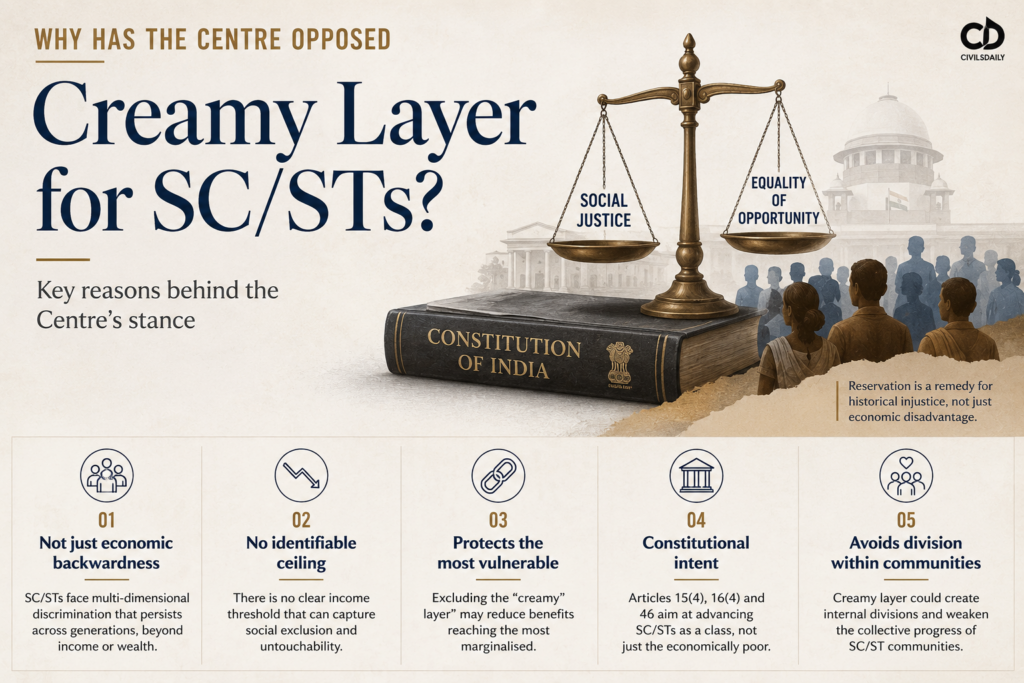
The Union government reiterated before the Supreme Court that the creamy layer exclusion does not apply to Scheduled Caste and Scheduled Tribe classification. The position runs against a separate opinion in the 2024 sub categorisation ruling that urged the Court to consider extending the exclusion. The tension is between the constitutional premise that Scheduled Caste and Scheduled Tribe disadvantage is social rather than economic, and evidence that reservation benefits concentrate within a few advanced sub groups.
What is the creamy layer?
About: The creamy layer is the economically and socially advanced section within a reserved category, excluded from reservation benefits so that the quota reaches the genuinely disadvantaged.
Origin: The exclusion was mandated for Other Backward Classes in Indra Sawhney vs Union of India (1992).
Mechanism: Exclusion operates through an income and status ceiling, currently Rs 8 lakh of annual family income for Other Backward Classes, alongside constitutional post and service rank criteria.
Point of dispute: The doctrine has never been extended to Scheduled Castes and Scheduled Tribes, whose identification rests on untouchability and social exclusion rather than income.
Current Status of Reservation in India
Category shares: Scheduled Castes hold 15 per cent, Scheduled Tribes 7.5 per cent, and Other Backward Classes 27 per cent subject to the creamy layer exclusion.
Economically Weaker Sections: A further 10 per cent applies to those outside the reserved categories, introduced by the 103rd Constitutional Amendment.
Ceiling position: The 50 per cent ceiling set in Indra Sawhney stands, and the Economically Weaker Sections quota was upheld in 2022 as sitting outside it.
Sub categorisation: States may sub categorise within the Scheduled Caste and Scheduled Tribe lists after the 2024 ruling, but exclusion of individuals remains barred.
Central practice: The only central use of sub categorisation within the Scheduled Tribe quota is in Eklavya Model Residential Schools, which reserve minimum representation for Particularly Vulnerable Tribal Groups.
Constitutional Provisions Related to Reservation
Article 15(4) and 15(5): Permit special provisions for the advancement of socially and educationally backward classes, Scheduled Castes and Scheduled Tribes, including in educational institutions.
Article 16(4): Permits reservation in appointments for any backward class not adequately represented in state services.
Article 16(4A): Permits reservation in promotion with consequential seniority for Scheduled Castes and Scheduled Tribes.
Article 335: Requires that claims of Scheduled Castes and Scheduled Tribes be considered consistently with the maintenance of administrative efficiency.
Article 341 and Article 342: Empower the President to specify the Scheduled Castes and Scheduled Tribes for each state, with Parliament alone able to include or exclude from the list.
103rd Constitutional Amendment, 2019: Inserted Articles 15(6) and 16(6) creating the Economically Weaker Sections quota.
What did the Davinder Singh ruling actually decide?
Sub categorisation permitted: A seven judge Bench in August 2024 held that states may sub categorise within the Scheduled Caste and Scheduled Tribe lists to give preference to the most backward within them.
Homogeneity rejected: The Bench held that Scheduled Castes are not a homogeneous class, which is the premise sub categorisation rests on.
The separate opinion: One judge wrote separately that the creamy layer principle applied to Other Backward Classes in Indra Sawhney should be considered for Scheduled Castes and Scheduled Tribes.
Status of that view: The separate opinion did not create a binding direction, which is the gap the current litigation is testing.
What is the government’s stated objection?
Parliamentary competence: The power to include or exclude any community or individual from the Scheduled Caste and Scheduled Tribe lists rests solely with Parliament under Articles 341 and 342.
Precedent claim: No binding judicial precedent has ever mandated a creamy layer for Scheduled Castes and Scheduled Tribes.
Process objection: Any change should follow a holistic review and an empirical study, and should not arrive through judicial direction.
Basis of identification: Scheduled Caste status derives from the disability of untouchability, which income does not extinguish.
Major debates surrounding creamy layer extension
Social versus economic disadvantage: Whether caste based exclusion persists after income rises is the empirical question the entire dispute turns on.
Benefit capture: Sub categorisation was permitted precisely because a few advanced sub groups were found to be capturing a disproportionate share of the quota.
Consistency argument: The Economically Weaker Sections quota already applies an income exclusion, which is the same logic being resisted for Scheduled Castes.
Institutional route: Whether the change should come from Parliament under Article 341, from the executive, or from judicial interpretation.
Empirical gap: The Justice G Rohini Commission, set up in 2017 to examine Other Backward Classes sub categorisation, submitted its report three years ago and it remains unpublished.
Political mobilisation: The Reservation Hatao Andolan, an online movement with over five million followers, demands replacing caste based reservation with income based reservation.
Challenges to reservation policy design
Absence of current data: Caste wise socio economic data has not been published in usable form since 1931 for most categories. e.g. the Socio Economic and Caste Census of 2011 whose caste data was never released.
Ceiling pressure: State legislations repeatedly breach the 50 per cent ceiling and are struck down. e.g. the Maratha reservation law set aside by the Supreme Court in 2021.
Backlog vacancies: Reserved posts remain unfilled while the quota is nominally in force. e.g. the recurring backlog vacancies reported in central government establishments.
Promotion quota litigation: The requirement to demonstrate inadequacy of representation before reserving in promotion generates continuous litigation. e.g. the Jarnail Singh line of cases refining the M Nagaraj test.
Sub categorisation without data: States may now sub categorise but lack the empirical base to defend a specific split. e.g. the unpublished Rohini Commission report on Other Backward Classes sub categorisation.
Private sector exclusion: Reservation does not extend to private employment, which now accounts for most new job creation. e.g. the repeated but unlegislated demand for reservation in the private sector.
Conclusion
The dispute is not about whether advanced sub groups capture a disproportionate share of the Scheduled Caste quota, which the 2024 ruling accepted, but about who may act on that finding and on what evidence. The government’s position keeps the exclusion power with Parliament under Article 341 and makes the missing empirical study the precondition for any change. The next milestone is the Supreme Court’s decision on whether the creamy layer question survives as a live issue after the government’s stand.
Back2Basics: Justice G Rohini Commission
Constituted in October 2017 under Article 340 to examine sub categorisation of Other Backward Classes.
Mandated to examine the uneven distribution of reservation benefits among castes within the central Other Backward Classes list.
Also tasked with working out a scientific approach for sub categorisation and correcting errors in the central list.
Received repeated extensions and submitted its report to the President in July 2023.
The report has not been made public or acted upon, which is central to the current debate on evidence.
Way Forward
Publish the empirical base: Release caste wise socio economic data and the Rohini Commission report so any exclusion rests on evidence rather than assertion.
Legislate rather than litigate: Settle the exclusion question through Parliament under Article 341, which the government itself identifies as the competent authority.
Complete sub categorisation frameworks: Give states a model methodology for defensible sub categorisation after the 2024 ruling.
Fill backlog vacancies: Address unfilled reserved posts, since unused quota undercuts arguments on both sides of the debate.
Track outcomes, not intake: Report reservation performance through completion, retention and promotion data, not through admission and appointment counts alone.
“[2026] Consider the following statements about provisions pertaining to SC/STs in India:
1. Provisions for Tribal Areas in Assam, Meghalaya, Tripura and Mizoram are in the Fifth Schedule.
2. Some tribes of India are entitled to exemption from paying Income Tax on certain incomes.
3. The Constitution provides for reservation of seats in Panchayats for women belonging to SCs and STs.
(a) There are two correct statements, that include statement 2
(b) There are two correct statements, that are statements 1 and 3
A United States government report titled The Great Transhipment Scam: Global Evasion and Economic Costs names over 40 countries in a claimed shadow transhipment network and places India, Mexico, Canada and the European Union in Tier 1. The classification arrives while an India United States trade deal is under negotiation. The tension is between a tariff enforcement category built to catch origin fraud and a manufacturing model that legitimately imports Chinese components for domestic value addition.
What is transhipment in trade enforcement?
About: Transhipment in this context means routing goods of one origin through a third country so they enter the destination market under the third country’s tariff treatment.
Why it matters: Origin determines the tariff rate, so mislabelling origin converts a high tariff good into a low tariff one.
The legitimate case: Goods that undergo substantial transformation in the third country acquire that country’s origin lawfully under rules of origin.
The disputed boundary: The report’s methodology does not separate origin fraud from genuine domestic value addition, which is where India’s exposure arises.
What does the report actually claim?
Tier 1 classification: India, Mexico, Canada and the European Union are placed in the highest risk tier.
Volume estimate: About $67 billion of United States bound goods are estimated to be transhipped from China through top hubs, named as Mexico, India and Vietnam.
Revenue estimate: The estimated tariff revenue loss is about $28 billion.
Cluster naming: The report labels the Pune, Gujarat and Chennai industrial corridor as a cluster of concern.
Institutional source: The estimates come from the Office of Trade and Economic Analysis within the United States Commerce Department.
Why is India exposed despite genuine manufacturing?
Component dependence: Indian electronics assembly imports a large share of components from China, so import content is high even where assembly is real.
Measurement problem: A high Chinese import share can be read either as origin fraud or as an early stage manufacturing base, and the report does not distinguish the two.
Scheme linkage: Production Linked Incentive driven assembly expanded exports faster than the domestic component base grew, which widens the gap the report treats as suspicious.
Corridor concentration: Export clusters concentrate assembly activity geographically, which makes them visible in trade data as hubs.
What enforcement instruments follow from such a report?
Section 301 action: The United States Trade Representative can open an investigation and impose tariffs on a trading partner’s practices under Section 301 of the Trade Act, 1974.
Trade deal clause: A transhipment clause can be written into the pending India United States trade agreement, binding India to origin verification obligations.
Legal context: Reciprocal tariffs imposed earlier were struck down by the United States Supreme Court, which pushes enforcement toward statutory routes that survive judicial review.
Secondary tariff route: Separate legislation permitting tariffs of up to 100 per cent on major buyers of Russian oil provides an additional pressure point.
What is the counter argument to the report’s framing?
Value addition versus routing: A country that imports components, assembles and exports is performing manufacturing, not evasion, when the transformation meets the origin threshold.
Rules of origin already exist: Preferential and non preferential rules of origin provide a legal test for substantial transformation, so a new category adds pressure rather than clarity.
Negotiating leverage: Naming a partner in a public report ahead of a trade negotiation functions as leverage over the terms of that negotiation.
Bilateral drift: The instrument bypasses the multilateral dispute settlement route, which has been non functional since the Appellate Body lost quorum.
Challenges to India’s export position
Origin verification capacity: Certifying substantial transformation at scale requires customs documentation India’s exporters are not uniformly equipped for. e.g. disputes over certificates of origin under the India ASEAN agreement.
Component import dependence: Domestic value addition in electronics remains low even as export volumes rise. e.g. mobile handset exports growing faster than domestic component sourcing.
Dispute settlement vacuum: The World Trade Organization Appellate Body has been non functional since 2019, removing the appeal route against unilateral measures. e.g. appeals filed into the void by multiple members since then.
Tariff exposure concentration: The United States is India’s largest single export market, so a unilateral measure has outsized effect. e.g. the disruption to Indian shrimp and steel exports during earlier tariff rounds.
Rules of origin complexity: Each trade agreement carries a different origin threshold, raising compliance cost for the same exporter. e.g. differing value addition thresholds under India’s agreements with Japan and ASEAN.
Retaliation limits: India’s counter tariff capacity is small relative to the market it would be retaliating against. e.g. the limited effect of India’s 2019 retaliatory tariffs on United States agricultural goods.
Conclusion
The report converts a measurement ambiguity, high Chinese import content in Indian assembly, into an enforcement category, and that conversion is what puts India at risk rather than any finding of fraud. The remedy runs through demonstrable domestic value addition, not through contesting the label. The next milestone is whether a transhipment clause appears in the text of the India United States trade agreement.
Back2Basics: Rules of Origin
Rules of origin are the criteria used to determine the country of origin of a product for the purpose of applying tariffs and trade measures.
Non preferential rules of origin apply for most favoured nation tariffs, anti dumping duties and trade statistics.
Preferential rules of origin apply under free trade agreements and decide whether a good qualifies for concessional duty.
Substantial transformation is the core test, applied through a change in tariff classification, a regional value content threshold, or a specified processing operation.
India tightened enforcement through the Customs (Administration of Rules of Origin under Trade Agreements) Rules, 2020, which placed the burden of proof on the importer.
Way Forward
Raise domestic value addition thresholds: Tie incentive disbursement to verified local content rather than to export value alone.
Build an origin audit trail: Create a digital component provenance record for export clusters so transformation can be evidenced rather than asserted.
Negotiate the clause narrowly: Confine any transhipment clause in the trade agreement to documented origin fraud, not to import content share.
Deepen component manufacturing: Extend incentives to sub assemblies and passive components, since the exposure originates in the missing component layer.
Diversify export destinations: Reduce single market concentration through the concluded agreements with the United Kingdom and the European Free Trade Association bloc.
Matching Previous Year Question
“[2025, GS3, 10 marks] What are the challenges before the Indian economy when the world is moving away from free trade and multilateralism to protectionism and bilateralism? How can these challenges be met?”
The Taxation and Other Laws (Amendment) Act, 2026, passed in the concluded Monsoon Session, enables a Merchant Discount Rate on Unified Payments Interface and RuPay debit card transactions that are currently free. Data over the same period shows digital transaction growth decelerating while cash with the public rose to Rs 41.8 lakh crore. The tension is between making the payments system financially self sustaining and preserving the zero cost design that drove its adoption.
What is the Merchant Discount Rate?
About: The Merchant Discount Rate (MDR) is the charge a bank levies on a merchant for accepting a customer payment through a card or a digital payment instrument.
How it is split: The charge is shared between the card issuing bank, the acquiring bank and the network operator.
Current position in India: MDR on UPI and RuPay debit card transactions was set at zero in 2020, making the rails free at the point of acceptance.
What the Act changes: The amendment enables the government to permit an MDR on these instruments, reversing the zero charge position.
What do the payment and cash numbers actually show?
UPI value growth, decelerating: Growth fell from 133 per cent in 2019-20 to 95 per cent in 2020-21, 105 per cent in 2021-22, 20.3 per cent in 2025-26 and 18.7 per cent so far in 2026-27.
Cash growth, accelerating: Growth in cash with the public fell to about 4 per cent in 2023-24, then rose to 6.5 per cent in 2024-25, 12 per cent in 2025-26 and about 13 per cent in 2026-27.
Absolute cash level: Cash with the public stood at Rs 41.8 lakh crore as on 31 July 2026.
The anomaly: Digital payments and cash holdings are growing together, which contradicts the substitution assumption behind the zero MDR policy.
Why are digital payments and cash rising together?
Under counted inflation: If nominal transactions require more cash than measured inflation implies, the price index is understating actual price growth. Retail inflation was 4.45 per cent in July 2026 while wholesale inflation stood at 9.8 per cent.
Real growth explanation: A rate of real growth above 7 per cent expands nominal transaction demand for both cash and digital instruments at once.
Distress explanation: Rising cash holding is read as precautionary balances accumulating under high youth unemployment.
Measurement gap: The wholesale and retail inflation series have diverged by more than five percentage points, which is itself the evidence the competing explanations turn on.
What is contested about charging for UPI?
Government position: The charge will not fall on the general public and will apply only to certain high value transactions.
Opposition position: Merchants will pass the charge on to customers, so the incidence reaches the consumer regardless of who is billed.
Underlying fiscal problem: Zero MDR shifted the cost of running the rails onto banks and the exchequer through incentive payments, which is not indefinitely sustainable.
Adoption risk: Small merchants accepted UPI precisely because acceptance was costless, so a charge changes the acceptance calculation at the margin.
Challenges to the digital payments system
Cost recovery without an acceptance charge: Banks carry infrastructure costs with no transaction revenue on UPI. e.g. the annual incentive outlay the government has budgeted to compensate banks for zero MDR.
Concentration risk: Two applications account for the overwhelming majority of UPI volume. e.g. the National Payments Corporation of India repeatedly deferring its 30 per cent market share cap.
Fraud and mule accounts: Instant irreversible settlement makes recovery difficult once a payment is made. e.g. the rise in digital arrest and investment fraud cases routed through UPI collect requests.
Outage exposure: A single operator running the rails concentrates systemic failure risk. e.g. the intermittent UPI outages that halted merchant acceptance across the country in 2025.
Rural acceptance gap: Feature phone and low connectivity users remain outside the mainstream flow. e.g. limited uptake of UPI123Pay against smartphone based volumes.
Cash persistence in the informal economy: Cash remains preferred where transactions are deliberately unrecorded. e.g. cash with the public rising to Rs 41.8 lakh crore alongside record digital volumes.
Conclusion
The amendment converts a policy question about who pays for the payments system into an operative legal power, and the answer will determine whether acceptance keeps widening. The simultaneous rise in cash is the more important signal, since it suggests digital adoption has been additive rather than substitutive. The next milestone is the notification specifying which transaction categories will attract the charge and at what rate.
Back2Basics: National Payments Corporation of India
Set up in 2008 as an umbrella organisation for retail payments and settlement systems in India.
Incorporated as a not for profit company under Section 8 of the Companies Act, 2013, promoted by public and private sector banks.
Operates under the regulatory authority of the Reserve Bank of India, which draws its powers from the Payment and Settlement Systems Act, 2007.
Runs UPI, RuPay, Immediate Payment Service, National Automated Clearing House, National Electronic Toll Collection and Bharat Bill Payment System.
Established NPCI International Payments Limited in 2020 to take UPI and RuPay to overseas markets.
Way Forward
Define the threshold in the notification: State the transaction value above which the charge applies, so small merchant acceptance is not affected by ambiguity.
Cap the pass through: Prohibit merchant surcharging on transactions below the threshold, since incidence rather than billing decides the consumer effect.
Reconcile the inflation series: Investigate the divergence between retail and wholesale inflation before treating cash growth as evidence of either strength or distress.
Enforce the market share cap: Implement the volume cap on individual UPI applications to reduce concentration risk.
Fund the rails transparently: Publish the annual cost of running the zero charge system, so the trade off between an explicit charge and a budgetary subsidy is visible.
Matching Previous Year Question
“[2018] Which one of the following best describes the term Merchant Discount Rate sometimes seen in news? (a) The incentive given by a bank to a merchant for accepting payments through debit cards pertaining to that bank. (b) The amount paid back by banks to their customers when they use debit cards for financial transactions for purchasing goods or services. (c) The charge to a merchant by a bank for accepting payments from his customers through the bank’s debit cards. (d) The incentive given by the Government to merchants for promoting digital payments by their customers through Point of Sale (PoS) machines and debit cards. Answer: (c)”