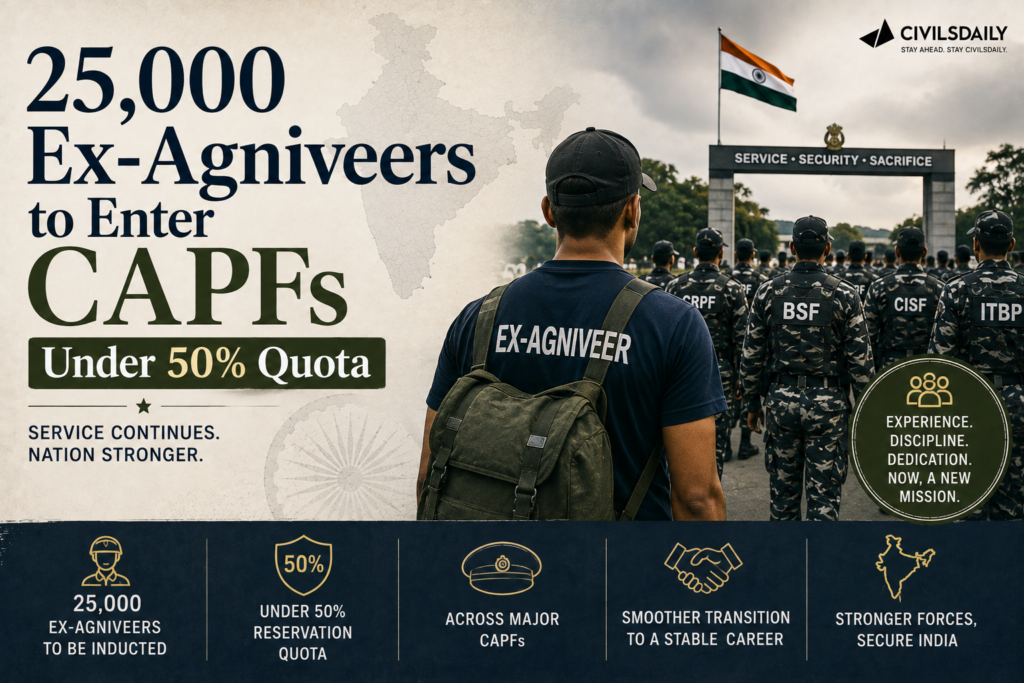
The armed forces will provide lists of eligible Agniveers to CAPFs for recruitment under the 50% reservation for former Agniveers. The first batch of around 25,000 Army Agniveers is expected to exit by December.
What is Agnipath?
Agniveers are recruited for a fixed 4-year tenure, including training.
Up to 25% are retained in the regular armed forces based on merit and organisational requirements.
The remaining 75% exit with a Seva Nidhi package.
They do not receive pension or gratuity.
What are CAPFs?
Central Armed Police Forces operate under the Ministry of Home Affairs, unlike the Armed Forces under the Ministry of Defence.
They include: BSF, CRPF, CISF, ITBP, SSB, Assam Rifles, and NSG
CAPF Recruitment for Former Agniveers
50% of Constable (GD) vacancies reserved for former Agniveers.
Eligible personnel will be identified through lists furnished by the Armed Forces.
Written examination, Physical Standard Test and Physical Efficiency Test are waived for former Agniveers.
Remaining 50% vacancies are filled through open recruitment.
Unfilled reserved vacancies are carried forward to open recruitment.
Why is it Important?
The framework provides Agniveers a pathway to a longer career, as CAPF personnel can serve up to 60 years, compared with the shorter service period in the armed forces.
Key Concerns
Eligibility depends on service-prepared lists, rather than direct application.
Criteria for inclusion in these lists are not clearly specified.
50% of CAPF Constable GD vacancies are reserved.
Former Agniveers enter at the entry grade without seniority/pay protection for military service.
Different States have adopted different reservation and age-relaxation policies.
Prelims Quick Facts
Agnipath tenure: 4 years
Retention: Up to 25%
Exit: Seva Nidhi, no pension/gratuity
CAPF quota: 50% of Constable GD vacancies
CAPFs: Under MHA
Armed Forces: Under Ministry of Defence
First Army Agniveer batch: About 25,000 expected to exit by December
“[2023] With reference to Home Guards, consider the following statements: 1. Home Guards are raised under the Home Guards Act and Rules of the Central Government. 2. The role of the Home Guards is to serve as an auxiliary force to the police in maintenance of internal security. 3. To prevent infiltration on the international border/coastal areas, the Border Wing Home Guards Battalions have been raised in some States. How many of the above statements are correct? (a) Only one (b) Only two (c) All three (d) None
India is the 2nd largest honey producer and 3rd largest exporter by value. However, around 76% of exports go to the U.S., while India’s honey has a relatively low unit value of about $1,858/tonne.
What is Apiculture?
Apiculture is the scientific rearing of honey bees in artificial hives for honey, hive products and pollination.
Apis mellifera: Italian bee
Apis cerana indica: Indian hive bee
Apis dorsata: Rock bee
Apis florea: Little bee
Products include honey, beeswax, propolis, royal jelly, pollen and bee venom.
Pollination: Bees contribute to 87 of 115 major food crops.
Domestic consumption: only ~37 g/person/year
What is NMR Testing?
Nuclear Magnetic Resonance (NMR) testing analyses the molecular profile of honey to detect: Added sugar syrups, Botanical origin, and Geographical origin. It is increasingly important for accessing premium export markets.
Major Challenges
Adulteration: Sugar syrup contamination
Limited NMR testing infrastructure
Pesticide and antibiotic residue concerns
Heavy dependence on the U.S. market
Low-value bulk exports
Weak traceability and branding
Competition from China and premium brands such as New Zealand’s Manuka honey
Way Forward
Expand NMR-capable laboratories
Develop cluster-based processing and packaging
Promote GI-tagged honey
Strengthen Farmer Producer Organisations (FPOs)
Diversify into beeswax, propolis and royal jelly
Strengthen the National Beekeeping and Honey Mission
Promote domestic honey consumption
Protect bee health through scientific beekeeping and pesticide management
“[2018, GS3, 15 marks] Assess the role of National Horticulture Mission (NHM) in boosting the production, productivity and income of horticulture farms. How far has it succeeded in increasing the income of farmers?”
[2023] Which of the following organisms perform waggle dance for others of their kin to indicate the direction and the distance to a source of their food?
A draft United States letter warns the 35 signatories of its artificial intelligence (AI) Opportunity Statement that signing up to Beijing’s competing framework will exclude them from the American led Pax Silica coalition. The demand converts a supply chain initiative into a test of exclusive alignment. Kazakhstan, a potential source of critical minerals that has joined both coalitions, is the immediate trigger.
What is the Pax Silica initiative?
About:Pax Silica was launched by Washington last year to secure supply chains for AI models, semiconductors and critical minerals.
Purpose: It was built for the technology rivalry with Beijing, treating minerals and chips as the inputs that decide who builds the most capable AI.
Membership:About two dozen countries have joined, including close allies Japan, Australia and South Korea.
Legal character: The framework is not binding, so membership carries no treaty obligation.
The new condition: Members that also join Beijing’s rival body face exclusion from the coalition.
What is the AI Opportunity Statement?
About: A United States statement signed in June by 35 countries that wish to align AI cooperation with Washington.
Coverage: Its signatories include members of the Pax Silica framework and other countries outside it, and the draft warning letter is addressed to this full list.
What is the World Artificial Intelligence Cooperation Organization?
About: A rival body launched in July by the Chinese President as a challenge to United States influence over the AI sector.
Its offer: It promotes China’s open weight technology, positioning access to models rather than access to chips as the basis of membership.
What are open weight AI models?
About: Models whose trained parameters are published for download, allowing anyone to run and adapt them on their own hardware.
Why it matters strategically: Adoption does not require a continuing commercial relationship with the developer, so influence spreads without any agreement being signed.
What does the draft letter actually demand?
A binary choice: Dozens of countries are to be told they must pick sides in the AI race with China.
The penalty: Signing Beijing’s competing framework means exclusion from the United States led coalition.
The stated objective: Washington hopes to starve China of resources in the race to build the most sophisticated AI.
Why that matters: The most capable models are treated as usable for military or economic dominance, which is what makes inputs a security question.
The evidentiary basis: The warning rests on an internal draft and a United States official, not on a published policy.
Why do critical minerals sit at the centre of the AI race?
Minerals precede chips: Semiconductors, servers and power systems depend on rare earths, gallium, germanium and graphite before any model can be trained.
Refining, not mining, is the chokepoint: China dominates the midstream separation and refining stages even for ore mined elsewhere.
Export controls as leverage: Beijing has used licensing of gallium, germanium, graphite and rare earth magnets as a direct policy instrument.
Why Kazakhstan matters: It is a key potential source of critical minerals, which is why its dual membership set off alarm in Washington.
The self limiting problem: Excluding a supplier country does not create refining capacity anywhere else.
What do the individual signatories’ positions show about the cost of forcing a choice?
Kazakhstan, the hedger: It is the only country so far known to have joined both initiatives, using its mineral endowment to sell access to both blocs rather than choose.
Japan, the equipment supplier: A Pax Silica member whose firms control critical semiconductor manufacturing equipment, photoresists and wafer materials that no bloc can replace quickly.
South Korea, the memory chip producer: A Pax Silica member whose memory chip makers run large fabrication capacity inside China, so exclusivity carries a direct commercial cost.
Australia, the mining leg: A Pax Silica member with rare earth deposits and a dedicated critical minerals financing facility, but with separation capacity that has historically depended on offshore processing.
China, the rival architecture: Beijing counters chip and minerals leverage with the World Artificial Intelligence Cooperation Organization and freely downloadable models.
United States, the coalition builder: Washington combines export controls on advanced chips with Pax Silica membership, and now with the threat of exclusion.
Why does the exclusivity demand cut against the United States’ own supply goal?
Suppliers gain from hedging: A mineral rich state earns more by selling access to both coalitions than by picking one.
A framework with no enforcement:Pax Silica is not binding, so exclusion is the only available lever and it is a blunt one.
Open weight models cannot be fenced: Chinese models spread by download, so denying a country coalition membership does not deny it Chinese technology.
Refining dependence persists: The coalition can exclude a supplier and still find that separation and processing run through China.
Retaliation risk: Beijing can curtail exports of critical minerals essential to advanced technology production while Western supply chains are still being built.
Where does India stand in the AI and critical minerals contest?
Minerals Security Partnership: India joined the Minerals Security Partnership in June 2023, a United States convened grouping to catalyse investment in critical mineral supply chains.
National Critical Mineral Mission: Approved in January 2025 with an outlay of about 16,300 crore rupees, it targets exploration, recovery from tailings and overseas asset acquisition.
IndiaAI Mission: Approved in March 2024 with about 10,371 crore rupees, covering compute capacity, datasets, foundation model support and safe AI.
Summit diplomacy: India chaired the Global Partnership on Artificial Intelligence and hosted its summit in New Delhi in December 2023, and was named the next AI summit host after the Paris AI Action Summit of February 2025.
The strategic autonomy problem: India sits in United States aligned mineral platforms and in BRICS and the Shanghai Cooperation Organisation alongside China, so an exclusivity demand of the Pax Silica kind directly conflicts with its standing position.
Challenges to Pax Silica
No enforcement mechanism: A framework that is not binding cannot police dual membership. e.g. Kazakhstan has joined both Pax Silica and the Chinese body without penalty so far.
Substitution by the rival supplier: Excluded states can buy the same inputs and models from Beijing. e.g. China’s export licensing of rare earth magnets from April 2025 halted assembly lines at European car plants, demonstrating who controls the flow.
Cost falls on allies first: Export control regimes hit allied firms’ revenues before they hit the target. e.g. Dutch lithography equipment makers lost a large share of their China sales after successive export restrictions.
Midstream capacity cannot be built quickly: Mining new deposits does not solve separation and refining. e.g. Australian rare earth concentrate was long shipped to Malaysia for separation rather than processed at home.
Price volatility deters new investment: Mineral projects need long horizons that commodity cycles destroy. e.g. lithium prices fell sharply from their 2022 peak, stalling announced projects worldwide.
Open weight diffusion defeats membership rules: Model access spreads independently of any coalition. e.g. a Chinese open weight reasoning model released in January 2025 was downloaded and self hosted worldwide within weeks.
Third country resistance to bloc politics: Middle powers resist being made to choose. e.g. several Global South states hold membership of both Western and Chinese digital and minerals platforms simultaneously.
Conclusion
The AI contest has moved from controlling exports of chips to controlling membership of coalitions, and the United States is testing whether exclusivity can be enforced on countries that hold the minerals. The instrument is weak, since Pax Silica binds no one, open weight models spread by download, and refining capacity stays with China regardless of who is excluded. Kazakhstan’s dual membership is the first demonstration that suppliers will hedge. For India, an exclusivity demand of this type collides directly with a foreign policy built on membership of competing platforms.
“[2025] Consider the following statements: I. India has joined the Minerals Security Partnership as a member. II. India is a resource-rich country in all the 30 critical minerals that it has identified. III. The Parliament in 2023 has amended the Mines and Minerals (Development and Regulation) Act, 1957 empowering the Central Government to exclusively auction mining lease and composite license for certain critical minerals. Which of the statements given above are correct? (a) I and II only (b) II and III only (c) I and III only (d) I, II and III
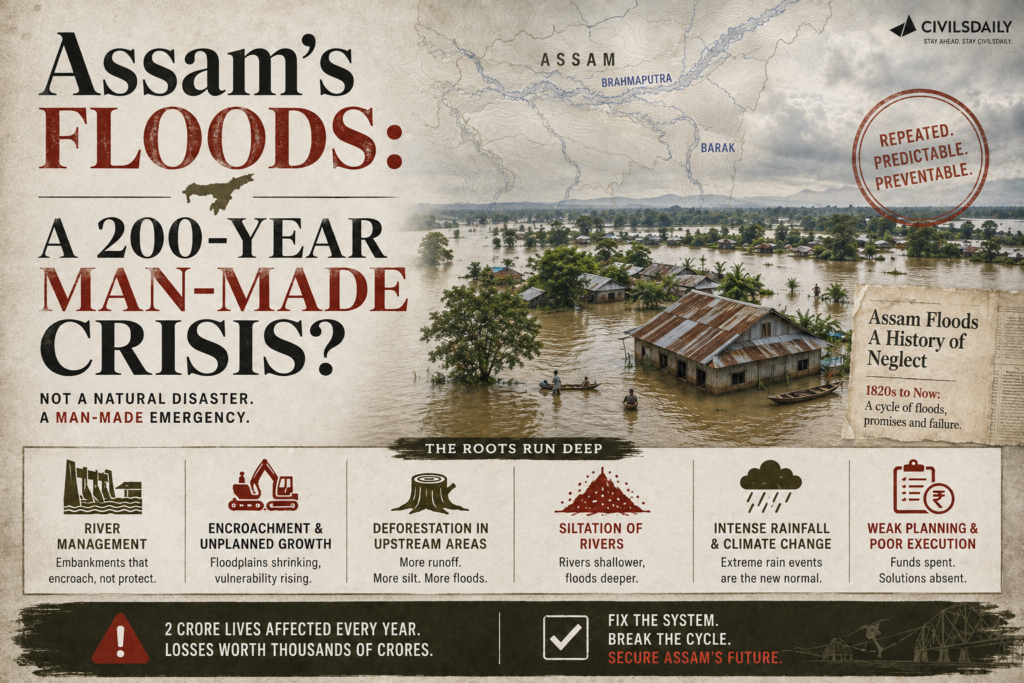
In the third week of July, several south bank rivers of Upper Assam rose with extreme speed, swallowed paddy fields and grazing lands, and swept through villages and towns in districts that had not previously faced catastrophic floods. The event exposes a conflict between two explanations of the disaster, one that treats the flood as a hydrological event to be excluded by engineering, and one that treats it as the outcome of a landscape whose capacity to absorb rain has been dismantled over two centuries.
What is embankment based flood control?
About: An embankment is an earthen barrier raised along a river to confine its flow within the channel and shield the settled floodplain from inundation.
When it was adopted in Assam: A techno bureaucratic campaign in the mid 20th century set out to shield settled floodplains from floods that had until then been treated as predictable and nourishing for agriculture.
The design assumption: The approach treats the flood as an external event to be kept out, rather than as the process that builds the plain it inundates.
The sediment consequence: These barriers interrupted the flow of sediment onto the floodplain, confining silt to the channel instead of spreading it across the fields.
The coverage limit: By 1988, even after thousands of kilometres of embankments had been built, two thirds of the valley still lay open to flooding.
What are the south bank tributaries of Upper Assam?
About: The south bank tributaries are the rivers that rise in the hills south and east of the Brahmaputra valley and join the main river from its right bank, including the Buridihing, Disang, Dikhow, Jhanji and Dhansiri.
Why they matter here: They are fed by rainfall over the Naga Hills and eastern Arunachal Pradesh, so their flood peaks are set by rain falling outside Assam’s own boundaries.
What is riverbed aggradation?
About:Aggradation is the raising of a riverbed by deposition of sediment that the river can no longer carry downstream.
Why it worsens flooding: A raised bed reduces the channel’s carrying capacity, so the same discharge overtops the banks at a lower volume than before.
What is a flash flood?
About: A flash flood is a rapid rise in water level within hours of intense rainfall, typical of steep catchments where runoff reaches the channel before it can infiltrate the soil.
The determining factor: The severity depends on how quickly the catchment sheds water, which is a function of forest cover and soil condition rather than rainfall volume alone.
What made the July flood different from a routine Brahmaputra flood?
Damage before the main river peaked: Upper Assam felt the brunt of the disaster before the Brahmaputra swelled to its highest, which rules out the main channel as the primary cause.
Rain fell outside Assam: Relentless rain pounded the Naga Hills and Arunachal Pradesh, soaked the slopes and unleashed sudden torrents into the southern tributaries.
New districts affected: Several districts once strangers to such catastrophic floods found themselves engulfed.
Extraction accelerated the runoff:Stone and boulder extraction from riverbeds and hillsides, common in both highlands and lowlands, was identified as a factor that hastened the rainfall’s journey downstream.
The regional setting: Assam is cushioned between the Eastern Himalaya to the north, the Patkai and Barail ranges to the east and the Bay of Bengal to the south, so the southwest monsoon links highlands, floodplains, billions of tonnes of sediment and the shifting channels of hundreds of rivers into a single interdependent system.
What has changed in the highland catchments that feed Upper Assam?
Shorter cultivation cycles: Growing populations in the highlands of Nagaland and eastern Arunachal Pradesh have made cultivation cycles shorter and more intense, cutting the fallow period that allowed soil to recover.
Small scale coal mining: Mining woven into local economies now competes with the highland agrarian economy and operates through complex networks of speculators.
Relentless logging: Continued removal of tree cover strips the canopy and root systems that slow rainfall reaching the ground.
Expanding infrastructure: New construction seals and compacts surfaces, adding to runoff.
The combined effect: This pressure on the uplands erodes the land’s ability to absorb rainfall, so a given storm now delivers more water, faster, to the tributaries below.
How did the south bank lose its historic resilience?
The earlier condition: The south bank districts of Upper Assam were once among the Brahmaputra valley’s most resilient regions, defined by thick forests, scattered settlements and a safe distance from the Brahmaputra’s main channel.
The colonial turn: The calm began to unravel in the mid 19th century, when these areas drew the attention of colonial tea planters.
The land use conversion: Land where rain once vanished quietly into the forest floor was transformed into plantations, sites of mineral extraction and farms.
The hydrological result: The converted land could no longer hold back the water, which shifted the flood response of the whole south bank.
What did the embankment campaign change?
The reversal of the flood’s meaning: Floods that had been seen as predictable and nourishing for agriculture were reclassified as a hazard to be excluded.
The sediment interruption: The barriers cut off the annual deposition of silt that had renewed floodplain fertility.
The incomplete shield: By 1988, thousands of kilometres of embankments still left two thirds of the valley exposed.
The failure mode in July: Embankments along the southern tributaries gave way before the main river crested, producing sudden breaches.
Why a breach is worse than a flood: The breach released a fall of water onto an unembanked plain, concentrating the discharge instead of spreading it.
How is the monsoon itself changing?
Greater unpredictability: India’s rainy season has become more unpredictable, marked by sudden downpours separated by long dry spells rather than simply more rain overall.
Corroboration for the Northeast: Studies focused on Northeast India echo these findings.
The explanatory shift: The gap between intense rainfall and a weakened landscape explains the flash floods more fully than the quantity of rain alone.
Why the distinction matters: A landscape that once absorbed a heavy monsoon now converts the same rainfall into a peak discharge, so historical rainfall thresholds no longer predict damage.
Do embankments protect the floodplain or deepen its exposure?
The protection is real but partial: Embankments shielded settled floodplains and made permanent cultivation and settlement possible on land that had flooded annually.
The cost is the sediment: The same barriers interrupted sediment flow, denying the plain the silt that renewed it and confining deposition to the channel bed.
Protection invites exposure: A shielded plain attracts denser settlement, which raises the population and assets at risk when a breach occurs.
Failure is concentrated, not gradual: An unembanked plain floods slowly and predictably, while an embanked one stays dry until the barrier gives way and then receives the full discharge at once.
The measure of the approach: After thousands of kilometres of construction, two thirds of the valley remained open to flooding, which shows the strategy could not be completed at the scale it assumed.
The deeper limitation: The state’s ecology has been treated as a puzzle for engineers, with each crisis examined in isolation, so the cumulative loss of catchment capacity is never entered into the calculation.
Challenges to flood management in Assam
Ageing embankments past their design life: Most of Assam’s embankment network was built decades ago and now fails at multiple points each season. e.g. the breach of the Bethukandi embankment on the Barak in June 2022, which submerged Silchar town for days.
Bank erosion and permanent land loss: The braided Brahmaputra shifts its channels and consumes cultivated land and villages every year. e.g. Majuli, the large river island in Assam, which has lost a substantial part of its area to erosion since the 1950s.
A catchment that lies outside the State’s jurisdiction: The rainfall that determines Assam’s flood peak falls in Arunachal Pradesh, Nagaland and beyond the international border. e.g. the July flood peak on the south bank tributaries generated by rain over the Naga Hills.
Sudden releases from upstream hydropower projects: Reservoir operation upstream can add a flood wave to an already rising river. e.g. water released from the Ranganadi project in Arunachal Pradesh flooding parts of Lakhimpur district.
Loss of wetlands that once absorbed flood water: The valley’s beels have been filled for construction and encroached upon. e.g. shrinkage of Deepor Beel, the Ramsar site adjoining Guwahati, which has intensified urban flooding in the city.
Relief centred rather than mitigation centred spending: Public expenditure concentrates on camps, compensation and post flood repair rather than catchment restoration. e.g. annual embankment repair works sanctioned after each season’s breaches rather than a basin wide restoration programme.
Riverbed and hillside extraction: Removal of stone, boulders and sand strips the roughness that slows runoff and destabilises slopes. e.g. boulder extraction from riverbeds in the foothills feeding the south bank tributaries.
Conclusion
The July flooding in Upper Assam is the outcome of vulnerabilities built over two centuries, not a seasonal misfortune produced by a river’s behaviour. Plantation conversion from the mid 19th century, embankment construction from the mid 20th century and current highland extraction have each reduced the landscape’s capacity to absorb rain, while the monsoon has shifted towards sudden concentrated downpours. Assam’s environment is approaching a tipping point and is not yet beyond repair. What remains unresolved is the framing itself, since the connections between highland and lowland, water and land, and forests and floodplains cannot be rebuilt by engineering alone.
“[2017, GS1, 15 marks] In what way can floods be converted into a sustainable source of irrigation and all-weather inland navigation in India?”
A collective defence pact signed in Mecca between Saudi Arabia, Turkiye and Pakistan has altered the security architecture of West Asia. The pact pools Saudi capital, Pakistani military strength and Turkish defence technology, and is aimed at deterring Israel rather than Iran. India built a decade of gains in the region and now has no declared strategy to answer this realignment.
What did India build in West Asia over the past decade?
2016, Saudi recognition:Saudi Arabia awarded India’s Prime Minister its highest civilian honour, marking a shift in the political relationship.
2021, I2U2: The I2U2 agreement was signed, tying India into a grouping with Israel, the United States and the UAE.
2024, Chabahar:Iran leased Chabahar port to India, giving overland access towards Afghanistan and Central Asia that bypasses Pakistan.
The UAE relationship: India cultivated a special relationship with the UAE built on remittances from Indian expatriate workers, investments by Indian business in the UAE, and UAE strategic investments in India.
Where they stand now: These are gains from the past, and India’s footprint is contracting one country at a time.
Why is the region’s security order breaking down now?
A war that spread: In the last four months the United States and Israel war with Iran escalated into a regional conflict.
Iran against the Gulf: Iran attacked GCC countries, ending the assumption that the Gulf monarchies sit outside the fighting.
Saudi strikes in Iraq: Saudi Arabia hit Iraqi militias.
Attacks at sea: The Houthis attacked Saudi ships.
Israeli strikes: Israel carried out strikes in multiple countries.
The American umbrella in doubt: Gulf states are rethinking the efficacy of the United States security umbrella and now see a threat from both Iran and Israel.
A schism over method: The Gulf is split between handling that threat through engagement, the UAE approach, and through deterrence, which Saudi Arabia is contemplating.
How has Pakistan converted the regional crisis into diplomatic capital?
The mediator role: Pakistan’s role as mediator in the United States and Iran conflict is earning it reputational benefits across the region.
The timing: It entered when no one else could bring the United States President and the Iranians to the table.
Who had failed first:Turkiye, Qatar and Egypt had all attempted mediation without success.
The pact as the payoff: The Mecca collective defence pact follows directly from that diplomatic moment.
The Israel risk for India: A future Israel and Pakistan war would draw India in, given the close India Israel partnership.
The Turkiye risk for India: Greater Turkish support for Pakistan in a future India Pakistan conflict cannot be ruled out.
What do the positions of individual regional states reveal about the new architecture?
Saudi Arabia, deterrence and a new maritime force: Riyadh is moving from engagement to deterrence, supplies the capital leg of the Mecca pact, and is raising a Saudi led maritime force for the Red Sea that India is not part of.
Turkiye, technology as leverage: Ankara contributes defence technology to the pact and runs a deepening military relationship with Pakistan that India has no channel to discuss.
Pakistan, military manpower as currency: Islamabad supplies the military strength the pact rests on, converting an army into diplomatic capital with Gulf financiers.
United Arab Emirates, engagement over deterrence: Abu Dhabi manages the Iran and Israel threat through engagement, and carries mounting differences with Saudi Arabia plus positions against United Nations recognised governments in conflicts as far away as Sudan.
Iran, from partner to belligerent: Tehran leased Chabahar to India in 2024 and has since attacked GCC states, putting India’s connectivity asset inside an active war zone.
Israel, strikes that created the pact: Israeli operations across multiple countries made three regional states conclude they are next, which is the design logic of the Mecca pact.
Why does India’s current posture carry risk?
The Israel bet: India’s approach rests on confidence in Israel’s victory, drawn from Israel’s proximity to the United States.
The American consensus is shifting: Both Make America Great Again Republicans and Democratic Socialists now question the once unquestioned United States support for Israel.
Israel alone: Whether Israel can prevail without assured American backing is unsettled.
The UAE bet: The second pillar of India’s regional position is the UAE relationship, resting on remittances, elite investment and Emirati investment in India.
UAE exposure: The UAE’s differences with Saudi Arabia and its Sudan positions place that pillar at risk.
What are the choices before India?
Formal alignment: India can sign military alliances with Israel and the UAE.
The cost of alignment: That would damage what is left of India’s relationships with Iran and Saudi Arabia.
Continued inaction: India can do nothing, which is the current position.
Cost of inaction, seafarers: Indian merchant mariners continue to be killed in the Strait of Hormuz.
Cost of inaction, shipping: More Indian ships sink in the Bab-el-Mandeb.
Reputational cost: A great power in the making appears hobbled in its own immediate maritime neighbourhood.
The third way: India can devise an active regional political strategy instead of choosing between alignment and drift.
What would an active Indian regional strategy involve?
Renewed engagement with Saudi Arabia: India has no explicit differences with Riyadh, which makes it the cheapest relationship to rebuild.
Arab and Iran trust building: India can work to rebuild trust between Arab states and Iran, beginning with the UAE and Iran relationship.
Jordan’s security: India can offer defensive technologies to Jordan at a time when United States munitions are running low.
Lebanon peacekeeping: India can take a role in the future UN peacekeeping presence in Lebanon, with UNIFIL forecast to end.
A back channel with Turkiye: India can share its red lines on Turkiye’s relationship with Pakistan through a quiet channel.
Red Sea shipping with Egypt: If India cannot join the Saudi led maritime force, it can work with Egypt on a parallel effort to protect India bound shipping from the Suez Canal to Bab-el-Mandeb.
A military presence: India can examine a presence in the Red Sea region, in Somaliland or Socotra.
Exercises with the region: Existing military training exchanges can be scaled into joint drills and exercises with a range of regional states.
A Special Envoy for West Asia: India can appoint one who draws all the threads together, rather than one confined to the Israel and Palestine peace process.
Challenges to India’s West Asia Strategy
The alliance trap: Any formal military alignment with one camp forecloses the other, since Iran and Saudi Arabia both read Indian alignment as a choice against them. e.g. India’s Chabahar development slowed each time United States sanctions pressure on Iran tightened.
The Turkiye and Pakistan axis: Turkish defence technology transfers to Pakistan directly degrade India’s conventional edge. e.g. Turkish origin Songar armed drones were used against Indian positions during the May 2025 hostilities.
Chokepoint exposure: India’s trade and energy routes converge on two narrow straits it cannot secure alone. e.g. Houthi attacks from late 2023 forced Indian bound shipping to reroute around the Cape of Good Hope, raising freight and insurance costs.
Attacks on Indian crewed shipping: Indian seafarers crew a large share of global merchant vessels and absorb the human cost of regional escalation. e.g. the drone strike on MV Chem Pluto off Porbandar in December 2023.
Evacuation burden: Every escalation converts India’s diaspora presence into a mass evacuation operation. e.g. Operation Kaveri from Sudan in 2023 and Operation Sindhu from Iran and Israel in June 2025.
No standing regional mechanism: India has no dedicated envoy or regional platform to convert bilateral goodwill into collective influence. e.g. the piece’s own recommendation for a Special Envoy for West Asia has no existing counterpart in the Indian system.
Exclusion from new regional security structures: New arrangements are being built without Indian participation. e.g. the Saudi led Red Sea maritime force, which India is not part of.
Conclusion
West Asia’s security architecture is being rebuilt around a Saudi Arabia, Turkiye and Pakistan pact designed to deter Israel, and India has no strategy that matches the scale of that change. Formal alignment with Israel and the UAE costs India Iran and Saudi Arabia, and inaction costs it seafarers, ships and standing. The workable route is an active regional political strategy built on renewed engagement with Riyadh, trust building between the Arab states and Iran, and a dedicated envoy. India’s capacity to shape the region survives, its window does not.
West Asia in India’s Foreign Policy
About: West Asia covers the Gulf monarchies, Iran, Iraq, Israel, Turkiye and the Levant, treated in Indian policy as an extended neighbourhood rather than a distant theatre.
Policy label: India’s approach shifted from Look West to Link West, moving beyond oil and labour transactions towards defence, technology and investment partnerships.
Energy: West Asia remains a principal source of India’s crude oil imports, and Qatar is India’s largest supplier of liquefied natural gas.
Diaspora: About 9 million Indians live and work in the Gulf, the largest concentration of the Indian diaspora anywhere.
Remittances: India is the world’s largest recipient of remittances, receiving over 100 billion dollars annually, with the Gulf a major contributor.
Trade: The UAE is among India’s top three trading partners, and the India UAE Comprehensive Economic Partnership Agreement took effect in May 2022.
Connectivity: The India Middle East Europe Economic Corridor (IMEC) was announced on the margins of the G20 New Delhi Summit in September 2023.
Back2Basics: Gulf Cooperation Council
Formation: Established in 1981 at Abu Dhabi.
Headquarters:Riyadh, Saudi Arabia.
Members: Saudi Arabia, the United Arab Emirates, Kuwait, Qatar, Bahrain and Oman.
Mandate: Coordination and integration among members in economic, defence, security and cultural affairs.
Military arm: The Peninsula Shield Force, a joint military force raised in 1984.
Economic instrument: A unified economic agreement and a customs union among the six members.
India link: India is not a member, and engages the bloc through bilateral strategic partnerships and an India GCC ministerial mechanism.
Government Initiatives for India’s West Asia Engagement
Link West Policy: Reframes the Gulf and West Asia as a zone of strategic partnership rather than an energy and labour market alone.
I2U2: Joint investment platform with Israel, the United States and the UAE across food security, clean energy and health.
India Middle East Europe Economic Corridor: Rail and shipping corridor linking India to Europe through the Gulf, announced in September 2023.
India UAE Comprehensive Economic Partnership Agreement, 2022: India’s first Gulf trade agreement, cutting tariffs on the bulk of traded goods.
Chabahar long term contract, 2024: A ten year agreement for operating the Shahid Beheshti terminal, giving India a port outside the Strait of Hormuz.
eMigrate portal and Pravasi Bharatiya Bima Yojana: Registration and mandatory insurance cover for Indian workers emigrating to Gulf destinations.
Evacuation operations: Operation Sindhu, Operation Ajay and Operation Kaveri, evacuating Indians from Iran and Israel, Israel and Sudan respectively.
Operation Sankalp: Indian Navy deployment in the Gulf of Oman and the Persian Gulf to escort Indian flagged merchant shipping.
Key Facts about India and West Asia
The Strait of Hormuz carries roughly a fifth of global oil consumption and has no practical bypass for most Gulf exporters.
The Bab-el-Mandeb is the southern gate of the Red Sea and the compulsory approach to the Suez Canal.
Chabahar is Iran’s only oceanic port, on the Gulf of Oman, and lies outside the Strait of Hormuz.
India’s overseas military logistics access includes Duqm in Oman, agreed in 2018.
I2U2 was agreed in 2021 and held its first leaders summit in July 2022.
India is not a member of the Organisation of Islamic Cooperation, and was invited as guest of honour to its foreign ministers meeting at Abu Dhabi in 2019.
The GCC has six members; the wider Arab League has 22.
“[2025, GS2, 15 marks] “Energy security constitutes the dominant kingpin of India’s foreign policy, and is linked with India’s overarching influence in Middle Eastern countries.” How would you integrate energy security with India’s foreign policy trajectories in the coming years?”
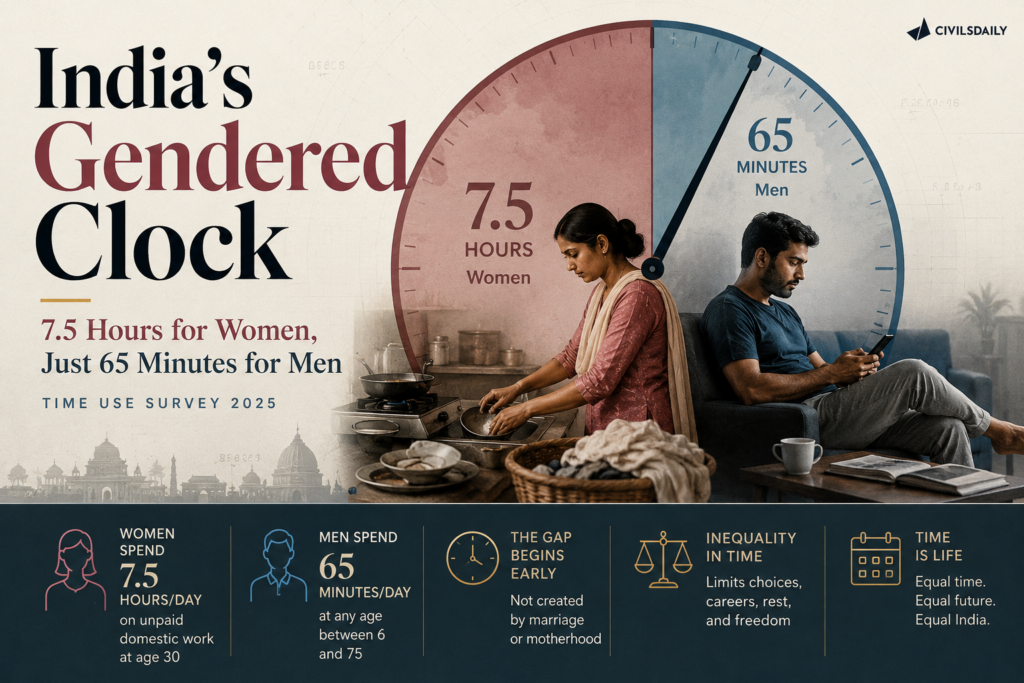
India’s Time Use Survey (2025) shows the time women spend on housework rising from about age 10 to a peak of nearly 460 minutes a day, over 7.5 hours, around age 30, while the male curve never crosses 65 minutes at any age between six and 75. The gap is not created by marriage or motherhood, it is assembled in childhood, which places it outside the reach of policies aimed at adult women.
What is the Time Use Survey?
About: The Time Use Survey is a national household survey conducted by the National Statistics Office under the Ministry of Statistics and Programme Implementation, which records how members of a household allocate their 24 hours across activities on a reference day.
What it captures: It measures activities that no other survey counts, including unpaid domestic services, unpaid caregiving, learning, leisure, self care and volunteer work, alongside paid employment.
Why it exists: Employment surveys count only work inside the production boundary, so time spent cooking or caring for a child disappears from official statistics unless a time use survey records it.
What is unpaid domestic and caregiving work?
About: Unpaid domestic and caregiving work covers cooking, cleaning, laundry, shopping, collection of water and fuel, minor repairs, and the care of children, the sick and the elderly performed for one’s own household without payment.
Its statistical treatment: These services are produced by households for their own consumption and fall outside the production boundary of the System of National Accounts, so they contribute nothing to measured Gross Domestic Product despite being economically essential.
What is the Periodic Labour Force Survey?
About: The Periodic Labour Force Survey (PLFS) is the National Statistics Office’s regular survey of employment and unemployment, which estimates the labour force participation rate, worker population ratio and unemployment rate.
Its relevance here: It records the reason given for staying outside the labour force, which is where unpaid domestic responsibility appears as a measured cause of women’s non participation.
What does the lifetime housework curve show?
The female curve: Time spent on housework begins to rise around age 10, continues through the late teens and twenties, and peaks at nearly 460 minutes a day, over 7.5 hours, around age 30.
The male curve: It never crosses 65 minutes at any age between six and 75, so there is no stage of the male life cycle at which domestic work becomes a substantial claim on time.
Timing of the peak: The peak falls in the prime working years, which is precisely when paid work, promotion and enterprise building compete for the same hours.
The continuity point: Adolescence is not separate from adulthood in this data, it is the stage at which the adult pattern begins to take shape.
How early does the gender gap in domestic work open?
Parity at age six: Indian boys and girls both spend about five minutes a day on domestic and care work at age six, and their trajectories remain close through early childhood.
The girls’ curve: Girls spend about 15 minutes a day at age 10, 75 minutes at 15, and around 130 minutes by 17.
The boys’ curve: Boys move from roughly five minutes at age six to only about 17 minutes by the end of childhood.
The widening ratio: The girl to boy ratio in unpaid work rises from 1.6 among children aged 6 to 9, to 4.5 among those aged 10 to 14, and to 7.5 among adolescents aged 15 to 17.
The divergence point: The curves separate sharply from around age 10, which is the same age at which the adult female housework curve begins its climb.
Why is leisure, not schooling, the real cost?
The trade off is usually framed wrongly: The cost of girls’ domestic work is normally argued as a trade off with schooling and education, and the data does not support that framing.
Girls are not losing study time: Girls spend slightly more time on learning than boys at most ages, so they remain in school while carrying the additional work.
Leisure absorbs the burden: Between ages six and 17, girls’ housework rises by roughly 124 minutes a day while their leisure time falls by around 115 minutes a day.
The boys’ pattern: For boys the decline in leisure is much smaller and the time spent on housework changes relatively little.
Why leisure is not residual: Sport, friendships, rest and exploration are how children build confidence, social networks, physical capability and a sense of agency, all of which shape later career trajectories.
The measurement blind spot: School enrolment and learning outcome data register no problem at all, because the loss is entirely in discretionary time.
Why does cooking sit at the centre of the divergence?
Participation gap in cooking: Among adolescents aged 15 to 17, 42.4 percent of girls report cooking, against only 2.9 percent of boys.
Time gap in cooking: Girls in this age group spend close to an hour cooking, while boys spend just two minutes.
Other gendered tasks:Cleaning and laundry also become increasingly gendered through adolescence, with wide gaps in both participation and time spent.
Where boys match or exceed girls: The only tasks are farm work and shopping, which are outward facing towards the field and the market rather than inward facing into the kitchen.
The full task set measured: Participation is recorded across childcare, cleaning, cooking, farm work, laundry, repairs, shopping and collection of water and fuel, and the inward facing tasks are the ones that carry the gap.
What the allocation trains: Girls are being trained for the household and boys for the world outside, which is how the pattern later appears as an efficient gendered allocation of household work.
How does childhood conditioning surface in the labour market?
The stated reason for non participation: In the 2025 PLFS, childcare and domestic responsibilities were the single most cited reason women gave for staying out of the labour force.
The urban and rural split: The reason was reported by 52.5 percent of urban women and 40 percent of rural women.
The male comparison:Less than 1 percent of men gave the same reason, so the constraint is not a household constraint but a gendered one.
The field observation behind the data: Among rural women in Haryana aspiring to become entrepreneurs, the biggest practical constraint on doing more paid work was time tied up in cooking and household chores, and their daughters rather than their sons were already sharing that burden.
Why do current policy interventions arrive too late?
Where policy currently intervenes: Most interventions address women’s unpaid work in adulthood, through childcare services, community kitchens, safe mobility infrastructure, flexible work and social protection.
What that misses: The unequal assignment of domestic work between boys and girls has already been completed before any of these instruments touch a woman’s life.
The correct objective: The aim is not to remove domestic work from children’s lives, but to remove its gender assignment.
The school as the instrument: Schools can give every child, boy or girl, equal opportunity to learn practical life skills, from cooking and home management to stitching, carpentry and financial management.
The gap in India’s own success: India has invested heavily in keeping girls in school and improving their educational outcomes, and paid no comparable attention to what happens to their time outside school.
Challenges to removing the gender assignment of domestic work
Norms are transmitted inside the household, where policy has no instrument: No scheme reaches the daily decision about which child is called into the kitchen. e.g. mothers in rural Haryana who identified their own time poverty still passed the chores to daughters rather than sons.
The burden is invisible in every headline indicator: Enrolment, learning outcomes and even attendance stay unaffected while leisure collapses. e.g. girls in the survey spend slightly more time learning than boys even while doing seven times the domestic work at 15 to 17.
Infrastructure deficits convert directly into girls’ time: Where water, fuel and sanitation are distant, the collection task falls on girls. e.g. households without piped water where fetching water is a daily pre school chore.
School curricula reinforce the split rather than break it: Vocational and life skill options remain gender typed in practice. e.g. home science and tailoring offered to girls while carpentry, electrical work and workshop practice fill with boys.
Measurement is infrequent: Time use data arrives too rarely to evaluate whether an intervention shifted the allocation. e.g. India ran a pilot time use survey in 1998 to 1999 and its first full national round only two decades later.
Care substitutes are absent for adolescent siblings: Where creche and elder care services are missing, the eldest daughter becomes the default carer. e.g. adolescent girls withdrawn from leisure and play to mind younger siblings while parents do wage work.
Employment law does not reach unpaid household work: No labour statute assigns rights, hours or rest to domestic work performed inside one’s own home. e.g. maternity and creche entitlements under labour law apply to formal employment, covering a small minority of working women.
Conclusion
The gender gap in unpaid work is not a marriage effect or a motherhood effect, it is set in place between the ages of 10 and 17 and simply expands afterwards to 7.5 hours a day by age 30. The price girls pay is measured in leisure rather than schooling, which is why India’s success in keeping girls in school has concealed it. Policy instruments built for adult women arrive after the allocation is fixed. The intervention point is the childhood assignment of domestic tasks, and schools that teach cooking, home management, carpentry and financial management to every child are the instrument available now.
[2024, GS1, 10 marks] Distinguish between gender equality, gender equity and women’s empowerment. Why is it important to take gender concerns into account in programme design and implementation?
The Tamil Nadu Legislative Assembly has passed a resolution asking the Centre to permanently freeze Lok Sabha seats at 543, retain the present State wise distribution, preserve the 2.2 to 1 ratio between the two Houses, and grant one third reservation for women from the 2029 election without linking it to any census. The seat freeze under Article 81 lapses with the first census after 2026, which forces a choice between equal vote value across citizens and equal treatment of States that controlled their population.
What is delimitation?
About:Delimitation is the process of fixing the number of seats and the boundaries of territorial constituencies in each State for the Lok Sabha and the State Legislative Assemblies.
Who performs it: It is carried out by a Delimitation Commission set up under an Act of Parliament, not by the Election Commission.
Governing principle:Article 81(2) requires the ratio between the number of seats and the population of a State to be, as far as practicable, the same for all States.
Present basis: The number of seats was last determined on the 1971 census population.
Democratic test it serves: The exercise operationalises the standard of one citizen, one vote, one value, under which every vote should carry equal weight in the House.
What is MPLADS?
About: The Members of Parliament Local Area Development Scheme (MPLADS) is a central scheme allowing each Member of Parliament to recommend works of a developmental nature in their constituency.
Fiscal relevance: Each member carries an annual allocation, so any increase in the size of the House raises the scheme’s total outlay proportionately.
What is a joint sitting of Parliament?
About: A joint sitting is a combined meeting of the Lok Sabha and the Rajya Sabha convened by the President under Article 108 to resolve a deadlock over an ordinary Bill.
How it decides: The Bill is passed by a majority of the total number of members of both Houses present and voting, so the numerically larger House determines the outcome.
What is the current status of Lok Sabha seat allocation in India?
Seat number and its base: The Lok Sabha has 543 elected seats, fixed on the 1971 census, when the population stood at 54.8 crore. That translated to an average of 10.1 lakh people per constituency.
Constitutional ceiling:Article 81 caps the elected strength at 550, comprising not more than 530 members from States and not more than 20 from Union Territories.
The freeze and its purpose: Seat allocation was frozen on the 1971 census so that States with faster population growth would not gain seats, which would have penalised effective population control.
Amendment trail: The 42nd Amendment Act froze the allocation until the year 2000. The 84th Amendment Act extended the freeze until the first census taken after 2026.
The trigger now due: The 2027 census is the first census after 2026, so it becomes the basis for readjustment.
Women’s reservation: The 106th Constitutional Amendment Act, 2023 provides one third reservation of seats for women in the Lok Sabha and State Assemblies, operative through a delimitation based on the 2027 census.
Bicameral ratio: The Rajya Sabha’s current strength is 245, producing a ratio of 2.2 to 1 between the two Houses.
Constitutional Provisions Related to Delimitation and Seat Allocation
Article 81: Fixes the composition of the Lok Sabha and the ceiling of 530 members from States and 20 from Union Territories.
Article 81(2)(a): Requires each State’s allocation to keep the seat to population ratio as far as practicable uniform across States.
Article 81(2)(b): Requires each State to be divided into constituencies of broadly uniform population.
Article 82: Mandates readjustment of seat allocation and constituency boundaries after every census, by an authority determined by Parliament through law.
Article 170: Governs the composition of State Legislative Assemblies, with a maximum of 500 and a minimum of 60 seats, and readjustment after each census.
Article 330: Reserves seats for Scheduled Castes and Scheduled Tribes in the Lok Sabha in proportion to their population.
Article 332: Reserves seats for Scheduled Castes and Scheduled Tribes in State Legislative Assemblies.
Article 329(a): Bars courts from questioning the validity of any law relating to delimitation or the allotment of seats.
Article 108: Provides the joint sitting mechanism to resolve a disagreement between the two Houses on a Bill.
42nd Amendment Act, 1976: Froze State wise seat allocation on the 1971 census until 2000.
84th Amendment Act, 2001: Extended the freeze to the first census after 2026 and permitted boundary readjustment within States.
87th Amendment Act, 2003: Shifted the basis for redrawing constituency boundaries to the 2001 census, while leaving seat numbers frozen.
106th Amendment Act, 2023: Inserted Articles 330A, 332A and 334A providing one third reservation for women, operative after a delimitation following the relevant census.
Why does the present seat distribution violate one person, one vote, one value?
The measure used: Vote value falls as projected population per seat rises, and Kerala is set at a value of 1 with 20 seats for a projected 3.6 crore people and 18 lakh per seat.
Uttar Pradesh and Bihar: Uttar Pradesh has 80 seats for a projected 25.7 crore, that is 32.1 lakh per seat and a vote value of 0.56. Bihar has 40 seats for 13.5 crore, that is 33.8 lakh per seat and 0.53.
Rajasthan and Madhya Pradesh: Rajasthan has 25 seats for 8.4 crore, that is 33.6 lakh per seat and 0.54. Madhya Pradesh has 29 seats for 9.1 crore, that is 31.4 lakh per seat and 0.57.
Tamil Nadu and the Telugu States: Tamil Nadu has 39 seats for 7.8 crore, that is 20 lakh per seat and 0.9. Andhra Pradesh with Telangana has 42 seats for 8.3 crore, that is 22.4 lakh per seat and 0.81.
Karnataka and Punjab: Karnataka has 28 seats for 6.9 crore, that is 24.6 lakh per seat and 0.73. Punjab has 13 seats for 3.2 crore, also 24.6 lakh per seat and 0.73.
The hill States: Himachal Pradesh has 4 seats for 0.8 crore, that is 20 lakh per seat and 0.9. Uttarakhand has 5 seats for 1.2 crore, that is 24 lakh per seat and 0.75.
What the spread shows: A Bihar elector’s vote carries close to half the weight of a Kerala elector’s vote, which is the arithmetic case for readjustment.
What would an 848 seat House based on 2026 population do to State shares?
Source of the projection: The redistribution is drawn from a Carnegie Endowment research paper by Milan Vaishnav and Jamie Hintson, applied to an enlarged House of 848 seats.
Uttar Pradesh: Seats rise from 80 to 143, and its share of the House rises from 14.7 percent to 16.9 percent.
Bihar: Seats rise from 40 to 79, and its share rises from 7.4 percent to 9.3 percent.
Rajasthan and Madhya Pradesh: Rajasthan rises from 25 to 50 seats and from 4.6 percent to 5.9 percent. Madhya Pradesh rises from 29 to 52 seats and from 5.3 percent to 6.1 percent.
Tamil Nadu: Seats rise from 39 to 49, while its share falls from 7.2 percent to 5.8 percent.
Andhra Pradesh with Telangana: Seats rise from 42 to 54, while the combined share falls from 7.7 percent to 6.4 percent.
Kerala: The seat count stays at 20, and the share falls from 3.7 percent to 2.4 percent.
Karnataka and Punjab: Karnataka rises from 28 to 41 seats but falls from 5.2 percent to 4.8 percent. Punjab rises from 13 to 18 seats but falls from 2.4 percent to 2.1 percent.
Himachal Pradesh and Uttarakhand: Himachal Pradesh stays at 4 seats and falls from 0.7 percent to 0.5 percent. Uttarakhand rises from 5 to 7 seats and falls from 0.9 percent to 0.8 percent.
The pattern: Southern States, smaller northern States and the North Eastern States lose share to the large northern States even where their absolute seat count rises, which cuts against the federal principle.
What is the Centre’s current proposal?
The Bill: The Constitution 131st Amendment Bill was introduced in April 2026 to raise the maximum number of Lok Sabha seats from 550 to 850.
The assurance: The Union Home Minister gave an oral assurance in Parliament that every State and Union Territory would gain 50 percent more seats on a pro rata basis.
Outcome: The Bill was defeated in the Lok Sabha.
Expected reintroduction: The government is expected to bring the Bill again with explicit provisions for a uniform 50 percent increase for all States and Union Territories.
Why the text matters: An oral assurance binds no future House and creates no enforceable entitlement, which is why the pro rata guarantee is sought inside the amendment itself.
What is the case for a 50 percent pro rata increase?
Proportions held constant: A uniform 50 percent rise leaves the existing proportion of representation of every State and Union Territory in the Lok Sabha unaltered.
Women’s reservation made seamless: An enlarged House of around 816 seats would carry 272 seats reserved for women, so the one third reservation displaces no existing constituency.
Absolute democratic gain: Electors per member fall in every State, which improves access to a representative everywhere.
Avoids a zero sum contest: No State surrenders a seat, which removes the political impossibility of asking any State to accept a reduction.
What institutional costs would a larger Lok Sabha impose?
The bicameral ratio skews: With the Rajya Sabha held at 245, a 50 percent larger Lok Sabha moves the ratio from 2.2 to 1 to 3.3 to 1.
Joint sittings become easier to win: A joint sitting under Article 108 has been used only three times since Independence, and a wider numerical gap makes it a more attractive route to push through Bills.
The Upper House weakens as a check: More frequent joint sittings reduce the Rajya Sabha’s value as a revising chamber and as a check on the Lower House.
Deliberative time shrinks: The Lok Sabha sits for only around 60 days a year, so adding members without adding sitting days cuts the floor time available to each member.
Representation becomes numerical: The House risks being reduced to a count of members rather than a forum for meaningful deliberation.
Cost to the exchequer: Additional members carry salaries, allowances and MPLADS allocations, and this fiscal load has to be reckoned with.
How can the democratic and federal principles be reconciled?
What a Member of Parliament actually does: The core work is legislating on Union List subjects such as defence, external affairs, railways, telecommunication and taxation, and holding the Union government accountable.
Where delivery sits: A majority of central government schemes are implemented by State governments, so delivery accountability belongs at the State legislature.
Freeze the Lok Sabha at 543: Retaining the present number causes no disruption to current State representation and upholds the federal principle.
Women’s reservation inside 543: One third reservation can be provided out of the existing 543 seats without enlarging the House.
Expand the Assemblies instead: The number of Members of the Legislative Assembly in each State can be raised in line with current population, which answers the democratic representation claim at the tier where schemes are executed.
Major debates surrounding delimitation
Democratic equality against federal parity: Equal vote value demands reallocation by population. Federal parity demands protection for States that limited population growth, and the two cannot be satisfied simultaneously inside a fixed House.
Penalising policy success: States that reached replacement level fertility earliest would lose relative weight, which reverses the incentive the 1971 freeze created.
Whether a uniform increase settles anything: A pro rata rise preserves proportions but widens absolute gaps, since a 50 percent increase applied to a 40 seat gap between two blocs produces a 60 seat gap.
Rebalancing the Upper House: One proposal is to offset a larger Lower House by restructuring the Rajya Sabha, though Rajya Sabha seats in India are themselves allotted broadly by State population.
Timing of the women’s quota: One position ties the one third reservation to the post census delimitation, another seeks it from the 2029 election within the existing 543 seats.
Finality of the Commission’s orders: Delimitation Commission orders have the force of law and cannot be questioned before any court, so the terms of reference effectively decide the outcome.
The data question: The exercise depends on the 2027 census, and the present argument runs on projections rather than enumerated figures.
Assembly delimitation runs alongside: Article 170 readjustment and the Scheduled Caste and Scheduled Tribe reserved seat map under Articles 330 and 332 move with the same census, widening the political stakes.
Challenges to the delimitation exercise
No inter regional political consensus: e.g. the Tamil Nadu Assembly resolution seeking a permanent 543 seat cap follows the Joint Action Committee of southern States convened at Chennai in March 2025 on fair delimitation.
The amendment threshold is severe: Raising the ceiling above 550 needs a two thirds majority, and whether ratification by half the States is required under the Article 368 proviso on representation of States in Parliament is itself contested. e.g. the Constitution 131st Amendment Bill was defeated in the Lok Sabha in 2026.
Delimitation outcomes are largely beyond judicial review: e.g. the Supreme Court declined to interfere with the Jammu and Kashmir Delimitation Commission’s order in Haji Abdul Gani Khan v. Union of India, 2023, holding that Article 329(a) barred the challenge.
Census timing controls everything: e.g. the decennial census due in 2021 was deferred and population enumeration is now scheduled for February 2027, so the entire readjustment calendar is derivative.
Internal migration is invisible to the exercise: e.g. Delhi, Mumbai and Bengaluru absorb migrants who stay enrolled in their home States, so destination cities remain structurally under represented.
Reserved seat maps shift with every redistribution: e.g. Scheduled Caste seats are rotated between constituencies at each delimitation, which unsettles sitting members and creates resistance within States as well as between them.
Physical and institutional capacity: e.g. the new Parliament building’s Lok Sabha chamber was designed to seat about 888 members, which sets a practical outer limit on any expansion.
Conclusion
The freeze lapses with the first census after 2026, so the readjustment Article 82 requires can no longer be postponed. Equal vote value and federal parity cannot both be met by redistributing a House, since a proportional increase preserves shares while widening the absolute gap between regional blocs. The unresolved choice is whether the settlement is sought by enlarging the Lok Sabha, or by freezing it at 543 and moving the representation gain to State Assemblies and to a restructured Rajya Sabha.
What is Federalism?
About:Federalism is a system in which constitutional authority is divided between a central government and constituent units, with each deriving its powers from the Constitution rather than from the other.
Rationale: It reconciles the need for a common national authority over defence, currency and external relations with the need for regional self government in a territorially and linguistically diverse polity.
Coming together federalism: Independent units pool sovereignty to form a union, and the units retain substantial residual authority.
Holding together federalism: A large unitary polity devolves power to constituent units to accommodate diversity, with residuary powers retained by the Centre. India follows this model.
Legislative federalism: Powers are distributed through the Union, State and Concurrent Lists in the Seventh Schedule under Article 246.
Administrative federalism: The Union directs States under Articles 256 and 257, and All India Services staff both levels.
Fiscal federalism: Taxation powers and transfers are divided under Articles 268 to 293, with the Finance Commission and the Goods and Services Tax Council as the balancing institutions.
Key Concerns Regarding Indian Federalism
Representation asymmetry: Population based seat allocation transfers political weight to faster growing States, and the delimitation freeze was itself a federal compromise rather than a settled principle.
The office of the Governor: Withholding assent to State Bills and discretionary reporting under Article 356 have been repeated sources of Centre State friction.
Shrinking divisible pool: Cesses and surcharges are not shareable with States under Article 270, so the States’ effective share falls below the Finance Commission’s headline percentage.
Loss of State tax autonomy under the Goods and Services Tax: States surrendered independent indirect tax powers, and the Council’s voting structure gives the Union a decisive third of the weighted votes.
Weak third tier finances: Panchayats and municipalities depend on State Finance Commission awards that are frequently delayed or not acted upon.
Central agencies and concurrent subjects: Expanding central legislation on Concurrent List items narrows the space for State level policy variation.
Constitutional Framework Governing Parliament and Its Composition
Article 79: Constitutes Parliament as the President, the Council of States and the House of the People.
Article 80: Fixes the composition of the Rajya Sabha, with up to 238 representatives of States and Union Territories and 12 nominated members.
Article 83: Fixes the duration of the Houses, five years for the Lok Sabha and a permanent Rajya Sabha with one third retiring every two years.
Article 84: Prescribes the qualifications for membership of Parliament.
Article 85: Requires the President to summon Parliament so that not more than six months separate two sessions.
Article 100: Fixes the quorum at one tenth of the total membership of the House.
Article 108: Provides for a joint sitting to resolve a deadlock between the Houses on an ordinary Bill.
Article 327: Empowers Parliament to legislate on all matters relating to elections to the legislatures.
Fourth Schedule read with Article 4: Allots Rajya Sabha seats to each State and Union Territory, and can be altered by ordinary law.
Back2Basics: Delimitation Commission
A statutory body constituted by the Union government under a Delimitation Commission Act passed by Parliament for each exercise.
Four Delimitation Commissions have been constituted so far, in 1952, 1963, 1973 and 2002.
Composition: a serving or retired Supreme Court judge as Chairperson, the Chief Election Commissioner or an Election Commissioner nominated by him, and the State Election Commissioner of the State concerned.
Associate members are drawn from Lok Sabha members and State Assembly members of the State concerned, and they have no right to vote and do not sign the final order.
Its orders have the force of law and cannot be called in question before any court, under Article 329(a).
Orders are laid before the Lok Sabha and the concerned State Assembly, which may discuss but cannot modify them.
A separate Delimitation Commission for Jammu and Kashmir was constituted in 2020 under the Jammu and Kashmir Reorganisation Act, 2019, and its 2022 order raised Assembly seats from 83 to 90.
Government Initiatives and Institutional Measures
Constitution (106th Amendment) Act, 2023, the Nari Shakti Vandan Adhiniyam: Provides one third reservation for women in the Lok Sabha, State Assemblies and the Delhi Assembly, to take effect after a post census delimitation.
Constitution 131st Amendment Bill, 2026: Proposed raising the ceiling on Lok Sabha strength from 550 to 850, and was defeated in the Lok Sabha.
Census 2027: Notified as a two phase digital census, with house listing followed by population enumeration, and it supplies the statutory trigger for readjustment under Article 82.
Jammu and Kashmir Delimitation Commission, 2020: The most recent delimitation body, which redrew Assembly constituencies and reserved seats for Scheduled Castes and Scheduled Tribes in the Union Territory for the first time.
84th and 87th Amendment Acts: The statutory instruments through which the freeze was extended and boundary readjustment on the 2001 census was permitted.
Key Facts about Delimitation
Seat numbers currently rest on the 1971 census, with boundaries last redrawn on the 2001 census under the 87th Amendment.
The 2002 Delimitation Commission completed its work in 2008, redrawing boundaries without changing State wise seat totals.
Article 170 caps a State Assembly at 500 seats and sets a floor of 60 seats, with exceptions for Sikkim, Goa, Mizoram and Arunachal Pradesh.
Anglo Indian nomination to the Lok Sabha and State Assemblies under Articles 331 and 333 lapsed after the 104th Amendment Act, 2019.
The 106th Amendment inserted Articles 330A, 332A and 334A.
The proposed enlarged House of around 816 to 848 seats would carry roughly 272 seats reserved for women at one third.
A joint sitting has been convened only three times, for the Dowry Prohibition Bill, the Banking Service Commission Repeal Bill and the Prevention of Terrorism Bill.
Challenges in Political Representation in India
Rising elector to member ratio: e.g. the average Lok Sabha constituency has moved from about 10.1 lakh people in 1971 to well over 25 lakh today, which is among the highest in any democracy.
Declining legislative scrutiny: e.g. Bills are increasingly passed without reference to Departmentally Related Standing Committees, and several Budget sessions have seen the Demands for Grants guillotined without discussion.
Criminalisation of politics: e.g. the Supreme Court in Public Interest Foundation v. Union of India, 2018 directed candidates and parties to publish criminal antecedents in newspapers and on television.
Weak anti defection enforcement: e.g. Tenth Schedule disqualification petitions have remained undecided by Speakers for years, prompting the Court in Keisham Meghachandra Singh v. Speaker, Manipur, 2020 to suggest a three month outer limit.
Under representation of women: e.g. women constitute under 15 percent of the Lok Sabha, and the one third reservation remains contingent on a future delimitation.
Money power in elections: e.g. the Supreme Court struck down the Electoral Bond Scheme in Association for Democratic Reforms v. Union of India, 2024 for violating the voter’s right to information.
Urban local representation deficit: e.g. municipal elections in several States have been postponed for years pending ward delimitation and other backward class reservation determination.
Way Forward
Legislate the pro rata guarantee: Write any uniform increase in seats into the text of the amendment rather than leaving it to an assurance on the floor of the House.
Pair any Lok Sabha expansion with Rajya Sabha reform: Restore the Upper House’s checking capacity by revisiting seat allotment, so the joint sitting route does not become a default.
Increase State Assembly strength first: Raise Assembly seats under Article 170 in line with current population, which addresses representation at the tier where central schemes are delivered.
Fix a calendar for the readjustment: Publish the terms of reference and timeline of the next Delimitation Commission before the census results, so States can prepare rather than react.
Expand parliamentary sitting days: Adopt a statutory minimum number of sitting days so that a larger House translates into more deliberation rather than less floor time per member.
Institutionalise inter State consultation: Route the readjustment question through the Inter State Council under Article 263, so the federal objection has a constitutional forum.
Decouple the women’s quota from delimitation: Provide the one third reservation within the existing 543 seats so it is not contingent on a contested exercise.
Matching Previous Year Question
“[2024] How many Delimitation Commissions have been constituted by the Government of India till December 2023? (a) One (b) Two (c) Three (d) Four Answer: (d)”
The 4 August 2026 flight from Phuket to Delhi, carrying 137 passengers and eight crew, has been reclassified from an event of turbulence to a serious incident after technical faults and a significant altitude deviation injured more than 20 people on board. The post flight screening of the pilot in command for psychoactive substances has exposed a crew fitness regime built around alcohol breathalysers rather than drug testing.
What are the Civil Aviation Requirements (CAR)?
About: The Civil Aviation Requirements are the binding regulatory instructions issued by the Directorate General of Civil Aviation (DGCA) under the aircraft rules, organised into numbered Sections and Series that operators must comply with to hold and retain approvals.
The relevant provision: Crew testing for psychoactive substances falls under CAR Section 5, Air Safety, Series F, Part V, which also applies to Air Traffic Controllers.
Its testing design: The requirement leans towards random and post flight or post shift testing with graded disciplinary action for a confirmed positive result.
What is a serious incident in civil aviation?
About: A serious incident is an occurrence involving circumstances indicating that an accident nearly occurred, a category distinct from an accident by the absence of the resulting damage or injury threshold.
Why the label matters: Reclassification from turbulence to a serious incident makes a formal independent investigation mandatory rather than leaving the occurrence to airline level reporting.
What is the Aircraft Accident Investigation Bureau?
About: The Aircraft Accident Investigation Bureau (AAIB) is the body under the Ministry of Civil Aviation that investigates aircraft accidents and serious incidents, kept institutionally separate from the DGCA so the regulator does not investigate outcomes of its own oversight.
International participation: Investigations draw in the safety authority of the State of design and manufacture, which is why France’s Bureau d’Enquetes et d’Analyses (BEA) and technical representatives of the manufacturer have joined this probe.
What are psychoactive substances in the aviation context?
About: Psychoactive substances are drugs that act on the central nervous system and alter perception, mood or cognition, covering narcotics, sedatives, hypnotics, cannabis, stimulants and certain over the counter medications.
Why they matter on the flight deck: They impair judgement, reaction time, coordination and decision making, which are the four skills a flight crew relies on during an abnormal event.
What actually happened on the flight?
Two parallel tracks: The occurrence now has a technical track and a crew fitness track, and the second has drawn the greater attention.
The technical anomalies: The Airbus A320N briefly carried fault warnings across the hydraulic systems, elevator flight control faults, autopilot disconnection, emergency exit door indications and an engine anti ice warning.
The consequence: Inflight technical issues and a significant deviation in aircraft altitude caused injuries to more than 20 passengers and crew.
The manufacturer’s data: Airbus’s initial data is said to support the evidence of technical errors.
The airline’s response: The operator has begun immediate and mandatory screening of its flight deck crew for any substances or unprescribed medications.
Why does the current crew screening regime under detect impairment?
The testing asymmetry: Pre flight and post flight breathalyser checks for alcohol are routine and near universal, while testing for psychoactive substances is comparatively sparse.
Detection after the event, not before: The pilot in command’s result surfaced through post flight screening following an incident, which means the system caught the risk only after passengers were injured.
Random testing as the primary tool: A regime built on random and post shift sampling cannot guarantee that an impaired crew member is stopped before a specific flight departs.
Voluntary action filling a regulatory gap: Mandatory screening began because a single airline was prodded into it, not because the requirement applies uniformly across operators.
Rising exposure: Expanding operations, crew citing stress related issues, and wider availability of substances for medicinal or recreational use together enlarge the risk the regime is not sized for.
What does the regulator’s own evidence base already establish?
The medical circular:DGCA Medical Circular No. 02 of 2021 on over the counter drugs and self medication flags impairment of pilot cognitive and psychomotor skills.
The Indian precedents it draws on: The circular draws on the Mangaluru (2010) and Kozhikode (2020) fatal air accidents. The 2010 crash of an Air India Express flight at Mangaluru killed 158 people after a runway overrun on a tabletop runway, and the 2020 accident at Kozhikode killed 21 in a similar runway excursion.
International documentation: Documented cases from Western jurisdictions show that even small levels of impairment affect crew judgement, reaction time, coordination and decision making.
The implication: The evidence linking impairment to fatal outcomes already exists in the regulator’s own material, so the gap is enforcement design rather than knowledge.
Challenges to crew fitness regulation in India
Self reporting of medication and illness: Disclosure of prescribed and over the counter drug use depends on the crew member volunteering it, with a licence at stake. e.g. DGCA Medical Circular No. 02 of 2021 exists precisely because self medication goes undeclared.
Punitive rather than rehabilitative framing: Graded disciplinary action deters disclosure of a substance or mental health problem instead of surfacing it. e.g. pilot bodies have repeatedly objected that a positive breathalyser result triggers suspension without a treatment pathway.
Fatigue rules lagging operations: Flight duty time limitations are revised slowly while network expansion increases night operations. e.g. revised flight duty time limitation norms for night duty and weekly rest were phased in only after sustained pilot representations.
Testing infrastructure at smaller stations: Drug testing requires sample collection, chain of custody and accredited laboratories that are absent outside metro airports. e.g. a post flight test at a small regional airport under the regional connectivity network has no on site collection facility.
Thin regulatory staffing against a growing fleet: Oversight capacity has not scaled with aircraft and operator numbers. e.g. the International Civil Aviation Organization’s safety oversight audits have repeatedly flagged vacancies in the technical cadre of the Indian regulator.
Air Traffic Controllers inside the same requirement, outside the same attention: The requirement covers controllers, and the screening debate stays confined to flight deck crew. e.g. controller fatigue and staffing shortfalls at busy terminal control areas rarely feature in post incident action.
Conclusion
The reclassification converts an event described as turbulence into a serious incident with a formal investigation into both airframe faults and crew fitness. The crew screening system detected a psychoactive substance result only after an incident had already injured more than 20 people, because the regime is built around alcohol breathalysers and random sampling. The next step is the Aircraft Accident Investigation Bureau’s findings with the French authority and the manufacturer, and the immediate question for the regulator is whether mandatory psychoactive substance screening becomes a uniform requirement across operators rather than one airline’s response. Safety here depended on the aircraft recovering, and that is an outcome, not a control.
Civil Aviation Safety Regulation in India
About: Civil aviation safety in India is regulated by the Directorate General of Civil Aviation under the Ministry of Civil Aviation, which certifies aircraft, licenses crew, approves operators and issues the Civil Aviation Requirements.
Investigation function: Accidents and serious incidents are investigated by the Aircraft Accident Investigation Bureau, kept separate from the regulator, in line with the International Civil Aviation Organization’s Annex 13 principle that investigation is for prevention and not for apportioning blame.
Economic regulation: The Airports Economic Regulatory Authority sets tariffs for major airports, and the Airports Authority of India provides air navigation services and manages airports.
Scale: India is among the largest domestic aviation markets in the world, with fleet and passenger volumes growing faster than regulatory staffing.
International anchor: India is a founding member of the International Civil Aviation Organization, and Indian standards derive from the Chicago Convention, 1944 and its Annexes.
Laws and Rules Governing Civil Aviation Safety
Bharatiya Vayuyan Adhiniyam, 2024: The principal aviation statute, which replaced the Aircraft Act, 1934 and governs the manufacture, possession, use, operation and sale of aircraft.
Retains the power to make rules for licensing of personnel, airworthiness and investigation of accidents, and provides for statutory recognition of the regulator and the investigation bureau.
Aircraft Act, 1934: The predecessor statute under which the existing rules and requirements were framed and which continues to supply their legal lineage.
Aircraft Rules, 1937: Contain the operative rules on airworthiness, crew licensing, and prohibition on flying under the influence of alcohol or psychoactive substances.
Rule 24 prohibits any person from acting as a crew member while under the influence of intoxicating liquor or drugs.
Aircraft (Investigation of Accidents and Incidents) Rules, 2017: Provide the legal basis for the Aircraft Accident Investigation Bureau and define accident, incident and serious incident.
Civil Aviation Requirements: Subordinate regulatory instructions of the DGCA, with Section 5, Series F, Part V governing psychoactive substance testing of crew and air traffic controllers.
Airports Economic Regulatory Authority of India Act, 2008: Establishes the economic regulator for major airports.
Anti Hijacking Act, 2016: Provides for the offence of hijacking and prescribes the death penalty where the offence results in death of a hostage or security personnel.
Carriage by Air Act, 1972: Gives effect in India to the Warsaw and Montreal Conventions on carrier liability to passengers.
Back2Basics: Directorate General of Civil Aviation (DGCA)
Type: Attached office of the Ministry of Civil Aviation, functioning as India’s civil aviation regulator.
Governing law: Operates under the Bharatiya Vayuyan Adhiniyam, 2024, which replaced the Aircraft Act, 1934, and the Aircraft Rules, 1937.
Mandate: Regulation of air transport services, enforcement of civil air regulations, air safety and airworthiness standards.
Functions: Registration of civil aircraft, certification of airworthiness, licensing of pilots, engineers and air traffic controllers, and grant of air operator certificates.
Instruments: Issues Civil Aviation Requirements, Aeronautical Information Circulars and Medical Circulars.
International role: Coordinates regulatory functions with the International Civil Aviation Organization, which was founded in 1944 under the Chicago Convention and is headquartered in Montreal.
Related bodies: The Bureau of Civil Aviation Security handles aviation security, and the Aircraft Accident Investigation Bureau handles accident and serious incident investigation.
Government Initiatives in Civil Aviation
National Civil Aviation Policy, 2016: The first integrated civil aviation policy, covering regional connectivity, safety, maintenance and repair, and air cargo.
UDAN (Ude Desh ka Aam Naagrik) Regional Connectivity Scheme: Connects unserved and underserved airports through capped fares and viability gap funding.
Krishi UDAN: Supports air transport of perishable agricultural produce from hill, tribal and North Eastern regions.
Digi Yatra: Facial recognition based contactless passenger processing at airports.
eGCA: Digitisation of the regulator’s licensing, examination and approval processes to cut manual discretion.
NABH Nirman: Initiative to expand airport capacity to handle a billion trips.
Aviation Safety Programme and State Safety Programme: Framework of safety management systems, mandatory occurrence reporting and safety performance indicators for operators.
Maintenance, Repair and Overhaul policy support: Tax and customs measures to develop domestic aircraft maintenance capacity.
Key Facts about Civil Aviation Safety
The Chicago Convention, 1944 created the International Civil Aviation Organization, headquartered in Montreal, and India is a founding member.
Annex 13 of the Chicago Convention governs aircraft accident and incident investigation, and defines a serious incident.
The Aircraft Accident Investigation Bureau was constituted in 2012 and functions under the Aircraft (Investigation of Accidents and Incidents) Rules, 2017.
International Civil Aviation Day is observed on 7 December.
The Mangaluru accident of 2010 killed 158 people and the Kozhikode accident of 2020 killed 21, both at tabletop runways.
The Bharatiya Vayuyan Adhiniyam, 2024 replaced the Aircraft Act, 1934 as India’s principal aviation statute.
CAR Section 5, Series F, Part V is the specific requirement governing psychoactive substance testing of crew and air traffic controllers.
Challenges in India’s Civil Aviation Sector
Regulator capacity against fleet growth: Technical posts remain vacant while aircraft numbers, operators and flights expand. e.g. International Civil Aviation Organization safety oversight audits have flagged shortfalls in trained flight operations inspectors.
Airport and airspace congestion: Slot and runway capacity at metro airports lags demand, which compresses turnaround times and crew rest. e.g. Delhi and Mumbai airports operating near saturation during peak banks.
Airline financial fragility: Thin margins push cost cutting into maintenance, training and rostering. e.g. the collapse of Jet Airways in 2019 and of Go First in 2023 left aircraft grounded and crew displaced.
Skilled manpower shortage: Pilots, aircraft maintenance engineers and air traffic controllers are trained in numbers below the sector’s expansion rate. e.g. Indian carriers holding large order books have had to lease aircraft with foreign crew.
Maintenance dependence on foreign facilities: A limited domestic maintenance base sends heavy checks abroad, raising cost and turnaround time. e.g. a large share of Indian airline heavy maintenance has historically been done in Sri Lanka, Singapore and West Asia.
Bird strike and wildlife hazard at airports: Waste dumps and abattoirs near airport perimeters draw birds into approach paths. e.g. recurring bird strike reports at airports adjoining municipal landfill sites.
Weather and terrain risk at critical airfields: Tabletop runways and monsoon operations narrow the safety margin. e.g. the Kozhikode runway excursion in heavy rain in 2020.
Way Forward
Make psychoactive substance screening mandatory and uniform: Extend routine pre flight and post flight screening for substances beyond alcohol across every operator rather than leaving it to voluntary action.
Build a non punitive disclosure pathway: Create a confidential reporting and rehabilitation route for crew with a substance or mental health problem, with return to duty after medical clearance.
Expand testing infrastructure: Provide accredited sample collection and chain of custody facilities at regional airports, not only at metro stations.
Strengthen fatigue risk management: Enforce revised flight duty time limitations with audited rostering data instead of self declared compliance.
Staff the regulator: Fill technical inspector vacancies and give the regulator recruitment autonomy so oversight scales with fleet growth.
Extend the same rigour to Air Traffic Controllers: Apply the testing and fatigue standards uniformly to controllers, who are already covered by the same requirement.
Publish investigation findings promptly: Release Aircraft Accident Investigation Bureau reports with safety recommendations and track their implementation publicly.
PYQ:
“`
[2015, GS2, 12 marks] For achieving the desired objectives, it is necessary to ensure that the regulatory institutions remain independent and autonomous. Discuss in the light of the experiences in recent past.
The Chief Election Commissioner stated on 16 August 2026 that the Special Intensive Revision (SIR) of electoral rolls in Bihar, which removed around 70 lakh names, was followed by a record 67.25 percent turnout in the 2025 Assembly election. The claim links roll purification to electoral participation at the same time that the revision is being contested elsewhere for excluding genuine electors.
What is the Special Intensive Revision of electoral rolls?
About: The Special Intensive Revision (SIR) rebuilds the electoral roll from scratch, verifying every existing entry afresh. It differs from the annual summary revision, which only adds, deletes and corrects entries at the margin.
Legal basis: The Election Commission of India (ECI) draws the power from Section 21 of the Representation of the People Act, 1950, which permits a special revision of the roll for any constituency at any time.
Enumeration stage:Booth Level Officers deliver and collect enumeration forms house to house. An existing elector who does not return the form does not carry into the draft roll.
Documentary stage: Electors not traceable to an earlier qualifying roll must furnish proof of date and place of birth. The 2003 Bihar roll served as the cut off reference in that State.
Claims and objections: A draft roll is published and a claims and objections window follows before the final roll. Appeals lie to the District Magistrate and then to the Chief Electoral Officer under Sections 24(a) and 24(b) of the 1950 Act.
Who is a Booth Level Officer?
About: A Booth Level Officer (BLO) is a local government or semi government employee appointed as the Election Commission’s field representative for a single polling station area.
Function: The BLO verifies entries house to house and assists the Electoral Registration Officer in preparing and updating the roll.
What is the Systematic Voters’ Education and Electoral Participation programme?
About:Systematic Voters’ Education and Electoral Participation (SVEEP) is the Election Commission’s voter education and outreach programme, running since 2009.
Function: It targets low turnout segments and first time voters through registration drives, campus outreach and mass media campaigns.
What is ECINET?
About:ECINET is the Election Commission’s single unified digital platform, built to merge over 40 separate voter and election applications into one interface.
Function: It brings voter registration, roll search, grievance filing and candidate affidavit access into a common login for electors, candidates and election officials.
What does the Election Commission’s Bihar assessment rest on?
Scale of deletion: The revision ran over a three month period and removed around 70 lakh names from the Bihar rolls.
Turnout figure: The November 2025 Assembly election recorded a 67.25 percent turnout, described by the Commission as the highest for Bihar since Independence.
International comparison: The turnout was placed above that recorded in the United States, the United Kingdom, France, Spain and Japan.
Precedent value: The exercise was described as the most successful nationwide initiative for purification of electoral rolls, with Bihar as its point of origin.
Nature of the claim: The case rests on a sequence, a cleaner roll followed by a higher turnout, without a separate study isolating the revision’s own contribution.
Why does a cleaner roll raise the recorded turnout?
Denominator effect: Turnout is votes polled divided by registered electors. Removing dead, shifted and duplicate entries shrinks the denominator and lifts the percentage even when no additional elector votes.
Scale of that effect: A deletion of about 70 lakh names from a roll of roughly 7.9 crore electors cuts the base by close to 9 percent.
Mobilisation effect: House to house enumeration places a field officer at every household, which itself works as a registration and awareness contact.
Migration correction: Bihar has heavy outward migration, and migrants enrolled in the State depress turnout without ever voting there. Their removal raises the measured figure.
Limits of the inference: Turnout also moves with the closeness of the contest, weather and pre poll welfare announcements. Roll purification and higher participation are not the same achievement.
What does the Electoral Literacy Club 2.0 redesign involve?
Origin:Electoral Literacy Clubs (ELCs) were launched in 2018 under SVEEP to familiarise students and young citizens with democratic values, the electoral process and the working of the Election Commission.
Reason for the redesign: The revision responds to the changed information and communication environment and the higher digital engagement of young people.
New design: Clubs in schools, colleges and universities are to run as active, experiential and digitally enabled platforms operating through the year, rather than as one off event bodies.
Rollout: The launch conference at Patna draws students, teachers, vice chancellors, principals and institutional heads from more than 400 educational institutions across Bihar.
Companion launch:ECINET is being launched alongside, moving roll services and grievance redress onto a single platform.
Why is the Election Commission consulting Booth Level Officers directly?
Scale of the interaction: Around 500 Booth Level Officers are to be met at Rajgir to report ground level difficulties and suggest measures.
Workload: A single BLO verifies roughly 1,200 electors in one polling area during a revision, alongside a regular government posting.
Accountability exposure: The BLO signs off on additions and deletions, so roll errors surface first as complaints against the BLO.
Design feedback: Form design, document lists and timelines are fixed centrally, and their workability is visible only at the booth.
Trust interface: The BLO is the only Commission functionary most electors ever meet, so the credibility of the revision rests on that contact.
Challenges to the Special Intensive Revision
Burden of proof shifts to the elector: The elector must establish eligibility rather than the State establishing ineligibility. e.g. in Bihar, electors absent from the 2003 roll had to produce one of eleven listed documents, a list that excluded Aadhaar when the exercise began.
Exclusion of migrants: Seasonal and long distance migrants are absent when the enumeration form is delivered and are recorded as untraceable. e.g. Bihar supplies a large migrant workforce to Delhi, Punjab and Maharashtra, and absentee households formed one of the largest deletion categories.
Documentary gaps at the bottom of the income distribution: Birth and residence records are least available to landless households, women married into another district and people without formal schooling. e.g. the Supreme Court in the 2025 Bihar hearings directed the Commission to treat Aadhaar as an additional identity document.
Appeal capacity after deletion: A deletion is reversed only through an individual appeal that most excluded electors never file. e.g. the West Bengal revision left about 36.6 lakh cases pending before 19 tribunals.
Spillover into welfare access: Removal from the roll affects benefit access wherever the roll doubles as residence proof. e.g. electors excluded in the West Bengal revision face denial of State welfare entitlements.
The base year roll carries its own errors forward: A revision anchored to an older roll treats that roll as presumptively correct. e.g. the Bihar exercise took the 2003 intensive revision roll as the benchmark, so any error already inside it survived unexamined.
Conclusion
The Commission’s position is that the Bihar revision cleaned the roll and that a record turnout followed. Part of the measured gain comes from a smaller denominator, so a purified roll and a more participative electorate are separate claims. The next milestones are the rollout of Electoral Literacy Club 2.0 and ECINET, and the disposal of exclusion claims in the States where the revision is still running.
Electoral Roll Management in India
About: The electoral roll is the constituency wise list of persons qualified to vote, prepared by the Electoral Registration Officer and revised before every general election.
Scale: India’s roll carries close to 99 crore electors across about 10.5 lakh polling stations, the largest managed electorate in the world.
Qualifying dates: Since the Election Laws (Amendment) Act, 2021, a person may register with reference to four qualifying dates in a year, 1 January, 1 April, 1 July and 1 October, replacing the single 1 January cut off.
Machinery: The Commission has no permanent field cadre and works through State government staff deputed as Electoral Registration Officers and Booth Level Officers.
Two revision types: A summary revision updates the roll annually, while an intensive or special intensive revision reconstructs it.
Constitutional Framework Governing Elections and Electoral Rolls
Article 324: Vests superintendence, direction and control of elections to Parliament, State legislatures, the office of President and the office of Vice President in the Election Commission.
Article 325: Bars a separate electoral roll for any constituency on grounds of religion, race, caste or sex, and bars exclusion from the general roll on those grounds.
Article 326: Provides that elections to the Lok Sabha and State Assemblies shall be on the basis of adult suffrage, with 18 years as the qualifying age.
Article 327: Empowers Parliament to make provision with respect to elections, including the preparation of electoral rolls.
Article 328: Gives State legislatures a residual power to legislate on elections to their own legislature.
Article 329: Bars courts from questioning the validity of a delimitation law and confines election disputes to an election petition.
Article 324(5): Protects the Chief Election Commissioner from removal except in the manner and on the grounds applicable to a Supreme Court judge.
Articles 243K and 243ZA: Vest panchayat and municipal roll preparation and election conduct in State Election Commissions, separate from the Election Commission of India.
Laws and Rules Governing Electoral Rolls
Representation of the People Act, 1950: Provides for the allocation of seats, delimitation of constituencies and the preparation of electoral rolls.
Section 16: Disqualifications for registration, including non citizenship and unsoundness of mind.
Section 19: Conditions of registration, being 18 years of age and ordinarily resident in the constituency.
Section 21: Power to prepare, revise and specially revise the roll.
Sections 22 and 23: Correction, deletion and inclusion of entries.
Section 24: Appeals against orders of the Electoral Registration Officer.
Representation of the People Act, 1951: Governs the actual conduct of elections, qualifications and disqualifications of candidates, corrupt practices and election petitions.
Registration of Electors Rules, 1960: Prescribes the forms, including Form 6 for new registration, Form 6A for overseas electors, Form 7 for objection to inclusion and Form 8 for corrections and shifting.
Conduct of Elections Rules, 1961: Governs polling, counting and the declaration of results.
Election Laws (Amendment) Act, 2021: Allows voluntary linking of Aadhaar with the electoral roll, introduces four qualifying dates and makes service voter provisions gender neutral.
Chief Election Commissioner and Other Election Commissioners (Appointment, Conditions of Service and Term of Office) Act, 2023: Governs the appointment, salary and tenure of the Commission’s members.
Back2Basics: Election Commission of India
A constitutional body established under Article 324, which came into existence on 25 January 1950.
Originally a single member body, it became a multi member body permanently from 1 October 1993, with a Chief Election Commissioner and two Election Commissioners.
Members hold office for six years or until the age of 65, whichever is earlier.
The Chief Election Commissioner can be removed only by the process applicable to a Supreme Court judge, while an Election Commissioner is removed on the Chief Election Commissioner’s recommendation.
It conducts elections to Parliament, State legislatures, and the offices of President and Vice President, and does not conduct local body elections.
It registers political parties and allots symbols under the Election Symbols (Reservation and Allotment) Order, 1968.
Headquarters: Nirvachan Sadan, New Delhi.
Government Initiatives
SVEEP: The flagship voter education programme, targeting low turnout pockets, women, young and urban electors.
Electoral Literacy Clubs and ELC 2.0: Institution based clubs converting classroom electoral literacy into year round, digitally enabled activity.
ECINET: A unified platform consolidating over 40 Commission applications and portals into one login.
cVIGIL: A citizen application for reporting Model Code of Conduct violations with a 100 minute response commitment.
Voter Helpline App and National Voters’ Service Portal: Online registration, roll search and grievance tracking for electors.
ERONET: The backend platform used by Electoral Registration Officers to process roll applications.
Home voting facility: Postal ballot at residence for electors above 85 years, persons with benchmark disabilities and essential service workers.
Saksham App: Accessibility services for persons with disabilities, including wheelchair requests at polling stations.
Key Facts about the Election Commission and Electoral Rolls
National Voters’ Day is observed on 25 January, marking the Commission’s foundation day, and has been observed since 2011.
The 61st Constitutional Amendment Act, 1988 lowered the voting age from 21 to 18.
NOTA was introduced after PUCL v. Union of India, 2013.
The first general election was held in 1951 to 1952.
The Model Code of Conduct originated in Kerala in 1960 and remains non statutory, enforced through the Commission’s Article 324 powers.
Section 62(5) of the Representation of the People Act, 1951 bars persons in prison from voting.
VVPAT was first used in the Noksen Assembly constituency of Nagaland in 2013.
Challenges in Electoral Roll Management
Duplicate entries across States: A person registered in two States remains countable twice until one entry is deleted. e.g. duplicate Elector Photo Identity Card numbers across State rolls were flagged by the Commission in 2025, prompting a unique numbering exercise.
Internal migrants remain effectively disenfranchised: An elector registered in the home State cannot vote from the workplace. e.g. the Commission’s proposed Remote Electronic Voting Machine demonstration in January 2023 was deferred after political parties objected.
Urban apathy in registration and voting: Metropolitan constituencies persistently record turnout below rural averages. e.g. Mumbai and Bengaluru seats have repeatedly polled in the fifties while adjoining rural seats crossed seventy percent.
Dependence on borrowed staff: The Commission has no permanent field cadre and relies on State employees. e.g. schoolteachers deputed as Booth Level Officers handle enumeration alongside teaching duties.
Aadhaar linkage and privacy: Linking is legally voluntary but is pursued as a mass collection drive. e.g. the Supreme Court has been asked to examine whether the voluntary character of Aadhaar seeding was preserved during roll updation drives.
Registration gaps for marginal groups: Homeless persons, transgender electors and pavement dwellers lack the address proof the forms assume. e.g. the Commission has had to permit registration of homeless electors on the basis of a Booth Level Officer’s night visit verification.
Weak deterrence against wrongful deletion: Objections under Form 7 can be filed in bulk with limited verification. e.g. mass Form 7 objections in urban constituencies have repeatedly triggered Commission inquiries into organised deletion attempts.
Way Forward
Publish a machine readable deletion audit: Release booth wise reasons for every deletion, categorised as deceased, shifted, duplicate or untraceable, so the reduction in the roll is independently verifiable.
Create a statutory appeal timeline: Fix an outer limit for disposal of Section 24 appeals and provide free legal assistance to excluded electors at the tribunal stage.
Build a permanent electoral registration cadre: Replace fully deputed staff with a trained standing cadre at the district level to reduce error and turnover.
Operationalise remote voting for migrants: Move the remote voting machine pilot forward with an all party technical audit, so migration ceases to be a deletion ground.
Adopt a single national elector identity: Complete the unique elector number rollout so cross State duplicates are eliminated without deleting genuine electors.
De link the roll from welfare eligibility: Ensure that ration, pension and housing entitlements are not conditioned on electoral roll presence.
Institutionalise the Booth Level Officer consultation: Convert one off conferences into a standing feedback mechanism feeding into form design and document lists.
Matching Previous Year Question
“[2018, GS2, 10 marks] In the light of recent controversy regarding the use of Electronic Voting Machines (EVM), what are the challenges before the Election Commission of India to ensure the trustworthiness of elections in India?”
A common krait entered the girls’ dormitory of a private aided Ashram School at Japtalai in Dhanora taluka of Gadchiroli district, Maharashtra, on the night of 9 and 10 August, bit six girls aged 8 to 14 and killed three. The deaths expose how a residential school built to carry tribal children out of poverty had neither the beds and nets to prevent the bite nor the road and ambulance to survive it.
What is an Ashram School?
About: An Ashram School is a residential school for Scheduled Tribe children, providing free education, boarding and lodging, run either directly by a State tribal development department or by a private body on government aid.
Purpose: They exist because tribal habitations are scattered across remote forest hamlets where a day school is not viable. e.g. most children on the rolls of the Japtalai school come from Etapalli, a village at least five hours away by road.
Funding route: Central support flows largely through grants in aid under Article 275(1) of the Constitution and through State tribal sub plan funds.
What is a common krait?
About: The common krait is a nocturnal, highly venomous snake of the Elapidae family and one of India’s Big Four venomous species, alongside the Indian spectacled cobra, Russell’s viper and the saw scaled viper.
Why the bite goes unnoticed: Its venom is neurotoxic, attacking the nervous system, and its bite feels like a mosquito bite with fang marks often impossible to locate. Treating clinicians place it at at least ten times more venomous than the king cobra.
What is anti snake venom and why does timing decide survival?
About: Anti snake venom (ASV) is an antibody preparation that neutralises circulating venom, and India uses a polyvalent formulation raised against the Big Four species.
The golden hour: The effective window for administering ASV is about half an hour after the bite. Beyond it neurotoxic paralysis of the respiratory muscles progresses even after the correct dose is given.
What happened at the Japtalai Ashram School?
The dormitory:Anu Koreti, aged 8, and 111 other girls from Classes 1 to 10 were sleeping on the floor of a hall measuring about 850 square feet when the krait entered.
The bite: The snake bit six girls aged between 8 and 14. Three died and three survived.
The alarm: The snake coiled around the leg of a fourth child, who woke screaming, and the children woke the cook. The cook struck the snake with a stick and called the peon, the only school employee on campus, who killed it.
The transport: The first two girls reached Dhanora Rural Hospital, 9 km away, at about 2.20 a.m. in a vegetable delivery van. Three more arrived at 2.40 a.m., and over 12 panicked girls were taken directly to Gadchiroli.
The deaths: Two girls were declared dead at about 4.10 a.m. after all protocol doses and cardiopulmonary resuscitation. The 8 year old died on the way to Gadchiroli’s main hospital after referral for ventilator support.
The survivors: One girl was airlifted to Nagpur and is home recovering, one remains on ventilator support at Gadchiroli but out of danger, and one is recovering.
What do the hostel’s living conditions reveal about residential school standards?
Sleeping arrangements: Over 100 girls slept on mattresses on the floor with no beds. The only bed in the hall belonged to the cook, a contractual worker.
No mosquito nets until after the deaths: Nets were fitted only afterwards, and the cook states the demand had been raised repeatedly in the past with no response.
Snake habitat at the window: Piles of bricks and wooden logs stood next to open windows and were removed only after the incident. Moist, cool wood is the most conducive environment for a krait.
Supervision gap: The school’s woman supervisor had allegedly gone on leave without the principal’s approval, which is why the cook was sleeping with the girls that night. She is absconding after a first information report for negligence.
Scale against space: The campus is about half a football field, with a two storied classroom block and a separate building of halls, holding 233 enrolled children.
Why did the emergency response fail?
The unusable highway: The 9 km stretch on National Highway 930 was so potholed it was unmotorable, forcing a 35 km detour and consuming the ASV golden hour.
No ambulance: The first children were moved in a vegetable delivery van, since the school had no ambulance and no accessible emergency medical service.
Delayed information to parents: A peon reached one father at 9 a.m., hours after the death, and did not tell him his daughter had died. He learnt it from a policeman outside the post mortem room.
Referral without capacity assessment: The 8 year old was referred onward for ventilator support even though the rural hospital had a ventilator, and she died in transit.
Seasonal isolation as a standing condition: Residents state the same highway stretch stays shut for three months every monsoon and the State bus service is suspended annually on that stretch.
The official position: The district Collector’s position is that responding quickly and bringing children in during an emergency is the school’s responsibility.
Why is Gadchiroli particularly exposed to snakebite?
Forest cover: Gadchiroli is Maharashtra’s easternmost district with dense forest cover of over 75 percent and a scattered tribal population across remote hamlets.
Reptile diversity: The dry deciduous forests and river basins of Gadchiroli and neighbouring Chandrapur support over 21 species of snakes, including all four of the Big Four venomous species.
The mortality record:99 people have died of snakebite in Gadchiroli in the last five years.
Development profile: The district was earlier part of the Red Corridor and remains among the most underdeveloped and remote parts of the State, with the Chief Minister as its guardian minister.
What has the State done in response?
Criminal action: Separate first information reports have been registered against five persons, including the former Member of Parliament who ran the school, under several bailable sections.
Licence cancellation: The State government has said the school’s licence will be cancelled.
Systemwide audit: A third party has been appointed to audit all 513 private aided residential tribal schools in Maharashtra.
Physical fixes: Mosquito nets have been fitted and the brick and log piles near the windows have been cleared.
Road repair on ministerial visit: Contractors were called overnight to patch the road with gravel once ministers announced visits, after years of complaints produced nothing.
Why does closing the school not solve the problem for these families?
All children are now home: All 233 enrolled children have returned to their villages, with the academic year interrupted.
No affordable alternative: Parents who work as farm labour say they cannot afford schools that require them to buy books and uniforms, so closure ends schooling rather than relocating it.
The parents’ demand: Parents are asking the government to provide facilities in the same school and let it function rather than shut it down.
Access was already fragile: One parent reports her daughter has lost three months of school every year for the last two years because the road is unusable in the monsoon.
What the school represented: For two generations of Gonds, a Scheduled Tribe, the school was the only route out of poverty, and the 8 year old who died wanted to become an Anganwadi Sevika.
What does the wider ashram school record show?
Scale of the system: Maharashtra runs 1,056 ashram schools for tribal children, of which 513 are private and aided.
The death toll: Opposition leaders cite reports that 584 students have died in these schools in the past two years, with the education system described as obsolete.
Accountability inversion: The project officer whose lapse is alleged to have led to the incident is the complainant in the case, which is the specific objection raised against the State’s response.
Supervision of quality: The demand is for action against senior government officials responsible for overseeing the quality of these schools, not only against school staff.
Challenges to the Ashram School system
Overcrowded residential infrastructure: Dormitory space is allotted by headcount rather than by norm, so basic safety fails. e.g. over 100 girls from Classes 1 to 10 sleeping on the floor of an 850 square feet hall at Japtalai.
Absent or unqualified wardens and supervisors: Residential care depends on a single staff member who may be absent without sanction. e.g. the woman supervisor at Japtalai who left on unapproved leave, leaving a contractual cook in charge overnight.
No emergency medical linkage: Schools in remote blocks have no ambulance, no tie up with a rural hospital and no protocol for night emergencies. e.g. children carried to Dhanora Rural Hospital in a vegetable delivery van.
Road connectivity failure in the monsoon: Physical access collapses for months every year, breaking both schooling and emergency evacuation. e.g. National Highway 930 between Dhanora and Japtalai, which is motorable in adjoining Chhattisgarh but not on the Maharashtra stretch.
Weak inspection and grant conditionality: Aid continues without verified compliance with hostel norms until a death forces an audit. e.g. the third party audit of Maharashtra’s 513 aided residential tribal schools ordered only after three girls died.
Political and private control of aided schools: Management by politically connected trusts blunts enforcement. e.g. the Japtalai school was run by a former Member of Parliament, and a first information report followed only after the deaths.
Nutrition and health monitoring gaps: Residential schools carry a documented record of student deaths from disease, suicide and accidents. e.g. the reported 584 student deaths across Maharashtra’s 1,056 ashram schools in two years.
Conclusion
The krait was the immediate cause of death, and every other cause was an administrative decision taken long before that night. A hall with no beds and no nets, a supervisor absent without sanction, a highway that turns 9 km into 35 km, and a vegetable van standing in for an ambulance together consumed the half hour in which anti snake venom works. The State’s response so far is a licence cancellation, five first information reports and a third party audit of 513 aided residential schools. The families most affected are asking for the school to be fixed rather than closed, since closure removes the only schooling their children have.
Tribal Education in India
About: Tribal education policy relies on residential schooling, since Scheduled Tribe habitations are dispersed across forest and hill terrain where a viable day school catchment does not exist.
Population base: Scheduled Tribes number about 10.45 crore, roughly 8.6 percent of India’s population as per Census 2011, spread across more than 700 notified communities.
The persistent gap: Scheduled Tribe literacy and school retention remain below the national average, with the steepest dropout at the transition from upper primary to secondary.
Institutional structure: Delivery runs through State run and aided Ashram Schools, centrally supported Eklavya Model Residential Schools, and hostels funded under Article 275(1) grants.
Administrative frame: Scheduled Areas are governed under the Fifth Schedule, with Tribes Advisory Councils and a Governor’s report to the President on their administration.
Constitutional Framework Governing Tribal Welfare
Article 15(4): Enables the State to make special provisions for the advancement of socially and educationally backward classes and Scheduled Tribes.
Article 21A: Makes free and compulsory education for children aged 6 to 14 a fundamental right.
Article 46: Directs the State to promote the educational and economic interests of Scheduled Castes and Scheduled Tribes and protect them from social injustice and exploitation.
Article 244 and the Fifth Schedule: Provide for the administration and control of Scheduled Areas and Scheduled Tribes outside the North East.
Sixth Schedule: Provides for autonomous district and regional councils in the tribal areas of Assam, Meghalaya, Tripura and Mizoram.
Article 275(1): Provides grants in aid from the Union to States for tribal welfare schemes and administration of Scheduled Areas, which funds ashram schools and hostels.
Article 338A: Establishes the National Commission for Scheduled Tribes to investigate and monitor safeguards for Scheduled Tribes.
Article 342: Empowers the President to specify the tribes deemed to be Scheduled Tribes in each State and Union Territory.
Laws and Rules Governing Tribal Welfare and Child Safety
Panchayats (Extension to the Scheduled Areas) Act, 1996: Extends Panchayati Raj to Fifth Schedule areas with adaptations.
Makes the Gram Sabha competent to safeguard community resources and mandates its consultation before land acquisition.
Scheduled Tribes and Other Traditional Forest Dwellers (Recognition of Forest Rights) Act, 2006: Recognises individual and community forest rights of forest dwelling Scheduled Tribes.
Recognises the right to community forest resources and to convert forest villages into revenue villages.
Right of Children to Free and Compulsory Education Act, 2009: Guarantees free and compulsory elementary education and prescribes school infrastructure and pupil teacher norms.
Juvenile Justice (Care and Protection of Children) Act, 2015: Regulates institutions housing children and prescribes standards of care and mandatory reporting.
Residential facilities housing children in need of care require registration and inspection under the Act.
Scheduled Castes and the Scheduled Tribes (Prevention of Atrocities) Act, 1989: Penalises offences against Scheduled Castes and Scheduled Tribes and provides for special courts.
Protection of Children from Sexual Offences Act, 2012: Applies to residential institutions and imposes mandatory reporting duties on staff.
Back2Basics: Eklavya Model Residential Schools (EMRS)
Ministry: Ministry of Tribal Affairs, implemented through the National Education Society for Tribal Students (NESTS).
Launch: Introduced in 1997 to 1998 and restructured in 2018 to expand coverage.
Norm: An EMRS in every block with more than 50 percent Scheduled Tribe population and at least 20,000 tribal persons.
Design: Fully residential co educational schools from Class 6 to Class 12, with a sanctioned capacity of about 480 students each.
Objective: Provide quality education comparable to Navodaya Vidyalayas to Scheduled Tribe children in remote areas, covering boarding, lodging and academic costs.
Funding: Central capital and recurring grants, with construction and running costs met from the Ministry of Tribal Affairs budget and Article 275(1) grants.
Government Initiatives for Tribal Welfare and Snakebite Control
Eklavya Model Residential Schools: Central residential schools for Scheduled Tribe children in tribal majority blocks.
Pre Matric and Post Matric Scholarships for Scheduled Tribe students: Fee and maintenance support to reduce dropout at the secondary and higher education stages.
Pradhan Mantri Janjati Adivasi Nyaya Maha Abhiyan (PM JANMAN): Saturation approach for Particularly Vulnerable Tribal Groups covering housing, roads, electricity, water and mobile connectivity.
Dharti Aaba Janjatiya Gram Utkarsh Abhiyan: Saturation of basic amenities and services across tribal majority villages.
National Action Plan for Prevention and Control of Snakebite Envenoming (NAPSE), 2024: Aims to halve snakebite deaths and disabilities by 2030 through ASV availability, training and surveillance.
Snakebite as a notifiable condition: States have been advised to make snakebite cases and deaths notifiable so that the true burden is captured.
Van Dhan Vikas Kendras: Value addition and marketing support for minor forest produce collected by tribal households.
Ashram School scheme under Article 275(1) grants: Central assistance to States for construction and upgradation of tribal residential schools and hostels.
Key Facts about Tribal Welfare and Snakebite in India
World Tribal Day, the International Day of the World’s Indigenous Peoples, is observed on 9 August.
Janjatiya Gaurav Divas is observed on 15 November, the birth anniversary of Birsa Munda.
India accounts for roughly half of global snakebite deaths, with about 58,000 deaths a year estimated by large mortality studies.
The World Health Organization classifies snakebite envenoming as a neglected tropical disease and targets halving deaths and disabilities by 2030.
The Big Four venomous snakes responsible for most Indian envenomations are the Indian spectacled cobra, common krait, Russell’s viper and saw scaled viper.
Gadchiroli has over 75 percent forest cover and is Maharashtra’s easternmost district.
Scheduled Tribes constitute about 8.6 percent of India’s population as per Census 2011.
Challenges in Tribal Residential Education
Distance between habitation and school: Enrolment forces children to live five hours or more from home, which raises both dropout and vulnerability. e.g. most children at the Japtalai school come from Etapalli, at least five hours away by road.
Infrastructure norms that exist on paper: Hostel space, bedding, sanitation and boundary walls are prescribed but unverified. e.g. no beds and no mosquito nets for 112 girls at Japtalai despite repeated staff requests.
Staffing and warden accountability: Residential care is left to contractual or unqualified staff at night. e.g. a contractual cook and a peon were the only adults handling a mass envenomation emergency.
Health and emergency infrastructure deficit in Scheduled Areas: Primary health centres lack ASV stocks, ventilators and trained staff, and referral chains are long. e.g. 99 snakebite deaths in Gadchiroli in five years in a district with over 75 percent forest cover.
Road and connectivity failure: Monsoon isolation cuts both schooling and evacuation for months. e.g. the kuccha forest road to Kehakawahi hamlet in Murumgaon, blocked by fallen trees and unusable in the monsoon.
Language and curriculum mismatch: Instruction in the State language alienates first generation tribal learners in early grades. e.g. Gond speaking children entering Class 1 in Marathi medium ashram schools.
Weak grievance and reporting culture: Parents learn of serious incidents late and through informal channels. e.g. a father informed at 9 a.m. by a peon who did not disclose that his daughter had died.
Way Forward
Make grant release conditional on a safety audit: Tie continued aid to each residential school to an annual verified certification of beds, nets, sanitation, boundary walls and fire and snake proofing.
Post a qualified resident warden and a nurse in every hostel: Replace overnight cover by contractual staff with trained residential staff and a mandatory night duty roster.
Stock anti snake venom and train staff at the nearest facility: Ensure every rural hospital and primary health centre in a high burden block holds polyvalent ASV and can begin treatment within the golden hour.
Attach a dedicated ambulance or emergency vehicle to remote residential schools: Provide a defined emergency transport arrangement rather than relying on whatever vehicle is available.
Prioritise all weather road connectivity in Scheduled Areas: Complete and maintain the Dhanora to Japtalai type stretches under road connectivity schemes so monsoon isolation ends.
Repair rather than close failing schools: Upgrade facilities in place where closure would end schooling for children with no affordable alternative.
Fix accountability upward: Ensure inquiries name the supervising project officers and departmental officials, and bar an official whose lapse is under examination from acting as complainant.
Notify and monitor snakebite: Make snakebite reporting mandatory across the district and publish block level data so preventive investment follows the burden.
PYQ:
“`
[2025, GS1, 15 marks] Does tribal development in India centre around two axes, those of displacement and of rehabilitation? Give your opinion.