💥Join UPSC 2027,2028 Mentorship (July Batch) + XFactor Notes & Microthemes PDF

Search results for: “”

  • Right of way

    Why in the News?

    The Supreme Court has reaffirmed that the right to walk safely on demarcated footpaths is part of Article 21 and therefore a fundamental right. The judgment highlights the gap between constitutional recognition of pedestrian rights and the absence of adequate pedestrian infrastructure.

    What has the Supreme Court held on the right to walk?

    1. Article 21 Protection: The Court held that safe access to footpaths forms part of the right to life and personal liberty.
    2. Pedestrian Dignity: Walking is not merely a mode of transport. It is a constitutional entitlement linked to safety and dignity.
    3. State Responsibility: Governments must ensure safe pedestrian infrastructure and cannot treat pedestrians as secondary road users.
    4. Compensation Jurisprudence: The ruling emerged from a case involving the death of a five-year-old child who was hit by a tanker lorry in Karnataka.

    Why Does India Lack Functional Pedestrian Infrastructure?

    1. No central law: No national law governs pedestrian rights or safety.
    2. Vehicle-Centric Planning: Urban transport systems prioritise road expansion and vehicle movement.
    3. Fragmented responsibility: Responsibility for pedestrian safety is split across municipal laws, town-planning statutes, and street design guidelines, with no single accountable authority.
    4. Minimal safety standard: Current practice treats pedestrians as safe if they face no immediate physical harm, not if they have usable, continuous infrastructure.
    5. Physical encroachment: Existing footpaths are frequently encroached by parking, vendors, utilities, and construction debris.
    6. Competing infrastructure priorities: Road-widening projects compete with footpath space, with roads typically winning.

    Why is recognition of a right insufficient by itself?

    1. Rights Need Infrastructure: A right becomes ineffective when the supporting public infrastructure is absent.
    2. Implementation Deficit: India often struggles with execution rather than legal recognition.
    3. Administrative Neglect: Urban local bodies frequently delay or abandon pedestrian projects.
    4. Funding Priorities: Public expenditure remains concentrated on road widening and motorised transport.
    5. Behavioural Norms: Motorists often view pedestrians as obstacles rather than legitimate road users.

    What Tension Does the Ruling Expose Between Rights Recognition and State Capacity?

    1. Right without infrastructure is hollow: If the state does not build footpaths, the citizen’s right to walk on them carries no practical content.
    2. Compensation is not prevention: A right enforced only through post-tragedy compensation does not change the conditions that caused the harm.
    3. Conflict with the Street Vendors Act: The new judgment is likely to generate disputes with the 2014 Act, since reclaiming footpaths for pedestrians can mean removing vendors the 2014 Act protects.
    4. Risk of gentrification: A state acting on this ruling could use it to clear footpaths of informal commercial activity, criminalising the survival strategies of the urban poor under the cover of a pedestrian-rights judgment.

    Does India’s Experience with Rights-Based Legislation Suggest that Legal Recognition Alone Is Insufficient?

    1. Street Vendors Act, 2014: The Act protects vendors’ right to trade under Article 19(1)(g). Implementation has lagged because surveys, Town Vending Committees, and vending zones remain incomplete. Municipalities continue eviction drives despite legal protection.
    2. Cigarettes and Other Tobacco Products Act 2003: Public smoking declined through sustained enforcement, social messaging, and small immediate penalties. Behaviour changed because legal recognition was backed by continuous implementation.
    3. Swachh Bharat and Waste Segregation Laws: Citizens are required to segregate waste. Municipal systems often fail to collect segregated waste. The absence of supporting infrastructure weakens compliance.
    4. Implementation Gap: Rights and duties succeed only when governments create the institutions, incentives, and enforcement mechanisms needed to support them.
    5. Lesson for the Right to Walk: Pedestrian rights will remain symbolic unless cities build continuous, unobstructed footpaths and protect them from encroachment.

    What Precondition Determines Whether the Right Produces Real Change?

    1. Pedestrian Infrastructure as the Missing Link: Constitutional recognition cannot improve pedestrian safety unless cities build continuous and unobstructed footpaths.
    2. Funding Redirection as the Binding Constraint: The ruling’s success depends on shifting public expenditure towards pedestrian infrastructure rather than treating the judgment as a compensation mechanism.
    3. Risk of Legal Tokenism: If the right remains usable only for post-tragedy compensation claims, it produces no change in pedestrian mobility or safety.
    4. Cultural Internalisation of Right of Way: Pavements must be socially recognised as pedestrian space. Judicial declaration alone cannot alter road-use behaviour.

    What must change for the right to walk to become meaningful?

    1. Dedicated Pedestrian Infrastructure: Cities must invest in continuous and obstruction-free footpaths.
    2. Pedestrian-First Urban Design: Walking must become the foundation of street planning.
    3. Clear Space Allocation: Urban authorities must balance pedestrian access and vendor livelihoods.
    4. Municipal Accountability: Local bodies must be assessed on pedestrian safety outcomes.
    5. Stable Funding: Budget allocations must shift towards non-motorised transport infrastructure.

    Conclusion

    The Supreme Court has expanded constitutional protection for pedestrians, but rights alone cannot create safe streets. India’s challenge is not recognising the right to walk but building the footpaths, governance mechanisms and urban priorities that make that right real. The success of the judgment depends on shifting public investment and administrative attention towards pedestrian infrastructure rather than merely providing legal remedies after accidents.

  • 🔴X-FACTOR CONCLAVE 2026 | 22–25 June | 7 Live Sessions | Registration Mandatory

    🔴X-FACTOR CONCLAVE 2026 | 22–25 June | 7 Live Sessions | Registration Mandatory

    Register for the session to get complete UPSC 2027 Prep Strategy


    Read about Civilsdaily’s X-Factor Conclave 2026

    The UPSC Mains isn’t won by studying more, it’s won by writing better.

    Join the X-Factor Conclave 2026, a four day intensive series designed to help you enrich your answers with the exact value addition UPSC rewards. From subject specific X-Factors to NYQs (Next Year Questions), live answer writing and topper strategies, every session is focused on improving your Mains score.

    Conclave Schedule

    22 June
    12:00 PM – X-Factor Session: Economy
    By Piyush Jain (AIR 80)

    4:00 PM – NYQ Session: Essay
    By Rohit Sir


    23 June
    5:00 PM – X-Factor Session: Polity & Governance
    By Shubham Sir


    24 June
    2:00 PM – X-Factor Session: International Relations
    By Vishwajeet (AIR 67)

    4:30 PMLive Answer Writing Workshop
    By Arvind Sir


    25 June
    2:00 PM – NYQ Session: Geography & Environment
    By Purnima Ma’am

    4:30 PM – X-Factor Session: Ethics
    By Shikhar Sir

    Why You Should Attend

    Learn how toppers enrich ordinary answers

    Master subject wise X Factor Notes and answer enrichment

    Decode probable UPSC Mains 2026 questions through the NYQ approach

    Watch live answer writing demonstrations

    Build introductions, conclusions, examples, frameworks and value additions that fetch extra marks

    If you’re serious about improving your GS and Essay scores, this conclave will show you how to move beyond content collection and start writing answers that stand out.

    Registration is Mandatory. Reserve your seat and get Mains-ready with Civilsdaily IAS.

    Civilsdaily ,2nd floor(206), Apsara Arcade, Pusa Rd Next to Gate No.6 Karol Bagh, Metro, North Extn Area, Rajinder Nagar, New Delhi, Delhi 110060

    Join us, from 22nd June to 25th June.

    See you in X-Factor Conclave 2026


    Join us for a Zoom session from 22nd June to 25th June. This session is a must attend for you If you are attempting UPSC for the first time or have attempted earlier and now preparing for next year, then it is going to be a valuable session for you too.

    See you in the session”

    Register for the session for a complete in-depth UPSC Mains Prep


    In this Civilsdaily masterclass, you will get:

    1. A 45-minute deep dive on how to plan your UPSC strategy from the start to the end.
    2. How do first-attempt IAS Rankers get the most out of their one year prep?
    3. Insider tips that only the top IAS and IPS rankers know and apply to get rank.

    By the end, you’ll have razor-sharp clarity and a clear path to crack UPSC with confidence and near-perfect certainty. 

    Join UPSC session from 22nd June to 25th June.

    (Don’t wait—the next webinar won’t be until July 26)


    These masterclasses are packed with value. They are conducted in private with a closed community. We rarely open these webinars for everyone for free. This time we are keeping it for 300 seats only.

    Ready to attend the UPSC Webinar?


    Not sure yet?

    We recommend you register here. It takes less than 10 seconds to register.

    • No spam! Once in a while, we’ll only send you high-quality exam-related content. 
    • We will inform you about the upcoming Masterclasses that might benefit you.
    • You can demand one free mentorship call from verified Civilsdaily mentors. 
    • You can always choose to unsubscribe. 
  • Abhigyan App and NAFIS

    Why in the news?

    The Union Home Minister, Amit Shah, launched Abhigyan, a mobile application developed by the National Crime Records Bureau that enables police personnel to identify suspects through portable fingerprint scanning linked to the national fingerprint database.

    Abhigyan App

    • Enables police officers to capture fingerprints using portable scanners and smartphones.
    • Connected to the National Automated Fingerprint Identification System (NAFIS).
    • Can match fingerprints with national records in about 35 seconds.
    • Features:
      • Real-time identification
      • Mobile access to criminal records
      • Two-factor authentication
      • Field-level policing support

    National Automated Fingerprint Identification System (NAFIS)

    • Launched in 2022 by NCRB.
    • A centralized biometric database of Criminal suspects, Arrested persons, Convicts, and Prison inmates
    • Contains over 1.3 crore fingerprint records.
    • Facilitates nationwide sharing and matching of fingerprint data.

    Legal Basis

    • Based on the Criminal Procedure (Identification) Act, 2022.
    • Authorizes collection of biometric measurements including Fingerprints, Palm prints, Iris and retina scans, Photographs, and Biological samples

    Significance

    • Faster identification of repeat offenders and absconders.
    • Strengthens inter-state criminal tracking.
    • Supports crime investigation and law enforcement.
    • Raises concerns regarding Privacy, Data protection, and Scope of biometric collection from individuals not formally accused.

    Criminal Procedure (Identification) Act, 2022

    • Replaced the Identification of Prisoners Act, 1920.
    • Expands the categories of persons whose biometric data can be collected.
    • NCRB is designated as the central repository of records.
    • Data may generally be retained for 75 years, subject to prescribed conditions.

    [2018] In addition to fingerprint scanning, which of the following can be used in the biometric identification of a person?
    1. Iris scanning
    2. Retinal scanning
    3. Voice recognition
    Select the correct answer using the code given below.

    [A] 1 only

    [B] 2 and 3 only

    [C] 1 and 3 only

    [D] 1, 2 and 3

  • Right to Walk on Footpaths Declared a Fundamental Right

    Why in the news?

    The Supreme Court, in a landmark judgment authored by Justice P. S. Narasimha, held that the right to walk safely on demarcated and well-maintained footpaths is a Fundamental Right, which takes precedence over the privilege of motorized vehicles.

    Right to Walk as a Fundamental Right

    • Derived from Article 19(1)(d): Right to move freely throughout the territory of India.
    • Also linked with:
      • Article 21: Right to life and personal liberty.
      • Article 19(1)(a): Freedom of expression.
      • Article 19(1)(b): Right to assemble peacefully.
      • Article 19(1)(c): Right to form associations.

    Court’s Observations

    • Walking is the most basic form of human movement and is intrinsically connected to life and dignity.
    • Public spaces cannot become monopolies of motorized vehicles.
    • If a road exists, authorities have an enforceable duty to provide and maintain footpaths.
    • Pedestrian rights must override the convenience of motorized traffic.

    Directions to Government

    • Create a statutory framework recognizing the right to walk.
    • Establish a dedicated regulatory body for:
      • Planning pedestrian infrastructure.
      • Enforcement and monitoring.
      • Providing remedies for violations.
    • Judgment sent to Ministries of:
      • Housing & Urban Affairs
      • Rural Development
      • Road Transport & Highways

    Case Background

    • The ruling arose from the death of a five-year-old child who was run over by a truck while walking to school with his father.
    • The Court awarded compensation exceeding ₹11 lakh.

    [2018] Right to Privacy is protected as an intrinsic part of Right to Life and Personal Liberty. Which of the following in the Constitution of India correctly and appropriately imply the above statement?

    (a) Article 14 and the provisions under the 42nd Amendment to the Constitution.

    (b) Article 17 and the Directive Principles of State Policy in Part IV.

    (c) Article 21 and the freedoms guaranteed in Part III.

    (d) Article 24 and the provisions under the 44th Amendment to the Constitution.

  • Fast X-ray Transients (FXTs)

    Why in the news?

    Astronomers from the Indian Institute of Astrophysics have traced the likely origin of a rare Fast X-ray Transient (FXT) event, EP241107a, detected by the Einstein Probe in November 2024.

    Key Findings

    • FXTs are energetic, non-repeating flashes of X-rays lasting from a few minutes to several hours.
    • They are a recently discovered class of transient cosmic events whose origin has remained uncertain.
    • Researchers identified a radio counterpart of FXT EP241107a using the Karl G. Jansky Very Large Array.
    • Follow-up observations were conducted using:
      • Himalayan Chandra Telescope
      • GROWTH India Telescope
      • Upgraded Giant Metrewave Radio Telescope

    Likely Origin

    • The event was probably caused by: Collapse of a massive star leading to a supernova and gamma-ray burst (GRB), or Merger of two neutron stars.
    • Researchers concluded that EP241107a is most likely an “orphan afterglow”:
      • A gamma-ray-burst-like explosion whose gamma rays were not directly detected.
      • Represents a lower-energy member of the GRB population.

    Fast X-ray Transients (FXTs)

    • Sudden flashes of low-energy X-rays.
    • Non-repeating and short-lived.
    • Fade rapidly after detection.
    • Associated with highly energetic cosmic explosions.

    Proposed Sources

    • Core-collapse supernovae.
    • Binary neutron star mergers.
    • Magnetars (highly magnetized neutron stars).
    • Tidal disruption events involving white dwarfs and black holes.
    • Gamma-ray bursts (GRBs).

    Gamma-Ray Bursts (GRBs)

    • Most energetic explosions known in the Universe.
    • Emit intense gamma radiation for a few milliseconds to several minutes.
    • Associated with the collapse of massive stars (Long GRBs) and Neutron star mergers (Short GRBs).
    • Followed by multi-wavelength “afterglows” in X-ray, optical, and radio bands.

    Neutron Star

    • Extremely dense remnant of a massive star after a supernova.
    • Mass ≈ 1.4-2 solar masses compressed into a sphere about 20 km across.
    • Composed mainly of neutrons.

    [2023] Consider the following pairs: Objects in space : Description
    1. Cepheids : Giant clouds of dust and gas in space
    2. Nebulae : Stars which brighten and dim periodically
    3. Pulsars : Neutron stars that are formed when massive stars run out of fuel and collapse
    How many of the above pairs are correctly matched ?

    [A] Only one

    [B] Only two

    [C] All three

    [D] None

  • India’s First Commercial-Scale Coal-to-Ammonium Nitrate Project

    Why in the news?

    The Prime Minister will lay the foundation stone of India’s first commercial-scale Coal-to-Ammonium Nitrate Project at Lakhanpur, Jharsuguda district, Odisha. The project, worth ₹25,016 crore, is a major step towards energy security, import substitution, and industrial self-reliance.

    Coal Gasification

    • A process that converts coal into Synthesis Gas (Syngas), mainly consisting of carbon monoxide (CO) and hydrogen (H₂).
    • Syngas can be used to produce Methanol, Urea, Ammonia, Ammonium Nitrate, Synthetic Natural Gas (SNG), Other chemical feedstocks

    Lakhanpur Project

    • India’s first commercial-scale Coal-to-Ammonium Nitrate facility.
    • Developed by Bharat Coal Gasification and Chemicals Limited, a joint venture of Bharat Heavy Electricals Limited and Coal India Limited.
    • Located on about 350 acres under Mahanadi Coalfields Limited land.
    • Capacity: 2,000 tonnes/day of Ammonium Nitrate.
    • Uses indigenous coal gasification technology developed by BHEL.
    • Receives ₹1,350 crore support under the Coal Ministry’s incentive scheme.

    Significance

    • Reduces dependence on imported natural gas, ammonia, methanol, and chemicals.
    • Supports Aatmanirbhar Bharat and domestic manufacturing.
    • Enhances value addition to India’s vast coal reserves (>400 billion tonnes).
    • Expected to boost downstream chemical and fertilizer industries.

    [2025] Consider the following substances:
    I. Ethanol
    II. Nitroglycerine
    III. Urea
    Coal gasification technology can be used in the production of how many of them?

    [A] Only one

    [B] Only two

    [C] All the three

    [D] None

  • International Sickle Cell Day 2026

    Why in the news?

    The President of India, Droupadi Murmu, commemorated International Sickle Cell Day at Omkareshwar and highlighted the achievements of the National Sickle Cell Anaemia Elimination Mission (NSCAEM).

    National Sickle Cell Anaemia Elimination Mission (2023)

    • Launched to eliminate Sickle Cell Disease (SCD) as a public health problem by 2047.
    • Targets screening of 7 crore people (0-40 years age group) in affected tribal and high-prevalence areas.
    • One of the world’s largest genetic disease screening programmes.
    • So far: Around 2.5 lakh patients identified. Over 20 lakh carriers detected.

    Sickle Cell Disease (SCD)

    • A hereditary genetic blood disorder caused by mutation in the haemoglobin gene.
    • Red blood cells become sickle-shaped, reducing oxygen supply.
    • Leads to anaemia, pain episodes, infections, organ damage, and reduced life expectancy.
    • Inherited in an autosomal recessive pattern.

    High-Risk Areas in India

    • Predominantly affects tribal populations across Madhya Pradesh, Maharashtra, Chhattisgarh, Odisha, Gujarat, Jharkhand, and Rajasthan

    Madhya Pradesh Initiatives

    • Sickle Mitra Initiative: Trains volunteers, NCC cadets, and civil society members for awareness and patient support.
    • Swasth Nari, Sashakt Parivar Abhiyan (2025): Screened over 4 lakh women for SCD.

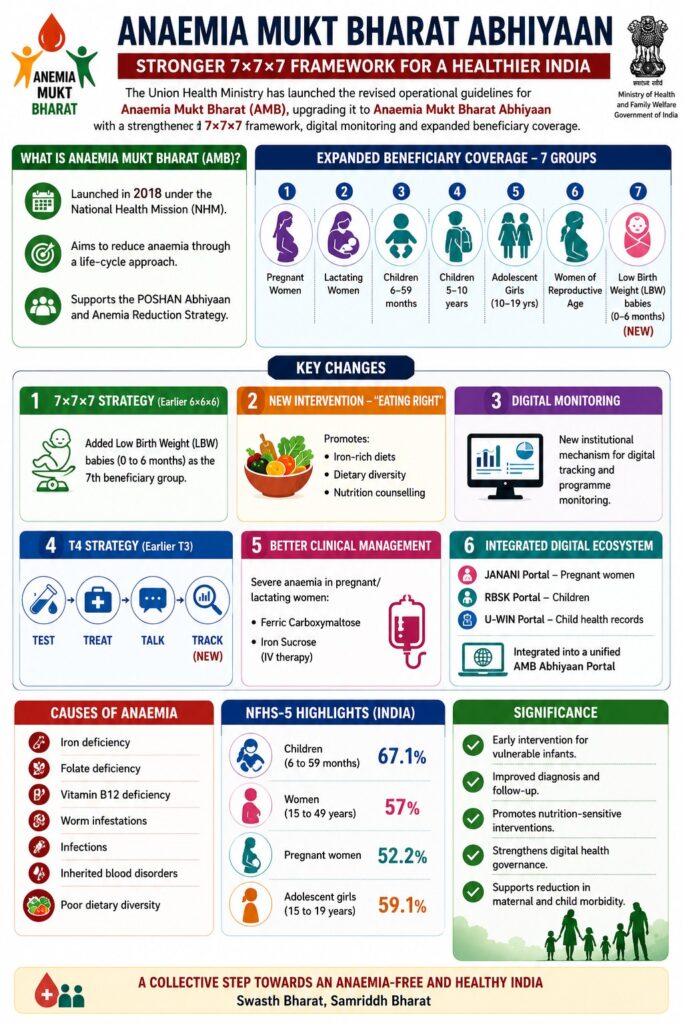
    [2023] Consider the following statements in the context of interventions being undertaken under Anaemia Mukt Bharat Strategy:
    1. It provides prophylactic calcium supplementation for pre-school children, adolescents and pregnant women.
    2. It runs a campaign for delayed cord clamping at the time of child- birth.
    3. It provides for periodic deworming to children and adolescents.
    4. It addresses non-nutritional causes of anaemia in endemic pockets with special focus on malaria, hemoglobinopathies and fluorosis.
    How many of the statements given above are correct?

    [A] Only one

    [B] Only two

    [C] Only three

    [D] All four

  • RBI Temporarily Lifts Interest Rate Ceiling on FCNR(B) & NRE Deposits

    Why in the news?

    The RBI has temporarily removed the interest rate ceiling on fresh FCNR(B) deposits (3-5 years) and NRE deposits (3 years and above) from 17 June 2026 to 30 September 2026 to attract foreign currency inflows, support the rupee, and ease external financing conditions.

    FCNR(B) Deposits

    • Foreign Currency Non-Resident (Bank) Deposits allow NRIs to maintain fixed deposits in designated foreign currencies.
    • Principal and interest are protected from exchange-rate risk.
    • RBI has removed the interest rate cap on fresh and renewed deposits of 3-5 year tenor.
    • Banks have already increased FCNR(B) deposit rates to around 7%.

    NRE Deposits

    • Non-Resident External (NRE) Accounts are rupee-denominated accounts maintained by NRIs.
    • Both principal and interest are fully repatriable.
    • Interest rate ceiling on fresh and renewed deposits of 3 years and above has been removed temporarily.
    • Transfers from NRO to NRE accounts will not qualify for this relaxation.

    RBI’s Objective

    • Attract larger NRI deposits and foreign currency inflows.
    • Strengthen foreign exchange reserves.
    • Support rupee stability.
    • Reduce overseas borrowing costs for banks and public sector entities.
    • Complement RBI’s concessional forex swap facility announced on 5 June 2026.

    Expected Impact

    • Analysts estimate $30-50 billion of inflows by Q3 FY27.
    • Similar FCNR(B) scheme in 2013 attracted nearly $25 billion.
    • Increased foreign currency liquidity may ease external sector pressures.

    [2021] Consider the following:
    1. Foreign currency convertible bonds
    2. Foreign institutional investment with certain conditions
    3. Global depository receipts
    4. Non-resident external deposits
    Which of the above can be included in Foreign Direct Investments?

    [A] 1, 2 and 3

    [B] 3 only

    [C] 2 and 4

    [D] 1 and 4

  • [19th June 2026] The Hindu OpED: NFHS-6 reveals progress amid nutrition challenge

    PYQ Relevance[UPSC 2018] Appropriate local community-level healthcare intervention is a prerequisite to achieve ‘Health for All’ in India. Explain.
    Linkage: The NFHS-6 findings highlight that achieving better nutrition outcomes requires community-level interventions through ASHAs, AWWs, crèches, behaviour-change communication, local governance participation and preventive counselling, rather than relying solely on institutional healthcare services.

    Mentor’s Comment

    NFHS-6 indicates that India has achieved substantial progress in public health delivery. The central challenge has shifted from expanding access to services toward improving caregiving, feeding behaviour, maternal support, and diet quality.

    What change does NFHS-6 reveal in India’s nutrition landscape?

    1. Decline in Stunting: Stunting among children under five declined from 35.5% to 29.3%.
    2. Better Maternal Care: Around 95% of mothers received antenatal care.
    3. Rise in Institutional Deliveries: Institutional births reached about 90%.
    4. Higher Immunisation Coverage: About 87% of children aged 12–23 months are fully vaccinated.
    5. Improved Public Health Access: Better housing, sanitation, education, and health services have strengthened child health outcomes.

    Why has nutrition progress lagged behind improvements in health indicators?

    1. Poor Breastfeeding Practices: Only about half of newborns are breastfed within the first hour of birth.
    2. Delayed Complementary Feeding: Many children do not receive timely solid and semi-solid foods after six months. In many households, complementary feeding begins only after annaprasana. Delays during this period contribute to growth faltering.
    3. Inadequate Diet Diversity: Only around 15% of children aged 6-23 months receive an adequate diet.
    4. Persistent Wasting: Severe wasting indicators show limited improvement.
    5. Weak Feeding Awareness: Families often lack information regarding age-appropriate nutrition.

    Why is maternal time poverty emerging as a major nutrition challenge?

    1. Double Burden of Work: Women perform paid and unpaid work simultaneously.
    2. Informal Labour Participation: Large numbers of women work in agriculture and informal sectors.
    3. Childcare Deficit: Lack of crèches forces many mothers to leave infants with relatives or older siblings.
    4. Crèches as Nutrition Infrastructure: Community childcare centres improve feeding continuity, support breastfeeding and reduce women’s unpaid care burden.
    5. Disrupted Feeding Practices: Work responsibilities reduce breastfeeding and complementary feeding frequency.
    6. Limited Childcare Infrastructure: Rural areas lack adequate crèches and support systems.

    Why does greater food expenditure not guarantee better nutrition?

    1. Consumer Expenditure Shift: Recent Consumer Expenditure Survey findings show declining spending on cereals and rising expenditure on dairy, processed foods and beverages.
    2. Nutrition-Diversity Gap: Dietary diversity does not necessarily ensure nutritional adequacy.
    3. Affordability Constraints: Pulses, fruits, vegetables, nuts, and animal-source foods remain expensive.
    4. Convenience Advantage: Processed foods are easily available and ready to consume.
    5. Departure from NIN Guidelines: Many household diets diverge from recommended nutritional patterns.

    Why must India’s nutrition strategy move beyond treatment to prevention?

    1. Critical First 1,000 Days: Nutrition from pregnancy to age two determines lifelong outcomes.
    2. Early Growth Faltering: Stunting and growth failure begin well before severe malnutrition becomes visible. Growth faltering often begins before severe malnutrition becomes visible and peaks during the second year of life.
    3. Need for Early Detection: Regular anthropometric monitoring can identify risks sooner.
    4. Preventive Counselling: Timely guidance to mothers can prevent nutrition deficits.
    5. Focus on At-Risk Children: Current interventions remain heavily oriented toward severe cases.
    6. 0-2 Years Data Gap: Lack of disaggregated data for children aged 0-2 years limits targeted interventions during the most critical growth period.
    7. POSHAN Focus Gap: Current identification systems focus on severely malnourished children rather than children beginning to show growth decline

    What implementation gaps weaken frontline nutrition delivery?

    1. Data Quality Challenges: Large volumes of nutrition data remain underutilised.
    2. Limited Analytical Capacity: Local-level analysis and feedback mechanisms remain weak.
    3. Training Deficits: AWWs, ASHAs, and ANMs need stronger nutrition counselling skills.
    4. Human Resource Gaps: District-level nutritionists and data analysts are inadequate.
    5. Limited Digital Support: Technology tools remain underused for counselling and monitoring.

    Why is child malnutrition not merely a health-sector problem?

    1. Water and Sanitation Linkages: Safe drinking water and sanitation directly influence nutrition outcomes.
    2. Local Governance Role: Gram Sabhas and Panchayats can prioritise nutrition interventions.
    3. Need for Convergence: Health, ICDS, education, and local governments must coordinate.
    4. Gender Dimension: Women’s economic participation requires childcare support systems.
    5. Role of Men in Caregiving: Shared domestic responsibilities improve child feeding practices.

    What is the central tension in India’s nutrition transition?

    1. Access vs Outcomes: Health-care access has improved substantially, but nutrition outcomes lag behind.
    2. Health Care vs Nutrition Outcomes: India has largely solved access-related deficits in maternal and child health, but feeding practices, caregiving constraints and diet quality now drive malnutrition.
    3. Treatment vs Prevention: Policy focus remains stronger on rehabilitation than early prevention.
    4. Food Availability vs Nutrition Quality: More food spending does not ensure better diets.
    5. Women’s Work vs Childcare Needs: Economic participation often competes with caregiving responsibilities.
    6. Data Generation vs Data Utilisation: India collects extensive nutrition data but uses it inadequately for corrective action.

    Conclusion

    NFHS-6 shows that India has largely succeeded in expanding health-care access and public service delivery. The next phase of nutrition improvement depends on correcting feeding practices, reducing maternal time poverty, improving diet quality, strengthening frontline counselling, and using nutrition data for preventive action. Better health care alone cannot overcome India’s nutrition challenge.