Mains Ready By December. Smash Mains & Smash PYQ Admissions Open

Search results for: “”

  • Skilling in India: Issues and Suggestions

    PM has yet again underscored the importance of a skilled workforce for achieving the goal of becoming Atma-nirbhar Bharat.  India still continues to be a country that faces one of the highest shortages of skilled workforce.

    Unemployment vs Skills
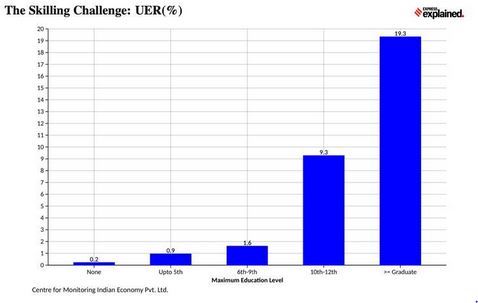
    • On one hand, companies in India face an acute shortage of skilled manpower and, on the other, India has millions of educated unemployed.
    • The data for this chart is for the January to April 2021 period, when the overall unemployment rate in the country was 6.83%.
    • In comparison, those with graduation (or even higher degrees) face almost three times the unemployment level.
    • At over 19% unemployment rate, one in every five Indians who graduate (or even better) is unemployed.

    What explains this contradiction?

    • The lack of skill is definitely the only answer.

    What is Skilling?

    • National Council of Applied Economic Research, 2018 — aptly titled “No time to lose”.
    • This report explains that there are three types of skills.
    1. Cognitive skills: basic skills of literacy and numeracy, applied knowledge and problem-solving aptitudes, and higher cognitive skills such as experimentation, reasoning, and creativity.
    2. Technical and vocational skills: physical and mental ability to perform specific tasks using tools and methods in any occupation.
    3. Social and behavioral skills include working, communicating, and listening to others.
    • Different levels of these three types of skills can be combined to further classify skills into foundational, employability, and entrepreneurial skills.

    What is the scale of the skilling challenge facing India?

    According to the 2018 report by NCAER, India had about 468 million people in its workforce.

    • Informal sector: Around 92% of them were in the informal sector.
    • Illiteracy: Around 31% were illiterate, only 13% had primary education, and only 6% were college graduates.
    • No vocational training: Further, only about 2% of the workforce had formal vocational training, and only 9% had non-formal vocational training.
    • Out of more than 5 lakh final year bachelors students aged 18–29 who were surveyed, around 54% were found to be “unemployable”.

    Opportunities for India

    • India has entered a demographic sweet spot that will continue for another two to three-decade.
    • There is a great opportunity for India to improve both its social and economic outcomes if a higher number of workers are productively employed.

    What is at stake?

    • If the skilling issue is not resolved, India risks forfeiting its so-called “demographic dividend”.
    • But whether this will turn into a demographic dividend or not will depend entirely on how many of those in the working-age bracket are working and becoming prosperous.
    • If they are not in well-paying jobs, the economy would not have the resources to take care of itself since with each passing year, the proportion of dependents will continue to rise after 2040.
    • To put it simply, to attain its rightful place and realize its aspirations, India must become rich before it gets old.

    The skilling paradox

    • Indians have excelled in technical expertise at the global level — be it medicine or engineering. Then what explains India’s domestic skilling paradox?
    • A big part of the trouble is the starting condition. Over 90% of India’s workforce is in the informal sector.

    India is trapped in a vicious cycle:

    1. Greater workforce informality leads to lower incentives to acquire new skills. Faced with inadequately skilled workers, businesses often choose to replace labor with machinery.
    2. That’s because “skilled labor and technology are complementary, but unskilled labor and technology are substitutes”.
    3. This, in turn, leads to still fewer formal jobs.

    What can be done to break this cycle?

    • A distinct disadvantage with India’s approach towards skilling has been to ignore and match the demands of the market.
    • For the most part, skills have been provided in a top-down fashion.
    • Given the way market demands fluctuate — for instance, how the Covid pandemic has upended supply chains — skilling efforts must try to anticipate the needs of the market.
  • Lokpal

    More than two years after the Lokpal came into being, the Centre is yet to appoint a director of inquiry for conducting a preliminary inquiry into graft complaints sent by the anti-corruption ombudsman.

    Who is ‘Director of Inquiry’?

    • According to the Lokpal and Lokayuktas Act, 2013, there shall be a director of inquiry, not below the rank of Joint Secretary to the GoI.
    • He/ She shall be appointed by the Central government for conducting preliminary inquiries referred to the Central Vigilance Commission (CVC) by the Lokpal.

    About the Lokpal

    • The Lokpal, the apex body to inquire and investigate graft complaints against public functionaries, came into being with the appointment of its chairperson and members in March 2019.
    • In March 2019, former SC judge Justice Pinaki Chandra Ghose was selected as the first head of the Lokpal.

    Lokpal and Lokayuktas Act, 2013

    • The Lokpal Act 2013 is anti-corruption legislation that seeks to provide for the establishment of the institution of Lokpal.
    • It seeks to inquire into allegations of corruption against certain important public functionaries including the PM, cabinet ministers, MPs, Group A officials of the Central Government etc.
    • The Bill was introduced in the parliament following massive public protests led by anti-corruption crusader Anna Hazare and his associates.
    • The Bill is one of the most widely discussed and debated Bills in India in recent times.

    Its history

    • The term Lokpal was coined in 1963 by Laxmi Mall Singhvi, a member of parliament during a parliamentary debate about grievance mechanisms.
    • The Administrative Reforms Commission (ARC) headed by Morarji Desai submitted an interim report on “Problems of Redressal of Citizen’s Grievances” in 1966.
    • In this report, ARC recommended the creation of two special authorities designated as ‘Lokpal’ and ‘Lokayukta’ for redress of citizens’ grievances.
    • Maharashtra was the first state to introduce Lokayukta through The Maharashtra Lokayukta and Upa-Lokayuktas Act in 1971.

    Also read:

    https://www.civilsdaily.com/news/explained-how-lokpal-will-form-function/

  • RBI bars Mastercard from issuing new cards

    The Reserve Bank of India (RBI) has banned Mastercard from issuing new debit and credit cards to customers in India.

    Why such a ban?

    • According to the RBI, the US card issuer has failed to comply with the local data storage rules announced by the central bank in 2018.

    What is the RBI’s data localization policy?

    • In 2018, the RBI had issued a circular ordering card companies such as Visa, Mastercard, and American Express to store all Indian customer data locally.
    • This was aimed for the regulator to have “unfettered supervisory access”.

    Why such a policy by RBI?

    • The reason offered by the RBI was that local storage of consumer data is necessary to protect the privacy of Indian users and also to address national security concerns.

    Issues with the policy

    • Privacy: Customer privacy and national security are genuine concerns that need to be taken seriously.
    • Protectionism: However, data localization rules may sound too stringent and they could simply be used by governments as tools of economic protectionism.
    • Security: For instance, it may not be strictly necessary for data to be stored locally to remain protected.
    • Formal international laws to govern the storage of digital information across borders may be sufficient to deal with these concerns.
    • Discrimination: Governments, however, may still mandate data localization in order to favour local companies over foreign ones.

    Implications of the move

    • Indian banks that are currently enrolled in the Mastercard network are expected to make alternative arrangements with other card companies.
    • The RBI’s data localization policy, as it burdens foreign card companies, may end up favouring domestic card issuers like RuPay, which in turn can lead to reduced competition.
    • Mastercard owns about one-third of the market share in India, and the RBI’s ban is likely to significantly benefit its competitors.
    • This could mean higher costs and lower quality services for customers.

    Conclusion

    • In today’s digital economy data have turned out to be a valuable commodity, which companies, as well as governments, have tried to gain control over.
    • With no clear rules on who owns customer data and to what extent, conflicts over data ownership are likely to continue for some time.
  • How the Moon ‘Wobble’ affects rising tides

    US coastlines will face increasing flooding in the mid-2030s due to a regular lunar cycle called the wobble effect that will magnify rising sea levels caused by climate change.

    What is the Moon Wobble?

    • The moon wobble is nothing but a regular swaying in the moon’s orbit.
    • It was first documented way back in 1728.
    • This wobble takes over an 18.6-year period to complete and continues in a cyclic fashion.

    How does this wobble occur?

    • High tides on this planet are caused mostly by the pull of the moon’s gravity on a spinning Earth. On most beaches, you would see two high tides every 24 hours.
    • The moon also revolves around the Earth about once a month, and that orbit is a little bit tilted.
    • moon’s orbital plane around the Earth is at an approximate 5-degree incline to the Earth’s orbital plane around the sun.
    • Because of that, the path of the moon’s orbit seems to fluctuate over time, completing a full cycle — sometimes referred to as a nodal cycle — every 18.6 years.
    • At certain points along the cycle, the moon’s gravitational pull comes from such an angle that it yanks one of the day’s two high tides a little bit higher, at the expense of the other.
    • This does not mean that the moon itself is wobbling, nor that its gravity is necessarily pulling at our oceans any more or less than usual.

    What impact does this wobble have on Earth?

    • Influences the ebb and flow of tides: The moon wobbles impacts the gravitational pull of the moon, and therefore, indirectly influences the ebb and flow of tides here on the Earth.
    • One half of the 18.6-year cycle suppresses the tides, which means that the high tides get lower, while the low tides get higher than normal.
    • Once this cycle completes, the situation flips—in the subsequent cycle, the tides are amplified, with high tides getting higher and low tides, lower.
    • The lunar cycle is expected to shift again by mid-2030, and in the coming phase, the tides will amplify once again.

    Moon wobble and climate change

    • The upcoming changes in the lunar cycle will pose a serious threat, as the amplified high tides coupled with the rising sea levels will make the risk of flooding far greater across all coastal regions of the globe.
    • The study predicts that the high tide-associated floods—also known as nuisance floods or sunny day floods—may occur in clusters that could last for months or even for longer periods!
    • This surge will be closely associated with the position of the Moon, Earth and the Sun.
    • When the Moon and Earth line up in specific ways with each other and the Sun, the resulting gravitational pull and the ocean’s corresponding response may leave city-dwellers coping with floods every day or two.
  • Places in news: Great Barrier Reef

    Chinese official has said that political tensions between Beijing and Australia were not behind a UNESCO recommendation to place the Great Barrier Reef on its endangered list.

    Great Barrier Reef

    • The Great Barrier Reef is the world’s largest coral reef system composed of over 2,900 individual reefs and 900 islands.
    • It is stretched for over 2,300 kilometres over an area of approximately 344,400 square kilometres.
    • The reef is located in the Coral Sea, off the coast of Queensland, Australia.
    • It was world heritage listed in 1981 by UNESCO as the most extensive and spectacular coral reef ecosystem on the planet.

    Importance of Corals

    Coral reefs are some of the most diverse and valuable ecosystems on Earth.

    • They support more species per unit area than any other marine environment, including about 4,000 species of fish, 800 species of hard corals and hundreds of other species.
    • This biodiversity is considered key to finding new medicines for the 21st century.
    • Medical use: Many drugs are now being developed from coral reef animals and plants as possible cures for cancer, arthritis, human bacterial infections, viruses, and other diseases.
    • Fisheries: Healthy coral reefs support commercial and subsistence fisheries as well as jobs and businesses through tourism and recreation.
    • Local economies receive billions of dollars from visitors to reefs through diving tours, recreational fishing trips, hotels, restaurants, and other businesses based near reef ecosystems.
    • Coral reef structures also buffer shorelines against 97 per cent of the energy from waves, storms, and floods, helping to prevent loss of life, property damage, and erosion.

    Answer this PYQ in the comment box:

    Q.Consider the following statements:

    1. Most of the world’s coral reefs are in tropical waters.
    2. More than one-third of the world’s coral reefs are located in the territories of Australia, Indonesia and the Philippines.
    3. Coral reefs host far more number of animal phyla than those hosted by tropical rainforests.

    Which of the above statements is/are correct?

    (a) 1 and 2 only

    (b) 3 only

    (c) 1 and 3 only

    (d) 1 and 3 only


    Back2Basisc: Coral Reef

    • Coral reefs are built by and made up of thousands of tiny animals—coral “polyps”—that are related to anemones and jellyfish.
    • Polyps are shallow-water organisms that have a soft body covered by a calcareous skeleton. The polyps extract calcium salts from seawater to form these hard skeletons.
    • The polyps live in colonies fastened to the rocky seafloor.
    • The tubular skeletons grow upwards and outwards as a cemented calcareous rocky mass collectively called corals.
    • When the coral polyps die, they shed their skeleton on which new polyps grow.
    • The cycle is repeated for millions of years leading to the accumulation of layers of corals shallow rock created by these depositions is called a reef.
  • Back in news: Pegasus Spyware

    Telephone numbers of some noted Indian journalists were successfully snooped upon by an unidentified agency using Pegasus software.

    Pegasus Spyware

    • All spyware do what the name suggests — they spy on people through their phones.
    • Pegasus works by sending an exploit link, and if the target user clicks on the link, the malware or the code that allows the surveillance is installed on the user’s phone.
    • A presumably newer version of the malware does not even require a target user to click a link.
    • Once Pegasus is installed, the attacker has complete access to the target user’s phone.
    • The first reports on Pegasus’s spyware operations emerged in 2016, when Ahmed Mansoor, a human rights activist in the UAE, was targeted with an SMS link on his iPhone 6.

    What is the new threat?

    • Pegasus has evolved from its earlier spear-phishing methods using text links or messages to ‘zero-click’ attacks which do not require any action from the phone’s user.
    • This had made what was without a doubt the most powerful spyware out there, more potent and almost impossible to detect or stop.

    How do zero-click attacks work?

    • A zero-click attack helps spyware like Pegasus gain control over a device without human interaction or human error.
    • Zero-click attacks are hard to detect given their nature and hence even harder to prevent.
    • Detection becomes even harder in encrypted environments where there is no visibility on the data packets being sent or received.
    • Most of these attacks exploit software that receive data even before it can determine whether what is coming in is trustworthy or not, like an email client.

    Answer this PYQ from CSP 2018:

    Q.The terms ‘WannaCry, Petya, Eternal Blue’ sometimes mentioned news recently are related to

    (a) Exoplanets

    (b) Crypto currency

    (c) Cyber attacks

    (d) Mini satellites

  • Top 3 Tips That Can Transform Your Essay | Learn From A Published Author For FREE! Daily Vocabulary Building, Writing Exercises, And More!

    Dear aspirants,

    Anand sir would be taking a special session on the top 3 things that matter the most in Essay writing that can help you score more in Essays. Join the session for FREE at 12:30 P.M. and start learning now!

    What do you learn?

    1. Important essay-writing tips.
    2. Daily writing exercises.
    3. Daily vocabulary building.
    4. Important reading material.
    5. Question and answers
    6. Live feedback

    And more…

    Session at 12.30 P.M.

    This is available for absolutely FREE but we request you not to miss it!

    What do you have to do?

    1. Join Habitat For Absolutely Free Sessions!
    2. Read The Discussions Happening On The General Page.
    3. Click On The Blue Box To Join The Discussion.
    4. Participate, Ask Questions, Engage, And Learn!

    Don’t Miss Out On The Questions That May Help You Succeed!

    Here is a list of topics and discussions you can join immediately:

    Revise Economics for IAS PrelimsRavi Ranjan11:00 am
    English WritingAnand Prakash12:30 pm
    Science and TechDr. Keerti1:00 pm
    Samadhan CSATRavi Ranjan2:00 pm
    UPSC EPFORohit Yadav3:00 pm
    Chat pe News: Current AffairsAnjum Sharma4:30 pm
    Polity Laxmikant Amoghavarsha5:30 pm
    Indian society and Social IssuesSiddharth 6:00 pm
    Abhyaas: Answer WritingGarima7:00 pm
    Samvad: Indian AgricultureRadhika Didwania7:30 pm
    Prelims HeistParth Verma8:30 pm
    Parakram Answer Writing sessionRohit Yadav9:30 pm
    Post dinner MCQs for IAS prelimsAmitB10:15 pm

    And many more…

    Whatever you need, we have it here.

    How to join a discussion?

    After you have joined/registered on Habitat for free, go to the General club. Click on the blue box of the session you want to attend.

  • 19th July 2021| Daily Answer Writing Enhancement(AWE)

    Topics for Today’s questions:

    GS-1  Salient features of Indian Society, Diversity of India

    GS-2 Welfare schemes for vulnerable sections of the population by the Centre and States and the performance of these schemes;


    GS-3 Indian Economy and issues relating to planning, mobilization, of resources; Effects of liberalization on the economy.


    GS-4 Aptitude and foundational values for Civil Service, integrity, impartiality and non-partisanship, objectivity, dedication to public service, empathy, tolerance and compassion towards the weaker-sections

    Questions:

    Question 1)


    Q.1) “Both the developments during the colonial period and changes witnessed post independence has shaped the present form of caste as an institution in India”. Discuss. (10 marks)


    Question 2)

    Q.2) The Covid-19 crisis has highlighted the many commonalities between all economically and occupationally vulnerable informal workers and seasonal/circular migrant workers and exposed the fault lines and gaps in the existing social protection system. In light of this, examine the shortcomings in the existing framework and suggest the measure to reduce their vulnerability. (10 Marks)

    Question 3)

    Q.3) Examine the implications of retrospective taxation adopted by India by amending Section 9(1)(i) of the Income Tax Act. What should be India’s course of action in the Cairn Energy dispute? (10 Marks)

    Question 4)  

    Q.4) Value of compassion towards the weak extends the limits of operations of a public servant by introducing flexibility but dilutes the principle of objectivity. Discuss. If a conflict arises between the value of compassion and principle of objectivity, how will you deal with it as a public servant? (10 Marks)


    HOW TO ATTEMPT ANSWERS IN DAILY ANSWER WRITING ENHANCEMENT(AWE)?

    1. Daily 4 questions from General studies 1, 2, 3, and 4 will be provided to you.

    2. A Mentor’s Comment will be available for all answers. This can be used as a guidance tool but we encourage you to write original answers.

    3. You can write your answer on an A4 sheet and scan/click pictures of the same.

    4.  Upload the scanned answer in the comment section of the same question.

    5. Along with the scanned answer, please share your Razor payment ID, so that paid members are given priority.

    6. If you upload the answer on the same day like the answer of 1st June is uploaded on 1st June then your answer will be checked within 72 hours. Also, reviews will be in the order of submission- First come first serve basis

    7. If you are writing answers late, for example, 1st June is uploaded on 3rd June, then these answers will be evaluated as per the mentor’s schedule.

    8. We encourage you to write answers on the same day. However, if you are uploading an answer late then tag the mentor like @Swatantra so that the mentor is notified about your answer.

    *In case your answer is not reviewed, reply to your answer saying *NOT CHECKED*. Swatantra Sir’s tag is available, tag him.

    For the philosophy of AWE and payment: 

  • UPSC Civil Services is not an Exam of “Selection” but of “Elimination”. How being “Well Guided” helps you Save Composure and Several Failed Attempts

    We have spent over 6,500 hours last year discussing the preparation strategies of over 9,000 students individually and we found that there are 2 kinds of aspirants.

    1. Those who received good guidance and planned their study to score more. And
    2. Those aspirants who were misguided by others and got overwhelmed by the syllabus.

    And if you feel that you need some experienced guidance, then you have come to the right place!

    We will tell you how we guide our students and you can decide if it suits you:

    1. Personalized Study Plans – Every student learns at a different pace. One study plan does not suit everyone. That is why when students get in touch with us, we prepare individual study plans for each student that helps them learn at their own pace.
    2. Identifying Mistakes – Our experienced mentors have worked with thousands of students and they know the most common mistakes the students make. When we teach our students, we guide them away from these mistakes so they can improve their performance quickly and score more.

    3. We Don’t Experiment With Your Career – Our success depends on the success of our students. That is why we only use Tried and Tested Methods of studying that has proven extremely successful in the past. We adapt to the changes and not experiment with your careers.

    4. We Present What UPSC Expects – We understand what the UPSC expects when it comes to answer-writing, essays, and other preparations. We work hard to decode UPSC patterns so that our students don’t have to. That is why we provide only the most relevant material to the students so they can study without feeling lost.

    5. One-Stop For All Your Needs – Our students do not get overwhelmed while studying because we provide them with everything they need! All the relevant study material, tests, discussions, and coaching in one place. This helps our students remain focused and concentrated.

    And more…

    We work with our students for their success. 

    And if you feel like talking to us just get in touch. We would love to know how we can help you succeed!

  • Complete Entire Environment Syllabus For FREE!

    MCQs, Hot Topics, Study Material, Discussions, Everything!

    Dear Aspirants,
    The environment is a big part of the Prelims syllabus and is highly dynamic in nature. You don’t want to miss out on these questions! Complete the entire syllabus of Environment for Prelims at absolutely NO CHARGE!

    What will you get?

    1) Complete Coverage Of Environment

    2) Latest MCQs and Most Expected Questions.

    3) Relevant Study Material.

    4) Complete concept clear and doubt clear sessions.

    5) Instant feedback from the mentor.

    And more…

    All of this for absolutely no charge!

    This is available for absolutely FREE but we request you not to miss it!

    What do you have to do?

    1. Join Habitat For Absolutely Free Sessions!
    2. Read The Discussions Happening On The General Page.
    3. Click On The Blue Box To Join The Discussion.
    4. Participate, Ask Questions, Engage, And Learn!

    Don’t Miss Out On The Questions That May Help You Succeed!

    Here is a list of topics and discussions you can join immediately:

    Revise Economics for IAS PrelimsRavi Ranjan11:00 am
    English WritingAnand Prakash12:30 pm
    Science and TechDr. Keerti1:00 pm
    Samadhan CSATRavi Ranjan2:00 pm
    UPSC EPFORohit Yadav3:00 pm
    Chat pe News: Current AffairsAnjum Sharma4:30 pm
    Polity Laxmikant Amoghavarsha5:30 pm
    Indian society and Social IssuesSiddharth 6:00 pm
    Abhyaas: Answer WritingGarima7:00 pm
    Samvad: Indian AgricultureRadhika Didwania7:30 pm
    Prelims HeistParth Verma8:30 pm
    Parakram Answer Writing sessionRohit Yadav9:30 pm
    Post dinner MCQs for IAS prelimsAmitB10:15 pm

    And many more…

    Whatever you need, we have it here.

    How to join a discussion?

    After you have joined/registered on Habitat for free, go to the General club. Click on the blue box of the session you want to attend.