[WpProQuiz 676]
[WpProQuiz_toplist 676]
1.1 Pradhan Mantri Krishi Sinchayee Yojana
Objective
● To achieve convergence of investments in irrigation at the field level.
● To enhance the recharge of aquifers and introduce sustainable water conservation practices.
● To explore the feasibility of reusing treated municipal wastewater for peri-urban agriculture.
● To attract greater private investments in irrigation.
● To promote extension activities relating to water harvesting, water management and crop alignment for farmers and grass root level field
functionaries.
Salient features
● Decentralized State level planning and projectized execution’ structure, in order to allow States to draw up a District Irrigation Plan (DIP) and a State Irrigation Plan (SIP). These plans need to be prepared in order to access
the PMKSY fund.
● It will be supervised and monitored by the Inter-Ministerial National Steering Committee (NSC) under PM with Union Ministers of all concerned Ministries. A National Executive Committee (NEC) is to be constituted under the Chairmanship of the Vice Chairman, NITI Aayog to oversee programme implementation.
● PMKSY has been formulated amalgamation ongoing schemes viz. Accelerated Irrigation Benefit Programme (AIBP); Integrated
Watershed Management Programme (IWMP); and On-Farm Water Management (OFWM) component of National Mission on Sustainable
Agriculture (NMSA).
● Water budgeting is done for all sectors namely, household, agriculture and industries.
● Investments will happen at farm level. So, farmers know what is happening and can provide valuable feedback.
● Recently, the Long Term Irrigation Fund has been instituted under PMKSY in NABARD for funding and fast-tracking the implementation
of incomplete major and medium irrigation projects.
1.2 RASHTRIYA KRISHI VIKAS YOJANA – RAFTAAR (RKVY-RAFTAAR)
Objective
● To make farming a remunerative economic activity through strengthening the farmer’s efforts, risk mitigation and promoting
agribusiness entrepreneurship.
● To attend national priorities through several sub-schemes.
● To empower youth through skill development, innovation and agri entrepreneurship based business models.
Salient features
● RKVY, initiated in 2007 as an umbrella scheme for holistic development of agriculture and allied sectors, has been recently revamped as
RKVY-RAFTAAR – Remunerative Approaches for Agriculture and Allied sector Rejuvenation for 2017-19 and 2019-20.
● It provided states with considerable flexibility and autonomy for planning and executing Programs.
● The decentralised planning for agriculture and allied sectors is initiated by the states through District Agriculture Plan and State Agriculture
Plan based on agro-climatic conditions, availability of appropriate technology and natural priorities.
● It will incentivize states to increase allocations for agriculture and allied sectors and help in creation of post-harvest infrastructure and
promotion of private investment in the farm sector across the country.
● Fund Allocation – 60:40 grants between Centre
and States in states and 90:10 for North Eastern States and Himalayan States through following streams – o Infrastructure & Assets and Production Growth o RKVY-RAFTAAR special sub-schemes of National Priorities o Innovation
and agri-entrepreneur development.
Sub-schemes include
● Bringing Green Revolution to Eastern India
● Crop Diversification Program – It is being implemented in the Original Green Revolution States of Punjab, Haryana and Western Uttar Pradesh to diversify area from water-guzzling crop
● Reclamation of Problem Soil ● Foot & Mouth Disease – Control Program
(FMD-CP)
● Saffron Mission
● Accelerated Fodder Development Programme (AFDP)
1.3 NATIONAL FOOD SECURITY MISSION
Objective
● Increasing production of rice, wheat, pulses, coarse cereals and commercial crops through area expansion and productivity enhancement
in a sustainable manner.
● Restore soil fertility and productivity at the individual farm level.
● Enhancing farm level economy.
Salient features
● It is a Centrally Sponsored Scheme which was launched in 2007.
● The approach of the scheme is to bridge the yield gap in respect of these crops through dissemination of improved technologies and farm management practices while focusing on districts which have high potential but relatively low level of productivity at present.
● Major Components – National Food Security Mission – Rice, National Food Security Mission – Wheat, National Food Security Mission – Pulses,
National Food Security Mission – Coarse Cereals and National Food Security Mission –Commercial Crops.
1.4 National Horticulture Mission
1. To provide holistic growth of the horticulture sector through an area based regionally differentiated strategies, to enhance horticulture production, improve nutritional security and income support to farm households
2. To establish convergence and synergy among multiple ongoing and planned programmes for horticulture development
3. To promote, develop and disseminate technologies, through a seamless blend of traditional wisdom and modern scientific knowledge
4. To create opportunities for employment generation for skilled and unskilled persons, especially unemployed youth.
Scheme:
A National Horticulture Mission was launched in 2005-06 as a Centrally Sponsored Scheme to promote holistic growth of the horticulture sector
through an area based regionally differentiated strategies. The scheme has been subsumed as a part of Mission for Integration Development of
Horticulture (MIDH) during 2014-15.
What is the National Horticulture Mission?
The National Horticulture Mission is a government mission to support horticultural production in the country. NHM is a Centrally Sponsored Scheme in which the Government of India contributes 85%, and 15% is met by the State Governments.
Factual Information:
● India ranks second in the global production of fruits and vegetables next to China.
● Started in 2005-06.
1.5 SOIL HEALTH CARD SCHEME
Objective
● To issue soil health cards every 3 years, to all farmers of the country, so as to provide a basis to address nutrient deficiencies in fertilization practices.
● To strengthen the functioning of Soil Testing Laboratories (STLs) through capacity building, the involvement of agriculture students and
effective linkage with Indian Council of Agricultural Research (ICAR) / State Agricultural Universities (SAUs).
● To diagnose soil fertility related constraints with standardized procedures for sampling uniformly across states.
● To build capacities of district and state level staff and of progressive farmers for promotion of nutrient management practices.
Salient features
● It is a centrally sponsored scheme launched by the Government of India in 2015.
● It is being implemented through the Department of Agriculture of all the State and Union Territory Governments.
● Assistance is provided to the State Government to issue Soil Health Card and also develop a database to improve service delivery.
● Soil Health Card issued to farmers carry crop-wise recommendations of nutrients and fertilizers required for the individual farms.
● The experts will analyze the strength and weaknesses (micronutrients deficiency) of the soil collected from farms and suggest measures
to deal with it.
● It will contain the status of his soil with respect to 12 parameters, namely N,P,K (Macronutrients); S (Secondary nutrient); Zn, Fe, Cu, Mn, Bo (Micro – nutrients); and pH, EC, OC (Physical parameters).
1.6 PM FASAL BIMA YOJANA
Objective
● To provide insurance coverage and financial support to the farmers in the event of natural calamities, pests & diseases.
● To stabilise the income of farmers to ensure
their continuance in farming. ● To encourage farmers to adopt innovative and
modern agricultural practices.
● To ensure flow of credit to the agriculture sector.
Intended beneficiary.
● All farmers including sharecroppers and tenant farmers growing notified crops in a notified area during the season who have insurable interest in the crop are eligible.
Salient features
● It replaced all other existing insurance schemes except the Restructured Weather-Based Crop Insurance Scheme (uses weather parameters as
proxy for crop yield in compensating the cultivators for deemed crop loses) .
● A uniform premium of only 2% to be paid by farmers for all Kharif crops and 1.5% for all Rabi crops.
● In case of annual commercial and horticultural crops, the premium to be paid by farmers will be only 5%.
● There is no upper limit on Government subsidy so farmers will get claim against full sum insured without any reduction.
● The difference between the premium paid by farmers and the actuarial premium charged was paid by the Centre and state government in
the ratio of 50:50.
● It is compulsory for loanee farmers availing crop loans for notified crops in notified areas and voluntary for non-loanee farmers.
● Yield Losses: due to non-preventable risks, such as Natural Fire and Lightning, Storm, Hailstorm, Cyclone, Typhoon, Tempest, Hurricane, Tornado.
Risks due to Flood, Inundation and Landslide, Drought, Dry spells, Pests/ Diseases also will be covered.
● Post-harvest losses are also covered.
● Mandatory use of technology: Smart phones, drones etc., will be used to capture and upload data of crop cutting to reduce the delays in claim payment to farmers. Remote sensing will be used to reduce the number of crop cutting
experiments.
● The Scheme shall be implemented on an ‘Area Approach basis’. Defined Area (i.e., unit area of insurance) is Village or above. It can be a
Geo-Fenced/Geo-mapped region having homogenous Risk Profile for the notified crop.
● Presently, 5 public sector insurers (Agriculture
Insurance Company of India, United India Insurance Company etc.) and 13 private insurance companies are empanelled for implementation of the scheme.
● Recently, states have been allowed to set up their own insurance companies for implementing the scheme.
1.7 National Mission for Sustainable Agriculture
National Mission for Sustainable Agriculture (NMSA) has been formulated for enhancing agricultural productivity especially in rainfed areas focusing on integrated farming, water use efficiency, soil health management and
synergizing resource conservation.
Objectives
● To make agriculture more productive, sustainable, remunerative and climate resilient by promoting location specific Integrated/Composite Farming Systems
● To conserve natural resources through appropriate soil and moisture conservation measures
● To adopt comprehensive soil health management practices based on soil fertility maps, soil test based application of macro & micro nutrients, judicious use of fertilizers etc.
● To optimize utilization of water resources through efficient water management to expand coverage for achieving ‘more crop per drop’.
● To develop capacity of farmers & stakeholders, in conjunction with other on going missions e.g. National Mission on Agriculture Extension &
Technology, National Food Security Mission, National Initiative for Climate Resilient Agriculture (NICRA) etc., in the domain of
climate change adaptation and mitigation measures.
● To pilot models in select blocks for improving productivity of rainfed farming by mainstreaming rainfed technologies refined through NICRA and by leveraging resources from other schemes/Missions like Mahatma
Gandhi National Rural Employment Guarantee Scheme (MGNREGS), Integrated Watershed Management Programme (IWMP), RKVY etc.;
and
● To establish an effective inter and intra Departmental/Ministerial coordination for accomplishing key deliverables of National Mission for Sustainable Agriculture under the aegis of National Action Plan on Climate
Change (NAPCC).
1.8 PARAMPARAGAT KRISHI VIKAS YOJANA
Objective
● Promotion of commercial organic production through certified organic farming.
● pesticide residue free produce and improved health of consumer
● Raise farmer’s income and create potential markets for traders.
● Motivate the farmers for natural resource mobilization for input production.
● Increase domestic production and certification of organic produce by involving farmers.
Intended beneficiary
● Farmers doing organic farming
● Farmers from NE India such as Sikkim
● Food processing industries
● Organic foods – export industry
Salient features
● “Paramparagat Krishi Vikas Yojana” is an elaborated component of Soil Health Management (SHM) under National Mission of Sustainable Agriculture (NMSA).
● Cluster Approach: Fifty or more farmers form a cluster having 50 acre land to take organic farming. Each farmer will be provided Rs. 20000
per acre in three years for seed to harvesting crops and to transport them to market.
● Government plans to form around 10 thousand clusters in three years and cover an area of 5 Lakh hectares under organic farming.
Components –
● Participatory Guarantee System (PGS) certification through cluster approach – mobilization of farmers, form clusters, identification of land resources and training on organic farming and PGS Certification and
quality control.
● Adoption of organic village for manure management and biological nitrogen harvesting through cluster approach –action plan for Organic Farming, Integrated Manure Management, Packing, Labelling and Branding
of organic products of cluster.
1.9 NATIONAL AGRICULTURAL MARKET
(NAM)
Objective
● To promote genuine price discovery
● Increases farmers’ options for sale and access to markets
● Liberal licensing of traders / buyers and commission agents. One license for a trader valid across all markets in the State
● Harmonisation of quality standards of agricultural produce
● Single point levy of market fees, i.e on the first wholesale purchase from the farmer.
● Provision of Soil Testing Laboratories in/ or near the selected mandi to facilitate visiting farmers to access this facility in the mandi itself
Intended beneficiary
● 585 regulated wholesale markets in states/union territories (UTs).
● Farmers
● Local traders
● Bulk buyers, processors
● Farm produce exporters
● Overall economy of the nation
Salient features
● NAM is a pan-India electronic trading portal which seeks to network the existing APMCs and other market yards to create a unified national
market for agricultural commodities.
● Small Farmers Agribusiness Consortium (SFAC) has been selected as the lead agency to implement it.
● Central government will provide the software free of cost to the states and in addition, a grant of up to Rs. 30 lakhs per mandi or market or
private mandis will be given for related equipment and infrastructure requirements.
● New Features added to the scheme such as E-NAM Mobile App, BHIM Payment facility, MIS dashboard for better analysis and insights,
grievance redressal mechanism for Mandi Secretaries and integration with Farmer Database to ease the registration and identification process will further strengthen e-NAM.
● Fund Allocation – The Scheme is being funded through AgriTech Infrastructure Fund (AITF).
1.10 KRISHI VIGYAN KENDRAS
Objective
● To be a frontline extension in agriculture, and to serve as a single window mechanism for addressing the technology needs of farmers
● To demonstrate location specific technologies and build capacity of farmers
● To serve as links between research and extension and also with farmers
Intended beneficiary
● Rural youth, farm women and Farmers (skill development training)
Salient features
● Indian Council of Agricultural Research (ICAR)has created a network of 645 Krishi Vigyan Kendras (KVKs) in the country and 106 more
KVKs will be established.
● Directorate of Extension in State Agriculture Universities also helps KVKs in its activities.
● KVKs lay strong emphasis on skill development training of rural youth, farm women and farmers
● Provide latest technological inputs like seeds,planting materials and bio-products.
● Advise farmers on timely crop/enterprise related recommendations, including climate resilient technologies.
● Diagnose and solve problems emerging from district agro-ecosystems and lead in adoption of innovations.
1.11 MERA GAON-MERA GAURAV
Objective
● To promote direct interface of scientists withthe farmers and hasten the land to lab process.
● To imbibe a sense of ownership among the agricultural scientists
● To provide farmers with required information, knowledge and advisories on regular basis by adopting villages.
Intended beneficiary
● Scientists with ground level experience
● Farmers
Salient features
● This scheme involves scientists of the Indian Council of Agriculture Research (ICAR) and state agricultural universities.
● Groups of four multidisciplinary scientists each will be constituted at these institutes and universities. Each group will “adopt” five villages within a radius of maximum 100 km.
1.12 Price Stabilization Fund
Objective: to safeguard the interest of the growers and provide them financial relief when prices fall below a specified level.
Scheme:
● Central Sector Scheme.
● To support market interventions for price control of perishable agri-horticultural commodities.
● PSF will be used to advance interest free loan to State Governments and Central agencies to support their working capital and other expenses on procurement and distribution interventions for such commodities.
● Procurement of the commodities will be undertaken directly from farmers or farmers’ organizations at farm gate/mandi and made available at a more reasonable price to the consumers.
● Initially the fund is proposed to be used for onion and potato only. Losses incurred, if any, in the operations will be shared between the Centre and the States.
Framework and Funding:
● States will set up a revolving fund to which theCentre and State will contribute equally, i.e. 50:50.
● The ratio of Centre-State contribution to the State-level corpus in respect of Northeast States will, however, be 75:25.
1.13 Mission Fingerling
● It is a programme to enable holistic development and management of the fisheries sector in India.
● The mission aims to achieve the target to enhance fisheries production from 10.79 mmt (2014-15) to 15 mmt by 2020-21 under the Blue Revolution.
Programme:
● Government has identified 20 States based ontheir potential and other relevant factors to strengthen the Fish Fingerling production and Fish Seed infrastructure in the country.
● This program will facilitate the establishment of Fingerling rearing pond and hatcheries.
● This will converge in the production of 20 lakh tonnes of fish annually, which will in turn benefit about 4 million families.
● The implementation of this program will supplement the requirement of stocking materials in the country up to a large extent, which is a much needed input to achieve the enhanced fish production.
1.14 Umbrella Scheme Green Revolution — Krishonnati Yojana
AIM
These schemes look to develop the agriculture and allied sector in a holistic and scientific manner to increase the income of farmers by enhancing
production, productivity and better returns on produce.
The Schemes that are part of the Umbrella Schemes are :-
i. Mission for Integrated Development of Horticulture (MIDH)
ii. National Food Security Mission (NFSM)
iii. National Mission for Sustainable Agriculture (NMSA)
iv. Submission on Agriculture Extension (SMAE)
v. Sub-Mission on Seeds and Planting Material (SMSP)
vi. Sub-Mission on Agricultural Mechanisation (SMAM)
vii. Sub Mission on Plant Protection and Plan Quarantine (SMPPQ)
viii. Integrated Scheme on Agriculture Census, Economics and Statistics (ISACES)
ix. Integrated Scheme on Agricultural Cooperation (ISAC)
x. Integrated Scheme on Agricultural Marketing (ISAM)
xi. National e-Governance Plan (NeGP-A) The Schemes/Missions focus on
creating/strengthening of infrastructure of production, reducing production cost and marketing of agriculture and allied produce.
1.15 Pradhan Mantri Annadata Aay SanraksHan Abhiyan (PM-AASHA)
1. The Scheme is aimed at ensuring remunerative prices to the farmers for their produce as announced in the Union Budget for 2018.
2. It is expected that the increase in MSP will be translated to farmers’ income by way of robust procurement mechanism in coordination with
the State Governments.
The three schemes that are part of AASHA are:
1. the Price Support Scheme (PSS)
2. the Price Deficiency Payment Scheme (PDPS)
3. the Pilot of Private Procurement and Stockist Scheme (PPPS)
● These three components will complement the existing schemes of the Department of Food and Public Distribution.
● They relate to paddy, wheat and other cereals and coarse grains where procurement is at MSP now.
● PSS – Under the PSS, physical procurement of pulses, oilseeds and copra will be done by Central Nodal Agencies.
● Besides, NAFED and Food Corporation of India will also take up procurement of crops under PSS.
● The expenditure and losses due to procurement will be borne by the Centre.
● PDPS – Under the PDPS, the Centre proposes to cover all oilseeds.
● The difference between the MSP and actual selling/modal price will be directly paid into the farmer’s bank account.
● Farmers who sell their crops in recognised mandis within the notified period can benefit from it.
● PPSS – In the case of oilseeds, States will have the option to roll out PPSS in select districts.
● Under this, a private player can procure crops at MSP when market prices drop below MSP.
● The private player will then be compensated through a service charge up to a maximum of 15% of the MSP.
1.16 Pradhan Mantri Kisan Samman Nidhi (PM-KISAN)
What is the news: The Central Government notified a decision to extend the benefit of ₹6,000 per year under the Pradhan Mantri Kisan Samman Nidhi
scheme to all 14.5 crore farmers in the country, irrespective of the size of their landholding.
● Central sector scheme
Objective
○ To provide income support to all farmer families having cultivable land.
○ To supplement the financial needs of the farmers in procuring various inputs to ensure proper crop health and appropriate yields, commensurate with the anticipated farm income.
Salient Features:
● The revised Scheme is expected to coveraround 2 crore more farmers, increasing the coverage of PM-KISAN to around 14.5 crore
beneficiaries.
● Responsibility of identifying the landholder farmer family eligible for benefit under the scheme shall be of the State/UT Government.
● The lists of eligible beneficiaries would be published at the village level to ensure transparency.
● Exclusions: Certain categories of beneficiaries of higher economic status such as institutional landholders, former and present holder of constitutional posts, persons who paid income tax in the last assessment year etc. shall not be eligible for benefit under the scheme.
■ Professionals like doctors, engineers and lawyers as well as retired pensioners with a monthly pension of over ₹10,000 and those who paid income tax in the last assessment year are also not eligible for the benefits.
■ For the purpose of exclusion State/UT Government can certify the eligibility of the beneficiary based on self-declaration by the beneficiaries.
● A dedicated PM Kisan Portal will be launched for the implementation of the scheme.
● This is a Central Sector Scheme and will be funded fully by the Government of India
Fill up this form to schedule a free on-call discussion with senior mentor from Civilsdaily. Once submitted we will call you within 24 hours.

The events of the past one year have significantly altered India’s thinking towards China. The relationship is at the crossroads now. The choices made will have a significant impact on the future of global geopolitics.
Line of Actual Control

Detailed Application Form (DAF) is one of the most important documents that you might have filled for UPSC interviews. A major part of the interview will revolve around the information and details provided in the DAF. It is more than your CV.
Your ability to defend your DAF before the panel is going to decide your success. Anticipating and preparing for the questions based on your DAF is an essential part of the interview preparation.
Civilsdaily’s senior team that includes academics, in-service officers and CD faculty will help you with a detailed in-depth analysis of your DAF. It is going to be an online (google meet or zoom) session.
Click here to schedule your 1-1 DAF analysis and get a DAF based questionnaire
CD team will get in touch with you and will give you a slot for your 1-1 analysis.
Well researched and relevant questions compiled by an experienced and dedicated team at Civilsdaily. Interlinking of questions to burning issues of national and international importance. We make sure that no area of the DAF has been left untouched.

This DAF-based questionnaire is an important tool which if used properly in your preparation may allow you to steer your interview in a particular direction.
Below are some of the pictures and sample of the questions that you are going to get.



Transcend is our flagship Interview Guidance Program for UPSC CSE 2020.
The article highlights the significance of the recent G-7 summit for India.
India must begin institutionalisation of its relationship with the West and increase its engagement on various common issues including the China challenge.
The Supreme Court last month quashed Maharashtra’s review petition challenging its earlier verdict that scrapped a quota for OBCs in the state’s local bodies, triggering a war of words between the ruling and opposition parties.
The Centre has informed the Supreme Court regarding the purchase of grains by the States and the UTs under the Open Market Sales Scheme (OMSS) in 2021-2022 while debunking apprehensions that those without ration cards may be left to die.
The present form of OMSS comprises 3 schemes as under:
Answer this PYQ in the comment box:
Q.The economic cost of food grains to the Food Corporation of India is Minimum Support Price and bonus (if any) paid to the farmers plus:
(a) Transportation cost only
(b) Interest cost only
(c) Procurement incidentals and distribution cost
(d) Procurement incidentals and charges for godowns

Last week, Amazon founder and billionaire Jeff Bezos’s space company called Blue Origin concluded the online auction for the first seat on New Shephard, a rocket system meant to take tourists to space.
Various organizations have initiated a Twitter campaign demanding official language status to Tulu in Karnataka and Kerala and received an overwhelming response.
Answer this PYQ in the comment box:
Q.Consider the following languages:
- Gujarati
- Kannada
- Telugu
Which of the above has/have been declared as ‘Classical Language / Languages’ by the Government?
(a) 1 and 2 only
(b) 3 only
(c) 2 and 3 only
(d) 1, 2 and 3
Currently, six languages enjoy the ‘Classical’ status: Tamil (declared in 2004), Sanskrit (2005), Kannada (2008), Telugu (2008), Malayalam (2013), and Odia (2014).
How are they classified?
According to information provided by the Ministry of Culture in the Rajya Sabha in February 2014, the guidelines for declaring a language as ‘Classical’ are:
40 Tests (8 Basic, 8 Advanced, 10 Current Affairs, 10 Full Length, 4 CSAT)
Download PDF for better visibility – Prime Prelims TS 2022 Time Table

It’s 2021-22 session and we are set to look at the brighter side of Covid mayhem. Apparently, it dented our confidence but not the will to stand tall. So much happened over the last couple of years and now things are set for a revival. Several exams were battered with UPSC Civil Services being no exception.
Despite the churnings happening around us, few fundamentals couldn’t be challenged at least about the UPSC exam. Much coveted UPSC civils service has always attracted the best talents from across India. Hence on the flip side heightening the competition. So, you really have to strive hard. As a result, a focussed and measured approach is always needed and that too throughout the year.
Those who have already faced the exam would know it themselves. The importance & contribution of the Mock Tests in finetuning the prep process cannot be overemphasized.
I wouldn’t mention anyone else but cite my own example.
During the first year of preparations, I used to struggle through Hindu and Express for current affairs. Investing around 4 hours a day fighting the menace of changing context all on my own. Then I realised the need for something which had the potential to give me clarity on the content and samples of what comes in the exam.
It then became evident that a reliable touch of direction and a source of instant help, whenever necessary is indispensable. That’s when I would know what are my weaknesses and how to correct them. Not only that but also how to mend my gaps in understanding.
These sessions have the power of healing touch and reassurance. That’s how I could divert all my energy with a needle tip precision and forsake all the non-core worries to my mentors/course designers.
Now fast forward to the present, to prove the point we have many testimonies and attestations. Not the least many top rankers in several pep talks have emphasised the importance of Mocks / Practice Test papers. And Civilsdaily IAS has always been at the centre stage.

The complete course has 36 Test papers, to enhance the exam worthiness of an aspirant. Especially those who have their house (concepts) in order about the course/syllabus. The idea of solving test or mock papers is with the intent to find out the gaps in our preparation. Sometimes they are also helpful for the mains or subjective type questions.
Course completion is what we care to establish with each finishing module. And this incorporates the aspect of Current affairs and Associated statics as well. Hence an aspirant gets a holistic mix of Static cum Dynamic elements featured in this course.
This is an important element for aiding/expediting the process of course completion within a specified time limit. Mentorship with tests is going to help an aspirant keep a track of the syllabus, which was earlier either glossed over or paid little attention to. Mentors will be the person who would have the responsibility to ensure you end up with all the papers. Also, imparting valuable advice to stay sane and mindful.
Test Mentorship calls would be provided once you are up-to-date with all the allotted tests. Calls would be scheduled as per this plan:
All India rankings are here to help you deal with the moments of truths vis-à-vis your preparation level. They give you the necessary nudge to focus back on evaluating the current state of preparation. Your mentor would have a lot more to focus on wrt the rankings you achieve.
At Civilsdaily, you would get a community always ready to deal with unexpected roadblocks. We aim to create a like-minded and similarly placed aspirant cohort. For a better discussion of tasks and problem-solving capabilities. So as a member of any Cohort, chat (responsibly) with other learners.
If you have a question, chances are, you’re not alone. Reach out in the discussion forum to ask for help from other learners taking this program.
Where your queries about courses/syllabus / basic doubts would be addressed to keep you always on the move.
Throughout this course, you will learn about the techniques of time management, the ability to find a static–dynamic convergence. Also, peace of mind about course completion under the guidance of a mentor. The mentor would also provide a lot of reading material from time to time. But sometimes, you may need to look things up on your own for extra learning. Things change fast in our dynamic socio-political setup, so it is critical to do your own research so you can stay up-to-date on what is new.
Tikdam technique is a very important skill which can boost your score by 30+ marks. It will prepare you and enhance your ability to perform under pressure (& lack of information).
We not only impart but make you practice these skills in our Test Series. We will provide:
1) Static and Tikdam Lectures: Lectures on static subjects will *not* focus on explaining you the basics but instead focus on important details/trivia you skip to miss. From a prelims perspective, these details become very important. We are also releasing 30+ Hours of Advanced Video Lectures on Static subjects – Polity, History, Geography, Economy
2) Economic Survey and Budget lectures: The importance of Union budget and economic survey can’t be overstated, not only for UPSC prelims but also for Mains and Essay as well, it is a not to be missed section for preparation. Even for UPSC interview candidates, these lecture series are very important.
3) Static PDF Notes: Civilsdaily has been known for its high-quality content. In this Program, We will be providing Static notes of various Subjects like Economics, Arts and Culture, Environment, Geography, History etc.
Our Testimonials:


What is there on Habitat?
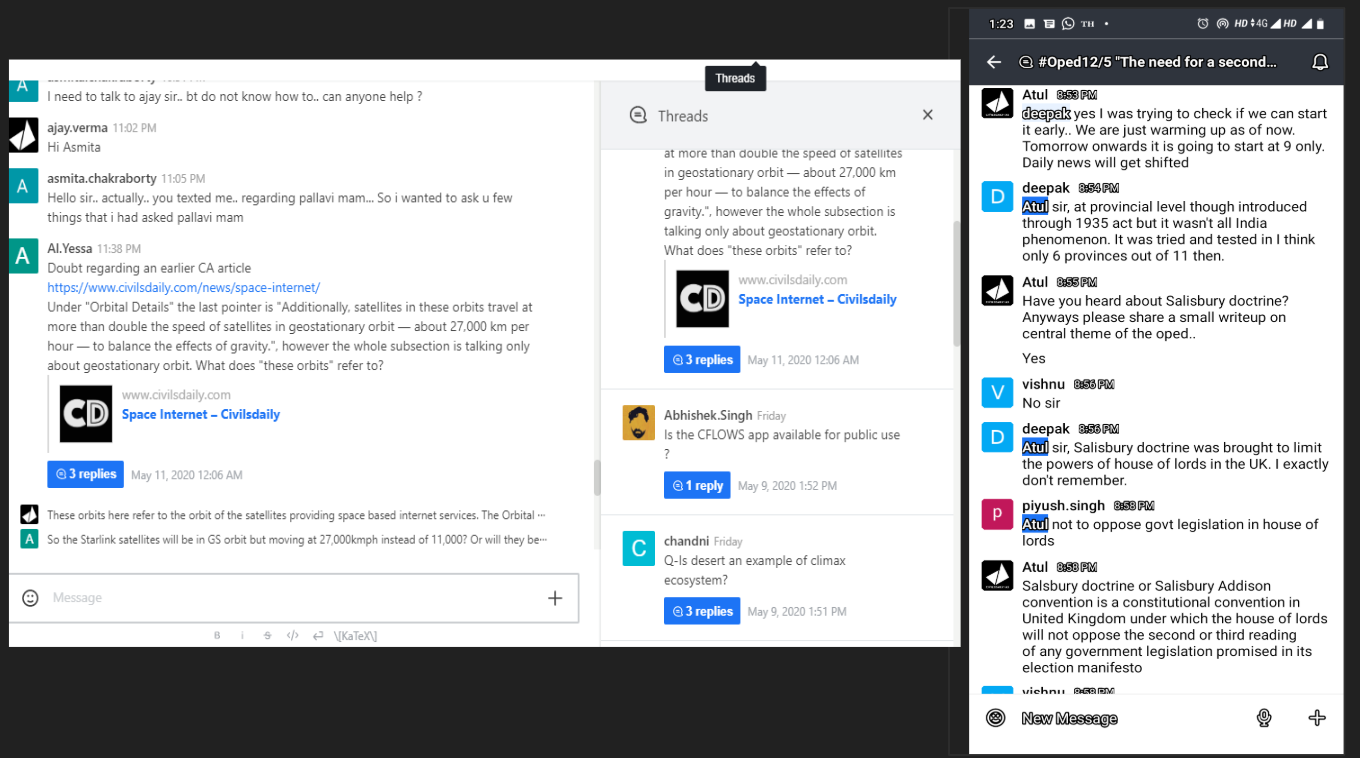 Habitat – Desktop and Mobile view

Civilsdaily’s Community: Testimonials
Two variants of Prelims Ts 2022: