Mains Ready By December. Smash Mains & Smash PYQ Admissions Open

Search results for: “”

  • MoSPI Secy: Nominal GDP revised down as informal sector data has improved

    Why in the News

    The Ministry of Statistics and Programme Implementation (MoSPI) has stated that the downward revision of nominal Gross Domestic Product (GDP) under the new base year series follows a change in how the informal sector is measured, not a correction of an earlier overstatement. The revision runs across every overlapping year of the two series and was driven by the replacement of proxy based estimates with direct annual surveys. The new series moves the base year to 2022-23 from 2011-12 and was released in February. Two separate criticisms have been put to the Ministry, one that the informal economy is still being read off the performance of listed companies, and the other that the price data used for deflation is the wrong kind. The contest is therefore not about the growth rate but about whether the measurement itself can be trusted.

    What changed in the new base year GDP series?

    1. The base moved: The series shifts its base year from 2011-12 to 2022-23, and was released in February.
    2. The estimation method changed with it: The informal sector is now estimated from direct, empirical annual surveys rather than from proxies carried forward from a base year.
    3. The revision is systematic, not a one year correction: Nominal GDP has been revised lower across all overlapping years, meaning 2022-23 to 2024-25 and the subsequent quarters.

    Why did nominal GDP fall in the revised series?

    1. The old series had no regular unorganised sector survey: MoSPI calculated Gross Value Added (GVA), meaning output net of the cost of inputs used up in producing it, for the unorganised sector by multiplying estimated workforce counts by the Value Added per Worker derived from decadal surveys.
    2. Forward projection of the base year figure: The projection used proxies such as formal corporate growth rates, inter survey growth rates and historical tax collections, because no regular data was available.
    3. Survey evidence changed the picture: Annual survey evidence made it possible to capture the distinct growth patterns of the informal sector, which had been running on the formal sector’s growth rate by assumption.
    4. Informal services, the largest single driver: The single largest driver of the revision is the improved measurement of India’s informal services sector.

    How do the new surveys change the measurement?

    1. Two surveys replaced the proxies: The Annual Survey of Unincorporated Sector Enterprises (ASUSE), which enumerates unincorporated non agricultural businesses, and the Periodic Labour Force Survey (PLFS), which measures employment and workforce size, now supply the inputs directly.
    2. Survey frequency: ASUSE is now available on a quarterly basis and PLFS on a monthly basis, so quarterly GDP no longer waits on a survey that ran once every five years.
    3. What is now measured directly: Unorganised sector productivity and workforce size are measured rather than inferred from corporate results.

    What is the Annual Survey of Unincorporated Sector Enterprises?

    1. What an unincorporated enterprise is: A business run as a proprietorship or a partnership rather than as a registered company. Its accounts are never filed with a corporate registry, so its output cannot be read off company results and has to be counted directly.
    2. What ASUSE enumerates: Non agricultural businesses in manufacturing, trade and other services. It covers both establishments that hire workers and own account enterprises run by the proprietor without hired labour.
    3. How the units are reached: The survey draws a sample against an area based frame rather than against a registration list, which is what allows it to reach units that appear on no register.
    4. Why the frequency changes the estimate: Its predecessor ran roughly once in five years, so every intervening year was filled in by projection. A survey running annually and now quarterly supplies measured values for the same periods the national accounts are compiled for.

    Where does the contest over the new series lie?

    1. The listed company charge: A former Chief Economic Adviser has argued that the GDP data does not capture the informal economy properly and extrapolates the performance of listed companies. The Ministry’s stated position is that ASUSE is being used for quarterly GDP and proxies are not.
    2. The proxies were always bounded: Even in the earlier series proxies were used only between the quinquennial surveys, carried forward from previous base years, which is how the overhang continued.
    3. Overestimation is rejected as a framing: The Ministry holds that GDP is an estimation built on the best data available at the time, and that calling the old series an overestimate implies a systematic bias that was not there.
    4. The price data objection: A separate criticism concerns the use of producer price data. The Ministry’s answer is that the method of calculation was shifted to producers in the 2011-12 series of the Wholesale Price Index (WPI) itself, and that data for the past 10 years has been collected from industry.
    5. What separates the two indices: The WPI excludes exports and imports and includes taxes and trade margins to some extent, while a Producer Price Index (PPI) does not, and the Ministry states those corrections have since been made.
    6. The growth is not felt on the ground: The Ministry treats this as a larger question shaped by other factors, uncertainties and the global situation, comparable to how an individual’s experience of prices differs from an inflation rate aggregated across the country.

    What is a Producer Price Index?

    1. Prices received at the factory gate: A Producer Price Index tracks the change in prices received by domestic producers for their own output at the factory gate. It reads the price at the point of production rather than the price at any later point in the chain.
    2. Why the deflator has to match the output: Real output is nominal output divided by a price index, so the index must track the prices of the goods and services being deflated. A mismatch between the output being measured and the prices used to deflate it moves the real growth rate without anything happening in the economy.
    3. The services gap: A wholesale price index is built on goods traded in bulk and carries no services. An economy whose output is majority services therefore has no matching price series for its largest component, which is why the deflator is the contested instrument.

    Challenges to a base year revision of the national accounts

    1. A long gap between base years builds in drift: Holding a base year for more than a decade lets the structure of the economy move away from the weights the series is built on. Eg. The 2011-12 base was carried forward for over a decade on proxies before the present revision replaced it.
      The Fix: Fix a statutory base year revision cycle with a published date, so the revision is a scheduled operation rather than an event that invites suspicion.
    2. A revision breaks the comparable series users rely on: Analysts, ratings and fiscal ratios are all computed on a level that has now moved, and back series construction is where most disputes about Indian GDP have historically landed. Eg. The dispute over the back series of the 2011-12 base ran for years after that series was introduced.
      The Fix: Release a fully documented back series alongside the new base, with the method for each sector stated, rather than issuing the levels first and the method later.
    3. Deflation remains the weakest link: Converting nominal values to real ones requires price indices that match the output being deflated, and India has no full producer price index for services. Eg. Services form the largest share of output and are deflated using indices built for goods.
      The Fix: Complete and publish a services producer price index so that the largest part of output is deflated on prices collected from services producers.
    4. Survey coverage of the informal sector is thin at the edges: An enterprise survey reaches businesses with a recognisable place of operation more easily than it reaches itinerant and home based work. Eg. Home based and own account work is concentrated among women, which is also where labour force measurement is weakest.
      The Fix: Link the enterprise survey to the labour force survey at the household level, so an activity missed as an enterprise is still captured through the worker reporting it.

    Conclusion

    The disagreement now on record is about method rather than about the growth rate, and the Ministry has taken the position that the new series is the best available and that no obvious correction has been put to it for the next one. That claim is testable, since a statistical system is judged on whether its next revision moves the numbers again in the same direction. The marker to watch is the deflator, because the informal sector question has now been answered with direct surveys while the price side has not been given an equivalent instrument.

    Matching Previous Year Question

    “[2021, GS3, 10 marks] Explain the difference between computing methodology of India’s Gross Domestic Product(GDP) before the year 2015 and after the year 2015.”

  • India gets 1.64 mt EU steel quota, imports of EU cars may rise 6-fold

    Why in the News

    The draft text of the India European Union (EU) Free Trade Agreement (FTA) gives India a country specific steel export quota of 1.64 million tonnes (mt) across 16 categories, including specialised items such as metallic coated sheets and stainless hot rolled quarto plates. The quota answers the tightening of EU steel entry through the Steel Overcapacity Regulation, which came into force on 1 July this year, and through the Carbon Border Adjustment Mechanism (CBAM), a levy that prices the carbon embedded in an imported good so that it carries the same carbon cost as an EU produced one. In exchange the EU has won a first year quota of 1,00,000 completely built up cars, close to six times what it currently ships to India. Only a part of India’s steel quota is actually reserved for India, while the automotive concession is the first of its kind India has given to a major economy after the United Kingdom.

    What is a Tariff Rate Quota?

    1. The instrument: A Tariff Rate Quota (TRQ) limits the quantity of a particular item that is eligible for a lower duty, so volume inside the quota enters cheap and volume beyond it pays the full tariff.
    2. Two components in India’s steel quota: The FTA component of 0.69 mt is reserved for India. The most favoured nation component of 0.95 mt is open to all partner countries.
    3. The assured component against the open component: Only the FTA component is assured, and India’s products must compete with other exporting countries for the remaining categories.

    How much steel market access has India actually secured?

    1. Breadth of the quota: The 1.64 mt covers 16 categories of steel, including specialised products such as metallic coated sheets and stainless hot rolled quarto plates.
    2. Value added lines are inside it: India has received quotas on several value added categories, which are the lines that carry a higher realisation per tonne.
    3. The assured share is small: The reserved FTA component is under half the headline quota, so the larger part of India’s access depends on outcompeting other suppliers for the same tonnage.
    4. The framing regulation: The TRQs follow the EU’s Steel Overcapacity Regulation, whose stated aim is to protect the EU steel industry against the effects of global overcapacity.

    What does the EU gain in India’s car market?

    1. A first year quota six times current trade: The EU has won a first year TRQ of 1,00,000 completely built up internal combustion and non plug in hybrid cars, against the 17,191 cars India imported from the EU in 2025.
    2. The ten year volume ramp: The quota rises to 1,60,000 cars by the 10th year of the agreement.
    3. A price floor protects the mass market: The concession applies only to cars priced above €15,000, and India has given no concession at all to cars below that price to protect Indian car manufacturers.
    4. The duty schedule for the mid segment: For cars priced between €15,000 and €35,000, the in quota duty falls from 110% to 35% in the first year and to 10% by the fifth year of the deal coming into effect.
    5. The duty schedule for the luxury segment: For cars priced above €35,000, tariffs decline from 66% to 30% in the first year and to 10% over the same period.
    6. A reserved luxury band: The quota is divided across three price bands, with 43,000 units reserved for cars priced above €50,000 from Year 5 onward.

    What does the separate electric vehicle schedule protect?

    1. Concessions begin later: Concessions on battery electric vehicles, plug in hybrids and cars using other technologies begin only in the fifth year of the agreement.
    2. A higher price floor applies: They apply only to vehicles priced at €20,000 or more, and electric and other eligible cars below that price get no concession.
    3. The volume ramp is slow: The completely built unit quota starts at 20,000 cars in the fifth year, rises to 50,000 in the tenth year and reaches 90,000 from the fourteenth year onwards.

    What must India do to use the steel quota?

    1. Move up the product ladder: Shifting toward higher value added steel products reduces the applicable CBAM tax burden and improves India’s competitive position in the EU market, per an Indian Council for Research on International Economic Relations (ICRIER) note.
    2. Pair the shift with industrial policy: The ICRIER note holds that this structural transition must be supported by industrial policies that integrate Production Linked Incentives with dedicated research and development funding.
    3. Carry the smallest firms through compliance: Targeted financial and technical assistance, including concessional financing, access to clean technology and investment guarantees, is treated as essential to ease the disproportionate compliance burden on Micro, Small and Medium Enterprises (MSMEs).

    What is the Carbon Border Adjustment Mechanism?

    1. The charge on embedded carbon: An importer of a covered good declares the greenhouse gas emissions released in producing it and surrenders certificates priced against the European Union’s own carbon market. The imported tonne therefore carries the same carbon cost as a tonne produced inside the EU.
    2. Covered goods: CBAM applies to emissions intensive goods traded in bulk, including iron and steel, aluminium, cement, fertilisers, electricity and hydrogen, which are the sectors where production is most easily relocated to a jurisdiction with no carbon price.
    3. Default values where data is absent: An exporter that cannot supply verified plant level emissions data is charged on a default value rather than on its actual emissions. Eg. A low emission Indian plant that does not document its emissions is charged as though it used the high emission route.
    4. Phasing: A transitional stage requires importers only to report embedded emissions, and the financial obligation attaches at the definitive stage, so the reporting burden arrives before the cost does.

    Challenges to the India EU Free Trade Agreement steel and auto package

    1. The quota covers well under half of existing trade: Most of what India already ships to the EU falls outside the country specific quota and meets the full tariff. Eg. India’s steel exports to the EU currently stand at 4 mt.
      The Fix: Concentrate the residual volume in categories where the per tonne realisation absorbs the out of quota duty, rather than treating the quota as the whole of the market.
    2. The out of quota wall is punitive: The Steel Overcapacity Regulation sets free of duty quotas at 18.3 mt overall with a 50% duty on out of quota imports, so exceeding the quota is close to a trade stop. Eg. The same regulation introduced a melt and pour regime that traces where steel was first cast, which narrows the scope for rerouting through third countries.
      The Fix: Seek an annual review clause that indexes the country specific quota to India’s realised shipments rather than fixing it at the level negotiated once.
    3. The carbon charge sits outside the quota: A tonne of steel that enters inside the quota still carries its CBAM liability, so tariff relief and carbon cost are two separate gates. Eg. CBAM prices embedded emissions per tonne, which penalises India’s coal based blast furnace and induction furnace routes regardless of quota access.
      The Fix: Build verified plant level emissions accounting into Indian steel exports so that lower carbon Indian output is recognised at the EU border instead of being charged on a default value.
    4. The automotive concession sets a precedent for other partners: The EU becomes the second major trade partner after the United Kingdom to secure automotive tariff concessions from India under an FTA. Eg. The Global Trade Research Initiative (GTRI) holds that these precedents could prompt other key trade partners such as Japan and South Korea to seek similar preferential market access and TRQs.
      The Fix: Fix a common automotive concession template across agreements, so each new negotiation starts from a stated ceiling rather than from the last deal signed.

    Conclusion

    The draft text is published rather than ratified, so the numbers in it are a negotiating position and not yet a schedule in force. What the package does settle is the shape of the bargain: India trades a widening opening of its passenger vehicle market for steel access that is only partly reserved and wholly separate from its carbon liability. The marker to watch is whether the reserved FTA component of the steel quota is enlarged in the final text, and whether India’s shipments move into the value added categories the quota already covers.

    Matching Previous Year Question

    “[2025, GS3, 10 marks] What are the challenges before the Indian economy when the world is moving away from free trade and multilateralism to protectionism and bilateralism? How can these challenges be met?”

  • 🔴[UPSC Webinar for 2028] By Prayas sir, UAP Mentor, Civilsdaily IAS | UPSC 2028 For Beginners: Complete Strategy & Syllabus Breakdown | Join on 13th Sept at 7PM

    🔴[UPSC Webinar for 2028] By Prayas sir, UAP Mentor, Civilsdaily IAS | UPSC 2028 For Beginners: Complete Strategy & Syllabus Breakdown | Join on 13th Sept at 7PM

    Register for the session


    Read about Webinar


    Behind every UPSC rank, there is usually a story people do not see.

    Repeated failures. Self doubt. Strategy changes. Burnout. Comebacks.

    And eventually, clarity.

    Join Me as I share the real lessons, mistakes, mindset shifts and strategic changes that finally helped me secure a UPSC rank after 6 attempts.

    This session is not just about motivation.
    It is about understanding what actually changes between unsuccessful attempts and a successful one.

    Prayas sir, UAP Mentor, Civilsdaily IAS

    What I’ll do in this live session:

    1. What Went Wrong in the Earlier Attempts

    • Common preparation mistakes aspirants repeat for years
    • The illusion of “studying hard” without improving scores
    • Why many aspirants remain stuck despite giving multiple attempts
    • The emotional and psychological side of repeated failures

    You’ll understand why UPSC often demands strategic evolution, not just more effort.


    2. The Turning Point in Preparation

    • What changed in the final successful attempt
    • The importance of clarity over excessive resources
    • How answer writing, revision and PYQ analysis were approached differently
    • Building consistency without burnout

    Sometimes small strategic corrections create massive score differences.


    3. Lessons From 6 Years of UPSC Preparation

    This section will cover:

    • What genuinely matters in long term preparation
    • What beginners should avoid from Day One
    • The role of patience, adaptability and mentorship
    • Why comparison with others damages preparation

    These are lessons usually learned after years of trial and error.


    4. The Mindset Required to Sustain UPSC Preparation

    UPSC is not just an academic exam.

    It tests:

    • emotional resilience
    • consistency
    • self awareness
    • discipline under uncertainty

    You’ll learn how to:
    • handle setbacks
    • avoid preparation fatigue
    • stay mentally stable during long preparation cycles
    • rebuild confidence after failures


    Who should attend:
    • Beginners targeting UPSC 2028
    • Candidates struggling after unsuccessful attempts
    • Beginners wanting to avoid common mistakes early
    • Aspirants feeling stuck despite hard work

    Join us, for a 45 minute live Zoom session on 13th Sept at 7PM.

    See you in masterclass.


    It will be a 45 minute session, post which we will open up the floor for all kinds of queries which a beginner must have. No questions are taboo and Parays Sir is known to be patiently solving all your doubts.

    Join us for a Zoom session on 13th Sept at 7 PM. This session is a must attend for you If you are attempting UPSC for the first time or have attempted earlier and now preparing for 2028, then it is going to be a valuable session for you too.

    See you in the session”

    Register for the session for a complete in-depth UPSC Prep


    In this Civilsdaily masterclass, you will get:

    1. A 45-minute deep dive on how to plan your UPSC strategy from the start to the end.
    2. How do first-attempt IAS Rankers get the most out of their one year prep?
    3. Insider tips that only the top IAS and IPS rankers know and apply to get rank.

    By the end, you’ll have razor-sharp clarity and a clear path to crack UPSC with confidence and near-perfect certainty. 

    Join UPSC session on 13th Sept, at 7 PM

    (Don’t wait—the next webinar/session won’t be until End May’26)


    These masterclasses are packed with value. They are conducted in private with a closed community. We rarely open these webinars for everyone for free. This time we are keeping it for 300 seats only.

    Ready to attend the UPSC Webinar?


    Not sure yet?

    We recommend you register here. It takes less than 10 seconds to register.

    • No spam! Once in a while, we’ll only send you high-quality exam-related content. 
    • We will inform you about the upcoming Masterclasses that might benefit you.
    • You can demand one free mentorship call from verified Civilsdaily mentors. 
    • You can always choose to unsubscribe. 
  • [12th September 2026] The Hindu OpED: A bigger BRICS, shaped by India’s vision

    [12th September 2026] The Hindu OpED: A bigger BRICS, shaped by India’s vision

    Question (2023, GS2): “‘Virus of Conflict is affecting the functioning of the SCO’. In the light of the above statement point out the role of India in mitigating problems.
    Linkage: This question directly mirrors the central tension of the New Delhi BRICS summit: holding a common line and delivering technical outputs when key member states are at war or experiencing severe conflict. It highlights India’s strategic role as a mediator and consensus-builder in multilateral forums

    Mentor Comment

    India has used its chairship of BRICS to convert the grouping’s agenda into a set of named functional outputs, and the New Delhi summit on 12 and 13 September 2026 is where those outputs are placed before the leaders. The chairship ran around 350 meetings across Indian cities, 22 of them at ministerial level, following the template India used for the G-20 Summit it hosted in New Delhi in 2023. India reframed the acronym around “building resilience, innovation, cooperation and sustainability”, and the deliverables track that framing: centres of excellence, a logistics framework, an enterprise portal and a set of research repositories. The grouping now carries 11 members and about 10 partner countries, and its collective output measured at purchasing power parity, meaning output adjusted for differences in domestic price levels, exceeds that of the G-7. The tension in the summit lies between the two things it is being asked to do at once, settle a set of technical cooperation outputs, and hold a common line among members several of whom are at war.

    Pillars of BRICS cooperation

    1. Political and security: The first pillar covers the grouping’s positions on conflicts, security cooperation and global governance questions.
    2. Finance and the economy: The second pillar covers trade, payments, development finance and economic cooperation among members.
    3. Culture and people-to-people exchanges: The third pillar covers education, health, skilling and social cooperation between member societies.
    4. Where India’s chairship agenda sits: The agenda India pursued relates more to the second and third pillars than to the first, since the leaders themselves settle the large geopolitical questions.

    Why is the Delhi summit a landmark?

    1. The backdrop: It takes place against geopolitical turbulence produced by a combination of forces, ongoing wars and conflicts, a breakdown in global governance, and the changing nature of global alliances.
    2. The grouping’s weight: BRICS now has 11 prominent members and about 10 partner countries, and its collective economic output in purchasing power parity terms outstrips that of the G-7, making it one of the largest and most important transcontinental groupings outside the West.
    3. The technology contest: Technological forces such as artificial intelligence and quantum computing are being weaponised, with both great powers trying to win the battle for tech supremacy.

    How did India prepare for the chairship?

    1. The template: India followed the approach it had used for the 2023 G-20 Summit in New Delhi.
    2. The scale of the process: Around 350 meetings were conducted in cities across the country, with 22 held at the ministerial level.
    3. The stated focus: India announced that it would focus on “building resilience, innovation, cooperation and sustainability”, giving a new expansion to the BRICS acronym.
    4. The intent behind the framing: The reframing was used to refocus and recalibrate the BRICS agenda rather than to inherit the previous year’s priorities unchanged.

    What has the chairship delivered on resilience?

    1. A digital centre for grids and storage: The BRICS Digital Centre of Excellence for Smart Grids and Energy Storage was launched under India’s stewardship.
    2. A logistics framework: The BRICS Logistics Supply Chain Cooperation Framework was adopted.
    3. Centres on farming systems: Centres of Excellence on Agro-Ecology and Regenerative Agriculture were established.
    4. What they are expected to do: Once operationalised, these initiatives are intended to provide the ballast that would make member economies genuinely resilient.

    What is on the innovation agenda?

    1. Capital for new firms: A start-up innovation fund and an incubator network were proposed.
    2. A digital public infrastructure repository: Members would pool digital public infrastructure, meaning the shared digital systems for identity, payments and data exchange that public services run on.
    3. A science and research repository: A common repository for scientific and research material was proposed alongside it.
    4. A plan for large research facilities: The action plan of the BRICS Working Group on research infrastructures and mega science projects sits within this pillar.
    5. Why pooling matters here: Members are not all at the same level of development in scientific research, so shared facilities and repositories are worth more to some members than to others.

    What does the cooperation pillar carry?

    1. Trade rules: Leaders are expected to endorse recommendations on revitalising the multilateral trading system.
    2. Health: A network of centres of excellence on mental wellness is to be welcomed by the leaders.
    3. Cities: A BRICS urbanisation forum is to be established.
    4. Women and digital access: Enhancing the digital capacity of women forms part of the recommendations.
    5. Skills and small enterprise: Cooperation is to be intensified in education and youth skilling, and through the BRICS Micro, Small and Medium Enterprises (MSME) Cooperation Portal.

    What does the sustainability agenda add?

    1. It continues the previous chair’s priority: Sustainability was the centrepiece of Brazil’s agenda in the preceding year, and India built on that base rather than replacing it.
    2. Land and forests: Combating desertification, and guidelines for disaster management and forest-fire preparedness, are specific areas of cooperation under this head.
    3. Aviation fuel: A BRICS forum on sustainable aviation fuels forms part of the agenda.
    4. Adaptation rather than mitigation: Advancing climate resilience through people-centric and community-based adaptation is included, which matters because international fora tend to focus almost exclusively on mitigation.

    Can a functional agenda hold when summit level geopolitics pulls the other way?

    1. The two tracks belong to different pillars: The chairship’s outputs sit in the economic and people-to-people pillars, and the large geopolitical questions are settled by the leaders under the first.
    2. The functional track is the more predictable of the two: Substantive outcomes appear assured on the strength of the ministerial and working group meetings already chaired, independent of what the leaders’ session produces.
    3. The caveat on the grouping: BRICS has to avoid being caught in geopolitical currents that are not of its own making and carry no strategic value for its members.
    4. Why it survives the contradiction: The grouping is now too large to be either ignored or allowed to fail, which gives members an interest in a working agenda even where they diverge politically.
    5. What it is ultimately for: The grouping helps members enhance their strategic options and push geopolitics towards a multipolar order, both of which are organising principles of India’s foreign policy.

    Challenges to India’s BRICS chairship agenda

    1. The deliverables are institutions without budgets: A centre of excellence, a framework and a portal each need a host, staff and recurring funding, none of which a one year chairship can commit on the group’s behalf. Eg. The BRICS Vaccine Research and Development Centre, announced in 2020, functions as a virtual network of national institutions rather than a staffed facility.
      The Fix: Attach each new centre to a named host institution with a member funded budget line recorded in the summit declaration.
    2. Repositories hold only what members choose to deposit: A digital public infrastructure repository and a science repository depend on voluntary contribution, and members operate under differing national data and procurement rules. Eg. Members’ identity and payment systems sit under separate data laws, so specifications and code are not equally shareable.
      The Fix: Settle a common licence and a deposit obligation for contributed material before the repositories open.
    3. A declaration carries no review of the last one: Outcomes are recorded as commitments in a communique, and no member reports against them the following year. Eg. The Rio declaration of July 2025 ran to 126 points with no implementation review attached to it.
      The Fix: Require the incoming chair to publish an implementation report against the previous declaration alongside the new one.
    4. The enterprise agenda needs a payments channel that is not yet working: An MSME portal and a start-up fund assume a listed supplier in one member country can be paid from another without routing through third currency correspondent banking. Eg. The grouping’s own cross border payment initiative remains at pilot stage.
      The Fix: Sequence the portal behind a working local currency settlement arrangement for the member pairs that already trade at scale.

    Conclusion

    The chairship’s output is a set of centres, frameworks, repositories and portals, and their value is decided after the summit closes rather than in its declaration. What converts an announced centre into a working institution is a host, a staff and a recurring budget, and none of those is a summit level decision. The grouping’s own design works against this, since priorities reset annually with the rotating chair and nothing obliges the next one to carry a predecessor’s working groups forward. What to watch is whether the declaration names a host institution and a funding source for the new centres, and whether the chair that follows India adopts the research infrastructure action plan rather than substituting its own themes.

    About BRICS

    1. What it started as: The acronym was coined in 2001 by a Goldman Sachs economist to identify a set of high growth emerging economies, and it was an investment category before it was a forum.
    2. How it became a grouping: The first meeting of Foreign Ministers took place on the margins of the United Nations General Assembly in 2006, and the first formal Leaders’ Summit was held at Yekaterinburg in Russia in 2009.
    3. How it expanded: South Africa joined in 2011. The 2023 Johannesburg Summit opened membership further, with Egypt, Ethiopia, Iran and the United Arab Emirates joining in 2024 and Indonesia in 2025.
    4. The partner tier: A Partner Country category was introduced in 2024 to engage states such as Malaysia, Thailand and Nigeria without conferring full membership.

    Institutions and Initiatives of BRICS

    1. New Development Bank: Headquartered in Shanghai, it lends for infrastructure and sustainable development, and has approved over $35 billion in loans.
    2. Contingent Reserve Arrangement: A $100 billion pool of member foreign exchange reserves providing short term liquidity support to a member under balance of payments pressure.
    3. BRICS Pay: A cross border payment initiative intended to settle trade among members in local currencies rather than through existing dollar based messaging channels.
    4. Remote Sensing Satellite Constellation: Six satellites contributed by member states, sharing earth observation data for disaster management and resource monitoring.

    Key Facts about BRICS

    1. Population weight: The grouping represents over 45 per cent of the world’s population, about 3.6 billion people.
    2. Energy weight: Members account for roughly 42 per cent of global oil production and exports, which is what the inclusion of Iran, Saudi Arabia and the United Arab Emirates added to the bloc.

    Challenges in BRICS

    1. Consensus across 11 members with different political systems: A joint declaration needs every member’s assent, so the text settles at the level the most reluctant member accepts. Eg. Declarations avoid language on human rights and democratic norms, since the membership spans elected governments and authoritarian ones.
      The Fix: Adopt a variable geometry, letting a subset of willing members carry an initiative under the BRICS name without requiring unanimity.
    2. One member’s economic weight shapes the agenda: China’s size gives it disproportionate influence over what the grouping prioritises and whom it admits. Eg. It has pushed for the inclusion of states carrying heavy Chinese debt exposure, which would tilt the bloc towards a China centred platform.
      The Fix: Publish membership criteria weighted to economic complementarity and regional balance rather than to any single member’s sponsorship.
    3. Reducing dollar dependence moves slower than the rhetoric: Settlement habits, contract law and reserve holdings all favour the incumbent currency. Eg. The US dollar still settles over 80 per cent of global trade.
      The Fix: Target local currency invoicing on the bilateral pairs that already have settlement arrangements, rather than pursuing a common currency.
    4. There is no permanent secretariat or charter: Each chair runs the calendar from its own foreign ministry, so institutional memory travels out with the chair. Eg. Working group records and unfinished action plans are held by the outgoing chair rather than by the grouping.
      The Fix: Create a small standing secretariat funded by member contributions to hold working group records and track commitments between summits.
    5. Trade within the bloc remains thin: Members trade more with the industrialised economies than with each other, which limits what economic cooperation can deliver. Eg. Most members still rely on G7 markets for high technology imports and for services exports.
      The Fix: Negotiate a tariff preference schedule among members on a limited list of manufactured goods, which is achievable without a full trade agreement.
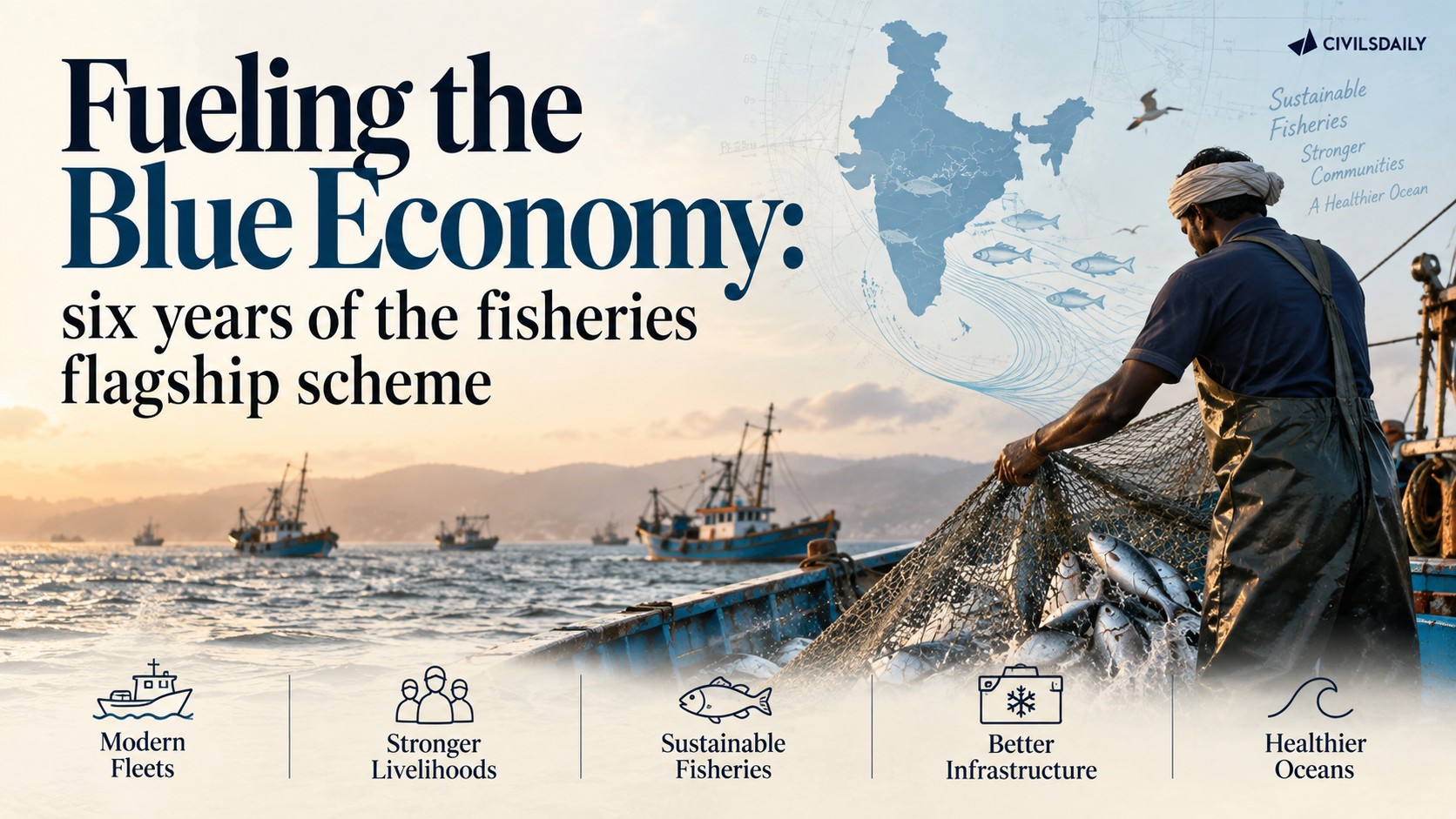
  • Fueling the Blue Economy: six years of the fisheries flagship scheme

    Fueling the Blue Economy: six years of the fisheries flagship scheme

    Why in News

    The Pradhan Mantri Matsya Sampada Yojana (PMMSY) completed six years. PMMSY is the flagship scheme for the fisheries sector.

    Core facts

    1. Budget: A record ₹2,500 crore was allocated in the 2026 to 2027 Budget Estimate. Total outlay since the 2020 to 2021 year is ₹20,750 crore.
    2. Fish production: It rose from 141.64 lakh tonnes to 197.75 lakh tonnes. The base year is 2019 to 2020. The latest figure is for 2024 to 2025.
    3. Exports: Fisheries exports rose from ₹46,663 crore to ₹73,890 crore over the same span.
    4. Employment: The scheme supported employment for 58 lakh persons. It backed 2,195 Fish Farmers Producer Organizations.
    5. Structure: PMMSY runs a Central Sector component and a Centrally Sponsored Scheme component.
    6. Sub scheme: The Pradhan Mantri Matsya Kisan Samridhi Sah Yojana (PM MKSSY) has an estimated ₹6,000 crore outlay for 2023 to 2024 up to 2026 to 2027. It formalises the sector through digital identities.
    7. Digital platform: The National Fisheries Digital Platform (NFDP) launched in September 2024. It recorded over 37.23 lakh registrations as of 8 September 2026.
    8. Coastal villages: 100 coastal villages are identified as Climate Resilient Coastal Fishermen Villages. Each carries a ₹200 lakh unit cost, fully government funded.
    9. Livelihoods: The fisheries sector sustains nearly three crore livelihoods.

    Static Context

    1. PMMSY launched in 2020. The Department of Fisheries under the Ministry of Fisheries, Animal Husbandry and Dairying runs it.
    2. Blue Economy is the sustainable use of ocean resources for growth, livelihoods and ocean health. PMMSY aligns with Sustainable Development Goal 14, Life Below Water.
    3. A Recirculatory Aquaculture System (RAS) filters and reuses water. It allows intensive fish farming on minimal land and water.
    4. Biofloc technology recycles nutrients using beneficial microbes with minimal water exchange.

    Prelims angle

    PMMSY launch in 2020 under the Department of Fisheries; PM MKSSY as a Central Sector sub scheme; NFDP launch in 2024; the working principle of Recirculatory Aquaculture System biofilters that convert ammonia to nitrate; PMMSY link to Sustainable Development Goal 14.

    Mains angle

    GS Paper 3, economics of animal rearing and allied sectors. The Blue Economy frame fits a question on fisheries as a driver of coastal livelihoods and sustainable growth.

    Matching Previous Year Question

    “[2023] With reference to the role of biofilters in Recirculating Aquaculture System, consider the following statements:
    1. Biofilters provide waste treatment by removing uneaten fish feed.
    2. Biofilters convert ammonia present in fish waste to nitrate.
    3. Biofilters increase phosphorus as nutrient for fish in water.
    How many of the statements given above are correct?
    (a) Only one
    (b) Only two
    (c) All three
    (d) None

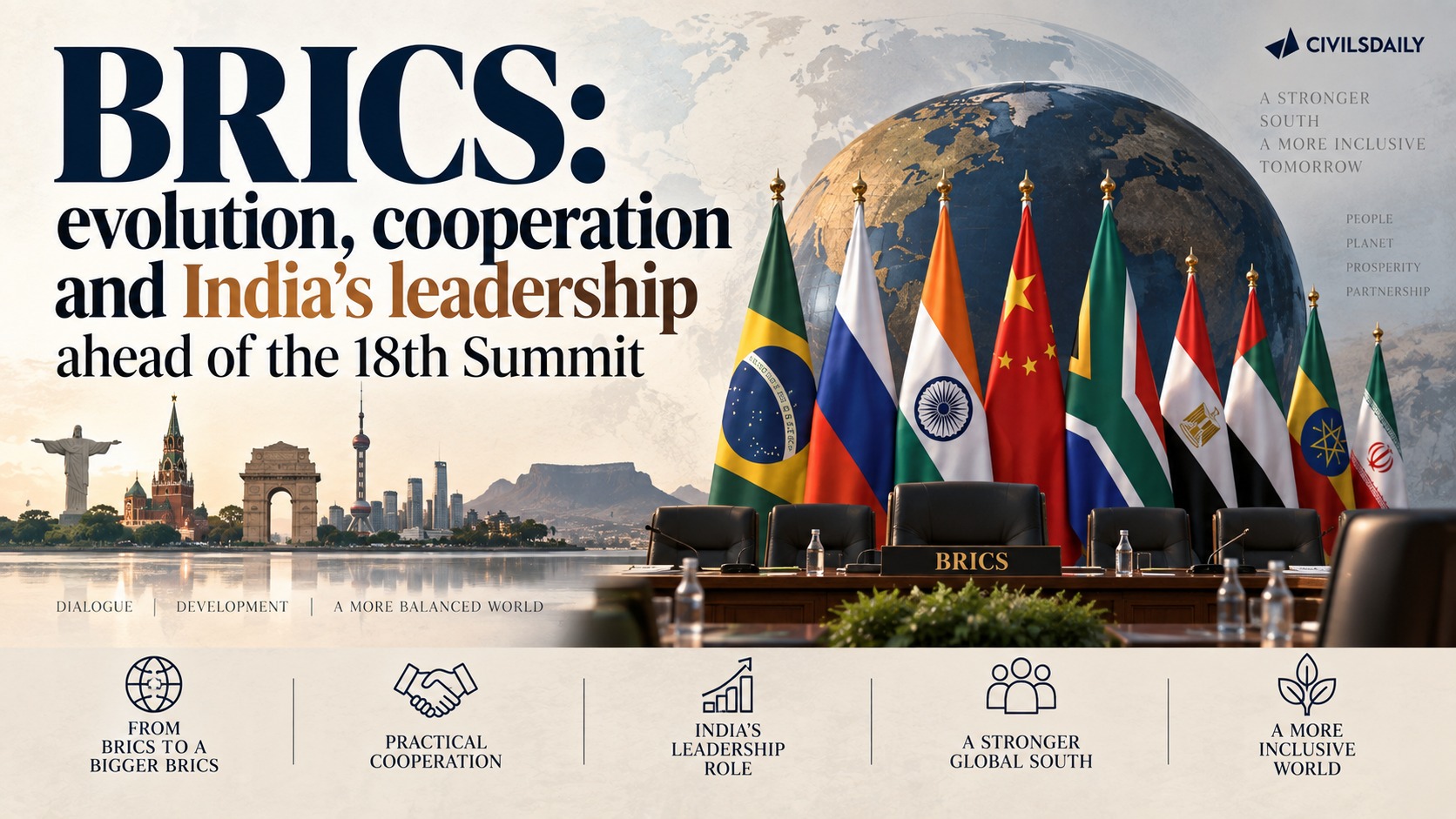
  • BRICS: evolution, cooperation and India’s leadership ahead of the 18th Summit

    BRICS: evolution, cooperation and India’s leadership ahead of the 18th Summit

    Why in News

    India hosts the 18th BRICS Summit on 12 to 13 September 2026 at Bharat Mandapam, New Delhi. BRICS is a grouping of major emerging economies.

    Current stage and next milestone

    India chairs BRICS for the fourth time in 2026. The leaders’ sessions run on 12 to 13 September 2026. The chairship has already run over 350 ministerial meetings across 25 cities.

    Core facts

    1. Origin: The acronym BRIC was coined in 2001 by Goldman Sachs. It projected Brazil, Russia, India and China as future major economies.
    2. Formation: South Africa joined in 2010, forming BRICS.
    3. Membership now: The grouping has 11 full members: Brazil, China, Egypt, Ethiopia, India, Indonesia, Iran, Russia, Saudi Arabia, South Africa and the United Arab Emirates. A Partner Country framework adds ten more nations.
    4. Weight: Members hold 49.5% of global population, 40% of global Gross Domestic Product and 26% of global trade.
    5. India’s chairships: They occurred in 2012, 2016, 2021 and 2026.
    6. Theme 2026: Building for Resilience, Innovation, Cooperation and Sustainability.
    7. Three pillars: Political and security cooperation, economic and financial cooperation, and cultural exchanges.
    8. 2026 agenda: Agriculture, health, urban infrastructure, Micro, Small and Medium Enterprises, supply chains and climate resilience.

    Static Context

    1. The New Development Bank (NDB) is the BRICS development bank. It was set up at the 6th Summit via the Fortaleza Declaration of 2014. Its headquarters is in Shanghai.
    2. The Contingent Reserve Arrangement is the BRICS currency swap framework for balance of payments support.
    3. The 16th Summit was held at Kazan, Russia, in 2024. The latest expansion admitted Egypt, Ethiopia, Iran, Saudi Arabia and the United Arab Emirates.

    Prelims angle

    NDB headquarters at Shanghai and its Fortaleza Declaration origin; BRICS membership list and the 11 member count; India’s chairship years; the NDB is a BRICS body, not an Asia Pacific Economic Cooperation body.

    Mains angle

    GS Paper 2, global groupings affecting India’s interests. BRICS suits a question on its role as a counterweight in global governance and a platform for the Global South.

    Matching Previous Year Question

    “[2025] Consider the following statements with regard to BRICS:
    I. The 16th BRICS Summit was held under the Chairship of Russia in Kazan.
    II. Indonesia has become a full member of BRICS.
    III. The theme of the 16th BRICS Summit was Strengthening Multiculturalism for Just Global Development and Security.
    Which of the statements given above is/are correct?
    (a) I and II
    (b) II and III
    (c) I and III
    (d) I only
    Answer: (a)”

    “[2026, GS2, 10 marks] “BRICS acts as a powerful counterweight in global governance, actively amplifying the voice and influence of the Global South.” Explain the role of BRICS in projecting itself as an alternative to other groupings.”

  • Seventh Gender Samvaad centres women’s leadership in rural livelihoods

    Why in News

    The Deendayal Antyodaya Yojana National Rural Livelihoods Mission (DAY NRLM) held the seventh Gender Samvaad on women’s agency in livelihoods.

    Core facts

    1. Theme: The edition focused on moving women from participation to leadership in livelihoods.
    2. Scale: Over 6 lakh stakeholders joined. Participation rose from 1,400 in April 2021 to near 6 lakh by September 2025.
    3. SHG base: The Self Help Group (SHG) movement represents over 100 million women.
    4. Lakhpati Didi: 346 million Lakhpati Didis earn over ₹1,00,000 a year. A Lakhpati Didi is an SHG woman with annual household income at or above ₹1 lakh.
    5. State models cited: Maharashtra’s Women Farmers’ Empowerment Bill recognises women without formal land titles. Odisha’s Bhubaneswar Declaration advances women’s land rights. Andhra Pradesh’s natural farming is led by women’s SHGs.
    6. Institution building: The focus is on strengthening Cluster Level Federations, Producer Groups and Farmer Producer Organisations (FPO). Governance, financial record keeping and credit readiness are flagged for the United Nations International Year of Women Farmers 2026.
    7. Entrepreneurship drive: The National Campaign on Entrepreneurship II runs from 21 August to 21 November 2026. It promotes enterprise development, value chains and market access for SHG women.

    Static Context

    1. DAY NRLM launched in 2011 as Aajeevika. It mobilises rural poor women into SHGs and their federations. The Ministry of Rural Development runs it.
    2. Gender Samvaad launched in April 2021. It is a joint platform of DAY NRLM and the Institute for What Works to Advance Gender Equality (IWWAGE). It shares gender practice across State Rural Livelihoods Missions.
    3. An SHG is a small voluntary savings and credit group, usually of 10 to 20 members. The SHG Bank Linkage Programme connects these groups to formal bank credit.

    Prelims angle

    DAY NRLM launch as Aajeevika in 2011 under the Ministry of Rural Development; Lakhpati Didi income threshold of ₹1 lakh; the SHG Bank Linkage Programme; distinction between Self Help Groups and Farmer Producer Organisations.

    Mains angle

    GS Paper 2, development processes and the role of SHGs. The theme fits a question on SHGs as vehicles of women’s economic empowerment and poverty reduction.

    Matching Previous Year Question

    “[2012] How does the National Rural Livelihood Mission seek to improve livelihood options of rural poor?
    1. By setting up a large number of new manufacturing industries and agri-business centres in rural areas
    2. By strengthening ‘Self-Help Groups’ and providing skill development
    3. By supplying seeds, fertilizers, diesel pumpsets, and micro-irrigation equipment free of cost to farmers
    (a) 1 and 2 only
    (b) 2 only
    (c) 1 and 3 only
    (d) 1, 2 and 3
    Answer: (b)”

    “[2020, GS2, 15 marks] “Micro-Finance as an anti-poverty vaccine, is aimed at asset creation and income security of the rural poor in India”. Evaluate the role of Self Help Groups in achieving the twin objectives along with empowering women in rural India.”

  • Securing Farmers’ Future with Dignity: seven years of the farmer pension scheme

    Why in News

    The Pradhan Mantri Kisan Maandhan Yojana (PM KMY) completed seven years. PM KMY is a voluntary contributory pension scheme for small and marginal farmers.

    Core facts

    1. Launch: PM KMY launched on 12 September 2019.
    2. Core benefit: It assures a minimum pension of ₹3,000 per month from the age of 60.
    3. Enrolment: Total enrolment is 24,96,252 farmers as of February 2026. Haryana leads with 5.75 lakh. Bihar follows with 3.46 lakh.
    4. Outlay used: Government investment since 2019 is ₹540.66 crore.
    5. Administration: It is a Central Sector Scheme under the Department of Agriculture and Farmers Welfare. The Life Insurance Corporation of India (LIC) is the pension fund manager.
    6. Eligibility: It covers farmers holding cultivable land up to two hectares. The entry age band is 18 to 40 years. Names must appear in land records as of 1 August 2019.
    7. Contribution: The farmer pays ₹55 to ₹200 per month by entry age. The government matches the farmer’s contribution equally.
    8. Family pension: A surviving spouse receives 50% of the pension, that is ₹1,500 per month.
    9. Exclusions: Income tax payers, registered professionals and beneficiaries of other pension schemes are barred. These other schemes include the National Pension System (NPS), the Employees State Insurance Corporation (ESIC), the Pradhan Mantri Shram Yogi Maandhan (PM SYM) and the Pradhan Mantri Laghu Vyapari Maandhan (PM LVM).
    10. Enrolment route: Enrolment runs through Common Service Centres using Aadhaar, a bank account and mobile One Time Password. A farmer may route PM KISAN benefits into the PM KMY contribution.

    Static Context

    1. PM KISAN is the Pradhan Mantri Kisan Samman Nidhi. It transfers ₹6,000 per year in three instalments to landholding farmer families.
    2. A Central Sector Scheme is funded fully by the Union government. A Centrally Sponsored Scheme splits funding between the Centre and the states.
    3. LIC is a statutory insurer. It was set up under the Life Insurance Corporation Act, 1956.

    Prelims angle

    PM KMY pension amount of ₹3,000 and entry age 18 to 40; LIC as the fund manager; the two hectare landholding ceiling; the distinction between Central Sector and Centrally Sponsored schemes; overlap bars with PM SYM and NPS.

    Mains angle

    GS Paper 2, welfare schemes for vulnerable sections. The scheme suits a question on old age income security for the unorganised and agrarian workforce.

    Matching Previous Year Question

    “[2016] Regarding ‘Atal Pension Yojana’, which of the following statements is/are correct?
    1. It is a minimum guaranteed pension scheme mainly targeted at unorganized sector workers.
    2. Only one member of a family can join the scheme.
    3. Same amount of pension is guaranteed for the spouse for life after subscriber’s death.
    Select the correct answer using the code given below.
    (a) 1 only
    (b) 2 and 3 only
    (c) 1 and 3 only
    (d) 1, 2 and 3
    Answer: (c)”

  • Inclusive and trusted intelligent finance pitched at Global Fintech Festival 2026

    Why in News

    The Ministry of Communications set out India’s digital finance record at the Global Fintech Festival 2026 in Mumbai.

    Core facts

    1. Guiding frame: Finance must become inclusive before it becomes intelligent. Connectivity, compute and trust are named the new digital trinity.
    2. Internet access: It expanded from 25 crore users to 100 crore users over a decade.
    3. Broadband access: It grew from 6 crore to 103 crore, a 16 fold rise in ten years. About 6.5 lakh villages now join the digital economy.
    4. 5G rollout: The fifth generation (5G) network covers 99.9% of districts and 85% of the population within 26 months of its 2022 launch. It runs on over 5 lakh base stations with ₹4.5 lakh crore capital expenditure.
    5. Data price: Data costs about 10 cents per gigabyte. India is stated as the world’s most affordable data market.
    6. Unified Payments Interface (UPI): UPI is a real time retail payment system linking bank accounts for instant transfers. It processed 24,162 crore transactions worth ₹314 lakh crore in the 2025 to 2026 financial year. It forms 84% of domestic digital transactions and 49% of global real time payment volumes.
    7. UPI abroad: It is live in nine countries at no cost. Expansion to 20 more nations is planned.
    8. Financial inclusion base: 60 crore Pradhan Mantri Jan Dhan Yojana (PMJDY) accounts are open. 9 billion documents sit on DigiLocker, the government’s digital document wallet.
    9. Rural coverage: Under Digital Bharat Nidhi, 22,000 towers are being placed across 34,000 villages without telecom links.
    10. Fraud tools: Sanchar Saathi blocks suspicious connections and stolen devices. ASTR, an Artificial Intelligence (AI) tool, cut 88 lakh suspicious mobile connections. The Financial Fraud Risk Indicator blocks fraudulent transfers before withdrawal.
    11. Stated vision: A Trust Grid would integrate telecom, digital identity, UPI and financial systems. The 6G mission targets 10% of global patents.

    Static Context

    1. UPI is operated by the National Payments Corporation of India (NPCI). NPCI is an umbrella body for retail payments set up in 2008 under the guidance of the Reserve Bank of India (RBI) and the Indian Banks’ Association.
    2. Digital Bharat Nidhi is the successor to the Universal Service Obligation Fund (USOF). It was renamed under the Telecommunications Act, 2023. It funds telecom access in commercially unviable rural and remote areas.
    3. PMJDY launched in 2014 as the national financial inclusion mission. It provides basic savings accounts, RuPay cards and overdraft access.
    4. DigiLocker operates under the Ministry of Electronics and Information Technology. It issues and stores verified documents linked to Aadhaar.

    Prelims angle

    UPI versus Central Bank Digital Currency (Digital Rupee) distinctions; the operator of UPI is NPCI, not RBI; Digital Bharat Nidhi sits under the Telecommunications Act, 2023 and replaces the USOF; PMJDY launch year 2014; Sanchar Saathi as the fraud reporting platform.

    Mains angle

    GS Paper 3, Indian economy and inclusive growth. The digital public infrastructure stack can frame a question on how far technology driven financial inclusion closes welfare and credit gaps.

    Matching Previous Year Question

    “[2026] Which one of the following statements about Unified Payments Interface (UPI) and Central Bank Digital Currency (Digital Rupee) is NOT correct?
    (a) UPI is a real-time payment system but Digital Rupee is akin to sovereign paper currency
    (b) In case of UPI, settlement for end users happens instantly; in case of Digital Rupee, wallet balance gets transferred to another wallet (no traditional settlement)
    (c) UPI transactions are recorded by banks and reflected in bank statements; in case of Digital Rupee, no data is captured in bank statements
    (d) In both the cases (UPI and Digital Rupee), the liability lies with the users and their respective banks
    Answer: (d)”

    “[2023, GS3, 10 marks] What is the status of digitalization in the Indian economy? Examine the problems faced in this regard and suggest improvements.”

  • For Bihar flood problem, solution lies beyond

    Why in the News

    Bihar received 27 per cent below normal rainfall between 1 June and the first week of September, and large parts of the state are still under water. Six rivers, the Ganga, Gandak, Kosi, Budhi Gandak, Punpun and Ghaghra, have risen above danger levels in different stretches. The flooding therefore cannot be explained by how much rain fell on the state, which locates the cause in how its rivers and channels are managed. The state’s inherited answer has been containment, holding rivers inside defined channels behind embankments since colonial times. That method separates a river from its floodplain, and with silt raising the bed year on year it reduces the channel’s capacity to carry the discharge it is given. The contested question is whether flood works should keep aiming to hold the river in, or to give it space to spread safely.

    Why did rivers cross danger levels in a deficit monsoon?

    1. The rainfall record for the season: The state recorded 27 per cent below normal rainfall for the period from 1 June to the first week of September.
    2. Two causes acting together: High upstream river flows combined with erratic weather, meaning spells of heavy localised rainfall inside an overall seasonal deficit, pushed rivers over their banks.
    3. A tributary can flood because the main river is high: The unusually high level of the Ganga created a backwater effect in the Gandak and the Punpun, the condition where a high level in the receiving river obstructs the outflow of a river draining into it.
    4. What that effect did: Both tributaries drain into the Ganga, and its high level made their discharge difficult, so water backed up in the tributaries and added to the flooding.
    5. Danger level is a gauge based threshold: It is the level fixed for each gauge site above which a river threatens habitation and property, so six rivers crossing it in different stretches describes localised failures rather than one basin wide event.

    What does containment by embankment do to a river?

    1. It cuts the river off from its floodplain: Embankments separate rivers from the floodplains that would otherwise absorb and spread a high discharge.
    2. The bed rises inside the confined channel: Continuous silt deposition raises the riverbed and reduces the channel’s capacity to carry flow.
    3. A breach concentrates the damage: When an embankment breaches, artificially contained water rushes into homes and fields at a depth and force an unconfined flood would not produce.
    4. Each year of containment narrows the next year’s margin: A rising bed inside fixed embankments means the same discharge sits higher against the same defences, so the safety margin shrinks with no change in rainfall.

    Why will higher embankments not settle the problem?

    1. The premise needs revisiting: The state needs to reconsider the idea that higher or stronger embankments will by themselves contain floods, since the containment is what raises the bed against them.
    2. Maintenance remains an obligation: Existing embankments protect settlements and land that have grown up behind them, so the choice is not between maintaining them and abandoning them.
    3. The stated objective is the opposite of containment: Persistent monsoon floods point to the need to give the river space to spread safely during periods of high discharge, which a confined channel is designed to prevent.
    4. This is an execution problem, not a knowledge problem: The measures required are already identified in policy, and the flooding continues, which places the failure in implementation rather than in diagnosis.

    What must accompany embankment maintenance?

    1. Restoration of drainage channels: The natural and constructed drains that carry water off the land have to be reopened, since water that cannot drain stays on fields after the river level falls.
    2. Protection of floodplains: The land a river needs during high discharge has to be kept free of the construction and occupation that turns a spread into a disaster.
    3. Better land use planning: Where settlement, cropping and infrastructure are permitted has to follow the flood behaviour of the stretch rather than precede it.
    4. Restoration of wetlands: Wetlands in the basin hold and release flood water, and their loss transfers that volume to the channel and to the settlements behind the embankment.
    5. Deployment of early warning systems: Warning converts an unavoidable flood into an evacuated one, and it is the only measure on this list that reduces loss without altering the river.

    Why has an existing basin plan not changed the outcome?

    1. The imperatives are already on record: The Ganga Basin River Management Plan, implemented for more than a decade, acknowledges these requirements.
    2. The outcome has not followed: Persistent monsoon floods in Bihar show how much remains to be done to give the river room to spread during high discharge.
    3. One requirement sits outside the state’s control: Addressing Bihar’s concerns requires greater coordination between the riverine states on reservoir releases, since a downstream state’s peak is partly set by upstream release decisions.

    Where does the Farakka question sit in this argument?

    1. The state’s long standing contention: Bihar has argued that the barrage and the India-Bangladesh Ganga water sharing treaty compounded its river management challenges.
    2. The mechanism it alleges: Its case is that the barrage altered the Ganga’s flow regime, affecting the movement and deposition of the river’s sediment load.
    3. The causal claim is not settled: The extent to which this contributes to flooding in Bihar remains contested, so it cannot carry the whole explanation for the season’s flooding.
    4. The claim still belongs in the negotiation: Renegotiation of the 1996 treaty, which expires in December, should take account of Bihar’s concerns over silt accumulation and the state’s river management needs.
    5. The evidence base has to be current: Any new arrangement needs to be informed by updated data on river flows and climate change projections rather than on historical records alone.
    6. The principle extends past this treaty: In a period of erratic weather, states and countries sharing a river basin have to strengthen coordination to manage flows and reduce flood related distress.

    Challenges to embankment based flood control in Bihar

    1. The network is too long to maintain to standard: Bihar carries roughly 3,800 km of flood embankments, and every weak section of it is tested in the same few weeks each year. Eg. Breaches are recorded each season at several points across different river systems rather than at one predictable location.
      The Fix: Publish a stretch wise condition rating for the full embankment length before each monsoon, with repair funds released against the ratings rather than spread evenly.
    2. Containment creates waterlogging behind the line: An embankment that keeps a river out also keeps rainwater and local drainage in, so land behind it is lost to standing water rather than to flooding. Eg. Large areas in the Kosi and Gandak belts of north Bihar remain waterlogged well after river levels have fallen.
      The Fix: Build and maintain sluice and pump drainage at every point where an embankment crosses a natural drain, and treat the outfall as part of the embankment asset.
    3. People live between the embankments: Villages inside the embanked corridor are flooded every year by design, without the protection the structure was built to provide. Eg. Settlements between the eastern and western Kosi embankments are inundated annually while the land outside them is defended.
      The Fix: Fix a statutory resettlement and compensation entitlement for households inside the embanked corridor, separate from general flood relief.
    4. The decisive failure point can lie outside the state: The Kosi and the Gandak are regulated by structures in Nepalese territory, so a breach beyond Bihar’s jurisdiction can determine its flood year. Eg. The 2008 Kosi flood followed a breach at Kusaha, upstream of the barrage in Nepal, and displaced close to three million people in Bihar.
      The Fix: Establish a joint pre monsoon inspection and certification regime with Nepal for the Kosi and Gandak structures, with agreed repair timelines.
    5. Warning lead time is short because the catchment is foreign: Rainfall and discharge data from the upper catchments decide how much notice a district can be given, and that data is not generated within India. Eg. A peak on the Kosi can reach the Bihar plains within a day of heavy rainfall in its Nepalese catchment.
      The Fix: Extend real time telemetry sharing across the upper catchments and route it directly to district administrations rather than only to state control rooms.
    6. Silt removal has no funded programme: Reversing a raised bed is slow work with no annual budget head behind it, so the only measure reliably funded is raising the embankment. Eg. Dredging in the state is undertaken for navigation on specific stretches rather than for restoring channel capacity across a river.
      The Fix: Create a standing sediment management head in the state’s water resources budget, reporting channel capacity rather than embankment height as its outcome.

    Conclusion

    A flood season inside a rainfall deficit places the cause in the river system rather than in the monsoon, and that changes what a flood programme should be measured against. Protection built on confining rivers cannot hold once the beds inside those confinements keep rising. The question Bihar now faces is whether it makes channel capacity and floodplain space the stated objective of its flood works, or continues to judge success by the height and length of its defences. The water negotiation ahead is where the state’s sediment case will either become an operating rule or remain a grievance.

    Back2Basics: Ganga Basin River Management Plan

    1. What it is: A basin scale plan that treats the Ganga as a single hydrological unit, covering environmental flows and sediment alongside pollution abatement, rather than as a set of separate state level works.
    2. Why a basin frame: The Ganga basin covers about 861,000 sq km in India, close to 26 per cent of the country’s geographical area, spread across 11 states.
    3. Who carries the Ganga programme: The National Mission for Clean Ganga, under the Ministry of Jal Shakti, is the implementing arm of the National Ganga Council and was constituted as an authority under the Environment (Protection) Act, 1986.
    4. What a basin plan can and cannot do: It sets requirements across the basin and depends on state departments and inter state coordination to execute them, which is how its imperatives can stand on record for years without changing outcomes on the ground.

    Matching Previous Year Question

    “[2017, GS1, 15 marks] In what way can floods be converted into a sustainable source of irrigation and all – weather inland navigation in India?”