| Question (2023, GS2): “‘Virus of Conflict is affecting the functioning of the SCO’. In the light of the above statement point out the role of India in mitigating problems. Linkage: This question directly mirrors the central tension of the New Delhi BRICS summit: holding a common line and delivering technical outputs when key member states are at war or experiencing severe conflict. It highlights India’s strategic role as a mediator and consensus-builder in multilateral forums |
Mentor Comment
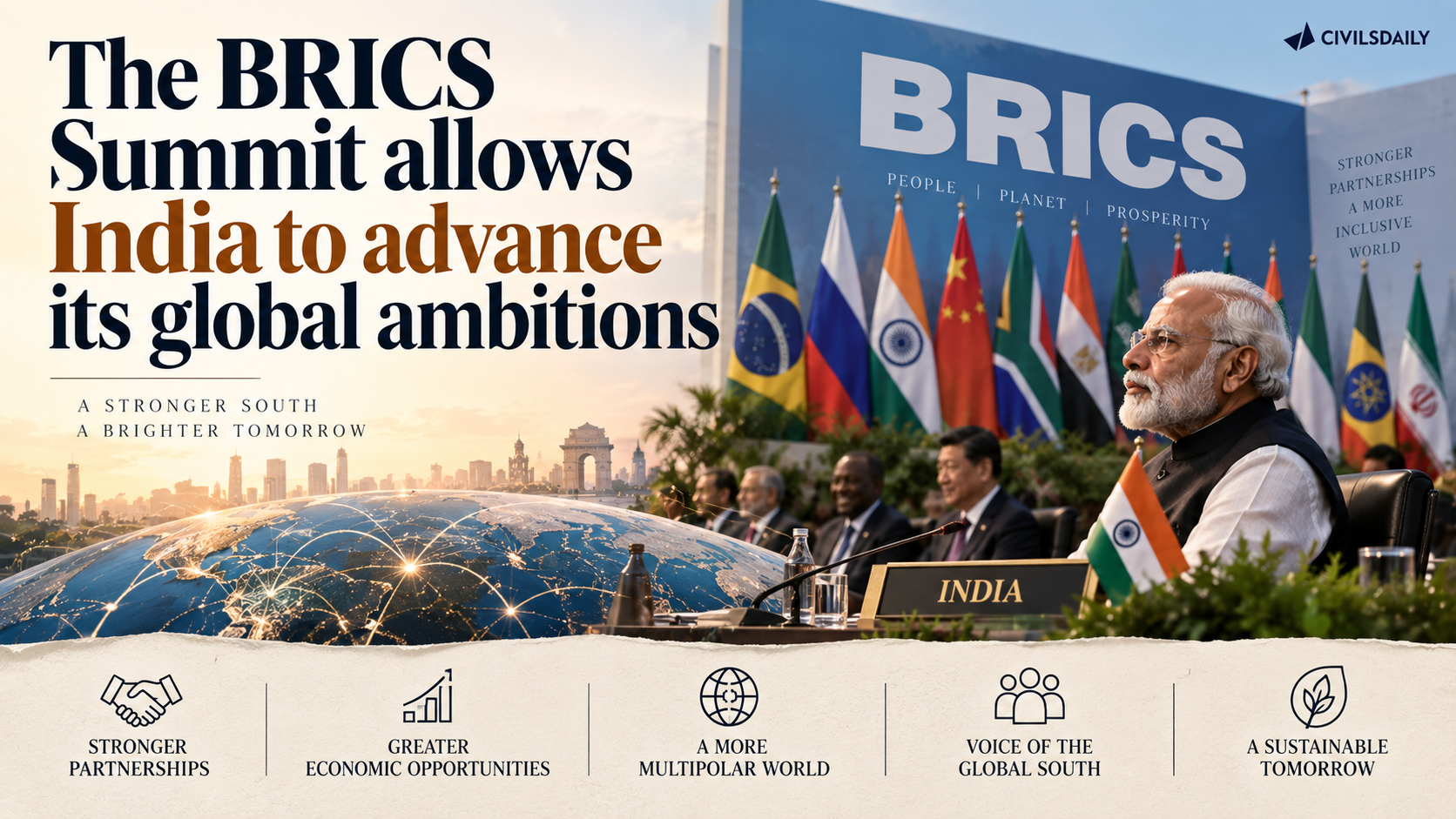
India has used its chairship of BRICS to convert the grouping’s agenda into a set of named functional outputs, and the New Delhi summit on 12 and 13 September 2026 is where those outputs are placed before the leaders. The chairship ran around 350 meetings across Indian cities, 22 of them at ministerial level, following the template India used for the G-20 Summit it hosted in New Delhi in 2023. India reframed the acronym around “building resilience, innovation, cooperation and sustainability”, and the deliverables track that framing: centres of excellence, a logistics framework, an enterprise portal and a set of research repositories. The grouping now carries 11 members and about 10 partner countries, and its collective output measured at purchasing power parity, meaning output adjusted for differences in domestic price levels, exceeds that of the G-7. The tension in the summit lies between the two things it is being asked to do at once, settle a set of technical cooperation outputs, and hold a common line among members several of whom are at war.
Pillars of BRICS cooperation
- Political and security: The first pillar covers the grouping’s positions on conflicts, security cooperation and global governance questions.
- Finance and the economy: The second pillar covers trade, payments, development finance and economic cooperation among members.
- Culture and people-to-people exchanges: The third pillar covers education, health, skilling and social cooperation between member societies.
- Where India’s chairship agenda sits: The agenda India pursued relates more to the second and third pillars than to the first, since the leaders themselves settle the large geopolitical questions.
Why is the Delhi summit a landmark?
- The backdrop: It takes place against geopolitical turbulence produced by a combination of forces, ongoing wars and conflicts, a breakdown in global governance, and the changing nature of global alliances.
- The grouping’s weight: BRICS now has 11 prominent members and about 10 partner countries, and its collective economic output in purchasing power parity terms outstrips that of the G-7, making it one of the largest and most important transcontinental groupings outside the West.
- The technology contest: Technological forces such as artificial intelligence and quantum computing are being weaponised, with both great powers trying to win the battle for tech supremacy.
How did India prepare for the chairship?
- The template: India followed the approach it had used for the 2023 G-20 Summit in New Delhi.
- The scale of the process: Around 350 meetings were conducted in cities across the country, with 22 held at the ministerial level.
- The stated focus: India announced that it would focus on “building resilience, innovation, cooperation and sustainability”, giving a new expansion to the BRICS acronym.
- The intent behind the framing: The reframing was used to refocus and recalibrate the BRICS agenda rather than to inherit the previous year’s priorities unchanged.
What has the chairship delivered on resilience?
- A digital centre for grids and storage: The BRICS Digital Centre of Excellence for Smart Grids and Energy Storage was launched under India’s stewardship.
- A logistics framework: The BRICS Logistics Supply Chain Cooperation Framework was adopted.
- Centres on farming systems: Centres of Excellence on Agro-Ecology and Regenerative Agriculture were established.
- What they are expected to do: Once operationalised, these initiatives are intended to provide the ballast that would make member economies genuinely resilient.
What is on the innovation agenda?
- Capital for new firms: A start-up innovation fund and an incubator network were proposed.
- A digital public infrastructure repository: Members would pool digital public infrastructure, meaning the shared digital systems for identity, payments and data exchange that public services run on.
- A science and research repository: A common repository for scientific and research material was proposed alongside it.
- A plan for large research facilities: The action plan of the BRICS Working Group on research infrastructures and mega science projects sits within this pillar.
- Why pooling matters here: Members are not all at the same level of development in scientific research, so shared facilities and repositories are worth more to some members than to others.
What does the cooperation pillar carry?
- Trade rules: Leaders are expected to endorse recommendations on revitalising the multilateral trading system.
- Health: A network of centres of excellence on mental wellness is to be welcomed by the leaders.
- Cities: A BRICS urbanisation forum is to be established.
- Women and digital access: Enhancing the digital capacity of women forms part of the recommendations.
- Skills and small enterprise: Cooperation is to be intensified in education and youth skilling, and through the BRICS Micro, Small and Medium Enterprises (MSME) Cooperation Portal.
What does the sustainability agenda add?
- It continues the previous chair’s priority: Sustainability was the centrepiece of Brazil’s agenda in the preceding year, and India built on that base rather than replacing it.
- Land and forests: Combating desertification, and guidelines for disaster management and forest-fire preparedness, are specific areas of cooperation under this head.
- Aviation fuel: A BRICS forum on sustainable aviation fuels forms part of the agenda.
- Adaptation rather than mitigation: Advancing climate resilience through people-centric and community-based adaptation is included, which matters because international fora tend to focus almost exclusively on mitigation.
Can a functional agenda hold when summit level geopolitics pulls the other way?
- The two tracks belong to different pillars: The chairship’s outputs sit in the economic and people-to-people pillars, and the large geopolitical questions are settled by the leaders under the first.
- The functional track is the more predictable of the two: Substantive outcomes appear assured on the strength of the ministerial and working group meetings already chaired, independent of what the leaders’ session produces.
- The caveat on the grouping: BRICS has to avoid being caught in geopolitical currents that are not of its own making and carry no strategic value for its members.
- Why it survives the contradiction: The grouping is now too large to be either ignored or allowed to fail, which gives members an interest in a working agenda even where they diverge politically.
- What it is ultimately for: The grouping helps members enhance their strategic options and push geopolitics towards a multipolar order, both of which are organising principles of India’s foreign policy.
Challenges to India’s BRICS chairship agenda
- The deliverables are institutions without budgets: A centre of excellence, a framework and a portal each need a host, staff and recurring funding, none of which a one year chairship can commit on the group’s behalf. Eg. The BRICS Vaccine Research and Development Centre, announced in 2020, functions as a virtual network of national institutions rather than a staffed facility.
The Fix: Attach each new centre to a named host institution with a member funded budget line recorded in the summit declaration. - Repositories hold only what members choose to deposit: A digital public infrastructure repository and a science repository depend on voluntary contribution, and members operate under differing national data and procurement rules. Eg. Members’ identity and payment systems sit under separate data laws, so specifications and code are not equally shareable.
The Fix: Settle a common licence and a deposit obligation for contributed material before the repositories open. - A declaration carries no review of the last one: Outcomes are recorded as commitments in a communique, and no member reports against them the following year. Eg. The Rio declaration of July 2025 ran to 126 points with no implementation review attached to it.
The Fix: Require the incoming chair to publish an implementation report against the previous declaration alongside the new one. - The enterprise agenda needs a payments channel that is not yet working: An MSME portal and a start-up fund assume a listed supplier in one member country can be paid from another without routing through third currency correspondent banking. Eg. The grouping’s own cross border payment initiative remains at pilot stage.
The Fix: Sequence the portal behind a working local currency settlement arrangement for the member pairs that already trade at scale.
Conclusion
The chairship’s output is a set of centres, frameworks, repositories and portals, and their value is decided after the summit closes rather than in its declaration. What converts an announced centre into a working institution is a host, a staff and a recurring budget, and none of those is a summit level decision. The grouping’s own design works against this, since priorities reset annually with the rotating chair and nothing obliges the next one to carry a predecessor’s working groups forward. What to watch is whether the declaration names a host institution and a funding source for the new centres, and whether the chair that follows India adopts the research infrastructure action plan rather than substituting its own themes.
About BRICS
- What it started as: The acronym was coined in 2001 by a Goldman Sachs economist to identify a set of high growth emerging economies, and it was an investment category before it was a forum.
- How it became a grouping: The first meeting of Foreign Ministers took place on the margins of the United Nations General Assembly in 2006, and the first formal Leaders’ Summit was held at Yekaterinburg in Russia in 2009.
- How it expanded: South Africa joined in 2011. The 2023 Johannesburg Summit opened membership further, with Egypt, Ethiopia, Iran and the United Arab Emirates joining in 2024 and Indonesia in 2025.
- The partner tier: A Partner Country category was introduced in 2024 to engage states such as Malaysia, Thailand and Nigeria without conferring full membership.
Institutions and Initiatives of BRICS
- New Development Bank: Headquartered in Shanghai, it lends for infrastructure and sustainable development, and has approved over $35 billion in loans.
- Contingent Reserve Arrangement: A $100 billion pool of member foreign exchange reserves providing short term liquidity support to a member under balance of payments pressure.
- BRICS Pay: A cross border payment initiative intended to settle trade among members in local currencies rather than through existing dollar based messaging channels.
- Remote Sensing Satellite Constellation: Six satellites contributed by member states, sharing earth observation data for disaster management and resource monitoring.
Key Facts about BRICS
- Population weight: The grouping represents over 45 per cent of the world’s population, about 3.6 billion people.
- Energy weight: Members account for roughly 42 per cent of global oil production and exports, which is what the inclusion of Iran, Saudi Arabia and the United Arab Emirates added to the bloc.
Challenges in BRICS
- Consensus across 11 members with different political systems: A joint declaration needs every member’s assent, so the text settles at the level the most reluctant member accepts. Eg. Declarations avoid language on human rights and democratic norms, since the membership spans elected governments and authoritarian ones.
The Fix: Adopt a variable geometry, letting a subset of willing members carry an initiative under the BRICS name without requiring unanimity. - One member’s economic weight shapes the agenda: China’s size gives it disproportionate influence over what the grouping prioritises and whom it admits. Eg. It has pushed for the inclusion of states carrying heavy Chinese debt exposure, which would tilt the bloc towards a China centred platform.
The Fix: Publish membership criteria weighted to economic complementarity and regional balance rather than to any single member’s sponsorship. - Reducing dollar dependence moves slower than the rhetoric: Settlement habits, contract law and reserve holdings all favour the incumbent currency. Eg. The US dollar still settles over 80 per cent of global trade.
The Fix: Target local currency invoicing on the bilateral pairs that already have settlement arrangements, rather than pursuing a common currency. - There is no permanent secretariat or charter: Each chair runs the calendar from its own foreign ministry, so institutional memory travels out with the chair. Eg. Working group records and unfinished action plans are held by the outgoing chair rather than by the grouping.
The Fix: Create a small standing secretariat funded by member contributions to hold working group records and track commitments between summits. - Trade within the bloc remains thin: Members trade more with the industrialised economies than with each other, which limits what economic cooperation can deliver. Eg. Most members still rely on G7 markets for high technology imports and for services exports.
The Fix: Negotiate a tariff preference schedule among members on a limited list of manufactured goods, which is achievable without a full trade agreement.
