Mains Ready By December. Smash Mains & Smash PYQ Admissions Open

Search results for: “”

  • Withdraw stand on Gram Sabha consent, rights group urges Ministry

    Why in the News

    The Tribal Affairs Ministry has held in an office memorandum that there is “no provision” under the Scheduled Tribes and Other Traditional Forest Dwellers (Recognition of Forest Rights) Act, 2006 to seek the consent of Gram Sabhas for diverting forest land to non-forest purposes. The Campaign for Survival and Dignity (CSD), a national platform of Adivasi and forest dweller organisations, has demanded immediate withdrawal of the memorandum. The position was arrived at during the Ministry’s discussion with the Power Ministry on the requirement of 100% Gram Sabha consent, which has been described as a “critical bottleneck” delaying large government projects. The contest is over what the consent requirement actually is. Treated as a statutory right it cannot be set aside by an executive communication, and treated as an administrative practice it can.

    What does the Forest Rights Act, 2006 give the Gram Sabha?

    1. It recognises rights: Section 3 recognises individual rights over forest land under occupation and community rights over minor forest produce, grazing, water bodies and traditional use.
    2. The Gram Sabha starts the process: Section 6 makes the Gram Sabha the authority that initiates determination of the nature and extent of individual and community forest rights.
    3. It carries powers over the forest itself: Section 5 empowers the Gram Sabha to protect wildlife, forest and biodiversity and to stop any activity that harms the community forest resource.
    4. Consent attaches to diversion: An Environment Ministry circular of 3 August 2009 requires written Gram Sabha consent, together with a certificate that rights recognition is complete, before forest land is diverted under the Forest (Conservation) Act, 1980.

    What did the Ministry hold, and what produced it?

    1. The memorandum’s claim: The office memorandum of 31 August states there is no provision in the Act requiring Gram Sabha consent for diversion of forest land to non-forest use.
    2. It came out of an inter-ministerial discussion: The Tribal Affairs Ministry is in discussions with the Power Ministry on the 100% consent requirement, which the discussions treat as a critical bottleneck holding up large government projects.

    On what grounds is the memorandum contested?

    1. Called factually and legally untenable: The CSD said the position “smacks of dereliction of duty” and that the error could have been avoided by reading the text of the law.
    2. It cuts against the Ministry’s own record: A former Union Environment Minister said the stance runs contrary to the Ministry’s own directives, communications, guidelines and the set procedure under law as it stands.
    3. It sits against the Niyamgiri ruling: In Orissa Mining Corporation v. Ministry of Environment and Forests (2013), the Supreme Court referred the question of community and religious claims to the Gram Sabhas of Rayagada and Kalahandi districts. All twelve Gram Sabhas consulted rejected bauxite mining in the Niyamgiri hills.
    4. A motive is alleged: The CSD alleged the Ministry took the position to appease the interests of project developers, contractors and large corporations.

    Challenges to Gram Sabha consent under the Forest Rights Act

    1. Consent presumes recognition is finished: Where community forest resource rights have not been recognised, there is no recorded rights holder whose consent can be sought, and the diversion proceeds on that silence. Eg. Gadchiroli district in Maharashtra carries widespread community forest resource titles, and recognition remains thin across most other States.
      The Fix: Complete community forest resource mapping and titling for a block before any diversion proposal for that block is admitted for processing.
    2. Consent can be manufactured: Resolutions are recorded without quorum, or with an agenda drafted by the project proponent and read out at the meeting. Eg. Gram Sabha consent resolutions for the Parsa coal block in Chhattisgarh’s Hasdeo Arand were alleged to be forged and were placed under official inquiry.
      The Fix: Video record every consent Gram Sabha and publish the attendance roll and the resolution in the local language before the clearance file moves.
    3. Clearance stages have been decoupled from consent: The Forest (Conservation) Rules, 2022 allow the Centre to grant in principle approval before the State certifies that forest rights settlement is complete. Eg. The Rules were challenged before the Supreme Court by retired civil servants and forest rights groups on precisely this ground.
      The Fix: Restore the consent certificate as a condition precedent to the first stage approval rather than an obligation the State discharges afterwards.

    Conclusion

    The memorandum stands, and only the Ministry that issued it can withdraw it. What is in dispute is not a policy preference but a reading of a statute, which means the answer is available to any court asked the question. The immediate marker is whether the Tribal Affairs Ministry withdraws or reissues its communication to the Power Ministry. The larger one is whether consent survives as a condition of forest diversion or is converted into a clearance stage that the executive can waive when a project is large enough.

    Matching Previous Year Question

    “[2013] Under the Scheduled Tribes and Other Traditional Forest Dwellers (Recognition of Forest Rights) Act, 2006, who shall be the authority to initiate the process for determining the nature and extent of individual or community forest rights or both? (a) State Forest Department (b) Distrit Collector/Deputy Commissioner (c) Tahsildar/Block Develoment Officer/Mandal Revenue Officer (d) Gram Sabha ANSWER: (d)”

  • Dangerous phase

    Why in the News

    United States forces have struck five Iranian oil tankers in Gulf waters, citing Iranian attacks on U.S. warships in the region. Iran has answered with a ballistic missile attack on the Muwaffaq Salti U.S. air base in Jordan, and has promised a stronger response to every further U.S. strike. It has also declared a new restricted zone in the Strait of Hormuz, warning commercial ships against crossing it under American naval escort. The U.S. had until recently used intense military strikes and economic strangulation as separate tools, and is now applying both at once. The pressure has produced escalation instead of concessions, and the conflict has widened to Jordan, Saudi Arabia and the Red Sea.

    What has changed in the U.S. approach to Iran?

    1. Two instruments applied together: Military strikes and economic strangulation were used separately in the recent past to force Iran to surrender. They are now being used simultaneously as maximum pressure on Tehran.
    2. The blockade has closed the revenue line: The U.S. naval blockade has largely prevented Iran from exporting its oil.
    3. Escorted convoys have blunted the chokepoint: American naval escort for a limited number of ships out of the Strait of Hormuz has reduced the effect of Iran’s chokehold on global energy prices.

    Why has maximum pressure not produced concessions?

    1. Iran escalated rather than conceded: Iran attacked American warships outside the Persian Gulf in the knowledge that a stronger U.S. military response would follow.
    2. A reading of American domestic politics: Iran sees a window in the weeks before the U.S. midterm elections. The U.S. President remains politically weak at home.
    3. Strike capability has been rebuilt: The missile attack on U.S. bases in Jordan indicates capabilities that the U.S. President had claimed were destroyed.

    How far has the conflict spread beyond Iran and the U.S.?

    1. Saudi Arabia has been drawn in: Yemen’s Houthis, closely aligned with Tehran, launched an attack on Saudi Arabia and wounded dozens. Riyadh has vowed a response.
    2. A second maritime front: The Houthis control northern Yemen and parts of its Red Sea coast, and have enforced a naval blockade of Saudi Arabia’s western ports.
    3. A ground offensive inside Yemen: The Houthis have launched an offensive against the forces of Yemen’s Saudi-backed government in Taiz and Mocha.
    4. Two waterways at risk at once: The Strait of Hormuz and the Red Sea, the trade channel between Europe and Asia, are both flashpoints. The conflict now runs horizontally from Tehran to Jordan and from Riyadh to Bab-el-Mandeb.

    Challenges to a maximum pressure strategy

    1. Coercion without an exit ramp invites escalation: A campaign that offers no negotiated off-ramp leaves the target with escalation as its only remaining lever. Eg. The U.S. left the Joint Comprehensive Plan of Action (JCPOA), the 2015 nuclear agreement, in 2018 and reimposed sanctions, and Iran began exceeding the agreement’s enrichment limits from 2019.
      The Fix: Attach a stated and verifiable de-escalation offer to each coercive step, so compliance carries a defined and reversible reward.
    2. Energy prices transmit the conflict to uninvolved economies: A threat to a shipping chokepoint raises freight, war-risk insurance and crude costs for states with no part in the dispute. Eg. Attacks on shipping in the Red Sea from late 2023 pushed carriers to route around the Cape of Good Hope, adding roughly two weeks to Asia to Europe voyages.
      The Fix: Hold deeper strategic petroleum reserves and pre-contract alternative routings, so a closure is absorbed over months rather than priced within days.
    3. Aligned armed groups let the target strike elsewhere: Sanctions imposed on a state do not reach the armed groups that act with it. Eg. The September 2019 attack on Saudi Aramco’s Abqaiq and Khurais facilities halted about half of Saudi crude output for a period.
      The Fix: Combine weapons transfer interdiction with a regional maritime security arrangement that includes the Gulf states, rather than an escort force drawn only from Western navies.
    4. Inspection access closes before the fighting does: Coercion removes the monitoring that would verify any later agreement. Eg. Iran stopped implementing the Additional Protocol, its expanded inspection arrangement with the International Atomic Energy Agency (IAEA), in February 2021.
      The Fix: Ring-fence safeguards access from the coercive track, so inspections continue whatever the state of the political negotiation.

    Conclusion

    Neither side is placed to step back. Washington has committed to military and economic coercion at the same time and has no concession to show for it. Tehran has answered each strike with a wider one and gains from escalating during a period of unsettled American politics. The marker to watch is whether the new restricted zone is enforced against an escorted convoy, since that is the point at which a shipping war becomes a general one.

    Back2Basics: Strait of Hormuz

    1. Location: A narrow sea passage between Iran to the north and Oman and the United Arab Emirates to the south, linking the Persian Gulf with the Gulf of Oman and the Arabian Sea.
    2. Dimensions: Roughly 33 km wide at its narrowest point, with the designated shipping lanes about 3 km wide in each direction.
    3. Traffic: Close to a fifth of global petroleum liquids consumption moves through it, along with most of Qatar’s seaborne liquefied natural gas.
    4. Bypass routes: Saudi Arabia’s East-West pipeline to the Red Sea and the United Arab Emirates’ Habshan to Fujairah pipeline are the only routes that move Gulf crude to open sea without crossing the strait.

    Matching Previous Year Question

    “[2026] Ships from which of the following countries have to cross the Strait of Hormuz to reach out to the Indian Ocean? 1. Bahrain 2. Syria 3. Qatar 4. Egypt (a) 1 and 2 (b) 1 and 3 (c) 2 and 3 (d) 3 and 4 ANSWER: (b)”

  • Pollution from open waste burning triples in cities during winter: study

    Why in the News

    Open waste burning across Indian cities rises sharply in winter, with the average incidence, the quantity of waste burned and the associated emissions as much as three times higher than in summer. The finding comes from a working paper by the World Resources Institute (WRI) India, built on field surveys carried out between 2019 and 2026 in 11 polluted Indian cities whose names have not been disclosed. The burning is not a major source of citywide particulate pollution, contributing under 1% of total PM2.5 and PM10 emissions in the cities assessed. The contest is over what the finding measures. Read as an air quality number the share is small, and read as a service delivery number it is evidence that municipal waste collection is failing in the poorest wards of the smallest cities.

    Why does the burning rise in winter?

    1. The seasonal multiple: Incidence, quantity burned and emissions run up to three times higher in winter than in summer across every category of city examined.
    2. The weather compounds it: The post monsoon period brings falling temperatures and stagnant atmospheric conditions, which make it harder for pollutants to disperse.

    How does the burden differ across city tiers?

    1. Tier 3 cities burn most often: They recorded the highest winter incidence, at an average of 49.6 incidents per square kilometre per day.
    2. Tier 2 cities burn the most waste: Cities with populations between 500,000 and five million recorded the highest quantities of waste burned, at 46 incidents per square kilometre per day.
    3. Tier 1 cities trail: The largest cities recorded 39.4 incidents per square kilometre per day.

    Why does a share under 1% still matter?

    1. The citywide share is small: Open burning contributed less than 1% of total citywide PM2.5 and PM10 emissions in the cities assessed.
    2. The exposure is close range: Burning happens near homes, streets and waste dumps, so it raises short term exposure to toxic smoke for the people living beside it.

    What does the income gradient reveal?

    1. Poorer areas burn more: Lower income neighbourhoods recorded substantially more burning than higher income areas within the same cities.
    2. The single highest reading: Nearly 84 incidents per square kilometre per day were recorded in the poorer areas of Tier 2 cities during winter, the highest figure in the study.
    3. What the researchers read into it: The pattern points to disparities in waste collection and other municipal services between neighbourhoods, rather than to differences in household behaviour alone.

    Challenges to municipal solid waste collection

    1. Segregation at source stays low: The Solid Waste Management Rules, 2016 require households to hand over segregated wet, dry and domestic hazardous waste, and mixed waste continues to reach collection points. Eg. Indore’s ward level segregated door to door collection is cited as an exception rather than the norm across Indian cities.
      The Fix: Tie Swachh Bharat Mission grant releases to third party audited segregation rates at ward level rather than to citywide self reported figures.
    2. Collection routes stop at the settlement edge: Informal settlements and peri urban wards often sit outside the contracted collection route, so waste there has no lawful disposal path. Eg. Peri urban wards added to municipal limits after boundary expansion frequently retain no collection contract for years.
      The Fix: Use burning incidence mapped per square kilometre to identify uncollected pockets and extend contracted routes to them.
    3. Processing capacity lags behind collection: Waste that is collected still lands on legacy dumpsites because sorting and processing plants are missing or underused. Eg. Delhi’s Ghazipur, Bhalswa and Okhla legacy dumps continue to receive fresh waste, with bio-mining running alongside.
      The Fix: Release bio-mining funds against verified reduction in dump height and volume rather than against tonnage cleared on paper.
    4. Enforcement against burning is nominal: Open burning of waste is prohibited and carries a spot fine under the 2016 Rules, and prosecution is rare because the offence is momentary and unwitnessed. Eg. The Graded Response Action Plan bars open burning across Delhi and the National Capital Region every winter, and incidents persist through the season.
      The Fix: Make the ward sanitation officer accountable for a measured incidence figure in the ward, so enforcement is judged on the count rather than on fines issued.

    Conclusion

    The paper converts open waste burning from an air quality footnote into a measurable test of municipal performance. The unit it uses is a count of incidents in a defined area, which a city can track ward by ward and compare across seasons. That makes the finding usable in a way a citywide emission share is not. The marker to watch is whether city clean air action plans adopt burning incidence as a service delivery indicator before the coming winter, or continue to treat it as a source with a negligible share.

    Back2Basics

    1. World Resources Institute: A global research organisation founded in 1982 and headquartered in Washington DC, working on climate, energy, food, forests, water and cities.
    2. WRI India: An independent research charity registered in India, which works with State governments and urban local bodies on air quality, mobility, energy and urban development.
    3. What a working paper is: A pre-publication research document circulated for comment, which has not been through peer review.

    Matching Previous Year Question

    “[2026, GS3, 15.0 marks] What are the challenges to solid waste management in India? Discuss the governmental policy framework on solid waste management. Discuss the success/failure cases of Delhi and Indore cities highlighting the salient feature of their solid waste management initiatives.”

  • Uttarakhand voter-deletion puzzle: Why 4 plains districts account for 85% of Form-7s

    Why in the News

    Four plains districts of Uttarakhand account for more than 85 per cent of the 1,30,382 Form 7 deletion applications filed during the claims and objections period of the Special Intensive Revision (SIR) of electoral rolls. Udham Singh Nagar filed 43,878, Haridwar 29,369, Dehradun 19,402 and Nainital 18,301, against 382 in Rudraprayag. The concentration is read two ways: the ruling party attributes it to migration and border movement, the Opposition to the minority and Scheduled Caste composition of those districts. The Election Commission of India (ECI) has meanwhile disposed of only a third of the applications and has pushed the claims and objections deadline back by nineteen days.

    What is the Special Intensive Revision of electoral rolls?

    1. A rebuild rather than an update: The roll is drawn afresh instead of being amended, so an existing elector is placed on a draft roll and re-established on it before the final roll is notified.
    2. The claims and objections window: A fixed period after the draft roll opens the roll to applications for inclusion, correction and deletion, and is the only stage at which an entry can be contested.
    3. The deletion form: Form 7 is the application seeking removal of a name, filed either by the elector concerned or by any other elector objecting to that entry.

    Where is the deletion demand concentrated?

    1. The four plains districts: Udham Singh Nagar, Haridwar, Dehradun and Nainital together account for over 85 per cent of the 1,30,382 Form 7 applications filed in the State.
    2. The hill districts barely register: Pauri Garhwal recorded 5,424 applications, Pithoragarh 3,044, Almora 2,999, Uttarkashi 2,109, Champawat 1,723, Chamoli 1,702 and Tehri Garhwal 1,431.
    3. The floor of the distribution: Bagheshwar recorded 618 applications and Rudraprayag 382, against Udham Singh Nagar’s 43,878.

    Why do the two sides read the same numbers differently?

    1. The migration explanation: Uttarakhand’s Minister for Minority Affairs attributed the concentration to the four districts being the State’s largest and most mobile urban centres, where people move while retaining electoral records at their previous locations.
    2. The targeting allegation: The Congress said it does not oppose the revision itself but objects to the manner of deletion, alleging that the affected seats are those with larger Muslim, minority, poor, Scheduled Caste and Scheduled Tribe populations.
    3. The rejection of a communal reading: The State minister rejected the suggestion that any minority was being targeted, resting the pattern on cross border movement of people alone.
    4. The Commission declines to interpret: The ECI’s stated position is that the figures record only applications received, and that district totals can vary with how actively individuals examined the roll.

    Can the machinery dispose of what has been filed?

    1. The disposal shortfall: Of the 1,30,382 applications received between 14 July and 13 August, only 44,132 had been disposed of as of 7 September, leaving 86,250 under process.
    2. Pendency follows the same map: Udham Singh Nagar has 34,903 applications under process, Haridwar 17,554, Nainital 11,498 and Dehradun 11,262.
    3. The schedule has moved: The claims and objections deadline has been extended from 9 September to 28 September, with the final electoral roll now due on 3 October.

    Challenges to the Special Intensive Revision

    1. Deletion volume outruns adjudication capacity: Each Form 7 requires an inquiry and a hearing before a name is struck, and a single electoral registration officer cannot run tens of thousands of them inside a notified window. Eg. Udham Singh Nagar carries 34,903 undisposed applications against a district electoral machinery sized for routine annual revision.
      The Fix: Publish a per district disposal rate through the window, so a shortfall is visible in time for the schedule to be corrected rather than after the final roll is notified.
    2. A rebuilt roll shifts the burden onto the elector: A revision that does not carry the previous roll forward requires every elector to act, which falls hardest on those least able to track a draft publication. Eg. Circular migrant workers absent from their registered address through the claims window have no practical way to contest a deletion entry.
      The Fix: Require a documented delivery of individual notice to the registered address before any deletion is confirmed, rather than treating draft roll publication as sufficient notice.
    3. Bulk objections are not distinguished from individual ones: The form makes no distinction between an elector correcting their own record and a third party objecting to another elector’s entry, so the two are counted and processed alike. Eg. The State’s own figures report only totals received, with no breakdown of who filed them.
      The Fix: Record and publish the filer category on every Form 7, so a concentration of third party objections is identifiable in the data itself.
    4. No published reason code for a deletion: A name removed as a duplicate, a name removed on death and a name removed as a non resident are all recorded as a deletion, so the roll’s shrinkage cannot be audited. Eg. The Uttarakhand figures allow no test of the migration explanation against the targeting allegation, which is why both survive the same dataset.
      The Fix: Attach a mandatory statutory reason code to every deletion order and publish the code wise totals alongside the final roll.

    Conclusion

    The Uttarakhand figures do not settle the dispute they have started. The same distribution supports a migration reading and a targeting reading, and the Commission has declined to choose between them because the data records applications rather than outcomes. The test now sits in the disposal record: 86,250 applications have to be decided before 28 September, and the final roll is due on 3 October.

    Matching Previous Year Question

    “[2026, GS2, 10.0 marks] Is the right to vote a fundamental right? Discuss the position of the Election Commission of India while undertaking the revision of electoral rolls. Can it also examine the question of citizenship of voters?”

  • Govt. not in favour of treating English as ‘native’ language

    Why in the News

    The Union government has told the Supreme Court that it “has an issue” with treating English as an indigenous language. It has assured the court that it will move quickly on consultations to grant the current Class 6 batch a one-time reprieve from the mandatory third-language paper in the Central Board of Secondary Education (CBSE) Class 10 examination. The court had earlier asked the CBSE to consider that relief. The petitioners want English moved out of the indigenous category into the “non-native” or foreign language category, and the Centre has reserved its submissions on that question. The court has also issued notice on petitions filed by minority schools on the three-language scheme. The dispute is about classification rather than count, because what counts as an indigenous language decides how many Indian languages a student must carry.

    What is the three-language formula under the National Education Policy, 2020?

    1. What it requires: The National Education Policy, 2020 continues the three-language formula in school education. At least two of the three languages taught must be native to India.
    2. Why classification decides the burden: A language treated as indigenous can fill one of the two mandatory Indian-language slots. English placed outside that category cannot, so a student carries an additional Indian language alongside it.
    3. Choice rests with States and students: The policy states that no language will be imposed on any State. The three languages are chosen by States, regions and students themselves.

    What has the Centre now told the Supreme Court?

    1. The petitioners’ ask: Counsel for the petitioners sought an order shifting English into the “non-native” or foreign language category.
    2. The Centre’s objection: The Centre said it “has an issue” with that, and asked to make its submissions before any order is passed.
    3. The assurance on the reprieve: The Centre told a Bench headed by the Chief Justice of India that a meeting with the officials concerned would be arranged within a day or two to decide on the one-time reprieve for Class 6 students.

    Why does the current Class 6 batch sit at the centre of the case?

    1. One batch faces full implementation: Under the CBSE guidelines, students in Classes 7 to 9 were exempted from the third-language requirement. The current Class 6 batch was slated for full implementation of the scheme.
    2. The examination date: Full implementation carries a mandatory Class 10 Board examination in the third language by 2031.
    3. The court’s earlier direction: At an earlier hearing the court asked the CBSE to consider relieving Class 6 students of writing the third-language examination in Class 10.
    4. The Bench on sequencing: A judge on the Bench said time is needed for students and for infrastructure to reach parity across education boards. Starting with the mother tongue, then an indigenous language, then another indigenous or foreign language works only where it begins in a lower class.

    What else is now before the court?

    1. The minority schools’ challenge: The court issued notice to the government on petitions filed by minority schools on the implementation of the three-language scheme.
    2. The English question is undecided: No order was passed on shifting English out of the indigenous category, because the Centre asked to be heard on it first.
    3. Timeline pressure from the petitioners: Counsel for the petitioners said parents were anxious and urged the court against further adjournments. The hearing stands adjourned to 17 September.

    Challenges to the three-language formula

    1. Political resistance where the formula reads as imposition: A centrally set language requirement collides with State language policy. Eg. Tamil Nadu has followed a two-language policy of Tamil and English since 1968, after the anti-Hindi agitations of 1965, and has refused the three-language formula since.
      The Fix: Make the third language a State-notified choice, and tie central funding to teacher recruitment for whichever language a State selects rather than to adoption of the formula itself.
    2. Teacher availability limits real choice: A school cannot offer a language for which no trained teacher is posted. Eg. UDISE+ returns record over one lakh single-teacher schools in the country.
      The Fix: Sanction language-specific posts and permit a shared language teacher across a cluster of schools before the subject becomes examinable.
    3. Foundational reading is the prior constraint: A third language added at the middle stage assumes reading fluency that many students do not have. Eg. The ASER 2024 survey found under half of Class 5 students in rural India able to read a Class 2 level text.
      The Fix: Sequence the third language behind a measured foundational literacy benchmark in the mother tongue, rather than behind a fixed grade.
    4. Minority institutions’ autonomy is engaged: Article 30(1) gives minorities the right to establish and administer educational institutions of their choice, and a prescribed set of languages touches that right. Eg. In T.M.A. Pai Foundation v. State of Karnataka (2002), an eleven-judge Constitution Bench held that regulation of such institutions is permissible for standards and not for control of administration.
      The Fix: Frame the language requirement as an attainment standard rather than as a prescribed language set, so minority institutions retain the choice of which languages meet it.

    Conclusion

    The case turns on a classification question rather than on the number of languages taught. Whether English is treated as indigenous decides whether a student carries two Indian languages or three. The Centre has reserved its position on that and has offered relief only to one batch of students. What remains unresolved is what happens to every batch that follows it.

    Matching Previous Year Question

    “[2020, GS2, 15.0 marks] National Education Policy 2020 is in conformity with the Sustainable Development Goal-4 (2030). It intends to restructure and reorient education system in India. Critically examine the statement.”

  • Market turbulence is here to stay, may deepen

    Why in the News

    Indian equity markets closed lower with the Sensex down 1.08 per cent, and the weakness ran across small and midcap indices as well. The fall follows a run of external shocks rather than a domestic slowdown, since the economy is growing at a fairly healthy rate. The Sensex has lost roughly 12 per cent since the beginning of this year. Brent crude has touched $100 a barrel as the conflict in West Asia expands, and the rupee has slipped past the 95 mark against the dollar. The tension is that the drivers of the sell off sit outside the reach of domestic policy. The instruments available to answer them act on demand at home.

    What has actually moved in Indian markets?

    1. Index and breadth both weakened: The Sensex closed down 1.08 per cent and the fall extended to small and midcap indices rather than staying confined to large caps.
    2. Volatility rose sharply: The India VIX (an index of the volatility the options market expects in the Nifty over the next 30 days) rose almost 7 per cent.
    3. The decline is not a single session event: The Sensex has fallen by roughly 12 per cent since the beginning of this year.
    4. Information technology led the weakness: Concerns have mounted over the sector’s long term growth prospects, given the rapid deployment of artificial intelligence.
    5. Asian peers did not move together: The Nikkei was down 0.2 per cent. The Kospi was up 1.4 per cent.

    Why has investor sentiment weakened despite a healthy growth rate?

    1. The West Asian conflict has widened: Attacks by the Iran backed Houthis on energy facilities and infrastructure in Saudi Arabia mark an escalation and raise concerns over energy supplies.
    2. Crude has returned to triple digits: Brent crude oil has touched $100 a barrel, levels last seen in July.
    3. India’s own import cost has risen faster: The Indian crude oil basket surged to $108.91 per barrel as on 8 September, according to the Petroleum Planning and Analysis Cell.
    4. The currency has broken a psychological level: The Indian rupee has slipped past the 95 mark against the dollar.
    5. Foreign investors have turned sellers: Foreign investors have taken out $1.3 billion from the stock markets in September so far.
    6. The transmission runs through three channels: Higher prices act on the external balance, on the currency and on inflation together rather than one at a time.

    What does the global rate environment do to India’s policy room?

    1. The US central bank has signalled a harder stance: Remarks by the US Federal Reserve chairman at the recent Jackson Hole meeting were read as hawkish, raising expectations of an aggressive policy stance.
    2. A rate increase is now priced for the coming week: The odds of an interest rate hike at next week’s meeting have risen on those remarks.
    3. Sovereign yields elsewhere have repriced: The US 10 year bond yield is around 4.8 per cent and Japanese yields are hovering near 2.9 per cent, which narrows the return advantage of holding Indian assets.
    4. The domestic decision arrives into a softening economy: The Reserve Bank of India’s Monetary Policy Committee meets early next month with expectations of a move towards tightening. Growth momentum that surpassed expectations in the first quarter is expected to moderate in the second half of the year.

    Challenges to macroeconomic stability from sustained market turbulence

    1. Imported energy costs pass through to domestic prices: An expensive crude basket raises the import bill and feeds into freight and manufacturing costs within a quarter. Eg. India meets over 85 per cent of its crude oil requirement through imports.
      The Fix: Expand strategic petroleum reserve capacity and widen term supply contracts beyond West Asian sellers, so a regional escalation does not move the whole basket at once.
    2. A weaker currency raises the cost of external borrowing: Depreciation increases the rupee cost of servicing dollar denominated debt taken on by Indian firms. Eg. External commercial borrowings are raised largely in dollars and repaid out of rupee earnings.
      The Fix: Tighten hedging requirements on unhedged foreign currency exposure of corporate borrowers, so depreciation does not convert into balance sheet stress.
    3. Portfolio flows reverse faster than they arrive: Foreign portfolio investment tracks interest rate differentials rather than domestic earnings, so an outflow can begin before any local data changes. Eg. The taper tantrum of 2013 produced heavy outflows and a sharp rupee fall within weeks of a single central bank statement.
      The Fix: Deepen domestic institutional demand through retirement and insurance flows, so a foreign exit is absorbed rather than amplified.
    4. Defending the currency raises the cost of credit at home: A policy rate increase aimed at the exchange rate also raises borrowing costs for firms already facing weak demand. Eg. Micro, small and medium enterprises borrow largely at floating rates, so pass through reaches them first.
      The Fix: Pair any tightening with a targeted refinance line for small borrowers, so the rate defence does not fall hardest on the segment least able to absorb it.

    Conclusion

    Market weakness is no longer traceable to domestic growth. Its drivers are a war premium on oil, a harder rate path abroad and portfolio flows that respond to both. Domestic instruments act on demand at home and cannot offset an imported price shock. What remains unresolved is whether policy defends the currency or supports output, since a single rate decision cannot do both.

    Back2Basics

    1. What it is: The Indian basket of crude oil is a weighted average of the prices of the grades India actually imports, not a traded contract in its own right.
    2. What it averages: It combines sour grades of the Oman and Dubai type with the sweet Brent dated grade, weighted by the share of each in India’s import mix.
    3. Who compiles it: The Petroleum Planning and Analysis Cell, an attached office of the Ministry of Petroleum and Natural Gas, publishes it.
    4. Why it is used: It is the reference price for estimating the oil import bill and for tracking the cost of the crude that Indian refiners actually buy.

    Matching Previous Year Question

    “[2018, GS3, 15.0 marks] How would the recent phenomena of protectionism and currency manipulations in world trade affect macroeconomic stability of India?”

  • [9th September 2026] The Hindu OpED: India-Japan defence cooperation breaks new ground

    [9th September 2026] The Hindu OpED: India-Japan defence cooperation breaks new ground

    Question (2019, GS2 – 10 Marks): “‘The time has come for India and Japan to build a strong contemporary relationship, one involving global and strategic partnership that will have a great significance for Asia and the world as a whole.’ Comment.
    Linkage: This question directly evaluates the transition of India-Japan ties into a robust “Special Strategic and Global Partnership”. It challenges candidates to analyze whether political mechanisms (like the 2+2 Ministerial Dialogues and institutional agreements) are producing meaningful regional and global security outcomes

    Mentor comment

    India and Japan have announced a new maritime cooperation framework, joint work on naval shipbuilding and design, and early implementation of the transfer of Japan’s UNICORN integrated communications antenna system. The agreements came out of a visit to India by Japan’s Defence Minister in August 2026. They follow more than a decade of institution building through annual dialogues, the 2+2 mechanism that brings the two countries’ foreign and defence ministers to a single table, joint exercises, logistics arrangements and defence technology discussions. That machinery has not produced matching operational or industrial output. The contest is whether a relationship rich in declarations of strategic convergence can now deliver usable capability.

    Why do further declarations of convergence add little?

    1. The convergence is already established: Both countries share concerns about coercive attempts to alter the status quo, the security of the maritime commons and the growing militarisation of the Indo-Pacific.
    2. Declarations now carry diminishing returns: The partnership has been more developed institutionally than operationally, so another statement of shared assessment changes nothing about what the two forces can do together.
    3. The test is joint operating capacity: The unmet task is converting shared assessments into arrangements that improve the two countries’ ability to operate together.

    What does the new maritime framework try to fix?

    1. Information sharing is the core: The framework places its emphasis on information sharing and Maritime Domain Awareness, the continuous picture of shipping, naval movement and activity in a maritime area assembled from radar, satellite, aircraft and vessel tracking inputs.
    2. The two sit at opposite ends of one theatre: Japan’s immediate security concerns are concentrated in the East China Sea and the waters surrounding Taiwan. India’s geographical position gives it a central role in the Indian Ocean maritime space.
    3. A single picture across two spaces: A closer information sharing architecture would build a more continuous strategic picture across these interconnected maritime spaces.
    4. The stated objective is operational: The aim is greater awareness, interoperability and operational familiarity between the two major maritime powers.

    What is being attempted in defence industry?

    1. Joint work on naval shipbuilding: The two sides are exploring joint development in naval shipbuilding and design, combining Japanese technological expertise with Indian production capabilities.
    2. Japanese use of Indian capacity: There was agreement to deepen discussions on Japan’s use of Indian production capabilities under the ‘Make in India’ framework.
    3. Reciprocal ship repair: The two sides agreed to move towards reciprocal arrangements for ship repair facilities.
    4. This is the weakest leg of the relationship: Defence industrial cooperation has consistently lagged behind strategic and political convergence.

    Why does the UNICORN transfer matter, and why is it not new?

    1. What the system is: UNICORN is an integrated communications antenna system that houses a warship’s antennas within a single composite mast, which reduces the ship’s radar signature.
    2. Described as a first, but already under way: Japan’s Ministry of Defence describes UNICORN as the first defence equipment transfer project between the two countries. A memorandum of understanding for the co-development of UNICORN masts, involving Bharat Electronics Limited, was signed in November 2024.
    3. The meeting advanced implementation: The August meeting represented a further step towards implementation rather than the initiation of a new project.
    4. The record it has to beat: New Delhi and Tokyo have struggled to convert their 2015 agreement on defence equipment and technology transfer into concrete outcomes.
    5. Research agencies are being linked: There are plans to deepen cooperation between India’s Defence Research and Development Organisation (DRDO) and Japan’s Acquisition, Technology and Logistics Agency (ATLA), the Japanese Defence Ministry body that runs procurement and technology development.
    6. Credibility now rests on delivery: The commitment to early implementation reflects a recognition that credibility depends on delivering projects rather than identifying possibilities.

    What do the exercises signal?

    1. Japanese fighters are flying in India: Japan’s fighter aircraft are participating in the Veer Guardian exercise in India from 9 to 22 September 2026, for the first time.
    2. Greater complexity by agreement: The two sides agreed to increase the complexity of bilateral exercises and to integrate unmanned systems.
    3. Short notice activation: They agreed to explore exercises organised at short notice, which tests readiness rather than choreography.
    4. Beyond the navies: They discussed cooperation between special operations forces, and with India’s future integrated theatre commands.

    Why does the western seaboard visit matter?

    1. The itinerary moved west: Before travelling to New Delhi, Japan’s Defence Minister visited the Western Naval Command in Mumbai and INS Chennai.
    2. Past the usual geography: The visit extended beyond the familiar strategic geography of the Bay of Bengal and the Strait of Malacca.
    3. What the western seaboard carries: It is central to India’s wider maritime interests, encompassing critical sea lanes, energy flows and India’s growing responsibilities in the western Indian Ocean.

    Is this a China-centric partnership?

    1. The message was sent without the name: The joint statement reiterated opposition to unilateral actions that impede freedom of navigation or seek to alter the status quo through force or coercion. Neither country named China.
    2. The value lies in going past China: The significance of India-Japan cooperation lies in its ability to move beyond a China-centric agenda.
    3. A wider agenda is already forming: Maritime security, resilient supply chains, defence industrial capacity, logistics and third country cooperation are becoming components of a wider regional security architecture.
    4. The civil side moved first: The July 2026 Annual Summit expanded cooperation across economic security, critical technologies and resilient supply chains, and the defence engagement followed it.

    Challenges

    1. Transfer agreements have not produced serial equipment flows: Named projects have repeatedly stalled between agreement and production. Eg. Negotiations on the US-2 amphibious search and rescue aircraft ran for years without producing a contract.
    2. Japan’s export control framework limits what can move: Japan’s post-war pacifist constitutional settlement and its restrictive export rules keep advanced and dual-use defence technology outside most transfer categories. Eg. The Three Principles on Transfer of Defence Equipment and Technology, adopted in 2014, replaced a near-total export ban but still confine transfers to defined categories.
    3. Habitual joint operation is still shallow: Interoperability is built by repetition, and the bilateral exercise tempo remains thin against the range of services involved. Eg. Japan first joined the Malabar naval exercise in 2007 and became a permanent participant only in 2015.
    4. Defence industrial cooperation remains below potential: Defence industrial cooperation has consistently lagged behind strategic and political convergence.
    5. Strategic alignment is not identical: Japan’s Indo-Pacific approach is closely coordinated with the United States and the G7. India retains strategic autonomy and stays in groupings Japan is not part of. Eg. India’s participation in the Vostok exercises in Russia sits awkwardly with Tokyo’s position.

    Way Forward

    1. Convert agreements into deliverables: Attach dated production milestones and named Indian production partners to defence transfers so that agreements move from signing to implementation.
    2. Work within Japan’s export framework: Concentrate joint projects on permitted categories such as sensors, communications, surveillance and rescue platforms.
    3. Build sustained interoperability: Establish a standing annual calendar covering naval, army and air exercises, with a short-notice activation slot.
    4. Deepen defence industrial cooperation: Move from individual technology transfers towards joint development, co-production and reciprocal maintenance, combining Japanese technological expertise with Indian manufacturing capacity.
    5. Strengthen maritime information sharing: Develop a more integrated Maritime Domain Awareness architecture and improve information sharing between the two countries’ maritime forces.
    6. Institutionalise strategic consultation: Establish a standing consultation mechanism on third-country engagements so that differences arising from India’s strategic autonomy do not become unexpected diplomatic surprises.
    7. Measure the partnership by outcomes: The ultimate benchmark should be delivered equipment, operational capability and functioning industrial partnerships, rather than another round of declarations.

    Back2Basic: About India-Japan Relations

    1. A Special Strategic and Global Partnership: The relationship was upgraded to this status in 2014, covering political, economic and security cooperation.
    2. Indo-Pacific convergence: India’s Act East Policy and its Indo-Pacific Oceans Initiative (IPOI) align with Japan’s Free and Open Indo-Pacific (FOIP) vision, and the two also work together within the Quad.
    3. Economic weight: Japan is the fifth largest investor in the Indian economy, with 6.6 per cent of India’s total foreign direct investment inflows. Bilateral trade stood at USD 25.17 billion in 2024-25.
    4. Development footprint: The Mumbai-Ahmedabad High Speed Rail project is the flagship connectivity work, and Japan is the only country undertaking development work in India’s Northeast, through the India-Japan Act East Forum.

    Initiatives and Agreements in India-Japan Cooperation

    1. Comprehensive Economic Partnership Agreement (CEPA), 2011: It covers trade in goods and services, investment and intellectual property rights.
    2. India-Japan Industrial Competitiveness Partnership, 2021: It works on India’s manufacturing base and on supply chain resilience.
    3. Acquisition and Cross-Servicing Agreement, 2020: It allows reciprocal provision of supplies and services between the two countries’ defence forces.
    4. Agreement for Cooperation in the Peaceful Uses of Nuclear Energy, 2017: It provides the legal basis for Japanese civil nuclear cooperation with India.
    5. Supply Chain Resilience Initiative: Run with Australia, it seeks to diversify supply chains away from dependence on a single country.
    6. Asia-Africa Growth Corridor: It aims to link East Asia, Southeast Asia and South Asia more closely with Africa.

    Key Facts about India-Japan Relations

    1. Joint exercises: JIMEX is the bilateral naval exercise and Dharma Guardian the army exercise. Both countries also take part in the Malabar and Milan multilateral exercises.
    2. The G4 grouping: India and Japan work with Brazil and Germany in the G4 to press for expansion of the United Nations Security Council.
    3. India Vision 2025: It frames the development of India’s Northeast as the convergence point between the Act East Policy and Japan’s Indo-Pacific vision.
  • How to appoint judges: A view from South Africa

    How to appoint judges: A view from South Africa

    Why in the News

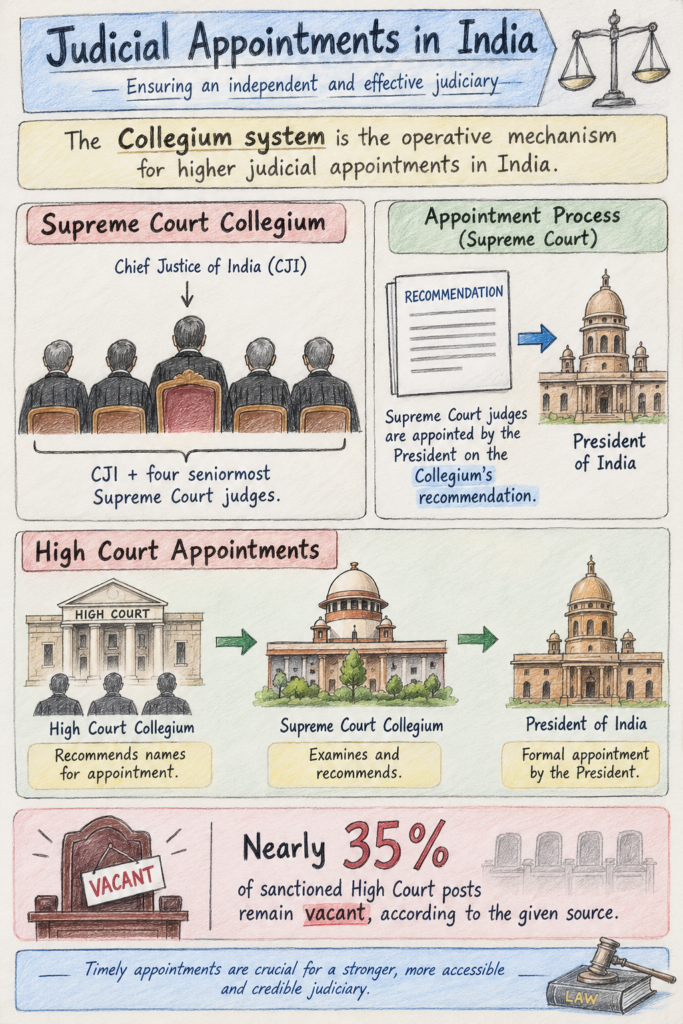
    • The Supreme Court has held that confidentiality in judicial appointments is necessary to preserve the integrity of the appointment process.
    • The issue arose in Arvind Malhotra v. High Court of Himachal Pradesh, involving a judge who challenged the elevation of a junior judge to the Supreme Court.
    • The case brings into focus the debate between confidentiality and transparency in judicial appointments.

    Judicial Service Commission of South Africa

    • The Judicial Service Commission (JSC) is a constitutional body involved in judicial appointments in South Africa.
    • It includes judges, lawyers, legal academics and political representatives.
    • Its proceedings are conducted publicly and broadcast.
    • Process involves:
      • Calling for nominations.
      • Preparing a shortlist.
      • Inviting public comments.
      • Conducting public interviews.
      • Voting where members disagree.
    • The identity of individual votes remains confidential.

    Judicial Accountability in South Africa

    • Judges do not enjoy special immunity from complaints regarding conduct.
    • The JSC can investigate allegations of improper conduct.
    • Serious cases can lead to a public enquiry and recommendations for impeachment.

    Constitutional Provisions

    • Article 124: Appointment of Supreme Court judges.
    • Article 217: Appointment of High Court judges.
    • 99th Constitutional Amendment Act, 2014: Provided for the National Judicial Appointments Commission (NJAC).
    • 2015: Supreme Court struck down the NJAC framework and restored the Collegium system.

    Major Concerns

    • Judges appointing judges: Concerns regarding limited external checks and accountability.
    • Transparency: Collegium resolutions are published, but detailed reasons for selection are generally not disclosed.
    • Representation: Concerns regarding social and regional diversity in higher judiciary.
    • Objective merit: Absence of a publicly stated and standardised evaluation framework.
    • Regional imbalance: Some High Courts remain unrepresented in the Supreme Court.

    Way Forward

    • Develop clear and publicly stated selection criteria.
    • Improve transparency while protecting legitimate confidentiality.
    • Consider regional and social representation alongside merit.
    • Strengthen mechanisms for addressing complaints against judicial officers.
    • Maintain the essential balance between judicial independence and public accountability.

    Prelims Pointers

    • Article 124 → Supreme Court judges.
    • Article 217 → High Court judges.
    • Collegium → Judicial appointments to higher judiciary.
    • NJAC → Created through 99th Constitutional Amendment, 2014.
    • NJAC struck down → 2015.
    • South Africa JSC → Constitutional body involved in judicial appointments.
    • TRAI vs JSC: JSC is a constitutional judicial appointments body in South Africa, while India’s Collegium is a judge-led mechanism evolved through judicial decisions.

    [2012] What is the provision to safeguard the autonomy of the supreme court of India?
    1. While appointing the Supreme Court judges, the president of India has to consult the CJI.
    2. the SC judges can be removed by the CJI only
    3. the salaries of judges are charged on the consolidated fund of India to which the legislature does not have to vote.
    4. All appointments of officers and staffs of the SC are made by the govt only after consulting the CJI
    Which of the statements given above is/are correct?

    [A] 1 and 3 only

    [B] 3 and 4 only

    [C] 4 only

    [D] 1, 2, 3 and 4

  • A possible G3 is casting a shadow over BRICS

    A possible G3 is casting a shadow over BRICS

    Why in the News

    BRICS leaders meet in Delhi this week to add further layers of cooperation, ranging from agriculture, health to digitalisation. The grouping’s two principal driving forces, Russia and China, are at the same time exploring separate and joint accommodations with the United States, whose domination of the world order BRICS exists to counter.

    What will the Delhi summit actually produce?

    1. More layers, slowly added: The summit will extend cooperation into agriculture, health and digitalisation.
    2. The declaration is not the draw: The last summit, at Rio de Janeiro, issued a declaration of 126 paragraphs without changing anything in the international system.
    3. The attraction is attendance: International interest is focused on the presence of the leaders of China, Russia and Iran.
    4. One bilateral carries the weight: The Chinese President is visiting India for the first time since 2019, and the two leaders are expected to stabilise the boundary situation and reset economic relations.

    Why has BRICS become less coherent?

    1. Expansion cut both ways: Enlargement added weight to the grouping and subtracted coherence from it.
    2. The Iran war split two members: The conflict opened a sharp divide between Tehran and Abu Dhabi, now fellow members of the grouping.
    3. Two incompatible asks: Iran wants BRICS to condemn American and Israeli military action. The United Arab Emirates, which suffered Iranian attacks and disruption to commerce through the Strait of Hormuz, stresses sovereignty, protection of civilian infrastructure and freedom of navigation.
    4. It has already cost an outcome: Those differences prevented the BRICS foreign ministers from issuing a consensual joint statement in Delhi in May.

    Why is a G3 conceivable now?

    1. A leader driven American approach: The US President has long held that good personal relations with the Russian and Chinese leaders could reduce global strategic tensions and produce major political and economic deals.
    2. Domestic and allied resistance: That instinct has repeatedly encountered resistance from the American foreign policy establishment, Congress and US allies.
    3. European and Asian fears differ: The Europeans worry that an accommodation with Moscow could be made at their expense. Asian allies fear that a bargain with Beijing could weaken American commitments to regional security.
    4. Nothing has been transformed yet: Neither relationship has been changed, and the preference for leader driven diplomacy keeps the possibility of movement open.
    5. The idea has been tested before: The possibility of such a meeting was explored last summer, during the 80th anniversary of the end of the Second World War.

    What does Russia bring to that table?

    1. The war has not been won: Four and a half years of fighting have produced no decisive victory, and the front remains costly and difficult to move.
    2. A channel has reopened: Shuttle diplomacy by American envoys between Moscow and Kyiv has reopened the diplomatic channel, without any sign that the fundamental differences between Russia and Ukraine are narrowing.
    3. Both sides hedge: Moscow and Kyiv are supporting the American peace initiative and preparing for escalation at the same time.
    4. European security could become a chip: Russian security questions could be treated by Washington as part of a larger bargain with Beijing.

    What does China bring?

    1. It negotiates from strength: China approaches Washington from a stronger position than Russia does.
    2. A sequenced diplomatic run: Its journey from the Shanghai Cooperation Organisation summit at Bishkek, through Cairo and Delhi, to the White House later this month presents China as the leader of the Global South and as a co-equal manager of the international order at the same time.
    3. What a second summit could yield: An extension of the trade truce, additional Chinese purchases from the United States and negotiations over technology restrictions are the available deliverables.
    4. The differences are structural: Washington accuses China of relying on subsidised exports and industrial overcapacity. Beijing uses rare earths, market access and its control of important supply chains as leverage.
    5. Taiwan is the standing ask: China will continue to press for a reduction in American support for Taiwan.

    Can anti-Western rhetoric and a seat at the American table hold together?

    1. Alignment and hedging run together: Russia and China are closer to each other than ever and share concerns about the United States. Both also seek a workable relationship with Washington.
    2. Both claim the high table: For all their anti-Western rhetoric, each claims a place at the high table with the United States.
    3. The claim has history: Russia was once part of the G8, the group of Western industrial states, and engaged directly with NATO. China now sees itself as America’s peer.
    4. What a trilateral would signify: Both lay claim to shaping the global order established after 1945, and a summit of the three leaders would mark the beginning of triangular global leadership as a successor to the Yalta System.
    5. It is not imminent: A global directorate of three is not close, and the idea remains an exploration rather than a plan.

    What are India’s three answers?

    1. Build national power first: The first answer is internal reform and accelerated economic development.
    2. Separate multipolarity from anti-American bloc politics: Russia and China use BRICS to expand their diplomatic options and to preserve the freedom to negotiate with Washington. India must approach the emerging order with the same realism.
    3. Widen the partnership base: India must intensify bilateral and minilateral cooperation with the Anglosphere, Brazil, Europe, Japan, Korea and other middle powers that have no enthusiasm for a G3 world.

    Challenges to BRICS

    1. Internal rivalry limits cohesion: Friction between the two largest Asian members prevents a common strategic position inside the grouping. Eg. The unsettled India-China boundary has kept the two from a shared security line inside the same forum.
    2. Consensus across incompatible political systems: The membership spans vibrant democracies and autocracies, which makes agreement on human rights or democratic norms unreachable in joint declarations. Eg. The entry of Iran and Ethiopia alongside Brazil and India widened that political range further.
    3. De-dollarisation is slower than the rhetoric: Local currency settlement has grown, and the US dollar still settles the overwhelming share of global trade. Eg. Rupee-rouble and rupee-dirham settlement covers only a fraction of India’s external trade.
    4. There is no permanent secretariat: The grouping has no charter and no standing institution, so continuity depends entirely on the annual chair. Eg. Each presidency resets the agenda, and commitments lapse when the chair changes.
    5. Intra-group trade stays low: Members continue to rely on G7 markets for high technology imports and services exports. Eg. Most members source advanced semiconductors and aerospace components from the United States, Europe and Japan.
    6. Expansion risks dilution: A larger BRICS+ risks becoming a discussion forum that produces no decisions. Eg. The Non-Aligned Movement grew past 120 members and lost the ability to reach operative positions.

    Way Forward

    1. Focus on areas of common interest: Confine joint positions to areas where members already agree, such as development finance and public health, rather than seeking a security consensus that does not exist.
    2. Adopt variable geometry: Move towards a variable geometry model in which subsets of members can sign issue specific instruments without binding the whole group.
    3. Strengthen payment infrastructure: Target payments infrastructure that lowers settlement cost and time, rather than focusing primarily on the displacement of the US dollar as a reserve currency.
    4. Create a permanent institutional mechanism: Establish a small standing secretariat with a limited mandate to track implementation of past declarations and maintain institutional continuity.
    5. Promote intra-BRICS supply chains: Direct the New Development Bank towards financing intra-group industrial supply chains, particularly in strategic sectors such as advanced technology and manufacturing.
    6. Formalise expansion criteria: Establish clear entry criteria for partner countries, ensuring that future expansion is based on economic complementarity rather than political alignment.

    Conclusion

    Multipolarity has always had two possible shapes: one distributes power across many capitals; the other concentrates it among a handful and calls the result a balance. BRICS rests on the first assumption; its two strongest members hedge towards the second. For India the operative question is not whether a three cornered directorate forms, which it may not, but whether Indian diplomacy is organised for a world in which its two largest partners in the grouping negotiate separately with Washington. That answer will show up in what India builds outside the room, not in what the room declares.

    About BRICS

    1. What it is: BRICS is an informal grouping of major emerging economies that coordinates political and economic positions outside Western led institutions, without a founding treaty.
    2. Membership: Its full members are Brazil, Russia, India, China, South Africa, Egypt, Ethiopia, Indonesia, Iran, Saudi Arabia and the United Arab Emirates, with Saudi Arabia participating without having formalised its status.
    3. Its weight: The grouping accounts for over 45 per cent of the world’s population, about 37 per cent of global output measured at purchasing power parity, which exceeds the G7’s share, and roughly 42 per cent of global oil production and exports.
    4. Its stated objectives: Reform of the United Nations Security Council, the International Monetary Fund and the World Bank for more equitable representation, a multipolar order, and reduced reliance on the US dollar and on SWIFT, the messaging network banks use to instruct cross border payments.

    Key Facts about BRICS

    1. The acronym predates the grouping: ‘BRIC’ was coined in 2001 by a Goldman Sachs economist to identify high growth emerging economies.
    2. From officials to leaders: The first meeting of foreign ministers was held on the margins of the United Nations General Assembly in 2006. The first formal Leaders’ Summit was held at Yekaterinburg in Russia in 2009.
    3. How it grew: South Africa joined in 2011. Expansion was decided at the 2023 Johannesburg Summit, with Egypt, Ethiopia, Iran and the United Arab Emirates joining in 2024 and Indonesia in 2025.
    4. A partner tier: A ‘Partner Country’ category was introduced in 2024 to engage states such as Malaysia, Thailand and Nigeria without granting full membership.

    Initiatives under BRICS

    1. New Development Bank: Headquartered in Shanghai, it has approved over USD 35 billion in infrastructure lending.
    2. Contingent Reserve Arrangement: A USD 100 billion fund providing short term liquidity support to members.
    3. BRICS Pay: A cross border payment system in pilot stage, intended to work around SWIFT.
    4. BRICS Vaccine Research and Development Centre: Set up during the pandemic for technology transfer and vaccine equity.
    5. Remote Sensing Satellite Constellation: Six satellites contributed by member states, sharing data for disaster management.
    6. Partnership on New Industrial Revolution (PartNIR): Cooperation on artificial intelligence, digitalisation and green technology.
    7. BRICS Space Council: Established in 2025 to coordinate deep space exploration and lunar research.

    Back2Basics: The Yalta System

    • Why the term recurs: ‘Yalta System’ is used as shorthand for an international order settled among a small number of great powers rather than by the wider membership.f BRICS in projecting itself as an alternative to other groupings.”
    • Where the term comes from: The Yalta Conference of February 1945 brought together the leaders of the United States, the United Kingdom and the Soviet Union to settle the shape of the post-war order.
    • What it settled: It fixed the occupation and reorganisation of Europe and confirmed agreement on creating the United Nations.
    • The concert it produced: It led to a Security Council with permanent seats and a veto for five powers, entrenching great power management of international peace.

    [2026, GS2, 10.0 marks] “BRICS acts as a powerful counterweight in global governance, actively amplifying the voice and influence of the Global South.” Explain the role of BRICS in projecting itself as an alternative to other groupings.

  • Why a flat map fails to accurately depict Earth

    Why a flat map fails to accurately depict Earth

    Why in the News

    • The UN General Assembly has adopted a resolution encouraging a shift from the Mercator projection towards the Equal Earth projection.
    • 164 countries, including India, supported the resolution.
    • The United States voted against, while six countries abstained.
    • The resolution is non-binding.
    • The debate centres on how world maps represent the relative size of different regions, particularly Africa.

    What is a Map Projection?

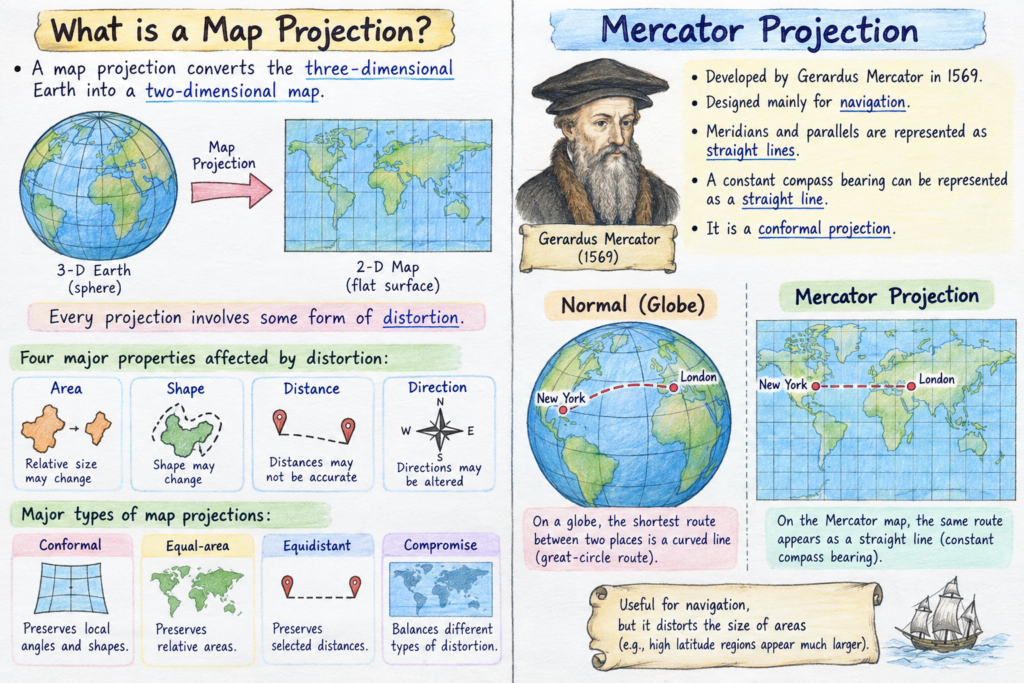
    • A map projection converts the three-dimensional Earth into a two-dimensional map.
    • Every projection involves some form of distortion.
    • Four major properties are: Area, Shape, Distance, Direction
    • Major types include:
      • Conformal: Preserves local angles and shapes.
      • Equal-area: Preserves relative areas.
      • Equidistant: Preserves selected distances.
      • Compromise: Balances different types of distortion.

    Mercator Projection

    • Developed by Gerardus Mercator in 1569.
    • Designed mainly for navigation.
    • Meridians and parallels are represented as straight lines.
    • A constant compass bearing can be represented as a straight line.
    • It is a conformal projection.

    Major Limitation

    • Areas become increasingly exaggerated towards the poles.
    • Greenland and Antarctica therefore appear much larger than their actual relative size.
    • This can visually distort perceptions of the geographical size of regions.

    Equal Earth Projection

    • Developed in 2018.
    • It is an equal-area projection.
    • Preserves the relative area of landmasses.
    • Particularly useful for:
      • Population distribution
      • Climate data
      • Land-use mapping
      • Resource distribution
    • It sacrifices some accuracy in shape and distance.

    Which Projection for Which Purpose?

    • Navigation → Mercator or other conformal projections.
    • Statistical/thematic maps → Equal-area projections such as Equal Earth.
    • General world maps → Robinson or Winkel Tripel.
    • Polar regions → Azimuthal projections.

    Challenges

    • UN resolutions are not legally binding.
    • Digital mapping systems continue to rely heavily on Mercator-derived projections.
    • Changing a projection does not eliminate distortion; it only changes which property is prioritised.
    • Therefore, maps should clearly mention the projection and its principal purpose.

    Way Forward

    • Use projection according to purpose, rather than adopting one universal map.
    • Provide equal-area options in government statistical and mapping platforms.
    • Clearly mention the projection used on published maps.
    • Improve geographical literacy by teaching the limitations of different projections.

    Prelims Pointers

    • Compromise projections → Balance multiple distortions.
    • Mercator → Conformal projection.
    • Mercator → Developed in 1569.
    • Mercator’s major use → Navigation.
    • Equal Earth → Equal-area projection.
    • Equal-area projection → Preserves relative areas.
    • Geostationary ≠ Geosynchronous is a separate orbital concept, not a map projection.
    • No flat map → Can simultaneously preserve area, shape, distance and direction perfectly.