GS Paper: GS1-07.Role of women and women’s organization, population and associated issues, poverty and developmental issues.

  • [2nd October 2026] The Hindu OpED: Other than outrage: On women, unsafe public spaces

    [2nd October 2026] The Hindu OpED: Other than outrage: On women, unsafe public spaces

    Question (2014, GS4 – 10 Marks): We are witnessing increasing instances of sexual violence against women in the country. Despite existing legal provisions against it, the number of such incidences is on the rise. Suggest some innovative measures to tackle this menace.”
    Linkage: Despite strict legal amendments enacted post-2012 (Nirbhaya case), NCRB statistics confirm that crimes against women have increased by 80%. This question addresses the fundamental failure of purely retributive law to act as a deterrent, asking for innovative, societal, and behavioral interventions beyond legislative measures.

    Mentor’s Comment

    Fourteen years of post-Nirbhaya schemes have fixed the supply of laws, funds and infrastructure. They have not fixed the delivery of safety. The test of the state’s response is whether it holds officials accountable for outcomes at vulnerable locations, or lets scheme operationalisation stand in for protection while the burden of caution moves to women.

    Why in the News

    A string of gang-rapes in Delhi last month shows how little has changed in the 14 years since the Nirbhaya case. The latest National Crime Records Bureau (NCRB) report shows crimes against women rose 80%, from 2.4 lakh in 2012 to 4.4 lakh in 2024.

    What did the Nirbhaya case set in motion?

    1. Post-Nirbhaya safety framework: After the 2012 Nirbhaya case, the state created schemes, laws and funds to protect women, especially in public spaces. Like a fire alarm, it protects only if someone responds.
    2. Schemes on the ground: The framework includes:
      • Safe City project and Mission Shakti;
      • a women’s helpline and an Emergency Response Support System (one number routing callers to police);
      • one-stop centres for survivors and fast-track courts.
    3. Dedicated financing: Many of these schemes are paid for through the Nirbhaya Fund.
    4. The takeaway: India has no shortage of women’s safety schemes; what it lacks is proof that they make public spaces safer.

    What do the recent crimes and NCRB data show?

    1. Delhi cases last month: Three gang-rapes drew public outrage that faded quickly:
      • three men posing as police personnel gang-raped a 17-year-old in Astha Kunj Park;
      • a 16-year-old was gang-raped and murdered in Swaroop Nagar;
      • another 17-year-old was gang-raped on a sleeper bus from Greater Noida to Delhi.
    2. Reporting does not explain the rise: The new laws made it easier to report these crimes, so part of the rise is higher reporting. Reporting alone cannot explain so large an increase.
    3. Crime every hour: In 2024, more than 50 crimes against women were reported every hour.
    4. Urban hotspots: Among cities, the highest rates of crimes against women were in Jaipur, Indore, Lucknow and Delhi.

    Why are the schemes not making public spaces safe?

    1. Implementation gap: The schemes exist, so the recent crimes point to a failure in how they are implemented.
    2. Hardware without response: Lighting and CCTV cameras cannot make a city safe unless they are functional, monitored and connected to a response system.
    3. Patrols need trained people: Police patrols and emergency numbers matter only if they bring prompt intervention by sensitised personnel.
    4. Justice delayed: Speedy investigation loses meaning when survivors spend years awaiting trial because of the courts’ case backlog.

    Should women’s safety mean restricting women’s freedom?

    1. Restriction as the easy answer: Authorities are tempted to turn women’s safety into restrictions on women’s freedom.
    2. Burden placed on women: Telling women to avoid parks after dark, return home early or travel with companions makes them organise their lives around male violence.
    3. Root cause: The deeper task is to challenge the culture of sexual violence and toxic masculinity that patriarchal traditions sustain.

    Challenges

    1. Unspent safety money: Parliamentary committees have repeatedly flagged under-utilisation of the Nirbhaya Fund.
    2. Thin police presence: Police vacancies and few women in the police weaken patrolling and survivor support.
    3. Slow forensics: Backlogs in forensic laboratories delay chargesheets and keep conviction rates low.

    Way Forward

    1. Outcome-based policing: Police should move from scheme-based to preventive, outcome-based policing, judged by crimes prevented rather than money spent.
    2. Public safety audits: States should run public audits of vulnerable locations, with deadlines and named officers accountable for fixes.
    3. Faster trials: The Union and States should staff fast-track courts and forensic laboratories so rape trials meet statutory timelines.

    Conclusion

    India has built a large women’s safety architecture but has not turned it into safer streets. The unresolved test is whether policing will be judged by outcomes, and whether the state will confront male violence instead of curbing women’s freedom.

    Back2Basics: Nirbhaya Fund

    1. Origin: Announced in the Union Budget 2013-14 with an initial corpus of Rs 1,000 crore.
    2. Non-lapsable: Unspent money carries over to the next year instead of returning to the treasury.
    3. Administration: The Department of Economic Affairs administers it; the Ministry of Women and Child Development is the nodal ministry for projects.
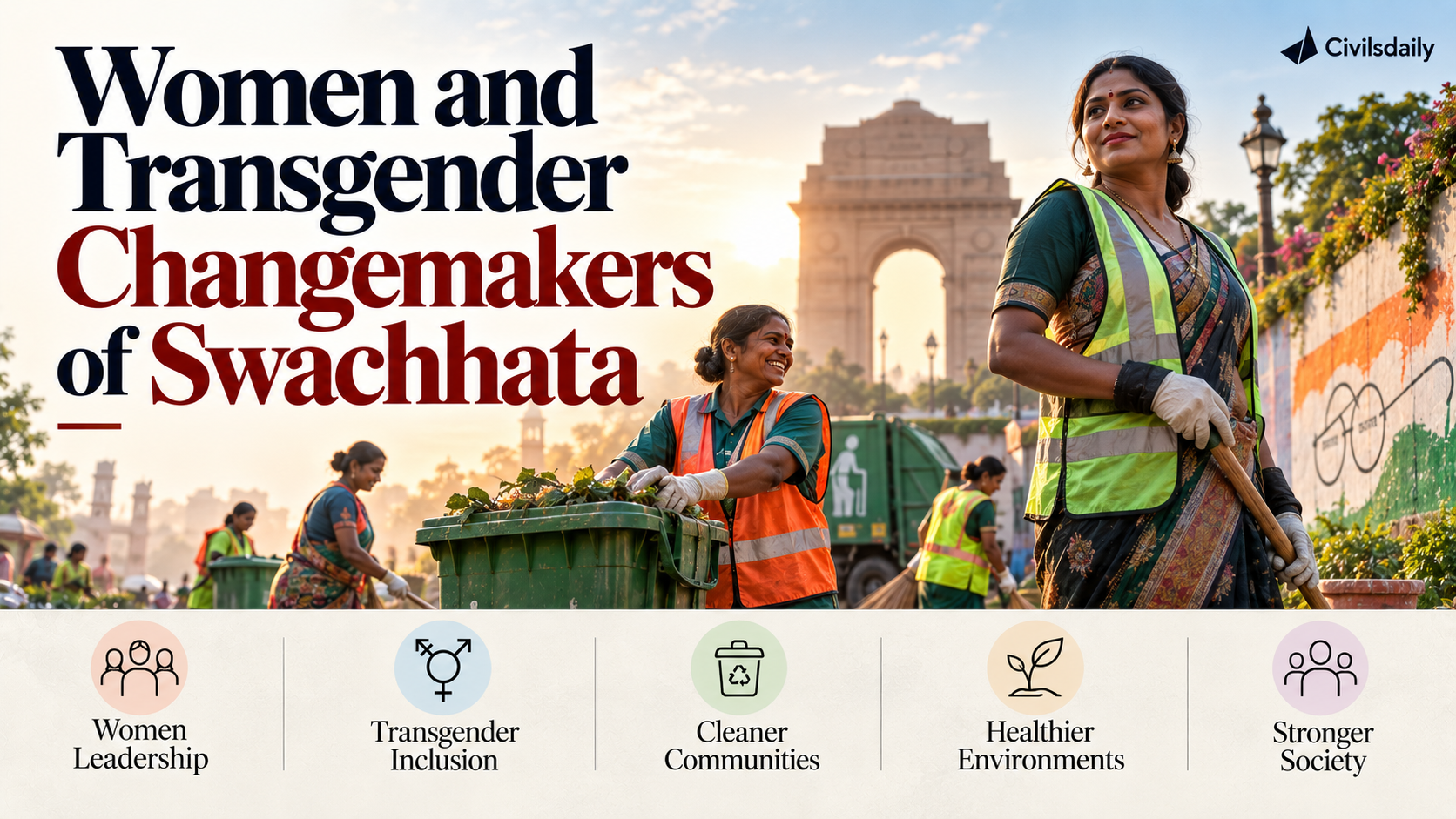
  • Women and Transgender Changemakers of Swachhata

    Women and Transgender Changemakers of Swachhata

    Why in the News?

    • Swachhata Hi Seva 2026 was launched on 17 September 2026 with the theme “Swachhata Mein Sahbhag; Swachh Bharat, Viksit Bharat”.
    • It highlights women’s participation, livelihood creation and inclusion of transgender persons in sanitation and waste-management activities.

    Key Highlights

    • Promotes a Whole-of-Government and Whole-of-Society approach to Swachhata.
    • Women are involved in:
      • Waste-to-livelihood enterprises
      • Material Recovery Facilities
      • Community cleanliness campaigns
      • Composting and waste reduction
    • Transgender persons are being integrated into urban sanitation services through Self-Help Groups (SHGs).

    Women-led Waste-to-Livelihood

    • Loni, Uttar Pradesh: Women use cow dung to produce incense sticks and Loban cups.
    • Initiative began with 8-10 women and employs around 40-50 women during peak summer production.
    • Products use around 30-35% dry cow dung powder, reducing the requirement for wood sawdust.
    • Loni Nagar Palika Parishad can earn up to 25% revenue from product sales.
    • Products supplied to Delhi, Mumbai, Punjab, Gujarat and Hyderabad, with some orders reaching Mauritius and South Africa.
    • Future possibilities include cow-dung fuel and biodegradable flower pots.

    Pink Material Recovery Facility

    • Patna, Bihar: Pink Material Recovery Facility (MRF) is operated primarily by women.
    • Capacity:
      • 2 tonnes/day dry waste
      • 1.5 tonnes/day wet waste
    • Cash for Waste: Citizens receive payment for bringing dry waste at prescribed rates.
    • Patna also converted old unusable vehicles into mobile Pink Toilets.
    • Reflects the 3Rs: Reduce, Reuse and Recycle.

    Community-led Swachhata

    • Bhopal: 250 women brand ambassadors work on cleanliness and waste management.
    • Bartan Banks: Established across 25 wards to reduce single-use plastic through reusable utensils.
    • Swachhata Kitty Group: 60 women, each contributing ₹100 per month, fund community cleanliness activities.
    • Uttarakhand:Bainni Sena (“Army of Sisters”) comprises 57 groups and 570 women.
      • Monitor cleanliness
      • Conduct awareness programmes
      • Communicate complaints
      • Coordinate with municipal authorities and sanitation workers.
    • Shillong: Iynnehskhem Self-Help Group converts household wet waste into compost.

    Inclusion of Transgender Persons

    • Cuttack, Odisha: Municipal Corporation organised transgender persons into a Self-Help Group and trained them to operate and maintain a Septage Treatment Plant.
    • Model expanded to other Odisha Urban Local Bodies through Self-Help Groups.
    • Areas include:
      • Faecal Sludge and Septage Management (FSSM)
      • Solid waste management
    • Bhubaneswar: Swikruti SHG operates a 75-KLD Faecal Sludge Treatment Plant (FSTP) at Basuaghai.
    • Transgender groups are also involved in operation and maintenance of seven cesspool vehicles.
    • Training includes health, hygiene, Personal Protective Equipment (PPE) and desludging protocols.

    Prelims Quick Revision

    • Swachhata Hi Seva 2026: Launched 17 September 2026.
    • Theme: “Swachhata Mein Sahbhag; Swachh Bharat, Viksit Bharat”.
    • Loni: 30-35% dry cow dung powder used in incense products.
    • Pink MRF, Patna: 2 tonnes/day dry + 1.5 tonnes/day wet waste.
    • Bhopal: 250 women brand ambassadors and Bartan Banks across 25 wards.
    • Uttarakhand: Bainni Sena = 57 groups, 570 women.
    • Bhubaneswar: 75-KLD FSTP operated by Swikruti SHG.
    • Patna’s mobile Pink Toilets demonstrate the 3Rs: Reduce, Reuse and Recycle.

    UPSC Prelims Trap

    • MRF is associated with material recovery and waste processing, while FSTP deals with faecal sludge treatment.
    • Bainni Sena is associated with Uttarakhand, not Odisha or Bihar.
    • Swikruti SHG operates a 75-KLD FSTP in Bhubaneswar.
    • The Pink MRF is located in Patna, while the cow-dung livelihood initiative described is from Loni, Uttar Pradesh.
  • We need to manage public spaces, not women

    Why in the News

    In Delhi’s Aastha Kunj Park, three men posing as police officers gang-raped a 17-year-old, and young couples in Bihar’s Jamui and Samastipur were assaulted or harassed. Each victim was doing something ordinary in public, which shows the state still manages women instead of making public spaces safe.

    What does it mean to manage women instead of public spaces?

    1. Conditional access: In “Why Loiter?”, Shilpa Phadke, Sameera Khan and Shilpa Ranade argue that women gain access to public space only on proof of “respectability and purpose”.
    2. Paternalistic approach: This view manages risk by restricting women, not the space. It is like keeping people indoors instead of fixing a broken streetlight.
    3. Vocabulary of suspicion: Anti-Romeo squads in Uttar Pradesh, police overstepping their mandate and self-appointed moral guardians fixing curfews treat ordinary meetings between men and women as suspect.
    4. Cover for crime: Because a friendship or a walk home can easily be branded wrongdoing, offenders find it easy to pose as police, as in the Delhi park case.
    5. The takeaway: Policing women’s presence keeps them out of public life and hands abusers a ready disguise.

    What have reforms since 2012 changed, and what did the Verma Committee ask for?

    1. Legal reforms: After the 2012 Delhi gang rape and the 2024 rape and murder of a doctor at Kolkata’s RG Kar Medical College, India added fast-track special courts and harsher sentences.
    2. Women at work: The female workforce has grown rapidly, with millions more women professionals, but public infrastructure has not kept pace.
    3. Verma diagnosis: The Justice J.S. Verma Committee traced the 2012 crime to deep-seated patriarchy and the state’s failure to keep women safe. The Supreme Court reiterated that failure this week.
    4. Verma recommendations: The Committee treated sexual violence as an expression of power, not desire. It recommended gender-sensitisation training for police, better public amenities for women and wider conversations on masculinity.

    What does South Africa show about legal and lived equality?

    1. Sandton killings: A women’s running club in Sandton, Johannesburg, lost a member on an evening jog. The bodies of 10 women have been found with signs of sexual assault.
    2. National disaster: South Africa’s femicide rate is over six times the global average. Last year it declared gender-based violence and femicide a national disaster.
    3. Progressive constitution: South Africa’s 1996 constitution protects women even from private discrimination. Three decades on, women still improvise safety, running in groups and tracking each other by phone.
    4. Arrests in India: Unlike in South Africa, the alleged perpetrators of the Indian cases have been arrested.
    5. Legal versus lived equality: Both societies mistake legal equality for lived equality, so rights on paper do not make streets safe.

    Why must infrastructure come before generational change?

    1. Slow social change: Dismantling male entitlement and raising boys who need no policing is generational work. Women’s mobility cannot wait for it.
    2. Faster fixes: Regular patrols change the odds inside a park. Streetlights and better connectivity change what a walk home risks.
    3. Infrastructure as choice: Safe infrastructure gives women alternatives and agency, and makes their presence in public unremarkable.
    4. Less room for harm: Together with sensitisation, these measures cut the chances for toxic masculinity to cause harm.

    Challenges

    1. Moral policing by the state: Squads that watch couples divert police time from protecting women.
    2. Dark public spaces: Unlit parks, lanes and bus stops remain common in Indian cities.
    3. Slow trials: Judge vacancies and backlogs in special courts blunt the deterrence of harsher laws.

    Way Forward

    1. Space audits: Municipal bodies should map unsafe parks, lanes and stops and publish repair timelines.
    2. Evening beat patrols: State police should patrol parks and transit hubs every evening.
    3. End moral policing: State governments should disband squads that target consenting adults.

    Conclusion

    India has strengthened laws against sexual violence but still manages women’s behaviour rather than the spaces they use. The test is whether city budgets treat safe public space as core infrastructure rather than a response to the next crime.

    Government Initiatives for Women’s Safety

    1. Mission Shakti, ‘Sambal’: Runs One Stop Centres, the Women Helpline and Nari Adalats for legal, medical and counselling support.
    2. Safe City Projects: In eight major cities, artificial intelligence (AI) enabled closed-circuit television (CCTV) cameras and panic buttons cover public spaces.
    3. Nirbhaya Fund: Funds Women Help Desks in police stations to make them survivor friendly.
    4. Zero FIR: Section 173 of the Bharatiya Nagarik Suraksha Sanhita, 2023 lets a woman file a First Information Report (FIR) at any police station.

    Matching Previous Year Question

    “[2025, GS2, 10 marks] Women’s social capital complements in advancing empowerment and gender equity. Explain.”

  • Gender disparities in contraceptive use and sterilisation

    Why in the News

    For the first time, the World Health Organization (WHO) has set benchmarks for reversible male contraceptives, challenging a pattern in which India has met its fertility goals while leaving contraception almost wholly to women. The new guidelines widen the choice of methods beyond those women use.

    What do the new WHO guidelines change?

    1. What they are: The guidelines widen contraceptive options. They set benchmarks that reversible male methods, ones a man can stop to regain fertility, must meet, like a product standard for developers.
    2. Why now: WHO research has challenged the assumption that men would not use new contraceptives.
    3. Choice as equality: WHO’s director for sexual and reproductive health called choice a gender equality issue.
    4. Imbalance in India: Women increasingly carry the burden of both temporary and permanent contraception, so falling fertility has not shifted any of it to men.
    5. The takeaway: Better male methods give India a practical way to share contraceptive responsibility.

    What does NFHS-6 show on contraceptive use?

    1. Unmet need: Fertility is below replacement level. The National Family Health Survey (NFHS-6) for 2023-24 finds unmet need, married women who want to avoid pregnancy but use no method, down one percentage point.
    2. More use overall: Married women using any method rose from 66.7% to 69.1% since NFHS-5.
    3. Modern methods decline: Modern methods, such as pills, intrauterine devices, condoms and sterilisation, fell from 56.4% to 52.7%.
    4. Traditional methods rise: Rhythm and withdrawal rose 6 percentage points, the largest rise of any method. Possible factors are fear of side-effects, privacy, partner preference and access.

    How lopsided is sterilisation?

    1. Female sterilisation: Its use eased from 37.9% to 36.5%, after climbing quickly between NFHS-1 and NFHS-3.
    2. Male sterilisation: Only 0.5% reported it in NFHS-6, down from 3.4% in NFHS-1.
    3. State pattern: Male sterilisation rose in 22 States, but only Telangana gained over one percentage point. States that reached a low Total Fertility Rate (TFR) early were no exception.

    Why has vasectomy become marginal, and why does it matter?

    1. From visible to marginal: As India reached replacement fertility, vasectomy shrank from a visible method to a marginal one, so the goal was met through women.
    2. Simpler procedure for men: Female sterilisation is not unsafe, but ending fertility is less invasive for men and needs only local anaesthesia.

    Challenges

    1. Social norms: Contraception is seen as a woman’s task, and fears about masculinity keep men from vasectomy.
    2. Programmes built around women: Family planning has long relied on female sterilisation camps. Eg. The 2014 Bilaspur camp deaths, Chhattisgarh.
    3. Few male options: Men have only condoms and vasectomy, since reversible male methods are still in development.

    Way Forward

    1. Adopt WHO benchmarks: India should use the WHO guidelines to address the gender imbalance, with the Central Drugs Standard Control Organisation aligning approval rules for male methods.
    2. Counsel men: Train Accredited Social Health Activists (ASHAs) to counsel men on vasectomy.
    3. Address side-effect fears: Counsel women on modern methods so they do not drift to less reliable ones.

    Conclusion

    India has reached its fertility goal without sharing the burden of contraception between women and men. What to watch is whether family planning programmes adopt WHO’s benchmarks for male methods.

    Key numbers

    1. Male sterilisation, NFHS-5: 0.3% (2019-21).
    2. Female sterilisation since NFHS-3: about 36 to 38%.

    Back2Basics: Total Fertility Rate

    1. What it is: TFR is the average number of children a woman would bear in her lifetime at current age-specific birth rates.
    2. Replacement level: About 2.1, above 2 because some children die young and slightly more boys are born.

    Matching Previous Year Question

    “[2026, GS1, 15 marks] Critically examine the challenges of demographic transition in contemporary India.”

  • Women’s safety falls through gap between intent and policy

    Why in the News

    Women’s safety policy has stopped at intent and never reached accountability, capacity or women’s presence in public life, so the funds and schemes built since the December 2012 Delhi gangrape have not made public spaces safe. A gangrape at Aastha Kunj Park in South Delhi and a molestation case in Bihar’s Jamui, almost 15 years on, have reopened the question.

    What has the Nirbhaya framework built since 2012?

    1. What it is: The Nirbhaya Fund is a dedicated pool of Union money for women’s safety programmes, created after the 2012 protests. It works like a ring-fenced budget line for safety projects.
    2. Legal response: The Sexual Harassment of Women at Workplace (Prevention, Prohibition and Redressal) Act, 2013 (POSH Act) also followed the protests. It sets rules to prevent and redress sexual harassment at work.
    3. Spending record: Of Rs 7,712.85 crore allotted over a decade, Rs 5,846.08 crore was used.
    4. What the money built: Nearly 15,000 women’s help desks in police stations and fast-track courts for rape cases. Chennai, Surat and Bhubaneswar also set up gender labs to test safer urban design.
    5. The takeaway: Money has been spent and institutions built, yet streets remain unsafe, so the failure lies in follow-through, not funding.

    Why do safety audits not make streets safer?

    1. Safety audit: A safety audit walks a street, park or bus route to record risks such as dark stretches. Nikore Associates, a consultancy, has audited public spaces and transport in at least 10 cities.
    2. Audits as an end: Administrations publicise how many audits they conduct, not how the problems found are fixed, so no agency answers for a flagged risk.
    3. Unfixed dark zone: A lane behind Lady Shri Ram College, Delhi, has a 500 m unlit stretch that is widely known and still unfixed.
    4. Public reporting demand: City agencies should publish how they fix audit findings, handle women’s safety helpline calls, and how long their crisis response takes.

    Why do free bus rides not add up to safety?

    1. Free travel schemes: At least eight States offer free bus travel for women, in place of investment in gender-sensitive infrastructure such as lit streets and safe stops.
    2. Wait and walk: A free bus does little for safety if waits are long and unpredictable, or if women walk to the stop on unsafe streets.
    3. Intent without capacity: Free fares show that governments mean well. They do not show the capacity to innovate, meaning the design skill to build inclusive cities that work for all users.

    How would more women in public-facing jobs change public space?

    1. Absence breeds risk: Women are nearly absent from public spaces in the evenings, and emptier streets are less safe for them.
    2. Public-facing jobs: Government agencies hire drivers, conductors, station managers, park workers and e-auto drivers, so new hiring rules and targets can quickly raise women’s presence.
    3. Delhi height rule: The Delhi government cut the bus driver height requirement from 159 cm to 153 cm.
    4. Women bus drivers in Delhi: Within a year of the 2022 change, 34 women bus drivers were inducted.
    5. Women in police: Women are only about 10 per cent of the police, against the Centre’s 33 per cent target.

    Challenges

    1. Input metrics: Nirbhaya spending is tracked by money released, not by fewer crimes or freer movement for women.
    2. Fragmented responsibility: Lighting, buses, parks and policing sit with different agencies, so no single body owns a flagged risk.
    3. Fares versus capital: Fare waivers are a recurring cost that competes with budgets for lights, shelters and buses.

    Way Forward

    1. Outcome-linked releases: The Ministry of Women and Child Development should tie Nirbhaya releases to outcomes such as audit findings closed.
    2. Recruitment norm review: Transport and municipal bodies should revise physical norms that bar women, as Delhi did.
    3. Police hiring plans: States should set yearly recruitment plans for women police to meet the Centre’s target.

    Conclusion

    Women’s safety policy has been measured by money spent and audits held, not by risks removed. The test now is whether city agencies report what they have fixed and whether governments hire enough women to change who occupies public space.

    Government initiatives for women’s safety

    1. Mission Shakti, ‘Sambal’: Runs One Stop Centres, the Women Helpline and Nari Adalats for legal, medical and counselling support.
    2. Safe City Projects: In eight major cities, artificial intelligence (AI) enabled closed-circuit television (CCTV) cameras and panic buttons cover public spaces.
    3. Zero FIR: Section 173, Bharatiya Nagarik Suraksha Sanhita, 2023, lets a woman file a First Information Report at any police station.

    Matching Previous Year Question

    “[2025, GS2, 10 marks] Women’s social capital complements in advancing empowerment and gender equity. Explain.”

  • Long wait for justice as pendencies in rape cases mount

    Why in the News

    Steady rape registrations since 2018 have turned into a growing trial backlog, with only about 2% of cases sent for trial in 2024 ending in conviction within the same year, National Crime Records Bureau (NCRB) data show. The recent gang rape of a 17 year old girl in south east Delhi has renewed concern over women’s safety in public spaces.

    How does a rape case move through the justice system?

    1. What the pipeline is: A case moves from police registration, to an investigation ending in a chargesheet (the police report accusing a person), to a court trial. Like a funnel, delay anywhere slows everything after.
    2. Why deadlines were set: After the 2012 Nirbhaya case, legislative changes brought tougher punishments and timelines for disposal of rape cases.
    3. Scope of the data: NCRB, which compiles India’s crime statistics, reports cases under the Protection of Children from Sexual Offences Act, 2012 (POCSO), the law on sexual offences against children, separately. They are excluded here.
    4. What went wrong: Courts finish fewer trials than the new cases reaching them, so the pending pool grows even as new registrations stay flat.
    5. The takeaway: Stricter laws have not shortened the wait, because the bottleneck is courts’ capacity to finish trials.

    What does the 2024 data show?

    1. Steady registrations: Registrations have stayed roughly flat since 2018, at an average of about 84 cases a day.
    2. Investigation pool: Police had nearly 40,000 cases to investigate, 29,536 of them newly reported. The rest were mostly carried over from the previous year, with a few reopened.
    3. Chargesheeting: Police chargesheeted about 25,000 (63%). The rest stayed under investigation, went to another agency, or were closed by police as not warranting further proceedings.
    4. Trial pool: Chargesheeted cases joined lakhs already awaiting trial, taking the pool to 2,06,777 cases. Nearly 90% were still pending at year end.
    5. How decided cases ended: Courts disposed of, meaning decided, 20,587 cases:
      • about 68% in acquittal;
      • about 8% in discharge, where the accused is freed before trial;
      • about 24% in conviction.

    Why is conviction within the year so rare, and why does it matter?

    1. Same year convictions: Only 421 cases ended in conviction in the year they went to trial, under 1.5% of all rape cases filed.
    2. A lasting pattern: Earlier years show similarly tiny same year conviction shares, so 2024 is not a one year dip:
      • 1.2% in 2021;
      • 1.9% in 2022;
      • 2.3% in 2023.
    3. Spill over explains little: Cases reaching court late in the year run into the next year. That cannot explain the low share, because the law fixes trial deadlines.
    4. Low conviction overall: The overall conviction rate in rape cases is below 30%, and even convictions usually take long.
    5. Wider safety concern: Videos from Bihar’s Jamui and Samastipur showing harassment of girls add to demands for prompt preventive and punitive action.

    Challenges

    1. Too few trial courts: Rape trials share courts with other criminal cases, so hearings are spaced months apart.
    2. Forensic delays: Pending DNA and forensic reports from State laboratories hold up both chargesheets and trials.
    3. Witness attrition: Long trials let witnesses turn hostile and victims withdraw, which feeds the high acquittal share.
    4. Deadlines without consequence: Statutory timelines carry no penalty when missed, so they work as targets rather than obligations.

    Way Forward

    1. Staff dedicated courts: The Department of Justice and States should expand and fully staff Fast Track Special Courts for rape cases.
    2. Forensic capacity: States should add forensic laboratories and fix reporting times for sexual assault evidence.
    3. Protect witnesses: States should enforce the Witness Protection Scheme, 2018, upheld by the Supreme Court in Mahender Chawla v. Union of India (2018).
    4. Publish case age data: High Courts should publish district wise data on how long rape trials have been pending, so delays are tracked.

    Conclusion

    Rape cases now face a courtroom bottleneck rather than a gap in the law. Unless trial capacity grows, the pending pool will keep rising however stringent the punishments become.

    Back2Basics: Statutory timelines in rape cases

    1. Criminal Law (Amendment) Act, 2018: It fixed time limits for rape cases in the Code of Criminal Procedure, 1973.
    2. Investigation: Police must complete investigation within two months of recording the information.
    3. Trial: The trial must be completed within two months of the chargesheet being filed.
    4. Bharatiya Nagarik Suraksha Sanhita, 2023: It replaced the 1973 Code and retained these investigation and trial timelines.

    Matching Previous Year Question

    “[2025, GS2, 10 marks] Women’s social capital complements in advancing empowerment and gender equity. Explain.”

  • Towards recognising women farmers

    Why in the News

    Maharashtra has passed the Women Farmers’ Empowerment Bill. The law grants women independent recognition as farmers irrespective of land ownership, through a Woman Farmer Certificate. It is the first Indian State legislation to give enforceable legal form to the activity-based, land-delinked definition of ‘farmer’. The National Policy for Farmers set that definition out in 2007 and never operationalised it. A comparable central law was introduced in the Rajya Sabha in 2011 and lapsed. The contested point is that recognition as a farmer in India runs through land revenue records, and those records stand primarily in men’s names. The United Nations has named 2026 the International Year of the Woman Farmer.

    What is the Woman Farmer Certificate under the Women Farmers’ Empowerment Bill?

    1. Land-delinked definition: The Act recognises women residents engaged in agriculture for at least one agricultural season a year, irrespective of the nature of the land. It broadens the definitions of both ‘agriculture’ and ‘farmer’.
    2. Woman Farmer Certificate: The certificate is the document that confers an independent agricultural identity on a woman, drawn from what she does rather than from a title in a land record.
    3. Categories named in the Act: It explicitly recognises the landless cultivator, the landless livestock rearer, the agricultural labourer, the plantation labourer and the pastoralist.

    How far has women’s participation in agriculture outrun their recognition as farmers?

    1. Workforce size: In 2025 agriculture employed roughly 110 million women and 127 million men in rural India, on Census adjusted Periodic Labour Force Survey (PLFS) estimates, bringing the sector close to gender parity.
    2. Rate of increase: The women’s agricultural workforce has more than doubled since 2017-18.
    3. Concentration in agriculture: Nearly three-quarters of all rural women workers are now in agriculture, against less than half of men.
    4. Unpaid work: In 2025 more than 41% of female agricultural workers were unpaid, against 20% of men.
    5. Own-account work: Nearly 63% of men were own-account workers, against 39% of women.

    Why does the land record decide who counts as a farmer?

    1. Ownership held by men: Women largely work family land without owning it or appearing on the land record, because patriarchal norms keep records in men’s names.
    2. Share of holdings: Only 14% of operational agricultural land holdings, measured primarily through land records, are with women, as per the Agriculture Census 2015-16.
    3. Land record as the source of truth: Each State uses its land revenue record for administrative purposes, so the bias against women is carried forward into databases and scheme access.
    4. What exclusion costs: A woman left off the record cannot reach credit, subsidies, technology, extension services and related opportunities tied to land titles.

    What does scheme access reveal about the recognition gap?

    1. PM-KISAN coverage: Only 23% of beneficiaries of the Pradhan Mantri Kisan Samman Nidhi (PM-KISAN) are women.
    2. PM-KISAN design: The scheme pays Rs 6,000 a year in direct financial assistance to eligible landholding farmer families for agricultural expenses and household needs.
    3. Gap where women dominate the workforce: Even in States where women are more than 50% of the agriculture workforce, women are under one-third of beneficiaries in most of them.
    4. Three measures of the gap: The gap is approximated by three shares taken together, women as a share of all agriculture and allied workers in 2025, women’s operational holdings as a share of all operational holdings in 2015-16, and women as a share of eligible PM-KISAN beneficiaries in 2024.
    5. Comparability caveat: The holdings and PM-KISAN figures sit nine years apart, and PM-KISAN counts individuals per landholding family, including successor widows, while the Census counts each holding once.

    Why is the binding constraint the identification system rather than land itself?

    1. Missing instrument: A women farmers’ registry delinked from land records had been absent before this legislation, so recognition shifts from the owner of land to the person who farms.
    2. Meghalaya: Women are 70% of PM-KISAN beneficiaries there, a share that reflects matrilineal inheritance under which women are the customary landholders.
    3. Kerala: Women are 44% of beneficiaries, and collective farming through groups such as Kudumbashree provides an alternative route to participation and recognition.
    4. Odisha: The KALIA scheme has reached landless and sharecropper women without a land title as the gate.
    5. Widest gaps: In Jammu and Kashmir and Himachal Pradesh women are nearly two-thirds of the agricultural workforce but a small fraction of beneficiaries.
    6. The constraint named: Where the land record is the gatekeeper women are filtered out, and where an alternative mechanism exists their access rises substantially.

    What will turning recognition into access require?

    1. Route to registration: Implementation runs through either self-registration or identification of women farmers by the Gram Sabha, including women with no land and women with no title in their name.
    2. A new database: The Act provides for a database of women farmers, which has to be connected to existing agricultural databases.
    3. Digital integration: Linking the certificates to Agri Stack, the digital agriculture platform developed by the Union Ministry of Agriculture and Farmers Welfare, and issuing FarmerIDs to women is what carries them into the wider digital agricultural ecosystem.

    Challenges to the Woman Farmer Certificate

    1. Duplication and exclusion in the register: A second database beside existing agricultural databases can record the same woman twice or leave her out of both. Eg. States hold no common definition for identifying a woman farmer, issuing her certificate or maintaining the record.
      The Fix: Build a standardised cross-State system of definitions, certificates and databases, so one woman farmer carries one identity across schemes and platforms.
    2. Awareness as the binding step: A certificate confers status without telling its holder what the status unlocks. Eg. Registration depends on a woman either applying herself or being identified by her Gram Sabha, and a woman who knows of neither route stays uncounted.
      The Fix: Run a continuous local information campaign naming the schemes and the credit lines the certificate opens.
    3. Central eligibility still keyed to land: A State certificate does not by itself alter the eligibility test a central scheme applies. Eg. PM-KISAN pays landholding farmer families, so a landless certificate holder still fails that test.
      The Fix: Rewrite scheme eligibility around the activity-based definition of a farmer rather than around a land title.

    Conclusion

    One State has separated the identity of a farmer from the ownership of land. Access to credit and welfare still runs through databases that read titles. The unresolved question is whether scheme administrators treat an activity-based certificate as proof of farmer status, or whether a second register simply sits beside the first without opening anything. What to watch is whether other States legislate a comparable registry, and whether the Gram Sabha route reaches women who have never appeared in any agricultural record.

    Matching Previous Year Question

    “[2014, GS1, 10 marks] Discuss the various economic and socio-cultural forces that are driving increasing feminization of agriculture in India.”

  • Global Gender Gap Index 2026

    Global Gender Gap Index 2026

    Why in the News?

    The World Economic Forum (WEF) released the Global Gender Gap Index 2026, ranking 145 economies across four dimensions. India retained its 131st position. Iceland remained at the top.

    Key Findings

    • India’s overall gender parity: 64.5%
    • Global average: 69.2%
    • India has closed 4.3 percentage points of its gender gap since 2006.
    • Globally, 69.2% of the gender gap has been closed.
    • Iceland: 1st, with 93% of its gender gap closed.
    • Top three:
      • Iceland
      • Finland
      • Norway
    • Chad: lowest-ranked country.
    • Iran and Pakistan were also among the bottom three.

    Four Dimensions of the Index

    1. Economic Participation and Opportunity

    India’s parity score: 41.2%

    • Improved by 0.5 percentage points from the previous edition.
    • Still 3.5 percentage points below India’s best score in 2013.
    • Professional and technical workers: parity increased from 26.6% in 2006 to 49.9% in 2026.
    • Legislators, senior officials and managers: 13.1% parity.
    • Labour-force participation parity: 44.1%.

    2. Educational Attainment

    • India recorded 96.6% parity.
    • Declined by 0.5 percentage points from the previous year.
    • Educational gains have been a major contributor to India’s improvement since 2006.

    3. Health and Survival

    • India’s parity score: 95.6%.
    • Sex ratio at birth remained nearly one percentage point lower than in 2006.

    4. Political Empowerment

    • India’s highest-performing subindex.
    • 24.5% of the gender gap closed.
    • Global rank: 67th.
    • Parliament: 16.1% of the gender gap closed in 2026.
    • Ministerial level: 5.9%, compared with 3.5% in 2006.
    • India’s ministerial parity had reached 30% in 2019, before declining.

    Important Global Observations

    • Southern Asia was the lowest-scoring region in Economic Participation and Opportunity.
    • Globally, political empowerment recorded the largest gains since 2006, but has experienced a reversal since 2016.
    • Women account for 19.1% of CEO roles globally.
    • Women remain underrepresented in Artificial Intelligence (AI), accounting for fewer than one in five AI engineers.
    • Australia entered the global top 10 for the first time.
    • Iceland was the only country to cross 90% parity, at 93%.

    Important Full Forms

    • WEF: World Economic Forum
    • AI: Artificial Intelligence
    • CEO: Chief Executive Officer

    Prelims Quick Revision

    • Global Gender Gap Index: World Economic Forum
    • 2026 edition: 145 economies
    • India: 131st
    • Top: Iceland
    • India overall parity: 64.5%
    • Global parity: 69.2%
    • Four dimensions:
      1. Economic Participation and Opportunity
      2. Educational Attainment
      3. Health and Survival
      4. Political Empowerment
    • India’s highest subindex: Political Empowerment
    • India’s Economic Participation parity: 41.2%
    • India’s Educational Attainment parity: 96.6%
    • India’s Health and Survival parity: 95.6%
    • Political Empowerment: 24.5% gap closed
  • Concerns over the Census questions

    Why in the News

    The Central government has notified the questions to be asked of every individual during the population enumeration phase of the 2027 Census. In a departure from past Censuses, the schedule seeks personal details that cannot be used to generate any useful statistics: the names of the parents of every individual, nationality as declared, the permanent residential address, the place of COVID-19 vaccination, the number of bank accounts held, and mobile, Aadhaar, voter identity and passport numbers. The same details are the ones required to prepare or update a population register. The contest is over whether a questionnaire built partly out of identifiers still serves the statistical purpose the Census exists for.

    What is a population census?

    1. The United Nations definition: A census is the total process of planning, collecting, processing, analysing, disseminating and evaluating demographic, economic and social data at the smallest geographic level, at a specified time, covering all persons in a country or in a well delimited part of it.
    2. Its output is statistics, not records: The exercise generates statistics for the use of the government in particular and society in general, so the information an individual gives is used only to compile the relevant statistics.
    3. Confidentiality is a founding principle: Principle 6 of the United Nations Fundamental Principles of Official Statistics requires individual data collected by statistical agencies to be strictly confidential and used exclusively for statistical purposes. India has adopted these principles.

    What is new in the 2027 questionnaire?

    1. Household relationships: Respondents must give the details of the parents of every individual, and of the spouses of the married persons in the household.
    2. Status and residence: Nationality as declared and the permanent residential address are to be recorded.
    3. A pandemic era question: The place of COVID-19 vaccination is to be recorded.
    4. Financial detail: The total number of bank accounts held by each person is to be recorded.
    5. Identifiers: Mobile number, Aadhaar number and voter identity card number are to be recorded if available, along with the passport number of Indian passport holders and whether the person holds a driving licence.
    6. The length of the schedule: The questionnaire runs to 40 questions, many of them requiring descriptive answers.

    Why have names never entered Census databases?

    1. A name identifies, it does not measure: An individual’s name has no relevance to the exercise beyond identifying the person during enumeration. Names have been placeholders and have not been present in Census databases.
    2. India has never computerised them: There have been no attempts in the Indian Censuses to computerise names at all.
    3. Other countries record names for a declared later use: Some countries include the name and open past Census data for genealogical study. Eg. Past data from the United States Census can be accessed 72 years after the exercise, and India has no comparable rule or policy.

    Which households cannot answer these questions?

    1. Institutional households: Wardens of hostels, old age homes and jails must supply the names of every resident along with the names of their parents.
    2. Students are counted where they are not present: Large numbers of children study away from home in hostels and as paying guests. February falls towards the end of the academic year, so they may not be at home and would not be eligible for enumeration at their normal households.
    3. Ordinary households have gaps too: A respondent may not know the details of grandparents living with them.
    4. Visitors and staff are also covered: Visitors and domestic servants living in a household for the entire duration of the enumeration period are to be enumerated there, and the respondent may be unable to obtain their details.

    What can the identifier questions actually produce?

    1. ‘If available’ is undefined: It is unclear whether availability refers to the household member concerned or to the respondent. Read as the respondent, the numbers will not reach the Census, since respondents are frequently housewives or elderly parents who do not hold these details for every member.
    2. The numbers do not tabulate: These are not data items usable for any tabulation, beyond determining whether such a number exists.
    3. The field cost is prohibitive: More than 30 lakh enumerators would have to sit with households to record these numbers correctly, and they may lack the time and patience to obtain the relevant records.
    4. The respondent carries no duty of care: The respondent is not a Census functionary, so an individual whose identifiers are disclosed by a household respondent has no protection against their misuse.

    What would the bank account question have to be to work?

    1. The tabulation it supports is narrow: The total number of bank accounts held by each person yields a distribution of persons by number of accounts, and little else.
    2. The same distribution exists elsewhere: For account holders, the number can be obtained by tabulating accounts against each Permanent Account Number (PAN), which is required to open a bank account.
    3. A simpler question meets the policy need: If the object is only to identify persons without any bank account, asking whether the person holds one is enough.
    4. The field reality: A schoolteacher appointed as an enumerator will struggle to get a correct count of accounts from upper class respondents, who may not answer even the simpler questions.

    Why was the nationality question dropped after 1961?

    1. Declaration does not establish status: Nationality as declared may serve no useful purpose, since a person residing illegally may declare Indian nationality.
    2. India tried it and abandoned it: The question was asked in the 1951 and 1961 Censuses and was discarded from 1971 onwards.
    3. A comparable decision abroad: The United States decided, after considerable debate, not to include the citizenship question in its 2020 Census.

    Is the Census being used to build the National Population Register?

    1. The proposal has a history: Proposals to update the National Population Register (NPR) during the 2021 Census exercise drew objections from several States.
    2. States control the field staff: The Census is conducted by enumerators appointed by the State government under Section 4(2) of the Census Act, 1948, so a State may refuse the use of its staff for work that is not part of the Census. The Citizenship Act says nothing about a State government’s role in preparing the NPR.
    3. The new questions fit the register, not the statistics: Details of parents, permanent address and nationality are useful for preparing or updating the NPR, which is to form the basis for preparing the National Register of Citizens. They add no statistics of their own.
    4. Extraction would breach confidentiality: Collecting the information through the Census questionnaire and later extracting it for another organisation within the government may violate the principle of confidentiality.
    5. The objection is to the route, not the register: Preparing a population register or a citizen register is unobjectionable and its uses are well recognised. The collection for it should run through a transparent process with a legal basis, without jeopardising the Census.

    What does the length of the schedule do to data quality?

    1. Respondent fatigue: The time a long descriptive schedule takes per household invites disinterest, and the respondent answers similar questions again for every individual in the household.
    2. Casual replies follow: A disinterested respondent supplies answers that are recorded as data, so fatigue enters the dataset rather than showing up as non-response.
    3. Enumerator workload: Recording names and addresses has significantly increased the enumerator’s workload.
    4. The output degrades: Loading the Census with questions that generate no statistics may seriously affect the quality of Census data.

    Challenges to the 2027 Census

    1. The decadal series carries a gap: The last completed Census was in 2011, so sampling frames, welfare targeting and constituency data have run for over a decade on an ageing base. Eg. Household surveys draw their samples from Census frames, which have not been refreshed since 2011.
      The Fix: Fix a statutory calendar for enumeration and for data release, so the exercise cannot be deferred by administrative decision.
    2. The general data protection regime does not cover this risk: Census records rely on the secrecy provisions of the Census Act. The general law carries wide exemptions for government processing. Eg. The Digital Personal Data Protection Act, 2023 permits the Union government to exempt instrumentalities of the State from its obligations.
      The Fix: Notify an express purpose limitation for Census records that bars their transfer into any non statistical database.
    3. Digital self enumeration excludes the least connected: The 2027 Census offers self enumeration through a digital application, which the households most likely to be missed are least able to use. Eg. Internet access and smartphone ownership remain lowest among the poorest rural households.
      The Fix: Keep full enumerator coverage as the default and treat self enumeration as an additional channel rather than a substitute.
    4. Caste enumeration adds a classification burden: The 2027 Census will record caste, and caste names vary across regions, languages and spellings, which makes field coding unreliable. Eg. The 1931 Census, the last to enumerate caste comprehensively, recorded several thousand caste and sub caste entries.
      The Fix: Publish a pre coded State wise caste list with a residual open field, so enumerators record rather than classify.

    Conclusion

    The questionnaire stands notified, and enumeration will run on it unless the government revises the schedule before the field work begins. The unresolved point is not whether the state may build a population register, which nobody disputes. It is whether the Census, whose cooperation from a household rests on the assurance that answers become numbers and nothing else, is the right instrument to build one with. Every question that cannot be tabulated tests that assurance, and a household that begins to doubt it answers the rest of the schedule differently.

    Back2Basics: National Population Register

    1. What it is: A register of the usual residents of the country, prepared at the local, sub district, district, State and national level.
    2. Legal basis: It is prepared under the Citizenship Act, 1955 and the Citizenship (Registration of Citizens and Issue of National Identity Cards) Rules, 2003.
    3. Who is a usual resident: A person who has resided in a local area for six months or more, or who intends to reside there for the next six months or more, irrespective of citizenship.
    4. Its status now: The register was first prepared in 2010 alongside the house listing phase of Census 2011 and was updated in 2015.

    Matching Previous Year Question

    “No direct PYQ traced in the provided files”

  • Census advanced in four poll-bound States, formally deferred in Manipur

    Why in the News

    The Union government has advanced the population enumeration phase of Census 2027 in the poll-bound States of Uttar Pradesh, Punjab, Uttarakhand and Goa, scheduling it from November 16, 2026 to January 4, 2027, ahead of the nationwide enumeration planned for February 2027. The same notification formally deferred the Census exercise in Manipur till further declaration. The reference date for the four States is fixed at 00.00 hours on January 5, 2027, against March 1 for the rest of the country and October 1, 2026 for Ladakh and the snow-bound areas of Uttarakhand, Jammu and Kashmir and Himachal Pradesh. The second phase carries 40 questions and includes an open-ended field for recording caste details. The tension is that a single count needs a single moment of reference, and the schedule now bends to the electoral calendar in four States and to a citizenship register demand in one.

    What does the revised schedule change?

    1. The legal basis: The notification was issued by the Registrar General and Census Commissioner of India under the Census Act, 1948.
    2. The order of operations in the four States: Residents have the option of self-enumeration through a dedicated portal between November 16 and November 30, ahead of the door-to-door survey, which begins on December 1.
    3. The revisional round: Population enumeration in the four States is followed by a revisional round from January 5 to January 9, 2027, immediately after the reference moment.
    4. The stated reason for the advance: The exercise is being completed in these four States before assembly elections due early next year.

    What does the second phase ask?

    1. The scale of the schedule: The second phase carries 40 questions, of which at least 13 are new compared with the 2011 Census.
    2. Caste is recorded without a fixed list: The schedule includes an open-ended field for caste details. Respondents may also decline to disclose their caste or state that they do not belong to any caste.
    3. The new identity and household questions: Spouse’s name, nationality, father’s particulars and mother’s particulars are being asked for the first time.
    4. The new asset, document and service questions: Digital literacy, permanent residential address, place of Covid-19 vaccination, number of bank accounts, passport number, availability of a driving licence and a mobile phone, and Aadhaar and voter ID numbers where available.

    Why has Manipur been left out?

    1. The deferral is open ended: The notification defers the Census exercise in the State indefinitely, with no revised date attached.
    2. The demand behind it: A large section of civil society groups from the Meitei and Naga communities has demanded that a National Register of Citizens (NRC) be compiled first, before the Census is undertaken in the ethnic violence-hit State.
    3. The communities involved: Manipur has three major communities, the Meitei, the tribal Naga and the Kuki-Zo, and the demand as reported comes from groups within two of them.
    4. What deferral costs: A State counted at a different time cannot be compared with the rest of the country on the same reference date, which is the property that makes Census data usable for allocation.

    What is the Opposition’s objection?

    1. The planning objection: The Congress has said the fresh notification shows shoddy planning, since the population enumeration due in February 2027 has been advanced in four States where elections were already known to be due.
    2. The timing objection: It has framed the sudden revision as driven by political calculation rather than statistical need, given how long the schedule had been settled.
    3. The caste question objection: It has argued that the caste question is deliberately very poorly designed and will render the whole caste census exercise meaningless.
    4. The procedural complaint: The Leaders of the Opposition in the Lok Sabha and the Rajya Sabha wrote to the Prime Minister on August 20, 2026 on the caste question, and no mid-course correction followed.

    Challenges to Census 2027

    1. An open-ended caste field cannot be aggregated: Self-reported caste names arrive in many spellings, synonyms and sub-group labels, and no total can be produced from them without a coding frame prepared in advance. Eg. The Socio Economic and Caste Census of 2011 threw up roughly 46 lakh distinct caste entries, and its caste data was never released.
      The Fix: Publish a draft State-wise caste list for public objection before enumeration, and code every response against that list at the point of collection.
    2. A delayed count ages every entitlement built on it: Welfare coverage fixed as a share of population continues to use the last enumerated population until a new one exists. Eg. Coverage under the National Food Security Act, 2013 remains anchored to the 2011 Census, so population added since then sits outside the ration entitlement.
      The Fix: Provide in the enumeration notification for automatic revision of population-linked entitlement ceilings once provisional totals are published.
    3. Self-enumeration presumes the capability being measured: A portal-first round shifts the first pass onto respondents who need a device, connectivity and the confidence to file. Eg. Digital literacy is itself one of the questions being asked in this schedule, which indicates it cannot be assumed across households.
      The Fix: Treat the portal response as one input into the door-to-door visit rather than as a substitute for it, and verify every self-filed record in the field round.
    4. The count competes with the election machinery for the same staff: Enumerators in India are largely school teachers and local officials, who are also the staff deployed on electoral roll work and poll duty. Eg. The advanced enumeration in the four States runs in the months immediately preceding their assembly elections.
      The Fix: Ring-fence the enumeration workforce from election duty for the enumeration and revisional rounds, and record the deployment so overlaps are visible.

    Conclusion

    The count is now running on two clocks, one set by the electoral calendar and one by the need for a common moment of reference. Comparability survives only if enumeration in each region closes cleanly before the next begins, and an advanced schedule in four States narrows that margin. The revisional round that follows the advanced enumeration is the last point at which its errors can be corrected. Manipur’s deferral carries no end date, so the country’s first count in over a decade will be incomplete until the demand that produced the deferral is settled.

    Back2Basics: Census Act, 1948

    1. It provides the legal basis for taking the Census in India and empowers the Centre to notify the schedule, the questions and the reference date.
    2. The exercise is conducted by the Registrar General and Census Commissioner of India, which functions under the Ministry of Home Affairs.
    3. Individual returns are confidential, are not open to inspection and are not admissible as evidence in any court; only aggregated data is published.
    4. Answering the Census questions is a legal obligation on the respondent, and giving false information or refusing to answer is a punishable offence.

    Matching Previous Year Question

    “Consider the following statements : 1. Between Census 1951 and Census 2001, the density of the population of India has increased more than three times. 2. Between Census 1951 and Census 2001, the annual growth rate (exponential) of the population of India has doubled. Which of the statements given abova is/are correct ? (a) 1 only (b) 2 only (c) Both 1 and 2 (d) Neither 1 nor 2”