Mains Ready By December. Smash Mains & Smash PYQ Admissions Open

Search results for: “”

  • Delimitation of Jammu and Kashmir

    The Jammu and Kashmir Delimitation Commission has completed its consultation with various and stated that it would base its final report on the 2011 Census to add at least seven more seats to the 83-member Assembly of the erstwhile state.

    Agenda for delimitation

    • Delimitation will be conducted on the basis of the 2011 census report. This assumes significance because the last delimitation exercise was conducted 26 years ago in 1995, and that too was based on the census of 1981.
    • Apart from the demographics indicated in the Census, the commission will also take into account practicality, geographical compatibility, topography, physical features, means of communication and convenience available.
    • Twenty-four seats that are reserved for Pakistan-occupied Jammu and Kashmir (PoJK) would not be delimited in this process. This further makes the delimitation exercise relevant because some political parties argue, that this freeze has created inequity for the Jammu region.
    • The commission will also specify the number of seats to be reserved for the SC and the ST communities in the UT. This is important because despite having a sizeable tribal population, no seats had ever been reserved in the past for the Scheduled Tribes in Jammu and Kashmir.
    • A draft report will be prepared and put in the public domain for consensus and feedback. Only after the fresh comments, the final draft will be prepared.

    What is Delimitation and why is it needed?

    • Delimitation is the act of redrawing boundaries of an Assembly or Lok Sabha seat to represent changes in population over time.
    • This exercise is carried out by a Delimitation Commission, whose orders have the force of law and cannot be questioned before any court.
    • The objective is to redraw boundaries (based on the data of the last Census) in a way so that the population of all seats, as far as practicable, be the same throughout the State.
    • Aside from changing the limits of a constituency, the process may result in a change in the number of seats in a state.

    How often has delimitation been carried out in J&K?

    • Delimitation exercises in J&K in the past have been slightly different from those in the rest of the country because of the region’s special status — which was scrapped by the Centre in August 2019.
    • Until then, the delimitation of Lok Sabha seats in J&K was governed by the Constitution of India, but the delimitation of the state’s Assembly was governed by the J&K Constitution and J&K Representation of the People Act, 1957.
    • Assembly seats in J&K were delimited in 1963, 1973 and 1995.
    • The last exercise was conducted by the Justice (retired) K K Gupta Commission when the state was under President’s Rule and was based on the 1981 census, which formed the basis of the state elections in 1996.
    • There was no census in the state in 1991 and no Delimitation Commission was set up by the state government after the 2001 census as the J&K Assembly passed a law putting a freeze until 2026.

    Why is it in the news again?

    • After the abrogation of J&K’s special status in 2019, the delimitation of Lok Sabha and Assembly seats in the newly-created UT would be as per the provisions of the Indian Constitution.
    • On March 6, 2020, the government set up the Delimitation Commission, headed by retired Supreme Court judge Ranjana Prakash Desai, which was tasked with winding up delimitation in J&K in a year.
    • As per the J&K Reorganization Bill, the number of Assembly seats in J&K would increase from 107 to 114, which is expected to benefit the Jammu region.
  • Graded Response Action Plan (GRAP)

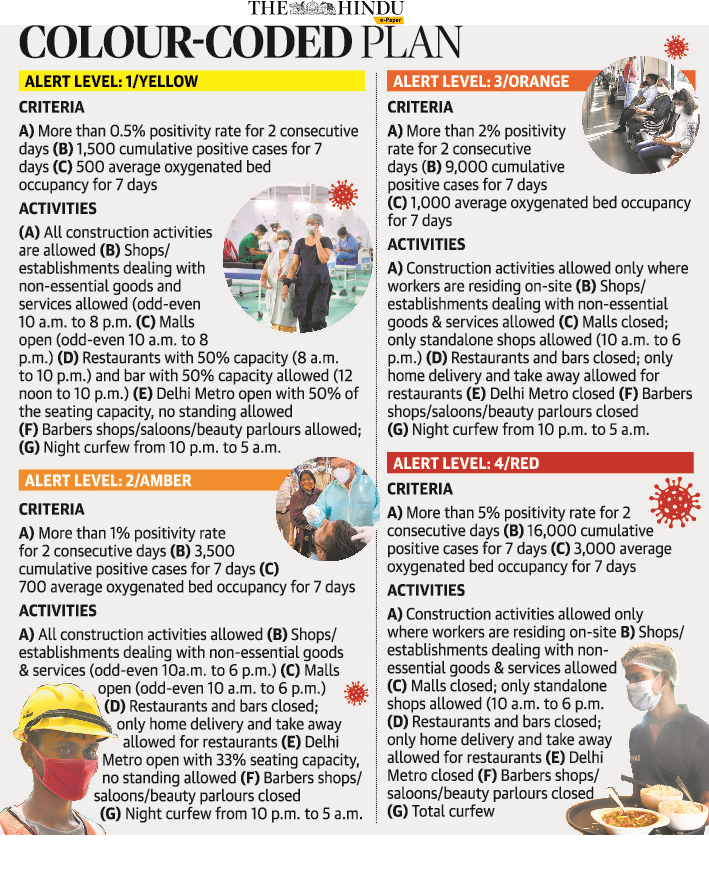
    Fearing any surge in coronavirus cases in the national capital, which is witnessing a decline in cases of infection, the Delhi government has chalked out the ‘Graded Response Action Plan (GRAP).’

    Graded Response Action Plan (GRAP)

    • In 2014, when a study by the WHO found that Delhi was the most polluted city in the world, panic spread in the Centre and the state government.
    • Approved by the Supreme Court in 2016, the plan was formulated after several meetings that the Environment Pollution (Prevention and Control) Authority (EPCA) held with state government and experts.
    • The result was a plan that institutionalized measures to be taken when air quality deteriorates.
    • GRAP also works as an emergency measure.
    • It includes strict measures such as a ban on the entry of heavy vehicles, the odd-even road rationing restrictions, and a halt of construction work – each of which is likely to be impractical at a time when the pandemic has exacted heavy economic costs and public transport has been seen as an infection risk.

    For covid purposes

    • This time, it was decided to notify the GRAP that will “objectively and transparently” ensure an “institutional and automatic” response with regards to enforcement measures, lockdowns and unlock activities.
    • The plan was prepared in comparison with ascent data of the four waves at specific positivity rates of 0.5%, 1%, 2% and 5% and also considered on the basis of the earlier four waves.
  • [pib] Species in news: Avicennia Marina

    Scientists at the Department of Biotechnology (DBT) have reported for the first time a reference-grade whole genome sequence of a highly salt-tolerant and salt-secreting true-mangrove species Avicennia Marina.

    Avicennia marina

    • Avicennia marina is one of the most prominent mangroves species found in all mangrove formations in India.
    • It is a salt-secreting and extraordinarily salt-tolerant mangrove species that grows optimally in 75% seawater and tolerates >250% seawater.
    • It is among the rare plant species, which can excrete 40% of the salt through the salt glands in the leaves, besides its extraordinary capacity to exclude salt entry to the roots.

    Why in news?

    • The A. marina genome assembled in this study is nearly complete and can be considered as a reference-grade genome reported so far for any mangrove species globally and the first report from India.
    • This study assumes significance as agriculture productivity globally is affected due to abiotic stress factors such as limited water availability and salinization of soil and water.

    Its significance

    • Availability of water is a significant challenge to crop production in dryland areas, accounting for ~40 per cent of the world’s total land area.
    • Salinity is prevalent in ~900 million hectares globally (with an estimated 6.73 million ha in India), and it is estimated to cause an annual loss of 27 billion USD.
    • The genomic resources generated in the study will pave the way for researchers to study the potential of the identified genes for developing drought and salinity tolerant varieties of important crop species.
    • This is particularly important for the coastal region as India has 7,500m of coastline and two major island systems.

    Try these PYQs:

    Q.Which one of the following is the correct sequence of ecosystems in the order of decreasing productivity? (CSP 2013)

    (a) Oceans, lakes, grasslands, mangroves

    (b) Mangroves, oceans, grasslands, lakes

    (c) Mangroves, grasslands, lakes, oceans

    (d) Oceans, mangroves, lakes, grasslands


    Q.The 2004 Tsunami made people realize that mangroves can serve as a reliable safety hedge against coastal calamities. How do mangroves function as a safety hedge? (CSP 2011)

    (a) The mangrove swamps separate the human settlements from the sea by a wide zone in which people neither live nor venture out

    (b) The mangroves provide both food and medicines which people are in need of after any natural disaster

    (c) The mangrove trees are tall with dense canopies and serve as an excellent shelter during a cyclone or tsunami

    (d) The mangrove trees do not get uprooted by storms and tides because of their extensive roots.


    Back2Basics: Mangroves

    • A mangrove is a shrub or small tree that grows in coastal saline or brackish water.
    • Mangroves occur worldwide in the tropics and subtropics, mainly between latitudes 30° N and 30° S, with the greatest mangrove area within 5° of the equator.
    • Mangroves are salt-tolerant trees, also called halophytes, and are adapted to live in harsh coastal conditions.
    • They contain a complex salt filtration system and complex root system to cope with salt water immersion and wave action.
    • They are adapted to the low-oxygen conditions of waterlogged mud.
    • They are a unique group of species found in marshy intertidal estuarine regions and survive a high degree of salinity through several adaptive mechanisms.
    • They form a link between marine and terrestrial ecosystems, protect shorelines, provide habitat for a diverse array of terrestrial organisms.
  • YOU Pick The Subject And WE Will Teach You, For FREE!

    YOU Pick The Subject And WE Will Teach You, For FREE!

    Dear aspirants,

    We welcome you to join this unique opportunity of learning. At Habitat, we are providing FREE complete learning sessions by our experienced mentors on every UPSC topic. You do not have to pay a single rupee! 

    Just join in, select the subject you want to study, and start engaging with our mentors immediately!

    What do you have to do?

    1. Join Habitat for absolutely FREE by clicking here.
    2. Go through the discussions going on in the GENERAL channel.
    3. PICK the topic YOU would like to learn more about.
    4. Join that discussion.
    5. Read, participate, ask questions, and clarify doubts instantly!

    And more…

    Learn What You Want To Learn! It’s FREE!

    Here is a list of topics and discussions you can join immediately:

    Subject/TopicMentorTime
    Sociology optional Aakash6:00 am
    Revise Economics for IAS PrelimsRavi Ranjan11:00 am
    English WritingAnand Prakash12:30 pm
    Science and TechDr. Keerti1:00 pm
    Samadhan CSATRavi Ranjan2:00 pm
    UPSC EPFORohit Yadav3:00 pm
    Chat pe News: Current AffairsAnjum Sharma4:30 pm
    Destroy Prelims: score boosterZeeshan Hashmi5:30 pm
    Indian society and Social IssuesSiddharth 6:30 pm
    Sangharsh: Answer WritingZeeshan Hashmi7:00 pm
    Samvad- Physical geography through MCQsRadhika Didwania7:30 pm
    Economics GamifiedAmoghavarsha8:30 pm
    Parakram Answer Writing sessionRohit Yadav9:30 pm
    Post dinner MCQs for IAS prelimsAmitB10:15 pm

    And many more…

    Whatever you need, we have it here

    How to join a discussion?

    After you have joined/registered on Habitat for free, go to General club. Click on the blue box of the session you want to attend.

  • Registration Window Closing Tomorrow || Only a Few Slots left || How to improve your chances of cracking the UPSC exam 2022 by 800 percent? || Open Invitation for an Exclusive Webinar by Sajal Singh(GS Topper 2017)

    Dear Aspirants,

    Over 150 CivilsDaily Students are appearing in the UPSC interviews this year. YOU could definitely be next! And one very dominant factor in this turnaround is an impactful Civilsdaily Ecosystem. You would not just get a complete Prelims to Interview handholding but also a personal guide to help you finish each milestone.

    Hence, I would like to invite you to a fascinating webinar where you would come to know how we, and our students, achieved this success and how we could use the very methods to help you succeed as well. In the upcoming webinar, we will present the best of what Civilsdaily IAS has to offer and introduce you to the CORE Philosophy of our highly successful Mentorship Program!

    UPSC is the trickiest and uncertain exam in the world. It has a selection ratio of 0.1 per cent and to be selected for IAS, the selection ratio further falls to 0.01%. Now Suppose if we tell you that by Joining Civilsdaily’s Foundation program, this ratio increases to 80 per cent. How will you react?.

    You might think that we are cracking a joke. But fortunately, this is possible, which we achieved with the Smash Mains Program last year. 80 per cent success rate. (Read testimonials below)

    Unfortunately, this program was only open to Veterans. We believe that with the same mentorship style, we can replicate the same success with Aspirants who have just started preparation and are targeting the 2022 UPSC exam. Why waste 5 years when you can crack the exam on the very first attempt.

    I need 50 dedicated students who can give their 100 per cent for next 1 year. Follow whatever I tell you and I assure you that your chances of cracking the exam on the very first attempt would significantly increase.

    To know more about how your journey will be under my guidance for the next 1 year. Please register for the open Webinar on Sunday.

    What can you expect from the Webinar?

    1.Fundamental mistakes committed by an aspirant which can cost you an attempt

    2.Sharing my best practices helped me score the highest marks in GS in the 2017 exam.

    3.Blueprint of how your journey will be under my guidance till 2022 Mains.

    4.Best practices that can help you increase your score in Prelims and Mains exam

    5.Open Q&A session with me

    6.CD softcopies for Preparation

    We will discuss the MOST EFFECTIVE WAY of cracking this exam. And we will talk about the highly successful methods that are TRIED, TESTED and ENDORSED!

    This is a webinar that can truly transform your preparation. All you need to do is register and watch!

    A Quick Bit About the Author

    Sajal Singh is an MS Economics from Gokhale Institute of Politics and Economics, MS Financial Economics from Carleton University Canada. NET(JRF) in Economics qualified. He had obtained the highest marks in GS papers in UPSC Mains 2017 and appeared in several UPSC CS interviews. He also heads the Civilsdaily flagship Smash Mains initiative with an over 80% success ratio in the Mains exam.

  • [pib] India Industrial Land Bank (IILB)

    The GIS Enabled Land Bank is gaining immense popularity.

    Try to answer this question in short:

    Q.Discuss the benefits of digitizing land records in India.

    India Industrial Land Bank (IILB)

    • The IILB is a GIS-based portal with all industrial infrastructure-related information such as connectivity, infra, natural resources and terrain, plot-level information on vacant plots, line of activity, and contact details.
    • It was launched by the Ministry for Commerce and Industry in 2020.
    • Currently, the IILB has approximately 4000 industrial parks mapped across an area of 5.5 lakh hectares of land, serving as a decision support system for investors scouting for land remotely.
    • The system has been integrated with industry-based GIS systems of 17 states to have details on the portal updated on a real-time basis and will achieve pan-India integration by December 2021.
    • In the previous quarter (Apr – Jun 2021) total users were 13,610 out of which 12,996 were unique users with total page views of approximately 1.3 lakh.
  • Civil society need to play role in strengthening of institutions

    Context

    In the wake of the second wave of Covid, our failure as a country to hold our government accountable is evident. Civil society perhaps also needs to re-examine its role.

    What constitutes civil society

    • India’s civil society has many actors:
    • Grassroots organisations that connect to the last mile and provide essential services.
    • Think tanks and academic institutions that churn out new policy ideas and generate evidence.
    • Advocacy organisations that amplify and build support for causes.
    • Large impact funds and philanthropists who decide how these organisations get funded.

    Challenges faced by civil society

    • Government have significantly curtailed the kind of activities that civil society actors can engage in.
    • Philanthropists and donor organisations often find themselves unable to support initiatives that strengthen India’s democracy and its accountability mechanisms, for fear of retribution.
    • By ignoring the politics around policy and focussing disproportionately on technocratic solutions, civil society has also missed the wood for the trees.

    How civil society can play role in reforms of democratic institutions

    • In the absence of a strong push from civil society, our democratic institutions have no intrinsic incentive to reform.
    • There is a need to re-examine parliamentary rules that are heavily tilted in favour of the sitting government, strengthen the judiciary, bolster federalism and the independent media, while creating transparency in decision making within the executive.
    • Civil society has an important and irreplaceable role to play here.
    • Civil society organisations too need to broaden their agenda to include issues that strengthen India’s institutions while collaborating to present a strong unified voice that demands more transparency and accountability in all areas and levels of policymaking.
    • This involves taking more fights to the courts on transgressions by the government, building public opinion about expectations from a well-functioning democracy and creating tools and fora that help citizens engage with policymaking more readily.

    Conclusion

    To not see the strengthening of institutions and the deepening of checks and balances as important areas of work is our collective failure, one we must address immediately.

  • How to improve your chances of cracking the UPSC exam 2022 by 800 per cent? || Open Invitation for an Exclusive Webinar by Sajal Singh(GS Topper 2017) || Registration Open with UPDATED FORM

    Dear Aspirants,

    Over 150 CivilsDaily Students are appearing in the UPSC interviews this year. YOU could definitely be next! And one very dominant factor in this turnaround is an impactful Civilsdaily Ecosystem. You would not just get a complete Prelims to Interview handholding but also a personal guide to help you finish each milestone.

    Hence, I would like to invite you to a fascinating webinar where you would come to know how we, and our students, achieved this success and how we could use the very methods to help you succeed as well. In the upcoming webinar, we will present the best of what Civilsdaily IAS has to offer and introduce you to the CORE Philosophy of our highly successful Mentorship Program!

    UPSC is the trickiest and uncertain exam in the world. It has a selection ratio of 0.1 per cent and to be selected for IAS, the selection ratio further falls to 0.01%. Now Suppose if we tell you that by Joining Civilsdaily’s Foundation program, this ratio increases to 80 per cent. How will you react?.

    You might think that we are cracking a joke. But fortunately, this is possible, which we achieved with the Smash Mains Program last year. 80 per cent success rate. (Read testimonials below)

    Unfortunately, this program was only open to Veterans. We believe that with the same mentorship style, we can replicate the same success with Aspirants who have just started preparation and are targeting the 2022 UPSC exam. Why waste 5 years when you can crack the exam on the very first attempt.

    I need 50 dedicated students who can give their 100 per cent for next 1 year. Follow whatever I tell you and I assure you that your chances of cracking the exam on the very first attempt would significantly increase.

    To know more about how your journey will be under my guidance for the next 1 year. Please register for the open Webinar on Sunday.

    What can you expect from the Webinar?

    1.Fundamental mistakes committed by an aspirant which can cost you an attempt

    2.Sharing my best practices helped me score the highest marks in GS in the 2017 exam.

    3.Blueprint of how your journey will be under my guidance till 2022 Mains.

    4.Best practices that can help you increase your score in Prelims and Mains exam

    5.Open Q&A session with me

    6.CD softcopies for Preparation

    We will discuss the MOST EFFECTIVE WAY of cracking this exam. And we will talk about the highly successful methods that are TRIED, TESTED and ENDORSED!

    This is a webinar that can truly transform your preparation. All you need to do is register and watch!

    A Quick Bit About the Author

    Sajal Singh is an MS Economics from Gokhale Institute of Politics and Economics, MS Financial Economics from Carleton University Canada. NET(JRF) in Economics qualified. He had obtained the highest marks in GS papers in UPSC Mains 2017 and appeared in several UPSC CS interviews. He also heads the Civilsdaily flagship Smash Mains initiative with an over 80% success ratio in the Mains exam.

  • 100% Of Our Students Found Their Scores Rise In Prelims Tests After Joining These FREE Sessions! Give It A Shot, There’s NO CHARGE!

    100% Of Our Students Found Their Scores Rise In Prelims Tests After Joining These FREE Sessions! Give It A Shot, There’s NO CHARGE!

    Dear aspirants,

    We are happy to announce that our FREE sessions on Habitat have had some spectacular results. Almost all our students found their scores increase in Prelims mock-tests and so did their confidence! And all of this WITHOUT PAYING A SINGLE RUPEE!

    What do you have to do?

    1. Join Habitat for absolutely FREE by clicking here [Insert Link].
    2. Go through the discussions going on in the GENERAL channel.
    3. PICK the topic YOU would like to learn more about.
    4. Join that discussion.
    5. Read, participate, ask questions, and clarify doubts instantly!

    And more…

    Learn What You Want To Learn! It’s FREE!

    Here is a list of topics and discussions you can join immediately:

    Subject/TopicMentorTime
    Sociology optional Aakash6:00 am
    Revise Economics for IAS PrelimsRavi Ranjan11:00 am
    English WritingAnand Prakash12:30 pm
    Science and TechDr. Keerti1:00 pm
    Samadhan CSATRavi Ranjan2:00 pm
    UPSC EPFORohit Yadav3:00 pm
    Chat pe News: Current AffairsAnjum Sharma4:30 pm
    Destroy Prelims: score boosterZeeshan Hashmi5:30 pm
    Indian society and Social IssuesSiddharth 6:30 pm
    Sangharsh: Answer WritingZeeshan Hashmi7:00 pm
    Samvad- Physical geography through MCQsRadhika Didwania7:30 pm
    Economics GamifiedAmoghavarsha8:30 pm
    Parakram Answer Writing sessionRohit Yadav9:30 pm
    Post dinner MCQs for IAS prelimsAmitB10:15 pm

    And many more…

    Whatever you need, we have it here

    How to join a discussion?

    After you have joined/registered on Habitat for free, go to General club. Click on the blue box of the session you want to attend.

  • Need for coordinated database for tracking fugitives

    Context

    India lacks a domestic tracking system for fugitives. That makes it easier for them to evade the criminal justice system.

    Challenges at investigation and prosecution level

    • Central agencies have developed reasonable expertise in investigation and prosecution because they are focussed only on investigation and prosecution work.
    • On the other hand, State police forces (except specialised wings) are engaged in law-and-order work as well as investigations.
    • The bulk of the investigation and prosecution work happens at police stations in the States.
    • There is a tendency to close investigations once the accused have absconded.
    • Some police stations do initiate proceedings for attachment of property and declaration of the accused as proclaimed offenders, but the number of cases where coordinated efforts are made to pursue fugitives – domestically or internationally – are hardly documented.

    No system for tracking criminals domestically

    • Through Interpol Notices and the sharing of immigration databases of different countries, there exists a system of tracking criminals worldwide.
    • However, there is no coordinated system or database for tracking criminals or wanted persons domestically in India.
    • In the absence of such a system, it is relatively easy for criminals from one police station/jurisdiction to melt into the population in any other area, almost undetected.

    Way forward

    • The creation of a nationwide database of wanted persons, which could be accessible for police agencies, the public and others is needed.
    • A nation-wide system of ‘Wanted Persons Notices’, similar to Interpol Notices, is required, to help track fugitives domestically.
    • The Crime and Criminal Tracking Network and Systems and the National Intelligence Grid are efforts in the right direction/
    • Countries like the U.S. have functional inter-State extradition and fugitive tracking systems.
    • India needs to set up such dedicated ‘fugitive tracking units’.
    • There needs to be enhanced integration between immigration agencies, State police agencies, Interpol-New Delhi, the External Affairs Ministry and Home Ministry and central investigation agencies.
    • Sharing India’s ‘wanted’ database or providing access to it to foreign embassies on a reciprocal basis or through treaties or arrangements would also be helpful.
    • Signing of more bilateral and multilateral conventions on criminal matters would help plug legal infirmities.
    • Signing bilateral agreements on cooperation in policing matters would also help.
    • All relevant legal processes and requirements should be incorporated into one consolidated law on international cooperation.
    • The entire gamut of activities pertaining to fugitives, from investigation to extradition, needs to be incorporated into a specialised set-up.

    Conclusion

    In the absence of a coordinated database, criminals can go undetected. What we need is a watertight system that would deter criminals from hoodwinking the law.


    Back2Basics: Crime and Criminal Tracking Network and Systems (CCTNS)

    • CCTNS aims at creating a comprehensive and integrated system for enhancing the efficiency and effective policing at all levels and especially at the Police Station level.
    • It aism at adoption of principles of e-Governance, and creation of a nationwide networked infrastructure for evolution of IT-enabled state of- the-art tracking system around “investigation of crime and detection of criminals” in real time.
    • It is is a critical requirement in the context of the present day internal security scenario.
    • The scope of CCTNS spans all 35 States and Union Territories and covers all Police Stations (15,000+ in number) and all Higher Police Offices (6,000+ in number) in the country.
    • The CCTNS project includes vertical connectivity of police units (linking police units at various levels within the States – police stations, district police offices, state headquarters, SCRB and other police formations – and States, through state headquarters and SCRB, to NCRB at GOI level) as well as horizontal connectivity, linking police functions at State and Central level to external entities.

    National Intelligence Grid (NATGRID)

    • First conceptualised in 2009, NATGRID seeks to become the one-stop destination for security and intelligence agencies to access database related to immigration entry and exit, banking and telephone details of a suspect on a “secured platform”.
    • All State police are mandated to file First Information Reports (FIR) in the CCTNS.
    • It is only a repository and the data pertaining to FIRs of a particular police station are a State subject.