Mains Ready By December. Smash Mains & Smash PYQ Admissions Open

Search results for: “”

  • What are Basel III compliant Bonds?

    The country’s largest lender State Bank of India has raised Rs 7,000 crore by issuing Basel III compliant bonds.

    Try this PYQ:

    Q.‘Basel III Accord’ or simply ‘Basel III’, often seen in the news, seeks to:

    (a) Develop national strategies for the conservation and sustainable use of biological diversity

    (b) Improve the banking sector’s ability to deal with financial and economic stress and improve risk management

    (c) Reduce greenhouse gas emissions but places a heavier burden on developed countries

    (d) Transfer technology from developed countries to poor countries to enable them to replace the use of chlorofluorocarbons in refrigeration with harmless chemicals

    What are Basel III compliant Bonds?

    • The bonds qualify as tier II capital of the bank, and has a face value of Rs 10 lakh each, bearing a coupon rate of 6.24 per cent per annum payable annually for a tenor of 10 years.
    • There is a call option after 5 years and on anniversary thereafter.
    • Call option means the issuer of the bonds can call back the bonds before the maturity date by paying back the principal amount to investors.

    Back2Basics: What are Basel Norms?

    • Basel is a city in Switzerland. It is the headquarters of the Bureau of International Settlement (BIS), which fosters co-operation among central banks with a common goal of financial stability and common standards of banking regulations.
    • Basel guidelines refer to broad supervisory standards formulated by this group of central banks – called the Basel Committee on Banking Supervision (BCBS).
    • The set of the agreement by the BCBS, which mainly focuses on risks to banks and the financial system is called Basel accord.
    • The purpose of the accord is to ensure that financial institutions have enough capital on account to meet obligations and absorb unexpected losses.
    • India has accepted Basel accords for the banking system.

    Basel I

    • In 1988, BCBS introduced a capital measurement system called Basel capital accord, also called as Basel 1.
    • It focused almost entirely on credit risk. It defined capital and structure of risk weights for banks.
    • The minimum capital requirement was fixed at 8% of risk-weighted assets (RWA).
    • RWA means assets with different risk profiles.
    • For example, an asset-backed by collateral would carry lesser risks as compared to personal loans, which have no collateral. India adopted Basel 1 guidelines in 1999.

    Basel II

    • In June ’04, Basel II guidelines were published by BCBS, which were considered to be the refined and reformed versions of Basel I accord.
    • The guidelines were based on three parameters, which the committee calls it as pillars:
    • Capital Adequacy Requirements: Banks should maintain a minimum capital adequacy requirement of 8% of risk assets.
    • Supervisory Review: According to this, banks were needed to develop and use better risk management techniques in monitoring and managing all the three types of risks that a bank faces, viz. credit, market and operational risks.
    • Market Discipline: This needs increased disclosure requirements. Banks need to mandatorily disclose their CAR, risk exposure, etc to the central bank. Basel II norms in India and overseas are yet to be fully implemented.

    Basel III

    • In 2010, Basel III guidelines were released. These guidelines were introduced in response to the financial crisis of 2008.
    • A need was felt to further strengthen the system as banks in the developed economies were under-capitalized, over-leveraged and had a greater reliance on short-term funding.
    • Also, the quantity and quality of capital under Basel II were deemed insufficient to contain any further risk.
    • Basel III norms aim at making most banking activities such as their trading book activities more capital-intensive.
    • The guidelines aim to promote a more resilient banking system by focusing on four vital banking parameters viz. capital, leverage, funding and liquidity.
  • What are Medicanes?

    Very recently, a medicane named Ianos made landfall along the coast of Greece and caused heavy rainfall and flooding on the islands of Zakynthos, Kefalonia and Ithaca.

    Try this PYQ:

    In the South Atlantic and South-Eastern Pacific regions in tropical latitudes, cyclone does not originate. What is the reason?

    (a) Sea surface temperatures are low

    (b) Inter-Tropical Convergence Zone seldom occurs

    (c) Coriolis force is too weak

    (d) Absence of land in those regions

    What are Medicanes?

    • Medicanes are extra-tropical hurricanes observed over the Mediterranean Sea.
    • Medicanes occur more in colder waters than tropical cyclones, hurricanes and typhoons.
    • Hence, the cores of these storms are also cold, as compared to the warm cores of tropical cyclones.
    • Warmer cores tend to carry more moisture (hence rainfall), are bigger in size and have swifter winds.
    • The main societal hazard posed by Medicanes is not usually from destructive winds but through life-threatening torrential rains and flash floods.

    Why in news?

    • This year is a mild La Niña, according to the World Meteorological Organization.
    • La Niña is the cooling phase of the El Niño Southern Oscillation (ENSO) cycle in the equatorial Pacific Ocean, as opposed to the warming El Niño phase.
    • It is characterized by the unusual cooling of the central and east-central equatorial Pacific Ocean.
    • A La Niña produces more rain in the central-eastern part, where most of the Mediterranean cyclones develop.

  • Ocean Services, Modelling, Applications, Resources and Technology (O-SMART) SCHEME

    The Union Ministry of Earth Sciences has informed about the progress of O-SMART Scheme.

    Do you know?

    India’s ambitious Deep Ocean Mission is an umbrella scheme under O-SMART initiative. Bottom of Form

    O-SMART Scheme

    • The services rendered under the O-SMART will provide economic benefits to a number of user communities in the coastal and ocean sectors, namely, fisheries, offshore industry, coastal states, Defence, Shipping, Ports etc.
    • It seeks to address issues relating to SDG-14, which aims to conserve the use of oceans, marine resources for sustainable development.
    • It also provides the necessary scientific and technological background required for the implementation of various aspects of Blue Economy.
    • The State of Art Early Warning Systems established Scheme will help in effectively dealing with ocean disasters like Tsunami, storm surges.
    • The technologies being developed will help in harnessing the vast ocean resources of both living and non-living resources from the seas around India.
    • A fleet of research vessels viz., Technology Demonstration vessel SagarNidhi, Oceanographic Research Vessel SagarKanya, Fisheries and Oceanographic Research Vessel SagarSampada and Coastal Research Vessel SagarPurvi have been acquired to provide required research support.

    Some of the modified objective

    The objectives of O-SMART are:

    • To generate and regularly update information on Marine Living Resources and their relationship with the physical environment in the Indian Exclusive Economic Zone (EEZ),
    • To periodically monitor levels of seawater pollutants for health assessment of coastal waters of India, to develop shoreline change maps for assessment of coastal erosion due to natural and anthropogenic activities,
    • To develop a wide range of state-of-the-art ocean observation systems for the acquisition of real-time data from the seas around India,
    • To generate and disseminate a suite of user-oriented ocean information, advisories, warnings, data and data products for the benefit of society,
    • To develop high-resolution models for ocean forecast and reanalysis system,
    • To develop algorithms for validation of satellite data for coastal research and to monitor changes in the coastal research,
    • Acquisition of 2 Coastal Research Vessels (CRVs) as replacement of 2 old CRVs for coastal pollution monitoring, testing of various underwater components and technology demonstration,
    • To carry out exploration of Polymetallic Nodules (MPN) from a water depth of 5500 m in the site of 75000 sq.km allotted to India by United Nations in Central Indian Ocean Basin, to carry out investigations of gas hydrates,
    • Exploration of polymetallic sulphides near Rodrigues Triple junction in 10000 sq. km of the area allotted to India in International waters by International Seabed Authority/UN and,
    • Submission of India’s claim over continental shelf extending beyond the Exclusive Economic Zone supported by scientific data, and Topographic survey of EEZ of India.

    Also read:

    https://www.civilsdaily.com/news/explained-indias-deep-ocean-mission/

  • 22nd September 2020| Daily Answer Writing Enhancement

    Important Announcement:  Topics to be covered on 23rd September-

    GS-1 Modern Indian history from about the middle of the eighteenth century until the present.

    GS-4 Case studies

    Question 1)

    Why India being a country which prides itself on enjoying unity in diversity planning for a common script? Will a common script like Bharati bring down communication barriers in the country? Analyze. 10 marks

    Question 2)

    What are the implications of the outcomes of the ongoing Afghan peace process for India? Also elaborate on the issues with India’s Afghanistan policy as Taliban gains the legitimacy. 10 marks

    Question 3)

    To ensure the success of Atmanirbhar Bharat Abhiyan, India needs action plan. Discuss. 10 marks

    Question 4)  

    ‘Honour killing’ has been in news in recent times. It involves the homicide of a member of a family by other members, due to the perpetrators’ belief that the victim has brought shame or dishonour upon the family. Analyse this problem in detail and indicate not only the social but also the emotional and attitudinal factors responsible for this problem? Also, distinctly bring out why: (a) The youth in such areas do not speak up against these practices. (b) The conviction rate in ‘honour killing’ cases is extremely low. (c) Women, who have to face the brunt of this crime the most, do not speak against it collectively. Discuss some feasible steps, which could be effective in controlling this serious problem. 10 marks

    Reviews will be provided in a week. (In the order of submission- First come first serve basis). In case the answer is submitted late the review period may get extended to two weeks.

    *In case your answer is not reviewed in a week, reply to your answer saying *NOT CHECKED*. If Parth Sir’s tag is available then tag him.

    For the philosophy of AWE and payment, check  here: Click2Join

  • Action plan for the success of Atmanirbhar Bharat project

    Atmanirbhar Bharat Abhiyan, well considered plan by the Central government seeks to transform the Indian economy. The article analyses its potential and suggests the ways to achieve the aims.

    Vocal for local

    • Prime Minister Narendra Modi gave a call to fellow Indians to be “Vocal for Local” in May.
    • This includes not only to buy and use local products but to also take pride in promoting them.

    Challenges

    1) Imports from China

    • Serious challenge to Atmanirbhar mission is country’s $65 billion worth of imports from China alone.
    • Most of these imports are of essential items — raw materials, components and intermediates required in producing finished goods.
    • For example, the pharmaceuticals sector imports nearly 70 per cent of its raw material and drug intermediates.
    • It may not be feasible to replace all Chinese imports in the near future.
    • It may also be debatable if the end goal is to replace the entire chain of imports from a country.
    • Nevertheless, experts and industrialists do assert that the ANBA is an excellent initiative and gives India the opportunity to embark on the self-reliance drive.

    2) Struggling MSMEs

    • A major part of the Vocal for Local mission rests on the MSMEs, which has been seen as struggling for survival.
    • But the reforms announced as part of the ANBA should put them on a stronger footing.
    • One immediate fallout of these measures will be creation of large scale employment opportunities for both the skilled and unskilled workforce.
    • A stronger manufacturing base will also lead to positive spinoffs related to the supply-purchase of local raw material and capacity building of allied manufacturing units.

    Way forward

    • First, an umbrella action plan should be drawn by the Niti Aayog listing all targets under the ANBA and the Vocal for Local Mission.
    • A monitoring agency will review and suggest course correction to ensure that no delay is allowed to build.
    • Second, each state/UT will develop an action plan in consonance with the umbrella plan.
    • A separate organisation created by each state will be responsible for the implementation of the action plan
    • Such organisation should also conduct regular studies to identify local and global market trends and invite competitive solutions to meet market demands.
    • Third, each district (or a group of districts) will work out a more detailed action plan, and charter of responsibilities for ground level officers and departments.

    Conclusion

    The ANBA is a mission to empower the people of India. It will in all likelihood become a benchmark of how governments and their various organisations can work in a mission mode.

  • Ethics group on Civilsdaily’s Habitat | Link and instructions inside

    Click here to join Ethics group on Habitat (instructions below)

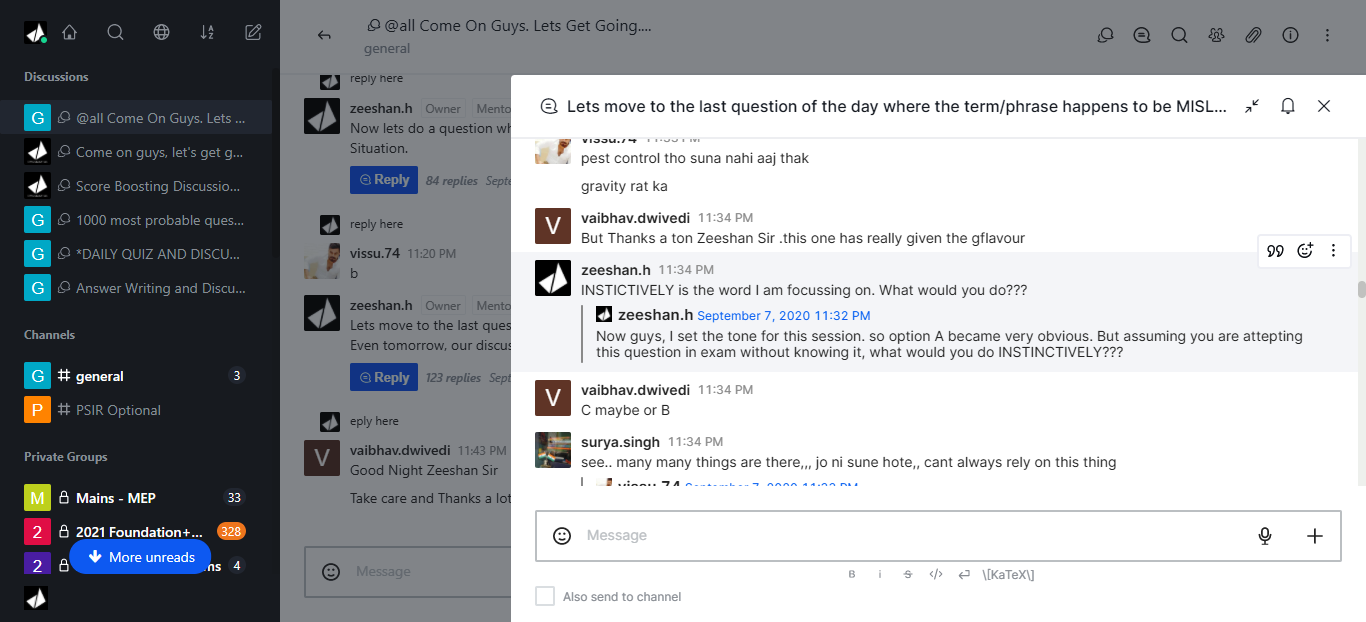
    Join our Habitat now for live discussion on Chapter 3: Attitude today by Sukanya Ma’am at 7:30 pm. Know the best answer writing structure and technique for both section-A and case studies, develop examples/understanding from current, professional/social life, your areas of interest etc.

    If you are already on Habitat, you don’t need to register again. Discussion by Sukanya Ma’am will take place in Ethics group at 7:30 pm. Others follow these steps:

    INSTRUCTIONS:

    1. Click on the link provided above.
    2. Choose Web Application. (Mandatory)
    3. Enter your details. Click on ‘Register a new account’.
    4. Choose a username.
    5. That is it. Welcome to Habitat.

    For access through Mobile app:

    1. Install the Mobile application (click here) from your App store.
    2. Click on Join a Workspace.
    3. Enter this in the Workspace URL – habitat.civilsdaily.com
    4. Use the same email id and password as you used above.

    Scoring well in ethics paper is the sine qua non for featuring in final list and getting one’s desired service. Like the essay paper, this paper gives maximum returns on investment.

    Join Our Ethics Masterclass 2021.

    This image has an empty alt attribute; its file name is Opera-Snapshot_2020-09-11_183805_habitat.civilsdaily.com_-1.png
    This image has an empty alt attribute; its file name is Opera-Snapshot_2020-09-11_183700_habitat.civilsdaily.com_-1024x437.png

    Here, the involvement is active. Not merely passive that is to say only depending upon what’s being provided. Discussion is to include even the missing zones in individual’s preparation. Even, if you are at your very first reading of this particular paper,it will increase the pace of syllabus coverage since this is a time bound and practical initiative. Also you will know how much importance is to be given to one topic or sub-topic.
    Once done with this cycle of discussion and interaction you will be comfortable with concepts and your strengths.

    Answer writing, discussions, exchanging views with our dedicated peer is more important than merely relying on books for Ethics. The group will be administered by Sukanya ma’am, UPSC toppers and in-service officers. From discussions to answer writing sessions are going to be held there in a planned manner.

    Enroll here for Ethics Masterclass 2021.


    Should you encounter any issue in this process or you have a query, reach out to us at +91 89299 87787 or hello@civilsdaily.com

  • Expected questions – IAS 2020 prelims by Zeeshan sir at 8 pm| Join Habitat session. (Links inside)

    Register here for Nikaalo Prelims 2020 – FLTs

    Zeeshan sir – Expected questions for the UPSC 2020 prelims exam. You don’t want to miss out on these most important questions.

    Instructions for joining Habitat at the bottom.

    Join Civilsdaily’s Habitat (Click here)

    If you are already on Habitat, you don’t need to register again. Discussion by Zeeshan sir will take place in General group. at 8.00 pm. Others follow these steps:

    1. Click on the link provided above.
    2. Choose Web Application. (Mandatory)
    3. Enter your details. Click on ‘Register a new account’.
    4. Choose a username.
    5. That is it. Welcome to Habitat.

    For access through Mobile app:

    1. Install the Mobile application (click here) from your Appstore.
    2. Click on Join a Workspace.
    3. Enter this in the Workspace URL – habitat.civilsdaily.com
    4. Use the same email id and password as you used above.

    Should you encounter any issue in this process or you have a query, reach out to us at +91 89299 87787 or hello@civilsdaily.com

  • Understanding the opposition of farmers to agriculture Bills

    The article analyses the issue of farmers opposition to the three agricultural bills.

    Context

    • Farmers have been protesting against the three bills related to agriculture.
    • These three Bills are-
    • 1) The Farmers’ Produce Trade and Commerce (Promotion and Facilitation) Bill, 2020
    • 2) The Farmers (Empowerment and Protection) Agreement of Price Assurance and Farm Services Bill, 2020.
    • 3) The Essential Commodities (Amendment) Bill, 2020.

    What are the aims of the bills?

    • The Bills aim to do away with government interference in agricultural trade by creating trading areas outside the structure of Agricultural Produce Market Committees (APMCs).
    • One of the bills aims at removing restrictions of private stockholding (under Essential Commodities Act 1955) of agricultural produce.
    • One of the bills deals with the regulation of contract farming.

    Issues with the Bills

    • The government has failed to hold any discussion with the various stakeholders including farmers and middlemen.
    • The attempt to pass the Bills without proper consultation adds to the mistrust among various stakeholders including State governments.
    • Farmer organisations see these Bills as an attempt to weaken the APMCs and eventual withdrawal of the Minimum Support Prices (MSP).
    • Farmers in Punjab and Haryana have genuine concern about the continuance of the MSP-based public procurement given the large-scale procurement operations in these States.

    Understanding the role of APMC

    • APMCs do play an important role of price discovery essential for agricultural trade and production choices.
    • The middlemen are a part of the larger ecosystem of agricultural trade, with deep links between farmers and traders.
    • The preference for corporate interests at the cost of farmers’ interests and a lack of regulation in these non-APMC mandis are cause for concern.
    • To understand the role of APMC, consider the example of Bihar.
    • After Bihar abolished APMCs in 2006, farmers in Bihar on average received lower prices compared to the MSP for most crops.
    • Despite the shortcomings and regional variations, farmers still see the APMC mandis as essential to ensuring the survival of MSP regime.

    Conclusion

    The protests by farmers are essentially a reflection of the mistrust between farmers and the stated objective of these reforms.

  • Roles, functions and limitations of Parliamentary Committees

    The government pushed through two crucial agriculture Bills in Rajya Sabha, rejecting Opposition demands to refer them to a Select Committee of Rajya Sabha.

    Try this PYQ:

    With reference to the Parliament of India which of the following Parliamentary Committees scrutinizes and reports to the House whether the powers to make regulations, rules, sub-rules, bylaws, etc. conferred by the Constitution or delegated by the Parliament are being properly exercised by the Executive within the scope of such delegation?(CSP 2018)

    (a) Committee on Government Assurances

    (b) Committee on Subordinate Legislation

    (c) Rules Committee

    (d) Business Advisory Committee

    What is a Parliamentary Committee?

    • It means a Committee which is appointed or elected by the House or nominated by the Speaker and which works under the direction of the Speaker and presents its report to the House or to the Speaker and the Secretariat for which is provided by the Lok Sabha Secretariat.

    By their nature, Parliamentary Committees are of two kinds: Standing Committees and Ad hoc Committees.

    1. Standing Committees are permanent and regular committees which are constituted from time to time in pursuance of the provisions of an Act of Parliament or Rules of Procedure and Conduct of Business in Lok Sabha. The work of these Committees is of continuous nature. The Financial Committees, DRSCs and some other Committees come under the category of Standing Committees.
    2. Ad hoc Committees are appointed for a specific purpose and they cease to exist when they finish the task assigned to them and submit a report. The principal Ad hoc Committees are the Select and Joint Committees on Bills. Railway Convention Committee, Joint Committee on Food Management in Parliament House Complex etc also come under the category of ad hoc Committees.

    Why need Parliamentary Committee?

    • Parliament scrutinizes legislative proposals (Bills) in two ways. The first is by discussing it on the floor of the two Houses.
    • This is a legislative requirement; all Bills have to be taken up for debate.
    • The time spent debating the bills can vary. They can be passed in a matter of minutes, or debate and voting on them can run late into the night.
    • Since Parliament meets for 70 to 80 days in a year, there is not enough time to discuss every Bill in detail on the floor of the House.

    Its role in the passage of a Bill

    • The debate in the house is mostly political and does not go into the technical details of a legislative proposal.
    • The second mechanism is by referring a Bill to a parliamentary committee. It takes care of the legislative infirmity of debate on the floor of the House.
    • However, referring to Bills to parliamentary committees is not mandatory.

    And what is a Select Committee?

    • India’s Parliament has multiple types of committees.
    • They can be differentiated on the basis of their work, their membership and the length of their tenure. First are committees that examine bills, budgets and policies of ministries.
    • These are called departmentally related Standing Committees. There are 24 such committees and between them, they focus on the working of different ministries.
    • Each committee has 31 MPs, 21 from Lok Sabha and 10 from Rajya Sabha.
    • The main purpose is to ensure the accountability of Government to Parliament through a more detailed consideration of measures in these committees.
    • The purpose is not to weaken or criticize the administration but to strengthen by investing in with more meaningful parliamentary support.

    When does a committee examine a Bill?

    • Bills are not automatically sent to committees for examination. There are three broad paths by which a Bill can reach a committee.
    • The first is when the minister piloting the Bill recommends to the House that his Bill be examined by a Select Committee of the House or a joint committee of both Houses.
    • Last year Electronics and IT Minister moved a motion in Lok Sabha referring the Personal Data Protection Bill to a Joint Committee.
    • If the minister makes no such motion, it is up to the presiding officer of the House to decide whether to send a Bill to a departmentally related Standing Committee.

    What happens when a bill goes to a Committee?

    • Sending a Bill to any committee results in two things.
    • First, the committee undertakes a detailed examination of the Bill. It invites comments and suggestions from experts, stakeholders and citizens.
    • The government also appears before the committee to present its viewpoint.
    • All this results in a report that makes suggestions for strengthening the Bill. While the committee is deliberating on a Bill, there is a pause in its legislative journey.
    • It can only progress in Parliament after the committee has submitted its report. Usually, parliamentary committees are supposed to submit their reports in three months, but sometimes it can take longer.

    What happens after the report?

    • The report of the committee is of a recommendatory nature. The government can choose to accept or reject its recommendations.
    • Very often the government incorporates suggestions made by committees. Select Committees and JPCs have an added advantage.
    • In their report, they can also include their version of the Bill. If they do so, the minister in charge of that particular Bill can move for the committee’s version of the Bill to be discussed and passed in the House.