Modern India and national struggle for independence
Tips for study –
For modern India from 1757 to 1857 you have to study Old NCERT book of modern India.
At same time you can prepare for mains as you can expect 1 question from this part every year.
Struggle for Indian independence by Bipan Chandra ( Don’t know why UPSC loves this book. It literally picks questions from this directly both in prelims and mains) Read this book as many times as possible. Please note that this book is not specially written for examination and one needs to make his own points and underline them in same page.
Spectrum Modern India is book which has all summarized of both NCERT and Bipin Chandra. It has many tables, bullet points. This book is perfect for revision and memorizing points but this book should be studied only after reading above books otherwise sometimes you may not understand the issue or event. (At this point with 1 month left for prelims this is important).
Next important part in history is Culture. Most of the questions from ancient and medieval India will be related to socio-cultural issues.
How to tame Art & Culture?
Main books and web links have been listed above
Now take a drawing chart divide it into 4 parts with vertical lines. Then under each part divide whole art and culture into visual arts, performing arts, literature and drama, socio religious and others. You may choose your own way of division of topics. (Such a division of any topics either in art and culture or polity will get you more quality).
So now while reading ancient you come across some architecture you write about that in very small and short important keywords in chart. Then when Buddhism comes write in socio religious part. Like that complete the whole books. Similarly do with the medieval India.
Then start with CCRT and study. There is a problem of getting confused and forgetting what we read in culture. So preparing through chart is one method. In addition to that, when you are reading about something try to see that image in internet. (For example if I am studying regarding Dravidian architecture it would be easy if I keep seeing an image while studying. This increases the understanding level and also makes your life easy).
Buddhism is a hot favorite, anyday!
PS – For history & visualisations – we have started some crisp infographs in the history sections. Follow the stories as they may help in the ultimate revisions.
This personal blog is a part of an ongoing series – Target IAS 2015 & Beyond. Satish has been an integral part of the core team which laid down the foundation of Civilsdaily – an initiative to simplify News for IAS Prep.
There will around 15 questions from polity part in prelims every year. In the present scenario where CSAT is only taken into consideration for cut off, aspirants need to attempt at least 95% of polity questions correctly as these questions will be mostly from areas familiar to aspirants but with a little trick!
DD. Basu (Many people say this is very good book but I never read this. I believe that Lakshmikanth is simple to understand)
General Polity Gyan (before we launch dive headlong) –
First study Lakshmikanth line by line and understand every chapter given there. No need to prepare any short notes for polity because everything in that books is important. Questions can come in from any chapter (They asked about attorney general in 2013 which is not expected).
You may choose to underline with a Blue gel pen in the book where you feel it is important. It so happened to me that every other time I would read this book only to find a new thing that I had missed before!So keep underlining every time when you find a new thing and also make sure that you revise it.
Most of the aspirants feel comfortable with this subject – They get a feeling that once they have read it *n* number of times – they are perfect and can answer any question from polity! Believe you me that you can still be stumped by the manner in which UPSC frames the questions. Its Civil Services Examination after all! Take up questions of any institute or website and try answering them. Every question in polity will have some trick in it.
Sample Ques – Prime minister has the power to dissolve the parliament. What do you think?
Many may think this statement is correct. But its wrong as lok sabha + rajya sabha + president = parliament. So PM can dissolve only lok sabha!
Geared up for the next level? Let me tell you how to divide & conquer this subject. First of all, divide Indian Polity into 3 parts –
Preamble, Fundamental rights , DPSP, Fundamental duties, Amendments and Emergency provisions
Parliament and state legislature, President, Supreme court and high courts, Federalism, Center state relations
iii. Constitutional bodies, Statutory bodies , Rights issues , Panchayats & Political parties, elections , anti defection law, all schedules, oaths and remaining topics
When you start one part and study that completely. You may choose to divide the syllabus in your own way but please do fragment the syllabus and study. It makes you easy to remember.
Rights Issues: This is one area where you get ~2 questions each year. So have a look at some of rights issues topics – Forest rights, PESA act, Human rights , Consumer rights, MNERGA, Food security, Manual scavenging act, Street vendors act, RTE act, RTI act, NALSA act, recently right to clearance by telangana government and a few more.
One question will be on Panchayats and local bodies. It may be regarding PESA act or panchayats in north east. Read both chapters (panchayats and urban local bodies) of Lakshmikanth.
As most part of constitution remained same from last 60+ years kindly go through past 25 years questions which came from polity in prelims. This is like reverse engineering! You will cover most of the topics from there itself.
Along with all this, check issues which are in news and try to cover static part related to that. For example – Lt. Governor of Delhi is in news. So kindly go through provisions of Delhi state about who has more power over administrative decisions.
Similarly appointment and removal of governor is in news.
At Civilsdaily, we try to do a good job at covering and tracking the Polity in News in a way that you understand the whole historical context along with present day news. Go through all of the stories at the website –
I will be here, most of the time answering your queries. Make sure you do read the posts completely before asking questions. The next blog would be on tackling History.
Are there any provisions in UN which can help us chase black money?
Yes, there are a few. And they might help us get black money back in India. Let’s look at the history of such negotiations to learn more about them and hone your understanding for Probable questions for IAS Mains.
Tough negotiations on this subject in Vienna, Austria, in 2003 was a vital part of the United Nations Convention Against Corruption (UNCAC).
The first breakthrough came when the group established asset recovery as a “fundamental principle” of the convention.
Then it was only a matter of laying a framework, in both civil and criminal law, for tracing, freezing, forfeiting and returning funds obtained through corrupt activities.
What did the convention accomplish? Legal obstacles should be tackled with international cooperation rather than by domestic laws.
Some of the relevant provisions of the convention are crucial to the question of recovery of assets.
It provides that each state party shall take such measures as may be necessary to permit its competent authorities to give effect to an order of confiscation issued by a court of another state party.They are also required to share information with the competent authorities of another state, when necessary, to investigate, claim and recover proceeds of offences.
The UN, through its Office on Drugs and Crime, which leads the fight against illicit drugs and international crime, has been given the responsibility to implement the convention, particularly its assets recovery provisions.
Refining India’s approach
In the case of India, difficulties may have arisen not in establishing that the sums amassed abroad belong to India, but in proving that the assets were illegally obtained.
There is a need of domestic management and disposal of seized and confiscated assets and the management of the return and disposal of assets recovered in the context of international corruption cases.
I am giving a broad sketch on how to approach these 2 very crucial topics for Prelims. Take it with a pinch of salt and feel free to ask me specific queries (restricted to CSE Prelims).
The market is full of fear psychosis and there are so many books/ study materials But I will try to keep it simple. Advance readers should feel free to put in the comments on the right and I will pick and answer a few.
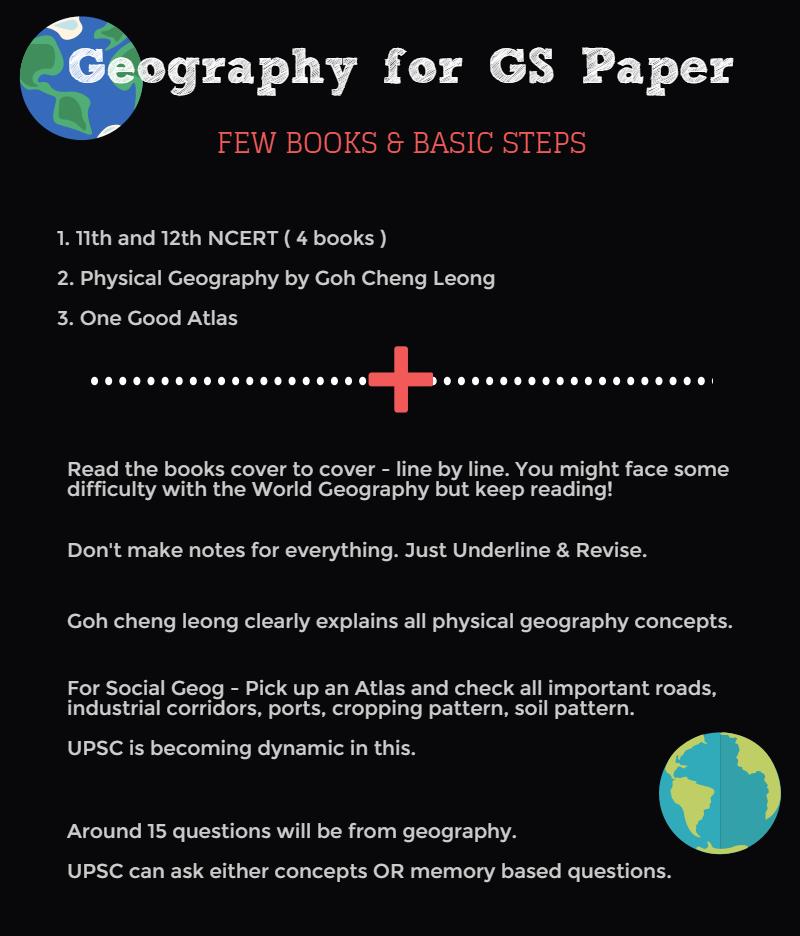
How to study Geography:
First complete all the basic 4 NCERT books. Read line by line. You face difficulty in studying world physical geography NCERT book.
There is no need to make short notes for this but underline in ncert book only with some blue pen so that you can easily do revision. Remember these books should be revised atleast 3-4 times before you go to exam.
Goh cheng leong clearly explain all physical geography concepts. This will be helpful for both prelims and mains. All landforms formations, ocean currents , climatic regions, important physical characteristics formation all will be covered very nicely.
Social and economic geography you need to first go through NCERTs but they are not enough keeping in mind of present trend of UPSC paper. So pick up an atlas and check all important roads, industrial corridors, ports, cropping pattern, soil pattern (This year international year for soils by FAO so a question can be expected), all rivers and its tributaries, industries.
In Indian economic survey also you will have some data related to economic geography. While reading that kindly make note of them also.
Around 15 questions will be from geography. UPSC can ask either concepts, memory based questions. See that you wont do concept based questions wrong which keeps you in safe zone.
Most important phase after studying is writing tests. Kindly write as many tests as possible from all coaching center available and note down all concepts in a book which you can poor and cover them once tests are done. This will give you lot of confidence before exam.
How to study Ecology:
Aside from the pointers mentioned in the infograph, a few more –
Many questions will be on sanctuaries, national parks, biosphere reserves, endemic species and endangered species. These can only be answered if u know them and that is sheer luck according to me. So better go through as many national parks in wiki, Along with that of you come through any species try to look at its image, this helps you in remembering that species and where is it found.
In species related questions mainly focus on India specific
Questions based on concept cannot go wrong. So be carefull about the concepts. You need revise N number of times.
Same as geography, write as many number of tests as possible and note down all concepts in which you are doing wrong. So attempt at least 500 questions on ecology before going to exam. This will cover most of the topics.
Have more questions on these two subjects? Put on the comments.
Why should one make current affairs notes for IAS Prep?
Current affairs are important in every GS paper and also in few optionals. In essay paper, through current affairs we can show our contemporary awareness. In GS paper 1 Indian society part, geography most of questions need current affairs to substantiate your answers. Whole of GS paper 2 and paper 3 questions are based on current affairs. In case of GS paper 4, current affairs is needed for giving more examples and making our answer unique.
One needs to read basics in every topic and update its issues with current affairs.
Sources of current affairs for IAS Prep
The Hindu paper and frontline
Yojana and kurukshetra
Rajyasabha and Loksabha TV discussions
All India radio spot light discussions and Mann ki Baat of Prime minister
PIB features
Websites of some ministries
Think Tanks, NITI Aayog, etc.
How to prepare current affairs?
Every aspirant should prepare notes for current affairs. It is only then one can revise them and remember during examination. During exam aspirant will be under great pressure so it is only if we revise at least for 3-4 times before going to exam. Along with that one needs to practice answers and keep including these current affairs in these.
It is advised to prepare as short as possible so that it can be revised fast.
There are 2 ways we can prepare notes
Hand Written Notes: This has its advantage of we will have a writing practice but also has dis advantage we cannot edit them. This makes some topics like health which need constant updates a little tough to prepare notes in one place.
Online using Evernote/ONE NOTE (a note making software): In this updates can be made easily and all your current affairs and notes can be at one place. But this may not be comfortable for few.
Streamlining of notes making for current affairs
You should take 4 spiral binding books. Each book should consists of some topics with index on first page so that each current affairs can be updated separately .
Example:
Book 1: Indian society , globalization , population , women issues , geography characteristics , distribution of resources and industries
Book 2: Indian polity all topics you can divide the way you want , social justice , NGOs , Governance
Book 3: Indian economy , budgeting , infrastructure , agriculture , investment models , Science and technology , Disaster management , Internal security
Book 4: International affairs , ethics examples , pub add ethics and case studies
Try to divide the whole UPSC structure in 4-5 books and whenever an article from any source comes keep updating. In over a period of time say 6 months you will have a lot of current affair material
Where exactly do we use current affairs in IAS Prep?
One an important issue can just come as question like judicial appointments commission or APMC act issue which are issues by themselves which are in news and they can come directly as questions.
Next, current affairs can be used to substantiate the argument like census data 2011 on IMR to support our arguments.
Further more, some current issues can be used to present as examples which will enrich our answer and make it more unique.
What to keep in mind while putting in efforts with current affairs?
Indian society: issues of women and women organization examples about various initiatives, population issues government policy census data , poverty issues from yojana and various schemes changing trends of poverty, Globalization and its effects on various categories like children, women, disabled etc with examples. Regionalism, communalism and secularism – you can take examples from current events
Geography: In science and technology section, The Hindu will have reports regarding melting of icebergs, la nino and such things, along with that various industries will be in news and interview of an industry expert will be taken every Monday so in these cases those industry locational factor and problems should be covered. Along with this resource distribution which India is targeting now a days like Africa and Australia.
Indian polity: Every question from polity is a current affair issue. One needs to know positives and negatives of each issues after reading several articles and get a balanced view of all important issues example like death penalty issue in 2014. In addition to that if any regulatory or constitutional body is in news one needs to know about that – Rail Tariff Authority announced in budget 2014. Along with that one should intelligent enough to gather quick examples like Greenpeace -a pressure group trying to influence policy of government.
Social justice: Get examples of NGOs SHGs and all associations. Welfare programs from budget and other ministry websites. Health and education issues from paper and yojana. Issues of poverty will come from time to time like poverty line issue, Food security issue etc.
Governance: This also from best administrative practices, issues in yojana etc.
International affairs: These are completely from newspaper especially last 6 months before the exam. You can refer to frontline for more deep coverage of issues and discussion from Rajya Sabha and Lok Sabha.
Indian economy: Discussion in LSTV & RSTV, Economic Survey & Budget. Various initiatives by government. Agriculture issues should have more focus. Various examples of PPP projects, infrastructure, powers etc.
Science and technology: Hindu, science reporter of rajya sabha Tv, disasters, Management examples etc.
Internal security: This is a tough areas to guess. Kindly see every area where Indian internal security is at threat. Examples of money laundering, steps taken by government to counter naxalism like this
Ethics: This is a crucial area where you need to be cautious to get examples of all good initiatives, about the life of great people, good decision making situations; you can also derive case studies out of current affairs. Take the case of confidentiality and ethical concerns in recent corporate espionage.
These are just for understanding purpose, there are many things which should be noted in current affairs.
Golden Rules
First one has to know what the syllabus is. You should literally mug up the whole syllabus and be conscious all the time whatever they read so that they should see that it can be utilized during answer writing.
Every aspirant should prepare a short notes in written on in digital format. Otherwise it is impossible to study.
Such notes should be made in fragmented format where whole syllabus should be divided topic wise and prepare notes so that all issues on 1 topic will be at 1 place.
One should practice answer writing & use these current affairs in explaining yourself.
Examples from contemporary will enrich your answers.
Don’t look into many sources and many newspaper – it wont help you. Get a basic knowledge and balanced view about the issue.
Any further questions? Write them out in the comments and I will be glad to help you with them.
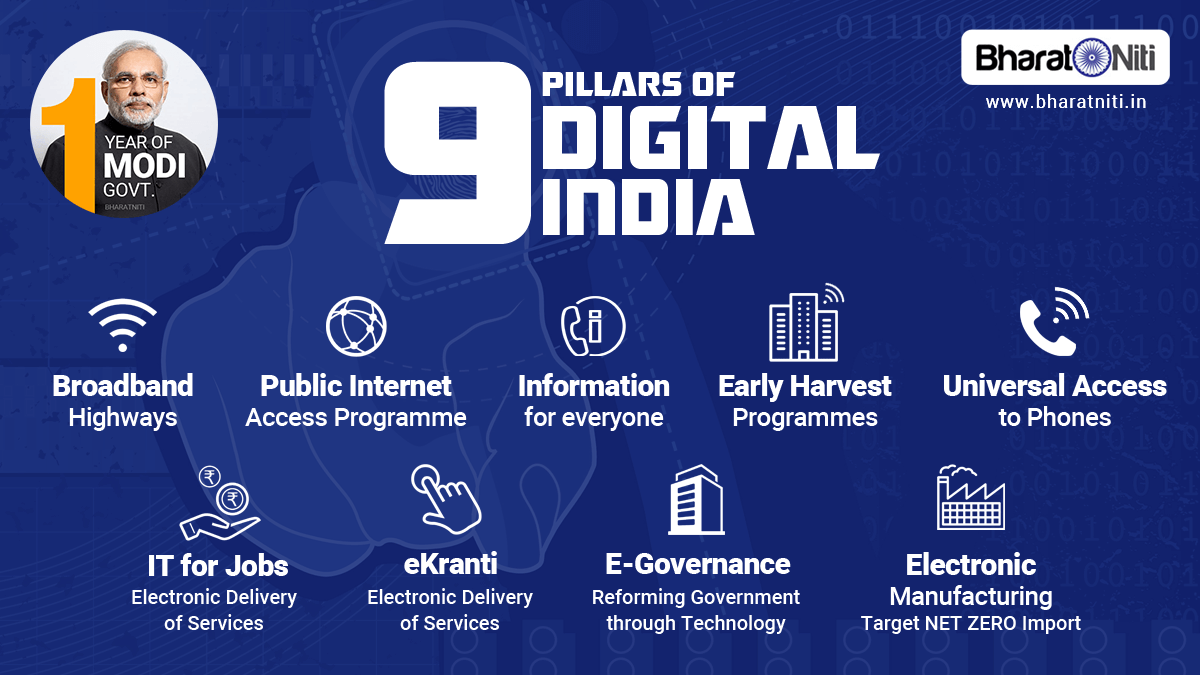
The Union Budget 2016-17 has given a big boost to the Digital India vision of the Hon’ble Prime Minister. Let’s understand it in brief.
Announcements for Digital India
Budget announcements will give a big boost to Digital India initiatives, Digital literacy, greater application of Cloud and above all big push to the Electronics Manufacturing
Focus on the larger involvement of post office platform for financial inclusion, including delivery of services
Let’s now take an overview of some profound changes of last 20 years –
IT / ITeS exports have crossed USD 100 billion
India’s share in global IT services outsourcing presently 56%, is growing every year
Total employment in IT / ITeS sector is 37 lakhs in this financial year, out of which the net addition is 2 lakhs
Electronics Manufacturing has seen remarkable improvement, due to the initiatives of government in this sector
New Incentives announced in the Budget 2016-17
Electronics Manufacturing
Electronic manufacturing in India has got boost by further rationalization of duty structure
Tax benefits for IT units in SEZs has been extended from 2017 till 2020.
This will enable technology units to set up and commence operations in SEZs and also significant move for skill development to services companies as well
This will permit 30 % of additional wages paid to new workmen, deductible for 3 years. This will give a big boost to the BPO operations and generate new jobs (essential for India to reap it’s demographic dividend)
Encouragement to Digital Literacy & Digital Lockers
Digital depository of school leaving certificates, college degrees and mark-sheets will be created
This would enhance the footprint of cloud technology in the Country
The IT department has already laid down the framework for cloud technology and will assist in the expansion <Cloud Technology is the delivery of on-demand computing resources— everything from applications to data centers over the Internet on a pay-for-use basis>
Extraordinary expansion to Digital Literacy in the country; imparting digital literacy to 6 crore households in next 3 years
As of now, against the target of 52.5 lakhs, more than40 lakhs have been trained
Use of Aadhaar platform for delivery of services
A legislation will be brought to give a statutory backing to Aadhaar, for delivery of services /subsidies / benefits, corning out of Consolidated Fund of India
This will prevent leakages by identifying the beneficiaries correctly and would encourage good governance
Greater stress on the use of digital platform across various departments
This will further encourage consolidation of seminal programmed of Digital India
Reforms in Postal department
Effort is being made to leverage the vast network of India Post for implementing the mandate of financial inclusion
Today, India Post has not only installed more than 576 ATMs but has overtaken the SBI to become India’s largest Core Banking Network having 18,231 branches
By March, 2016 all the 25,000 Departmental Post Offices would offer Anywhere Banking facilities using Core Banking Solutions
Further, India Post has achieved new heights in tapping the potential of e-commerce
Its parcel revenues have witnessed a growth of 110% and it has collected more than Rs.1200 Crores from Cash on Delivery mode of payment for e-Commerce services