The Lok Sabha has cleared the Bankers’ Books Evidence Bill, 2026, replacing the colonial Bankers’ Books Evidence Act, 1891. It modernises how bank records are admitted as evidence in court, amid data-privacy concerns.
What does the Bill change?
Digital records: It recognises electronic and digital bank records as admissible evidence, aligning with modern banking.
Officer powers: It empowers a senior-rank officer to certify records and use hash values to verify integrity.
Why do concerns remain?
Data privacy: Wider access to digital bank records raises questions on safeguards for customer financial data.
Certification standards: The reliability of hash-based verification depends on tamper-proof audit trails.
Overlap with new codes: The Bill must sit consistently with the recently enacted evidence and criminal law framework.
Conclusion
The Bill updates a 19th-century evidence law for a digital banking era. The next milestone is Rajya Sabha clearance and rules on data safeguards.
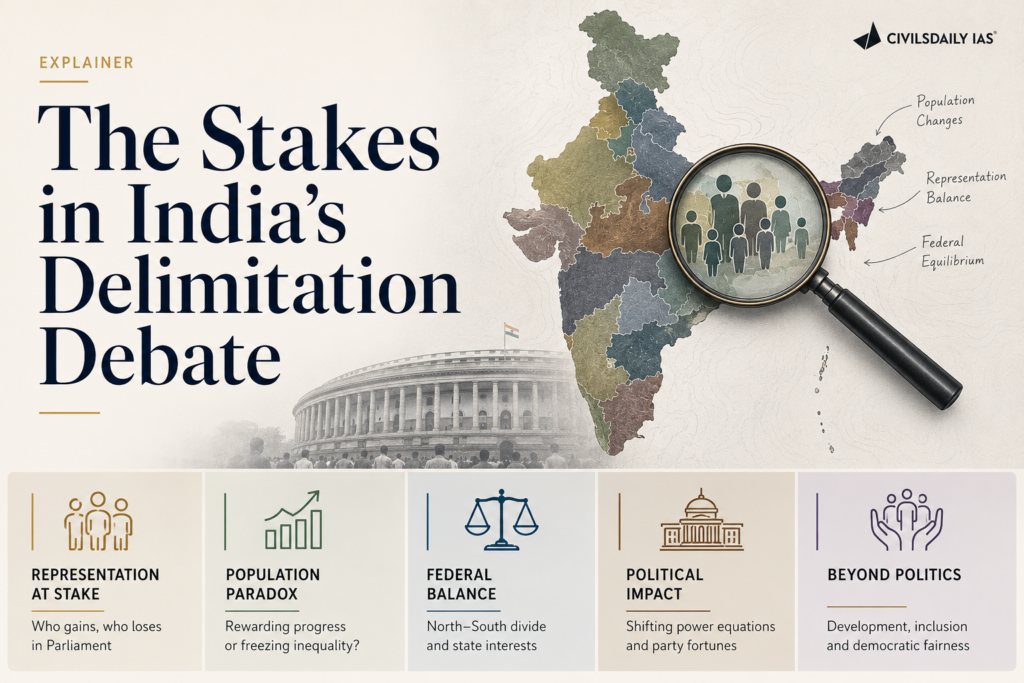
The first delimitation after the 2027 Census could alter the distribution of Lok Sabha seats among States, raising concerns over political representation and federal balance.
What is Delimitation?
Definition: Readjustment of the number and boundaries of constituencies based on population.
Constitutional basis:Article 82 provides for readjustment after each Census; Article 81 deals with Lok Sabha composition.
Authority: Conducted by an independent Delimitation Commission constituted by Parliament.
Why is it Contested?
Seat freeze: Inter-state allocation has been frozen using the 1971 Census until the first Census after 2026.
North-South divide: Population-control States fear reduced political representation relative to high-growth States.
Federalism: Unequal demographic growth creates tension between population-based representation and federal balance.
Lok Sabha size: Any major increase in seats raises questions about Parliament’s size and effective representation.
Value Addition
Delimitation Commission: Its orders have the force of law and generally cannot be challenged in court.
Key challenge: Achieving “one person, one vote” without penalising States that successfully controlled population growth.
“[2024] How many Delimitation Commissions have been constituted by the Government of India till December 2023?
Ladakh is set to be the first to begin the Population Enumeration phase of Census 2027, from 17 August, with an open-ended caste column. It is the first full caste count in independent India’s Census.
What is Population Enumeration?
Definition: Population Enumeration is the second phase of the Census, when detailed data on every individual, including caste, is collected.
First phase: It follows Houselisting, which records housing and household amenities.
Why does caste enumeration matter?
Policy base: Caste data underpins reservation, welfare targeting, and sub-categorisation debates that currently rely on 1931 caste figures.
Open-ended column: An open caste field captures self-reported identity rather than a fixed dropdown, raising classification and comparability challenges.
Security-sensitive geography: Ladakh’s enumeration near the China and Pakistan borders is being geo-tagged, adding a strategic dimension.
Conclusion
The caste column makes Census 2027 a landmark data exercise for social policy. The next milestone is the nationwide enumeration schedule.
Matching Previous Year Question
“No direct PYQ traced in the provided files. Closest microtheme: Census / Registrar General and Census Commissioner of India.”
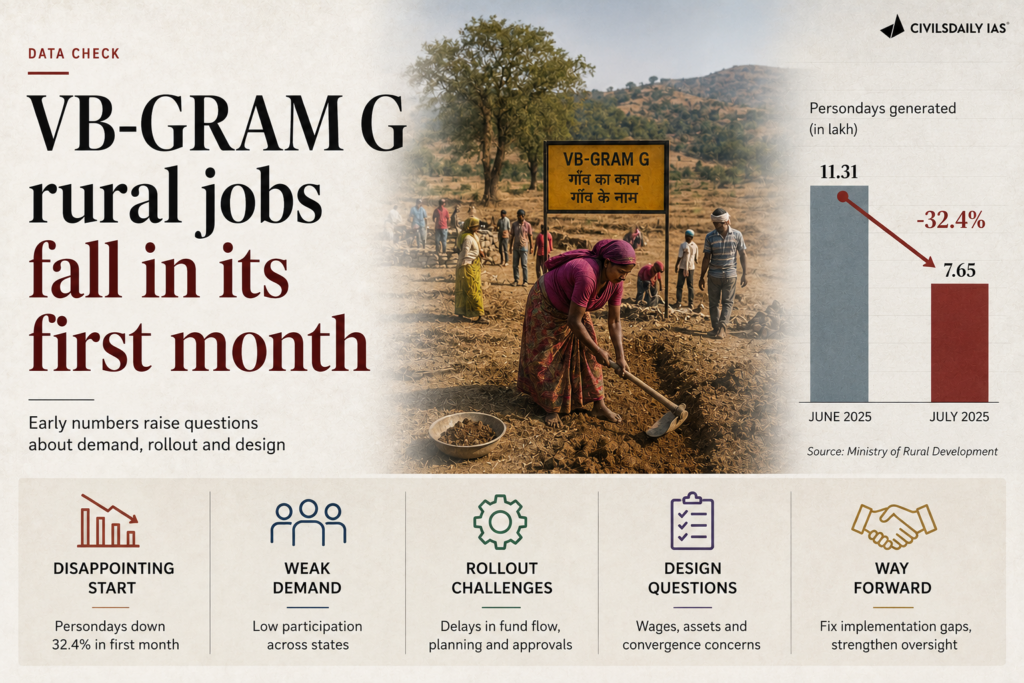
After replacing MGNREGS on 1 July 2026, the Viksit Bharat Guarantee for Rozgar and Ajeevika Mission (Gramin) [VB-GRAM G] recorded nearly a 50% year-on-year decline in rural employment generated during its first month.
What is VB-GRAM G?
New framework: Replaced MGNREGS from 1 July 2026.
Employment guarantee: Increased from 100 to 125 days per rural household.
Digital monitoring: Retains face-authentication-based attendance.
Why did employment fall?
Transition friction: Migration of registrations, job cards and payment systems disrupted work allocation.
Sowing season: Provision for pausing employment demand during peak agricultural operations reduced July person-days.
Comparability issue: Comparing July 2026 with July 2025 may exaggerate the decline because the institutional framework has changed.
Implementation lag: Initial administrative bottlenecks may have temporarily reduced employment generation.
MGNREGS: Back to Basics
Ministry: Ministry of Rural Development.
Legal basis:MGNREGA, 2005.
Guarantee: At least 100 days of wage employment per rural household.
PYQ Relevance [UPSC 2022] Reforming the government delivery system through the Direct Benefit Transfer Scheme is a progressive step, but it has its limitations too. Comment. Linkage: The PYQ Examines DBT-based welfare delivery, fiscal sustainability, and the trade-off between welfare transfers and human-capital expenditure. The article highlights the trade-off between cash transfers and spending on education, health and development.
Mentor’s Comment
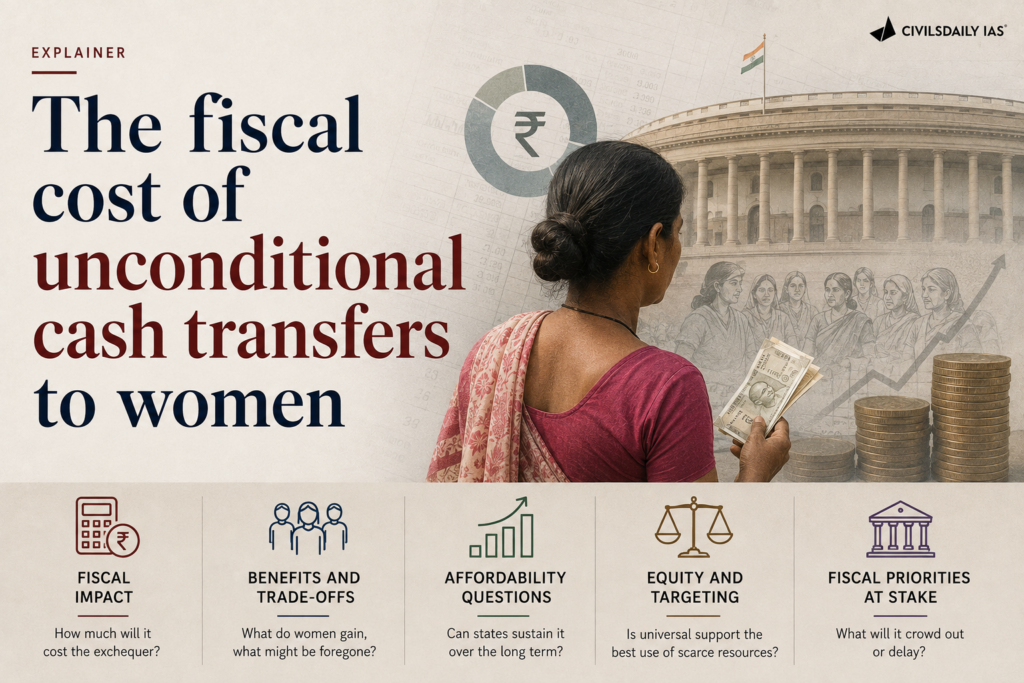
Delhi rolled out the Lakshmi Yojana on August 1, an unconditional cash transfer (UCT) of ₹2,500 a month for eligible women, joining a rapidly growing list of States running similar schemes since 2023. Fresh State-wise expenditure data show that in several States this spending already exceeds the entire education or health budget, reopening the question of what these transfers displace. The concern is set against the 16th Finance Commission’s award period.
What is an unconditional cash transfer?
Definition: A UCT is a direct income payment to a beneficiary with no work, attendance, or behaviour condition attached, unlike a conditional transfer or an in-kind subsidy.
This wave: The current schemes target women with a fixed monthly sum, framed as income support rather than a service.
Why are states rushing to launch women’s UCT schemes?
Electoral promise: Most schemes were pledged at assembly elections and rolled out immediately, drawing the label of a pre-poll dole.
Near-universal spread: From 2023 onward almost every major state added a scheme, making it politically hard for any state to abstain.
Compensation framing: Some argue the transfers compensate women for the state’s failure to create broad opportunity and services.
Are these transfers a benefit to women or a burden on states?
Used productively: Evaluations show women mostly spend the money on food, health and education, so the transfer reaches real welfare needs.
Fiscal pressure: The same spending expands a recurring liability that presses on existing health and education budgets.
Genuine trade-off: The tension is real, the cash is used well by recipients yet competes with the public services those recipients depend on.
How much fiscal space do states actually have?
Committed spending: The 16th Finance Commission notes almost 44% of state expenditure is locked in interest payments, pensions and salaries.
Shrinking social share: Social sector revenue expenditure has stayed stable as a share of total spending since 2011-12 but has declined as a share of GDP since 2020-21.
Little room: With most of the budget pre-committed, new UCT outlays crowd against fresh investment in services and infrastructure.
How large are these schemes across states?
Share of total spending: UCT outlays range from 10.03% of total expenditure in Jharkhand and 7.84% in West Bengal down to 0.97% in Goa and 0.26% in Himachal Pradesh.
Share of education spending: In the largest-scheme states the UCT bill exceeds half the entire education budget, near 74% in Jharkhand and Karnataka and 54% in West Bengal.
Named schemes and amounts: Karnataka Gruha Lakshmi (Rs 2,000), Madhya Pradesh Ladli Behna (Rs 1,500), Tamil Nadu Kalaignar Magalir Urimai Thogai (Rs 1,000), Maharashtra Majhi Ladki Bahin (Rs 1,500), Jharkhand Maiya Samman (Rs 2,500), Odisha Subhadra (Rs 10,000 a year), Assam Orunodoi (Rs 1,250), and Delhi Lakshmi Yojana (Rs 2,500).
Do the transfers reach the poorest, or do barriers exclude them?
Rationalisation cuts: Maharashtra and Madhya Pradesh have reduced beneficiary numbers in the name of rationalisation.
Gatekeeping criteria: Delhi’s scheme requires a recommendation from the local MLA or MP, plausibly to cap numbers before rollout.
Access barriers: Lack of documents, weak bank access and errors in digital records still exclude eligible women.
Conclusion:
The transfers are used well by the women who receive them, but states have little fiscal room, since most spending is pre-committed and the social sector share of GDP is already falling. Without new resource mobilisation, the schemes are financed by squeezing the very education and health services their beneficiaries rely on. The unresolved question is whether states raise revenue to fund them or let public services erode.
Back2Basics: 16th Finance Commission
Award period: The 16th Finance Commission’s recommendations cover the five years beginning 2026-27.
What it is: A constitutional body under Article 280, constituted every five years.
Mandate: Recommends the sharing of central taxes between the Centre and states (vertical devolution) and among states (horizontal devolution), plus grants-in-aid.
[2022, GS2, 10 marks] Reforming the government delivery system through the Direct Benefit Transfer Scheme is a progressive step, but it has its limitations too. Comment.
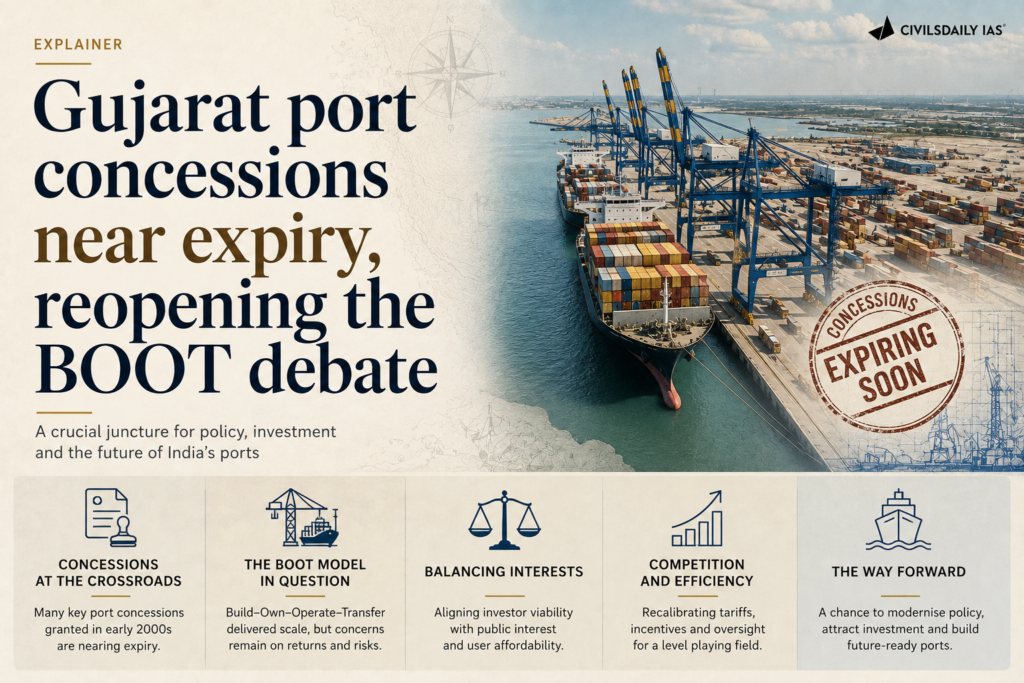
Concessions for Gujarat’s Pipavav and Mundra ports near expiry, reopening the debate on the Build-Own-Operate-Transfer (BOOT) model and how India structures private port infrastructure.
What is the BOOT model?
Definition: Under Build-Own-Operate-Transfer (BOOT), a private operator finances, builds, and runs an asset for a fixed concession period, then transfers it back to the public authority.
Application: Gujarat’s 1997 BOOT framework let private players develop ports like Mundra and Pipavav on state maritime board land.
What is at stake as concessions expire?
Asset transfer terms: Expiry forces a decision on renewal, renegotiation, or transfer of high-value operating ports.
Investment signal: The treatment of expiring concessions shapes confidence for greenfield private ports such as Vizhinjam and Dhamra.
Federal split: Major ports fall under the Centre while non-major ports like Gujarat’s fall under state maritime boards, complicating policy.
“[2026] Consider the following statements with reference to the Sagarmala Programme of the Government of India : I. The Sagarmala Programme seeks to achieve port-led economic growth through cost-effective and sustainable coastal infrastructure. II. The success of the Sagarmala Programme is reflected in significant growth in coastal and inland waterway shipping, along with improved global port rankings. III. Sagarmala 2.0 aims to position India as global maritime innovation hub aligned with Atmanirbhar Bharat and Viksit Bharat 2047 visions. Which of the following relationships among the above statements is/are correct? 1. Statement II validates the effectiveness of the strategies envisioned in statement I. 2. Statement III extends the objectives of statement I by embedding them into a future-oriented innovation framework. 3. Statement I contradicts statement III by focusing only on traditional infrastructure instead of modern innovation. Select the answer using the code given below:
The government plans to raise the FDI threshold requiring CCEA approval from ₹5,000 crore to ₹15,000 crore, reducing political-level scrutiny for large investments.
What is the FDI Approval System?
Automatic route: No prior government approval is required.
Government route: Requires approval from the concerned ministry/department.
CCEA layer: Very large proposals above the prescribed threshold require Cabinet Committee on Economic Affairs (CCEA) approval.
What is the impact of Raising the Threshold?
Fewer escalations: Investments between ₹5,000 crore and ₹15,000 crore can avoid CCEA clearance.
Faster approvals: Reduces procedural delays and improves the ease of doing business.
Greater investment autonomy: Gives ministries greater authority to clear large investments.
Liberalisation: Continues India’s shift towards a simpler, faster FDI regime, following the abolition of FIPB in 2017.
Back2Basics
FDI: Investment by a foreign entity in an Indian enterprise with a lasting interest.
FIPB: Abolished in 2017; its role was transferred mainly to the concerned ministries/departments.
Key balance: Faster approvals must be accompanied by national security, competition and strategic-sector safeguards.
PYQ Relevance
[UPSC 2016] Justify the need for FDI for the development of the Indian economy. Why is there a gap between MoUs signed and actual FDIs? Suggest remedial steps to be taken for increasing actual FDIs in India.
Linkage: The PYQ examines FDI as a driver of investment, growth and ease of doing business. Raising the approval threshold can reduce delays and help convert investment proposals into actual FDI inflows.
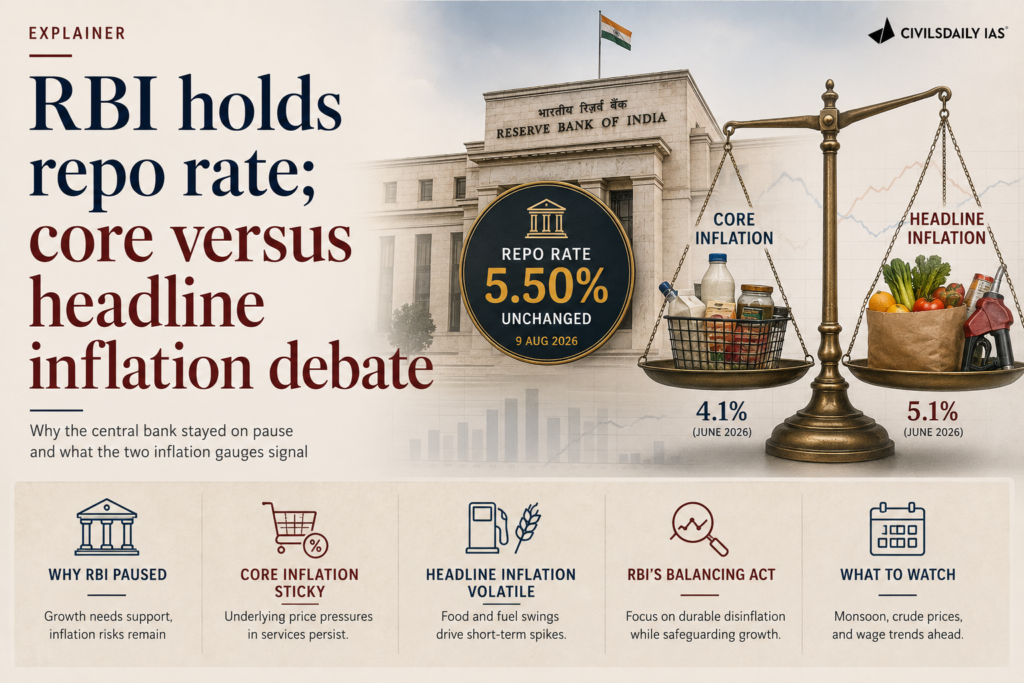
The Reserve Bank of India (RBI) held the repo rate at 5.25%. Economists are divided over whether the central bank is anchoring policy to headline CPI or to core inflation, which strips out food and fuel.
What is core inflation?
Definition: Core inflation measures price change after removing volatile food and fuel components, showing the underlying, persistent trend.
Why it matters: Monetary policy affects demand-driven prices, not a monsoon-driven food spike, so core is a cleaner signal for interest-rate decisions.
Why is the anchor contested?
Mandate is headline: The RBI’s legal target is headline retail inflation around 4%, not core, so leaning on core risks appearing to shift the goalpost.
Food weight is large: Food is a large share of India’s consumption basket, so ignoring it understates the inflation households actually face.
Credibility risk: Frequent redefinition of the operative measure weakens the predictability that anchors inflation expectations.
Conclusion
The rate hold reflects a judgement that underlying price pressure is easing even as headline stays elevated. The next milestone is whether food inflation cools enough to align headline with the target.
PYQ Relevance
[UPSC 2024] What are the causes of persistent high food inflation in India? Comment on the effectiveness of the monetary policy of the RBI to control this type of inflation.
Linkage: The PYQ examines the limits of monetary policy in controlling persistent food-driven inflation. The debate over headline versus core inflation highlights how the RBI balances its inflation mandate with supply-side food shocks.
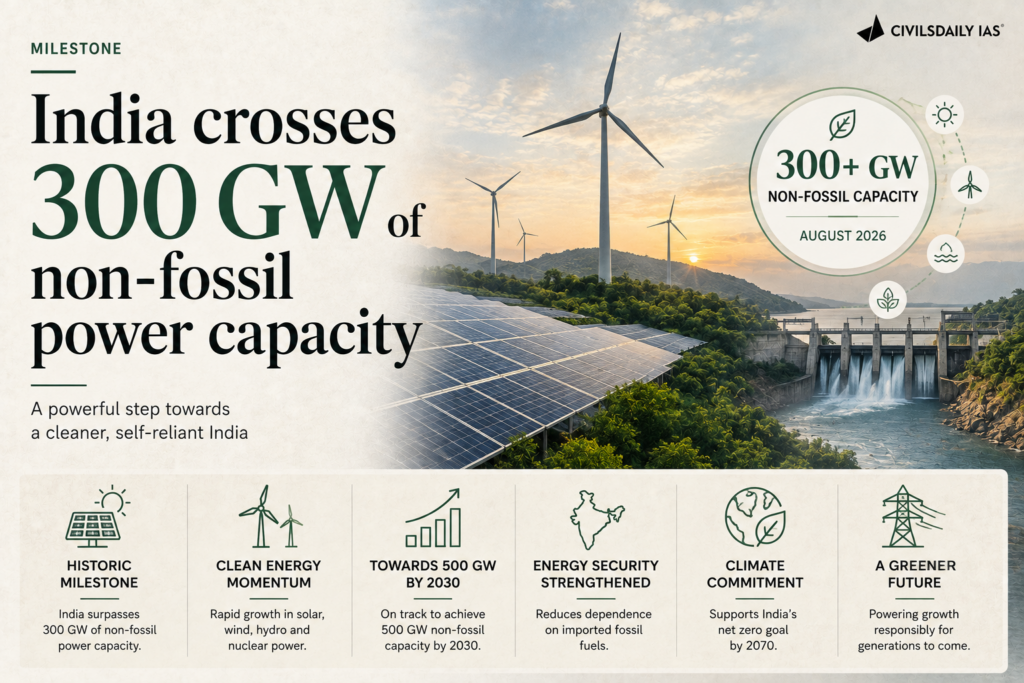
India’s non-fossil fuel capacity has crossed 300 GW, achieving about 60% of the 500 GW target for 2030. The key challenge is converting installed capacity into actual electricity generation.
What is the 500 GW Target?
Panchamrit pledge: India committed at COP26, Glasgow (2021) to achieve 500 GW of non-fossil electricity capacity by 2030.
Coverage: Includes solar, wind, hydro and nuclear capacity.
Not total capacity: It excludes fossil-fuel capacity such as coal and gas.
Why Capacity ≠ Generation?
Capacity factors: Solar and wind are intermittent, so installed capacity does not translate proportionately into electricity generated.
Storage gap: Batteries and pumped-storage hydropower are needed to provide reliable renewable power.
Grid constraints: Transmission and grid-balancing infrastructure must expand alongside renewable capacity.
Peak demand mismatch: Renewable generation may not coincide with periods of highest electricity demand.
Value Addition
Panchamrit: 500 GW non-fossil capacity by 2030; 50% energy requirements from renewables; reduce projected carbon emissions by 1 billion tonnes; reduce emissions intensity by 45%; achieve net zero by 2070.
“[2022, GS3, 15 marks] Do you think India will meet 50 percent of its energy needs from renewable energy by 2030? Justify your answer. How will the shift of subsidies from fossil fuels to renewables help achieve the above objective? Explain.”
[2026] Consider the following statements with reference to India’s response to climate change: I. India’s Long-Term Low Emission Development Strategy (LT-LEDS) is a crucial tool for achieving net-zero emissions by 2070 II. India’s 4th Biennial Update Report (BUR-4) submitted in December, 2024 recorded around 8% decrease in Greenhouse gas emissions in 2020 over 2019. III. Climate-resilient development necessarily depends on quick and short-term achievement of emission reduction targets. Which of the following relationships among the above statements is/are correct? 1. Statement I is empirically supported by statement II. 2. Statement III contradicts the approach implicit in statement I. 3. Statement I and statement III together establish the premise of long-term sustainability. Select the answer using the code given below:
The Zoological Survey of India (ZSI) has published the Catalogue of Lepidoptera (Butterflies & Moths) of India in the peer-reviewed journal Zootaxa. The catalogue, prepared over nearly 12 years, provides an updated national inventory of India’s butterfly and moth diversity.
Key Findings
India has 13,703 species of Lepidoptera.
This represents about 8.25% of the world’s known Lepidoptera.
Butterflies: 1,417 species
Moths: 12,286 species
These are distributed across: 3,705 genera, 240 subfamilies, 102 families, 31 superfamilies
Geometroidea
2,205 species of Geometroidea have been catalogued in India.
They belong to: 479 genera, 13 subfamilies, and 4 families
They constitute around 8.8% of the world’s known Geometroidea.
Many are nocturnal pollinators, complementing daytime pollinators such as butterflies.
Note: Geometridae is a very large family of slender-bodied, broad-winged moths.