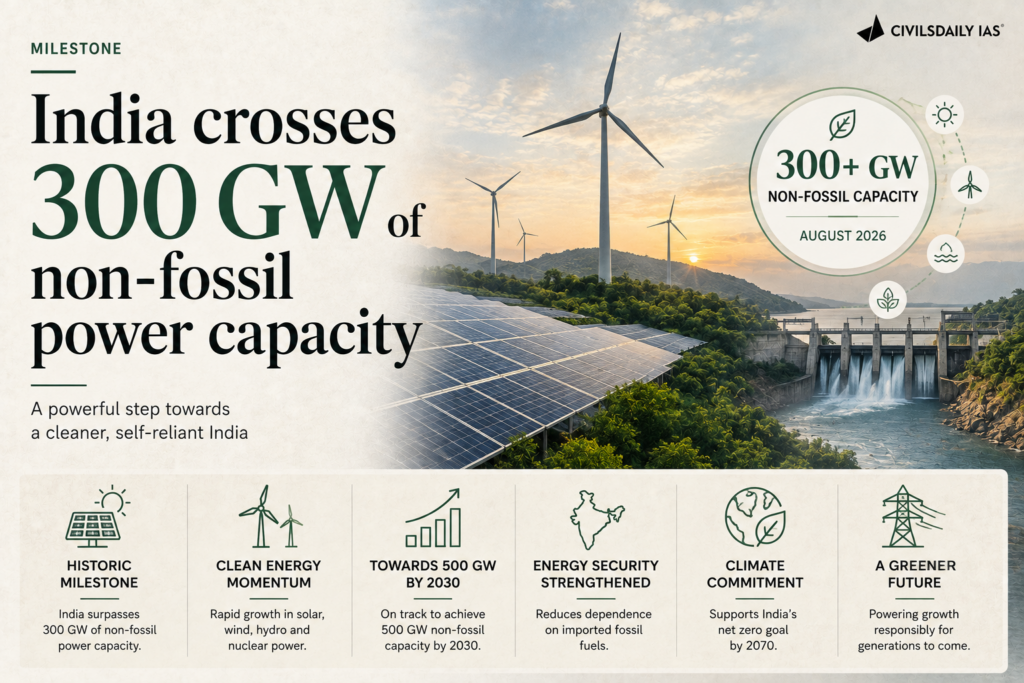
Why in the News
India’s non-fossil fuel capacity has crossed 300 GW, achieving about 60% of the 500 GW target for 2030. The key challenge is converting installed capacity into actual electricity generation.
What is the 500 GW Target?
- Panchamrit pledge: India committed at COP26, Glasgow (2021) to achieve 500 GW of non-fossil electricity capacity by 2030.
- Coverage: Includes solar, wind, hydro and nuclear capacity.
- Not total capacity: It excludes fossil-fuel capacity such as coal and gas.
Why Capacity ≠ Generation?
- Capacity factors: Solar and wind are intermittent, so installed capacity does not translate proportionately into electricity generated.
- Storage gap: Batteries and pumped-storage hydropower are needed to provide reliable renewable power.
- Grid constraints: Transmission and grid-balancing infrastructure must expand alongside renewable capacity.
- Peak demand mismatch: Renewable generation may not coincide with periods of highest electricity demand.
Value Addition
- Panchamrit: 500 GW non-fossil capacity by 2030; 50% energy requirements from renewables; reduce projected carbon emissions by 1 billion tonnes; reduce emissions intensity by 45%; achieve net zero by 2070.
- Key challenge: Shift from capacity addition → reliable, dispatchable clean power.
“[2022, GS3, 15 marks] Do you think India will meet 50 percent of its energy needs from renewable energy by 2030? Justify your answer. How will the shift of subsidies from fossil fuels to renewables help achieve the above objective? Explain.”
[2026] Consider the following statements with reference to India’s response to climate change:
I. India’s Long-Term Low Emission Development Strategy (LT-LEDS) is a crucial tool for achieving net-zero emissions by 2070
II. India’s 4th Biennial Update Report (BUR-4) submitted in December, 2024 recorded around 8% decrease in Greenhouse gas emissions in 2020 over 2019.
III. Climate-resilient development necessarily depends on quick and short-term achievement of emission reduction targets.
Which of the following relationships among the above statements is/are correct?
1. Statement I is empirically supported by statement II.
2. Statement III contradicts the approach implicit in statement I.
3. Statement I and statement III together establish the premise of long-term sustainability.
Select the answer using the code given below:
[A] 1 only
[B] 1 and 2
[C] 2 and 3
[D] 3 only
