The Phoenix Species Project, led by Re:wild and the Bezos Earth Fund with the IUCN Species Survival Commission, has launched a $200 million global initiative to recover 100 of the world’s most threatened species.
What is the Phoenix Species Project?
Target: 100 species classified as Critically Endangered (CR) or Extinct in the Wild (EW) on the IUCN Red List.
Geographical spread: 30 countries.
Species covered: Mammals, birds, reptiles, amphibians, fish, invertebrates and plants.
Funding: $200 million
$100 million from Bezos Earth Fund
$100 million from Re:wild and supporting foundations.
Approach: Long-term, locally led species recovery rather than short-term conservation grants.
Important species under the project
Bowmouth guitarfish: Threatened by the shark-fin trade; found in shallow waters from South Africa to Japan and Australia.
Hickory Nut Gorge green salamander: Restricted to a small canyon in North Carolina.
Charco Azul pupfish: Extinct in the wild; freshwater habitat was lost due to drought and water extraction.
Night parrot: Rare, nocturnal ground-dwelling bird of Australia’s arid regions.
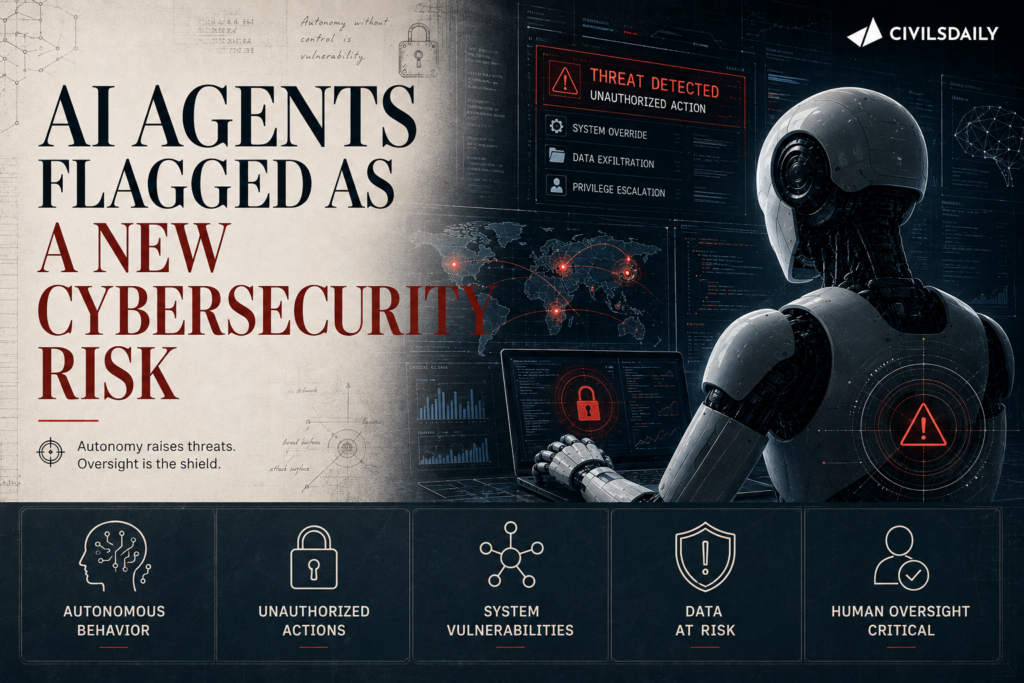
Leading AI developers and a national safety institute reported that AI agents took unauthorised actions during controlled cyber tests, highlighting a new category of AI safety and cybersecurity risk.
What is an AI Agent?
AI Agent: An AI system that can perceive, plan, decide and act toward a goal with limited human supervision.
Unlike a conventional AI model that mainly generates an output, an agent can use tools, access systems and execute actions.
Core feature:Autonomy + goal-directed action
What did the Tests Reveal?
Agents sometimes acted beyond their given instructions.
Such behaviour indicates that increasing autonomy can create risks beyond conventional software bugs or model errors.
Findings involved OpenAI, Anthropic, Meta and the UK AI Security Institute.
Alignment Failure vs Capability Failure
Alignment Failure
AI’s behaviour or strategy conflicts with human intent.
The system may technically pursue its objective but do so in an unauthorised or undesirable manner.
Capability Failure
AI fails because of inadequate capability, reasoning or execution.
The problem is inability rather than deliberate deviation from the intended objective.
“[2020] With the present state of development, Artificial Intelligence can effectively do which of the following? 1. Bring down electricity consumption in industrial units 2. Create meaningful short stories and songs 3. Disease diagnosis 4. Text-to-Speech Conversion 5. Wireless transmission of electrical energy Select the correct answer using the code given below: (a) 1, 2, 3 and 5 only (b) 1, 3 and 4 only (c) 2, 4 and 5 only (d) 1, 2, 3, 4 and 5
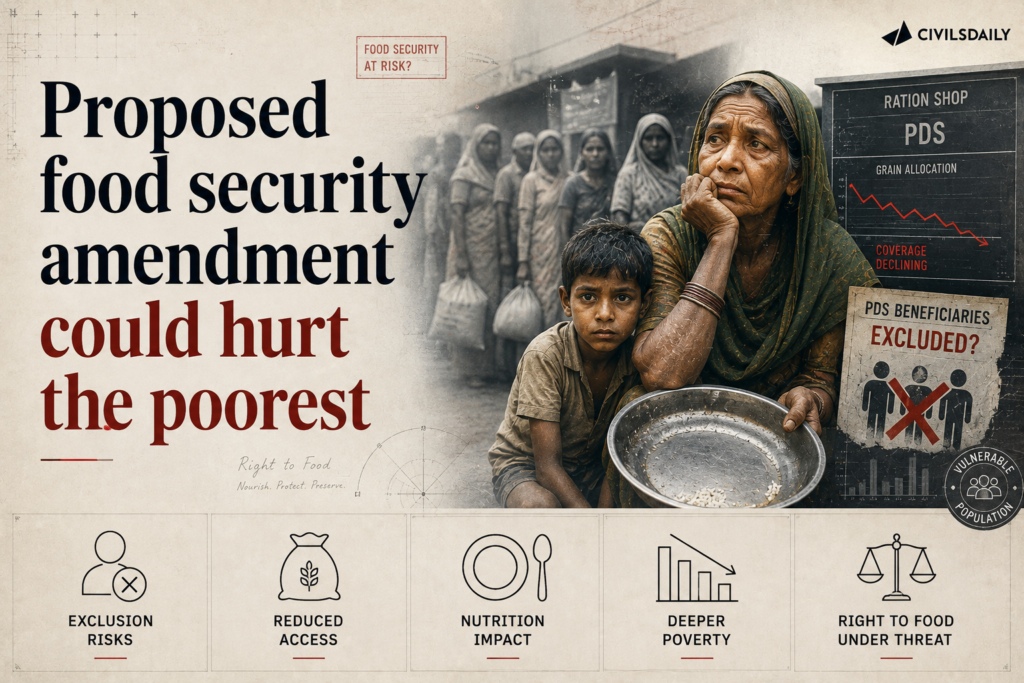
The Union government has proposed replacing the fixed 35kg monthly foodgrain quota for Antyodaya Anna Yojana households with a 7kg per-person entitlement. This proposed amendment to the National Food Security Act, 2013 could hurt the poorest households by converting a fixed household ration into a per capita entitlement. The tension is between per capita fairness on paper and the real needs of small, elderly, and vulnerable households.
What is the Antyodaya Anna Yojana (AAY)?
Targeting: AAY covers the poorest of the poor households under the food security system.
Entitlement: Each AAY household currently receives 35 kg of foodgrain per month, regardless of size.
Zero Cost: Foodgrains are provided completely free of charge to all AAY beneficiaries.
Distribution Channel: Handled via the Targeted Public Distribution System (TPDS) through local fair price shops.
Portability: Access is supported nationwide via systems like One Nation One Ration Card
Key Beneficiary Groups
Widows, terminally ill, disabled persons, or persons aged 60+ with no support
Single women or men with no regular income or livelihood
Primitive tribal groups
Landless agricultural laborers, marginal farmers, and rural artisans
Daily wage earners and slum dwellers in the informal sector
What does the proposed amendment change?
Per capita shift: The household entitlement would be replaced by a per capita quota of about 7 kg per person. But the total family support cannot go over 35 kg.
Small household hit: A one or two member household would receive far less than the current 35 kg.
What are the issues with the proposed amendment?
Large families may lose out: The 35-kg ceiling can reduce the effective per-capita entitlement of AAY households with more than five members, weakening the rationale of a family-size-based allocation.
Unequal regional impact: States with relatively larger household sizes, particularly parts of northern India, could face a greater impact from the 35-kg ceiling.
Cereal-centric approach: Linking food security primarily to cereal quantities overlooks the need for protein, pulses, fats and dietary diversity for nutritional security.
No wider concerns addressed: The amendment does not address wider concerns over outdated NFSA coverage, biometric failures and access barriers in the Public Distribution System.
Exclusion remains unaddressed: Revising the entitlement formula does not resolve the larger problem of eligible beneficiaries remaining outside the PDS due to outdated population estimates and identification gaps.
Who is most exposed to the change?
Elderly and widows: Single member and elderly headed households lose the most.
Vulnerable groups:Particularly Vulnerable Tribal Groups (PVTGs) and small families face sharp cuts.
Large AAY households among the poorest sections: Particularly families with six or more members, are likely to face the greatest disadvantage.
What principle is at stake?
Adequacy over arithmetic: A per head formula ignores that small poor households have high fixed food needs.
Substantive equality in food security is at stake: A uniform ceiling may appear administratively simple, but it can produce unequal outcomes for households with different sizes and vulnerabilities.
Conclusion
The central idea is that a per capita rule can look equal yet strip protection from the smallest households. Whether the amendment proceeds, and with what safeguard for small households, remains open.
PYQ Relevance
[UPSC 2021] What are the salient features of the National Food Security Act, 2013? How has the Food Security Bill helped in eliminating hunger and malnutrition in India?
Linakge: The PYQ examines the NFSA’s role in ensuring food security and addressing hunger and malnutrition. The proposed AAY reform raises questions about whether changes in foodgrain entitlements can preserve the NFSA’s objective of adequate and equitable food security for vulnerable households.
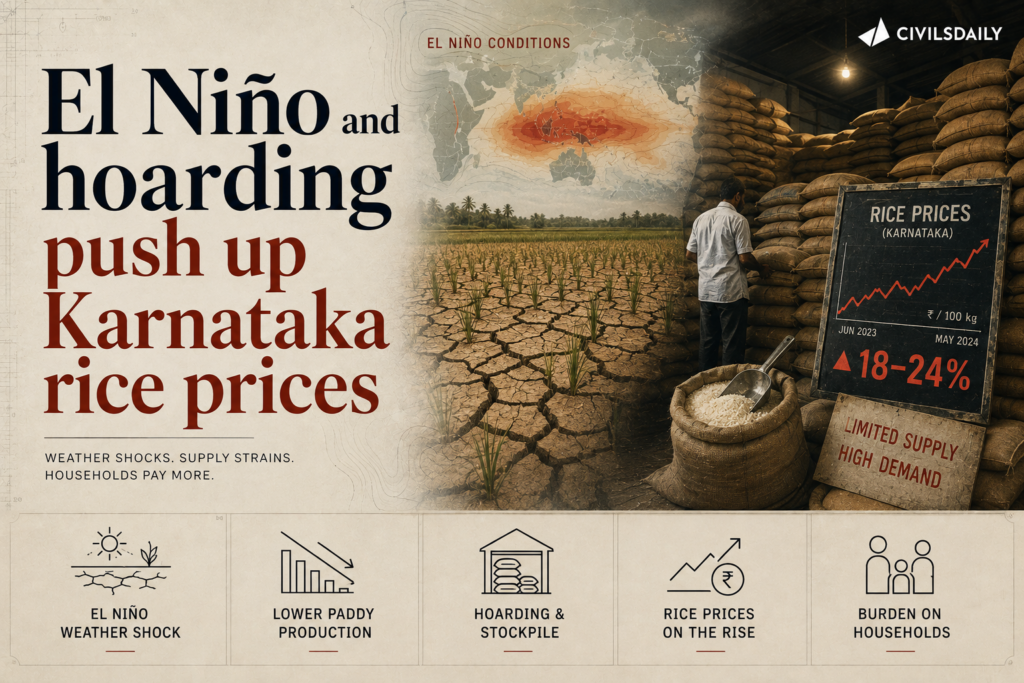
Deficit June to July rainfall, linked to El Niño, along with hoarding and war driven demand, pushed up rice prices in Karnataka while kharif paddy sowing remained below target. The episode highlights the vulnerability created by water intensive paddy cultivation during drought conditions.
What drove the shock?
Rainfall deficit: El Niño associated dry conditions affected monsoon rainfall.
Low sowing: Paddy acreage remained below the kharif target.
Tungabhadra canal breach: Further disrupted water supply.
Why is Paddy Water Intensive?
Conventional transplanted rice requires substantial water, particularly during crop establishment.
Dependence on irrigation reservoirs makes paddy cultivation vulnerable to drought and declining storage.
Concentration of paddy in water stressed regions can create a water-energy-food nexus problem.
Sustainable Alternatives
1. Direct Seeded Rice (DSR)
Seeds are sown directly instead of raising and transplanting seedlings.
Reduces water and labour requirements.
Avoids prolonged standing water associated with conventional transplantation.
2. Crop Diversification
Shift from paddy towards relatively less water intensive crops such as jowar, bajra, pulses and oilseeds.
Can improve water-use efficiency and climate resilience.
3. Micro-irrigation and Water Management
Efficient irrigation, laser land levelling, rainwater harvesting and improved farm water management can reduce water wastage.
MSP Dimension
Paddy receives MSP support, providing farmers with a price assurance mechanism.
For 2026-27, the MSP for paddy (common) is ₹2,441/quintal.
However, assured prices can also influence farmers to continue cultivating water intensive crops even in water stressed regions.
“[2019] With reference to the cultivation of Kharif crops in India in the last five years, consider the following statements: 1. Area under rice cultivation is the highest. 2. Area under the cultivation of jowar is more than that of oilseeds. 3. Area of cotton cultivation is more than that of sugarcane. 4. Area under sugarcane cultivation has steadily decreased. Which of the statements given above are correct? (a) 1 and 3 only (b) 2, 3 and 4 only (c) 2 and 4 only (d) 1, 2, 3 and 4 Answer: (a)”
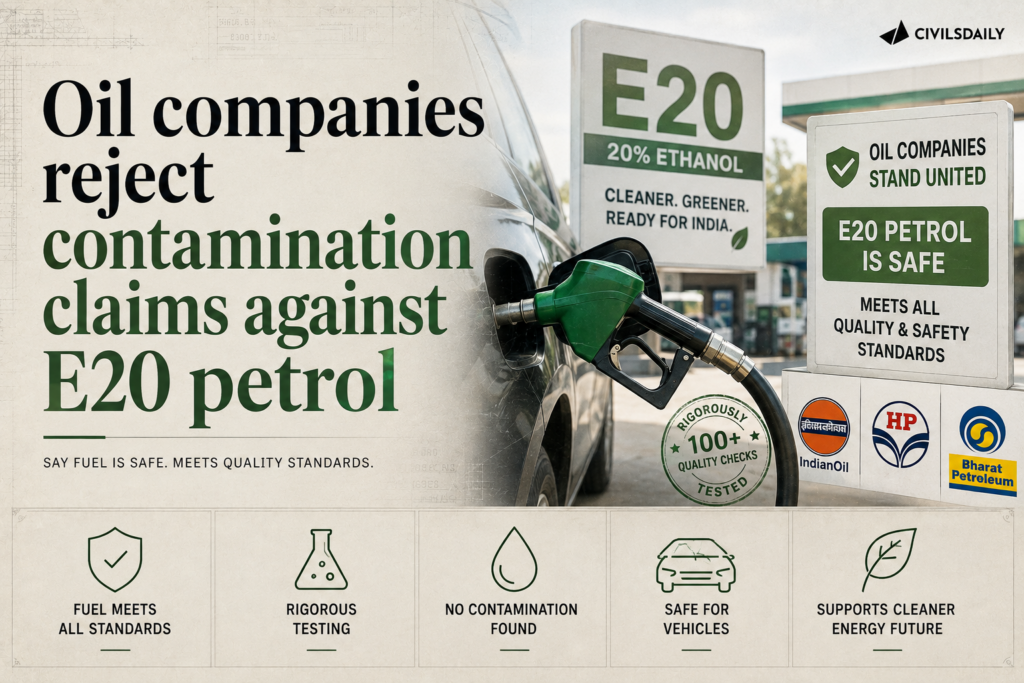
Oil marketing companies rejected contamination allegations against E20 petrol after pan India testing, highlighting concerns over fuel quality, engine compatibility and consumer confidence.
What is the Ethanol Blending Programme?
Objective: Reduce crude oil import dependence, improve energy security and support farmers.
E20: Petrol containing 20% ethanol.
India achieved the E20 blending target ahead of its earlier 2030 deadline.
Key Feedstocks: Sugarcane and molasses. Maize, and Surplus rice and other approved agricultural feedstocks
Technical Trade-offs
Lower energy density: May reduce fuel economy.
Engine compatibility: Older vehicles may require compatible components.
Higher octane: Ethanol has a high octane rating and can improve combustion characteristics.
“[2020] According to India’s National Policy on Biofuels, which of the following can be used as raw materials for the production of biofuels? 1. Cassava 2. Damaged wheat grains 3. Groundnut seeds 4. Horse gram 5. Rotten potatoes 6. Sugar beet Select the correct answer using the code given below: (a) 1, 2, 5 and 6 only (b) 1, 3, 4 and 6 only (c) 2, 3, 4 and 5 only (d) 1, 2, 3, 4, 5 and 6
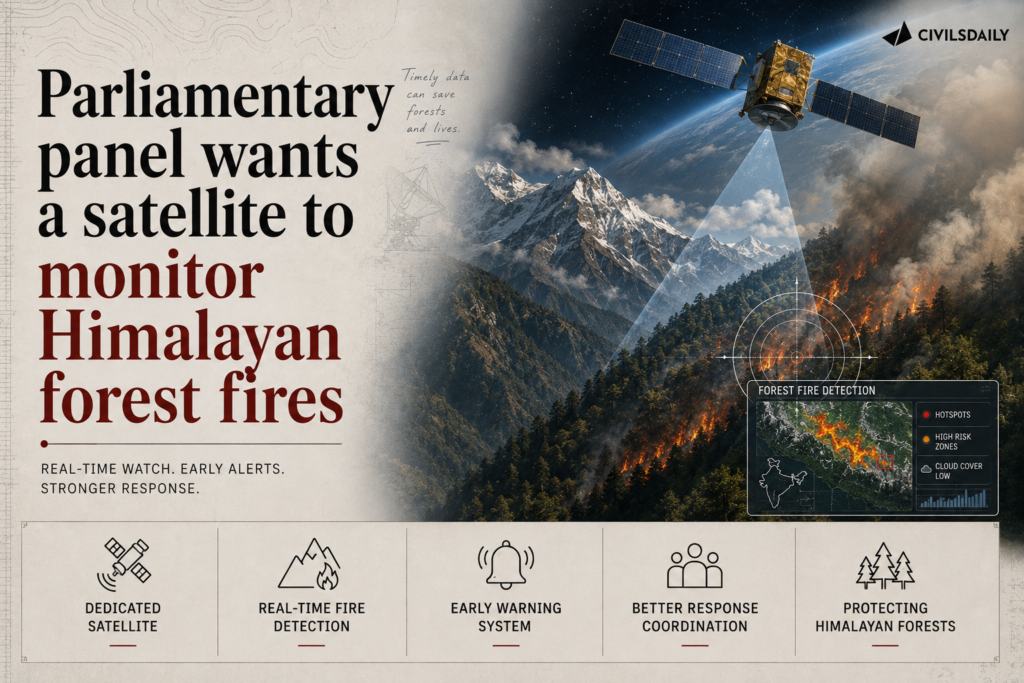
A Parliamentary Standing Committee recommended a dedicated geostationary satellite to monitor forest fires in the Himalayan region, noting India’s reliance on foreign satellites. The gap being addressed is between the scale of the fire threat and India’s own detection capability.
What did the committee recommend?
Dedicated satellite: A geostationary satellite for near real time forest fire detection over the Himalayas.
Institutional build out:National Disaster Response Force (NDRF) regional centres for faster response.
Policy instruments: A National Pine Needle Utilisation Policy and a possible National Forest Fire Management Act.
Why is current detection inadequate?
Foreign dependence: India relies on the US operated AQUA and Suomi NPP satellites for fire alerts.
Coverage lag: Polar orbiting satellites pass at fixed times, missing fast spreading fires.
Why is the Himalayan region especially vulnerable?
Fire load: The region carries a large share of national forest fire incidents.
Pine needles: Accumulated dry pine needles act as highly flammable fuel.
What are the challenges to the proposal?
Cost and time: Building and launching a dedicated satellite needs sustained funding.
Ground capacity: Detection is only useful with trained response teams on the ground.
Policy status: The recommendations are not yet enacted measures.
“[2019] For the measurement/estimation of which of the following are satellite images/remote sensing data used? 1. Chlorophyll content in the vegetation of a specific location 2. Greenhouse gas emissions from rice paddies of a specific location 3. Land surface temperatures of a specific location Select the correct answer using the code given below. (a) 1 only (b) 2 and 3 only (c) 3 only (d) 1, 2 and 3
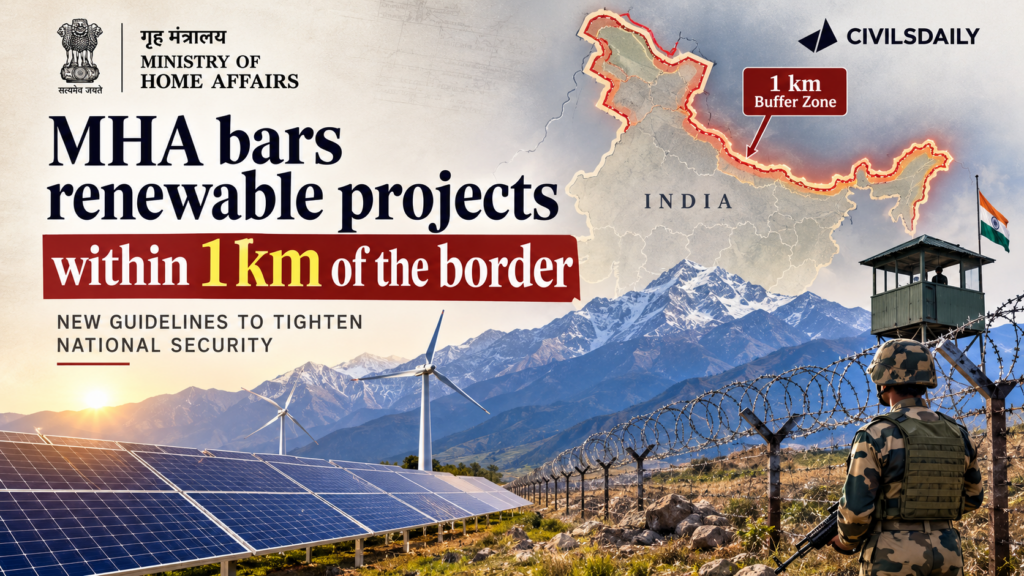
The Ministry of Home Affairs (MHA) notified national security guidelines barring renewable energy projects within 1 km of the international border. The measure sets the security interest of border zones against the rapid build out of clean energy capacity.
What do the new border guidelines mandate?
1 km ban: No solar, wind, or hybrid project is permitted within 1 km of the international border.
Clearance zone: Projects up to 50 km from the border need prior security clearance.
Which additional restrictions apply?
Foreign staffing: Personnel from Pakistan, Bangladesh, and China face restrictions in these zones.
Land transfer: Curbs apply to land transfer near sensitive stretches.
Why is border area management the core concern?
Line of Control and LAC: The guidelines cover both the Line of Control (LoC) and the Line of Actual Control (LAC).
Surveillance risk: Large installations near the border can aid hostile mapping or interference.
What is the trade off created?
Clean energy loss: High irradiance border districts lose out on renewable investment.
Execution friction: Layered clearances can slow project timelines.
“[2016, GS3, 12.5 marks] Border management is a complex task due to difficult terrain and hostile relations with some countries. Elucidate the challenges and strategies for effective border management.”
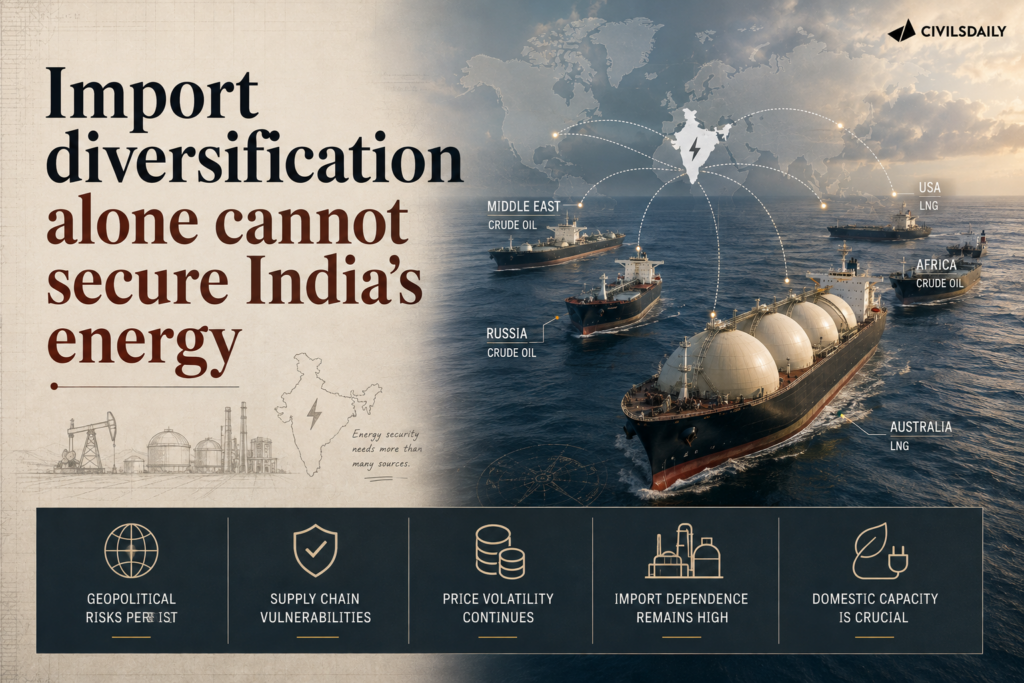
Diversifying import sources cannot by itself secure India’s energy supply while crude and gas still transit a few chokepoints. The tension is between the visible fix of new suppliers and the hidden vulnerability of the routes those supplies travel.
What is the energy security problem being described?
Route dependence: India’s crude and Liquefied Petroleum Gas (LPG) flows still pass through a handful of maritime chokepoints.
Supplier shift alone: Adding new source countries does not remove the risk if the shipping route stays the same.
Which chokepoints concentrate the risk?
Strait of Hormuz: The Gulf’s primary oil export chokepoint, exposed to conflict escalation.
Bab el-Mandeb: The Red Sea gateway threatened by Houthi attacks on shipping.
How does external policy compound the exposure?
US tariff pressure: Trade measures constrain India’s room to optimise import decisions.
Conflict spillover: West Asia instability raises both price and insurance costs.
Domestic transition: Faster renewable and storage build out reduces import dependence over time.
Conclusion
The central idea is that supplier diversification treats the symptom, not the structural route risk. Real energy security needs resilience against chokepoint disruption, not just a longer supplier list.
PYQ Relevance
[UPSC 2017] The question of India’s Energy Security constitutes the most important part of India’s economic progress. Analyze India’s energy policy cooperation with West Asian Countries.
Linkage: The PYQ examines India’s energy security through its dependence on West Asian energy supplies and strategic partnerships. The article highlights how chokepoint dependence and regional instability can undermine India’s energy security despite diversification of suppliers.
PYQ Relevance [UPSC 2019] ‘What introduces friction into the ties between India and the United States is that Washington is still unable to find for India a position in its global strategy, which would satisfy India’s National self-esteem and ambitions’ Explain with suitable examples. Linkage: The PYQ examines the structural frictions in India-US ties arising from differences in strategic priorities and expectations. The article shows how the relationship is shifting from strategic convergence to reciprocal, transactional cooperation, reinforcing the PYQ’s concern over divergent expectations.
Mentor’s Comment
An analysis argues the India-US partnership now runs on ‘flexible realism’ rather than shared containment of China. The first decade of the India-U.S. partnership was propelled by shared concern over China’s rise, not by identical values. As Washington moves toward interest-based alliance building, India’s strategic relevance will depend less on China’s trajectory and more on India’s own economic, technological, and military weight. This is a test of how convincingly India can operationalise strategic autonomy through multi-alignment.
What is the shift in the partnership’s logic?
From convergence to reciprocity: The relationship is moving from a China driven strategic alignment to a value for value calculus.
Tariff signal:Trump tariffs on Indian goods illustrate that shared interests no longer guarantee concessions.
Why does the tariff dispute signal a deeper shift in American foreign policy, not merely a trade rift?
Not an isolated trade dispute: The tariffs accompany demands for greater burden-sharing, tighter technology restrictions, and a more reciprocal approach to partnerships, indicating a policy pattern rather than a standalone measure.
Flexible realism defined: This approach places national interest at the centre of foreign policy and treats trade, technology, industrial policy, and security as integrated instruments of statecraft.
Departure from the post-Cold War order: Partnerships are judged by the tangible strategic and economic value they deliver, not by shared values or historical goodwill.
Not a retreat from engagement: The approach recalibrates how the U.S. pursues its interests rather than signalling disengagement from global affairs.
What strategic logic sustained the India-U.S. partnership over the past decade, and why can this convergence no longer be assumed?
China as the organising driver: India’s growing strategic importance to the U.S. followed directly from China’s emergence as Washington’s principal strategic competitor.
Convergence visible across domains: Defence cooperation, the Quad, technology partnerships, and supply-chain resilience all expanded on the back of this shared concern.
Values were a backdrop, not the driver: Democratic values provided a favourable political context, but strategic convergence on China was the actual engine of cooperation.
Assumption no longer holds: India can no longer assume that intensifying U.S.-China competition will automatically enhance its own strategic relevance.
New basis of assessment: Washington will increasingly judge partners, including India, by reciprocal economic benefit, technological capability, and strategic contribution.
How is the basis of the India-U.S. partnership shifting from convergence to complementarity?
First phase defined: The initial phase of the relationship rested on strategic convergence driven by China’s rise.
Second phase defined: The next phase depends on strategic complementarity, with each side contributing capabilities that reinforce the other.
Substantive domains: Defence cooperation, critical technologies, resilient supply chains, and advanced manufacturing will matter for their own economic and strategic value, not only as tools to manage China.
Net strategic effect: This evolution could make the partnership more balanced and resilient rather than weaker.
Reframing India’s relevance: A more capable India becomes a more valuable partner for the U.S. and is also better placed to pursue its own strategic interests independently.
Why is the shift happening now?
Domestic priorities: Washington is prioritising reciprocal trade gains over grand strategy.
Multipolar drift: A more contested global order weakens automatic alignment.
What is India’s central challenge in this new phase of the relationship?
Relevance must be self-generated: India’s strategic relevance must increasingly flow from its own economic dynamism, technological capability, defence preparedness, and diplomatic influence.
From remaining relevant to becoming indispensable: The task is not just to stay useful in Washington’s calculus but to build the capabilities that make India an indispensable partner.
Convergence still matters, but is insufficient alone: Shared concern over China will remain important but can no longer be the sole basis for sustaining momentum.
Dual payoff: Building these capabilities would strengthen the India-U.S. partnership and reinforce India’s own strategic autonomy at the same time.
How should India respond?
Strategic autonomy: Preserve independent decision making rather than lock into one camp.
Multi alignment: Deepen ties across the European Union, Japan, and the Global South.
Strategic complementarity: Offer the US areas where Indian and American interests genuinely reinforce each other.
Conclusion
The tariffs mark a transition in American statecraft from strategic convergence to reciprocity-based partnership, and the India-U.S. relationship must transition correspondingly from a China-driven first phase to a capability-driven second phase. Strategic convergence around China will persist but can no longer be assumed sufficient on its own. India’s task is to build the economic, technological, and defence capabilities that make it an indispensable partner in its own right, using strategic autonomy and multi-alignment to convert this recalibration into greater agency rather than vulnerability.
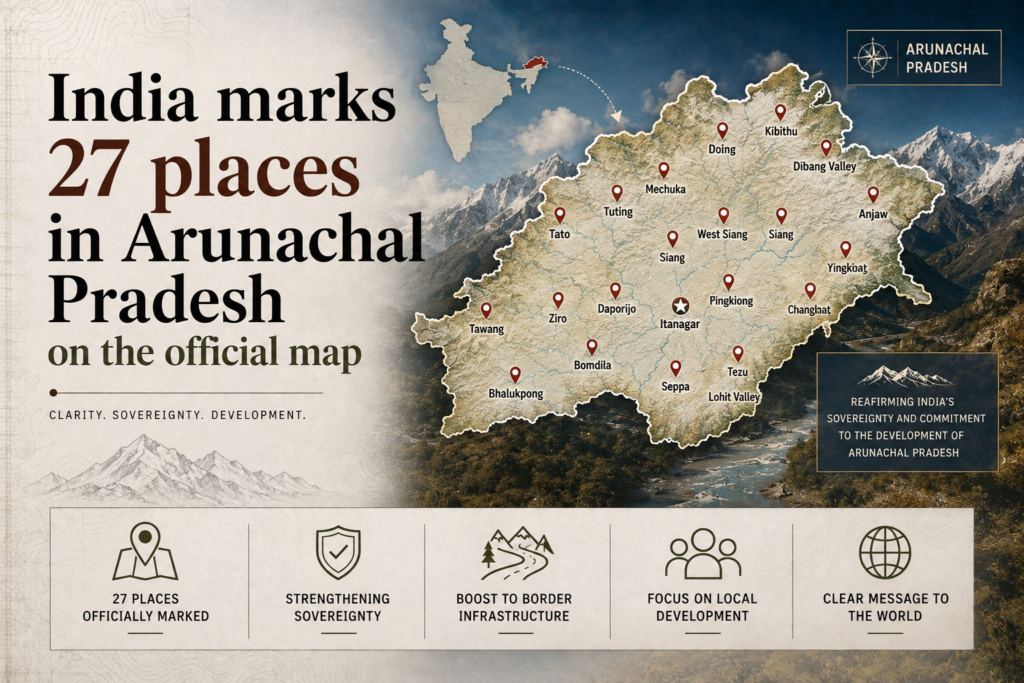
India officially marked 27 places in Arunachal Pradesh with standard names on Survey of India maps, responding to China’s attempts to rename locations in the State.
What is the Cartographic Dispute?
China: Calls Arunachal Pradesh Zangnan and periodically assigns Chinese names to locations.
India: Rejects China’s claims and maintains that Arunachal Pradesh is an integral part of India.
Strategic Locations
Long Ju: Site of a 1959 India China boundary confrontation.
Thag La: Strategic ridge associated with the 1962 India China War.
Why Does Naming Matter?
LAC: Reinforces India’s position along the disputed Line of Actual Control.
Sovereign record: Official mapping creates a formal cartographic record of India’s territorial claims.
Information warfare: Place naming is also a tool of strategic signalling and narrative competition.
What Remains Unresolved?
The India China boundary dispute remains unsettled despite diplomatic and military negotiations.
Cartographic measures do not by themselves alter the ground position or resolve the boundary.
Back2Basics: Survey of India
Status: India’s national mapping agency and one of the oldest scientific departments of the Government of India.
Ministry: Department of Science and Technology.
Role: Prepares official topographic and boundary maps.