💥Join UPSC 2027,2028 Mentorship (August Batch) + XFactor Notes & Microthemes PDF

GS Paper: Governance, Transparency & Accountability, Citizens Charters

  • Four-year UG Program formally launched in Kerala

    Why in the News?

    Kerala CM Pinarayi Vijayan inaugurated the curriculum of Four-Year Undergraduate Programmes (FYUP) in the state, stressing that it is in line with changes in the Global Education System where the focus is equally on imparting knowledge as well as the transfer of skills and vocational training.

    About Four-Year Undergraduate Program (FYUP):

    Parameters Details
    Key features 
    • Students can choose their major and minor subjects freely, for example science students can pursue humanities courses.
    • Provision for students to complete the degree in 2.5 years if they secure the required credits.
    • Offers 16 FYUP honors programs with research across science, arts, commerce and business streams at the University of Kerala.
    FYUP curriculum
    • It is designed to provide students with knowledge, intellectual abilities, multidisciplinary perspectives, flexible skills, social commitment and research aptitude to make them responsible citizens and offer multiple opportunities in research and employment
    • Includes online courses, skill development, internships and research projects.
    Eligibility criteria
    • Students need a CGPA of 7.5 or above to advance to the 4th year and get an honors degree with research.
    •  Admission based on 12th marks for now, entrance exam planned from next year.

    Administrative and Technological Upgrades required:

    • Regulatory Revisions: Plans for a comprehensive revision of University Acts and Regulations to streamline academic processes and enhance efficiency.
    • K-REAP Initiative: Introduction of Kerala Resources for Education Administration and Planning (K-REAP), a governance software to centralize institutional activities.

    Issues with FYUP Program

    • Implementation Challenges: The introduction of the FYUP faced logistical and administrative hurdles, impacting its rollout across Kerala’s higher educational institutions.
    • Curriculum Adaptation: Critics argue that the FYUP’s curriculum overhaul lacks sufficient alignment with industry needs and fails to adequately prepare students for real-world challenges.
    • Student Adaptation: Some students and educators have expressed concerns about the abrupt shift in academic structure and its impact on learning outcomes and student performance.
    • Evaluation Methods: There is ongoing debate over the effectiveness of the FYUP’s assessment methods, with some stakeholders questioning its ability to accurately gauge student knowledge and skills.
    • Policy Revisions: Continuous revisions and adjustments to the FYUP’s policies and regulations are needed to address evolving educational needs and feedback from various stakeholders.

    New Education Policy (NEP), 2020:

    • The New Education Policy (NEP) 2020 introduced by the Government of India aims to transform the educational landscape of the country.
    • One of the key changes in the NEP is the restructuring of the duration and framework of undergraduate programs.
    • The NEP 2020 introduces a four-year undergraduate program as a standard duration for bachelor’s degrees, replacing the traditional three-year format.
    • Students can exit the program at different stages with a qualification. For example:
      • After 1 Year: Certificate
      • After 2 Years: Diploma
      • After 3 Years: Bachelor’s Degree
      • After 4 Years: Bachelor’s Degree with Research


    PYQ:

    [2015] The quality of higher education in India requires major improvement to make it internationally competitive. Do you think that the entry of foreign educational institutions would help improve the quality of technical and higher education in the country. Discuss.

  • [4th July 2024] The Hindu Op-ed: Trials, medical ethics and the orbit of power

    [4th July 2024] The Hindu Op-ed: Trials, medical ethics and the orbit of power

    PYQ Relevance:
    Mains: 

    Q) If an amendment bill to the Whistleblowers Protection Act 2011 tabled in the Parliament is passed, there may be no one left to protect. Critically Evaluate. (UPSC CSE 2015) 

    Q) With consideration towards the strategy of inclusive growth, the new Companies Bill, 2013 has indirectly made CSR a mandatory obligation. Discuss the challenges expected in its implementation in earnest. Also, discuss other provisions in the Bill and their implications. (UPSC CSE 2013) 

    Note4Students: 

    Prelims:  Whistleblowers Protection Act 2011,

    Mains:  Ethical issues in the Medical sector,

    Mentor comment: On January 10, 2021, Rashida Bee, Nawab Khan, Rachna Dhingra, and Nausheen Khan alleged ethical violations in Bharat Biotech’s Covaxin trial at People’s Hospital, Bhopal. They cited informed consent breaches, enrollment of vulnerable groups, non-reporting of adverse events, and inadequate participant monitoring. They demanded intervention to halt the study and independent investigation. The outcome of their letter remains undisclosed.

    Let’s learn!

    __

    Why in the news? 

    In India, the primary safeguards intended to prevent medical ethics abuse are ineffective.

    What are the Primary safeguards?

    • Primary safeguards are fundamental measures or systems put in place to prevent unethical practices and ensure ethical standards are maintained.
    • These safeguards are designed to protect individuals and maintain integrity within processes, such as clinical trials.
    • They typically include regulatory frameworks, oversight committees, informed consent procedures, transparency requirements, and accountability mechanisms.

    Ethical Abuse 

    • Allegations of Ethical Violations in Covaxin Trial: Irregularities and ethical violations were alleged in the Covaxin clinical trial conducted by People’s Hospital in Bhopal, Madhya Pradesh. Violations included lack of informed consent, enrollment of vulnerable populations, non-reporting of adverse events, and inadequate monitoring and follow-up.
    • Regulatory Approval and Ethical Guidelines before the completion of Phase III study: The Indian drug regulator, Central Drugs Standard Control Organisation (CDSCO), approved Covaxin for “Restricted Use under Clinical Trial Mode” before the completion of its Phase III study.This approval process was not defined in India’s Drug Regulatory Framework, creating ambiguity and potential ethical lapses.
    • Lacking in the effectiveness of Ethics Committees: Ethics committees at trial sites are meant to oversee and ensure ethical conduct in clinical trials. There were issues with the effectiveness of these committees, with allegations of gross violations of ethics guidelines.
    • Whistle-blowers show the various incidents of ethical violations: Whistle-blowers play a crucial role in exposing ethical violations in medical experimentation.  Carl Elliott’s book, “The Occasional Human Sacrifice,” details various incidents of ethical violations in medical trials, highlighting the courage required to speak out.

    Innovative therapies and ethics

    • Balancing Risk and Benefit: Developing life-saving medicines involves a delicate balance between the potential risks to patients and the projected benefits of the therapeutic candidate. This process requires specialised knowledge and experience to make informed decisions, which is often lacking, leading to ethical challenges.
    • Lack of Expertise in Clinical Development: India has a strong generic drug manufacturing industry but lacks deep expertise in developing innovative therapies. The management of clinical development is often overseen by medical doctors who may not have specialized knowledge in drug development, leading to ethical violations and inadequate oversight.
    • Ethical Violations in Pandemic Response: During the COVID-19 pandemic, there were examples of medical ethics being compromised, such as unrealistic projections of case numbers and the creation of terms like “emergency use authorization in clinical trial mode” to justify premature decisions. These actions highlight the need for better guardrails and ethical standards in managing the development and approval of new therapies.

    Indian Patients and Clinical Studies

    • Violation of Informed Consent: There is a historic and repeated violation of informed consent in India, with poor and uneducated patients being enrolled in clinical studies without being fully informed of potential harm. Ensuring informed consent falls under the responsibility of institutional ethics committees, whose effectiveness is often questionable.
    • Ineffectiveness of Institutional Ethics Committees: Despite existing on paper and in regulations, the functioning and effectiveness of institutional ethics committees in India are patchy. A study by Gayatri Saberwal et al. (2022) identified numerous issues, such as clinical trials without ethics committees and trials with more sites than functional ethics committees.
    • Abuse of Regulations by the Industry: A significant abuser of these regulations is a section of the industry promoted by the Ministry of AYUSH, which conducts poorly designed and executed clinical studies with zero oversight. These studies often aim to provide a veneer of scientific validity to various concoctions without proper ethical standards.
    • Comparison with Western Systems: Even well-designed and well-run systems in the West face challenges in maintaining checks and balances on accountability. India’s systems are far from achieving the same level of function and effectiveness, highlighting a significant gap in ethical standards and accountability in clinical studies.

    Way forward: 

    • Enhancing Training and Oversight: Provide specialized training for members of institutional ethics committees to ensure they have the necessary knowledge and skills to oversee clinical trials effectively. Regular audits and monitoring should be conducted to assess the performance and adherence to ethical guidelines.
    • Independent Audits: Conduct independent audits of clinical trial sites and ethics committees to ensure compliance with ethical standards and regulatory requirements. Establish clear consequences for non-compliance to deter unethical practices.
    • Clear Guidelines and Definitions: Define clear regulatory pathways and guidelines for clinical trials, including terms like “Restricted Use under Clinical Trial Mode.” This will reduce ambiguity and ensure consistent application of ethical standards.
  • [3rd July 2024] Great expectations, liberalism in dark times


    PYQ Relevance:

    Mains: 

    Q. In the context of the neo-liberal paradigm of development planning, multi-level planning is expected to make operations cost-effective and remove many implementation blockages.” Discuss. (UPSC IAS/2019)

    Q. ‘Whether National Commission for Scheduled Castes (NCSC) can enforce the implementation of constitutional reservation for the Scheduled Castes in the religious minority institutions? Examine. 

     (UPSC IAS/2018)

    Note4Students: 

    Prelims: Definition of Liberalism;

    Mains: Challenges to liberalism;

    Mentor comment: Politics, like philosophy, aims to reconcile diversity, where contradictions converge in a multicultural society. Understanding this harmony reflects an idealistic state that prioritizes coexistence and universal welfare. However, global democratic history reveals ongoing challenges to liberalism, which safeguards against authoritarianism and protects civil rights. Amid rising sectarianism, the fundamental question persists: Who deserves basic rights? This issue underscores civil discrimination, racial politics, and xenophobia, exacerbated by the rise of right-wing nationalism and global migration dynamics.

    Let’s learn.

    Why in the News?

    There remains a glimmer of hope in the resilience of democratic forces, which can effectively counteract and uproot any divisive political aberration when the time is ripe.

    What is Liberalism?

    • Liberalism is a political and philosophical ideology that emphasizes individual rights, liberty, equality under the law, and limited government intervention in personal and economic affairs. It advocates for freedoms such as freedom of speech, press, religion, and assembly, and supports democratic processes, rule of law, and protection of civil liberties. Liberalism typically promotes social progress through tolerance, pluralism, and a commitment to human rights and justice.


     Electoral outcomes

    • Shift in Public Opinion: There is a noticeable shift towards conservative and right-wing ideologies, marked by sentiments such as climate scepticism, anti-migration views, and nationalism. This trend was reflected in recent elections both in Europe and India.
    • Voter Response: Despite expectations favouring right-wing outcomes, the electorate, particularly in India, was surprised with a strong rejection of what was perceived as authoritarianism and communalism. This indicates a robust defense of democratic values and fundamental rights.
    • Impact on Minority Communities: The election results have been seen as a reassurance to minority communities, particularly Muslims, who felt marginalized and insecure due to perceived policies of exclusion and communal tension.
    • Democratic Fortitude: The outcome is portrayed as a reaffirmation of democracy’s strength in allowing for checks and balances against oppressive regimes and divisive politics.
    • Hope for Robust Opposition: There is optimism about the emergence of a strong opposition capable of holding the government accountable, promoting debate, and safeguarding diverse civil society interests.
    • Challenges and Aspirations: The electorate expects rational governance, justice, and responsiveness to marginalized groups’ issues such as poverty, unemployment, and hunger.
    • Ethical Governance: Emphasis is placed on governance that respects human rights universally, avoiding discrimination or exclusion based on ethnicity, religion, or political affiliation.

    Verdict and the Advent of Hope

    • Challenge to Democracy: The passage highlights a global erosion of democratic values, with right-wing governments accused of manipulating truth and resorting to oppressive tactics to maintain power.
    • Call for Tempered Liberalism: There’s a plea for ruling dispensations to embrace a more moderate form of liberalism, abandoning illiberal practices that undermine democratic norms and freedoms.
    • Role of Opposition: Expectations are set on opposition alliances to uphold principles of humility, pluralism, and modesty, providing a counterbalance to dominant political forces.
    • Philosophical Reflection: The outcome of elections prompts reflection on political astuteness and statesmanship, essential for navigating the trajectory of democracy amidst global challenges.
    • Natural vs Civil Order: Drawing from Spinoza, the clash between natural self-interest and civil responsibility underscores the necessity of societal order governed by law and morality to prevent chaos and uphold rights.
    • Hope and Scepticism: The Indian electoral outcome reflects a dual sentiment of hope and scepticism, shaping the future direction of democracy and fostering philosophical introspection.

    Challenges to liberalism:

    • Rise of Right-Wing Sentiment: There is a global trend towards right-wing ideologies, marked by climate scepticism, anti-migration sentiment, and nationalist fervour, posing challenges to liberal values and policies.
    • Authoritarianism and Communalism: The resurgence of authoritarianism and communal politics threatens democratic principles and societal harmony, particularly impacting marginalized communities like Muslims.
    • Hope and Despair: The electorate’s response reflects a mix of hope and despair, with optimism placed in a robust opposition and democratic institutions to safeguard fundamental rights and uphold civil society diversity.
    • Balancing Public and Private: The need for a nuanced approach in reconciling private religious beliefs with public, politicized lifestyles without diminishing individual rights is crucial for fostering a tolerant society.

    Way forward: 

    • Policy Reforms: Implement inclusive policies that address economic disparities, social inequalities, and regional disparities effectively. This includes measures to tackle poverty, unemployment, and hunger through targeted welfare programs.
    • Social Integration: Foster initiatives that promote social cohesion and integration across diverse communities. Encourage dialogue and understanding among different cultural and religious groups to mitigate communal tensions.
    • Democratic Checks and Balances: Enhance the autonomy and effectiveness of democratic institutions such as the judiciary, election commissions, and anti-corruption bodies. Ensure they operate independently and transparently to uphold democratic principles.
    • Dialogue and Consensus-Building: Foster inclusive decision-making processes that involve stakeholders from diverse backgrounds. Encourage political parties to engage in constructive dialogue and seek consensus on key policy issues.
  • On Tamil Nadu’s financial distress   

    Why in the news?

    At a June 22 meeting for Union Budget 2024-25, Tamil Nadu’s Finance Minister Thangam Thennarasu requested ₹63,246 crore for Chennai Metro Rail Phase-2, ₹3,000 crore for disaster restoration, and increased unit costs for centrally sponsored schemes.

    How are the funds for phase two of the Chennai Metro Rail distributed?

    • Funding Agencies and International Support: Chennai Metro Rail Phase-2 is financed by multiple international agencies, including the Japan International Cooperation Agency (JICA), Asian Development Bank (ADB), Asian Infrastructure Investment Bank (AIIB), and New Development Bank (NDB).
    • State Government Contributions: Up to March 31, 2024, the Tamil Nadu government sanctioned ₹5,400 crore as share capital for the Chennai Metro Rail Limited (CMRL) and ₹12,013.89 crore as subordinate debt, bearing the entire expenditure due to delays in approval from the Union Cabinet Committee on Economic Affairs (CCEA).

    Is the Centre stalling the funds for the metro project?

    Approval Status:

    • Public Investment Board: The Chennai Metro Rail Project’s Phase-2 was approved by the Public Investment Board (PIB) as a Central sector project under the equity sharing model in August 2021.
    • Union Cabinet Committee on Economic Affairs: The project has been awaiting approval from the Union Cabinet Committee on Economic Affairs (CCEA) since then.

    State Government Actions:

    • Foundation Stone: Despite the pending approval, the foundation stone for the phase was laid by Union Home Minister Amit Shah in November 2020 when the AIADMK was in power.
    • Ongoing Expenditure: The Tamil Nadu government continues to fund the project independently, stressing its finances and urging the Centre to sanction the project under the 50:50 equity sharing model as was done for Phase 1.

    What about funds released by the Centre for restoration work after natural disasters in the State?

    • Initial Request by Tamil Nadu: Tamil Nadu submitted detailed memoranda to the Union government, seeking approximately ₹37,906 crore for restoration works following two natural disaster spells in 2023.
    • Initial Central Release: The Union government initially released a sum of ₹276 crore for immediate restoration efforts.
    • Additional Approvals: The Union Ministry of Home Affairs (MHA) later approved additional assistance of ₹285.54 crore and ₹397.13 crore for the two disaster spells.
    • Disbursed Amounts: From these approvals, a total of ₹115.49 crore and ₹160.61 crore were disbursed under the National Disaster Response Fund (NDRF).
    • State Disaster Response Fund (SDRF): The Union government’s order also mentioned ₹406.57 crore as the 50% available in the State Disaster Response Fund (SDRF) account of Tamil Nadu as of April 1, 2023.

    Way forward: 

    • Metro Rail Project: The Union government should prioritize and expedite the approval process for significant infrastructure projects like the Chennai Metro Rail Phase-2. This can be achieved by setting stricter timelines for the Union Cabinet Committee on Economic Affairs (CCEA) to finalize decisions.
    • Natural Disaster Restoration: The Centre should reassess the current disaster relief funding mechanism to ensure timely and adequate financial support for states hit by natural disasters.

    Mains PYQ:

    Q Discuss the recent measures initiated in disaster management by the Government of India departing from the earlier reactive approach. (UPSC IAS/2020)

  • Will the Agnipath scheme be revamped? | Explained 

    Why in the news?

    Following the 2024 election results, NDA allies Janata Dal (United) and Lok Janshakti Party (Ram Vilas) raised concerns about the Agnipath scheme and called for discussions on the matter.

    What is the Agnipath scheme?

    • The Agnipath scheme recruits soldiers, sailors, and airmen into the Indian armed forces for a four-year term, replacing the previous system of permanent recruitment. After completing their four-year tenure, up to 25% of Agniveers can be selected for permanent positions within the armed forces.
    • Agniveers can obtain educational certificates and skill certifications during their service. They receive a lump sum amount upon completing their tenure but are not eligible for a pension.

    Issues Associated with the Scheme

    • Personnel Shortage: There is a significant shortage of personnel in the ‘below officer’s rank’ cadres, exacerbated by the recruitment freeze during the COVID-19 pandemic. The Army retires around 60,000 soldiers annually but only recruits 40,000, leading to a growing shortfall.
    • Low Conversion Rate: The 25% conversion rate from Agniveers to regular soldiers is considered insufficient to address the personnel shortage.
    • Compressed Training: The four-year tenure necessitates a shorter training period, which may impact the quality of training.
    • Political and Social Opposition: The scheme has faced political opposition and led to violent protests in some parts of the country. Critics argue for a clause-by-clause review or complete scrapping of the scheme.

    Present Scenario

    As the Agnipath scheme marks two years since its implementation, the Department of Military Affairs (DMA) in the Defence Ministry is reviewing the scheme based on feedback from the armed forces.

    • Feedback Compilation: The Navy and Air Force have compiled their feedback, while the Army is still in the process.
    • Recommendations: Suggestions include increasing the intake numbers, raising the permanent recruitment rate from 25% to at least 50%, and extending the age limit for technical recruits from 21 to 23 years.
    • Review Process: The DMA will compile all recommendations and submit them to the Defence Ministry for potential adjustments to the scheme.

    Way forward:

    • Enhance Educational and Skill Development Opportunities: Partner with educational institutions to provide Agniveers with advanced degrees and certifications that are recognized nationwide. Offer vocational training and skill development programs that are aligned with industry standards, improving post-service employability.
    • Increase Permanent Induction Rate: Raise the conversion rate of Agniveers to permanent positions from 25% to at least 50% to address the personnel shortage effectively.
  • [26th June 2024] The Hindu Op-ed: Agony still in Manipur, a year later

    PYQ Relevance: 

    Q What are the two major legal initiatives by the state since Independence, addressing discrimination against Scheduled Tribes (ST)? (UPSC IAS/2017)
    Q Why are the tribals in India referred to as ‘the Scheduled Tribes’? Indicate the major provisions enshrined in the Constitution of India for their upliftment. (UPSC IAS/2016)

    Mentors’ comment: The Meiteis and Kuki-Zos are the two major ethnic communities in Manipur engaged in a violent conflict since May 2022. The Meiteis, the dominant group in the Imphal valley, have demanded Scheduled Tribe status, which the Kuki-Zos in the hills oppose fearing loss of land and jobs. The conflict has led to over 220 deaths, thousands injured, and tens of thousands displaced, creating a humanitarian crisis.

    Let’s learn!

    Why in the news?

    The absence of Manipur Chief Minister N. Biren Singh was notable at the high-level security meeting on Manipur convened by Union Home Minister Amit Shah in New Delhi on June 17, 2024.

    Background issue:

    • Communities Involved: The primary conflict is between two major ethnic communities in Manipur: the Meitei and the Kuki-Zo tribes.
    • Violence and Casualties: The clashes have resulted in significant violence, including attacks on civilians and property. The conflict has led to a considerable loss of life, with casualties reported on both sides.
    • Displacement: The violence has caused widespread displacement within Manipur. Both Meiteis and Kuki-Zos have been forced to flee their homes, contributing to a humanitarian crisis in the region.
    • Reason: The roots of the conflict are deep-seated and include historical grievances and disputes over land, resources, and political representation.

    Issues related to High-Level Security Meeting:

    • Exclusion from High-Level Meetings: Manipur Chief Minister N. Biren Singh was conspicuously excluded from a high-level security meeting convened by Union Home Minister Amit Shah in New Delhi on June 17, 2024.
    • Centralized Control: Speculations arose about an undeclared President’s Rule in Manipur, indicating that the State government’s authority in handling the ethnic clashes between Meitei and Kuki-Zo tribes has been significantly diminished.
    • Appointment of Officials: The Director General of Police and Security Adviser for Manipur were appointed from outside the State following the outbreak of violence, highlighting a shift in administrative control away from local authorities.

    Recent challenges:

    • Misguided Separation Strategy: An attempt to create a buffer zone between the warring communities by dividing responsibilities between central forces and state police backfired.
    • Lack of Resolution Efforts: While violence temporarily subsided, underlying causes of discord between Meiteis and Kuki-Zos were not addressed, allowing tensions to persist and escalate unpredictably.
    • Presence of Security Forces: Despite a large deployment of around 70,000 personnel, the strategy has focused on managing rather than resolving the conflict, leading to sustained distrust and communal tensions.

    Impact on Meiteis and Kuki-Zos communities:

    • Casualties and Displacement: Official figures report 225 deaths, with significant displacement and mutual ethnic cleansing affecting both Meiteis and Kuki-Zos communities.
    • Blurred Victim-Perpetrator Lines: Over time, the distinction between victims and perpetrators has become less clear, complicating reconciliation efforts and deepening communal divisions.
    • Humanitarian Impact: The conflict has exacted a heavy toll on lives and properties, necessitating empathy and shared acknowledgement of suffering as a basis for reconciliation and eventual peace-building.

    Way forward: 

    • Inclusion of Local Leadership: Ensure the meaningful participation of Manipur Chief Minister N. Biren Singh and local community leaders in high-level security meetings and decision-making processes. This can help in fostering trust and ownership of initiatives aimed at resolving the conflict.
    • Address Root Causes: Conduct a comprehensive assessment to identify and address the underlying causes of ethnic tensions, such as historical grievances, competition over resources, and political representation. Develop policies and initiatives that aim at long-term reconciliation rather than short-term management of conflict.

    Source: 

    https://www.thehindu.com/opinion/lead/agony-still-in-manipur-a-year-later/article68332570.ece#:~:text=There%20seem%20to%20be%20no,placed%20in%20virtual%20animated%20suspension.
  • Indian Railways and safety challenges

    Why in the news?

    The turmoil has not subsided since the tragic accident involving the GFCJ container train, which, while travelling at high speed, collided with the 13174 Agartala-Sealdah Kanchanjunga Express, resulting in 11 deaths and approximately 40 injuries.

    Indian Railways: Recent Issues

    • Tragic Accident: The GFCJ container train collided with the 13174 Agartala-Sealdah Kanchanjunga Express, causing 11 deaths and around 40 injuries.
    • Premature Conclusions: The Chairperson of the Railway Board prematurely blamed the container train crew and provided incorrect information about casualties.
    • Slow Rollout of Kavach System: Kavach, an indigenous signalling system to prevent collisions, has been slowly implemented due to limited industrial capacity.
    • Staffing Issues: Indian Railways is overstaffed but has critical vacancies in safety-sensitive positions, leading to stress and overwork for existing staff.
    • Ambiguous Protocols: Ambiguous rules for handling Automatic signal failures create confusion and increase the risk of accidents.

    What are the major challenges that Indian Railways faces?  

    • Safety Concerns: Inadequate measures to prevent collisions and improve overall safety, despite technological advancements.
    • Staffing Shortages: Critical vacancies in essential roles such as loco pilots, train managers, and signal maintainers, lead to overworked staff.
    • Slow Technological Implementation: Delayed implementation of safety technologies like the Kavach system due to limited industrial capacity and lack of focus.
    • Ambiguous Safety Protocols: Poorly drafted rules and unclear protocols for handling signal failures and emergencies.
    • Managerial and Communication Issues: Premature conclusions and miscommunication by top management, undermine trust and effective crisis management.

    What can be the solution?

    • Enhanced Safety Protocols: Strengthen and clarify protocols for Automatic signal failures and other emergency situations.
    • Accelerated Technology Adoption: Fast-track the implementation of safety technologies like the Kavach system, with targets of 4,000 to 5,000 km/year.
    • Increase Recruitment in Critical Areas: Fill vacancies in essential safety roles promptly to reduce stress and workload on existing staff.
    • Encourage Industrial Capacity Building: Support and incentivize allied industries to increase capacity for producing and implementing safety technologies.
    • AI-Enabled Safety Monitoring: Implement AI-enabled applications to analyze digital data from station loggers and train microprocessors for actionable safety insights.
    • Focus on Managerial Accountability: Ensure that managerial issues are thoroughly investigated and addressed to improve overall safety management.

    Steps taken by the government:

    • The government has established the Rashtriya Rail Sanraksha Kosh (RRSK), a dedicated fund with a corpus of Rs. 1 lakh crore over 5 years, to finance critical safety asset replacement, renewal, and upgradation.
    • The government has implemented Electrical/Electronic Interlocking Systems at 6,427 stations as of May 2023, which centrally operate points and signals to eliminate human error-related accidents.

    Conclusion: Strengthen and clarify safety protocols for handling signal failures and emergencies, ensuring clear guidelines and training for staff. Fast-track the implementation of safety technologies like the Kavach system, setting annual targets of 4,000 to 5,000 km to improve overall safety and prevent collisions.

    Mains PYQ:

    Q Why is Public Private Partnership (PPP) required in infrastructural projects? Examine the role of PPP model in the redevelopment of Railway Stations in India. (UPSC IAS/2022)

  • India among a select few countries that have not conducted the Census    

    Why in the news?

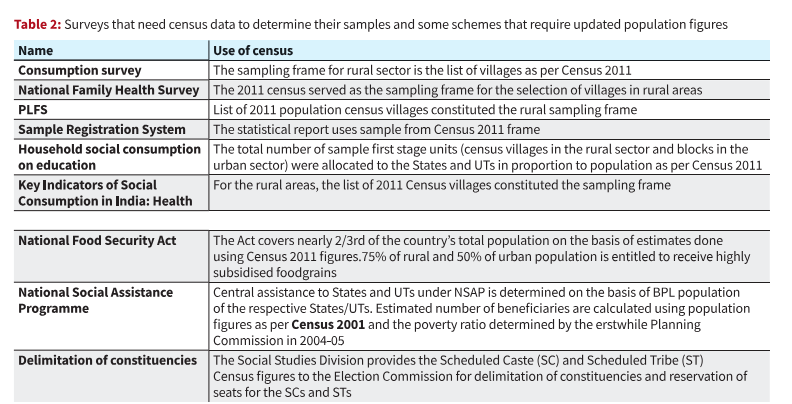
    India’s last census was conducted in 2011, and the scheduled Census 2021 has been indefinitely postponed, citing the COVID-19 pandemic. This delay has significant implications for welfare schemes and policy planning reliant on accurate population data.

    Significance of Census Calculation  

    • Foundation for Policy Planning and Governance: Census data forms the foundational basis for policy planning and governance across various sectors such as education, healthcare, infrastructure development, and social welfare.
    • Allocation of Resources and Welfare Benefits: Census figures are crucial for determining the allocation of resources and distribution of welfare benefits like food subsidies, housing schemes, healthcare facilities, and educational resources.
    • Monitoring Socio-Economic Development: Census data enables monitoring of socio-economic development indicators over time, such as literacy rates, employment patterns, poverty levels, and household incomes.

    Present Observations:

    • Global Comparison: India is among a minority of countries (44 out of 233) that have not conducted the latest census, despite most nations managing to proceed with their census rounds after March 2020, amidst the pandemic. This delay places India alongside conflict-affected countries and those facing economic crises.
    • Regional Context: Among BRICS nations, India is the only country yet to conduct its latest census, contrasting with others such as Brazil, China, South Africa, and Russia, which have completed their census rounds during or after the pandemic.
    • Dependency on Census Data: Census data serves as the primary source for accurate demographic information at grassroots levels, crucial for planning and implementing welfare schemes across various sectors, including education, healthcare, and social security.

    Implications for Society:

    • Welfare Scheme Implementation: The absence of updated census figures hampers the effective implementation of welfare schemes such as the Public Distribution System (PDS), National Family Health Survey, and National Family Security Act. Outdated population data from 2011 leads to inaccuracies in identifying beneficiaries, potentially excluding millions from essential services and entitlements.
    • Education and Social Development: Schemes like the Eklavya Model Residential School (EMRS), aimed at providing quality education to Scheduled Tribe (ST) children, are adversely affected. Allocation decisions based on 2011 census data may not accurately reflect current demographic realities, leading to misplaced resource distribution and missed opportunities for targeted interventions.
    • Economic and Social Planning: Census data plays a pivotal role in economic planning, resource allocation, and policy formulation. Without updated population figures, India faces challenges in devising evidence-based policies that address regional disparities, socio-economic needs, and demographic shifts effectively.

    Conclusion: The indefinite postponement of Census 2021 in India has profound implications for governance, socio-economic planning, and equitable development. Addressing these challenges requires expedited efforts to conduct the census and ensure accurate demographic data to inform inclusive policy frameworks.

    Mains question for practice: 

    Q Discuss the present observations regarding India’s census delay and analyze its implications. 15M

  • What is ‘Blood Money’ in Islamic Law?

    Why in the News?

    • The Indian Government has approved the transfer of the sum of $40,000 for preliminary discussions regarding the release of Nimisha Priya from a Yemeni prison.
      • Currently, Priya’s mother is in Yemen, trying to waive her death penalty by paying “blood money” to the murdered man’s family.

    Nimisha Priya’s Case Details

    • Priya, a nurse, moved to Yemen in 2008 and married Tomy Thomas in 2011 before returning to Yemen.
    • She faced abuse and exploitation by Talal Abdo Mahdi, leading to the tragic events resulting in Mahdi’s death and Priya’s arrest.
    • The $40,000 payment aims to initiate negotiations for Priya’s release.
    • To waive the death penalty, Priya’s family may need to raise $300,000-$400,000.
    • The ‘Save Nimisha Priya International Action Council’ is fundraising to meet this requirement.

    What is Blood Money?

    • According to Islamic law, victims of crimes have a say in how criminals are to be punished.
    • In the case of murder, this principle applies to the families of victims.
    • Although murder is punished via the death penalty, the victim’s family (specifically, heirs) may choose to “forgive” the murderer in exchange for monetary compensation.
    • This is the principle of Diyya, or, as it is commonly referred to “blood money”.
    • It can be traced to the Holy Quran.
    • Applicability:
      • Blood money is applicable in cases of unintentional homicide (Qatl Khata) or accidental death, as well as in cases of bodily injury or harm caused by negligence or unintentional actions.

    Practical Implications of Blood Money

    • Scholars believe that the idea behind this is to encourage the virtue of forgiveness, while also providing reparative justice to the victims’ family.
    • The scriptures do not set any specific amount as compensation.
    • The sum is generally arrived at via negotiation between the murderer’s family/representatives and the victim’s family.
    • Some Islamic countries, however, have set minimum compensation amounts.

    Significance of Blood Money

    • Forgiveness from the victim’s family is highly encouraged and considered virtuous in Islam.
    • Blood money aims to prevent cycles of vengeance or retaliation (Qisas) that could lead to further social harm or conflict.
    • It promotes reconciliation and mutual understanding.
  • What is SWM Cess and Why is It Levied on Waste Generators?

    Why in the News?

    The Bruhat Bengaluru Mahangara Palike (BBMP) has proposed a Solid Waste Management (SWM) Cess of ₹100 per month for each household.

    What is Cess?

    • A cess is a form of tax or levy imposed by governments to fund specific services or purposes, such as waste management or infrastructure development.

    How has the SWM cess fared so far?

    • Purpose of SWM Cess: SWM Cess is intended to cover a portion of the costs incurred by Urban Local Bodies (ULBs) in providing SWM services, which are resource-intensive and crucial for maintaining cleanliness and health standards in urban areas.
    • Legal Provisions: According to the Solid Waste Management Rules, 2016, ULBs are mandated to collect user fees/cess for SWM services. The proposed increase reflects the rising costs and challenges faced by ULBs in managing solid waste effectively.

    Why has it hit the headlines suddenly?

    • Significant Increase in User Fee: The proposed SWM Cess represents a substantial increase from the previous user fees typically charged by ULBs (Urban Local Bodies) across India, which are generally in the range of ₹30-50 per month. Such a significant rise in fees has garnered attention and sparked debate among residents and stakeholders in Bengaluru.
    • Impact on Residents: The SWM Cess directly affects every household in Bengaluru, potentially adding financial burden on residents. This has led to widespread discussions and concerns among citizens about the affordability and justification of the proposed increase.

    Present Status in Bengaluru:

    • Bengaluru faces significant challenges in solid waste management (SWM) due to its large population and high daily waste generation of approximately 5,000 tonnes. Managing such volumes requires extensive resources and infrastructure.
    • The Bruhat Bengaluru Mahangara Palike (BBMP) primarily focuses its SWM efforts on the collection and transportation of waste. These activities are labor-intensive and consume a major portion of BBMP’s budget allocated for SWM services.
    • SWM services constitute a substantial portion of BBMP’s budget, with limited revenue generated from these services. This financial strain necessitates the proposal of initiatives like the SWM Cess to bridge the funding gap and ensure sustainable service delivery.

    What is about to change?

    • Proposed Changes: Going forward, Bengaluru plans to implement several changes in its SWM strategy.
      • These include revising user fees and potentially increasing charges on bulk waste generators to better cover operational costs and enhance service efficiency.
    • Strategies for Improvement: BBMP aims to enhance waste management practices through initiatives such as waste segregation at source, promoting decentralized composting centres, and launching public awareness campaigns. These efforts are aimed at optimizing resource utilization and improving overall SWM effectiveness in the city.

    Mains PYQ: 

    Q What are the impediments in disposing of the huge quantities of discarded solid wastes which are continuously being generated? How do we remove safely the toxic wastes that have been accumulating in our habitable environment? (UPSC IAS/2018)