💥Mains Ready By December. Smash Mains & Smash PYQ Admissions Open

GS Paper: Government Scheme/Policies

  • Pradhan Mantri Ujjwala Yojana  (PMUY)

    Why in the News?

    New Delhi CM has announced expanding Ujjwala Yojana to families using traditional stoves or coal heaters to improve air quality and promote clean cooking.

    About Pradhan Mantri Ujjwala Yojana (PMUY):

    • Overview: Introduced in 2016 by the Ministry of Petroleum and Natural Gas to provide clean cooking fuel (LPG) to poor and rural households.
    • Objective: Replace traditional cooking fuels like firewood, dung, and coal with LPG, improving women’s health, reducing indoor pollution, and promoting clean energy.
    • Target and Beneficiaries: Initially aimed to provide 8 crore LPG connections to deprived households by March 2020, with each connection issued in the name of an adult woman from the household.
    • Financial Support: Government provides ₹1,600 per connection, covering the security deposit, first refill, and stove (hotplate)– all free of cost.
    • Subsidy Entitlement: Beneficiaries eligible for up to 12 LPG cylinder subsidies per year (each of 14.2 kg).
    • Eligibility Criteria:
      • Adult woman from a poor household without an existing LPG connection.
      • Must belong to SECC 2011, SC/ST, PMAY, AAY, Forest Dweller, Most Backward Class, or Tea/Ex-Tea Garden Tribe categories.
      • Others can apply under “poor household” category by submitting a 14-point self-declaration.
    • Application Process: Available both online and offline through oil marketing companies.
    • Ujjwala 2.0: Announced in August 2021 to expand coverage by 1 crore new LPG connection, especially targeting migrant workers and urban poor.
      • Financial Assistance: Continued ₹1,600 per connection support with a free stove and first gas cylinder; subsequent refills paid by users.

    Achievements:

    • LPG Coverage Growth: Expanded national LPG coverage from 62% (2016) to 99.8% (April 2021).
    • Employment Generation: Created ~1 lakh jobs in the LPG distribution and logistics network.
    • COVID-19 Relief: Provided 14 crore free refills to PMUY households under the Pradhan Mantri Garib Kalyan Package (PMGKP).
    • Environmental Impact: Significant decline in biomass stove dependence, improving air quality and reducing household emissions.
  • Centre amends MGNREGA for Water Conservation in Scarcity Zones

    Why in the News?

    The Central Government has amended the Mahatma Gandhi National Rural Employment Guarantee Act (2005) to mandate a minimum share of funds for water conservation and harvesting works. Earlier this month, MGNREGA completed 20 years of its implementation.

    What is entailed in this MGNREGA (2005) Amendment?

    • Objective: Prioritise long-term water management, shift focus from reactive drought relief to preventive groundwater conservation.
    • Provision Amended: Paragraph 4(2), Schedule I of MGNREGA (2005).
    • Mandate: Minimum share of MGNREGA funds earmarked for water conservation & harvesting works.
    • Allocation Criteria: Based on groundwater stress classification (Central Ground Water Board (CGWB) assessment):
      • 65% in over-exploited / critical (dark zones).
      • 40% in semi-critical blocks.
      • 30% in safe/non-critical blocks.
    • Responsibility: District Programme Coordinator / Programme Officer must ensure compliance.
    • Earlier Provision: Gram Panchayats could prioritise works; at least 60% of funds had to go to agriculture & allied works, including water.

    About MGNREGA:

    • Overview: MGNREGS is a rights-based Centrally Sponsored Scheme launched under the MGNREGA Act of 2005 to ensure the Right to Work for rural households.
    • Origins:
      • The idea of employment guarantee in India began with Maharashtra’s pilot, Employment Guarantee Scheme (MEGS), in 1965 under the Vasantrao Naik government.
      • At the national level, the idea was first proposed in 1991 by then PM P. V. Narasimha Rao and later enacted in 2005.
    • Employment Guarantee: It provides 100 days of wage employment per year to any adult willing to do unskilled manual labour in rural India.
    • Legal Obligation: It is the first law in India that imposes a legal duty on the government to provide employment and compensate for non-compliance.
    • Development Goal: The scheme aims to promote livelihood security, inclusive growth, and rural development.

    Key Features:

    • Statutory Right: Employment under MGNREGS is a legal entitlement, not just a welfare scheme.
    • Eligibility: Any rural adult aged 18 or above can apply and must be offered work within 15 days.
    • Proximity and Wages: Work must be provided within 5 km of the applicant’s residence with minimum wage, and delays attract compensation.
    • Unemployment Allowance: If work is not provided on time, the state must pay an allowance.
    • Demand-Driven Model: The scheme is worker-initiated, requiring the government to respond to demand.
    • Transparency and Audits: Regular social audits and online updates ensure accountability in job cards, muster rolls, and fund use.
    • Local Implementation: It is decentralised, led by Gram Panchayats, with support from block and state officials, and centrally funded.
    • Women’s Inclusion: At least one-third of beneficiaries must be women, enhancing gender equity.
    • Sustainable Assets: Projects focus on durable rural infrastructure like ponds, roads, canals, and plantations.
    [UPSC 2011] Among the following who are eligible to benefit from the “Mahatma Gandhi National Rural Employment Guarantee Act”?

    (a) Adult members of only the scheduled caste and scheduled tribe households

    (b) Adult members of below poverty line (BPL) households

    (c) Adult members of households of all backward communities

    (d) Adult members of any household *


  • [pib] Swasth Nari, Sashakt Parivar Abhiyaan (SNSPA)

    Why in the News?

    Prime Minister has launched the Swasth Nari, Sashakt Parivar Abhiyaan (SNSPA) alongside the 8th Rashtriya Poshan Maah.

    [pib] Swasth Nari, Sashakt Parivar Abhiyaan (SNSPA)

    About Swasth Nari, Sashakt Parivar Abhiyaan (SNSPA):

    • Launch: Introduced on 17 September 2025 by the PM, jointly led by Ministry of Health and Family Welfare and the Ministry of Women and Child Development.
    • Objective: Strengthen women’s, children’s, and family health services, focusing on rural, tribal, and underserved regions.
    • Scale: Over 10 lakh health camps at Ayushman Arogya Mandirs, Community Health Centres (CHCs), and District Hospitals.
    • Screenings: Anaemia, hypertension, diabetes, TB, breast and cervical cancers, sickle cell disease, reproductive health conditions.
    • Services offered: Maternal, child, adolescent health including antenatal care, immunisation, nutrition counselling, menstrual hygiene, mental health, lifestyle awareness.
    • Digital Monitoring: SASHAKT portal ensures real-time data tracking and transparency.
    • Jan Bhagidaari: Collaboration with private hospitals, SHGs, Anganwadis, Panchayati Raj institutions, volunteers.
    • Tribal Focus: Specialised medical services and tailored counselling for remote and tribal areas.

    What is Rashtriya Poshan Maah?

    • Overview: Part of POSHAN Abhiyaan (National Nutrition Mission); celebrated annually since 2018.
    • 2025 Edition: 8th Poshan Maah, aligned with SNSPA for synergised impact.
    • Aim: Mobilise communities to improve nutrition of children, pregnant women, lactating mothers, and adolescent girls.
    • Activities: Poshan Panchayats, health and nutrition camps, recipe demos, rallies, school-Anganwadi outreach, Jan Andolan approach.
    • Focus Areas (2025):
      • Anaemia Mukt Bharat and micronutrient awareness.
      • Complementary feeding practices for infants and toddlers.
      • Poshan-Vatika (nutri-gardens) for food security.
      • Promotion of traditional and regional diets for sustainable nutrition.
    [UPSC 2024] With reference to the ‘Pradhan Mantri Surakshit Matritva Abhiyan’, consider the following statements:

    1. This scheme guarantees a minimum package of antenatal care services to women in their second and third trimesters of pregnancy and six months post-delivery health care service in any government health facility.

    2. Under this scheme, private sector health care providers of certain specialities can volunteer to provide services at nearby government health facilities.

    Which of the statements given above is/are correct?

    Options: (a) 1 only (b) 2 only* (c) Both 1 and 2 (d) Neither 1 nor 2


  • 20 Years of MGNREGS

    Why in the News?

    On the 20th anniversary of Mahatma Gandhi National Rural Employment Guarantee Act, 2005, concerns were raised over chronic underfunding of the scheme during the past decade.

    About MGNREGS:

    • Overview: MGNREGS is a rights-based Centrally Sponsored Scheme launched under the MGNREGA Act of 2005 to ensure the Right to Work for rural households.
    • Origins:
      • The idea of employment guarantee in India began with Maharashtra’s pilot, Employment Guarantee Scheme (MEGS), in 1965 under the Vasantrao Naik government.
      • At the national level, the idea was first proposed in 1991 by then PM P. V. Narasimha Rao and later enacted in 2005.
    • Employment Guarantee: It provides 100 days of wage employment per year to any adult willing to do unskilled manual labour in rural India.
    • Legal Obligation: It is the first law in India that imposes a legal duty on the government to provide employment and compensate for non-compliance.
    • Development Goal: The scheme aims to promote livelihood security, inclusive growth, and rural development.

    Key Features:

    • Statutory Right: Employment under MGNREGS is a legal entitlement, not just a welfare scheme.
    • Eligibility: Any rural adult aged 18 or above can apply and must be offered work within 15 days.
    • Proximity and Wages: Work must be provided within 5 km of the applicant’s residence with minimum wage, and delays attract compensation.
    • Unemployment Allowance: If work is not provided on time, the state must pay an allowance.
    • Demand-Driven Model: The scheme is worker-initiated, requiring the government to respond to demand.
    • Transparency and Audits: Regular social audits and online updates ensure accountability in job cards, muster rolls, and fund use.
    • Local Implementation: It is decentralised, led by Gram Panchayats, with support from block and state officials, and centrally funded.
    • Women’s Inclusion: At least one-third of beneficiaries must be women, enhancing gender equity.
    • Sustainable Assets: Projects focus on durable rural infrastructure like ponds, roads, canals, and plantations.
    [UPSC 2006] Consider the following statements in respect of the National Rural Employment Guarantee Act, 2005:

    1. The Act provides 100 days of employment to households as a fundamental right.

    2. Women are given priority such that half of the employment seekers are women.

    Which of the statements given above is/are correct?

    Options: (a) 1 only (b) 2 only (c) Both 1 and 2 (d) Neither 1 nor 2 *


  • [pib] Members of Parliament Local Area Development Scheme (MPLADS)

    Why in the News?

    The Ministry of Statistics and Programme Implementation (MoSPI) recently organized a national workshop on the e-SAKSHI web portal and mobile app for the Members of Parliament Local Area Development Scheme (MPLADS).

    About MPLADS:

    • Overview: A Central Sector Scheme, launched in 1993, to empower MPs to recommend developmental works in their constituencies, focusing on durable community assets addressing local needs.
    • Administration: Initially under the Ministry of Rural Development; Since 1994, managed by MoSPI.
    • Implementation:
      • State-level nodal department supervises implementation.
      • District authorities sanction projects, release funds, and ensure execution.
    • Funding:
      • Each MP gets ₹5 crore per year (since 2011–12).
      • Disbursed by MoSPI in two instalments of ₹2.5 crore each to district authorities.
      • Funds are non-lapsable i.e. carried forward if unutilized.
    • Targeted Allocation: Minimum 15% for SCs and 7.5% for STs.
    • Special Provisions:
      • Up to ₹25 lakh annually can be spent outside constituency/state for national unity projects.
      • Up to ₹1 crore can be allocated nationwide during severe natural calamities.
    • Eligible Projects:
      • Durable community assets (e.g., libraries, community halls, ambulances, sports infrastructure, sanitation).
      • MPLADS funds can be converged with MGNREGS or integrated with Khelo India for asset creation.
      • Support allowed on lands of registered societies/trusts (3+ years old) engaged in welfare work.
      • Prohibited for societies/trusts where the MP/family are office-bearers.
    • Transparency Measures:
      • Plaque with MP’s name and project details must be installed at project sites.
      • Project details listed in district offices, MPLADS website, and accessible via RTI.
    • Monitoring & Audit:
      • District authorities inspect at least 10% of projects annually.
      • Funds audited by statutory auditors.
      • Regular review meetings at state and central levels.
    • e-SAKSHI platform: Enables MPs to digitally recommend, monitor, and track MPLADS projects, improving transparency, accountability, and efficiency in fund utilization.
    [UPSC 2020] With reference to the funds under Members of Parliament Local Area Development Scheme (MPLADS), which of the following statements are correct?

    1. MPLADS funds must be used to create durable assets like physical infrastructure for health, education, etc.

    2. A specified portion of each MP’s ‘fund must benefit SC/ST populations.

    3. MPLADS funds are sanctioned on yearly basis and the unused funds cannot be carried forward to the next year.

    4. The district authority must inspect at least 10% of all works under implementation every year.

    Select the correct answer using the code given below:

    Options: (a) 1 and 2 only (b) 3 and 4 only (c) 1, 2 and 3 only (d) 1, 2 and 4 only*


  • [pib] PM Viksit Bharat Rozgar Yojana (PM-VBRY)

    Why in the News?

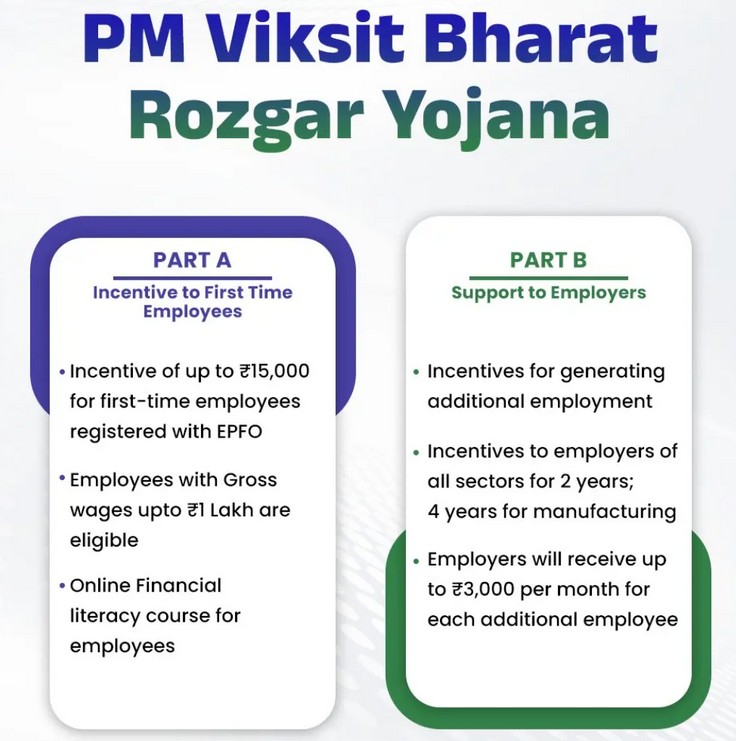
    The Employment Linked Incentive (ELI) Scheme has been officially launched as the PM Viksit Bharat Rozgar Yojana (PM-VBRY), effective from 1st August 2025.

    About PM Viksit Bharat Rozgar Yojana (PM-VBRY):

    • Objective: Promote formal employment and inclusive job creation.
    • Outlay: ₹99,446 crore (Aug 2025 – July 2027).
    • Aim:  3.5 crore new jobs, including 1.92 crore first-time entrants into the workforce.
    • Focus: Expanding EPFO coverage and supporting Viksit Bharat vision.
    • Sectoral Coverage: Open to all sectors, with special focus on manufacturing for long-term growth.

    PM Viksit Bharat Rozgar Yojana (PM-VBRY)

    Key Features:

    1. Incentives for Employees
      • Eligible: First-time EPFO-registered workers earning ≤ ₹1 lakh/month.
      • Benefit: 1-month EPF wage (max ₹15,000) in two parts — after 6 and 12 months.
      • Condition: Completion of a financial literacy programme; Part of the amount is locked in a savings scheme.
    1. Incentives for Employers
      • Applies to: New hires with salary ≤ ₹1 lakh/month.
      • Minimum hires: 2 (if firm <50 employees), 5 (if ≥50).
    • Incentive per employee/month:
      • ₹1,000 (wages ≤ ₹10,000)
      • ₹2,000 (₹10,001–₹20,000)
      • ₹3,000 (₹20,001–₹1 lakh)
    • Manufacturing sector: Extended benefits for 3rd & 4th years.
    1. Payment Mechanism
    • To employees: Direct Benefit Transfer via Aadhaar-based system.
    • To employers: Paid to PAN-linked bank accounts.
    [UPSC 2024] With reference to the Pradhan Mantri Shram Yogi Maan-dhan (PM-SYM) Yojana, consider the following statements:

    1. The entry age group for enrolment in the scheme is 21 to 40 years

    2. Age specific contribution shall be made by the beneficiary

    3. Each subscriber under the scheme shall receive a minimum pension of ₹ 3,000 per month after attaining the age of 60 years

    4. Family pension is applicable to the spouse and unmarried daughters

    Options: (a) 1 and 4 (b) 2 and 3* (c) 2 only (d) 1,2 and 4


  • [pib] TALASH Initiative 

    Why in the News?

    The National Education Society for Tribal Students (NESTS) and UNICEF India launched TALASH (Tribal Aptitude, Life Skills and Self-Esteem Hub), a first-of-its-kind national initiative for holistic development of tribal students in Eklavya Model Residential Schools (EMRSs).

    About the TALASH Initiative:

    • Overview: TALASH (Tribal Aptitude, Life Skills and Self-Esteem Hub) is a national programme launched by the National Education Society for Tribal Students (NESTS) in partnership with UNICEF India.
    • Target Group: It is aimed at the holistic development of tribal students studying in Eklavya Model Residential Schools (EMRSs) across the country.
    • Objectives: The initiative fosters self-awareness, emotional resilience, life skills, and career clarity among tribal youth.
    • Focus: It is the first national initiative in India designed specifically for tribal students.
    • Broader Policy: TALASH aligns with the National Education Policy 2020, promoting inclusive, equitable, and competency-based education.
    • Coverage Goal: Over 1,38,336 students across 28 States and 8 Union Territories are expected to benefit.
    • Implementation: By the end of 2025, TALASH aims to be implemented in all EMRSs nationwide.

    Key Features of TALASH:

    • Psychometric Assessments:
      • Inspired by NCERT’s ‘Tamanna’, TALASH offers aptitude tests to help students discover their interests, abilities, and potential.
      • Based on the results, students receive Career Cards suggesting suitable career options.
    • Career Counselling: The platform offers structured career guidance to help students make informed decisions aligned with their strengths and aspirations.
    • Life Skills & Self-Esteem Modules: TALASH teaches communication, problem-solving, emotional regulation, and self-confidence through interactive modules.
    • E-Learning for Teachers:
      • A dedicated online portal provides training and resources to teachers to help them mentor students effectively.
      • So far, 189 teachers from 75 EMRSs have been trained to lead school-level sessions.
    [UPSC 2017]  With reference to ‘National Skills Qualification Framework (NSQF)’, which of the statements given below is/are correct?

    1. Under NSQF, a learner can acquire the certification for competency only through formal learning.

    2. An outcome expected from the implementation of NSQF is the mobility between vocational and general education.

    Select the correct answer using the code given below:

    Options: (a) 1 only (b) 2 only* (c) Both 1 and 2 (d) Neither 1 nor 2


  • [pib] Aspirational District Mineral Foundation (DMF) Programme

    Why in the News?

    The Union Coal and Mines Minister launched operational guidelines for the Aspirational DMF Programme to align DMF initiatives with the goals of the Aspirational District and Block Programmes.

    Back2Basics: District Mineral Foundation (DMF)

    • Establishment: DMF is a non-profit trust established under the Mines and Minerals (Development and Regulation) Amendment Act, 2015.
    • Main Objective: Its primary purpose is to work in the interest of persons and areas affected by mining-related operations, as determined by the respective state governments.
    • Funding Source: It is funded through contributions made by holders of mining leases for major and minor minerals, with the exact amount prescribed by central or state government rules.
    • Governance: The operation, governance, and functioning of the DMF fall under the jurisdiction of the state government, which defines its composition and implementation mechanisms.
    • Decentralized Utilization: DMF funds are collected and utilized at the district level, enabling decentralized and locally relevant developmental interventions.

    What is the Aspirational DMF Programme?

    • Launch: It was launched by the Ministry of Coal and Mines to align DMF planning and implementation with national development priorities.
    • Convergence with National Programs: It seeks to converge DMF activities with the Aspirational District Programme (ADP) and Aspirational Block Programme (ABP) for maximum social impact.
    • Operational Framework: It ensures that DMF funds are used to improve socio-economic indicators in the most underserved districts and blocks.
    • Collaboration: The programme encourages collaboration among central, state, and local authorities, improving the effectiveness and accountability of DMF investments.

    Back2Basics: Aspirational District/Block Programme

    Aspirational District Programme (ADP):

    • Launch: It was launched in January 2018 by the Government of India to uplift 117 underdeveloped districts across the country.
    • Key Principles: It is based on the principles of Convergence, Collaboration, and Competition, aiming to transform districts through coordinated efforts.
    • Positive Labeling: The word “Aspirational” was deliberately chosen to avoid labels like “backward” and to promote positive transformation and development-oriented thinking.
    • Selection Criteria: Districts were selected by NITI Aayog using a composite index based on 49 indicators across 5 sectors:
    1. Health and Nutrition (30%)
    2. Education (30%)
    3. Agriculture and Water Resources (20%)
    4. Financial Inclusion and Skill Development (10%)
    5. Basic Infrastructure (10%)
    • Real-Time Tracking: The ADP focuses on real-time data tracking, public disclosure of rankings, and building administrative capacity at the district level.
    • People’s Movement: The programme has become a Jan Andolan (people’s movement), actively involving citizens, NGOs, and local administration.

    Aspirational Block Programme (ABP):

    • Overview: It was introduced in the Union Budget 2022–23 as an extension of the ADP to the block level.
    • Rural Focus: It is aimed at ensuring that development reaches deep into rural areas, particularly those not fully covered under ADP.
    • Coverage: Initially, the programme covers 500 blocks across 31 states and Union Territories, with room for states to expand the list.
    • Geographical Concentration: A significant number of these blocks are concentrated in six states:
      • Uttar Pradesh (68 blocks)
      • Bihar (61 blocks)
      • Madhya Pradesh (42 blocks)
      • Jharkhand (34 blocks)
      • Odisha (29 blocks)
      • West Bengal (29 blocks)
    • Focus Areas: It focuses on improving indicators similar to ADP, with emphasis on health, education, livelihoods, and basic infrastructure.
    • Collaborative Governance: Like ADP, it promotes convergence of schemes, competitive spirit among blocks, and collaborative governance at all levels.


    [UPSC 2012] Which of the following can be said to be essentially the parts of ‘Inclusive Governance’?

    1. Permitting the Non-Banking Financial Companies to do banking 2. Establishing effective District Planning Committees in all the districts 3. Increasing the government spending on public health 4. Strengthening the Mid-day Meal Scheme

    Options: (a) 1 and 2 only (b) 3 and 4 only (c) 2, 3 and 4 only* (d) 1, 2, 3 and 4


  • Employment Linked Incentive (ELI) Scheme 

    Why in the News?

    The Union Cabinet has approved the Employment Linked Incentive (ELI) Scheme to promote job creation, enhance employability, and expand social security—especially in the manufacturing sector.

    About Employment Linked Incentive (ELI) Scheme:

    • Objective: It aims to promote employment generation, enhance employability, and expand social security across all sectors, with a special focus on the manufacturing sector.
    • Inception: The scheme was first announced in the Union Budget 2024–25 as part of the Prime Minister’s ₹2 lakh crore Employment and Skilling Package, which targets 4.1 crore youth.
    • Goal: It seeks to create more than 3.5 crore jobs between 1st August 2025 and 31st July 2027.

    Key Features of the ELI Scheme:

    • It offers direct financial incentives to both first-time employees and employers to promote formalisation and sustained employment. It has 2 major components:
    • Part A – Incentives to First-Time Employees:
      • One-month EPF wage (up to ₹15,000) in two instalments.
      • First instalment after 6 months of continuous service.
      • Second instalment after 12 months and completion of a financial literacy programme.
      • Eligibility for employees earning up to ₹1 lakh/month.
      • Portion of incentive saved in a deposit instrument.
      • Benefits to approximately 1.92 crore new employees.
    • Part B – Support to Employers:
      • Incentives for employers hiring additional employees with salaries up to ₹1 lakh/month.
      • Amount ranges from ₹1,000 to ₹3,000 per employee per month, based on wage slabs.
      • Employment must be sustained for at least 6 months.
      • Manufacturing sector gets incentives for 4 years instead of 2.
      • Employers must hire:
        • At least 2 additional employees (if workforce < 50).
        • At least 5 additional employees (if workforce ≥ 50).
    • Payment Mechanism:
      • Employees: via Direct Benefit Transfer (DBT) through Aadhaar Bridge Payment System (ABPS).
      • Employers: via PAN-linked accounts.
    [UPSC 2024] With reference to the Pradhan Mantri Shram Yogi Maan-dhan (PM-SYM) Yojana, consider the following statements:

    1. The entry age group for enrolment in the scheme is 21 to 40 years

    2. Age specific contribution shall be made by the beneficiary

    3. Each subscriber under the scheme shall receive a minimum pension of ₹ 3,000 per month after attaining the age of 60 years

    4. Family pension is applicable to the spouse and unmarried daughters

    Options: (a) 1 and 4 (b) 2 and 3* (c) 2 only (d) 1,2 and 4


  • [30th June 2025] The Hindu Op-ed: A year later — colonial-era laws to new criminal codes

    PYQ Relevance:

    [UPSC 2024] The Doctrine of Democratic Governance makes it necessary that the public perception of the integrity and commitment of civil servants becomes absolutely positive. Discuss.

    Linkage: The new criminal codes, through provisions like mandatory audio-video recording of searches and seizures, aim to improve the quality of investigation and ensure greater integrity and commitment from investigating officers (IOs). This directly seeks to foster a positive public perception of civil servants involved in law enforcement, aligning with the query’s emphasis on progress in the new codes.


    Mentor’s Comment:  As India completes one year of implementing its overhauled criminal justice framework—comprising the Bharatiya Nyaya Sanhita (BNS), Bharatiya Nagarik Suraksha Sanhita (BNSS), and Bharatiya Sakshya Adhiniyam (BSA)—the on-ground feedback is beginning to surface. A major highlight has been the operationalization of the ‘e-Sakshya’ app for real-time evidence collection. While it empowers investigation officers (IOs) and enhances transparency, several systemic and logistical constraints hinder its full potential. Despite attempts at modernization, the gap between legal reforms and infrastructural readiness threatens to blunt the progressive intent of these laws. This transitional phase is a crucial moment for policy correction and investment.

    Today’s editorial talks about the effectiveness of India’s new criminal laws—BNS, BNSS, and BSA. This topic is important for GS Paper II (Indian Polity & Governance) in the UPSC mains exam.

    _

    Let’s learn!

    Why in the News?

    Recently, India’s new criminal laws—BNS, BNSS, and BSA—mark a year of implementation. Technological tools like the e-Sakshya app aid progress, but feedback from investigating officers reveals key challenges and improvement needs.

    What are the key improvements brought by the BNS, BNSS, and BSA in the criminal justice system?

    • Modernization of Colonial Laws: The new laws replace the outdated Indian Penal Code (1860), CrPC (1973), and Indian Evidence Act (1872), aligning criminal justice with contemporary realities, citizen-centric values, and technological advancements.
    • Integration of Technology in Investigation: The BNSS mandates audio-video recording of critical procedures such as search, seizure, and statement recording. It supports the use of tools like the ‘e-Sakshya’ app for real-time digital evidence collection, improving transparency and accountability.
    • Improved Victim-Centric and Time-Bound Procedures: Provisions like seven-day deadlines for medical reports in rape cases and emphasis on video conferencing for witness examination under BNSS aim to ensure faster process, reduce trauma for victims, and increase judicial efficiency.

    How has the ‘e-Sakshya’ app enhanced evidence collection and policing?

    • Real-time digital documentation: The app enables investigating officers to capture photos and videos on the spot with geo-coordinates and a timestamp, ensuring authenticity and preventing tampering. For instance, during a search and seizure, the officer must record the process under Section 105 of BNSS, improving transparency.
    • Improved accountability in investigations: Investigating officers are now required to take selfies at crime scenes, ensuring that they personally conduct the investigation and don’t delegate it unofficially. This deters fabrication of evidence and builds a stronger chain of custody for trial.
    • Strengthened witness reliability: The visual capture of witness presence at the crime scene discourages denial of participation later in court. Eg when a suspect is made to show the place where a weapon or contraband is hidden, the recording serves as reliable secondary electronic evidence admissible in court.

    Why is digital integration through CCTNS and ICJS vital for the new laws’ success?

    • Seamless transition and registration of cases: The Crime and Criminal Tracking Network and Systems (CCTNS) ensures smooth FIR registration and jurisdictional transfers, enabling police stations to shift from old laws to BNS, BNSS, and BSA without disruption. For instance, zero FIRs are easily routed to the correct police stations within a state using CCTNS.
    • Interlinking of justice system pillars: The Inter-operable Criminal Justice System (ICJS) connects police with forensic labs, prosecution, courts, and jails, improving coordination and efficiency. This digital integration supports time-bound actions like forwarding medical examination reports or conducting video-based evidence collection as mandated under BNSS.
    Note: About Zero FIR It refers to a First Investigation Report (FIR) that is registered irrespective of the area where the offence is committed. The police in such a case can no longer claim that they have no jurisdiction.

    What are the challenges that hinder the effective implementation of the new criminal laws?

    • Inadequate digital infrastructure: Many police stations have only one tablet, and officers often use their personal phones to operate the e-Sakshya app, which requires Android version 10 or higher and at least 1GB of storage. This limits the ability to uniformly implement mandatory audio-video recording provisions under BNSS.
    • Lack of real-time integration with courts: While images and videos are stored on the National Government Cloud (NGC), courts still do not directly access this digital evidence through the ICJS. Instead, police submit evidence using pen drives, leading to duplication, extra costs, and delay in proceedings.
    • Forensic and legal bottlenecks: Despite the requirement of FSL expert visits under Section 176 of BNSS, forensic infrastructure in many states remains underdeveloped. Also, cybercrime evidence often needs expert analysis and testimony, but State forensic labs are yet to be notified under the IT Act, hampering admissibility of digital evidence.

    What reforms are needed to address them? (Way forward)

    • Strengthen digital infrastructure in police stations: The government should ensure that each investigating officer (IO) has access to a dedicated device compatible with the e-Sakshya app. Providing sufficient tablets or mobile phones with the required specifications will help officers capture evidence reliably and eliminate the need for using personal devices.
    • Enable direct court access to digital evidence: Courts must be integrated with the Inter-operable Criminal Justice System (ICJS) to allow secure, real-time access to evidence stored on the National Government Cloud. This will eliminate dependency on external storage like pen drives and promote efficiency and authenticity in judicial proceedings.