💥Join UPSC 2027,2028 Mentorship (July Batch) + XFactor Notes & Microthemes PDF

GS Paper: GS1-04.Post-Independence- Consolidation and reorganisation within country

  • Trace India’s consolidation process during early phase of independence in terms of polity, economy, education and international relations.

    Post-independence India initiated a structural, multi-dimensional consolidation process to build a sovereign, democratic nation out of extreme geopolitical, economic, and social fragmentation.

    India’s Political Consolidation Process

    Integration of Princely States: Unified 552 volatile kingdoms into the Indian Union using strategic diplomacy under Sardar Patel’s leadership

    Constitutional Enactment: Drafted a comprehensive, supreme legal document securing democratic rights and structural governance.

    Democratic Universal Franchise: First General Elections (1951-52) managed seamlessly under Chief Election Commissioner Sukumar Sen.

    Linguistic Reorganization under States Reorganisation Act in 1956.

    Tribal Protection Framework: Eg: Fifth and Sixth Schedules to govern tribal areas autonomously.

    Resolving linguistic conflicts. Eg: Official Languages Act (1963) allowing English alongside Hindi for official communication.

    Integration of French/Portuguese Enclaves: Eg: Liberation of Pondicherry (1954) and Operation Vijay liberating Goa in 1961.

    India’s Economic Consolidation Process

    Centralized Planned Economy: Eg: Establishment of the Planning Commission (1950) and launch of the First Five-Year Plan.

    Agrarian Land Reforms: Eg: Passing the Zamindari Abolition Acts across various states in the early 1950s.

    Heavy Industrial Infrastructure: Eg: The Mahalanobis Strategy during the Second Plan founding the Bhilai and Rourkela steel plants.

    Pioneering the Green Revolution: Introduced high-yielding seeds to achieve self-sufficiency and break chronic food dependency.

    Banking Sector Nationalization in 1969 for rural and agrarian upliftment.

    State Control of Strategic Sectors: Eg: Setting up the Life Insurance Corporation (LIC) in 1956 by merging 245 firms.

    Cooperative Dairy Movement: Eg: Launch of Operation Flood (1970) by Verghese Kurien, creating the Amul pattern.

    India’s Educational Consolidation Process

    Institutionalizing Higher Education: Eg: Foundation of the University Grants Commission (UGC) via a parliamentary act in 1956.

    Pioneering Technical Institutes: Eg: Setting up IIT Kharagpur (1951) with international institutional and technical assistance.

    Elite Management Training: Eg: Establishment of IIM Calcutta and IIM Ahmedabad in late 1961.

    Scientific Research Networks: Eg: Rapid expansion of the Council of Scientific and Industrial Research (CSIR) under Shanti Swarup Bhatnagar.

    Secondary School Restructuring: Eg: Implementing key recommendations of the Mudaliar Commission on Secondary Education (1952).

    National Policy on Education in 1968 to achieve uniform standards and equal educational access.

    The Three-Language Formula in secondary schools under the 1968 policy.

    India’s International Relations Consolidation Process

    Pioneering Non-Aligned Movement: Retained sovereign foreign policy autonomy by refusing to join either Cold War superpower military bloc.

    Enunciating Panchsheel Principles: Institutionalized peaceful co-existence and mutual non-aggression as the bedrocks of Asian diplomacy.

    Retaining Commonwealth Membership: Reconfigured relationship with Britain by joining the Commonwealth while retaining republican status.

    Internationalizing Kashmir Crisis: Eg: Appealing against Pakistani tribal aggression at the United Nations Security Council in 1948.

    Liberation of Bangladesh: Altered South Asia’s geopolitical map by militarily intervening against genocide to secure eastern borders.

    Leading Anti-Colonial Global Advocacy: Championed Afro-Asian solidarity and vocal opposition against racial apartheid on international stages.

    Peaceful Nuclear Posturing: Eg: Conducting India’s first subterranean nuclear test, Operation Smiling Buddha, in 1974.

    Pioneering UN Peacekeeping Support: Eg: Deploying early medical and military contingents during the Korean War (1950-53).

    India’s multi-sectoral consolidation successfully safeguarded democratic continuity, converted institutional crises into structural stability, and built an enduring sovereign nation.

    World History

  • Param Vir Dirgha at Rashtrapati Bhavan

    Why in the News?

    On the occasion of Vijay Diwas 2025, the President of India, Droupadi Murmu, inaugurated Param Vir Dirgha at Rashtrapati Bhavan, where portraits of all 21 Param Vir Chakra awardees are now displayed.

    Key Development

    • Portraits of 21 Param Vir Chakra awardees displayed
    • Replaced portraits of 96 British Aide de Camps (ADCs)
    • Initiative symbolises removal of colonial legacy and celebration of Indian national heroes

    About Param Vir Chakra (PVC)

    Highest military decoration of India
    • Awarded for exceptional valour, courage and self sacrifice during war
    • Instituted on 26 January 1950
    • Awarded to personnel of Army, Navy and Air Force
    • Total awardees till date: 21

    Param Vir Dirgha

    • A dedicated gallery at Rashtrapati Bhavan
    • Showcases portraits and legacy of Param Vir Chakra awardees
    • Aims to educate visitors about India’s bravest soldiers
    • Reinforces national pride and military heritage

    Broader Context of De Colonialisation Initiatives

    Rajpath renamed Kartavya Path
    Indian Navy ensign redesigned, removing Saint George’s Cross and adopting symbols linked to Chhatrapati Shivaji Maharaj
    Mughal Garden renamed Amrit Udyan
    Race Course Road renamed Lok Kalyan Marg
    Ross Island renamed Netaji Subhash Chandra Bose Dweep
    Neil Island renamed Shaheed Dweep
    Havelock Island renamed Swaraj Dweep
    Port Blair renamed Sri Vijaya Puram
    21 islands named after Param Vir Chakra awardees
    • Republic Day Beating Retreat ceremony now features Indian musical instruments

    Significance for UPSC Prelims

    • Links Vijay Diwas with national military honours
    • Highlights Param Vir Chakra facts and symbolism
    • Reflects policy of removing colonial symbols
    • Important for culture, defence and modern Indian history

    What are the duties of the Chief of Defence Staff (CDS) as Head of the Department of Military Affairs? (2024)

    1. Permanent Chairman of Chiefs of Staff Committee. 

    2. Exercise military command over the three Service Chiefs. 

    3. Principal Military Advisor to Defence Minister on all tri-service matters. 

    Select the correct answer using the code given below: 

    (a) 1, 2, 3 (b) 1 and 2 only (c) 2 and 3 only (d) 1 and 3 only

  • The Left we need: The Legacy of Indian Socialism

    Introduction

    Once a vibrant stream of India’s political life, socialism today survives only on the margins, overshadowed by dominant political narratives. The Samajwadi Ekjutata Sammelan attempted to revive this forgotten legacy by recalling socialist icons, showcasing their contributions, and highlighting the ideological resources they left behind. Unlike European social democracy or Marxism, Indian socialism, particularly articulated by Ram Manohar Lohia, offered a distinct doctrine—integrating caste, gender, and cultural politics with economic equality and Gandhian satyagraha. At a time when the world grapples with inequality, climate change, and rising authoritarianism, revisiting Indian socialism is not just about remembering the past, but about reclaiming tools for the future.

    Why in the News?

    The 90th anniversary of the socialist movement was commemorated through a large convention in Pune, bringing together activists, veterans of the Emergency resistance, and younger voices. This event is significant because it highlights the amnesia and disjunction surrounding socialism in India today, where even icons like JP, Usha Mehta, and Kamaladevi Chattopadhyay are remembered for roles outside the socialist tradition. The Sammelan underscored a major problem: the ideological vacuum created by the neglect of Indian socialism, just when its core ideas, on inequality, sustainable development, cultural politics, and resistance to authoritarianism, are urgently needed. The striking aspect is not just nostalgia, but the contrast between socialism’s past centrality and its near invisibility in today’s discourse.

    The Legacy of Indian Socialism

    1. Founding of Congress Socialist Party (1934): Socialist stream within Congress connected political freedom with social and economic equality.
    2. Quit India Movement: JP, Lohia, Usha Mehta and others led underground resistance, marking socialism’s high point in the freedom struggle.
    3. Post-Independence Role: Departure from Congress to form an independent opposition, mobilising backward castes and the poor, especially in the Hindi belt.
    4. Emergency Resistance: Socialist leaders like Rajkumar Jain, Vijay Pratap, and Anand Kumar stood against authoritarianism, spending months in jail.

    Why is Socialism Fading from Public Memory?

    1. Amnesia: Young people today conflate socialists with communists or Maoists, erasing the distinctiveness of the socialist tradition.
    2. Disjunction in Memory: JP Narayan is remembered as Gandhian, Kamaladevi for handicrafts, Usha Mehta as freedom fighter—none as socialists.
    3. Neglect of Ideas: Unlike communists, socialists lacked a robust academic subculture and access to English-speaking opinion-makers.
    4. Absence of Popular Recall: Figures like Yusuf Meherally, Achyut Patwardhan, Madhu Limaye, and S.M. Joshi remain unknown to today’s youth.

    Distinctive Ideas of Indian Socialism

    1. Expanded Equality: Beyond economics, it included caste, gender, race, nationality, relevant to debates on women’s reservation, caste census, and subquotas.
    2. Alternative Development Model: Critiqued technocratic-industrial path; emphasised sustainable well-being, now crucial amid climate change.
    3. Satyagraha as Politics: Advocated Gandhian non-violent resistance as an alternative to violence or electoralism.
    4. Cultural Politics: Rooted in Indian languages and traditions, countering hegemonic cultural nationalism with inclusive symbols.

    Why Does Indian Socialism Matter Today?

    1. Counter to Inequality: Rising global inequality makes Lohia’s expanded framework urgent.
    2. Democratic Deepening: Socialists played key role in mobilisation of backward castes and poor, essential for inclusive democracy.
    3. Resistance to Authoritarianism: With a consistent history of fighting Emergency and excesses, socialism offers principled tools to resist authoritarian regimes.
    4. Global Relevance: By abjuring Eurocentric roots, Indian socialism contributed a new doctrine to world thought.

    Conclusion

    The decline of Indian socialism is not just the fading of a political ideology but the loss of a moral and intellectual compass that once challenged inequality and authoritarianism. The Sammelan in Pune reminded us that socialism is more than an electoral project; it is a resource for reimagining democracy and justice in the 21st century. Whether or not the label survives, its ideas remain indispensable. The real challenge lies in recalling, renewing, and repurposing socialism to confront contemporary crises.

    PYQ Relevance

    [UPSC 2020] Since the decade of the 1920s, the national movement acquired various ideological strands and thereby expanded its social base. Discuss.

    Linkage: Since the 1920s, the national movement diversified ideologically with strands like socialism, which linked political freedom with social and economic equality. Socialists such as JP and Lohia expanded the movement’s base by mobilising peasants, backward castes, women, and workers, while also shaping resistance during Quit India and the Emergency. This ideological pluralism deepened democracy and widened the social foundations of Indian politics.

    Value Addition

    History of Socialism in Pre-Independent India

    Early Currents (1920s–1930s)

    1. Global Influence: The Russian Revolution (1917) electrified Indian youth. Marxist ideas about class struggle and collective ownership inspired a generation disillusioned with colonial exploitation.
    2. Indian Context: The non-cooperation movement (1920–22) radicalised many students and workers. Young leaders like S.A. Dange, M.N. Roy, Nalini Gupta, Muzaffar Ahmad started bringing socialist ideas into India.
    3. Labour & Peasant Movements: The formation of AITUC (All India Trade Union Congress, 1920) and Kisan Sabhas gave socialism a practical ground.

    Formation of the Congress Socialist Party (1934)

    1. Background: Many young nationalists within the Congress felt that Congress under Gandhi was too focused on political freedom without a social revolution.
    2. Founding: The Congress Socialist Party (CSP) was founded in Patna, 1934 by Jayaprakash Narayan, Acharya Narendra Deva, Ram Manohar Lohia, Yusuf Meherally, and others.

    Objectives:

    1. Radicalise the Congress by linking freedom with social & economic equality.
    2. Advocate land reforms, redistribution of wealth, end of caste discrimination.
    3. Maintain distance from the Communists but work inside the Congress unlike them.

    Impact: CSP became the ideological left-wing of the Congress, drawing in students, workers, peasants, and socially progressive leaders.

    Role in the Quit India Movement (1942)

    • Context: With the launch of Quit India (August 1942), much of the mainstream Congress leadership was arrested.

    Socialist Contribution:

    1. Socialists like JP, Lohia, Usha Mehta, Aruna Asaf Ali kept the movement alive underground.
    2. Usha Mehta ran the Secret Congress Radio, broadcasting messages against British rule.
    3. JP and Lohia organised clandestine networks, strikes, and sabotage against colonial infrastructure.

    Significance: This gave socialism a heroic image of sacrifice and resistance, showing it could sustain the national struggle when the mainstream was paralysed.

    Peasant & Worker Mobilisation

    1. Kisan Sabhas: Led by Swami Sahajanand Saraswati in Bihar and N.G. Ranga in Andhra, peasants were mobilised against landlordism, high rents, and colonial agrarian policies.
    2. Labour Strikes: Socialist leaders engaged with trade unions and AITUC, mobilising railway workers, mill workers, and dockyard labourers.
    3. Linkage with Socialism: These movements translated the abstract ideals of socialism into mass struggles, rooting the ideology in agrarian and working-class realities.

    Other Key Developments

    1. Students’ Movement: Socialist ideas found strong resonance in the All India Students’ Federation (AISF) and later the Socialist Youth movements.
    2. Princely States Movements: Socialists often took leadership in agitations in princely states (like Travancore, Hyderabad), linking freedom with social justice.
    3. Intellectual Contribution: Leaders like Acharya Narendra Deva (theorist), JP (activist organiser), Lohia (thinker & mass mobiliser) gave socialism in India both intellectual depth and activist energy.

    Summary

    1. By the 1940s, socialism in India was not merely an imported ideology—it had become a home-grown political stream, deeply connected to the freedom struggle. Its distinctiveness lay in:
    2. Rooting Marxist equality in Indian realities of caste, agrarian hierarchy, and colonial exploitation.
    3. Combining Gandhian satyagraha with socialist radicalism.
    4. Mobilising peasants, workers, students, women, and backward castes, thereby expanding the social base of the national movement.

    Socialist Principles in the Indian Constitution

    Explicit Reference:

    • Preamble (42nd Amendment, 1976): India declared to be a “Socialist, Secular, Democratic Republic.”

    Directive Principles of State Policy (DPSP):

    1. Article 38: Promote welfare of people through a just social order.
    2. Article 39: Equitable distribution of resources, prevention of wealth concentration, protection of workers’ rights.
    3. Article 41: Right to work, education, and public assistance.
    4. Article 43: Living wage, decent working conditions, and participation of workers in management.
    5. Article 47: Duty of state to improve public health, nutrition, and prohibition of intoxicants.

    Comparative Analysis: Indian vs. Western Socialism

    Aspect Western Socialism Indian Socialism
    Origins Industrial Revolution (Europe, 19th c.), Marxist critique of capitalism. Freedom struggle (20th c.), influenced by Gandhi + Lohia + JP + Marxism.
    Focus Class-based equality (workers vs capitalists). Multi-dimensional equality (caste, class, gender, nationality).
    Method Revolution (Marxist), or reform (social democracy). Democratic, non-violent satyagraha + electoral politics.
    State Role Welfare state ensuring redistribution, public ownership of key industries. Mixed economy with state-led planning (Nehruvian model) + constitutional guarantees.
    Culture & Identity Largely secular, materialistic basis. Rooted in Indian culture, language, symbols (Lohia’s “cultural politics”).
    Developmental Model Industrialisation as progress. Critique of technocratic-industrial model, stress on sustainability & decentralisation.


  • 125th Birth Anniversary of Syama Prasad Mookerjee

    Why in the News?

    Prime Minister Modi has paid respectful tributes to eminent thinker and educationist Dr. Shyama Prasad Mukherjee on his 125th birth anniversary.

    125th Birth Anniversary of Syama Prasad Mookerjee

    About Syama Prasad Mookerjee (1901-1953):

    • Early life: He was born on July 6, 1901, in Kolkata, West Bengal.
    • Academics: He studied at Presidency College and the University of Calcutta, where he excelled academically.
    • Professional Career: He became a barrister after being called to the English Bar at Lincoln’s Inn, London. At the age of 33, he was appointed Vice-Chancellor of Calcutta University, one of the youngest to hold the post.
    • Association with Freedom Movement: He began his political journey with the Indian National Congress. Later, he joined the Hindu Mahasabha, becoming its president.
    • Demise: He died in 1953, while in custody in Jammu and Kashmir, under mysterious circumstances that remain controversial to this day.

    His Contributions:

    • Role in Pre-Independence Politics:
      • He served as the Finance Minister of Bengal under British rule.
      • He resigned in 1942, protesting British policies during the Quit India Movement.
      • He became a strong voice against British repression and for Indian self-rule.
    • Advocacy for Partition of Bengal:
      • He advocated the partition of Bengal to safeguard Hindu interests during the run-up to Partition.
      • His efforts contributed to the creation of a separate West Bengal within the Indian Union.
    • Minister in Nehru’s Cabinet:
      • After independence, he served as India’s first Minister for Industry and Supply in Jawaharlal Nehru’s cabinet.
      • In 1950, he resigned from the cabinet in protest against the Nehru-Liaquat Pact.
      • He believed the pact failed to protect the Hindu minorities in East Bengal (now Bangladesh).
    • Founding of Bharatiya Jana Sangh (1951):
      • In 1951, Mookerjee founded the Bharatiya Jana Sangh with ideological support from the RSS.
      • The party aimed to present a nationalist alternative to the Congress Party.
    • Opposition to Article 370:
      • Mookerjee strongly opposed Article 370, which gave special status to Jammu and Kashmir.
      • He believed the article promoted separatism and weakened national integration.
      • He famously declared that- “One country cannot have two constitutions, two prime ministers, and two flags.”
    • Legacy:
      • Mookerjee’s thoughts continue to influence the ideological foundation and policies of the far right political parties.
      • He is remembered as a champion of national unity, constitutional equality, and strong central integration.
    [UPSC 2024] Consider the following pairs:

    Party: Its Leader

    1. Bharatiya Jana Sangh : Dr. Shyama Prasad Mukherjee 2. Socialist Party : C. Rajagopalachari 3. Congress for Democracy : Jagjivan Ram 4. Swatantra Party : Acharya Narendra Dev How many of the above are correctly matched?

    Options: (a) Only one (b) Only two* (c) Only three (d) All four


  • 50 years of Sikkim’s integration with India

    Why in the News? 

    May 16 is observed annually as Sikkim Day, marking the historic occasion in 1975 when the Kingdom of Sikkim formally became a state of India.

    About the Kingdom of Sikkim

    • Foundation: The Kingdom of Sikkim was established in 1642, when three Tibetan lamas crowned Phuntsong Namgyal as the first Chogyal (monarch).
    • Namgyal dynasty: It ruled Sikkim for 333 years, maintaining a Buddhist monarchy until 1975.
    • Treaty of Tumlong (1861): It made Sikkim a British protectorate, where the Chogyals retained internal authority while the British handled external affairs.
    • Other key treaties shaping Sikkim’s status: These included the Treaty of Titaliya (1817), Calcutta Convention (1890), and Lhasa Convention (1904), which defined borders and reaffirmed British influence.

    How did Sikkim join India?

    • Post-1947 Status: After India’s independence, Sikkim did not join India like other princely states, due to its unique British treaty status.
    • Nehru’s Approach: While Sardar Patel and B.N. Rau wanted Sikkim to accede, Jawaharlal Nehru opted for a Standstill Agreement to preserve the status quo.
    • Indo-Sikkim Treaty of 1950: This treaty made Sikkim an Indian protectorate, with India managing defence, foreign affairs, and communications.
    • Role of Sikkim National Congress: Led by Kazi Dorji, the SNC became the key pro-democracy and pro-merger party.
    • 1973 Agreement: After widespread protests, a tripartite agreement was signed between the Chogyal, the Government of India, and the Sikkimese parties.
    • Democratic Transition: In 1974, elections were held, and a new constitution reduced the monarch’s powers.
    • Referendum of 1975: In April 1975, over 97% of voters supported abolishing the monarchy and merging with India.
    • Merger with India: In May 1975, the 36th Constitutional Amendment was passed, and Sikkim became the 22nd state of India. It added Article 371F to provide special provisions for the state of Sikkim.

    Back2Basics: Article 371F of the Indian Constitution

    • Constitutional Origin: Added by the 36th Amendment Act (1975) when Sikkim became the 22nd state of India.
    • Objective: Protects Sikkim’s unique history, culture, and legal system during integration.
    • Legislative Assembly: Sikkim must have at least 30 MLAs, fewer than other states under Article 170.
    • Parliamentary Representation: Sikkim has 1 Lok Sabha and 1 Rajya Sabha seat, with the Assembly electing the MP.
    • Governor’s Role: Governor holds special responsibility for peace, equity, and development.
    • Pre-Merger Laws: Existing laws and judgments before 1975 remain valid unless changed by Parliament.
    • Presidential Powers: President can modify laws and extend central laws to Sikkim within two years post-merger.
    • Land and Job Rights: Only 1961-registered Sikkimese can own land or hold state government jobs.
    • Tax Exemption: Original Sikkimese were exempt from income tax.
    • Recent Controversy: The Finance Bill, 2023 expanded the term “Sikkimese”, raising concerns over erosion of indigenous rights.


    [UPSC 2007] Which one of the following is the correct chronological order of the formation as full States of the Indian Union?

    Options:

    (a) Sikkim-Arunachal Pradesh-Nagaland-Haryana

    (b) Nagaland-Haryana-Sikkim-Arunachal Pradesh *

    (c) Sikkim-Haryana-Nagaland-Arunachal Pradesh

    (d) Nagaland-Arunachal Pradesh-Sikkim-Haryana


  • 5 women who helped draft the Constitution

    5 women who helped draft the Constitution

    Why in the News?

    On Constitution Day (November 26), President Murmu acknowledged the significant role of women members in the Constituent Assembly of India.

    5 Notable Women in the Constituent Assembly

    Name Their Contributions
    Ammu Swaminathan (1894-1978) • Co-founded the Women’s India Association in 1917 with leaders like Annie Besant.
    • Advocated for women’s education and rights.
    • Spoke on the Hindu Code Bill and gender equality in the Constituent Assembly.
    • Became the first woman elected to the Madras legislature.
    • After independence, served as India’s goodwill ambassador to countries like Russia, China, and the US.
    Annie Mascarene (1902-1963) • Born in Travancore to a Latin Christian family considered at the bottom of the caste system.
    • Advocated for universal adult franchise and against caste-based voting rights.
    • Joined the Travancore State Congress and fought for political representation of marginalized communities.
    • As a member of the Constituent Assembly, called for a strong Centre and autonomy for local governments.
    Elected as an independent candidate in 1952 from Thiruvananthapuram.
    Begum Qudsia Aizaz Rasul (1909-2001) • Hailing from a prominent family in Punjab, she faced resistance for her education, with a fatwa issued against her convent schooling.
    Fought for women’s rights and opposed separate electorates based on religion.
    Stayed in India post-partition and joined the Indian National Congress.
    Elected to the Rajya Sabha in 1952.
    • Helped promote women’s hockey in India.
    Dakshayani Velayudhan (1912-1978) First Dalit woman to graduate in science and the first Dalit woman in the Cochin Legislative Council.
    • Advocated for nationalism and opposed separate electorates for Dalits.
    • Strongly committed to social justice despite facing discrimination.
    • After independence, remained involved in the Dalit movement and continued advocating for social justice.
    Renuka Ray (1904-1997) • Came from an affluent family with a civil servant father and a progressive mother.
    • Joined the freedom struggle after meeting Mahatma Gandhi in 1920.
    • Advocated for women’s rights, particularly on divorce and inheritance.
    Represented women’s organizations in the Central Legislative Assembly in 1943.
    Opposed women’s reservation in legislatures, seeing it as a hindrance to women’s growth.
    • After losing the 1952 elections, returned to politics and worked on women’s empowerment.


    PYQ:

    [2011] With reference to Indian freedom struggle, Usha Mehta is well-known for:

    (a) Running the secret Congress Radio in the wake of Quit India Movement
    (b) Participating in the Second Round Table Conference
    (c) Leading a contingent of Indian National Army
    (d) Assisting in the formation of Interim Government under Pandit Jawaharlal Nehru

  • Mandal, Mandir, and now Market


    Mandal Commission: An Analysis. The promulgation of the Mandal… | by The  Education Growth Summit | TEGS | Medium

    Central Idea:

    The article discusses the three pivotal forces that shaped contemporary India – Mandal, Mandir, and Market, which were unleashed between August 1990 and August 1991. It highlights the significance of these forces in defining India’s trajectory and how they continue to influence the country’s politics, economy, and society today. Furthermore, it focuses on the forgotten legacy of Prime Minister P.V. Narasimha Rao, who played a crucial role in implementing economic reforms and reshaping India’s foreign policy during his tenure from 1991 to 1996. The article underscores the importance of trusting society over the state, the necessity of liberalization for welfare schemes, and the harmony embedded in Indian civilization, as exemplified by Narasimha Rao’s approach.

    Key Highlights:

    • Mandal, Mandir, and Market as defining forces in contemporary India.
    • Significance of the Ram temple movement and the Mandal Commission report.
    • P.V. Narasimha Rao’s pivotal role in liberalizing India’s economy and reorienting its foreign policy.
    • Lessons from Narasimha Rao’s leadership: trusting society, liberalization-led growth, and harmony in Indian civilization.

    Key Challenges:

    • Balancing economic liberalization with social welfare and inclusive growth.
    • Addressing religious and social tensions in a diverse society.
    • Overcoming political opposition and vested interests to implement reforms.

    Main Terms:

    • Mandal: Refers to the implementation of backward caste quotas in government jobs.
    • Mandir: Symbolizes the movement for the construction of a Ram temple in Ayodhya.
    • Market: Represents the liberalization of India’s economy, opening it up to globalization and private sector participation.
    • Bharat Ratna: India’s highest civilian honor.
    • Liberalization: The process of reducing government restrictions and regulations in the economy.
    • Globalization: Integration of economies and societies through international trade, investment, and technology.

    Important Phrases:

    • “Mandal, Mandir, and Market continue to define India.”
    • “Narasimha Rao actively plotted to open India’s economy to the world.”
    • “India grows best when politicians trust society rather than the state.”
    • “Liberalization-led growth is a precondition for welfare schemes.”
    • “Harnessing the harmony embedded in Indian civilization.”

    Quotes:

    • “India grows best when politicians trust society rather than the state.”
    • “My model is not Margaret Thatcher but Willy Brandt.”
    • “Why are there only Western examples being given where violence — on some pretext or the other — is the basic propensity.”

    Mandal Commission And Its Top 13 Interesting Facts | Background ,  Criticism, Procedure And Reccomendation, Janata Party | Indira Sawhney  Case- 13angle

    Anecdotes:

    • L.K. Advani’s rath yatra from Somnath to Ayodhya symbolized BJP’s alignment with the Ram temple movement.
    • Narasimha Rao’s astute political maneuvering to implement economic reforms despite opposition from within his own party.

    Useful Statements:

    • “Narasimha Rao’s reforms were not confined to economics alone.”
    • “India grows best when politicians trust society rather than the state.”
    • “Liberalization-led growth is a precondition for welfare schemes.”

    Examples and References:

    • Implementation of backward caste quotas in government jobs following the Mandal Commission report.
    • L.K. Advani’s rath yatra as a symbol of BJP’s support for the Ram temple movement.
    • Narasimha Rao’s economic reforms leading to increased tax revenue, enabling government spending on welfare schemes.

    Facts and Data:

    • P.V. Narasimha Rao served as Prime Minister of India from 1991 to 1996.
    • The Ram temple movement gained momentum in the early 1980s.
    • Economic liberalization measures were initiated in mid-1991.

    Critical Analysis:

    The article presents a comprehensive analysis of the forces that have shaped India’s trajectory since the early 1990s, focusing on both political and economic dimensions. It highlights the role of leaders like Narasimha Rao in driving significant reforms despite facing numerous challenges. However, it also acknowledges the shortcomings and failures of political leadership, particularly in handling religious and social tensions. The emphasis on trust in society, liberalization-led growth, and harmony reflects a nuanced understanding of India’s complex socio-political landscape.

    Way Forward:

    • Emphasize continued trust in society over excessive state intervention.
    • Prioritize economic liberalization to enable inclusive growth and welfare schemes.
    • Promote harmony and understanding among diverse religious and cultural communities.
    • Encourage political leadership to learn from past successes and failures to navigate future challenges effectively.
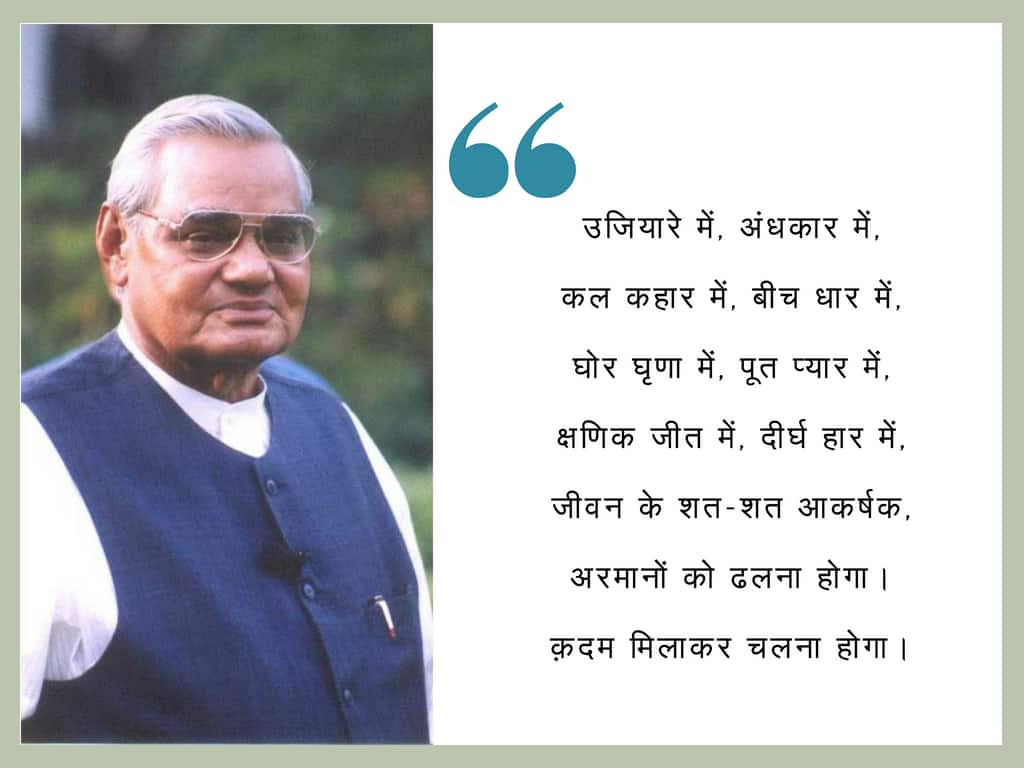
  • Ram Madhav writes: Opposition today needs to learn from Atal Bihari Vajpayee

    Atal Bihari Vajpayee, the poet: Famous couplets written by the former PM |  News | Zee News

    Central idea 

    The article highlights the evolution of leaders within India’s parliamentary democracy, contrasting them with those from dynastic politics. It celebrates Atal Bihari Vajpayee as a prime example, emphasizing his journey from an activist to a mature statesman. The central theme underscores the virtues of leaders emerging organically through democratic processes and the challenges posed by dynastic political practices.

    Key Highlights:

    • The article discusses the evolution of leaders within India’s parliamentary democracy and contrasts them with those from dynastic politics.
    • Atal Bihari Vajpayee is highlighted as an exemplary product of Indian parliamentary democracy, having entered politics as an activist and evolved into a mature statesman.
    • Vajpayee’s role in the BJP’s rise from the fringes to the mainstream during the Congress-dominated era is emphasized.
    • The article underscores Vajpayee’s oratorical skills, his role in consensus politics, and his commitment to national interests.

    Key Challenges:

    • Critique of dynastic politics in the Congress party post-Nehru, seen as a hindrance to embodying leadership values of parliamentary democracy.
    • The challenge of maintaining decorum in political discourse, contrasting it with the current cheap antics of the Opposition.

    Key Terms:

    • Dynastic politics: The practice of political leadership being passed down through family lines.
    • Consensus politics: The approach of seeking agreement among diverse political parties for effective governance.
    • Oratorical skills: The ability to deliver powerful and persuasive speeches.

    Key Phrases:

    • “Leaders are born, they are not made”: Expresses the perspective on the natural emergence of leadership qualities.
    • “Evil of dynastic politics”: Describes the negative impact of hereditary political leadership.
    • “Teflon-coated Hindutva-vadi”: Term used to describe Atal Bihari Vajpayee, suggesting resilience in the face of criticism.

    Key Quotes:

    • “Leaders are born, they are not made.”
    • “Dynasts can never fully appreciate and demonstrate the leadership values and principles of parliamentary democracy.”
    • “Atal ji’s greatness is not limited to his prime ministership.”

    Anecdotes:

    • Vajpayee’s witty remark to Nehru about having a “split personality” and an “inverted vision.”
    • Jaitley’s mention of Vajpayee’s obituary address for Nehru as a quality tribute to a political adversary.

    Key Statements:

    • “Leaders born into political families struggle to fully appreciate and demonstrate the leadership values of parliamentary democracy.”
    • “Vajpayee’s commitment to consensus politics is noted, even during the challenges of leading a 23-party coalition.”
    • “Vajpayee’s role as an ideal opposition leader is praised, emphasizing his support for the government during crucial times.”

    Key Examples and References:

    • Vajpayee’s journey from a young activist to a mature statesman within the parliamentary system.
    • His criticism of Nehru’s policies and the BJP’s rise during the Congress-dominated era.
    • Instances of Vajpayee’s leadership during events like the nuclear tests in 1998 and the Kargil War.

    References:

    • Arun Jaitley’s memorial address for Vajpayee, highlighting his oratory skills and leadership in opposition.
    • Jaitley’s mention of Vajpayee’s best orations occurring when he was on the opposition benches.

    Critical Analysis:

    • The article critically analyzes the impact of dynastic politics on embodying democratic leadership values.
    • Vajpayee is portrayed as an exemplary leader, emphasizing his oratorical skills, commitment to consensus politics, and prioritization of national interests.

    Way Forward:

    • Encourage a departure from dynastic politics and foster leadership emerging through democratic processes.
    • Advocate for a return to decorum in political discourse and a focus on consensus politics for effective governance.
    • Learn from Vajpayee’s legacy, striving for political environments that prioritize national interests over partisan considerations.
  • Decoding the Annexation of Goa: Operation Vijay and Historical Context

    goa portuguese

    Central Idea

    • Liberation of Goa: On December 19, 1961, India successfully annexed Goa, ending years of Portuguese colonial rule.
    • Criticism of Nehru: Prime Minister Narendra Modi accused former Prime Minister Jawaharlal Nehru of not supporting Goan satyagrahis and delaying military action.

    Goa’s Colonization: A Historical Overview

    • Portuguese Rule: Goa became a Portuguese colony in 1510 under Admiral Afonso de Albuquerque.
    • Long Colonial Encounter: For over four centuries, Goa was a focal point of regional and global power struggles, leading to a unique Goan identity.
    • Nationalist Sentiment: The early 20th century saw a rise in nationalist sentiment against Portuguese rule, paralleling India’s anti-British movement.

    Beginning of the Freedom Movement

    • Goan Nationalism: Tristao de Braganza Cunha, hailed as the father of Goan nationalism, founded the Goa National Congress in 1928.
    • Lohia’s Influence: In 1946, Ram Manohar Lohia’s rally in Goa galvanized the freedom movement, advocating civil liberties and integration with India.
    • Armed Resistance: Groups like the Azad Gomantak Dal (AGD) advocated for an armed struggle for liberation.

    Recognition and Legal Status of Goa’s Annexation

    • Supreme Court’s Recognition: The Supreme Court of India validated the annexation, dismissing the law of occupation’s applicability.
    • Portugal’s Acknowledgment: In 1974, Portugal recognized Indian sovereignty over Goa through a retroactive treaty.
    • International Law: Under jus cogens, forceful annexations post-UN Charter are deemed illegal, but Goa’s annexation is an exception.

    Why Goa remained under Portuguese Rule Post-1947?

    • Nehru’s Peace Image: Nehru avoided military action to maintain his global peace leader image.
    • Partition’s Aftermath: The trauma of Partition and the Indo-Pak war diverted India’s focus.
    • International Concerns: There were concerns about internationalizing the issue.
    • Lack of Internal Demand: Gandhi believed more groundwork was needed to unify diverse political voices in Goa.

    Nehru’s Dilemma and Delay in Military Action

    • Global Image and Peaceful Methods: Nehru prioritized India’s global standing and exhausted diplomatic options.
    • Portugal’s NATO Strategy: Portugal’s reclassification of Goa aimed to bring it under NATO’s protection.
    • Indigenous Push for Liberation: Nehru balanced diplomatic efforts with supporting indigenous liberation movements.

    Factors Leading to the 1961 Military Offensive

    • Portuguese Aggression: The 1955 firing on satyagraha led India to sever ties with Portugal.
    • India’s Decolonization Leadership: India’s role in global anti-colonial movements intensified pressure to liberate Goa.
    • African Nations’ Criticism: African criticism at a 1961 seminar highlighted the need to dismantle Portuguese colonialism.
    • Decisive Military Action: These factors culminated in Operation Vijay, a swift military campaign liberating Goa in less than two days.

    Conclusion

    • End of Colonial Rule: The annexation marked the end of Portuguese colonialism in India.
    • Historical Significance: Goa’s liberation remains a pivotal event, symbolizing the culmination of India’s struggle against colonialism and the unification of its territories.
  • VT Rajshekar: Journalist, anti-caste legend who spoke his mind

    V T Rajshekar - Alchetron, The Free Social Encyclopedia

    Central idea

    Vontibettu Thimmappa Rajshekar Shetty (VTR) authored 30 books centering on caste, nation and religion

    Key Highlights:

    • Vontibettu Thimmappa Rajshekar Shetty (VTR) is a renowned figure in the Ambedkarite, anti-caste movement, known for his fearless journalism.
    • Born in 1932, VTR played a significant role in shaping the intellectual discourse of the anti-caste sphere since the 1970s.
    • Founder of the world-famous periodical Dalit Voice in 1981, VTR advocated for Dalit rights and challenged the Brahminical state order.

    Challenges:

    • Faced opposition and legal challenges, including being booked under India’s Terrorism and Anti-Disruptive Activities Act.
    • Dalit Voice was forced to shut down due to assault by the BJP, rechristened as Brahmana Jaati Party.

    Key Phrases:

    • “Triumph of Ambedkarism”: VTR envisioned the 21st century as a period of triumph for Ambedkarism.
    • “Caste as a nation within the nation”: VTR viewed caste as a separate entity rather than a subsidiary of the nation-state.

    Critical Analysis:

    • VTR’s journalism focused on exposing Brahminical hypocrisies and advocating for the rights of the oppressed.
    • Fearless critiques of the caste system and Brahminical state order marked his intellectual contributions.
    • VTR’s alignment with international radical movements showcased a commitment to broader social justice issues.
    • Alliances with African-American movements and international solidarity reflected a global perspective on caste-based discrimination.
    • Booking under India’s Terrorism and Anti-Disruptive Activities Act highlighted the resistance faced by VTR for his outspoken journalism.
    • Dalit Voice’s closure due to opposition from the BJP underscores the challenges anti-caste voices encounter in political landscapes.
    • Despite significant contributions, VTR and many anti-caste legends are often inadequately honored and celebrated.
    • The proposed establishment of a national award for fearless journalists in V T Rajshekar’s name aims to recognize and honor his impactful work.

    Key Examples and References:

    • Founded Dalit Voice in 1981 and authored 30 books, including “Dalit: The Black Untouchables of India.”
    • Inspired solidarity between Dalits and contemporary African-American activists.

    Key Data:

    • Born on July 17, 1932.
    • Founded Dalit Voice in 1981.

    Key Facts:

    • VTR faced legal challenges, including being booked under India’s Terrorism and Anti-Disruptive Activities Act.
    • Dalit Voice shut down due to opposition from the BJP.

    Key Terms:

    • Ambedkarism,
    • Brahminical state order,
    • Dalit Voice,
    • Caste-based violence,
    • Internationalism,
    • Brahmana Jaati Party.

    Way Forward:

    • Recognition and celebration of VTR’s contributions to anti-caste journalism and social justice.
    • Proposed establishment of a national award for fearless journalists in the name of V T Rajshekar to honor his legacy.