💥Join UPSC 2027,2028 Mentorship (August Batch) + XFactor Notes & Microthemes PDF

GS Paper: India & Its Neighborhood – Relations

  • [7th August 2025] The Hindu Op-ed: Decoding China, the lessons for a vulnerable India

    Recent actions by China, such as the withdrawal of engineers from India, are not isolated events but a deliberate geo-economic manoeuvre. This strategy is driven by China’s apprehension of a rising India and its ambition to maintain a ‘unipolar Asia’. 

    Recent Actions Undertaken by China against India’s interest:

    1. Recalling over 300 Chinese engineers from iPhone manufacturing facilities in India.
    2. Restricting exports of rare earths and critical minerals to India.
    3. Informal trade restrictions on the export of capital equipment including high-end manufacturing equipment for electronics assembly heavy-duty boring machines and solar equipment to India.

    China’s Geo-economic Manoeuvre against India:

    “It is a meticulously calibrated stratagem, designed to arrest India’s burgeoning manufacturing ambitions.”

    • Impending Technology Transfer: The withdrawal of the Chinese engineers reflects China’s calculated move to Disrupt technology transfer and Stall India’s capacity-building in advanced electronics manufacturing. By pulling out talent, it ensures that ‘India’s learning curve in high-precision, high-efficiency manufacturing remains steep.’
    • Subtle yet potent strategy: As India positions itself in global supply chains through initiatives like Production Linked Incentive (PLI) schemes, any delay in technology adoption weakens India’s global competitiveness.
    • Weaponization of Supply Chains: By restricting exports of rare earths, critical minerals, and high-end manufacturing equipment, China leverages its control over global supply chains to disrupt India’s industrial ambitions. These informal trade restrictions are non-transparent and hence are hard to contest, create uncertainty and increase costs.
    • Weaponising Overcapacity: Price War as Strategy: China’s industrial overproduction is used deliberately to crash prices and drive out competition. BYD in electric vehicles is flooding global markets with ultra-cheap products. This makes it hard for nations like India to compete fairly, stalling local industries.

    Difference in Manufacturing Ecosystems of India and China:

    China

    India

    Systemic Industrial Dominance:

    1. Not accidental, but strategic: China’s industrial pre-eminence is not trivial, it has been built through decades of strong policies, investments, and planning.

    2. Covers critical and emerging sectors:

    Like, Artificial Intelligence (AI), Quantum computing, 6G telecommunications, Electric Vehicles (EVs)

    3. Controls global supply chains:

    China does not merely export goods, it orchestrates and controls global supply chains, from raw materials to finished products.

    4. Weaponising overcapacity: Overproduction (a sign of weakness elsewhere) is strategically used by China to lower global prices, making it hard for other countries to compete.

    5. Aggressive pricing = market capture:

    This stifles new competitors and helps China maintain dominance.

    6. Economic statecraft by China: China uses its manufacturing power as a geo-economic tool to stay ahead globally and protect its export-driven economy.

    Challenges Faced:

    1. Nascent Manufacturing Ecosystem:

    Compared to China, India is still in the early stages of becoming a global manufacturing power.

    2. Facing many hurdles: Poor infrastructure infrastructure lacunae)

    3. Complex government procedures (bureaucratic red tape)

    4. High import dependence: India still imports many critical components like Semiconductors, Sophisticated chips, Sensors, Engines

    5. Limited local capability:

    Even basic assembly-level manufacturing (referred to as “screwdriver technology“) depends on external help.

    6. “Make in India” needs outside support:

    While the goal is self-reliance, India is still not fully capable of producing independently, especially in high-tech sectors.

    India’s Strategic Dilemma: Even as India tries to de-risk from China by aligning with the West, it faces challenges like US tariff hikes on Indian goods and Exemptions given to China despite its pro-Russia stance. This underscores the need for true strategic autonomy building resilient internal capacities rather than over-dependence on foreign goodwill.

    Way Forward:

    Based on China’s strategy of weaponizing its supply chains, India should adopt a multi-pronged response to enhance its own strategic and economic resilience.

    1. Bolster Domestic Manufacturing: India must double down on initiatives like the Production Linked Incentive (PLI) scheme to reduce its import dependence on high-value electronics and components.
    2. Diversify Supply Chains and Sourcing: Actively seek alternative suppliers and build resilient supply chains with like-minded countries to reduce over-reliance on a single nation for critical goods. For example, India is a part of the Supply Chain Resilience Initiative (SCRI), a trilateral framework with Japan and Australia.
    3. Invest in Strategic Alliances: India should utilize multilateral platforms such as the Quad and forge bilateral partnerships to secure access to critical minerals and technologies.
    4. Boost Domestic Critical Mineral Exploration: It is essential to intensify domestic exploration and processing of critical minerals through missions like the National Critical Minerals Mission (NCMM) to achieve self-reliance.
    5. Leverage Economic Diplomacy: India should use trade agreements and international forums like the WTO to challenge informal trade restrictions and protect its emerging industries from coercive practices.

    China’s aggressive external policies are a direct result of its domestic problems, such as an aging population and economic overcapacity. This forces it to rely on exports, making any competitor like India a perceived threat. As Henry Kissinger said, “Empires have no interest in operating within an international system; they aspire to be the international system.” This highlights the need for India to build its own strategic autonomy and avoid relying on fragile alliances.


    Value Addition:

    Quotes by Famous Scholars that can be used in the India-China Relation Topic:

    1. India lives in a tough neighbourhood. It needs to be wise, not merely strong.” — Shivshankar Menon

    2. “In geopolitics, economics is not just policy — it’s a weapon.” — Henry Kissinger


    Mains Practice Questions:

    GS2 (IR): “China’s geo-economic manoeuvres are a reflection of its internal compulsions and not just strategic rivalry.” Elucidate with reference to recent developments in India-China trade relations.

    GS3 (Economy): “India’s ambition to become a global manufacturing hub faces challenges both internal and external.” Discuss the role of strategic autonomy in achieving self-reliance in electronics and high-tech sectors.
  • The Maldives: A brief history of the nation and its ties with India

    Why in the News?

    Recently, Prime Minister Narendra Modi’s two-day state visit to the Maldives (July 2025) marked a significant reset in bilateral ties after months of strain following the election of President Mohamed Muizzu, who had earlier run on an ‘India Out’ platform.

    What caused the India-Maldives ties reset under Muizzu?

    • Troop Withdrawal & Civilian Substitution: President Muizzu demanded the removal of Indian military personnel, citing sovereignty. India responded by replacing them with civilian technical staff 
    • High-Level Diplomatic Engagements: Muizzu visited New Delhi in October 2024, signaling openness to dialogue.Indian PM reciprocated with a state visit to Male in July 2025, the first by a foreign Head of State under Muizzu.  
    • Economic Support & Debt Relief: India extended budgetary support and credit lines, easing Maldives’ financial burden. Eg: A ₹4,850 crore Line of Credit and 40% debt repayment reduction in 2025.
    • Softening of Rhetoric & Public Signals: President Muizzu acknowledged historical ties, calling the Indian Ocean a testament to shared heritage. This marked a shift from his earlier India-Out campaign tone.
    • Launch of Institutional Mechanisms: Announcement of India-Maldives Parliamentary Friendship Group and FTA discussions in 2025.

    How has India ensured the Maldives’ security?

    • Military Intervention in Crisis: In 1988, India launched Operation Cactus to foil a coup attempt, securing the capital and leadership.
    • Bilateral Defence Cooperation:  The DOSTI maritime exercise, started in 1991, strengthens Coast Guard coordination.
    • Strategic Presence and Infrastructure Support: India maintained a defensive presence (now civilian) and supported surveillance capabilities like helped set up coastal radar systems.
    • Humanitarian and Disaster Relief Operations: India has provided quick assistance during natural disasters, showcasing readiness and goodwill. India provided critical aid to Maldives after the 2004 Indian Ocean tsunami.
    • Regional Security Engagements: Maldives is a key member of the Colombo Security Conclave, focusing on counter-terrorism and maritime security.

    Why is the Maldives vital for India amid China’s presence?

    • Strategic Location in the Indian Ocean: The Maldives lies along key international shipping lanes, making it critical for India’s maritime security and energy supply routes. Eg: Over 80% of India’s energy imports pass close to the Maldives archipelago, near the Eight Degree Channel.
    • Countering China’s Expanding Influence: China’s increasing investments and debt diplomacy in Maldives threaten to shift the regional balance. Eg: The Sinamale Bridge, built with Chinese funding, raised concerns over strategic dependence.
    • Ensuring Regional Stability and Security Cooperation: Maldives’ support is essential for coordinated patrols, anti-terrorism, and anti-piracy efforts.

    Way forward: 

    • Strengthen People-to-People Ties and Institutional Dialogue: Promote educational, cultural, and tourism exchanges while deepening parliamentary and civil service cooperationto build long-term goodwill and trust.
    • Enhance Transparent and Sustainable Development Partnerships: Focus on jointly planned, community-driven projects with clear benefits to Maldivian citizens, countering external influence through mutual respect and shared values.

    Mains PYQ:

    [UPSC 2024] Discuss the geopolitical and geostrategic importance of Maldives for India with a focus on global trade and energy flows. Further also discuss how this relationship affects India’s maritime security and regional stability amidst international competition?


    Linkage: The article talk about the Maldives’ geographical location in the northern Indian Ocean and its historical and ongoing ties with India. It also highlights India’s concerns about “growing Chinese influence in the region”, which directly relates to “international competition” and its impact on “regional stability.” The question also touches upon “global trade and energy flows” and “maritime security,” which are intrinsic to the strategic importance of an island nation like Maldives.

  • China commences construction of Mega Dam over Brahmaputra

    Why in the News?

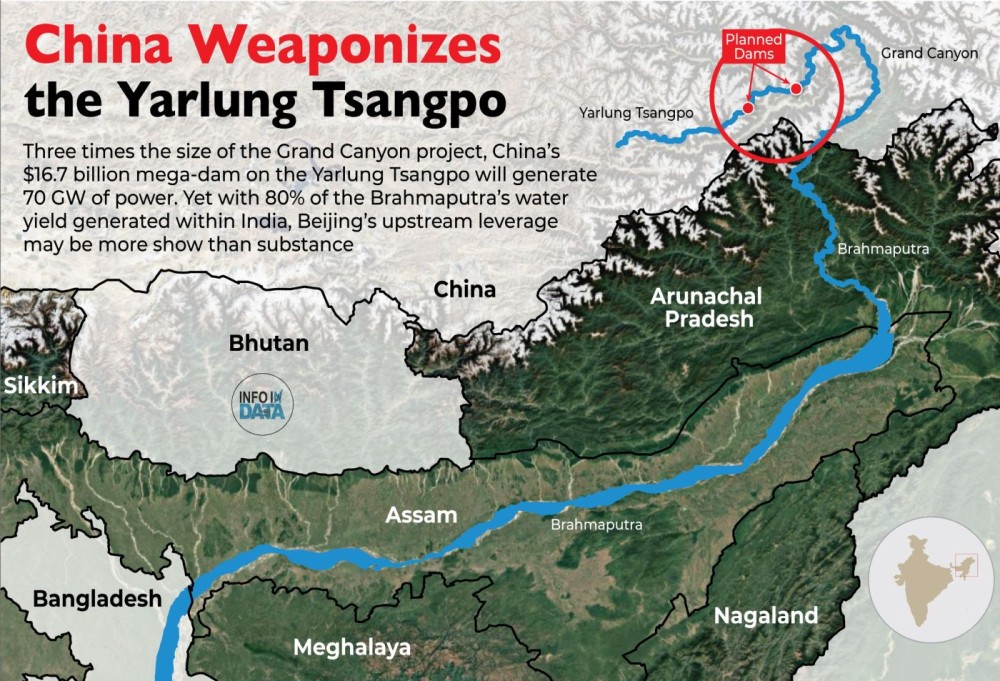
    China has commenced the construction of a massive hydropower project on the Yarlung Tsangpo river (Brahmaputra in India) in southeastern Tibet.

    China commences construction of Mega Dam over Brahmaputra

    About the Mega Dam Project on Brahmaputra (Yarlung Tsangpo):

    • Location: Nyingchi, southeastern Tibet, on the Yarlung Tsangpo River (Brahmaputra in India).
    • Project Size: Estimated investment of 1.2 trillion yuan (USD 167 billion).
    • Components: Comprises five cascade hydropower stations.
    • Power Generation: Expected to produce 300 billion kilowatt-hours (kWh) of electricity annually.
    • Objective:
      • Contribute to China’s carbon neutrality target by 2060.
      • Meet local power needs in Tibet and supply electricity to other Chinese provinces.
    • Concerns:
      • Environmental risks in a seismically active and ecologically fragile zone.
      • Geopolitical tensions with downstream countries (India, Bangladesh).
      • Potential impact on river flow and water availability downstream.
    • Strategic Significance: Close to India-China border, raising concerns amid existing border disputes.

    What if China stops Brahmaputra Water? 

    You should know: Three Gorges Dam 

    • Location: On the Yangtze River, Hubei province, central China.
    • Completed: Fully operational since 2012.
    • Type: Hydroelectric gravity dam – the world’s largest power station by installed capacity.
    • Power Generation Capacity: Around 22.5 gigawatts (GW).
    • Notable Impact:
      • Helped in flood control, navigation, and electricity supply.
      • Also criticized for ecological damage, displacement of over 1 million people, and increased seismic risk.


    [UPSC 2011] The Brahmaputra, Irrawady and Mekong rivers originate in Tibet and flow it through narrow and parallel mountain ranges in their upper reaches. Of these rivers, Brahmaputra makes a “U” turn in its course to flow into India. This “U” turn is due to:

    (a) Uplift of folded Himalayan series

    (b) Syntaxial bending of geologically young Himalayas

    (c) Geo-tectonic disturbance in the tertiary folded mountain chains

    (d) Both (A) and (B) above


  • [23rd July 2025] The Hindu Op-ed: China, India and the conflict over Buddhism

    PYQ Relevance:

    [UPSC 2020] Pala period is the most significant phase in the history of Buddhism in India. Enumerate.

    Linkage: To understand the “conflict over Buddhism,” it is essential to appreciate its historical roots and evolution within India. The Pala period saw a flourishing of Buddhist art, philosophy, and institutions, which contributed significantly to its spread, including to regions like Tibet, making it a foundational element of the cultural heritage that both India and China now seek to influence. 


    Mentor’s Comment:  India and China are engaged in a growing geopolitical contest over influence in the Himalayan Buddhist sphere, especially regarding spiritual leadership, monastic networks, and cultural legitimacy. With the Dalai Lama’s succession looming, both countries are using Buddhism as a strategic tool to shape regional loyalties, particularly in border areas like Ladakh, Tawang, Nepal, and Bhutan. This spiritual soft power struggle is emerging as a critical front in India-China rivalry, alongside their military and maritime tensions.

    Today’s editorial analyses the Issues related to Himalayan Buddhist sphere between India and China. This topic is important for GS Paper I (Indian Society, Ancient India and Geography), GS Paper II (International Relations)  in the UPSC mains exam.

    _

    Let’s learn!

    Why in the News?

    The Himalayas are the true battleground for a future clash between the Asian powers (India and China), as both sides try to win the support of people living along the border.

    How is China leveraging Buddhism in the Himalayas to influence the region and challenge India?

    • State-controlled Buddhism: China uses Buddhism as a tool of statecraft, asserting the right to control reincarnations (e.g., the 2007 rule requiring official approval for “Living Buddhas”).
    • Soft power through infrastructure: Beijing builds roads, shrines, and monasteries in border regions and funds Buddhist projects (e.g., in Nepal’s Lumbini).
    • Buddhist diplomacy: China invites Himalayan monks to conferences, slowly shifting their spiritual loyalties.
    • Manipulating internal sect disputes: China supports splinter sects (e.g., Dorje Shugden) to undermine Tibetan unity and weaken India’s influence.

    What is the background story of the Dalai Lama?

    • Early Life and Recognition: The 14th Dalai Lama, Tenzin Gyatso, was born in 1935 in Taktser, Tibet. At the age of 2, he was recognized as the reincarnation of the 13th Dalai Lama, following Tibetan Buddhist spiritual traditions.
    • Exile and Conflict with China: In 1950, China invaded Tibet. After a failed uprising in 1959, the Dalai Lama fled to India and established the Tibetan Government-in-Exile in Dharamshala, Himachal Pradesh, where he continues to lead the Tibetan cause.
    • Global Peace Icon: He became a global symbol of peace and non-violence, receiving the Nobel Peace Prize in 1989. Though he stepped down from political duties in 2011, he remains the spiritual leader of Tibetan Buddhists and a strong advocate of compassion and dialogue.

    Why is the Dalai Lama’s succession a strategic issue for India-China relations?

    • Dual claims: The 90-year-old Dalai Lama has hinted at reincarnating outside Chinese control (likely India), while China insists on selecting a successor through its Golden Urn method.
    • Split leadership: This could lead to two rival Dalai Lamas — one backed by India and the Tibetan diaspora, and another by China in Lhasa.
    • Regional impact: This schism would force Himalayan Buddhist populations (Ladakh, Bhutan, Tawang) to choose allegiances, influencing their political alignment.

    What challenges does India face in countering China’s Buddhist diplomacy?

    • Lack of a Coordinated National Strategy: India’s Buddhist outreach remains fragmented across ministries (Culture, External Affairs, Tourism), lacking a central vision or institutional mechanism. Eg: While India promotes the Buddhist circuit (Bodh Gaya, Sarnath), it has limited regional engagement with Himalayan Buddhist leaders compared to China’s structured approach.
    • Sectarian Divisions Within Indian Buddhism: Rivalries among sects, such as the two Karmapas (Ogyen Trinley Dorje vs. Thaye Dorje), weaken India’s ability to present a unified spiritual leadership. Eg: The divided Karmapa lineage allows China to exploit internal rifts and influence parts of the Kagyu sect in Sikkim and beyond.
    • Delayed Response to China’s Assertive Moves: India has been slow to counter China’s active engagement with Himalayan monasteries, especially in Nepal and Bhutan, where spiritual allegiance is also geopolitical. Eg: China’s investments in Lumbini (Buddha’s birthplace) and support for Shugden sects in Nepal show how it uses religious infrastructure to undermine India’s influence.

    How does the spiritual identity of the Himalayan regions affect their geopolitical stance?

    • Loyalty to Buddhist Lineages Influences Foreign Policy Orientation: Regions like Ladakh, Sikkim, Bhutan, and parts of Nepal follow Tibetan Buddhist traditions (Gelug, Kagyu, Nyingma), which often align them spiritually with Dharamsala-based Tibetan leadership under the Dalai Lama. This shapes their emotional, cultural, and sometimes strategic affinity with India over China.
    • Religious Influence Determines Soft Power Competition: China uses religious diplomacy, including recognising Buddhist leaders and promoting pro-China sects (e.g., Shugden), to erode India’s cultural sway in the Himalayas. Spiritual loyalties in monasteries can subtly shift political allegiances, especially in Nepal and Bhutan.
    • Monasteries Act as Political and Social Anchors: In Himalayan societies, monastic institutions are not just religious centres but also sources of local leadership, education, and conflict resolution. Control or influence over these can tilt regional attitudes towards either India or China, making them strategic soft power assets.

    How can India use its Buddhist heritage to boost regional influence? (Way forward)

    • Strengthen Cultural Diplomacy through Buddhist Circuits: India can promote Buddhist pilgrimage sites like Bodh Gaya, Sarnath, and Kushinagar as centres of global Buddhist unity. Eg: India’s International Buddhist Confederation (IBC) can be used to host annual regional Buddhist summits to enhance people-to-people ties with countries like Sri Lanka, Thailand, Vietnam, and Nepal.
    • Support and Recognize Key Monastic Leaders in the Himalayas: India can nurture its ties with Tibetan Buddhist communities in Ladakh, Sikkim, and Arunachal Pradesh by supporting locally respected Rinpoches and monastic institutions. Eg: Facilitating wider recognition of the 17th Karmapa (Ugyen Trinley Dorje) can help project a unified spiritual leadership from Indian soil and counter China’s manipulation of Buddhist lineages.
    • Leverage Buddhist Soft Power in Neighbourhood Diplomacy: By incorporating Buddhism in regional initiatives like Neighbourhood First and Act East, India can expand cultural influence over ASEAN and SAARC nations. Eg: India’s Lumbini-Bodh Gaya direct air link with Nepal and cultural grants to Myanmar monasteries show how soft power can strengthen strategic partnerships.
  • [7th July 2025] The Hindu Op-ed: The new battle challenge of China-Pakistan collusion

    PYQ Relevance:

    [UPSC 2018] The China-Pakistan Economic Corridor (CPEC) is viewed as a cardinal subset of China’s larger ‘One Belt One Road’ initiative. Give a brief description of CPEC and enumerate the reasons why India has distanced itself from the same.

    Linkage: The Article state that China’s traditional strategy involves “building up Pakistan’s strategic and conventional capabilities through overt and covert help to counter India and keep it off-balance”. This question directly relates to the “China-Pakistan nexus” by focusing on the China-Pakistan Economic Corridor (CPEC).


    Mentor’s Comment:  The Indian Army has officially confirmed what experts had long suspected, China directly helped Pakistan during Operation Sindoor (May 7–10), marking a major change in their military relationship. For the first time, China supported Pakistan in battle by sharing real-time surveillance data, using advanced weapons together, and spreading information online — all without openly escalating the conflict. This has turned the idea of a “two-front war” into a “one-front reinforced” war, where China backs Pakistan more closely in a real conflict. China’s support included high-tech weapons, cyber tools, and diplomatic moves at the UN, while avoiding any clear criticism of the Pahalgam terror attack. The use of Chinese-made fighter jets, drones, and air defence systems by Pakistan during the fighting is a game-changer and means India needs to rethink its defence strategy.

    Today’s editorial analyses the China-Pakistan military collusion and its impact. This topic is important for GS Paper II (International Relations) in the UPSC mains exam.

    _

    Let’s learn!

    Why in the News?

    The new “one-front reinforced” threat is now real, not just an idea. India must now rethink how it defends itself, update its military equipment, and clearly show its strength to others.

    What are the strategic implications of China-Pakistan military collusion for India’s security?

    • Increased Security Threat from a “One-Front Reinforced War”: A conflict with Pakistan now includes covert Chinese support, transforming it into a hybrid front rather than a standalone battle. India must prepare for simultaneous pressure on both borders, diluting its strategic flexibility. Eg: During Operation Sindoor (May 2025), China provided real-time ISR support and surveillance data to Pakistan.
    • Enhanced Pakistani Military Capabilities via Chinese Technology: Pakistan’s use of advanced Chinese weapons systems improves its operational effectiveness and battlefield confidence. This deepens strategic asymmetry and reduces India’s military advantage. Eg: Pakistan deployed Chinese J-10C fighters and HQ-9 air defence systems, guided by China’s BeiDou satellites, during active operations.
    • Erosion of India’s Strategic Autonomy and Deterrence: Collusion undermines India’s ability to execute punitive strikes without risking escalation or Chinese interference. India must now calibrate its response to avoid wider regional destabilisation. Eg: China blocked India’s diplomatic push at the UNSC post-Pahalgam attack and echoed Pakistan’s narrative, limiting India’s international manoeuvring space.

    How has China’s role in India-Pakistan conflicts evolved over time?

    • From Passive Diplomatic Support to Active Collusion: In earlier conflicts (1965, 1971, Kargil 1999), China offered only diplomatic or symbolic support to Pakistan without direct involvement. Now, China is actively enhancing Pakistan’s battlefield capabilities through technology and real-time support. Eg: In Operation Sindoor (2025).
    • Use of Advanced Defence and ISR Systems: China has moved from supplying basic military hardware to enabling operational interoperability and network-centric warfare. Chinese platforms are now tactically integrated into Pakistan’s military exercises and combat. Eg: Deployment of Chinese J-10C fighters, PL-15 missiles, and BeiDou navigation for missile guidance shows deeper integration.
    • Strategic Messaging and Digital Warfare Support: China now also supports Pakistan via propaganda, perception warfare, and digital influence operations. It helps shape global narratives and reduces diplomatic pressure on Pakistan. Eg: Chinese media amplified Pakistan’s ISPR propaganda during Operation Sindoor and resisted India’s push at the UNSC, aligning with Pakistan’s narrative.

    What is a “One-Front Reinforced War”?

    A “one-front reinforced war” refers to a conflict scenario where India fights on one primary front (e.g., against Pakistan), but this front is reinforced by active support from another adversary (e.g., China) without that second adversary being officially at war.

    Why is the “one-front reinforced war” concept critical for India’s defence strategy?

    • Unified Threat Vector: The China-Pakistan collusion has created a combined strategic front, making it harder for India to manage threats separately.  
    • Reduced Response Window: India faces a compressed decision-making timeline and resource overstretch, requiring faster and more coordinated defence responses. Eg: Despite the 2024 Ladakh disengagement, large Indian deployments are still needed on both the LAC and LoC.
    • Need for Capability Boost: The “one-front” scenario highlights the urgency to upgrade conventional deterrence, invest in modern warfare tech, and adapt military doctrine. Eg: Pakistan acquiring Chinese J-35 stealth jets, KJ-500 AEW&C, and HQ-19 missile defence systems intensifies pressure on India to respond.

    How should India respond to rising two-front challenges amid declining defence spending?

    • Increase Defence Allocation and Modernise Capabilities: India must reverse the decline in defence expenditure (from 17.1% of central spending in 2014-15 to 13% in 2025-26) and invest in next-generation warfare capabilities. This includes drones, AI-enabled surveillance, cyber defence, and network-centric warfare systems.
    • Adopt Asymmetric and Unpredictable Response Strategies: India should avoid predictable retaliation and adopt multi-domain deterrence, including economic, cyber, and covert measures. Eg: Strategic reconsideration of agreements like the Indus Waters Treaty, economic sanctions on critical Chinese firms, or calibrated cyber operations.
    • Institutional and Diplomatic Realignment:  India needs to bolster its international alliances and ensure seamless coordination between the armed forces, intelligence agencies, and foreign policy apparatus. Eg: Deepening defence ties with the Quad members, France, and Israel for intelligence sharing, joint exercises, and technology transfer.

    Way forward: 

    • Strengthen Integrated Defence Capabilities: India must invest in network-centric warfare, ISR systems, drone technologies, and joint-force interoperability to counter a reinforced adversary. Enhancing real-time battlefield awareness and communication across services is key.
    • Recalibrate Strategic and Diplomatic Posture: India should link China’s strategic collusion with Pakistan to its bilateral ties, signalling consequences for such behaviour. Simultaneously, boost alliances like QUAD, and explore unpublicised retaliatory options (e.g., Indus Waters Treaty leverage) to deter future collusion.
  • [28th June 2025] The Hindu Op-ed:  A China-led trilateral nexus as India’s new challenge

    PYQ Relevance:

    [UPSC 2017] ‘China is using its economic relations and positive trade surplus as tools to develop potential military power status in Asia’, In the light of this statement, discuss its impact on India as her neighbor.

    Linkage: It focuses on how China uses its economic power to gain strategic and military advantages, and how this affects India, its neighbor. The article show that Pakistan heavily depends on China for money, support, and infrastructure. With China’s backing, Pakistan could pose new terrorism and security threats to India.


    Mentor’s Comment:  China recently held a three-country meeting with Pakistan and Bangladesh in Kunming, soon after a similar one with Pakistan and Afghanistan. These talks show that China is trying to increase its influence in South Asia by bringing India’s neighbours closer, especially as India’s ties with Bangladesh are tense and India is becoming more active in Afghanistan. This reminds us of Cold War-style strategies, where countries tried to surround rivals. As India takes strong action against terrorism and defends its regional interests, China’s new meetings seem to show not just strategy, but also nervousness about India’s growing power.

    Today’s editorial talks about the recent meeting between China, Pakistan, and Bangladesh. This topic is important for GS Paper II (International Relations) in the UPSC mains exam.

    _

    Let’s learn!

    Why in the News?

    Last week, China, Pakistan, and Bangladesh met together for the first time in a three-country meeting held in Kunming, China.

    What are China’s goals behind trilateral talks with Pakistan and others?

    • Expand Regional Influence: China aims to increase its geopolitical footprint in South Asia by leading trilateral forums.
    • Contain India’s Rise: Trilateral talks help China keep India distracted by regional tensions, limiting its strategic outreach and diplomatic bandwidth. Eg: China’s coordination with Pakistan and Afghanistan shortly after India’s Operation Sindoor aimed to show Pakistan as a regional stakeholder and challenge India’s dominance.
    • Promote BRI and Economic Interests: By drawing countries like Afghanistan and Bangladesh closer, China seeks to push its Belt and Road Initiative and related infrastructure investments. Eg: Discussions with Afghanistan have included extending the China-Pakistan Economic Corridor (CPEC) through Afghan territory.

    Why is China increasing regional engagement amid India’s rise?

    • To Counter India’s Strategic Clout: As India grows economically and diplomatically, China seeks to undermine its influence in neighbouring countries. Eg: China’s trilateral with Pakistan and Bangladesh followed India’s strengthening ties with Afghanistan and regional powers.
    • To Exploit Shifting Political Landscapes: China is leveraging regime changes in countries like Afghanistan and Bangladesh to draw them closer into its orbit. Eg: After the regime change in Bangladesh (2024), China intensified efforts to engage Dhaka through trilaterals.
    • To Protect and Expand Economic Interests: Rising Indian assertiveness challenges China’s economic initiatives, especially BRI projects. Regional engagement helps safeguard these investments. Eg: China wants to extend the China-Pakistan Economic Corridor (CPEC) into Afghanistan to secure trade routes and regional access.

    How does the China-Pakistan nexus affect India’s security strategy?

    • Increased Two-Front Security Threat: The China-Pakistan partnership forces India to prepare for simultaneous threats on both western and northern borders, complicating military planning. Eg: During Operation Sindoor (2025), Pakistan used Chinese-made drones, radars, and fighter jets, requiring India to recalibrate its defence posture.
    • Diplomatic Isolation Attempts: China often backs Pakistan at global platforms, shielding it from international scrutiny, especially on terror-related matters. Eg: China blocked UN resolutions targeting Pakistan-sponsored terrorists, limiting India’s global counterterrorism diplomacy.
    • Regional Instability via Trilateral Engagements: China promotes trilateral meetings involving Pakistan and India’s neighbours to sideline New Delhi and create regional pressure points. Eg: The China-Pakistan-Bangladesh trilateral aims to undermine India’s influence in South Asia and divert attention from long-term strategic goals.

    What are the developments that show India countering China’s regional influence?

    • Assertive Military and Diplomatic Response: India has adopted a proactive approach to respond to security threats and Chinese intrusions. Eg: In response to the Pahalgam terror attack, India launched Operation Sindoor (2025) and suspended the Indus Waters Treaty, restricted port access, and took military action, signalling firm redlines.
    • Strengthening Ties with Neighbours: India is engaging constructively with its neighbours to limit Chinese outreach and reinforce strategic trust. Eg: Despite past tensions, India supported Nepal’s energy cooperation with Bangladesh and re-engaged with Maldives and Sri Lanka, reinforcing regional goodwill.
    • Coalition Building with Like-Minded Nations: India is enhancing cooperation with democratic allies to counterbalance China’s strategic footprint in South Asia. Eg: India has deepened ties through platforms like QUAD, and built defence and intelligence partnerships with countries like the U.S., Japan, and Australia, strengthening its regional deterrence.

    Who among the neighbours are shifting towards China?

    • Pakistan: Deeply aligned with China for military, economic, and diplomatic support. Eg: Over $29 billion in loans, and 80% of arms imports from China.
    • Bangladesh: After the 2024 regime change, it has shown increasing economic and political engagement with China. Eg: Joined trilateral talks with China and Pakistan, indicating a shift despite India’s past close ties.
    • Afghanistan: Shifted closer to China-Pakistan axis after the Taliban takeover (2021) and again after 2024 regime changes.

    Way forward: 

    • Enhance Strategic Partnerships in South Asia: India should build stronger bilateral ties with its neighbors through infrastructure support, trade cooperation, and regional connectivity projects. Strengthening initiatives like BIMSTEC and Act East Policy can counterbalance China’s influence.
    • Assert Regional Leadership Through Security and Diplomacy: India must continue to lead anti-terror cooperation, defend regional sovereignty, and set clear redlines for any hostile alignments. At the same time, it should promote inclusive regional forums that prioritize peace and mutual development.
  • India to alter Ganges Water Sharing Treaty with Bangladesh

    Why in the News?

    India is preparing to reassess and renegotiate the Ganges Water Sharing Treaty with Bangladesh, which is set to expire in 2026, completing its 30-year term.

    About the Ganga Water Agreement (1996):

    • Signing: It was signed on December 12, 1996, by PM H. D. Deve Gowda (India) and PM Sheikh Hasina (Bangladesh) to share the Ganga’s dry season flow.
    • Purpose: It aimed to ensure water availability for irrigation, ecology, and navigation in both countries, especially at the Farakka Barrage, which diverts water to sustain the Kolkata Port.
    • Duration: It replaced earlier short-term deals and set a 30-year framework (1996–2026), with a renewal clause by mutual consent.

    Key Terms of the Agreement:

    • Lean Season Period: The treaty applies from January 1 to May 31, with water sharing calculated in 10-day intervals.
    • Sharing Formula at Farakka:
      • ≤ 70,000 cusecs: 50% each
      • 70,000–75,000 cusecs: India gets the remainder after Bangladesh gets 35,000
      • ≥ 75,000 cusecs: India gets 40,000; Bangladesh gets the balance
    • Alternate Sharing: From March 11 to May 10, both countries receive 35,000 cusecs alternately every three 10-day blocks.
    • No Minimum Guarantee: If flow falls below 50,000 cusecs, Article II allows for consultations and emergency adjustments.
    • Monitoring Mechanism: The Joint Rivers Commission (JRC) ensures implementation and dispute resolution.
    • Project Provisions: Both countries may construct water projects for irrigation and navigation.

    Why must India reconsider it?  

    • Treaty Expiry: The treaty ends in 2026, and India wants a revised pact to reflect current demands.
    • Rising Needs: India seeks an additional 30,000–35,000 cusecs due to:
      • Increased irrigation in West Bengal and other states
      • Siltation issues at Kolkata Port
      • Urban and industrial growth
    • Flexibility Concerns: Officials argue the treaty lacks provisions for climate variability and seasonal shortages.
    • State Support: West Bengal supports changes, citing inadequate current allocations.
    • Proposed Change: India may pursue a shorter, more flexible treaty, like its move on the Indus Waters Treaty with Pakistan.

    Implications for Bangladesh:

    • Downstream Vulnerability: Bangladesh faces greater risk from reduced water flow.
    • Historical Shortfalls: Between 1997 and 2016, Bangladesh received less than its share 65% of the time.
    • Potential Consequences:
      • Increased salinity in rivers and farmland
      • Reduced water for fisheries, irrigation, and drinking
      • Navigation issues in the delta
    • Political Sensitivity: Many in Bangladesh already view the treaty as unfair, and further reduction may trigger domestic backlash.
    • Diplomatic Impact: A poorly negotiated outcome could strain India-Bangladesh ties, especially in water diplomacy and cross-border trust.
    [UPSC 2009] Consider the following statements:

    1. The Baglihar Power Project had been constructed within the parameters of the Indus Water Treaty.

    2. The project was completely built by the Union Government with loans from Japan and the World Bank. Which of the statements given above is/are correct?

    Options: (a) 1 only * (b) 2 only (c) Both 1 and 2 (d) Neither 1 nor 2


  • [14th June 2025] The Hindu Op-ed: Endgame of a 2,611-year-old Jewish-Persian enmity

    PYQ Relevance:

    [UPSC 2019] What introduces friction into the ties between India and the United States is that Washington is still unable to find for India a position in its global strategy, which would satisfy India’s National self-esteem and ambitions” Explain with suitable examples.

    Linkage: The article points out several trade and economic tensions between the U.S. and India. These include disagreements over the actual size of the U.S. trade deficit with India, the increase of tariffs on steel and aluminium imports from 25% and 10% to 50%, which also affects India, and warnings of possible tariffs on Apple products if they are made in India.

    Mentor’s Comment:  Israel’s bold “Rising Lion” operation against Iran on June 13, 2025, is a major turning point in Middle East politics. By killing top Iranian military and nuclear officials and bombing over 100 key sites, Israel has taken one of the most serious actions in its long rivalry with Iran. Both countries have described it as a historic moment, showing how serious the situation is. This is more than just a military move — it could have huge effects on the region and the world, including risks to energy supplies, rising tensions, and economic problems. It raises important questions about whether such surprise attacks can really prevent conflict or if they make things worse in an already unstable region.

     Today’s editorial focuses on the analysis of the Israeli attack on Iran and its impact. This content is very relevant to GS Paper II (International Relations) Mains.

    _

    Let’s learn!

    Why in the News?

    Recently, the Israeli military launched the “Rising Lion” operation against Iran, which is a very big step up in tensions in the Middle East.

    What are the strategic objectives behind Israel’s “Rising Lion” operation against Iran?

    • Neutralizing Nuclear and Missile Capabilities: Israel seeks to dismantle Iran’s ability to develop or deploy nuclear weapons and long-range missiles. Eg: Over 200 Israeli Air Force jets attacked 100+ targets, including nuclear sites and missile installations.
    • Eliminating Key Military Leadership: The operation targets Iran’s military command to disrupt strategic coordination and weaken retaliation capabilities. Eg: High-ranking officials like the Chief of Staff of the Armed Forces and Revolutionary Guard commanderswere assassinated.
    • Asserting Regional Military Superiority: By launching a preemptive, technology-driven blitzkrieg, Israel aims to reinforce its deterrence and reshape regional power dynamics. Eg: The campaign follows 21 months of pressure on Iran and its proxies, including provocative assassinationsand systematic airstrikes.

    Why has the Israeli campaign raised concerns about regional and global stability?

    • Risk of Regional Escalation: The conflict could widen if Iran retaliates or drags its proxies into action, destabilizing the Middle East. Eg: The Sunni Arab world fears blowback through attacks on oil facilities, incitement of Shia minorities, or revival of terrorist networks like ISIS.
    • Threat to Global Oil Supply Chains: Hostilities near key maritime chokepoints like the Strait of Hormuz can disrupt global energy flows. Eg: About 20% of global oil passes through the Strait; any Iranian attempt to block it could trigger oil price surgesand inflation.
    • Economic Fallout and Global Instability: A prolonged or messy war could amplify existing economic challenges like inflation, supply chain shocks, and geopolitical tension. Eg: The conflict may cause stock market instability, worsen the impact of other regional conflicts, and reverse global growth momentum.

    How has U.S. foreign policy influenced the escalation of the Israel-Iran conflict?

    • Withdrawal from the Iran Nuclear Deal: The U.S. pulled out of the Joint Comprehensive Plan of Action (JCPOA) in 2018, dismantling diplomatic progress and increasing Iran’s nuclear activity. Eg: Under Trump 1.0, the U.S. exited the deal and applied “maximum pressure” sanctions, leading to heightened tensions and mistrust.
    • Economic Strangulation Strategy: U.S. actions aimed to weaken Iran economically and diplomatically, increasing regional hostility. Eg: The U.S. pressured Saudi Arabia to flood the oil market, reducing Iran’s oil revenues, and pushed the IAEAto condemn Iran before the Israeli attack.
    • Military and Diplomatic Alignments: The U.S. built strategic ties and military alignments with Israel and other regional players to isolate Iran. Eg: The June 12 IAEA resolution, U.S. airstrikes on al-Houthis, and renewed ties with Pakistan signal coordinated steps that emboldened Israeli action.

    What are the implications of the conflict for the Sunni Arab world and global oil supply chains?

    • Strait of Hormuz Vulnerability: The conflict raises the risk of disruption in the Strait of Hormuz, a vital energy chokepoint. Eg: Nearly 20% of global oil supply passes through this strait, and Iran may block or threaten its use in retaliation.
    • Shia-Sunni Sectarian Tensions: Iran could incite Shia minorities in Sunni-ruled countries, destabilizing domestic security. Eg: Countries like Saudi Arabia and Bahrain fear internal unrest or uprisings, particularly in Shia-dominated regions.
    • Proxy Warfare and Regional Blowback: Iran-backed militias or proxies may target Sunni governments or U.S. allies, increasing regional instability. Eg: Attacks by Hezbollah, Houthis, or Iraqi militias could threaten infrastructure in UAE or Saudi Arabia.
    • Oil Price Surge and Inflation: Threats to supply lines or actual conflict could lead to global oil price spikes, impacting inflation. Eg: Fear of escalation alone can push prices upward, hurting import-dependent economies like India, and driving global market volatility.
    • Policy Dilemma for Sunni Arab States: Sunni states face a strategic dilemma—balancing between opposing Iran and avoiding regional escalation. Eg: Countries like Saudi Arabia and the UAE are wary of openly backing Israel, fearing retaliation and regional backlash.

    What could be the impact on India? 

    • Oil Price Volatility and Economic Stress: Rising tensions threaten energy security, as India imports over 85% of its crude oil. Eg: A spike in Brent crude prices due to disruptions in the Strait of Hormuz would increase India’s current account deficit, raise fuel prices, and trigger inflation.
    • Geopolitical Balancing Challenge: India must maintain a delicate diplomatic balance between Israel, Iran, and the U.S. Eg: India has strong strategic ties with Israel (defence and tech) but also energy and connectivity interests with Iran (e.g., Chabahar Port), making neutrality harder to maintain.
    • Threat to Diaspora and Trade Routes: Escalation could impact the safety of the Indian diaspora in the Gulf and disrupt maritime trade routes. Eg: Over 8 million Indians live in West Asia. Any conflict-induced displacement or shipping disruptions through the Persian Gulf would hurt remittances and exports.

    Way forward: 

    • Strengthen Energy Diversification and Strategic Reserves: India should diversify oil import sources (e.g., from Latin America, Africa) and expand strategic petroleum reserves to cushion against supply shocks. Eg: Fast-track deals with Brazil, UAE, and the U.S., while increasing domestic oil storage capacity.
    • Pursue Proactive and Balanced Diplomacy: India must engage in quiet diplomacy with both Israel and Iran, reaffirming strategic ties without compromising neutrality. Eg: Leverage platforms like BRICS, Shanghai Cooperation Organisation (SCO), and G20 to promote regional de-escalation and safeguard Indian interests.
  • Is Bangladesh slipping into authoritarianism?

    Why in the News?

    Bangladesh is seeing major political change as interim leader Dr. Muhammad Yunus delays elections to April 2026 and proposes the “July Proclamation” to reform or replace the 1972 Constitution.

    Why is the ‘July Proclamation’ seen as a threat to Bangladesh’s democratic foundations?

    • Lacks Democratic Legitimacy: It is being pushed by an unelected interim regime without a popular mandate or proper parliamentary debate. Eg: Prof. Yunus’ government is not elected, yet is trying to undertake constitutional reforms meant for a legislature.
    • Distorts Historical Legacy: The move seeks to marginalize the legacy of Sheikh Mujibur Rahman and diminish the significance of December (Victory Day) and August (Mujib’s assassination), promoting July as a new political start. Eg: The July Proclamation downplays Bangladesh’s founding narrative to suit a new political agenda.

    What are the risks of an unelected interim government pursuing constitutional reforms?

    • Lack of Legitimacy and Public Mandate: An interim government is not elected by the people and lacks the constitutional authority to undertake major reforms meant for a parliament or constituent assembly. Eg: In Bangladesh, Prof. Yunus’ government is implementing reforms without elections, violating democratic norms.
    • Potential for Power Consolidation: Such reforms can be used to prolong the tenure of the interim regime, sideline opposition, and weaken checks and balances, paving the way for authoritarian rule. Eg: The banning of the Awami League and the extension of election dates to 2026 raise concerns of power entrenchment.
    • Political Instability and Polarisation: Constitutional changes without bipartisan consensus can lead to unrest, legitimacy crises, and deep political divisions. Eg: The BNP, though opposed to the Awami League, is uncomfortable with the July Proclamation, showing a lack of political unity.

    How could the proposed humanitarian corridor affect regional security?

    • Violation of Sovereignty and Military Tensions: A demilitarised humanitarian corridor, especially if monitored by international forces, may be seen as a breach of national sovereignty by host countries.
      Eg: The Bangladesh Army chief objected to international enforcement in the Rakhine region, fearing it would undermine Bangladesh’s sovereignty.
    • Risk of Weapon Smuggling and Armed Group Access: Without effective monitoring mechanisms, such corridors could be exploited by international armed groups to smuggle weapons and infiltrate conflict zones. Eg: Concerns exist that the proposed corridor into Myanmar’s Rakhine province may be misused by armed groups, threatening both Myanmar and Indian border security.
    • Uncertain Aid Distribution and Escalation of Conflicts: There’s no guarantee that humanitarian aid will reach only the intended civilian population (like Rohingya) and not be diverted to militant factions, escalating regional conflicts. Eg: India fears that lack of clarity over corridor enforcement could worsen militancy in the Northeast and Indo-Myanmar border areas.
    Note: The humanitarian corridor to Myanmar’s Rakhine province is a proposed initiativenot yet implemented — and it was publicly supported by Professor Muhammad Yunus, the Chief Adviser to the interim government of Bangladesh, in a speech on June 7, 2025.

    Why does the sidelining of major parties like BNP and Awami League raise democratic concerns?

    • Undermining of Political Representation: Exclusion of major political parties weakens democratic legitimacy and narrows the space for public representation and opposition. Eg: The ban on the Awami League and the marginalisation of the BNP prevents millions of citizens from having their voices heard in the political process.
    • Emergence of Proxy or Unrepresentative Forces: The vacuum created by sidelining mainstream parties can be filled by unaccountable or extremist groups, increasing political instability. Eg: The rise of the National Citizens Party (NCP), referred to as the ‘King’s Party’ by the BNP, raises fears of state-sponsored political manipulation.

    Way forward: 

    • Inclusive Political Dialogue and Election Roadmap: The interim government must initiate an inclusive dialogue involving all major political parties, including the BNP and Awami League, to build consensus on constitutional reforms and ensure free and fair elections.  
    • Limit Powers of the Interim Government: Clearly define and restrict the mandate of the interim government to conduct elections only, avoiding any major constitutional or policy decisions that should be left to an elected Parliament.

    Mains PYQ:

    [UPSC 2013] Critically examine the compulsions which prompted India to play a decisive roles in the emergence of Bangladesh.

    Linkage: Understanding India’s historical role is crucial for comprehending the current political landscape in Bangladesh, especially as the interim government seems to want to ensure “that the legacy of 1971.

  • Assam CM on Pakistan ‘scare narrative’: Could Chinese dams affect Brahmaputra flow in India?

    Why in the News?

    India has rejected the “scare stories” spread by Pakistan and others about China building dams upstream on the Brahmaputra River, especially the big 60,000 MW Medog Hydropower Project in Tibet.

    What is the significance of the Brahmaputra’s flow originating mostly in India?

    • Major Contribution to River Flow: Although India has only about 34.2% of the Brahmaputra basin area, it contributes over 80% of the river’s total water flow due to higher rainfall and tributary inflows. Eg: The Indian basin receives an average annual rainfall of 2,371 mm, much higher than Tibet’s 300 mm.
    • Flood Management Potential: Control over a major share of the river’s flow gives India better scope to design flood control infrastructure and storage systems to reduce monsoon-related disasters. Eg: Assam CM stated that reduced flow from China could help mitigate annual floods in Assam.
    • Strengthened Riparian Rights and Development Planning: India’s dominant share in flow enhances its claim as a principal riparian state, empowering it to undertake hydropower and irrigation projects without heavy external dependency. Eg: India is developing hydropower projects like Dibang and Subansiri in Arunachal Pradesh based on its flow share.
    Note: A “riparian state” refers to a state or country that shares a river or stream border with another state or country.


    What about the Medog Hydropower Project?

    The Medog Hydropower Project is an ambitious and controversial initiative by China to construct the world’s largest hydropower dam on the Yarlung Tsangpo River in Tibet. With a planned capacity of 60,000 megawatts (MW) and an estimated cost of $137 billion, the project has significant environmental, geopolitical, and social implications for the region

    Why is China’s proposed Medog hydropower project raising concerns for India?

    • Strategic Control Over Water Flow: China’s 60,000 MW Medog dam could allow manipulation of the Brahmaputra’s flow, risking reduced water in dry seasons or artificial floods during monsoons. Eg: Sudden releases from Chinese dams have previously caused flash floods in Arunachal Pradesh and Assam.
    • Environmental and Seismic Hazards: The dam’s location in a seismic zone threatens biodiversity, increases landslide risks, and may disrupt sediment flow critical for downstream agriculture. Eg: Trapped sediments can reduce soil fertility, impacting farming in India and Bangladesh.
    • Absence of Water-Sharing Agreements: China’s unilateral actions without consultation violate equitable sharing norms, worsening trust deficits. Eg: Unlike the Indus Treaty with Pakistan, no formal pact exists between India and China on the Brahmaputra.

    What steps has India taken or proposed to utilise the Brahmaputra’s water potential?

    • Development of Hydropower Projects: India is actively constructing and planning large hydropower projects in Arunachal Pradesh to harness the Brahmaputra’s energy potential and establish water-use rights. Eg: Projects like the Dibang Multipurpose Project (2880 MW) and Subansiri Lower Hydroelectric Project (2000 MW) are designed to generate clean energy and regulate river flow.
    • Construction of Multipurpose Storage Reservoirs: India is focusing on creating dams and storage facilities to control floods, store monsoon water, and ensure water availability in dry seasons. Eg: The proposed Upper Siang project aims to store floodwaters and generate electricity while supporting irrigation and drinking water needs in the region.
    • Promotion of Inland Waterways and River Navigation: The Brahmaputra is being developed as a key navigable waterway under India’s Act East Policy to boost trade and regional connectivity. Eg: The National Waterway-2 (NW-2) on the Brahmaputra facilitates cargo movement between Assam and Bangladesh, promoting economic use of the river.

    Way forward: 

    • Bilateral Water-Sharing Framework: India and China should initiate dialogue to establish a formal transboundary water-sharing agreement, ensuring data transparency, flow regulation, and emergency notification mechanisms—similar to the Indus Waters Treaty.
    • Regional Environmental Assessment Mechanism: Promote a joint environmental impact assessment (EIA) involving India, China, and Bangladesh under a multilateral platform like the UN or SAARC, to ensure sustainable and equitable river basin management.

    Mains PYQ:

    [UPSC 2013} What do you understand by run of the river hydroelectricity project? How is it different from any other hydroelectricity project?

    Linkage: The articles talks about the Chinese infrastructure interventions on the Brahmaputra are “hydropower projects with minimal storage”. It also mentions the massive planned Medog project as the world’s largest hydropower facility, and India’s own Upper Siang Project which will generate power and serve as a buffer against flow variations. This question directly relates to a type of hydropower project pertinent to river development and control.