💥Join UPSC 2027,2028 Mentorship (July Batch) + XFactor Notes & Microthemes PDF

GS Paper: Indigenization Of Technology

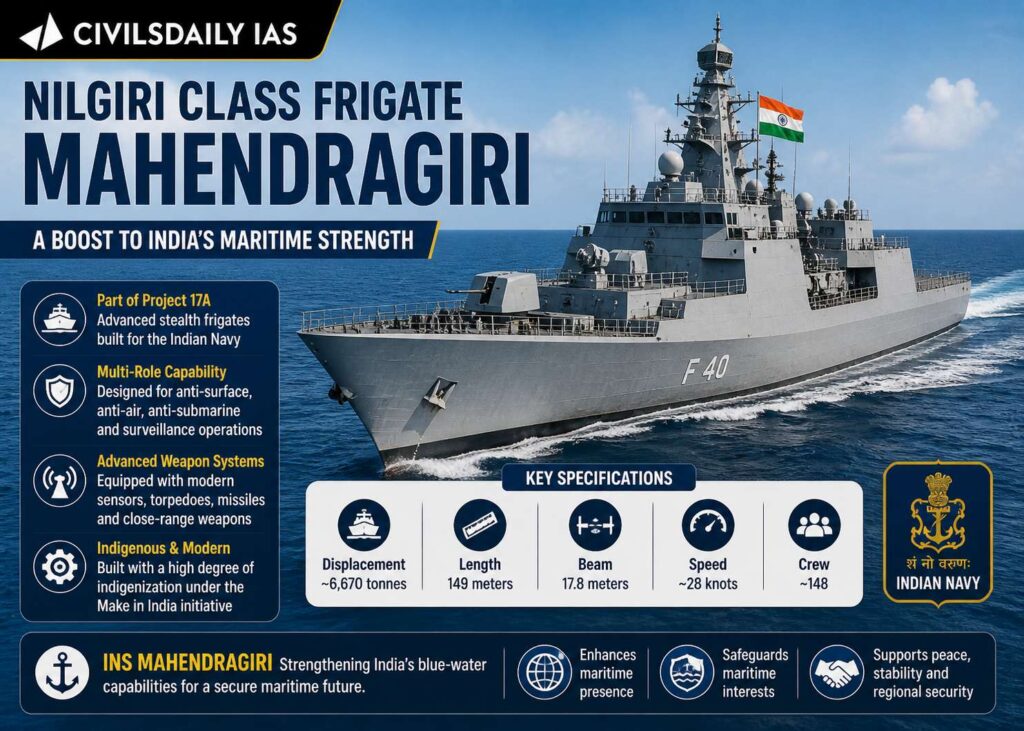
  • Nilgiri Class Frigate Mahendragiri 

    Why in the News

    The Indian Navy has inducted INS Mahendragiri, the sixth ship of the Nilgiri class (Project 17A), strengthening India’s naval combat capability and indigenous defence manufacturing.

    Key Facts

    • Name: INS Mahendragiri
    • Class: Nilgiri class stealth frigate
    • Project: Project 17A
    • Built by: Mazagon Dock Shipbuilders Limited
    • Location: Mumbai
    • Designed by: Warship Design Bureau (India)

    Features of Project 17A Frigates

    • Advanced stealth technology
    • Multi mission capability:
      • Anti surface warfare
      • Anti air warfare
      • Anti submarine warfare
    • Equipped with:
      • Advanced sensors
      • Modern weapons systems

    Propulsion System

    • CODOG (Combined Diesel or Gas)
    • Allows:
      • Efficient cruising (diesel)
      • High speed operations (gas turbine)

    Indigenous Capability

    • Around 75 percent indigenous content
    • Involvement of: 200 plus MSMEs
    • Employment generated:
      • 4000 direct jobs
      • 10000 indirect jobs
    [2025] With reference to India’s defence, consider the following pairs: 
    Aircraft type : Description 
    1 Dornier-228 : Maritime patrol aircraft 
    2 IL-76 : Supersonic combat aircraft 
    3 C-17 Globemaster III : Military transport aircraft 
    How many of the pairs given above are correctly matched? 
    (a) Only one (b) Only two (c) All the three (d) None
  • The significance of India’s third nuclear submarine

    Why in the News?

    India has inducted INS Aridaman, its third SSBN, marking the first time India operates three nuclear ballistic submarines simultaneously. This significantly strengthens India’s second-strike capability, a cornerstone of its nuclear doctrine. The induction represents a shift from limited deterrence to continuous sea-based nuclear readiness, especially amid growing regional strategic competition. The ability to carry K-4 missiles (3,500 km range) marks a major qualitative upgrade over earlier capabilities.

    What are Ship Submersible Ballistic Nuclear (SSBN)?

    1. Definition: Nuclear-powered submarines equipped with submarine-launched ballistic missiles (SLBMs) carrying nuclear warheads.
    2. Core function: Ensures second-strike capability, enabling retaliation even after a nuclear attack.
    3. Endurance: Uses nuclear reactors, allowing months-long submerged operations without surfacing.
    4. Stealth capability: Operates undetected in deep oceans, ensuring survivability of nuclear arsenal.
    5. Strategic role: Forms the most secure leg of the nuclear triad, unlike vulnerable land or air systems.

    Which are India’s earlier SSBNs?

    1. INS Arihant (Commissioned: 2016):
      1. Significance: India’s first indigenous nuclear-powered submarine; marked entry into nuclear triad.
      2. Missile capability: K-15 (700 km range).
      3. Displacement: ~6,000 tonnes.
      4. Role: Established India’s sea-based deterrence foundation.
    2. INS Arighaat (Commissioned: 2024):
      1. Technological upgrade: Improved stealth, endurance, and reactor efficiency over Arihant.
      2. Missile capability: Supports both K-15 and K-4 (3,500 km) missiles.
      3. Role: Strengthened credible deterrence with longer-range strike capability.

    How does INS Aridaman strengthen India’s nuclear deterrence?

    1. Second-strike capability: Ensures survivable nuclear retaliation even after a first strike; SSBNs remain undetected underwater for months.
    2. Extended range missiles: Supports K-4 SLBMs (3,500 km), enabling deep-strike capability beyond immediate neighbourhood.
    3. Operational continuity: Facilitates continuous at-sea deterrence, unlike earlier limited deployment cycles.
    4. Technological upgrade: Incorporates advanced nuclear reactors, enhancing endurance and stealth.

    Why is sea-based deterrence central to India’s nuclear doctrine?

    1. Nuclear triad completion: Integrates land (Agni missiles), air (Rafale, Su-30), and sea-based platforms.
    2. No First Use (NFU): Requires assured retaliation; SSBNs provide guaranteed survivability.
    3. Stealth advantage: Submerged platforms reduce detection risk compared to land and air assets.
    4. Credible deterrence: Enhances deterrence credibility against nuclear adversaries.

    What are the key features of Arihant-class submarines?

    1. INS Arihant (2016):
      1. K-15 Sagarika missiles: Range ~700 km
      2. Displacement: ~6,000 tonnes
      3. Launch tubes: Four
    2. INS Arighaat (2024):
      1. Enhanced technology: Improved stealth and endurance
      2. Missile capability: K-15 + K-4
    3. INS Aridaman (2026):
      1. Displacement: ~7,000 tonnes
      2. Launch tubes: Estimated eight
      3. Missile capability: Higher K-4 payload

    What distinguishes SSBNs from other submarine types?

    1. SSBN (Ballistic nuclear): Enables nuclear deterrence via long-range ballistic missiles.
    2. SSGN (Guided nuclear): Carries conventional guided missiles for tactical operations.
    3. SSN (Nuclear attack): Focuses on anti-submarine and anti-surface warfare.
    4. Strategic significance: SSBNs represent the most survivable nuclear delivery platform.

    How do SSBNs function as strategic deterrence platforms?

    1. Ballistic missile capability: Carries Submarine-Launched Ballistic Missiles (SLBMs) with nuclear warheads; enables long-range strikes (e.g., K-4 ~3,500 km) from secure maritime zones.
    2. Second-strike assurance: Ensures retaliation even after a nuclear first strike; forms the backbone of credible minimum deterrence.
    3. Stealth endurance: Operates silently for months underwater using nuclear propulsion, reducing detection probability.
    4. Strategic targeting: Focuses on counter-value and counter-force targets, influencing adversary calculations at the strategic level.

    How do Ship Submersible Guided Nuclear (SSGNs) differ in role and operational utility?

    1. Guided missile systems: Equipped with cruise missiles (e.g., land-attack or anti-ship missiles) instead of ballistic missiles.
    2. Conventional strike role: Conducts precision strikes on tactical targets such as military bases, ports, and infrastructure.
    3. Versatility: Supports special operations forces (SOF deployment) and intelligence missions.
    4. Operational scope: Used in limited conflicts and conventional warfare, not primarily for nuclear deterrence.

    What defines Ship Submersible Nuclear (SSNs) as attack submarines?

    1. Primary mission: Conducts anti-submarine warfare (ASW) and anti-surface warfare (ASuW) to neutralize enemy naval assets.
    2. Fleet support: Escorts aircraft carriers and protects SSBNs, ensuring layered maritime defence.
    3. High mobility: Nuclear propulsion enables high speed and sustained underwater operations for tracking enemy vessels.
    4. Tactical dominance: Engages in sea denial strategies, restricting adversary movement in strategic waters.

    Why are Ship Submersible Ballistic Nuclear (SSBNs) considered the most survivable nuclear platforms?

    1. Stealth advantage: Deep-sea deployment makes detection extremely difficult compared to fixed land silos or air bases.
    2. Mobility: Constant movement complicates enemy targeting and pre-emption strategies.
    3. Redundancy: Even if land and air assets are destroyed, SSBNs ensure assured retaliation capability.
    4. Deterrence stability: Reduces incentives for a first strike by adversaries, thereby promoting strategic stability. 

    What technological and strategic challenges remain?

    1. Limited fleet size: Three SSBNs insufficient for full-time deterrence patrol cycles.
    2. Dependence on foreign inputs: Reactor and propulsion technologies involve external collaboration.
    3. Detection risks: Advances in anti-submarine warfare (ASW) technologies.
    4. Operational gaps: India currently operates 16 conventional submarines, below required strength (~18-24).

    What are India’s future submarine plans?

    1. SSN programme: Plans to build six nuclear attack submarines domestically.
    2. Lease model: Acquisition of SSN from Russia to bridge capability gaps.
    3. Project-75I: Collaboration with Germany’s ThyssenKrupp Marine Systems for AIP submarines.
    4. Expansion objective: Achieve full-spectrum underwater capability.

    Conclusion

    INS Aridaman marks a transition from symbolic deterrence to operationally credible nuclear deterrence. Sustained investment in SSBN and SSN fleets remains essential for ensuring strategic stability.

    PYQ Relevance

    [UPSC 2022] What are the maritime security challenges in India? Discuss the organisational, technical and procedural initiatives taken to improve maritime security.

    Linkage: SSBNs like INS Aridaman strengthen maritime security by ensuring credible nuclear deterrence and second-strike capability within India’s oceanic domain. The question enables integration of submarine capability, naval modernization, and Indo-Pacific strategic challenges, making SSBNs a key technical initiative in maritime security.

  • INS Anjadip Commissioned

    Why in the News

    The Indian Navy commissioned INS Anjadip, the fourth indigenously designed and built Anti Submarine Warfare Shallow Water Craft, at Chennai Port.

    About INS Anjadip

    • Type: Anti Submarine Warfare Shallow Water Craft
    • Length: 77 metres
    • Built by: Garden Reach Shipbuilders & Engineers at Kattupalli
    • Named after: Anjadip Island off Karwar coast

    Key Capabilities

    • Designed for shallow and coastal waters
    • Detect, track and neutralise enemy submarines
    • Equipped with:
      • Shallow water sonars
      • Lightweight torpedoes
      • Anti submarine rockets
      • Combat management system

    Operational Roles

    • Anti submarine warfare in littoral zones
    • Coastal surveillance
    • Low intensity maritime operations
    • Search and rescue missions

    Significance

    • Enhances India’s anti submarine warfare capability
    • Strengthens coastal defence architecture
    • Reflects Aatmanirbhar Bharat in naval shipbuilding
    • Boosts indigenous defence manufacturing ecosystem
    [2016] Which one of the following is the best description of ‘INS Astradharini’, that was in the news recently? (a) Amphibious warfare ship 

    (b) Nuclear-powered submarine 

    (c) Torpedo launch and recovery vessel 

    (d) Nuclear-powered aircraft carrier

  • India’s First Private Helicopter Assembly Line at Vemagal

    Why in the News?

    India’s first private sector helicopter Final Assembly Line was inaugurated at Vemagal, Kolar district, Karnataka to manufacture Airbus H125 helicopters through a partnership between Tata Advanced Systems and Airbus.

    Key Entities Involved

    • Tata Advanced Systems Limited
    • Airbus
    • France
    • Hindustan Aeronautics Limited

    About the Facility

    • Location: Vemagal, Kolar district, Karnataka
    • Type: Private sector Final Assembly Line
    • Product: Airbus H125 single engine helicopter
    • Initial annual capacity: 10 helicopters
    • First delivery expected: Early 2027
    • Will serve Indian and South Asian markets

    This becomes the fourth global production site for the H125 after France, USA and Brazil.

    About H125 Helicopter

    • One of the world’s best selling single engine helicopters
    • Over 4,300 units flying globally
    • Certified under European Union Aviation Safety Agency standards
    • Designed for high altitude and rugged terrain operations

    Military Variant

    • H125M version proposed
    • Seen as a successor to Cheetah and Chetak helicopters
    • Suitable for:
      • Tactical reconnaissance
      • High altitude logistics
      • Search and rescue
      • Medical evacuation
    [2024] Consider the following aircraft: 

    1. Rafael 

    2. MiG-29 

    3. Tejas MK-1 

    How many of the above are considered fifth generation fighter aircraft? 

    (a) Only one (b) Only two (c) All three (d) None

  • What’s ailing India’s battery scheme for EVs

    Why in the News?

    The ₹18,100 crore PLI Scheme for Advanced Chemistry Cell (ACC) Battery Storage, launched to create 50 GWh of domestic battery manufacturing capacity by 2025, has achieved only 1.4 GWh of installed capacity even after multiple bidding rounds. Despite awarding 20 GWh of capacity and disbursing commitments to three beneficiaries, no incentive funds have been released due to missed milestones. The scheme has attracted only 25.58% of the targeted investment, far below expectations. This represents a sharp contrast with the scheme’s original promise of rapidly catalysing India’s EV battery ecosystem and exposes structural weaknesses in mineral supply, technology readiness, and industrial execution.

    What are Advanced Chemistry Cells (ACCs)?

    1. Energy storage systems: Enable storage of electrical energy and conversion back to electricity as required.
    2. Lithium-ion dominance: Represent the most widely used battery chemistry globally, particularly in EVs and electronics.
    3. Technology-agnostic design: Allows multiple chemistries, including lithium manganese cobalt, lithium iron phosphate, and sodium-ion batteries.

    What was the intent behind the ACC PLI scheme?

    1. Manufacturing ecosystem creation: Seeks establishment of large-scale domestic battery manufacturing capacity.
    2. Import substitution: Reduces reliance on Chinese battery imports and supply chains.
    3. Strategic value chain integration: Requires complementary policies for mineral refining and component manufacturing.

    How was the scheme designed to function?

    1. Capacity-linked incentives: Rewards firms based on committed and operational manufacturing capacity.
    2. Minimum scale requirement: Mandates at least 5 GWh per participant to ensure economies of scale.
    3. Investment threshold: Requires ₹225 crore per GWh of committed capacity.
    4. Performance-linked payouts: Allows incentives up to ₹2,000 per kWh sold.
    5. Domestic Value Addition (DVA): Mandates 25% DVA within two years and 60% by the fifth year.

    Who were selected as beneficiaries under the scheme?

    1. Ola Electric: Awarded 20 GWh capacity initially; operationalised only 1.4 GWh by October 2025.
    2. Reliance New Energy: Allocated 5 GWh in the first round and an additional 10 GWh in the second round.
    3. Rajesh Exports: Allocated 5 GWh capacity.

    What has been the actual performance so far?

    1. Capacity shortfall: Only 1.4 GWh operational against a target of 50 GWh by 2025.
    2. Investment gap: Scheme generated only ₹1,118 crore, compared to an expected ₹4,360 crore.
    3. Zero disbursement: No incentive payouts released despite elapsed timelines.
    4. Concentration risk: Entire operational capacity limited to a single beneficiary.

    Why has the ACC PLI scheme underperformed?

    1. Unrealistic gestation period: Two-year commissioning timeline unsuitable for complex battery manufacturing plants.
    2. Mineral processing gaps: India lacks domestic facilities for lithium, nickel, and cobalt refining.
    3. Subsidy-centric design: Emphasises financial incentives without adequate ecosystem readiness.
    4. Execution capability mismatch: New entrants lack manufacturing experience compared to established global players.
    5. Supply chain dependence: Continued reliance on China for raw materials, equipment, and technical approvals.
    6. Regulatory delays: Slow clearance of Chinese technical specialists and technology transfer processes.
    7. Skilled labour deficit: Insufficient trained workforce for precision battery cell manufacturing.

    What does the article recommend going forward?

    1. Faster regulatory approvals: Accelerates visas and clearances for foreign technical expertise.
    2. Penalty relaxation: Extends commissioning deadlines by at least one year to reflect ground realities.
    3. Value chain deepening: Requires targeted schemes for mineral refining and component manufacturing.
    4. Technology and R&D focus: Prioritises domestic innovation over assembly-led expansion.
    5. Human capital development: Builds specialised skill pipelines for battery manufacturing.

    Conclusion

    The ACC PLI scheme reveals that fiscal incentives alone cannot substitute for ecosystem readiness. Manufacturing scale, mineral security, skilled labour, and technological capability must evolve simultaneously. Without structural correction, India’s battery ambitions risk remaining aspirational rather than transformative.

    PYQ Relevance

    [UPSC 2023] The adoption of electric vehicles is rapidly growing worldwide. How do electric vehicles contribute to reducing carbon emissions and what are the key benefits they offer compared to traditional combustion engine vehicles?

    Linkage: Electric vehicles reduce carbon emissions only when supported by clean electricity and efficient energy storage; weak domestic battery manufacturing limits these climate gains. Without strong domestic battery manufacturing, EV adoption may remain limited to vehicle sales rather than real decarbonisation.

  • Electronics Components Manufacturing Scheme 

    Why in the News?

    The Ministry of Electronics and Information Technology approved 22 additional projects under the Electronics Components Manufacturing Scheme involving an investment of ₹41,863 crore.

    About Electronics Components Manufacturing Scheme

    • A flagship incentive scheme to promote domestic manufacturing of electronic components, sub assemblies and capital equipment
    • Implemented by the Ministry of Electronics and Information Technology
    • Aims to reduce import dependence in India’s electronics sector

    Target Segments

    • Printed Circuit Boards, Camera modules, Copper clad laminates, Polypropylene films and Electronics capital equipment.

    Performance Linked Features

    • Incentives linked to incremental production
    • Employment generation based payouts
    • Early movers receive higher benefits

    Strategic Manufacturing Targets

    • 100 percent domestic demand for copper clad laminates
    • 20 percent domestic demand for printed circuit boards
    • 15 percent domestic demand for camera modules

    Ecosystem Linkages

    • Complements Production Linked Incentive Scheme for Electronics
    • Supports India Semiconductor Mission
    • Strengthens the electronics manufacturing ecosystem

    Prelims Pointers

    • ECMS focuses on electronics components rather than finished products
    • Copper clad laminates are critical for PCB manufacturing
    • Scheme uses performance based incentives
    • Electronics manufacturing is a priority sector under Atmanirbhar Bharat
    [2023] Consider the following statements: 

    Statement-I: India accounts for 3.2% of global exports of goods. 

    Statement-II: Many local companies and some foreign companies operating in India have taken advantage of India’s ‘Production-linked Incentive’ scheme. 

    Which one of the following is correct in respect of the above statements? 

    (a) Both Statement-I and Statement-II are correct and Statement-II is the correct explanation for Statement-I 

    (b) Both Statement-I and Statement-II are correct and Statement-II is not the correct explanation for Statement-I 

    (c) Statement-I is correct but Statement-II is incorrect 

    (d) Statement-I is incorrect but Statement-II is correct

  • [1st January 2026] The Hindu OpED: India’s space programme, a people’s space journey

    [UPSC 2016] Discuss India’s achievements in the field of Space Science and Technology. How has the application of this technology helped India in its socio-economic development?

    Linkage: The article illustrates India’s progression from landmark space missions to a citizen-centric space ecosystem supporting disaster management, agriculture, infrastructure, and governance.

    Mentor’s Comment

    India’s space programme has entered a decisive phase of transformation, from a state-led scientific endeavour to a people-centric strategic ecosystem. The article captures this transition by mapping India’s journey from symbolic achievements to institutional depth, private participation, and societal integration. It highlights how space has become a tool for governance, economy, national confidence, and global leadership, rather than remaining a niche scientific pursuit.

    Introduction

    India’s space programme is in focus following a series of firsts and institutional shifts that redefine its purpose and scale. From the Prime Minister’s articulation of Amrit Kaal goals to the operationalisation of the Indian Space Policy 2025, the sector is no longer limited to launches and missions. It now underpins disaster management, governance delivery, startup ecosystems, education, and international collaboration. The transformation is significant because it marks India’s shift from a mission-centric model to a citizen-facing, market-enabled, and globally integrated space ecosystem, an evolution rarely achieved by developing economies.

    How did India’s space journey evolve from inspiration to infrastructure?

    1. Foundational Vision: Established scientific self-reliance through indigenous launch vehicles and satellites, creating strategic autonomy in space access.
    2. Mass Participation: Chandrayaan missions generated nationwide engagement, embedding scientific ambition within public consciousness.
    3. Technological Maturity: Achieved precision landing, rover operations, and in-orbit docking, reflecting systemic depth beyond symbolic success.
    4. Societal Integration: Transitioned space assets from elite scientific use to everyday governance and citizen services.

    What milestones redefined India’s credibility as a space power?

    1. Chandrayaan-1: Confirmed presence of water molecules on the Moon, reshaping lunar science understanding.
    2. Chandrayaan-2: Delivered high-resolution lunar data despite partial mission failure, reinforcing learning-based innovation.
    3. Chandrayaan-3: Achieved first-ever soft landing near the lunar south pole, placing India among elite lunar explorers.
    4. Gaganyaan Preparations: Advanced human spaceflight readiness through crew module recovery and test vehicle missions.
    5. Aditya-L1 and SPADEX: Expanded capabilities into solar observation and in-orbit docking for future space stations.

    Why is the space sector being reframed as a national development tool?

    1. Disaster Management: Enables early warning systems, damage assessment, and real-time coordination.
    2. Agriculture and Fisheries: Supports crop estimation, drought monitoring, and marine resource advisories.
    3. Infrastructure and Transport: Enhances railway safety, urban planning, and power grid monitoring.
    4. Democratisation of Access: Positions space-derived data as a public good accessible to citizens and states.

    How is policy reform reshaping India’s space ecosystem?

    1. Indian Space Policy 2025: Institutionalises private sector participation across launch, satellite, and downstream services.
    2. Commercial Scaling: Facilitates startups in satellite manufacturing, launch vehicles, and data analytics.
    3. Economic Expansion: Increased sector valuation from ₹5,615 crore (2013-14) to ₹24,116 crore (2025-26).
    4. Employment Creation: Generates high-skill jobs across aerospace, AI, robotics, and materials science.

    What role do youth, education, and innovation play in this transition?

    1. Capacity Building: Engages over 60,000 students annually through Olympiads and space challenges.
    2. Innovation Platforms: Hackathons and competitions integrate academia with applied research.
    3. Startup Ecosystem: Over 350 startups contribute to satellite systems, launch services, and applications.
    4. Future Workforce: Strengthens STEM education pipeline aligned with emerging space technologies.

    How does India project leadership in global space governance?

    1. Climate Monitoring: Deploys satellites like G-20 Climate Satellite for global environmental observation.
    2. Data Sharing: Collaborates with NASA, ISRO, CNES, and ESA on Earth observation and planetary missions.
    3. Normative Leadership: Advances cooperative space use rooted in Vasudhaiva Kutumbakam.
    4. South-South Outreach: Provides satellite services and training to developing nations.

    Conclusion

    India’s space programme has evolved from a symbol of scientific aspiration into a core pillar of national development and strategic capability. By integrating space technology with governance delivery, economic expansion, private innovation, and global cooperation, India has repositioned space as a public good rather than an elite scientific pursuit. The transition towards human spaceflight, indigenous space infrastructure, and citizen-centric applications reflects a mature ecosystem aligned with the vision of Amrit Kaal. Sustained policy support, institutional coordination, and inclusive access will determine whether this transformation consolidates India’s role as a leading space power serving both national and global interests.
  • INS Vagsheer

    Why in the News?

    • Droupadi Murmu became the second Indian President to undertake a submarine sortie, embarking on INS Vagsheer from Karwar naval base.

    About INS Vagsheer

    • Sixth submarine of the Kalvari class (Scorpene class) under Project-75
    • Operated by the Indian Navy
    • Named after the sandfish, a deep sea predator of the Indian Ocean
    • Commissioned on 15 January 2025
    • Sister vessels
      • INS Kalvari December 2017
      • INS Khanderi September 2019
      • INS Karanj March 2021
      • INS Vela November 2021
      • INS Vagir January 2023

    Indigenous Systems Onboard

    • Air conditioning plant
    • Internal communication network
    • Ku Band SATCOM system

    Prelims Takeaway

    • INS Vagsheer is the last submarine of the first Kalvari class batch
    • Built in India under Project-75
    • Among the quietest conventional submarines globally
    • Important milestone for self reliance in defence manufacturing
    Consider the following statements: (2009)

    1. INS Sindhughosh is an aircraft carrier. 

    2. INS Viraat is a submarine. 

    Which of the statements given above is/are correct? 

    (a) 1 only (b) 2 only (c) Both 1 and 2 (d) Neither 1 nor 2

  • Kavach System – Automatic Train Protection (ATP)

    Why in the News?

    • The Union Railway Minister informed the Lok Sabha during the Winter Session of Parliament that the indigenously developed Kavach system has been fully commissioned on over 2,000 km of the Indian Rail network.
    • The rollout is progressing at a very fast pace across multiple railway zones.

    What is Kavach?

    • Kavach is an indigenous Automatic Train Protection (ATP) system.
    • It is designed to prevent train collisions, over-speeding, and signal passing at danger (SPAD).
    • It enhances operational safety through real-time monitoring and automatic intervention.

    Development and Agencies Involved

    • Developed by:
      • Research Design and Standards Organisation (RDSO) under Indian Railways
    • Industry partners:
      • Medha Servo Drives Pvt. Ltd.
      • HBL Power Systems Ltd.
      • Kernex Microsystems

    Current Status (as of December 2025)

    • 7,129 km of Optical Fibre Cable laid
    • 860 telecom towers installed
    • 767 railway stations connected to data centres
    • Trackside equipment deployed along 3,413 km
    • 4,154 locomotives equipped with Kavach
    • Around 40,000 technicians and operators trained

    Impact

    • Consequential railway accidents reduced by nearly 90%
    • Accidents declined from 135 (2014) to about 11 currently
    • Demonstrates tangible improvement in railway safety outcomes
    Consider the following statements: (2025)

    I. Indian Railways have prepared a National Rail Plan (NRP) to create a future ready railway system by 2028.

    II. ‘Kavach’ is an Automatic Train Protection system developed in collaboration with Germany.

    III. ‘Kavach’ system consists of RFID tags fitted on track in station section.

    Which of the statements given above are not correct?

    (a) I and II only 

    (b) II and III only 

    (c) I and III only 

    (d) I, II and III

  • INS Aridhaman

    Why in the News

    The Indian Navy has indicated that INS Aridhaman, India’s third nuclear powered ballistic missile submarine (SSBN), will be inducted soon.

    About INS Aridhaman

    • Second submarine of the Arihant class SSBNs
      • Developed under the Advanced Technology Vessel (ATV) project
      • Built at Ship Building Centre, Visakhapatnam
      • Strengthens India’s nuclear triad with credible sea based deterrence.

    Strategic Significance 

    • Enhances deterrence posture under No First Use policy
      • Consolidates India’s position as a blue water navy
      • Increases maritime security presence in the Indian Ocean Region

    Note: A blue water navy is a maritime force that can operate far beyond its own coastal waters and project power across the deep oceans of the world.

    Consider the following statements: (2023)

    1. Ballistic missiles are jet-propelled at sub-sonic speeds throughout their flights, while cruise missiles are rocket-powered only in the initial phase of flight. 

    2. Agni-V is a medium-range supersonic cruise missile, while BrahMos is a solid-fuelled intercontinental ballistic missile. 

    Which of the statements given above is/are correct? 

    (a) 1 only (b) 2 only (c) Both 1 and 2 (d) Neither 1 nor 2