💥Join UPSC 2027,2028 Mentorship (August Batch) + XFactor Notes & Microthemes PDF

GS Paper: GS3-14.Investment models

  • Did Press Note 3 relaxations help attract more FDI?

    Why in the News

    The government’s March 2026 relaxation of Press Note 3 (2020) now allows the automatic route for foreign investors from land-border-sharing countries where the resulting stake is below 10 percent. Press Note 3 (2020) had required prior government approval for any foreign direct investment from an entity based in, or beneficially owned by, a country sharing a land border with India, a restriction imposed after India’s border tensions with China. Since the relaxation, 29 Foreign Direct Investment (FDI) projects together worth ₹4,895.65 crore have been reported as raised through the automatic route. The scale of that inflow is now being tested against whether it represents genuine new investment or capital that was already structured to qualify.

    What is Press Note 3 and why was it imposed?

    1. Origin in 2020 border tensions: The Department for Promotion of Industry and Internal Trade issued Press Note 3 in April 2020 requiring government approval for FDI from any country sharing a land border with India, a category that in practice targets China.
    2. Stated rationale of opportunistic acquisition: The measure was framed as a safeguard against opportunistic takeovers of Indian companies whose valuations had fallen sharply during the COVID-19 pandemic.
    3. No de minimis threshold in the original rule: The 2020 version applied government-approval scrutiny regardless of the size of the resulting stake, so even a marginal shareholding increase by an investor linked to a bordering country required clearance.
    4. Applied to beneficial ownership, not just direct investment: The restriction reaches an investment structured through a third country if the ultimate beneficial owner is based in a bordering country, closing a routing loophole.

    What has the March 2026 relaxation changed?

    1. Automatic route restored below a 10 percent threshold: Investment from a bordering-country-linked entity resulting in a stake below 10 percent in the Indian company no longer requires prior government approval.
    2. Retains approval requirement above the threshold: Any investment crossing the 10 percent stake mark, or any greenfield or strategic-sector investment, continues to require case-by-case government clearance.
    3. 29 projects reported since relaxation: ₹4,895.65 crore in FDI has been reported as raised through the automatic route across 29 projects since the relaxation took effect.

    Did the relaxation actually attract more FDI?

    1. Reported inflow is modest against India’s total FDI base: ₹4,895.65 crore is a small fraction of India’s annual FDI inflow, so a Press Note 3 relaxation limited to sub-10 percent stakes has not shifted aggregate FDI in a way that will show clearly in headline balance-of-payments data.
    2. The 10 percent cap limits which capital responds: A relaxation confined below the threshold attracts portfolio-style minority stakes rather than the strategic or controlling investment that would signal deeper industrial commitment.
    3. Difficult to isolate the relaxation’s own effect: FDI flows respond to multiple factors simultaneously, including global interest rates and India’s own growth outlook, making it hard to attribute the 29 reported projects solely to the policy change.
    4. Sectoral destination of the reported inflow remains the open question: Whether the ₹4,895.65 crore has gone into manufacturing capacity or into financial and services stakes shapes how much the relaxation has actually served its stated industrial goal.

    Conclusion

    The Press Note 3 relaxation has produced a measurable but modest reported inflow, ₹4,895.65 crore across 29 projects, since March 2026. Whether this represents a genuine widening of investor participation from land-border-sharing countries or capital that was already positioned to enter below the new threshold will become clearer as more reporting cycles pass.

    Back2Basics: Press Note 3 (2020)

    1. Issued by the Department for Promotion of Industry and Internal Trade under the Foreign Direct Investment policy framework, not a standalone statute.
    2. Requires government approval for FDI from, or beneficial ownership traced to, any country sharing a land border with India: China, Pakistan, Bangladesh, Nepal, Bhutan, Myanmar, and Afghanistan.
    3. Applies to both fresh investment and a change in beneficial ownership of an existing investment resulting from a transfer.
    4. Enforced through the Reserve Bank of India’s foreign exchange reporting framework under the Foreign Exchange Management Act, 1999.

    Matching Previous Year Question

    “[2022] Which one of the following situations best reflects “Indirect Transfers” often talked about in media recently with reference to India ?
    (a) An Indian company investing in a foreign enterprise and paying taxes to the foreign country on the profits arising out of its investment
    (b) A foreign company investing in India and paying taxes to the country of its base on the profits arising out of its investment
    (c) An Indian company purchases tangible assets in a foreign country and sells such assets after their value increases and transfers the proceeds to India
    (d) A foreign company transfers shares and such shares derive their substantial value from assets located in India
    ANSWER: (d)”

  • Investment question has a political answer

    Investment question has a political answer

    Why in the News

    Private corporate investment in India remains considerably lower than the peak seen in the mid 2000s, even as large corporates hold substantial cash. Firms are deploying funds in financial assets rather than building physical assets such as factories, and are taking money out of the country rather than investing it here. The standard explanations offered for this are subdued domestic demand and global uncertainty. A political economy explanation is now advanced instead, locating the cause in how political power structures affect investment decisions. Centralisation of political power has been unmistakable after 2014, accompanied by fiscal centralisation and a reconfiguration of federal structures. The contested claim is that market concentration around a handful of “national champions” is not an accident of policy but is politically useful, which would make an investment revival costly to the current political settlement.

    What are “national champions”?

    • Definition: A national champion is a large domestic business group that a government treats as the preferred vehicle for building strategic capacity, and that is favoured in policy design as a result.
    • How the status is conferred: Preference operates through the terms of auctions, tariffs, incentive eligibility, clearances and access to public contracts rather than through an announced designation.
    • The economic consequence: A handful of such groups now command far greater sway over the economy than before, which raises the entry barrier facing any firm attempting to compete with them.

    What does the investment slowdown actually look like?

    • Cash-rich firms are not building: Large corporates hold funds but are not committing them to new capacity in India.
    • Capital is leaving: Companies are taking money out of the country rather than investing it domestically.
    • Investment is below its own peak: Private corporate investment remains considerably lower than the level reached in the mid 2000s.
    • Financial assets over physical assets: Corporate India is more keen to deploy funds in financial assets than to use them for factories and plant.
    • The standard explanations are incomplete: Subdued domestic demand and global uncertainty have been put forward, and neither accounts for why firms with the means to invest choose not to.

    Why does the concentration of political and market power deter private investment?

    • Political and fiscal centralisation: Centralisation of political power after 2014 has been accompanied by greater fiscal centralisation and a reconfiguration of federal structures, including attempts to restrict the powers of states and, as a consequence, of regional parties. Eg. The Mines and Minerals (Development and Regulation) Amendment Act, 2026, amending the 1957 law under which the State owns the mineral and signs the lease while the Centre sets the rules and the royalty rate.
    • Market concentration has moved in step: The rise of a handful of large companies, aided by policy, has given them far greater sway over the economy than ever before.
    • One, patronage for smaller firms has dried up: The concentration of political power and the decline in the relative power of regional parties has ended the patronage and protection that were afforded to smaller and regional firms, who could rise up and become national players.
    • Two, policy uncertainty and an uneven playing field: Higher barriers to entry and terms tilted towards larger corporates make it harder for new players to emerge, and firms will not invest if they fear the rules of the game can be arbitrarily changed or that they can be caught on the wrong side of policies. Policy credibility is what is at stake.
    • Three, the fear of being muscled out: Investors fear that business success will be met by a hostile takeover by a national champion, so the question is not whether they are allowed to operate but whether they can stay in business and remain competitive over the next 10 to 20 years.

    Why would dispersing economic power be politically costly?

    • Competition requires a rethink of the strategy: For the larger corporate sector to ramp up investment and for competition to emerge, the strategy of relying on a few national champions needs to be reconsidered.
    • Dispersed economic power funds political opposition: A larger number of big private players would disperse rather than concentrate economic power, which would in turn increase the funding avenues available to Opposition parties.
    • Economic competition feeds political competition: Weakening the concentration of economic power would possibly weaken the concentration of political power, so greater economic competition could lead to greater political competition.
    • The two open questions: It is unsettled whether the current political structure creates the space for new players to safely invest and emerge as competitors to the national champions, or whether market concentration is itself politically useful.

    Why do the ingredients of an investment boom not produce one?

    • The macroeconomic conditions are present: An undervalued exchange rate, depressed real wages and sustained public sector investment in infrastructure are all in place, alongside the demographic dividend.
    • The same mix powered East Asia: This combination powered the rise of countries such as China and South Korea, where firms responded to it with large capacity additions.
    • India’s firms are not responding: Firms are likely to remain hesitant and unsure about investing without a change in the approach, despite those conditions.
    • Confidence, not capability, is binding: Investment decisions are taken only when investors think they have a fair chance of benefiting from them.
    • The end state if nothing changes: The consequent absence of competition raises the possibility of an uncompetitive, high-cost economy.

    Challenges to the national champions strategy

    • Concentration raises consumer and input costs: Dominant firms in a sector face little pressure to hold prices down, which raises costs for every downstream user. Eg. Telecom tariffs rose sharply after the sector consolidated into three private operators. Fix. Use the deal value threshold introduced by the Competition (Amendment) Act, 2023 to review acquisitions that current turnover tests miss.
    • Policy-created advantage is hard to withdraw: Once a group builds capacity on the strength of an incentive, removing the incentive becomes a shock the government is reluctant to deliver. Eg. Most approved incentive under the Production Linked Incentive scheme for large-scale electronics manufacturing has flowed to a small group of mobile phone assemblers. Fix. Publish sunset dates and firm-level disbursement data with each incentive scheme so withdrawal is scheduled rather than negotiated.
    • Concentrated bank exposure transmits firm risk to the system: Lending concentrated in a few large groups converts a single group’s distress into a banking problem. Eg. The corporate loan losses that produced the non-performing asset build-up of the 2010s were concentrated in a handful of infrastructure and metals groups. Fix. Enforce large exposure limits at group rather than borrower level and publish group-wise banking exposure.
    • Bidding rules can favour incumbents: Net worth, prior experience and bank guarantee conditions in auctions and tenders can exclude new entrants before price is considered. Eg. Critical mineral block auctions have repeatedly failed for want of qualified bidders. Fix. Set qualification thresholds proportionate to block or contract size and allow consortium bidding for first-time entrants.
    • Competition enforcement is slow relative to market speed: Investigations concluded years after conduct occurs cannot restore a market that has already tipped. Eg. Appeals against Competition Commission of India orders routinely run for several years before finality. Fix. Fund a dedicated appellate bench for competition matters with statutory disposal timelines.

    Conclusion

    The reluctance of cash-rich Indian firms to invest is being read as a political economy problem rather than a demand or global uncertainty problem. Concentrated political power, an uneven playing field and the fear of being displaced by a national champion together deny new entrants confidence in a 10 to 20 year horizon. Reversing that requires dispersing economic power, which carries political costs the current settlement has no incentive to accept. What remains unresolved is whether market concentration will be treated as a cost to growth or retained as a political asset.

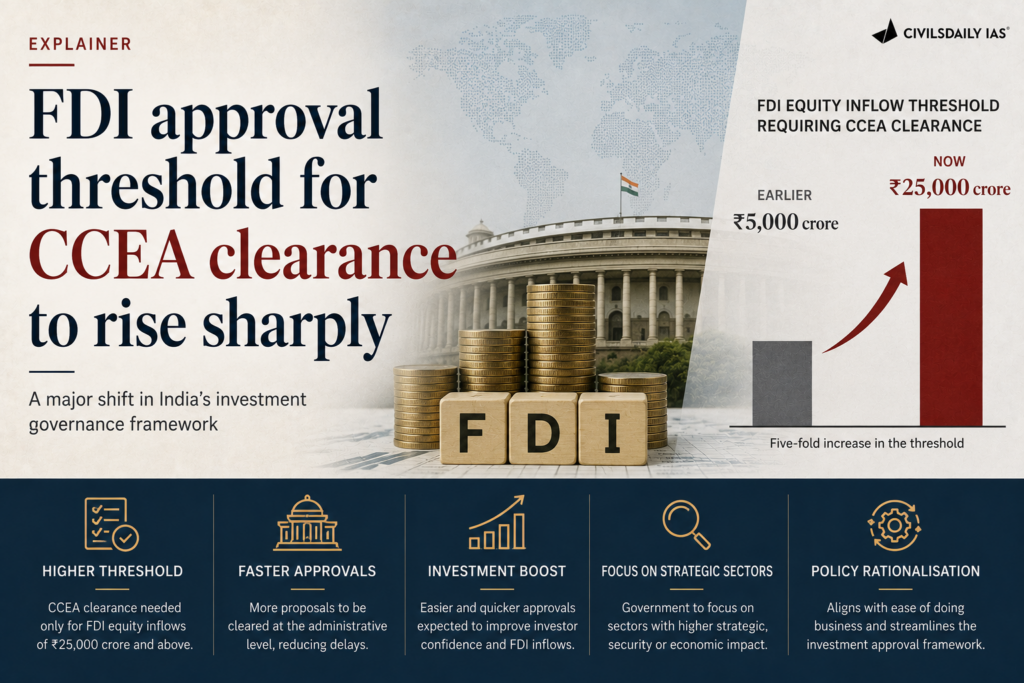
  • FDI approval threshold for CCEA clearance to rise sharply

    Why in the News

    The government plans to raise the FDI threshold requiring CCEA approval from ₹5,000 crore to ₹15,000 crore, reducing political-level scrutiny for large investments.

    What is the FDI Approval System?

    1. Automatic route: No prior government approval is required.
    2. Government route: Requires approval from the concerned ministry/department.
    3. CCEA layer: Very large proposals above the prescribed threshold require Cabinet Committee on Economic Affairs (CCEA) approval.

    What is the impact of Raising the Threshold?

    1. Fewer escalations: Investments between ₹5,000 crore and ₹15,000 crore can avoid CCEA clearance.
    2. Faster approvals: Reduces procedural delays and improves the ease of doing business.
    3. Greater investment autonomy: Gives ministries greater authority to clear large investments.
    4. Liberalisation: Continues India’s shift towards a simpler, faster FDI regime, following the abolition of FIPB in 2017.

    Back2Basics

    1. FDI: Investment by a foreign entity in an Indian enterprise with a lasting interest.
    2. FIPB: Abolished in 2017; its role was transferred mainly to the concerned ministries/departments.
    3. Key balance: Faster approvals must be accompanied by national security, competition and strategic-sector safeguards.

    PYQ Relevance

    [UPSC 2016] Justify the need for FDI for the development of the Indian economy. Why is there a gap between MoUs signed and actual FDIs? Suggest remedial steps to be taken for increasing actual FDIs in India.

    Linkage: The PYQ examines FDI as a driver of investment, growth and ease of doing business. Raising the approval threshold can reduce delays and help convert investment proposals into actual FDI inflows.

  • PM SVANidhi Street Food Hub Initiative

    Why in News?

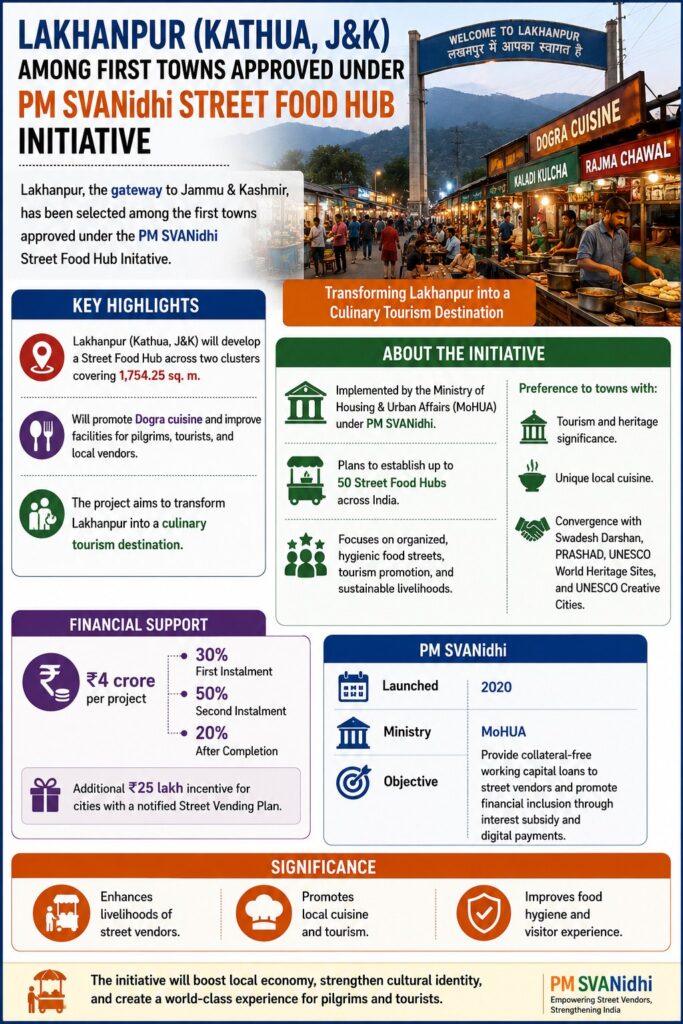
    Lakhanpur (Kathua, Jammu & Kashmir) has been selected among the first towns approved under the PM SVANidhi Street Food Hub Initiative.

    Key Highlights

    • Lakhanpur, the gateway to Jammu & Kashmir, will develop a Street Food Hub across two clusters covering 1,754.25 sq. m.
    • Will promote Dogra cuisine and improve facilities for pilgrims, tourists, and local vendors.
    • The project aims to transform Lakhanpur into a culinary tourism destination.

    About the Initiative

    • Implemented by the Ministry of Housing & Urban Affairs (MoHUA) under PM SVANidhi.
    • Plans to establish up to 50 Street Food Hubs across India.
    • Focuses on organized, hygienic food streets, tourism promotion, and sustainable livelihoods.
    • Preference to towns with:
      • Tourism and heritage significance.
      • Unique local cuisine.
      • Convergence with Swadesh Darshan, PRASHAD, UNESCO World Heritage Sites, and UNESCO Creative Cities.

    Financial Support

    • ₹4 crore per project: 30% first instalment, 50% second instalment, and 20% after completion
    • Additional ₹25 lakh incentive for cities with a notified Street Vending Plan.

    PM SVANidhi

    • Launched: 2020, Ministry: MoHUA
    • Objective: Provide collateral-free working capital loans to street vendors and promote financial inclusion through interest subsidy and digital payments.

    Significance

    • Enhances livelihoods of street vendors.
    • Promotes local cuisine and tourism.
    • Improves food hygiene and visitor experience.

    [2015] Pradhan Mantri Jan Dhan Yojana has been launched for

    [A] providing housing loan to poor people at cheaper interest rates

    [B] Promoting women’s Self-Help Groups in backward areas

    [C] promoting financial inclusion in the country

    [D] providing financial help to marginalised communities

  • Explain the meaning of investment in an economy in terms of capital formation. Discuss the factors to be considered while designing a concession agreement between a public entity and a private entity.

    Investment refers to the creation or addition of capital assets in an economy that enhance its productive capacity. It involves machinery, infrastructure, technology, and human skills.

    Meaning of Investment in Terms of Capital Formation

    Addition to Capital Stock- Eg- Samruddhi Expressway, Foxconn Plant in Chennai.

    Gross Capital Formation (GCF)- additions to fixed assets, inventories, valuables. Eg- Solar Plant in Rajasthan.

    Enhances Productive Capacity- Eg- Dedicated Freight Corridors boosting logistics efficiency.

    Savings and Investment Link- Higher savings enable greater capital formation. Eg- Sovereign Green Bonds funding renewable energy assets.

    Includes Physical, Human and Social Capital- Eg- Skill India Mission, Metro rail projects.

    Creates jobs, improves productivity, accelerates growth. Eg- Sagarmala driving port-led industrialisation.

    Factors to Consider While Designing a Concession Agreement (Public-Private)

    Political / Policy

    Clear Scope Definition- project components, performance standards, service quality benchmarks, and asset ownership.

    Model of partnership – Eg- Hybrid annuity model or BOT Model

    Concession Period based on asset life, investment size, and recovery period. Eg- 20-30 years for highways.

    Economic

    Risk Allocation between government and private entity

    Revenue Model- Eg- tariffs, user charges, annuity payments, or viability gap funding.

    Financial Structure- Terms on capital investment, debt-equity ratio, refinancing rules.

    Social

    Environmental & Social Safeguards- Compliance with EIA and land acquisition laws.

    Transparency and Accountability- Public disclosures, third-party audits, and periodic review.

    Technological

    Performance Metrics- KPIs, service standards, monitoring, penalties, incentives.

    Legal

    Dispute Resolution- arbitration method.

    Renegotiation Rules- framework for handling unforeseen demand or cost shocks.

    Termination Clauses- rules for default, compensation, and asset handback.

    Kelkar Committee recommendations

    Prioritizing service delivery over fiscal benefits in contracts

    Establishing independent sector regulators

    Better risk allocation between stakeholders

    Utilizing advanced risk management techniques

    A well-designed concession agreement ensures efficient public-private collaboration, ultimately leading to sustainable high-quality infrastructure delivery and realisation of a $40 Trillion economy by 2047.

  • Fully Accessible Route (FAR) of Investment

    Why in the News?

    In 2025, foreign investors have invested only about ₹69,000 crore ($7.8 billion) nearly half than expected, into Indian government bonds, even though the rules were made simpler and more flexible under the Fully Accessible Route (FAR) to attract more investment.

    What is Fully Accessible Route (FAR)?

    • Overview: A special investment framework launched by the Reserve Bank of India (RBI) in March 2020 to attract foreign investment in Indian government securities (G-secs).
    • Purpose: Aims to liberalise India’s debt market, enhance foreign participation, and integrate it with global financial systems.
    • Eligible Investors: Open to Foreign Portfolio Investors (FPIs), Non-Resident Indians (NRIs), and Overseas Citizens of India (OCIs) without investment caps.
    • Key Feature: Permits unlimited foreign investment in designated government bonds with free buy–sell access and no quantitative ceiling.
    • Liquidity & Integration: Designed to improve bond market depth, diversify funding sources, and boost India’s visibility in global debt indices.
    • Repatriation Freedom: Allows investors to repatriate capital and profits freely to their home countries.
    • Global Milestone: In June 2024, JP Morgan included 29 Indian G-secs under FAR in its Emerging Market Bond Index (EMBI), marking India’s debut in major global bond benchmarks.

    Comparison with Other Routes:

    1. Medium Term Framework (MTF): Allows foreign investment in G-secs but with limits and conditions on exposure and tenure.
    2. Voluntary Retention Route (VRR): Permits FPIs to invest in G-secs provided they retain investments for a minimum period, ensuring stable long-term inflows.

    Complementary Function: FAR, MTF, and VRR operate together, providing flexibility in investment terms and balancing market stability with foreign access.

    Why were higher inflows expected?

    • Projected Inflows: Index inclusion in 2024–25 was expected to attract $20–25 billion from global institutional and index-tracking investors.
    • Attractiveness Factors: India’s 7% stable yields, macroeconomic strength, and favourable risk–return ratio made it a promising destination for long-term capital.
    • Actual Outcome: Only $10.7 billion flowed in during 2024-25: well below expectations.
    • Key Reasons:
      • Global monetary uncertainty: investors awaited clarity on the US Federal Reserve’s rate policy.
      • Domestic caution: RBI removed 14- and 30-year bonds from FAR in 2024 to reduce volatility.
      • Geopolitical tensions and FPI withdrawals from equities reduced investor appetite.
    • Significance: Despite lower inflows, FAR remains a structural reform strengthening India’s position as a globally accessible and competitive bond market.
    [UPSC 2024] Consider the following statements:

    1. In India, Non-Banking Financial Companies can access the Liquidity Adjustment Facility window of the Reserve Bank of India.

    2. In India, Foreign Institutional Investors can hold the Government Securities (G-Secs).

    3. In India, Stock Exchanges can offer separate trading platforms for debts.

    Which of the statements given above is/are correct?

    Options: (a) 1 and 2 only (b) 3 only (c) 1, 2 and 3 (d) 2 and 3 only*