A rare August cyclone, named ‘Asna’, currently positioned off the Kutch coast is even more remarkable for having originated over land.
Why was there a lot of excitement over Asna?
“Asna” is notable because it’s the first cyclone in August in the North Indian Ocean since 1981. August is typically not part of the cyclone season in this region.
The cyclone began as a land-born depression that intensified as it moved over the warm waters of the Arabian Sea. It formed from a rare strong low-pressure system that grew unusually powerful over land.
Asna’s formation is linked to the broader context of rapid warming over the Arabian Sea, influenced by climate change. The northward shift of the low-level jet stream due to warming over West Asia contributed to its development.
Why does the North Indian Ocean have two cyclone seasons?
The North Indian Ocean has two distinct cyclone seasons due to the unique monsoonal circulation patterns in the region:
Pre-monsoon season (March-May): The Arabian Sea warms rapidly during this time as the sun crosses over to the Northern Hemisphere. The Bay of Bengal is relatively warmer and begins producing atmospheric convection and rainfall. This leads to cyclogenesis in both the Arabian Sea and the Bay of Bengal.
Post-monsoon season (October-December): This is the northeast monsoon season for India. The Arabian Sea cools due to the strong southwesterly winds and mixing of cold subsurface waters. However, the Bay of Bengal remains favourable for cyclogenesis. The post-monsoon season is the major cyclone season in the North Indian Ocean
How is climate change affecting the region?
Warming of the Indian Ocean: Climate change is amplifying the warming of the Indian Ocean, with more heat being transferred from the Pacific Ocean and Southern Ocean. This increases the overall sea surface temperature (SST), crucial for cyclone formation.
Monsoon and cyclones: The warming affects the monsoon patterns and has the potential to change cyclone intensity. More heat and moisture from the warming seas lead to more energy available for cyclones.
Impact on global ocean circulation: The warming of the Indian Ocean is also affecting global ocean currents, impacting heat uptake by the Pacific Ocean and water sinking in the North Atlantic. The Indian Ocean is playing a central role in global climate change processes.
Way forward:
Strengthening Early Warning Systems: Enhance real-time monitoring and forecasting of cyclones, particularly in the pre- and post-monsoon seasons, using satellite data and advanced models.
Building Climate Resilience: Implement climate adaptation strategies, especially for coastal communities, by improving infrastructure and disaster preparedness to cope with increasing cyclone intensity due to climate change.
Mains PYQ:
Q Discuss the meaning of colour-coded weather warnings for cyclone prone areas given by India Meteorological Department. (UPSC IAS/2022)
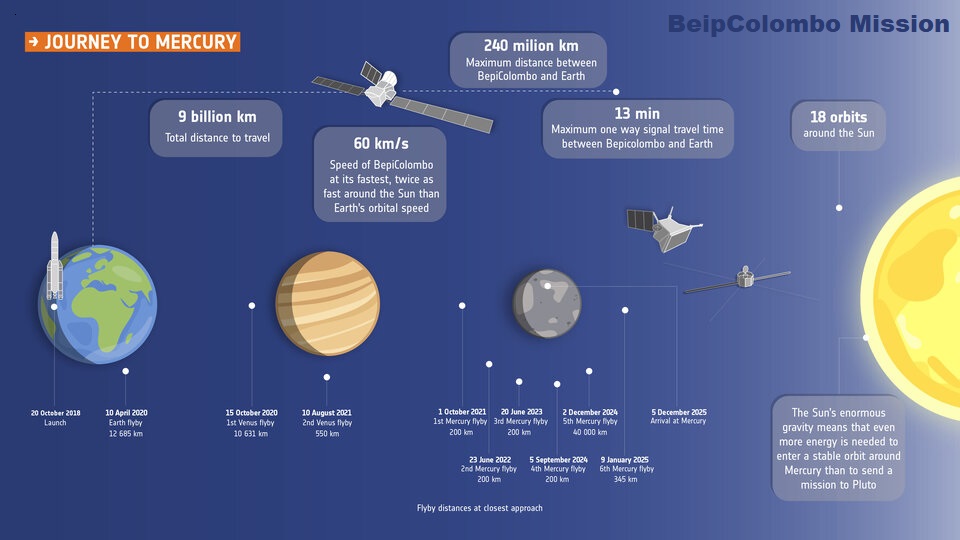
On Thursday, the ESA-Japan spacecraft “BepiColombo” made its closest approach to Mercury, capturing detailed images of its sunrise-lit surface and revealing the planet’s south pole.
Highlights of the Latest Flyby:
BepiColombo uses flybys of Earth, Venus, and Mercury to slow down and enter orbit around Mercury. This approach gives scientists new information about Mercury’s south pole and its unusual peak ring craters, which haven’t been studied much before.
Note: Flybys are close passes of a spacecraft near a planet or celestial body
About BepiColombo Mission:
Details
Collaboration
European Space Agency (ESA) and Japan Aerospace Exploration Agency (JAXA)
Launch Date
October 20, 2018
Expected to enter Mercury’s orbit by late 2026.
Launch Vehicle
Ariane 5 Rocket
Objectives
Study Mercury’s magnetic field
Investigate surface composition and geology
Analyze Mercury’s interaction with solar wind
Study exosphere and geological history
Spacecraft Components
ESA’s Mercury Planetary Orbiter (MPO): Focus on surface and interior study
JAXA’s Mercury Magnetospheric Orbiter (MIO): Focus on magnetic field and surrounding space
Planned Flybys
6 (Flybys of Earth, Venus, and Mercury)
Ongoing, with 4 out of 6 Mercury flybys completed
Craters Studied
Vivaldi Crater, Stoddart Crater
Significance
Second mission ever to orbit Mercury (after NASA’s Messenger, 2004)
Challenges
Mercury’s proximity to the Sun accelerates spacecraft, requiring multiple flybys to slow down
Thruster issues causing mission delay
PYQ:
[2008] What is the purpose of the US Space Agency’s Themis Mission, which was recently in the news?
(a) To study the possibility of life on Mars.
(b) To study the satellites of Saturn.
(c) To study the colourful display of high latitude skies.
(d) To build a space laboratory to study the stellar explosions.
Two NASA astronauts aboard Boeing’s Starliner will remain on the International Space Station (ISS) for an extended period due to issues with a faulty propulsion system, including helium leaks.
About Helium
Helium is inert, meaning it does not react or combust when exposed to other substances.
This makes it ideal for pressurization and cooling systems in rockets and spacecraft.
With an atomic numberof2, Helium is second lightest element after hydrogen, helping to keep the rocket’s weight low, which is crucial for achieving the necessary speeds and altitudes to reach orbit.
It has an extremelylow boiling point (-268.9°C), allowing it to stay in a gaseous state in super-cold environments, where many rocket fuels are stored.
Though non-toxic, helium cannot be inhaled on its own as it displaces oxygen, which is vital for human respiration.
How is Helium used for space applications?
Fuel Tank Pressurization: Helium pressurizes fuel tanks, ensuring a consistent flow of fuel to the rocket’s engines, even as the fuel is burned.
Cooling Systems: It also plays a key role in cooling systems, particularly in environments where rocket fuel and oxidizer need to be stored at extremely low temperatures.
Maintaining Tank Pressure: As fuel and oxidizer are consumed, helium fills the empty space left behind, ensuring the overall pressure inside the tanks remains stable.
Is Helium prone to leaks?
Helium’s small atomic size and low molecular weight make it prone to leaking through tiny gaps or seals in storage tanks and fuel systems.
Since helium is rare in Earth’s atmosphere, even minor leaks are easily detectable, making it a valuable tool for spotting potential faults in spacecraft fuel systems.
Examples of Leaks:
In May, hours before Boeing’s Starliner spacecraft attempted its first astronaut launch, sensors detected a small helium leak in one of its thrusters.
After Starliner launched in June, additional leaks were found in space, prompting NASA to return the spacecraft to Earth without its crew.
Alternatives to Helium
Argon and Nitrogen: Some rocket launches have experimented with other inert gases like argon and nitrogen, which are sometimes cheaper, but helium remains the industry standard.
Ariane 6’s Novel System: Europe’s new Ariane 6 rocket abandoned helium in favor of a pressurization system that converts small amounts of its liquid oxygen and hydrogen into gas for pressurizing the fuel.
However, during Ariane 6’s debut launch, this system failed in space, adding to the global rocket industry’s pressurization challenges.
PYQ:
[2012] A team of scientists at Brookhaven National Laboratory included those from India created the heaviest anti-matter (anti-helium nucleus). What is/are the implication/implications of the creation of anti-matter?
1. It will make mineral prospecting and oil exploration easier and cheaper.
2. It will help prove the possibility of the existence of stars and galaxies made of anti-matter.
3. It will help understand the evolution of the universe.
Select the correct answer using the codes given below:
Q What were the reasons for the introduction of Fiscal Responsibility and Budget Management (FRBM) Act, 2013? Discuss critically its salient features and their effectiveness. (UPSC IAS/2018)
Q The public expenditure management is a challenge to the Government of India in the context of budget making during the post-liberalization period. Clarify it. (UPSC IAS/2019)
Q How have the recommendations of the 14th Finance Commission of India enabled the States to improve their fiscal position? (UPSC IAS/2021)
Mentor comment: Fiscal deficit is considered a problem in India because it leads to increased government borrowing, which can raise public debt to unsustainable levels. This borrowing often crowds out private investment by driving up interest rates, making it more expensive for businesses to borrow. Additionally, financing the deficit by printing money can lead to inflation, eroding consumers’ purchasing power. It also places a burden on future generations, who will have to pay off the debt. In today’s editorial, we will be having a look on how the high fiscal deficits can undermine investor confidence, potentially resulting in credit downgrades and higher borrowing costs.
_
Let’s learn!
Why in the News?
The FM in the Union Budget of 2024-25 stated that, from 2026-27 onwards, Indian govt will focus to reduce the fiscal deficit each year to ensure that the debt declines as a percentage of GDP.
The speech also says that the Centre’s fiscal deficit would be reduced to 4.5% of GDP in 2025-26 from its budgeted level of 4.9% in 2024-25.
About the Fiscal Deficit: • Fiscal Deficit is excess of total budget expenditure over total budget receipts excluding borrowings during a fiscal year. • Fiscal Deficit = Total Expenditure – (Revenue Receipts + Non-Debt Creating Capital Receipts).
What is the National Debt? • The national debt is the total amount of money that the government owes to its lenders at a particular point in time. It is different from the fiscal deficit. • In simple, it is the amount of debt that has accumulated by the government over many years of running fiscal deficits and borrowing to bridge the deficits.
What are the implications of the Fiscal deficit?
Negative Implications:
Inflationary Pressure: When a country’s government runs a persistently high fiscal deficit, this can eventually lead to higher inflation as the government will be forced to use fresh money issued by the central bank to fund its fiscal deficit.
It also eventually leads to a higher ratio of interest payments to revenue receipts. Hence there will be lower shares for financing non-interest expenditures.
Crowding Out effect: When the government borrows a large portion of available funds from financial markets to finance its deficit, it crowds out private investment with reduced access to credit for businesses and individuals.
This can hinder economic growth and productivity.
Reduced Fiscal Space: A high fiscal deficit limits the government’s ability to respond to economic shocks or crises.
With limited fiscal space, the government may be unable to implement countercyclical fiscal policies such as increased spending or tax cuts to stimulate economic growth during downturns.
Difficulty in borrowing: As a government’s finances worsen, demand for the government’s bonds begins to drop, forcing the government to offer to pay a higher interest rate to lenders.
Positive Implications of Lower Fiscal Deficit:
Improve Credit Ratings: Higher credit ratings make it cheaper for India to borrow in global markets, reducing the cost of external debt.
Enhance the space for development: Less money is diverted to debt servicing while the fiscal deficit is lower, which leaves more funds for development projectslike infrastructure, education, and healthcare.
This can enhance investor confidence,leading to increased foreign and domestic investment.
Improve the Balance of Payment: Lower deficits will be reducing the reliance on foreign borrowing. It will help in stabilizing the exchange rateand the overall current account.
What are the reforms needed?
Infrastructure Finance Reforms: Improving mechanisms for financing infrastructure projects by involving the private sector through public-private partnerships (PPP), infrastructure bonds, and development of finance institutions.
Recommendations: The NK Singh committee in 2017proposed a draft Debt Management and Fiscal Responsibility Bill, 2017 which need to be implemented comprehensively.
Incentivizing Financial Savings: Promoting higher household financial savings through tax incentives on financial products, improving returns on long-term savings schemes, and enhancing financial literacy.
The Public Accounts Committee (PAC) has included a review of SEBI’s performance, amid political controversy surrounding chairperson Madhabi Puri Buch following Hindenburg Research’s allegations.
What are the allegations against SEBI?
Conflict of Interest: SEBI chairperson Madhabi Puri Buch faces conflict of interest allegations due to her past ICICI Bank role amid Adani investigations.
Toxic Work Environment: Reports have surfaced from approximately 500 SEBI employees claiming that the work culture at the regulatory body is “toxic and fearful.” This has led to demands for an impartial inquiry into the alleged workplace issues and the overall management of SEBI.
Response to Allegations: Buch and SEBI have denied wrongdoing, asserting that all necessary disclosures and recusal norms have been followed diligently.
Significance and Functions of the Public Accounts Committee (PAC)
The PAC was introduced in 1921 after its first mention in the Government of India Act, 1919 (Montford Reforms).
Oversight Role: The PAC serves as a parliamentary watchdog for government spending, ensuring accountability and transparency in the use of public funds. It plays a crucial role in auditing the revenue and expenditure of the government.
Review of Regulatory Bodies: The PAC has the authority to review the performance of regulatory bodies established by the Act of Parliament.
Suo-motu subjects: The PAC can select subjects for in-depth examination beyond the standard audit reports, allowing it to address pressing issues that may arise in the public interest, such as the allegations against SEBI’s chairperson.
Advisory Role: While the PAC can make recommendations based on its findings, it does not have the authority to enforce compliance. Its recommendations are advisory in nature.
How SEBI can improve its regulation considering recent challenges? (Way forward)
Enhanced Disclosure Regulations: SEBI has already made progress with the SEBI (Listing Obligations and Disclosure Requirements) Regulations, 2023, but further refinement is needed.
It should focus on clarifying the scope of disclosures required from companies, particularly regarding financial irregularities and conflicts of interest.
Bolstering Whistleblower Protections: SEBI should strengthen its whistleblower protection framework to encourage the reporting of internal issues or malpractices, ensuring accountability and protection for informants.
Improving Internal Governance and Work Culture: SEBI can address concerns about a toxic work environment by conducting independent reviews of its internal governance, improving employee welfare, and fostering a transparent, positive work culture.
Collaborating with Global Regulatory Bodies: SEBI can work more closely with global financial regulators to align with international best practices and enhance cross-border market oversight, ensuring that India’s markets remain resilient and transparent.
The National Tiger Conservation Authority (NTCA), the apex body responsible for tiger conservation, recently issued directives urging 19 States to prioritize the relocation of villagers residing in core tiger zones.
NTCA’s Directive:
According to the NTCA, 591 villages, comprising 64,801 families, reside in the core tiger zone, posing a significant concern for tiger conservation.
The core zone refers to the part of a tiger reserve where human activities such as hunting and forest produce collection are PROHIBITED, and tribals CANNOT reside.
Outside the core zone is the buffer zone, where certain activities are allowed but regulated.
About National Tiger Conservation Authority (NTCA):
Details
Constitution
Statutory body under MoEFCC, constituted under Wildlife (Protection) Act, 1972.
Chairmanship
Chaired by the Minister for Environment and Forests.
Structure
• 8 experts in wildlife conservation and tribal welfare.
• 3 MPs.
• Inspector General of Forests as ex-officio Member Secretary.
Objectives
• Provide statutory authority to Project Tiger.
• Enhance Centre-State accountability in managing Tiger Reserves.
• Provide parliamentary oversight.
• Address livelihood concerns of local communities.
Powers and Functions
• Approve state-prepared tiger conservation plans.
• Prevent unsustainable land use in Tiger Reserves.
• Set standards for tourism and tiger conservation guidelines.
• Conduct tiger censuses (via M-STrIPES app).
• Support biodiversity conservation through eco-development and people’s participation.
Key Initiative
• Project Tiger, a Centrally Sponsored Scheme for in-situ conservation of tigers, launched on April 1, 1973.
PYQ:
[2014] Consider the following statements:
1. Animal Welfare Board of India is established under the Environment (Protection) Act, 1986.
2. National Tiger Conservation Authority is a statutory body.
3. National Ganga River Basin Authority is chaired by the Prime Minister.
Which of the statements given above is/ are correct?
Recent research reveals that FD&C Yellow 5, a common food dye, can temporarily make tissue transparent, with potential implications for cancer treatment and medical procedures.
AboutYellow Food Dye
FD&C Yellow 5, also known as Tartrazine, is a widely used synthetic food dye found in various snacks, drinks, and processed foods.
Approved by the FDA, it is commonly used to give products a vibrant yellow color.
How does it work?
The dye has the ability to make tissue transparent is based on its interaction with light, specifically through the Kramers-Kronig relations, a principle in physics.
It absorbs blue light, leaving only the red-orange spectrum visible.
This alters the refractive index of water, causing it to match the refractive index of fats and proteins in tissue.
When the refractive indices match, light can pass through tissue with less scattering, creating the appearance of transparency.
Potential Medical Applications of Yellow Food Dye
Cancer Treatment: By making tissues transparent, FD&C Yellow 5 could enhance photodynamic and photothermal therapies, allowing laser light to reach deeper tissues and target cancerous cells more effectively.
Vein Visibility: Transparent tissues could help make veins more visible, aiding in procedures like venepuncture for blood draws or injections, particularly in patients with hard-to-see veins.
Non-invasive Diagnostics: The dye could allow doctors to visualize internal organs and structures without the need for invasive procedures like biopsies or expensive imaging technologies like CT scans or MRIs.
PYQ:
[2018] Consider the following statements:
1. The Food Safety and Standards Act, 2006 replaced the Prevention of Food Adulteration Act, 1954.
2. The Food Safety and Standards Authority of India (FSSAI) is under the charge of Director General of Health Services in the Union Ministry of Health and Family Welfare.
Which of the statements given above is/are correct?
The Union Ministry of Textiles has launched India’s first fashion forecasting initiative ‘VisioNxt’.
AboutVisioNxt Initiative
Details
Launched By
National Institute of Fashion Technology (NIFT) in collaboration with the Ministry of Textiles, Government of India.
Objective
To provide India-specific fashion trend insights and reduce dependence on global forecasting agencies.
Significance
India’s first initiative to integrate Artificial Intelligence (AI) and Emotional Intelligence (EI) to forecast fashion trends.
Key Features
Delivers localized fashion trend insights tailored for Indian designers, manufacturers, and retailers.
Provides forecasts reflecting India’s cultural diversity and socio-economic nuances.
Designed to support the Indian fashion and retail market with consumer-focused trend data.
AI Model Used
“DeepVision” – AI-based model that decodes Indian fashion patterns, analyzing attributes like style, color, and regional influences.
Accessibility
Bilingual resources (Hindi and English) through a web portal, making the insights accessible to a broader range of stakeholders in the Indian fashion industry.
Goal
To empower Indian fashion professionals with India-specific data, reducing reliance on international forecasting systems.
PYQ:
[2019] What makes the Indian society unique in sustaining its culture? Discuss.

![[7th September 2024] The Hindu Op-ed: Stick to fiscal deficit as the norm for fiscal prudence](https://www.civilsdaily.com/wp-content/uploads/2024/09/7-SEP-1-1568x882.jpg)