The Union Cabinet has approved the Clean Plant Programme (CPP) proposed by the Ministry of Agriculture and Farmers Welfare.
What is the Clean Plant Programme (CPP)?
Details
Objective
To providevirus-free, high-quality planting material to farmers, enhancing the quality, productivity, and sustainability of fruit crops across India.
Aligns with Mission LiFE and One Health initiatives, promoting sustainable practices and reducing dependence on imported planting materials.
Key Features
Virus-Free Planting Material: Ensures availability of high-quality, virus-free planting material.
All-inclusivity: Accessible to all farmers, with emphasis on women’s participation.
Region-Specific Approaches: Tailored strategies for diverse agro-climatic conditions across India.
Core
Components
Clean Plant Centers (CPCs): Nine state-of-the-art CPCs equipped with advanced diagnostics and tissue culture labs will be established across India. These include:
These centers will produce and maintain virus-free planting material for large-scale propagation.
Certification and Legal Framework: Under the Seeds Act of 1966.
Nursery Infrastructure: Support for large-scale nurseries to multiply clean planting materials.
Key Benefits
For Farmers: Increased crop yields, improved income opportunities, and economic stability through access to virus-free, high-quality planting materials.
ForConsumers: Access to superior quality, virus-free fruits, resulting in better taste, appearance, and nutritional value.
For nation: Strengthened position in global fruit trade through the production of higher-quality, disease-free fruits.
PYQ:
[2013] Fruits stored in a cold chamber exhibit longer storage life because:
(a) Exposure to sunlight is prevented
(b) Concentration of carbon dioxide in the environment is increased
(c) Rate of respiration is decreased
(d) There is an increase in humidity
[2018] Assess the role of National Horticulture Mission (NHM) in boosting the production, productivity and income of horticulture farms. How far has it succeeded in increasing the income of farmers?
UK researchers suggest stricter daily silica dust exposure limits in industries could save 13,000 lives as per British Medical Journal Thorax.
What is Silicosis?
Silicosis is a lung disease that results in the hardening of the lungs. It is caused by inhaling silica dust or crystals, commonly found in soil, sand, concrete, mortar, granite, and artificial stone.
Silicosis is a chronic disease that develops slowly, often after 10 to 20 years of exposure.
Silicosis can lead to other severe conditions, including lung cancer, tuberculosis, and chronic obstructive pulmonary disease (COPD).
Note: Silicosis is a recognized disease under the Mines Act (1952) and the Factories Act (1948).
Causes of Silicosis:
Workers in industries such as construction, mining, oil and gas extraction, kitchen engineering, dentistry, pottery, and sculpting are at high risk.
The cutting, drilling, or breaking down of materials containing silica releases fine dust into the air.
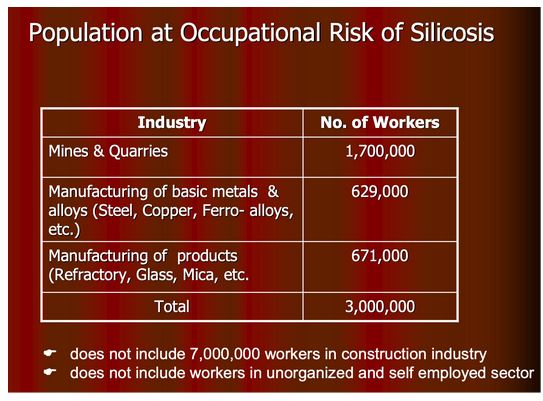
As per National Programme on Elimination of Silicosis in India
Remedies for Silicosis:
Currently, there is no cure for silicosis, and treatment focuses on managing symptoms and preventing complications.
Preventive measures:
Water Suppression Techniques: Using water or foam to suppress dust at the source.
Proper Ventilation: Ensuring adequate airflow in work environments to reduce dust accumulation.
Personal Protective Equipment (PPE): Providing workers with masks and respirators that filter out fine particles.
Regular Monitoring: Implementing regular health checks for workers and monitoring air quality in workplaces.
Case study related to reducing Silica Dust Exposure
United States: Implemented stricter regulations on silica dust, resulting in a significant reduction in silicosis cases.
Australia: Banned the use of engineered stone due to its propensity to release high levels of silica dust when cut or drilled.
PYQ:
[2019] Why is there a great concern about the ‘microbeads’ that are released into environment?
(a) They are considered harmful to marine ecosystems.
(b) They are considered to cause skin cancer in children.
(c) They are small enough to be absorbed by crop plants in irrigated fields.
(d) They are often found to be used as food adulterants.
Q1 “Policy contradictions among various competing sectors and stakeholders have resulted in inadequate ‘protection and prevention of degradation to the environment.” Comment with relevant illustrations. (UPSC IAS/2018)
Q2 Environmental Impact Assessment studies are increasingly undertaken before a project is cleared by the Government. Discuss the environmental impacts of coal-fired thermal plants located at coal pitheads. (UPSC IAS/2014)
Note4Students:
Prelims: What is just a transition concept?;
Mains: Advantages of a just transition framing;
Mentor comments: In April 2024, the Supreme Court of India delivered a significant judgment in the case of “M.K. Ranjitsinh and Others vs Union of India.” The two-judge bench, comprising Justice Sanjiv Khanna and Justice Dipankar Datta, ruled on the matter concerning the rights of wildlife and environmental protection. The court emphasized the importance of safeguarding natural habitats while balancing developmental needs, thereby reinforcing the legal framework aimed at preserving biodiversity and ecological integrity in India. This ruling reflects the judiciary’s commitment to environmental justice and sustainable development practices.
Let’s learn!
__
Why in the News?
In April 2024, the Supreme Court of India, in the case of “M.K. Ranjitsinh and Others vs Union of India”, acknowledged a human right to be free from the adverse effects of climate change.
This landmark decision has generated considerable discussion, with varying opinions. For some, it represents a significant advancement in climate action, while others contend that it inadequately safeguards endangered biodiversity.
Key points as per judgement:
Recognition of Human Rights Against Climate Change: The Supreme Court’s judgement recognized a human right against the adverse impacts of climate change, marking a significant step in the realm of environmental jurisprudence in India.
Concept of Just Transition: The judgement emphasized the importance of framing climate action through the lens of “just transition.”
Inclusion of the Non-Human Environment: A significant aspect of the judgement was the consideration of introducing the non-human environment, such as biodiversity and ecosystems, as a subject within the concept of just transition.
Mixed Reactions: The decision has sparked diverse opinions. While it is seen as a victory for climate action, some critics argue that it has not sufficiently protected endangered biodiversity, especially species like the Great Indian Bustard.
What is just a transition concept?
The concept of just transition refers to a framework aimed at ensuring that the shift from a high-carbon economy to a low-carbon economy is equitable and inclusive, addressing the social, economic, and environmental impacts of this transition.
Advantages of a just transition framing
Equitable Climate Action: Framing the case within a just transition context allows the court to promote equitable and inclusive climate action. It shifts the narrative from viewing decarbonisation and biodiversity protection as adversarial to recognising their interdependence.
This approach can prevent the marginalisation of biodiversity interests, ensuring that the burdens of climate action are shared fairly among all stakeholders, including affected communities and ecosystems.
Expansion of Just Transition Concept: The case provides a unique opportunity to broaden the just transition framework by incorporating the non-human environment, specifically the Great Indian Bustard, as an affected entity.
This inclusion can help develop jurisprudence that recognizes the rights of nature and expands the understanding of just transition beyond human communities, aligning with emerging eco-centric legal principles.
Catalyst for Research and Awareness: Introducing the just transition concept in this case can stimulate much-needed research on just transition litigation in India, an area that remains underexplored.
By mapping existing cases and integrating them into the broader discourse on just transitions, the court can contribute to filling gaps in knowledge and understanding of how climate justice can be effectively achieved in the context of renewable energy projects.
Way forward:
Developing a Comprehensive Legal Framework for Just Transition: The Supreme Court should advocate for the creation of a robust legal framework that explicitly incorporates the principles of just transition. This framework should provide clear guidelines for ensuring that climate action, particularly decarbonisation efforts, is inclusive and fair to all stakeholders, including vulnerable communities and ecosystems.
Establishing a Multidisciplinary Task Force for Monitoring and Implementation: The Court could recommend the formation of a multidisciplinary task force comprising experts in environmental law, social justice, economics, and biodiversity conservation.
The increase in drug-resistant fungal infections, especially Trichophyton indotineae, is becoming a major health problem in India.
What Is Trichophyton Indotineae?
Trichophyton indotineae is a dermatophyte commonly known as ringworm or jock itch.
First identified in India, this fungus has now spread to several countries worldwide.
It belongs to genotype VIII within the T. mentagrophytes/T. interdigitale species complex, found in regions including Australia and Oman.
Factors causing its spread
Patients often present with persistent, treatment-resistant rashes that can be mistaken for eczema or other skin conditions.
Misdiagnosis leads to the use of ineffective treatments, prolonging patient suffering and allowing the infection to worsen.
Trichophyton indotineae has shown resistance to terbinafine due to genetic mutations, with growing resistance to itraconazole also a concern.
The unregulated sale of steroid-containing combination creams further complicates treatment efforts.
Treatments available
Alternative to terbinafine and Itraconazole are available but often come with significant side effects, requiring close monitoring by healthcare providers.
Integrating comprehensive skin care regimens can enhance treatment efficacy, including maintaining skin hydration and using barrier creams.
PYQ:
[2014] Lichens, which are capable of initiating ecological succession even on a bare rock, are actually a symbiotic association of:
Facing a significant decline in its tiger population in recent years, Chhattisgarh on Wednesday approved a long-awaited proposal to establish a new tiger reserve, which will be the third largest in the country.
Process of Notification of Tiger Reserves
Proposal and Evaluation: The state government initiates the process by proposing an area to be designated as a tiger reserve. This proposal is then evaluated by the National Tiger Conservation Authority (NTCA).
Cabinet Approval: After NTCA’s recommendations, the state cabinet must approve the notification of the tiger reserve.
Integration of Areas: The Guru Ghasidas-Tamor Pingla Tiger Reserve integrates the existing Guru Ghasidas National Park and Tamor Pingla Wildlife Sanctuary, covering an area of 2,829 square kilometers.
Note: Once a tiger reserve is notified, it cannot be easily denotified. The Wildlife (Protection) Act, 1972, allows for denotification only under exceptional circumstances and with approval from the NTCA and the National Board for Wildlife.
About Guru Ghasidas-Tamor Pingla Tiger Reserve
It is Chhattisgarh’s fourth tiger reserve, following Indravati, Udanti-Sitanadi, and Achanakmar.
The reserve spans four districts: Manendragarh-Chirmiri-Bharatpur, Koriya, Surajpur, and Balrampur.
It aims to bolster conservation efforts and provide a protected habitat for tigers, thereby promoting eco-tourism and creating employment opportunities for local communities.
It aims to bolster conservation efforts and provide a protected habitat for tigers by Providing additional budgetary resources from the National Project Tiger Authority for its operations.
It would promote eco-tourism and create employment opportunities for local communities.
Tiger Reserves in India
As of June 2024, India has 55 tiger reserves. This number has increased from 9 reserves in 1973 when Project Tiger was initiated. India is home to around 75% of the global tiger population.
The latest addition to the list is the Dholpur-Karauli Tiger Reserve in Rajasthan, which is the 55th reserve established in the country.
These reserves are crucial for the conservation of the Bengal tiger, which is a keystone species in India’s ecosystems, and they collectively support around 80% of the world’s tiger population.
Madhya Pradesh has the highest number of tigers at 785, followed by Karnataka (563), Uttarakhand (560), and Maharashtra (444).
The initiative was taken by the Government:
Strengthening Legal Framework: The Wildlife (Protection) Act, 1972 provides a legal framework for tiger conservation, establishing national parks, wildlife sanctuaries, and critical tiger habitats. The 2006 amendment led to the creation of the National Tiger Conservation Authority (NTCA).
Anti-Poaching Measures:Special Tiger Protection Force (STPF) has been deployed in tiger reserves to combat poaching. Modern surveillance technologies like camera traps and drones are used to monitor tiger populations and deter poaching activities.
To avoid human-tiger conflict: As of 2023, 12,327 families from 173 villages have been successfully relocated from tiger reserves to reduce human-tiger conflict.
Way forward:
Undertake habitat restoration measures in the tiger reserves, including prey base management and removal of invasive species, to improve the quality of tiger habitats.
Deploy the Special Tiger Protection Force (STPF) in the newly notified Guru Ghasidas-Tamor Pingla Tiger Reserve to curb poaching.
Mains PYQ:
Q How does biodiversity vary in India? How is the Biological Diversity Act,2002 helpful in conservation of flora and fauna? (UPSC IAS/2018)
The Jammu region has faced severe security issues recently, exacerbated by troop redeployment to the LAC. To address this, around 3,500 additional troops and Special Forces were deployed.
Present Context of J&K
Security Concerns: The Jammu region has seen a resurgence in terrorist activities, with security forces suffering significant losses. The situation has deteriorated, particularly following the redeployment of troops to the Line of Actual Control (LAC) after the Galwan incident in June 2020.
Increased Military Presence: In response to the rising threats, additional troops, including Special Forces and Assam Rifles, have been inducted into the region to bolster counter-terrorism operations.
Following the abrogation of Article 370 in 2019, there has been a strategic shift in militancy from Kashmir to Jammu, with militants adapting their tactics and increasing their operational activities in districts like Reasi, Rajouri, and Poonch.
Need to Establish the Grid System in Vulnerable Areas
Establishing a counter-terrorism grid involves deploying military units strategically in vulnerable areas to dominate potential terrorist movements. This requires thorough threat assessments based on terrain, local population inclinations, and historical data.
The grid system emphasizes the importance of winning the trust of the local population through community engagement, which is crucial for gathering intelligence on terrorist activities.
Challenges
Integration of New Troops: Newly inducted troops face the challenge of quickly orienting themselves to the local terrain and population dynamics.
Divided Local Population: The local population is divided into subsets that either support the state, support terrorists, or remain neutral.
Gaining the support of the neutral majority is critical for the success of counter-terrorism efforts.
Operational Control: Recent trends show a shift in operational control from battalion-level commanders to higher command levels, which can hinder effective and timely responses to emerging threats.
About Operation Dudhi
Historical Context: Operation Dudhi, conducted in May 1991 by the 7 Assam Rifles, is remembered as a successful counter-terrorism operation in the Chowkibal area. It showcased the effectiveness of battalion-level command in conducting operations.
Lessons Learned: The operation highlighted the importance of allowing commanding officers to maintain control over their units.
Recent trends of centralizing control may undermine operational effectiveness and responsiveness.
Need for Integrated Deployment: The success of future operations requires that newly inducted troops be deployed as integral units under existing command structures, rather than in a fragmented manner, to enhance operational coherence and effectiveness.
Way forward:
Enhance Human Intelligence Networks: It is crucial to build robust human intelligence networks by integrating local informants and community members into counter-terrorism efforts.
Integrated Deployment of Forces: Newly inducted troops should be strategically integrated with existing units to create a cohesive counter-terrorism grid. This approach will facilitate knowledge sharing and operational synergy, allowing new troops to quickly acclimatize to the local environment and build relationships with the community.
The global stock and bond markets, especially Japan’s, are experiencing turmoil due to the unwinding of the immensely popular yen carry trade.
What is Yen carry trade?
The yen carry trade is a popular currency trading strategy that involves borrowing Japanese yen at low interest rates and using the funds to invest in higher-yielding assets denominated in other currencies, with the goal of profiting from the interest rate differential.
Why is it unwinding right now?
Strengthening Yen: The Japanese yen has appreciated significantly, rising over 3% against the dollar after the Bank of Japan (BoJ) raised interest rates to 0.25% and announced a reduction in bond purchases. This strengthening of the yen diminishes the profitability of the carry trade, which relies on a weaker yen to remain viable.
Interest Rate Changes: Expectations of imminent interest rate cuts by the U.S. Federal Reserve have contributed to the dollar’s weakness, further impacting the carry trade. As the interest rate differential narrows, the incentive to maintain yen carry positions decreases.
How does it work?
Mechanism: The yen carry trade involves borrowing yen at low interest rates and converting it into higher-yielding currencies. Investors use the borrowed yen to purchase assets in currencies that offer better returns, such as U.S. dollars or Australian dollars.
Investors typically aim for annualized returns of around 5% to 6% on dollar-yen carry trades, which is the difference between U.S. and Japanese interest rates. The strategy can be lucrative as long as the yen does not appreciate significantly against the currencies in which the investments are made.
How did it begin?
The yen carry trade can be traced back to 1999 when Japan lowered its policy rates to zero following an asset price bubble burst. This led Japanese investors to seek better returns in international markets, effectively turning Japan into the world’s largest creditor nation.
The contemporary form of the carry trade gained prominence in 2013 under Prime Minister Shinzo Abe’s quantitative easing policies, coinciding with rising U.S. rates and a depreciating yen. This trend intensified in 2022 and 2023 as the Federal Reserve raised rates rapidly while the Bank of Japan maintained negative short-term rates.
How large Is It?
The estimated size is about $350 billion in short-term external loans by Japanese banks attributed to yen-funded carry trades. However, this figure may not fully capture the extent of the trades, as it could include commercial transactions or loans to foreign businesses.
The actual size of yen carry trades could be larger due to the leverage used by hedge funds and computer-driven funds.
Is it coming to an end?
The Bank of Japan has recently started raising rates, which has led to a stronger yen. As a result, the yield gap between Japanese and other currencies has narrowed, diminishing the profitability of carry trades.
The appreciation of the yen (by about 13% in a month) has prompted leveraged investors to unwind their positions, leading to a sell-off in global stock and bond markets. This unwinding is driven by the need to repay yen loans as the currency strengthens, causing further declines in asset prices internationally.
Conclusion: The yen carry trade is unwinding due to the strengthening yen and narrowing interest rate differentials. As the yen appreciates, profitability decreases, prompting investors to exit positions, leading to global market sell-offs. This trend signifies a shift in monetary policies and changing economic conditions affecting currency trading strategies.
“Osteoporosis” is a condition where bones become weak and brittle, with over 10 million cases annually in India.
It predominantly affects ageing women due to decreased oestrogen levels post-menopause.
A recent study in Nature by researchers at the Universities of California uncovered a brain-derived hormone, CCN3, which increases bone mass in postpartum lactating mothers.
What is Oestrogen?
Oestrogen is a primary female sex hormone essential for reproductive and sexual development.
It regulates the menstrual cycle and is crucial for the development of secondary sexual characteristics like breast development.
Oestrogen also plays a vital role in maintaining bone density and cardiovascular health.
It is produced mainly in the ovaries but also in smaller amounts by the adrenal glands and fat tissue.
The hormone influences various tissues, including the brain, heart, skin, and bones.
Imbalances in oestrogen levels can lead to various health issues, such as osteoporosis and cardiovascular disease.
Role of Oestrogen in Bone Growth
Oestrogen is crucial for bone growth and formation, acting as a manager signalingthe bone construction crew.
During breastfeeding, oestrogen production dropsto focus on milk production, which should weaken bones.
Contrary to expectations, mothers’ bones become stronger to meet their babies’ high calcium demands.
How does the ‘Hidden’ Hormone Keep Mice Mothers’ Bones Healthy?
During breastfeeding, the body suppresses oestrogen production to focus on milk production, which should weaken bones.
Despite low oestrogen, mothers’ bones strengthen.
Researchers found that KISS1 neurons in the hypothalamus (a part of the brain) release the CCN3 hormone, which helps maintain and even increase bone mineralisation.
Experimental Findings:
In experiments with genetically modified mice, those lacking the oestrogen receptor alpha still maintained healthy bones due to CCN3.
When CCN3 wasintroduced to skeletal stem cells, it significantly increased bone formation, showing its potential to strengthen bones independently of oestrogen.
PYQ:
[2019] ‘RNA interference (RNAi)’ technology has gained popularity in the last few years. Why?
It is used in developing gene silencing therapies.
It can be used in developing therapies for the treatment of cancer.
It can be used to develop hormone replacement therapies.
It can be used to produce crop plants that are resistant to virtual pathogens.
Select the correct answer using the code given below.
The Ministry of Cooperation, since its inception on 6th July 2021, has taken many initiatives to strengthen and deepen the cooperative movement at the grassroots level.
What is a Co-operative?
A cooperative is “an autonomous association of persons united voluntarily to meet their common economic, social, and cultural needs and aspirations through a jointly-owned enterprise”.
Cooperatives are democratically owned by their members, with each member having one vote in electing the board of directors.
Evolution of Cooperatives in India:
Pre-Independence Era:
First Cooperative Act (1904): Enacted after the Indian Famine Commission (1901) suggested cooperative credit societies to tackle rural debt.
Cooperative Societies Act (1912): Amended the 1904 Act to include non-credit societies and support the cooperative movement.
Maclagan Committee (1915): Evaluated the cooperative movement’s economic and financial stability.
Montague-Chelmsford Reforms (1919): Made cooperation a provincial subject, boosting regional cooperative initiatives.
Post Economic Depression (1929): Various committees in regions like Madras, Bombay, Travancore, Mysore, Gwalior, and Punjab restructured cooperatives.
Gandhian Influence: Gandhi promoted cooperatives for a socialistic society and decentralization. Established the Phoenix Settlement and Tolstoy Farm as cooperative settlements in South Africa.
Post-Independence Era:
First Five-Year Plan (1951-56): Emphasized cooperatives for comprehensive community development.
Multi-State Co-operative Societies Act (2002): Regulated the formation and functioning of multi-state cooperatives.
Amendment (2022): Introduced the Co-operative Election Authority to oversee board elections in multi-state cooperatives.
97th Constitutional Amendment (2011): Made the right to form cooperatives a fundamental right under Article 19.
Added Part IX-B to the Constitution, establishing “The Co-operative Societies” (Articles 243-ZH to 243-ZT).
Empowered Parliament to legislate for multi-state cooperative societies and state legislatures for other cooperatives.
Union Ministry of Cooperation (2021): Created to oversee cooperative affairs, previously under the Ministry of Agriculture.
Initiatives Making Primary Cooperatives Economically Vibrant and Transparent
Details
Model Bye-Laws for Primary Agricultural Credit Societies (PACS)
Prepared and circulated to all States/UTs.
Enables PACS to undertake over 25 business activities.
Adopted by 32 States/UTs.
Establishing New Multipurpose PACS/Dairy/Fishery Cooperatives
Plan to cover all Panchayats/villages in 5 years.
6,844 new PACS, Dairy, and Fishery cooperative societies registered.
World’s Largest Decentralized Grain Storage Plan
Create warehouses and agri-infrastructure at PACS level.
Pilot project extended to 500 additional PACS.
Formation of New Farmer Producer Organizations (FPOs) by PACS
1,100 additional FPOs to be formed by PACS.
992 FPOs formed by NCDC.
PACS Given Priority for Retail Petrol/Diesel Outlets
Included in Combined Category 2 (CC2) for allotment.
270 PACS from 25 States/UTs applied online.
PACS Eligible for LPG Distributorship
Allowed to apply for LPG distributorships.
31 PACS from four States/UTs submitted applications.
PACS as Pradhan Mantri Bharatiya Jan Aushadhi Kendra
Promote PACS to operate Janaushadhi Kendras.
2,594 PACS given initial approval, 674 received drug licenses.
PACS as Pradhan Mantri Kisan Samriddhi Kendras (PMKSK)
Ensure easy accessibility of fertilizer and related services.
38,141 PACS functioning as PMKSK.
Convergence of PM-KUSUM at PACS Level
Farmers can adopt solar agricultural water pumps and install photovoltaic modules.
Micro-ATMs to Bank Mitra Cooperative Societies
Provide doorstep financial services.
2,700 micro-ATMs distributed in Gujarat.
Rupay Kisan Credit Card to Members of Milk Cooperatives
Provide credit at lower interest rates.
48,000 Rupay KCC distributed in Gujarat.
Formation of Fish Farmer Producer Organization (FFPO)
69 FFPOs registered by NCDC.
Department of Fisheries allocated work to convert 1000 fisheries cooperative societies into FFPOs.
Initiatives Strengthening Urban and Rural Cooperative Banks
Details
Urban Cooperative Banks (UCBs) Allowed to Open New Branches
Open up to 10% (max 5 branches) without prior RBI approval.
Doorstep Services by UCBs
Provide banking facilities at home.
Extended Time Limit for Priority Sector Lending (PSL) Targets
Timeline extended to March 31, 2026.
Nodal Officer in RBI for UCBs
Designated for regular interaction.
Increased Housing Loan Limit by RBI
Doubled for UCBs to Rs. 60 lakhs.
Increased to Rs. 75 lakhs for Rural Cooperative Banks.
Rural Cooperative Banks Lending to Real Estate/Residential Housing
Diversify business to benefit Housing cooperative societies.
Non-scheduled UCBs, StCBs, and DCCBs Notified as MLIs in CGTMSE Scheme
Risk coverage up to 85% on loans.
Doubled Monetary Ceiling for Gold Loan by RBI
Increased from Rs. 2 lakhs to Rs. 4 lakh.
Umbrella Organization for UCBs
Approval given to NAFCUB for formation, providing IT infrastructure and operational support.
PYQ:
[2011] In India, which of the following have the highest share in the disbursement of credit to agriculture and allied activities?
G Padmanabhan, the Chandrayaan-3 team, Annapurni Subramaniam, and 30 others have been chosen for the inaugural Rashtriya Vigyan Puraskar (RVP), India’s new national science awards established last year.
What is Rashtriya Vigyan Puraskar?
The RVP comprises four awards:
Vigyan Ratna for lifetime achievement.
Vigyan Shri for scientists of all ages.
Vigyan Yuva for scientists under 45 years.
Vigyan Team for collaborative research work.
These awards were instituted last year, replacing all existing science awards, including the prestigious Shanti Swarup Bhatnagar Prize.
The Vigyan Yuva now serves as a replacement for the Bhatnagar Prize, which also recognized outstanding scientists below 45 years.
Ceremony Details:
These awards shall be announced on the National Technology Day (11th May) every year.
The Award Ceremony for all categories of awards shall be held every year on the National Space Day on 23rd August.
The Hon’ble President of India / The Hon’ble Vice President of India may confer the Awards.
Notable Awardees
G Padmanabhan: At 86, G Padmanabhan, a renowned biochemist known for his work on the malaria parasite, has been named a Vigyan Ratna, recognizing his lifetime achievement in science. Padmanabhan is a towering figure in Indian science and has been honored with the Padma Shri and Padma Bhushan.
Chandrayaan-3 Team: The team behind Chandrayaan-3, which successfully landed India’s first spacecraft on the Moon last year, has been awarded the Vigyan Team award for their collaborative research work.
Vigyan Yuva Puraskar Recipients:
Vivek Polshettiwar (Tata Institute of Fundamental Research, Mumbai): A chemist working on carbon capture technologies.
Urbasi Sinha (Raman Research Institute, Bengaluru): A leading expert in quantum research.
Roxy Mathew Koll (Indian Institute of Tropical Meteorology, Pune): A climate scientist.
Annapurni Subramaniam:
Among the 13 scientists selected for the Vigyan Shri award, Annapurni Subramaniam’s main research focuses on the formation and evolution of star clusters and galaxies.
Other Vigyan Shri Recipients:
Jayant Bhalchandra Udgaonkar: A biologist and former director of IISER Pune.
Naba Kumar Mondal: A particle physicist from Saha Institute of Nuclear Physics, Kolkata.
PYQ:
[2009] For outstanding contribution to which one of the following fields is Shanti Swarup Bhatnagar Prize given?
![[9th August 2024] The Hindu Op-ed: A moment for just transition litigation to take wing](https://www.civilsdaily.com/wp-content/uploads/2024/08/9-july-1568x882.jpg)