Why in the News
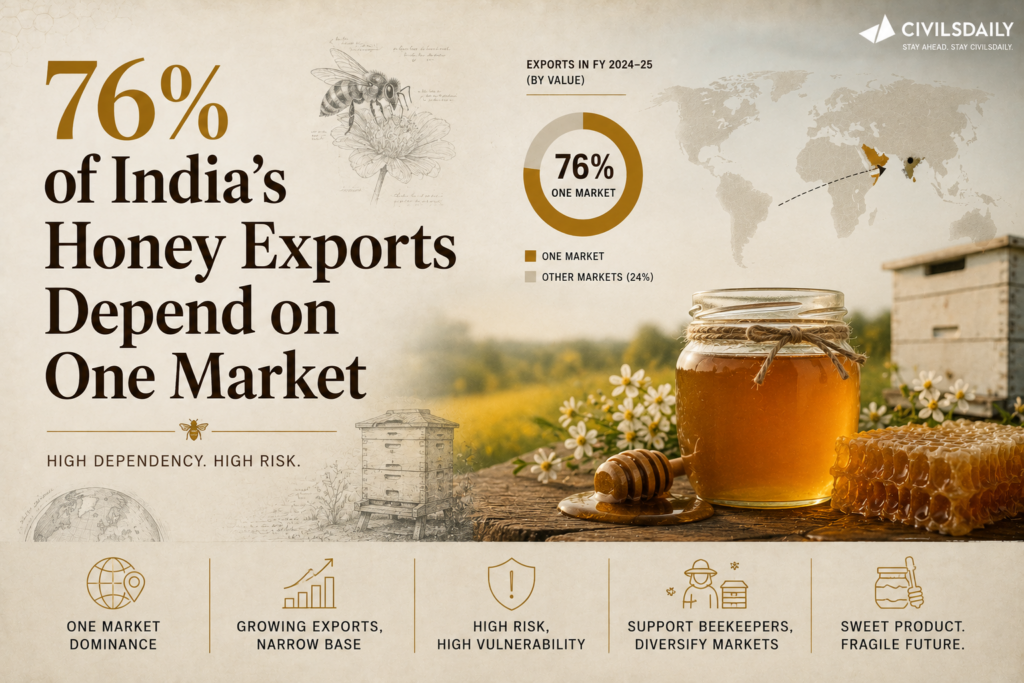
India has emerged as the world’s second largest producer of honey and the third largest exporter by value, with production nearly doubling over the last decade. That scale rests on a narrow base, since about 76 percent of exports go to a single market that recently imposed high tariffs, and Indian honey realises a unit value well below the world average. The larger asset behind the trade, the pollination service bees provide to Indian agriculture, carries no price at all.
What is apiculture?
- About: Apiculture, or honey bee farming, is the scientific rearing of bee colonies in artificial hives for honey and other hive products, and for the pollination service the colonies provide.
- Species used in India: Apis mellifera, the Italian bee, and Apis cerana indica, the Indian hive bee, are reared in boxes, while the rock bee Apis dorsata and the little bee Apis florea are wild and are harvested rather than kept.
- Products: Beyond honey, colonies yield beeswax, propolis, royal jelly, pollen and bee venom.
- Migratory beekeeping: Colonies are moved between flowering seasons and regions, for example to the mustard fields of Uttar Pradesh and Rajasthan and the apple orchards of Himachal Pradesh.
- Why it suits Indian farming: It requires little land and small capital, so it functions as a supplementary income source alongside cultivation.
What is unit value realisation?
- About: Unit value realisation is the price obtained per unit of quantity exported, calculated as export value divided by export volume.
- What it indicates: A low unit value shows the product is being sold as an undifferentiated bulk commodity rather than as a graded, branded or certified good.
What is Nuclear Magnetic Resonance testing of honey?
- About: Nuclear Magnetic Resonance (NMR) testing profiles the full molecular composition of a honey sample rather than checking a few specified parameters.
- Why importers require it: The profile detects added sugar syrups that conventional tests miss, and identifies the botanical and geographical origin of the sample.
What is a Farmer Producer Organisation?
- About: A Farmer Producer Organisation (FPO) is a collective of primary producers registered as a producer company or cooperative, which aggregates their output and inputs.
- Why it matters for honey: Aggregation spreads the fixed cost of testing, certification and traceability documentation across many small beekeepers who could not bear it individually.
What do the production and trade figures show about India’s honey sector?
- Production growth: Honey production has nearly doubled in a decade, from about 76,000 tonnes in 2013 to 2014 to roughly 1,51,000 tonnes in 2025 to 2026.
- Global production rank: India is the second largest producer of honey in the world, after China.
- Global export rank: India is the third largest exporter of honey in value terms, after China and New Zealand.
- Export dependence: Almost 70 percent of India’s honey production is exported.
- Export value: Honey exports were worth 208 million dollars in 2025 to 2026, with the source’s export value series also recording a level of about 203.07 million dollars in the preceding period.
- Share of world trade: India accounts for around 8.4 percent of global honey exports.
- Single market concentration: The United States absorbed about 76 percent of India’s exports, worth 157.8 million dollars, in 2025 to 2026.
- Unit value: Indian honey realises about 1,858 dollars per tonne, well below the world average and far from premium categories such as New Zealand’s Manuka honey.
- Domestic consumption: India’s per capita honey consumption is about 37 grams per year, despite the size of the population.
- The wider product market: The global market for bee products such as beeswax, propolis, royal jelly and pollen was valued at roughly 12.7 billion dollars in 2023 and is projected to grow.
Which markets is India diversifying into?
- Netherlands: Shipments have risen as part of the shift away from a single dominant buyer.
- Belgium: A second European Union destination absorbing increased Indian volumes.
- Germany: A market where consumers pay a premium for traceable and environmentally responsible products.
- Israel: A further destination reflecting the reorientation of the export basket.
- The common demand these markets make: European Union buyers pay a premium for traceability and environmental responsibility, traits that India’s multifloral and organic honey varieties can offer.
- The next set of targets: Premium European Union, Japanese and East Asian markets are identified as the destinations that entry level compliance investment would open.
Why does pollination matter more than the honey trade itself?
- Share of global crop output: The Food and Agriculture Organisation (FAO) attributes almost one third of global crop output to the pollination service bees provide.
- Crops dependent on it: Pollination enhances yields for 87 of the 115 leading food crops worldwide.
- Quality, not only quantity: Bees also improve the nutritional quality of farm produce, so the benefit is not captured by yield figures alone.
- An unpriced input: Every rupee of honey exported rests on a far larger unpriced service that underwrites orchards, oilseed fields and vegetable plots.
- The policy implication: Bees function as an unpaid agricultural workforce, so the sector’s value to the economy exceeds the value of the honey traded from it.
Did the tariff shock weaken India’s honey trade or force it to improve?
- The shock was real: The sudden imposition of high United States tariffs on Indian goods was a direct blow to honey exporters and to the farmers supplying them.
- The response was fast: The turnaround in diversifying export markets was swift, with shipments redirected towards European Union buyers and Israel.
- The economic reading: Trade barriers compel resilience and innovation, and the sector is now spread across geographies rather than confined to one large buyer.
- What diversification does not fix: Spreading destinations does not raise the 1,858 dollars per tonne realisation, since the same bulk unbranded product is simply being sold elsewhere.
- One dependence replaced by another: European Union entry requires traceability, residue compliance and NMR grade testing, so market concentration risk is exchanged for compliance risk.
- The limit of the lesson: Resilience achieved under tariff pressure is reactive, and the underlying weakness in quality infrastructure was visible long before the tariffs arrived.
Why does Indian honey realise so little value?
- The benchmark gap: At about 1,858 dollars per tonne, Indian honey sits well below the world average unit value.
- The premium comparison: Categories such as New Zealand’s Manuka command multiples of that price on the strength of certified floral origin and graded potency.
- The form of sale: Price realisation improves when exports move into branded retail packs rather than wholesale unbranded volumes.
- The missing attributes: Upgrading quality, traceability and branding is the specific requirement, not higher volume.
- The infrastructure behind those attributes: Realisation depends on NMR capable testing laboratories and cluster based processing that small exporters cannot build alone.
Why is the domestic market not yet an alternative outlet?
- The consumption level: Per capita honey consumption of about 37 grams a year leaves the domestic market limited despite the population size.
- The untapped potential: The low base itself signals enormous potential yet to be tapped.
- What would unlock it: Wider awareness of honey’s health benefits and improved retail penetration are the two stated conditions.
- Why it matters for exports: A larger domestic market would stabilise producer incomes while premium quality output is directed to exports.
What reforms would raise value realisation?
- Testing infrastructure: Investment in NMR capable testing laboratories to certify purity to importer standards.
- Cluster based processing: Shared processing and packing facilities that bring bulk honey to retail grade near the production cluster.
- Geographical Indication branding: GI branding for unique floral varieties, including Sundarbans honey and Ramban Sulai honey.
- Converting producer groups into FPOs: Turning farmer organisations into FPOs lowers compliance costs and enables entry into premium markets.
- Diversifying beyond honey: Moving into beeswax, propolis, royal jelly and pollen taps a global market valued at roughly 12.7 billion dollars in 2023 with higher margins than bulk honey.
- Scaling existing programmes: The National Beekeeping and Honey Mission and the export support of the Agricultural and Processed Food Products Export Development Authority (APEDA) require sharper targeting, laboratories, cluster grants and export promotion.
- Building domestic demand: Large scale consumer campaigns of the Honey for Health type are proposed to grow the domestic market.
Why does bee health set the ceiling for the sector?
- The binding constraint: Expanding exports cannot come at the expense of bee health, since colony numbers determine both honey supply and pollination capacity.
- Scientific beekeeping: Trained hive management, disease control and colony multiplication protect yields per colony.
- Pesticide management: Regulation of application timing and toxicity protects foraging bees in the very fields that depend on them.
- Pollination service support: Paying for or subsidising pollination services makes the ecosystem contribution visible in the beekeeper’s income.
- The irreversibility point: A lost pollinator base cannot be bought back by policy after the fact, which makes protection cheaper than restoration.
- The proposed targets: Doubling the number of honey bee colonies by 2030 and doubling India’s share of the global market by the same year.
Challenges to India’s honey export growth
- Adulteration and detection failure: Sugar syrup adulteration passes domestic tests while failing importer profiling, which damages country reputation. e.g. the 2020 Centre for Science and Environment investigation, where samples from leading Indian brands cleared Indian standards but failed NMR testing in Germany.
- Thin accredited testing capacity: Exporters depend on a small number of laboratories capable of importer grade profiling. e.g. consignments requiring NMR profiling sent to overseas laboratories, adding cost and time to each shipment.
- Antibiotic and pesticide residue rejections: Importing regulators reject consignments exceeding maximum residue limits. e.g. European Union residue alerts on Indian agricultural consignments, which raise the compliance burden for every subsequent shipment.
- Market concentration risk: A single destination taking 76 percent of exports exposes producers to one country’s trade policy. e.g. the United States tariff imposition that hit Indian honey exporters and farmers directly.
- Bulk commodity positioning: Exports move as unbranded wholesale volumes rather than graded retail packs. e.g. Indian honey at about 1,858 dollars per tonne against premium categories such as Manuka.
- Weak traceability from hive to pack: Buyers paying premiums require documented floral and geographical origin. e.g. European Union buyers paying premiums for traceable honey that only certified multifloral and organic Indian varieties can currently access.
- Competition from established exporters: China competes on price and New Zealand on premium branding, leaving India without a distinct position. e.g. India holding about 8.4 percent of global honey exports despite being the second largest producer.
Conclusion
India’s honey story is one of volume without value, since production nearly doubled to about 1,51,000 tonnes while unit realisation stayed at roughly 1,858 dollars per tonne and three quarters of exports went to one market. The tariff shock forced a rapid diversification into the Netherlands, Belgium, Germany and Israel, though those markets pay premiums only for traceability, certification and branding that India has not yet built. The larger unresolved issue is that the pollination service underwriting one third of crop output remains unpriced, so bee health does not appear in any policy calculation of the sector’s worth. The stated benchmark now is whether India can double its honey bee colonies and its share of the global market by 2030.
Beekeeping and Honey in India
- About: Beekeeping is the maintenance of honey bee colonies in hives for honey, wax and allied products, and for the pollination of nearby crops.
- India’s standing: India is the second largest honey producer in the world and the third largest exporter by value, with output of roughly 1,51,000 tonnes.
- Species reared and harvested: Apis cerana indica and Apis mellifera are reared in hives, while Apis dorsata, Apis florea and the stingless Trigona are harvested from the wild.
- Leading producer states: Uttar Pradesh, West Bengal, Punjab, Bihar, Rajasthan and Madhya Pradesh account for the bulk of production.
- The policy label: The promotion of beekeeping as a rural income source is described as the Sweet Revolution, following the pattern of the Green, White and Blue revolutions.
- Institutional structure: The National Bee Board, under the Ministry of Agriculture and Farmers Welfare, is the nodal body, with online registration of beekeepers and colonies through the Madhukranti portal.
- Why it is a farm income instrument: Beekeeping needs no land title, has low capital cost and yields returns within a season, which suits landless and marginal households.
Laws and Rules Governing Honey and Bee Products
- Food Safety and Standards Act, 2006: The parent food law under which honey sold in India must meet prescribed standards.
- The Food Safety and Standards (Food Products Standards and Food Additives) Regulations were tightened in 2020 to add tests for foreign sugar markers, including specific marker for rice syrup and trace marker for rice syrup, after adulteration findings.
- Agricultural and Processed Food Products Export Development Authority Act, 1985: Establishes APEDA, which develops and regulates the export of scheduled agricultural products including honey.
- APEDA operates the honey traceability system requiring registration of beekeepers, honey collection centres and processing plants for export consignments.
- Export (Quality Control and Inspection) Act, 1963: Provides for compulsory pre shipment quality inspection and certification of notified export commodities.
- Geographical Indications of Goods (Registration and Protection) Act, 1999: The basis for GI registration of distinctive regional honeys such as Sundarban honey and Ramban Sulai honey.
- Insecticides Act, 1968: Regulates registration, labelling and use of pesticides, which determines the exposure of foraging bees and residue levels in honey.
- Legal Metrology (Packaged Commodities) Rules, 2011: Govern declarations on retail packs, relevant to branded packaging and origin claims.
- Biological Diversity Act, 2002: Governs access to biological resources and benefit sharing, relevant to wild honey collection from forest areas.
Back2Basics: National Beekeeping and Honey Mission
- Type: A central sector scheme for the scientific development of beekeeping and the honey value chain.
- Ministry: Ministry of Agriculture and Farmers Welfare, implemented through the National Bee Board.
- Launch: Announced in 2020 as part of the Atmanirbhar Bharat package, to promote holistic growth of the beekeeping sector.
- Aims: To raise agricultural and horticultural productivity through pollination support, to increase farm incomes through honey and hive products, and to formalise the beekeeping value chain.
- Mini Mission 1: Focuses on production and productivity, including colony multiplication, training and capacity building of beekeepers.
- Mini Mission 2: Focuses on post harvest management, including processing units, storage, collection and marketing infrastructure and honey testing laboratories.
- Mini Mission 3: Focuses on research and technology generation in areas such as bee disease management and floral calendars.
- Targeted beneficiaries: Beekeepers, honey collectors, farmers, self help groups and Farmer Producer Organisations.
- Digital component: The Madhukranti portal, an online platform for registration of beekeepers and colonies and for source traceability of honey.
Government Initiatives
- National Beekeeping and Honey Mission: The umbrella mission for scientific beekeeping, processing infrastructure and honey testing capacity.
- National Bee Board: The nodal body for beekeeping development, registration, training and standards for hive products.
- Madhukranti portal: A digital platform for registration and traceability of honey from the hive to the processing unit.
- Khadi and Village Industries Commission Honey Mission: Launched in 2017, it distributes bee boxes with toolkits and training to farmers, tribal households and unemployed youth.
- Mission for Integrated Development of Horticulture: Supports beekeeping as a pollination support component alongside horticulture crop development.
- Formation and Promotion of 10,000 Farmer Producer Organisations: Includes dedicated honey FPO clusters aggregating small beekeepers for processing and marketing.
- APEDA export promotion and honey testing laboratories: Supports market development, buyer seller meets and residue testing infrastructure for export consignments.
- Pradhan Mantri Formalisation of Micro Food Processing Enterprises: Provides credit linked subsidy for micro units, usable for honey processing and packing enterprises.
- Agriculture Infrastructure Fund: Offers interest subvention for post harvest infrastructure, including collection centres and processing units for hive products.
Key Facts about Honey and Bees
- World Bee Day is observed on 20 May, marking the birth anniversary of Anton Janša, the pioneer of modern beekeeping.
- The United States observes National Honey Bee Day on the third Saturday of August, which coincided with India’s Independence Day this year.
- The FAO attributes almost one third of global crop output to pollination, which enhances yields for 87 of 115 leading food crops.
- India is the second largest honey producer and the third largest exporter by value, after China and New Zealand.
- Manuka honey of New Zealand is the global premium benchmark, priced far above ordinary multifloral honey.
- Sundarban honey of West Bengal and Ramban Sulai honey of Jammu and Kashmir carry Geographical Indication tags.
- Colony Collapse Disorder is the term for the sudden disappearance of worker bees from a hive, a global concern for pollinator dependent agriculture.
- Honey purity is tested through C4 sugar tests, specific and trace markers for rice syrup, and NMR profiling for full compositional fingerprinting.
- The global bee products market, covering beeswax, propolis, royal jelly and pollen, was valued at roughly 12.7 billion dollars in 2023.
Challenges in the Beekeeping Sector in India
- Pesticide exposure and colony mortality: Chemical application during flowering kills foraging bees in the crops that depend on them. e.g. neonicotinoid application on mustard and cotton, associated with bee mortality reported by migratory beekeepers in Punjab and Haryana.
- Forage scarcity from monoculture: Continuous cereal cropping leaves long gaps in the flowering calendar with no nectar source. e.g. the lean period after the mustard bloom in north India, when colonies must be fed sugar syrup to survive.
- Bee diseases and parasites: Colony losses from mites and viral infections are poorly monitored and treated. e.g. the Thai sac brood virus outbreak that devastated Apis cerana colonies in the Western Ghats and Himalayan belt.
- Absence of a paid pollination service market: Farmers receive the pollination benefit without paying for it, so beekeepers earn only from honey. e.g. apple growers in Himachal Pradesh renting colonies during bloom, one of the few organised paid pollination arrangements in the country.
- Fragmented producers with no aggregation: Small beekeepers sell to traders at bulk prices and cannot access certification or branding. e.g. migratory beekeepers in Uttar Pradesh and Punjab selling unbranded drums to intermediaries.
- Weak extension and training reach: Scientific hive management, queen rearing and disease control skills are not transmitted at scale. e.g. dependence on National Bee Board training modules that reach a fraction of registered beekeepers.
- Climate variability shifting flowering calendars: Early or delayed bloom disrupts migratory beekeeping routes planned months in advance. e.g. advanced mustard flowering in north India in warm winters, which shortens the nectar window.
- Credit and insurance gaps: Colonies are a productive asset with no standard financing or insurance product. e.g. colony losses in floods and cyclones that fall outside crop insurance coverage.
Way Forward
- Price the pollination service: Introduce pollination service contracts and incentives for orchard and oilseed growers, so the ecosystem contribution becomes part of the beekeeper’s income.
- Build accredited testing capacity domestically: Establish NMR capable laboratories in the major production clusters so purity certification does not depend on overseas testing.
- Move exports into branded retail packs: Support cluster level processing, packing and labelling so consignments leave as graded retail products rather than bulk drums.
- Expand Geographical Indication and organic certification: Register additional distinctive regional honeys and certify multifloral and organic varieties that European Union and Japanese buyers pay premiums for.
- Set and track a colony expansion target: Adopt the proposed doubling of honey bee colonies by 2030, with registration and verification through the Madhukranti portal.
- Regulate pesticide use around flowering: Enforce application timing restrictions and promote lower toxicity formulations during the bloom period in bee dependent crops.
- Grow domestic demand deliberately: Run sustained consumer campaigns on the health value of honey and expand retail penetration, so producer incomes do not depend entirely on export destinations.
- Diversify into high margin hive products: Support processing and marketing of beeswax, propolis, royal jelly and pollen to capture a share of the global bee products market.
- WP Subject: Agriculture (id 61)
- WP Subject Child: Allied SectorXHorticulture (id 1130)
- WP GS Paper: GS3 (id 255)
- WP GS Paper Child: GS3-09.Economics of Animal Rearing (id 311)
- WP Type: op-ed snap, Schemes
# Compiled Articles, Batch F, 17 August 2026
Matching Previous Year Question
“[2018, GS3, 15 marks] Assess the role of National Horticulture Mission (NHM) in boosting the production, productivity and income of horticulture farms. How far has it succeeded in increasing the income of farmers?”
