Why in the News
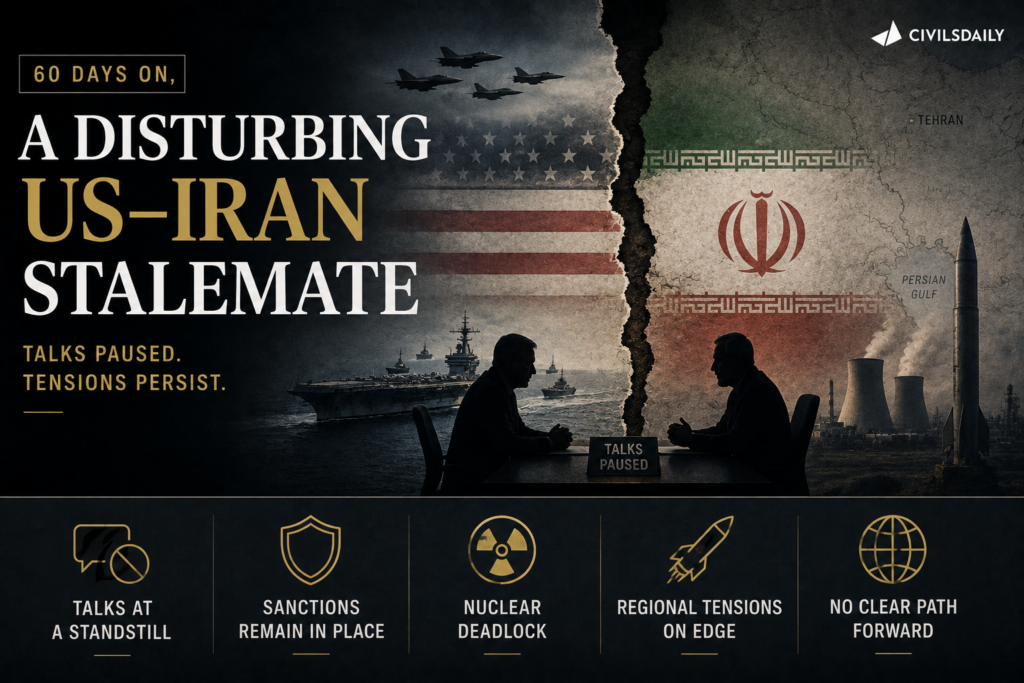
The 60 day window for the United States and Iran to agree a long term peace framework expired on 17 August 2026 with no agreement. Both sides had already shut that window through late June and July while trading strikes, and the Strait of Hormuz remains blockaded by Iran and counterblockaded by the United States. A deadlock that neither side can end now holds global oil and gas movement hostage.
What is the US Iran Memorandum of Understanding of 17 June?
- What it was: An interim understanding signed on 17 June 2026 that declared the immediate and permanent termination of military operations on all fronts.
- The clock: It set a 60 day timeframe, extendable by mutual consent, within which a broader agreement was to be reached.
- What the broader deal covered: Limits on Iran’s nuclear programme on one side and the lifting of United States sanctions on the other.
- The disputed clause: Point 5 was read by Tehran as giving it the right to manage the Strait of Hormuz, which it shares with Oman. Washington rejected that reading.
- How it collapsed: Hostilities resumed once Iran began firing on vessels it said were using an unapproved route through the waterway.
- Status on expiry: No long term framework exists. The interim text is the only agreed document and it is no longer being observed.
What is the Strait of Hormuz?
- Location: A narrow sea passage connecting the Persian Gulf to the Gulf of Oman and the Arabian Sea, bordered by Iran to the north and Oman and the United Arab Emirates to the south.
- Why it matters: About a fifth of global oil and liquefied natural gas moved through it before the war, with no overland route able to absorb that volume.
What is a naval blockade?
- Definition: A blockade is the use of warships to stop shipping from entering or leaving a coast or a waterway.
- The two sided version here: Iran has closed the strait to traffic it has not approved. The United States has answered with a counterblockade of Iranian ports that it says it can sustain indefinitely by rotating ships.
What is the Bab el Mandeb Strait?
- Location: The passage between Yemen and Djibouti that links the Red Sea to the Gulf of Aden, and so links Suez traffic to the Indian Ocean.
- Current state: The Yemen based Houthi group enforces a partial blockade there, which puts a second chokepoint on the same route at risk.
What are strategic petroleum reserves?
- Definition: Underground crude oil stocks held by the State to cover consumption when imports are cut off by war, sanctions or a supply shock.
- How they work: The reserve is filled when prices are low and released into refineries when supply stops, so the shock reaches the economy slowly rather than at once.
Why did the 60 day framework fail to hold?
- Interpretation, not intent: The understanding began to unravel largely over disagreement on how its own terms should be read, not over a refusal to talk.
- The strait stayed shut: The framework never reopened the Strait of Hormuz, which Iran has effectively blockaded since the Israel and United States attack of 28 February 2026.
- The war widened instead: The 60 day period saw the Houthis and Saudi Arabia begin attacking each other, extending the conflict to a second waterway.
- Escalation on the ground: Iranian drones struck the office of the Kurdistan Regional Government’s prime minister in northern Iraq on 17 August.
- Policy shift in Tehran: A senior Iranian official stated that Iran has moved from a defensive to a fully offensive posture and would strike to break the American naval blockade if diplomacy failed.
- Parallel track: Iran and Oman have separately negotiated the coordinates of a jointly managed route through the strait, and progress there has been slow.
Which figures define the scale of the disruption?
- Transit collapse: Traffic through the strait fell to two vessels in a day against more than 130 daily before the conflict.
- Share of world energy: About one fifth of global oil and liquefied natural gas flowed through the strait before the war.
- Timeline: The war was launched on 28 February 2026. The Memorandum of Understanding was signed on 17 June and its window closed on 17 August.
- Second chokepoint: Seven missiles were fired at the Bab el Mandeb Strait and the Mokha coastline in a single day, alongside Houthi claims of striking a Saudi landing ship and four patrol boats.
- Spillover count: The Kurdistan region of Iraq has been targeted more than 1,000 times by Iran and pro Iran armed groups since the war began.
- Environmental cost: A 160 km oil slick from a bulk carrier struck by a projectile spread off Qeshm island and threatened the Hara mangrove forests, a UNESCO biosphere reserve.
- India’s gas shift: Indian liquefied natural gas imports rose 15.4 percent to 7.08 million tonnes over May to July as Qatari supply collapsed.
Why are both sides doubling down on economic warfare?
- Lesson learned in Washington: Bombing alone has not dislodged the government in Tehran, and the United States is running low on munitions.
- Lesson learned in Tehran: The United States has come to stay in the region, and ballistic missiles fired at American bases or at Israel will not change that.
- American instruments: Washington has rescinded sanction waivers on Iranian oil in the international market and threatens to hold its naval blockade of Iranian ports indefinitely.
- Iranian instrument: Tehran’s single point of leverage is the strait itself, which it can keep closed at low cost to its own military.
- Iran’s political bet: Tehran calculates that it can squeeze the American administration until the midterm elections and treats the stalemate as the new balance of power.
- The American constraint: With a midterm election approaching, the United States President must show that the pressure campaign is producing results without trapping the country in another foreign war.
What do the positions of other States in the conflict demonstrate?
- Oman: It shares the strait with Iran and is negotiating a jointly managed route with Tehran, which makes a small mediating State the only working channel. The United States President has threatened to bomb Oman if it gets in the way of a deal.
- Gulf States and the Malacca model: Oman, backed by Gulf States, offered Iran a scheme of voluntary transit fees for using the strait, modelled on the arrangement used in the Strait of Malacca.
- Israel: It launched the war jointly with the United States on 28 February, which is why the closure of the strait is treated in Tehran as a response to an attack rather than an independent act.
- Saudi Arabia: It is now in direct exchange of fire with the Houthis, which shows how a bilateral war spreads to a second chokepoint through proxies.
- Yemen and the Houthis: A non State armed group enforces a partial blockade of the Bab el Mandeb using ballistic missiles and drones against naval and commercial shipping.
- Iraq and the Kurdistan region: Iranian drones and pro Iran armed groups have struck the autonomous region’s leadership more than 1,000 times, showing that the conflict travels through weak neighbouring States.
- Qatar: Its liquefied natural gas exports must cross the strait, which is why the shutdown forced buyers such as India to switch to United States, Nigerian, Omani and Angolan cargoes.
Where does the stalemate turn against both sides?
- Each side believes time favours it: Tehran is waiting out the American electoral calendar. Washington is waiting for economic pain to force a concession.
- Neither can convert leverage: Neither party has gained decisive leverage to force a settlement, and neither can end the conflict on its own terms.
- Rhetoric against interest: The American position swings between threatening to bomb a mediating State and insisting that a negotiated settlement is possible.
- Cost falls on third parties: The deadlock means the rest of the world remains hostage to a conflict that neither side is capable of ending.
- Stalemate as an outcome: The likeliest result is not victory for either side but the deadlock itself becoming the new normal.
- Diplomacy is not a hedge: For States dependent on the strait, waiting for a settlement is a bet on two governments that have both chosen to wait.
What does the stalemate demand of India?
- Managed so far: India has absorbed the consequences of the closure to date without a visible supply failure.
- Three interests exposed: A persisting stalemate puts India’s economic, energy and strategic interests at risk together, not one at a time.
- Diplomacy alone is insufficient: Negotiating access with either party does not remove the underlying dependence on a single waterway.
- Cut import dependence: India must reduce its overwhelming dependence on imported oil rather than manage each disruption as it arrives.
- Build larger reserves: Strategic petroleum reserve capacity has to be expanded well beyond present levels. Oil and Natural Gas Corporation is to reserve half of its 1.75 million tonne Mangaluru facility for strategic storage.
- Diversify and substitute: Gas sourcing has already shifted to the United States, Nigeria, Oman and Angola, and investment in alternative energy is the only durable substitute.
Challenges to India’s energy security in a Hormuz disruption
- Single route concentration: A large share of Indian crude and gas passes one 21 nautical mile wide passage with no overland alternative. e.g. Qatari liquefied natural gas supply to India collapsed once the strait shut.
- Reserve cover is thin: Indian strategic reserves cover only a few days of national consumption against the 90 day standard used by International Energy Agency members. e.g. phase one caverns at Visakhapatnam, Mangaluru and Padur hold 5.33 million tonnes in total.
- Freight and insurance shock: War risk premiums and rerouting raise the landed cost of every cargo even when volumes are secured. e.g. Red Sea diversions around the Cape of Good Hope from 2024 added roughly two weeks to voyages from Europe.
- Currency and fiscal transmission: An oil price spike widens the current account deficit and pushes up subsidy and inflation pressure together. e.g. every $10 rise in the crude price is estimated to add close to 0.4 percent of gross domestic product to India’s import bill.
- Refinery configuration: Indian refineries are tuned to specific crude grades, so substitution is not simply a question of finding any seller. e.g. sour heavy Gulf grades cannot be replaced one for one by lighter Nigerian or United States crude.
- Diaspora and remittance exposure: About nine million Indians work in the Gulf, and a wider war puts both their safety and their transfers at risk. e.g. evacuation operations of the scale of Operation Ajay in 2023.
- Shipping and seafarer risk: Indian crews form a large share of global merchant manning and are directly exposed to attacks on commercial vessels. e.g. the drone strike on a merchant vessel in the Arabian Sea in December 2023.
Conclusion
The lapse of the 60 day window confirms that the closure of the Strait of Hormuz is no longer a temporary interruption but the working balance of power between two governments that both expect the other to break first. For India the practical consequence is that the exposure is structural and cannot be negotiated away one shipment at a time. Reduced dependence on imported crude, a materially larger strategic reserve and a faster shift to alternative energy are the only responses that survive whichever way the deadlock ends.
About Global Maritime Chokepoints
- Definition: A chokepoint is a narrow shipping channel through which a large share of world trade must pass, so a closure at that point reroutes or halts global flows.
- Strait of Hormuz: The single largest oil chokepoint, carrying roughly 20 million barrels a day of petroleum liquids before the war, about a fifth of world consumption.
- Strait of Malacca: The busiest passage between the Indian and Pacific Oceans, carrying most of the crude bound for China, Japan and South Korea.
- Bab el Mandeb: The Red Sea entrance that connects Suez traffic to the Indian Ocean, about 18 nautical miles wide at its narrowest.
- Suez Canal and Panama Canal: Artificial chokepoints whose closure adds thousands of nautical miles to a voyage. e.g. the Ever Given grounding blocked Suez for six days in March 2021.
- Turkish Straits and Danish Straits: The Bosphorus and Dardanelles carry Black Sea grain and Russian crude. The Danish Straits carry Baltic exports.
- India’s position: India lies alongside the Indian Ocean sea lanes that connect Hormuz and Malacca, which makes it both exposed to and capable of policing these routes.
Treaty Framework Governing Passage Through International Straits
- United Nations Convention on the Law of the Sea, 1982: The framework treaty governing maritime zones, navigation rights and the settlement of maritime disputes.
- Article 3: Allows a coastal State a territorial sea of up to 12 nautical miles, which is why the Strait of Hormuz falls within Iranian and Omani waters.
- Article 37: Applies the transit passage regime to straits used for international navigation between one part of the high seas and another.
- Article 38: Guarantees all ships and aircraft the right of transit passage, which cannot be suspended by the bordering States.
- Article 44: Bars States bordering a strait from hampering or suspending transit passage and requires them to publicise navigational hazards.
- Article 88 and Article 301: Reserve the high seas for peaceful purposes and bar the threat or use of force against the territorial integrity of any State.
- Iran’s position: Iran signed but has not ratified the Convention, and argues that the transit passage regime does not bind a non party.
Laws and Rules Governing India’s Oil and Gas Security
- Petroleum Act, 1934: Regulates the import, transport, storage, production and refining of petroleum and petroleum products.
- Oilfields (Regulation and Development) Act, 1948: Governs the grant of exploration and production rights over petroleum and natural gas.
- Territorial Waters, Continental Shelf, Exclusive Economic Zone and Other Maritime Zones Act, 1976: Defines India’s maritime zones and the rights India exercises in each of them.
- Merchant Shipping Act, 1958: Governs registration, safety and manning of Indian flag vessels and the protection of Indian seafarers.
- Petroleum and Natural Gas Regulatory Board Act, 2006: Creates the downstream regulator for refining, transport, distribution and marketing, other than production.
- Essential Commodities Act, 1955: Allows the Union government to control the production, supply and distribution of petroleum products in a scarcity.
- Energy Conservation Act, 2001: Provides the legal base for efficiency standards and, after the 2022 amendment, for a domestic carbon credit trading scheme.
Back2Basics: Strait of Hormuz
- Designation: A maritime chokepoint, tracked in the Places in News list as a strategic waterway rather than a protected area.
- Location: Between Iran on the north and Oman’s Musandam peninsula and the United Arab Emirates on the south.
- Connects: The Persian Gulf on one side to the Gulf of Oman and the Arabian Sea on the other.
- Dimensions: About 21 nautical miles wide at its narrowest, with inbound and outbound shipping lanes of about two miles each separated by a buffer.
- Littoral States: Iran, Oman and the United Arab Emirates. Qatar, Bahrain, Kuwait and Iraq have no route to the open ocean except through it.
- Islands: Qeshm, Hormuz, Larak, and the disputed Abu Musa and the Greater and Lesser Tunbs, held by Iran and claimed by the United Arab Emirates.
- Ecology: The Hara mangrove forests off Qeshm island, dominated by grey mangrove, form a UNESCO biosphere reserve.
Government Initiatives
- Indian Strategic Petroleum Reserves Limited: Builds and operates India’s underground crude caverns. Phase one covers Visakhapatnam, Mangaluru and Padur with a combined 5.33 million tonnes.
- Strategic reserve phase two: Approved caverns at Chandikhol in Odisha and a second Padur facility, adding about 6.5 million tonnes of capacity.
- Hydrocarbon Exploration and Licensing Policy and Open Acreage Licensing Policy: Replace production sharing with a revenue sharing model and let bidders select blocks on their own initiative to raise domestic output.
- National Green Hydrogen Mission: Approved in 2023 to build five million tonnes of annual green hydrogen capacity by 2030 and cut fossil fuel imports.
- Ethanol Blended Petrol Programme: Substitutes imported crude with domestic ethanol. The 20 percent blending target was advanced to 2025 and met.
- PM Surya Ghar Muft Bijli Yojana: Supports rooftop solar in one crore households, shifting household demand away from fossil generation.
- Overseas equity oil: ONGC Videsh Limited holds producing assets abroad so that a share of India’s crude comes from equity rather than the spot market.
Key Facts about India’s Oil and Gas Dependence
- Import dependence: India imports over 85 percent of the crude oil it consumes and about half of its natural gas.
- Consumption rank: India is the third largest consumer of crude oil in the world after the United States and China.
- Refining capacity: India is the fourth largest refiner globally, with Jamnagar in Gujarat the largest single refining complex in the world.
- Main suppliers: Russia, Iraq, Saudi Arabia, the United Arab Emirates and the United States are the largest sources of Indian crude imports.
- Gas sources: Qatar has been India’s largest supplier of liquefied natural gas, delivered under long term contracts through Hormuz.
- Reserve benchmark: International Energy Agency members hold 90 days of net import cover. India’s strategic reserves cover only a small fraction of that.
- Institutional link: India became an Association country of the International Energy Agency in 2017 and has sought full membership.
Challenges in India’s Energy Security
- Import concentration by geography: A single region supplies a majority of Indian crude, so one regional conflict moves the whole import basket. e.g. West Asian suppliers accounted for the bulk of Indian crude before Russian barrels rose after 2022.
- Payment and sanctions exposure: Secondary sanctions can strand a supply relationship that is otherwise commercially sound. e.g. Indian refiners halted Iranian crude purchases in 2019 after the United States ended sanction waivers.
- Domestic production decline: Output from ageing fields keeps falling even as demand rises, widening the import gap. e.g. Mumbai High output has fallen steadily from its peak levels.
- Storage and pipeline gaps: Gas cannot reach demand centres without a completed grid, so imported cargoes are stranded at terminals. e.g. sections of the Urja Ganga pipeline in eastern India took over a decade to commission.
- Critical mineral dependence in the transition: A shift to electric mobility replaces oil dependence with lithium, cobalt and rare earth dependence. e.g. India imports nearly all of its lithium and cobalt requirement.
- Grid readiness for renewables: Variable solar and wind output needs storage and balancing capacity that does not yet exist at scale. e.g. curtailment of renewable generation in high output states during low demand hours.
- Price pass through politics: Retail fuel prices are politically managed, so a crude spike lands on oil marketing company balance sheets rather than consumers. e.g. under recoveries absorbed by public sector oil marketing companies during 2021 and 2022.
Way Forward
- Expand strategic storage: Complete the phase two caverns and move Indian cover toward the 90 day benchmark used by International Energy Agency members.
- Commercialise reserve operation: Allow foreign and private participation in cavern filling so storage is built and rotated without full budgetary funding.
- Diversify supply geography: Hold standing contracts across West Asia, West Africa, the Americas and Russia so no single waterway carries a majority of volumes.
- Accelerate substitution: Scale ethanol blending, compressed biogas, green hydrogen and electric mobility so demand growth is not met by imported crude.
- Secure the sea lanes: Sustain Indian naval deployments for merchant escort in the Gulf of Aden and the Arabian Sea, and expand maritime domain awareness sharing.
- Build the gas grid: Complete the national gas grid and city gas networks so imported and domestic gas reaches demand centres.
- Deepen mineral supply chains: Secure lithium, cobalt and rare earth supply through overseas assets and domestic processing so the energy transition does not create a fresh chokepoint.
“[2026] Ships from which of the following countries have to cross the Strait of Hormuz to reach out to the Indian Ocean?
1. Bahrain
2. Syria
3. Qatar
4. Egypt
(a) 1 and 2
(b) 1 and 3
(c) 2 and 3
(d) 3 and 4