Growth in India’s Index of Industrial Production (IIP) quickened to 8% in August 2026, the second fastest pace in the new series. The strong run since the start of the financial year sets the economy up well for the festive season.
What is the IIP, and why does the new series matter?
What it is: The IIP is a monthly index of the volume of output from mines, factories and power plants. It works like a monthly pulse check on industry.
Better measurement: The new IIP series has an updated base year, more data sources and an improved methodology, so it gives as accurate a picture of industrial growth as official data can.
Short history: The new series has growth data only from April 2024, so comparisons reach back no further.
The takeaway: Because the new series is more reliable, the current growth spurt can be read as genuine industrial momentum.
How strong has industrial growth been?
Peak month: The fastest growth in the new series, 8.8%, came in June 2026.
Five-month run: IIP growth for April to August stood at 6.8%, faster than the same period in each of the previous two years.
Manufacturing surge:Manufacturing grew by nearly 9% in August and averaged 7.6% over April to August 2026.
Year-on-year jump: That compares with about 4.2% manufacturing growth in the first five months of the previous financial year.
Input pressures: Producers achieved this growth even as they faced several pressures on their inputs.
Do the IIP and the core index now agree?
Index of Core Industries (ICI): The ICI, the other official gauge of industry, now largely tracks the IIP, apart from a few divergences.
Electricity: The IIP shows electricity growth quickening to 12.3% in August, against 11.6% in the ICI.
Construction goods:Construction goods grew a relatively strong 6.4% in August, slower than 8% in July.
Cement: In step, the ICI shows cement growing a robust 12.5% in August, slightly slower than 12.7% in July.
End of contrary signals: The older series of both indices often pointed in opposite directions, so this alignment strengthens confidence in the data.
Is domestic demand now driving manufacturing?
From exports to home demand: Early in 2026, manufacturing growth was driven by exports. August data show it is now supplemented by a recovery in domestic consumption.
Consumer goods:Consumer durables output rose 11.1% in August, and consumer non-durables returned to growth of a little over 2% after contracting in July.
Festive expectations: The boost from the Goods and Services Tax (GST) rate cuts of September 2025 should have faded by now. Higher durables output therefore signals that producers expect a strong festive season.
Third quarter test: The third quarter of the financial year will be crucial, and the groundwork for a relatively good one is in place.
Challenges
Seasonal demand: A festive-season boost is seasonal, so strong output before the festivals need not mean lasting consumer demand.
Export exposure: Export-led manufacturing stays exposed to global demand and trade barriers abroad.
Short data history: The new series has only a short growth record, so it cannot yet show long-term trends.
Modest non-durables recovery: Everyday consumer goods grew only modestly after a contraction, so the consumption recovery is uneven.
Way Forward
Linked back series: The Ministry of Statistics and Programme Implementation (MoSPI) should publish a linked back series so the new IIP can be compared with earlier years.
Input cost relief: The Centre should review duties on industrial inputs that raise manufacturers’ costs.
Income-led demand: The Union and States should support jobs and household incomes so demand outlasts the festive season.
Export diversification: The Ministry of Commerce and Industry should use trade agreements to widen export markets for manufacturers.
Conclusion
Indian industry now draws strength from both exports and home demand, and the official indices finally agree on it. October to December output will show whether consumer demand holds once the festive and tax-cut effects fade.
Back2Basics: Index of Core Industries (ICI)
What it measures: Monthly output of eight core industries: coal, crude oil, natural gas, refinery products, fertilisers, steel, cement and electricity.
Compiled by: The Office of the Economic Adviser, Department for Promotion of Industry and Internal Trade (DPIIT), Ministry of Commerce and Industry.
Link with the IIP: The eight core industries are also part of the IIP, so the two indices should broadly move together.
Matching Previous Year Question
“[2025, GS3, 15 marks] Discuss the rationale of the Production Linked Incentive (PLI) scheme. What are its achievements? In what way can the functioning and outcomes of the scheme be improved?”
For the first time, India’s Green Energy Corridor (GEC) programme will fund battery storage alongside transmission lines, so that solar power is not wasted for want of grid capacity. The Union Cabinet has approved Green Energy Corridor Phase-III (GEC-III) to evacuate up to 135 gigawatts (GW) of renewable energy across States, with completion targeted by FY 2032-33.
What is GEC-III, and why is it needed?
What it is: GEC-III builds transmission lines and storage to evacuate renewable power, meaning carry it out of solar and wind plants into the grid. It is like widening the roads out of a busy factory town.
Grid bottleneck:Peak power demand keeps hitting record highs, yet grid operators are forced to curtail (switch off) solar generation because transmission lines cannot carry it.
The takeaway: Without new lines and storage, added solar capacity is wasted, so GEC-III is central to the Prime Minister’s stated push towards 900 GW of non-fossil capacity by 2035.
How large is the transmission gap?
Temporary connections: Close to 21 GW, about 9% of installed renewable capacity, runs on temporary grid connections, awaiting dedicated transmission lines.
Peak-hour limits: Around 12 GW of this faces evacuation restrictions at peak solar hours, so developers lose revenue and several projects’ financial viability is in doubt.
Lost clean power: In FY 2025-26, around 6,900 gigawatt-hours (GWh) of clean electricity faced restrictions because renewable capacity grew faster than transmission.
What are the components of GEC-III?
Storage at generation, Battery Energy Storage Systems (BESS):50 GWh of storage at renewable developer or generator sites, or other grid-critical locations, with an outlay of Rs 50,000 crore; primary stakeholder: renewable energy developers and generators.
Evacuation, Intra-State Transmission System (InSTS): New and upgraded intra-State transmission lines, with an outlay of Rs 1,36,378 crore; primary stakeholder: State transmission utilities.
Total outlay: The scheme costs Rs 1,86,405 crore, of which the Centre gives Rs 54,082 crore as central financial assistance (CFA).
Purpose of central support: The CFA offsets intra-State transmission charges, keeping power costs lower for end consumers.
Purpose of storage: Batteries store surplus solar power and release it later:
supply stays steady through intermittency, the rise and fall of solar output with sunlight;
less power is switched off when lines are congested at peak solar hours;
stored power meets demand in non-solar hours.
How will the projects be built?
Greenfield lines: All new InSTS projects will be awarded through Tariff Based Competitive Bidding (TBCB), where the bidder quoting the lowest tariff wins.
Brownfield upgrades: Upgrading and strengthening existing networks will run on a Cost Plus Basis (CPB), where the utility recovers its approved cost plus a return.
Implementing agency:State transmission utilities will be the overall implementing agency.
Private builders:Transmission service providers (TSPs) will bid under TBCB on a Build-Own-Operate-Maintain (BOOM) model, so they finance, own and run the lines.
Challenges
Right of way: New lines need land and right-of-way clearance across farms and forests, which often delays transmission projects.
Weak State utility finances: Loss-making State power utilities may struggle to fund their share of the investment.
Battery import dependence: India imports nearly all its lithium and cobalt, so storage costs depend on foreign supply chains.
Timeline mismatch: The scheme runs into the next decade, but renewable capacity is added every year, so curtailment can persist meanwhile.
Way Forward
Time-bound clearances: States should fix time-bound right-of-way and land approvals for GEC-III lines.
Congested zones first: State transmission utilities should first build lines where plants run on temporary connections.
Domestic battery cells: The Centre should link BESS procurement to domestic cell manufacturing under the Production Linked Incentive (PLI) scheme for advanced chemistry cells.
Transparent bidding: States should publish TBCB awards and completion timelines so private builders stay accountable.
Conclusion
GEC-III shifts India’s renewable push from adding capacity to moving and storing the power already produced. Whether State utilities award and finish the lines on time will decide how quickly curtailment falls.
Matching Previous Year Question
“[2026] Which of the following statements with regard to Green Hydrogen is/are correct? 1. It is decarbonized hydrogen obtained from natural gas reforming combined with carbon capture and storage (CCS). 2. It is produced using electrolysis of water with electricity generated by renewable energy. 3. National Green Hydrogen Mission of India aims for abatement of nearly 50 MMT of annual greenhouse gas emissions by 2030. (a) 1 only (b) 2 and 3 only (c) 2 only (d) 1, 2 and 3 Answer: B”
Unified Payments Interface (UPI) payments are moving from no merchant charge to a card-style merchant discount rate (MDR) of 0.40 per cent with a maximum of Rs 300. Welcomed as making UPI self-sustaining, the fee still raises whether a rail built as an alternative to card networks should copy their percentage-of-value pricing.
What is UPI, and how does it differ from a card payment?
What it is: UPI moves money directly from one bank account to another, across any bank or app, at population scale. India built it as a home-grown rail to cut dependence on international card schemes.
Credit transfer (push): The payer starts the payment from their own account. Real Time Gross Settlement (RTGS), National Electronic Funds Transfer (NEFT) and Immediate Payment Service (IMPS) work alike.
Card payment (pull): The merchant starts a card payment, and the customer’s account or credit line is debited once approved.
Merchant discount rate (MDR): The fee a merchant pays on each payment it receives, the way card networks price their service.
The takeaway: As a push system, UPI resembles NEFT more than a card network, so card-style pricing is contested.
How has India priced its other credit-transfer rails?
Slab pricing, not percentages: NEFT and RTGS have charged fixed slab fees with maximum caps, not a percentage of the amount sent.
NEFT example: NEFT historically charged at most Rs 5 for transfers up to Rs 1 lakh.
IMPS rule: In 2016 the government directed public-sector banks that IMPS charges above Rs 1,000 must not exceed NEFT charges.
Real-time precedent: The National Payments Corporation of India (NPCI), which runs UPI, priced its real-time IMPS system in simple, low slabs. A percentage MDR breaks that tradition.
What does it actually cost to run UPI?
NPCI’s cost per transaction: An Indian Institute of Management (IIM) Bangalore analysis puts NPCI’s 2024-25 cost at about 9.8 paise per transaction.
Operating cost alone: Without marketing, the cost is around 5 paise per transaction.
Wider ecosystem costs:Banks, merchant acquirers (firms that sign up merchants), fraud management, security and customer support add costs beyond NPCI’s own.
Low cost at scale: NPCI keeps its cost to a few paise by running very high volumes frugally, a lesson for the wider ecosystem.
Should UPI adopt card-style pricing?
Sustainability within purpose: Banks and technology firms must earn enough to keep running, and profit is not the problem. That need should not override UPI’s public purpose.
Participation, not revenue: UPI and India’s Digital Public Infrastructure (DPI) were built to widen economic participation, not to maximise revenue. Eg. A small merchant accepting Rs 50, or a migrant sending money instantly.
Pricing as the next innovation: UPI’s next innovation should be how the rail is priced, not only how it moves money, because efficiency must serve well-being.
Challenges
Small merchant burden: A percentage fee weighs most on small merchants with thin margins, who may steer customers back to cash.
Fee rises with value, cost does not: A percentage MDR grows with payment size, but processing cost per transaction stays flat.
Unclear cost base: No published benchmark shows what revenue banks and acquirers need.
Way Forward
Slab-based charge: The government and NPCI should price UPI in flat rupee slabs with a low cap, matching NEFT and IMPS practice.
Annual cost study: NPCI should publish a yearly cost-of-service study so any fee is tied to measured cost.
Small-payment exemption: The government should exempt small-value payments so participation does not fall.
Conclusion
The UPI fee debate is about whether a public payment rail is priced as infrastructure or as a card network. The final design, percentage or slab, will decide whether small merchants stay digital.
Key numbers
NPCI’s 2024-25 base: Expenses of Rs 2,270 crore against 230.2 billion transactions (IIM Bangalore analysis).
NEFT above Rs 1 lakh: Maximum charge of Rs 25.
RTGS caps: Rs 25 for transfers of Rs 2 to 5 lakh; Rs 50 above Rs 5 lakh.
UPI users: Over 800 million active users (May 2026).
Payment Systems and DPI in India
Digital Public Infrastructure: DPI is a set of shared digital systems for development and inclusion. Through India Stack, India was first to build all three pillars: digital identity, fast payments and consent-based data sharing.
UPI’s scale: UPI processed about 23.2 billion transactions in May 2026.
RuPay credit on UPI: From June 2026, an MDR applies to large RuPay credit card transactions on UPI, raising merchant costs.
Matching Previous Year Question
“[2026] An e-commerce revenue model where the seller has control over pricing but doesn’t keep products in stock and instead transfers customer orders and shipment details to a third-party supplier, who then ships the goods directly to the customer, is called: (a) Dropshipping Model (b) Affiliate Revenue Model (c) Transaction Fee Revenue Model (d) Agency Revenue Model Answer: A”
India’s household debt has reached 45.5% of gross domestic product (GDP) as of September 2025, according to the Reserve Bank of India (RBI). The level is modest beside several emerging market economies, but the mix and pace of borrowing deserve attention.
What is household debt, and how has it changed?
What it is:Household debt is what families owe through credit cards, personal and consumer durable loans, digital lending and buy-now-pay-later plans. It is like spending next year’s salary today.
Rising trend: The debt ratio has climbed steadily from 39.2% of GDP in March 2021.
Savings recovery:Household net financial savings (financial assets added minus new borrowing) fell from pandemic highs without collapsing, then recovered to about 6% of GDP in 2024-25.
Housing versus consumption:Housing loans, traditionally the main component, create an asset; consumption borrowing creates none.
The takeaway: A modest ratio does not prove safety, because the real risk lies in what borrowing pays for and who must repay it.
Why does the reason for borrowing matter?
Unsecured lending boom: Fast-growing personal loans and credit-card borrowing, backed by no asset, keep family spending steady when income falls short. They also lock up future income in repayment.
Unequal repayment risk: A salaried household with predictable pay repays comfortably. A self-employed, informal-sector or casual worker with irregular pay faces far higher risk.
Shift in loan purpose: The RBI finds consumption borrowing still large but slowing, and productive borrowing rising.
Two kinds of borrowing: Debt for houses, education or productive assets from rising incomes is benign. Debt for food, health care, rent or durables because income is inadequate only postpones the problem.
Easier digital credit:Instant app-based loans make borrowing quick and cheap, so households confuse what they can afford with what they can borrow.
How can household debt weaken the economy?
Short-run boost:Credit-financed consumption supports aggregate demand (total spending in the economy), but creates future repayment obligations for households.
Debt-service squeeze: As loan repayments rise, households cut non-essential spending, so consumption moves with interest rates and job security.
Self-reinforcing cycle: Weak incomes set off a loop:
income stagnation;
borrowing to sustain consumption;
rising debt service;
declining disposable income;
weaker consumption;
greater dependence on credit.
Two growth models: Spending funded by credit lifts demand only temporarily. Spending funded by rising incomes is the sustainable foundation for growth.
Is a modest debt ratio a sign of health or of hidden distress?
Official reassurance: The government stresses that household leverage is below many emerging-market peers and savings have improved.
Debt replacing social protection: Families borrow for health care, education, housing or old age because public support for these needs is weak. Debt therefore reflects gaps in social protection, not only personal choice.
Questions behind the number: The issue is not how much households owe, but why they owe, to whom, at what cost and against what income.
Credit mistaken for welfare: As incomes grow more unequal and uncertain, households borrow to keep up living standards, so easy credit is wrongly read as rising welfare.
Challenges
No data on loan purpose: Lenders record loan type, not why a family borrowed, so distress credit is hard to spot.
Illegal loan apps: Unregulated digital lenders operate outside RBI oversight and often charge very high interest.
Elevated small-loan defaults: Missed repayments on personal loans and small digital loans stayed high through 2025-26.
Way Forward
Credit by purpose: The RBI should separate productive credit from distress credit, borrowed to meet basic needs, rather than simply restricting lending.
Wider social protection: The Union and States should expand health insurance and pensions so families need not borrow for basic needs.
Purpose-level reporting: The RBI should make credit bureaus record loan purpose and borrower income type.
Conclusion
The household debt question has shifted from how much families owe to whether they borrow to build assets or to get by. Unless incomes steady and social protection widens, credit will keep financing today’s living out of tomorrow’s income.
Key numbers
Household debt, June 2023: About 42% of GDP.
Net financial savings, 2023-24: 5.2% of GDP.
Government Initiatives on Household Credit
RBI Digital Lending Directions (2025): Bind regulated lenders on recovery practices, data privacy, transparency and grievance redressal.
RBI Digital Lending Directory (2025): Lets borrowers check whether a lending platform is legitimate.
Blocking illegal apps: The Ministry of Electronics and Information Technology (MeitY) can block illegal loan apps under Section 69A of the Information Technology Act, 2000.
Matching Previous Year Question
“[2026] Which one of the following correctly represents the three key sub-indices of the Financial Inclusion Index (FI-Index) of the RBI? (a) Credit access, Insurance depth, and Pension coverage (b) Banking access, GDP contribution, and Financial literacy (c) Access, Usage, and Quality (d) Access, Affordability, and Transparency Answer: C”
Why Civilsdaily’s UPSC Mentorship Program Is Unique? UAP is NOT your regular course. This isn’t just a program, it’s an ecosystem built to deliver ranks. The core of UAP is – Fault Finding & Course Correction. While other mentorships feel like blackboxes-random calls, vague advice, zero accountability & mere doubt solving-ours is a precision system built to spot your faults and fix them fast. No fluff, no guesswork. Real mentorship means real corrections.
We follow 5 steps: The Approach → Weekly Targets → Note-Building → Testing → Test Discussions. Every step sharpens you. Every step pulls you closer to the list. From crafting your strategy to squeezing out every last mark in Mains, UAP goes all in. In 2023, AIR 2 came from UAP. Many cleared in their first attempt. Others cracked it in their final shot.
What’s common? Grind, Focus, Clarity, and UAP. This alone is a strong enough reason why UAP is a unique program.
The heart of the Civilsdaily is the Ultimate Assessment Program (UAP). For years, aspirants have enrolled here because they couldn’t find such depth and passion towards quality content and Mentorship anywhere. Their search for Mentorship inevitably ends at Civilsdaily.
What You Need to Crack UPSC-CSE in One Attempt
To succeed in UPSC-CSE in a single attempt, it’s essential to have a well-structured, strategic approach. Here’s a breakdown of the key program inclusions that will help you achieve that:
Goal Setting: The Foundation of Preparation Every month, you’ll have a clear timeline of what needs to be covered and by when. This ensures consistent progress, avoids burnout, and keeps you on the right track throughout your preparation.
Assessment-Based Approach A comprehensive strategy that focuses on covering the entire syllabus in the shortest time possible, while still allowing room for multiple revisions. This approach ensures you stay on top of every subject while reinforcing your understanding.
Concise & Comprehensive Notes Access to crisp, ranker-recommended notes on relevant micro themes, based on trends from previous years’ questions (PYQs). These notes will help you focus on high-priority topics without getting overwhelmed.
Practical & Effective Revision Strategy A tailored revision plan focused on one goal: qualifying both Prelims and Mains. This strategy ensures you’re not just learning but retaining information effectively for the exams.
Mastering the Theme & Demand of Mains Questions Understand how to approach Mains questions with the right “Theme-Demand” analysis. Build a ready reference of “Intro-Body-Conclusion” structures for repeated themes, helping you develop muscle memory for answering questions efficiently.
Sharp Feedback from Mentors Consistent, detailed feedback on every mock test you attempt for Prelims and Mains. The goal is to make all your mistakes during the mocks, so you go into the final exam fully prepared and confident.
By mastering these elements, you’ll build the skills, mindset, and preparation necessary to clear UPSC-CSE in one attempt.
Schedule a 1-1 call with Civilsdaily’s Mentorfor focused UPSC Prep
Secondly, Let’s Understand Why Traditional Methods Fall Short
Relying solely on traditional methods attending 1:many classes, reading model answers, and taking a few mock tests-often creates the illusion that this is the core of Prelims and Mains preparation. In reality, these approaches make up only about 10% of a comprehensive strategy. When your goal is to secure a rank in the least number of attempts, the stakes are even higher. Here’s how UAP Mentorship elevates your preparation to the next level:
Personalized Study Plan: Sit down with a mentor to craft a detailed, fortnightly study schedule that covers the syllabus systematically. After each cycle, attempt a mock test to evaluate your progress and identify areas for improvement.
Expert Feedback: Practicing mocks is great, but imagine receiving sharp, actionable feedback from a mentor who has guided toppers like AIR 2, 22, 48, and others. Learn how to gain those crucial extra marks for each question and unlock the X-factor in your preparation.
Mapping Mains Themes: Solving Prelims and Mains PYQs is just the beginning. With UAP, you’ll work with mentors to map the UPSC syllabus onto key Mains themes, using PYQs to prioritize your revision efforts efficiently.
Crafting Concise Notes: Already created your Mains revision notes? Let’s take it further by refining them into concise one-pagers for each theme, complete with updated examples and multiple dimensions for deeper understanding.
Actionable Evaluation: Receiving an evaluated mock test copy is crucial-but what’s next? With UAP, we provide clear, actionable points to work on before you attempt your next mock, ensuring continuous improvement.
If you’re relying on outdated methods, UAP Mentorship might not be for you. But if you’ve tried those approaches and seen their limitations, now’s the time to level up. Apply for UAP Mentorship and experience the difference in your UPSC preparation journey.
What is the Ultimate Assessment Program (UAP)?
UAP is far from your typical course-it’s a complete ecosystem designed to handle every aspect of your UPSC preparation, from refining your strategy to significantly boosting your rank. In 2023, AIR 2 was one of the top ranks produced by UAP, alongside several other rankers. Many of these aspirants cleared the exam in their first attempt, while others succeeded in their final or second-to-last attempts.
These aspirants not only cleared Prelims with ease but also scored 400+ marks in their GS Mains papers. If your goal is to secure a top rank-be it IAS, IPS, or IFS-scoring 400+ in Mains is essential. To make your rank “interview-proof,” you should aim for nothing less than 450+. This is where UAP truly stands out.
UAP cuts through the overwhelming chaos of conventional preparation, bringing intense focus and clarity to your journey. With UAP, you’re not just preparing for an exam-you’re setting yourself up for success. The result? Your name on the final list next year.
Our program goes beyond generic study plans and superficial guidance. We believe that every aspirant is unique, and so are the challenges they face. Our mentorship is focused on providing personalized support that ensures you remain focused, disciplined, and efficient in your preparation.
Three Pillars of UAP
1. Mentorship:
Each student will be assigned a dedicated mentor who will track your progress, understand your strengths and weaknesses, and design a roadmap specific to your needs. Your mentor will provide continuous monitoring, regular check-ins, and feedback, helping you stay on track with your goals. Whether it’s time management, overcoming distractions, or mastering specific subjects, our mentors will be there to guide you.
Year-long Mentorship that’s all encompassing
Ensure you hit your next milestone
Subject strategy, target setting – providing base schedule.
Post test discussion
Phases of Mentorship
One-on-one mentor calls every week to provide the target and planner for the first 2 months. Mentor calls will thereafter be held every 10 days after that.
Weekly Report Card
Macro-strategy & macro targets for every three months
Test-related 1-on-1 detail disucssion.
Philosophy: Every Student Is A Batch
2. Core Programs:
Five Core Programs that are industry standards in themselves:
Samachar Manthan
Prelims Test Series
Mains Test Series
Essay Test Series
Dominate Prelims Crash Course
3. Pre-Acceleration Phase
We combine the knowledge and best practices from all rankers and present the learning in the prep acceleration sessions. This includes
ܳDedicated Monthly CA Test: Focus on Risk-Taking, Logical Problem Solving
Monthly CA Magazines (News, Op-Ed,PIB, Govt. Reports)
ܳDetailed Explainations
ܳAll India Rankings
2. Samachar Manthan:
Civilsdaily is renowned for its Samachar Manthan Program, an intensive current affairs initiative that will ensure you are fully prepared to tackle the dynamic aspects of the UPSC syllabus. With expert analysis, structured explanations, and discussions on major national and international issues, you’ll be equipped to handle both Prelims and Mains questions related to current affairs with confidence.
ܳ Weekly News Analysis (Video + Notes)
ܳ Mains Level Q&A Evaluation To Compliment The Lectures
ܳ Checked Copy Discussion On Phone/In-Person
3. Mains TS
Mock tests are crucial for success, and our test series is designed to simulate the actual exam environment. From day one, you’ll have access to a structured test series, including:
With detailed feedback on every answer you write, ensuring you develop a strong, exam-oriented answer writing style.
Custom Test Plans tailored to your progress, providing just the right amount of challenge to improve performance steadily.
Civilsdaily’s 1.5-Year Mentorship Program for UPSC CSE 2027/28 is your ticket to success in this prestigious exam. Limited seats are available, ensuring each student gets personalized attention and mentorship. Enroll today to kickstart your journey toward becoming a future civil servant.
Schedule a 1-1 call with Civilsdaily’s Mentorfor focused UPSC Prep
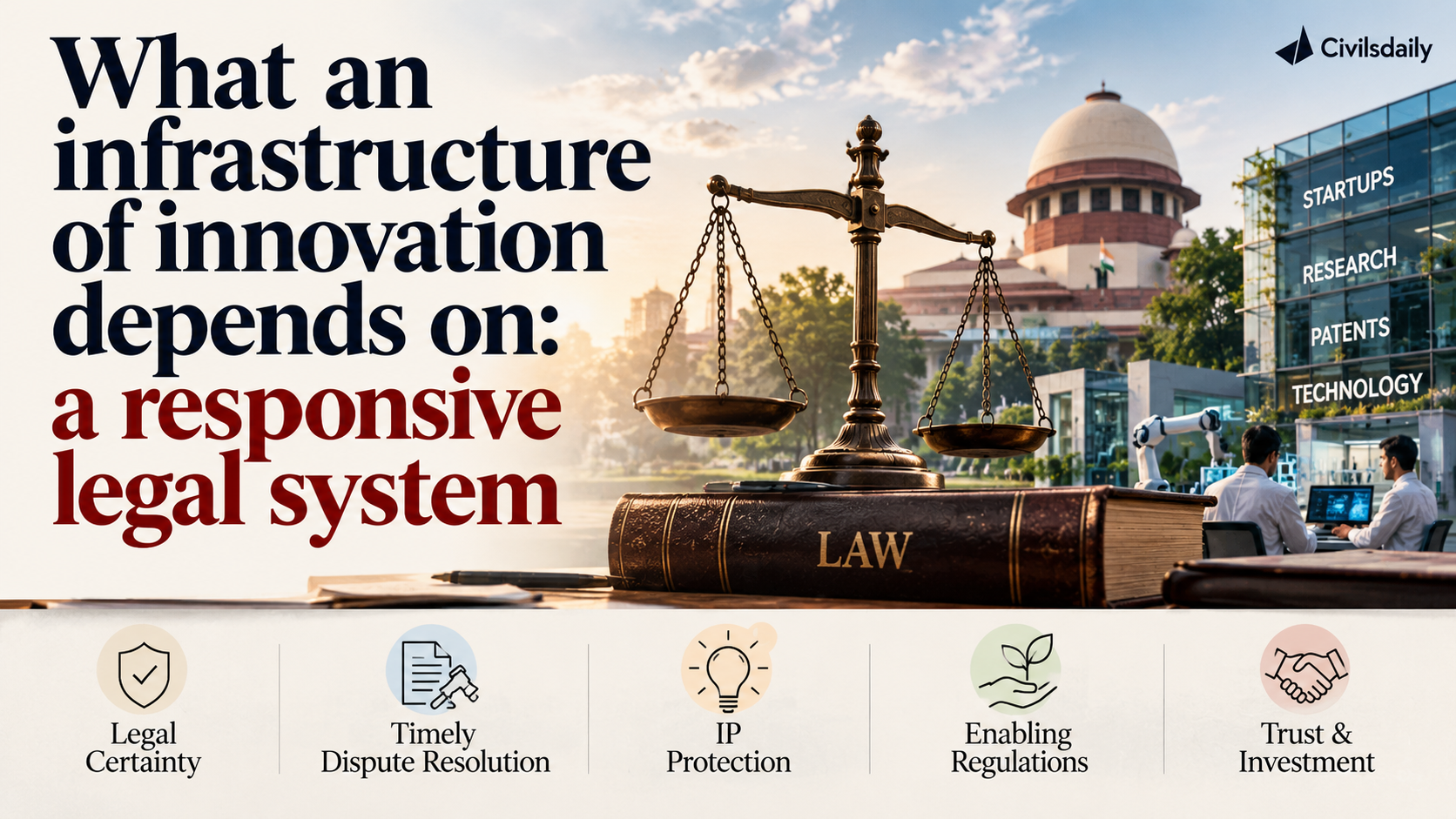
The Delhi High Court’s model for intellectual property (IP) disputes has been held up as a framework for courts serving India’s other innovation and commercial hubs. Other courts can copy it only with equal investment in their infrastructure, because investors in innovation need courts that settle disputes fast.
What changed in India’s patent regime after 2005?
What a product patent is: A product patent protects the chemical itself, not just one way of making it. It is like owning the recipe, not one kitchen method.
The 2005 amendment: The last major amendment to the Patents Act, 1970 restored product patents for chemicals, affecting pharmaceuticals, biotechnology and agro-chemicals.
Why it came:World Trade Organization (WTO) membership bound India to the Trade-Related Aspects of Intellectual Property Rights (TRIPS) agreement’s common minimum IP rules, which leave room to protect public health.
Public interest guardrails: India kept safeguards so patents do not hurt the public:
compulsory licences, letting others make a patented product in the public interest;
checks on evergreening, extending a patent through minor changes;
a local working rule, requiring the invention to be commercially used in India;
competition law curbs on abuse of IP monopolies.
The takeaway: Stronger rights multiplied IP, from trademarks and copyrights to geographical indications, industrial designs, semiconductor layouts and plant varieties, so disputes multiplied too.
Why did disputes rise, and how did the legal system respond?
Complex commerce: After liberalisation, Indian firms competed globally under WTO rules, so IP and commercial disputes rose sharply. Foreign investors, then Indian firms, demanded faster, skilled courts.
Ranking pressure: Speed and quality of dispute resolution became a metric in global ease of doing business rankings.
Alternative Dispute Resolution (ADR): The first response promoted arbitration and mediation, private settlement outside court.
Commercial Courts Act, 2015: The second response let State governments set up dedicated commercial courts in consultation with their High Courts. It amended the Code of Civil Procedure to speed commercial cases.
What is alternative dispute resolution?
Meaning:ADR settles a dispute privately, outside the court system, with minimal court interference.
Forms: It takes the form of arbitration or mediation.
Purpose: It decongests civil courts and disposes of time-sensitive disputes quickly.
What makes the Delhi High Court a model?
Original side: The Delhi High Court is the court of first instance for civil suits above a set value, so high-stakes cases skip lower courts.
Landmark rulings: Its rulings on pharmaceuticals, Standard Essential Patents (patents a telecom standard cannot work without), copyrights and IP versus fundamental rights are a benchmark for the Global South and North.
Intellectual Property Division: Building on the 2015 Act, it created a division hearing only IP disputes. It framed IP Division Rules in 2022, welcomed by the World Intellectual Property Organization (WIPO).
Paperless court:E-filing since the 2020 lockdown made it largely paperless, helping litigants seeking urgent relief and building stakeholder confidence.
Can the model work beyond Delhi?
Viksit Bharat link: Becoming a developed nation, Viksit Bharat, by 2047 needs a culture of innovation and entrepreneurship. A legal system that enforces rights is part of that ecosystem.
Unfinished ADR: ADR has broad acceptance, yet calls for world-class ADR infrastructure show gaps remain.
Challenges
Limited original side: Only a few High Courts, such as Delhi, Bombay, Calcutta and Madras, hear civil suits at first instance.
Tribunal abolition: Abolishing the Intellectual Property Appellate Board (IPAB) moved its appeals to already burdened High Courts.
Patent office backlog: Slow examination and too few examiners delay patents before any dispute arises.
Uneven digital capacity: Many courts lack reliable e-filing and staff trained in technical IP evidence.
Way Forward
IP Divisions elsewhere: High Courts serving major commercial hubs should set up IP Divisions with their own rules.
Dedicated funding: The Union and States should fund judges, technical experts and e-courts.
Examination timelines: The patent office should fix examination deadlines and hire more examiners.
Institutional arbitration: Credible arbitration centres would keep more disputes out of court.
Conclusion
Strong IP law protects innovation only when courts can enforce it quickly, and outside Delhi that capacity is thin. Whether other High Courts create funded IP Divisions will show if one court’s success becomes a national standard.
Government Initiatives for India’s IPR Ecosystem
National IPR Policy, 2016: Aims to build a robust intellectual property rights (IPR) ecosystem that promotes innovation and entrepreneurship.
Patent Facilitation Centres: Guide inventors, especially small enterprises and startups, through filing and protection.
Matching Previous Year Question
“[2024, GS3, 10 marks] What is the present world scenario of intellectual property rights with respect to life materials? Although, India is second in the world to file patents, still only a few have been commercialized. Explain the reasons behind this less commercialization.”
Question (2025, GS2 – 15 Marks): “The reform process in the United Nations remains unresolved, because of the delicate imbalance of East and West and entanglement of the USA vs. Russo-Chinese alliance.” Examine and critically evaluate the East-West policy confrontations in this regard. Linkage: Directly addresses why comprehensive UN structural reform remains stalled—attributing the paralysis to major-power rivalry, veto misuse, and the unwillingness of the P5 to concede influence.
[2026] Which of the following international conventions have NOT been ratified by India? 1. Employment Policy Convention 2. Abolition of Forced Labour Convention 3. International Convention on the Protection of the Rights of All Migrant Workers and Members of Their Families 4. Geneva Convention Relative to the Protection of Civilian Persons in Time of War 5. Convention on Reduction of Statelessness (a) 2 and 4 (b) 1 and 2 (c) 3 and 4 only (d) 3, 4 and 5
Mentor’s Comment
The UN was built to create trust between states, and it now has to earn trust from the people it serves. Delivery is not the problem, since 98 million people were reached. The problem is that funding power, opaque oversight and skewed leadership make delivery look partisan. Each reform the article implies shifts power away from those who hold it. Donors would lose influence over recruitment and programmes. Permanent members would lose freedom on the veto. Headquarters cities would lose posts. Restoring trust therefore depends on the actors who benefit from the current arrangement agreeing to constrain themselves.
Why in the News
The 81st United Nations General Assembly (UNGA) held its high-level week under the theme “Restoring Trust, Managing Transformation: a UN that delivers for all”. The word “restoring” concedes that trust in the UN has collapsed, and global surveys confirm the fall.
Why does trust matter to the UN, and how far has it fallen?
Why the UN exists: Set up after the Second World War, the UN makes states’ conduct more predictable through dialogue and international law, like agreed rules in a game rivals play.
What went wrong: Over three decades, the UN went from building trust between parties in peacebuilding to needing to restore trust in itself.
Falling confidence:Edelman Trust and Pew surveys found declining trust. In a UN Foundation poll, 52 per cent want deep structural reform, saying the UN struggles to deliver.
Doubts on leadership: Only 58 per cent think the UN can lead on global problems (Rockefeller Foundation and Focaldata poll), possibly a historic low.
The takeaway: The UN’s authority rests on states and publics trusting it, so falling trust weakens its ability to broker peace.
What are the four reasons for the loss of trust?
Security Council deadlock:UN Security Council (UNSC) paralysis eroded the Assembly’s trust, so it passed resolution A/76/262 requiring permanent members to explain each veto.
Integrity and oversight gaps: Scandals were blamed on individuals, and systemic accountability was seldom addressed:
a procurement scandal in Afghanistan (2013);
sexual exploitation and abuse cases involving peacekeepers (2017);
contracts for non-existent housing projects in Ghana and India (2021).
Donor capture: A few countries give extra-budgetary grants, voluntary money outside the regular budget, and use them to place their nationals and back cherry-picked programmes:
the Advisory Committee on Administrative and Budgetary Questions (ACABQ), the UN’s top financial watchdog, found one government sponsoring eight of nine experts in one agency;
spending data reach donor governments, not beneficiary publics;
fear of upsetting donors has made staff risk-averse on conflict prevention.
Global South under-representation: Most programmes run in the Global South, where trust is higher, but power sits elsewhere:
developing nations hold 84 per cent of the world’s population but 44 per cent of UN civil service leadership posts;
only a third of UN leaders in Africa are African, and two-fifths of UN headquarters cities are in the Global South;
posts moved out of New York and Geneva in 2025 to cut costs largely bypassed Global South cities.
Where does the UN still deliver, and where does it fall short?
Humanitarian reach: The UN aided and protected 98 million people in 2025-26. Aid quality and funds reaching local actors remain weak.
Tactical wins: In the wars in Ukraine, Gaza and Iran, the UN kept Black Sea grain exports flowing and prevented a Red Sea oil spill.
Peacemaking gap: It could not turn that goodwill into mechanisms for belligerents to talk, because peacemaking initiative is centralised at the top of the bureaucracy.
Challenges
Costless vetoes: Explaining a veto carries no penalty, so permanent members keep blocking action. Eg. Ukraine and Gaza.
Weak accountability: No independent system holds senior managers answerable for systemic failures.
Minilateralism: States bypass the UN for smaller groupings. Eg. the Quad, BRICS.
Way Forward
Public transparency: UN entities should publish programme spending to beneficiary publics, not only to donors.
People-centred ties: The UN should rebuild ties with people, not only governments.
Equitable staffing: The Secretariat should set Global South leadership targets and relocate posts to Global South hubs.
Decentralised peacemaking: The Secretary-General should let field envoys open talks without waiting for headquarters.
Conclusion
The UN’s crisis of trust stems less from failed delivery than from how it is governed: who decides, who pays and who answers for failure. Whether the promised “transformation” opens UN leadership and finances to the Global South will decide if trust returns.
About UN Security Council reform
G4 bid: India, Brazil, Japan and Germany seek expansion of both permanent and non-permanent seats.
Amendment hurdle (Article 108): An amendment needs two-thirds of the Assembly and ratification by two-thirds of members, including all five permanent members.
Rival blocs: The Uniting for Consensus group, including Pakistan, Italy and Mexico, wants only non-permanent seats added. Africa’s Ezulwini Consensus seeks at least two permanent seats with veto.
Stalled talks: The 2026 session of the Intergovernmental Negotiations (IGN) ended without consensus on a framework for expansion.
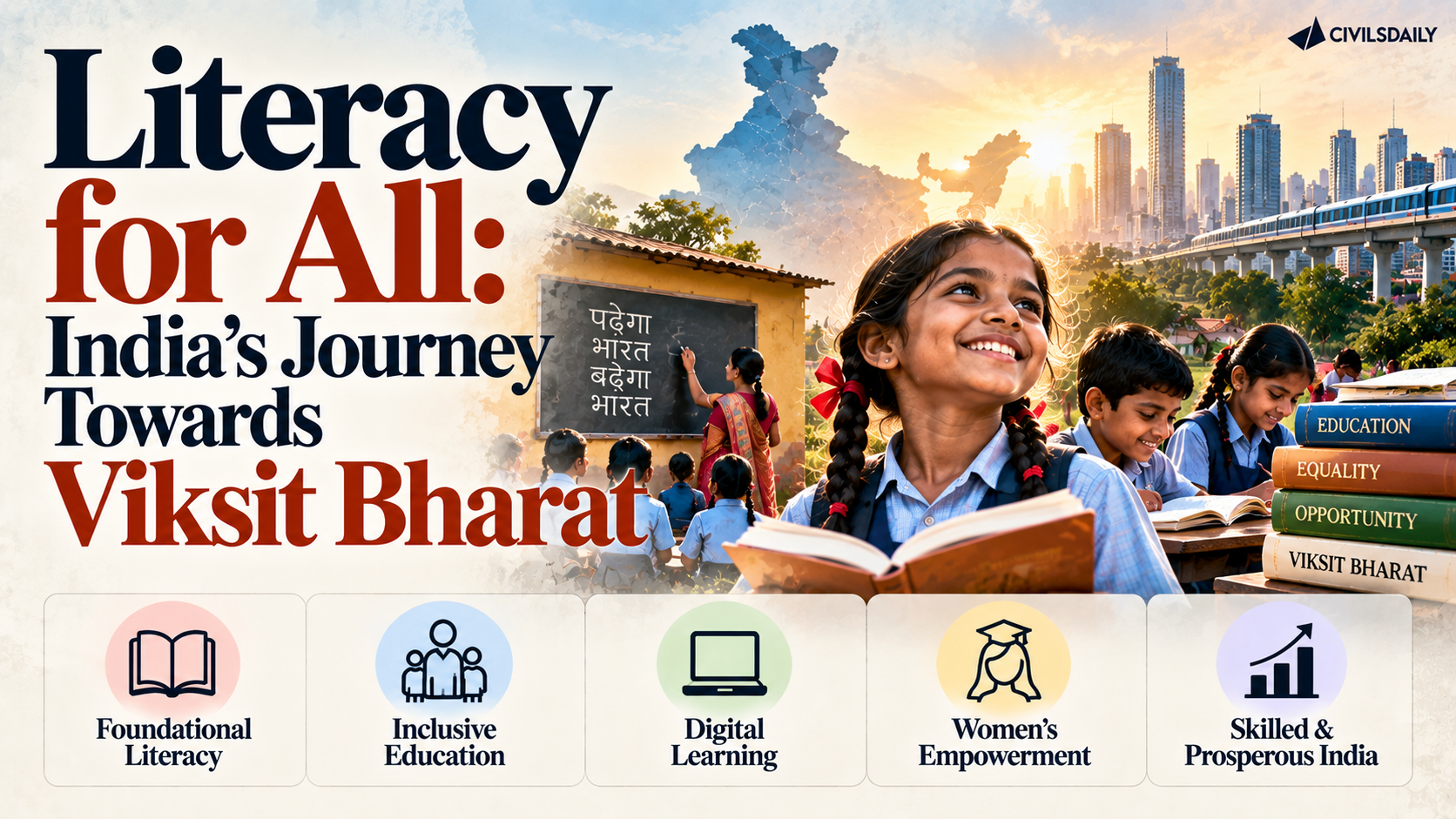
The PIB highlighted India’s progress towards universal literacy, including recent literacy data and government initiatives such as ULLAS and NIPUN Bharat.
Key Highlights
India’s literacy rate increased from 18.32% in 1951 to 74.04% in 2011.
Female literacy increased from 8.86% in 1951 to 65.46% in 2011.
As per PLFS 2025, overall literacy rate was 81.1%.
Urban literacy among population aged 7+ years: 89%.
Rural literacy among population aged 7+ years: 77.4%.
The Department of School Education and Literacy considers 95% literacy in a State/UT equivalent to full literacy.
According to UDISE+ 2025-26, over 24.72 crore students were enrolled in schools.
Higher education enrolment increased from 3.42 crore in 2014-15 to 4.50 crore in 2023-24.
Higher education GER increased from 23.7% to 30% during the same period.
ULLAS
ULLAS stands for Understanding of Lifelong Learning for All in Society.
Also known as New India Literacy Programme (NILP).
Centrally sponsored scheme aligned with NEP 2020.
Targets adults aged 15 years and above who missed formal schooling.
Covers:
Functional literacy
Numeracy
Critical life skills
Lifelong learning
Uses volunteerism and Janbhagidari for universal literacy.
ULLAS App provides learning material in 27 languages.
Learners eventually appear for the Foundational Literacy and Numeracy Assessment Test (FLNAT).
Target: 5 crore learners during 2022-27.
Financial outlay: ₹1,037.90 crore.
Around 4.03 crore registered learners and over 52.20 lakh volunteers.
More than 3.3 crore learners have participated in FLNAT.
10 States/UTs declared themselves fully literate between 2024 and 2026.
NIPUN Bharat
NIPUN: National Initiative for Proficiency in Reading with Understanding and Numeracy.
Launched in July 2021 under Samagra Shiksha.
Target: universal foundational literacy and numeracy by 2026-27.
Focuses on children in the Foundational Stage, ages 3-8 years.
Aims to ensure foundational skills by Grade 2.
Other Education Initiatives
Samagra Shiksha: Promotes equitable and quality school education; subsumed SSA, RMSA and Teacher Education schemes.
PM SHRI: Aims to strengthen more than 14,500 exemplar schools.
PM e-VIDYA: Provides digital, online and on-air education; expected to benefit nearly 25 crore school-going children.
PM POSHAN: Provides one hot cooked meal to 11.20 crore students in Bal Vatikas and Classes I-VIII across 10.36 lakh schools.
Prelims Quick Revision
95% literacy in a State/UT is considered equivalent to full literacy.
India’s literacy rate: 74.04% in 2011.
Overall literacy as per PLFS 2025: 81.1%.
ULLAS: Adult literacy, 15+ years.
NIPUN Bharat: Foundational literacy and numeracy, ages 3-8 years.
ULLAS target: 5 crore learners during 2022-27.
NIPUN Bharat target: foundational literacy and numeracy by 2026-27.
SDG 4 focuses on inclusive and equitable quality education and lifelong learning.
UPSC Prelims Trap
ULLAS vs NIPUN Bharat: ULLAS focuses on adult learners aged 15+, while NIPUN Bharat focuses on foundational learning among children aged 3-8 years.
95% literacy is the benchmark for declaring a State/UT fully literate in the given framework, not 100%.
ULLAS is centrally sponsored, not a standalone Central Sector scheme.
NIPUN Bharat was launched in July 2021 under Samagra Shiksha.
A three-judge US Court of Appeals for the Ninth Circuit panel has lifted an injunction (a court order to stop) that Amazon won against the “Assistant” in Perplexity AI’s Comet browser. The panel held that the user, not Perplexity, “accessed” Amazon’s servers, because Perplexity’s systems never contacted them directly. This reopens who controls an AI agent acting for a person.
What is an AI agent, and why did Amazon sue?
What it is: An agentic AI acts for a user like a human assistant. Unlike a web scraper, which only copies text, it can log in, fill a cart and pay.
Amazon’s grievance: Assistant entered customers’ password-protected accounts with their permission but without Amazon’s authorisation.
Legal basis: Amazon sued in November under the US Computer Fraud and Abuse Act (CFAA), an anti-hacking law, and a California computer fraud law, not breach of contract.
The takeaway: The case asks whether a user’s permission is enough when a platform says no, which decides how freely agents can shop for people.
How did the Ninth Circuit reason?
Trial court view: On 9 March the trial judge granted a preliminary injunction, a temporary ban until trial, holding access unauthorised even with users’ permission.
Meaning of access: The CFAA punishes access “without authorisation”, and the panel read access as a person’s act, not software’s. Facebook v. Power Ventures differed because servers contacted servers directly.
User authority: A consumer’s authority over their own account was enough to authorise an AI intermediary, shifting power from platform to user.
Two-hop design: Only the user’s browser contacted Amazon. Perplexity’s servers, working from screenshots, spoke only to the user’s device, so a centralised service would likely have fared worse.
Narrow ruling: The panel left open a claim for breach of terms of service. Courts increasingly keep anti-hacking laws for technical break-ins and leave broken terms to contract law.
How would Indian law treat an AI agent?
Information Technology Act, 2000:Section 43(a) penalises access to a computer without the owner’s permission. Section 66 makes it a crime where the access is dishonest or fraudulent.
Digital proxy: An agent using the user’s login is their digital proxy. Indian law on agency and delegation would still generally treat its access as unauthorised.
Competition risk: A dominant platform blocking rival agents but favouring its own could face the Competition Commission of India (CCI). Eg. CCI’s MakeMyTrip cases (2019, 2020).
Indian Contract Act, 1872:Click-wrap terms, accepted by clicking “I agree”, bar automated access. Unconscionable terms, such as a blanket agent ban, remain open to challenge.
Digital Personal Data Protection (DPDP) Act, 2023: Platforms are data fiduciaries that process data, and users are data principals whose data it is. Consent managers could let agents operate with managed consent.
Why does the reading of “access” matter?
Narrow reading: If access means breaking a technical barrier, platforms cannot use computer fraud law against browsing agents.
Broad reading: If agent browsing counts, dominant platforms gain a weapon against agentic rivals, hurting innovation and consumer choice.
Start-up design: Indian start-ups should favour client-side, user-mediated execution, keeping contact on the user’s device to limit Section 43 liability.
Revenue impact: Agents read a page’s code, not its look, so they skip sponsored ads, pushing platforms to new revenue models.
Challenges
Legal uncertainty: No Indian court has ruled on AI agents, so liability is unclear.
Fraud and security: Agents holding card details and logins attract account takeover attacks.
Liability for errors: No law says who pays for an agent’s unwanted purchase.
Weak contract defence: Terms of service are largely untested against agents.
Way Forward
Official agent APIs: Platforms should offer agent application programming interfaces (APIs) that cap request rates and block suspicious bots.
Clear statutory rules: Parliament should define agents’ rights and duties, and when user authorisation outweighs platform security.
Regulatory sandboxes: Regulators should test technical and legal options in sandboxes.
Consent manager route: The Data Protection Board should clarify how agents use consent managers.
Conclusion
In the US, who accessed the platform is settled for now, but whether an agent breaches a platform’s contract is still open. In India, how courts read unauthorised access will set the balance between platform security, competition and consumer autonomy.
Key numbers
Flipkart: 50 to 60 per cent of e-commerce gross merchandise value, GMV (ICICI Securities, May 2026, all three figures).
Amazon: 25 to 30 per cent of GMV.
Meesho: about 10 per cent of GMV.
Matching Previous Year Question
“[2026] Which of the following statements with regard to Large Language Models (LLMs) used in machine learning is/are correct? 1. LLMs assign probabilities to the next possible words and then pick the one with the highest probability. 2. LLMs process data through mathematical optimization to minimise prediction errors. 3. LLMs produce unbiased outputs. (a) 1 only (b) 1 and 2 only (c) 2 and 3 only (d) 1, 2 and 3 Answer: B”



![[30th September 2026] The Hindu OpED: The United Nations’ long road to restoring trust](https://d18x2uyjeekruj.cloudfront.net/wp-content/uploads/2026/09/ChatGPT-Image-Sep-30-2026-12_02_19-PM.png)