Mains Ready By December. Smash Mains & Smash PYQ Admissions Open

Search results for: “”

  • Agricultural policy monitoring and evaluation by OECD

    The OECD (Organisation for Economic Co-operation and Development) has provided five sets of data on the issue of agriculture support and India trails on most counts:

    The ongoing debate about farmers protest has brought to light some of the key support mechanisms for agriculture in India. And it is being argued that the government has preferred the welfare of Indian consumers over the Indian farmers.

    Lets’ have a look at various OECD’s parameters:

    (1) Producer Support Estimates (PSE)

    • These are transfers to agricultural producers and are measured at the farm gate level.
    • They comprise market price support, budgetary payments and the cost of revenue foregone.

    (2) Consumer Support Estimates (CSE)

    • These refer to transfers from consumers of agricultural commodities. They are measured at the farm gate level.
    • If negative, the CSE measures the burden (implicit tax) on consumers through market price support (higher prices), that more than offsets consumer subsidies that lower prices to consumers.

     (3) General Services Support Estimates (GSSE)

    • GSSE transfers are linked to measures creating enabling conditions for the primary agricultural sector through the development of private or public services, institutions and infrastructure.
    • GSSE includes policies where primary agriculture is the main beneficiary but does not include any payments to individual producers.
    • GSSE transfers do not directly alter producer receipts or costs or consumption expenditure.

    (4) Total Support Estimate (TSE)
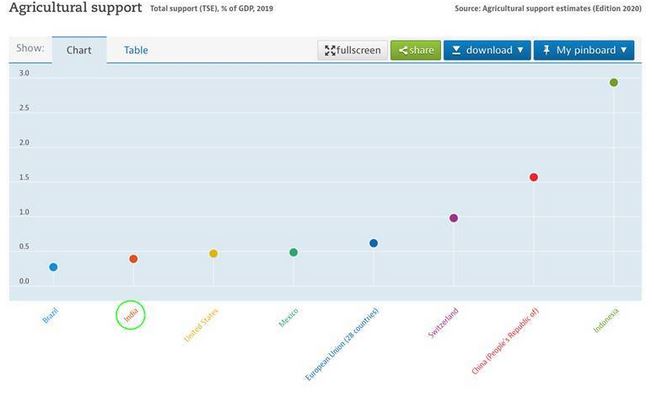
    • The TSE transfers represent the total support granted to the agricultural sector, and consist of producer support (PSE), consumer support (CSE) and general services support (GSSE).

    (5) Producer protection

    • Lastly, the OECD also provides data on “producer protection”.
    • The PP is the ratio between the average price received by producers (measured at the farm gate), including net payments per unit of current output, and the border price (measured at the farm gate).
    • For instance, a coefficient of 1.10, which China has, suggests that farmers, overall, received prices that were 10% above international market levels.
  • CPEC- The corridor of uncertainty

    The China-Pakistan Economic Corridor (CPEC) has turned five.

    What is CPEC?

    • China–Pakistan Economic Corridor (CPEC) is a collection of infrastructure projects that are under construction throughout Pakistan since 2013.
    • It is an extension of the Belt and Road Initiative of China.
    • It intended to upgrade Pakistan’s required infrastructure and strengthen its economy by the construction of modern transportation networks, numerous energy projects, and special economic zones.
    • On 13 November 2016, CPEC became partly operational when Chinese cargo was transported overland to Gwadar Port for onward maritime shipment to Africa and West Asia.

    Why in news?

    • The viability of some of the CPEC’s projects, and how they were going to be paid for in a pandemic-hit economy, had come under renewed attention in Pakistan.
    • China had sought additional guarantees before sanctioning a $6 billion loan for the Main Line-1 (ML-1) project, which includes upgrading a 1,872 km rail line from Peshawar to Karachi.
    • This is due to the “weakening financial position of Pakistan” and had “proposed a mix of commercial and concessional loans against Islamabad’s desire to secure the cheapest lending”.

    An overrated project

    • The CPEC, to some degree, has been a victim of its own hype.
    • Its economic figure may never materialise as the plan has been “considerably slimmed-down” from the scope that was first imagined.
    • This largely due to the ever-deteriorating financial situation of Pakistan and a visible debt-trap.
    • Pakistan had established a CPEC authority to speed up the execution of several projects that were mired in delays (and to give the military a greater role in the project).

    Threats of Baloch insurgency

    • Gwadar, the heartland of CPEC certainly faces serious threats.
    • The city is a prime target for Baloch nationalist insurgents. Hence Pakistan has decided to fence the area.
    • This has sparked a new furore among the local residents.

    India’s concerns with CPEC

    • CPEC passes through Pakistan-Occupied Kashmir (Gilgit-Baltistan) which is an Indian territory illicitly occupied by Pakistan.
    • Thus CPEC undermines India’s strategic interests and territorial integrity.
    • More importantly, with CPEC, China will get access to the western Indian Ocean through Gwadar port.
    • This will help China in controlling maritime trade and would affect the freedom of navigation and trade-energy security of India.
  • FSSAI slashes limit for Trans Fats level in food

    The Food Safety and Standards Authority of India (FSSAI) has capped the amount of trans fatty acids (TFA) in oils and fats to 3% for 2021 and 2% by 2022 from the current permissible limit of 5%.

    New FSSAI norms

    • FSSAI has acted in response to the amendment to the Food Safety and Standards (Prohibition and Restriction on Sales) Regulations.
    • The country’s food regulatory body notified the amendment on December 29, more than a year after it issued a draft on the subject for consultation with stakeholders.
    • The revised regulation applies to edible refined oils, vanaspati (partially hydrogenated oils), margarine, bakery shortenings, and other mediums of cooking such as vegetable fat spreads and mixed fat spreads.
    • It was in 2011 that India first passed a regulation that set a TFA limit of 10% in oils and fats, which was further reduced to 5% in 2015.

    What are Trans Fats?

    • Artificial Trans fats are created in an industrial process that adds hydrogen to liquid vegetable oils to make them more solid.
    • Since they are easy to use, inexpensive to produce and last a long time, and give foods a desirable taste and texture, they are still widely used despite their harmful effects being well-known.

    Why such a regulation?

    • Trans fats are associated with increased risk of heart attacks and death from coronary heart disease.
    • As per the WHO, approximately 5.4 lakh deaths take place each year globally because of intake of industrially-produced trans-fatty acids.
    • The WHO has also called for global elimination of trans fats by 2023.
  • Places in news: Deepor Beel

    Assam has prohibited community fishing at Deepor Beel, a wetland on the south-western edge of Guwahati and it’s the only Ramsar site.

    Try this PYQ:

    In which one among the following categories of protected areas in India are local people not allowed to collect and use the biomass?

    (a) Biosphere reserves

    (b) National parks

    (c) Wetlands declared under Ramsar convention

    (d) Wildlife sanctuaries

    Deepor Beel

    • Deepor Beel is located to the south-west of Guwahati city, in Kamrup district of Assam, India.
    • It is a permanent freshwater lake, in a former channel of the Brahmaputra River, to the south of the main river.
    • It is a wetland under the Ramsar Convention which has listed since November 2002, for undertaking conservation measures on the basis of its biological and environmental importance.
    • Considered as one of the largest beels in the Brahmaputra valley of Lower Assam, it is categorised as a representative of the wetland type under the Burma monsoon forest biogeographic region.
    • It is also an important bird sanctuary habituating many migrant species.
    • Freshwater fish is a vital protein and source of income for these communities; the health of these people is stated to be directly dependent on the health of this wetland ecosystem.

    Back2Basics: Ramsar Convention

    • The Convention on Wetlands of International Importance (better known as the Ramsar Convention) is an international agreement promoting the conservation and wise use of wetlands.
    • It is the only global treaty to focus on a single ecosystem.
    • The convention was adopted in the Iranian city of Ramsar in 1971 and came into force in 1975.
    • Traditionally viewed as a wasteland or breeding ground of disease, wetlands actually provide fresh water and food and serve as nature’s shock absorber.
    • Wetlands, critical for biodiversity, are disappearing rapidly, with recent estimates showing that 64% or more of the world’s wetlands have vanished since 1900.
    • Major changes in land use for agriculture and grazing, water diversion for dams and canals and infrastructure development are considered to be some of the main causes of loss and degradation of wetlands.
  • [pib] Kochi – Mangaluru Natural Gas Pipeline

    PM will today dedicate the Kochi – Mangaluru Natural Gas Pipeline to the nation.

    Try this PYQ:

    Q. Consider the following statements:

    1. Natural gas occurs in the Gondwana beds.
    2. Mica occurs in abundance in Kodarma.
    3. Dharwars are famous for petroleum.

    Which of the statements given above is/are correct?

    (a) 1 and 2 only

    (b) 2 only

    (c) 2 and 3 only

    (d) None

    Kochi – Mangaluru Pipeline

    • The 450 km long pipeline has been built by GAIL (India) Ltd.
    • It has a transportation capacity of 12 Million Metric Standard Cubic Metres per day.
    • It will carry natural gas from the Liquefied Natural Gas (LNG) Regasification Terminal at Kochi (Kerala) to Mangaluru (Dakshina Kannada district, Karnataka).
    • It will pass through Ernakulam, Thrissur, Palakkad, Malappuram, Kozhikode, Kannur and Kasaragod districts.

    Its significance

    • The event marks an important milestone towards the creation of ‘One Nation One Gas Grid’.
    • The pipeline will supply environment-friendly and affordable fuel in the form of Piped Natural Gas (PNG) to households and Compressed Natural Gas (CNG) to the transportation sector.
    • It will also supply Natural Gas to commercial and industrial units across the districts along the pipeline.
    • Consumption of cleaner fuel will help in improving air quality by curbing air pollution.

    Back2Basics: Natural Gas

    • Natural gas is a fossil fuel source consisting primarily of methane.
    • It is the cleanest among all the available fossil fuels.
    • It is used as a feedstock in the manufacture of fertilizers, plastics and other commercially important organic chemicals as well as used as a fuel for electricity generation, heating purpose in industrial and commercial units.
    • Natural gas is also used for cooking in domestic households and a transportation fuel for vehicles.

  • Issues with U.P. religious conversion ordinance

    The article examines the provision of U.P. governments religious conversion ordinance and issues with these provision.

    Power to promulgate an ordinance

    • As per Article 213(1) of the Constitution of India, there are three pre-conditions to be satisfied before the Governor promulgates an ordinance, these are:
    • 1) The State Legislature should not be in session.
    • 2) Circumstances should exist for promulgating an ordinance and importantly.
    • 3) Those circumstances must warrant immediate action.

    Scrutiny of the circumstances

    • There is no established practice requiring the Governor (or the President under Article 123) to state the circumstances for promulgating the Ordinance.
    • The reason for immediate action is, as yet, not justiciable.
    • But the Supreme Court of India has held that the existence of circumstances leading to the satisfaction of the Governor can be inquired into.
    • A healthy convention should develop and the preamble to any ordinance should state the immediacy for promulgating it when the Legislature is not in session.
    • This would greatly enhance transparency in legislation.
    • This would also help legislators to understand why they are by-passed and why a procedures in the Legislature could not be awaited.

    Issues with the U.P. ordinance

    • The Uttar Pradesh Prohibition of Unlawful Conversion of Religion Ordinance records the satisfaction of the Governor of the existence of circumstances and the necessity for “him/her to take immediate action.
    • If one fraudulent or coercive inter-faith marriage is taking place, the police can certainly prevent it.
    • An ordinance is not required for it.
    • Section 3 prohibits conversion or attempt to convert any person from one religion to another by coercion or fraud etc. or by marriage.
    • But, nobody gets converted by marriage.
    • The offense of attempting to convert poses a bigger rights issue.
    • Under Section 7, on receiving the information a police officer is authorized to arrest a person without orders from Magistrate or warrant.
    • The nature of information includes an allegation of allurement which includes an offer of any temptation in the form of a gift or gratification.
    • Under Section 8, if someone genuinely desires to convert but not get married, that person would have to inform the District Magistrate (DM) two months in advance of the plan through a declaration.
    • Assuming conversion is not objected to, even thereafter the DM must be informed by the converted through a declaration under Section 9.
    • Section 12 provides that the burden to prove the conversion was not on account of coercion, fraud, etc., or by marriage will be on the person who has caused the conversion.
    • But, how the person causing the conversion expected to know the mind of the converted?

    Conclusion

    The ordinance vilifies all inter-faith marriages and places unreasonable obstacles on consenting adults in exercising their personal choice of a partner, mocks the right to privacy and violates the right to life, liberty, and dignity. In short, it is unconstitutional.

  • Melting of the Arctic ice and its geopolitical footprints

    Melting of the ice in the Arctic region has as much impact on the geopolitics as it has on the environment. The article explains in detail the geopolitics involved.

    Melting of Arctic ice and its impact on climate

    • Arctic region is warming up twice as fast as the global average.
    • The ice cap is shrinking fast — since 1980, the volume of Arctic sea ice has declined by as much as 75 percent.
    • The loss of ice and the warming waters will affect sea levels, salinity levels, and current and precipitation patterns.
    • The Tundra is returning to the swamp, the permafrost is thawing, sudden storms are ravaging coastlines and wildfires are devastating interior Canada and Russia.
    • The rich biodiversity of the Arctic region is under serious threat.
    • These changes are making the survival of Arctic marine life, plants, and birds difficult while encouraging species from lower latitudes to move north.
    • The Arctic is also home to about 40 different indigenous groups, whose culture, economy, and way of life are in danger of being swept away.

    Opportunities in the melting of the Arctic

    • The Northern Sea Route (NSR) which connects the North Atlantic to the North Pacific through a short polar arc was once not open for navigation.
    • The melting ice has now made it a reality and a trickle of commercial cargo vessels have been going through every summer since the last decade.
    • The opening of the Arctic presents huge commercial and economic opportunities, particularly in shipping, energy, fisheries, and mineral resources.
    • Oil and natural gas deposits, estimated to be 22 percent of the world’s unexplored resources, mostly in the Arctic ocean, will be open to access along with mineral deposits.

    Challenges in exploiting opportunities

    • Navigation conditions are dangerous and restricted to the summer.
    • There is a lack of deep-water ports, a need for ice-breakers, a shortage of workers trained for polar conditions, and high insurance costs.
    • Mining and deep-sea drilling carry massive costs and environmental risks.
    • Unlike Antarctica, the Arctic is not a global common and there is no overarching treaty that governs it, only the UN Convention of Law of the Sea (UNCLOS).
    • Large parts of it are under the sovereignty of the five littoral states — Russia, Canada, Norway, Denmark (Greenland) and the US — and exploitation of the new resources is well within their rights.

    Geopolitics of the Arctic

    • Russia, Canada, Norway, and Denmark have put in overlapping claims for extended continental shelves.
    • The US, not a party to UNCLOS, is unable to put in a formal claim but is under pressure to strengthen its Arctic presence.
    • For the present, Russia is the dominant power, with the longest Arctic coastline, half the Arctic population, and a full-fledged strategic policy.
    • Russia anticipates huge dividends from commercial traffic including through the use of its ports, pilots, and ice-breakers.
    • China, playing for economic advantage, has moved in fast, projecting the Polar Silk Road as an extension of the BRI, and has invested heavily in ports, energy, undersea infrastructure, and mining projects.

    What are the concerns for India

    • India’s extensive coastline makes it vulnerable to the impact of Arctic warming on ocean currents, weather patterns, fisheries, and most importantly, our monsoon.
    • Scientific research in Arctic developments, in which India has a good record, will contribute to our understanding of climatic changes in the Third Pole — the Himalayas.
    • The strategic implications of an active China in the Arctic and it’s growing economic and strategic relationship with Russia are self-evident and need close monitoring.

    Way forward

    • India has observer status in the Arctic Council, which is the predominant inter-governmental forum for cooperation on the environment and development (though not the security) aspects of the Arctic.
    • India should leverage its presence in Arctic Council for a strategic policy that encompassed economic, environmental, scientific, and political aspects.

    Consider the question “Melting of the Arctic opens the door for geopolitical game in the region and India cannot be immune to its implications. In the context of this, examine the developments in the region and how it impacts India’s interests?”

    Conclusion

    India must strive to protect its interest and strive for strategic policy for the region.

  • Issues with NEP’s regulatory architecture

    The article deals with the idea of single regulator for higher education in the country and the challenges it could fece.

    Recommendations for regulation of higher education

    • Regulatory bodies came up in response to the rapid growth of private participation since the 1980s.
    • Due to multiplicity of regulatory bodies in higher education, nearly all advisory panels appointed since 2005 have been asked for a single regulator.
    • National Knowledge Commission (NKC) concluded in 2007 that the plethora of agencies attempting to control entry, operation, intake, price, size, output and exit had rendered the regulation of higher education ineffectual.
    • The NKC recommended the setting up of an overarching Independent Regulatory Authority in Higher Education (IRAHE).
    • A major concern of the Yash Pal Committee constituted in 2009 was compartmentalisation of academia.
    • To promote such a dialogue, the Yash Pal committee recommended the creation of an apex body called the National Commission for Higher Education and Research (NCHER).
    • TSR Subramanian committee in 2016 proposed an Act for setting up an Indian Regulatory Authority for Higher Education (IRAHE) to subsume all existing regulatory bodies in higher education.
    • The draft national policy presented by the Kasturirangan Committee in 2019 proposed a National Higher Education Regulatory Authority (NHERA) as a common regulatory regime for entire higher education sector.
    • The draft NEP 2020 proposed a Rashtriya Shiksha Aayog (RSA) to coordinate, direct and address inter-institutional overlaps and conflicts.

    The regulatory regime under NEP 2020

    • NEP 2020 has now a single regulator for all higher education barring medical and law education.
    • It envisages an overarching Higher Education Commission of India (HECI), with four independent verticals comprising the National Higher Education Regulatory Council (NHERC), the National Accreditation Council (NAC), the Higher Education Grants Council (HEGC) and the General Education Council (GEC).
    •  The University Grants Commission (UGC) is to become HEGC while the other regulatory bodies will become professional standard setters.

    Fragmented regulation of medical education to continue

    • NEP-2020 provides for separate regulation for medical education.
    • But it envisions healthcare education as an inter-disciplinary system.[Allopathic student to have a basic understanding of Ayurveda, Yoga etc and vice-versa]
    • Multiple regulators in health education include the National Commission for Homoeopathy (NCH) and the National Commission for Indian System of Medicine (NCISM) and continuation of the Dental Council of India (DCI), Pharmacy Council of India (PCI) and the Indian Nursing Council (INC),
    • Thus, making medical education inter-disciplinary would be difficult due to multiple regulators.

    Lessons from the governance of medical education

    • The above example demonstrate the difficulty in designing a single regulatory framework to take care of the domain-specific needs of even within healthcare education.
    • But if accepted as a principle, it has the potential to delay, if not derail, the idea of a single regulator.
    • And should that actually happen, the idea of reining in the regulators might mean abandoning the idea of regulation of regulators.

    Issues with the single regulator proposed in NEP 2020

    • The regulatory architecture proposed in the NEP is far too monolithic for a system of higher education serving a geographically, culturally and politically diverse country like ours.
    • Even in the matter of privatisation, there is enormous diversity of players and practices.
    • Historically too, private participation in the running of colleges has not followed a single pattern.
    • To imagine that a uniform structure called Board of Governors can serve all different kinds of institutions across the country is flawed.
    • Such a vision calls for better appreciation of what exists, no matter how worrisome a condition it is in.

    Consider the question “What are the challenges in the regulation of higher education in the country? What are the concerns with the idea of single regulator for the regualtion of higher education in country?”

    Conclusion

    Before proceeding with the single regulator, the government need to pay attention to the issue of diversity in various aspects in the country.

  • How to crack IAS 2021?| Also, things you need sorted before starting preparation for IAS 2022 | Fill Samanvaya-1 on 1 session with senior mentors

    How to crack IAS 2021?| Also, things you need sorted before starting preparation for IAS 2022 | Fill Samanvaya-1 on 1 session with senior mentors

    A well-informed start is always a good start.

    Talk to senior mentors from Civilsdaily: Click here and fill Samanvaya form for IAS 2021 and IAS 2022. (also provided at the bottom of this post).


    What is the best strategy for IAS 2021 and 2022 exams? How to start preparation? What does UPSC expect? How to cover the syllabus? How to connect current affairs with static? When to start answer writing? How to plan a daily schedule and then follow it..

    There are a number of similar questions that you must be facing. IAS preparation is not just about memorizing and information gathering. Before you start you need to get answers to these questions. (Read below about our three-tiered mentoring)

    More than 10.5 lakh applied, but only 796 are going to clear IAS 2020. It is going to be much more challenging in 2021 and 2022.

    We’ve had a discussion with 1800 aspirants who failed in Prelims 2020. Many had taken multiple attempts before that.

    Lack of direction, no guidance, inability to make required necessary changes in their preparation, and an absence of a well-defined strategy were issues common to all. (What issues are you facing? tell us)

    Prelims 2020 in many ways was a watershed moment for IAS aspirants. It has highlighted the changing nature of UPSC and to be successful you need to adapt to the expectations of UPSC and adopt a new approach.

    For 2021 aspirants, your preparation should be highly outcome-oriented (enabling you to fetch more marks). Every action of yours must be very objectively defined, every step as a part of your strategy. Whatever you are learning must be utilizable in the exam (both pre and mains). Your preparation should have an element of measurability.

    Moreover, you need to balance both Prelims and Mains on one hand and current-static-optional on the other. Fill Samanvaya form to know how it should be done.

    It’s about how ‘you’ should be doing it instead of how someone else did it. That is the ‘elephant in the room’.

    All this stands true for 2022 aspirants as well. This is the right time to start preparation.

    Fill Samanvaya form given at the bottom of this post.

    Broadly, six factors determine your success in cracking this prestigious IAS exam and the most important being understanding the expectations of UPSC and according to that planning and strategizing; other being, Learning – Knowledge and information; Analyzing – making linkages, connections, etc.; Executing and utilizing information; and Constant course correction – because mistakes are inevitable, need to rectify them asap. Get these in order before you start for IAS 2021/22.

    But how to do that? Read below how our three-tiered mentoring will help.

    Talk to senior mentors from Civilsdaily: Click here and fill Samanvaya form for IAS 2021/22


    Integrate them in your preparation. We’ll tell you how to do it.

    Talk to senior mentors from Civilsdaily: Click here and fill Samanvaya form for IAS 2021-22


    This is where our 3 tier mentoring comes in:

    1. First step starts with this Samanvaya call: Once you fill in the form, our senior mentors will have a 1-to-1 detailed discussion (on-call) with you to understand your prep level, working/ study constraints, current strategies, and create a step by step plan for next week, next month and so on.

    2. You are given access to our invite-only chat platform, Habitat where you can connect with mentors, ask your daily doubts, discuss your test-prep questions and have real-time live sessions on news and op-eds, and find your optional groups.

    How to prepare for upsc 2021? Strategy for upsc 2021?
Answer writing for 2020
    Daily target monitoring.

    3. The third and the most personalized tier is the dedicated 1 on 1 mentor allotment who stays with you through the course of your UPSC preparation – always-on chat and on scheduled calls to help you assess, evaluate, and chart the next milestone of your IAS 2021/2022 journey.

    Let’s talk. Fill this Samanvaya form (click here)

    (Civilsdaily’s mentor will call you within 24 hours.)


    Who are you?

    1. Working Junta? If you are preparing for IAS 2021/2022 and working simultaneously, we can help you strategize and decipher the IAS exam and design a timetable that fits right in your hectic schedule.
    2. First-time prep? If you are in the last year of college or thinking of dropping a year and preparing for IAS 2021/2022 full time, we’ll help you pick the right books and craft a practical & personal strategy.
    3. Have appeared before? and weren’t successful. We’ll help you identify your mistakes, rectify them for the necessary course correction. Let this be your final and successful attempt.

    You just have to take 5 minutes out and fill this form: Samanvaya For IAS 2021/2022

    Once done, we will call you within 24 hours or so.

    How to prepare for upsc 2021? Strategy for upsc 2021?
Answer writing for 2020
Abhishek Saraf rank 8 Civilsdaily
    Abhishek has benefited from Civilsdaily’s approach.

    Talk to senior mentors from Civilsdaily: Click here and fill Samanvaya form for IAS 2021-22

    How to prepare for upsc 2021? Strategy for upsc 2021?
Answer writing for 2020
    Daily target monitoring

    These are some of the images from Habitat, our learning platform. It is one of the ways we monitor your progress.

    Talk to senior mentors from Civilsdaily: Click here and fill Samanvaya form for IAS 2021-22


    Our rankers in 2019

    Civilsdaily’s Hall of Fame.
    Fill up the following details in Samanvaya form given below to schedule a free one-on-one mentorship session with senior mentors from Civilsdaily. We’ll call you within 24 hours.

    Civilsdaily Samanvaya 1-On-1 Mentorship Form

    Field will not be visible to web visitor
  • Recap: Minimum Support Price

    Minimum Support Price (MSP) is the assured price at which foodgrains are procured from farmers by the central and state governments and their agencies, for central pool of foodgrains. The central pool is used for providing foodgrains under the Public Distribution System (PDS) and other welfare schemes, and also kept as reserve in the form of buffer stock.  However, in the past few months, there have been demands to extend MSP to private trade as well and guarantee MSP to farmers on all kinds of trade.

    Is MSP applicable for all crops?

    The central government notifies MSP for 23 crops every year before the Kharif and Rabi seasons based on the recommendations of the Commission for Agricultural Costs and Prices, an attached office of the Ministry of Agriculture and Farmers’ Welfare. These crops include foodgrains such as cereals, coarse grains, and pulses.  However, public procurement is largely limited to a few foodgrains such as paddy (rice), wheat, and, to a limited extent, pulses.

    Since rice and wheat are the primary foodgrains distributed under PDS and stored for food security, their procurement level is considerably high. 

    How does procurement vary across states?

    The procurement of foodgrains is largely concentrated in a few states.  Three states (Madhya Pradesh, Punjab, and Haryana) producing 46% of the wheat in the country account for 85% of its procurement.   For rice, six states (Punjab, Telangana, Andhra Pradesh, Chhattisgarh, Odisha, and Haryana) with 40% of the production have 74% share in procurement. 

    The rice and wheat focus

    • Procurement of marketed surplus of paddy (rice) and wheat at Minimum Support Price (MSP) completely insulated farmers against any price or market risks. It also ensured a reasonably stable flow of income from these two crops.
    • Over time, the technological advantage of rice and wheat over other competing crops further increased as public sector agriculture research and development allocated their best resources and scientific manpower to these two crops.
    • Other public and private investments in water and land and input subsidies were the other favourable factors.
    • Thus, wheat in rabi and paddy in Kharif turned out to be the best in terms of productivity, income, price and yield risk and ease of cultivation among all the field crops (cereals, pulses, oilseeds).

    85% wheat procurement is from three states (2019-20)

    76% of the rice procured comes from six states (2019-20)

    Punjab, Haryana vs. States

    The region comprising Punjab, Haryana and western Uttar Pradesh, was an early adopter of Green Revolution technology. It was also a major beneficiary of various policies adopted to spread modern agriculture technology in the country.

    • High productivity, assured MSP which is often above open market price, free power, and fertilizer subsidy underlie the higher income per unit area from wheat and paddy cultivation.
    • Land-labour ratio is also very favourable in Punjab when compared to other States; on an average, a farmer owns and cultivates 2.14 hectares net sown area as against 1.42 hectares in Haryana and 1.17 hectares at the national level.
    • An estimate of income (derived from National Accounts Statistics) shows that all agriculture activities taken together to generate an annual net income of ₹5.31 lakh per cultivator in Punjab; it is ₹3.44 lakh in Haryana while the all-India average is ₹1.7 lakh (reference year, 2017-18).

    How has MSP affected the cropping pattern?

    According to the central government’s procurement policy, the objective of public procurement is to ensure that farmers get remunerative prices for their produce and do not have to resort to distress sale.  If farmers get a better price in comparison to MSP, they are free to sell their produce in the open market.  The Economic Survey 2019-20 observed that the regular increase in MSP is seen by farmers as a signal to opt for crops which have an assured procurement system (for example, rice and wheat).  

    Declining Incomes

    • Loss of growth momentum in the income from the agriculture sector, which has fallen to 1% in Haryana and 0.6% in Punjab after 2011-12.
    • With the productivity of rice and wheat reaching a plateau, there is pressure to seek an increase in MSP to increase income. However, demand and supply do not favour an increase in MSP in real terms.
    • In India, the per capita intake of rice and wheat is declining and consumers’ preference is shifting towards other foods.
    • The average spending by urban consumers is more on beverage and spices than on all cereals. On the supply side, rice production is rising at the rate of 14% per year in Madhya Pradesh, 10% in Jharkhand and 7% in Bihar.

    Issues related to procurement

    • Limited procurement in different regions.
    • MSP leading to farmer preference for the production of few crops like wheat and rice.
    • The growing rice production will further increase pressure on the procurement and buffer stock of rice. Rice and wheat procurement in the country has more than doubled after 2006-07 and buffer stocks have swelled to an all-time high.
    • The country does not find an easy way to dispose of such large stocks and they are creating stress on the fiscal resources of the government.
    • Procurement of almost the entire market arrivals of rice and wheat at MSP for more than 50 years has affected the entrepreneurial skills of farmers to sell their produce in a competitive market where prices are determined by demand and supply and competition.

    Environmental issues, unemployment

    • The biggest casualty of paddy cultivation and the policy of free power for pumping out groundwater for irrigation is the depletion of groundwater resources.
    • In the last decade, the water table has shown a decline in 84% observation wells in Punjab and 75% in Haryana.
    • In the last couple of years, the burning of paddy stubble and straw has become another serious environmental and health hazard in the whole region.
    • Another rather more serious challenge for the two States is to provide attractive employment to rural youths. Most of the farm work in these two States is undertaken by migrant labour.

    Is MSP mandatory for private trade as well in some states?

    MSP is not mandatory for purchase of foodgrains by private traders or companies.  It acts as a reference price at which the government and its agencies procure certain foodgrains from farmers.

    In September 2020, the central government enacted a new farm law which allows anyone with a PAN card to buy farmers’ produce in the ‘trade area’ outside the markets notified or run by the state Agricultural Produce Marketing Committees (APMCs).  Buyers do not need to get a license from the state government or APMC, or pay any tax to them for such purchase in the ‘trade area’.  These changes in regulations raised concerns regarding the kind of protections available to farmers in the ‘trade area’ outside APMC markets, particularly in terms of the price discovery and payment.  

    In October 2020, Punjab passed a Bill in response to the central farm law to prohibit purchase of paddy and wheat below MSP. Any person or company compelling or pressurising farmers to sell below MSP will be punished with a minimum of three-year imprisonment and a fine. 

    Similarly, in November 2020, Rajasthan passed a Bill to declare those contract farming agreements as invalid where the purchase is done below MSP.   Any person or company compelling or pressurising farmers to enter into such an invalid contract will be punished with 3 to 7 years of imprisonment, or a fine of minimum five lakh rupees, or both.   Both these Bills have not been enacted yet as they are awaiting the Governors’ assent.

    Way forward

    • The solution to the ecological, environmental and economic challenges facing agriculture in the traditional Green Revolution States is not in legalizing MSP but to shift from MSP crops to high-value crops and in the promotion of non-farm activities.
    • Rather than focusing on a few enterprises, Punjab and Haryana should look at a large number of area-specific enterprises to avoid gluts.
    • This will require a mechanism to cover price and market risks. Farmers’ groups and farmer producer organizations can play a significant role in the direct marketing of their produce.

    To encourage crop diversification and thereby reduce the consumption of water, some state governments are taking measures to incentivise farmers to shift away from paddy and wheat.  For example, Haryana has launched a scheme in 2020 to provide Rs 7,000 per acre to those farmers who will use more than 50% of their paddy area (as per the area sown in 2019-20) for other crops.  The farmers can grow maize, bajra, pulses, or cotton in such diversified area.  Further, the crop produce grown in such diversified area under the scheme will be procured by the state government at MSP.

    • Both Punjab and Haryana need to promote economic activities with strong links with agriculture tailored to State specificities.
    • Some options for this are: promotion of food processing in formal and informal sectors; a big push to post-harvest value addition and modern value chains; a network of agro- and agri-input industries; high-tech agriculture; and a direct link of production and producers to consumers and consumers without involving intermediaries.
    • The traditional Green Revolution States of Punjab and Haryana would need to shed “business as usual” approach and embrace an innovative development strategy in agriculture and non-agriculture to secure and improve the future of farming and rural youth.

    References:-

    https://www.thehindu.com/opinion/lead/punjab-haryana-need-to-look-beyond-msp-crops/article33339838.ece
    https://www.prsindia.org/theprsblog/examining-urban-local-governance-india-through-case-bengaluru