Mains Ready By December. Smash Mains & Smash PYQ Admissions Open

Search results for: “”

  • Problem with ethanol blending isn’t sugar — it’s reliance on grains; the way forward (Op-ed by Harish Damodaran)

    Why in the News

    India’s ethanol blended petrol (EBP) programme, an arrangement under which oil marketing companies blend ethanol into petrol to progressively raise the blending ratio, was designed primarily to help sugar mills earn an additional revenue stream so they could pay cane farmers on time. For the current supply year ending October 2026, grain based feedstock accounts for 759.8 crore litres, or 72.5 percent, of the 1,048.3 crore litres of ethanol allocated among distilleries, against 288.5 crore litres, or 27.5 percent, from sugarcane based feedstock. What began as a sugar-support programme has become a grain-dependent one, and the article argues this reversal, not sugar diversion, is the programme’s real problem.

    What is the Ethanol Blended Petrol (EBP) programme?

    1. About: The EBP programme requires oil marketing companies to blend ethanol into petrol at a rising target ratio, currently 20 percent under the E20 standard, to cut crude oil imports and support farm incomes.
    2. Feedstock: Ethanol can be produced from sugarcane derived molasses and juice, or from cereal grains such as maize and rice, through milling, starch extraction, fermentation, distillation and dehydration to 99.9 percent pure alcohol.
    3. Original design: The programme was conceived to give sugar mills a secondary revenue stream so they could clear cane payment dues to farmers, and was later extended to maize farmers as an additional demand source.

    How did the feedstock mix shift from sugarcane to grain?

    1. The molasses-only phase, till 2017-18: All ethanol supplied to oil marketing companies came from C-heavy molasses, the final byproduct of cane juice processing left after mills had recovered all economically extractable sugar.
    2. The B-heavy and direct-juice phase, from 2018-19: Mills began producing ethanol from intermediate B-heavy molasses and directly from cane juice or syrup, incentivised by higher government-set prices for ethanol from these routes, which let mills divert sucrose before it was even crystallised into sugar. Ethanol supplies to oil marketing companies rose from 38 crore litres in 2013-14 to 190 crore litres in 2018-19, and blending rose from 1.6 percent to 4.9 percent over the same period.
    3. The grain takeover, 2018-19 onward: Standalone grain-based distilleries, running on maize or on surplus and damaged rice sourced from the Food Corporation of India (FCI) or the open market, expanded independently of the sugar season. By 2023-24, grain-based feedstock supplied 402 crore litres, or 59.7 percent, of the 673 crore litre total that helped achieve 14.6 percent average blending, a reversal the article calls the tail wagging the dog.
    4. Current supply year, 2025-26: Of the 1,048.3 crore litres allocated to hit the E20 target, 759.8 crore litres, or 72.5 percent, is from grains and only 288.5 crore litres, or 27.5 percent, is from sugarcane-based feedstock, against a backdrop of September-ending sugar stocks projected at a 17-year low.

    Why is rice, not maize, now the likely mainstay feedstock?

    1. Maize supply risk: El Nino conditions are expected to persist through the first half of next year, raising doubts about maize availability for ethanol in 2026-27 even as sugarcane diversion is curtailed.
    2. Rising reliance on FCI rice: The government allocated 5.2 million tonnes of surplus FCI rice to ethanol distilleries for 2025-26, raised to 7.2 million tonnes in July; at 450 to 460 litres of ethanol per tonne, that yields only 325 to 330 crore litres, well short of the roughly 1,050 crore litres needed to sustain E20.
    3. Rice is water-intensive and underpriced for this use: FCI rice is sold to ethanol distilleries at Rs 23.2 per kg, with a reserve price of Rs 21 per kg for fully broken grains, against a retail market price of Rs 40 per kg for normal rice and Rs 30 per kg for broken rice, and rice is a water-guzzling crop to be diverting toward fuel at scale.
    4. Distillery capacity outpaces demand: Distillers have built an aggregate ethanol production capacity of nearly 2,000 crore litres, against 421 crore litres in 2014 and current annual offtake of 1,050 crore litres, and it is this installed capacity, not farmer need, that is driving the push for even higher blending standards such as E22, E25, E27 and E30.

    What effect has the programme had on maize farmers, and what is at risk if grain reliance deepens further?

    1. Maize price gains: With ethanol demand added to poultry and livestock feed demand, wholesale maize prices in India rose from a Rs 13.8 to Rs 17.8 per kg range in 2021 to a Rs 22.1 to Rs 24.5 range in 2024, benefiting maize growers the way the programme once benefited cane farmers.
    2. A rice-driven repeat of the same trade-off: Sustaining current blending targets without sugar or adequate maize would require earmarking still more FCI rice, a shift the article argues is difficult to justify given rice’s water footprint and its underpriced diversion from the food security stock.

    Way Forward

    1. Discourage standalone grain distilleries reliant on FCI rice: The government should end this diversion route and push distillers toward less water-intensive grains such as bajra and jowar, which carry 58 to 62 percent recoverable starch and can yield 380 to 400 litres of ethanol per tonne, comparable to maize, letting millet farmers gain the same price benefit maize growers have seen.
    2. Stop chasing blending targets ahead of schedule: The EBP programme was already succeeding at 10 to 15 percent blending, and the article notes the government’s own chief economic adviser has suggested reverting to the E10 standard, an argument the piece endorses as pragmatic rather than a retreat.

    Back2Basics: What is the E10/E20 standard?

    1. E10 and E20 denote the percentage of ethanol blended into petrol, so E20 petrol contains 20 percent ethanol against 80 percent petrol by volume.
    2. India crossed the E10 blending average in 2021-22 and reached the E20 national average in the current 2025-26 supply year, years ahead of the original 2030 target set for E20.
    3. Government notified fuel standards now extend beyond E20 to E22, E25, E27 and E30, reflecting distillery capacity built well beyond current ethanol offtake.

    Matching Previous Year Question

    “In the context of alternative sources of energy, ethanol as a viable bio-fuel can be obtained from:” (2009, Microtheme: Biofertilizers/Fuels, Subject: Environment)

  • Policy mistakes, not ethanol, behind sugar price rise (Editorial)

    Why in the News

    Retail sugar prices have risen from an average of Rs 45 to Rs 65 per kg within a month, and the increase is being widely blamed on the ethanol blended petrol programme. Only 27.5 percent of the ethanol supplied by distilleries to oil marketing companies in 2025-26 came from sugarcane juice and molasses, with the balance from cereal grains, and the roughly 3 million tonnes of sugar diverted for ethanol is close to a tenth of the year’s 30.9 million tonne gross production. Similar or larger diversions in the four preceding sugar years did not cause comparable price spikes, which places the blame elsewhere.

    Is ethanol actually responsible for the price spike?

    1. Small diversion share: The estimated 3 million tonnes of sugar diverted to ethanol production is close to a tenth of the 30.9 million tonne gross sugar output for the year ending September 2026.
    2. No precedent for a price link: The four preceding sugar years saw diversions of 3.5 million tonnes, 2.4 million tonnes, 4.3 million tonnes and 3.6 million tonnes respectively, all without triggering a comparable price spiral.
    3. Feedstock mix has shifted away from sugar already: Only 27.5 percent of ethanol supplied to oil marketing companies in 2025-26 came from sugarcane juice and molasses, with the rest from cereal grains, so the programme is no longer primarily a sugar diversion story.

    What actually explains the price spurt?

    1. A large output shortfall: Gross sugar production for the year came in well below the initial 34.4 million tonne projection made at the start of crushing in November, a shortfall of 3.5 million tonnes.
    2. A late government response: Mills in Uttar Pradesh and Maharashtra were struggling to get cane and shutting down crushing operations by February, but the shortfall was not addressed until exports were banned only in mid-May.
    3. Panic measures after prices soared: From July, as a deficient June monsoon raised concerns about cane yields for 2026-27, the government imposed a 400 tonne stock limit with a 30 day holding cap on all dealers and ordered mills to furnish details of bulk buyers who purchased 500 tonnes or more.

    What should the government have done instead?

    1. Keep the import window open: Rather than banning exports, the government could have cut the tariff on raw and white sugar imports from 100 percent to zero by April, when most mills had stopped crushing.
    2. Rely on market intelligence over controls: The sugar industry runs on government-set controls, from cane pricing to how much a mill may sell in a given month, a control structure this crisis exposed as failing to anticipate and balance supply and demand.

    Conclusion

    The editorial’s central claim is that the sugar price rise is a policy failure, rooted in a delayed response to an anticipated output shortfall and a subsequent set of panic controls, not a consequence of the ethanol blending programme. The remedy it points to, opening the import window through tariff cuts rather than export bans and stock limits, remains untested by the government to date.

    Matching Previous Year Question

    “Statement I: Of the two major ethanol producers in the world, i.e., Brazil and the United States of America, the former produces more ethanol than the latter. Statement II: Unlike in the United States of America, where corn is the principal feedstock for ethanol production, sugarcane is the principal feedstock for ethanol production in Brazil.” (2025, Microtheme: Biofertilizers/Fuels, Subject: Environment)

  • Government to introduce fortnightly sugar allocation

    Why in the News

    The Centre has decided to replace the existing monthly sugar quota system with a fortnightly allocation system from September. A physical verification of sugar stocks at mills found that many mills held stocks well beyond their declared monthly returns, that some mills engaged in short selling by selling less sugar than their monthly allocation, and that sugar sold at the start of a month was in some cases lifted by buyers only at the month’s end. The move tightens a monitoring system the government found could be gamed under a monthly cycle.

    Why did the government find the monthly quota system inadequate?

    1. Stock under-declaration: Physical verification showed many mills were holding stocks in excess of what they had declared in their monthly returns to the government.
    2. Short selling: Some mills sold less sugar than the quantity actually allocated to them under the monthly quota, without any monthly-cycle mechanism to catch the shortfall quickly.
    3. Delayed lifting by buyers: In some cases sugar sold by a mill early in the month was dispatched or lifted by the buyer only near the end of the month, defeating the purpose of a monthly release schedule.

    What does the new fortnightly system require?

    1. Split sale mandate: Mills must sell at least 40 percent of their fortnightly allocation in the first week and the remaining balance in the second week.
    2. Faster dispatch: Mills have been directed to dispatch sold sugar within a week of sale, closing the gap that allowed delayed lifting under the monthly system.
    3. Closer monitoring: A fortnightly cycle lets the government track the demand supply position more frequently, respond faster to market changes, and release additional quota where needed.

    Challenges to the fortnightly allocation system

    1. Compliance burden on mills: A fortnightly reporting and dispatch cycle roughly doubles the administrative and logistical load mills previously carried under a monthly system. Eg. Mills must now furnish dispatch proof and stock declarations twice as often, straining smaller mills with limited administrative staff. Fix. Phase in stricter reporting first for mills previously flagged for under-declaration or short selling, rather than applying the full compliance load uniformly from day one.
    2. Enforcement capacity: The scheme depends on the government’s ability to verify declarations at the mill level frequently enough to catch violations before the next cycle begins. Eg. The August verification exercise that triggered this shift was itself a one-time physical check, not a standing monitoring mechanism. Fix. Institutionalise periodic third-party stock audits rather than relying on ad hoc verification drives.

    Conclusion

    The fortnightly allocation system is a direct administrative response to mill-level under-declaration, short selling and delayed dispatch uncovered during stock verification. Crushing for the new sugar year begins on 15 October, with production of 10 lakh tonnes expected in October and 45 lakh tonnes in November, and mills are free to sell without restriction through October.

    Matching Previous Year Question

    No direct PYQ traced in the provided files.

  • [28th August 2026] The Hindu OpED: New-age fires

    [28th August 2026] The Hindu OpED: New-age fires

    Question (2024, GS3): “What is disaster resilience? How is it determined? Describe various elements of a resilience framework. Also mention the global targets of the Sendai Framework for Disaster Risk Reduction (2015-2030).”
    Linkage: The lack of a “distinct safety regime” for highly vulnerable environments like ICUs represents a core gap in India’s disaster resilience framework. This question challenges candidates to describe how to move from a structural vulnerability to a resilient system using global standards like the Sendai Framework.

    Mentor Comment

    India’s fire risk profile has shifted over the past 15 years from industrial facilities, large offices and mass gatherings toward residential buildings, hotels and hospitals, with electrical fires, driven by heavier appliance use, overloaded circuits and poor maintenance, now predominant. Intensive Care Units are especially vulnerable because of their oxygen rich environments, and this month back to back fires struck neonatal Intensive Care Units in Amravati, Maharashtra, and Chhindwara, Madhya Pradesh. Despite a string of near identical incidents since the 2024 Jhansi fire in which 18 newborns died, ICU fires have still not produced a single, distinct safety regime for the units most at risk.

    What happened in this month’s neonatal ICU fires?

    1. Amravati: The fire was extinguished within 30 minutes, but smoke proved fatal for three babies who were already being treated for complications, with a faulty ventilator suspected as the cause.
    2. Chhindwara: A short circuit in a warmer at the district hospital’s Neonatal Intensive Care Unit triggered a fire in which three newborns, only days old, suffered burns.

    Why should ICU fires be treated as a distinct safety category?

    1. They are sealed spaces that fill with smoke fast: Intensive Care Units are sealed compartments where smoke accumulates quickly, and in a Neonatal Intensive Care Unit patients cannot evacuate on their own, making regular evacuation drills essential.
    2. A safer design already exists on paper: A best case setup includes three independent exits, with at least two allowing horizontal evacuation, automatic sprinklers, independent power lines for major equipment, oxygen cylinder supports positioned away from electrical sockets, and fire drills held every two years.

    What regulatory response has followed past ICU fires?

    1. A professional body called for mandatory certification: Following an earlier Neonatal Intensive Care Unit fire in Delhi, the National Neonatology Forum called for mandatory fire safety certification for Neonatal Intensive Care Unit equipped hospitals, regular power audits and analogue addressable alarms.
    2. A named evacuation protocol followed: The same push produced a standard evacuation protocol, now known as RACE, for Rescue, Alarm, Confine, and Extinguish or Evacuate.
    3. New national guidelines offer a starting point: The 2026 National Guidelines on Fire and Life Safety in Healthcare Facilities can serve as a starting point for building ICU and Neonatal Intensive Care Unit specific safety standards.

    What risk do post fire investigations typically miss?

    1. Electrical harmonics is a largely unaudited factor: Neonatal Intensive Care Unit equipment is packed with electronic components that draw distorted current, which can silently overheat neutral wiring, transformers and loose connections without ever tripping a circuit breaker.
    2. Generic findings may be hiding the real cause: Post fire reports that cite generic “short circuits” or “technical faults” may be missing this harmonic driven degradation entirely, leaving the underlying risk unaddressed even after an inquiry closes the case.

    Challenges to ICU fire safety

    1. Fire safety certification is not uniformly enforced: Many hospitals, particularly outside metro cities, operate without a valid fire safety no objection certificate or lapse on renewal. Eg. Investigations after major hospital fires, including the Jhansi Neonatal Intensive Care Unit fire in which 18 newborns died, have repeatedly found expired or absent fire clearances. Fix. Link a hospital’s fire safety certificate renewal to its registration and accreditation status, so a lapsed certificate automatically suspends the facility’s licence to operate.
    2. Backup power for critical equipment is often shared, not independent: Ventilators, warmers and monitors frequently run off the same power lines as general hospital load, so a single fault can cut life support equipment. Eg. A suspected equipment fault caused this month’s Amravati Neonatal Intensive Care Unit fire. Fix. Mandate a dedicated, separately fused power line for every ICU bed’s life support equipment, independent of the hospital’s general electrical circuit.
    3. Frontline staff are rarely trained for ICU specific evacuation: Evacuating patients who cannot move on their own requires drilled procedures that most hospital staff never practise. Eg. Regular ICU evacuation drills remain the exception rather than the norm even at accredited hospitals nationally. Fix. Make a biennial ICU evacuation drill, as already recommended for Neonatal Intensive Care Units, a mandatory condition of hospital accreditation across all critical care units, not only newborn wards.

    Conclusion

    ICU and Neonatal Intensive Care Unit fires have recurred at roughly the same scale and for the same reasons since the 2024 Jhansi fire, with certification calls and evacuation protocols repeatedly following each incident without preventing the next one. Treating ICU fires as a distinct safety category, backed by independent power lines, harmonics audits and enforced certification, is what remains to convert a decade of incident specific responses into a standing safety regime.

  • Echoes of past, warning for future

    Echoes of past, warning for future

    Why in the News

    A flash flood in Nepal’s Bhotekoshi Trishuli river system has killed more than 350 people, left several hundred more missing, and damaged 35 motorable bridges, 45 suspension bridges and about 40 kilometres of roads across the affected corridor, Nepalese authorities said. Satellite imagery analysed by global agencies, including the Indian Space Research Organisation, points to a glacier collapse or rock and ice avalanche in Tibet that briefly blocked the river before a sudden, destructive release downstream. An earthquake was initially suspected as the trigger, but subsequent analysis has not supported that theory. The exact sequence, whether an ice block broke away from the glacier or a lake within the glacier breached, remains contested, and the disaster is the latest in a run of Himalayan cascade events that repeated monitoring gaps have failed to prevent.

    What is a Glacial Lake Outburst Flood?

    1. About: A Glacial Lake Outburst Flood is the sudden, large scale release of water when a lake formed by a melting glacier breaches, either because a block of glacial ice or rock falls into it or because accumulated stress in its containing moraine gives way.
    2. Mechanism: The resulting wave can overtop and breach the lake’s frontal moraine, releasing water, rock and debris that erode river banks, uproot trees and trigger further landslides as it moves downstream.
    3. A related event type: A cascade can also begin without a lake, when a large block of glacial ice or rock breaks away and falls directly into a river, as is currently suspected in the Nepal disaster.

    What is understood so far about what caused the Nepal disaster?

    1. A rock and ice avalanche is the leading explanation: The event is currently understood to have been triggered by a large block of glacier breaking off in the upper reaches of the Bhotekoshi river, known as the Trishuli in its lower course, though what caused the break is not yet clear.
    2. Heavy rainfall has been ruled out: No heavy rainfall was recorded in the area, which rules out an extratropical Western Disturbance as the trigger despite north India and the Himalayan region being under its influence at the time.
    3. The earthquake reading was reclassified: The United States Geological Survey first reported a 4.4 magnitude earthquake, then revised its assessment to say the seismic signal, later corrected to 5.2 magnitude, was generated by a glacial collapse and debris flow rather than an actual earthquake.
    4. Scientists are divided on the exact mechanism: One glaciologist has pointed out that no ice blocks are visible in videos of the disaster and suggested a breach in a “supra glacial lake” (a lake that forms within a glacier rather than at its foot, increasingly common as glaciers melt under climate change) as the more likely cause, a view a former national disaster management official has echoed.

    How does the Nepal disaster compare with past Himalayan cascade disasters?

    1. Kedarnath, 2013: Unusually heavy rainfall melted the Chorabari glacier and swelled the Mandakini river, causing flash floods and landslides across Uttarakhand, Himachal Pradesh and western Nepal that left nearly 6,000 people presumed dead, the most devastating of the four.
    2. Chamoli, 2021: A rock and ice avalanche broke away from a glacier, an estimated 27 million cubic metres of material, and fell into the Rishiganga river in Uttarakhand, killing more than 200 people.
    3. Sikkim, 2023: The collapse of nearly 14.7 million cubic metres of frozen moraine into the South Lhonak glacial lake generated a 20 metre high wave that breached the lake’s frontal moraine, releasing about 50 million cubic metres of water, eroding roughly 270 million cubic metres of sediment and triggering 45 secondary landslides that killed at least 55 people.
    4. Dharali, 2025: Days of continuous rain combined with terrain at nearly 6,900 metres above sea level triggered mudslides, debris slides and flash floods in Uttarakhand that killed at least 69 people.

    Why does the Himalayan region keep producing these cascading disasters?

    1. The ecosystem is already destabilised: A glaciologist heading a Himalayan research organisation’s Cryosphere group has described the entire Himalayan region as “out of balance” because of population pressure and climate change, with newer areas being exposed as glaciers retreat.
    2. A single trigger becomes a multi hazard chain: What begins as one event, extreme rainfall, a landslide or a lake overflow, quickly compounds into a chain reaction of bank erosion, added debris and further landslides, because the surging water in a narrow mountain valley has no way to disperse until the terrain flattens.
    3. The region is also earthquake prone: The Himalaya is among the most seismically dangerous regions in the world, and Nepal itself suffered a 7.2 magnitude earthquake in 2015, so rainfall, a landslide or seismic activity can each independently trigger a similar cascade.

    What early warning cooperation exists across the Himalayan region?

    1. Two regional mechanisms already exist: The World Meteorological Organisation’s South Asia Hydromet Forum brings together the region’s meteorological and hydrological agencies, while the South Asia Flash Flood Guidance System provides regional flood forecasting and guidance.
    2. These systems remain under scaled for the risk: Both need to be scaled up to allow greater sharing of data, forecasting expertise and early warning systems among Himalayan countries, since the current disaster crossed from Tibet into Nepal without any shared alert reaching people downstream in time.
    3. India and China share common ground despite other differences: The two countries are often aligned in climate negotiations despite their broader geopolitical disagreements, a common outlook that has not yet been converted into a shared India China Nepal early warning system for glacial and flood risk.

    Challenges to Himalayan glacier and flood monitoring

    1. The scale of what needs monitoring is enormous: The Indian Himalaya alone holds nearly 7,500 glacial lakes and about 15,000 glaciers, only some of which are tracked through remote sensing. Eg. Ground verification requires site visits that are feasible only between July and September because of terrain and weather. Fix. The National Disaster Management Authority’s National GLOF Risk Mitigation Programme, launched after the Sikkim disaster with an outlay of Rs 150 crore, is installing early warning systems at high risk glacial lakes across Sikkim, Uttarakhand, Arunachal Pradesh, Himachal Pradesh, Jammu and Kashmir and Ladakh, though it currently covers only 195 lakes against thousands identified.
    2. Early warning carries its own risk of being ignored or causing panic: Forecasting a glacier collapse accurately remains extremely difficult, and a warning that proves false can be counterproductive if residents who lack alternatives choose not to move regardless. Eg. Communities living near glacial lakes have historically stayed in place through repeated flood warnings because they have nowhere else to go. Fix. Pair early warning systems with pre identified relocation sites and compensation, so a warning carries a real alternative rather than only an instruction to move.
    3. Construction in vulnerable zones continues unchecked: Dams and hydropower projects sited in glacial and flood prone terrain are consistently among the first structures destroyed in these events. Eg. A hydropower project in Sikkim was pulverised by the 2023 South Lhonak glacial lake outburst flood. Fix. Enforce construction codes that bar large dams and settlements from mapped high risk zones and require glacier health assessments before project clearance.

    Conclusion

    The exact cause of the Nepal flood is still being verified, but it fits an established pattern of Himalayan cascade disasters that recur every few years across India and Nepal. What remains unresolved is less the mechanism of any single event than the region’s continuing gaps in glacier monitoring, construction regulation in vulnerable terrain and cross border early warning, none of which past disasters have closed.

    PYQ

    [2014] “Bring out the relationship between the shrinking Himalayan glaciers and the symptoms of climate change in the Indian sub-continent.”

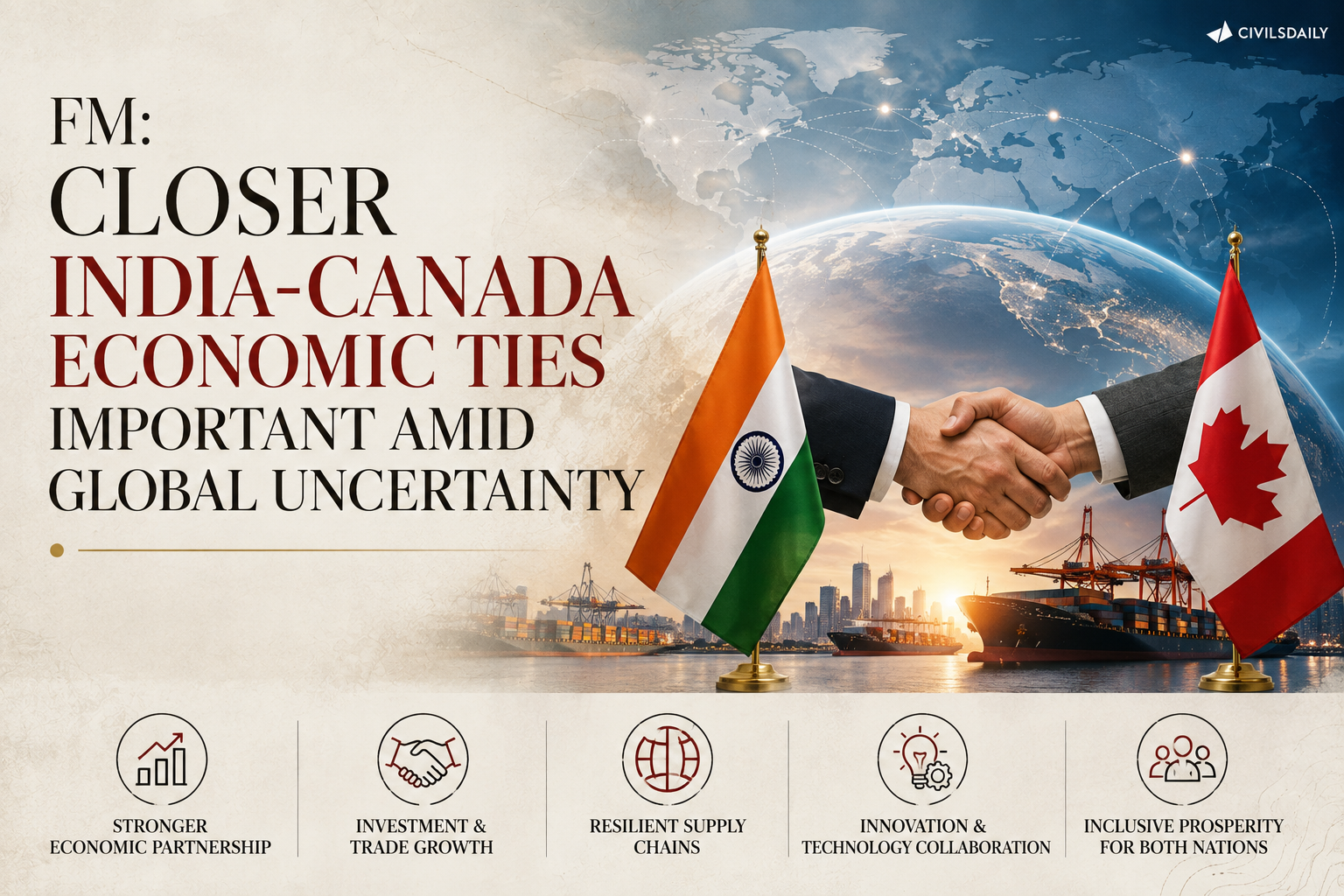
  • FM: Closer India-Canada economic ties important amid global uncertainty

    FM: Closer India-Canada economic ties important amid global uncertainty

    Why in the News

    The Union Finance Minister has said closer economic cooperation between India and Canada carries greater significance amid a rapidly changing global landscape marked by geopolitical uncertainty, and called for stronger partnerships to build resilient, sustainable and inclusive economies. The remarks came after the inaugural India Canada Economic and Financial Dialogue, the first such dialogue between the two countries. The Finance Minister said the dialogue reflects a shared ambition to move beyond traditional trade in goods and services toward a deeper partnership covering investment, finance, capital markets and regulatory cooperation.

    What is the India Canada Economic and Financial Dialogue?

    1. About: It is a bilateral mechanism between the Indian and Canadian finance ministries to coordinate on macroeconomic policy, financial sector cooperation and multilateral economic issues, launched with its inaugural round.
    2. Scope of discussions: The inaugural round covered three areas, macroeconomic developments and domestic policy priorities in both countries, avenues for financial sector cooperation, and broader international and multilateral cooperation on shared interests.
    3. Anchored in a wider strategic goal: The Prime Minister and his Canadian counterpart have set an ambitious goal for strengthening bilateral ties, and the dialogue is meant to give that goal fresh momentum and direction.

    What case did the Finance Minister make for closer India Canada cooperation?

    1. Global uncertainty is the backdrop: The Finance Minister described the world as going through a profound transformation with constantly evolving geopolitical and economic realities, making resilient partnerships more important.
    2. India’s economy was presented as a stable partner: The Finance Minister highlighted India’s “remarkable macroeconomic resilience” and pointed to complementarities between the two economies as grounds for expanding investment and economic cooperation.

    What specific areas of financial cooperation did the two sides identify?

    1. Cross border payments and financial stability: The two sides explored cooperation on cross border payment systems and measures to safeguard financial stability.
    2. Fintech and capital markets: Discussions also covered cooperation in financial technology and capital markets, part of the plan to move beyond goods and services trade into deeper financial integration.

    Conclusion

    The inaugural dialogue has set out macroeconomic policy coordination, financial sector cooperation and multilateral engagement as its three working areas. No date has been set for the next round, but the framework is intended to carry forward the broader bilateral goal the Prime Minister and his Canadian counterpart have set for the relationship.

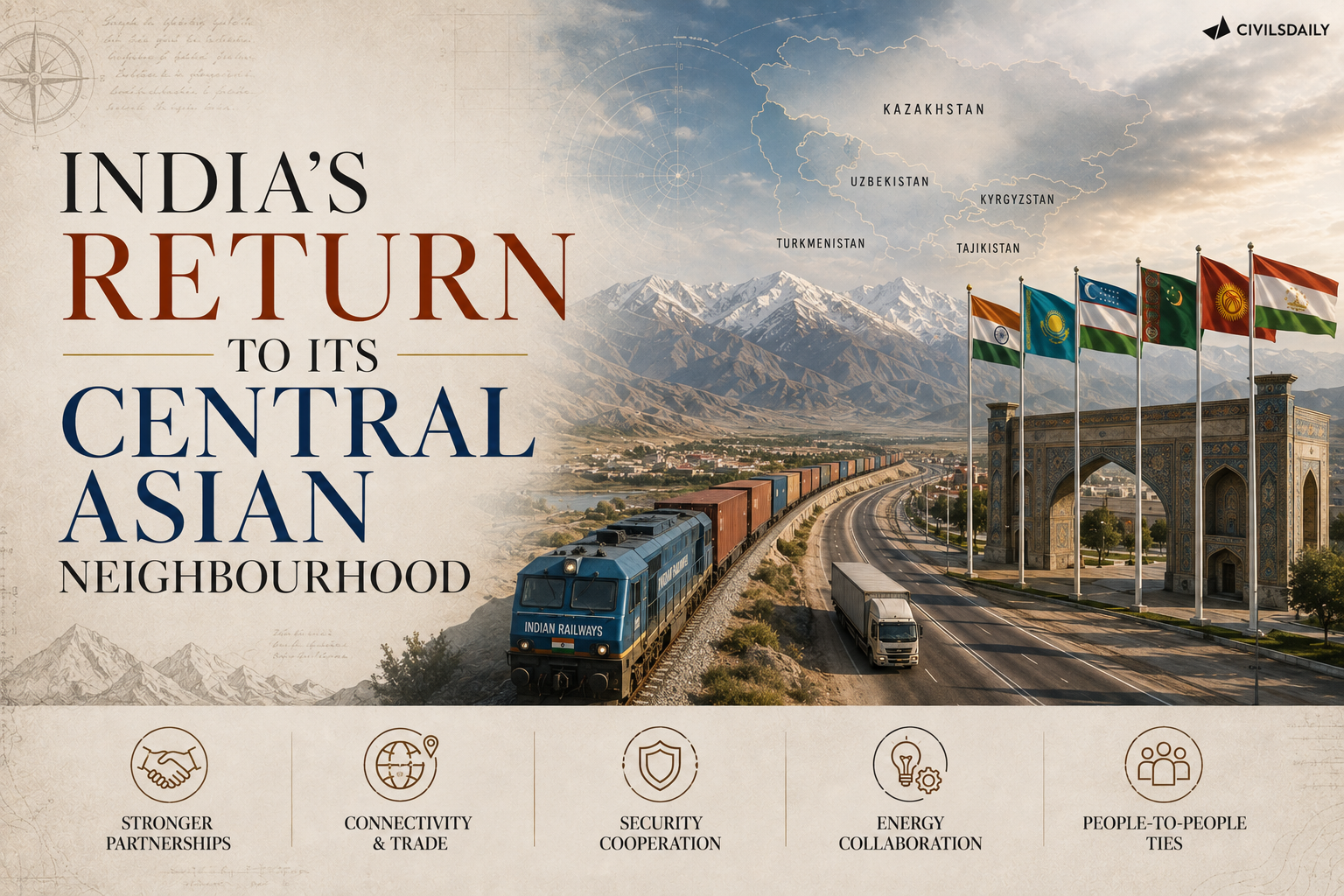
  • India’s return to its Central Asian neighbourhood

    India’s return to its Central Asian neighbourhood

    Why in the News

    The Prime Minister is set to travel to Central Asia, beginning with a state visit to Uzbekistan and followed by participation in the Shanghai Cooperation Organisation (SCO) summit of Heads of State in Bishkek, the Kyrgyz capital once called Frunze in Soviet times. The visit follows a decade long build up in India’s outreach to the region, a landmark 2015 tour of all five Central Asian states, India’s entry into the SCO as a full member in 2017, and the invitation extended to all five Central Asian leaders as chief guests for Republic Day in 2022. Central Asia sits between Russia and China, both of which still shape its politics and economy, while Pakistan seeks to claim the region’s historical and religious lineage as its own. The visit tests how far India can convert a civilisational and diplomatic relationship into a substantive one without a shared land border.

    Why does India treat Central Asia as its neighbourhood despite the absence of a land border?

    1. A civilisational link substitutes for geography: Central Asia shares deep ties with India in culture, religion, language and architecture, and India is separated from Tajikistan only by the narrow Wakhan corridor inside Afghanistan.
    2. Pakistan contests this claim: Pakistan seeks to use religious affinity to claim the region’s historical lineage for itself and to cut India off from these connections, an approach that has not succeeded so far.
    3. The region is turning outward: Central Asian states are increasingly looking beyond Russia and China for development partners, and view India’s plural, moderate and democratic experience with admiration rather than suspicion.

    How has India built its Central Asia engagement over the past decade?

    1. The 2015 visit ended a policy of deference: The Prime Minister’s 2015 tour of all five Central Asian states marked the end of India’s earlier practice of deferring to Russia in what it treated as Moscow’s periphery.
    2. SCO membership followed in 2017: India was admitted to the Shanghai Cooperation Organisation as a full member in 2017, the same year Pakistan was admitted, sponsored respectively by Russia and China.
    3. A dialogue mechanism followed the pandemic: An unprecedented invitation to all five Central Asian leaders as Republic Day chief guests in 2022 was forced online by the COVID 19 pandemic, but still produced the India Central Asia Dialogue as a standing mechanism for cooperation.

    Why does the visit begin with Uzbekistan?

    1. Uzbekistan has been the region’s most dynamic reformer: Ties with Uzbekistan have improved steadily under its president since 2016, and the country is regarded as the most forward looking in the region on diversifying its foreign policy.
    2. Its counter terrorism record matters to India: Uzbekistan has taken an uncompromising line against terrorism and extremism, and its close knowledge of and pragmatic approach to Afghanistan and the Taliban is of direct value to India.
    3. It anchors India’s alternative connectivity plans: India has held detailed talks with Uzbekistan on alternative rail and road routes through Iran and Afghanistan, links that need to be revisited given recent developments in both countries.

    What other powers is India competing with in the region?

    1. Russia and China remain the dominant powers: Central Asia is landlocked between the two, and both continue to shape the region’s politics and economy even as their relative influence shifts, Russia’s weakening and China’s growing.
    2. Turkiye and Iran hold cultural and economic sway: Both countries are described as dominant influences in the region alongside Russia and China.
    3. The United States and European Union are entering the space: Both are working their way into Central Asia as Russia’s grip loosens.
    4. Radicalisation spillover from Afghanistan is a shared anxiety: China fears the spread of radicalisation into its border regions from Afghanistan, an anxiety the region shares along with memories of attacks such as the 2024 Crocus City Hall attack in Moscow.

    What is India’s position inside the SCO?

    1. The SCO has grown well beyond its founding core: What began as the “Shanghai Five” grouping in 1996 has grown, in its 25th year, to 10 members, 15 dialogue partners and two observers.
    2. India engages the SCO on geography, not ideology: India has been a regular participant at SCO Head of State meetings except in 2024, and has pushed ideas on economic, technological and civilisational cooperation, including a vision of security, connectivity and opportunity put forward at last year’s Tianjin summit.
    3. India offers a counterweight within the SCO’s China Pakistan dyad: Negotiating inside the SCO against a China Pakistan axis is demanding, and for a country as dependent on China as Kyrgyzstan, India’s presence in the SCO offers a genuine alternative.

    Challenges to India’s Central Asia outreach

    1. Weak physical connectivity limits how far ties can grow: India has no direct land or transit route into Central Asia, so trade and people movement rely on routes through third countries. Eg. Talks on alternative rail and road links through Iran and Afghanistan remain unfinished even after years of discussion. Fix. Operationalise the Chabahar port route and conclude a transit framework with Uzbekistan and other Central Asian states independent of Afghan transit uncertainty.
    2. China’s economic footprint outpaces India’s: China’s connectivity and trade financing in the region dwarf India’s presence in infrastructure and investment. Eg. China has built rail links and pipeline corridors connecting Central Asia directly to its own territory, a scale of investment India has not matched. Fix. Use lines of credit and the India Central Asia Dialogue to fund discrete, deliverable projects in energy, health and digital infrastructure rather than compete on scale.
    3. Russia’s traditional primacy still shapes the region’s security choices: Most Central Asian states retain security arrangements with Russia through the Collective Security Treaty Organisation, limiting how far they can diversify. Eg. Kyrgyzstan and Tajikistan continue to host Russian military bases. Fix. Build India’s security cooperation around counter terrorism training and disaster response, areas that do not compete with existing Russian linked security arrangements.

    Conclusion

    The visit signals a deliberate, structured attempt to convert a civilisational relationship into a strategic one, anchored first in Uzbekistan and then in the SCO platform. Connectivity gaps and the entrenched primacy of Russia and China in the region mean this return builds incrementally rather than displacing existing power structures. How far India can embed itself economically and strategically in Central Asia will depend on sustained follow through on the India Central Asia Dialogue rather than on the visit itself.

    Back2Basics

    What is the Shanghai Cooperation Organisation?

    1. Origin: It began in 1996 as the “Shanghai Five”, grouping China, Russia, Kazakhstan, Kyrgyzstan and Tajikistan, and was renamed the Shanghai Cooperation Organisation in 2001 when Uzbekistan joined.
    2. Mandate: It focuses on regional security, counter terrorism, economic cooperation and connectivity among its Eurasian member states.
    3. Headquarters: Its secretariat is based in Beijing.

    [2024] “Critically analyse India’s evolving diplomatic, economic and strategic relations with the Central Asian Republics (CARs) highlighting their increasing significance in regional and global geopolitics.”

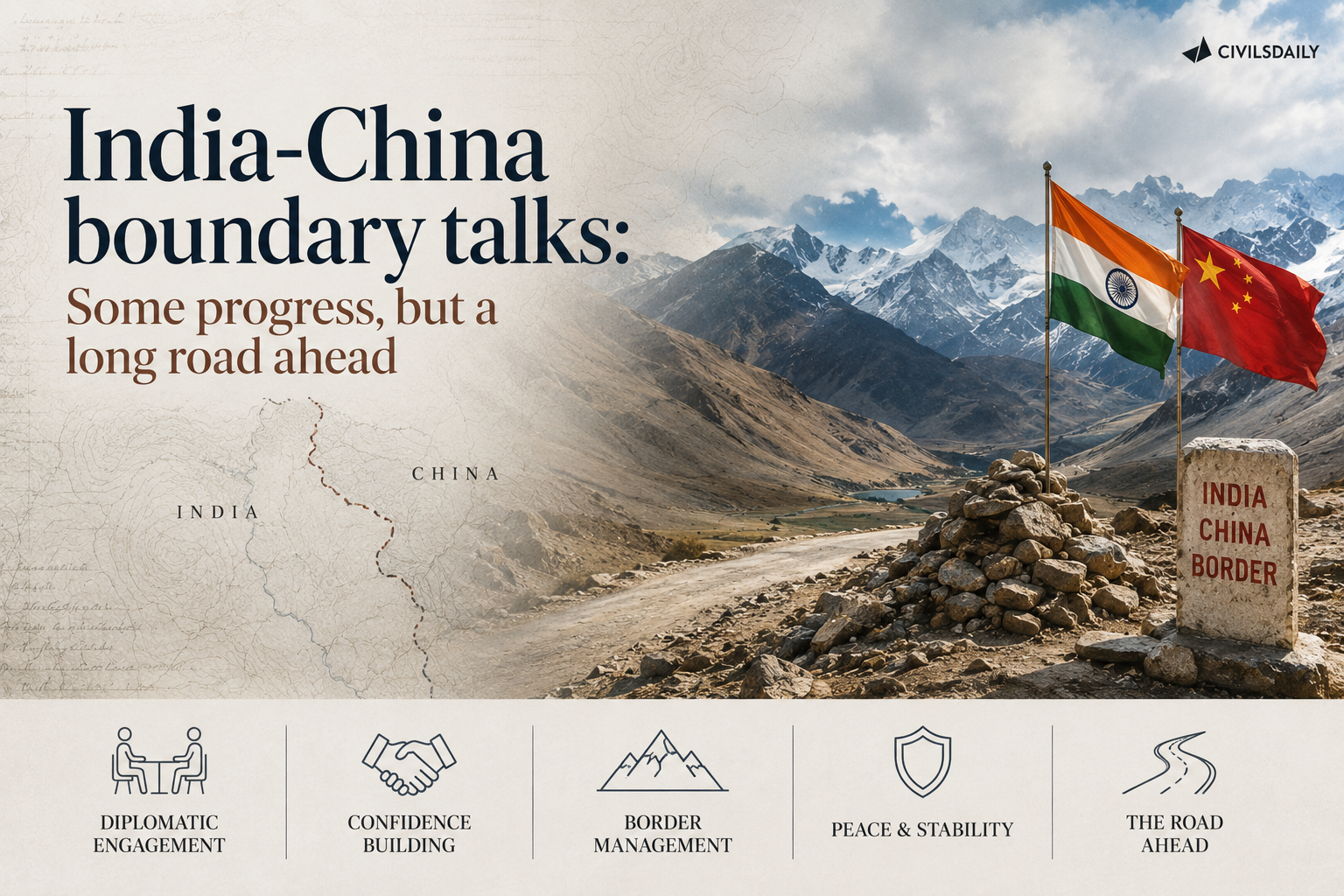
  • India-China boundary talks: Some progress, but a long road ahead

    India-China boundary talks: Some progress, but a long road ahead

    Why in the News

    An eight point consensus has emerged from the 25th round of talks between the Special Representatives of India and China, the National Security Advisor and the Chinese Foreign Minister, held in Beijing. The talks come ahead of the expected visit of the President of China to India for the BRICS Summit. The outcomes include agreement to advance a framework for settling the boundary question through an Expert Group and a Working Group, and to establish two new hotlines in the Eastern and Middle Sectors. Whether this procedural progress marks the start of genuine boundary delimitation, or repeats a decades long pattern of confidence building measures that stall before they mature, remains contested.

    What is the Special Representatives mechanism on the India China boundary?

    1. A political level channel: The Special Representatives mechanism is the designated political level channel, held at the level of the National Security Advisor and the Foreign Minister, tasked with negotiating a framework for settlement of the boundary question.
    2. The current round: The 25th round of talks was held in Beijing between the National Security Advisor and the Chinese Foreign Minister.
    3. Its relationship to implementation bodies: It operates alongside implementation level mechanisms such as the Working Mechanism for Consultation and Coordination on India China Border Affairs (WMCC), which handles border management and now houses the Expert Group and Working Group tasked with delimitation and management.

    What did the 25th round of talks agree to?

    1. Reaffirming peace along the border: The outcomes concern maintenance of peace and tranquillity in the border areas, and advancing negotiations on a framework for settlement of the boundary question in accordance with previous agreements.
    2. New task for the Expert Group and Working Group: There is a specific reference to advancing discussions through an Expert Group and a Working Group respectively, to explore an early harvest of boundary delimitation in appropriate sectors, and effective border management.
    3. Implementing an earlier understanding: The two sides agreed to implement last year’s understanding on additional General Level Mechanism or Senior Highest Military Commander meetings, along with establishing two hotlines in the Eastern and Middle Sectors.

    How has the border personnel meeting mechanism evolved since 1992?

    1. Origins in the Joint Working Group: In 1992, the Joint Working Group on the Boundary Question decided on confidence building measures such as Border Personnel Meetings, complementing forward movement on border trade.
    2. A subgroup that grew into an institutional mechanism: A subgroup of the Joint Working Group was created following the 1993 border peace and tranquillity agreement, the India China Expert Group of Diplomatic and Military Officials, which became the precursor to the Working Mechanism for Consultation and Coordination on India China Border Affairs, set up in 2012.
    3. New meeting points identified after 1995: After the success achieved in 1995 on disengagement at Sumdorong Chu, Lipulekh in the Middle Sector and Dichu in the Eastern Sector were identified as additional military meeting points.
    4. Not every point could be operationalised: The plan for meetings at Lipulekh was abandoned for want of infrastructure and because of adverse weather conditions. A trial meeting at Dichu, in the Kibithu sector of Arunachal Pradesh’s Anjaw district and the site of a notable 1962 battle in which the Kumaon Regiment fought, was finalised, but the chosen site on Madan Ridge proved contentious and no further meetings took place there.
    5. The proposal was revived only in 2014: It was then decided to hold regular meetings at Wacha, opposite Damai on the Chinese side, in the same Kibithu sector, in addition to existing venues across Bum La in Arunachal Pradesh and Nathu La in Sikkim.

    What do the new hotlines add to existing India China contact channels?

    1. The understanding they build on: Last year, the two sides had reached agreement in principle on working towards additional General Level or Senior Highest Military Commander meetings in the Eastern and Middle Sectors, similar to the existing mechanism in the Western Sector at Chushul and Moldo.
    2. Existing channels already in place: Hotlines already exist at Daulat Beg Oldie and Chushul, with informal communication at Demchok in the Western Sector, and similar hotlines at Nathu La in Sikkim and at Bum La and Kibithu in the Eastern Sector.
    3. What the new hotlines could achieve: The two additional hotline channels agreed for the Eastern and Middle Sectors could strengthen this existing capacity and help defuse local tensions.

    What broader thaw in ties has this round of talks followed?

    1. Political level consensus behind the process: The Special Representatives are working to realise the consensus reached between the Prime Minister and the President of China at Kazan in October 2024, and at Tianjin in August 2025, on improving ties.
    2. Other signs of normalisation: The resumption of the Kailash Mansarovar Yatra, the restoration of direct flights, and the resumption of border trade are meaningful steps in the same direction.

    What tensions temper optimism about this round of talks?

    1. It would be premature to call this delimitation: It would be premature to suggest that substantive boundary delimitation has already begun in earnest, since the Expert Group and the Working Group under the Working Mechanism for Consultation and Coordination are only now explicitly tasked with finalising their respective terms of reference, meaning the framework is being created and the process is being activated only incrementally.
    2. The road ahead is long: The task of achieving an early and substantial harvest of boundary delimitation and border management may be long and arduous, requiring patient negotiations.
    3. Piecemeal progress against an unsettled whole: There is also the question of piecemeal progress against a more holistic settlement of differences along the Line of Actual Control (LAC), since neither the Sikkim subsector nor the Middle Sector are free from their own unresolved differences.
    4. Negotiators need to be equal to a vexed history: The negotiators must be empowered to engage in meaningful discussions and must have sufficient experience in handling a matter that has proved difficult for previous generations.

    Conclusion

    This round of Special Representative talks has advanced the procedural architecture for the India China boundary question, through new hotlines and a formal mandate for the Expert Group and Working Group, ahead of the expected visit of the President of China for the BRICS Summit. Genuine boundary delimitation has not yet begun, and the decades long history of the border personnel meeting mechanism shows that such confidence building steps can stall for years before they mature. Whether the newly mandated Expert Group and Working Group convert this round’s procedural momentum into an actual settlement remains to be seen.

    Back2Basics: Line of Actual Control (LAC)

    1. Definition: The LAC separates Indian controlled territory from Chinese controlled territory along the unsettled boundary between the two countries.
    2. Three sectors: It is divided into three sectors, the Eastern Sector covering Arunachal Pradesh and Sikkim, the Middle Sector covering Uttarakhand and Himachal Pradesh, and the Western Sector covering Ladakh.

    “[2024, GS3, 15 marks] India has a long and troubled border with China and Pakistan fraught with contentious issues. Examine the conflicting issues and security challenges along the border. Also give out the development being undertaken in these areas under the Border Area Development Programme (BADP) and Border Infrastructure and Management (BIM) Scheme.”

  • Insurers can invest in NDB’s onshore rupee bonds, says IRDAI

    Insurers can invest in NDB’s onshore rupee bonds, says IRDAI

    Why in the News

    The Insurance Regulatory and Development Authority of India (IRDAI) has permitted insurers to invest in Maharajah INR Bonds, the onshore rupee bonds of the New Development Bank (NDB). The approval follows a representation from the NDB seeking clearance for the bonds, under which the bank proposes to raise Rs 25,000 crore over a five year period. The move assumes significance ahead of next month’s BRICS Summit in New Delhi.

    What is a Maharajah INR Bond?

    1. Definition: It is an onshore rupee bond issued in the Indian market by the New Development Bank.
    2. Purpose: Proceeds are intended to be raised over a five year period, totalling Rs 25,000 crore, for general corporate purposes and for financing or onward lending to sustainable development, sustainable infrastructure, and green and social projects in India.
    3. Legal classification: IRDAI has clarified that the proposed onshore rupee bond issuances by the NDB fall under the definition of securities under the Securities Contracts (Regulation) Act, 1956.

    What has IRDAI approved and why does it matter now?

    1. The approval itself: IRDAI communicated its approval to insurers through a circular, permitting them to invest in the NDB’s Maharajah INR Bonds.
    2. What triggered it: The approval follows a representation from the NDB seeking clearance for the bond programme.
    3. Its timing: The approval assumes significance ahead of next month’s BRICS Summit in New Delhi, where the New Development Bank’s fundraising plans are likely to draw attention.

    Under what conditions can insurers invest, and what is the intent behind the approval?

    1. Widening the investment universe: IRDAI is permitting the investment to give insurers more scope for investments.
    2. Regulatory treatment: The investment will be treated as part of insurers’ approved investments and remains subject to norms laid down by the Government of India and to SEBI (Securities and Exchange Board of India) approval, among other conditions.
    3. Who stands behind the bonds: The New Development Bank is a multilateral development bank established by Brazil, Russia, India, China and South Africa, the BRICS grouping.

    Conclusion

    IRDAI’s approval is a procedural but enabling step that widens the pool of domestic capital available to the New Development Bank ahead of the BRICS Summit in New Delhi. How much of the proposed Rs 25,000 crore is actually raised will depend on the bond issuance itself and on insurer appetite once it opens.

    Back2Basics: New Development Bank

    1. Formation: The New Development Bank was established in 2014 under the founding agreement of the BRICS grouping and became operational the following year.
    2. Headquarters: It is headquartered in Shanghai, China.
    3. Mandate: It mobilises resources for infrastructure and sustainable development projects in BRICS and other emerging and developing economies.
    4. Membership: It has since expanded its membership beyond its five founding countries to include other developing nations.

    [2014] “India has recently signed to become founding a New Development Bank (NDB) and also the Asian Infrastructure Investment Bank (AIIB). How will the role of the two Banks be different? Discuss the significance of these two Banks for India.”

  • Can India build a strategic fuel system?

    Why in the News

    Disruptions related to West Asia have exposed a vulnerability in India’s energy security system. India imports large quantities of crude oil, liquefied natural gas (LNG) and liquefied petroleum gas (LPG), but its ability to store, move and release these fuels during a prolonged disruption differs sharply by fuel. Against this, the government is considering a decade long strategic fuel programme that would add about 28 MT (million tonnes) of crude oil storage, 9 MT of LNG storage and 4 MT of LPG storage. The programme remains under consideration and should be treated as a proposed target rather than committed capacity.

    What is India’s proposed strategic fuel storage programme?

    1. Scale of the proposal: The decade long programme would add about 28 MT of crude oil storage, 9 MT of LNG storage and 4 MT of LPG storage, roughly 41 MT of combined new capacity.
    2. Purpose: The reserves are intended to provide nearly two months of crude oil and LNG demand cover and about six weeks of LPG demand cover during a prolonged supply disruption.
    3. Status: The programme remains under consideration and is a proposed target, not committed capacity.

    How much strategic fuel storage does India already have?

    1. Crude storage is the most developed: Phase I of the Strategic Petroleum Reserve provides 5.33 MT of underground capacity, with actual storage of about 3.37 MT, or roughly 63 to 64 percent utilisation, across Visakhapatnam, Mangaluru and Padur. A further 6.5 MT has been approved under Phase II at Chandikhol and Padur.
    2. Execution has lagged on Chandikhol: Work on the Chandikhol project remains slow amid ongoing land acquisition requirements and the finalisation of commercial public private partnership frameworks.
    3. LPG storage is a fraction of the proposed target: The Visakhapatnam and Mangaluru caverns together provide about 0.14 MT of capacity, so a proposed 4 MT reserve would represent roughly a thirty fold increase in underground LPG capacity.
    4. Natural gas has no underground storage at all: India currently has no operational underground gas storage facility, and its gas security instead depends on domestic production, LNG imports, import terminals, commercial inventories and pipelines.
    5. Capacity is not the same as usable inventory: A facility has a physical capacity, but the fuel it actually holds can vary, and not all inventory is immediately accessible. During a crisis, the critical measure is how much fuel is available and at what withdrawal rate it can reach consumers.

    What does the proposed 9 MT of LNG storage actually mean?

    1. Regasification capacity is not the same as strategic inventory: India already has substantial LNG import and regasification infrastructure, but a regasification terminal’s capacity to convert LNG into natural gas does not itself constitute strategic inventory.
    2. LNG storage and underground gas storage work differently: LNG is stored as a cryogenic liquid at around 162 degrees Celsius below zero, requiring specialised insulated tanks and management of boil off gas. Underground gas storage instead regasifies the LNG first and injects the resulting natural gas into a depleted reservoir or cavern.
    3. A narrower stress test already exists: A study by the Petroleum and Natural Gas Regulatory Board (PNGRB) and the International Copper and Fertiliser (ICF) group examined how much additional LNG infrastructure would be needed to supply priority consumers for a stress period of 20 days by 2030, estimating a requirement of about 0.56 to 0.6 MT of LNG equivalent, achievable with roughly eight additional LNG tanks at a combined cost of about 1 billion dollars.
    4. The proposed reserve is an order of magnitude larger: Against the same study’s projection of roughly 58 MT of annual LNG imports, the proposed 9 MT works out to about 56 days of import cover, which is the basis for describing it as nearly two months of LNG import cover, not two months of India’s total gas consumption.

    Does all of India’s gas storage have to take the form of LNG tanks?

    1. A portfolio approach is possible: India could eventually use a combination of surface LNG tanks and underground natural gas storage rather than LNG tanks alone.
    2. A parallel proposal targets import terminals directly: A separate proposal from the Ministry of Petroleum and Natural Gas would require LNG import terminals to maintain storage capacity 10 percent above their normal operating requirement, with the additional capacity available to the government during supply or price disruptions.
    3. Depleted reservoirs offer the largest potential volumes: Depleted oil and gas reservoirs, which account for 74 percent of global working gas volume, could provide much larger volumes of underground gas storage, while salt caverns allow faster injection and withdrawal, making them more suited to shorter duration balancing.
    4. India has candidate geology but not yet usable storage: India’s sedimentary basins, including Krishna, Godavari, Cambay, Mumbai Offshore and Rajasthan, offer potential locations, but moving from geological potential to usable storage requires subsurface investigation, site selection, engineering, construction, testing, filling and pipeline integration. Rajasthan’s salt bearing formations have similarly been investigated for solution mined caverns, with suitability depending on depth, thickness, purity, geometry, groundwater and mechanical properties.

    What does the United States Strategic Petroleum Reserve show about storage as a system?

    1. Scale achieved through salt caverns: The United States Strategic Petroleum Reserve holds an authorised capacity of 714 million barrels across 60 salt caverns.
    2. Storage works only as part of an infrastructure system: The American reserve functions as an integrated network of caverns, pipelines, marine terminals and refineries, showing that strategic storage is fundamentally an infrastructure system and not simply an underground space.

    How mature are India’s crude and LPG storage systems?

    1. Crude is the most mature component: India already operates underground crude caverns and has developed the associated engineering capabilities.
    2. LPG presents a much larger scaling challenge: LPG storage is technically proven in India, but a proposed 4 MT reserve would require a substantial network of new caverns or other storage facilities, together with import terminals, pipelines, pumping systems and bottling infrastructure.
    3. The Mangaluru cavern illustrates the complexity involved: Underground construction requires geological and hydrogeological investigation, rock mechanics analysis and groundwater management, particularly where work takes place alongside operating surface facilities.

    How is India strengthening the logistics that move fuel once it is stored?

    1. India is investing to reduce reliance on foreign shipping: State run oil refiners and the Shipping Corporation of India plan to invest 1.5 to 2 billion dollars in a joint venture to acquire 59 ships.
    2. Sourcing is being diversified too: Indian Oil is expanding sourcing through new 2027 agreements with Algeria and increased purchases from the United States, while exploring direct stakes in Very Large Gas Carriers to secure greater control over its supply chain.
    3. New pipelines are expanding delivery, not storage: The PNGRB has authorised approximately 1,800 km of new LPG pipelines across six States, involving investment of around 0.7 billion dollars. These pipelines improve connections between supply sources and inland markets and reduce dependence on road movement, but they do not themselves add strategic storage.
    4. Every storage form depends on connectivity to be useful: Underground gas storage is useful only if it can inject into and withdraw from the gas grid at the required rate. LNG tanks are useful only when regasification and downstream pipelines can move the gas onward, and LPG caverns require connections to bottling and distribution systems.

    Who pays for building and running the strategic reserves?

    1. The reported cost remains unconfirmed: A reported 42 billion dollar programme, which the government has yet to confirm, combines infrastructure capital expenditure with the cost of purchasing and maintaining strategic fuel inventories, with more than half expected to go towards storage infrastructure and the balance towards purchasing and filling the reserves.
    2. A cess has been ruled out: Financing is a genuine challenge, and the government has rejected reports that a cess would be charged to pay for the reserves.
    3. Replenishment carries its own cost and risk: Stocks released during a crisis would need to be replenished, potentially when commodity and freight prices are higher, so the policy needs to settle who owns and finances the inventory, minimum stock obligations, emergency release authority, and who bears replenishment and price risk.
    4. A mixed commercial and strategic model could ease the burden: A model that combines commercial and strategic use of the same capacity could reduce the public financing burden, provided the commercially used capacity remains available during emergencies.

    Is storage capacity alone enough for India’s energy security?

    1. Building capacity is only part of the equation: A strategic reserve is effective only if India can access the fuel, transport it inland, and replenish stocks after a release.
    2. Energy security depends on an integrated framework: Reserves buy time, shipping brings the next cargo, pipelines deliver fuel inland, and governance decides how emergency releases are executed, so the real test of the programme is its ability to coordinate all these elements at once when a crisis hits.

    Conclusion

    India’s existing storage differs sharply by fuel, with crude the most developed, LPG a limited underground footprint, and natural gas without any operational underground facility. The proposed 28 MT of crude, 9 MT of LNG and 4 MT of LPG storage would mark a major expansion, but the programme remains under consideration, and its value will depend as much on shipping, pipelines and financing arrangements as on the storage capacity itself.

    Back2Basics: Petroleum and Natural Gas Regulatory Board (PNGRB)

    1. Governing law: PNGRB was set up under the Petroleum and Natural Gas Regulatory Board Act, 2006.
    2. Jurisdiction: It regulates the downstream petroleum and natural gas sector, including refining, processing, storage, transport, distribution, marketing and sale of petroleum products and natural gas, excluding production and exploration.
    3. Mandate: It authorises and lays down technical and safety standards for gas and LPG pipelines and city gas distribution networks, and protects consumer interests while promoting competitive markets.
    4. Relevance here: It is the regulator behind the LPG pipeline authorisations and the LNG stress test study referenced in this item.

    [2025] “Energy security constitutes the dominant kingpin of India’s foreign policy, and is linked with India’s overarching influence in Middle Eastern countries.” How would you integrate energy security with India’s foreign policy trajectories in the coming years?”