Mains Ready By December. Smash Mains & Smash PYQ Admissions Open

Search results for: “”

  • On workers rights, shrinking spaces and cruel state response

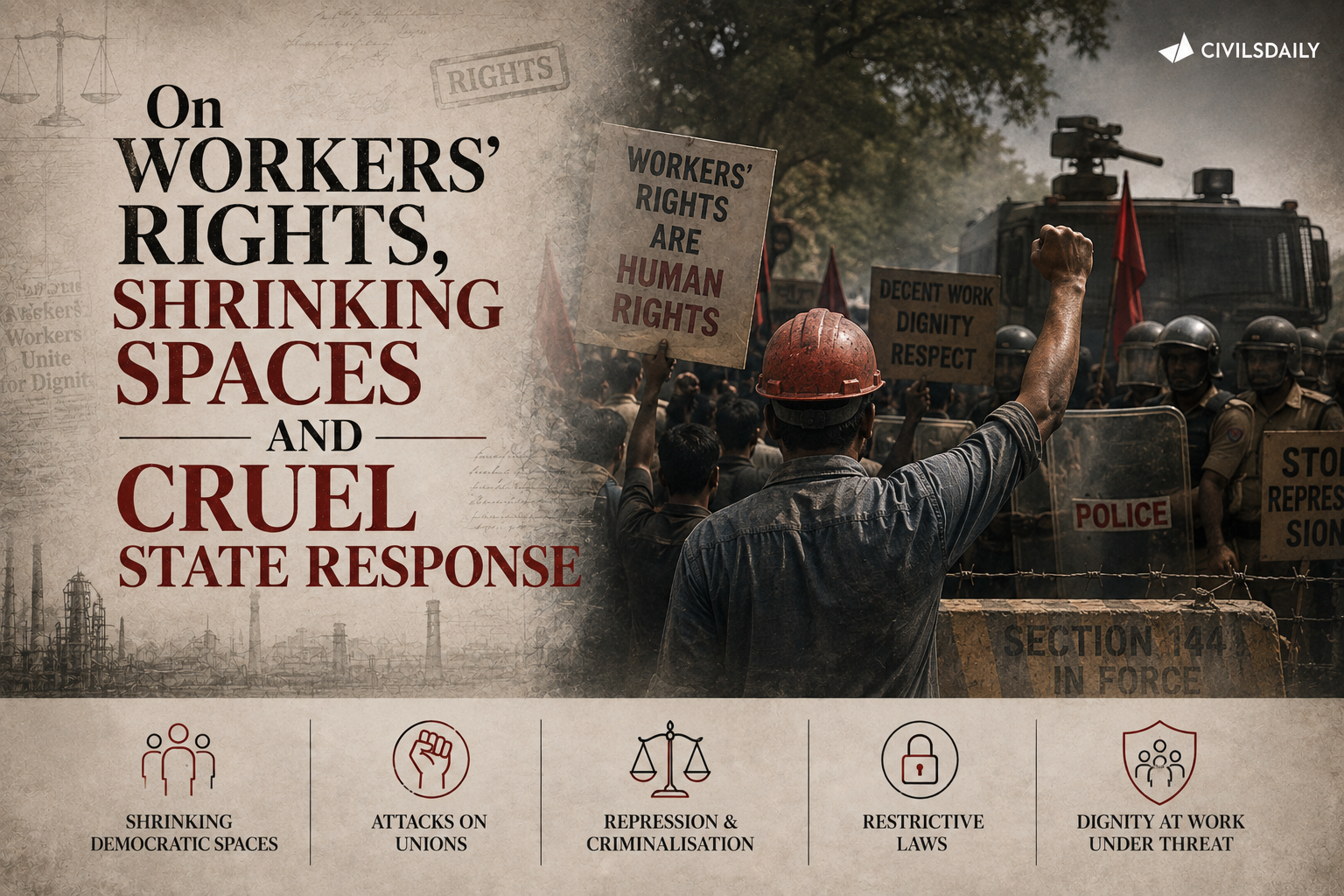
    On workers rights, shrinking spaces and cruel state response

    Why in the News

    An opinion piece has linked the invocation of the National Security Act, 1980 (NSA) against wage protesters in Noida and Ghaziabad to a longer decline in trade unionism and a spread of casual, contract based labour across India’s unorganised sector. The piece follows a wage protest by thousands of workers on 13 April, after which the Noida police floated a theory that the agitation was sponsored by “Pakistan based handlers” and radical leftists, and about 200 people were arrested, two of them booked under the NSA. The piece argues that the same law once reserved for genuine threats to State security is now being used against ordinary economic protest and ideological dissent.

    What is the National Security Act, 1980?

    1. Preventive detention power: The Act lets the Union or a State government detain a person without trial for up to twelve months where it is satisfied that the person’s activities are prejudicial to the defence of India, State security, public order or the maintenance of essential supplies.
    2. Subjective satisfaction standard: Detention rests on the detaining authority’s own assessment of a future risk rather than on a proven criminal act, so no conviction or specific offence needs to be established beforehand.
    3. Limited disclosure of grounds: The grounds for detention must ordinarily be communicated to the detainee within days of the order, but can be withheld where disclosure is considered against the public interest.
    4. Advisory Board review: An Advisory Board that includes sitting or former High Court judges reviews each detention within a set period, though its proceedings are not equivalent to a full trial.

    How did the state respond to the Noida and Ghaziabad wage protest?

    1. A wage protest turned into a security case: Thousands of workers in Noida and Ghaziabad took to the streets on 13 April demanding higher wages. The Noida police, caught off guard, floated a theory that the agitation was sponsored by “Pakistan based handlers” and radical leftists.
    2. Mass arrests followed: About 200 people were arrested on charges of inciting violence.
    3. Two individuals were booked under the NSA: Journalist Satyam Verma and Delhi University student Akriti Chaudhary were held under the NSA, for their ideological leanings rather than for any specific act.
    4. The underlying wage demand was met, but the case was not withdrawn: The Uttar Pradesh government announced higher wages for the workers, while those arrested fought a difficult legal battle and continue to face its aftermath even after coming out of jail.

    Why has India’s unorganised workforce lost the power to resist such treatment?

    1. A largely unrecorded toll: Forty thousand to fifty thousand casual workers die every year from occupational hazards in India’s unorganised sector, according to numerous research studies, and many more deaths go unrecorded in official data altogether.
    2. A sector too large to protect through informal goodwill alone: The unorganised sector employs nearly 80 percent of India’s workforce, so lapses in protection affect the majority of working people rather than a small margin.
    3. Trade unionism has receded since liberalisation: The movement that once produced leaders such as George Fernandes has weakened sharply as India’s economy has liberalised.
    4. Casualisation spread from the media into government itself: From the 1990s, news organisations began hiring staff on contract rather than on the payroll, part of a wider trend already under way in other sectors. The Centre and State governments, the country’s largest employers, eventually adopted the same contract based hiring as a way to save cost, entrenching the casualisation of labour.
    5. The result is a workforce with no leverage: Workers and employees today have little means to demand better conditions or resist injustice.
    6. Left parties have lost political weight: The Left is losing political strength and relevance, and the term “leftist” is now used as a pejorative in social media discourse.

    What historical precedent of ideological accommodation has been abandoned?

    1. Trade unions once worked across ideological lines: In Kanpur in 1985, leaders of the CITU (Centre of Indian Trade Unions), the AITUC (All India Trade Union Congress), the INTUC (Indian National Trade Union Congress) and the BMS (Bharatiya Mazdoor Sangh) shared a camaraderie and jointly took up the cause of labour despite their ideological differences.
    2. Workers won rights through sustained struggle, not political patronage: Workers in textile mills and in the defence sector earned their rights through consistent struggles against management.
    3. A trade unionist held a Brahmin dominated seat for two decades: Kanpur, despite being a predominantly Brahmin constituency, was represented in the Lok Sabha by S M Banerjee, a veteran trade union leader, from 1957 to 1977.
    4. Political rivals once mourned an ideological opponent: In 1997, the BJP’s national executive passed a resolution mourning the assassination of AISA (All India Students Association) leader and former JNU (Jawaharlal Nehru University) Students Union president Chandrashekhar, killed by Mohammed Shahabuddin in Siwan. Chandrashekhar belonged to a Naxal aligned ideological stream.
    5. That same accommodation would now be treated as suspect: The piece argues that the 1997 BJP resolution, if found in someone’s possession today, would itself risk being treated as seditious material by the Uttar Pradesh Police.

    What tension does criminalising ideological material expose?

    1. Possession of a book is being treated as an offence: A book on Marxism, or on Gaza or the Palestinian struggle, is being categorised as criminal material when found in an individual’s possession.
    2. Marxist ideology sits within India’s constitutional mainstream: Marxist ideology is as much a part of India’s political mainstream as the Congress or the BJP, and every political party that swears loyalty to the Constitution is allowed to grow and function in the country.

    Challenges to invoking the National Security Act against protest and dissent

    1. Vague and subjective grounds for invocation: The Act permits detention on the executive’s own subjective satisfaction that a person’s activities are prejudicial to public order, without a defined evidentiary threshold. Eg. In 2020, the National Security Act was invoked against a doctor in Uttar Pradesh over a public speech, and the Allahabad High Court quashed the detention in 2021 for lacking any evidence of an actual threat to public order. Fix. Require a documented, judicially reviewable threshold of imminent public order harm before invocation, rather than the detaining authority’s subjective satisfaction alone.
    2. Weak disclosure of the case against the detainee: Grounds for detention can be withheld where disclosure is considered against the public interest, leaving the detainee unable to mount a full challenge. Eg. Detainees under the Act have often learned the specific allegations against them only after approaching High Courts through habeas corpus petitions. Fix. Mandate disclosure of detention grounds within a fixed period, with any exception reviewed by a judicial officer rather than decided by the detaining authority itself.
    3. The Advisory Board functions as an executive check rather than a judicial one: The Board that reviews detention orders has historically confirmed most of the orders referred to it, and its proceedings offer limited scope for legal representation. Fix. Allow legal representation before the Advisory Board and require it to publish reasoned orders, so its review carries genuine weight.
    4. A chilling effect on journalists and students: Using a preventive security law against people over their reading material or ideological leanings, rather than any proven act, discourages lawful reporting and dissent. Eg. A Manipur journalist was detained under the Act in 2018 over a social media post criticising the state’s Chief Minister. Fix. Confine invocation of the Act to demonstrable threats to public order, with judicial pre screening required in cases involving journalists and students.

    Conclusion

    The Noida episode shows that as trade union protections have eroded and labour has been casualised, the state has increasingly reached for security legislation such as the National Security Act to answer a wage protest, extending a pattern of criminalising political dissent that earlier generations of political rivals once resisted. Whether the arrested journalist and student receive a fair hearing, and whether India’s civil liberties framework is reformed to prevent such recourse to preventive detention against economic protest, remains unresolved.

    Current Status of Personal Liberty in India

    1. A broad but conditional guarantee: Personal liberty covers freedom of speech, assembly, association, and movement under Article 19(1)(a) to (e), and the right to life and personal liberty under Article 21, all subject to reasonable restrictions the state may impose by law.
    2. A carved out exception for preventive detention: Article 22 protects against arbitrary arrest and detention, but specifically permits preventive detention laws such as the National Security Act, 1980 and the Unlawful Activities (Prevention) Act, 1967, under which a person can be held without a trial.
    3. Judicial reading has widened even as detention powers remain broad: Courts have steadily expanded what Article 21 protects, yet the power to preventively detain still rests largely on the executive’s own satisfaction rather than on prior judicial approval.

    Constitutional Provisions Related to Personal Liberty

    1. Article 19(1)(a): Guarantees freedom of speech and expression.
    2. Article 19(1)(b): Guarantees freedom of peaceful assembly.
    3. Article 19(1)(c): Guarantees freedom of association.
    4. Article 21: Guarantees the right to life and personal liberty, protecting against arbitrary state action.
    5. Article 22: Protects against arbitrary arrest and detention, while permitting preventive detention laws as a specific exception.

    Major debates surrounding Personal Liberty

    1. Security law versus proportionality: Whether preventive detention laws such as the National Security Act curtail personal liberty beyond what public order genuinely requires.
    2. Dissent versus disorder: Whether vague grounds such as public order or prejudicial activity are being used to criminalise lawful dissent rather than address genuine security threats.
    3. Judicial expansion versus executive discretion: The gap between the judiciary’s expansive reading of Article 21 protections and the limited judicial oversight available at the point of preventive arrest itself.

    Laws and Rules Governing Personal Liberty and Preventive Detention

    1. Unlawful Activities (Prevention) Act, 1967: Allows the government to designate organisations and individuals as unlawful or as terrorists, and permits prolonged detention before trial in cases involving alleged threats to India’s sovereignty and integrity.
    2. Bharatiya Nyaya Sanhita, 2023, Section 152: Replaced the sedition offence earlier defined under Section 124A of the Indian Penal Code, 1860, penalising acts that excite secession, armed rebellion, or subversive activity.
    3. Bharatiya Nagarik Suraksha Sanhita, 2023: Governs the ordinary process of arrest, remand and bail that a preventive detention law such as the National Security Act bypasses.

    [2024] Right to privacy is intrinsic to life and personal liberty and is inherently protected under Article 21 of the Constitution. Explain. In this reference discuss the law relating to D.N.A. testing of a child in the womb to establish its paternity.”

  • Why 543 should remain 543

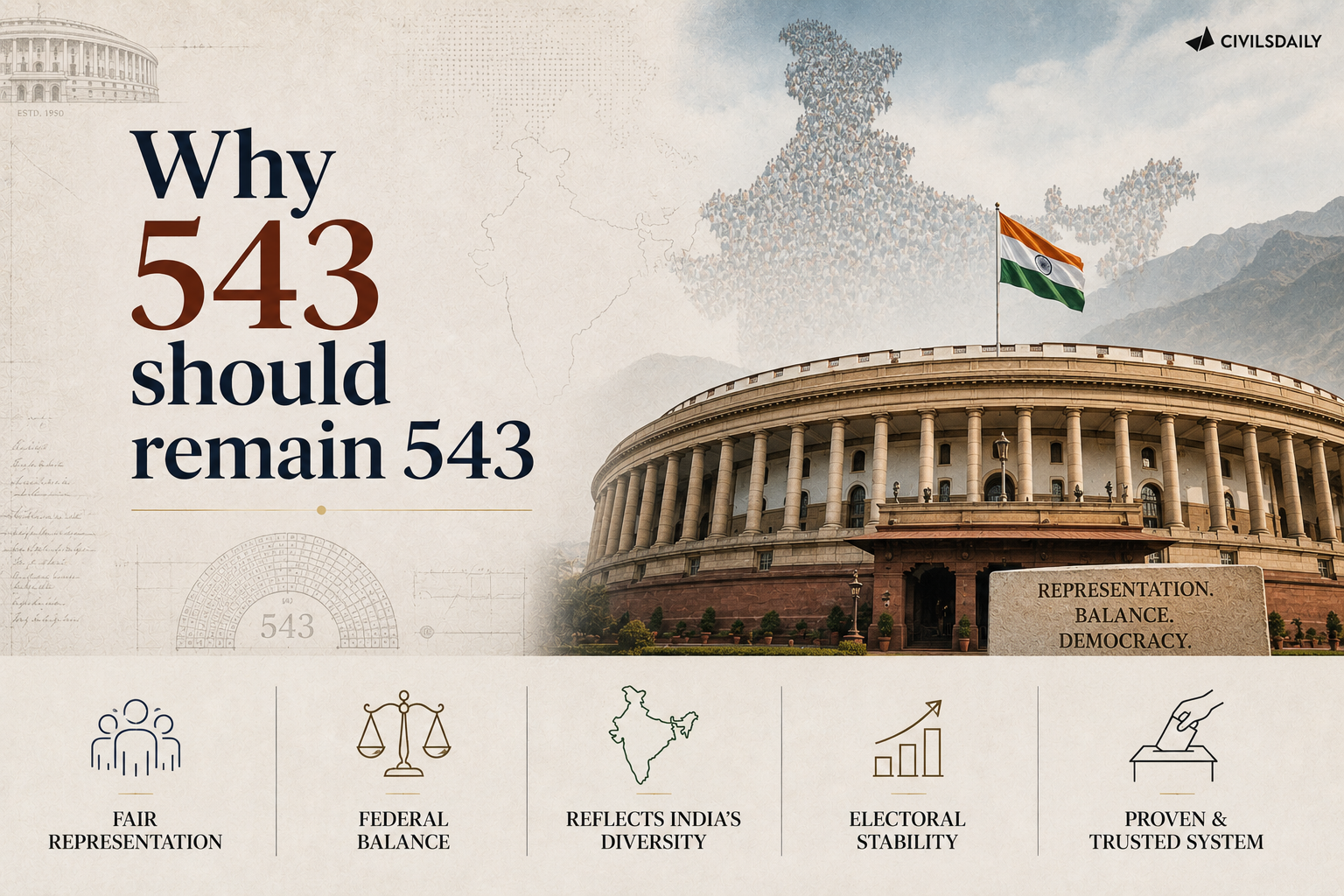
    Why 543 should remain 543

    Why in the News

    After both Houses of Parliament were adjourned sine die, the monsoon session has yet to be formally prorogued, prompting speculation that Parliament could be reconvened for another attempt at the constitutional amendment linked to delimitation and women’s reservation. That uncertainty sharpens a question Parliament must confront: whether delimitation, the redrawing of constituency boundaries to reflect population change, must necessarily mean enlarging the Lok Sabha beyond its present 543 seats. The government has reportedly suggested increasing every State’s representation by roughly 50 percent so each keeps its current proportion of seats, a formula that leaves the proportional balance between States unchanged even as it widens the absolute gap in their voting strength.

    What is the constitutional basis linking delimitation to the Lok Sabha’s size?

    1. The representation principle: Article 81 requires that representation broadly correspond to population “so far as practicable,” while Article 82 provides for a fresh delimitation exercise after every Census.
    2. The 1976 freeze: The 42nd Constitutional Amendment, 1976 froze the inter State allocation of Lok Sabha seats on the basis of the 1971 Census, so States that succeeded in family planning were not politically penalised for slowing population growth.
    3. The extension: The freeze was extended by the 84th Constitutional Amendment, 2001 until the first Census conducted after 2026 is published.

    Why does a proportional expansion still favour larger States?

    1. Proportions stay the same: A roughly 50 percent increase in every State’s seats would keep each State’s share of the Lok Sabha unchanged from today.
    2. But the absolute gap widens: If Uttar Pradesh’s seats rose from 80 to 120 and Tamil Nadu’s from 39 to about 59, the proportional relationship would hold, yet the absolute gap in voting strength would widen from 41 Members of Parliament to around 61.
    3. Why the gap matters: Parliament votes in absolute numbers rather than proportions, so governments, confidence motions and constitutional amendments would all turn on a wider numerical gap than exists today.

    Can delimitation happen without enlarging the House?

    1. A precedent already exists: The delimitation exercise after the 2001 Census reorganised constituencies within States while leaving the existing inter State seat allocation untouched.
    2. The same principle can apply again: The Census expected in 2027 could provide the basis for redrawing constituencies within each State to reflect demographic movement and urbanisation, without increasing the Lok Sabha beyond 543 seats.

    What do other democracies show about legislature size and population growth?

    1. United States: The House of Representatives has remained at 435 voting members for more than a century, despite the country’s population growing many times over.
    2. Switzerland: The National Council has stayed at 200 members since 1963.
    3. Hungary: Parliament was reduced from 386 members to 199.
    4. Italy: The Chamber of Deputies was cut from 630 members to 400.

    What would a larger Lok Sabha do to Parliament’s own functioning?

    1. Fixed parliamentary time: Parliamentary time does not expand with the number of Members of Parliament, so even with 543 members, many already get few opportunities to speak, ask questions or raise matters of public importance.
    2. A larger House would worsen this: A Lok Sabha enlarged to more than 800 members would reduce those opportunities further even as numerical representation rises.
    3. Already outsized constituencies: Indian Members of Parliament already represent the largest average constituencies among the world’s major democracies, several times the size of a United States congressional district or a United Kingdom constituency.

    Where should the accessibility pressure from population growth be absorbed instead?

    1. No federal arithmetic constraint at the State level: A larger Vidhan Sabha, or State Legislative Assembly, shifts no balance between States, since each Assembly answers only to its own State’s population.
    2. The proposed shift: Strengthening representation through more Members of the Legislative Assembly and smaller Assembly constituencies can bring representatives closer to citizens without enlarging the national legislature, since most citizens approach elected representatives over matters substantially within the State sphere, such as roads, schools and hospitals.

    How does women’s reservation fit within a frozen 543 seat House?

    1. The existing House can absorb it: One third of the present Lok Sabha is approximately 181 seats, and women’s constitutionally promised representation can be delivered within the existing House of 543 rather than through additional seats.
    2. What reservation is meant to do: The purpose of reservation is to alter who occupies parliamentary seats, not to create hundreds of additional ones.
    3. The risk of combining it with enlargement: An expansion on the proposed scale could raise the number of women Members of Parliament while also deepening the numerical dominance of the already larger States, so a reform addressing one imbalance could deepen another.

    Challenges to keeping the Lok Sabha frozen at 543

    1. Political resistance from faster growing States: States whose population has grown fastest since 1971 may resist a freeze that keeps their Lok Sabha strength unchanged relative to their current population share. Eg. States with higher population growth could press for the government’s enlargement proposal precisely because it raises their absolute seat count. Fix. Pair the freeze with strengthened State level representation, so faster growing States gain proportionate voice through larger Assemblies rather than through the Lok Sabha.
    2. Redrawing constituencies within States is itself contentious: Internal redelimitation shifts constituency boundaries and can alter the political weight of specific regions or social groups within a State, so it invites dispute even where a State’s total seat count is untouched. Eg. The Jammu and Kashmir Delimitation Commission’s 2022 exercise was contested by opposition parties as tilting the balance toward one region over another. Fix. Anchor any internal redelimitation in updated, transparent 2027 Census data, with a public objection and hearing process before boundaries are finalised.
    3. A prolonged freeze delays updated representation: Continuing the freeze until the first post 2026 Census pushes any change in the Lok Sabha’s internal distribution well into the future, leaving current population shifts unreflected for years. Eg. The freeze first imposed in 1976 has already run for close to half a century without a fresh count of inter State seat shares. Fix. Commit to a fixed timeline for the post 2026 Census based delimitation, so the freeze does not become indefinite by default.

    Conclusion

    Delimitation and the size of the Lok Sabha are separable questions, and preserving the House at 543 seats while redrawing constituencies within States and absorbing accessibility pressure through larger State Assemblies would deliver updated representation, women’s reservation and federal fairness without disturbing the balance between larger and smaller States. Whether Parliament chooses this route or an across the board enlargement that widens the absolute gap between States even as it keeps their proportions unchanged will shape the federal balance of the Republic for decades, a question that stays open as long as the constitutional amendment remains pending.

    Back2Basics: What is a Delimitation Commission?

    1. What it is: A Delimitation Commission is a body constituted under a Delimitation Act to redraw the boundaries of parliamentary and Assembly constituencies based on the latest Census.
    2. How many: Delimitation Commissions have been constituted four times in independent India, in 1952, 1963, 1973 and 2002.
    3. Legal basis: Its orders have the force of law and cannot be challenged in a court.
    4. Latest exercise: The most recent Commission, based on the 2001 Census, redrew constituency boundaries within States without altering the inter State allocation of Lok Sabha seats frozen since 1976.

    [2024] How many Delimitation Commissions have been constituted by the Government of India till December 2023?

    [A] One

    [B] Two

    [C] Three

    [D] Four

  • A.P. to become third subsea hub on data centre buildout

    A.P. to become third subsea hub on data centre buildout

    Why in the News

    Technology majors Microsoft and Google are building new subsea cable landing stations on the coast of Andhra Pradesh as part of an artificial intelligence linked data centre buildout in the State. Microsoft is part of a consortium with Lightstorm and the Singaporean telecom operator Singtel to land the 3,600 kilometre India Southeast Asia Submarine Cable System, while Google’s globe spanning America India Connect system will land at Visakhapatnam, where the company’s own data centre complex is coming up. Once complete, the buildout will give India, after Mumbai and Chennai, a third digital international gateway, even as a global shortage of fibre threatens to slow the inland network these projects still need.

    What is a subsea cable landing station?

    1. Definition: A subsea cable landing station is the facility where an undersea fibre optic cable comes ashore and connects to a country’s terrestrial network, carrying the bulk of international internet traffic.
    2. Global reliance: The overwhelming majority of the world’s international data traffic travels through such undersea cable systems rather than satellites, making landing stations critical infrastructure.
    3. India’s current concentration: India’s existing landing stations are concentrated in Mumbai and Chennai, leaving the country reliant on a small number of routes.

    What new cable infrastructure is being built off Andhra Pradesh’s coast?

    1. Microsoft’s consortium project: Microsoft, alongside Lightstorm and Singtel, is landing the 3,600 kilometre India Southeast Asia Submarine Cable System, expected to be ready for service in the fourth quarter of 2029.
    2. Google’s own system: Google’s America India Connect system will land at Visakhapatnam, alongside the data centre complex the company is building there as part of what a Google executive described as an artificial intelligence hub.

    What does this make Visakhapatnam?

    1. India’s third gateway: After Mumbai and Chennai, Visakhapatnam becomes India’s third digital international subsea gateway, connecting the country directly with Southeast Asia, Australia and the Middle East.
    2. A new corridor: Lightstorm’s chief executive has described the India Southeast Asia system, which also connects to Chennai, as providing a fresh corridor to South Asia from Singapore and Malaysia.

    Why are companies building on the east coast now?

    1. Ageing existing infrastructure: Most cables currently connecting India’s east coast are old, are already filled to capacity and are approaching the end of their working life.
    2. A search for resilience: Companies are also seeking to reduce the risk of relying on a single route by adding cables on India’s east coast, citing instability in West Asia as a reason to build in an alternate location.

    What inland infrastructure does this buildout require?

    1. A nationwide undertaking: Both projects require installing and lighting thousands of kilometres of new terrestrial fibre linking the coast to major cities, a scale one company executive described as spanning the entire country.
    2. A dedicated corridor: Lightstorm is expected to build a terrestrial corridor connecting Machilipatnam to Mumbai and Hyderabad, and Chennai to Hyderabad and Mumbai, with matching bandwidth.
    3. A global fibre shortage: Fibre, its components and its raw material are in short supply worldwide, including from Indian manufacturers, a constraint industry executives describe as unprecedented in over a decade.

    What will Google’s Visakhapatnam facility do?

    1. Focused on inference: The facility will focus on inference work rather than power intensive training runs, serving domestic enterprises and government agencies given the deep adoption of artificial intelligence across government service delivery.
    2. Power and water choices: Google is seeking to source as much renewable power for the project as possible and is using air cooling technology to minimise water use.

    Challenges to the subsea cable buildout

    1. A global fibre shortage: A worldwide shortage of fibre and its raw material, unprecedented in over a decade, could delay the inland network these projects still need. Eg. Industry executives report that fibre is out of stock across the globe, including from Indian manufacturers. Fix. Expand domestic fibre manufacturing capacity through targeted incentives so the inland rollout is not held back by global supply constraints.
    2. Physical vulnerability of undersea cables: Undersea cables remain exposed to accidental damage from fishing and anchoring activity and to disruption in contested waters. Eg. India’s existing east coast cables are already ageing and running close to capacity, leaving few redundant routes today. Fix. Build multiple, geographically separated landing points and routes, as the new Visakhapatnam gateway is itself intended to do, so a single cable fault cannot isolate India’s connectivity.
    3. Concentration of ownership with foreign firms: The new cable systems and the data centres they serve are being built and operated by foreign technology majors, so India’s expanding gateway capacity depends on the investment decisions of a small number of firms. Eg. Both the India Southeast Asia system and the America India Connect system are anchored by Microsoft and Google respectively rather than Indian carriers. Fix. Encourage Indian telecom operators to invest jointly in landing station capacity so gateway control is not concentrated entirely with foreign firms.

    Conclusion

    Andhra Pradesh’s coastline is emerging as India’s third major digital gateway, as Microsoft and Google build new subsea cable systems into Visakhapatnam alongside the data centres driving the region’s artificial intelligence buildout. Delivering on that promise depends on inland fibre rollout keeping pace despite a global supply crunch, and on India diversifying its cable landing points and ownership so its expanding digital infrastructure does not remain concentrated in a handful of ageing routes and foreign owned systems.

    [2023] “What is the status of digitalization in the Indian economy? Examine the problems faced in this regard and suggest improvements.”

  • Carney’s defiance is well thought out

    Carney’s defiance is well thought out

    Why in the News

    Canada’s Prime Minister has walked away from trade negotiations with the United States after Washington put forward terms that would have cost Canada its sovereignty, key industries, French language protections and its freedom to negotiate with other countries. He has also announced retaliatory tariffs matching the new United States tariffs dollar for dollar, stating that the Americans “asked too much and offered too little.” The move tests whether a middle power, an economy that sends roughly three quarters of its exports into a market ten times its size, can resist pressure from a dominant trading partner without folding, and it carries lessons for other countries, including India, that are negotiating their own terms with Washington.

    What calculations underlie the decision to walk away?

    1. Broad domestic backing: The stance draws support even from the opposition Conservative party, amid public frustration with the United States President’s repeated talk of making Canada the fifty first state.
    2. A contained tariff footprint: The new tariffs apply to only about 5 percent of Canada’s overall exports to the United States, worth roughly 20 billion dollars, limiting the immediate domestic cost of retaliation.
    3. A calculated bet on mutual damage: A breakdown in trade relations is expected to hurt the United States as well, so Canada does not need to win the confrontation outright, only to make the arithmetic politically painful in Washington.

    How exposed is the United States to a breakdown with Canada?

    1. A leading export destination: Canada is the largest export market for 26 American states and among the top three trading partners for 45 of the 50 states.
    2. Energy dependence: Canada supplies roughly 60 percent of America’s crude oil imports, and Canadian electricity helps power grids in New England and the upper Midwest.
    3. Critical inputs: Canadian potash is vital to American agriculture, while Canadian critical minerals feed strategically important American supply chains.

    Why is the timing unfavourable for Washington?

    1. Domestic economic strain: A stalemate with Iran has pushed United States gasoline prices above 4 dollars a gallon, while the 30 year Treasury yield has climbed above 5.3 percent, its highest level since 2007.
    2. Fiscal and political weakness: Federal debt has crossed 40 trillion dollars, and the United States President’s net approval rating has fallen to minus 26 percent, narrowing his room to absorb a prolonged trade standoff.

    What broader pattern does this defiance respond to?

    1. A repeated negotiating playbook: Governments from Mexico City to Brussels to Tokyo have spent the past year confronting an American administration that treats a signed trade agreement as an opening bid that can be revisited whenever it suits it, coercing partners with escalating tariff threats and demanding unilateral concessions.
    2. Prior diversification, not improvisation: The Canadian Prime Minister had earlier warned that middle powers must stand up or risk ending up “on the menu,” and spent close to a year building trade ties with China, the Gulf and Asia, including India, so that a closed door in Washington did not mean a locked room globally.

    Challenges to Canada’s defiance strategy

    1. Economic exposure to a sustained standoff: Canada still sends roughly three quarters of its exports to an economy ten times its own size, so a prolonged confrontation could cost jobs and growth even if it wins the political argument. Eg. Estimates cited alongside the retaliatory tariffs put up to 90,000 Canadian jobs at risk from a sustained trade confrontation. Fix. Continue diversifying export markets by deepening the trade ties already being built with China, the Gulf and Asia.
    2. A narrow tariff footprint limits leverage: The new tariffs cover only about 5 percent of Canada’s exports to the United States, so retaliation alone may be too small to force a reversal in Washington. Eg. Even a full breakdown leaves most of Canada’s three quarter dependence on the United States market untouched. Fix. Extend retaliation toward strategically sensitive sectors such as crude oil, electricity and critical minerals, where Canada supplies a large share of United States demand.
    3. Domestic political risk if pain outlasts patience: Sustained economic pain could erode the broad backing that currently underwrites the stance, including support from the opposition. Eg. Higher fuel and consumer prices from a prolonged standoff could shift Canadian public opinion before comparable pressure is felt in Washington. Fix. Time targeted relief for the sectors affected by the new tariffs so public patience holds through the standoff.

    Conclusion

    The decision to reject an unfavourable trade deal, backed by calculated retaliation and prior diversification of trade ties, is being read as proof that a middle power can resist pressure from a much larger economy without folding. Whether the strategy succeeds depends on whether Canada’s own economic pain stays contained and whether Washington’s vulnerabilities, from energy prices to approval ratings, bite hard enough to force a reversal. For India, still negotiating its own trade deal with Washington, the lesson is not to reject a deal outright but to know precisely which concessions it can never afford to make.

    [2025] What are the challenges before the Indian economy when the world is moving away from free trade and multilateralism to protectionism and bilateralism? How can these challenges be met?”

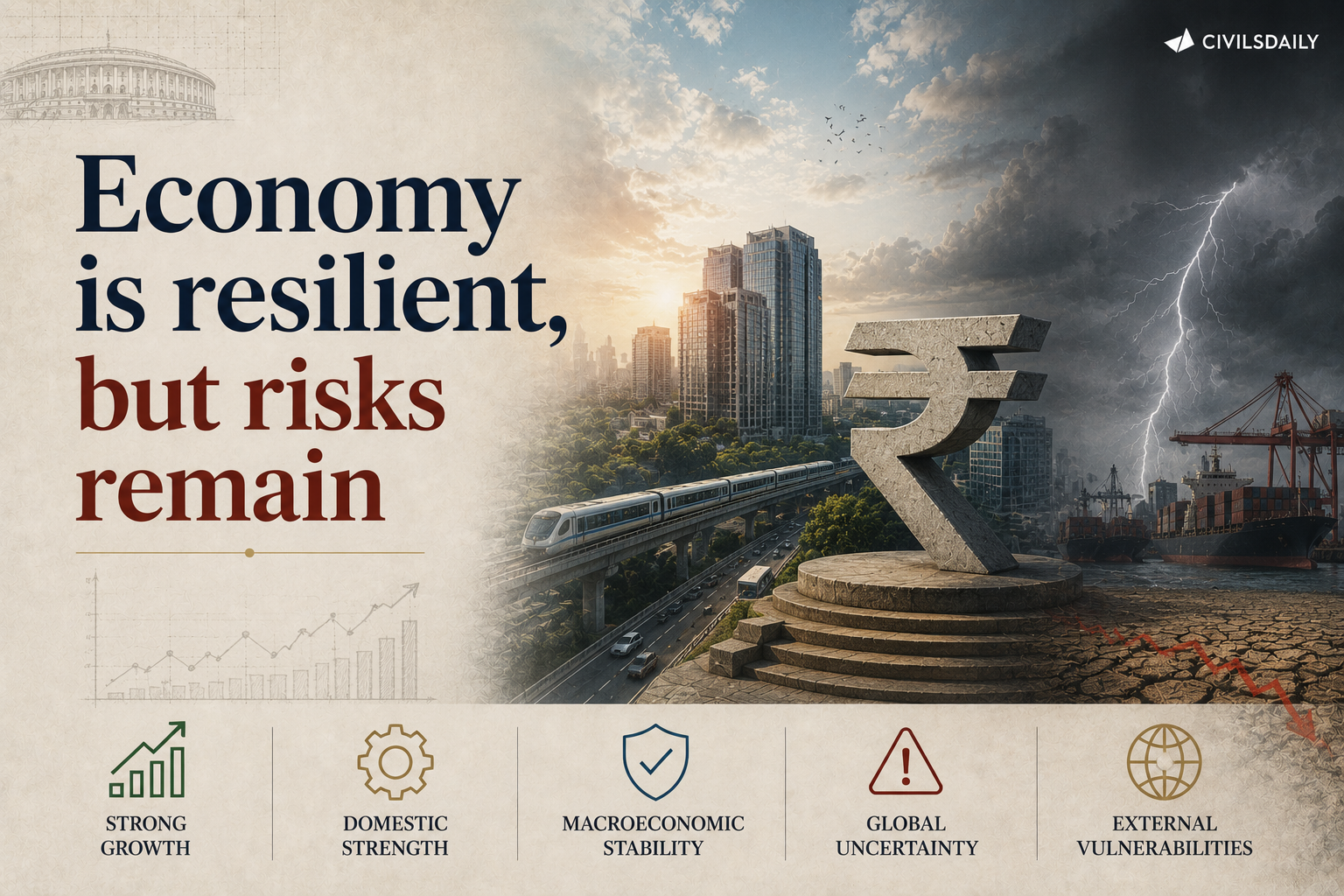
  • Economy is resilient, but risks remain

    Economy is resilient, but risks remain

    Why in the News

    The State of the Economy report, compiled by economists at the Reserve Bank of India (RBI), together with the finance ministry’s monthly economic review, has found that India’s underlying growth momentum held up through the first quarter of the financial year. Both readings point to firm household consumption, industrial output and credit growth even as global conditions stay unsettled. The outlook nonetheless remains clouded by continuing geopolitical and trade related uncertainty, volatile energy prices and a strengthening El Niño (a periodic warming of central and eastern Pacific Ocean waters that disrupts monsoon rainfall patterns), risks that could weigh on growth just as the National Statistics Office (NSO) prepares to release its first quarter Gross Domestic Product (GDP) estimate.

    What signals point to resilient domestic growth?

    1. Steady consumption indicators: E way bill generation has stayed firm, Goods and Services Tax (GST) revenues have remained healthy, and passenger vehicle, tractor and two wheeler sales have all been strong.
    2. Firm industrial output: The Index of Industrial Production (IIP), a measure of output across mining, manufacturing and electricity, rose 5.8 percent in the quarter, aided by the manufacturing sector, while electricity demand held steady.
    3. Corporate profitability and credit growth: Firms in both manufacturing and services reported improved operating profits, and bank credit has grown at a brisk pace across both industrial and retail lending.
    4. Monsoon recovery and exports: A recovery in the monsoon has supported kharif sowing, and exports excluding oil grew 12.8 percent in the first four months of the year, aided by the currency’s depreciation.
    5. Public capital spending: The Centre’s own expenditure grew by roughly 24 percent in the quarter, keeping public capital spending on track.

    What risks could weigh on this resilience?

    1. External uncertainty: Continuing geopolitical and trade related tensions, along with supply chain pressures, threaten to unsettle the momentum built up domestically.
    2. Volatile energy prices: Fluctuating global energy prices raise input costs across manufacturing and transport and feed inflation risk.
    3. A strengthening El Niño: A stronger El Niño could unsettle the rainfall gains that supported this quarter’s kharif sowing and rural demand.
    4. A cautious institutional tone: The finance ministry’s economic review itself notes that “recent years have been a time for hunkering down and battening down the hatches,” and expects coming years to be no exception.

    What does the growth trajectory imply for the GDP estimate?

    1. RBI’s own projection: At its August Monetary Policy Committee (MPC) meeting, the central bank projected 7 percent growth for the first quarter, a figure broadly matched by assessments from agencies such as Crisil and ICRA.
    2. The GDP release ahead: The National Statistics Office is set to release its first quarter GDP estimate shortly, with growth seen as likely to surprise on the upside even as the external environment continues to weigh on the outlook.

    Conclusion

    Domestic demand, industrial output and credit growth show the economy’s underlying momentum has held up, but persistent external risks, from trade tensions to volatile energy prices and a strengthening El Niño, mean policymakers cannot afford complacency. The National Statistics Office’s forthcoming GDP estimate will offer the first concrete test of whether this resilience is translating into headline growth, even as the external environment continues to demand a calibrated policy response.

    Back2Basics: What is the State of the Economy report?

    1. Publisher: It is a monthly assessment published in the Reserve Bank of India’s Bulletin, written by economists in the RBI’s Monetary Policy Department.
    2. Status: It carries a standard disclaimer that the views expressed are those of the authors and not necessarily those of the RBI.
    3. Purpose: It reviews high frequency indicators of growth, inflation and the external sector to assess the economy’s current momentum.

    [2021] “Explain the difference between computing methodology of India’s Gross Domestic Product(GDP) before the year 2015 and after the year 2015.”

  • PSU banks more efficient than private peers: EAC-PM

    PSU banks more efficient than private peers: EAC-PM

    Why in the News

    A paper by two economists for the Economic Advisory Council to the Prime Minister (EAC-PM), a body that advises the Prime Minister on economic policy questions, found that public sector banks (PSBs) are more efficient than private and foreign banks.

    Titled “Reforms, Efficiency, and Productivity of Indian Banking Sector in the Last Decade: DEA Approach”, the paper used Data Envelopment Analysis (DEA), a method that measures how far a unit could shrink its inputs while producing the same output, to compare 47 banks.

    What does the study find?

    1. PSBs improved significantly: During 2014-15 to 2025-26, PSBs recorded average efficiency of 88.53%, compared with 85.62% for private banks. Foreign banks led over the full period: Foreign banks had the highest 12-year average of 88.98%, but their efficiency declined from 95.86% in 2014-15. Most efficient banks:
    2. HSBC and JPMorgan Chase: 100% efficiency in all 12 years.
    3. HDFC Bank: 97.54% average efficiency among private banks.
    4. State Bank of India (SBI): 97.49%, highest among PSBs.
    5. DBS Bank India: Lowest single-year efficiency of 40.12% in 2021-22, linked to its merger with Lakshmi Vilas Bank.
    6. Impact of PSB mergers: PSBs were relatively less efficient than private banks during FY2019 to FY2022, partly due to the merger and rationalisation of branches, employees and business operations.

    Data Envelopment Analysis (DEA)

    1. DEA is a method for measuring the relative efficiency of units, here banks, that produce the same kind of output from different combinations of inputs.
    2. An efficiency score below 100% means the unit could reduce its inputs by that shortfall and still produce the same output. Eg. A score of 85% means the unit could cut inputs by 15% without any loss of output.

    “[2024] Consider the following statements:
    Statement-I: Syndicated lending spreads the risk of borrower default across multiple lenders.
    Statement-II: The syndicated loan can be a fixed amount/lump sum of funds, but cannot be a credit line.
    Which one of the following is correct in respect of the above statements?
    (a) Both Statement-I and Statement-II are correct and Statement-II explains Statement-I
    (b) Both Statement-I and Statement-II are correct, but Statement-II does not explain Statement-I
    (c) Statement-I is correct, but Statement-II is incorrect
    (d) Statement-I is incorrect, but Statement-II is correct

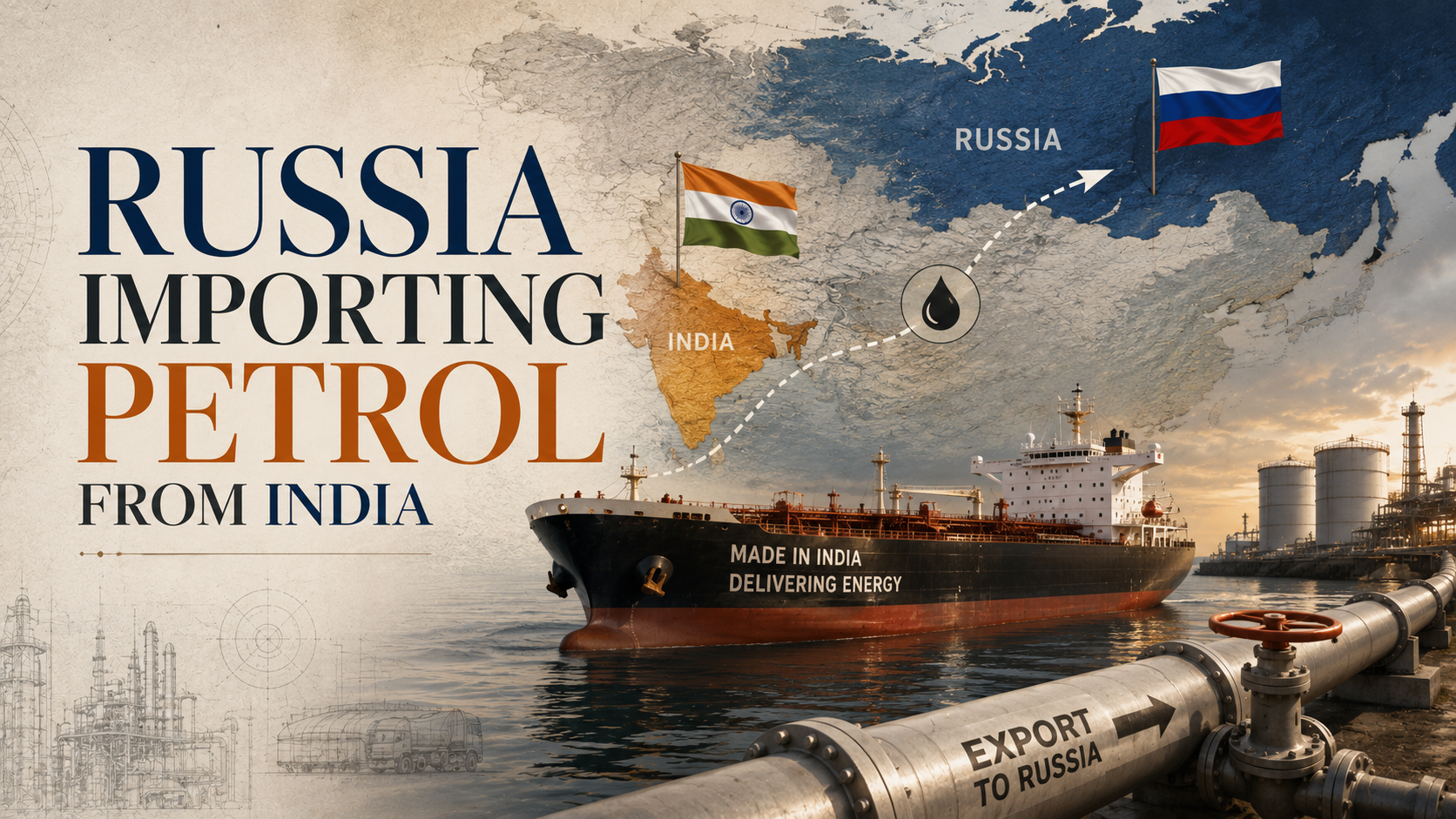
  • Russia turns to India to meet petrol demand after oil infra takes a hit in Ukraine strikes

    Russia turns to India to meet petrol demand after oil infra takes a hit in Ukraine strikes

    Why in the News

    Repeated Ukrainian strikes on Russian oil refineries, combined with routine maintenance, strong summer demand and logistical bottlenecks, have cut Russia’s domestic petrol supply. Russia imported over one million barrels of petrol from India, mainly from Nayara Energy’s Vadinar refinery, over June and July 2026, according to ship tracking data.

    What does the trade data show?

    1. Rising volumes over two months: Gasoline exports from India to Russia rose from about 12,000 barrels per day in June 2026 to about 21,000 barrels per day in July 2026, together close to a million barrels, with the trend reported to have continued into August.
    2. Vadinar as the main Indian source: Three cargoes of around 320,000 to 350,000 barrels each were shipped to Russia from the Vadinar refinery, which has significant Russian shareholding. Additional volumes may have reached Russia through ship-to-ship transfers and vessels with undeclared destinations.
    3. Belarus and Kazakhstan remain the largest suppliers: Most of Russia’s imported gasoline still comes from Belarus, where one of two refineries is 42% owned by a Russian consortium and processes only Russian crude. Kazakhstan is a net petrol importer itself and cannot supply large volumes.
    4. Russia has restricted its own exports to protect domestic supply: Moscow has curbed diesel exports ahead of winter and placed volume limits on petrol sold per vehicle at fuel stations in several regions, since its refining system produces a comfortable diesel surplus but only a thin petrol buffer over domestic demand.

    Why does this mark a reversal in the India-Russia energy relationship?

    1. India’s established role has been as buyer, not supplier: Russian crude, discounted after Western sanctions cut off Moscow’s traditional European buyers following its invasion of Ukraine, now makes up the largest share of India’s crude import basket.
    2. The new flow runs in the opposite direction: India is now supplying a refined product back to Russia, derived in part from the same Russian crude it imports, a flow that did not exist before June 2026.

    Petrol vs Diesel Situation

    Petrol

    • More vulnerable to supply disruptions.
    • Domestic refinery output normally only slightly exceeds demand.
    • Russia has:
      • Restricted exports.
      • Limited petrol supplies at some fuel stations.
      • Adjusted product specifications to protect domestic availability.

    Diesel

    • Russia is relatively better supplied.
    • Its refining system produces more diesel than domestic consumption requires.
    • Nevertheless, Russia has also restricted diesel exports to build a cushion before winter.

    Why is India Important?

    • India has substantial refining capacity and exportable petroleum products.
    • Indian refineries continue to receive large quantities of Russian crude oil.
    • Some petrol exported to Russia may therefore be produced from Russian crude refined in India.
    • This creates an increasingly complex two-way India-Russia energy relationship.

    Conclusion

    The shift shows India’s refining capacity, especially at plants processing discounted Russian crude, has become a swing supplier for Russia’s own domestic fuel shortfall. Whether the flow continues depends on how quickly Russia can repair refining capacity damaged by continuing strikes.

    “[2024] Consider the following statements:
    Statement-I: Recently, Venezuela has achieved a rapid recovery from its economic crisis and succeeded in preventing its people from fleeing/emigrating to other countries.
    Statement-II: Venezuela has the world’s largest oil reserves.
    Which one of the following is correct in respect of the above statements?
    (a) Both Statement-I and Statement-II are correct and Statement-II explains Statement-I
    (b) Both Statement-I and Statement-II are correct, but Statement-II does not explain Statement-I
    (c) Statement-I is correct, but Statement-II is incorrect
    (d) Statement-I is incorrect, but Statement-II is correct

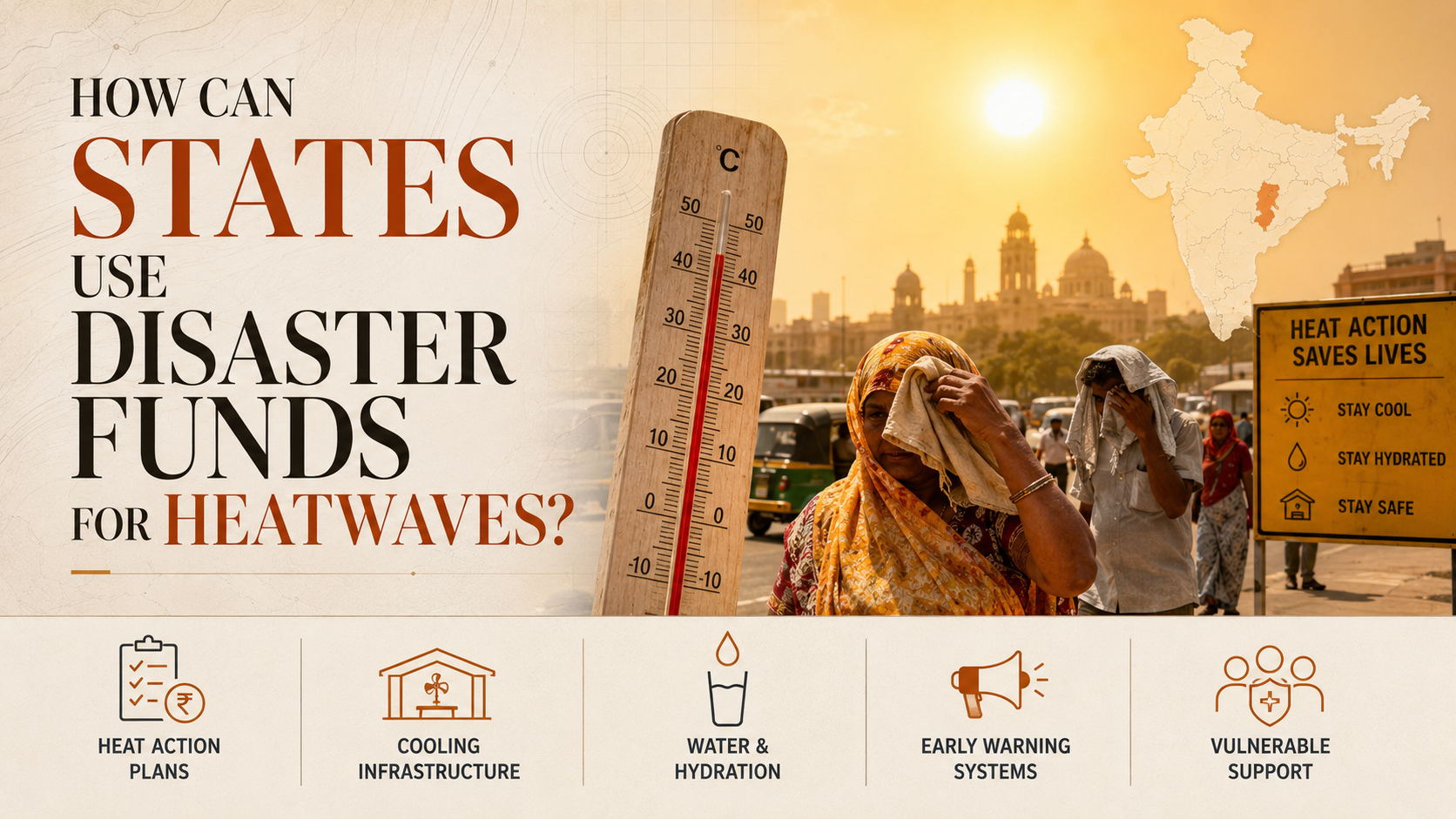
  • How can States use disaster funds for heatwaves?

    How can States use disaster funds for heatwaves?

    Why in the News

    The Ministry of Home Affairs told the Lok Sabha on 4 August 2026 that heatwaves and lightning have been added to India’s list of notified natural calamities, taking the list to 14 items. The change follows a recommendation of the Sixteenth Finance Commission (FC-XVI), the constitutional body under Article 280 that recommends the distribution of resources including disaster funds between the Centre and the states, and operational guidelines issued on 30 June 2026. Heatwaves are now eligible for the full State Disaster Risk Management Fund pool rather than the capped local-disaster route states previously had to use.

    What changes for states?

    1. Removal of the funding ceiling: A state could previously notify a heatwave only as a “local disaster” and draw on the State Disaster Response Fund (SDRF) up to a 10% annual cap, after setting its own compensation norms. Other notified disasters such as floods and cyclones faced no such ceiling. The new notification removes this asymmetry.
    2. Two distinct funding routes now available: Under the SDRF, states can fund relief and compensation for heat-related losses. Under the State Disaster Mitigation Fund (SDMF), a fund meant for longer-term risk reduction rather than immediate response, states can finance cooling shelters and early-warning systems.
    3. Scale of the fund pool: FC-XVI recommended Rs 2.04 lakh crore for state disaster funds over 2026-27 to 2030-31, about 28% more than the previous Commission’s allocation, split Rs 1.6 lakh crore to the SDRF and the rest to the SDMF. It separately recommended Rs 79,406 crore for national disaster funds that states can draw on when a disaster exceeds their own resources.

    What challenges are in the way of using the funds effectively?

    1. Uneven heat action planning: Twelve states have notified heatwaves locally, but only around 300 cities and districts across 23 heatwave-prone states have Heat Action Plans (HAPs), leaving roughly 4,800 urban local bodies and 800 districts without one. Fix. Heat-specific SDMF guidelines, still awaited, will need to be paired with the risk and vulnerability assessments already required before any project proposal.
    2. Limited technical capacity to convert plans into proposals: A 2023 review found 79% of existing HAPs asked city departments to self-fund interventions rather than costing a proposal against the new fund. Fix. States need model mitigation proposals suited to local climate and geography, since many local bodies lack the capacity to prepare fundable projects on their own.
    3. Weak loss-and-damage data: Relief payouts under the new notification will depend on accurate heat mortality and morbidity data. The Health Ministry’s surveillance system, covering over 51,000 reporting units, recorded 4,853 heatstroke cases and 20 confirmed heatstroke deaths between 1 March and 26 July, but it does not capture the wider toll from heart, lung and kidney conditions worsened by heat.

    Conclusion

    The notification closes a genuine funding gap between heat and other disasters, but the benefit depends on state capacity to plan, cost and document heat interventions. Parametric insurance, which pays out automatically once a set temperature threshold is crossed, similar to Nagaland’s existing rainfall insurance, is one fast-disbursing tool states can pair with the new fund access.

    Back2Basics: State Disaster Risk Management Fund

    1. It is the combined pool of the State Disaster Response Fund (SDRF), for immediate relief and reconstruction after a disaster, and the State Disaster Mitigation Fund (SDMF), for interventions that reduce the risk of a hazard becoming a disaster.
    2. The Finance Commission fixes the inter-state distribution using a disaster risk index built from hazard frequency and intensity, exposure, vulnerability, and a state’s expenditure record in the previous Commission’s period.

    “[2024, GS3, 15 marks] What is disaster resilience? How is it determined? Describe various elements of a resilience framework. Also mention the global targets of the Sendai Framework for Disaster Risk Reduction (2015-2030).”

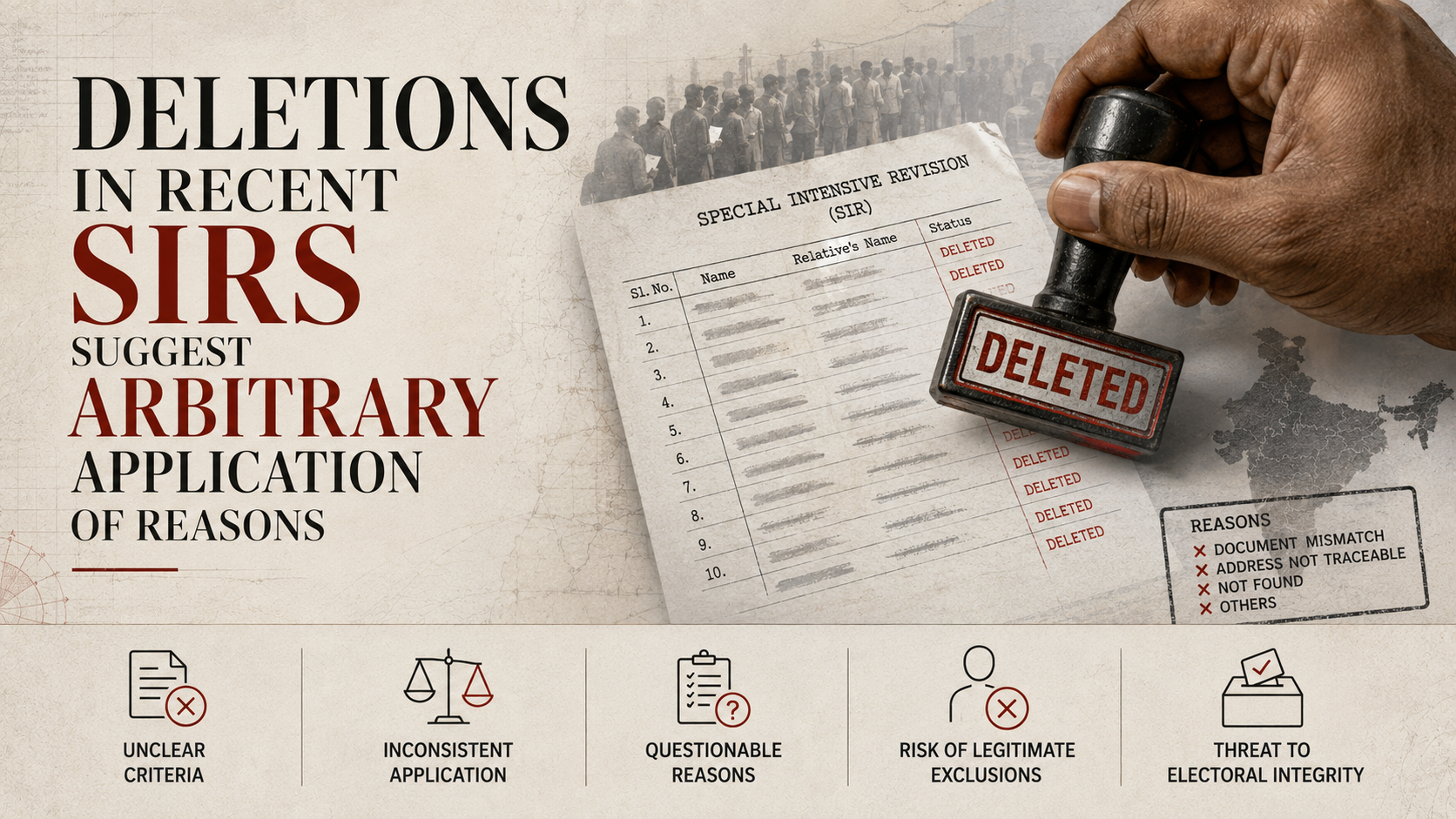
  • Deletions in recent SIRs suggest arbitrary application of reasons

    Deletions in recent SIRs suggest arbitrary application of reasons

    Why in the News

    Draft electoral rolls released after the enumeration phase of the Special Intensive Revision (SIR), an exercise conducted by the Election Commission to verify every elector afresh rather than only updating additions and deletions, show wide variation in the reasons recorded for deleting names in Karnataka and Telangana. Both states saw roughly one-fifth of their electors deleted, the highest share among major states. A reason-wise breakdown of the deletions shows extreme, inconsistent use of the two largest deletion categories, “Shifted” and “Absent”, across constituencies of comparable size. The Election Commission has not defined when a Booth-level Officer (BLO) should mark an elector “Shifted” rather than “Absent”, and has never published the break-up between the two categories.

    What do the numbers show?

    1. No defined threshold between categories: The Election Commission’s Manual on Electoral Rolls, 2023 states that a person absent temporarily from their ordinary residence does not, by law, cease to be ordinarily resident there, which raises the question of whether an elector found “Absent” during enumeration should be deleted at all. The manual gives BLOs no rule for choosing between “Shifted” and “Absent”.
    2. Wide swings between similar constituencies in Telangana: Of 1,79,510 deletions in Jubilee Hills, 83% were marked “Shifted” and only 15,000 “Absent”. In the comparably sized Nizamabad (Urban), 50,307 of 83,282 deletions were marked “Absent”. In Nakrekal (SC), all 20,169 deletions were marked as reasons other than “Absent”, with not a single elector recorded as absent.
    3. Wide swings in Karnataka: In Hebbal, 87% of 1.3 lakh deletions were marked “Shifted” and only 287 “Absent”. In Hubli-Dharwad-East, roughly 25,000 of 47,000 deletions were marked “Absent”. In Bommanahalli, 2.65 lakh electors, 54.8% of the roll, were deleted, with only about 9,700 marked deceased.
    4. Aggregated official reporting hides the pattern: The Election Commission has only ever published a combined figure for “Shifted” and “Absent” deletions in every state where the SIR has run. The category-wise breakdown used in this analysis was derived independently by processing thousands of constituency-level deletion lists.

    Conclusion

    The scale of variation in reason-coding for deletions, without a defined rule separating “Shifted” from “Absent”, points to inconsistent application rather than a uniformly applied enumeration standard. The Election Commission has not made public a category-wise breakdown for any SIR state, leaving independent verification as the only route to auditing how deletions are being classified.

    Back2Basics: Special Intensive Revision (SIR)

    1. SIR is a full re-verification of the electoral roll, requiring every elector to be freshly enumerated, unlike the routine annual “Summary Revision” that only processes additions, deletions and corrections against the existing roll.
    2. Deletions during SIR are coded under four broad reasons: Shifted (or Permanently Shifted), Absent, Deceased and Duplicate.

    “[2024, GS2, 10 marks] Examine the need for electoral reforms as suggested by various committees with particular reference to “one nation-one election” principle.”

  • [27th May 2026] The Hindu OpED: The high cost of India’s private health-care boom

    [27th May 2026] The Hindu OpED: The high cost of India’s private health-care boom

    Question (2024, GS2): “In a crucial domain like the public healthcare system, the Indian State should play a vital role to contain the adverse impact of marketisation of the system. Suggest some measures through which the State can enhance the reach of public healthcare at the grassroots level.”
    Linkage: This question directly targets the core of the private healthcare boom, framing it as the “marketisation of the system”. It asks candidates to address the “adverse impacts” (such as high costs and inequitable access) and outlines the state’s responsibility to provide affordable, grassroots-level alternatives

    Mentor Comment

    The Parliamentary Standing Committee on Health and Family Welfare’s 176th Report has found that the average cost of hospitalisation is ₹50,508 in a private facility against ₹6,631 in a government facility, and that out-of-pocket childbirth expenditure is ₹7,630 in private facilities against ₹2,299 in public ones. The Committee has made 368 recommendations, including standardised package rates, mandatory pre-treatment cost estimates, a proposal to cap basic room tariffs in metropolitan private hospitals at the average tariff of nearby three-star hotels, and a review of foreign direct investment (FDI) rules governing the acquisition and management of existing hospitals. The article argues this exposes a contradiction at the heart of India’s health policy: the country wants more private and foreign capital in health care, particularly in Tier-2, Tier-3 and rural areas, even as it moves to restrict the same capital’s ability to acquire existing hospitals.

    What contradiction does the Committee’s report expose?

    1. Wanting more capital and restricting it at once: The Committee wants India to attract more private and foreign investment in health care, especially in under-served Tier-2, Tier-3 and rural areas, while simultaneously asking the government to review FDI rules on the acquisition and management of existing hospitals.
    2. Cross-subsidy expectation on corporate hospitals: Among its recommendations, large corporate hospitals earning from medical tourism, foreign patients and high-net-worth individuals are expected to cross-subsidise poorer Indians and reserve beds for Ayushman Bharat-Pradhan Mantri Jan Arogya Yojana (AB-PMJAY) beneficiaries at regulated rates.
    3. The case for continued investment: Hospitals require substantial capital, for land, equipment, intensive care units, digital systems, laboratories and trained personnel, and public hospitals cannot currently meet all demand for secondary and tertiary care, so foreign investors and private-equity funds fill a genuine capacity gap; excessively restrictive or unpredictable regulation risks pushing that investment elsewhere.

    How does information asymmetry drive up private health-care costs?

    1. The patient cannot independently verify need: A patient rarely decides independently whether an MRI is required, whether admission should continue for two more days, or whether a procedure is necessary, because the provider knows more than the patient, the condition economists call information asymmetry.
    2. Financial incentives shape volume, not just price: When financial incentives become too strong, they can influence not just the price of care but how much care is delivered in the first place.
    3. Institutional incentives compound the effect: Corporate hospital groups competing for well-known specialists, sophisticated technology and premium infrastructure build a high-cost ecosystem; revenue targets, procedure-linked incentives, and higher occupancy or revenue-per-bed expectations can gradually influence institutional behaviour even where most doctors act in patients’ interests.
    4. The resulting medicalisation: Lab investigations may detect abnormalities that would never have caused harm, more screening can lead to unnecessary follow-up tests, and a patient manageable as an outpatient may be admitted; Caesarean sections, angioplasties, intensive-care admissions, diagnostic packages and long medicine lists need to be read within this incentive structure, not only as individual clinical decisions.

    What should an FDI review in hospitals actually test?

    1. New capacity versus acquired capacity: Whether an investment creates new beds or simply acquires existing ones.
    2. Competition versus concentration: Whether it improves competition or leads to market concentration.
    3. Under-served areas versus metro saturation: Whether it enters an under-served district or adds another high-end facility in a metro that already has one.
    4. Enforceable public-interest conditions: Where an investor receives concessional land, tax benefits or other public support, whether there are enforceable obligations tied to affordable beds or participation in public insurance schemes.

    Why can’t a hotel-tariff-linked room cap fix hospital pricing?

    1. A hospital room is not a hotel room: A hospital room includes nursing, infection-control and emergency support that a hotel room does not, so tying its tariff to a nearby three-star hotel’s rate is easy to understand but does not capture what the charge covers.
    2. Capping one component shifts cost elsewhere: If one component of the bill is capped, hospitals may raise charges on other components, leaving the total bill largely unaffected.
    3. A relevant precedent, with a caveat: India’s experience with coronary stent price regulation showed that government intervention can reduce excessive mark-ups, but hospital care is more complex than a single device, since what matters is the total cost of an episode, not one component.
    4. The alternative on the table: Diagnosis-Related Groups (DRG), a patient-classification system that pays a fixed, predetermined amount for an inpatient stay based on the diagnosis and procedures involved, rather than reimbursing each service separately, alongside package rates, transparent cost estimates, billing standards and audit mechanisms.

    Challenges to price capping and FDI review as the fix

    1. Regulation cannot substitute for public capacity: India cannot regulate its way out of weak public health care; if government hospitals stay overcrowded, understaffed or hard to access, citizens will keep depending heavily on private providers regardless of price rules. Eg. OECD countries’ experience shows a strong public health system that offers a credible alternative is itself one of the most effective forms of regulation. Fix. Strengthen primary health care so disease is prevented, detected and treated early, so public hospitals become a genuine option rather than a last resort.
    2. Insurance design can reinforce the wrong incentive: An insurance system that pays for volume of procedures, rather than appropriate care, reproduces the same incentive problem privately funded care already has. Fix. Redesign AB-PMJAY and similar insurance systems to reward appropriate, outcome-linked care rather than higher procedure volumes, backed by clinical audits and evidence-based treatment protocols.

    Conclusion

    Price caps and an FDI review are reasonable starting points, but the Committee’s own recommendations expose a deeper contradiction between wanting more private and foreign capital in health care and restricting the same capital’s ability to acquire hospitals. The article’s central argument is that the real fix does not lie only in capping prices, but in building a public health system credible enough to counterbalance the incentive structure that private investment creates; the next milestone is whether the government acts on the Committee’s recommendations, including the proposed FDI review.

    Parliamentary Standing Committee on Health and Family Welfare

    1. It is a Department-related Parliamentary Standing Committee, one of the panels through which Parliament examines the working of a ministry, here the Ministry of Health and Family Welfare, between sittings of the House.
    2. Its reports, such as the 176th Report cited here, are recommendatory: the government must respond to them but is not bound to act on their recommendations.
    3. Its membership is drawn from both Houses of Parliament, giving it cross-party composition distinct from a ministry-appointed expert panel.