| Question (2024, GS3): “What is disaster resilience? How is it determined? Describe various elements of a resilience framework. Also mention the global targets of the Sendai Framework for Disaster Risk Reduction (2015-2030).” Linkage: The lack of a “distinct safety regime” for highly vulnerable environments like ICUs represents a core gap in India’s disaster resilience framework. This question challenges candidates to describe how to move from a structural vulnerability to a resilient system using global standards like the Sendai Framework. |
Mentor Comment
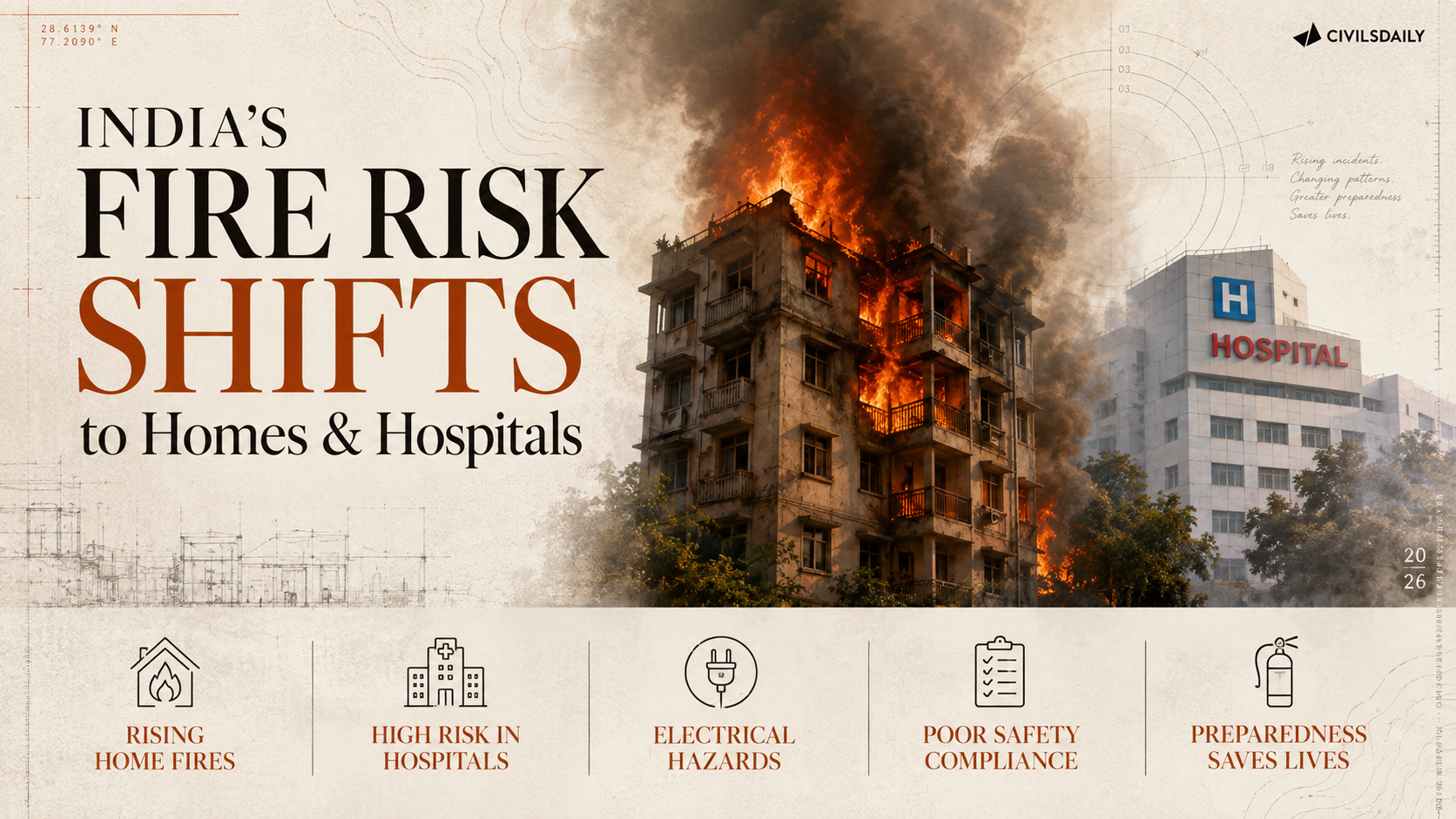
India’s fire risk profile has shifted over the past 15 years from industrial facilities, large offices and mass gatherings toward residential buildings, hotels and hospitals, with electrical fires, driven by heavier appliance use, overloaded circuits and poor maintenance, now predominant. Intensive Care Units are especially vulnerable because of their oxygen rich environments, and this month back to back fires struck neonatal Intensive Care Units in Amravati, Maharashtra, and Chhindwara, Madhya Pradesh. Despite a string of near identical incidents since the 2024 Jhansi fire in which 18 newborns died, ICU fires have still not produced a single, distinct safety regime for the units most at risk.
What happened in this month’s neonatal ICU fires?
- Amravati: The fire was extinguished within 30 minutes, but smoke proved fatal for three babies who were already being treated for complications, with a faulty ventilator suspected as the cause.
- Chhindwara: A short circuit in a warmer at the district hospital’s Neonatal Intensive Care Unit triggered a fire in which three newborns, only days old, suffered burns.
Why should ICU fires be treated as a distinct safety category?
- They are sealed spaces that fill with smoke fast: Intensive Care Units are sealed compartments where smoke accumulates quickly, and in a Neonatal Intensive Care Unit patients cannot evacuate on their own, making regular evacuation drills essential.
- A safer design already exists on paper: A best case setup includes three independent exits, with at least two allowing horizontal evacuation, automatic sprinklers, independent power lines for major equipment, oxygen cylinder supports positioned away from electrical sockets, and fire drills held every two years.
What regulatory response has followed past ICU fires?
- A professional body called for mandatory certification: Following an earlier Neonatal Intensive Care Unit fire in Delhi, the National Neonatology Forum called for mandatory fire safety certification for Neonatal Intensive Care Unit equipped hospitals, regular power audits and analogue addressable alarms.
- A named evacuation protocol followed: The same push produced a standard evacuation protocol, now known as RACE, for Rescue, Alarm, Confine, and Extinguish or Evacuate.
- New national guidelines offer a starting point: The 2026 National Guidelines on Fire and Life Safety in Healthcare Facilities can serve as a starting point for building ICU and Neonatal Intensive Care Unit specific safety standards.
What risk do post fire investigations typically miss?
- Electrical harmonics is a largely unaudited factor: Neonatal Intensive Care Unit equipment is packed with electronic components that draw distorted current, which can silently overheat neutral wiring, transformers and loose connections without ever tripping a circuit breaker.
- Generic findings may be hiding the real cause: Post fire reports that cite generic “short circuits” or “technical faults” may be missing this harmonic driven degradation entirely, leaving the underlying risk unaddressed even after an inquiry closes the case.
Challenges to ICU fire safety
- Fire safety certification is not uniformly enforced: Many hospitals, particularly outside metro cities, operate without a valid fire safety no objection certificate or lapse on renewal. Eg. Investigations after major hospital fires, including the Jhansi Neonatal Intensive Care Unit fire in which 18 newborns died, have repeatedly found expired or absent fire clearances. Fix. Link a hospital’s fire safety certificate renewal to its registration and accreditation status, so a lapsed certificate automatically suspends the facility’s licence to operate.
- Backup power for critical equipment is often shared, not independent: Ventilators, warmers and monitors frequently run off the same power lines as general hospital load, so a single fault can cut life support equipment. Eg. A suspected equipment fault caused this month’s Amravati Neonatal Intensive Care Unit fire. Fix. Mandate a dedicated, separately fused power line for every ICU bed’s life support equipment, independent of the hospital’s general electrical circuit.
- Frontline staff are rarely trained for ICU specific evacuation: Evacuating patients who cannot move on their own requires drilled procedures that most hospital staff never practise. Eg. Regular ICU evacuation drills remain the exception rather than the norm even at accredited hospitals nationally. Fix. Make a biennial ICU evacuation drill, as already recommended for Neonatal Intensive Care Units, a mandatory condition of hospital accreditation across all critical care units, not only newborn wards.
Conclusion
ICU and Neonatal Intensive Care Unit fires have recurred at roughly the same scale and for the same reasons since the 2024 Jhansi fire, with certification calls and evacuation protocols repeatedly following each incident without preventing the next one. Treating ICU fires as a distinct safety category, backed by independent power lines, harmonics audits and enforced certification, is what remains to convert a decade of incident specific responses into a standing safety regime.
