Mains Ready By December. Smash Mains & Smash PYQ Admissions Open

Search results for: “”

  • Why India’s R&D system needs a map of where funds really go

    Why India’s R&D system needs a map of where funds really go

    Why in the News

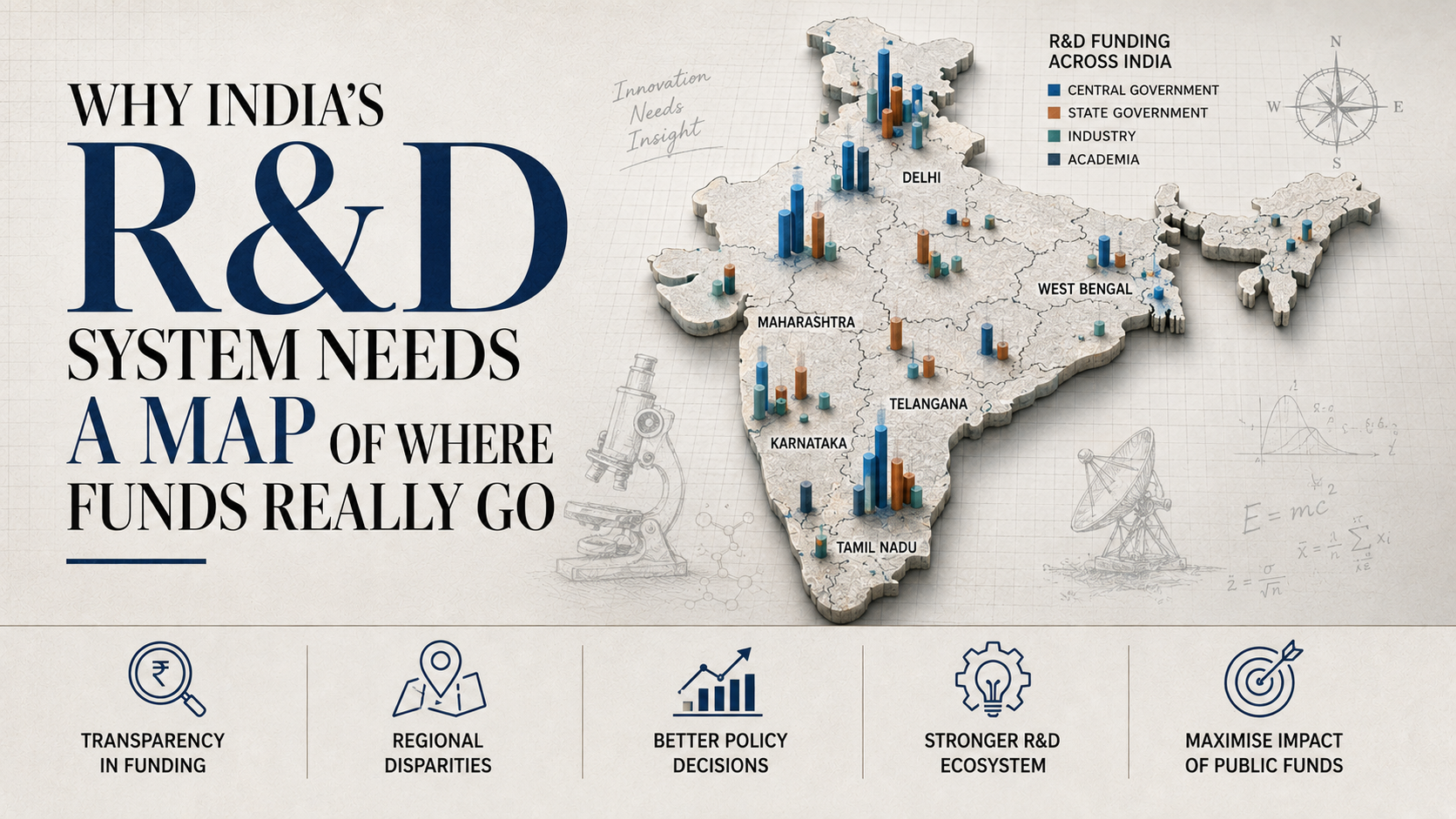
    A NITI Aayog report, ‘Ease of Doing R&D in India’, drawing on a survey of over 400 institutional leaders and 850 scientists, has found that close to 80% of funding under the Anusandhan National Research Foundation (ANRF, India’s apex research funding body, whose governing board is headed by the Prime Minister and which is mandated to draw much of its funding from non-governmental sources alongside Central contributions) is concentrated in the IITs, despite ANRF’s own mandate to support a wider base of universities and research bodies. The report also flagged that multiple central agencies may be funding overlapping research areas, leading to what it calls “inefficient” use of public money. NITI Aayog’s proposed response is the Unified Project Management System (UPMS), meant to streamline planning, funding, monitoring and evaluation of public R&D projects across ministries. The article argues that UPMS does not by itself fix the deeper gap it is meant to solve: India has no system that can tell funders, researchers or the public who is being funded, by whom, for what, and whether that funding has already been given elsewhere.

    What is a persistent digital identifier (PID), and why does India’s R&D funding lack one?

    1. Persistent digital identifier (PID): A permanent, unique, machine-readable identifier attached to every research grant, comparable to how a PAN number identifies a taxpayer or an IMEI number identifies a phone.
    2. Attached metadata: Each PID is meant to carry a standard set of details, which agency gave the money, to which institution, to which named researcher, what amount, over what period, and in which field, linked so officials can track outcomes when the PID is cited in a published paper.
    3. Scattered and inconsistent records today: This information already exists inside Indian funding agencies, but scattered across dozens of separate databases, in inconsistent formats, often as free text. Eg. A researcher’s name may appear as “IISc, Bangalore” in one dataset and “Indian Institute of Science, Bengaluru” in another, enough for an automated system to fail to recognise them as the same institution.

    What does the NITI Aayog report reveal about India’s R&D funding?

    1. Concentration in a few institutions: Close to 80% of ANRF funding is concentrated in the IITs, despite ANRF’s mandate to support a wider base of universities and research bodies than the traditional funding model has managed.
    2. Possible duplication across agencies: Multiple Central agencies are possibly funding similar research areas, resulting in overlap and “inefficient” use of public money, per the report’s survey of over 400 institutional leaders and 850 scientists.
    3. The underlying gap: Both findings point to the same root cause, the absence of a system that can tell funders, researchers or the public who is funded, by whom, for what, and whether that funding has already been given elsewhere.

    How have other countries solved this identifier problem?

    1. Crossref’s Grant Linking System (global, non-profit): Built by the open digital infrastructure organisation Crossref, this system now has more than 2 lakh grants registered worldwide from funders seeking to track duplication and concentration.
    2. Research Organisation Registry (ROR) and ORCID: A funder ID identifies the funding agency down to the division or department; a ROR ID identifies the receiving institution; an ORCID identifier, already familiar to Indian researchers since most journals require it, identifies the individual researcher so funding can be aggregated per person.
    3. Grant DOI, since 2020: Crossref extended its system to a permanent identifier for the grant itself, which can be linked to whatever the grant produces, papers, patents or data.
    4. Government-owned national portals compatible with the global standard: The U.K.’s “Gateway to Research” portal and the European Union’s CORDIS and OpenAIRE infrastructure run their own government-owned single points of entry for funding agencies, while generating identifiers fully compatible with the Crossref/ROR/ORCID standards, giving national governments ownership without breaking compatibility with the global dataset.
    5. Documented scale of the problem elsewhere: A 2013 analysis of U.S. federal grant applications using automated text-matching estimated duplicate or overlapping funding may have cost the U.S. nearly $70 million; a 2020 analysis of nearly 20,000 competitive grants in Denmark found funds concentrated among a small group of researchers and a narrow set of topics, a pattern the article says mirrors what NITI Aayog flagged for India.

    What are India’s options going forward?

    1. Build a sovereign national registry: India could develop and maintain its own India-specific grant registry from the ground up, giving it full control and the ability to tailor the system to its own agencies, federal structure and State research schemes.
    2. Join the existing global infrastructure: India’s funding agencies could become members of the Crossref ecosystem directly, which can be implemented faster since the technical standards and governance already exist internationally.
    3. A hybrid middle path: India could build a single national portal, the NITI Aayog’s own proposed UPMS, that internally mints Crossref-compatible grant DOIs and links every record to ROR and ORCID identifiers, following the model of the U.K.’s Gateway to Research and the EU’s CORDIS/OpenAIRE.

    Challenges to the Unified Project Management System (UPMS)

    1. Legacy data inconsistency: Migrating scattered, free-text agency records into a structured PID system requires resolving years of inconsistent naming across agencies before the system can produce reliable data. Eg. The same institution recorded as “IISc, Bangalore” in one dataset and “Indian Institute of Science, Bengaluru” in another. Fix. Mandate a common institutional and researcher master list, cross-validated against existing ORCID and ROR records, before agencies are required to report through UPMS.
    2. Compliance is not self-enforcing: A national portal only produces reliable data if every Central and State funding agency consistently deposits data into it; a voluntary or partially adopted system reproduces the same blind spots the report identifies. Fix. Make UPMS reporting a precondition for releasing funds under any Central research scheme, so compliance is enforced through the funding process itself.

    Conclusion

    NITI Aayog’s Unified Project Management System addresses the process of streamlining India’s R&D funding, but by itself does not supply the persistent digital identifier and metadata infrastructure that would let funders, researchers and the public actually see where public research money goes and whether it has already gone somewhere else. The next milestone is whether UPMS is designed to mint Crossref-compatible identifiers and how many agencies are made to report through it.

    “[2024, GS2, 15 marks] What are the aims and objects of the recently passed and enforced, The Public Examination (Prevention of Unfair Means) Act, 2024? Whether University/State Education Board examinations, too, are covered under the Act?”

  • Nuclear power operator plans new design unit to support pvt players

    Nuclear power operator plans new design unit to support pvt players

    Why in the News

    The Nuclear Power Corporation of India Limited (NPCIL) is setting up a new design vertical to support private companies deploying Pressurised Heavy Water Reactor (PHWR) technology. This follows recent legal reform enabling private participation in civil nuclear power. The move marks a shift from NPCIL’s traditional role as sole builder and operator of India’s nuclear fleet toward a design-support role for private entrants, addressing India’s stated need to scale nuclear capacity to meet rising electricity demand while keeping deployment within a technology NPCIL already operates at scale.

    Why does India favour PHWR technology for private entry?

    1. Established domestic supply chain: PHWR technology has been indigenised in India since the 1980s, giving it a mature domestic manufacturing and fuel-cycle base that a newly entering private player can draw on.
    2. Natural uranium fuel cycle: PHWRs use natural, unenriched uranium, avoiding dependence on enrichment technology that remains tightly controlled internationally.

    What does NPCIL’s new design unit change?

    1. From sole operator to technology enabler: NPCIL will now provide design support to private players rather than being the only entity that builds and runs reactors, opening a role private companies previously could not access.
    2. Institutional capacity test: Whether NPCIL’s new vertical can support multiple private projects simultaneously, without diverting engineering capacity from its own ongoing reactor construction, remains to be demonstrated.

    Pressurised Heavy Water Reactor (PHWR)

    • PHWR = Pressurised Heavy Water Reactor uses heavy water (deuterium oxide, D₂O) as moderator and Coolant
    • It uses natural, unenriched uranium as fuel.

    Key Features of PHWR

    Heavy Water

    • Heavy water contains deuterium, an isotope of hydrogen.
    • It acts as both the moderator and coolant in PHWRs.

    Natural Uranium

    • PHWRs can operate using natural uranium, avoiding the need for uranium enrichment for the reactor fuel.

    Online Refuelling

    • PHWRs permit online refuelling.
    • Fuel bundles can be replaced while the reactor continues operating.
    • Therefore, the reactor does not need to be shut down for routine fuel replacement.

    “[2017, GS3, 15 marks] Give an account of the growth and development of nuclear science and technology in India. What is the advantage of fast breeder reactor programme in India?”

    [2023] Consider the following statements:
    Statement-IIndia, despite having Uranium deposits, depends on coal for most of its electricity production.
    Statement-II:Uranium, enriched to the extent of at least 60%, is required for the production of electricity.
    Which one of the following is correct in respect of the above statements

    [A] Both Statement-I and Statement – II are correct and Statement- II is the correct explanation for Statement- I

    [B] Both Statement I and Statement II are correct and Statement-II is not the correct explanation for Statement-I.

    [C] Statement- I is Correct but Statement-II is incorrect.

    [D] Statement-I incorrect but Statement-II is correct.

  • Rural India needs jobs, not wage guarantees

    Rural India needs jobs, not wage guarantees

    Why in the News

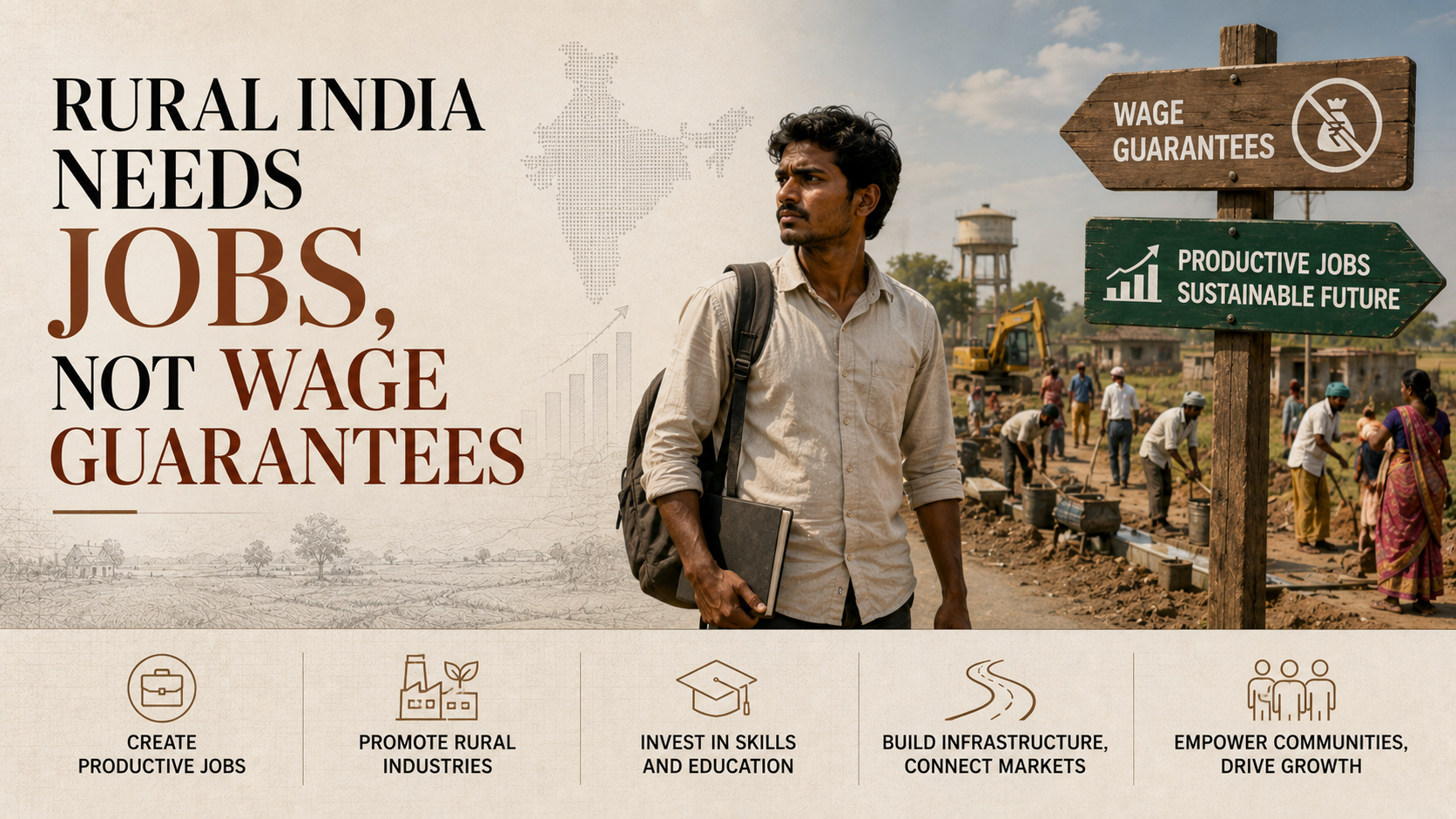
    An opinion piece argues that a new rural wage-guarantee scheme has recorded low uptake among the rural workforce, and contends this shows rural India needs durable, income-generating employment rather than a guaranteed-wage safety net. The scheme pays a guaranteed wage for a fixed number of days, which the piece contrasts with sectors such as food processing, renewable energy and small and medium enterprises (SMEs), which it argues could generate sustained employment rather than a temporary income floor. The tension is between a safety-net approach to rural distress and a growth-oriented approach that builds durable non-farm jobs.

    Why has the wage-guarantee scheme seen low uptake?

    1. Wage ceiling below market rates: Where the scheme’s guaranteed wage sits below prevailing local market wages for casual labour, workers have limited incentive to enrol, since informal market work pays more for the same effort.
    2. Seasonal mismatch: A fixed-day guarantee does not align well with the seasonal peaks in rural labour demand during sowing and harvest, when private demand for labour already absorbs much of the available workforce.

    What alternative does the piece propose?

    1. Food processing: Expanding food processing capacity near production zones can absorb rural labour in agro-processing roles that persist beyond a single season.
    2. Renewable energy: Rural solar and biomass energy projects can generate sustained local employment in installation, operation and maintenance roles.
    3. Small and medium enterprises: Supporting rural SMEs with credit and market access can create employment that grows with demand, rather than being capped at a fixed number of guaranteed days.

    Unemployment in India

    1. The International Labour Organization (ILO) defines an unemployed person as someone of working age, without work, currently available to work and actively seeking work in a reference period.
    2. India’s unemployment carries several distinct types: frictional, structural (a mismatch between workers’ skills and market demand), cyclical, seasonal, disguised (as in agriculture, where more people are employed than the work requires), and chronic.
    3. Over 90 percent of India’s workforce remains informal, which limits meaningful, secure job creation regardless of headline employment growth.
    4. Manufacturing contributes only about 16 to 18 percent of GDP, well below China’s roughly 26 percent, constraining the sector’s capacity to absorb surplus labour.

    Government Initiatives for Employment Generation

    1. Mahatma Gandhi National Rural Employment Guarantee Act (MGNREGA), 2005: Guarantees 100 days of rural wage employment a year to any adult member of a rural household, and is the specific scheme this op-ed’s wage-guarantee critique concerns.
    2. PM Vishwakarma: Provides collateral-free loans, skilling and toolkits to artisans across 18 traditional trades.
    3. PM Vishwakarma Rozgar Yojana / Employment Linked Incentive (ELI) scheme: Approved with an outlay of about 99,446 crore rupees, targeting 3.5 crore jobs over two years.
    4. e-Shram Portal: A national database that issues unorganised workers a Universal Account Number and links them to social security schemes.
    5. DAY-NRLM: Mobilises the rural poor into Self-Help Groups to build self-sustained livelihoods.

    Challenges in Unemployment

    1. Survey design undercounts informal and rural work: Household surveys do not fully capture home-based, gig or platform work within the roughly 90 percent informal workforce, and rural labour force surveys have historically run at a lower frequency than urban ones. Eg. Rural Periodic Labour Force Survey (PLFS) data was measured only annually for years, while urban data was collected quarterly, understating rural distress in real time. Fix. Move rural PLFS to the same quarterly frequency as urban surveys and explicitly incorporate underemployment into the headline definition.
    2. Capital-intensive growth limits absorption: Investment has flowed disproportionately toward information technology and infrastructure rather than labour-intensive sectors capable of absorbing low and semi-skilled workers. Eg. Services now drive the largest share of GDP growth while employing under 30 percent of the workforce, the jobless growth pattern this op-ed’s wage-guarantee critique responds to. Fix. Direct incentive schemes toward labour-intensive sectors such as textiles, leather, food processing and electronics assembly rather than capital-intensive ones alone.

    Conclusion

    The piece argues that a wage-guarantee scheme with low enrolment is evidence that rural India’s underlying problem is a shortage of durable jobs, not a shortage of a temporary income floor, and that policy should shift resources toward sectors capable of generating sustained rural employment.

    Back2Basics: Periodic Labour Force Survey (PLFS)

    1. The PLFS is India’s principal household survey for estimating employment and unemployment, conducted by the National Sample Survey Office (NSSO) under the Ministry of Statistics and Programme Implementation (MoSPI).
    2. It reports unemployment on three measures: Usual Status (activity over the preceding year), Current Weekly Status, and Current Daily Status, the last of which best captures underemployment.
    3. It has historically surveyed urban areas quarterly but rural areas only annually, a frequency gap that limits its ability to track rural distress as it develops.

    “[2023, GS3, 15 marks] Most of the unemployment in India is structural in nature. Examine the methodology adopted to compute unemployment in the country and suggest improvements.”

  • Gross FDI hit 15-year high of $30.7 billion in April-June 2026

    Gross FDI hit 15-year high of $30.7 billion in April-June 2026

    Why in the News

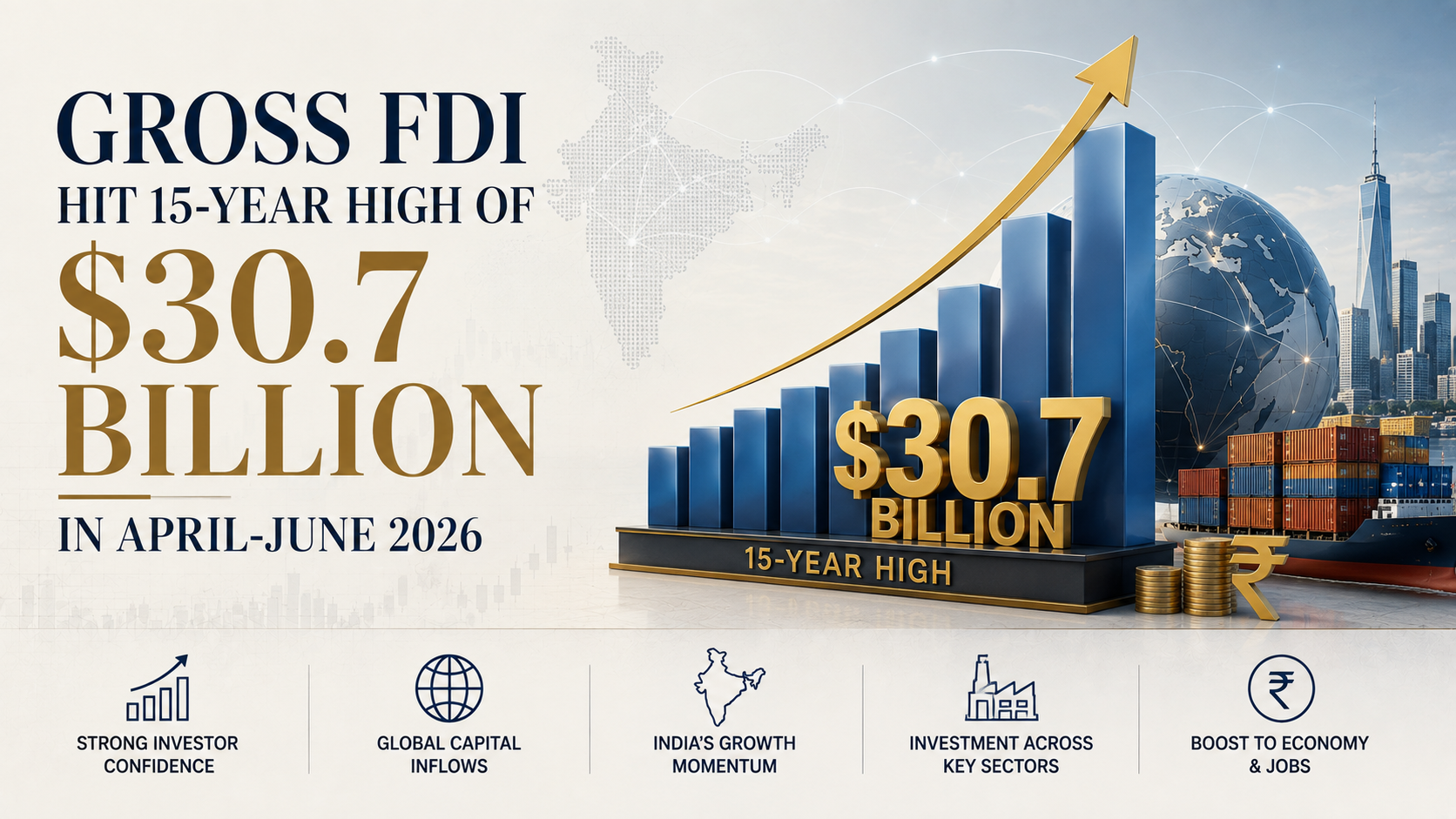
    Reserve Bank of India (RBI) data shows gross Foreign Direct Investment (FDI) inflows reached $30.7 billion in April-June 2026, the highest quarterly figure in fifteen years. Net FDI, which nets out repatriation and disinvestment by existing foreign investors, turned positive again in June 2026 at $1.3 billion, after a period of elevated repatriation had kept it depressed. Singapore, the Netherlands, the United States and Canada led the inflows, concentrated in manufacturing. The tension is between the strength of the gross inflow figure and the much smaller net figure, since heavy repatriation by existing foreign investors has been offsetting fresh inflows for several preceding quarters.

    What does the data show?

    1. Fifteen-year high in gross inflows: Gross FDI of $30.7 billion in a single quarter is the highest recorded in fifteen years, reversing a period of relatively subdued inflows.
    2. Net FDI turns positive: Net FDI turned positive in June 2026 at $1.3 billion, after running negative or near zero in preceding months.
    3. Source and sector concentration: Singapore, the Netherlands, the United States and Canada were the leading source countries, with manufacturing the leading destination sector.

    Why does the gap between gross and net FDI matter?

    1. Repatriation pressure: A large gap between gross and net FDI signals that existing foreign investors have been exiting or repatriating profits at a pace close to new inflows. This is a different signal from headline inflow growth alone.
    2. Policy implication: A durable improvement in net FDI, not gross inflows alone, is the more reliable indicator of investor confidence in staying invested in India over the medium term.

    Gross FDI vs Net FDI

    • Gross FDI: Fresh foreign investment entering India.
    • Net FDI: Gross inflows after accounting for repatriation and disinvestment.
    • A large gap between gross and net FDI indicates that substantial investment is also flowing out through existing investors.
    • Therefore, high gross FDI does not necessarily mean high net FDI.

    “[2022] Which one of the following situations best reflects “Indirect Transfers” often talked about in media recently with reference to India ?
    (a) An Indian company investing in a foreign enterprise and paying taxes to the foreign country on the profits arising out of its investment
    (b) A foreign company investing in India and paying taxes to the country of its base on the profits arising out of its investment
    (c) An Indian company purchases tangible assets in a foreign country and sells such assets after their value increases and transfers the proceeds to India
    (d) A foreign company transfers shares and such shares derive their substantial value from assets located in India

  • SEBI’s ITRI: Global test for India’s future-ready financial architecture

    SEBI’s ITRI: Global test for India’s future-ready financial architecture

    Why in the News

    The Securities and Exchange Board of India (SEBI) has introduced an IT Resilience Index (ITRI) to assess the technological robustness of Market Infrastructure Institutions (MIIs), meaning stock exchanges, depositories and clearing corporations. The index responds to growing global concern about outages and cyberattacks at systemically important financial market infrastructure. It follows comparable resilience frameworks already adopted by regulators in the United Kingdom, the European Union, the United States, Singapore, Hong Kong and Australia. The tension is between certifying resilience on paper through a scored index and ensuring MIIs make the operational investment the index is meant to incentivise.

    What does the ITRI assess?

    1. Nine weighted parameters: The index scores each market infrastructure institution across nine parameters covering system uptime, cyber-incident preparedness, disaster recovery capability and related technology governance measures.
    2. Comparative design: SEBI has drawn on resilience frameworks used by regulators in the United Kingdom, the European Union, the United States, Singapore, Hong Kong and Australia in constructing the index.

    Why has SEBI shifted from compliance-checking to a quantitative resilience score for MIIs?

    • Systemic-risk trigger: Rising technological dependence in capital markets means even minutes of disruption at an MII can affect millions of investors and billions of rupees in trades.
    • Regulatory foundation: SEBI’s 2015 circular first classified MIIs as systemically important, mandating a robust cybersecurity framework.
    • Boardroom shift: Retail participation through online platforms, algorithmic trading volumes, and faster settlement cycles have made technology reliability inseparable from market efficiency.
    • Global first: ITRI is among the first attempts by any regulator to design a resilience barometer as measurable as capital adequacy is for banks.

    How does ITRI’s weighting structure reflect SEBI’s risk-prioritisation approach?

    • Nine-parameter design: ITRI rests on nine parameters, each weighted by a systemic-risk hierarchy, with sub-parameters to be defined by the Industry Standards Forum of MIIs.
    • Highest-weighted parameters: Availability and security carry the highest weight, at 20% each, as the first line of defence for market functioning.
    • Recovery-focused weighting: Business Continuity and Reliability carries 10% weight, reflecting a regulatory shift from preventing failures to absorbing shocks and recovering quickly.
    • Growth-risk calibration: Scalability carries only 5% weight, reflecting SEBI’s view that rapid market growth does not yet pose an immediate stability risk.
    • Early Warning System: MIIs will build an Early Warning System to detect parameter deterioration before it causes performance issues or disruptions.

    What do global resilience frameworks show about the alternatives to a single numeric index?

    • United Kingdom — FCA/PRA: Operational resilience rules require institutions to identify important business services and demonstrate recovery capability from severe shocks, without a single numeric score.
    • European Union — DORA: The Digital Operational Resilience Act functions as a regulatory rulebook rather than a numerical scorecard.
    • United States: No single resilience index exists for exchanges; technology resilience is embedded into general regulatory oversight instead.
    • Singapore — Monetary Authority of Singapore: Technology risk guidelines are considered particularly relevant to India given comparably high digital financial penetration and large retail investor bases.
    • Hong Kong: Cyber resilience assessment frameworks use measurable maturity levels, making them the closest structural parallel to SEBI’s numeric approach.

    Can a single numeric score capture resilience across MIIs with different technology architectures?

    • Architecture heterogeneity: Stock exchanges, clearing corporations and depositories operate different technology architectures and functions, raising doubts about a common index applying uniformly.
    • Weight uncertainty: Questions remain on the statistical estimation of the assigned weights, finalised through Technical Advisory Committee discussions rather than validated outage data.
    • Provisional status: The current weights are a starting framework that SEBI may have to refine using actual outage data, cyber incidents and stress tests.
    • Pace mismatch: Technology risks evolve faster than regulatory frameworks, making the index vulnerable to obsolescence even as it is being implemented.
    • Investment burden: Building automated monitoring systems, continuous testing and redundant infrastructure requires substantial investment from MIIs.

    Back2Basics: Market Infrastructure Institutions (MIIs)

    1. MIIs are the entities that provide the trading, clearing and settlement backbone of the securities market: stock exchanges, depositories and clearing corporations.
    2. They are classified as systemically important, since their failure or compromise can disrupt trading and settlement across the entire market rather than a single participant.
    3. SEBI regulates MIIs under the SEBI (Stock Exchanges and Clearing Corporations) Regulations and the SEBI (Depositories and Participants) Regulations.

    Conclusion

    SEBI’s ITRI converts technology resilience from a compliance checklist into a quantitative, weighted score, a model most global regulators have not attempted. Whether this scoring approach works depends on unresolved questions: the statistical basis of the weights, the comparability of a single index across MIIs with different architectures, and whether a high score actually translates into faster recovery during an actual technology shock. Until validated against real incident data, ITRI remains a measurement framework rather than a proven resilience guarantee.

    “[2015, GS2, 12 marks] For achieving the desired objectives, it is necessary to ensure that the regulatory institutions remain independent and autonomous. Discuss in the light of the experiences in recent past.”

  • $100,000 fee for H-1B: The new legal route Trump is pursuing

    $100,000 fee for H-1B: The new legal route Trump is pursuing

    Why in the News

    The US Department of Homeland Security (DHS) has proposed a new $103,265 fee on H-1B visa petitions, using a rulemaking route after a court struck down an earlier attempt to impose the same fee. The earlier fee had relied on a presidential proclamation, which a US court found exceeded executive authority. The administration is now pursuing the same outcome through a formal DHS rulemaking process instead. The move directly affects Indian workers, who receive the largest single-country share of H-1B visas, and sets up a tension between the United States’ stated intent to restrict low-cost skilled immigration and its technology sector’s dependence on Indian software professionals.

    What is the new legal route, and why does it matter?

    1. Rulemaking instead of proclamation: DHS is now proposing the fee through the standard federal rulemaking process, which carries stronger legal footing than a presidential proclamation but takes longer and includes a public comment period.
    2. Same fee, different vulnerability: A fee approved through rulemaking is harder to strike down in court than one imposed by proclamation, since it follows the procedure Congress has authorised for agency rule changes.

    What is the impact on Indian workers?

    1. Concentration of exposure: Indian nationals receive the largest single-country share of H-1B visas each year, so a steep new fee disproportionately raises the cost of hiring or transferring Indian technology professionals to the United States.
    2. Employer cost shift: US employers typically bear the H-1B fee, not visa applicants. The increase is likely to reduce new H-1B filings for Indian applicants rather than being absorbed by individual workers directly.

    Conclusion

    The Department of Homeland Security’s shift to a rulemaking process to reimpose the $100,000-plus H-1B fee is a more durable attempt to restrict skilled immigration than the earlier proclamation. The outcome for Indian workers now depends on the rulemaking’s public comment period and eventual finalisation, not merely a court challenge.

    Back2Basics: H-1B visa

    1. The H-1B is a US non-immigrant visa category for foreign workers in speciality occupations, typically requiring at least a bachelor’s degree in a related field.
    2. It is issued under an annual numerical cap, allocated through a lottery when applications exceed the cap.
    3. Indian nationals have consistently received the largest single-country share of H-1B approvals, concentrated in information technology roles.

    “[2023, GS2, 10 marks] Indian diaspora has scaled new heights in the West. Describe its economic and political benefits for India.”

  • Centre-state compromise on mines, minerals is in tatters

    Centre-state compromise on mines, minerals is in tatters

    Why in the News

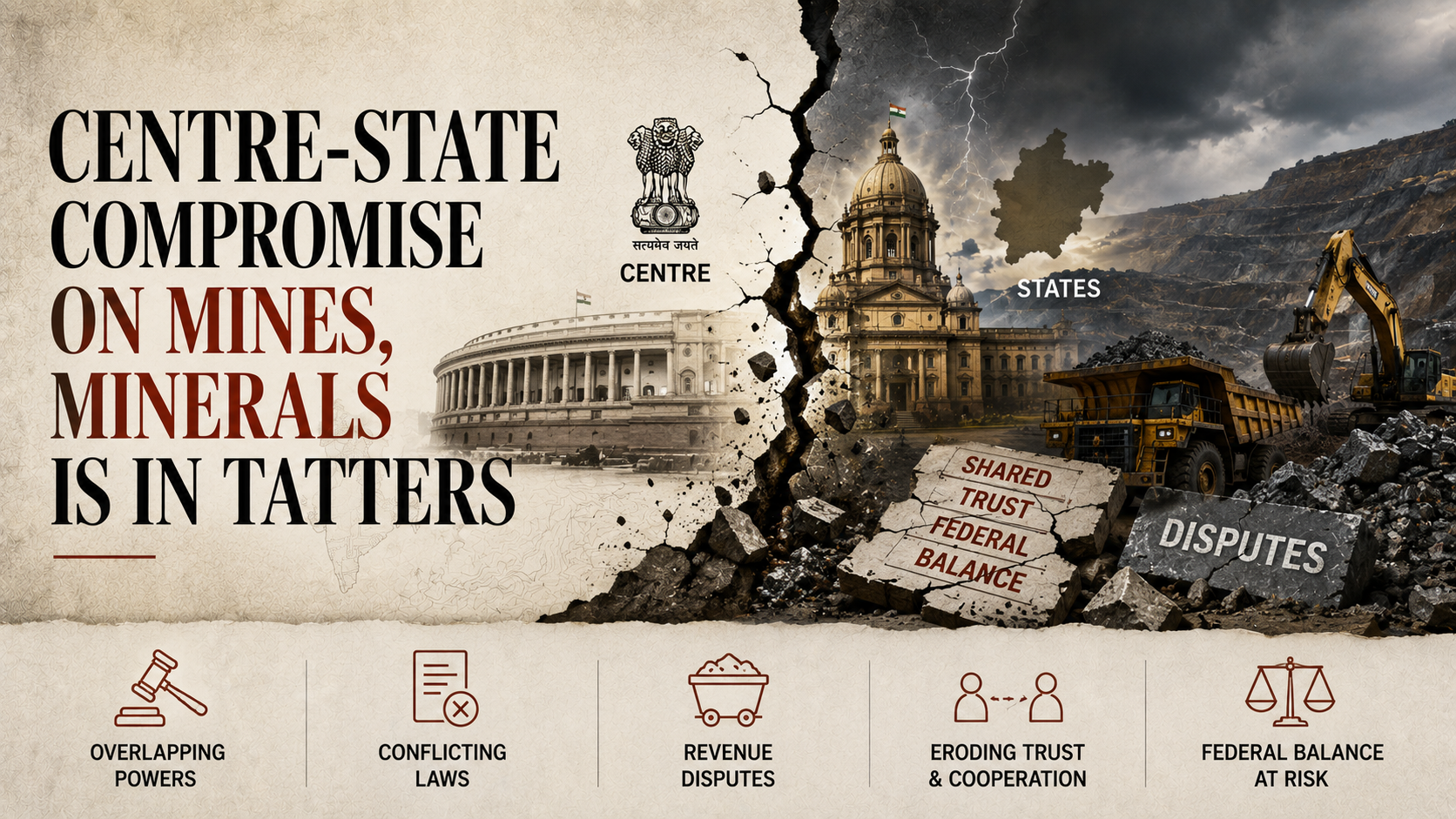
    An opinion piece argues that the Mines and Minerals (Development and Regulation) Amendment Act, 2026 (MMDR Amendment Act) has centralised mineral taxation authority at the expense of States. This disturbs a long standing settlement, dating to the original Mines and Minerals (Development and Regulation) Act, 1957, under which States collected royalty on minerals within their territory without a corresponding compensation mechanism now built in. The piece contends this follows a pattern already seen in the Goods and Services Tax (GST) Council, where States have progressively lost autonomous taxation power to a Union-dominated body. The tension is between the Union’s claim that uniform mineral taxation supports national resource planning, and States’ claim that this erodes a revenue base the Seventh Schedule recognises as theirs.

    What changed under the amendment?

    1. Centralised rate-setting power: The amendment shifts the power to determine certain mineral levies and cesses from State legislatures to the Union government, narrowing what States can independently tax.
    2. Erosion of a settled compromise: Mineral royalty had functioned as a relatively stable, State-collected revenue source since the 1957 Act. The amendment disturbs that settlement without a corresponding compensation mechanism.

    Why is this compared to the GST Council experience?

    1. Repeated pattern of centralisation: The piece argues that the GST Council, though structured as a joint Centre-State body, has in practice let Union preferences dominate rate decisions, and that the same dynamic is now repeating in mineral taxation.
    2. States left to negotiate after the fact: Under both regimes, States raise objections after a rate or rule is set centrally, rather than co-designing the rule up front.

    Current Status of Fiscal Federalism in India

    1. The Union controls the most buoyant tax sources, income tax, corporate tax and the dominant share of the GST base, while States carry larger expenditure responsibilities in health, education and welfare, producing a standing vertical fiscal imbalance.
    2. Devolution to States is currently governed by the 16th Finance Commission’s award, which fixed the States’ share of the divisible pool at 41 percent.
    3. Mineral royalty and cesses have historically sat with States as an independent, non-shared revenue source, which is the specific arrangement this amendment narrows.

    Constitutional Provisions Related to Fiscal Federalism

    1. Article 246 and the Seventh Schedule: Distribute taxation and legislative subjects between the Union, State and Concurrent Lists, and mineral development is a subject that straddles Union and State competence under Entry 54 of the Union List and Entry 23 of the State List.
    2. Article 280: Establishes the Finance Commission to recommend the distribution of net tax proceeds between the Union and the States.
    3. Article 246A and Article 279A: Together create the GST regime and the GST Council as the joint body that recommends GST rates and administration.
    4. Article 293: Governs the Union’s control over State borrowing where a State remains indebted to the Union.

    Major debates surrounding Fiscal Federalism

    1. Divisible pool erosion through cesses and surcharges: Revenue the Union raises as a cess or surcharge does not enter the divisible pool the Finance Commission distributes, so a nominal 41 percent devolution understates the Union’s discretionary control over shared revenue.
    2. State taxation autonomy under GST: States gave up the power to independently tax goods and services on joining GST, leaving royalty and mineral levies among the few remaining independent State taxation instruments, which is precisely what this amendment now narrows.
    3. Weak third-tier finances: Local bodies devolved under the 73rd and 74th Amendments remain financially dependent on State and Union transfers, compounding the same imbalance one tier further down.

    Challenges in Fiscal Federalism

    1. No binding consultation requirement before a rate change: Neither the GST Council’s structure nor the MMDR Act requires the Union to secure State consent before altering a shared levy, only consultation. Eg. The GST Council’s voting structure gives the Union a one-third weightage sufficient to block any change it opposes. Fix. Amend Article 279A to require a demonstrated State revenue-neutral transition before a Council decision that narrows State taxation power takes effect.
    2. No compensation mechanism for a narrowed State tax base: Unlike the GST transition, which carried a five-year compensation guarantee for States, the MMDR Amendment Act, 2026 carries no equivalent revenue protection for States losing mineral levy autonomy. Eg. The GST Compensation Cess mechanism lapsed in 2022, and States have separately argued its withdrawal alone widened the same imbalance this amendment now adds to. Fix. Extend a time-bound compensation formula, indexed to each State’s historical mineral revenue, for a fixed transition period.

    Government Initiatives for Fiscal Federalism

    1. Finance Commission: A constitutional body appointed every five years to recommend Union-State and inter-State devolution of tax proceeds and grants-in-aid.
    2. GST Council: The joint Union-State body under Article 279A that recommends GST rates, exemptions and administrative rules.
    3. District Mineral Foundation: A statutory trust under the Mines and Minerals (Development and Regulation) Act, 1957 that channels a share of mineral royalty into welfare of mining-affected areas, funded from the same royalty base this dispute concerns.

    Back2Basics: Mines and Minerals (Development and Regulation) Act, 1957

    1. The Act is the principal central law governing mineral concessions and mineral development in India, most recently amended in 2026.
    2. It empowers the Union to prescribe rates of royalty and dead rent on minerals, which States then collect.
    3. A 2015 amendment introduced auction as the mandatory mode of allocating mineral concessions, replacing the earlier discretionary allotment system.

    Conclusion

    The mineral taxation dispute is presented as further evidence that fiscal federalism in India increasingly follows a pattern of after-the-fact State objection to Union-set rules, rather than genuine ex ante bargaining. What remains unresolved is whether States will pursue a legal challenge or extract a compensation formula through political negotiation.

    “[2025, GS2, 15 marks] Examine the evolving pattern of Centre-State financial relations in the context of planned development in India. How far have the recent reforms impacted the fiscal federalism in India?”

  • India, China to advance boundary talks for ‘early harvest’, set up new LAC meeting points, hotlines

    India, China to advance boundary talks for ‘early harvest’, set up new LAC meeting points, hotlines

    Why in the News

    India and China have agreed to advance work on delimiting the Line of Actual Control (LAC) and to create new mechanisms for managing the border. The two sides reached this outcome at the conclusion of the 25th round of Special Representative (SR) talks, the designated channel between India’s National Security Adviser and China’s Foreign Minister for discussing a political framework for a boundary settlement. The talks follow the restoration of high level border diplomacy after the 2020 Galwan standoff, which had frozen the SR mechanism for several years. Eight outcome points have been agreed, including new military hotlines and meeting points, an expert mechanism on trans-border rivers, and a push toward “early harvest” delimitation in less disputed sectors, even as neither government has published a public roadmap for how full delimitation will proceed.

    What did the two sides actually agree to?

    1. New military hotlines and meeting points: The two sides will add direct communication lines and physical meeting points along the LAC to reduce the risk of miscalculation during patrols. Eg. Existing hotlines were credited with de-escalating stand-offs after 2020, and the new points extend coverage to previously uncovered stretches.
    2. Boundary delimitation working groups: Both sides will set up dedicated groups to work toward an “early harvest” agreement on sectors where the alignment is least contested, rather than attempting a single comprehensive settlement.
    3. Trans-border river mechanism: A joint expert mechanism will meet to share hydrological data on rivers that cross the border. This addresses a long standing Indian concern about upstream Chinese dam activity.

    Why does the lack of a public roadmap matter?

    1. Transparency gap: Neither government has released the substance of what an “early harvest” delimitation would cover or which sectors are prioritised. Parliament and citizens have no way to assess the trade-offs being discussed.
    2. Precedent for slippage: Past India-China dialogue mechanisms, including the Special Representative talks themselves, have lapsed for years after an initial burst of activity. An outcome document alone does not guarantee follow-through.

    Conclusion

    The 25th round of Special Representative talks has produced the most concrete institutional steps on the India-China boundary since the Galwan standoff, but a working roadmap for actual delimitation remains undisclosed. The next milestone is the first meeting of the delimitation working groups and whether the trans-border river mechanism produces a data-sharing protocol.

    Back2Basics: Line of Actual Control (LAC)

    1. The LAC is the de facto boundary separating Indian and Chinese controlled territory, distinct from an internationally recognised border.
    2. It is not a single demarcated line. Both sides hold differing perceptions of its alignment in several sectors, including eastern Ladakh and Arunachal Pradesh.
    3. The Special Representatives mechanism, established in 2003, is the designated channel for discussing a political framework for a boundary settlement.

    “[2026] The Chancellor of Germany visited India in January 2026. Which of the following is/are NOT correct in terms of outcomes?
    1. MoU between All India Institute of Ayurveda and University of Hamburg
    2. MoU on Youth Hockey Development between Hockey India and German Hockey Federation
    3. Establishment of a bilateral dialogue mechanism on the Indo-Pacific
    4. Opening of an Honorary Consul of Germany in Lucknow
    (a) 2 and 3 (b) 1 and 4 (c) 3 and 4 (d) 1 only

  • UN panel flags ‘human rights violations’ in India, urges Delhi to suspend, review NRC

    UN panel flags ‘human rights violations’ in India, urges Delhi to suspend, review NRC

    Why in the News

    The UN Committee on the Elimination of Racial Discrimination (CERD) has released concluding observations, following its eleventh periodic review of India on August 11-12, criticising the implementation of the National Register of Citizens (NRC) in Assam and calling for its suspension. This is a One development, one row item; The Hindu and The Indian Express both carried the Committee’s findings, and this entry is filed from the Indian Express account, which reports the call to suspend the NRC and the Committee’s specific concern about the Special Intensive Revision (SIR) process, in more detail.

    What did the Committee find, and what did it call on India to do?

    1. The Committee criticised the NRC’s implementation in Assam: It found that the process subjected Bengali-speaking Muslims to what it described as “systematic and structural racial discrimination,” and called for the NRC to be suspended and India’s legislative framework around it to be reviewed.
    2. The Special Intensive Revision process was separately flagged: The Committee raised concern that Bengali-speaking Muslim voters were reportedly disproportionately affected by the Election Commission’s SIR process in West Bengal and Assam.
    3. The Committee’s concern extends to Scheduled Castes, Scheduled Tribes, and Rohingya refugees: It said it was “gravely concerned” about reports of large-scale violations by law enforcement officials against ethnic and ethno-religious groups, including Scheduled Tribes, Scheduled Castes (particularly Dalits), and non-citizens, and cited allegations of racially motivated violence, excessive use of force, extrajudicial killings, arbitrary detention, torture and sexual violence.
    4. It called for accountability, not merely acknowledgement: The Committee asked India to conduct prompt, thorough and impartial investigations into these allegations and ensure accountability for those responsible, and to urgently address hate speech and hate crimes against Rohingya, Bengali-speaking Muslims, migrants and asylum-seekers.
    5. India’s response came through its review delegation: India sent the Solicitor-General as head of delegation for the underlying periodic review held on August 11-12, ahead of these concluding observations.

    Conclusion

    CERD’s concluding observations place NRC suspension, a review of the associated legislative framework, and law enforcement accountability toward Scheduled Castes, Scheduled Tribes and Rohingya refugees on record as a formal treaty-body finding against India, made under the same UN human rights review process, rather than as commentary on a single incident, with India’s substantive reply yet to be reported.

    Back2Basics

    1. UN Committee on the Elimination of Racial Discrimination (CERD): The treaty body of independent experts that monitors States parties’ implementation of the International Convention on the Elimination of All Forms of Racial Discrimination (ICERD), which India ratified in 1968, through periodic reviews and concluding observations.
    2. National Register of Citizens (NRC), Assam: A register, first prepared in 1951 and updated under Supreme Court supervision, intended to identify genuine Indian citizens in Assam by excluding illegal migrants, particularly in the context of the Assam Accord (1985).
  • Fair pricing could help sustain UPI network

    Fair pricing could help sustain UPI network

    Why in the News

    The op-ed, by a NITI Aayog consultant, argues that the zero-Merchant Discount Rate (MDR) regime underpinning Unified Payments Interface (UPI)‘s free-to-use model is financially unsustainable, and proposes a differentiated pricing structure as the Department of Financial Services examines whether to restore MDR for high-threshold transactions or merchants. The piece is pegged to a Parliamentary Standing Committee on Finance report tabled this month, which cited an industry estimate of about Rs 20,700 crore in annual UPI operating costs against a Rs 2,000 crore government allocation under the zero-MDR regime.

    What is the fiscal problem with UPI’s current pricing model, and what does the op-ed propose?

    1. The cost-subsidy gap is large and quantified: The Parliamentary Standing Committee on Finance’s report cited industry estimates of roughly Rs 20,700 crore in annual UPI operating costs, against a government allocation of only Rs 2,000 crore under the zero-MDR regime, with banks and payment companies absorbing the balance.
    2. Two restructuring options are formally under examination: The Department of Financial Services is examining restoring MDR for certain high-threshold transactions or merchants, and separately, phasing out government support through a tiered incentive structure.
    3. The op-ed’s proposed principle is differentiated, not uniform, pricing: It argues for keeping UPI free for consumers and small merchants while allowing a capped MDR for larger commercial users and higher-value transactions, on the basis that a uniform rate would be negligible for a large retailer but consequential for a street vendor.
    4. The author’s own research links merchant ecosystem formalisation to UPI adoption: Citing research with Sharon Buteau, the op-ed states that more formalised merchant ecosystems are associated with higher UPI use, and that MDR design should be calibrated to where acceptance networks are still developing rather than applied uniformly.
    5. Aggregated payment data is proposed as a second, non-MDR revenue and policy tool: The op-ed cites PhonePe’s PulsePro and a recent MoU with the Ministry of Electronics and Information Technology (MeitY) to integrate UPI transaction metrics into PM GatiShakti for infrastructure and economic planning, arguing that privacy-safe aggregated payment signals have public value independent of any pricing decision.

    Conclusion

    The op-ed’s position is that UPI’s zero-MDR model has reached a fiscal limit documented by Parliament’s own Standing Committee, and that a threshold-based, differentiated MDR, protecting small merchants and consumers while pricing larger commercial transactions, is a more sustainable path than either continuing an unfunded subsidy or imposing a uniform fee that would slow onboarding in less-formalised markets.

    Back2Basics

    1. Merchant Discount Rate (MDR): The fee a merchant pays to their bank or payment service provider for accepting digital payments, historically waived to zero on UPI and RuPay debit card transactions in India since January 2020 to encourage adoption.
    2. Unified Payments Interface (UPI): A real-time payment system developed by the National Payments Corporation of India (NPCI) that enables instant interbank transactions through a single mobile application.

    “[2023, GS3, 10 marks] What is the status of digitalization in the Indian economy? Examine the problems faced in this regard and suggest improvements.”