Why in the News
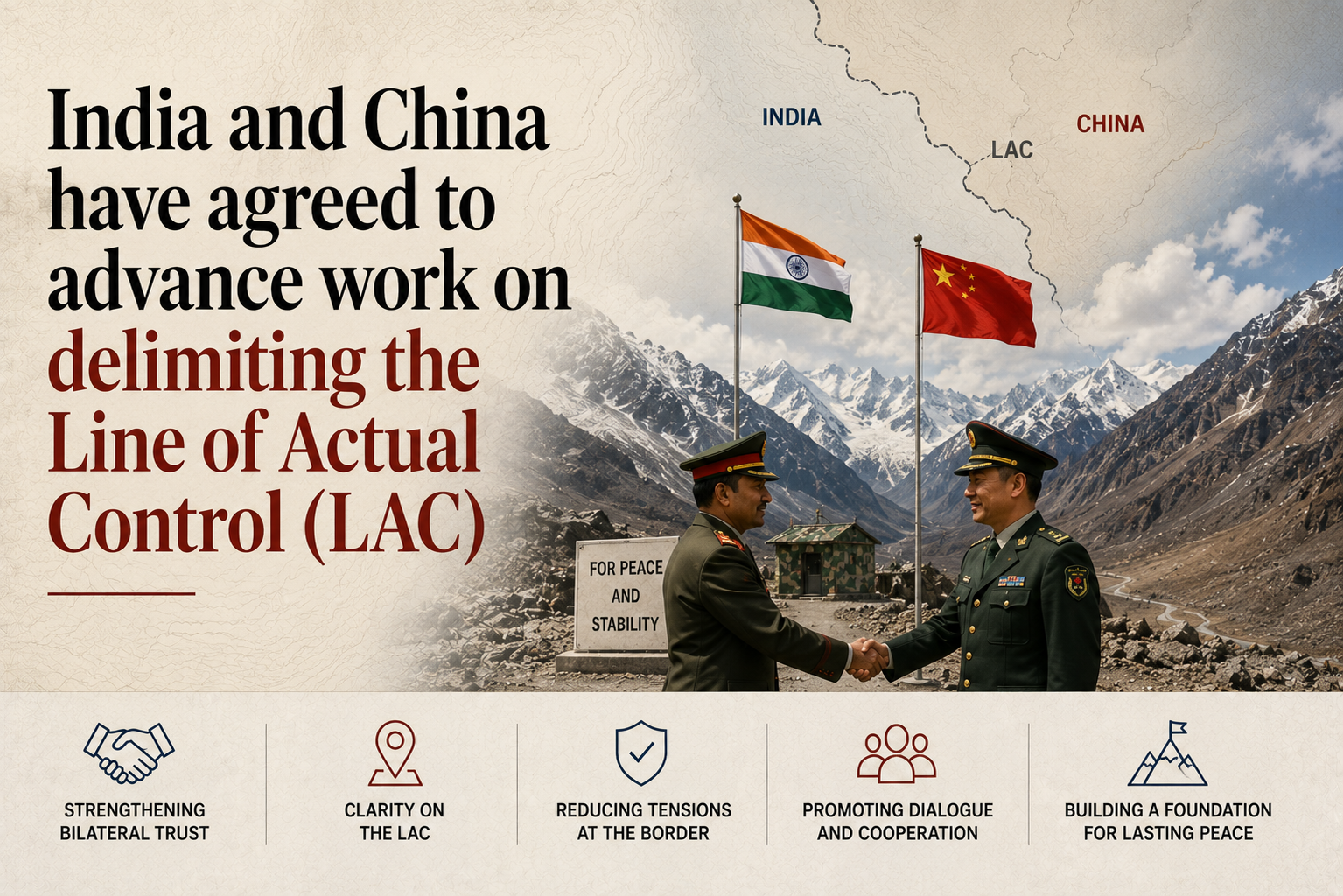
India and China have agreed to advance work on delimiting the Line of Actual Control (LAC) and to create new mechanisms for managing the border. The two sides reached this outcome at the conclusion of the 25th round of Special Representative (SR) talks, the designated channel between India’s National Security Adviser and China’s Foreign Minister for discussing a political framework for a boundary settlement. The talks follow the restoration of high level border diplomacy after the 2020 Galwan standoff, which had frozen the SR mechanism for several years. Eight outcome points have been agreed, including new military hotlines and meeting points, an expert mechanism on trans-border rivers, and a push toward “early harvest” delimitation in less disputed sectors, even as neither government has published a public roadmap for how full delimitation will proceed.
What did the two sides actually agree to?
- New military hotlines and meeting points: The two sides will add direct communication lines and physical meeting points along the LAC to reduce the risk of miscalculation during patrols. Eg. Existing hotlines were credited with de-escalating stand-offs after 2020, and the new points extend coverage to previously uncovered stretches.
- Boundary delimitation working groups: Both sides will set up dedicated groups to work toward an “early harvest” agreement on sectors where the alignment is least contested, rather than attempting a single comprehensive settlement.
- Trans-border river mechanism: A joint expert mechanism will meet to share hydrological data on rivers that cross the border. This addresses a long standing Indian concern about upstream Chinese dam activity.
Why does the lack of a public roadmap matter?
- Transparency gap: Neither government has released the substance of what an “early harvest” delimitation would cover or which sectors are prioritised. Parliament and citizens have no way to assess the trade-offs being discussed.
- Precedent for slippage: Past India-China dialogue mechanisms, including the Special Representative talks themselves, have lapsed for years after an initial burst of activity. An outcome document alone does not guarantee follow-through.
Conclusion
The 25th round of Special Representative talks has produced the most concrete institutional steps on the India-China boundary since the Galwan standoff, but a working roadmap for actual delimitation remains undisclosed. The next milestone is the first meeting of the delimitation working groups and whether the trans-border river mechanism produces a data-sharing protocol.
Back2Basics: Line of Actual Control (LAC)
- The LAC is the de facto boundary separating Indian and Chinese controlled territory, distinct from an internationally recognised border.
- It is not a single demarcated line. Both sides hold differing perceptions of its alignment in several sectors, including eastern Ladakh and Arunachal Pradesh.
- The Special Representatives mechanism, established in 2003, is the designated channel for discussing a political framework for a boundary settlement.
“[2026] The Chancellor of Germany visited India in January 2026. Which of the following is/are NOT correct in terms of outcomes?
1. MoU between All India Institute of Ayurveda and University of Hamburg
2. MoU on Youth Hockey Development between Hockey India and German Hockey Federation
3. Establishment of a bilateral dialogue mechanism on the Indo-Pacific
4. Opening of an Honorary Consul of Germany in Lucknow
(a) 2 and 3 (b) 1 and 4 (c) 3 and 4 (d) 1 only
