Why in the News
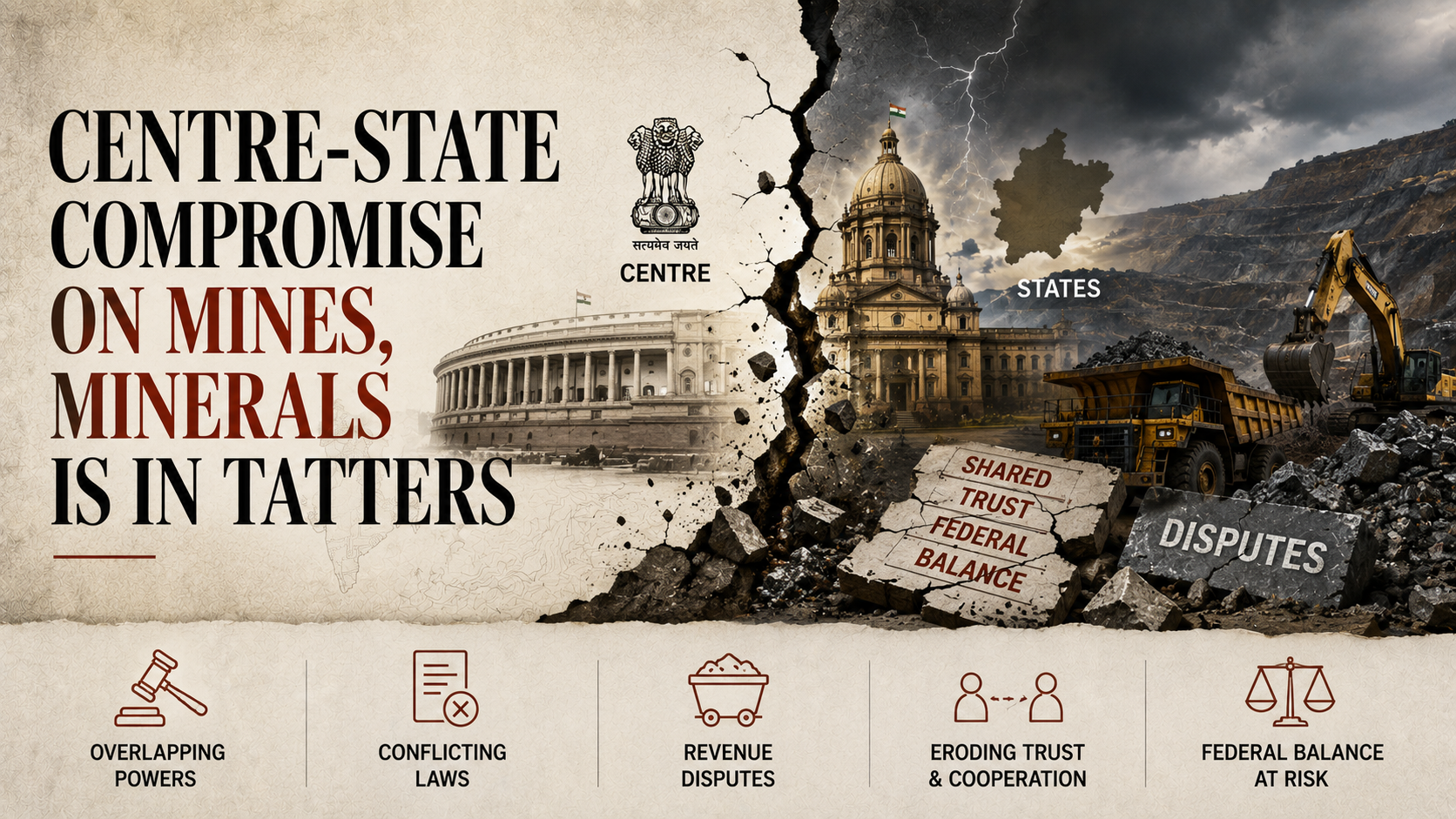
An opinion piece argues that the Mines and Minerals (Development and Regulation) Amendment Act, 2026 (MMDR Amendment Act) has centralised mineral taxation authority at the expense of States. This disturbs a long standing settlement, dating to the original Mines and Minerals (Development and Regulation) Act, 1957, under which States collected royalty on minerals within their territory without a corresponding compensation mechanism now built in. The piece contends this follows a pattern already seen in the Goods and Services Tax (GST) Council, where States have progressively lost autonomous taxation power to a Union-dominated body. The tension is between the Union’s claim that uniform mineral taxation supports national resource planning, and States’ claim that this erodes a revenue base the Seventh Schedule recognises as theirs.
What changed under the amendment?
- Centralised rate-setting power: The amendment shifts the power to determine certain mineral levies and cesses from State legislatures to the Union government, narrowing what States can independently tax.
- Erosion of a settled compromise: Mineral royalty had functioned as a relatively stable, State-collected revenue source since the 1957 Act. The amendment disturbs that settlement without a corresponding compensation mechanism.
Why is this compared to the GST Council experience?
- Repeated pattern of centralisation: The piece argues that the GST Council, though structured as a joint Centre-State body, has in practice let Union preferences dominate rate decisions, and that the same dynamic is now repeating in mineral taxation.
- States left to negotiate after the fact: Under both regimes, States raise objections after a rate or rule is set centrally, rather than co-designing the rule up front.
Current Status of Fiscal Federalism in India
- The Union controls the most buoyant tax sources, income tax, corporate tax and the dominant share of the GST base, while States carry larger expenditure responsibilities in health, education and welfare, producing a standing vertical fiscal imbalance.
- Devolution to States is currently governed by the 16th Finance Commission’s award, which fixed the States’ share of the divisible pool at 41 percent.
- Mineral royalty and cesses have historically sat with States as an independent, non-shared revenue source, which is the specific arrangement this amendment narrows.
Constitutional Provisions Related to Fiscal Federalism
- Article 246 and the Seventh Schedule: Distribute taxation and legislative subjects between the Union, State and Concurrent Lists, and mineral development is a subject that straddles Union and State competence under Entry 54 of the Union List and Entry 23 of the State List.
- Article 280: Establishes the Finance Commission to recommend the distribution of net tax proceeds between the Union and the States.
- Article 246A and Article 279A: Together create the GST regime and the GST Council as the joint body that recommends GST rates and administration.
- Article 293: Governs the Union’s control over State borrowing where a State remains indebted to the Union.
Major debates surrounding Fiscal Federalism
- Divisible pool erosion through cesses and surcharges: Revenue the Union raises as a cess or surcharge does not enter the divisible pool the Finance Commission distributes, so a nominal 41 percent devolution understates the Union’s discretionary control over shared revenue.
- State taxation autonomy under GST: States gave up the power to independently tax goods and services on joining GST, leaving royalty and mineral levies among the few remaining independent State taxation instruments, which is precisely what this amendment now narrows.
- Weak third-tier finances: Local bodies devolved under the 73rd and 74th Amendments remain financially dependent on State and Union transfers, compounding the same imbalance one tier further down.
Challenges in Fiscal Federalism
- No binding consultation requirement before a rate change: Neither the GST Council’s structure nor the MMDR Act requires the Union to secure State consent before altering a shared levy, only consultation. Eg. The GST Council’s voting structure gives the Union a one-third weightage sufficient to block any change it opposes. Fix. Amend Article 279A to require a demonstrated State revenue-neutral transition before a Council decision that narrows State taxation power takes effect.
- No compensation mechanism for a narrowed State tax base: Unlike the GST transition, which carried a five-year compensation guarantee for States, the MMDR Amendment Act, 2026 carries no equivalent revenue protection for States losing mineral levy autonomy. Eg. The GST Compensation Cess mechanism lapsed in 2022, and States have separately argued its withdrawal alone widened the same imbalance this amendment now adds to. Fix. Extend a time-bound compensation formula, indexed to each State’s historical mineral revenue, for a fixed transition period.
Government Initiatives for Fiscal Federalism
- Finance Commission: A constitutional body appointed every five years to recommend Union-State and inter-State devolution of tax proceeds and grants-in-aid.
- GST Council: The joint Union-State body under Article 279A that recommends GST rates, exemptions and administrative rules.
- District Mineral Foundation: A statutory trust under the Mines and Minerals (Development and Regulation) Act, 1957 that channels a share of mineral royalty into welfare of mining-affected areas, funded from the same royalty base this dispute concerns.
Back2Basics: Mines and Minerals (Development and Regulation) Act, 1957
- The Act is the principal central law governing mineral concessions and mineral development in India, most recently amended in 2026.
- It empowers the Union to prescribe rates of royalty and dead rent on minerals, which States then collect.
- A 2015 amendment introduced auction as the mandatory mode of allocating mineral concessions, replacing the earlier discretionary allotment system.
Conclusion
The mineral taxation dispute is presented as further evidence that fiscal federalism in India increasingly follows a pattern of after-the-fact State objection to Union-set rules, rather than genuine ex ante bargaining. What remains unresolved is whether States will pursue a legal challenge or extract a compensation formula through political negotiation.
“[2025, GS2, 15 marks] Examine the evolving pattern of Centre-State financial relations in the context of planned development in India. How far have the recent reforms impacted the fiscal federalism in India?”
