Mains Ready By December. Smash Mains & Smash PYQ Admissions Open

Type: Op-ed

  • Editorial on the Air India AI 2379 reclassification argues crew testing over emphasises alcohol breathalysers relative to psychoactive substances under the Civil Aviation Requirements

    Why in the News

    The 4 August 2026 flight from Phuket to Delhi, carrying 137 passengers and eight crew, has been reclassified from an event of turbulence to a serious incident after technical faults and a significant altitude deviation injured more than 20 people on board. The post flight screening of the pilot in command for psychoactive substances has exposed a crew fitness regime built around alcohol breathalysers rather than drug testing.

    What are the Civil Aviation Requirements (CAR)?

    1. About: The Civil Aviation Requirements are the binding regulatory instructions issued by the Directorate General of Civil Aviation (DGCA) under the aircraft rules, organised into numbered Sections and Series that operators must comply with to hold and retain approvals.
    2. The relevant provision: Crew testing for psychoactive substances falls under CAR Section 5, Air Safety, Series F, Part V, which also applies to Air Traffic Controllers.
    3. Its testing design: The requirement leans towards random and post flight or post shift testing with graded disciplinary action for a confirmed positive result.

    What is a serious incident in civil aviation?

    1. About: A serious incident is an occurrence involving circumstances indicating that an accident nearly occurred, a category distinct from an accident by the absence of the resulting damage or injury threshold.
    2. Why the label matters: Reclassification from turbulence to a serious incident makes a formal independent investigation mandatory rather than leaving the occurrence to airline level reporting.

    What is the Aircraft Accident Investigation Bureau?

    1. About: The Aircraft Accident Investigation Bureau (AAIB) is the body under the Ministry of Civil Aviation that investigates aircraft accidents and serious incidents, kept institutionally separate from the DGCA so the regulator does not investigate outcomes of its own oversight.
    2. International participation: Investigations draw in the safety authority of the State of design and manufacture, which is why France’s Bureau d’Enquetes et d’Analyses (BEA) and technical representatives of the manufacturer have joined this probe.

    What are psychoactive substances in the aviation context?

    1. About: Psychoactive substances are drugs that act on the central nervous system and alter perception, mood or cognition, covering narcotics, sedatives, hypnotics, cannabis, stimulants and certain over the counter medications.
    2. Why they matter on the flight deck: They impair judgement, reaction time, coordination and decision making, which are the four skills a flight crew relies on during an abnormal event.

    What actually happened on the flight?

    1. Two parallel tracks: The occurrence now has a technical track and a crew fitness track, and the second has drawn the greater attention.
    2. The technical anomalies: The Airbus A320N briefly carried fault warnings across the hydraulic systems, elevator flight control faults, autopilot disconnection, emergency exit door indications and an engine anti ice warning.
    3. The consequence: Inflight technical issues and a significant deviation in aircraft altitude caused injuries to more than 20 passengers and crew.
    4. The manufacturer’s data: Airbus’s initial data is said to support the evidence of technical errors.
    5. The airline’s response: The operator has begun immediate and mandatory screening of its flight deck crew for any substances or unprescribed medications.

    Why does the current crew screening regime under detect impairment?

    1. The testing asymmetry: Pre flight and post flight breathalyser checks for alcohol are routine and near universal, while testing for psychoactive substances is comparatively sparse.
    2. Detection after the event, not before: The pilot in command’s result surfaced through post flight screening following an incident, which means the system caught the risk only after passengers were injured.
    3. Random testing as the primary tool: A regime built on random and post shift sampling cannot guarantee that an impaired crew member is stopped before a specific flight departs.
    4. Voluntary action filling a regulatory gap: Mandatory screening began because a single airline was prodded into it, not because the requirement applies uniformly across operators.
    5. Rising exposure: Expanding operations, crew citing stress related issues, and wider availability of substances for medicinal or recreational use together enlarge the risk the regime is not sized for.

    What does the regulator’s own evidence base already establish?

    1. The medical circular: DGCA Medical Circular No. 02 of 2021 on over the counter drugs and self medication flags impairment of pilot cognitive and psychomotor skills.
    2. The Indian precedents it draws on: The circular draws on the Mangaluru (2010) and Kozhikode (2020) fatal air accidents. The 2010 crash of an Air India Express flight at Mangaluru killed 158 people after a runway overrun on a tabletop runway, and the 2020 accident at Kozhikode killed 21 in a similar runway excursion.
    3. International documentation: Documented cases from Western jurisdictions show that even small levels of impairment affect crew judgement, reaction time, coordination and decision making.
    4. The implication: The evidence linking impairment to fatal outcomes already exists in the regulator’s own material, so the gap is enforcement design rather than knowledge.

    Challenges to crew fitness regulation in India

    1. Self reporting of medication and illness: Disclosure of prescribed and over the counter drug use depends on the crew member volunteering it, with a licence at stake. e.g. DGCA Medical Circular No. 02 of 2021 exists precisely because self medication goes undeclared.
    2. Punitive rather than rehabilitative framing: Graded disciplinary action deters disclosure of a substance or mental health problem instead of surfacing it. e.g. pilot bodies have repeatedly objected that a positive breathalyser result triggers suspension without a treatment pathway.
    3. Fatigue rules lagging operations: Flight duty time limitations are revised slowly while network expansion increases night operations. e.g. revised flight duty time limitation norms for night duty and weekly rest were phased in only after sustained pilot representations.
    4. Testing infrastructure at smaller stations: Drug testing requires sample collection, chain of custody and accredited laboratories that are absent outside metro airports. e.g. a post flight test at a small regional airport under the regional connectivity network has no on site collection facility.
    5. Thin regulatory staffing against a growing fleet: Oversight capacity has not scaled with aircraft and operator numbers. e.g. the International Civil Aviation Organization’s safety oversight audits have repeatedly flagged vacancies in the technical cadre of the Indian regulator.
    6. Air Traffic Controllers inside the same requirement, outside the same attention: The requirement covers controllers, and the screening debate stays confined to flight deck crew. e.g. controller fatigue and staffing shortfalls at busy terminal control areas rarely feature in post incident action.

    Conclusion

    The reclassification converts an event described as turbulence into a serious incident with a formal investigation into both airframe faults and crew fitness. The crew screening system detected a psychoactive substance result only after an incident had already injured more than 20 people, because the regime is built around alcohol breathalysers and random sampling. The next step is the Aircraft Accident Investigation Bureau’s findings with the French authority and the manufacturer, and the immediate question for the regulator is whether mandatory psychoactive substance screening becomes a uniform requirement across operators rather than one airline’s response. Safety here depended on the aircraft recovering, and that is an outcome, not a control.

    Civil Aviation Safety Regulation in India

    1. About: Civil aviation safety in India is regulated by the Directorate General of Civil Aviation under the Ministry of Civil Aviation, which certifies aircraft, licenses crew, approves operators and issues the Civil Aviation Requirements.
    2. Investigation function: Accidents and serious incidents are investigated by the Aircraft Accident Investigation Bureau, kept separate from the regulator, in line with the International Civil Aviation Organization’s Annex 13 principle that investigation is for prevention and not for apportioning blame.
    3. Economic regulation: The Airports Economic Regulatory Authority sets tariffs for major airports, and the Airports Authority of India provides air navigation services and manages airports.
    4. Scale: India is among the largest domestic aviation markets in the world, with fleet and passenger volumes growing faster than regulatory staffing.
    5. International anchor: India is a founding member of the International Civil Aviation Organization, and Indian standards derive from the Chicago Convention, 1944 and its Annexes.

    Laws and Rules Governing Civil Aviation Safety

    1. Bharatiya Vayuyan Adhiniyam, 2024: The principal aviation statute, which replaced the Aircraft Act, 1934 and governs the manufacture, possession, use, operation and sale of aircraft.
    2. Retains the power to make rules for licensing of personnel, airworthiness and investigation of accidents, and provides for statutory recognition of the regulator and the investigation bureau.
    3. Aircraft Act, 1934: The predecessor statute under which the existing rules and requirements were framed and which continues to supply their legal lineage.
    4. Aircraft Rules, 1937: Contain the operative rules on airworthiness, crew licensing, and prohibition on flying under the influence of alcohol or psychoactive substances.
    5. Rule 24 prohibits any person from acting as a crew member while under the influence of intoxicating liquor or drugs.
    6. Aircraft (Investigation of Accidents and Incidents) Rules, 2017: Provide the legal basis for the Aircraft Accident Investigation Bureau and define accident, incident and serious incident.
    7. Civil Aviation Requirements: Subordinate regulatory instructions of the DGCA, with Section 5, Series F, Part V governing psychoactive substance testing of crew and air traffic controllers.
    8. Airports Economic Regulatory Authority of India Act, 2008: Establishes the economic regulator for major airports.
    9. Anti Hijacking Act, 2016: Provides for the offence of hijacking and prescribes the death penalty where the offence results in death of a hostage or security personnel.
    10. Carriage by Air Act, 1972: Gives effect in India to the Warsaw and Montreal Conventions on carrier liability to passengers.

    Back2Basics: Directorate General of Civil Aviation (DGCA)

    1. Type: Attached office of the Ministry of Civil Aviation, functioning as India’s civil aviation regulator.
    2. Governing law: Operates under the Bharatiya Vayuyan Adhiniyam, 2024, which replaced the Aircraft Act, 1934, and the Aircraft Rules, 1937.
    3. Mandate: Regulation of air transport services, enforcement of civil air regulations, air safety and airworthiness standards.
    4. Functions: Registration of civil aircraft, certification of airworthiness, licensing of pilots, engineers and air traffic controllers, and grant of air operator certificates.
    5. Instruments: Issues Civil Aviation Requirements, Aeronautical Information Circulars and Medical Circulars.
    6. International role: Coordinates regulatory functions with the International Civil Aviation Organization, which was founded in 1944 under the Chicago Convention and is headquartered in Montreal.
    7. Related bodies: The Bureau of Civil Aviation Security handles aviation security, and the Aircraft Accident Investigation Bureau handles accident and serious incident investigation.

    Government Initiatives in Civil Aviation

    1. National Civil Aviation Policy, 2016: The first integrated civil aviation policy, covering regional connectivity, safety, maintenance and repair, and air cargo.
    2. UDAN (Ude Desh ka Aam Naagrik) Regional Connectivity Scheme: Connects unserved and underserved airports through capped fares and viability gap funding.
    3. Krishi UDAN: Supports air transport of perishable agricultural produce from hill, tribal and North Eastern regions.
    4. Digi Yatra: Facial recognition based contactless passenger processing at airports.
    5. eGCA: Digitisation of the regulator’s licensing, examination and approval processes to cut manual discretion.
    6. NABH Nirman: Initiative to expand airport capacity to handle a billion trips.
    7. Aviation Safety Programme and State Safety Programme: Framework of safety management systems, mandatory occurrence reporting and safety performance indicators for operators.
    8. Maintenance, Repair and Overhaul policy support: Tax and customs measures to develop domestic aircraft maintenance capacity.

    Key Facts about Civil Aviation Safety

    1. The Chicago Convention, 1944 created the International Civil Aviation Organization, headquartered in Montreal, and India is a founding member.
    2. Annex 13 of the Chicago Convention governs aircraft accident and incident investigation, and defines a serious incident.
    3. The Aircraft Accident Investigation Bureau was constituted in 2012 and functions under the Aircraft (Investigation of Accidents and Incidents) Rules, 2017.
    4. International Civil Aviation Day is observed on 7 December.
    5. The Mangaluru accident of 2010 killed 158 people and the Kozhikode accident of 2020 killed 21, both at tabletop runways.
    6. The Bharatiya Vayuyan Adhiniyam, 2024 replaced the Aircraft Act, 1934 as India’s principal aviation statute.
    7. CAR Section 5, Series F, Part V is the specific requirement governing psychoactive substance testing of crew and air traffic controllers.

    Challenges in India’s Civil Aviation Sector

    1. Regulator capacity against fleet growth: Technical posts remain vacant while aircraft numbers, operators and flights expand. e.g. International Civil Aviation Organization safety oversight audits have flagged shortfalls in trained flight operations inspectors.
    2. Airport and airspace congestion: Slot and runway capacity at metro airports lags demand, which compresses turnaround times and crew rest. e.g. Delhi and Mumbai airports operating near saturation during peak banks.
    3. Airline financial fragility: Thin margins push cost cutting into maintenance, training and rostering. e.g. the collapse of Jet Airways in 2019 and of Go First in 2023 left aircraft grounded and crew displaced.
    4. Skilled manpower shortage: Pilots, aircraft maintenance engineers and air traffic controllers are trained in numbers below the sector’s expansion rate. e.g. Indian carriers holding large order books have had to lease aircraft with foreign crew.
    5. Maintenance dependence on foreign facilities: A limited domestic maintenance base sends heavy checks abroad, raising cost and turnaround time. e.g. a large share of Indian airline heavy maintenance has historically been done in Sri Lanka, Singapore and West Asia.
    6. Bird strike and wildlife hazard at airports: Waste dumps and abattoirs near airport perimeters draw birds into approach paths. e.g. recurring bird strike reports at airports adjoining municipal landfill sites.
    7. Weather and terrain risk at critical airfields: Tabletop runways and monsoon operations narrow the safety margin. e.g. the Kozhikode runway excursion in heavy rain in 2020.

    Way Forward

    1. Make psychoactive substance screening mandatory and uniform: Extend routine pre flight and post flight screening for substances beyond alcohol across every operator rather than leaving it to voluntary action.
    2. Build a non punitive disclosure pathway: Create a confidential reporting and rehabilitation route for crew with a substance or mental health problem, with return to duty after medical clearance.
    3. Expand testing infrastructure: Provide accredited sample collection and chain of custody facilities at regional airports, not only at metro stations.
    4. Strengthen fatigue risk management: Enforce revised flight duty time limitations with audited rostering data instead of self declared compliance.
    5. Staff the regulator: Fill technical inspector vacancies and give the regulator recruitment autonomy so oversight scales with fleet growth.
    6. Extend the same rigour to Air Traffic Controllers: Apply the testing and fatigue standards uniformly to controllers, who are already covered by the same requirement.
    7. Publish investigation findings promptly: Release Aircraft Accident Investigation Bureau reports with safety recommendations and track their implementation publicly.

    PYQ:

    “`

    [2015, GS2, 12 marks] For achieving the desired objectives, it is necessary to ensure that the regulatory institutions remain independent and autonomous. Discuss in the light of the experiences in recent past.

    “`
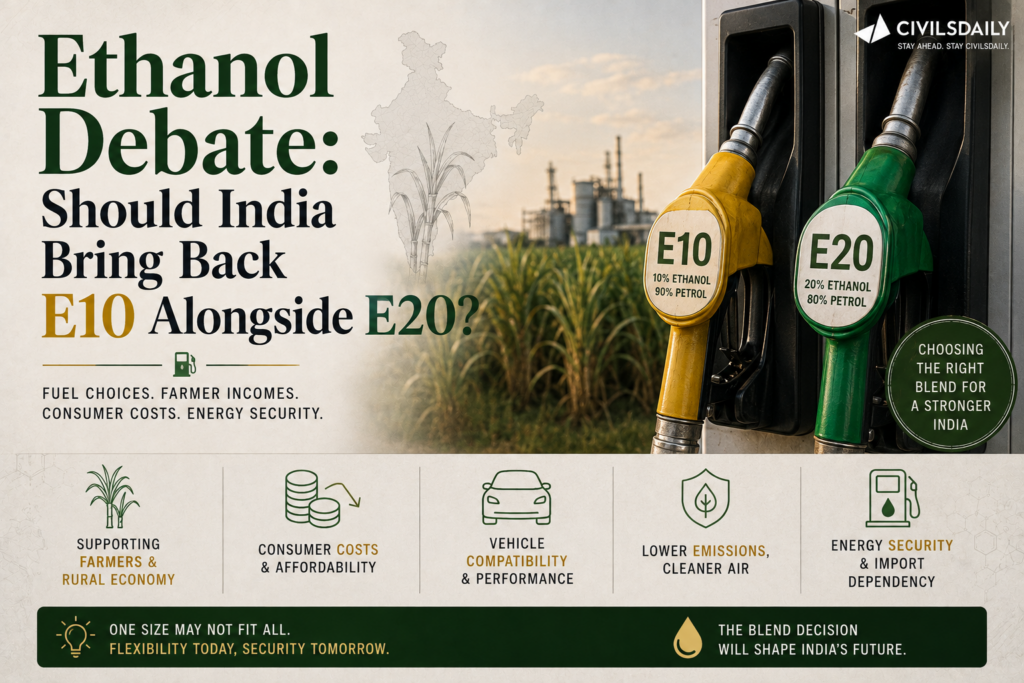
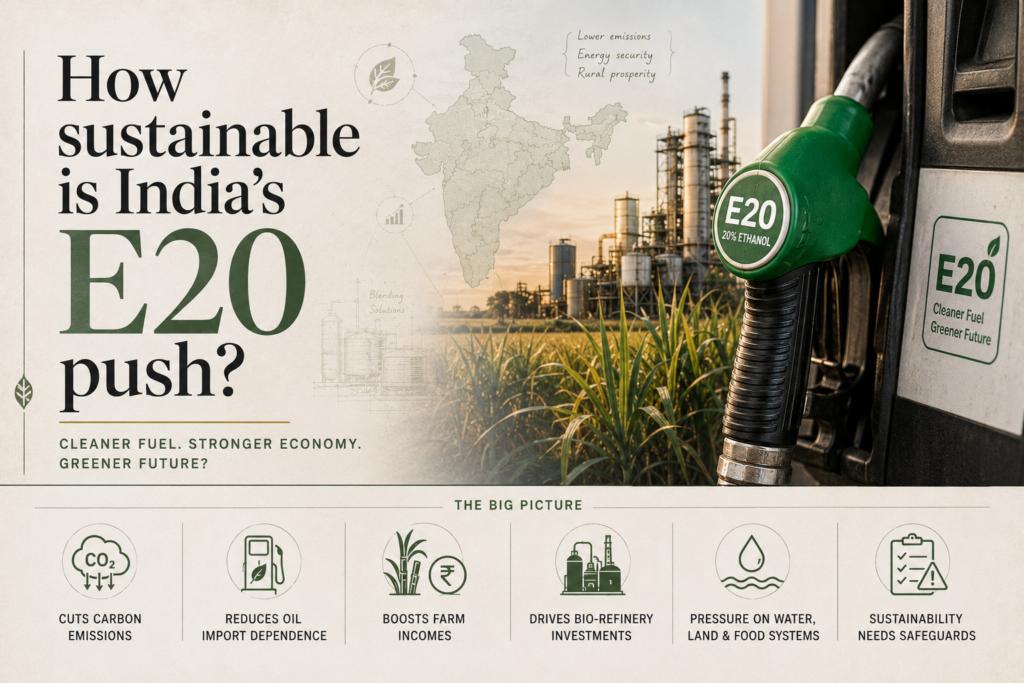
  • Ethanol Debate: Should India Bring Back E10 Alongside E20?

    Why in the News

    A public campaign claiming that E20 petrol wrecks engines and empties fuel tanks faster has been answered with test evidence showing no increased engine wear. The rebuttal has exposed the question the blending debate has avoided, which is whether pushing the blend beyond 20 percent moves land and water from food to fuel.

    What is the Ethanol Blended Petrol Programme?

    1. About: The programme mandates the blending of ethanol, an alcohol produced from crops, into petrol sold by oil marketing companies. E20 denotes a fuel that is 20 percent ethanol by volume and 80 percent petrol.
    2. Origin: It was rolled out nationally from 2003 and expanded through the National Policy on Biofuels, 2018.
    3. Feedstock routes: Ethanol is produced from sugarcane juice, B heavy and C heavy molasses, maize, damaged food grains and surplus rice.
    4. Stated objectives: It aims to cut the crude oil import bill, reduce tailpipe emissions and give cane and grain growers an assured market.
    5. Price setting: Oil marketing companies buy ethanol at administered prices that differ by feedstock route rather than at a single market price.

    What is the distinction between green water and blue water?

    1. Green water: This is rainfall held in the soil and taken up by the crop, water the field would have received in any case.
    2. Blue water: This is water drawn from rivers, canals, groundwater pumps and wells. It is the scarce component, because withdrawing it denies the same unit to another user.

    What are Distillers Dried Grains with Solubles?

    1. About: These are the residual grain solids left over after ethanol is distilled from maize or rice.
    2. Where they go: They are sold as protein rich animal feed and compete directly with soybean meal in the same market.

    Why does the charge that E20 damages engines not hold up?

    1. Lower energy density is real: Ethanol carries about two thirds the energy of petrol. A litre of E20 therefore takes a vehicle slightly less far.
    2. The size of the penalty is small: Ethanol is only a fifth of the blend, so the energy loss is around 6 to 7 percent. The 30 percent figure circulating online is wrong.
    3. Emissions improve: Carbon monoxide and unburnt hydrocarbons fall on E20, which is an environmental gain.
    4. Domestic durability testing agrees: Testing by the Automotive Research Association of India (ARAI), the petroleum institute and Indian Oil found no increased wear attributable to the blend.
    5. The fear is misplaced, the concern is not: Loss of range is not a malfunction. The genuine problem lies elsewhere in the fleet.

    Which vehicles are the genuine exception to that record?

    1. Scale of the exposed fleet: India has roughly 75 million to 80 million two wheelers built before the BS4 norms that run on carburettors.
    2. Why a carburettor cannot adjust: A carburettor cannot sense the extra oxygen the blend carries. The engine then draws too little fuel for the air it takes in and runs hot.
    3. Seal degradation is a separate defect: Older rubber seals not rated for ethanol degrade on contact with the fuel. This happens irrespective of engine temperature.
    4. Retrofitting is cheap but slow: Replacing seals with ethanol compatible ones costs little. Covering 75 million to 80 million two wheelers happens one vehicle at a time and will take years.
    5. The protection fuel went missing: The original roadmap asked that a lower blend stay on sale for these vehicles. That fuel quietly vanished from the pumps.
    6. What restoring E10 would achieve: Selling E10 alongside E20 would protect the legacy fleet while the retrofit programme catches up. It would also lower total ethanol use rather than raise it.

    Why is the edible oil import gap a better target than the crude oil bill?

    1. Scale of the crude bill: India’s crude oil import bill runs at around Rs 11 lakh crore to Rs 12 lakh crore a year.
    2. Scale of the edible oil bill: The edible oil import bill is far smaller, at roughly Rs 1.6 lakh crore to Rs 1.75 lakh crore.
    3. What E20 actually saves: Ethanol at E20 trims only 3 to 4 percent of the crude bill.
    4. The edible oil gap is closeable: India already produces about 40 percent of its cooking oil and aims to reach 72 percent by financial year 2031.
    5. The test of a good target: A gap the government can close fully and then stop subsidising is worth more than one it can only reduce at the margin forever.

    How has the shift in feedstock turned a distant trade off into a direct one?

    1. Grain now dominates the feedstock mix: Maize supplies about half of India’s ethanol. Grains together supply nearly 67 percent.
    2. Direct competition for the same fields: Maize competes with soybean, groundnut and mustard for identical acreage.
    3. First pull, the administered price: Ethanol from maize is procured at a fixed price well above the sugarcane route. That keeps maize attractive whatever the open market pays.
    4. Second pull, the feed by product: The leftover grain from distillation is sold as animal feed and undercuts soybean meal.
    5. The oilseed farmer loses twice: Weaker meal prices drag down soybean prices. The grower loses on acreage and then again on price.

    Why do the water and climate claims not settle the case for a higher blend?

    1. The headline figure mixes two things: Quoted totals of thousands of litres of water per litre of ethanol combine green water and blue water into one alarming number.
    2. Only the blue component is scarce: Rain the crop would have received anyway does not represent a withdrawal from a contested source.
    3. Where the pressure actually falls: Cane in Maharashtra and Karnataka draws heavily on already stressed rivers, canals and groundwater.
    4. What the rule should measure: A water norm for ethanol should target blue water use, not the frightening aggregate.
    5. The climate evidence is unsettled: Indian life cycle studies do not agree on whether grain ethanol is cleaner than the alternatives once cultivation and processing are counted.
    6. Consequence for the green case: The environmental argument for going beyond E20 does not survive close scientific scrutiny.

    What does experience abroad show about the limits of high ethanol blends?

    1. United States, Oak Ridge National Laboratory: The laboratory ran 86 vehicles for a cumulative 10 million kilometres on blends up to E20 and found no increased wear in cars not rated for E20.
    2. United States, multiple blends at the pump: American pumps sell E10 and E15 side by side, so owners of older vehicles retain a compatible option. This is the design India’s roadmap intended and then lost.
    3. United States, Renewable Fuel Standard: The mandate fixes volumes of renewable fuel in transport fuel. Its corn ethanol component drew sustained criticism for raising feed and food grain prices.
    4. Brazil, the Proalcool programme: Brazil built blending on sugarcane and on flex fuel vehicles able to run on any blend up to pure ethanol. The fleet, rather than the fuel specification, absorbs changes in the blend.

    Why is holding at E20 not a costless option either?

    1. Cane arrears were cleared: Ethanol demand gave sugar mills the cash flow to settle sugarcane dues owed to farmers.
    2. Rural incomes rose: The programme lifted incomes and built an assured market for cane and grain growers.
    3. Distillery capacity was built for more: Capacity now in place was created on the expectation of blends above E20.
    4. Loans were taken against expected demand: Those investments carry debt to be serviced against demand a freeze would not deliver.
    5. The sugar surplus needs an outlet: Ethanol absorbs a structural sugar surplus that would otherwise depress domestic prices.
    6. Both sides belong in the reckoning: The honest course weighs the cost of holding against the cost of advancing, rather than assuming either away.

    Why should reversibility decide the sequence of policy moves?

    1. Instruments that can change within a season: The ethanol procurement price, the protection fuel at the pump, the water rules and the import duty on edible oil can all be altered and reversed if evidence turns.
    2. The one instrument that cannot: The blend level is not reversible on the same timescale.
    3. Why the blend locks in: Once land and water are committed to fuel, cropping patterns and distillery investment are built around that commitment.
    4. The sequencing principle: Prudence says to move the reversible instruments first and hold off on the irreversible one until a thorough cost benefit analysis is complete.
    5. What the recommendation amounts to: Restore E10 for the older fleet, correct the price and water distortions favouring maize, revisit the edible oil import duty, and hold at E20.

    Challenges to the Ethanol Blended Petrol Programme

    1. Feedstock concentration in water intensive crops: Cane and maize both carry heavy irrigation demand in already stressed basins. e.g. Latur in Maharashtra received drinking water by train during the 2016 Marathwada drought while cane crushing continued in the region.
    2. Diversion of food grain to fuel: Grain routed to distilleries competes with the public distribution and feed markets. e.g. the release of surplus rice by the Food Corporation of India to distilleries was repeatedly started and stopped between 2023 and 2024 as open market rice prices rose.
    3. Material compatibility in the legacy fleet: Older engines and fuel lines were never certified for a 20 percent blend. e.g. two wheelers manufactured before the BS4 norms of 2017 use carburettors and non compliant elastomer seals.
    4. Blending logistics and evacuation: Ethanol absorbs water and cannot move through existing multiproduct petroleum pipelines. e.g. supply moves by road tanker from distillery clusters in Uttar Pradesh and Maharashtra to deficit states in the south and the east.
    5. Second generation ethanol has not scaled: Cellulosic ethanol from crop residue remains commercially fragile. e.g. the Panipat second generation bioethanol refinery based on paddy straw has struggled with feedstock aggregation since its commissioning in 2022.
    6. Administered price distortion across routes: A fixed price above the cane route pulls acreage towards maize regardless of demand. e.g. maize acreage has expanded in Bihar and Madhya Pradesh at the expense of oilseeds.
    7. Consumer trust and labelling: Buyers cannot easily tell which blend they are purchasing or whether their vehicle is rated for it. e.g. the 2026 online campaign over E20 mileage produced public demands for a lower blend option at pumps.

    Conclusion

    The engine controversy was never the real argument. The decision that matters is the blend level itself, because procurement prices, water rules, the protection fuel and import duties can be reversed within a season while committed land, cropping patterns and distillery capacity cannot. Restoring E10 for the older fleet and holding at E20 until the food versus fuel trade off is properly costed keeps every reversible option open. The unresolved question is what India chooses to grow, and what it will not be able to take back.

    Biofuels and Ethanol Blending in India

    1. About: Biofuels are liquid or gaseous fuels produced from biomass and used to substitute petroleum products in transport.
    2. Categories: They run from first generation fuels made from food crops, to second generation fuels from agricultural residue, third generation fuels from algae and fourth generation fuels using carbon capture.
    3. Blending record: Average ethanol blending rose from 1.53 percent in financial year 2014 to 20 percent in 2025, achieved five years ahead of the 2030 target.
    4. Global standing: India is among the largest ethanol producers and consumers in the world, after the United States and Brazil.
    5. Scale of the fuel base: India consumes roughly 40 million tonnes of petrol a year, which sets the size of the ethanol requirement at any given blend.
    6. Claimed gains: Official statements place foreign exchange savings from ethanol blending at over Rs 1 lakh crore since 2014.
    7. Structural feature: Ethanol is the only large scale biofuel India has commercialised, while biodiesel and compressed biogas remain far below their targets.

    Laws and Rules Governing Biofuels in India

    1. National Policy on Biofuels, 2018: Categorises biofuels, widens the permitted feedstock list and sets indicative blending targets.
    2. 2022 amendment: Advanced the 20 percent ethanol blending target to the 2025 26 ethanol supply year and permitted additional feedstocks.
    3. Industries (Development and Regulation) Act, 1951: Provides the regulatory basis for distilleries and for the Centre’s control over industrial and denatured alcohol.
    4. Judicial position: A nine judge Bench of the Supreme Court held in October 2024 that “intoxicating liquor” under Entry 8 of the State List covers industrial alcohol, preserving State regulatory power.
    5. Essential Commodities Act, 1955: Enables control over the movement, storage and pricing of molasses and ethanol.
    6. Environment (Protection) Act, 1986: Governs distillery effluent standards, including zero liquid discharge norms for molasses based units.
    7. Motor Vehicles Act, 1988 and Central Motor Vehicles Rules, 1989: Set emission norms and material compatibility requirements for vehicles rated to run on E20.
    8. Bureau of Indian Standards specifications: IS 2796 governs motor gasoline and IS 15464 governs anhydrous ethanol, with a separate notified specification for E20 fuel.

    Back2Basics: National Policy on Biofuels, 2018

    1. Nodal ministry: Ministry of Petroleum and Natural Gas.
    2. Approval and revision: Approved by the Union Cabinet in 2018 and amended in 2022.
    3. Categorisation: Divides biofuels into Basic Biofuels, meaning first generation bioethanol and biodiesel, and Advanced Biofuels, meaning second generation ethanol, municipal solid waste to drop in fuels, third generation biofuels and bio compressed natural gas.
    4. Permitted raw materials for ethanol: Sugarcane juice, sugar beet, sweet sorghum, corn, cassava, damaged food grains such as wheat and broken rice, and rotten potatoes unfit for human consumption.
    5. Blending targets: 20 percent ethanol in petrol and 5 percent biodiesel in diesel by 2030, with the ethanol target later advanced to the 2025 26 supply year.
    6. Surplus grain clause: Allows use of surplus food grains for ethanol production with the approval of the National Biofuel Coordination Committee, chaired by the Minister of Petroleum and Natural Gas.
    7. Financial support: Provides viability gap funding for second generation ethanol refineries and additional incentives for advanced biofuels.

    Government Initiatives for Biofuels and Ethanol

    1. Ethanol Blended Petrol Programme, 2003: Mandates blending of ethanol in petrol supplied by oil marketing companies across notified states and Union Territories.
    2. Pradhan Mantri JI-VAN Yojana, 2019: Provides viability gap funding to commercial and demonstration second generation bioethanol projects using lignocellulosic biomass.
    3. SATAT initiative, 2018: Sustainable Alternative Towards Affordable Transportation invites entrepreneurs to set up compressed biogas plants and sell the output to oil marketing companies.
    4. GOBARdhan scheme: Converts cattle dung and agricultural waste into biogas and organic manure, targeted at rural households and dairy clusters.
    5. Ethanol Interest Subvention Scheme: Subsidises interest on loans taken by sugar mills and standalone distilleries to expand ethanol capacity.
    6. Global Biofuels Alliance: Launched at the G20 New Delhi Summit in September 2023 with India, the United States and Brazil as founding members, to accelerate global biofuel trade and technology transfer.
    7. National Mission on Edible Oils, Oil Palm, 2021, and the Oilseeds Mission: Target domestic self sufficiency in cooking oil, which is the competing claim on the same land the ethanol programme draws from.

    Key Facts about Ethanol Blending

    1. World Biofuel Day is observed on 10 August, marking the day in 1893 an engine was run on peanut oil by Rudolf Diesel.
    2. The Ethanol Supply Year runs from 1 November to 31 October, not the financial year.
    3. E20 is 20 percent ethanol by volume, E85 is 85 percent, and E100 denotes ethanol used as a standalone fuel.
    4. India achieved 20 percent average blending in 2025, five years ahead of the 2030 target set in the 2018 policy.
    5. Flex fuel vehicles are engineered to run on any blend up to E85 or E100 without modification.
    6. Ethanol procurement uses differential administered prices by feedstock route, with the sugarcane juice route priced highest among cane routes.
    7. The National Biofuel Coordination Committee clears the use of surplus food grains for ethanol.

    Challenges in the Biofuel Sector

    1. Biodiesel blending has barely moved: Against a 5 percent target, biodiesel blending has remained close to negligible. e.g. used cooking oil collection under the Repurpose Used Cooking Oil initiative covers only a fraction of India’s restaurant and hotel supply chain.
    2. Sugar cycle volatility disrupts contracts: Ethanol supply from cane is hostage to sugar availability decisions taken mid season. e.g. the 2023 restriction on diverting cane juice to ethanol was imposed to protect domestic sugar supply and stranded distillery offtake plans.
    3. Centre and State conflict over alcohol regulation: Regulatory authority over industrial alcohol is contested and affects distillery licensing. e.g. the Supreme Court’s nine judge ruling of October 2024 held that States retain power over industrial alcohol under Entry 8 of the State List.
    4. Compressed biogas offtake and evacuation: Plant commissioning lags the announced targets because feedstock aggregation and gas evacuation are unresolved. e.g. SATAT set a target of 5,000 compressed biogas plants and actual commissioning has run far behind.
    5. Water footprint of the feedstock base: Blending demand is concentrated in crops grown in drought prone tracts. e.g. Maharashtra’s cane belt draws on stressed groundwater in districts that carry recurring drought declarations.
    6. Vehicle fleet compatibility lag: Only recent vehicles are certified for the mandated blend. e.g. only vehicles manufactured from April 2023 are E20 material compliant, leaving the older fleet dependent on a lower blend that is no longer sold.
    7. Absence of a settled national life cycle assessment: Without an agreed carbon accounting method, the climate benefit claimed for each blend level cannot be verified. e.g. Indian studies differ on whether maize ethanol lowers emissions once fertiliser and processing energy are counted.

    Way Forward

    1. Restore a lower blend at the pump: Sell E10 alongside E20 nationally until the retrofit of pre BS4 two wheelers is substantially complete.
    2. Correct the administered price: Reprice ethanol by feedstock so that maize does not carry an artificial advantage over oilseeds.
    3. Regulate blue water, not aggregate water: Set distillery and feedstock water norms on measured groundwater and canal withdrawal, with metering at the distillery gate.
    4. Fund oilseed self sufficiency: Direct the incentive structure towards closing the edible oil import gap, which is smaller and fully closeable.
    5. Scale second generation ethanol: Build residue aggregation networks so that paddy straw and bagasse substitute for grain feedstock.
    6. Mandate flex fuel capability: Require new vehicles to be flex fuel rated so that future blend changes are absorbed by the fleet rather than by the fuel specification.
    7. Publish a national cost benefit study: Complete a transparent food versus fuel accounting, covering land, blue water and life cycle emissions, before any move to E27 or E30.

    “[2020] According to India’s National Policy on Biofuels, which of the following can be used as raw materials for the production of biofuels?
    1. Cassava
    2. Damaged wheat grains
    3. Groundnut seeds
    4. Horse gram
    5. Rotten potatoes
    6. Sugar beet
    Select the correct answer using the code given below:
    (a) 1, 2, 5 and 6 only
    (b) 1, 3, 4 and 6 only
    (c) 2, 3, 4 and 5 only
    (d) 1, 2, 3, 4, 5 and 6

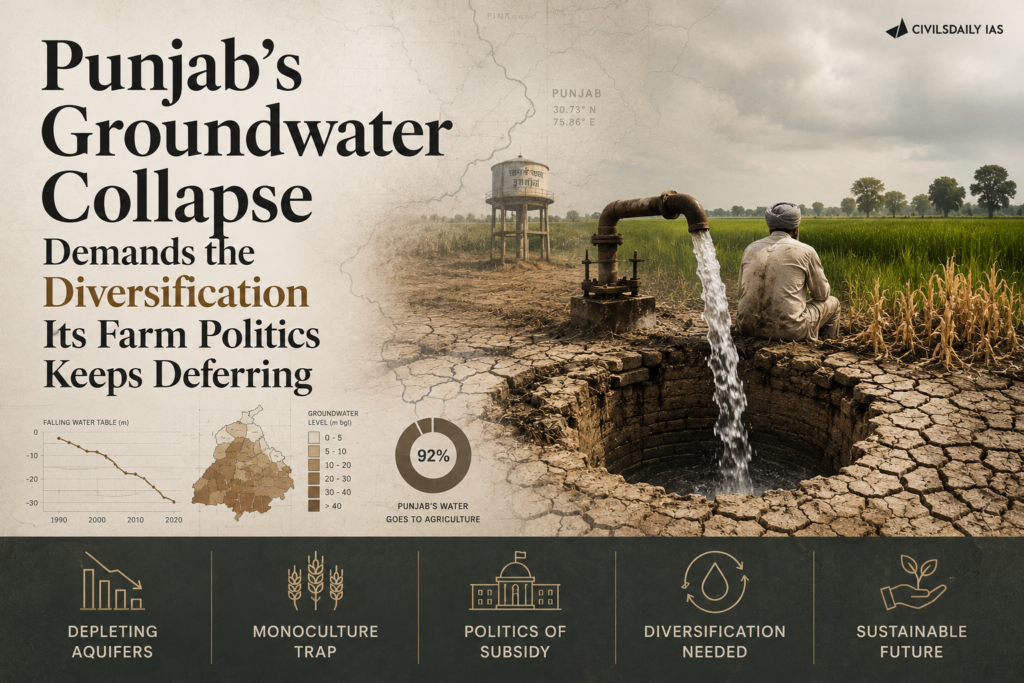
  • Punjab’s groundwater collapse demands the diversification its farm politics keeps deferring

    Why in the News

    The acreage under water intensive paddy in Punjab touched a record high this year, even as the water table continues to fall and experts warn of impending desertification. The State that built its agrarian success on assured irrigation is now consuming the resource that made it possible, while governments across party lines keep supplying free water and power rather than executing the diversification plans already drafted.

    What is crop diversification?

    1. About: Crop diversification is the shift of cropped area away from one or two dominant crops toward a wider mix of crops within the same season or rotation.
    2. How it works: A cultivator replaces part of the area under a water intensive or soil depleting crop with pulses, oilseeds, maize, cotton or horticulture.
    3. Rationale: It reduces the drawdown on a single natural resource and spreads market and weather risk across several crops.
    4. The precondition: It requires an assured market or procurement for the replacement crop, since the displaced crop already has one.

    Who was Ajit Singh?

    1. About: Ajit Singh was a peasant leader of colonial Punjab and the uncle of Bhagat Singh, and one of the main architects of the Pagdi Sambhal Jatta agitation against British agricultural laws.
    2. Exile and return: Hounded by the British, he spent nearly four decades abroad, engaging with revolutionaries including Lala Har Dayal and Subhas Chandra Bose, and was imprisoned in Germany after the Second World War before Jawaharlal Nehru secured his release in early 1947.
    3. Death: He died at Dalhousie at about 3.30 am on 15 August 1947, aged 66, his last words recorded as “Jai Hind”.

    What were the canal colonies of western Punjab?

    1. About: The canal colonies, known locally as the Baar, were settlements created in western Punjab after the British built an extensive canal network in the late nineteenth and early twentieth centuries.
    2. Why they were created: Large parts of western Punjab had remained uncultivated for centuries for want of irrigation, and the canals made cultivation possible for the first time.

    What is a murabba?

    1. About: A murabba is a square land allotment of 25 acres, the standard unit granted to settlers in the canal colonies.
    2. Who received them: Cultivators from what is now Indian Punjab, including retired soldiers, were moved into the colonies and allotted murabbas.

    What is abiana?

    1. About: Abiana is the water charge levied on cultivators for the use of canal irrigation.
    2. Why it mattered: A hike in abiana was one of the three grievances that triggered the 1907 Pagdi Sambhal Jatta agitation.

    What was the Pagdi Sambhal Jatta movement?

    1. About: Pagdi Sambhal Jatta was a peasant agitation of 1907 in colonial Punjab against three British laws that threatened farmers’ rights over their land and raised the water charge.
    2. How it got its name: Lala Banke Dayal’s poem of that title was recited at a rally in Lyallpur in March 1907, giving the movement its name and its anthem.

    What is desertification?

    1. About: Desertification is the degradation of land in dry, semi dry and dry sub humid areas, driven by climatic variation and human activity, until it loses its biological productivity.
    2. How it applies to Punjab: Sustained groundwater extraction beyond the recharge rate turns irrigated land progressively unproductive, which is the process experts have warned of in Punjab.

    What is Vibhajan Vibhishika Smriti Diwas?

    1. About: Vibhajan Vibhishika Smriti Diwas, or Partition Horrors Remembrance Day, is observed on 14 August each year since 2021.
    2. Purpose: It commemorates the displacement and loss suffered during the Partition of 1947.

    How did canal irrigation create Punjab’s agrarian identity?

    1. Arid land before irrigation: Large parts of western Punjab stayed uncultivated for centuries for want of irrigation.
    2. The canal network was the first input: The British built an extensive canal system across the region in the late nineteenth and early twentieth centuries.
    3. Settlers were the second input: Water alone was not enough, so cultivators from what is now Indian Punjab, including retired soldiers, were moved into the new tracts.
    4. Land allotted as murabbas: Each settler household received a murabba of 25 acres in the colonies.
    5. Settlements numbered, not named: New colonies were given administrative numbers such as Chak 8, Chak 20 and Chak 503, often carrying the name of the migrants’ original village, as in Chak 503 Narangwal.
    6. Reclamation took years: The land was arid and took years of sustained work before it turned fertile, which is why its loss at Partition was felt as the loss of built capital.

    What does Punjab’s tradition of agrarian resistance consist of?

    1. The 1907 movement: Ajit Singh led the Pagdi Sambhal Jatta agitation alongside Lala Lajpat Rai against three British laws that threatened farmers’ rights and hiked the water charge or abiana.
    2. Scale of mobilisation: Ajit Singh addressed 19 of the 33 meetings recorded by British intelligence.
    3. The anthem: Lala Banke Dayal’s poem was recited at a rally in Lyallpur in March 1907 and gave the movement its name.
    4. The outcome: The British withdrew the farm laws, and both leaders were imprisoned in Mandalay, Burma.
    5. Recognition: Bal Gangadhar Tilak hailed Ajit Singh as the “king of Punjab peasantry” on his return.
    6. The tradition carried forward: The same slogan was raised during the 2020-21 farmers’ agitation against the since repealed central farm laws.

    Why has the adversary shifted from colonial law to resource depletion?

    1. The threat is now internal: The challenge today is not colonial rule but the depletion of the resource that made Punjab’s agrarian success possible.
    2. Warnings are long standing: Experts have warned of impending desertification in Punjab for years.
    3. The trend is worsening, not stabilising: Acreage under water intensive paddy cultivation touched a record high this year.
    4. The water table keeps falling: The aquifer continues to drop even as extraction expands with every additional paddy season.
    5. The cost is deferred, not avoided: Groundwater does not recharge at the rate at which it is being pumped, so each season transfers the shortfall to a later one.

    Why has a known diagnosis not produced action?

    1. The solutions are already documented: Economist S S Johl outlined diversification measures during the tenure of the previous Congress government in the State.
    2. Later plans exist as well: The current State government has also prepared plans on the water issue.
    3. Implementation is the gap: Execution of both sets of plans remains negligible.
    4. The problem is not knowledge: Punjab knows precisely what has to be done and consistently fails to do it, which makes this an execution failure rather than a policy vacuum.

    Why do free water and assured paddy procurement keep expanding the crop that is emptying the aquifer?

    1. The case for the free provision: Free water and free power for tubewells lower the cash cost of cultivation for a farm sector carrying heavy debt.
    2. The political arithmetic: State governments cutting across party lines have continued the free provision for political reasons, since withdrawing it carries an immediate electoral cost.
    3. Assured procurement completes the lock in: Paddy and wheat carry guaranteed purchase at a minimum support price, and no alternative crop offers comparable certainty.
    4. The other side of the ledger: Free power removes the price signal on extraction, so pumping continues well past the rate at which the aquifer can recharge.
    5. Two legitimate claims in conflict: Farm income security and aquifer survival both carry a genuine claim, and current policy settles the question entirely in favour of the first.
    6. The cost appears nowhere: The support shows up as a power subsidy line in the State budget, while the depletion appears in no account until wells begin to fail.

    Why have farmer unions’ priorities not tracked the water crisis?

    1. Attention directed at trade: Farmer unions have mobilised strongly against free trade agreements.
    2. The nearer threat is unaddressed: The same unions have overlooked aquifer depletion as a looming calamity of comparable scale.
    3. Individual adaptation is happening: Some individual farmers have adopted alternatives to paddy on their own initiative.
    4. Collective adaptation is not: Most cultivators remain caught within an unsustainable farming model that no organised body is challenging.

    What does the stated way forward require?

    1. Reduce paddy dependence: Cut the area under water intensive paddy cultivation.
    2. Guarantee markets for the substitutes: Ensure assured markets for diversified crops so that the switch is not a loss of income.
    3. Invest in micro irrigation: Move field irrigation from flood delivery to drip and sprinkler systems.
    4. Build food processing capacity: Create processing demand that gives non paddy crops a committed buyer.
    5. Align policy with ecology: Set agricultural policy against ecological limits rather than electoral compulsions.

    Challenges to crop diversification in Punjab

    1. Absence of assured procurement for alternative crops: Only paddy and wheat carry guaranteed purchase, so any switch transfers price risk to the farmer. e.g. maize in Punjab routinely selling below its minimum support price for want of a procurement agency.
    2. Free power removes the cost of extraction: Zero marginal cost pumping eliminates any incentive to economise on water. e.g. blocks in Sangrur, Barnala and Moga classified as over exploited by the Central Ground Water Board while tubewell use continues unchecked.
    3. Sunk investment in the paddy and wheat rotation: Farm assets are built around a single cycle and cannot be repurposed. e.g. combine harvesters, paddy transplanters and laser levelled fields configured for that rotation alone.
    4. Labour and machinery calendar locked to paddy: The seasonal labour supply arrives for a specific operation window. e.g. migrant labour arriving in June for transplanting, a cycle no substitute crop matches.
    5. Groundwater regulation limited to sowing dates: Existing law delays transplanting without reducing total irrigated area. e.g. the Punjab Preservation of Subsoil Water Act, 2009, which shifted the transplanting date later but left acreage untouched.
    6. Weak processing and cold chain for horticulture: Perishable substitutes fail without storage and processing capacity nearby. e.g. kinnow growers in Abohar and Fazilka facing distress sales in glut years.
    7. Residue burning tied to the compressed paddy to wheat window: The delayed transplanting date leaves too little time between harvest and the next sowing. e.g. the October and November stubble fires across Sangrur, Bathinda and Patiala every year.

    Conclusion

    Punjab’s crisis is not the absence of a diversification plan but the presence of a policy structure that pays cultivators to keep growing paddy. Free water and power remove the cost of extraction while assured procurement removes the risk of continuing, so a record paddy acreage now coexists with a falling water table and warnings of desertification. Diversification will begin only when an alternative crop carries the same market certainty that paddy already has. Until then the tradition of agrarian resistance will keep facing outward while the aquifer empties.

    Groundwater Irrigation in India

    1. About: Groundwater irrigation is the extraction of water from aquifers through wells and tubewells for crop cultivation, as distinct from surface canal irrigation.
    2. India’s standing: India is the largest user of groundwater in the world, extracting more than the United States and China combined.
    3. Share of irrigation: Groundwater accounts for roughly 60 per cent of irrigated area and about 85 per cent of rural drinking water supply.
    4. The assessment system: The Central Ground Water Board and State agencies jointly assess blocks annually and classify them as safe, semi critical, critical or over exploited.
    5. Regional concentration of stress: Punjab, Haryana, Rajasthan, western Uttar Pradesh and parts of Tamil Nadu carry the highest proportion of over exploited units.
    6. The energy link: Subsidised or free electricity for agricultural pumping is the single largest driver of extraction, since it removes the marginal cost of drawing water.

    Constitutional Framework Governing Water in India

    1. Entry 17, State List, Seventh Schedule: Places water supply, irrigation, canals, drainage, embankments and water storage under State legislative competence.
    2. Entry 56, Union List, Seventh Schedule: Empowers Parliament to regulate inter State rivers and river valleys where it declares such regulation expedient in the public interest.
    3. Article 262: Allows Parliament to provide for adjudication of inter State river water disputes and to bar the jurisdiction of courts in such disputes.
    4. Article 21: Interpreted by the Supreme Court to include the right to clean and adequate water as part of the right to life.
    5. Article 48A: Directs the State to protect and improve the environment, which courts have read as covering groundwater conservation.
    6. Article 243G and the Eleventh Schedule: Assign minor irrigation, water management and watershed development to panchayats.

    Laws and Rules Governing Groundwater Use

    1. Indian Easements Act, 1882: Treats groundwater as attached to land ownership, which is the legal root of unrestricted extraction by landowners.
    2. Environment (Protection) Act, 1986: Provides the authority under which the Central Ground Water Authority was constituted to regulate and control groundwater development.
    3. Water (Prevention and Control of Pollution) Act, 1974: Governs the quality dimension of water resources through the pollution control boards.
    4. Punjab Preservation of Subsoil Water Act, 2009: Bars paddy nursery sowing and transplanting before notified dates, in order to shift the crop’s peak water demand closer to the monsoon.
    5. Model Bill for Conservation, Protection and Regulation of Groundwater, 2016: Circulated to States to establish groundwater as a public trust and to create local level groundwater security plans.
    6. Electricity Act, 2003: Governs agricultural power tariffs and the State subsidy mechanism that determines the cost of pumping.
    7. Guidelines for groundwater extraction, 2020: Prescribe the no objection certificate regime for industrial, infrastructure and mining users of groundwater.

    Back2Basics: Central Ground Water Board

    1. What it is: The Central Ground Water Board (CGWB) is the national apex agency for groundwater assessment, exploration, monitoring and management.
    2. Year established: Constituted in 1970, on the reorganisation of the Exploratory Tubewells Organisation.
    3. Parent ministry: It functions under the Department of Water Resources, River Development and Ganga Rejuvenation, Ministry of Jal Shakti.
    4. Headquarters: Faridabad, Haryana, with regional offices across the country.
    5. Mandate: It develops and disseminates technologies and monitors and implements national policies for the scientific and sustainable development of groundwater.
    6. Key outputs: It publishes the annual Dynamic Ground Water Resource Assessment and the groundwater year book, and it categorises assessment units by stage of extraction.
    7. Regulatory arm: The Central Ground Water Authority, constituted under Section 3(3) of the Environment (Protection) Act, 1986, exercises the regulatory powers over extraction.

    Government Initiatives for Groundwater and Crop Diversification

    1. Atal Bhujal Yojana: A community led groundwater management scheme in water stressed blocks across seven States, with incentives linked to measured improvement in the water table.
    2. Pradhan Mantri Krishi Sinchayee Yojana, Per Drop More Crop: Funds drip and sprinkler micro irrigation to raise water use efficiency at the farm level.
    3. Crop Diversification Programme: Operates in the original Green Revolution States of Punjab, Haryana and western Uttar Pradesh to shift area from paddy to alternative crops.
    4. Pani Bachao Paisa Kamao: A Punjab scheme paying farmers for electricity saved against a benchmark, converting free power into a metered incentive to pump less.
    5. Direct Seeded Rice incentive: A per acre payment in Punjab for sowing paddy directly rather than transplanting into puddled fields, cutting water use substantially.
    6. Jal Shakti Abhiyan, Catch the Rain: A national campaign for rainwater harvesting and recharge structure creation in water stressed districts.
    7. National Food Security Mission and the National Mission on Edible Oils: Support pulses and oilseeds as area substitutes for paddy through seed, input and market interventions.

    Key Facts about Groundwater and Punjab Agriculture

    1. Extraction stage: Punjab has the highest stage of groundwater extraction among Indian States, exceeding the annual recharge by a wide margin.
    2. Over exploited units: A large majority of Punjab’s assessment blocks are classified as over exploited by the Central Ground Water Board.
    3. Tubewell density: Punjab operates well over a million agricultural tubewells, nearly all running on subsidised or free power.
    4. Paddy water requirement: Transplanted paddy consumes several thousand litres of water per kilogram of grain, the highest among Punjab’s field crops.
    5. Procurement share: Punjab and Haryana together account for a dominant share of central wheat procurement and a large share of rice procurement.
    6. Green Revolution origin: Punjab was the first State where high yielding wheat varieties were introduced in the mid 1960s, establishing the wheat and paddy rotation.
    7. The 2009 legal shift: The Punjab Preservation of Subsoil Water Act, 2009 pushed paddy transplanting to mid June to align it with the monsoon onset.

    Challenges in Groundwater Management in India

    1. Legal treatment of groundwater as private property: Ownership attached to land under the Indian Easements Act, 1882 makes extraction limits hard to enforce. e.g. the absence of any cap on the number of tubewells a landowner may sink in most States.
    2. Free or heavily subsidised farm power: Zero marginal cost pumping removes the economic brake on extraction. e.g. Punjab, Haryana and Tamil Nadu supplying agricultural power free or at a nominal flat rate.
    3. Minimum support price incentives skewed to water intensive crops: Assured procurement concentrates in paddy and wheat and pulls area toward them. e.g. paddy area in Punjab reaching a record high in 2026 despite falling water tables.
    4. Weak metering and monitoring of extraction: Without volumetric measurement, regulation cannot be calibrated. e.g. the very small share of agricultural connections in the northern States that carry functioning energy meters.
    5. Aquifer contamination alongside depletion: Falling water tables concentrate geogenic contaminants and draw in poor quality water. e.g. arsenic in the Gangetic plains and fluoride in parts of Rajasthan and Telangana.
    6. Fragmented institutional responsibility: Water is a State subject while the regulatory authority is central, producing overlapping mandates. e.g. Central Ground Water Authority notifications applying to industry while agricultural extraction stays outside their reach.
    7. Poor uptake of micro irrigation: Capital cost and small holding size limit the spread of drip and sprinkler systems. e.g. micro irrigation covering only a small fraction of Punjab’s net sown area despite years of subsidy.

    Way Forward

    1. Extend assured procurement to substitute crops: Guarantee purchase of maize, pulses and oilseeds in Punjab at announced prices so the switch out of paddy carries no income penalty.
    2. Convert free power into a measured entitlement: Scale the Pani Bachao Paisa Kamao model, paying farmers for unused power rather than withdrawing the subsidy outright.
    3. Meter agricultural extraction: Install energy or volumetric meters on tubewells to make regulation and incentive design possible.
    4. Fund micro irrigation at scale: Raise the subsidy and credit support for drip and sprinkler systems to cover small holdings.
    5. Build processing and cold chain capacity: Locate processing units for maize, kinnow, potato and dairy in Punjab to create local demand for diversified output.
    6. Enact a groundwater law based on public trust: Adopt the Model Bill for Conservation, Protection and Regulation of Groundwater so extraction rights derive from a shared resource rather than land title.
    7. Link central assistance to measured water table outcomes: Extend the Atal Bhujal Yojana incentive design, so State transfers respond to verified improvement in the aquifer.

    “[2021, GS3, 15 marks] What are the present challenges before crop diversification? How do emerging technologies provide an opportunity for crop diversification?”

  • Section 79(3)(b) of the IT Act as a takedown route that bypasses judicial scrutiny

    The Union government summoned senior staff of Meta, the parent company of Facebook and Instagram, and reprimanded them over the brief removal in India of a video message by the Prime Minister. The confrontation exposed a takedown route under Section 79(3)(b) of the Information Technology Act, 2000, which allows an agency to declare content unlawful without a court ever examining the claim. Content from the Jantar Mantar protests has already been erased or suppressed through a barrage of such notices.

    What is Section 79(3)(b) of the Information Technology Act, 2000?

    1. About: Section 79 grants an intermediary immunity from liability for content that its users post, and Section 79(3)(b) is the condition on which that immunity is lost.
    2. How it operates: The immunity ends if the intermediary fails to remove the content expeditiously after receiving actual knowledge or a notification from the appropriate government or its agency.
    3. What the notice contains: It records only that the reporting agency considers the content referred to it illegal.
    4. No judicial step: No court order and no reasoned adjudication is required before such a notice is issued.
    5. The incentive it creates: An intermediary that refuses risks losing safe harbour across its entire platform, so compliance is cheaper than contest.
    6. Distinction from Section 69A: Section 69A is a formal blocking power with a designated committee and recorded reasons, while Section 79(3)(b) carries none of that structure.

    What is an intermediary under the Information Technology Act, 2000?

    1. Definition: Any person who receives, stores or transmits an electronic record on behalf of another person, or provides any service in relation to that record.
    2. Coverage: The term includes telecom and network service providers, search engines, online marketplaces, payment sites, cyber cafes and social media platforms.

    What is safe harbour?

    1. About: It is a statutory immunity that protects a platform from liability for third party content that it did not create, initiate or modify.
    2. Conditions: The platform must remain a passive conduit, must not select the receiver or alter the transmission, and must observe the due diligence and removal requirements the law imposes.

    What is Section 69A of the Information Technology Act, 2000?

    1. About: It empowers the Central Government to direct any agency or intermediary to block public access to information through any computer resource.
    2. Grounds and safeguards: Blocking is confined to the grounds in Article 19(2), the reasons must be recorded in writing, and the procedure is set by the Information Technology (Procedure and Safeguards for Blocking for Access of Information by Public) Rules, 2009.

    What did the Supreme Court hold in Shreya Singhal v. Union of India (2015)?

    1. Section 66A struck down: The provision punishing grossly offensive or menacing online messages was held void for vagueness and for travelling beyond Article 19(2).
    2. Section 79(3)(b) read down: Actual knowledge was confined to a court order or a government notification, so a private complaint alone cannot trigger a takedown obligation.
    3. Section 69A upheld: The blocking power survived because it is tied to the Article 19(2) grounds and requires written reasons.
    4. The governing test: A restriction on speech must have a proximate connection to public order, and advocacy or discussion remains protected.

    What is the current status of free speech online in India?

    1. The right: Article 19(1)(a) covers online expression, and Anuradha Bhasin v. Union of India (2020) held that expression and trade through the Internet are constitutionally protected.
    2. The limits: A restriction must fall within the eight grounds in Article 19(2) and must satisfy the proportionality test.
    3. The blocking regime: Section 69A survives with recorded reasons and a review committee, and blocking orders are treated as confidential under the 2009 Rules.
    4. The takedown regime: Section 79(3)(b) as read down requires a court order or a government notification, which agencies now issue at scale.
    5. The compliance layer: The Information Technology (Intermediary Guidelines and Digital Media Ethics Code) Rules, 2021 require removal within 36 hours of a court order or government notice, and significant platforms must appoint a chief compliance officer, a nodal contact person and a resident grievance officer.
    6. The live dispute: The Karnataka High Court in 2025 rejected a platform’s challenge to the Sahyog portal, which lets authorised officers across States issue takedown notices, and the question remains under appeal.

    Which constitutional provisions govern freedom of speech and its restriction?

    1. Article 19(1)(a): Guarantees freedom of speech and expression to citizens.
    2. Article 19(2): Permits reasonable restrictions only on the grounds of sovereignty and integrity of India, security of the State, friendly relations with foreign States, public order, decency, morality, contempt of court, defamation and incitement to an offence.
    3. Articles 19(1)(g) and 19(6): Protect the right to carry on a business, which platforms invoke against arbitrary compliance burdens.
    4. Article 21: Covers privacy and the right to receive information, recognised in K.S. Puttaswamy v. Union of India (2017).
    5. Article 14: Requires that any classification of content or of speakers be reasonable and not arbitrary.
    6. Article 13(2): Voids any law that abridges a fundamental right, which is the basis on which takedown provisions are challenged.
    7. Articles 32 and 226: Provide the remedy against an unconstitutional restriction on speech.

    What triggered the confrontation between the government and the platform?

    1. The summons: The Union government called in senior staff of Meta, the parent company of Facebook and Instagram, and reprimanded them.
    2. The stated reason: The brief removal in India of a video message by the Prime Minister.
    3. The unstated objective: Pressure on the platform to suppress posts from protests such as the demonstration at Jantar Mantar.
    4. The scale of removal: A barrage of takedown notices has already erased or suppressed the more emblematic forms of those protests.
    5. Why the platform matters: Instagram Reels shows users automatically recommended posts from creators they do not follow, which has made it one of the most influential mass media formats in the country.

    Why does Section 79(3)(b) work as a censorship route without judicial scrutiny?

    1. The notice is an assertion, not a finding: It merely records that the reporting agency feels the content referred to is illegal.
    2. No court tests it: Posts taken down under this section almost never go to court, so the assertion is never examined.
    3. The platform bears the risk: Refusal exposes the intermediary’s safe harbour, while compliance costs it nothing.
    4. Volume replaces reasoning: A route that requires no order can be used at a scale that a blocking committee could never process.
    5. The speaker is not heard: The user whose content is removed is not a party to the notice and receives no reasons.
    6. No precedent is built: Because nothing is adjudicated, the boundary of lawful online speech is never judicially clarified.

    What do the Pakistani and Chinese examples show about where this path leads?

    1. Pakistan: TikTok was banned for a period in 2021 and restored only after the platform agreed to control content described as immoral or indecent, which made market access conditional on an editorial concession.
    2. China: A single party system with a stated ideological commitment to centralised control wipes out nearly all dissent within minutes of posting.
    3. The Chinese precondition: The conditions that enabled that level of censorship were fostered over the decades preceding the Internet’s growth, not built after it.
    4. What the comparison establishes: Seeking suppression of political speech on a recommendation driven platform would place India in the company of these two systems rather than that of open democracies.
    5. The limit of the comparison: Neither example carries a constitutional court that can strike down a restriction, which is the one structural difference India retains.

    Is the platform a target of state pressure or a participant in censorship?

    1. The case for target: The company was summoned and given a dressing down, and its safe harbour is the leverage being used against it.
    2. The case for participant: For months it has taken down every post referred to it under Section 79(3)(b) without contesting a single one.
    3. Compliance as a choice: The section requires expeditious removal on a valid notification, not uniform removal of everything referred.
    4. What the pattern created: Consistent automatic compliance established that pressure works, which set the stage for the current arm twisting.
    5. The central site problem: The platform was also the main venue for the mobilisations, so its compliance decisions determined what the protests looked like in public memory.
    6. The unresolved point: A platform that never litigates a takedown converts a contestable statutory condition into an unreviewable administrative power.

    Why does the absence of Chinese preconditions not make Indian speech safe?

    1. The structural argument: Without decades of conditioning before the Internet grew, and without a single party system committed to centralising control, the Internet cannot be tamed.
    2. The capacity gap: What currently limits Indian censorship is the inability to check posts in real time, which is a capacity constraint and not a legal safeguard.
    3. The technology that closes the gap: Automated screening supplies exactly the real time capacity that is missing, which makes it a destructive solution to that gap.
    4. The cultural harm: Warping the public’s cultural self perception damages society regardless of whether full control is ever achieved.
    5. The successor problem: A draconian power created without checks passes intact to every government that follows.
    6. The wrong lesson: Mass mobilisation is being treated as an aberration to be prevented, when it is the lifeblood of a democracy.

    What are the major debates surrounding online speech regulation in India?

    1. Actual knowledge after Shreya Singhal: Whether an executive notification under Section 79(3)(b) can carry the same force as a court order.
    2. Formal against informal blocking: Section 69A carries safeguards and Section 79(3)(b) carries none, and agencies prefer the route without safeguards.
    3. Confidentiality of blocking orders: Rule 16 of the 2009 Rules keeps blocking orders secret, which prevents the affected user from challenging them.
    4. Traceability and encryption: Rule 4(2) of the 2021 Rules requires significant messaging platforms to identify the first originator of a message, which is challenged as incompatible with end to end encryption and privacy.
    5. The Sahyog portal: Whether large numbers of authorised officers across States may issue takedown notices without a central record or a reasoned order.
    6. Government fact checking: The Bombay High Court struck down the 2023 amendment creating a government fact check unit for online content about government business in Kunal Kamra v. Union of India (2024).
    7. Proportionality in practice: Whether the least restrictive means test laid down in Anuradha Bhasin is actually applied to content removal.
    8. The future of safe harbour: Whether narrowing or removing intermediary immunity would increase platform accountability or simply increase over removal.

    Challenges to the Section 79(3)(b) takedown framework

    1. Absence of a reasoned order: The notice states a conclusion without disclosing the legal ground, e.g. the removal of posts and reels documenting the Jantar Mantar protests, where users were given no ground for takedown.
    2. No hearing for the speaker: The person whose content is removed is never a party, e.g. Rule 16 of the 2009 Blocking Rules keeps orders confidential, so users blocked during the 2021 farm protest removals were never served the reasons.
    3. Over removal by platforms: The safe harbour risk pushes a platform to remove first and assess later, e.g. Meta’s uniform compliance with every referral made to it under this section over recent months.
    4. Decentralised issuing authority: A large number of officers can issue notices without a common standard, e.g. the Sahyog portal, whose challenge by X Corp was rejected by the Karnataka High Court in 2025.
    5. Automation risk: Machine screening at scale extends removal to lawful speech without human review, e.g. algorithmic suppression of Reels cuts reach without a formal takedown, leaving nothing for the user to challenge.
    6. Chilling effect on creators: Repeat removals lower a creator’s distribution, so creators censor themselves, e.g. accounts covering the protests reduced posting after the most emblematic footage was suppressed.
    7. Misuse after invalidation: An unchecked power outlives the government and even the statute that created it, e.g. arrests under Section 66A continued for years after it was struck down in 2015, until the Supreme Court issued fresh directions in People’s Union for Civil Liberties v. Union of India (2021).

    Conclusion

    Section 79(3)(b) has become the preferred route for removing online speech precisely because it needs no court, no reasons and no hearing, and a platform that complies with every referral has converted a contestable statutory condition into an unreviewable administrative power. The outcome is not Chinese style control, which India lacks the political architecture to build, but a censorship practice that is invisible, unaccounted and inheritable by every future government. What must change is the trigger itself: a notification under this section must carry a reasoned order, a record open to the user, and a route of appeal.

    What is Intermediary Liability?

    1. About: It is the legal question of when a platform is answerable for content that its users create and publish.
    2. Rationale: Platforms cannot screen the volume of user content in advance, so the law exempts them from liability in exchange for cooperation with lawful removal.
    3. Conditional immunity: The exemption applies only while the platform remains a passive conduit and acts on a qualifying notice.
    4. Notice and takedown: The standard model requires removal on receipt of a qualifying notice, and jurisdictions differ on who may issue that notice.
    5. Due diligence obligations: The platform must publish rules, appoint officers, run a grievance process and file compliance reports to retain the immunity.
    6. Significant platforms: Larger platforms carry heavier obligations, which in India begin above a threshold of 50 lakh registered users.

    Key Concerns Regarding Intermediary Liability

    1. Privatised adjudication: A company decides what is unlawful, without the procedure and reasoning a court would apply.
    2. Asymmetric incentives: The cost of wrongful removal falls on the user, while the cost of wrongful retention falls on the platform, so removal is always the safer choice.
    3. Opaque enforcement: Neither the volume nor the grounds of removals are systematically disclosed to the public.
    4. Immunity as leverage: The threat of losing safe harbour can be used to obtain compliance on matters unconnected to the notice.
    5. Automated moderation: Scale forces machine decisions on speech whose legality depends entirely on context.
    6. Jurisdictional conflict: A global platform faces contradictory removal orders from different countries over the same content.

    Constitutional and Statutory Framework Governing Online Speech

    1. Article 19(1)(a): Guarantees freedom of speech and expression, which extends to expression on the Internet.
    2. Article 19(2): Permits reasonable restrictions on that freedom only on the eight enumerated grounds.
    3. Section 69, Information Technology Act, 2000: Allows interception, monitoring and decryption of information through a computer resource in specified circumstances.
    4. Section 69A, Information Technology Act, 2000: Empowers the Central Government to block public access to information, with reasons recorded in writing.
    5. Section 79, Information Technology Act, 2000: Grants intermediaries immunity from liability for third party content.
    6. Section 79(3)(b), Information Technology Act, 2000: Withdraws that immunity if the intermediary does not expeditiously remove content after actual knowledge or a government notification.
    7. Information Technology (Intermediary Guidelines and Digital Media Ethics Code) Rules, 2021: Prescribe due diligence, a 36 hour removal timeline, grievance officers and a traceability requirement for significant messaging platforms.
    8. Information Technology (Procedure and Safeguards for Blocking for Access of Information by Public) Rules, 2009: Set the committee procedure, the hearing stage and the confidentiality of blocking orders.

    Laws, Acts and Rules Governing Online Content Regulation in India

    1. Information Technology Act, 2000: The parent statute covering electronic records, cyber offences, intermediary liability and blocking of information.
    2. Information Technology (Amendment) Act, 2008: Inserted Section 66A, Section 69A and the present safe harbour scheme in Section 79.
    3. Information Technology (Intermediary Guidelines and Digital Media Ethics Code) Rules, 2021: Created the due diligence, grievance redress and digital media ethics framework for intermediaries and online publishers.
    4. Information Technology Amendment Rules, 2023: Created a government fact check unit for content about government business, struck down by the Bombay High Court in 2024.
    5. Information Technology (Procedure and Safeguards for Blocking for Access of Information by Public) Rules, 2009: Govern the process for orders under Section 69A.
    6. Digital Personal Data Protection Act, 2023: Regulates processing of digital personal data and creates the Data Protection Board of India.
    7. Bharatiya Nyaya Sanhita, 2023: Replaced the Indian Penal Code and carries the offences of promoting enmity between groups and of statements prejudicial to national integration that are routinely invoked against online speech.
    8. Telecommunications Act, 2023: Allows suspension of telecom services and interception of messages on public emergency grounds, replacing the corresponding power in the Indian Telegraph Act, 1885.
    9. Cable Television Networks (Regulation) Act, 1995 and the Cinematograph Act, 1952: The older content regulation model on which the digital ethics code was patterned.

    Back2Basics: Information Technology Act, 2000

    1. Enacted: 2000, modelled on the UNCITRAL Model Law on Electronic Commerce, 1996.
    2. Purpose: Gave legal recognition to electronic records and digital signatures and created a framework for cyber offences.
    3. Major amendment: The 2008 amendment, brought after the Mumbai attacks, added Sections 66A and 69A and rewrote the safe harbour provision.
    4. Bodies under it: The Indian Computer Emergency Response Team (CERT-In) under Section 70B and the Controller of Certifying Authorities.
    5. Appellate route: The Cyber Appellate Tribunal’s functions were merged into the Telecom Disputes Settlement and Appellate Tribunal in 2017.
    6. Judicial history: Section 66A was struck down in Shreya Singhal v. Union of India (2015).
    7. Extraterritorial reach: Section 75 applies the Act to offences committed outside India where a computer or computer network located in India is involved.

    Government Initiatives for Digital Content and Cyber Governance

    1. Sahyog portal: A central platform through which authorised officers of States and central agencies issue notices to intermediaries under Section 79(3)(b).
    2. Indian Cyber Crime Coordination Centre (I4C): Coordinates action against cybercrime across States and runs the national cybercrime reporting portal and helpline 1930.
    3. Indian Computer Emergency Response Team (CERT-In): The national agency for cyber incident response, advisories and coordination under Section 70B.
    4. Grievance Appellate Committees: Constituted in 2023 under the 2021 Rules to hear user appeals against a platform’s content decision.
    5. Information Security Education and Awareness programme: Builds capacity and public awareness on safe digital practices.
    6. Digital India programme: The umbrella mission for digital infrastructure, services and literacy under which the intermediary framework operates.

    Key Facts about Online Speech Regulation in India

    1. Significant social media intermediary: A platform with more than 50 lakh registered users in India, which carries the additional obligations under the 2021 Rules.
    2. Removal timelines: 36 hours for a court order or government notice, 24 hours for non consensual intimate imagery, and 72 hours for information sought by an authorised agency.
    3. Compliance officers: A chief compliance officer, a nodal contact person and a resident grievance officer must be appointed by significant platforms.
    4. Landmark ruling: Shreya Singhal v. Union of India (2015) struck down Section 66A and read down Section 79(3)(b).
    5. Follow up ruling: People’s Union for Civil Liberties v. Union of India (2021) directed States to stop registering cases under the struck down Section 66A.
    6. Internet shutdowns: India records among the highest numbers of Internet shutdowns in the world, and Anuradha Bhasin v. Union of India (2020) required shutdown orders to be published and periodically reviewed.
    7. Fact check unit: The government fact check unit under the 2023 amendment was struck down by the Bombay High Court in 2024.

    Challenges in Regulating Online Speech in India

    1. No independent oversight of removals: The executive is the issuing authority, the reviewing authority and the beneficiary of a takedown, e.g. review committees under the 2009 Blocking Rules are composed entirely of government officers.
    2. Scale of misinformation: Removal cannot keep pace with coordinated falsehood on closed messaging groups, e.g. the lynchings triggered by forwarded rumours in 2018, after which a limit on message forwards was introduced.
    3. Vague statutory grounds: Terms such as public order and decency are applied without a defined test, e.g. Section 66A was struck down in 2015 precisely for that vagueness, yet similar phrasing survives in the 2021 Rules.
    4. Encryption against traceability: A traceability mandate cannot be met without weakening security for every user, e.g. the challenge by WhatsApp to Rule 4(2) of the 2021 Rules pending before the Delhi High Court.
    5. Capacity of enforcement agencies: Police and prosecutors lack the technical training to distinguish unlawful speech from lawful criticism, e.g. arrests for social media posts continued under Section 66A for six years after it ceased to exist.
    6. Economic dependence of platforms: A large user market gives the state leverage that no legal safeguard offsets, e.g. TikTok’s restoration in Pakistan in 2021 only after it accepted content conditions.
    7. Absence of transparency data: Neither the number nor the grounds of Section 79(3)(b) notices are published, e.g. platform transparency reports record aggregate requests without disclosing the legal basis of each.

    Way Forward

    1. Require a reasoned order: Mandate that every notification under Section 79(3)(b) record the specific Article 19(2) ground and the material relied on.
    2. Notify the user: Require the intermediary to serve the ground of removal on the person who posted the content, so that a challenge becomes possible.
    3. Publish takedown statistics: Require the government and platforms to publish the number, source and legal ground of takedown notices at fixed intervals.
    4. Independent review: Reconstitute the review committee under the blocking rules with non official members, including a retired judge and a technical expert.
    5. Centralise issuing authority: Restrict the power to issue notices to a designated senior officer, ending the dispersal created by portal based issuance.
    6. Statutory appeal: Provide a time bound appeal against a takedown to a tribunal, rather than leaving writ jurisdiction as the only route.
    7. Codify proportionality: Write the least restrictive means test from Anuradha Bhasin into the rules, so that suspension of reach or a geographic block is preferred to full removal.

    Matching Previous Year Question

    “[2013, GS2, 10 marks] Discuss Section 66A of IT Act, with reference to its alleged violation of Article 19 of the Constitution.”

  • [15th August 2026] The Hindu OpED: [Financial femocracy, the Jan Dhan transformation]

    PYQ Relevance
    [UPSC 2016]
    Pradhan Mantri Jan-Dhan Yojana (PMJDY) is necessary for bringing unbanked to the institutional finance fold. Do you agree with this for financial inclusion of the poorer section of the Indian society? Give arguments to justify your option.
    Linkage: The PYQ tests whether PMJDY has translated bank-account access into substantive financial inclusion for the poor. The article extends the PYQ by examining the shift from account ownership to actual usage of savings, credit and insurance.

    Mentor’s Comment

    The Pradhan Mantri Jan Dhan Yojana (PMJDY) completed twelve years on Independence Day 2026, having crossed 58 crore accounts with deposits of about ₹3 lakh crore. The milestone exposes the distance between owning a bank account and actually using savings, credit and insurance through it.

    What is the Pradhan Mantri Jan Dhan Yojana (PMJDY)?

    1. About: National financial inclusion mission announced from the ramparts of the Red Fort on 15 August 2014 and formally launched at Vigyan Bhawan on 28 August 2014.
    2. Core entitlement: Every household in India was to have a bank account, a RuPay debit card and insurance cover.
    3. Zero balance design: The account can be opened and held without any minimum balance requirement.
    4. Credit attachment: An overdraft facility of up to ₹10,000 is attached to the account so that it functions as more than a deposit box.
    5. Administering authority: The Department of Financial Services, Ministry of Finance, runs the scheme through public and private sector banks.

    What is Antyodaya?

    1. Definition: The principle that the most deprived person is the most deserving claimant on the fruits of development.
    2. Origin: The concept was propounded by both Mahatma Gandhi and Deendayal Upadhyaya.

    What is the JAM trinity?

    1. Definition: The linking of Jan Dhan bank accounts, Aadhaar digital identity and Mobile connectivity into one delivery rail.
    2. Function: It allows a government payment to reach a verified individual account without passing through any intermediate handling point.

    What is Direct Benefit Transfer (DBT)?

    1. Definition: The transfer of a subsidy or entitlement directly into the beneficiary’s bank account instead of through a physical distribution chain.
    2. Purpose: It removes the intermediate custody points at which cash and commodity leakage historically occurred.

    What is Digital Public Infrastructure (DPI)?

    1. Definition: Publicly governed digital rails for identity, payments and data sharing on which both government and private services are built.
    2. The Indian stack: Aadhaar supplies identity, the Unified Payments Interface (UPI) supplies payments, and Jan Dhan accounts supply the account layer.

    Why did political independence not deliver financial access to millions of Indians?

    1. A distant formal system: Decades after 1947, a bank account, formal credit, insurance and a reliable channel to receive government support could not be taken for granted.
    2. Leakage in delivery: A former Prime Minister acknowledged that when a rupee was sent from Delhi, only 15 paise reached the intended recipient.
    3. No delivery address: Without an account, a citizen had no address to which government money could be sent directly.
    4. Exclusion by balance: Minimum balance requirements made the formal banking system unusable for people whose incomes were small and irregular.
    5. Incomplete freedom: Political freedom remains incomplete where a citizen cannot save securely, receive money directly or reach the institutions through which economic opportunity flows.

    Why is access to formal finance treated as a responsibility of the state?

    1. The Chanakya formulation: The launch invoked Sukhasya moolam dharmah, Dharmasya moolam artha, Arthasya moolam rajyam, that the root of happiness is dharma, the root of dharma is artha, and the root of artha is the state.
    2. The claim it carries: Economic means are fundamental to human well being, so creating access to those means is a state obligation and not a discretionary favour.
    3. The Antyodaya test: The architecture was built on the rule that the last person in the queue should not remain outside the system.
    4. Entry point, not benefit: The account was designed as an entry point into the formal economy, not as one more transfer to be received.
    5. A second independence: Sixty seven years after 1947, financial and digital literacy was placed at the centre of the Independence Day address as unfinished national business.

    How was the Jan Dhan account designed so that the poorest could keep it?

    1. No entry cost: The zero balance account meant that having little money was no longer a reason to stay outside the banking system.
    2. A usable instrument: The RuPay debit card converted the account from a passbook into a transacting instrument.
    3. Small credit line: The overdraft facility gave the holder a formal alternative to the moneylender for a consumption shortfall.
    4. Embedded insurance: A ₹2 lakh accident insurance cover was attached to the RuPay card without a separate premium payment.
    5. Household unit: Coverage was defined at the household level, so the target was universality rather than a beneficiary list.

    What do twelve years of numbers show about the scale of the first step?

    1. Account base: The scheme had crossed 58 crore accounts by July 2026.
    2. Deposits held: Balances in these accounts run into about ₹3 lakh crore.
    3. Women’s share: More than half of all Jan Dhan accounts are held by women.
    4. Geographic spread: Roughly three fourths of the accounts are in rural and semi urban areas.
    5. Average balance: The two figures together imply an average balance of about ₹5,200 per account.

    How did a bank account become the first layer of a national digital infrastructure?

    1. First layer of JAM: Jan Dhan supplied the account layer on which Aadhaar identity and mobile connectivity were stacked.
    2. A direct channel: Once accounts were linked to identity and mobile, the government gained a direct route through which benefits could reach a named individual.
    3. Transformed transfers: This changed what Direct Benefit Transfer could actually do, from a pilot idea to the default mode of payment.
    4. Continuity with UPI: The same infrastructure carried the Unified Payments Interface into everyday retail payments.
    5. Cross border reach: A merchant accepting a UPI payment in France in 2026 and a first time account holder of 2014 sit on the same financial infrastructure.

    Does opening accounts amount to financial inclusion?

    1. The ownership side: With 58 crore accounts and near universal household coverage, the question of formal access has been settled.
    2. The usage side: Financial inclusion means participation in savings, payments, credit, insurance and economic opportunity, which an account count does not measure.
    3. What the balances say: An average balance of about ₹5,200 indicates that the account works mainly as a receiving channel rather than as a savings instrument.
    4. The credit gap: The overdraft remains the least used component of the design, so formal credit has not displaced the informal lender for most holders.
    5. Dormancy: Close to a fifth of Jan Dhan accounts have been reported inoperative, which means the rail exists but is not always carrying traffic.

    Why does a bank account function as a marker of identity?

    1. Recognition with respect: The account gave people from marginalised sections a formal record of existence that the system had rarely offered them.
    2. Visibility: It made those on the periphery visible and counted within the financial system.
    3. The scheme’s own framing: The tagline Mera khaata, bhagya vidhata, my account the destiny maker, states the claim that the account itself changes standing.
    4. Forward link: Financial inclusion is now positioned as an input into the Viksit Bharat 2047 goal.

    What are the challenges to the Pradhan Mantri Jan Dhan Yojana?

    1. Inoperative accounts: A large share of accounts records no customer induced transaction for long periods, e.g. the Finance Ministry ran a nationwide fresh KYC drive in 2024 covering roughly 11 crore inoperative Jan Dhan accounts.
    2. Overdraft under use: Banks sanction the overdraft to a small fraction of eligible holders because these borrowers carry no credit score, e.g. lenders treat a zero balance account with irregular inflows as an unscorable credit risk.
    3. Last mile agent viability: Business correspondents earn thin commissions on low value transactions, e.g. Bank Mitras in remote blocks handle deposits too small to cover travel and cash carrying costs.
    4. Duplicate accounts: The 2014 enrolment drive produced multiple accounts per household, e.g. families opened a second account to capture the accident cover, inflating the headline count.
    5. Unclaimed insurance: The accident cover lapses through ignorance of its conditions, e.g. holders do not know the RuPay card must have been used within a qualifying period before the accident for the claim to stand.
    6. Misuse of dormant accounts: Idle zero balance accounts are rented out as conduits for fraud proceeds, e.g. mule account networks flagged by the Indian Cyber Crime Coordination Centre have used dormant no frills accounts.

    Conclusion

    Twelve years of Jan Dhan have settled the question of access and left the question of use open. The visible achievement is 58 crore accounts; the durable one is the rail that now carries Direct Benefit Transfer and UPI. The unfinished work is converting a receiving account into a working relationship with savings, credit and insurance.

    Back2Basics:

    What is Financial Inclusion?

    1. About: Financial inclusion is the delivery of banking, payment, credit, insurance and pension services to every section of society at an affordable cost.
    2. Rationale: Exclusion from formal finance forces households into informal credit at punitive rates and denies the state a clean channel to transfer entitlements.
    3. Access: The first dimension is the availability of a formal account and a service point within reach of the household.
    4. Usage: The second dimension is the actual frequency and depth of transactions, savings and borrowing through that account.
    5. Quality: The third dimension covers consumer protection, grievance redress and financial literacy, and it is the dimension the Reserve Bank of India Financial Inclusion Index weights lowest.

    Laws and Rules Governing Financial Inclusion in India

    1. Reserve Bank of India Act, 1934: Establishes the central bank and its power to direct banking policy, including branch authorisation and priority sector norms.
    2. Banking Regulation Act, 1949: Governs the licensing and conduct of banks, and is the basis for the Basic Savings Bank Deposit Account norms that permit zero balance accounts.
    3. Aadhaar Act, 2016: Section 7 permits the use of Aadhaar authentication as a condition for receiving a subsidy or benefit funded from the Consolidated Fund of India.
    4. Payment and Settlement Systems Act, 2007: Gives the Reserve Bank authority to regulate payment systems, and is the legal basis for the National Payments Corporation of India operating UPI, RuPay and the Aadhaar Enabled Payment System.
    5. Prevention of Money Laundering Act, 2002 and Rules: Prescribe the customer identification and record keeping obligations that govern account opening and periodic verification.

    Pradhan Mantri Jan Dhan Yojana

    1. Ministry or Department: Ministry of Finance, Department of Financial Services.
    2. Launch year: 2014, announced on 15 August and launched on 28 August.
    3. Aims and objectives: Financial inclusion through zero balance accounts, insurance, overdraft and micro pension, forming the first leg of the JAM trinity.
    4. Targeted beneficiaries: Unbanked adults, with a household level coverage target.
    5. Key features: Basic Savings Bank Deposit accounts, an overdraft of up to ₹10,000, an accident cover of ₹2 lakh, and RuPay and Aadhaar Enabled Payment System interoperability.
    6. Record: The scheme holds a Guinness World Record for the most bank accounts opened in a single week during its 2014 rollout.

    Government Initiatives for Financial Inclusion

    1. Pradhan Mantri Jeevan Jyoti Bima Yojana: Renewable one year life cover for account holders aged 18 to 50 at a low annual premium.
    2. Pradhan Mantri Suraksha Bima Yojana: Accident death and disability cover for account holders aged 18 to 70 at a nominal annual premium.
    3. Atal Pension Yojana: Guaranteed minimum pension for unorganised sector workers, delivered through the same bank accounts.
    4. Pradhan Mantri Mudra Yojana: Collateral free institutional credit to micro enterprises under the Shishu, Kishore and Tarun categories.
    5. Stand Up India: Bank loans for greenfield enterprises promoted by Scheduled Caste, Scheduled Tribe and women entrepreneurs.
    6. PM SVANidhi: Working capital loans to street vendors, extending formal credit to a category with no collateral.

    Key Facts about Financial Inclusion in India

    1. JAM as a term: The JAM trinity entered official vocabulary through the Economic Survey that followed the launch of Jan Dhan.
    2. Financial Inclusion Index: The Reserve Bank publishes an annual composite index built on Access, Usage and Quality, with Usage carrying the largest weight.
    3. Priority Sector Lending: Scheduled commercial banks must direct 40 per cent of adjusted net bank credit to priority sectors, including weaker sections.
    4. Payments banks: A separate bank category was licensed to accept small deposits and offer payments without lending, expanding the service point network.
    5. Aadhaar Enabled Payment System: It allows cash withdrawal at a business correspondent point using fingerprint authentication alone, without a card or a branch.

    Challenges in Financial Inclusion in India

    1. Thin rural service points: Banking outlets remain concentrated in towns, e.g. aspirational districts in central India depend on a single business correspondent covering several villages.
    2. Low insurance penetration: Micro insurance uptake stays low despite nominal premiums, e.g. renewal rates for the low cost life and accident schemes fall sharply after the first auto debit year.
    3. Weak grievance redress: New account holders rarely reach an effective complaint channel, e.g. unauthorised debit complaints from rural holders often stop at the branch level and never reach the Banking Ombudsman.
    4. Connectivity failures: Authentication depends on network availability, e.g. Aadhaar Enabled Payment System withdrawals fail in hilly and forest blocks where mobile data is intermittent.
    5. Financial literacy gap: Holders do not understand interest, penalty and claim conditions, e.g. overdraft users treat the limit as a grant rather than as a loan carrying interest.
    6. Gendered control of accounts: Women hold accounts that male household members operate, e.g. transfers under women centred schemes are frequently withdrawn by another family member at the agent point.

    Way Forward

    1. Shift the metric: Measure the scheme on transaction frequency, credit uptake and insurance claims settled rather than on accounts opened.
    2. Build alternative credit scoring: Use account transaction history and Account Aggregator consented data to underwrite the overdraft for holders with no formal credit record.
    3. Fix agent economics: Revise business correspondent commissions to reflect distance and transaction cost so that remote service points remain viable.
    4. Run a dormancy clearance cycle: Institutionalise periodic verification and reactivation drives instead of one off campaigns.
    5. Embed literacy in delivery: Attach a short standardised explanation of overdraft interest and insurance claim conditions to every account and card issued.
    6. Harden the rail against misuse: Apply transaction pattern monitoring to dormant zero balance accounts to detect mule account recruitment early.

  • How sustainable is India’s E20 push?

    Why in the news?

    The government has told Parliament that its ethanol blending programme has saved large sums of foreign exchange, while Opposition leaders have launched campaigns arguing that E20 harms vehicles and is being forced on people. The debate exposes a tension between the energy security and forex gains of blending 20 per cent ethanol into petrol and the costs it imposes on the country’s large legacy vehicle fleet and, potentially, on food security. The dispute now runs through disputed damage studies and feedstock diversion.

    What is E20?

    1. About: E20 is petrol blended with 20 per cent ethanol, meant to replace a fifth of transport petrol with domestically produced ethanol.
    2. Objective: The government targeted 10 to 11 billion litres of ethanol so that the money stays in the Indian economy rather than flowing out as a foreign exchange outgo on crude oil imports.

    What is ethanol and why does it affect engines?

    1. Polar solvent: Ethanol is a polar solvent that degrades older rubber compounds and plastics, hardening and cracking fuel hoses over time.
    2. Hygroscopic behaviour: Ethanol absorbs atmospheric moisture, and in parked vehicles the ethanol-water mixture separates and forms an acidic layer that corrodes tanks, damages fuel pumps, and clogs filters with sludge.

    What is the status of ethanol production?

    1. Capacity ramp-up: India’s distillery capacity now can produce some 18 to 20 billion litres from around 500 distilleries.
    2. Procurement contracted: For this ethanol year, which runs November to October, oil companies have contracted to procure some 10.5 billion litres of ethanol.
    3. Feedstock mix: Government figures show 45 per cent of ethanol for petrol blending will come from maize, Food Corporation of India (FCI) rice about 22 per cent, sugarcane juice 16 per cent, B-heavy molasses about 10 per cent, damaged foodgrains around 4.5 per cent, and C-heavy molasses 1.1 per cent.
    4. Maize expansion: India’s maize output grew 45 per cent in three years to 55 million tonnes in 2025-26, with more than 20 per cent of it going into ethanol.

    Will E20 spur corn imports from the United States?

    1. No import surge: There is no evidence of a surge in ethanol or maize imports in Ministry of Commerce statistics.
    2. Import ban: Direct ethanol import for petroleum blending is banned, even as the US corn lobby pushes India to increase corn imports.
    3. Sugar stocks stable: The closing stock of sugar was around 5 million tonnes and is expected to hold, indicating diversion to ethanol has not affected sugar availability.
    4. Conditional risk: In the event of monsoon failure, crop losses, and foodgrain shortages, diversion of FCI rice, sugarcane juice, and B-heavy molasses will come under stress. This raises the possibility of corn imports.

    Which vehicles are affected, and which are not?

    1. Newer fleet safe: Vehicles bought after April 2023, when the Bharat Stage 6 Phase 2 mandate took effect, were factory-engineered for E20 with ethanol-resistant elastomers, fluorinated fuel lines, upgraded pump seals, and recalibrated engine control units.
    2. Scale of newer fleet: These roughly 70 million vehicles are about 23 per cent of India’s active petrol fleet and face little cause for concern.
    3. Legacy fleet at risk: The remaining 77 per cent, nearly 240 million legacy two-wheelers and cars built for E5 or E10, are the genuine worry.

    Do the damage claims hold up? (the central tension)

    1. Consumer complaints: Consumer surveys by LocalCircles found 66 per cent of pre-2023 owners reporting mileage losses exceeding 10 per cent, and 55 per cent reporting increased maintenance.
    2. Institutional defence: IIT Kanpur’s Engine Research Laboratory maintains E20 causes no notable damage, with efficiency loss under 5 per cent, attributing most complaints to driving habits and traffic conditions.
    3. Field disputes: Independent mechanics and automotive communities dispute this, citing real-world fuel pump and injector failures traced to ethanol’s solvent and low-lubricity properties.
    4. Manufacturer data: The government told Parliament that one manufacturer serviced 2.84 crore vehicles in FY 2025-26, including about 1.5 crore legacy vehicles, without finding E20-linked engine damage, and reported an efficiency penalty of about 2 to 6 per cent in some E10-designed vehicles.

    Why has the rollout drawn criticism?

    1. Speed of transition: India reached the 10 per cent milestone in 2022 and ramped up to 20 per cent within three years, with very little information and advisories from manufacturers.
    2. Contrast with Brazil: Brazil’s transition to high ethanol levels happened over several decades in a stable manner, alongside vehicle modifications, taking the public into confidence.
    3. Information gap: The compressed rollout left legacy vehicle owners without clear guidance on effects and maintenance.

    Has ethanol blending eased the oil supply burden?

    1. Forex saving: The government said the programme has saved around 2 lakh crore rupees of foreign exchange and substituted some 32 million tonnes of crude oil imports.
    2. Import substitution: Substituting 10 billion litres of petrol with ethanol amounts to dispensing with about a month of crude imports.
    3. Price shielding claim: The government said that while crude prices rose 70 per cent during the war in West Asia, pump petrol prices rose only 7 to 8 per cent, though under-recoveries also increased.
    4. Cost ambiguity: Oil companies procure ethanol at around 70 rupees per litre, and with the base price of petrol at 55 to 60 per cent of the pump price, it is difficult to conclude independently that ethanol has kept prices down.

    Conclusion

    The central idea is that E20 delivers real forex and energy-security gains but shifts costs onto a legacy fleet of nearly 240 million vehicles whose damage claims remain contested between consumer surveys and institutional studies. What remains unresolved is a transparent, phased communication of effects and maintenance, and a food-security cushion if monsoon failure forces feedstock diversion. A Brazil-style stable transition would have taken the public into confidence.

    National Biofuel Policy: About

    1. About: The National Policy on Biofuels sets targets for blending ethanol in petrol and biodiesel in diesel to cut import dependence.
    2. Feedstock scope: It permits multiple feedstocks including sugarcane, damaged foodgrains, maize, and other surplus grains.
    3. Blending target: The policy advanced the 20 per cent ethanol blending target, which India pursued aggressively from 2022.

    Government Initiatives for Biofuels

    1. Ethanol Blended Petrol (EBP) Programme: Mandates blending of ethanol with petrol and drives procurement by oil companies.
    2. Pradhan Mantri JI-VAN Yojana: Supports second-generation ethanol from agricultural residues.
    3. SATAT initiative: Promotes compressed biogas as a transport fuel from waste and biomass.

    Key Facts about Ethanol Blending

    1. Ethanol year: Runs from November to October.
    2. Grades of molasses: B-heavy and C-heavy molasses are distinct sugar-industry by-products used as feedstock.
    3. BS6 Phase 2: Took effect in April 2023 and coincided with factory engineering of vehicles for E20.

    Challenges to the E20 push

    1. Legacy fleet damage: Corrosion, hose degradation, and pump failures in pre-2023 vehicles.
    2. Efficiency loss: Lower energy density reduces mileage, disputed in magnitude.
    3. Food-fuel conflict: Diversion of rice, maize, and sugar feedstock risks food security in a bad monsoon.
    4. Water intensity: Sugarcane and maize cultivation for ethanol strains groundwater.
    5. Consumer information deficit: Rapid rollout without adequate advisories.
    6. Cost transparency: Different tax and costing regimes obscure whether ethanol lowers pump prices.

    Way Forward

    1. Phased communication: Issue clear manufacturer advisories on effects and maintenance for legacy vehicles.
    2. Feedstock diversification: Expand second-generation ethanol from residues to reduce grain diversion.
    3. Food-security buffer: Build safeguards to pause grain diversion during monsoon failure.
    4. Independent testing: Commission transparent, independent studies on legacy-vehicle impacts.
    5. Consumer redress: Provide guidance and support for owners of affected pre-2023 vehicles.

    PYQ Relevance

    “[2020] According to India’s National Policy on Biofuels, which of the following can be used as raw materials for the production of biofuels?

    1. Cassava

    2. Damaged wheat grains

    3. Groundnut seeds

    4. Horse gram

    5. Rotten potatoes

    6. Sugar beet

    (a) 1, 2, 5 and 6 only

    (b) 1, 3, 4 and 6 only

    (c) 2, 3, 4 and 5 only

    (d) 1, 2, 3, 4, 5 and 6

  • Are regional parties losing relevance in India?

    Why in the News?

    The defeat of the Trinamool Congress in the 2026 West Bengal Assembly elections and a wave of defections across regional parties have raised questions about their future. Lokniti CSDS data shows regional parties have retained a consistent one third vote share across four Lok Sabha elections, exposing that their challenge is organisational renewal rather than declining voter support.

    How are national and regional parties classified?

    1. What it is: The Election Commission of India classifies parties as national, state (regional), or registered unrecognised, based on vote share and seats won in general and state elections.
    2. Why vote share matters: Vote share is the best indicator of a party’s underlying support base, because India’s first past the post system magnifies both victories and defeats in seat terms.

    What do the Lok Sabha vote share figures show, 2009 to 2024?

    1. National parties combined: 63.59 per cent in 2009, 60.04 per cent in 2014, 68.15 per cent in 2019, and 62.72 per cent in 2024.
    2. Regional parties combined: 31.22 per cent in 2009, 35.85 per cent in 2014, 28.1 per cent in 2019, and 33.53 per cent in 2024.
    3. National seats: National parties won 376 seats in 2009, 342 in 2014, 397 in 2019, and 346 in 2024.
    4. BJP trajectory: The Bharatiya Janata Party (BJP) rose from 116 seats and 18.8 per cent in 2009 to 282 seats and 31 per cent in 2014, 303 seats and 37.3 per cent in 2019, and 240 seats and 36.56 per cent in 2024.
    5. Congress trajectory: The Congress fell from 206 seats and 28.55 per cent in 2009 to 44 seats and 19.31 per cent in 2014, then 52 seats and 19.46 per cent in 2019, and 99 seats and 21.19 per cent in 2024.
    6. Stable one third: Regional parties have consistently secured around one third of total votes, the only dip being 2019 at 28.1 per cent, held down by the Balakot air strike backdrop.

    What does the state wise picture show?

    1. Assembly preference: Voters display a much stronger preference for regional parties in Assembly elections than in Lok Sabha elections, underscoring the enduring pull of state level identities.
    2. Replacement within the regional camp: In Tamil Nadu, when the Dravida Munnetra Kazhagam faced a setback, it was replaced by another regional party rather than by a national one.
    3. Persistent strength: Regional parties retain significant vote share across several states despite fluctuations in seats won.

    Why do defections not signal shrinking support?

    1. Trinamool: The Trinamool Congress witnessed several defections following its West Bengal defeat.
    2. Aam Aadmi Party: The Aam Aadmi Party saw many of its Rajya Sabha members defect.
    3. Nationalist Congress Party (Sharad Pawar): It saw defections in Maharashtra.
    4. Distinction: These point to organisational vulnerabilities, but defections by themselves do not indicate a shrinking electoral support base.

    What is the governance footprint of regional parties?

    1. Independent rule: Regional parties independently govern four states, the lowest number in nearly two and a half decades, down from nine states independently governed between 2015 and 2020.
    2. Dominant coalition partners: Regional parties are the dominant partners in four states, namely Andhra Pradesh, Meghalaya, Nagaland, and Puducherry.
    3. Junior partners: The BJP leads coalitions with regional allies in Bihar, Uttar Pradesh, Assam, Goa, Maharashtra, and Tripura, while the Congress is a junior partner in Jharkhand, Jammu and Kashmir, and Tamil Nadu.
    4. Fewer governments, stable votes: The decline in the number of governments headed by regional parties does not imply a corresponding decline in their electoral support.

    Setback versus survival, the real challenge

    1. Not declining votes: The challenge before regional parties is not declining voter support but organisational renewal.
    2. FPTP distortion: The first past the post system magnifies seat swings even when vote share stays broadly stable.
    3. Too early for an obituary: A consistent one third vote share shows it is premature to write the obituary of regional parties.

    One Nation One Election context

    1. The proposal: The proposed One Nation One Election framework would synchronise Lok Sabha and state Assembly elections.
    2. Concern for regional parties: Regional parties fear that simultaneous polls could let national issues and better resourced national parties overshadow state level concerns where regional parties are strongest.

    What are the challenges to regional parties?

    1. Organisational decay: Weak cadre structures and dependence on single leaders leave parties fragile.
    2. Defections and poaching: Loss of legislators erodes bargaining power even when vote share holds.
    3. Leadership succession: Founder centric parties struggle with generational transition.
    4. Resource asymmetry: National parties command far greater funding and media reach.
    5. Simultaneous elections risk: One Nation One Election could dilute the salience of state issues.
    6. Coalition dependence: Falling numbers of independent governments push parties into junior roles.

    Conclusion

    Regional parties continue to retain a substantial and consistent support base despite electoral setbacks and defections. The evidence shows their difficulty is organisational renewal, not shrinking voter preference, since vote share has stayed near one third across four Lok Sabha elections. Both national and regional parties hold stable places in India’s party system.

    India’s Party System (Foundational Context)

    1. About: India has a multi party system with recognised national parties, recognised state parties, and registered unrecognised parties.
    2. Rationale: Party recognition governs privileges such as reserved election symbols, free broadcast time, and star campaigner allowances.
    3. Classification basis: The Election Commission of India recognises parties based on thresholds of vote share and seats won in Lok Sabha and Assembly elections.

    Key Concerns Regarding the Party System

    1. Intra party democracy deficit: Many parties lack transparent internal elections and leadership accountability.
    2. Money and elections: Rising campaign expenditure entrenches resource rich parties.
    3. Defections: Frequent defections weaken mandate stability despite anti defection law.
    4. Personality centric organisation: Dependence on individual leaders undermines institutional continuity.

    Back2Basics: Representation of the People Act, 1951

    1. What it is: The Representation of the People Act, 1951 governs the conduct of elections to Parliament and state legislatures.
    2. Coverage: It covers qualifications and disqualifications of members, registration of parties, and corrupt practices and offences.
    3. Party recognition: Party recognition and symbol allotment operate under this Act and the Election Symbols (Reservation and Allotment) Order, 1968.
    4. Regulator: It is administered by the Election Commission of India, a constitutional body under Article 324.

    Constitutional and Statutory Framework Governing Elections

    1. Article 324: Vests superintendence, direction, and control of elections in the Election Commission of India.
    2. Article 325: Provides a single general electoral roll and bars exclusion on grounds of religion, race, caste, or sex.
    3. Article 326: Provides for elections on the basis of adult suffrage.
    4. Representation of the People Act, 1950: Governs preparation of electoral rolls and allocation of seats.
    5. Representation of the People Act, 1951: Governs the actual conduct of elections and party registration.

    Way Forward

    1. Strengthen internal democracy: Institutionalise leadership succession and cadre building within regional parties.
    2. Reform party finance: Improve transparency to reduce resource asymmetry.
    3. Enforce anti defection: Tighten timelines and disqualification processes to deter defections.
    4. Protect federal representation: Design electoral reforms, including any simultaneous elections proposal, to safeguard state level voice.

    PYQ Relevance

    [UPSC 2024] Examine the need for electoral reforms as suggested by various committees with particular reference to “one nation-one election” principle.

    Linkage: The PYQ directly relates to electoral reforms and the One Nation-One Election proposal. The article highlights how simultaneous elections could affect regional parties, state-level issues and India’s federal party system.

  • [10th August 2026] The Hindu OpED: The fiscal cost of unconditional cash transfers to women

    PYQ Relevance
    [UPSC 2022]
    Reforming the government delivery system through the Direct Benefit Transfer Scheme is a progressive step, but it has its limitations too. Comment.
    Linkage: The PYQ Examines DBT-based welfare delivery, fiscal sustainability, and the trade-off between welfare transfers and human-capital expenditure. The article highlights the trade-off between cash transfers and spending on education, health and development.

    Mentor’s Comment

    Delhi rolled out the Lakshmi Yojana on August 1, an unconditional cash transfer (UCT) of ₹2,500 a month for eligible women, joining a rapidly growing list of States running similar schemes since 2023. Fresh State-wise expenditure data show that in several States this spending already exceeds the entire education or health budget, reopening the question of what these transfers displace. The concern is set against the 16th Finance Commission’s award period.

    What is an unconditional cash transfer?

    • Definition: A UCT is a direct income payment to a beneficiary with no work, attendance, or behaviour condition attached, unlike a conditional transfer or an in-kind subsidy.
    • This wave: The current schemes target women with a fixed monthly sum, framed as income support rather than a service.

    Why are states rushing to launch women’s UCT schemes?

    • Electoral promise: Most schemes were pledged at assembly elections and rolled out immediately, drawing the label of a pre-poll dole.
    • Near-universal spread: From 2023 onward almost every major state added a scheme, making it politically hard for any state to abstain.
    • Compensation framing: Some argue the transfers compensate women for the state’s failure to create broad opportunity and services.

    Are these transfers a benefit to women or a burden on states?

    • Used productively: Evaluations show women mostly spend the money on food, health and education, so the transfer reaches real welfare needs.
    • Fiscal pressure: The same spending expands a recurring liability that presses on existing health and education budgets.
    • Genuine trade-off: The tension is real, the cash is used well by recipients yet competes with the public services those recipients depend on.

    How much fiscal space do states actually have?

    • Committed spending: The 16th Finance Commission notes almost 44% of state expenditure is locked in interest payments, pensions and salaries.
    • Shrinking social share: Social sector revenue expenditure has stayed stable as a share of total spending since 2011-12 but has declined as a share of GDP since 2020-21.
    • Little room: With most of the budget pre-committed, new UCT outlays crowd against fresh investment in services and infrastructure.

    How large are these schemes across states?

    • Share of total spending: UCT outlays range from 10.03% of total expenditure in Jharkhand and 7.84% in West Bengal down to 0.97% in Goa and 0.26% in Himachal Pradesh.
    • Share of education spending: In the largest-scheme states the UCT bill exceeds half the entire education budget, near 74% in Jharkhand and Karnataka and 54% in West Bengal.
    • Named schemes and amounts: Karnataka Gruha Lakshmi (Rs 2,000), Madhya Pradesh Ladli Behna (Rs 1,500), Tamil Nadu Kalaignar Magalir Urimai Thogai (Rs 1,000), Maharashtra Majhi Ladki Bahin (Rs 1,500), Jharkhand Maiya Samman (Rs 2,500), Odisha Subhadra (Rs 10,000 a year), Assam Orunodoi (Rs 1,250), and Delhi Lakshmi Yojana (Rs 2,500).

    Do the transfers reach the poorest, or do barriers exclude them?

    • Rationalisation cuts: Maharashtra and Madhya Pradesh have reduced beneficiary numbers in the name of rationalisation.
    • Gatekeeping criteria: Delhi’s scheme requires a recommendation from the local MLA or MP, plausibly to cap numbers before rollout.
    • Access barriers: Lack of documents, weak bank access and errors in digital records still exclude eligible women.

    Conclusion:

    The transfers are used well by the women who receive them, but states have little fiscal room, since most spending is pre-committed and the social sector share of GDP is already falling. Without new resource mobilisation, the schemes are financed by squeezing the very education and health services their beneficiaries rely on. The unresolved question is whether states raise revenue to fund them or let public services erode.

    Back2Basics: 16th Finance Commission

    • Award period: The 16th Finance Commission’s recommendations cover the five years beginning 2026-27.
    • What it is: A constitutional body under Article 280, constituted every five years.
    • Mandate: Recommends the sharing of central taxes between the Centre and states (vertical devolution) and among states (horizontal devolution), plus grants-in-aid.

    [2022, GS2, 10 marks] Reforming the government delivery system through the Direct Benefit Transfer Scheme is a progressive step, but it has its limitations too. Comment.

  • RBI holds repo rate; core versus headline inflation debate

    Why in the News

    The Reserve Bank of India (RBI) held the repo rate at 5.25%. Economists are divided over whether the central bank is anchoring policy to headline CPI or to core inflation, which strips out food and fuel.

    What is core inflation?

    1. Definition: Core inflation measures price change after removing volatile food and fuel components, showing the underlying, persistent trend.
    2. Why it matters: Monetary policy affects demand-driven prices, not a monsoon-driven food spike, so core is a cleaner signal for interest-rate decisions.

    Why is the anchor contested?

    1. Mandate is headline: The RBI’s legal target is headline retail inflation around 4%, not core, so leaning on core risks appearing to shift the goalpost.
    2. Food weight is large: Food is a large share of India’s consumption basket, so ignoring it understates the inflation households actually face.
    3. Credibility risk: Frequent redefinition of the operative measure weakens the predictability that anchors inflation expectations.

    Conclusion

    The rate hold reflects a judgement that underlying price pressure is easing even as headline stays elevated. The next milestone is whether food inflation cools enough to align headline with the target.

    PYQ Relevance

    [UPSC 2024] What are the causes of persistent high food inflation in India? Comment on the effectiveness of the monetary policy of the RBI to control this type of inflation.

    Linkage: The PYQ examines the limits of monetary policy in controlling persistent food-driven inflation. The debate over headline versus core inflation highlights how the RBI balances its inflation mandate with supply-side food shocks.

  • Proposed food security amendment could hurt the poorest

    Why in the News

    The Union government has proposed replacing the fixed 35kg monthly foodgrain quota for Antyodaya Anna Yojana households with a 7kg per-person entitlement. This proposed amendment to the National Food Security Act, 2013 could hurt the poorest households by converting a fixed household ration into a per capita entitlement. The tension is between per capita fairness on paper and the real needs of small, elderly, and vulnerable households.

    What is the Antyodaya Anna Yojana (AAY)?

    1. Targeting: AAY covers the poorest of the poor households under the food security system.
    2. Entitlement: Each AAY household currently receives 35 kg of foodgrain per month, regardless of size.
    3. Zero Cost: Foodgrains are provided completely free of charge to all AAY beneficiaries.
    4. Distribution Channel: Handled via the Targeted Public Distribution System (TPDS) through local fair price shops.
    5. Portability: Access is supported nationwide via systems like One Nation One Ration Card

    Key Beneficiary Groups

    1. Widows, terminally ill, disabled persons, or persons aged 60+ with no support
    2. Single women or men with no regular income or livelihood
    3. Primitive tribal groups
    4. Landless agricultural laborers, marginal farmers, and rural artisans
    5. Daily wage earners and slum dwellers in the informal sector

    What does the proposed amendment change?

    1. Per capita shift: The household entitlement would be replaced by a per capita quota of about 7 kg per person. But the total family support cannot go over 35 kg.
    2. Small household hit: A one or two member household would receive far less than the current 35 kg.

    What are the issues with the proposed amendment?

    1. Large families may lose out: The 35-kg ceiling can reduce the effective per-capita entitlement of AAY households with more than five members, weakening the rationale of a family-size-based allocation.
    2. Unequal regional impact: States with relatively larger household sizes, particularly parts of northern India, could face a greater impact from the 35-kg ceiling.
    3. Cereal-centric approach: Linking food security primarily to cereal quantities overlooks the need for protein, pulses, fats and dietary diversity for nutritional security.
    4. No wider concerns addressed: The amendment does not address wider concerns over outdated NFSA coverage, biometric failures and access barriers in the Public Distribution System.
    5. Exclusion remains unaddressed: Revising the entitlement formula does not resolve the larger problem of eligible beneficiaries remaining outside the PDS due to outdated population estimates and identification gaps.

    Who is most exposed to the change?

    1. Elderly and widows: Single member and elderly headed households lose the most.
    2. Vulnerable groups: Particularly Vulnerable Tribal Groups (PVTGs) and small families face sharp cuts.
    3. Large AAY households among the poorest sections: Particularly families with six or more members, are likely to face the greatest disadvantage.

    What principle is at stake?

    1. Adequacy over arithmetic: A per head formula ignores that small poor households have high fixed food needs.
    2. Substantive equality in food security is at stake: A uniform ceiling may appear administratively simple, but it can produce unequal outcomes for households with different sizes and vulnerabilities.

    Conclusion

    The central idea is that a per capita rule can look equal yet strip protection from the smallest households. Whether the amendment proceeds, and with what safeguard for small households, remains open.

    PYQ Relevance

    [UPSC 2021] What are the salient features of the National Food Security Act, 2013? How has the Food Security Bill helped in eliminating hunger and malnutrition in India?

    Linakge: The PYQ examines the NFSA’s role in ensuring food security and addressing hunger and malnutrition. The proposed AAY reform raises questions about whether changes in foodgrain entitlements can preserve the NFSA’s objective of adequate and equitable food security for vulnerable households.