💥Join UPSC 2027,2028 Mentorship (July Batch) + XFactor Notes & Microthemes PDF

Category: Burning Issues

  • [Burning Issue] Inter-State River Water Disputes (Amendment) Bill, 2017

    Highlights of the Bill

    1. Dispute Resolution Cmtee (DRC) will try to settle disputes through negotiations within 1 yr, extendable by another 6 months
    2. If the negotiations fail after 18 months (1yr + 6 mths) the dispute will be referred to the Tribunal
    3. Members of DRC will comprise relevant subject matter experts as decided by the centre
    4. The Tribunal
    • the Bill proposes a single permanent Tribunal with multiple benches
    • all the existing tribunals will be merged into it
    • each dispute has to be solved within 4.5 yrs
    • appeal agains the tribunal’s verdict is not allowed. The decision is final and binding.

    For each river basin (at the national level) a dedicated agency will be established by the centre for data collection.

    The system at present (ISWDA, 1956)

    1. A new tribunal has to be formed each time a state approaches the centre with the request and the latter is convinced.
    2. 8 such Tribunals have been formed till date.
    3. The Judiciary does not have jurisdiction over such disputes. It can, however, interpret verdicts of tribunals
    4. The system has had some successes especially with the 1st gen Tribunals (Krishna, Narmada and Godavari)
    5. But in general, the system has struggled to offer equitable awards.
    • Out of the 8, only 3 tribunals'(Krishna, Narmada and Godavari) awards have been accepted by the states.
    • Tribunals like Cauvery and Ravi-Beas have been in existence for over 26 and 30 years respectively without any award.

    Problems with ISWDA, 1956

    1. Protracted proceedings and extreme delays in dispute resolution

    Reasons for delays

    • no time limit for adjudication by a Tribunal
    • no upper age limit for the Chairman or the Members
    • work getting stalled due to the occurrence of any vacancy, and
    • no time limit for publishing the report of the Tribunal
    • politicization of the issue compounds the problem

    eg. recent eruption of Cauvery dispute as an identity issue b/w Tamils and Kannadigas

    • Opacity in institutional framework and guidelines
    1. procedural complexities + India’s messy federal polity (Water – state list ; Regulation and dvpt of inter-state rivers – union list) = muddled adjudication
    • The tribunals have largely failed in ensuring compliance of verdicts, especially in the coalition era.

    eg. Punjab refused to accept the Ravi-Beas Tribunal’s verdict

    1. An absence of authoritative water data makes adjudication difficult.

    The new system (2017 Bill) vs. The existing system (1956 Act)

    • Will address problem 1 (of Delays (see above)) as
    • the Bill proposes defined timelines and qualifications for members, and
    • obviates the need for notification of the award in official gazette by the centre
    • Will NOT address the problem – of Opacity – because of procedural complexities
    • the DRC’s functions sound similar to the current techno-legal procedures of Tribunals
    • India’s messy federal polity will continue to haunt satisfactory resolution
    • as the Bill continues with the extant constitutional arrangement on ‘Water’
    • Will NOT address problem 3 – of Compliance – as
    • today, inter-state water disputes are no longer just about water allocation, public opinion matters too.
    • the Bill lacks a transparent and robust institutional framework to secure public opinion and ensure quick implementation
    • About problem 4 – related to establishment of a data bank and information system
      1. despite a similar provision in the extant law, tenuous centre-state relations have obscured success.
      2. the challenge is not about gathering data and information but more about consensus over the gathered data.
      3. moreover, the capacity to process this data to deliver ‘knowledge’ that could fasten adjudication remains elusive

    Way forward

    • Collaborative, not competitive approach to water disputes
      1. states should be sensitive to each others’ needs
      2. the govt must bring in a comprehensive legislation in place of the River Boards Act, 1956
    • Implementation / Compliance
      1. set up a transparent and robust institutional framework
      2. the SC should restrain itself in accepting the inevitable “Spl Leave Petitions” against the Tribunal’s award
    • Put ‘Water’ in the concurrent list to avoid legal complexities
    • Improve awareness about rising water stress.
    • Adopt a participatory approach (involve the public) to improve water use-efficiency.
    • Incentivize sustainable use of water, especially in agriculture and industry.
  • [Burning Issue] Institute of Excellence Debate

    Why in news?

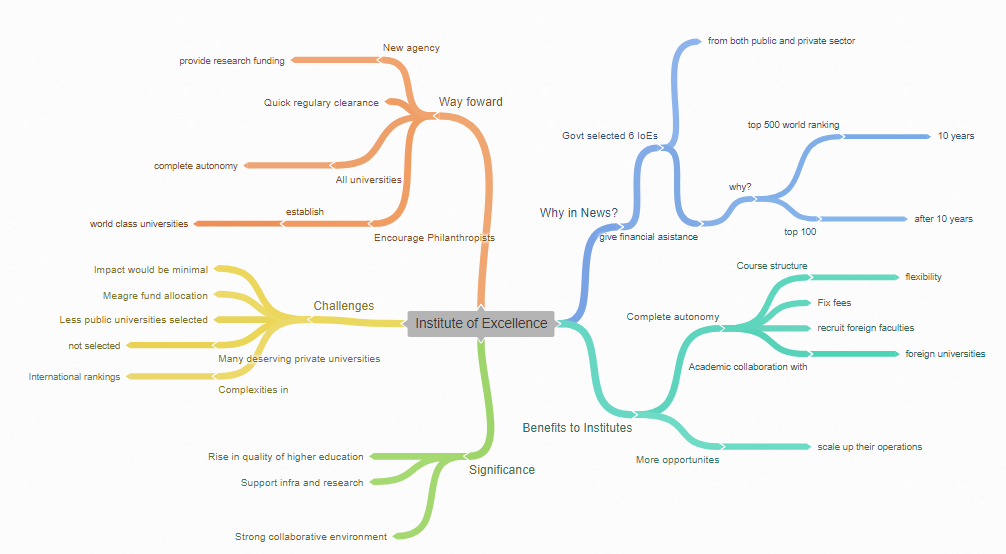
    1. The Government has shortlisted Six Institutions of Eminence (IoEs)  including 3 from Public Sector and 3 from Private Sector
    2. It is expected that the above-selected Institutions will come up in the top 500 of the world ranking in 10 years and in top 100 of the world ranking eventually overtime
    3. Each public Institution selected as ‘Institution of Eminence’ will get financial assistance up to Rs. 1000 Crore over the period of five years under this scheme

    What will be the benefit of this decision to institutes?

    1. It will ensure complete autonomy to the selected institutions and facilitate them to grow more rapidly
    2. They will get more opportunity to scale up their operations with more skills and quality improvement so that they become World Class Institutions in the field of education
    3. To achieve the top world ranking, these Institutions shall be provided with:
    • Greater autonomy to admit foreign students up to 30% of admitted students
    • To recruit foreign faculty up to 25% of faculty strength; to offer online courses up to 20% of its programmes
    • To enter into academic collaboration with top 500 in the world ranking Institutions without permission of UGC
    • Free to fix and charge fees from foreign students without restriction
    • The flexibility of course structure in terms of number of credit hours and years to take a degree
    • Complete flexibility in fixing of curriculum and syllabus

    The significance of this step

    • IoEs will have unprecedented freedom to fund activities and customise courses, bringing creativity to higher education
    • It will support infrastructure and research in leading institutions to help them achieve international rankings
    • Under this initiative, there is recognition that education and research require strong collaborative environments with other institutions and people of diverse nationalities, cultures and ideas.

    Criticism/Challenges

    1. Less public universities selected:

    • The committee tasked with recommending Institutes of Eminence (IoE) wanted eight public universities and three private ones to get the tag.
    • This was from a total of 114 universities that applied for the IoE status and scrutinised by a four-member committee.
    • These universities included 74 public, 29 private (brownfield) and 11 private (green field) universities. However, the government mysteriously sanctioned only three public universities.
    • The deserving public ones that missed out are IIT Madras, IIT Kharagpur, Delhi University, Jadavpur University and Anna University

    2. Many deserving Private universities not selected:

    • The deserving private greenfield university applicants that did not make the cut include ISB (Hyderabad), KREA (Raghuram Rajan) and Vedanta. The deserving private universities that did not make the cut include Ashoka University and Amrita University.

    3. Very meagre allocation of funds:

    • The government will give Rs 1,000 crore over five years to each of the three selected public universities.
    • That is a budgetary outlay of Rs 600 crores per year for all the pomp and show. The top 10 universities in the world spend annually an average of Rs 5,800 crore each on research alone.
    • The total endowment funds of top 10 universities on an average should be Rs 1,24,000 crore each

    4. The impact on the majority of Universities would be minimal:

    • India currently has approximately 800 universities, 39,000 colleges and 12,000 standalone institutions and over 34 million young Indians join higher education annually. Given the sheer size and scale of the Indian higher education system, the direct benefits that may accrue from implementing this proposal are likely to be minimal.

    5. Complexities of International rankings:

    • The idea of using global rankings for assessing universities has drawn some well-justified criticism before. What does a focus on rankings mean for education? Such rankings tend to prioritise impact of publications over the quality of research programs, the latter being equally, if not more, important for advancing knowledge.
    • Further, these metrics only speak to individual publications and not the evaluation of research programs or their impact on the communities that they seek to serve.
    • In nations such as India, where there is a need for research that addresses society, the usability and impact of applied research becomes important, which is one of the goals of creating IoE. This calls for newer, more holistic approaches to assessment of research quality

    Way Forward

    With the focus trained just on 6 institutes in this particular proposal, several hundreds of government universities where tens of millions of India’s youth study are being laid to waste by excessive regulation, lack of  leadership, shortage of teaching staff, inadequate funding, lack of infrastructure and maladministration, especially in smaller cities and towns. This ‘bullet-train’ type solution applied to the education field isn’t necessarily bad, but the lack of transparency seems to only benefit a minuscule proportion of the population in more than one way.

    In light of the importance and urgency of transforming India’s higher education system, lessons from around the world, it is clear that there is a better way forward for the nation.

    Following steps are required

    1. To unshackle the higher education system quickly and at scale: integrate the regulatory agencies to create a single-window for establishing new universities, eliminate unnecessary functions of these agencies, and realign their responsibilities.
    2. To spur hundreds of universities and thousands of colleges to improve their level of excellence: give all higher education institutions complete autonomy. Let them all compete and get better. In tandem with increased transparency and accountability on outcomes, all the stakeholders—students, industry, society and nation—will benefit.
    3. Encourage 40-50 philanthropists to establish world-class universities: removing the regulatory hurdles for all at the outset, and letting them earn their eminent status from stakeholders, just like Stanford and all world-class universities have done, is far more effective and equitable.
    4. Create a new agency that provides research funding on merit to faculty members in both public and private universities. This is a well-accepted practice around the world. Peer-reviewed by experts in respective fields, the increased research funding will spur competition between faculty members and institutions, catalyze India’s research and innovation ecosystem, and accelerate solving the nation’s grand challenges.

    Conclusion

    It is time to unshackle India’s higher education system from the British Raj rules, regulations, and mindset. With a tsunami-scale wave of youth at the gates of higher education, India cannot afford to transform the system six Institutes of Eminence at a time. It is time to make urgent and comprehensive reforms. Now.

  • [Burning Issue] India-based Neutrino Observatory (INO)

    Why in News?

    The India-based Neutrino Observatory (INO) project has got a fresh lease of life

    1. The Ministry of Environment and Forests (MoEF) has taken it up as a special case and granted it environmental clearance to set up the lab in Bodi West Hills

    What are neutrinos?

    1. Neutrinos are electrically neutral, elementary weakly interacting subatomic particles with half-integer spin. They belong to the lepton family.
    2. Neutrinos were first proposed by Swiss scientist Wolfgang Pauli, are the second most widely occurring particle in the universe, only second to photons, the particle which makes up light.
    3. Neutrinos are similar to the more familiar electron, with one crucial difference: neutrinos do not carry electric charge. Because neutrinos are electrically neutral, they are not affected by the electromagnetic forces which act on electrons.

    How are atmospheric neutrinos produced in nature?

    1. Atmospheric neutrinos are produced from cosmic rays which consist of protons and heavy nuclei.
    2. These collide with atmospheric molecules such as Nitrogen to give off pions and muons which further decay to produce neutrinos.

     Why study neutrinos?

    • Properties of the sun

    Solar neutrinos, produced in the core of the sun give us information about the interior of the sun. Studying these neutrinos can help us understand what goes on in the interior of the sun.

    • What makes up the universe?

    If the properties of neutrinos are understood better, they can be used in astronomy to discover what the universe is made up of.

    • Probing Early Universe

    The extragalactic neutrinos we observe may be coming from the distant past. These inviolate messengers can give us a clue about the origin of the universe and the early stages of the infant universe, soon after the Big Bang.

    • In Nuclear non-proliferation:

    It may have a role to play in nuclear non-proliferation through the remote monitoring of nuclear reactors. Using appropriate neutrino detectors, the plutonium content can be monitored remotely and used to detect any pilferage.

    • Improve telecom and internet services:

    They may open up a faster way to send data than the current ‘around the earth’ model, using towers, cables or satellites.

    Such a communication system using neutrinos will be free of transmission losses as neutrinos rarely react with the atoms in their path. This can open up new vistas for telecom and Internet services.

    • To detect mineral and oil deposits deep in the earth:

    Neutrinos tend to change their “flavour” depending on how far they have travelled and how much matter they have passed through in the way, this same property might help us detect early geological defects deep within the earth, and thereby might be the answer to an early warning system against earthquakes.

    India-based Neutrino Observatory (INO)

    1. India-based Neutrino Observatory (INO) is a particle physics research project under construction to primarily study atmospheric neutrinos in a 1,300 meters (4,300 ft) deep cave under Ino Peak near Theni, Tamil Nadu, India
    2. This project is notable in that it is anticipated to provide a precise measurement of neutrino mixing parameters
    3. The project is a multi-institute collaboration and one of the biggest experimental particle physics projects undertaken in India
    4. When completed, the main magnetized iron calorimeter (ICAL) experiment will include the world’s largest magnet, four times larger than the 12,500-tonne magnet in the Compact Muon Solenoid detector at CERN in Geneva, Switzerland
    5. The initial goal of INO is to study neutrinos
    6. Neutrinos are fundamental particles belonging to the lepton family. They come in three flavors, one associated with electrons and the others with their heavier cousins the muon and the Tau
    7. Recent experiments indicate that these charge-neutral fundamental particles have finite but small mass which is unknown

    What’s special about locating the INO in the South?

    1. A project report says most of the neutrino detectors are at latitudes over 35 deg. It is possible to push such a detector down to almost 8 deg latitude in South India, within proximity to the Equator.
    2. This permits neutrino astronomy searches covering the whole celestial sky and study of solar neutrinos passing through the Earth’s core.

    Why does INO need the mountain?

    1. The mountain consists of 1km of solid rock that filters away most of the charged particles from the cosmic rays.
    2. The filtered set consists of a part of the incident cosmic ray protons and pions and practically all the neutrinos.

    Why does the experiment have to be underground?

    1. If the detector was placed at the surface of the mountain, it would pick up billions of cosmic ray muons every hour and about 10 neutrino events per day.
    2. After placing inside the rock, it would detect only 300 muon events per hour and about 10 neutrino events per day of which 3 will be the desired muon neutrino events.

    Who else has a neutrino facility?

    1. Underground: SNO, Canada, Kamioka in Japan and Gran Sasso, Italy.
    2. Underwater: Amundsen-Scott South Pole Station, Antarctica. Antares – under the Mediterranean Sea off the coast of Toulon, France.

    Why are the locals opposing it?

    1. Locals fear that the excavation and blasts needed to bore the tunnel in the mountains will endanger the biodiversity of the Western Ghats.
    2. Some of the concerns voiced range from radiation, structural damage to the mountain to emission of hazardous chemicals.

    Other concerns and way forward

    1. Yet another concern is that spending crores on scientific research of this kind is a waste of money. Scientists counter this argument by highlighting the enormous achievements 20th century has brought in on the pillars of relativity and quantum mechanics.
    2. Furthermore, they point out that the INO faculty will give Indian particle physics students the chance to do cutting-edge research at home. This counter-argument gains significance considering the fact that more than half the Nobel Prizes in physics in the past 50 years have been awarded to basic research in particle physics — this includes the 2015 Prize for the discovery of neutrino oscillations!.
    3. Thus, while public apprehensions about projects like INO are understandable, they also illustrate the fact that communication between the scientific community and citizens needs to be more basic and more democratic. At a time when India is battling a brain drain epidemic, doing this could give its scientific community a much-needed boost while making science accessible to the larger public
  • [Burning Issue] India-Nepal Relations

    Basic features of Indo-Nepal treaty of peace and friendship

    1. Nepal is the only vital neighbour as it shares an open border with India.
    2. India and Nepal initiated their relationship with the signing ten articles treaty of 1950, “Indo-Nepal Treaty of Peace and Friendship”.
    3. The treaty allows free movement of people and goods between the two nations and a close relationship and collaboration on matters of defense and foreign policy.
    4. This allows the reciprocality for Nepalese and Indian citizens to move freely across the border without passport or visa, live and work in either country and own property or conduct trade or business in either country.
    5. However, a section of Nepalese received this treaty as violation of their sovereignty.
    6. The extensive Indian trade and economic influence was also resented by some in Nepal.
    7. In 1975 after the annexation of Sikkim by India, Nepal began openly lobbying for renegotiation of the treaty and proposed itself as a Zone of Peace between India and China.

    Importance of Nepal for India and vice-versa

    Cultural Importance

    1. While enjoying their own peculiarities, both India and Nepal share common culture and ways of life.
    2. Religion is perhaps the most important factor, and plays a predominant role in shaping the cultural relations between these two countries, marked by cross country pilgrimage on Char Dham Yatra, Pashupatinath Temple and some Buddhist sites.
    3. A considerable section of Nepalese comprises of madhesi population which has familial & ethnic ties with states of Bihar, UP.
    4. Although Nepal has its unique geography, history and cultural heritage still it is an integral part of the broader cultural history and tradition of Indian sub-continent.

    Strategic Importance

    1. Nepal is a buffer state between India and China.
    2. It has an open border with India which leads to problems such as illegal migrants, counterfeit currency entry, drug and human trafficking.
    3. Several Nepali Citizens are also deployed in Indian defense forces as well.

    Political Importance

    1. Constitutional turmoil is not new in Nepal. India has played a vital role in the democratic transition in Nepal against the monarch King Gyanendra.
    2. Nepali Congress (NC) is one of the country’s oldest parties which supports relations with India, but the communist parties show a tilt towards China.

    Economic Importance

    1. Nepal is a important export market for India.
    2. Himalayan rivers flowing through Nepal can be used for Hydroelectric power projects which will benefit border states of UP, Bihar and other adjacent areas.
    3. There are three major water deals between Nepal and India, namely the Kosi Agreement, the Gandak Treaty and the Mahakali Treaty. India also exports Power to Nepal.
    4. Also, Nepal is the largest borrower of Indian Currency in South Asia.

    Examples of bilateral cooperation

    1. The “Treaty of Peace and Friendship” was one of the landmark initiative of bilateral relations between India and Nepal.
    2. Operation Maitri of 2015 reiterated India’s commitment towards relations with Nepal. The search, rescue and relief operations carried out by Indians.
    3. Through this India once again proved its potential in role-playing and responsibility-bearing capacity in the region.
    4. India also announced a post-earthquake reconstruction package of US$ 1 bn for Nepal.
    5. India and Nepal have a Power Exchange Agreement since 1971 for meeting the power requirements in the border areas of the two countries.
    6. In 2014, PM Modi won hearts of Nepalese Population by his address in Nepal’s parliament.

    Irritants in bilateral ties

    Grudges of Nepal

    1. Anti-India Sentiment in Nepal is largely politically motivated as it is wrongly perceived as India’s backing to Monarchy.
    2. The issue of open borders has also been a point of debate in Nepal in recent years- Nepalese people argue that the India is benefiting more from it than Nepal.
    3. Nepal feels vulnerable and insecure because it is landlocked.
    4. Increasing Chinese presence in Nepal is one of the major concern for India. China’s move to extend the rail link to its border with Nepal can reduce Kathmandu’s dependence on India.
    5. Fundamentally these Chinese agencies are building up anti-India sentiments in Nepal.
    6. Nepal’s assent for “One Belt One Region” (OBOR) initiative of China is viewed by India with suspicion.

    Grudges of India

    Madhesi Issue

    1. Nepal adopted the new post-monarchy Constitution in 2015. Madhesi, a minority group residing in the Terai of Nepal, have been demanding a redrawing of federal boundaries.
    2. The Nepali constitution has given equal representation on the basis of “geographical area” triggering a demand for separate Madhesi province.
    3. Most of the key constitutional posts have been reserved for only citizens by descent hence surpassing Madhesis.
    4. In line with Madhesi Protest, Indian supply was blockaded at the border points leading to acute shortage of essential commodities.
    5. Nepal has accused India of imposing an undeclared blockade
    6. This angered a large part of the Nepalese population, allowing China to step in as an alternative.

    Human trafficking in Nepal

    1. An estimated 100,000–200,000 Nepalese in India are believed to have been trafficked.
    2. Sex trafficking is particularly rampant within Nepal and to India, with as many as 5,000–10,000 women and girls trafficked to India alone each year.

    Border Issue

    1. The unsettled border disputes at Kalapani and Susta have contributed substantially to the anti-Indian sentiments in Nepal.
    2. Border crossings from undesignated posts is a matter of content for India.

    India’s importance to Nepal

    1. India is the nearest foreign employer to Nepali Citizens, which provides various avenues of work and ease in assimilation into a foreign culture.
    2. India is the only potential neighbour who could harness Nepal’s hydropower.
    3. Moreover, Indian tourists are the major movers of Nepal’s tourism sector.

    Nepal’s Importance for India

    1. Nepal is a feasible market for Indian exports and attracts huge economic dependence on India.
    2. It acts as a strategic buffer state between India and China.
    3. As discussed earlier, India is the only beneficiary to harness its immense hydropower capacity.
    4. It is one of the major proponent and supporter of India’s interest on various International forums.

    Way Forward

    1. India can be the big-brother for Nepal in all sense.
    2. The onus is on India to rethink on a long-term basis how to recalibrate its relationship with Nepal provided Nepal should not ignore its dependence on India.
    3. India needs to continue to understand that there is another opportunity to rewrite bilateral and geopolitical history.
    4. India needs to also realize the new reality that its monopoly over geopolitics in Nepal is over, and there is another relationship that Nepal is nurturing.
    5. While China does not have people-to-people interactions with Nepal on a par with India, it has an open avenue for India to retain its strategic importance.
  • [Burning Issue] Indo ASEAN Relations

    Why in News?

    • India invited all ten heads of state of the Association of Southeast Asian Nations (ASEAN) as chief guests at the Republic Day celebrations.
    • India and the ASEAN are also celebrating
    1. 25 years of their rapidly expanding partnership.
    2. 15 years of their Summit engagement.
    3. Five years of Strategic their Partnership.
    • In addition, ASEAN completed 50 years of its establishment.

    India-ASEAN Relations

    • Look-East Policy in 1992 gave an upthrust to India -ASEAN relation and helped India in capitalizing its historical, cultural and civilizational linkages with the region.
    • India entered into a Free Trade Agreement(FTA) in goods with the region in 2003 which has facilitated the bilateral trade which now stands at approximately USD 76 Billion.
    • The India-ASEAN Free Trade pact in services and investments, which was concluded in 2014 and came into effect a year later, has the potential to further reduce India’s trade deficit with ASEAN.
    • Further, the launch of Act East Policy in 2014 has added a new vigour to India-ASEAN relations.
    • ASEAN countries, owing to their strategic location in the Pacific Ocean, are also very crucial for maintaining the stability in the Indo-Pacific region.

    Five-key focus areas for India and ASEAN

    • Connectivity
      1. Physical connectivity remains a constraint in India-ASEAN trade relations.
      2. However, infrastructure projects like Trilateral Highway connecting India’s Northeast to Thailand, the Data Deep-sea Port in Myanmar, and the Kaladan Multi-modal Transit Transport Project have the potential to overcome the infrastructure bottleneck. Continued commitment and investment is needed.
      3. Apart from this, Non-tariff barriers should also be rationalized and the institutional mechanisms be streamlined to further augment the connectivity with the region.
    • Maritime Security
      1. The maritime space in today’s world plays a key role not only in economic development but also in security and connectivity.
      2. Piracy, disputes over resources, territorial claims, terrorism, China’s increasing assertiveness, and a fractured governance system are creating instability in the Indo-Pacific region.
      3. Thus, ASEAN India cooperation is imperative for maintaining peace and stability in the region.
    • Blue Economy
      1. Given India’s vast Exclusive Economic Zone(EEZ), there is huge potential in this sector that remains to be realized.
      2. India should deepen its engagement with ASEAN on this front through developing PPP models for fisheries sectors, knowledge sharing and joint efforts to conserve and manage coastal and marine resource.
    • The Digital Age

    Two things need to be considered under this :

    Inclusive Growth

    Technological disruptions may further increase inequality in incomes, digital access, and opportunities. Thus, India and ASEAN should focus on greater knowledge sharing and developing best practices for fostering inclusive growth.

    Cyber Security

    Policies governing cyberspace and cyber securities are in their nascent stage, in such scenario both India and ASEAN should seek to be a decisive voice in norm-setting, and in cultivating inter-regional cooperation for addressing cyber insecurity.

    • Migration
      1. Because jobless growth in India, unemployment is on rise. In such scenario, ASEAN nations can act as an important destination for Indian immigrant workers.
      2. On the other hand, job creation is expected to rise in ASEAN countries like Singapore and Malaysia. There are gaps in labour supply across different sectors in ASEAN nations.
      3. Therefore, both India and ASEAN should work together to reduce barriers to immigration, and facilitate the freer movement of labour between them, as they both stand to gain.

    Issues Hampering India-Asean Relations

    • In bilateral trade, there is an imbalance as the majority of ASEAN countries have strong manufacturing bases that rely on export while Indian export remains feeble. Moreover, the current policy under Make In India is to promote domestic production.
    • India still engages more with ASEAN countries on a bilateral basis rather than on a multilateral basis.
    • India’s has a limited capacity to provide development assistance and other financial relation. Moreover, ASEAN’s inclination to harness India for regional stability remains limited because of the presence of other regional powers like China.

    Conclusion

    • On the trade front, there are certain concerns related to Free Trade Agreement in services. Services being India’s domain, India need to work on these concerns on a priority to give an impetus to exports in services.
    • Efforts should also be made to finalise an agreement for free movement of labour so that both ASEAN and India could capitalize on each other’s resources
    • Further, with increasing assertiveness of China Indo-Pacific region and the uncertain Trump administration in U.S. A, the cooperation between India and ASEAN become all more important to maintain rule-based order and stability in the Indo-Pacific region
  • [Burning Issue] India Israel Relations

    Why in News

    The fact that an Indian Prime Minister is making a visit for the first time in 25 years since we established full diplomatic ties is significant and termed historic in itself. The focus of the visit signifies 25th anniversary of diplomatic ties has opened a new chapter in the Indo-Israel bonhomie.

    Advantage Israel

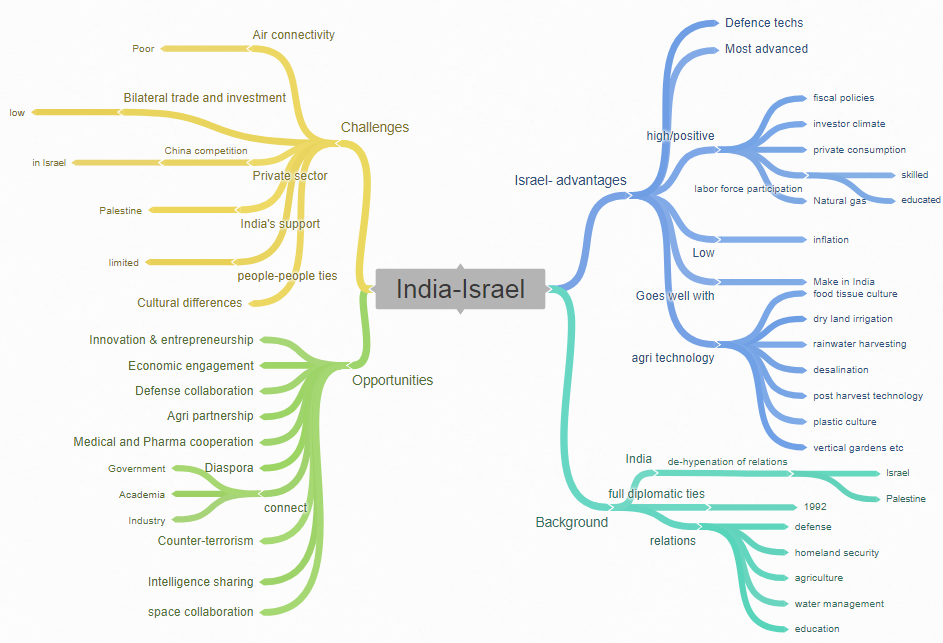
    1. Israel, led by strong growth of private consumption, low inflation, rising labor force participation, a positive investors’ climate because of low interest rates, natural gas finds and responsible fiscal policies, has a lot to offer.
    2. A modern economy like Israel goes well with our own flagship programmes like Make in India. Indian companies with their engineering and scale and Israeli companies with their innovation and technology can together stimulate our domestic manufacturing sector, particularly in defense.
    3. Israel, at the same time, is considered as the most advanced country in SW Asia and the Middle East in economic and industrial development.
    4. It is a developed country having a highly skilled and educated workforce. So, developing relations between the two is important.
    5. Israel has become one of the foremost technology superpowers in areas such as rainwater harvesting, use of oceanic water and using that for irrigation in the most dry land.
    6. Israel has transitioned from a water-deficit state to a water-surplus state, and has pioneered the water desalination technique, something that’s absolutely significant in the era of climate change, rapid loss of fresh water bodies, and rise in seawater levels.
    7. Israel achieved self -sufficiency in food production despite having 50% barren Land. Its 3.7% of workforce produces 97% of its own food. India could well follow its path by using techniques from it like Drip Irrigation, Post-Harvest technology, Food Tissue culture, Plastic Culture , Vertical gardens etc.

    Background of Indo- Israel relations

    1. Since India established full diplomatic ties with Israel in 1992, relations between the two countries have grown at an astonishing pace, covering a wide range of issues from defence and homeland security, to agriculture and water management, and now education and even outer space.
    2. The formal acknowledgement of the relationship at the highest levels leaving behind hesitations of history and India’s de-hyphenation of its Israel and Palestine policies for the first time (and taking the related course-correction measures such as rethinking India’s voting choices on anti-Israel resolutions at the UN and dropping the demand for East Jerusalem as capital of a future Palestinian state), is the turning point in the relations of both countries going forward.

    Key areas of Camaraderie, cooperation and coordination

    Hinged on defence, intelligence-sharing, counter-terrorism on one side and cooperation in water harvesting and agriculture on the other, there are a number of avenues in which India-Israel ties would be key to the emerging global order.

    • Economic Engagement: Israel, led by strong growth of private consumption, low inflation, rising labor force participation, a positive investors’ climate because of low interest rates, natural gas finds and responsible fiscal policies, has a lot to offer.  Policy initiatives on ease of doing business and the opening of defense, construction and pharma sectors have added to India’s attractiveness as an investment destination.
    • Defense collaboration: The India-Israel equation in defense has acquired strategic dimensions but there is need and opportunity to make it “more broad-based” through production and manufacturing partnerships. Israeli defense industries are well inclined towards joint ventures to give a boost to the ‘Make in India’ campaign.
    • Innovation and Entrepreneurship Culture: Israel embodies a culture of entrepreneurship highlighted by the power of innovation, global leadership in R&D spending and venture capital investment. A joint innovation and research and development fund can work wonders.

    A country that has no automotive industry for example, and yet they are the R&D centre for autonomous cars (self-driving) in the world.

    • Agricultural Partnership and Water Conservation: Arid land technology, biotechnology and a joint action plan to research India specific and export-oriented seeds deserve attention. Israel has tackled its rain deficiency by developing technology solutions for waste water management, purification, desalination techniques and water reuse in agriculture and industry. The Israeli dairy industry with its proven know-how and design, technology and genetic material can revolutionize the dairy industry in India.
    • Medical and Pharma sector cooperation: Medical technologies and devices could be the next growth areas for collaboration.
    • Diaspora potential: Another important factor in bilateral ties will be the Indian diaspora. Most Jewish Indians, about 80,000, have all moved here, and there are just about 4,000-5,000 left in India.
    • Academia-Industry- government Connect: We have to learn from their universities, how they have technology transfer companies based right on their campuses, who help convert theory into useful products in a very short period of time.
    • Counter-Terrorism and Intelligence Sharing: India and Israel are boosting up the counter-terrorism cooperation and sharing real-time intelligence on issues crucial to national security.
    • Military and Strategic Ties: Israel is the second-largest source of defense equipment for India, after Russia. Arms trade between the two nations reached almost $600 million in 2016. India has purchased Barak I missiles, 3 Phalcon AWACS, and Israeli spike anti-tank missiles from Israel. Israel is developing Barak 8 missile for Indian Navy and IAF and plans to purchase 2 more Phalcon AWACS are in progress.
    • Space Collaboration: In 2002, India and Israel signed a cooperative agreement promoting space collaboration. India has successfully launched TecSAR and RISAT-2 radar imaging satellites of Israelfrom PSLV of ISRO.

    Sticky Points in the Relations

    1. Bilateral Trade and investment still below potential: From just $200 million in 1992, bilateral trade (excluding defense) peaked at about $5 billion in 2012 but since then it has dropped to about $4 billion. Also, bilateral trade has not diversified much—diamonds and chemicals still make up for the large chunk of the pie.
    2. Private Sector still finding feet: Indian companies like Sun Pharma and ATG, a specialty tyre-maker, have big interests in Israel. But perhaps unsurprisingly, the Chinese are streets ahead of us in bilateral trade and their companies are investing heavily in Israel’s cutting-edge start-ups.
    3. Connectivity between two countries still poor with just one direct flight from Mumbai 3 times a week and no direct flights from Delhi.
    4. Historical retrenchment: India’s consistent support for a sovereign, independent, viable and united Palestinian state with East Jerusalem as its capital, living within secure and recognized borders, side by side and at peace with Israel and Pro-Arab stance has been a sticky point.
    5. Limited People to People ties and cultural differences: Israelis and Indian approach business differently and often find it difficult to get on the same page. Though formal ties were established in 1992, but the ideological divide resurfaces time and again.

    Way forward

    1. Investments to boost tourism, education and cultural ties and building bridges with the Indian diaspora in Israel can help significantly in this context. Indeed, these are the low-hanging fruits in the bilateral relationship that can be plucked right away.
    2. Taking cues of Israel’s industry-academia ecosystem, its innovation and start up culture and the state of art cutting edge technology across sectors; India can build mutual collaborations for present and future development.
    3. Tapping each other’s potential should be the imperative in the new “Strategic Partnership” to truly make “India-Israel is a match made in heaven”
  • [Burning Issue] India-Iran Relations

    WHY INDIA NEEDS IRAN?

    • Conventionally, for energy security
    1. Iran is amongst India’s top oil suppliers
    • But since the 1990s, Iran’s importance has become ‘strategic’
    1. Iran’s cooperation is critical for India’s security given that
    2. Pak supports terrorism in India
    3. India’s influence in Afghanistan is marginal
    • India needs Iran to moderate Pak’s influence in West Asia
    1. Iran is a leader in the Muslim world
    2. Pak is anti-India
    • Access to Afghanistan and Central Asia
      1. Till 1947 (undivided India), India shared a border with Iran

    WHY IRAN NEEDS INDIA

    1. India is Iran’s second largest oil buyer after China.
    2. While Iran is of strategic importance to India, the reverse is not true. India is, at best, a trade partner for Iran

    IRRITANTS IN INDO-IRAN TIES

    • Growing Saudi-India-US-Israel relations have irked Iran.
      1. in retaliation, Iran, for the first time, has linked the plight of Muslims in Gaza, Yemen, and Bahrain, with those in Kashmir
    • Warming Iran-Pak-China ties have annoyed India.
    • Slow Chahbahar port development has annoyed Iran
      1. Iran has indicated that the port will not be used exclusively by India and that China and Pak may be invited

    JOINT COMPREHENSIVE PLAN OF ACTION (JCPOA)

    • About the deal
      1. Signed between Iran and P5+1 (the five permanent members of the U.N. Security Council and Germany) in 2015.
      2. Iran agreed to a joint comprehensive plan of action (JCPOA) in return for removal of the economic sanctions against it.
      3. The JCPOA drastically reduced Iran’s uranium enriching capacity & levels, enriched stockpiles and centrifuges. Besides, it provided for stringent inspection and monitoring by international agencies.
    • Has Iran complied?
      1. Yes. All other signatories as well as the UN (The IAEA) have confirmed Iran’s compliance of the deal (latest report, Aug 2017)
    • Benefits for Iran
      1. Removal of sanctions boosted her economy. GDP grew at 9.2% in the latest quarter (jul-sep 2017).
    • Why USA/Trump wants to trash the deal?
    1. The present deal doesn’t address (US ally) Israel’s concerns adequately.
    2. Moreover, Trump administration has never explicitly stated why it considers the JCPOA “the worst agreement in American diplomatic history”.
    • Trump has been hawkish towards Iran since he took over as President.
    1. Imposing new sanctions on its missile programmes and joining hands with its regional rivals in West Asia have been part of Trump’s Iran policy.

    Possible ramifications of cancellation of the JCPOA

    1. Hardliners in Iran will make a political comeback which will lead to uncertainty and instabilty in West Asian geopolitics
    2. Threat of nuclear proliferation as Iran may resume its nuclear weapons programme.
    3. Since EU supports Iran, the withdrawal will hurt US-EU relations. The Trans-Atlantic Security Partnership will lead to secondary US sanctions against EU companies dealing with Iran.
    4. USA’s unilateral decision to withdraw will hurt its stature as a global leader.

    Impact on India

    • Indian Diaspora
    1. Political instability in West Asia will undermine their security and remittances.
    • Crude Oil
    1. Iran accepts payment in Indian currency for its oil.
    2. India will have to depend more on Saudi Arabia and Iraq for oil supplies.
    3. Reduction of supplier diversity will make India more vulnerable to oil price shocks
    • Chabahar
    1. India could lose access to Chahbahar port of Iran which is a strategic necessity for India’s access to Central Asia.
    • Iran-Pak-China
    1. This axis could get strengthened.

    Way ahead for India

    1. India will have to maintain a fine balance between US, Israel and Saudi on the one hand and Iran on the other.
    2. India should make greater use of Euro-denominated transactions for its oil trade to minimise the adverse impacts.
    3. Also, efforts should be made to revitalise mechanisms like the Asian Clearing Union.
  • [Burning Issue] India’s membership of Australia Group and Wassenaar Group

    Why in News?

    In last 1-year India has become the member of Australia group and the Wassenaar group

    https://s3.amazonaws.com/examsprint-api-prod/production/articles/thumb_9b9d255fe9e8aa5328369bad9da0d4d8.png


    India Joins the Australia Group

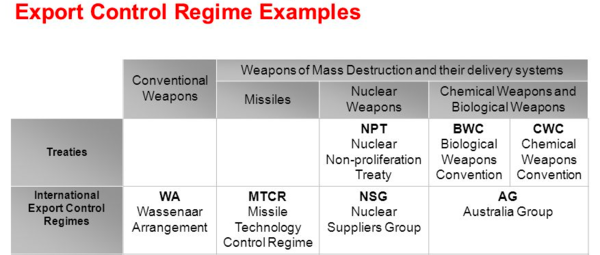
    • India has admitted as the 43rd member of the Australia Group
    • The group is an informal bloc of countries that keep a tight control over exports of substances used in the making of chemical weapons

    The Australian Group

    • The Australia Group is a multilateral export control regime (MECR) and an informal group of countries (now joined by the European Commission) established in 1985 (after the use of chemical weapons by Iraq in 1984) to help member countries to identify those exports which need to be controlled so as not to contribute to the spread of chemical and biological weapons
    • The group, initially consisting of 15 members, held its first meeting in Brussels, Belgium, in September 1989.
    • With the incorporation of India on January 19, 2018, it now has 43 members, including Australia, the European Commission, all 28 member states of the European Union, Ukraine, and Argentina
    • The name comes from Australia’s initiative to create the group. Australia manages the secretariat
    • The initial members of the group had different assessments of which chemical precursors should be subject to export control
    • Later adherents initially had no such controls
    • Today, members of the group maintain export controls on a uniform list of 54 compounds, including several that are not prohibited for export under the Chemical Weapons Convention but can be used in the manufacture of chemical weapons
    • In 2002, the group took two important steps to strengthen export control
    • The first was the “no-undercut” requirement, which stated that any member of the group considering making an export to another state that had already been denied an export by any other member of the group must first consult with that member state before approving the export
    • The second was the “catch-all” provision, which requires member states to halt all exports that could be used by importers in chemical or biological weapons programs, regardless of whether the export is on the group’s control lists
    • Delegations representing the members meet every year in Paris, France

    Significance for India

    • With its admission into the Australia Group, India is now part of three of the four key export control groups in the world
    • This includes the Missile Technology Control Regime, the Wassenaar Arrangement. The only export control group that India is not a part of is the elite Nuclear Suppliers Group (NSG)
    • Series of multilateral export control groups that India has joined “helps in establishing our credentials” for joining the NSG.
    • Joining the Australia Group would also help in “strengthening supply chain security in the dynamic industry fields of biotechnology and chemicals”, along with meeting non-proliferation objectives.

    India joins the Wassenaar arrangement

    • Elite export control regime Wassenaar Arrangement (WA) has decided to admit India as its new member

    About Wassenaar Agreement

    • The Wassenaar Arrangement was founded in 1996
    • Its stated aim is “to contribute to regional and international security and stability, by promoting transparency and greater responsibility in transfers of conventional arms and dual-use goods and technologies, thus preventing destabilizing accumulations.”
    • Its (WA) member countries are required to ensure that transfers of these items do not contribute to the development or enhancement of military capabilities which undermine these goals. The aim is also to prevent the acquisition of these items by terrorists.
    • New members are accepted based on specific criteria, including countries which produce/export arms or associated dual-use goods and technologies; establish national policies that restrict sale of arms and sensitive technologies to countries of concern; and adhere to non-proliferation regimes.
    • It is clubbed with mechanisms such as the Nuclear Suppliers Group (NSG), the Missile Technology Control Regime (MTCR) and the Australia Group
    • It comes on the heels of membership last year of the MTCR.

    Why did India get membership of Wassenaar Arrangement?

    • Even though India is not a signatory to the Non-Proliferation Treaty, it has managed to make its entry into the Wassenaar group.
    • India has managed to do that by updating its export control lists earlier this year, to bring it in line with international standards, including those required by the Wassenaar Arrangement.
    • To be precise, India approved SCOMET (Special Chemicals, Organisms, Materials, Equipment, and Technologies) items, mandatory under the Wassenaar Arrangement. Through the revised list of items, India also seeks to send a message about its larger commitment to non-proliferation.

    Significance for India

    https://currentaffairs.gktoday.in/wp-content/uploads/2017/12/WA-22.png

    • Boost international image: India’s formal entry into this group would further boost its image in the international arena.
    • Enhance its credentials in the field of non-proliferation: Even though India is not a signatory to the Non-Proliferation Treaty, it has managed to make its entry into the Wassenaar group, which would enhance its credentials in the field of non-proliferation.
    • India has built strong for NSG: With this development, India’s has built a strong case for its entry into the Nuclear Suppliers Group (NSG), which was opposed by China last year
    • Facilitate high technology tie-up: It will also facilitate high technology tie-ups with Indian industry and ease access to high-tech items for our defence and space programmes. It will also create grounds for realignment of India in export control policy framework of other WA members, including eligibility for certain licensing exceptions.
    • Enhances India’s chance to be member of UNSC: Being a responsible state in the international system, India is eyeing to play a more proactive role globally. Being a part of major groups like WA enhances India’s chances to get a permanent seat in United Nations Security Council in future.
  • [Burning Issue] Increasing Influence Of China In Indian Ocean And Its Impact In India

    The Indian Ocean is the world’s third largest body of water and has become a growing area of competition between China and India. Escalated activities such as port development and military exercises and rhetoric could endanger stability in a critical region for global trade flows.

    India has treated the Indian Ocean as an ocean of peace and stability. Now that China has decided that it is going to become one of the major player in the region, India has reasons to worry because China will come to India’s immediate neighbourhood.

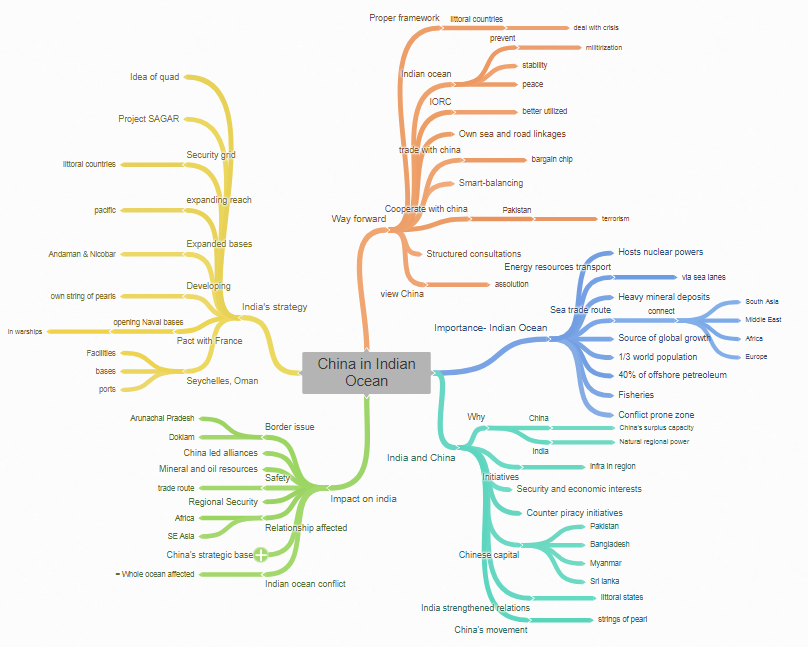
    Importance of the Indian Ocean

    • The Indian Ocean littoral has the potential to become the leading source of new global growth over the next 20 years.
    • One-third of the world population lives in the region, including one-quarter of the UN members.
    • It provides critical sea trade routes that connect the Middle East, Africa, and South Asia with the broader Asian continent to the east and Europe to the west.
    • A number of the world’s most important strategic choke points are found in the Indian Ocean.
    • Indian Ocean channels carry 2/3rd of the world’s oil shipments, 1/3rd of the bulk cargo and half of all container traffic.
    • Nearly 40 per cent of the world’s offshore petroleum is produced in the Indian Ocean.
    • The Indian Ocean hosts heavy mineral deposits, and fisheries are increasingly important for both exports and domestic consumption.
    • China and India are dependent on energy resources transported via the secure sealanes in the Indian Ocean to fuel their economies.
    • India imports nearly 80 percent of its energy, mostly oil from the Middle East.
    • For New Delhi’s press to maintain economic growth, its dependency on the safe transport of resources will likely intensify.
    • The region is home to some of the most intense conflict-prone areas and hosts various nuclear powers of the world.

    India and China In Indian Ocean

    • China’s growing global influence and India’s rapid economic rise have heightened the ocean’s strategic value.
    • Both countries have developed initiatives to bolster infrastructure and other connections in the region.
    • Each country is seeking to strengthen ties with smaller regional states to secure their respective security and economic interests.
    • Since launching counter-piracy operations in 2009, Beijing has become increasingly active in the region.
    • Beijing’s regional vision outlines its One Belt, One Road plan.
    • China’s ties with regional states have deepened, including the influx of Chinese capital into construction projects in Bangladesh, Myanmar, Pakistan, and Sri Lanka.
    • Beijing’s forays into the Indian Ocean are driven by China’s excess capacity challenges, incentivizing Chinese firms to compete in and open new markets abroad.
    • India sees itself as the natural preeminent regional power.
    • India has doubled-down on maintaining stronger diplomatic, economic, and security ties with IOR maritime states.
    • It is meant to strengthen India’s economy, establish its role a driver of regional growth, and simultaneously diminish China’s growing appeal.
    • It is India’s neighbourhood that holds the key to its emergence as a regional and global power.
    • China’s movements in the region have been described by the “string of pearls” metaphor, which holds that China is taking on economic and investment projects with Indian Ocean states to secure ports or places for its military stations.

    Impact of Chinese Influence on India

    • The Indian Ocean is the only ocean which has been named after one of the countries. So, this indicates the important presence of India in this zone.
    • About 7000 km of India’s coastal land borders around the Indian Ocean. Most of its trade through sea-route occurs through this Ocean and some of the islands belonging to the Indian territory lie in this Ocean, whose safety is also a primary responsibility of India.
    • China’s increased presence can mean a great harm to this position.
    • Chinese are increasing their trading posts all around the Indian Ocean and also exploring mineral and oil resources in these areas.
    • India has a competitive and cooperative relationship in many countries of Africa and Southeast Asia which might get affected due to Chinese presence.
    • China has become the first or second major trading country with all these countries in the Indian Ocean region and Australia as well.
    • There could possibly be China-led alliances, Chinese client states and the establishment of Chinese spheres of influence, affecting India’s clout in the region.
    • With China, stepping up its political and economic footprint in the region, revisionist claims in the land and oceanic space could be brought up again like the issue of Doklam and Arunachal Pradesh.
    • With the presence of Chinese strategic bases, there will be constriction of the Indian strategic manoeuvre space within its own geographical area.
    • India has legitimate strategic concerns because any conflict in the Indian Ocean will have ramification in the whole region.
    • It may hamper regional security situation and in such case, India’s relationship with IOR countries may get disrupted.
    • There is global maritime security interest involved in the region and many nations want India to balance the assertive and rising China and like it to get involved in the dispute to maintain peace and security in the region.

    India’s current strategy in the Indian Ocean

    • India is moving to shore up its position against a more assertive Chinese presence by developing its own ‘string of pearls’.
    • New Delhi recently signed a strategic pact with France, with each opening their naval bases to the other’s warships across the Indian Ocean.
    • That gives the Indian navy access to strategically important French ports including one in Djibouti that offers easy access to key oil supply and trade routes.
    • Prime Minister Modi finalised an agreement for a new base in Seychelles and negotiated military access to facilities at Oman’s port and airfields.
    • India signed an agreement with Singapore and Indonesia for naval cooperation.
    • India has expanded its bases on Andaman and Nicobar Islands.
    • India has realised that it needs to match China’s assertiveness, and that includes expanding its reach into the Pacific.
    • India is creating a security grid with the littoral countries so that militarization of the Indian Ocean can be prevented.
    • For Delhi, having a counter power-projection capability in the South China Sea is now seen as critical to its strategic deterrence against Beijing.
    • India has also stepped up aid to littorals through its Project SAGAR (Security and Growth for All in the Region), which is designed to revive India’s ancient trade routes and cultural linkages around the Indian Ocean. It is a counter-move to China’s maritime silk road.
    • India is seemingly increasing its alliance with the US to deal with Beijing; most recently the Quad.

    What More India Should Do

    • The idea of selling the illusion of China as a villain in Asia may not work beyond a point.
    • Instead, view China as part of the solution to the region’s challenges.
    • A mutual ‘complex interdependence’ in economic, security and other domains should be strengthened by initiating structured consultations. E.g. the current India-China joint anti-piracy missions in the Gulf of Aden.
    • India should certainly focus on the Indo-Pacific and consider cooperating with China, even while being part of the Quad.
    • India also needs to strategize a plan to nudge China towards playing a role so as to ensure a stable regional security order.
    • This is particularly in the context of its role in Pakistan, where China has to balance trade and terrorism.
    • Despite this strategy of mutual trust, the role of military strength in guaranteeing national security cannot be underestimated.
    • Thus, India would be better served by adopting a more nuanced strategy of ‘smart-balancing’ China.
    • It is suggested that India should use its $70 billion-strong trading relationship with China as a bargaining chip to check Chinese behaviour.
    • India needs to plan its own sea and road linkages with its neighbouring countries.
    • Indian Ocean RIM Association should be a force multiplier for India’s interests and for this, bilateral relations with all countries in this region has to be revived.
    • Maintaining peace and stability of the Indian ocean is very important.
    • The militarization of Indian ocean must be prevented.
    • A proper framework must be developed by the littoral countries to deal with any type of crisis be it natural or any other.
  • [Burning Issue] HYPERLOOP

    Why in news?

    In February 2018, Richard Branson’s Virgin Hyperloop One signed an agreement with the Maharashtra government to build a Hyperloop between Mumbai and Pune to reduce travelling time.

    Hyperloop: Fifth mode of transportation

    • A Hyperloop is a proposed mode of passenger and/or freight transportation which has a sealed tube or system of tubes through which a pod may travel free of air resistance or friction conveying people or objects at high speed while being very efficient.
    • The idea was first mooted by Elon Musk,CEO of SpaceX and tesla, who gave a white paper on it in the year 2013.
    • The Hyperloop concept has been explicitly “open-sourced” by Musk and SpaceX, and others have been encouraged to take the ideas and further develop them.

    Expected Benefits

    • Speed: Because of sealed environment which offer little or no resistance, the pod can reach a speed up to 1,000 kph which is much faster than bullet train and even commercial aircraft.
    • Economical: Hyperloop requires relatively less ground to construct and if it uses its own solar panels are used to generate electricity, the fare can be much cheaper as compared to bullet trains or aircraft.
    • Environmental friendly: A greater benefit is that Hyperloop would run completely on electricity eliminating or reducing the need for fossil fuels and minimising greenhouse gases emission.
    • Less prone to human errors: As the system is fully automated and sealed, the human related error can be averted.
    • Less Land Intensive: In an already land-scarce country like ours, hyperloop will be a boon as the availability of land availability will not be an issue because steel tubes will be either erected on a column or tunnelled underground.
    • One of its biggest advantages is that it can draw energy from any source including solar panels, windmills and even nuclear reactors.

    Challenges

    • Some experts are skeptical, saying that the proposals ignore the expenses and risks of developing the technology and that the idea is “completely impractical”.
    • Claims have also been made that the Hyperloop is too susceptible to disruption from a power outage or terror attacks to be considered safe
    • High speed of capsule (almost at speed of sound) may cause dizziness to the passengers travelling due to vibration and jostling.
    • In India where the funds for infrastructure are already thin,whether lakhs of crore can be spent for experimental transportation technology need to be considered more.

    Conclusion

    With the rising population and increasing congestion, Transport Oriented Development(TOD) is the need of the hour in which hyperloop like transportation can play a major role. However, much is needed to be done before it can become a reality.