Mains Ready By December. Smash Mains & Smash PYQ Admissions Open

GS Paper: GS3-17.Awareness in the fields of IT, Space, Computers, Robotics, Nano-technology, Bio-technology and issues relating to Intellectual Property Rights.

  • Study of distant Magnetar reveals facets of the Exotic Star

    An international group of researchers has succeeded in measuring for the first time the characteristics of a flare on a distant magnetar.

    What is a Magnetar?

    • Magnetars are the most magnetic stars in the universe.
    • It is a rare compact type of neutron star teeming with energy and magnetism.
    • It is an exotic type of neutron star, its defining feature that it has an ultra-powerful magnetic field.
    • The field is about 1,000 times stronger than a normal neutron star and about a trillion times stronger than the Earth’s.
    • Magnetars are relatively rare objects, with only about thirty having been spotted within the Milky Way so far.

    What is the recent study?

    • The studied magnetar is about 13 million light years away, in the direction of the NGC 253, a prominent galaxy in the Sculptor group of galaxies.
    • Its flare spewed within a few tenths of a second as much energy as the Sun would shed in 100,000 years.
    • It was captured accidentally on April 15, 2020, by the Atmosphere-Space Interactions Monitor instrument (ASIM) of the International Space Station.
    • This is the first study to characterize such a flare from so distant a magnetar.

    How do magnetars form?

    • During the course of their evolution, massive stars – with masses around 10-25 times the mass of the Sun – eventually collapse and shrink to form very compact objects called neutron stars.
    • A subset of these neutron stars is the so-called magnetars which possess intense magnetic fields.
    • These are highly dense and have breathtakingly high rotation speeds – they have rotational periods that can be just 0.3 to 12.0 seconds.

    What characterizes Magnetars?

    (1) Violent flares

    • The observed giant flare lasted approximately 160 milliseconds and during this time 1039 joules of energy was released.
    • The flare spewed as much energy in a tenth of a second that our Sun will radiate in 100,000 years.

    (2) Starquakes

    • Eruptions in magnetars are believed to be due to instabilities in their magnetosphere, or “starquakes” produced in their crust – a rigid, elastic layer about one kilometer thick.
    • This causes waves in the magnetosphere, and interaction between these waves causes dissipation of energy.


    UPSC 2022 countdown has begun! Get your personal guidance plan now! (Click here)

  • Program for Development of Semiconductors and Display Manufacturing Ecosystem in India

    The Union Cabinet has approved a ₹76,000 crore scheme to boost semiconductor and display manufacturing in the country.

    About the Program

    • The scheme would provide financial support of up to 50% of the project cost for setting up semiconductor and display fabrication units.
    • The scheme was aimed at making India a global hub of electronic system design and manufacturing, the statement noted.
    • In addition, the Centre would work with the States to set up high-tech clusters with the necessary infrastructure such as land and semiconductor-grade water.

    Components of the mission

    [1] Semiconductor Fabs and Display Fabs

    • This shall extend fiscal support of up to 50% of project cost to eligible applicants.
    • The govt will work closely with the states establish High-Tech Clusters with requisite infrastructure in terms of land, semiconductor grade water, high quality power, logistics and research.

    [2] Semi-conductor Laboratory (SCL):

    • The Ministry of Electronics and Information Technology will take requisite steps for the modernization and commercialization of the Semi-conductor Laboratory (SCL).
    • MeitY will explore the possibility for the Joint Venture of SCL with a commercial fab partner to modernize the brownfield fab facility.

    [3] Semiconductor Design Companies:

    • The Design Linked Incentive (DLI) Scheme shall extend product design linked incentive of up to 50% of eligible expenditure and product deployment linked incentive of 6% – 4% on net sales for five years.
    • Support will be provided to 100 domestic companies of semiconductor design for Integrated Circuits (ICs), Chipsets, System on Chips (SoCs), Systems & IP Cores.

    [4] India Semiconductor Mission:

    • In order to drive the long-term strategies for developing sustainable semiconductors and display ecosystem, a specialized and independent ISM will be set up.
    • The ISM will be led by global experts in the semiconductor and display industry.
    • It will act as the nodal agency for efficient and smooth implementation of the schemes on Semiconductors and Display ecosystem.

    [5] Chips to start-ups Program

    • This program would develop 85,000 well-trained engineers, he claimed. Semiconductor designers would be given the opportunity to launch start-ups.
    • The government would bear 50% of the expense under the design-linked incentive scheme.
    • The entire programme would lead to 35,000 high-quality direct jobs and 1 lakh indirect employment.

    Significance of the scheme

    • In the current geopolitical scenario, trusted sources of semiconductors and displays hold strategic importance and are key to the security of critical information infrastructure.
    • The approved program will propel innovation and build domestic capacities to ensure the digital sovereignty of India.
    • It will also create highly skilled employment opportunities to harness the demographic dividend of the country.
    • Development of semiconductor and display ecosystem will have a multiplier effect across different sectors of the economy with deeper integration to the global value chain.


    UPSC 2022 countdown has begun! Get your personal guidance plan now! (Click here)

  • The challenges in being a chip hub

    Context

    India is aiming to manufacture silicon semiconductor chips.

    Efforts to set up chip fabrication plant

    • India has intensified efforts to set up a semiconductor fabrication plant with the help of Taiwan, the market leader.
    • For this the government is investing over $7.5 billion.
    • The Tata Group is in talks with three States — Tamil Nadu, Telangana and Karnataka — to invest over $300 million to set up a semiconductor manufacturing facility.
    • In 2014, NASSCOM wanted to promote a National Technology Corridor along coastal A.P. stretching through the Visakhapatnam, Rajahmundry and Vijayawada region.
    • Given the abundance of water, sand (raw material for making silicon ingots), road, rail, ports and airport connectivity, the industry body wanted to push and promote the design and manufacturing of electronic chips.

    Challenges

    • IP and design: While welcoming such moves by the government and technology experts, local players in the segment say that chip making itself will not be enough.
    • Other aspects such as designing and Intellectual Property are required to make a mark.
    • Designing is what brings value to the chips.
    • If the Intellectual Property lies with the foreign entity, we end up manufacturing the basic material which does not serve the purpose.
    • Need to promote SoCs: Rather, we need an ecosystem to promote SoCs (System on a Chip) which makes more sense.”
    • There are several firms in India which are now making SoCs, which is a good sign.
    • Connect related industries: The bigger challenge and immediate need for the Indian government is to connect related industries in India to create the ecosystem, industry players say.

    Consider the question “What are the challenges India may face as it aims to manufacture silicon semiconductor chips?”

    Conclusion

    The initiative is an uphill task as many factors need to come together for India to make a mark in the niche chip making and designing industry. Also, upcoming firms should be able to sustain themselves in the market when subsidies from the government are withdrawn.

    UPSC 2022 countdown has begun! Get your personal guidance plan now! (Click here)

  • 5G Network and Aviation Safety

    The US Federal Aviation Administration (FAA) has issued directives to create a framework as well as gather more information about the potential effects of 5G on crucial aviation safety equipment.

    What is 5G technology?

    • 5G or fifth generation is the latest upgrade in the long-term evolution (LTE) mobile broadband networks.
    • It mainly works in 3 bands, namely low, mid and high-frequency spectrum — all of which have their own uses as well as limitations.

    Three bands of 5G

    • The low band spectrum has shown great promise in terms of coverage and speed of internet and data exchange, the maximum speed is limited to 100 Mbps (Megabits per second).
    • This means that while telcos can use and install it for commercial cellphones users who may not have specific demands for very high-speed internet, the low band spectrum may not be optimal for specialised needs of the industry.
    • The mid-band spectrum, on the other hand, offers higher speeds compared to the low band but has limitations in terms of coverage area and penetration of signals.
    • Telcos and companies, which have taken the lead on 5G, have indicated that this band may be used by industries and specialised factory units for building captive networks that can be moulded into the needs of that particular industry.
    • The high-band spectrum offers the highest speed of all the three bands, but has extremely limited coverage and signal penetration strength.
    • Internet speeds in the high-band spectrum of 5G have been tested to be as high as 20 Gbps (gigabits per second), while, in most cases, the maximum internet data speed in 4G has been recorded at 1 Gbps.

    What is the issue?

    • There is a threat of potential radar altimeter interference from 5G cellular in the 3700 MHz-3800 MHz frequency or the C-band.
    • The 3700-4200 MHz band is close to the 4200 MHz-4400 MHz range used by aircraft radio altimeters.

    Potential impacts

    • Operations by aircraft including large jets could be limited or prohibited from using certain landing and navigation systems in places where there is scope for potential interference from new 5G cellular networks.
    • The restrictions could be severe for smaller aircraft and helicopters.
    • Overall, these could result in flight cancellations, delays or diversions in 46 places where these towers are, according to an aviation report.

    What is the aircraft equipment that can be affected?

    • The radio altimeter measures height (not altitude) of the aircraft above the surface immediately below the plane. It transmits a radio signal directly below.
    • There are various other systems that depend on inputs from the radio altimeter — for example, predictive wind shear, ground proximity warning system, traffic collision avoidance system, and auto land.
    • These effects are only when the aircraft is close to the ground, i.e. up to 2,500 ft above ground level (depending on the aircraft make).
    • Any disturbance to internal radio altimeter readings caused by 5G or other equipment transmitting in frequency bands close to it can result in disastrous effects on crucial systems during approach/landing.

    Impact of mobile phones

    • 5G devices can interfere with aircraft altitude instruments and recommended that they should be turned off (or put to flight mode) during flight.
    • Experts believe that electrical interference from a mobile phone could have been a factor in the crash of a small aircraft.
    • The navigation system of the small aircraft could be disrupted by mobile phone signals.
    • But up until now, there has been no evidence of a mobile phone having caused a crash.

    What about the implications for India?

    • Pilots in India are aware of the implications of 5G in the country.
    • However, in India, 5G could be rolled out in the 3.2 GHz-3.6 GHz band, which may not have the potential to interfere with aircraft operations.


    UPSC 2022 countdown has begun! Get your personal guidance plan now! (Click here)

  • NASA’s Imaging X-Ray Polarimetry Explorer (IXPE) Mission

    NASA has launched a new mission named Imaging X-ray Polarimetry Explorer or IXPE.

    About IXPE

    • IXPE observatory is a joint effort of NASA and the Italian Space Agency.
    • The mission will study “the most extreme and mysterious objects in the universe – supernova remnants, supermassive black holes, and dozens of other high-energy objects.”
    • The mission’s primary length is two years and the observatory will be at 600 kilometers altitude, orbiting around Earth’s equator.
    • IXPE is expected to study about 40 celestial objects in its first year in space.

    What are the instruments onboard?

    • IXPE carries three state-of-the-art space telescopes.
    • Each of the three identical telescopes hosts one light-weight X-ray mirror and one detector unit.
    • These will help observe polarized X-rays from neutron stars and supermassive black holes.
    • By measuring the polarization of these X-rays, we can study where the light came from and understand the geometry and inner workings of the light source.
    • This new mission will complement other X-ray telescopes such as the Chandra X-ray Observatory and the European Space Agency’s X-ray observatory, XMM-Newton.

    Why is it important?

    The mission will help scientists answer questions such as:

    • How do black holes spin?
    • Was the black hole at the center of the Milky Way actively feeding on surrounding material in the past?
    • How do pulsars shine so brightly in X-rays?
    • What powers the jets of energetic particles that are ejected from the region around the supermassive black holes at the centers of galaxies?


    UPSC 2022 countdown has begun! Get your personal guidance plan now! (Click here)

  • Laser Communications Relay Demonstration (LCRD)

    NASA has launched its new Laser Communications Relay Demonstration (LCRD) — the agency’s first-ever laser communications system.

    What is LCRD?

    • LCRD involves laser communications – also called optical communications which uses infrared light to send information.
    • LCRD is launched in a geosynchronous orbit, over 35,000km above Earth.
    • LCRD has two optical terminals – one to receive data from a user spacecraft, and the other to transmit data to ground stations.
    • The modems will translate the digital data into laser signals. This will then be transmitted via encoded beams of light.

    Benefits offered by LCRD

    • Currently, most NASA spacecraft use radio frequency communications to send data.
    • Optical communications will help increase the bandwidth 10 to 100 times more than radio frequency systems.
    • The LCRD will help the agency test optical communication in space.

    Laser vs Radio

    • Laser communications and radio waves use different wavelengths of light. It uses infrared light and has a shorter wavelength than radio waves.
    • This will help the transmission of more data in a short time.
    • Using infrared lasers, LCRD will send data to Earth at 1.2 gigabits-per-second (Gbps).
    • It would take roughly nine weeks to transmit a completed map of Mars back to Earth with current radio frequency systems. With lasers, we can accelerate that to about nine days, says NASA.

    Other advantages

    Optical communications systems are smaller in size, weight, and require less power compared with radio instruments.

    • A smaller size means more room for science instruments.
    • Less weight means a less expensive launch.
    • Less power means less drain on the spacecraft’s batteries.


    UPSC 2022 countdown has begun! Get your personal guidance plan now! (Click here)

  • Arms Race towards Hypersonic Weapons

    China recently tested a nuclear-capable hypersonic missile while Russia announced that it had successfully test-launched a Tsirkon hypersonic cruise missile in early October.

    What are Hypersonic Weapons?

    • The speed of sound is Mach 1, and speeds upto Mach 5 are supersonic and speeds above Mach 5 are hypersonic.
    • They are manoeuvrable weapons that can fly at speeds in excess of Mach 5, five times the speed of sound.
    • A number of other countries – including Australia, India, France, Germany, and Japan—are developing hypersonic weapons technology.

    Features of HSWs

    • Trajectory: Ballistic Missiles are long-range missile that leaves the earth’s atmosphere before re-entry, pursuing a parabolic trajectory towards its target
    • Maneuverability: HSW travel within the atmosphere and can manoeuvre midway which combined with their high speeds make their detection and interception extremely difficult.
    • Stealth: Radars and air defences cannot intercept them till they are very close. They can penetrate most missile defences and further compress the timelines for response by a nation under attack.

    Types of Hypersonic Weapons

    There are two classes of hypersonic weapons:

    1. Hypersonic glide vehicles (HGV): They are launched from a rocket before gliding to a target.
    2. Hypersonic cruise missiles (HCM): They are powered by high-speed, air-breathing engines, or scramjets, after acquiring their target.

    Where does the US stand?

    • The US has active hypersonic development programs.
    • It is said to be lagging behind China and Russia because most US hypersonic weapons are not being designed for use with a nuclear warhead.
    • It is in process of developing prototypes to assist in the evaluation of potential weapon system concepts and mission sets.

    Hypersonic program in India

    • HSTDV program: India is developing an indigenous, dual-capable hypersonic cruise missile as part of its Hypersonic Technology Demonstrator Vehicle (HSTDV) program.
    • Capacity: India operates approximately 12 hypersonic wind tunnels and is capable of testing speeds of up to Mach 13.
    • In-operation: The DRDO has successfully tested a Mach 6 scramjet in June 2019 and September 2020 using the demonstrated scramjet engine technology.

    DRDO has validated many associated crucial technologies such as:

    1. Aerodynamic configuration for hypersonic maneuvers
    2. Use of scramjet propulsion for ignition and sustained combustion at the hypersonic flow
    3. Thermo-structural characterization of high-temperature materials
    4. Separation mechanism at hypersonic velocities has been validated

    Conclusion

    • There are rising tensions between the US, China and Russia worsening the geopolitical situation worldwide.
    • The focus for hypersonic weapons is only set to accelerate more countries to invest significant resources in their design and development.

    Back2Basics:


    UPSC 2022 countdown has begun! Get your personal guidance plan now! (Click here)

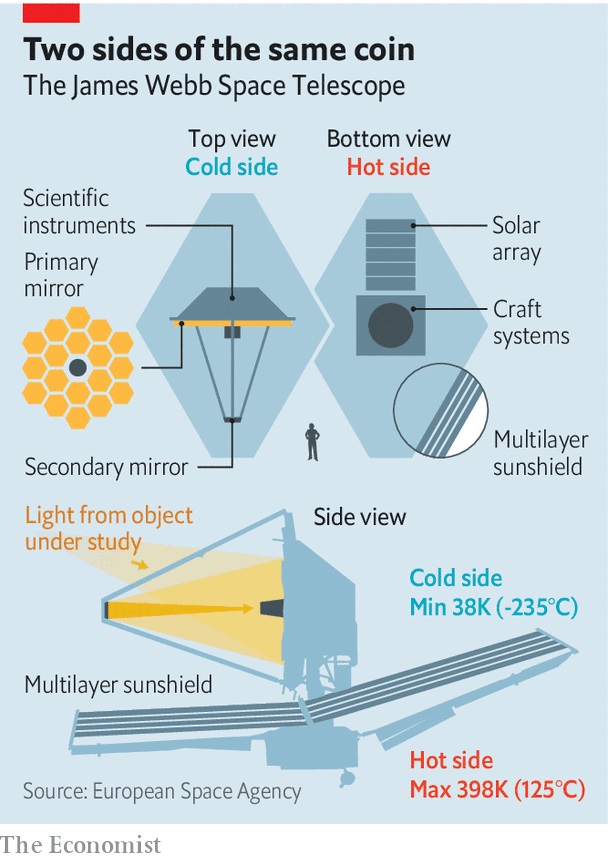
  • James Webb Space Telescope

    The James Webb Space Telescope, NASA’s largest space science telescope ever constructed, is scheduled to be sent into orbit in December.

    James Webb Space Telescope (JWST)

    • It is a space telescope being jointly developed by NASA, the European Space Agency (ESA), and the Canadian Space Agency (CSA).
    • It has taken 30 years and $10bn to develop, and is being described as one of the grand scientific endeavors of the 21st Century.

    What is the goal of this telescope?

    • The telescope will be able to see just about anything in the sky.
    • However, it has one overriding objective – to see the light coming from the very first stars to shine in the Universe.
    • These pioneer stars are thought to have switched on about 100-200 million years after the Big Bang, or a little over 13.5 billion years ago.
    • Webb will be picking out groupings of these stars.
    • They are so far away their light – even though it moves at 300,000km per second – will have taken billions of years to travel the cosmos.

    JWST mirror

    • One of the most important objects it will carry is a large mirror which will help collect light from the objects being observed.
    • The primary mirror is made of 18 hexagonal-shaped mirror segments — each 1.32 metre in diameter — stitched together in a honeycomb pattern.
    • The primary mirror is a technological marvel.
    • The lightweight mirrors, coatings, actuators and mechanisms, electronics, and thermal blankets when fully deployed form a single precise mirror that is truly remarkable.
    • Each mirror segment weighs approximately 20 kilograms and is made from beryllium.

    Why beryllium?

    • NASA explains that beryllium was used as it is both strong and light.
    • Beryllium is very strong for its weight and is good at holding its shape across a range of temperatures. Beryllium is a good conductor of electricity and heat and is not magnetic.
    • Because it is light and strong, beryllium is often used to build parts for supersonic airplanes and the Space Shuttle.
    • It added that special care was taken when working with beryllium because it is unhealthy to breathe in or swallow beryllium dust.

    So, it does not have gold?

    • After the beryllium mirror segments were polished a thin coating of gold was applied to it. Gold helps improve the mirror’s reflection of infrared light.
    • The gold was coated using a technique called vacuum vapour deposition.
    • The mirrors are kept inside a vacuum chamber and a small quantity of gold is vapourised and deposited on the mirror.
    • The thickness of the gold is just 100 nanometers. So less than 50 grams of gold was used for the entire mirror.
    • A thin layer of glass was also deposited on top of the gold layer to protect it from scratches.


    UPSC 2022 countdown has begun! Get your personal guidance plan now! (Click here)

  • A launch window for India as a space start-up hub

    Context

    After the launch of Sputnik in 1957, space race is on again, but this time, private players are on the power field. This has huge implications for original equipment manufacturers (OEMs) in the space sector in India and is a promising venture for global investors.

    Insignificant share of India in space economy

    • 2% India’s share: The space economy is a $440 billion global sector, with India having less than 2% share in the sector.
    • While total early-stage investments in space technologies in FY21 were $68 billion, India was on the fourth place with investments in about 110 firms, totalling not more than $2 billion.

    Reasons for India’s insignificant private participation

    • Absence of a framework: The reason for the lack of independent private participation in space includes the absence of a framework to provide transparency and clarity in laws.
    • Brain drain: Another aspect to throw light on is the extensive brain drain in India, which has increased by 85% since 2005.
    • Policy bottlenecks: Brain drain can be linked to the bottlenecks in policies which create hindrances for private space ventures and founders to attract investors, making it virtually non-feasible to operate in India.

    Suggestions

    • The laws need to be broken down into multiple sections, each to address specific parts of the value chain and in accordance with the Outer Space Treaty.
    • Dividing into upstream and downstream: Dividing activities further into upstream and downstream space blocks will allow legislators to provide a solid foundation to products/services developed by the non-governmental and private sectors within the value chain.
    • Timeline on licensing: With the technicalities involved in the space business, timelines on licensing, issuance of authorisation and continuous supervision mechanism need to be defined into phases.
    • Insurance and indemnification clarity: Another crucial aspect of space law is insurance and indemnification clarity, particularly about who or which entity undertakes the liability in case of a mishap.
    • In several western countries with an evolved private space industry, there is a cap on liability and the financial damages that need to be paid.
    • Need to generate own IP: Currently, many of the private entities are involved in equipment and frame manufacturing, with either outsourced specifications or leased licences.
    • However, to create value, Indian space private companies need to generate their intellectual property for an independent product or service with ISRO neither being their sole or largest customer nor providing them IP and ensuring buy-backs.

    Possibilities for India and the government’s effort

    • India currently stands on the cusp of building a space ecosystem and with ISRO being the guiding body, India can now evolve as a space start-up hub for the world.
    • Already 350 plus start-ups such as AgniKul Cosmos, Skyroot Technologies, Dhruva Space and Pixxel have established firm grounds for home-grown technologies with a practical unit of economics.
    • Last year the Government of India created a new organisation known as IN-SPACe (Indian National Space Promotion and Authorisation Centre) which is a “single window nodal agency” established to boost the commercialisation of Indian space activities.
    • A supplement to the Indian Space Research Organisation (ISRO), the agency promotes the entry of the Non-Government Private Entities (NGPEs) in the Indian space sector.

    Consider the question “Examine the factors responsible for hindering the participation of the private sector in India’s space industry? Suggest the ways to increase the participation of private sector.”

    Conclusion

    To continue the growth engine, investors need to look up to the sector as the next “new-age” boom and ISRO needs to turn into an enabler from being a supporter. To ensure that the sky is not the limit, investor confidence needs to be pumped up and for the same, clear laws need to be defined.

    UPSC 2022 countdown has begun! Get your personal guidance plan now! (Click here)


    Back2Basics: The Outer Space Treaty

    • The Outer Space Treaty was considered by the Legal Subcommittee in 1966 and agreement was reached in the General Assembly in the same year ( resolution 2222 (XXI)).
    • The Treaty was largely based on the Declaration of Legal Principles Governing the Activities of States in the Exploration and Use of Outer Space, which had been adopted by the General Assembly in its resolution 1962 (XVIII) in 1963, but added a few new provisions.
    • The Treaty was opened for signature by the three depository Governments (the Russian Federation, the United Kingdom and the United States of America) in January 1967, and it entered into force in October 1967.
    • The Outer Space Treaty provides the basic framework on international space law, including the following principles:
    • The exploration and use of outer space shall be carried out for the benefit and in the interests of all countries and shall be the province of all mankind;
    • Outer space shall be free for exploration and use by all States;
    • Outer space is not subject to national appropriation by claim of sovereignty, by means of use or occupation, or by any other means;
    • States shall not place nuclear weapons or other weapons of mass destruction in orbit or on celestial bodies or station them in outer space in any other manner;
    • The Moon and other celestial bodies shall be used exclusively for peaceful purposes;
    • Astronauts shall be regarded as the envoys of mankind;
    • States shall be responsible for national space activities whether carried out by governmental or non-governmental entities;
    • States shall be liable for damage caused by their space objects; and
    • States shall avoid harmful contamination of space and celestial bodies.
  • Ericsson Mobility Report on 5G Subscriptions

    India 5G subscriptions are set to reach 500 mn by 2027, said Ericsson in its report.

    Ericsson Mobility Report

    • The report has added that the total number of smartphone subscriptions is expected to be 810 million at the end of 2021.
    • It is projected to grow at a compounded annual growth rate of 7%, exceeding 1.2 billion by 2027.

    5G penetration in India

    • 5G telecom services are likely to account for 39% of mobile subscriptions or about 500 million subscriptions in India at the end of 2027.
    • 4G is expected to remain the dominant technology in India in 2027.
    • 4G subscriptions are expected to reduce from 68% of mobile subscriptions in 2021 to 55% in 2027 as subscribers migrate to 5G.
    • However, 4G subscriptions are forecast to drop from 790 million in 2021 to 710 million in 2027, showing an annual average decline of 2%.

    Back2Basics: 5G Technology

    • 5G or fifth generation is the latest upgrade in the long-term evolution (LTE) mobile broadband networks.
    • It mainly works in 3 bands, namely low, mid and high-frequency spectrum — all of which have their own uses as well as limitations.

    Three bands of 5G

    • The low band spectrum has shown great promise in terms of coverage and speed of internet and data exchange, the maximum speed is limited to 100 Mbps (Megabits per second).
    • This means that while telcos can use and install it for commercial cellphones users who may not have specific demands for very high-speed internet, the low band spectrum may not be optimal for specialised needs of the industry.
    • The mid-band spectrum, on the other hand, offers higher speeds compared to the low band but has limitations in terms of coverage area and penetration of signals.
    • Telcos and companies, which have taken the lead on 5G, have indicated that this band may be used by industries and specialized factory units for building captive networks that can be molded into the needs of that particular industry.
    • The high-band spectrum offers the highest speed of all the three bands, but has extremely limited coverage and signal penetration strength.
    • Internet speeds in the high-band spectrum of 5G have been tested to be as high as 20 Gbps (gigabits per second), while, in most cases, the maximum internet data speed in 4G has been recorded at 1 Gbps.


    UPSC 2022 countdown has begun! Get your personal guidance plan now! (Click here)