Mains Ready By December. Smash Mains & Smash PYQ Admissions Open

GS Paper: GS2-18.Bilateral, regional and global groupings and agreements involving India and/or affecting India’s interests.

  • From virtual conferencing to real leadership

    Context

    SAARC has become the ‘virtual’ platform through which leaders of the eight countries of our troubled region agreed to work together to combat unarguably the greatest immediate threat to the people: the COVID-19 health pandemic.

    Success depends on India

    • The success of the Modi-SAARC initiative will largely depend on India—the dominant power of the region, in every sense.
    • Pakistan’s position may become marginal: Once New Delhi demonstrates that it has the capacity, the political willingness to institutionalise and to lead a mutually beneficial cooperative regime in the region, Pakistan’s “churlish” behaviour will become marginal to SAARC.
      • Various international relations theorists view this as a function of “hegemonic stability”.
    • Much needs to be done: Much more will need to be done by New Delhi to establish that the video conference was not a mere event, but the assertive expression of its new willingness to stabilise the region through cooperative mechanisms, for our common future.
    • Rare opportunity: This is a moment thus of a rare opportunity for India to establish its firm imprimatur over the region, and to secure an abiding partnership for our shared destiny.

    The genesis of SAARC

    • SAARC was born at a moment of hope in the 1980s.
    • An initiative by Zia Ur Rehman: The idea was initiated by one of the most inscrutable leaders of the region, General Zia Ur Rehman of Bangladesh, who, met many of the other leaders personally and dispatched special envoys to the capitals of the countries of the region.
      • Dhaka’s persistence resulted in the first summit of the seven leaders of the region in 1985.
      • Afghanistan joined in 2007.
    • Not lived up to expectation: In the nearly 35 years of its existence, even its champions will concede however that SAARC has, to put it euphemistically, not lived up to the promise of its founder.

    How the SAARC has performed?

    • The dismal performance in the trade: South Asia is the world’s least integrated region; less than 5% of the trade of SAARC countries is within. A South Asian Free Trade Zone agreed on, in 2006, remains, in reality, a chimera.
    • Moribund state: The last SAARC summit, scheduled to be held in Islamabad in November 2016, was postponed after the terrorist attacks in Uri; none has been held since then, and until Mr. Modi’s initiative, no major meeting had been planned.
    • Marginal in our collective consciousness: A quick look at some of the questions posed in the Lok Sabha and Rajya Sabha on SAARC, in the last years, suggest that Indian MPs seek answers on why India is still a member of SAARC and on the strength of other organisations such as the Bay of Bengal Initiative for Multi-Sectoral Technical and Economic Cooperation (BIMSTEC) that India is engaged with.
      • Thus SAARC had become almost marginal to our collective consciousness.

    The fadeout and revival of SAARC

    • India-Pakistan tension: Clearly, most of the smaller states and external players believe that the India-Pakistan conflict has undermined SAARC.
    • How Pakistan derails the initiatives? Bilateral issues cannot be discussed in SAARC but since the organisation relies on the principle of unanimity for all major decisions, Pakistan has often undermined even the most laudable initiative lest it gives India an advantage.
      • Relative gains by India are more important for Pakistan than the absolute gains it secures for itself.
    • Pakistan’s use of terror: For India, Pakistan’s use of terror as an instrument of foreign policy has made normal business impossible.
    • Need of the revival to deal with the COVID-19: There is no doubt that the impact of COVID-19 will be unprecedented, in terms of those it targets and the way we live. It is too early to judge the consequences , but it will take years for the world to return to the old and familiar.
      • Strategies to cope with this new insidious, scheming and diabolic strain of the coronavirus have to be dynamic and ad hoc.
      • Two principles to deal with the epidemic: Containment and the possible prevention of community transmission are the only two principles that are firmly tested.
      • If community transmission occurs and cannot be contained, the consequences will be calamitous.
    • Time to act together: This is indeed a time for SAARC and the experts of the region to think and act together and India can lead this effort.

    Conclusion

    It is evident that Mr Modi is an out-of-the-box lateral thinker, especially on foreign policy. More importantly, the tragedy of COVID-19 may provide an opportunity for India to demonstrate its compassionate face to secure a region at peace with itself. India cannot afford to not to harvest this opportunity, after having sowed the seeds of a New South Asia.
  • After the Trump visit

    Context

    President Trump’s visit had the right optics. Attention must now turn to India-US priority areas.

    What were the mutual gains and highlights of the visit?

    • Security: Homeland Security is an American expression. For us to own it shows our concerns on cross-border sponsored terrorism.
    • Nuclear technology: Our nuclear VVER power plant technologies are state of the art and of Russian and French design.
      • Fast breeder: Good, but one more is better. We are well on the way to the fast breeder on the thorium route and these nuclear turbines are an essential step.
      • Unlimited thorium: We don’t have much uranium but unlimited thorium, so in the long run, apart from solar, this is the energy future.
      • Insurance obstacle resolved: Obviously, the insurance obstacle, as to who will bear the cost of insurance against disaster damage, which the Americans were raising earlier, has been resolved.
      • We have to build nuclear power to provide the initial feedstock for the thorium-based reactors.
    • No progress on trade pact: There are obviously differences between the two nations on the trade pact.
      • There is “progress”, but otherwise, we don’t know the way forward. Since the event was Ahmedabad-based, Amul is invading America and dairying is real politics.
    • US concerns over Kashmir issue: The US concern on Kashmir and minority rights is real.
      • If the largest foreign office establishment in the world is raising issues through their chief, let’s not bury our head in the sand.
      • Our defence minister expressing sadness at former chief ministers of Jammu and Kashmir being in detention was a gesture to the US President’s stand on pursuing solutions.
    • The bipartisan foreign policy of India shifting: The Americans generally rally behind the President on foreign policy.
      • We are more advanced now and have kicked a bipartisan approach to foreign affairs.
      • Seven decades of a bipartisan policy are thrown away without a word in explanation.

    Challenges to the rights in India

    • Every right is tampered with. Your religion, your identity in a country that never questioned it, you name it, it’s in question.
    • Multiple identity cards not accepted: The Aadhaar card, passport, ration card, election card are not enough. One office doesn’t accept another’s card, even if they carry the same information.
    • A study on a ration card and election cards: A study funded by the Canadian IDRC showed the poor only keep under lock and key the ration and election cards. One saves them from starvation, the other gives them dignity. At least once every five years, the mightiest knock at their door. We must not destroy, we must build.

    Conclusion

    There are obviously differences between the two nations on the trade pact. But apart from trade, there are many areas the cooperation on which can benefit both the countries.


  • Explained: US-Taliban Pact


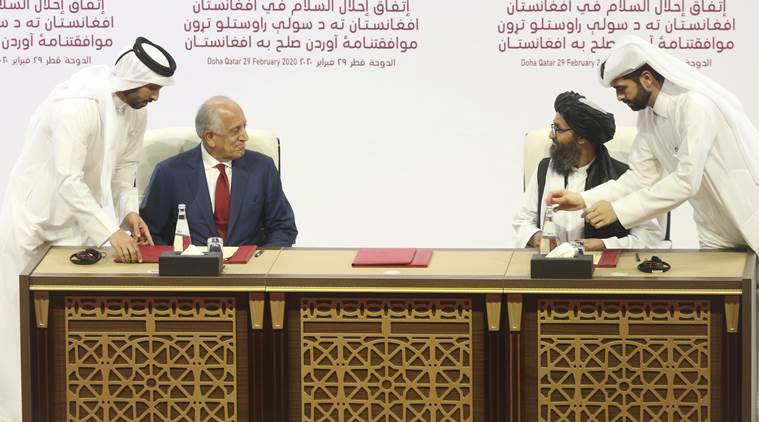
    • The US and Taliban signed an agreement for “Bringing Peace to Afghanistan”, which will enable the US and NATO to withdraw troops in the next 14 months.
    • The pact is between the “Islamic Emirate of Afghanistan which is not recognized by the United States as a state and is known as the Taliban” and the US.
    • The four-page pact was signed between Zalmay Khalilzad, US Special Representative for Afghanistan Reconciliation, and Mullah Abdul Ghani Baradar, political head of the Taliban.

    Key elements of the deal

    Troops Withdrawal

    • The US will draw down to 8,600 troops in 135 days and the NATO or coalition troop numbers will also be brought down, proportionately and simultaneously.
    • And all troops will be out within 14 months — “all” would include “non-diplomatic civilian personnel” (could be interpreted to mean “intelligence” personnel).

    Taliban Commitment

    • The main counter-terrorism commitment by the Taliban is that “It will not allow any of its members, other individuals or groups, including al-Qaeda, to use the soil of Afghanistan to threaten the security of the US and its allies”.
    • While Miller said the reference to al-Qaeda is important, the pact is silent on other terrorist groups — such as anti-India groups Lashkar-e-Toiba or Jaish-e-Mohammed.
    • Again, India, not being an US ally, is not covered under this pact.

    Sanctions Removal

    • UN sanctions on Taliban leaders to be removed by three months (by May 29) and US sanctions by August 27.
    • The sanctions will be out before much progress is expected in the intra-Afghan dialogue.

    Prisoner’s release

    • This is a possible trouble spot because the US-Taliban agreement and the joint declaration differ, and it is not clear whether the Ashraf Ghani-led government is on board with this big up-front concession to Taliban.
    • The joint declaration says the US will facilitate discussion with Taliban representatives on confidence building measures, to include determining the feasibility of releasing significant numbers of prisoners on both sides.
    • While there are no numbers or deadlines in the joint declaration, the US-Taliban pact says up to 5,000 imprisoned Taliban and up to 1,000 prisoners from “the other side” held by Taliban “will be released” by March.
    • The intra-Afghan negotiations are supposed to start in Oslo.

    Ceasefire

    • This is identified as another potential “trouble spot”.
    • The agreement states ceasefire will be simply “an item on the agenda” when intra-Afghan talks start, and indicate actual ceasefire will come with the “completion” of an Afghan political agreement.

    Implications of the Deal

    An adieu to democracy in Afghanistan

    • The Taliban have got what they wanted: troops withdrawal, removal of sanctions, release of prisoners.
    • This has also strengthened Pakistan, Taliban’s benefactor, and the Pakistan Army and the ISI’s influence appears to be on the rise.
    • It has made it unambiguous that it wants an Islamic regime.
    • The Afghan government has been completely sidelined during the talks between the US and Taliban.
    • The future for the people of Afghanistan is uncertain and will depend on how Taliban honours its commitments and whether it goes back to the mediaeval practices of its 1996-2001 regimes.

    Implications for India

    • India has been backing the Ghani-led government and was among very few countries to congratulate Ghani on his victory.
    • India’s proximity to Ghani also drew from their shared view of cross-border terrorism emanating from Pakistan.
    • There has not been formal contact with top Taliban leaders, the Indian mission has a fair amount of access to the Pashtun community throughout Afghanistan through community development projects of about $3 billion.
    • Due to So, although Pakistan military and its ally Taliban have become dominant players in Kabul’s power circles, South Block insiders insist that it is not all that grim for New Delhi.
    • these high-impact projects, diplomats feel India has gained goodwill among ordinary Afghans, the majority of whom are Pashtuns and some may be aligned with the Taliban as well.

    Way Forward

    • The joint declaration is a symbolic commitment to the Afghanistan government that the US is not abandoning it.
    • Much will depend on whether the US and the Taliban are able to keep their ends of the bargain, and every step forward will be negotiated, and how the Afghan government and the political spectrum are involved.
    • Like in 1989, 1992, 1996, and in 2001, Pakistan has the opportunity to play a constructive role. It frittered away the opportunities in the past.

    Back2Basics

    India and the Taliban

    • India and the Taliban have had a bitter past.
    • New Delhi nurses bitter memories from the IC-814 hijack in 1999, when it had to release terrorists — including Masood Azhar who founded Jaish-e-Mohammed that went on to carry out terror attacks as such on Parliament, Pathankot and in Pulwama.
    • Quite predictably, Mullah Baradar did not name India among the countries that supported the peace process, but specially thanked Pakistan for the “support, work and assistance” provided.
    • The Taliban perceived India as a hostile country, as India had supported the anti-Taliban force Northern Alliance in the 1990s.
    • India never gave diplomatic and official recognition to the Taliban when it was in power during 1996-2001.
    • But its foreign policy establishment has shied away from engaging with the Taliban directly.
  • Blue Dot Network


    With US President Donald Trump on his maiden visit to India, the two countries are expected to have discussed the Blue Dot Network, a proposal that will certify infrastructure and development projects.

    Blue Dot Network

    • Led by the US’s International Development Finance Corporation (DFC), the Blue Dot network was jointly launched by the US, Japan (Japanese Bank for International Cooperation) and Australia (Department of Foreign Affairs and Trade) in November 2019 on the sidelines of the 35th ASEAN Summit in Thailand.
    • It is meant to be a multi-stakeholder initiative that aims to bring governments, the private sector and civil society together to promote “high quality, trusted standards for global infrastructure development”.
    • The network is like a “Michelin Guide” for infrastructure projects.
    • This means that as part of this initiative, infrastructure projects will be vetted and approved by the network depending on standards, as per which, the projects should meet certain global infrastructure principles.
    • The projects that are approved will get a “Blue Dot”, thereby setting universal standards of excellence, which will attract private capital to projects in developing and emerging economies.

    Countering China’s BRI?

    • Observers have referred to the proposal as a means of countering China’s Belt and Road Initiative (BRI), which was launched over six years ago.
    • While Blue Dot may be seen as a counter to BRI, it will need a lot of work for two reasons.

    Fundamental difference between BRI and Blue Dot

    • While the former involves direct financing, giving countries in need immediate short-term relief, the latter is not a direct financing initiative and therefore may not be what some developing countries need.
    • The question is whether Blue Dot offering first-world solutions to third-world countries.
    • Secondly, Blue Dot will require coordination among multiple stakeholders when it comes to grading projects.
    • Given the past experience of Quad, the countries involved in it are still struggling to put a viable bloc. Therefore, it remains to be seen how Blue Dot fares in the long run.
  • A U.S. strategy only meant to isolate China

    Context

    Since 2017, the United States government has released a few reports and fact sheets on its new Indo-Pacific strategy. Buried in these documents is a much deeper agenda of the U.S. government: to use three large Asian states — Australia, India, and Japan — to isolate China. There is nothing else to it.

    The scale of BRI and the US objections

    • Objections to BRI: The U.S. government has made it clear that what it finds most objectionable is China’s Belt and Road Initiative (BRI), which has signed on more than 70 countries in the world.
    • What BRI aims to achieve? Adopted in 2013, the BRI is intended as a mechanism to-
      • Development of new markets: BRI aims to end China’s reliance upon the markets of the West and to develop new markets in other continents.
      • Building infra: It is also intended to use China’s massive surpluses to build infrastructure in key parts of Africa, Asia, and Latin America.
      • Investment of $ 1.3 trillion: By 2027, according to estimates by Morgan Stanley, China will spend about $1.3 trillion on this ambitious construction project.
      • Involvement of Saudi Arabia: Even Saudi Arabia, a close ally of the U.S., has made the BRI one of the cornerstones of its Saudi Vision 2030 plan.
    • Involvement of Pakistan: While China has invested $68 billion to build the China-Pakistan Economic Corridor from Xinjiang to Pakistan’s Gwadar Port.
      • Saudi Arabia has agreed to invest $10 billion in the port itself.

    Significance of the BRI and comparison with the US spending

    • Staggering scale and participation: The scale of Chinese investment, and the participation of a range of countries with different political identities in the BRI, is staggering.
    • Loss of appetite in the US to spend: At the Indo-Pacific Business Forum in July 2018 the U.S. said that it has spent $2.9 billion through the Department of State and the USAID (United States Agency for International Development).
      • It has lined up hundreds of millions of dollars more through its U.S. Millennium Challenge Corporation (MCC) and the Overseas Private Investment Corporation.
      • Inadequate US spending: If one adds up all the money that the U.S. intends to spend for economic projects, it is still a fraction of the amount spent by China.
      • ‘America First’ attitude: There is no appetite in Washington, D.C., with its ‘America First’ attitude, to funnel more money towards investments in the region currently being built by the BRI.

    Military Claims of the US and investment

    • US investment with military presence: It appears as if U.S. investments will come only with military claims.
      • The case of Nepal: A few years ago, Nepal discovered a large amount of uranium in Mustang, near the Nepal-China border; this has certainly motivated U.S. interest in Nepal’s economy.
      • If the U.S. money comes with U.S. military presence, this will create a serious flashpoint in the Himalayas.

    Raising human right and transparency issue against China

    • The argument of human rights and transparency
      • Rhetorical argument: Unable to outspend the Chinese, the U.S. government is making a rhetorical argument that it has more respect for “transparency, human rights, and democratic values” than China, which “practices repression at home and abroad”.
    • The argument of transparency and the debt trap
      • Debt trap used by the US: It is hard to imagine the U.S. being “transparent” with its trade deals. It is equally hard to imagine the U.S. being able to argue that it would not put countries into debt.
      • Debt crisis created by the US in the 1980s: The U.S. government enabled a massive Third World debt crisis in the 1980s, which was then used by the U.S.-driven International Monetary Fund’s Structural Adjustment Programs to strangle countries in Africa, Asia, and Latin America.
      • This history is alive, and it makes a mockery of the U.S.’s attempt to say that its own approach is superior to that of China’s.

    US withdrawal from multilateralism

    • Apart from that, the U.S. government has already indicated that it is uninterested in multilateral deals.
    • Withdrawal from TPP: The US withdrew from the Trans-Pacific Partnership in 2017, for instance.
      • Australia and Japan shrugged, and then put their energy into the Regional Comprehensive Economic Partnership, which sidelines the U.S.

    The claim of free and open Indo-Pacific

    • Renaming the Pacific Command: In May 2018, the U.S. military’s Pacific Command was renamed the Indo-Pacific Command, a symbolic gesture that provides a military aspect to the Indo-Pacific Strategy.
    • What free and open mean to the US? The U.S. government has made it clear that for all its talk of a “free and open Indo-Pacific”, what it actually wants is an Indo-Pacific with fewer Chinese ships and more U.S. warships.
    • Just before this renaming, the U.S. National Security Strategy of 2017 noted that “China seeks to displace the United States in the Indo-Pacific region”, and so the Indo-Pacific Strategy intends for the S. to fight for its dominance in the Pacific Ocean, the Indian Ocean, and in the Asian rim.
    • This is a very dangerous war that the U.S. seeks to impose on Asia.

    India adopting the US project of Indo-Pacific

    • Australia and Japan moving away: As the military aspect of the Strategy increased, both Australia and Japan edged away from full-scale adoption of the U.S. project.
      • Japan has begun to use the term “Indo-Pacific” without the word “Strategy”.
      • Australia has signed onto a “comprehensive strategic partnership” with China.
    • Only India adopting the project: Only India remains loyal to the agenda set by U.S. President Donald Trump.
      • No US strategy to contain China: In all the documents released by the U.S. government and in all the speeches by officials, there is no discussion of the strategy to contain China.
      • There is only rhetoric that skates into the belligerent territory.

    Conclusion

    India would be advised to study the U.S. project rather than jump into it eagerly. Room for an independent foreign policy for India is already narrowed, and room for independent trade policy is equally suffocated. To remain the subordinate ally of the U.S. suggests that India will miss an opportunity to be part of a reshaped Asia.


  • Terms of transaction

    Context

    Trump administration seems supportive of India as part of its Indo-Pacific strategy, while also counting gains for itself.

    No substantive outcomes of the visit stated

    • Neither side has so far publicly touted any major substantive outcomes of the visit.
    • Creation of positive atmosphere: To create some positive atmospherics, the Indian Cabinet Committee on Security just gave final approval to $3 billion worth of pending contracts to purchase military helicopters from US companies Lockheed Martin and Boeing.
      • Missile defence system sale: The US Administration, on its part, informed Congress of its willingness to authorise the sale of another $1.8 billion worth missile defence system.
      • The move is indicative of the US’s growing willingness to allow higher technology defence equipment to India.
    • Placing India at level (STA-1) similar to its closest allies: The Trump Administration has gone farther than its predecessors in the technology levels it is willing to offer.
      • Including Guardian drones in 2017, and placing India at STA-1 level, similar to its closest allies and partners.
    • The expected MoUs: The spokesperson of the Ministry of External Affairs indicated on February 20 that five MoUs can be expected, inter alia,-
      • On intellectual property.
      • Trade facilitation and
      • Homeland security.
    • Making sense of the US’s actions in the present context: There will also be the regulation joint statement.
      • Analysing in greater details: This time, the statement will be parsed in more than usual detail for indications of future direction and intent for the partnership.
      • It is the time when the US has been talking of “Make America Great Again”, advocating for sovereignty and nationalism.
      • The US is also decrying-Alliance commitments, Readying to sign an agreement with the Taliban by month-end leading to a drawdown of US troop presence.
      • Yet, it is articulating repeatedly about India being a lynchpin of its “Free and Open Indo-Pacific Strategy”.

    No development on the limited trade front

    • No progress on limited trade package: The two countries have not been able to finalise even a “limited trade package”, which has been under discussion for two years.
    • Gaps between the expectations: Obviously, there is a gap between what India can accommodate, and what the US negotiators want for their own political reasons.
    • The Trump administration has taken several steps that have negatively impacted India.
      • It has imposed additional tariffs on steel and aluminium imports from India, ostensibly on national security grounds.

    Contradictory impulses

    • The above action flies in the face of citing strategic partnership and convergence in Indo-Pacific strategy.
    • GSP withdrawal: It has withdrawn hitherto available GSP benefits from certain categories of labour-intensive Indian products.
    • Labelling India a ‘Developed’ country: The US has taken India out of its list of “developing” countries, lowering the threshold for countervailing trade action.
    • Against the spirit of the beneficial rise of India: These actions go against the grain of the US articulation that it sees the rise of India to be in US benefit.
      • Treating the trade deficit with China and India on equal footing: It also does not make sense when India is an overall trade deficit country.
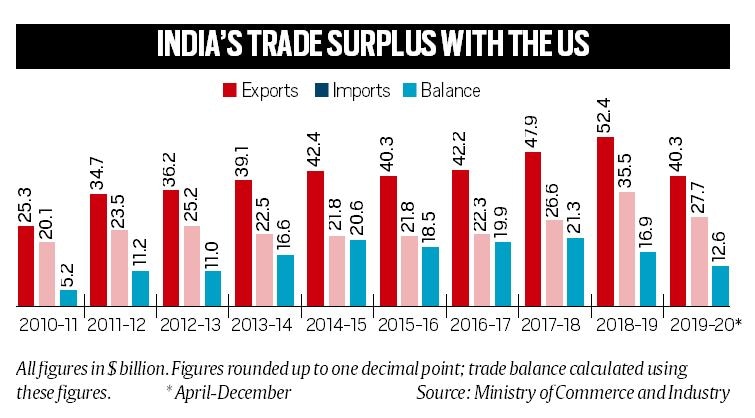
      • Even though it has a $20 billion surplus with the US which pales compared to China’s $350 billion surplus.
    • Unprecedented actions against the closest allies: Trump has taken unprecedented action against the closest US allies.
      • He has also repeatedly publicly ridiculed Indian tariffs, claiming recently that India has not treated the US fairly.

    What the future holds for the India-US relationship

    • Is the US “all-weather” partner: Given the contradictory impulses, it would be fair to ask what the future holds for the India-US relationship, and where would the Trump visit and its aftermath take us.
      • Can India consider the US a reliable and “all-weather” partner, or be constantly juggling convergences and divergences?
    • The factors that affected relationship: Historically, four factors have affected the India-US relationship at any point of time:
      • US global posture and priorities.
      • Strength of bilateral relations.
      • The role assigned to Pakistan in its global objectives.
      • The strategy towards China.

    Evolution of India-US relationship

    • Under Democrat Presidents
    • Roosevelt Period: During the Second World War, Roosevelt pushed Britain to grant independence to India, facilitated a separate official Indian representation in Washington through an Agent-General since 1941.
      • But did not go far enough fearing disruption of the necessary wartime alliance. In the post-war period.
    • Truman Period: Truman spoke of partnering with developing countries for their industrial and scientific progress.
      • He welcomed Indian PM Nehru for an acclaimed visit in 1949.
      • But initiated the Cold War containment strategy against the Soviet Union, and the assessment of newly independent countries from that lens.
    • Kennedy Period: He was extremely supportive of democratic India’s economic assistance requirements, and for military assistance during the 1962 China conflict.
    • Carter Period: Carter, wedded to human rights issues, acclaimed India’s post Emergency elections.
      • But was critical on non- proliferation differences.
    • Clinton Period: Clinton stabilised the relationship after the dissonance and sanctions following our 1998 nuclear tests.
      • And gave full support to India’s position during the 1999 Kargil conflict with Pakistan.
    • Obama Period: He came out in support of India’s permanent membership of the UN Security Council, and declared India a Major Defence Partner, enabling higher-level technology authorisations.
    • Under Republican Presidents
    • Eisenhower Period: Eisenhower embraced and armed Pakistan in its CENTO and SEATO military alliances.
      • India as a bulwark against China: He emphasised food and economic assistance to India seeing it as a democratic bulwark against a Communist China.
      • First-ever visit to India by the US president: He made a successful first-ever visit of a serving US President to India, welcomed also by a 5 lakh crowd in Connaught Place.
    • Nixon Period: He visited India for a day in 1959, was upset with Indian criticism of his Vietnam military offensives.
      • Sided completely with Pakistan during the Bangladesh crisis of 1971.
      • He sent the US seventh fleet into the Bay of Bengal to pressurise India and sought to reorder the global balance by outreach to China through a secret Kissinger visit that year.
    • Reagan Period: He explored economic and scientific cooperation with India, but was absorbed with Pakistan’s support in pushing the Soviet Union out of Afghanistan.
    • George W Bush Period: George W Bush transformed the relationship with the civil nuclear cooperation agreement of 2008.
      • Perceiving again the technological, military and political challenge to the US from a rising China.

    Conclusion

    It is clear that India’s interests have been impacted a bit by party orientation on issues, but more by the overall global circumstance. Under the present circumstance, therefore, India will have to deal with a transactional administration, supportive of strengthening India as part of its Indo-Pacific strategy, but also counting the gains for itself.


  • An agenda for Modi-Trump

    Context

    With the withdrawal of the US from Afghanistan and other regions, India must think about its new role in the region.

    The US plans for Afghanistan and the Gulf-cause of concerns for India

    • Why it matters? Prime Minister Narendra Modi will be eager to get a first-hand briefing from the US President on his plans for the Af-Pak region and the Gulf.
      • These two regions are vital to India’s economic, political and military security.
    • End of an important era in northwestern frontier: The impending withdrawal of US forces from Afghanistan and the downsizing of the American security role in the Gulf region mark the end of an important era in India’s northwestern frontiers — both land and maritime.
    • Can India overcome the past reluctance? The question is whether Modi and Trump can overcome the past reluctance in both capitals to collaborate in the regions west of India.
      • Suitable for both the countries: There is a good fit between-
      • America’s downward adjustment in the region under Trump, and-
      • India’s ambition to play a larger role in the Gulf and the Indian Ocean.

    Broad understandingIndo-Pacific and extending it to the West

    • Development in the last three years: Over the last three years of the Trump presidency, Delhi and Washington had developed a broad understanding of how to secure the Indo-Pacific that the US had defined.
    • Need to extend the same to Western Indian Ocean: Officials in Delhi frequently complained that these common perspectives did not extend to the Western Indian Ocean.
    • In recent weeks, though, senior US officials have said the Indo-Pacific region extends to the east coast of Africa.
      • Question of strategic cooperation: Extending Indo-Pacific is not a question of defining geography but finding ways to secure common ground through strategic cooperation.

    Elevation of South West Asia to the top of America’s security concerns

    • Filling the vacuum created by the British Empire: As the sun set over the British empire in the east after a century and a half, the US stepped in to fill the breach.
      • What began as a cautious entry into the Indian Ocean became a full-blown military power projection at the end of the 1970s.
    • Other events that played an important role? The dramatic rise in oil prices, the Islamic Revolution in Iran and its threat to export it to the Arab World, and the Soviet occupation of Afghanistan, saw the elevation of South West Asia to the top of America’s security concerns.
    • Events after Gulf War: The First Gulf War during 1990-91 saw the US intervene to restore the sovereignty of Kuwait that was swallowed by Iraq’s Saddam Hussein.
      • 9/11 attacks: The terror attacks on September 11, 2001, invited a ferocious response from the US that ousted the Taliban from power in Afghanistan.

    The Iraq and Afghanistan war-Endless wars

    • Costly failures: Notwithstanding the initial successes in both Afghanistan and Iraq, there is a growing consensus in the US that these occupations have been costly failures.
      • Trump has been among the first political leaders in the US to call these wars initiated by a Republican predecessor in the White House as “stupid”.
      • The promise of ending the endless wars: During his presidential campaign in 2016 and since Trump has promised to end the “endless wars” in the Greater Middle East and bring the boys back home.
      • It is an idea that has found considerable resonance among Democrats.
    • Focusing on great power competition instead of small wars: While the security establishment is not willing to give up, US is now focusing more on the great power competition with Russia and China than the small wars that had preoccupied it over the last three decades.
    • The Oil factor: The steep decline in US energy dependence on the Gulf, too, has reduced the salience of the region in Washington.

    Three consequence of the change in the US policy

    • Cutting down the military commitments
      • The Middle East and Africa: Trump has been cutting down military commitments in the Middle East and Africa.
      • His officials are about to sign an agreement with the Taliban that provides for American withdrawal from Afghanistan.
      • Maritime front: On the maritime front, Trump has called on all major powers, especially those importing oil from the Gulf, to contribute to the security of shipping in the Strait of Hormuz.
    • How it matters for India?
      • Challenges of limiting the consequences: The challenge for Indian policymakers has been to limit the consequences of what seems a definitive turn in US policy.
      • Chance to extend the own role: It should also be about seizing the possibilities for expanding India’s own role in the western marches of the Subcontinent.
    • To expand its role Delhi needs to make a few important shifts in its own thinking.
      • One, it must overcome the still powerful belief in sections of the Indian establishment that the US-Pakistan relationship is unchanging.
      • The US tilt toward India and away from Pakistan: Over the last two decades, there has been a tilt in US policies away from Pakistan and towards India.
      • For instance, the US pressures on Pakistan to vacate the Kargil heights, an exclusive nuclear exemption to India and efforts to rein in Pakistan’s cross-border terrorism during the Obama years.
      • Support in Trump period: Trump went further to acknowledge that Pakistan is part of the problem in Afghanistan and turned up the heat on Pakistan’s support for terrorism.
      • He has supported India’s efforts at the UNSC to bring Masood Azhar to book in the face of Chinese resistance.
      • Helped India isolate Pakistan at the Financial Action Task Force.
      • Prevented the UNSC from discussing Kashmir.
      • But India must also recognise: That there will be a measure of cooperation between the US and Pakistan.
      • Delhi’s focus should, instead, be on expanding its own security cooperation with the US in the troubled lands to the west of India.
    • India needs to prepare for a larger security role in Afghanistan
      • Question of being at the next-door: Trump has been asking a simple question: If India is next door to Afghanistan, should it not be doing more for Afghan security?
      • Need to explore the options: The NDA government has stepped up security assistance to Kabul. As Afghanistan enters a turbulent phase, regional and other powers are bound to fill the vacuum left by the US.
      • There are many options–  between doing nothing and sending the Indian army into Afghanistan- that Delhi and Washington could discuss.
    • Need to increase Naval activity
      • Increased role as regional security provider: Delhi has already stepped up its naval activity within the Gulf and beyond as part of its emergence as a regional security provider.
      • Cooperation with others: Effectiveness of India’s role will rise manifold if it acts in concert with the US and other partners.
      • Modi and Trump could begin by laying the political foundation for such cooperation.

    Conclusion

    At the beginning of Trump’s term, sceptics dismissed the prospects for India-US security cooperation in the eastern Indian Ocean and the Pacific, but progress has been steady. That cooperation can and must be extended now to the Western Indian Ocean.


  • Forging a new India-U.S. modus vivendi

    Context

    It is clearer than perhaps ever before in recent times, that New Delhi needs the continued support of the U.S. government on almost everything substantial that matters to India in its quest to be a power of substance in the international system.

    Preparing for Trump 2.0

    • The world may have to deal with Mr Trump for four more years after the end of his present term this year.
    • Where India can benefit from constructive ties with the US?
      • A fairer trade regime.
      • Accessing cutting-edge technology.
      • The fight against terrorism.
      • Stabilising our region.
      • New Delhi stands to benefit from constructive ties on all issues, given a more sensitive United States.
    • India must, therefore, seek greater understanding and engagement should there be a Trump 2.0.
    • Understanding the asymmetrical partnership: Asymmetrical partnerships, as we know from history, are rarely easy.
      • Partnership with the superpowers: Partnerships with superpowers are even more difficult; in international politics, as in life, even the best of unequal relationships results in a loss of some dignity and autonomy. 

    Why the partnership with the US matters for India?

    • The growing influence of China in Indo-Pacific: Without the United States, the region could become willy-nilly part of a new Chinese tributary system.
      • Chance of more organic rule-based order: With a fully engaged United States, the region has at least the chance of creating a more organic rules-based order.
    • Past consequences for India: the history of “estrangement” with the United States, during the Cold War, has had consequences for vital national interests that continue to cast their shadow on the present.
      • Jammu and Kashmir (J&K).
      • Nuclear non-proliferation.
      • Festering of the Pakistan “problem”.
      • The Chinese humiliation of 1962, are just a few examples.
    • Change in the perception over the US: But much of course has changed today.
    • Anti–Americanism is outdate: Anti-Americanism, once the conventional wisdom of the Indian elite, seems outdated.
      • Close alignment with the US: New Delhi has, over the decades, gone on to align itself more closely with Washington.
      • Opinion in favour of the stronger ties: More important, both within India and in the U.S., the consensus across the mainstream of political opinion favours stronger relations between the two countries.

    Pro-US tilt of the Indian Foreign policy

    • A survey suggests support for Trump: According to the latest Pew Surveys of Global Opinion, support for Mr Trump in India is high enough to suggest a great deal of public affection for the American President.
      • That itself is a marker of the way India and Indians now see the world.
    • Reason for the change in geo-strategic change: The reason for the change in New Delhi’s geostrategic outlook can be summarised quickly.
      • If the 1971 Friendship Treaty with the Soviet Union was a response to the continuing U.S. tilt towards Pakistan and the beginnings of a Washington-Beijing entente.
      • China factor: At present, it is the prospect of a potentially hegemonic China in the Indo-Pacific region is helping to cement the relationship.
      • Beijing has managed to alienate nearly all its neighbours and allies, except North Korea and Pakistan.
    • Gains made in bilateral ties in the last 3 years:
      • COMCASA– A foundational military agreement that allows for the sharing of encrypted communications and equipment.
      • Export control law relaxation: A change in U.S. export control laws that places India in a privileged category of NATO and non-NATO U.S. allies;
      • 2+2 dialogue: New ‘2+2’ foreign and defence ministers dialogue.
      • Oil export to India: An exponential increase in U.S. oil exports to India.
      • Tri-lateral military exercise: The inauguration of the first India-U.S. tri-service military exercise and expansion of existing military exercises.
      • The signing of Industrial Security Annex: The signing of an Industrial Security Annex that will allow for greater collaboration among the two countries’ private defence industries.
      • Inclusion of India in a U.S. security Initiative: The inclusion of India and South Asia in a U.S. Maritime Security Initiative.

    Preparing for the President from Democratic Party

    • There is, of course, a chance that we may have a Democratic President next year.
    • Bipartisan support in the US: In those circumstances, we can only hope that the bipartisan consensus on engaging India will prevail.
      • To be sure, however, a new President will seek to put his/her own imprimatur on the relationship.
      • Democrats and the Human Right issue: The Democrats will clearly be more proactive on human rights and on issues of inclusion and diversity, which would make a greater demand on India and test its capacity and creativity.
    • Indian diaspora: India, of course, continue engaging with its strongest source of support in the United States: the Indian diaspora.
      • Fortunately, there is a near consensus on the need to strengthen this constituency.

    Conclusion

    In any case, there is little doubt that whoever is the next occupant of the White House, a retreat from multilateralism (especially on trade-related issues) and concern about China will continue to be the two main pillars of contemporary American foreign policy. If for only those reasons, Mr Trump’s reason has undeniable significance.


  • Why trade with the US matters to India?


    Context

    • US President Trump arrives in India months after he went on stage with PM Modi at the ‘Howdy Modi’ event in Texas.
    • Both countries have repeatedly resolved to strengthen trade ties — however, attempts at working out a short-term agreement have fallen apart in the past, and tensions have risen over tariffs.
    • The US often accuses India of taking decisions over the previous few years that prevented “equitable and reasonable access” for Americans to its markets.
    • Let’s have a look at the current state of play:

    Why trade with the US matters to India?

    • India’s existing and stalled bilateral free trade agreements (FTAs) started to receive attention from the government last year, even as the country worked to conclude the seven-year negotiations to join the RCEP, the world’s “largest” regional trade pact.
    • But by backing out of the RCEP in November, India shut the door on the large “integrated market” that the deal was offering.
    • Instead, it increased the pressure on itself to strengthen existing separate trade agreements with each member of the RCEP bloc.
    • Without these, it may not be able to tap a sizeable portion of the global market; also, it may not be able to easily access the products and services of these countries.

    Need for more bilateral activities

    • In the backdrop of the global economic slowdown, where India’s global exports have fallen consistently, it is important for the country to diversify and strengthen bilateral relations with other markets.
    • It has set its sights on “large developed markets”, improved access to which would help its industry and services sectors.
    • These include the US, which has, over the last two decades, become a crucial trading partner in terms of both goods and services.

    Trump’s advent

    • In March 2017, soon after taking office with election campaign focussing on “making America great again”, Trump ordered “first-ever comprehensive review” of trade deficits of the United States.
    • India was among the countries that exported more to the United States than it imported, and the latter was left with a trade deficit of over $21 billion in 2017-18.
    • While the US’s deficit with India is only a fraction of its deficit with China (over $340 billion in 2019), American officials have repeatedly targeted the “unfair” trade practices followed by India.
    • These include the tariffs that India imposes, which the Trump administration feels are too high — and over which the President has personally called New Delhi out on several occasions.

    Locating the main sticking points

    • Negotiations on an India-US trade deal have been ongoing since 2018, but have been slowed by “fundamental” disagreements over tariffs subsidies, intellectual property, data protection, and access for agricultural and dairy produce.
    • The office of the US Trade Representative (USTR) has underlined India’s measures to restrict companies from sending personal data of its citizens outside the country as a “key” barrier to digital trade.
    • The US wants India to strengthen patent regulations, and to ease the limitations American companies investing in India face.

    India’s tariffs

    • India is a “tariff king” that imposes “tremendously high” import duties, Trump has complained repeatedly.
    • The health cess on imported medical devices announced in the Budget for 2020-21 too, is seen as a negative for the American side, as the US is among the top three exporters of these categories of products to India.
    • However, India is working to finalise a proposal to move from caps on prices of medical devices to limiting the margins of those involved in the supply of the products.

    Agri sector

    • The US has long demanded greater access for American agriculture and dairy products.
    • For India, protecting its domestic agriculture and dairy interests was a major reason to walk out of the RCEP agreement.

    US retaliation

    1) Tariff on steel

    • In 2018, the US imposed additional tariffs of 25% on steel and 10% on aluminum imports from various countries, including India.
    • While India’s government claims the impact is “limited”, they brought down the US share in India’s steel exports to 2.5% in 2018-19 from 3.3% in 2017-18.
    • In March 2018, India challenged the US decision at the World Trade Organization (WTO).
    • India held off on imposing retaliatory tariffs until the US struck again — by removing it from a scheme of preferential access to the American market.

    2) GSP axe and response 

    • In June 2019, the US decided to terminate India’s benefits under the Generalized System of Preferences (GSP) scheme, which provides preferential, duty-free access for over $6 billion worth of products exported from this country to the US.
    • The decision followed a warning earlier that year, after negotiations on a potential trade agreement had broken down.

    3) Labelling India as developed country

    • India was the largest beneficiary of the US GSP programme.
    • While duty-free benefits accrued to only around $200 million for the billions of dollars worth of exports, India is understood to have asked for restoration of these benefits in the ongoing trade negotiations.
    • Most recently, the USTR classified India as a “developed” country based on certain metrics. It is not clear whether the upgrade from “developing” will impact the restoration of benefits under the GSP scheme.

    The WTO tussle

    • India is one of the largest importers of almonds from the US, having imported fresh or dried shelled almonds worth $615.12 million in 2018-19.
    • Imports from the US of fresh apples stood at $145.20 million, of phosphoric acid at $155.48 million, and of diagnostic reagents at nearly $145 million that year.
    • Removal from the GSP list amidst rising trade tensions prompted India to finally impose retaliatory tariffs on several American imports, including almonds, fresh apples, and phosphoric acid.
    • This was a significant move — and the US approached the WTO against India.

    Whats’ next?

    • US administration appeared to suggest that while no deal was imminent, work on a longer-term agreement was progressing well, and that his personal chemistry with Prime Minister Narendra Modi might help.
    • India and the US could begin with some “low-hanging fruit” to indicate their willingness for a deeper economic commitment.
    • This includes the US reinstating India’s benefits under the GSP programme, and India doing away with duties on motorcycles.
  • Hype Trumps Hope

    Context

    US president’s visit comes when a mutually beneficial framework of bilateral relationship stands disrupted.

    Significance previous U.S. President’s visits

    • The Clinton visit:  The Clinton visit occurred against the backdrop of a new assessment within the American strategic community of India’s potential role in the post-Cold War era and against the backdrop of the rise of China.
      • Recognition of India’s nuclear power: He implicitly recognising India’s nuclear power status.
      • Kashmir issue: He suggested that the line of control (LoC) between India and Pakistan should be viewed as the international border so as to bury the “Kashmir issue” forever and-
      • Visas for Indians: increasing entry visas for Indians that has since contributed to the emergence of a sizeable community of Indian Americans.
      • As a counter to China: It was suggested that the rise of democratic India would be in the interests of the US and so the latter ought to be supportive of the former.
    • The Bush visit:
      • Political context: The rise of China and of radical Islam and jihadi terrorism provided the geopolitical context.
      • Economic context: The growth of an increasingly open Indian economy provided the economic context.
      • Cooperation in civil nuclear energy: Influenced by this new thinking, President George Bush took the next steps in strategic partnership and led the initiative to promote cooperation in the field of civil nuclear energy that also explicitly recognised India as a nuclear weapons power.
      • As heads of state, Clinton and Bush altered US-India bilateral relations in a fundamental way.
    • The Obama visit:
      • P2P relation: His second visit was more a recognition of the growing importance of people-to-people (P2P) relations and
      • Defence sales to India: The visit also aimed at promoting defence sales to India.
      • During the nuclear deal negotiations, US Congresspersons would often suggest that it was a “123 for 126” deal — that is, they would vote in favour of the 123 agreement in Congress in the hope that India would buy 126 fighter jets from the US.
      • That hope remains as yet unfulfilled, with the French getting the Rafale deal and no decision taken on the purchase of US fighter jets.

    America First policy of Trump

    • The credit for laying the foundation for a new and supportive post-Cold War relationship between the US and India goes singularly to President Bush.
    • Disruption with the arrival of Trump: The mutually beneficial framework that Bush helped create to promote the bilateral relationship has been rudely disrupted by the arrival of Donald Trump in Washington DC.
      • End of GSP: Trump’s “America First” policy offers no space for offering India “special and differential” treatment on any front, least of all trade.
      • Status of the Indian economy from the US perspective: With per capita annual national income of US $60,000, Trump’s America has no qualms declaring India, with a per capita annual average national income of US $2,000 a “developed economy” not deserving of any leniency in trade policy.
      • Clubbing together with China: To club China, a $15-trillion economy, with a $3-trillion India on the trade front is not just stupid but an affront to Indian sensibilities.

    What are the hopes and what could be the outcomes of the visit?

    • No bi-partisan support to India’s rise: It has to be recognised that neither Democratic liberals nor Republican conservatives are any longer willing to be supportive of the Bush-Rice paradigm that views India’s rise in benign and mutually beneficial terms.
      • Inward-orientation in both the countries: Today the relationship seems caught in the pincers between the inward-orientation of rightwing nationalists in both nations.
      • No hope of change: There is no reason as yet to believe that this unfortunate state of affairs will be altered by the Trump visit next week.
    • Stand on Pakistan or Kashmir: Trump has also moved away from the Clinton-Bush framework on India-Pakistan relations and moved closer to approach of wanting to insert the US into the equation on Kashmir.
      • Appeasement of Pakistan: Trump’s motives are no different from those that initially drove Obama-namely, to appease Pakistan in the hope of securing a peaceful exit from Afghanistan.
      • Expect differences to persist: At best, India can hope to limit the damage Trump may do to strategic stability in the region.
    • Visa and investment: There will be much talk about US investments in India and increased visas for Indians going to the US.
      • Corporate interests: Both are driven largely by US corporate interests.
      • Given the direction of the Modi government’s trade policy, one cannot expect any dramatic concessions being made.
      • Defence purchases: The best India can do for the US is to buy more defence equipment and ease up on some trade restrictions.
      • Defence sales to India are an essentially commercial activity and much of it can go on even in the absence of strategic convergence and shared geopolitical perspectives.
    • Brain-drain and need to focus on education: Much is made of Indian Americans heading US multinationals and the Great Indian Diaspora in the US.
      • Outmigration of talent: The continued neglect of education in India is increasing the outmigration of talent, offering the US a reservoir of talent.
      • Drain on national resources: While the Indian elite celebrates this out-migration, the fact is that it is a drain on national resources.

    Conclusion

    In sum,  with the supportive Bush-Rice doctrine defining the post-Cold War US-India partnership virtually abandoned, and the new Trump doctrine treating India as a “developed” economy, demanding parity on trade, bilateral relations have become uncertain and testy. To hide the lack of substance in the relationship the Trump visit will focus on the hype and Prime Minister Modi has perfected the art of diplomacy as mass entertainment.