💥Join UPSC 2027,2028 Mentorship (August Batch) + XFactor Notes & Microthemes PDF

GS Paper: GS3-18.Conservation, Environmental Pollution and Degradation, Environmental Impact Assessment.

  • Formula for Flapping Frequency across Flying and Swimming Animals


    Why in the news?

    • Researchers at Roskilde University in Denmark discovered a formula that correlates the flapping frequency of winged and swimming animals to their mass and wing/fins size.
      • The formula applies universally across a diverse range of species, from insects to birds, bats, penguins, whales, and even robotic ornithopters.

    Formula for Flapping Frequency

    • The formula was derived from Newton’s second law (F= mass x acceleration) applied to animals flapping wings to stay airborne.
    • Factors considered in the derivation included air density, wing size, and the forces generated by wing movements.

    Research Methodology

    • The researchers derived the formula theoretically from Newton’s second law, relating the force needed to stay airborne or submerged to the wing/fins’ motion, air/water dynamics, and animal mass.
    • They incorporated empirical observations into a constant C to account for specific shape and flight kinematics variations.

    Application and Validity

    • The formula’s validity was tested across various animals:
      • 176 insect data points (e.g., bees, moths, dragonflies)
      • 212 bird data points (from hummingbirds to swans)
      • 25 bat data points

    Formula Extension to Swimming Animals

    • The formula also predicts the frequency of fin/fluke movements in swimming animals.
    • Adjustments are made for water density and buoyancy effects, excluding fish with swim bladders.

    Limitations and Modifications

    • The formula applies well in conditions with high Reynolds numbers (Re), where fluid flow is streamlined.
    • At low Re values, where viscosity dominates, modifications are needed.
    • The equation holds as long as animal density variations do not exceed a factor of ten.

    Insights and Future Research

    • Insights from the formula include understanding flight efficiency and potential evolutionary pathways for winged animals.
    • Future research aims to explore further insights hidden within the C constant, potentially revealing deeper principles governing animal flight and swimming dynamics.

    PYQ:

    [2024] The organisms “Cicada, Froghopper and Pond skater are:

    (a) Birds

    (b) Fish

    (c) Insects

    (d) Reptiles

  • In news: Nagarhole Tiger Reserve

    Why in the News?

    • Ashwatthama, a 38-year-old elephant, died of electrocution near Karnataka’s Nagarahole Tiger Reserve.
      • The High Court of Karnataka suo motu initiated a PIL petition to inquire about this incident attributed to a lack of care and diligence by concerned authorities.

    Nagarahole Tiger Reserve

    • Located in the Western Ghats in Karnataka; Spans over 643 square kilometers.
    • Declared a wildlife sanctuary in 1955 and a tiger reserve in 1999.
    • Part of the Nilgiri Biosphere Reserve is recognised as an Important Bird Area (IBA) and a Project Tiger, Project Elephant reserve.
    • Managed by the Karnataka Forest Department with efforts focused on conservation, ecotourism, and community engagement.
    • The reserve is crisscrossed by several rivers such as the Kabini River, Lakshmana Tirtha River, and Moyar River.
      • Flora and Fauna: Known for its diverse ecosystem, including tropical and moist deciduous forests, home to a variety of wildlife such as tigers, leopards, elephants, gaur, and several species of deer and birds.

    Protective Measures: Project Elephant

    • It was launched in the year 1992 as a Centrally Sponsored Scheme with the following objectives:
      • To protect elephants, their habitat & corridors
      • To address issues of man-animal conflict
      • The welfare of captive elephants
    • It covers 23 states across India.
    • The Ministry of Environment, Forest and Climate Change provides financial and technical support to major elephant range states in the country through the project.
    • It contributed to the increase in the wild elephant population from around 25,000 in 1992 to about 30,000 in 2021.

    Status of Elephant Conservation in India

    Details
    Population Estimate
    • India hosts the largest population of wild Asian Elephants (Elephas maximus), with around 29,964 individuals,
    • Approximately 60% of the global population (2017 census).
    Leading States Karnataka holds the highest number of elephants, followed by Assam and Kerala.
    Conservation Status
    • IUCN Red List:  Endangered.
    • CMS: Appendix I.
    • Wildlife (Protection) Act, 1972: Listed under Schedule I,
    • CITES: Appendix I.


    PYQ:

    [2020] With reference to Indian elephants, consider the following statements:

    1. The leader of an elephant group is a female.
    2. The maximum gestation period can be 22 months.
    3. An elephant can normally go on calving till the age of 40 years only.
    4. Among the States in India, the highest elephant population is in Kerala.

    Which of the statements given above is/are correct?

    (a) 1 and 2 only

    (b) 2 and 4 only

    (c) 3 only

    (d) 1, 3 and 4 only

  • No outcome in Bonn: why money is key to climate action

    Why in the news?

    The Bonn climate meeting failed to define a new climate finance goal, crucial for finalizing a sum exceeding $100 billion annually by the end of 2024.

    Key Highlights of the Climate Meeting in Bonn, Germany

    • Failure to Define New Climate Finance Goal: The recent climate meeting in Bonn did not make significant progress in setting a new climate finance goal. This new goal is supposed to replace the existing $100 billion per year target, which needs to be finalized by the end of 2024.
    • Outcome: The meeting only produced a lengthy 35-page “input paper” summarizing various countries’ demands and concerns, without providing any concrete numbers or agreements. This paper is expected to be developed into a formal negotiating draft for COP29 in Baku, Azerbaijan.

    Search for a New NCQG (New Collective Quantified Goal)

    • Importance of Climate Finance: Money is essential for climate action, including mitigation, adaptation, and other tasks like collecting and reporting climate data, which require substantial funds, especially in developing countries.
    • Existing Commitment: Developed countries had promised to mobilize $100 billion annually from 2020 to help developing countries fight climate change. This target is now being re-evaluated to increase the amount post-2025.

    Previous Assessment

    • Current Needs: It is widely recognized that developing countries now require trillions of dollars annually. A UNFCCC assessment indicated that these countries need about $6 trillion by 2030 for climate actions, with adaptation needs alone requiring $215 billion to $387 billion annually.
    • Energy Transition: The global shift to clean energy requires investments of about $4.3 trillion per year until 2030 and around $5 trillion annually thereafter until 2050 to achieve global net-zero emissions.
    • Developing Countries’ Demands: India has proposed that developed countries should provide at least $1 trillion annually after 2025, while Arab and African countries have suggested figures of $1.1 trillion and $1.3 trillion, respectively.

    Debate Over Contribution

    • Original Responsibility: According to the UNFCCC and Paris Agreement, only the 25 countries listed in Annexure 2, along with the European Economic Community, are responsible for providing climate finance to developing countries.
    • Shifting Responsibility: These countries argue that other nations, such as China, Gulf countries, and South Korea, are now economically capable and should also contribute. However, countries like China have stated they do not intend to take on additional responsibilities beyond their current efforts.
    • Developed Countries’ Stance: While acknowledging that the new target must be higher than the existing $100 billion per year, developed countries have not made any specific offers publicly.

    Way forward:

    • Clear Definition of Climate Finance: Establish a universally accepted definition of climate finance to prevent discrepancies in reporting and ensure transparency.
    • Precise Targets and Timelines: Set clear, incremental targets leading up to the final goal, with defined timelines for achieving these targets. This will provide a roadmap for both developed and developing countries.

    Mains PYQ:

    Q Describe the major outcomes of the 26th session of the Conference of the Parties (COP) to the United Nations Framework Convention on Climate Change (UNFCCC). What are the commitments made by India in this conference?  (UPSC IAS/2021)

  • India is the World’s Second Largest emitter of Nitrous Oxide

    Why in the News?

    • India ranks as the world’s second-largest contributor (after China) to nitrous oxide (N2O), a potent greenhouse gas (GHG), accounting for approximately 11% of global man-made emissions in 2020 as per data published in the journal Earth System Science Data.
      • The top five country emitters by volume of anthropogenic N2O emissions in 2020 were China (16.7%), India (10.9%), the United States (5.7%), Brazil (5.3%), and Russia (4.6%).

    About Nitrous Oxide

    • Nitrous oxide (N2O), a colourless and odourless gas, is a potent greenhouse gas, 300 times more powerful than CO2. Despite its small atmospheric fraction, it ranks third in concentration after CO2 and methane (CH4). It’s a crucial target for environmental research and efforts to mitigate climate change impacts.

    Sources of Emission:

    1. Natural Sources: N2O is naturally produced in processes such as microbial nitrogen cycling in soil and water bodies, volcanic activity, and biomass burning.
    2. Anthropogenic Activities: Human activities significantly contribute to N2O emissions, with the primary sources being:
    • Agricultural practices, including the use of nitrogen-based fertilizers and animal manure.
    • Industrial processes such as combustion of fossil fuels and wastewater treatment.
    • Combustion of biomass and waste.
    • Use of nitrous oxide in medical and dental procedures (as a sedative) and in food packaging.

    Impact on Climate Change:

    • Greenhouse Gas: N2O is a potent greenhouse gas with a global warming potential (GWP) much higher than that of carbon dioxide (CO2).
    • Ozone Depletion: In addition to its role in climate change, N2O also contributes to ozone depletion in the stratosphere, further exacerbating environmental concerns.

    Environmental and Health Effects:

    • Environmental Pollution: N2O emissions can lead to pollution of soil, water bodies, and air, affecting ecosystems and human health.
    • Health Risks: While N2O is relatively non-toxic at ambient levels, prolonged exposure or high concentrations can pose health risks, including respiratory issues and neurological effects.

    Global Nitrous Oxide Emissions

    • Atmospheric Concentration: The concentration of atmospheric N2O reached 336 parts per billion in 2022, about 25% above pre-industrial levels.
    • Next to Carbon Emissions: In comparison, the concentration of carbon dioxide was 417 parts per million in 2022.
    • Persistent Lifespan: Once emitted, N2O stays in the atmosphere for longer than the average human lifespan (117 years), making its climate and ozone impacts long-lived.
    • Contribution to Climate Change: These emissions are responsible for 6.4% of the effective radiative forcing of greenhouse gases and have added about 0.1°C to current global warming.
    • Impact of Nitrogen Fertilizers: N2O emissions from human activities have increased by 40% in the past four decades, with agricultural production using nitrogen fertilizers and animal manure contributing 74% of total anthropogenic N2O emissions in the last decade.

    Call for Action and Future Outlook

    • Scientists warn that anthropogenic N2O emissions must decline by at least 20% relative to 2019 levels by 2050 to align with net-zero emission pathways consistent with the Paris Agreement.
    • Nitrogen fertilizers, which are heavily subsidized in India, contribute significantly to N2O emissions. Urgent reforms are needed to promote alternative production systems and mitigate emissions.

    India’s Policy Initiatives to Curb Nitrogen Pollution

    • Nutrient-Based Subsidy (NBS) (2010): This policy encourages the adoption of controlled-release fertilizers to enhance nutrient management efficiency.
    • Soil Health Cards (2015): Provided to farmers, these cards offer insights into soil nutrient levels and tailored fertilizer recommendations, promoting balanced nutrient application.
    • Bharat Stage (BS VI) Emission Standards (2016): These stringent regulations for vehicles and industries aim to reduce the emission of nitrogen oxides and particulate matter, thereby mitigating air and water pollution.
    • Nano Urea (2021): Marketed by the Indian Farmers Fertiliser Cooperative Limited (IFFCO), Nano Urea is a patented fertilizer approved for commercial use, designed to curb excessive and indiscriminate conventional urea use while boosting crop yields.

    PYQ:

    [2016] Why does the Government of India promote the use of ‘Neem-coated Urea’ in agriculture?

    (a) Release of Neem oil in the soil increases nitrogen fixation by the soil microorganisms

    (b) Neem coating slows down the rate of dissolution of urea in the soil

    (c) Nitrous oxide, which is a greenhouse gas, is not at all released into the atmosphere by crop fields

    (d) It is a combination of a weedicide and a fertilizer for particular crops

  • Bonn Climate Conference 2024: 3rd Glasgow dialogue flags need for loss & damage cooperation

    Why in the News?

    This week, the Third Glasgow Dialogue on Loss and Damage occurred during the 60th Session of the Subsidiary Bodies (SB60) to the United Nations Framework Convention on Climate Change (UNFCCC) in Bonn, Germany.

    Key highlights of the Conference:

    • Dialogue on Loss and Damage (L&D): The conference focused on discussions around the mechanisms under the UNFCCC, including the Santiago Network on Loss and Damage (SNLD), the Warsaw International Mechanism (WIM), and the recently operationalized Loss and Damage Fund (LDF).
    The SNLD was established at COP25 in 2019 to catalyze technical assistance for developing countries in implementing approaches for averting, minimizing, and addressing loss and damage

    The WIM was established at COP19 in 2013 to promote approaches for averting, minimizing, and addressing loss and damage associated with climate change impacts

    The LDF was operationalized at COP27 in 2022 to provide financial support to developing countries for averting, minimizing, and addressing loss and damage

    • Progress in Mechanisms: The co-chairs of each mechanism highlighted the progress made in addressing L&D in the UNFCCC negotiations. This includes positive steps taken in forming the Board of the LDF and formalizing its institutional arrangements and additional rules.
    • Global South Concerns: Countries from the Global South, including the African Group of Negotiators (AGN), the Alliance of Small Island States (AOSIS), and the Arab Group, emphasized the growing cases of L&D in developing nations. There were calls for better cooperation and coordination between countries and mechanisms to address L&D more effectively.
    African Group of Negotiators (AGN): It is a coalition of African countries that work together to coordinate their positions and negotiate on various international issues, such as climate change, sustainable development, and human rights.

    Alliance of Small Island States (AOSIS): It is a coalition of small island developing states that work together to address common challenges and promote their interests in international forums.

    Arab Group: It is a coalition of Arab states that work together to promote their collective interests and coordinate their positions on various international issues.

    • Need for Clarity and Coordination: There were calls for a clear relationship between the SNLD, WIM, and LDF, as they each continue to have separate discussions despite having the same goal of addressing L&D. Coordination between these mechanisms would address gaps and improve resource mobilization for developing nations.

    About Article 6 and its structural mandate:

    • Article 6 of the UNFCCC deals with cooperative approaches for the implementation of climate action. It provides a framework for international cooperation in areas such as emissions trading, sustainable development, and the transfer of mitigation outcomes. 
    • The structural mandate of Article 6 aims to facilitate cooperation between countries to enhance climate action and achieve the goals of the Paris Agreement.
    • Article 6.2: Authorisation is the formal approval process where emission reductions (Internationally Transferred Mitigation Outcomes or ITMOs) are sanctioned by the host country for transfer to another country.
    • Article 6.4 of the Paris Agreement focuses on operationalising market mechanisms for emission reduction units (6.4ERs), addressing issues like authorisation, carbon removal activities, and the role of the supervisory body in developing market procedures.

    Key Goals and Objectives:

    • Raised Ambition: International cooperation under Article 6 aims to raise ambition by enabling countries to achieve more ambitious emission reduction targets.
    • Supporting Sustainable Development: The cooperation mechanisms must support sustainable development, addressing not only climate change but also other sustainability issues.
    • Ensuring Environmental Integrity: The mechanisms must ensure environmental integrity by preventing emission reductions from being counted more than once and ensuring that countries do not circumvent their climate action efforts

    Way Forward:

    • Clarity and Coordination: There is a need for clarity on the framework of L&D as a whole, with a defined relationship between its key mechanisms. This would ensure better coordination and cooperation in addressing L&D effectively.
    • Enhanced Technical Interventions: Countries emphasized the importance of technical interventions such as Early Warning Systems and timely provision of finance to improve responses to L&D. Implementing these interventions could minimize the impacts of extreme weather events and facilitate faster recovery.
    • Tailored Responses: Responses to L&D must be tailored to the unique contexts of each country, with individual vulnerability and needs assessments being a priority. This would ensure that assistance and support are provided where they are most needed.
    • Trigger-based Funding Mechanisms: Suggestions were made for trigger-based funding mechanisms or timeline-based provision of funds for countries facing devastating impacts and remaining most vulnerable. Such mechanisms would ensure timely and adequate support for those in need.

    Mains PYQ:

    Q Explain the purpose of the Green Grid Initiative launched at the World Leaders Summit of the COP26 UN Climate Change Conference in Glasgow in November 2021. When was this idea first floated in the International Solar Alliance (ISA)? (UPSC IAS/2021)

  • Remoulding the Global Plastics Treaty

    Why in the news?

    As discussions for an international legally binding treaty on plastic pollution continue, it is essential to consider how it can support a fair transition for informal waste collectors and recyclers.

    Observations by the OECD Global Plastic Outlook

    • In 2019, global plastic waste production was 353 million tonnes, more than double the amount in 2000. This number is expected to triple by 2060. Only 9% of plastic waste was recycled in 2019.
    • 50% of plastic waste was sent to landfills, 19% incinerated, and 22% disposed of in uncontrolled sites or dumps.

    Challenges due to Plastic Pollution:

    • Soil Pollution: Plastic waste can contaminate soil, reducing its fertility and affecting plant growth.
    • Marine Pollution: Plastic waste in oceans can harm marine life, alter habitats, and disrupt natural processes, making ecosystems less resilient to climate change.
    • Water Pollution: Plastic waste can contaminate groundwater and waterways, affecting human consumption and aquatic life.
    • Health Risks: 
      • Microplastics: Plastic waste can break down into microplastics, which can be ingested by humans and animals, potentially causing health problems.
      • Toxic Chemicals: Plastic products can leach toxic chemicals, such as phthalates and BPA, into food and water, posing health risks

    Significance of Recognizing the Issue

    • Crucial role of recycling workers: Informal recycling workers recycled 85% of the 9% recycled plastic, playing a crucial role in global waste management.
    • Economic and Environmental Contribution: These workers alleviate municipal budgets, promote circular waste management solutions, and help mitigate greenhouse gas emissions. Their efforts significantly reduce plastic in landfills and prevent plastic leakage into the environment.
      • Despite their contributions, informal recycling workers are often overlooked and remain vulnerable. They face risks such as privatization of waste management, waste-to-energy projects, and exclusion from public policy interventions in plastic waste management.

    Global Plastic Treaty Needs Just Transition

    • Need for Intergovernmental Negotiating Committee (INC): Established in 2021, the INC aims to create a legally binding agreement to reduce plastic pollution. The INC has held several meetings, with the final one scheduled in South Korea.
    • Promoting Informal Workers Participation: The International Alliance of Waste Pickers (IAWP) emphasizes the need to support and integrate informal waste pickers into the treaty discussions. Their historical contributions should be acknowledged, their rights protected, and their perspectives included in policy implementation.
    • Building Clarity: There is no universally agreed-upon terminology for a just transition or a formal definition of the informal waste sector. Clarifying these definitions is essential.

    India’s Voice is Important

    • India promotes repair, reuse, refill, and recycling without eliminating the use of plastics. This approach emphasizes country-specific circumstances and capacities.
    • India’s informal waste pickers are indispensable and remain central to the discussion on plastic waste management.
    • Rethinking EPR norms is crucial to integrating the informal worker cohort into the new legal framework.
    • As a key representative from the Global South, India’s perspectives and approaches are vital in shaping the Global Plastics Treaty.

    Conclusion: By incorporating the perspectives of informal waste workers and ensuring their livelihoods are protected, the Global Plastics Treaty can embody social justice and equity principles, contributing to a sustainable future while leaving no one behind.

    Mains PYQ:

    Q What are the impediments in disposing of the huge quantities of discarded solid wastes which are continuously being generated? How do we remove safely the toxic wastes that have been accumulating in our habitable environment?  (UPSC IAS/2018)

  • In news: Volkhov River

    Why in the News?

    Four medical students from India studying in a university in Russia drowned in Volkhov River near St. Petersburg.

    About Volkhov River

    • The Volkhov River is a significant waterway in northwestern Russia.
    • It is located in the Leningrad Oblast and Novgorod Oblast of Russia, in the northwestern part of the country.
    • It stretches approximately 224 kilometers (139 miles) from Lake Ilmen to Lake Ladoga.
    • Origin: It flows out of Lake Ilmen north into Lake Ladoga, the largest lake in Europe.
    • Tributaries: The Msta River is the largest tributary of the Volkhov.
    • Major Cities: Several cities and settlements are situated along the banks of the Volkhov River, including Novgorod, Veliky Novgorod, and Volkhov.

    PYQ:

    [2020] Consider the following pairs:

    River – Flows into

    1. Mekong – Andaman sea
    2. Thames – Irish Sea
    3. Volga – Caspian Sea
    4. Zambezi – Indian Ocean

    Which of the pairs above is/are correctly matched?

    (a) Only 1

    (b) Only 2

    (c) 3 Only

    (d) None of the above/More than one of the above.

  • Two bird sanctuaries of Bihar added to Ramsar List

    Why in the News?

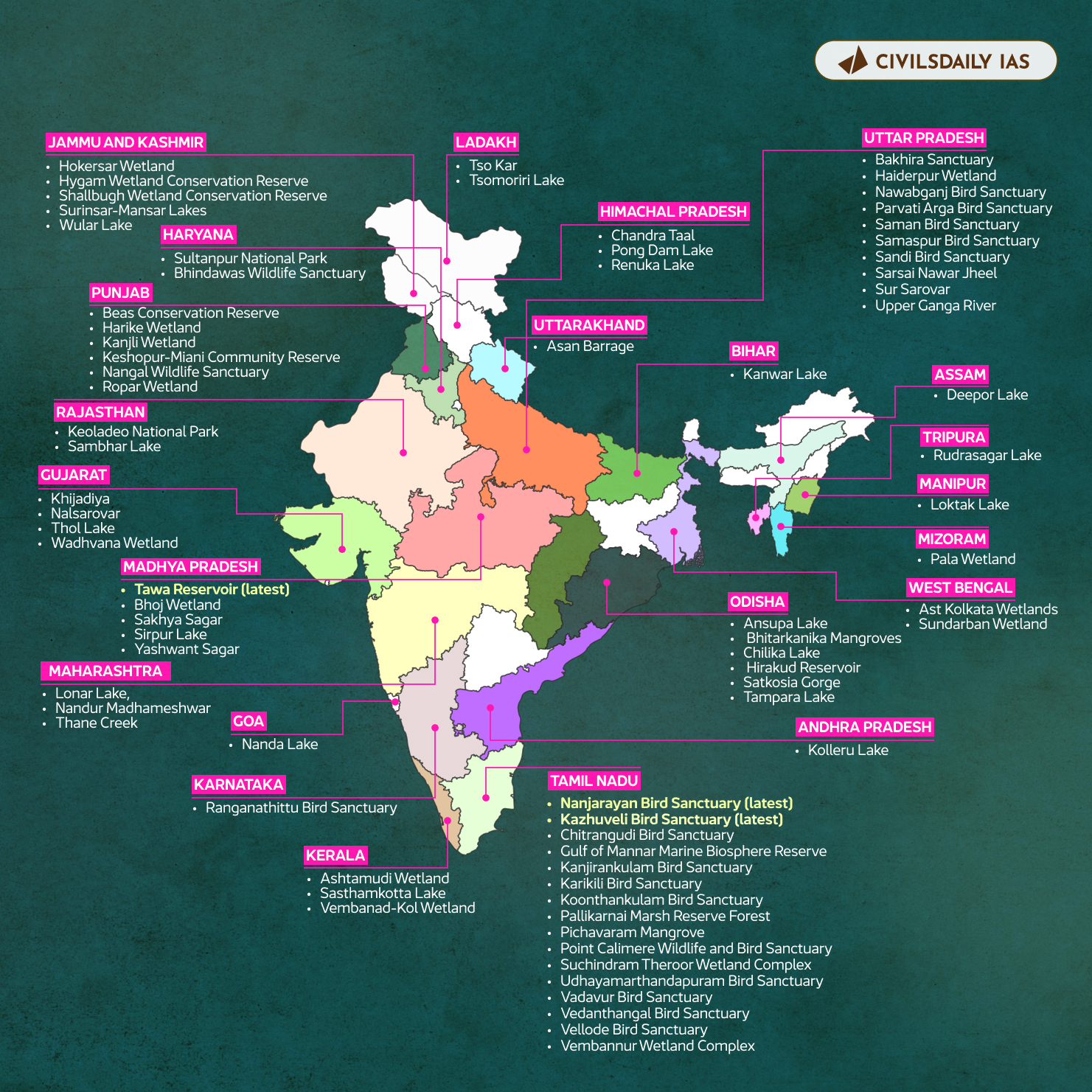
    Two wetlands in Bihar, Nagi and Nakti bird sanctuaries, have been added to the global list of wetlands of international importance under the “Ramsar Convention”, bringing India’s total Ramsar sites to 82.

    Do you know?

    • Currently, the highest number of such sites is in the UK (175) followed by Mexico (144).
    • The number of Indian sites on the list has increased from 26 to 82 in the last ten years, of which 40 have been added in the last three years.

    About Nagi-Nakti Wetland

    • These wetlands, situated in Bihar’s Jamui district within the Jhajha forest range, are man-made reservoirs nestled amid dry deciduous forests and hills.
    • Both sanctuaries were developed as man-made reservoirs, primarily for irrigation purposes, through the construction of dams.
    • These wetlands host a diverse range of flora and fauna, including over 150 species of birds, mammals, fish, aquatic plants, reptiles, and amphibians.

    Nakti Bird Sanctuary:

    • It was developed primarily for irrigation through the construction of the Nakti dam.
    • In 1984, the wetland was designated as a bird sanctuary, highlighting its importance as a wintering habitat for several migratory species, with over 20,000 birds congregating during winter months.
    • This includes one of the largest congregations of red-crested pochard in the Indo-Gangetic plain.

    Nagi Bird Sanctuary:

    • It was, on the other hand, created by the damming of the Nagi River, which enabled the gradual formation of water bodies with clear water and aquatic vegetation.
    • Overall, the wetland and its fringes provide habitat for over 75 bird species, 33 fish, and 12 aquatic plants.
    • Notably, the site hosts one of the largest congregations of bar-headed geese in the Indo-Gangetic plain.

    Ecological Significance

    • Migratory Bird Haven: The sanctuaries serve as critical wintering habitats for numerous migratory bird species, attracting over 20,000 birds during the winter months.
    • Species Diversity: Nagi and Nakti sanctuaries support a rich biodiversity, including over 75 bird species, 33 fish species, and 12 aquatic plant species.
    • Bar-headed Geese Congregation: Notably, the wetlands host one of the largest gatherings of bar-headed geese on the Indo-Gangetic plain, highlighting their importance as migratory bird habitats.

    Back2Basics: Ramsar Convention

    Explanation
    Purpose International treaty aimed at conserving and promoting the sustainable use of wetlands.
    Establishment Established on February 2, 1971, in Ramsar, Iran.
    Key Components
    • Identifying and designating wetlands of international importance.
    • Ensuring their effective management.
    • Promoting international cooperation for wetland conservation and sustainable use.
    9 Criteria for Sites Declaration
    1. A site should contain representative, rare, or unique wetland types.
    2. It should support vulnerable, endangered, or endemic species.
    3. It should be a habitat for waterfowl.
    4. It should have significant ecological, botanical, zoological, limnological, or hydrological features.
    5. It should support scientific research and biodiversity conservation.
    6. It should provide essential services such as flood control, water purification, and groundwater recharge.
    7. It should have cultural, recreational, or spiritual value for local communities.
    8. It should support sustainable livelihoods for human communities.
    9. It should be at risk or face human-induced threats that require international cooperation for conservation.
    Participating Countries 171 contracting parties (countries) as of September 2021.
    India and Ramsar Convention  The first Ramsar Site in India, the Chilika Lake in Odisha, was designated in 1981.
    Ramsar Secretariat The convention is administered by the Ramsar Secretariat, based in Gland, Switzerland.
    World Wetlands Day
    • February 2nd of each year.
    • To raise awareness about the importance of wetlands and commemorate the adoption of the Ramsar Convention.
    Montreux Record Register of wetland sites on the List of Wetlands of International Importance under the Ramsar Convention that require special attention.


    PYQ:

    [2014] If a wetland of international importance is brought under the ‘Montreux Record’, what does it imply?

    (a) Changes in ecological character have occurred, are occurring or are likely to occur in the wetland as a result of human interference.

    (b) The country in which the wetland is located should enact a law to prohibit any human activity within five kilometres of the edge of the wetland

    (c) The survival of the wetland depends on the cultural practices and traditions of certain communities living in its vicinity and therefore the cultural diversity therein should not be destroyed

    (d) It is given the status of ‘World Heritage Site’

    [2019] Consider the following statements:

    1. Under Ramsar Convention, it is mandatory on the part of the Government of India to protect and conserve all the wetlands in the territory of India.
    2. The Wetlands (Conservation and Management) Rules, 2010 were framed by the Government of India based on the recommendations of the Ramsar Convention.
    3. The Wetlands (Conservation and Management) Rules, 2010 also encompass the drainage area or catchment regions of the wetlands as determined by the authority.

    Which of the statements given above is/are correct?

    (a) 1 and 2 only

    (b) 2 and 3 only

    (c) 3 only

    (d) 1, 3 and 3

  • A call to action for a sustainable future  

    Why in the news?

    World Environment Day (WED) on June 5th is a global event where people come together to celebrate the importance of environmental conservation and sustainability, emphasizing the urgent need to tackle environmental challenges.

    World Environment Day 2024 Theme

    Theme: “Land Restoration, Desertification, and Drought Resilience”

    • Highlighting Critical Issues: Focuses on the significant threats posed by land degradation and desertification, which impact food security, biodiversity, and climate change. For example, the United Nations estimate that about 30% of land is degraded worldwide
    • The urgency for Action: Emphasizes the need for immediate actions in the face of the triple planetary crisis: Climate Change, Nature and Biodiversity Loss, and Pollution and Waste.
    • Shared Responsibility: Stresses collective action and individual responsibility in restoring ecosystems, urging everyone to contribute to solutions.
    • Empowering Youth: Encourages young people to lead the change towards a sustainable future with the #GenerationRestoration slogan.
    • Alignment with Global Goals: Supports the UN Decade on Ecosystem Restoration (2021-2030) and the Sustainable Development Goals, promoting a comprehensive approach to environmental protection.

    India’s Ambitious Renewable Targets

    • Renewable Energy Goals: India aims to achieve 450 GW of renewable energy capacity by 2030, emphasizing solar and wind energy.
    • Solar Energy Initiatives: Major solar projects, including the world’s largest solar park in Karnataka and the International Solar Alliance (ISA), aim to promote solar energy adoption.
    • Wind Energy: India is one of the world’s largest producers of wind energy, with significant wind farms in Tamil Nadu and Gujarat.
    • Policy Support: The government has introduced various policies and incentives to encourage investment in renewable energy, including subsidies, tax benefits, and easier land acquisition processes.
    • Sustainable Development: These initiatives align with India’s commitments under the Paris Agreement to reduce carbon emissions and promote sustainable development.

    How COVID-19 Shows Us the Way Forward

    • Environmental Awareness: The pandemic has heightened awareness of the interconnectedness between human health and the environment, highlighting the importance of preserving natural habitats to prevent zoonotic diseases.
    • Reduction in Pollution: Lockdowns and reduced industrial activities during the pandemic led to significant decreases in air and water pollution, demonstrating the impact of human activities on the environment.
    • Green Recovery: The concept of building back better suggests incorporating green recovery strategies into post-pandemic economic plans, focusing on sustainable practices and renewable energy investments.
    • Resilient Systems: Emphasizes the need for resilient and adaptive systems that can withstand future shocks, including those caused by climate change and environmental degradation.
    • Global Cooperation: COVID-19 underscored the importance of international cooperation and collective action to tackle global challenges, a principle that is equally applicable to environmental issues.

    Conclusion: By embracing the lessons from the pandemic, setting ambitious renewable energy targets, and focusing on land restoration and resilience, the global community can work towards a sustainable and resilient future. World Environment Day 2024 serves as a pivotal moment to reflect on these goals and renew our commitment to environmental stewardship.

    Mains PYQ:

    Q Access to affordable, reliable, sustainable and modern energy is the sine qua non to achieve Sustainable Development Goals (SDGs)”.Comment on the progress made in India in this regard. (150 Words, 10 Marks) (UPSC IAS/2018)

  • Protecting Mangroves in Tamil Nadu 

    Why in the News?

    The International Union for Nature Conservation (IUCN) has listed mangroves in coastal regions spanning Tamil Nadu, Sri Lanka and Maldives as ‘critically endangered’ in its first global assessment of mangrove ecosystems.

    Red List of Mangrove Ecosystems: Study by IUCN

    • Global assessment reveals a 50% risk of mangrove ecosystem collapse. Without further conservation, by 2050, 7,065 sq km more mangroves will be lost, and 23,672 sq km submerged.

    If we let this happen, the world is at risk of losing:  

    • 1.8B tonnes of carbon stored, costing society $336B (based on the social cost of carbon). Protects 2.1M lives and $36B worth of property from coastal flooding..

    Sea-level rise is the main threat affecting mangrove ecosystems. 

    • 25% of the global mangrove area is predicted to be submerged in the next 50 Years.
    • 1/3 of the world’s mangrove ecosystem provinces will be severely affected by sea-level rise.

    Tamil Nadu’s Efforts for Mangroves Conservation

    • The Tamil Nadu Forest Department has doubled mangrove cover from 23 sq km in 2001 to 45 sq km in 2021, as per the Indian State of Forest Report.
    • Mangrove restoration projects have been undertaken across Nagapattinam, Thiruvarur, Cuddalore, Pudukottai, Ramanathapuram, Thiruvallur, and Villupuram districts, with plans for an additional 15 sq km restoration under the Tamil Nadu Coastal Restoration Mission funded by the World Bank.

    TN-SHORE: World Bank-funded Coastal Restoration Mission

    • Tamil Nadu’s TN-SHORE initiative, launched in January 2024, aims to address environmental challenges along the coastline. With Rs 1,675 crore funding, including 70% from the World Bank, it focuses on blue carbon sequestration.

    Back2Basics: Mangroves

    • Mangroves constitute a group of trees and shrubs inhabiting the coastal intertidal zone.
    • They are found globally in tropical and subtropical regions, typically between latitudes 25° N and 25° S.
    • Mangroves are predominantly located in tropical regions due to their intolerance to the extreme cold conditions prevalent in temperate zones.

    Features of Mangroves:

    • Adaptation to waterlogged and anoxic soil: Mangroves possess unique characteristics allowing them to survive in waterlogged and oxygen-deficient environments.
    • Halophytes: Mangrove species have the ability to filter out up to 90% of the salt from seawater as it enters their roots, with some species also excreting salt through glands in their leaves.
    • Water retention capacity: Thick succulent leaves store fresh water, while a waxy coating on some species’ leaves minimizes evaporation.
    • Pneumatophores: Certain mangroves develop pencil-like roots that emerge from the ground to absorb oxygen from the air, aiding in coping with tidal flooding.
    • Prop roots: Many mangrove trees possess dense aerial roots descending from their trunks and branches, which stabilize and support them against waves and tides.
    • Lenticellated bark: Oxygen enters mangroves through lenticels, small breathing pores in the bark and roots, enabling them to adapt to low oxygen conditions.
    • Viviparity: Seed pods germinate while still on the tree, facilitating immediate root growth upon dropping.

    Mangroves in India:

    • According to the India State of Forest Report 2021, mangrove cover in India comprises 0.15% of the country’s total geographical area.
    • West Bengal has the highest percentage of area under total mangrove cover among states and union territories, followed by Gujarat and the Andaman and Nicobar Islands.
    • The Sundarbans, characterized by the dominant mangrove species sundari (Heritiera fomes), is the largest continuous mangrove forest globally.
    • Various mangrove areas in India are protected within reserves and sanctuaries such as the Sundarbans Tiger Reserve, Bhitarkanika, Coringa, Nelapattu, Point Calimere Wildlife Sanctuaries, Pirotan National Park, among others.


    PYQ:

    [2011] The 2004 Tsunami made people realize that mangroves can serve as a reliable safety hedge against coastal calamities. How do mangroves function as a safety hedge?

    (a) The mangrove swamps separate the human settlements from the sea by a wide zone in which people neither live nor venture out

    (b) The mangroves provide both food and medicines which people are in need of after any natural disaster

    (c) The mangrove trees are tall with dense canopies and serve as an excellent shelter during a cyclone or tsunami

    (d) The mangrove trees do not get uprooted by storms and tides because of their extensive roots.