💥Join UPSC 2027,2028 Mentorship (August Batch) + XFactor Notes & Microthemes PDF

GS Paper: Federalism

  • Extension of President’s Rule in Manipur

    Why in the News?

    Home Minister is set to move a statutory resolution in the Rajya Sabha to extend President’s Rule in Manipur by another 6 months.

    What is President’s Rule?

    • Overview: It refers to the suspension of a state’s constitutional machinery, placing the state under direct control of the Union Government.
    • It is also known as State Emergency or Constitutional Emergency.
    • Constitutional Basis:
      • Article 355: Obligates the Union to ensure that governance in every state is in accordance with the Constitution.
      • Article 356(1): Allows the President to assume control of a state’s executive if the Governor reports a constitutional breakdown or the President independently concludes so.
      • Article 365: Deems a state’s failure to comply with Union directions as a failure of constitutional machinery.

    Duration and Extension of President’s Rule:

    • Initial duration: Valid for 6 months from the date of proclamation.
    • Extensions: Can be extended every six months, subject to parliamentary approval, for a maximum of 3 years.
    • Parliamentary Approval (Article 356(3)):
      • Must be approved by both Houses of Parliament within 2 months.
      • Requires a simple majority (members present and voting).
    • Beyond 1 Year: Allowed only if:
      • A National Emergency (Article 352) is in operation in the whole or part of the state.
      • The Election Commission of India certifies that elections to the Legislative Assembly cannot be held.
    • Beyond 3 Years: Requires a constitutional amendment (e.g., 67th and 68th Amendments extended President’s Rule in Punjab).

    Implications of President’s Rule on a State:

    • Executive Powers (Article 356(1)(a)):
      • The President assumes functions of the state government via the Governor.
      • Administration is carried out by the Governor, with support from the Chief Secretary and advisors.
    • Legislative Powers (Article 356(1)(b)):
      • The Legislative Assembly is either suspended or dissolved.
      • Legislative powers are exercised by Parliament or delegated to the President.
    • Financial Powers (Article 356(1)(c)):
      • The President may authorize expenditure from the Consolidated Fund of the State pending Parliament’s approval (under Article 206 and Article 357).

    Revocation:

    • President’s Rule can be revoked at any time by the President under Article 356(2).
    • No parliamentary approval is required for revocation.

    Supreme Court Judgments related to it:

    • S.R. Bommai v. Union of India (1994):
      • President’s Rule is subject to judicial review.
      • A floor test is the proper method to prove majority.
      • The Governor’s report alone is not sufficient for justification.
    • Sarbananda Sonowal v. Union of India (2005): Widened the scope of Article 355 for preventive action by the Union.
    • Rameshwar Prasad v. Union of India (2006):
      • Dissolution of Bihar Assembly was declared unconstitutional.
      • Use of Article 356 to prevent political defections was struck down.

    Key Reforms/Recommendations:

    • Sarkaria Commission (1987): President’s Rule should be used only as a last resort after exploring all other options.
    • Punchhi Commission (2010): Proposed localized emergency provisions for specific districts or regions instead of the entire state.
    • National Commission to Review the Working of the Constitution (2000):
      • Article 356 should remain but be used sparingly.
      • Suggested amendments to allow its use without National Emergency if elections cannot be held.
    [UPSC 2018] If the President of India exercises his power as provided under Article 356 of the Constitution in respect of a particular State, then

    Options: (a) the Assembly of the State is automatically dissolved.

    (b) the powers of the Legislature of that State shall be exercisable by or under the authority of the Parliament.

    (c) Article 19 is suspended in that State.

    (d) the President can make laws relating to that State.


  • What are Autonomous District Councils (ADC)?

    Why in the News?

    Mizoram Governor has imposed Governor’s Rule in the Chakma Autonomous District Council (CADC) due to prolonged political instability and repeated leadership changes.

    About Autonomous District Councils (ADCs):

    • Basis: They are local self-governing institutions established under the Sixth Schedule of the Indian Constitution.
    • Coverage: ADCs are constituted in tribal areas of the northeastern states—Assam, Meghalaya, Tripura, and Mizoram (ATM2) [Sixth Schedule] 
    • Purpose: These councils aim to provide autonomy to tribal communities to preserve their culture, customs, and govern their local affairs.
    • Notification: Each tribal area notified under the Sixth Schedule is declared an autonomous district, governed by its respective ADC.
    • Objective: The primary objectives of ADCs are to promote tribal self-governance, ensure local development, and protect tribal identity and rights.

    Note: The Constitution provides for the reservation of seats in Panchayats for STs.

    Key Features of ADCs

    • Legal Status: ADCs are formed through constitutional provisions under the Sixth Schedule and are not governed by state laws.
    • Council Composition: Each ADC comprises up to 30 members, of which 26 are elected by adult suffrage and 4 are nominated by the Governor.
    • Tenure: The tenure of an ADC is 5 years from the date of its constitution.
    • Scope of Authority: ADCs have legislative, executive, and limited judicial powers specific to the needs of tribal communities.
    • Applicability of Laws: State and Central laws do not automatically apply in ADC areas unless explicitly extended by the Governor.

    Powers and Functions of ADCs:

    • Law-Making Powers: ADCs can enact laws on land management, agriculture, and forest use (excluding reserved forests).
    • Customary Regulations: They can regulate inheritance, marriage, divorce, and social customs, and appoint traditional chiefs and headmen.
    • Local Administration: It oversee services such as primary education, dispensaries, roads, markets, and fisheries.
    • Judicial Functions: Councils can establish village courts to try civil and criminal cases involving tribal members, with sentencing powers up to five years.
    • Regulation of Trade: They may regulate money lending and trade by non-tribals, subject to Governor’s approval.
    • Revenue Sources: It can levy taxes on professions, trades, animals, vehicles, markets, ferries, and public infrastructure like roads and schools.

    Autonomy and Limitations:

    • Degree of Autonomy: ADCs enjoy substantial legislative and administrative autonomy within their territorial jurisdiction.
    • Non-Applicability of General Laws: Parliamentary and State laws apply only when directed by the Governor, ensuring self-rule.
    • Governor’s Oversight: Despite autonomy, the Governor retains discretionary powers and can approve, modify, or annul council decisions.
    • Financial Constraints: ADCs often face limited revenue generation, which restricts their developmental effectiveness.
    • Administrative Challenges: Operational issues include leadership instability, shortage of trained personnel, and state-level interference in council functions.
    [UPSC 2015] The provisions in Fifth Schedule and Sixth Schedule in the Constitution of India are made in order to:Options: (a) protect the interests of Scheduled Tribes * (b) determine the boundaries between States (c) determine the powers, authority and responsibilities of Panchayats (d) protect the interests of all border States
  • What are Zonal Councils?

    Why in the News?

    Union Home Minister recently highlighted that 83% of issues discussed in Zonal Council meetings have been resolved, reaffirming their role as effective platforms for intergovernmental cooperation.

    What are Zonal Councils?

    • Establishment: They are statutory bodies established under the States Reorganisation Act, 1956; they are not constitutional bodies.
    • Purpose: Their main goal is to promote cooperation and coordination among states, union territories, and the central government.
    • Basis for Zoning: Zones were drawn based on natural divisions, cultural and linguistic affinity, river systems, and security needs.
    • Zonal Division: India is divided into five zones—Northern, Central, Eastern, Western, and Southern—with a separate Zonal Council for each:
      1. Northern Zonal Council: Haryana, Himachal Pradesh, Jammu & Kashmir, Punjab, Rajasthan, Delhi, Chandigarh
      2. Central Zonal Council: Chhattisgarh, Uttarakhand, Uttar Pradesh, Madhya Pradesh
      3. Eastern Zonal Council: Bihar, Jharkhand, Odisha, West Bengal
      4. Western Zonal Council: Goa, Gujarat, Maharashtra, Dadra & Nagar Haveli, Daman & Diu
      5. Southern Zonal Council: Andhra Pradesh, Karnataka, Kerala, Tamil Nadu, Puducherry

    Note: 

    • North-Eastern Council (NEC) (separate body): Assam, Arunachal Pradesh, Manipur, Tripura, Mizoram, Meghalaya, Nagaland, Sikkim (added in 2002)
    • The union territories of Andaman and Nicobar Islands and Lakshadweep are NOT members of any of the Zonal Councils. However, they are presently special invitees to the Southern Zonal Council.

    Composition and Structure of Zonal Councils:

    • Chairperson: Each Zonal Council is chaired by the Union Home Minister.
    • State Representation: The Chief Ministers of all states in the respective zone are members of the Council.
    • Additional Members: Each state nominates two additional ministers; administrators of union territories also participate.
    • Vice-Chairperson Role: The role of Vice-Chairperson rotates annually among the Chief Ministers.
    • Standing Committees: These are formed with Chief Secretaries of states and meet ahead of full sessions to finalize the agenda.

    Functions and Responsibilities:

    • Cooperation & Consensus: Promote interstate and Centre-state cooperation through dialogue and consensus-building.
    • Key Issues Addressed: Economic and social planning, Border disputes, Inter-state transport, Linguistic minority concerns etc.
    • Advisory Role: While the councils’ recommendations are advisory, they play a vital role in dispute resolution and coordinated policy formulation.

    Recent Developments and Significance:

    • Leadership in NEC: In 2018, the Union Home Minister became the Chairperson of the North Eastern Council, signaling a push for broader integration.
    • Revitalization under Modi Government: Zonal Councils have evolved into dynamic, action-oriented platforms rather than passive advisory bodies.
    • Strengthening Federalism: These councils now actively contribute to cooperative federalism, resolve disputes, and accelerate regional development.
    • Efficacy in Implementation: With 83% of agenda issues resolved, Zonal Councils demonstrate increasing political will and effectiveness in addressing regional challenges.
    [UPSC 2013] Which of the following bodies is/are not mentioned in the Indian Constitution?

    1. National Development Council 2. Planning Commission 3. Zonal Councils

    Select the correct answer using the codes given below.

    Options: (a) 1 and 2 only (b) 2 only (c) 1 and 3 only (d) 1, 2 and 3


  • [5th July 2025] The Hindu Op-ed: Two Democracies and the Echoes of Tyranny

    PYQ Relevance:

    [UPSC 2024] What changes has the Union Government recently introduced in the domain of Centre-State relations? Suggest measures to be adopted to build the trust between the Centre and the States and for strengthening federalism.

    Linkage:  The articles discusses how India’s democratic backsliding occurred partly due to the exploitation of constitutional weaknesses and how “the deeper damage to political culture, to institutions, to the idea that constitutionalism alone can protect democracy remains” after the Emergency.


    Mentor’s Comment:  On U.S. Independence Day, reflections by Judge J. Michael Luttig and a look back at India’s 1975 Emergency give a strong warning about how democracy can be weakened from within. It compares how Indira Gandhi misused the Constitution in India to how leaders like Donald Trump show signs of authoritarianism in America. It highlights that freedom and rights can be lost not by war, but by twisting laws and failing institutions. The Emergency period still feels relevant today, as many democracies around the world face similar dangers. It’s a reminder that constant vigilance is the price of liberty.

    Today’s editorial analyses the  1975 Emergency and its impact in India. This topic is important for GS Paper II (Indian Polity) in the UPSC mains exam.

    _

    Let’s learn!

    Why in the News?

    The same problems that caused the Emergency in India are now putting the U.S. at risk. The lesson is that tyranny grows when important institutions stop doing their job.

    What Constitutional gaps enabled the 1975 Emergency’s misuse?

    • Vague Grounds for Proclaiming Emergency (Article 352): The term “internal disturbance” (before it was amended to “armed rebellion” by the 44th Amendment) was undefined, allowing the government to declare an Emergency without sufficient justification.
    • Lack of Judicial Safeguards: The judiciary, including the Supreme Court, failed to protect fundamental rights. In the ADM Jabalpur case (1976), the Court ruled that even the right to life could be suspended, revealing a serious weakness in judicial independence and constitutional checks.
    • Absence of Parliamentary Oversight Mechanisms: There was no mandatory review or time limit for an Emergency once proclaimed. Parliament was not empowered to effectively question or revoke the declaration, enabling prolonged executive overreach.
    • Preventive Detention Laws without Safeguards: Laws like the Maintenance of Internal Security Act (MISA) allowed for the detention of individuals without trial, and the suspension of habeas corpus, giving the executive near-total control over personal freedoms.

    How did the Emergency weaken democratic institutions in India?

    • Suppressing the Free Press: The government imposed pre-censorship on newspapers like The Indian Express and The Statesman, curbing freedom of the press. Journalists were jailed, and dissenting voices silenced, eroding media independence.
    • Paralysing the Legislature and Bureaucracy: Parliament became a rubber stamp, passing ordinances and amendments without real debate. Civil servants and ministers followed orders unquestioningly, prioritising loyalty over legality, thereby hollowing out institutional integrity.

    Why is India’s Emergency relevant to the current global democratic decline?

    • Authoritarianism through Legal Means: The 1975 Emergency showed how laws can be manipulated to suspend rights and suppress dissent without military coups. Today, similar tactics are used globally — leaders use legal loopholes and executive decrees to weaken democratic norms (e.g., Hungary’s rule-by-decree during the COVID-19 pandemic).
    • Erosion of Institutional Independence: During the Emergency, judiciary, media, and civil services failed to resist executive overreach. This institutional submission mirrors current trends in several democracies where checks and balances are compromised under pressure (e.g., judiciary weakening in Turkey and political pressure on U.S. law enforcement).
    • Cult of Personality and Centralised Power: Indira Gandhi’s consolidation of power and her son’s parallel command structure resemble modern populist leadershipsthat centralise authority, undermine opposition, and control narratives (e.g., executive overreach in Brazil, Philippines, or even Russia).

    What ethical duties do institutions hold in resisting authoritarianism?

    • Upholding Constitutional Values: Institutions like the judiciary, legislature, and civil services must prioritise the Constitution over political loyalty, ensuring that democratic principles, civil liberties, and rule of law are never compromised.
    • Maintaining Institutional Independence: Institutions have a duty to remain independent and impartial, resisting pressure from the executive or ruling parties. This includes protecting dissent, enabling checks and balances, and avoiding complicity in authoritarian overreach.
    • Defending Public Trust and Accountability: Ethical responsibility requires institutions to serve the public interest, not individual leaders. They must ensure transparency, fairness, and accountability, especially during crises when democratic norms are most vulnerable.

    How can citizens safeguard democracy from internal threats?

    • Active Civic Participation: Citizens must engage in democratic processes such as voting, peaceful protest, and public discourse to hold leaders accountable. Eg: Mass movements like India’s JP Movement in the 1970s or the U.S. Civil Rights Movement helped restore democratic accountability.
    • Demanding Transparency and Accountability: Citizens should question government actions, demand answers through RTI, media, and civil society platforms, and resist normalisation of unconstitutional acts. Eg: Public pressure during India’s anti-corruption movement (2011) led to the Lokpal Act.
    • Promoting Constitutional Literacy and Vigilance: A well-informed public is less likely to fall for authoritarian rhetoric. Citizens must educate themselves about constitutional rights and duties, enabling them to recognize and resist erosion of democratic norms.

    Way forward: 

    • Strengthen Institutional Independence: Ensure autonomy of key democratic institutions like the judiciary, election commission, and media through legal safeguards and transparent appointments to resist political influence.
    • Promote Constitutional Literacy and Civic Engagement: Launch nationwide awareness campaigns and integrate constitutional values into education to empower citizens to uphold democratic principles and resist authoritarianism.
  • A lofty concept, a Governor and unwanted controversy

    Why in the News?

    A big controversy has started in Kerala after the Governor put up a picture of ‘Bharat Mata’ in an official room at the Raj Bhavan, leading to a clash between the Governor and the elected state government.

    What is the origin and evolution of the Bharat Mata image?

    • Origin in literary and artistic nationalism: The concept of Bharat Mata originated in the late 19th century through Bankim Chandra Chattopadhyay’s novel Anandamath, which introduced the idea of Banga Mata (Mother Bengal). Later, Abanindranath Tagore painted a four-armed woman resembling a Hindu goddess in 1905, which was popularised by Sister Nivedita as Bharat Mata.
    • Evolution into a political symbol: During the Indian freedom movement, Bharat Mata evolved into a powerful emotional symbol representing the nation’s collective identity. While the slogan ‘Bharat Mata ki Jai’ became widespread, no specific image was officially adopted. Post-independence, the concept remained cultural but was not recognised in any constitutional or legal form.

    What is the Governor’s role in relation to decisions of the elected state government?

    • Constitutional Head: The Governor is the nominal head of the state and must act based on the aid and advice of the Council of Ministers, as per Article 163 of the Constitution. For instance, decisions on official functions, such as placing portraits or symbols, must follow government directions.
    • No Independent Decision-Making Power: Dr. B.R. Ambedkar clarified in the Constituent Assembly that the Governor has “no functions which he can discharge by himself.” In the Kerala case, the Governor unilaterally placing the Bharat Mata picture at state events goes against this principle.
    • Bound by Constitutional Protocols: The Supreme Court has held in multiple judgments (e.g., Nabam Rebia case, 2016) that the Governor cannot act at his discretion in routine matters. Thus, any deviation from official protocol, such as conducting ceremonies with unauthorised symbols, breaches constitutional norms.

    How does the Bharat Mata image controversy highlight tension between constitutional norms and cultural nationalism?

    • Lack of Constitutional Recognition: The image of Bharat Mata is not recognised by the Constitution like the national flag, emblem, or anthem. Including it in official state functions challenges the principle of secularism and constitutional symbolism, which mandates state neutrality in public symbolism.
    • Political and Ideological Association: The specific depiction used by the Governor—a woman in saffron with a lion—is commonly linked to“right-wing outfits”, making it a cultural nationalist representation rather than a universally accepted national symbol. Its use in state ceremonies risks the blurring of state and ideological lines.
    • Violation of Democratic Protocol: The elected state government objected to the image’s presence, arguing that no unilateral decision can override collective democratic authority. This reflects the friction between constitutional propriety and the personal or ideological preferences of a constitutional functionary.

    Can the Governor act independently in this case?

    • No. The Constitution does not permit the Governor to act unilaterally in official matters. Any display of symbols or portraits during official functions must have the State government’s approval. The Governor’s conduct must adhere to constitutional discipline, not personal or ideological preferences.

    How should officials balance personal beliefs with constitutional values? (Way forward)

    • Adhere to constitutional obligations over personal ideology – Public officials must act in line with constitutional principles like secularism, equality, and neutrality while performing official duties. For instance, a Governor should follow government protocol during official functions rather than promoting symbols not recognised by the Constitution.
    • Separate personal practices from public conduct – While officials are free to hold personal beliefs, they must not impose them in public institutions or state functions. Eg An officer may privately revere a religious symbol but should avoid displaying it in a government office to maintain inclusivity.

    Mains PYQ:

    [UPSC 2022] Are tolerance, assimilation and pluralism the key elements in the making of an Indian form of secularism? Justify your answer.

    Linkage: The controversy surrounding the display of a specific picture of Bharat Mata highlights a tension with the “strong secular core” and “inclusive” nature of Indian nationalism. This question explores the principles of Indian secularism, which are central to understanding the debate over how such a concept should be represented and integrated into official functions in a diverse society.

  • Banakacherla Project Dispute

    Why in the News?

    A fresh political and inter-state water dispute has erupted between Telangana and Andhra Pradesh over the proposed Banakacherla Reservoir Project.

    Banakacherla Project Dispute

    About the Banakacherla Project:

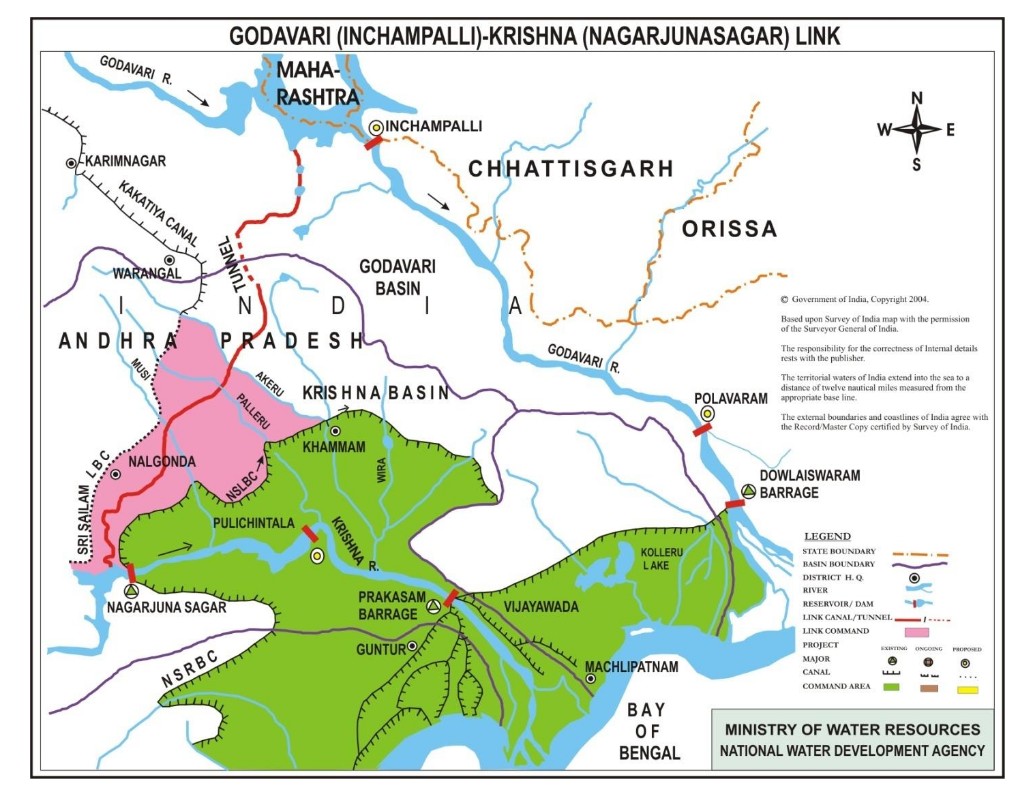
    • About: Also known as the Godavari-Banakacherla or Polavaram-Banakacherla Link Project, it is an ambitious interlinking plan proposed by the Andhra Pradesh government.
    • Objective: It aims to divert surplus Godavari River water via the Polavaram Project, through the Krishna basin, to reach the Banakacherla regulator in Kurnool district.
    • Reservoirs: The project involves construction of a new Bollapalli reservoir in Guntur district, enhancement of canal capacities (e.g., Polavaram canal from 17,500 to 38,000 cusecs), and a network of lift stations and tunnels through the Nallamala forest.
    • Water Pathway: It begins at Polavaram dam, moves to Bollapalli, and ends at Banakacherla, integrating Godavari, Krishna, and Penna River basins.

    Tap to read more about the Interstate River Water Disputes Act, 1956.

    Issues with the Project:

    • Violation of the AP Reorganisation Act (2014): Telangana claims that Andhra’s project infringes upon legal frameworks laid out during the bifurcation of the state.
    • Lack of Clearances: Telangana argues the project has not received mandatory approvals from:
      • Apex Council (Krishna River Management Board and Godavari River Management Board).
      • Central Water Commission (CWC).
    • Water Sharing: Telangana cites the Godavari Water Disputes Tribunal, which allocated 968 TMC to Telangana and 518 TMC to Andhra but did not quantify surplus water, making the legality of Andhra’s claim ambiguous.
    • Political Sensitivity: Water-sharing has historically been central to Telangana’s statehood movement; any diversion is seen as a betrayal of regional interests.
    • Ecological Concerns: The tunnel under the Nallamala forest may have environmental repercussions that have not been assessed or cleared.
    [UPSC 2012] Which of the following are included in the original jurisdiction of the Supreme Court? 1. A dispute between the Government of India and one or more States 2. A dispute regarding elections to either House of the Parliament or that of Legislature of a State 3. A dispute between the Government of India and a Union Territory 4. A dispute between two or more States

    Select the correct answer using the code given below:

    Options: (a) 1 and 2 only (b) 2 and 3 only (c) 1 and 4 only* (d) 3 and 4 only


  • Water Sharing Dispute between Punjab and Haryana

    Why in the News?

    Tensions escalated between Punjab and Haryana after the Bhakra Beas Management Board (BBMB) decided to release an extra 4,500 cusecs of water from the Bhakra dam to Haryana, sparking political and legal opposition from Punjab.

    Water Sharing Dispute between Punjab and Haryana

    About the Punjab-Haryana Water Dispute:

    • The dispute dates back to 1966 when Haryana was created from Punjab and was promised a share of river waters from the Ravi and Beas rivers.
    • The Satluj-Yamuna Link (SYL) canal was proposed to deliver Haryana’s share but remains incomplete due to Punjab’s resistance.
    • The current issue involves Punjab and Haryana over the release of additional water from the Bhakra dam, managed by the Bhakra Beas Management Board (BBMB).
    • On April 30, 2025, BBMB ordered the release of 8,500 cusecs of water to Haryana for drinking needs, which Punjab opposed, claiming Haryana had already withdrawn 104% of its annual share.
    • Water levels in the Bhakra, Pong, and Ranjit Sagar dams are low due to poor snowfall in the Himalayas.
    • Punjab argues that BBMB’s decision is unilateral and has refused to open the Nangal dam sluice gates.

    Inter-State Water Dispute Resolution in India:

    Water Sharing Dispute between Punjab and Haryana

    • Article 262 of the Constitution empowers Parliament to legislate on inter-state river water disputes and bar courts from intervening in such matters.
    • River Boards Act, 1956 allows creation of boards for inter-state river management, but no such board has ever been constituted.
    • Inter-State Water Disputes Act, 1956 provides for:
      • Conciliation by the Centre among aggrieved states.
      • Tribunal formation if conciliation fails.
    • The 2002 amendment mandates:
      • Formation of a tribunal within 1 year.
      • Tribunal decision within 3 years.
    • Supreme Court cannot question the award of a tribunal but can examine procedural issues.
    • Other prominent disputes include Krishna, Cauvery, and the Satluj Yamuna Link canal disputes.
    [UPSC 2006] Recently Uttar Pradesh and Madhya Pradesh governments signed a Memorandum of Understanding for the linking of two rivers as a link project. Which are these two rivers?

    Options: (a) Betwa and Chambal (b) Betwa and Ken* (c) Chambal and Son (d) Ken and Narmada


  • Diving into SC’s verdict on Governors

    Why in the News?

    On April 8, 2025, the Supreme Court settled a long-standing issue between the Governor of Tamil Nadu and the state’s government and Legislative Assembly.

    What was the Supreme Court’s ruling on the Tamil Nadu Governor’s delay in assenting to Bills?

    • No “Pocket Veto” by Governor: The Court ruled the Governor cannot indefinitely withhold assent to Bills passed by the State Legislature. Eg: The Governor delayed action on ten Bills for years without justification.
    • Governor Must Act Timely: The Governor must either assent, return, or refer the Bills to the President within reasonable time. Eg: The Court stated the Governor should act on the Bills, not delay them.
    • Article 142 Used to Declare Bills Law: Due to the delay, the Court invoked Article 142 to deem the Bills as law. Eg: The Tamil Nadu government notified the Acts as law following the Court’s decision.

    Why did the Court use Article 142 to declare the Bills as law?

    • Prolonged Delay by the Governor: The Court found that the Governor had unjustifiably delayed action on the Bills for years, violating the constitutional principles of federalism and representative democracy. Eg: The Governor kept the Bills pending for an extended period without offering valid reasons, causing a constitutional impasse.
    • Ensuring Justice and Upholding Democracy: The Court invoked Article 142 to do “complete justice” by respecting the will of the elected representatives of the State Legislative Assembly, thus protecting the democratic process. Eg: The Court deemed the Bills passed by the Legislature as law to ensure that the legislative intent of the people’s representatives was not thwarted.
    • Constitutional Vacuum and Remedy: Since the Constitution did not specify a time limit for the Governor’s action, the Court stepped in to remedy the situation, ensuring the Bills were not indefinitely stalled. Eg: The Tamil Nadu government immediately notified the Acts as law after the Court’s intervention, rectifying the Governor’s delay.

    When is the Governor constitutionally allowed to refer a Bill to the President?

    • When the Bill is Inconsistent with Central Law: The Governor can refer a Bill to the President if it conflicts with existing central laws or raises constitutional issues requiring the President’s decision. Eg: A Bill that contradicts a central law on the same subject matter may be referred to the President for approval.
    • When the Governor Has Doubts on the Bill’s Constitutionality: If the Governor has constitutional concerns regarding a Bill, they can refer it to the President for further consideration, especially if it involves matters outside the state’s jurisdiction. Eg: A Bill that encroaches on the powers reserved for the Union can be referred to the President for a final decision.

    Which constitutional flaw did the Court aim to rectify through this judgment?

    • Lack of Clear Guidelines for Governor’s Action: The Constitution did not specify clear timelines or procedures for the Governor in handling State Bills, leaving room for delays and misuse of power. Eg: The Governor of Tamil Nadu delayed assent to Bills for years, exploiting the absence of a specific time frame for action.
    • Absence of Safeguards Against Governor’s Arbitrary Power: The Constitution did not explicitly limit the Governor’s power to withhold assent or exercise a pocket veto, leading to potential abuse and undermining the democratic process. Eg: The Governor’s delay in assenting to ten Bills without any constitutional justification prompted the Court’s intervention.
    • Weakness in Protecting Federalism and Legislative Authority: The lack of specific checks on the Governor’s actions threatened the principles of federalism and undermined the autonomy of the State Legislative Assembly. Eg: By indefinitely stalling the Bills, the Governor weakened the power of the elected State Legislature, which led the Court to act to preserve federalism.

    Who is responsible for upholding constitutional conventions to protect federalism?

    • The Executive (Governor and Chief Minister): Both the Governor, as the representative of the President, and the Chief Minister, as the head of the state government, must respect constitutional conventions to ensure the smooth functioning of federalism and maintain the balance of power between the Centre and States. Eg: The Governor’s undue delay in assenting to Bills disrupted the federal balance and called for judicial intervention.
    • The Legislature (State Legislative Assembly): The elected representatives in the State Legislature must ensure that the legislative process adheres to constitutional conventions, fostering federal cooperation and preventing undue interference by the Centre. Eg: The Tamil Nadu Legislative Assembly passed Bills that reflected the will of the people, but faced obstruction due to Governor’s delays, highlighting the need for constitutional respect.
    • The Judiciary: The judiciary plays a crucial role in upholding constitutional conventions when other branches fail to act appropriately. The Supreme Court intervenes when there is a violation of constitutional principles like federalism and when executive or legislative actors overstep their bounds. Eg: The Supreme Court used Article 142 to declare the Tamil Nadu Bills as law, rectifying the constitutional flaw in the Governor’s inaction and protecting federalism.

    Way forward: 

    • Clarify Constitutional Procedures: There is a need for clear constitutional guidelines and timeframes for Governors to act on State Bills, reducing ambiguity and preventing delays that undermine federalism. This could involve amendments or judicial directions for timely decision-making.
    • Strengthen Checks on Executive Power: Strengthening safeguards against arbitrary use of powers by the Governor through legal reforms and accountability measures can ensure that the democratic process and legislative authority of states are respected.

    Mains PYQ:

     [UPSC 2022] Discuss the essential conditions for exercise of the legislative powers by the Governor. Discuss the legality of re-promulgation of ordinances by the Governor without placing them before the Legislature.

    Linkage: The Supreme Court’s 2025 verdict addressed the limits of the Governor’s power regarding assent to bills, effectively preventing the use of a “pocket veto”. This context makes the 2022 question relevant as it explores other aspects of the Governor’s legislative role and the need for accountability to the state legislature.

  • SC slams TN Governor, Fixes Time for Assent

    Why in the News?

    The Supreme Court criticised Tamil Nadu Governor R.N. Ravi, calling his actions “unconstitutional.” The court said he did nothing for months about 10 important Bills, and then suddenly sent them to the President only after the State Assembly passed them again and the matter reached the court.

    ‘Must act with due deference to conventions of parliamentary democracy’: Supreme Court sets aside TN Governor’s reservation of 10 Bills  

    What did the SC rule on the TN Governor’s reservation of Bills for the President in Nov 2024?

    • Action declared illegal: The Court ruled that the Governor’s act of reserving 10 Bills for the President after they were already reconsidered and passed again by the Tamil Nadu Assembly was unconstitutional. Eg: If a state legislature passes a Bill, and the Governor returns it, but the legislature passes it again, the Governor must either give assent or withhold it—he cannot send it to the President at that stage.
    • Violation of Article 200: According to Article 200, a Bill can be reserved for the President only when it is first presented to the Governor—not after it is passed again following reconsideration. Eg: The Governor had no authority to reserve the 10 Bills in November 2024 because they had already been returned, reconsidered, and passed again.
    • Presidential action also invalid: The Court held that since the Governor’s action was unconstitutional, any decision taken by the President based on that action is also invalid. Eg: Even if the President had accepted or rejected those Bills, it would not be valid because the referral itself was flawed.

    Why did the SC invoke Article 142 to grant assent to the 10 Bills?

    • Undue delay by the Governor: The Bills were kept pending for an excessively long time without any decision by the Governor, causing a constitutional deadlock. Eg: Some Bills were pending since January 2020, which hindered the functioning of the state legislature and governance.
    • Violation of constitutional spirit and conventions: The Governor showed disregard for established constitutional conventions and the Supreme Court’s earlier rulings by not acting in a timely or respectful manner. Eg: The Court said the Governor displayed “scant respect” for constitutional procedures by withholding assent without valid reason.
    • To ensure justice and restore balance: The Court used Article 142 (which allows it to do complete justice in any matter) to directly grant assent to the 10 Bills to break the impasse and uphold democratic functioning. Eg: Since the Governor failed in his duty, the Court stepped in to protect the will of the people as expressed through their elected legislature.
    Note: Article 142 of the Indian Constitution grants the Supreme Court the power to pass any decree or order necessary to do “complete justice” in any case or matter pending before it, allowing it to transcend the limitations of existing laws and statutes. 

    When can a Governor constitutionally reserve a Bill for the President’s consideration?

    • Only at the first instance of presentation (Article 200): Under Article 200 of the Constitution, the Governor may reserve a Bill for the President only when it is presented to him for the first time. Eg: If a state Assembly passes a Bill and the Governor receives it for the first time, he can reserve it for the President instead of giving or withholding assent.
    • Not after Assembly reconsideration (Article 200 – First Proviso): If the Governor returns a Bill to the Assembly and it is re-passed (with or without changes), the Governor must act—either grant or withhold assent—and cannot reserve it again unless it is substantially changed. Eg: In the Tamil Nadu case, the Governor reserved the Bills after they were reconsidered by the Assembly, which the Supreme Court ruled was unconstitutional.
    • Exception – If the Bill is materially different (Article 200 – Judicial Interpretation): If the Bill, after being reconsidered by the legislature, is substantially or materially different from the original, reservation may be allowed. Eg: If new provisions are added that affect national interest or conflict with Union laws, reservation might be justified, even after reconsideration.

    How did the SC define the Governor’s expected role and conduct under the Constitution?

    • Respect for Parliamentary Democracy and the Will of the Legislature: The Governor must act in accordance with the democratic spirit and not undermine the decisions of the elected legislature. Eg: Shamsher Singh v. State of Punjab (1974) — The SC ruled that the Governor is a constitutional head and must act on the aid and advice of the Council of Ministers, except in specific situations.
    • Facilitator, Not an Obstructionist: The Governor should enable smooth functioning of governance and not stall legislative processes. Eg: Samsher Singh case (1974) and reaffirmed in the 2024 SC ruling on Tamil Nadu Bills — The Court held that the Governor’s prolonged inaction amounted to a constitutional failure and disruption of state functioning.
    • Bound by Constitutional Oath and Values:The Governor is duty-bound to uphold the Constitution and work for the welfare of the people. Eg: Nabam Rebia v. Deputy Speaker (2016) — The SC observed that the Governor must act within the “four corners” of the Constitution and not misuse discretionary powers.

    Way forward: 

    • Time-bound Action Framework for Governors: A clear timeline should be laid down—either by Parliament or through judicial interpretation—for the Governor to act on Bills (assent, withhold, or reserve). Eg: A fixed period (like 4–6 weeks) can ensure that legislative processes are not indefinitely delayed, maintaining the balance between constitutional roles and democratic governance.
    • Institutional Clarity and Accountability: The role and powers of the Governor should be revisited to reduce ambiguity and misuse of discretion. Regular communication protocols between the Governor’s office and the elected government can also be institutionalized. Eg: Like in the case of money Bills where the Governor has limited scope, similar clarity must be applied to regular Bills to avoid conflict or misuse.

    Mains PYQ: 

    [UPSC 2018] Whether the Supreme Court Judgement (July 2018) can settle the political tussle between the Lt. Governor and elected government of Delhi? Examine.

    Linkage: The broader theme of the relationship between an unelected head of state (or administrator) and an elected government in a democratic setup.

  • [8th April 2025] The Hindu Op-ed: A case for a fair seat allocation

    PYQ Relevance:

    [UPSC 2024] What changes has the Union Government recently introduced in the domain of Centre-State relations? Suggest measures to be adopted to build the trust between the Centre and the States and for strengthening federalism.

    Linkage: The readjustment of Lok Sabha seats, especially if perceived as disproportionately benefiting some states over others, can significantly impact Centre-State relations and the balance of power within the federal system.


    Mentor’s Comment: Delimitation means fixing or re-fixing the boundaries of election constituencies. This is done by the Delimitation Commission, but only after a Census is held. According to Article 82 of the Constitution, after each Census, the number of Lok Sabha seats should be adjusted to match the population growth. However, the current strength of the Lok Sabha is based on the 1971 Census, when India’s population was about 54.79 crore. As of March 2025, this number is estimated to have increased to 141 crore. Despite this massive population growth over the last 50 years, the number of Lok Sabha seats has remained the same, as the seat count was frozen based on the 1971 population through a constitutional amendment until 2026.

    Today’s editorial talks about the problems and discussions around changing the number of Lok Sabha seats based on the next Census. This topic is useful for GS Paper 2 in the UPSC Mains exam.

    _

    Let’s learn!

    Why in the News?

    The issue of changing the number of Lok Sabha seats based on the upcoming Census is being widely discussed across the country.

    What is the primary difference between the readjustment of Lok Sabha seats and delimitation?

    Aspect Readjustment of Lok Sabha Seats Delimitation Example (Eg)
    Definition Changing the number of seats allocated to each State based on population. Redrawing the boundaries of constituencies within a State. After 2026, Uttar Pradesh may get more Lok Sabha seats (readjustment).
    Constitutional Basis Governed by Article 82; done after every Census through Parliament. Done by an independent Delimitation Commission after a Census. Constituency borders in Tamil Nadu were redrawn in 2008 (delimitation).
    Focus Area Focuses on inter-State seat distribution to reflect population changes. Focuses on intra-State constituency adjustment. Kerala may retain 20 seats, but constituency borders may shift (delimitation).

    Why was the number of Lok Sabha seats frozen based on the 1971 Census figures until 2026?

    • Promote Population Control: The freeze aimed to incentivize States to control population growth. Eg: Kerala and Tamil Nadu implemented successful family planning programs, and the freeze ensured they weren’t penalized for lower population growth.
    • Prevent Disproportionate Political Power: If seats were allocated purely on population, high-growth States would dominate Parliament. Eg: Uttar Pradesh, with population increasing from 8.38 crore (1971) to 24.1 crore (2025), could demand up to 240 seats, disrupting national balance.
    • Maintain Inter-State Equity: The goal was to maintain fair representation for all States despite demographic differences. Eg: Southern States like Kerala (68% population rise) would have lost out to northern States with over 200% increase.
    • Allow Time for Demographic Stabilization: It provided time for States with high fertility rates to stabilize their population before readjustment. Eg: Bihar’s population grew from 4.21 crore (1971) to 13.1 crore (2025), needing time to catch up on family planning efforts.
    • Backed by Constitutional Amendments: The 42nd (1976) and 84th (2001) Amendments legally froze the seat distribution until after the 2026 Census, reflecting national consensus. Eg: Article 82 was amended to delay readjustment, reinforcing the political importance of stability and fairness.

    Which States are likely to gain the most seats if readjustment is done strictly based on population growth?

    • High Population Growth in Northern States: States like Uttar Pradesh and Bihar have witnessed exponential population growth since 1971, leading to a higher claim for more seats if readjustment is done purely on population figures. Eg: Uttar Pradesh grew from 8.38 crore (1971) to 24.1 crore (2025) and may get up to 240 seats, up from the current 80.
    • Large Base and Sustained Growth in Central India: States such as Madhya Pradesh and Rajasthan, with relatively higher growth rates, are also poised to gain significantly in seat allocation. Eg: Madhya Pradesh, with its growing population and current 29 seats, could see a proportional jump in its representation.
    • Heavily Populated but Slower-Control States Like West Bengal and Maharashtra: These States have large populations and moderately high growth rates, placing them in the category of beneficiaries in seat readjustment. Eg: Maharashtra, with a population exceeding 12 crore, may go beyond its present 48 seats to possibly 60 or more.

    Which States fear losing political influence as a result?

    • Southern States with Successful Population Control: States like Kerala, Tamil Nadu, and Andhra Pradesh fear marginalisation because they effectively implemented family planning and now risk being underrepresented in Parliament. Eg: Kerala grew only 68% since 1971 and may gain very few seats (from 20 to 34), while Uttar Pradesh could triple its seats.
    • Concern over Disproportionate Power Shift to the North: Southern leaders worry that population-based seat allocation would reward States with poor governance on population control and shift national decision-making disproportionately northward.

    When was the last Lok Sabha seat readjustment, and when is the next one due?

    • Last Readjustment – Based on 1971 Census: The last readjustment of Lok Sabha seats was done based on the 1971 Census figures. Eg: The number of seats was fixed at 543 after the 1971 population was taken into account (approx. 54.8 crore).
    • Freeze Imposed Until 2026: The 42nd and 84th Constitutional Amendments froze the number of Lok Sabha seats based on the 1971 data, to encourage population control across States. Eg: This freeze was intended to avoid penalizing States like Kerala and Tamil Nadu which successfully limited population growth.
    • Next Readjustment Due After 2026: The next readjustment is constitutionally mandated to happen after the first Census conducted post-2026, which is expected to be the 2031 Census. Eg: If readjusted based on estimated 2025 population (approx. 141 crore), total seats may rise to around 800–912.

    What would be the impact on center-state relations? 

    • Federal Tensions and Demands for Autonomy: Southern and smaller States may feel marginalized and push for more fiscal and legislative autonomy. This could strain Centre-State relations and deepen regional political divides. Eg: Tamil Nadu or Telangana may seek greater control over education, health, or language policy as compensation for lower parliamentary weight.
    • Unequal Voice in Resource Allocation: More seats mean more bargaining power during budget debates and policy framing. States with fewer seats may feel sidelined in central schemes and fund distribution. Eg: Madhya Pradesh may influence infrastructure spending more than Mizoram, despite both having important developmental needs.

    Way forward: 

    • Balanced Formula Beyond Population Alone: Adopt a hybrid model that considers not only population but also parameters like the human development index (HDI), population control efforts, and geographical diversity to ensure fairness. Eg: Southern States like Tamil Nadu, despite lower population growth, could be rewarded for their social indicators and governance.
    • Constitutional and Political Consensus Building: Initiate bipartisan discussions and possibly form a national commission to recommend a fair readjustment mechanism, preserving federal balance and cooperative federalism. Eg: Ensuring that both high-growth and low-growth States feel represented will prevent regional discontent and maintain national unity.