On June 27, the Telangana High Court postponed the hearing on a petition filed by Bharat Rashtra Samiti (BRS) president and former Telangana Chief Minister K Chandrashekar Rao. The petition sought to halt all future proceedings of the Justice (retired) L Narasimha Reddy Commission until Friday.
What is the Narasimha Reddy Commission?
Formation: Appointed by the Congress government of Chief Minister A Revanth Reddy in March 2024.
Purpose: To investigate Power Purchase Agreements (PPAs) made with Chhattisgarh in 2014-15 and construction of power projects at Yadadri and Bhadradri. Allegations of irregularities in the Kaleshwaram irrigation project.
What is Power Purchase Agreements (PPAs)?
Power Purchase Agreements (PPAs) are long-term contracts between electricity producers (such as power plants) and purchasers (such as utilities, governments, or large industrial consumers).
These agreements stipulate the terms under which electricity is to be generated, delivered, and sold over a specified period.
What has the Commission done on the PPAs so far?
Notice Issued: On June 11, the Commission issued a notice to K Chandrashekar Rao (KCR) requesting a response by June 15 regarding the PPAs made during his tenure (2014-2023).
KCR’s Response: KCR accused the Commission of bias and political motivation, requesting Justice Reddy to recuse himself.
Legal Action: Anticipating a personal summons, KCR filed a petition in the Telangana High Court seeking a stay on all proceedings of the Commission.
Energy Minister Notice: G Jagdish Reddy, Energy Minister in KCR’s Cabinet, was also issued a notice to appear before the Commission to provide a statement regarding the PPAs.
Allegations Regarding the Power Plants
Irregularities in Construction: The Narasimha Reddy Commission is investigating allegations of irregularities in the construction of the Bhadradri Thermal Power Plant at Manuguru and the Yadadri Thermal Power Plant at Damaracherla.Both projects were executed by the Telangana State Power Generation Corporation (TG GENCO).
Specific Concerns: The focus is on potential discrepancies and irregularities during the construction process, which may involve issues related to project execution, costs, and adherence to regulatory norms.
Way forward:
Fair and Transparent Investigation: The Narasimha Reddy Commission should ensure a fair and transparent investigation into the allegations concerning Power Purchase Agreements (PPAs) and the construction of power projects.
Collaboration and Accountability: Stakeholders, including former government officials and current authorities involved in the projects under scrutiny, should cooperate fully with the Commission.
Q The concept of cooperative federalism has been increasingly emphasised in recent years. Highlight the drawbacks in the existing structure and the extent to which cooperative federalism would answer the shortcomings. (UPSC IAS/2015) Q How far do you think cooperation, competition and confrontation have shaped the nature of federation in India? Cite some recent examples to validate your answer. (UPSC IAS/2020)
Mentors’ comment: Federalism is crucial as it balances power between national and regional governments, fostering a diverse and inclusive governance structure. It allows regions to address local needs effectively while maintaining national unity. By promoting cooperation and accommodating diversity, federalism enhances democratic participation, prevents centralization of power, and ensures more equitable resource distribution, supporting overall stability and development.
Let’s learn_ _
Why in the news?
On June 4, 2024, the BJP fell short of a Lok Sabha majority, relying on regional partners. This coalition governance could curb the BJP’s dominance and revitalize India’s federal structure, damaged over the past decade.
Undermine the Federalism in last decade before the 2024 election
Centralisation of Power: Under the current administration, there has been a significant shift towards centralising power at the expense of state autonomy, moving away from the principle of cooperative federalism.
Use of Investigative Agencies: Regulatory and investigative agencies like the Enforcement Directorate, Central Bureau of Investigation, and Income-Tax agencies have been used to clamp down on political opponents from regional parties, thereby undermining state authority and autonomy.
Imposition of Hindi: Efforts to impose Hindi on non-Hindi speaking southern states have been part of a broader strategy to homogenize the nation, disregarding the linguistic and cultural diversity of states.
Unilateral Decision-Making: Key decisions, such as imposing a nationwide lockdown during the COVID-19 pandemic, were made unilaterally by the central government without consulting the states, exemplifying a top-down approach.
Fiscal Manipulation: The financial autonomy of states has been undermined by the central government through mechanisms like levying cesses on various items, which are not shared with states, disrupting the balance of fiscal federalism.
The concerns of the Southern States
Financial Disparity: Southern states recognize the necessity of correcting regional imbalances but are concerned about disproportionate financial allocations favoring less-performing northern states. For example, Uttar Pradesh received ₹25,069 crore in tax devolution, more than the combined total for all five southern states.
Potential Political Disenfranchisement: There is anxiety over the potential political dominance of northern states like Uttar Pradesh and Bihar, particularly concerning the upcoming delimitation exercise. These states, with their larger populations, could outweigh the southern states’ influence in the Lok Sabha.
Measures to resolve the concerns of southern States
Need for Equitable Redistribution: Southern leaders emphasise the importance of equitable redistribution and representation, advocating for a balanced approach that does not financially persecute the high-performing southern states.
Coordination Among Southern Leaders: Southern chief ministers are likely to collaborate to address the threat of political disenfranchisement, recognising that their collective interests are at stake in maintaining a fair federal structure.
Why Need to Revive the Inter-State Council?
Potential for Effective Deliberation: Although the Council has the potential to be a formidable forum for decision-making and dispute resolution, it has become ineffective under the control of the Ministry of Home Affairs.
Independent Arena for Coordination: Reviving the Council would provide an independent space for consultation, decision-making, and dispute resolution, ensuring better coordination between states and various governmental departments on issues affecting states.
Accommodating Diversity: In a diverse country like India, fostering a sense of common belonging while respecting the developmental differences among states is crucial. The Council can help in creating policies that are inclusive and considerate of these differences.
Preventing Fragmentation: Ensuring that all states feel that their common nationhood is beneficial helps in maintaining national unity. Without proper forums for dialogue, regional, religious, and linguistic tensions could escalate.
Addressing Inequitable Power Dynamics: The statement “We have more people, so we will have more money and power” threatens to disrupt the delicate balance of federalism. The Council can help address these power imbalances and promote equitable development across all states.
Conclusion: To strengthen India’s federalism, revitalizing the Inter-State Council is crucial, ensuring it operates independently for effective consultation and decision-making. Equitable fiscal practices, respect for state autonomy, and promotion of cultural diversity will foster cooperative governance and prevent centralization, thereby balancing regional needs with national unity.
Bihar Chief Minister Nitish Kumar has renewed the State’s persistent call for special category status from the Centre, which would boost the State’s share of tax revenues from the Central government.
How does the ‘Special Category’ Status benefit the states like Bihar?
Increased Central Funds: States with special category status receive a higher share of central funds for government schemes, typically 90% from the Centre, compared to 60%-80% for other states.
Tax-Related Concessions: These states enjoy various tax concessions that can attract investments and boost economic development.
Financial Aid for Development: The additional funds can be used to address developmental gaps, improve infrastructure, and support welfare programs.
Criteria for Special Category status:
Geographic Disadvantages: States with challenging terrains such as hilly or difficult terrain.
Low Population Density or High Tribal Population: States with a considerable proportion of tribal population or low population density.
Economic and Social Backwardness: States that are economically and socially disadvantaged.
Strategic Location: States that share international borders or have strategic significance.
Why has Bihar’s demand been a long-standing issue?
Economic Backwardness: Bihar has one of the lowest per capita incomes in India and lags behind in several human development indicators.
Fiscal Challenges: The bifurcation of the state leading to the formation of Jharkhand, frequent natural disasters, and insufficient water resources for irrigation have adversely affected Bihar’s fiscal situation.
Political Reiteration: Successive Bihar governments have continuously demanded special status to help the state’s development.
What are the political implications of granting ‘Special Status’ to Bihar?
Increased Bargaining Power: Granting special status could enhance Bihar’s political leverage with the central government, especially in coalition politics.
Precedent for Other States: Granting special status to Bihar could lead to similar demands from other states, potentially creating financial burdens for the Centre.
Electoral Promises and Alliances: Political parties may use the promise of special status as an electoral tool to gain or maintain power, as seen with the Congress party’s manifesto promise in 2024.
Centre-State Relations: The decision could impact the dynamics of center-state financial relations and influence the federal structure of revenue distribution in India.
Conclusion: The Central government should establish a transparent and well-defined framework for granting special category status, taking into account various economic, geographic, and social parameters. This framework should be periodically reviewed to ensure it remains relevant and fair to all states.
Mains PYQ:
Q To what extent is Article 370 of the Indian Constitution, bearing marginal note “Temporary provision with respect to the State of Jammu and Kashmir”, temporary? Discuss the future prospects of this provision in the context of Indian polity. (UPSC IAS/2016)
With the completion of the 2024 Lok Sabha elections, the demand for Special Category Status to Andhra Pradesh is again gaining attention.
Why is the demand for special status for Andhra Pradesh back in the political limelight?
Unfulfilled Promise: Despite assurances by the previous Prime Minister and BJP leaders, the Special Category Status (SCS) promised to Andhra Pradesh post bifurcation remained unfulfilled.
Economic Struggles: Andhra Pradesh faces revenue deficits and escalating debts post-bifurcation, hampering its development projects and infrastructure initiatives.
Dependency on Central Aid: With the need for funding for critical projects like Amaravati’s development and ongoing revenue deficits, Andhra Pradesh seeks central assistance for its economic stability and growth.
Five factors stood as the qualifying benchmark for the granting of SCS
States that comprise a majority tribal population, low density of population, hilly States and close to international borders, have socio-economic and industrial backwardness and lack adequate State finances.
At present, the States that have the SCS include Arunachal Pradesh, Assam, Himachal Pradesh, Jammu and Kashmir, Manipur, Meghalaya, Mizoram, Nagaland, Sikkim, Tripura, and Uttarakhand.
Why did Chandrababu Naidu, back in 2018, settle for a special package?
Pressure from Opposition: Facing criticism and a strong opposition campaign over the unmet promise of SCS, Naidu, then allied with the NDA, agreed to a Special Package (SP) as an alternative.
Naidu’s decision to accept the SP was influenced by political considerations that included maintaining stability within the NDA alliance and counter-opposition attacks.
Is the State qualified to be granted Special Status?
Debatable Qualification: Andhra Pradesh’s eligibility for SCS is contested, with some arguing it doesn’t meet the criteria outlined for special status, including socio-economic and geographical disadvantages.
Previous Annulment: The 14th Finance Commission equated SCS with general category status and annulled it for new states, citing increased tax devolution and revenue deficit grants as alternatives.
What did the 14th Finance Commission state?
On Alternative Grants: Instead of SCS, the commission increased tax devolution to states and introduced revenue deficit grants to address fiscal disparities, providing Andhra Pradesh with financial assistance.
Scope for Review: While the 14th Finance Commission did not explicitly rule out SCS, it left the decision to the Union Government, suggesting a potential review by subsequent finance commissions and policy bodies.
Way forward:
Comprehensive Economic Reform: Implement structural reforms to boost economic growth, reduce fiscal deficits, and attract investments, ensuring sustainable development beyond dependency on special status or central aid.
Targeted Development Projects: Prioritize funding for infrastructure projects based on critical needs and potential economic returns, focusing on sectors like agriculture, manufacturing, and technology to drive growth and employment.
Mains PYQ:
Q The political and administrative reorganization of states and territories has been a continuous ongoing process since the mid-nineteenth century. Discuss with examples. (UPSC IAS/2022)
Q To what extent, in your opinion, has the decentralisation of power in India changed the governance landscape at the grassroots? (UPSC IAS/2022)
Q How far do you think cooperation, competition and confrontation have shaped the nature of federation in India? Cite some recent examples to validate your answer.(UPSC IAS/2020)
Mentor’s comment: The 18th Indian general election signals a potential end to a cycle despite no change in power. The Bharatiya Janata Party’s loss of majority could catalyze a re-democratization process. Over a decade, India witnessed political and economic power concentrating, sidelining institutions and exacerbating inequalities. A shift in power dynamics and narratives may lead to significant changes, but their realization remains uncertain.
Let’s learn
Why in the news?
The election’s conclusion may signal a transition, yet the revival of India’s democracy rests on the involvement of pivotal actors, such as civil society.
10 Years of Modi Government: A Critical Analysis
Concentration of Power: For 10 years, India has experienced de-democratisation, with political and economic power concentrated in a few hands.
Bypassing Institutions: Top state officials made decisions, bypassing Parliament and federalism.
Economic Dominance: A few business cronies accessed resources and dominated the economy.
Increasing Inequalities: Inequalities increased, but the poor supported a pro-rich government due to identity politics and communal polarisation, overshadowing social issues.
Expected Changes
Power Dynamics: Significant changes are anticipated in power dynamics and narratives due to the new balance of power.
Partial Realization: However, these changes might not fully materialize.
No Shift, But a Tilt
Dominant Party: The BJP remains the dominant party, though Narendra Modi must now engage in coalition politics.
Institutional Empowerment: The weakening of Modi’s authority may empower institutions, including the Election Commission of India, the judiciary, and the media, to resist the government’s use of restrictive laws.
Revitalised Federalism: Federalism might be revitalised due to the need for support from state parties like the Telugu Desam Party (TDP) and Janata Dal (United) (JD(U)).
Narrative Shifts
Counter to National-Populism: Mr. Modi’s national-populist claim of embodying the nation might be countered by an agenda prioritising social equality.
Social Justice Focus: The Congress, Samajwadi Party, Rashtriya Janata Dal, and others are mobilising supporters on social issues, including the caste census, to promote social justice.
Opposition’s Rise to Popularity: Rahul Gandhi’s Bharat Jodo Yatra and Bharat Jodo Nyay Yatra have made him a popular leader, defending the Constitution and building a coalition of parties under the INDIA bloc.
Different Scenarios within the NDA Alliance
Bihar’s Caste Census: Nitish Kumar might push the National Democratic Alliance to emulate Bihar’s caste census initiative.
Coalition Politics: The TDP, JD(U), and others may promote their agendas, leading to different scenarios:
Modus Vivendi: A modus vivendi based on concessions from the Modi government to accommodate demands from TDP, JD(U), and others.
Worst-Case Scenario: A worst-case scenario where TDP and JD(U) make demands affecting BJP’s power-sharing or support base, possibly shifting alliances and causing the government to fall.
Potential Crisis
Scenario Development: The second scenario might unfold over months or years, especially if the Modi government weakens due to electoral setbacks.
Opposition Unity: The Opposition might solidify its unity, mobilize in the streets, and recruit more partners. Mayawati might revive the Bahujan Samaj Party in the new political context.
Future of the Ruling Alliance
Coalition Management: Modi may struggle to keep the NDA together if partners demand too much or if he fails to manage coalition tensions.
Leadership Change: The Sangh Parivar might replace Modi with someone like Nitin Gadkari, supported by the Rashtriya Swayamsevak Sangh (RSS).
Resistance to Power Loss: Modi and Amit Shah are unlikely to relinquish power easily, using various techniques to maintain their positions.
Role of Civil Society
Crucial Role: Civil society will play a crucial role in rejuvenating India’s democracy.
Beyond State-Level Change: A mere change of guard at the state level won’t suffice for re-democratisation or countering the dense network of RSS-related vigilantes.
Way Forward
Strengthening Institutions: It’s crucial to bolster democratic institutions like the judiciary, Election Commission, and media to ensure checks and balances.
Promoting Federalism: Federalism should be revitalized by empowering state governments and ensuring equitable distribution of resources.
Inclusive Politics: Political parties must prioritize inclusive policies addressing social and economic inequalities, fostering unity beyond identity politics.
Civil Society Engagement: Encourage active participation of civil society in monitoring government actions, advocating for transparency, and promoting accountability.
Legal Reforms: Implement legal reforms to safeguard democratic processes and protect civil liberties, ensuring fair and transparent elections.
Coalition Dynamics: Effective management of coalition dynamics is essential to maintain stability and address regional aspirations within a federal framework.
Conclusion
India’s democratic resilience will be tested in the coming years as it navigates the challenges of coalition politics, institutional empowerment, and societal inclusiveness.
The interplay between political centralisation and resistance will shape the future path of India’s democracy, emphasizing the need for continuous engagement, reform, and accountability.
Over 200,000 votes were cast for NOTA in the Indore Lok Sabha constituency. Let’s explore the reasons behind the introduction of this option and what occurs if, in an improbable scenario, NOTA garners more votes than all other candidates.
Back2Basics: NOTA in Indian Elections
NOTA, which stands for None of The Above, is an electoral choice where voters can express their disapproval of all the candidates in a voting system.
In the 2013 PUCL v. Union of India case, the Supreme Court mandated the use of NOTA in direct elections for the Lok Sabha and State Assemblies.
The ruling specified that in such elections, voters should have the option to select to indicate their dissatisfaction with all candidates or political parties listed on the ballot.
The NOTA option was first used in the 2013 legislative assembly elections held in four states—Chhattisgarh, Mizoram, Rajasthan, and Madhya Pradesh, and the union territory of Delhi.
Impact of NOTA Receiving the Highest Number of Votes in a Particular Constituency
1. Legal Consequence:
Current Status: NOTA has no legal consequence; the candidate with the highest votes after NOTA wins the election.
Indore Case: Shankar Lalwani won with a massive margin over NOTA, which received the highest number of votes ever recorded for NOTA in any constituency.
Possible Change: There are ongoing discussions and petitions urging that elections be declared null and void if NOTA receives the highest number of votes.
2. Future Considerations:
Petition by Shiv Khera: Calls for the ECI to frame guidelines to declare elections null and void if NOTA receives the majority vote and to debar candidates who receive fewer votes than NOTA for five years.
Judicial Stand
2013 Judgment: The Supreme Court ruled that the right to secrecy in voting includes those who choose not to vote, mandating the introduction of the NOTA option.
Rationale: The Court emphasised that secrecy is an essential feature of free and fair elections, supported by the introduction of EVMs to maintain voter anonymity.
Current Deliberations:
New Petition (2024): The Supreme Court is considering a petition to make elections null and void if NOTA gets the highest votes, with additional consequences for candidates.
State-Level Precedents: Some states and union territories (e.g., Maharashtra, Haryana, Delhi) have declared NOTA as a “Fictional Electoral Candidate” for local elections, mandating fresh elections if NOTA receives the majority vote.
Way forward:
Null and Void Clause: Introduce a clause in the Representation of the People Act to declare elections null and void if NOTA receives the highest number of votes.
Debarment of Candidates: Amend the law to debar candidates who receive fewer votes than NOTA from contesting elections for a specified period (e.g., five years).
Mains PYQ:
Q Discuss the procedures to decide the disputes arising out of the election of a Member of the Parliament or State Legislature under The Representation of the People Act, 1951. What are the grounds on which the election of any returned candidate may be declared void? What remedy is available to the aggrieved party against the decision? Refer to the case laws. (UPSC IAS/2022)
Q “While the national political parties in India favour centralisation, the regional parties are in favour of State autonomy.” Comment. (UPSC IAS/2022)
Q “The Indian party system is passing through a phase of transition which looks to be full of contradictions and paradoxes.” Discuss. (UPSC IAS/2016)
Mentor’s Comment: The 2024 Indian general elections have been marked by significant political dynamics and raised critical concerns about democratic erosion. The ruling Bharatiya Janata Party (BJP), which once propagated the slogan ‘aayega toh Modi hi’ (in the end, Modi will come), shifted its narrative to ‘Abki baar 400 paar’ (this time, more than 400 seats). This shift symbolized not just an ambition for electoral victory but an assertion of near-total control, which has prompted widespread anxieties about the health of India’s democracy.
Let’s Learn–
Why in the news?
The concerns of the average voter shaped the 2024 election, and how the BJP responds to these concerns will be crucial.
Crossing the Red Line: Democratic Erosion
Constructed Democratic Legitimacy: For years, the BJP has defended itself against accusations of democratic erosion by pointing to its electoral success. However, democratic legitimacy extends beyond merely winning elections, it hinges on conducting fair elections.
Contentious Actions: In the run-up to the 2024 elections:
Two Opposition Chief Ministers were jailed.
Many Opposition leaders faced investigations or tax probes.
The Election Commission of India (ECI) appeared partisan, not censuring the Prime Minister for violations of the Model Code of Conduct.
Traditional media often ignored Opposition campaigns and concerns.
Perception of Elections: This created a perception that elections were a foregone conclusion and performative.
Equal Opportunity: Democratic Theories invoked
•Robert Dahl’s View: Political theorist Robert Dahl emphasized the necessity for citizens to choose among all political actors and parties on equal footing. Equality of opportunity for all viewpoints is essential but often hard to measure.
•Adam Przeworski’s Minimal Condition: Adam Przeworski noted that a minimal condition of democracy is plausible political alternation, where the ruling party occasionally loses.
Voter Anxieties and Democratic Legitimacy
Systemic Failures: Voters across India expressed concerns about systemic coercion and manipulation of institutions by the ruling party. In Uttar Pradesh, Dalit communities feared constitutional changes. In southern states, there were anxieties about the federal structure and linguistic identities. These issues reflect a broader sentiment of institutional overreach by the BJP.
Media Control and Alternative Narratives: Traditional media’s reluctance to cover opposition campaigns led many voters to seek alternative narratives on social media. The overarching fear of a ‘tanaasahi’ (dictatorship) underscored the public’s discomfort with the BJP’s unbridled use of power.
Electoral Dynamics and Opposition Strategy
Harnessing Voter Discontent: Despite the BJP’s dominance, the opposition effectively harnessed voter discontent. The campaign against electronic voting machine (EVM) manipulation, regardless of its factual basis, gained traction in rural areas, highlighting a significant mistrust in the electoral process.
The Battle for the Constitution: The opposition framed the election as a battle for the Constitution, resonating with voters concerned about democratic erosion. This narrative forced the BJP to reassure the electorate about not changing the Constitution, indicating that bottom-up feedback mechanisms were still influential.
Implications for Governance and Democratic Accountability
The Role of Protests: Protests like those against the Citizenship (Amendment) Act and the farmers’ movement indicated a shift in how citizens exert democratic pressure. These movements succeeded outside formal political processes, demonstrating the erosion of traditional democratic institutions’ legitimacy.
The Path Forward: The BJP remains the largest party and is likely to form the government again. The critical question is whether it will continue its path of political centralization or heed the limits set by the electorate. Ignoring these limits could lead to new forms of resistance outside traditional democratic institutions.
Conclusion: The 2024 elections have underscored the complexities of democratic erosion in India. Addressing these challenges requires reinforcing fair electoral processes and ensuring equitable opportunities for all political actors. The interplay between political centralization and citizen resistance will shape the future of India’s democratic trajectory, demanding a nuanced approach to governance that respects democratic principles and public accountability.
The outcome of the Lok Sabha elections surprised those who had relied on the flawed exit polls.
The visible message from the general elections of 2024 emphasized two main points:
Revival of Federalism: The elections underscored the importance of revitalizing federalism, moving away from the centralized control that had characterized the previous decade. It highlighted the need for state governments to have more autonomy and the ability to deliver public services without excessive interference from the central government.
Constructive and Inclusive Political Approach: The results indicated that political parties need to adopt a more constructive and inclusive approach to nation-building. This includes a stronger focus on social justice, addressing economic issues such as unemployment and low wages, and ensuring that policies cater to the needs and rights of various segments of the population, including youth, women, farmers, and workers. The electorate showed a preference for parties that prioritize livelihood and employment issues along with social justice.
Need to revive the Federalism
Decentralization of Power: Federalism ensures a more balanced distribution of power between the central and state governments. This decentralization allows states to manage their affairs more effectively, tailoring policies and programs to their specific needs and circumstances.
Enhanced Public Service Delivery: State governments are primarily responsible for delivering essential public services such as health, education, and infrastructure. A revived federalism would enable states to perform these functions without undue interference from the central government, leading to more efficient and responsive governance.
Cultural and Regional Autonomy: India is a diverse country with varied cultural, linguistic, and regional identities. Federalism respects and accommodates this diversity by allowing states to preserve and promote their unique identities and traditions within the framework of a united nation.
Political Parties need to be more constructive, and inclusive in their approach to nation-building
Addressing Economic Challenges: Parties must focus on pressing economic issues such as unemployment, low wages, and the rising cost of living. Constructive policies that create jobs, support small businesses, and address economic disparities are crucial for national progress.
Social Justice and Inclusion: Inclusivity involves addressing the needs and rights of marginalized and disadvantaged groups. This includes ensuring social justice for various castes, genders, and socio-economic backgrounds. Emphasizing social justice can help reduce inequality and promote a more cohesive society.
Responsive to Public Needs: Political parties need to listen to and address the genuine needs and concerns of the populace. This involves creating policies that reflect the realities faced by people in different regions and socio-economic conditions.
Conclusion: The 2024 Lok Sabha elections underscored the need for revitalized federalism and a constructive, inclusive political approach focused on economic issues and social justice to address diverse public needs effectively.
Mains PYQ
Q How far do you think cooperation, competition and confrontation have shaped the nature of federation in India? Cite some recent examples to validate your answer. (UPSC IAS/2020)
Mains: Q) The political and administrative reorganization of states and territories has been a continuous ongoing process since the mid-nineteenth century. Discuss with examples. (UPSC CSE 2022) Q) In the context of the diversity of India, can it be said that the regions form cultural units rather than the states? Give reasons with examples for your viewpoint. (UPSC CSE 2017)
Note4Students:
Prelims: State Reorganization Acts;
Mains: Governance Issues; Regional Disparities; State Reorganization;
Mentor comment: In India, the phenomenon of ‘Regional Disparity’ has been a persistent challenge since independence, with some regions experiencing rapid growth while others lag. These disparities manifest in various forms, such as differences in culture and language, per capita income, access to infrastructure development. The same case evolved in 1956 in the form of ‘state reorganization’ on the linguistic lines. Andhra Pradesh was the first state in India after independence to be formed on a linguistic basis. However, after 2014 bifurcation of Andhra Pradesh into – Andhra Pradesh and Telangana created new governance and political doubts in the minds of policy makers. The question is now whether the organization of states should be on a linguistic basis or an administrative basis.
The bifurcation of Andhra Pradesh which took during 2014 has led to a significant decline in nostalgia (the pain from an old wound) for the shared history of the two regions. People from both sides are now moving on, with little emotional attachment to their past unity.
Let’s learn.
–
Why in the News?
On June 2, 2024, 10 years will be completed for the bifurcation of Andhra Pradesh and Telangana. At the 10th year, Hyderabad ceases to be the common capital of Andhra Pradesh and Telangana.
However, several critical issues related to various corporations and common institutions between residuary Andhra Pradesh and the new state of Telangana still need to be solved.
About the AP Reorganization Act of 2014:
The Andhra Pradesh Reorganisation Bill, 2014 was introduced in Lok Sabha on February 13, 2014, by the Minister for Home Affairs, Mr. Sushil Kumar Shinde.
The Bill also proposes consequential amendments to The Representation of the People Act, 1950, the Delimitation of Parliamentary and Assembly Constituencies Order, 2008, and the First and Fourth schedule of the Constitution of India.
What were the provisions led under the APR Act, of 2014?
Formation of Telangana: The Bill carves out a separate state called ‘Telangana’ comprising 10 districts of the existing state of ‘Andhra Pradesh’. Andhra Pradesh and Telangana will have a common capital, Hyderabad, for 10 years. After this period, Hyderabad shall be the capital of Telangana only.
Role of Governor: The Governor of the existing state of Andhra Pradesh shall be the common Governor for both states for a period determined by the President. As part of the administration, he shall be responsible for (i) security of life, liberty, and property, (ii) law and order, (iii) internal security, (iv) security of vital installations, and (v) management and allocation of government buildings.
Representation in Parliament: After the bifurcation, Andhra Pradesh will have 11 seats in Rajya Sabha, and Telangana will have 7. In Lok Sabha, Andhra Pradesh will have 25 seats and Telangana will have 17 seats.
Representation in the Legislative Assembly and Council: The total number of seats in the Legislative Assembly for Andhra Pradesh will be 175, and for Telangana will be 119. Further, the Governor may nominate one member each, from the Anglo-Indian community to the LAs of the successor states. The Legislative Council (L.C.) of Andhra Pradesh will have a maximum of 50 members, and Telangana, 40 members.
High Court: The High Court at Hyderabad shall be the common High Court for the successor states for some time. Following this, it shall become the High Court for the state of Telangana, and Andhra Pradesh shall get a new High Court.
Revenue Distribution: The resources allocated by the 13th Finance Commission to the existing state of Andhra Pradesh will be apportioned between the two successor states based on population ratio and other parameters.
Treasury and bank balances: The cash and credit balances of the existing state of Andhra Pradesh will be divided between the two successor states based on population ratio by adjusting the credit balances of the two states in the books of the Reserve Bank of India.
Polavaram Irrigation Project: The central government will execute the irrigation project in consultation with the governments of Andhra Pradesh and Telangana.
Centre’s assistance for police forces: The central government will assist the two successor states in raising additional police forces. The Greyhound and OCTOPUS forces of the existing state of Andhra Pradesh shall be re-distributed between the two successor states.
The Message from the Andhra Pradesh Bifurcation:
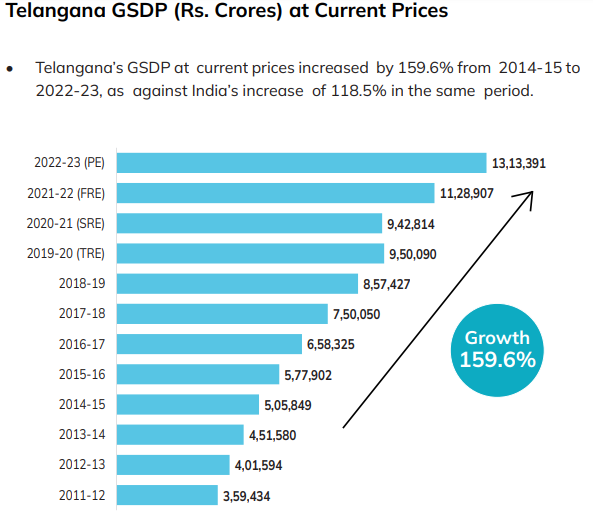
Regional Economic Disparities (Economic): The economic disparities between the two regions have not been bridged, with Telangana outperforming Andhra Pradesh in terms of per capita GSDP. This gap has remained relatively constant over the years.
Urban centers and their surrounding districts are contributing a larger chunk of state revenues, while the agricultural-based regions’ share is negligible.
However, the GCRs (Gini Coefficient Ratio) decreased in sectoral district domestic production for all three sectors (Agriculture, industry, and services). The Gini coefficient is often used to measure income inequality.
Question on Regional Fault Lines (Administrative): The bifurcation of Andhra Pradesh has exposed regional fault lines, including political, historical, and lifestyle differences.
The two regions were under different political authorities for 150 years. During the late medievals, the Nizam gave away the ‘coastal’ and the ‘ceded’ districts (Rayalaseema district) to the European powers.
They were ruled from Golconda and Hyderabad for a long time. However, after the independence, they were together after 1956 (the creation of the first state on a linguistic basis).
Such parting of ways has not yet happened with the Kannada-speaking area of the Nizam’s Hyderabad State, nor did it happen as yet with its Marathi-speaking area.
Therefore, the question arises, of unity based on language being frailer compared to those of the shared visions of Kannada and Marathi elites.
Challenges around the Federal and Future Scope:
Future of Centre-State Relations: The distribution of political power in the central legislature could become a point of friction among states, particularly if there are changes in delimitation that favor certain regions.
Andhra Pradesh had 42 Lok Sabha seats and was the largest State in south India. But now, with a mere 25 seats, it is smaller than Tamil Nadu which has 39 seats, and Karnataka which has 28 seats. Telangana, with 17 seats, is smaller than Kerala, thus becoming fifth in the pecking order in the south.
In our federal structure, numbers do matter but grossly unequal sizes among the units can render some regions irrelevant and others more relevant in deciding who holds power at the Centre. This may result in undesirable strains in the federal structure of our Republic.
Future of Linguistic States: Andhra Pradesh, in its first five years after the division, got bogged down in its attempt to build for itself as a ‘world-class’ capital, that would overcome the loss of Hyderabad. The next five years were consumed by profligate Direct Benefit Transfer (DBT) welfarism.
Therefore, the Indian Republic may need to look for alternative organizing principles, such as size or population.
Conclusion: The government needs to underscore the importance of federalism in addressing regional disparities and promoting more inclusive governance. The experience of Andhra Pradesh bifurcation offers valuable lessons for policymakers, highlighting the need to address regional disparities and adapt governance structures to changing regional dynamics.
Low voter turnout has been a notable trend in the initial phases of the ongoing 2024 general elections in India which reflects the shift in dynamics of democratic politics.
American Scenario during Past Elections:
Conventional Wisdom: In the U.S., increased voter turnout is traditionally believed to benefit Democrats. For example, it was argued that higher voter turnout could have altered the outcome in favour of Hillary Clinton in states like Pennsylvania, Michigan, and Wisconsin.
According to Daron R. Shaw and John R. Petrocik in “The Turnout Myth” (2020), Hillary Clinton’s support did not significantly vary with voter turnout.
Class Cleavages: The advantage Democrats gained from higher turnout has decreased since 1960 due to the erosion of class-based voting patterns.
Simulation Studies: Research by Michael D. Martinez and Jeff Gill, and later by Spencer Goidel, Thiago Moreira, and Brenna Armstrong, used simulations to predict how changes in turnout would affect election outcomes. In recent studies, the impact of increased turnout on party advantage has varied over time.
Perception About the Party’s Prospects:
High confidence in a party’s victory can deter voters from participating, thinking their vote is unnecessary.
Polls showing Bill Clinton’s like victory during the 1996 US Elections, led to low voter turnout, with some Clinton supporters abstaining because they believed his win was assured.
While both Clinton and Dole supporters showed reluctance to vote due to predicted outcomes, it led to higher abstention to vote for them.
Indian Scenario:
Class and Caste based: The 2019 Indian election saw a significant jump in the SC vote for the BJP, from 24% in 2014 to 34% in 2019, indicating a shift in voting patterns among Scheduled Castes. The Upper Caste Poor voted 49% BJP and 9% Congress, while Poor OBCs and Poor STs also followed a similar pattern. Poor Muslims, however, voted 8% BJP and 30% Congress.
Religion and Language-based: Religion is a significant factor, with political parties often indulging in communal propaganda to exploit religious sentiments. Language also plays a role, with parties arousing linguistic feelings to influence voter decisions.
Region and Personality based: Regionalism and sub-regionalism are important, with regional parties appealing to regional identities and sentiments. The charismatic personalities of party leaders, such as Jawaharlal Nehru, Indira Gandhi, Rajiv Gandhi, Atal Bihari Vajpayee, and Narendra Modi, have significantly influenced voter decisions.
Voter turnout trends in India have fluctuated, with no consistent correlation to incumbent advantage or disadvantage.
It is generally believed that higher voter turnout is detrimental to incumbents, though recent elections (2014 and 2019) saw high turnout with incumbent victories.
The voting patterns of habitual versus non-habitual voters likely vary significantly, influenced by the diverse and multi-party nature of Indian politics.
Decreased turnout in the 2024 general elections could be due to factors like weather, COVID-19, economic issues, and voter apathy, potentially impacting different parties in varied ways.
Conclusion
The role of non-habitual voters in Indian elections adds an element of unpredictability, making it difficult to draw firm conclusions until election results are finalised.
Mains PYQ:
Q Individual Parliamentarian’s role as the national law maker is on a decline, which in turn, has adversely impacted the quality of debates and their outcome. Discuss. (UPSC IAS/2019)
![[15th June 2024] The Hindu Op-ed: Reimagining Indian federalism](https://www.civilsdaily.com/wp-content/uploads/2024/06/15-June-1568x882.jpg)
![[6th June 2024] The Hindu Op-ed: The roads to India’s re-democratisation, the challenge](https://www.civilsdaily.com/wp-content/uploads/2024/06/6-June-1568x882.jpg)
![[5th June 2024] The Hindu Op-ed: Election results 2024: How India read the election, how the BJP reads the result](https://www.civilsdaily.com/wp-content/uploads/2024/06/5-June1-1568x882.jpg)
![[3 June 2024] The Hindu Op-ed: The message from the Andhra Pradesh bifurcation](https://www.civilsdaily.com/wp-content/uploads/2024/06/3-June-1568x882.jpg)