💥Join UPSC 2027,2028 Mentorship (July Batch) + XFactor Notes & Microthemes PDF

GS Paper: GS1-14.Important Geophysical phenomena such as earthquakes, Tsunami, Volcanic activity, cyclone etc.,

  • OGMP and MARS : An innovative opportunity to reduce methane emissions

    opportunity

    Context

    • The Methane Alert and Response System (MARS) initiative was launched by the United Nations Environment Programme (UNEP) at the 27th Conference of Parties (COP27) to the United Nations Framework Convention on Climate Change on November 11, 2022. Is it right to say that India not joining the Oil & Gas Methane Partnership is a missed opportunity?

    Click and get your FREE Copy of CURRENT AFFAIRS Micro Notes

    opportunity

    Methane a Toxic greenhouse gas

    • A major greenhouse gas: Methane is the second-most common of the six major greenhouse gases, but is far more dangerous than carbon dioxide in its potential to cause global warming.
    • One of major contributor of GHG emissions: Contribution Accounting for about 17 per cent of the current global greenhouse gas emissions.
    • One of the key reasons behind Temperature rise: Methane is blamed for having caused at least 25 to 30 per cent of temperature rise since the pre-industrial times.
    • Methane largely a Sectoral gas: Unlike carbon dioxide, methane is largely a sectoral gas, and there are only a few sources of emission.
    • Few sources large emissions of methane: The global warming potential of methane is about 80 times that of carbon dioxide. It accounts for a small portion of human-induced greenhouse gas emissions compared to carbon dioxide.

    Did you know? Global Methane pledge

    • The global methane pledge was adopted during COP26.
    • Under it, countries agreed to reduce global methane emissions by 30 per cent by 2030.
    • This will help to limit global warming to 1.5 degrees above pre-industrial levels.
    • into the right hands for emissions mitigation.

    opportunity

    What is Oil and Gas Methane Partnership (OGMP)?

    • A methodology to help companies reduce methane emissions: The Oil and Gas Methane Partnership (OGMP) methodology was created by the Climate and Clean Air Coalition in 2014 as a voluntary initiative to help companies reduce methane emissions in the oil and gas sector.
    • The Oil & Gas Methane Partnership 2.0: OGMP 2.0 is a multi-stakeholder initiative launched by UNEP and the Climate and Clean Air Coalition. The OGMP 2.0 is the only comprehensive, measurement-based reporting framework for the oil and gas industry that improves the accuracy and transparency of methane emissions reporting in the oil and gas sector.
    • Companies joined the partnership: Over 80 companies with assets on five continents, representing a significant share of of the world’s oil and gas production, have joined the Partnership. OGMP 2.0 members also include operators of natural gas transmission and distribution pipelines, gas storage capacity and LNG terminals. The members constitute around 35 per cent of the total global oil and gas production and two-thirds of the total liquefied natural gas flows around the world

    opportunity

    What is Methane Alert and Response System (MARS)?

    • MARS is a part of global efforts to slow climate change by tracking the global warming gas.
    • The system will be the first publicly available global system to connect methane detection to notification processes transparently.
    • The data-to-action platform was set up as part of the UN Environment Programme’s (UNEP) International Methane Emissions Observatory (IMEO) strategy to get policy-relevant data

    How many countries and companies are engaged with the MARS initiative and is India involved?

    • The system was requested by the United States and the European Union but it is in the service of the entire world.
    • There are no Indian companies that have joined the OGMP.

    Conclusion

    • MARS is a satellite-based system to help industries and governments detect and reduce methane emissions. This will help UNEP confirm methane emissions reported by companies and analyze changes over time. India should consider this as an opportunity to cooperate in reducing methane emissions

    Mains question

    Q. Methane is 25 times more potent as a greenhouse gas than carbon dioxide and currently contributes about a quarter of global warming. In light of this, what does it mean to engage with the OGMP and MARS system?

    (Click) FREE 1-to-1 on-call Mentorship by IAS-IPS officers | Discuss doubts, strategy, sources, and more

  • What are Carbon Markets and how do they operate? 

    carbon

    The Parliament passed the Energy Conservation (Amendment) Bill, 2022. It amends the Energy Conservation Act, 2001, to empower the Government to establish carbon markets in India and specify a carbon credit trading scheme.

    A quick recap

    • In order to keep global warming within 2°C, ideally no more than 1.5°C, global greenhouse gas (GHG) emissions need to be reduced by 25 to 50% over this decade.
    • Nearly 170 countries have submitted their nationally determined contributions (NDCs) so far as part of the 2015 Paris Agreement, which they have agreed to update every five years.
    • NDCs are climate commitments by countries setting targets to achieve net-zero emissions.
    • India, for instance, is working on a long-term roadmap to achieve its target of net zero emissions by 2070.

    What are Carbon Markets?

    • In order to meet NDCs, one mitigation strategy is becoming popular with several countries— carbon markets.
    • Article 6 of the Paris Agreement provides for the use of international carbon markets by countries to fulfil their NDCs.
    • Carbon markets are essentially a tool for putting a price on carbon emissions— they establish trading systems where carbon credits or allowances can be bought and sold.
    • A carbon credit is a kind of tradable permit that, per United Nations standards, equals one tonne of carbon dioxide removed, reduced, or sequestered from the atmosphere.
    • Carbon allowances or caps, meanwhile, are determined by countries or governments according to their emission reduction targets.

    Popularity of the carbon markets

    • A UN Development Program release this year noted that interest in carbon markets is growing globally.
    • Almost 83% of NDCs submitted by countries mention their intent to make use of international market mechanisms to reduce greenhouse gas emissions.

    What are the types of carbon markets?

    There are broadly two types of carbon markets that exist today— compliance markets and voluntary markets.

    (A) Voluntary Markets

    • They are those in which emitters— corporations, private individuals, and others— buy carbon credits to offset the emission of one tonne of CO 2 or equivalent greenhouse gases.
    • Such carbon credits are created by activities which reduce CO 2 from the air, such as afforestation. In a voluntary market, a corporation looking to compensate for its unavoidable GHG emissions purchases carbon credits from an entity engaged in projects that reduce, remove, capture, or avoid emissions.
    • For Instance, in the aviation sector, airlines may purchase carbon credits to offset the carbon footprints of the flights they operate.
    • In voluntary markets, credits are verified by private firms as per popular standards.
    • There are also traders and online registries where climate projects are listed and certified credits can be bought.

    (B) Compliance Market

    • Compliance markets— set up by policies at the national, regional, and/or international level— are officially regulated.
    • Today, compliance markets mostly operate under a principle called ‘cap-and-trade”, most popular in the European Union (EU).

    Successful example of Carbon Market: EU’s emissions trading system (ETS)

    • Under the EU’s ETS launched in 2005, member countries set a cap or limit for emissions in different sectors, such as power, oil, manufacturing, agriculture, and waste management.
    • This cap is determined as per the climate targets of countries and is lowered successively to reduce emissions.
    • Entities in this sector are issued annual allowances or permits by governments equal to the emissions they can generate.
    • If companies produce emissions beyond the capped amount, they have to purchase additional permit, either through official auctions or from companies.
    • This makes up the ‘trade’ part of cap-and-trade.

    How is carbon price determined?

    • The market price of carbon gets determined by market forces when purchasers and sellers trade in emissions allowances.
    • Notably, companies can also save up excess permits to use later.
    • Through this kind of carbon trading, companies can decide if it is more cost-efficient to employ clean energy technologies or to purchase additional allowances.
    • These markets may promote the reduction of energy use and encourage the shift to cleaner fuels.

    Other such examples

    • China launched the world’s largest ETS in 2021, estimated to cover around one-seventh of the global carbon emissions from the burning of fossil fuels.
    • Markets also operate or are under development in North America, Australia, Japan, South Korea, Switzerland, and New Zealand.

    Significance of Carbon Market

    • The World Bank estimates that trading in carbon credits could reduce the cost of implementing NDCs by more than half — by as much as $250 billion by 2030.
    • Last year, the value of global markets for tradable carbon allowances or permits grew by 164% to a record 760 billion euros ($851 billion).
    • The EU’s ETS contributed the most to this increase, accounting for 90% of the global value at 683 billion euros.
    • As for voluntary carbon markets, their current global value is comparatively smaller at $2 billion.

    What is the progress at UN?

    • The UN international carbon market envisioned in Article 6 of the Paris Agreement is yet to kick off as multilateral discussions are still underway about how the inter-country carbon market will function.
    • Under the proposed market, countries would be able to offset their emissions by buying credits generated by greenhouse gas-reducing projects in other countries.
    • In the past, developing countries, particularly India, China and Brazil, gained significantly from a similar carbon market under the Clean Development Mechanism (CDM) of the Kyoto Protocol, 1997.
    • India registered 1,703 projects under the CDM which is the second highest in the world.
    • But with the 2015 Paris Agreement, the global scenario changed as even developing countries had to set emission reduction targets.

    India’s efforts

    The new Bill empowers the Centre to specify a carbon credits trading scheme.

    • Issuance of credit certificates: Under the Bill, the central government or an authorised agency will issue carbon credit certificates to companies or even individuals registered and compliant with the scheme.
    • Tradable carbon credits: These carbon credit certificates will be tradeable in nature. Other persons would be able to buy carbon credit certificates on a voluntary basis.

    Existing mechanisms

    • Notably, two types of tradeable certificates are already issued in India-
    1. Renewable Energy Certificates (RECs) and
    2. Energy Savings Certificates (ESCs)
    • These are issued when companies use renewable energy or save energy, which are also activities which reduce carbon emissions.

    Lacunas of the bill

    • No clear mechanism: The Bill does not provide clarity on the mechanism to be used for the trading of carbon credit certificates— whether it will be like the cap-and-trade schemes or use another method— and who will regulate such trading.
    • Confusion over nodal agency: The right ministry to bring in a scheme of this nature, pointing out that while carbon market schemes in other jurisdictions like the US, UK are framed by their environment ministries, the Indian Bill was tabled by the power ministry instead of the MoEFCC.
    • Ambiguity over existing certificates: The Bill does not specify whether certificates under already existing schemes would also be interchangeable with carbon credit certificates and tradeable for reducing carbon emissions.
    • Overlapping: The question, thus, is whether all these certificates could be exchanged with each other. There are concerns about whether overlapping schemes may dilute the overall impact of carbon trading.

    Challenges to carbon markets

    • Double counting: of greenhouse gas reductions
    • Quality and authenticity: These parameters of climate projects that generate credits to poor market transparency
    • Greenwashing: Companies may buy credits, simply offsetting carbon footprints instead of reducing their overall emissions or investing in clean technologies.
    • Inefficiency: The IMF points out that including high emission-generating sectors under trading schemes to offset their emissions by buying allowances may immensely increase emissions on net.

    Way forward

    • Alignment with NDCs: The UNDP emphasizes that for carbon markets to be successful, emission reductions and removals must be real and aligned with the country’s NDCs.
    • Transparent financing: It says that there must be “transparency in the institutional and financial infrastructure for carbon market transactions”.


    Click and get your FREE Copy of CURRENT AFFAIRS Micro Notes

    (Click) FREE 1-to-1 on-call Mentorship by IAS-IPS officers | Discuss doubts, strategy, sources, and more

  • Historic biodiversity deal gets the nod at COP15 summit in Canada

    biodiversity

    Negotiators reached a historic deal at a UN Convention on Biological Diversity (CBD) conference that would represent the most significant effort to protect the world’s lands and oceans and provide critical financing to save biodiversity in the developing world.

    Key outcomes

    [A] 30×30 Deal

    • Delegates committed to protecting 30% of land and 30% of coastal and marine areas by 2030, fulfilling the deal’s highest-profile goal, known as 30-by-30.
    • Currently, 17% of terrestrial and 10% of marine areas are protected.
    • Indigenous and traditional territories will also count toward this goal, as many countries and campaigners pushed for during the talks.
    • The deal also aspires to restore 30% of degraded lands and waters throughout the decade, up from an earlier aim of 20%.
    • And the world will strive to prevent destroying intact landscapes and areas with a lot of species, bringing those losses “close to zero by 2030”.

    [B] Money for nature

    • Signatories aim to ensure $200 billion per year is channeled to conservation initiatives, from public and private sources.
    • Wealthier countries should contribute at least $20 billion of this every year by 2025, and at least $30 billion a year by 2030.
    • This appeared to be the Democratic Republic of Congo’s main source of objection to the package.

    [C] Big companies report impacts on biodiversity

    • Companies should analyse and report how their operations affect and are affected by biodiversity issues.
    • The parties agreed to large companies and financial institutions being subject to “requirements” to make disclosures regarding their operations, supply chains and portfolios.
    • This reporting is intended to progressively promote biodiversity, reduce the risks posed to business by the natural world, and encourage sustainable production.

    [D] Harmful subsidies

    • Countries committed to identify subsidies that deplete biodiversity by 2025, and then eliminate, phase out or reform them.
    • They agreed to slash those incentives by at least $500 billion a year by 2030, and increase incentives that are positive for conservation.

    [E] Pollution and pesticides

    • One of the deal’s more controversial targets sought to reduce the use of pesticides by up to two-thirds.
    • But the final language to emerge focuses on the risks associated with pesticides and highly hazardous chemicals instead, pledging to reduce those threats by “at least half”, and instead focusing on other forms of pest management.
    • Overall, the Kunming-Montreal agreement will focus on reducing the negative impacts of pollution to levels that are not considered harmful to nature, but the text provides no quantifiable target here.

    [F] Monitoring and reporting progress

    • All the agreed aims will be supported by processes to monitor progress in the future, in a bid to prevent this agreement meeting the same fate as similar targets that were agreed in Aichi, Japan, in 2010, and never met.
    • National action plans will be set and reviewed, following a similar format used for greenhouse gas emissions under U.N.-led efforts to curb climate change.
    • Some observers objected to the lack of a deadline for countries to submit these plans.

    Back2Basics: Convention on Biological Diversity (CBD)

    • The CBD (wef 1993) known informally as the Biodiversity Convention, is a multilateral treaty.
    • The convention has three main goals:
    1. the conservation of biodiversity
    2. the sustainable use of its components
    3. the fair and equitable sharing of benefits arising from genetic resources
    • Its objective is to develop national strategies for the conservation and sustainable use of biological diversity, and it is often seen as the key document regarding sustainable development.
    • It has two supplementary agreements, the Cartagena Protocol and Nagoya Protocol.

    (1) Cartagena Protocol

    • It is an international treaty governing the movements of living modified organisms (LMOs) resulting from modern biotechnology from one country to another.

    (2) Nagoya Protocol

    • It deals with Access to Genetic Resources and the Fair and Equitable Sharing of Benefits Arising from their Utilization (ABS).


    Click and get your FREE Copy of CURRENT AFFAIRS Micro Notes

    (Click) FREE 1-to-1 on-call Mentorship by IAS-IPS officers | Discuss doubts, strategy, sources, and more

  • Disparities in Climate Change Financial Responsibility

    Financial

    Context

    • Extreme weather events are becoming more prevalent with each passing year and countries are increasingly taking cognizance of this. Yet, there remains a rift between developing and developed countries, largely on account of asymmetries between the incidence of and the financial responsibility assumed for climate change.

    Click and get your FREE Copy of CURRENT AFFAIRS Micro Notes

    Background: Rift between developed and developing countries

    • Historical emission by developed countries: It is estimated that 92 per cent of excess historical emissions are attributable to developed countries.
    • Burden on developing countries: Yet the economic impact of climate change is disproportionately borne by vulnerable developing countries. The 58 vulnerable countries (or V20) account for 5 per cent of global emissions while the costs incurred are significant.
    • UNEP estimates that efforts on climate adaptation would require $160-340 billion by 2030. But, current financial flows are inadequate, with developing countries receiving only a third of what is required.
    • The dual costs of shifting away from fossil fuels and that of climate catastrophes are expected to further chip away at fiscal resilience as developing countries reel under the pressures of slowdown, inflation and excess sovereign debt.

    Financial

    COP27 decisions on accelerating finance

    • Recognized the need of transforming the financial system: In its draft decision, the UN highlighted that to meet the scale of funding will require a transformation of the financial systems, structures and processes. It will require engaging with all financial actors.
    • Recognized discontent of green climate fund: In the past there have been funding facilities such as the Green Climate Fund, which were meant to support adaptation and mitigation. But there is wide discontent with the pace and extent of access to such facilities.
    • Announcement of Loss and Damage (L&D) fund: The announcement of a Loss and Damage (L&D) fund stole the attention. However, reflections from past experiences are essential.

    Challenges on developing inclusive financial structure

    • Visible reluctance to contribute among big economies: The institutional architecture of multilateral funds has been demonstrably slow to deliver. Then there is the visible reluctance to contribute among the big economies. To restore its lost legitimacy, the US made several announcements at COP27 but its lack of support to the L&D fund and financing of the global shield meant to support vulnerable countries to address risks of climate change must be factored in.
    • Mismatch between financial expectations, regulations and society’s requirement: As the demands placed on economies dwarf public finances, it is intuitive to expect private capital to step up. For decades, developing countries have competed to attract private capital leading to frail legal and tax systems. Even as private capital shifts to the green sectors on account of regulatory action, it is reasonable to expect that its pace will be tempered by financial expectations.
    • National carbon tax is rarely discussed: Interestingly, experts are beginning to see climate actions connected with tax policy. This is evident from the revival of the repeatedly shelved Financial Transaction Tax in the EU. Every package announced involves a redistribution of incomes within and across countries. Therefore, a general overhaul of tax architecture is inevitable. Yet, a dedicated national carbon tax is rarely discussed.

    Financial

    Hypocrisy of developed countries and India’s call of Phase down

    • Policy makers discussed the inadequacies of the system: COP27 was a spectacle of distractions. Experts from around the world assembled in the comforts of their echo chambers, reciting the promise of the transition, as policy makers reiterated the inadequacies of the system.
    • Growing pressure on developing countries to abandon access to fossil fuel: There is also growing pressure on developing countries to abandon their access to fossil fuels, overlooking the view that a hastened transition can have adverse consequences for growth.
    • Systematically sidelined India’s Phase down Call: There have been repeated questions as to why India chooses to use the term “phase down” and its slow response. The hypocrisy of the developed countries was stark as countries chose to sideline India’s call to phase down all fossil fuels.

    Way ahead

    • While the release of the long-term low carbon development strategy is a fitting response from India, there needs to be better guidance on the pathway to net zero.
    • With India chairing the G-20 this year, the question of phasing down coal will be asked repeatedly.
    • There is already growing interest in signing a just energy transition partnership with India.

    Conclusion

    • The learnings from COP27 must inform the G-20 presidency. It is also important to remain conscious that dramatic shifts in policy are pursued domestically and not all change is pursued by consensus. The principle of common but differentiated responsibility should not be traded for the promise of finance.

    Mains question

    In the context of COP27, The principle of common but differentiated responsibility should not be traded for the promise of finance. Comment

    (Click) FREE1-to-1 on-call Mentorship by IAS-IPS officers | Discuss doubts, strategy, sources, and more

  • What are Western Disturbances?

    disturbance

    The days have been unusually warm for winter in New Delhi with the maximum temperature remaining above normal mostly on account of fewer western disturbances affecting this year.

    Western Disturbances

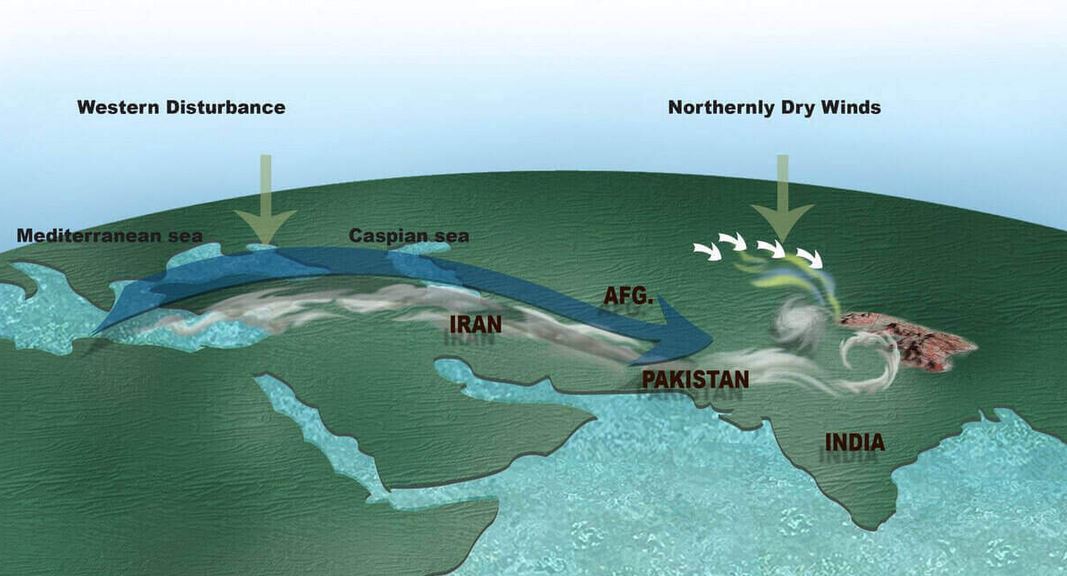
    • A western disturbance is an extratropical storm originating in the Mediterranean region that brings sudden winter rain to the northwestern parts of the Indian subcontinent.
    • They are labelled as an extra-tropical storm originating in the Mediterranean, is an area of low pressure that brings sudden showers, snow, and fog in northwest India.
    • In the term “extra-tropical storm”, storm refers to low pressure. “Extra-tropical” means outside the tropics. As the WD originates outside the tropical region, the word “extra-tropical” has been associated with them.
    • It is a non-monsoonal precipitation pattern driven by the westerlies.
    • The moisture in these storms usually originates over the Mediterranean Sea, the Caspian Sea and the Black Sea.
    • Extratropical storms are global phenomena with moisture usually carried in the upper atmosphere, unlike their tropical counterparts where the moisture is carried in the lower atmosphere.
    • In the case of the Indian subcontinent, moisture is sometimes shed as rain when the storm system encounters the Himalayas.
    • Western disturbances are more frequent and strong in the winter season.

    Impact: Winter Rainfall and Extreme Cold

    • Western disturbances, specifically the ones in winter, bring moderate to heavy rain in low-lying areas and heavy snow to mountainous areas of the Indian Subcontinent.
    • They are the cause of most winter and pre-monsoon season rainfall across northwest India.
    • An average of four to five western disturbances forms during the winter season.

    Its significance

    • Precipitation during the winter season has great importance in agriculture, particularly for the rabi crops.
    • Wheat among them is one of the most important crops, which helps to meet India’s food security.

    Try this PYQ:

    Consider the following statements:

    1. The winds which blow between 30°N and 60°S latitudes throughout the year are known as westerlies.
    2. The moist air masses that cause winter rains in the North-Western region of India are part of westerlies.

    Which of the statements given above is/are correct?

    (a) Only 1

    (b) Only 2

    (c) Both 1 and 2

    (d) Neither 1 nor 2


    [wpdiscuz-feedback id=”uouc14yg8a” question=”Please leave a feedback on this” opened=”1″]Post your answers here.[/wpdiscuz-feedback]


    Click and get your FREE Copy of CURRENT AFFAIRS Micro Notes

    (Click) FREE 1-to-1 on-call Mentorship by IAS-IPS officers | Discuss doubts, strategy, sources, and more

  • Why climate action needs women?

    climate

    Context

    • Women have historically been underrepresented at the UN’s global conference on climate change, and this year’s COP 27 congregation in Egypt, was no exception. A photo of the heads of state and government representatives participating in the event which went viral across social media, at the beginning of the summit, in fact, showcased the presence of only seven women leaders among the grand total of 110 attendees.

    Women participation in climate negotiations

    • Analysis by BBC percentage of women is very less: As per an analysis conducted by the BBC, women accounted for a mere 34 percent of the committee members in negotiations rooms with some country teams having more than 90 percent men.
    • Participation women at recent COP27 was one of the lowest: According to the Women’s Environment and Development Organisation (WEDO), which tracks women’s participation in climate forum, the recent COP27 numbers represented one of the lowest concentrations of women seen at the UN climate summit.
    • Despite of collective pledge to increase women participation, number fallen: These number have in fact, fallen from a peak of 40 percent women’s participation during COP24 in 2018 and despite the countries collective pledge to increase female representation at these talks as early as 2011.
    • Skewed gender ration in negotiations on key climate issues: This skewed gender ratio, however, reflected the broader trend across delegation teams, which participated in negotiations on key climate issues such as funding, limiting the use of fossil fuels, carbon emissions, etc.

    Click and get your FREE Copy of CURRENT AFFAIRS Micro Notes

    climate

    Why climate action needs women?

    • Women are most disproportionately affected by disasters: Females are in fact, most disproportionately affected when disasters hit as they suffer greater economic repercussions, bear an additional burden of unpaid care and domestic work, have lesser access to resources, and are pushed to drop out of school or marry early to help manage the family’s financial stress.
    • Domestic household responsibilities become more worse in disasters: Their responsibility to secure water, food, and fuel for their families becomes much more difficult during floods, droughts, or other climate-related crises, forcing them to travel to longer distances, putting their own health at risk.
    • Climate change also increases women’s vulnerability: As per new research published by ActionAid, climate change also increases women’s vulnerability to gender-based violence, further bringing about damaging consequences for their reproductive as well as psychological health.
    • Sustainable development and gender equality are intrinsically linked: The goal of pursuing sustainable development and bringing about gender equality are intrinsically linked, and one cannot be achieved without the attainment of the other.
    • Considering the various roles women play in the management of natural resources: Women just like any other member impact the overall management of natural resources through the various roles that they play including in the economy, in households, and the society. Their inclusion in climate negotiations is thus, crucial to ensure the development and implementation of a balanced approach to the diverse dimensions of sustainable development such as the economic, social and environmental.
    • Women have been at the forefront on environment related movements: Women and girls in all their diversity for centuries have played a transformative role in climate change adaptation as well as mitigation, and have been at the forefront of movements related to environmental and climate justice, putting forth some of the most creative and effective approaches for the promotion of sustainable energy transitions that help in the protection of local systems and are based on indigenous knowledge.
    • Gender diverse corporate boardrooms resulted in the adoption of more climate-friendly policies: There exists a growing body of evidence that shows the association between women’s participation and leadership in climate action, and better resource governance, conversation outcomes, and disaster readiness. This stands true, even for the private sector, where diversifying corporate boardrooms on the basis of gender have resulted in the adoption of more climate-friendly policies. For instance, according to a working paper series by the European Central Bank, “a 1 percent increase in the share of female firm managers leads to a 0.5 percent decrease in CO2 emissions
    • Comprise nearly half of the world’s population: The question, which therefore needs to be raised, is whether climate change mitigation, disaster reduction, and adaptation strategies can really be holistically developed without the inclusion of women who comprise of nearly half of the world’s population.
    • Women with their strong body of knowledge and expertise should, thus, be recognised as co-owners and agenda-settlers of the climate process with their skills, knowledge and experience being utilised to improve climate governance outcomes at the local and national levels as well as in multilateral climate forums and the private sector.

    climate

    What can be done to increase women participation in climate change negotiations?

    • Quotas can be provided not only to increase participation but also to address inequalities: To begin with, measures, including quotas can be put in place to not only increase women’s meaningful participation and leadership at all levels of climate action decision-making but also to address persisting inequalities including in terms of their access and control of resources such as land, technology, and finance.
    • Integrating a gender perspective across spectrums: Secondly, a conscious effort needs to be made by the policy makers to integrate a gender perspective across spectrums, ranging from design, monitoring and evaluation, implementation and funding of all national climate policies, plans and actions to ensure that the needs and concerns of women are being adequately addressed.
    • Expanding gender responsive finance and services: The member states must expand gender-responsive finance as well as gender-responsive public services, healthcare systems, universal social protections, combining measures both to eliminate gender-based violence in climate policies and to promote a care economy, thereby, guaranteeing the provision and access to justice for women.
    • Implementing the ways to multiply gender equality, thereby empowering women to harness their skills: Heads of states must identify and implement ways to multiply gender equality, empowering women and young girls. To put it simply, global investments, especially for women and girls belonging to marginalise communities must be focused on directly amplifying and fostering their skills, resilience and knowledge, thereby, removing critical barriers that hinder their participation in decision-making positions.

    climate

    Way ahead

    • There remains no doubt that climate change inevitably results in the exacerbation of gender inequalities.
    • The world leaders, therefore, need to pay attention to the voices of women who continue to bear a differential impact with mitigations strategies and negations being specifically tailored to the gender issues that women are confronted with during a climate-related crisis.

    Conclusion

    • Climate change is a complex global phenomenon, which requires comprehensive global action that includes each and every individual. The UN Climate Change Conference, one of the biggest summits instead of excluding women, should therefore, serve as an opportunity to recognise and augment the innovative climate actions that are being brought by women. It should also provide a platform for understanding how existing structures prevent women’s engagement and subsequently, develop response mechanisms with policy measures that take into account the immediate as well as long-term gendered impacts of environmental calamities.

    Mains Question

    Q. Women have historically been underrepresented at the UN’s global conference on climate change and COP 27 have been no exception. Why climate action needs women? What can be done? Discuss.

    (Click) FREE1-to-1 on-call Mentorship by IAS-IPS officers | Discuss doubts, strategy, sources, and more


  • Shortcomings in the climate justice negotiations

    climate

    Context

    • In the climate negotiations, areas of interest to developing countries are not covered or sparsely covered, while other areas are over-regulated. Equitable sustainable development is not even discussed. At COP27, the policy debate was no longer legitimized by science.

    Click and get your FREE Copy of CURRENT AFFAIRS Micro Notes

    Problems with the current negotiating process

    • Developed countries’ national emissions of C02 from consumption: citizens in developed countries are not even aware that two-thirds of their national emissions of carbon dioxide come from their diet, transport, and residential and commercial sectors, which together constitute the major share of their GDP; the consumption sectors are not independent silos but reflect their urban lifestyles.
    • Ignores urbanization and requirement of fossil fuels for developing countries: the process ignores that global well-being will also follow urbanisation of the developing country’s population, requiring fossil fuels for infrastructure and energy to achieve comparable levels.
    • Requirement of Infrastructure development in developing countries: the need for vast quantities of cement and steel in developing countries for infrastructure, constituting essential emissions, as they urbanise, is not being considered.

    climate

    Discussion missing on developing countries to pace up decarbonization

    • Late urbanization: As late urbanisers, developing countries account for more than half the annual emissions and most emissions growth.
    • Cannot afford new technologies: They cannot affordably access many of the new technologies to decarbonise quickly.
    • Not having a comparable level playing field: The result is a shrinking of their policy space and human rights, endangering efforts to achieve comparable levels of well-being with those who developed earlier without any constraints.

    Why the foundation of the Climate Treaty in international environmental law is questionable?

    • US interpretation in Stockholm Conference on the Environment (1972):  In the run-up to the Stockholm Conference, the United States Secretary of States stated that “urbanization has changed the nation with seventy five percent of its people living in the urban area. we must see ourselves not only as victims of environmental degradation but as environmental aggressors and change our patterns of consumption and production accordingly”.
    • Conclusion by scientific committee set up by the US: A scientific committee concluded that “long range planning to cope with global environmental problems must take account of the total ecological burden, controlling that burden by systematic reduction in per-capita production of goods and services would be politically unacceptable. A concerted effort is needed to orient technology toward making human demands upon the environment less severe”.
    • Power play on risk management but not on the technology transfer: Power play framed natural resource use around risk management rather than technology transfer and the well-being of all within ecological limits.

    climate

    Why climate negotiations are seen as Differentiated common responsibility?

    • Missing the objective: The objective of the Climate Treaty is to avoid a concentration of cumulative emissions of carbon dioxide, prevent dangerous anthropogenic interference with the climate system and enable sustainable economic development.
    • Climate agreements and initiatives: The Paris Agreement (2015) agreed to a 1.5°C global temperature goal. The Intergovernmental Panel on Climate Change (IPCC) in 2018 recommended that net emissions needed to zero out around 2050. In Glasgow, in 2021, negotiators zeroed in on coal to reduce future emissions.
    • Ignored the key findings of the IPCC report: This initiative was not based on science and it ignored the key finding of the IPCC on the centrality of the carbon budget, i.e., cumulative emissions associated with a specific amount of global warming that scientifically links the temperature goal to national action.
    • Carbon budget and the developing countries: Carbon budgets are robust as they can be estimated accurately from climate models. And, they are the most useful for policy as they couple the climate to the economy consistent with the science of both. The IPCC, in 2018, estimated the budget for a 50% chance of avoiding more than 1.5°C of warming to be 2,890 billion tonnes of carbon dioxide (now, it is less than 400bn tonnes), raising the question on how late developers will attain comparable levels of wellbeing.

    Shortcomings in Climate justice

    • Climate injustice flows from the negotiations and not from the text of the Climate Treaty.
    • Rejected historical responsibility and shifted the burden: The process adopted the structure of international law in a manner that rejected historical responsibility for a continuing problem, and steadily shifted the burden to China and India.
    • The flaw in set agenda: The agenda was set around globalised material flows described as global warming (the symptom), and not wasteful use of energy.
    • Public finance is not materialised for actual objective: Public finance is used as a means to secure a political objective, and not to solve the problem itself. The $100 billion promised at Paris along with pre-2020 commitments constituting the incentive for developing countries to agree to a global temperature goal has not materialised. And, new funding for ‘Loss and Damage’ will be from a “mosaic of solutions”, constituting a breach of trust.
    • Longer term trend has been ignored: With one-sixth of the global population, the developed country share in 2035 will still be 30%. Asia’s emissions with half the world’s population will rise to 40% remaining within its carbon budget. Pressures to further reduce emissions displace their human rights.

    Conclusion

    • India’s thrust on LiFE (or “Lifestyle for Environment”), with the individual shifting from wasteful consumption of natural resources goes back to the original science. Consumption-based framing challenges the ‘universalism’ that has dominated the negotiations and its common path of reductions based on single models. The carbon budget formalizes a ‘diversity’ of solutions. For example, in developed countries, exchanging overconsumption of red meat for poultry can meet half the global emissions reduction required by the end of the century.

    (Click) FREE1-to-1 on-call Mentorship by IAS-IPS officers | Discuss doubts, strategy, sources, and more


  • Places in news: Great Barrier Reef

    A joint report by the International Union for Conservation of Nature (IUCN) and UNESCO’s World Heritage Centre (WHC) expressed concern about the status of the Great Barrier Reef (GBR) in Australia, recommending that it “be inscribed on the List of World Heritage in Danger.”

    About Great Barrier Reef

    • Australia’s Great Barrier Reef is the world’s largest reef system stretching across 2,300 km and having nearly 3,000 individual reefs.
    • It hosts 400 different types of coral, gives shelter to 1,500 species of fish and 4,000 types of mollusc.
    • Coral reefs support over 25% of marine biodiversity even as they take up only 1% of the seafloor.
    • The marine life supported by reefs further fuels global fishing industries.
    • Besides, coral reef systems generate $2.7 trillion in annual economic value through goods and service trade and tourism.
    • In Australia, the Barrier Reef, in pre-COVID times, generated $4.6 billion annually through tourism and employed over 60,000 people including divers and guides.

    What does the new report say?

    • The current report surveyed 87 reefs in the GBR between August 2021 and May 2022.
    • Coral cover is measured by determining the increase in the cover of hard corals.
    • The hard coral cover in northern GBR had reached 36% while that in the central region had reached 33%.
    • Meanwhile, coral cover levels declined in the southern region from 38% in 2021 to 34% in 2022.
    • The record levels of recovery, the report showed, were fuelled largely by increases in the fast-growing Acropora corals, which are a dominant type in the GBR.

    Threats found

    • Acropora corals are also the most susceptible to environmental pressures such as rising temperatures, cyclones, pollution, crown-of-thorn starfish (COTs) attacks which prey on hard corals and so on.

    Does this mean the reef is out of the woods?

    • Behind the recent recovery in parts of the reef, are the low levels of acute stressors in the past 12 months — no tropical cyclones, lesser heat stress in 2020 and 2022 as opposed to earlier.
    • Besides predatory attacks and tropical cyclones, scientists say that the biggest threat to the health of the reef is climate change-induced heat stress, resulting in coral bleaching.
    • The concern is that in the past decade, mass bleaching events have become more closely spaced in time.
    • The first mass bleaching event occurred in 1998 when the El Niño weather pattern caused sea surfaces to heat, causing 8% of the world’s coral to die.
    • The second event took place in 2002.
    • But the longest and most damaging bleaching event took place from 2014 to 2017. Mass bleaching then occurred again in 2020, followed by earlier this year.

    Back2Basics: Coral Reefs

    • Corals are marine invertebrates or animals which do not possess a spine.
    • They are the largest living structures on the planet.
    • Each coral is called a polyp and thousands of such polyps live together to form a colony, which grow when polyps multiply to make copies of themselves.
    • Corals are of two types — hard corals and soft corals.
    1. Hard corals extract calcium carbonate from seawater to build hard, white coral exoskeletons. Hard corals are in a way the engineers of reef ecosystems and measuring the extent of hard coral is a widely-accepted metric for measuring the condition of coral reefs.
    2. Soft corals attach themselves to such skeletons and older skeletons built by their ancestors. Soft corals also add their own skeletons to the hard structure over the years. These growing multiplying structures gradually form coral reefs.

    How do corals bleach?

    • Corals share a symbiotic relationship with single-celled algae called zooxanthellae.
    • The algae prepares food for corals through photosynthesis and also gives them their vibrant colouration.
    • When exposed to conditions like heat stress, pollution, or high levels of ocean acidity, the zooxanthellae start producing reactive oxygen species not beneficial to the corals.
    • So, the corals kick out the colour-giving algae from their polyps, exposing their pale white exoskeleton and leading to coral starvation as corals cannot produce their own food.
    • Bleached corals can survive depending on the levels of bleaching and the recovery of sea temperatures to normal levels.
    • Severe bleaching and prolonged stress in the external environment can lead to coral death.

    Try this PYQ:

    Consider the following statements:

    1. Most of the world’s coral reefs are in tropical waters.
    2. More than one third of the world’s coral reefs are located in the territories of Australia, Indonesia and Philippines.
    3. Coral reefs host far more number of animal phyla than those hosted by tropical rainforests.

    Which of the above statements is/are correct?

    (a) 1 and 2 only

    (b) 3 only

    (c) 1 and 3 only

    (d) 1 and 3 only


    [wpdiscuz-feedback id=”hqty7xqwlv” question=”Please leave a feedback on this” opened=”1″]Post your answers here.[/wpdiscuz-feedback]


    UPSC 2023 countdown has begun! Get your personal guidance plan now! (Click here)

  • Education as a tool of innovation for the climate change generation.

    Education

    Click and get your FREE Copy of CURRENT AFFAIRS Micro Notes

    Context

    • Instead of mirroring a broken development paradigm predicated on an extractive relationship with nature, India can lead with an approach that’s better for both people and the planet. A climate-resilient education system will be essential to realising this opportunity.

    Background

    • India’s LiFE mass movement: At COP27, India released its Long-Term Low Emissions and Development Strategies (LT-LEDS). This outlines priorities for carbon-intensive sectors like electricity and industry and transport, and emphasizes the role of a Lifestyle for Environment (LiFE) as a mass movement towards sustainable consumption and production.
    • Education is vital: From behavioral shifts of individuals to the re-shaping of markets, education has a vital role in the LiFE movement.
    • Potential of demand side actions: According to the Intergovernmental Panel on Climate Change (IPCC), this could make a significant dent in reducing planet-warming gases, demand-side actions have the potential to cut greenhouse gas emissions by 40-70 per cent in 2050.

    Education

    What are the challenges facing the education sector and children at present?

    • School closures during the Covid pandemic affect productivity: school closures during the pandemic have led to a learning deficit that’s getting reflected in reduced test scores. This will likely impact productivity and per capita income levels in the long term. One year of school closures could reduce GDP levels by anywhere from 1.1 to 4.7 per cent by mid-century, according to a paper by the Organisation for Economic Co-operation and Development.
    • Hinderance to the economic mobility: The lasting impacts of Covid-19 could hinder economic mobility for a generation of Indians and alter the arithmetic for public finance.
    • Climate change impacts children more: Climate impacts are already disrupting children’s learning and well-being globally. For instance, extreme heat reduces students’ learning levels and causes physiological harm. Schools are temporarily shut down and children’s health is affected due to persistently poor air quality in cities like Delhi.
    • Disasters and displacing families affecting children: Debilitating deluges are permanently displacing families, often leading to children (and disproportionately girls) dropping out of schools and being trafficked or subject to child labour due to distressed household incomes. As these disasters grow more frequent and intense, we must prepare the infrastructure, content, and delivery of the public education system to protect the most vulnerable citizens, many of whom will be climate refugees.
    • Anxiety about the future: The lived experiences of climate-induced disasters and anxiety about the future are causing despair and dread among young people. This is compounded by digital platforms and news cycles that don’t linger long enough to make sense of challenges or build a widespread understanding of breakthroughs like the significant reductions in the costs of renewable energy.

    Education

    How can the climate education system be used to both prevent crisis and create opportunity?

    • Creating a strong and inclusive climate-resilient education system at national level: At a national level, a strong enabling framework for a climate-resilient education system shall cover matters from curricula to nutrition to school building codes in a climate-changed world. With its scale and reach, the public school system is not only a source of learning but also shelter, clothing, food, and community for millions.
    • Programs in states shall be implemented according to the local demands: Design and implementation in states and districts should be shaped by existing local needs and anticipated climate risks. This could involve infrastructure investments so school buildings can double up as emergency shelters in cyclone-prone areas and capacity additions so government schools in mega-cities that are destinations for climate migrants can integrate and empower children
    • Emphasize should be on social and emotional learning: Students’ mental health needs should be served through an empathic expansion and an emphasis on social and emotional learning. Across the board, children should be able to access clean water and nutritious food.
    • Technical curriculum with indigenous knowledge shall be applied: Curricula can be infused with scientific and technical know-how alongside indigenous and local knowledge. In pockets, there are already innovative initiatives under-way where non-government organisations are adding tremendous value through contextualisation and close work with communities.
    • Integrating biodiversity conservation learning process: Students should be taught about the potential of integrating biodiversity conservation with regenerative agriculture. Youth must be empowered and encourages to take civic and climate actions from waste management to recycle, to lake restorations and to make their city more liveable.
    • Fostering critical thinking: The cross-cutting imperative should be to foster critical thinking instead of rote learning so that the next generation can embrace complexity and make informed choices.

    Education

    Way ahead

    • There is a need for climate education across society rather than simply at the primary and secondary levels.
    • There is need to retrain workers in industries that have a future in a green economy.
    • So is the need to priorities technical training in colleges and universities so we can rapidly accelerate our decarbonization pathway.

    Conclusion

    • We can’t afford to be narrowly focusing on technical training for the innovation, research, and development of climate technologies. Rather, we should develop strong analytical capabilities and holistic thinking about societal transformations and how new technologies will be embedded in communities. As Elizabeth Kolbert, the Pulitzer Prize-winning journalist put it, “the ‘invisible hand’ always grasps for more”.

    Mains question

    Q. Climate change is rapidly altering the environment and economy, especially affecting children. In this light, Climate resilient education systems can be used to prevent crises and create opportunities. Discuss.

    (Click) FREE1-to-1 on-call Mentorship by IAS-IPS officers | Discuss doubts, strategy, sources, and more

  • ‘Loss and Damages’ Fund Launched at the onset of COP28

    loss and damage

    On the first day of the COP28 climate conference in Dubai, a fund dedicated to assisting vulnerable nations in dealing with the effects of climate change was formally inaugurated.

    Loss and Damage: The climate change context

    • Climate change causes costly damage, including from climate-related natural disasters, such as tropical cyclones, and more gradual changes, such as desertification and rising sea levels.
    • Currently, because climate change is caused by greenhouse gases already in the atmosphere, rich industrialised countries are responsible for most of the emissions causing these phenomena.

     ‘Loss and Damages’ Fund: Inception of the idea

    • The idea of a “loss and damage” fund (LDF) was first floated in 1991.
    • Vanuatu, a low-lying island nation in the Pacific, suggested the creation of an insurance scheme, under the auspices of the UN, to help pay for the consequences of rising sea levels.
    • For thirty years such demands were left ignored at the UN.
    • But twelve months ago in Scotland, that country’s first minister promised £2m ($2.4m) to the cause.

    Why need LDF?

    • Poor countries often feel the effects first being the most vulnerable and incapable of self-mitigation.
    • They also include not only economic damage to property but also loss of livelihoods, and the destruction of biodiversity and sites that have cultural importance.
    • This broadens the scope for affected nations to claim compensation.
    • Hence loss and damage is sometimes called the “third pillar” of climate politicking, after mitigation (tackling the root cause of the problem by reducing emissions) and adaptation (preparing for current and future impacts).

    Immediate triggers for such action

    Ans. Pakistan Floods

    • Unusually heavy monsoon rains caused more than $30bn of damage and financial losses in Pakistan, equivalent to nearly 9% of the country’s GDP.
    • Natural climatic variations, notably an ocean-cooling phenomenon known as “La Niña,” were partly responsible.
    • But the rains were also made heavier by the effects of greenhouse gases.

    When will LDF be operational?

    • Further decisions have been left to a “transitional committee” that will make recommendations to enable the actual adoption of the fund at the next year COP to be held in UAE.

    Realistic picture of LDF

    • Some critical questions remain unaddressed –
    1. Who will manage this fund?
    2. Whether contributions are expected from large developing countries?
    3. What the fair share of contributors will be?

    Status of global consensus over LDF

    • During COP27, financial pledges for LDF came from multiple countries, including Austria, Belgium, Canada, France, Germany, and New Zealand, joining Denmark and Scotland, which had made pledges previously.

    How much fund is necessary?

    • The expected monetary compensation from the L&D fund is estimated to be nearly $500 billion and rising by $200 billion annually.
    • A global transformation to a low-carbon economy is expected to require investments of at least $4-6 trillion a year.
    • The global stocktake refers to a five-year appraisal by countries of the impact of their actions to curb climate change.

    How realistic is the establishment of LDF?

    • To some extent, all this is immaterial.
    • Few believe that an UN-sponsored “loss and damage” fund will ever transfer the hundreds of billions that would be needed to offset the damage done by climate change.
    • COP27 itself dropped several hints that money for loss and damage could be found in what is called a “mosaic” of sources in existing global, regional and national financial institutions.

    Way forward

    • Mitigation, adaptation and loss and damage are inextricably linked.
    • Faster, more ambitious decarbonization will reduce the bill for adaptation.
    • Better mitigation and adaptation will mean that less money has to be spent rebuilding after disasters.

    Conclusion

    • LDF is largely a first concrete step towards the institutionalization of climate finance.
    • Delivering such funding will require a swift and comprehensive transformation of the financial system.