Mains Ready By December. Smash Mains & Smash PYQ Admissions Open

GS Paper: GS3-01.Indian Economy and issues relating to planning, mobilization of resources, growth, development and employment.

  • The rupee’s borrowed breathing space

    Why in the News

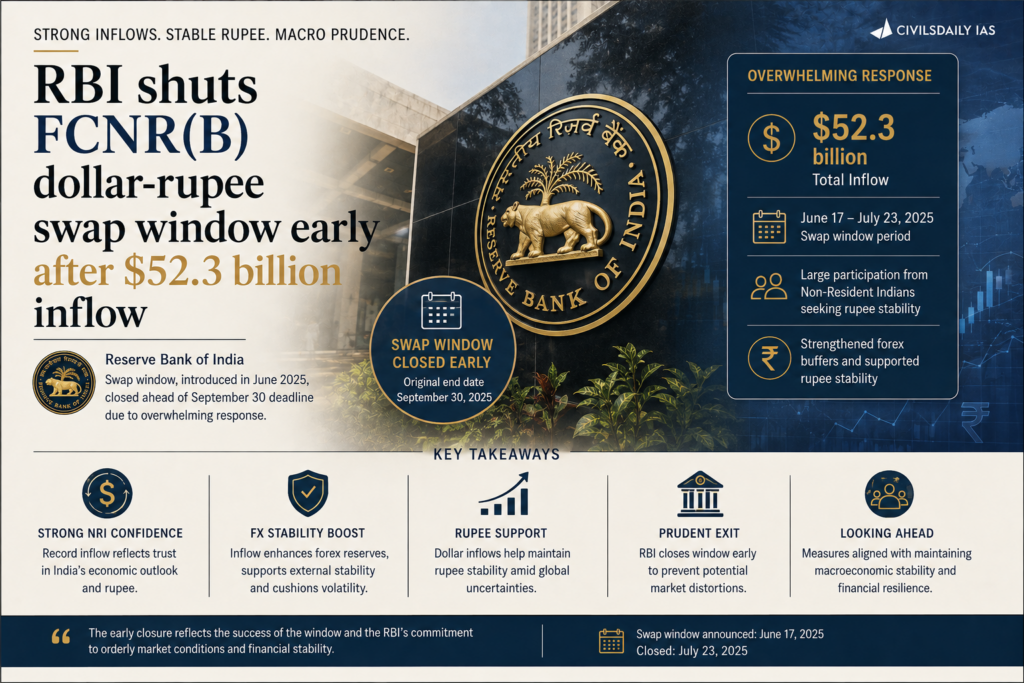
    Banks mobilised $52.3 billion in foreign currency inflows between 8 June and 13 August under the Reserve Bank of India (RBI) special swap facility, with Foreign Currency Non Resident Bank, or FCNR(B), deposits accounting for the bulk of the funds. The RBI closed the swap window a month earlier than scheduled, and the rupee fell to a 17 day low of 95.61 against the dollar the same day. A country can defend its currency by earning dollars or by borrowing them, and this stabilisation belongs to the second kind.

    How does the RBI special swap facility for FCNR(B) deposits work?

    1. The deposit: FCNR(B) deposits let non resident Indians hold foreign currency with Indian banks, free of rupee risk, with tax free interest and full repatriation.
    2. Step one, raising the money: Banks raise fresh deposits of three to five year maturity in foreign currency.
    3. Step two, the swap: Banks swap those dollars with the RBI in exchange for rupees.
    4. Step three, the subsidy: The central bank absorbs the hedging cost of that swap, which is the cost banks would otherwise pay to protect themselves against currency movement.
    5. The result for the depositor: Once the cost is lifted, banks can offer dollar rates near 6 to 7.5 per cent, and some add leverage of 9 to 19 times.
    6. The nature of the transaction: For a wealthy depositor borrowing abroad and placing the proceeds in India at a protected high yield, this is a carry trade with the currency risk removed by someone else.

    What is a carry trade?

    1. About: A carry trade is borrowing in a currency where interest rates are low and investing in an asset that pays a higher return, keeping the difference between the two rates.
    2. The risk it normally carries: The lender bears the exchange rate risk, since a fall in the investment currency can wipe out the interest gain.
    3. What is different here: The currency risk is removed by the central bank absorbing the hedging cost, so the investor keeps the yield without the exposure that usually pays for it.

    What is a hedging cost in a currency swap?

    1. About: A currency swap exchanges one currency for another today with an agreed reversal at a future date and a pre agreed rate.
    2. The cost: The hedging cost is the price of that future certainty, set mainly by the interest rate difference between the two currencies and by expectations of depreciation.
    3. Who pays it here: The RBI absorbs it, which is why the transaction is a subsidy rather than a market clearing price.

    What is an asset liability mismatch?

    1. About: An asset liability mismatch arises when a bank’s borrowings and its lending differ in currency, maturity or interest rate basis.
    2. The form it takes here: Banks raise three to five year foreign currency money and lend against it in rupees on different terms, so repayment obligations and asset returns do not move together.

    What did the swap window actually mobilise?

    1. The headline number: Banks mobilised $52.3 billion in foreign currency inflows between 8 June and 13 August under the facility.
    2. The composition: FCNR(B) deposits accounted for the bulk of the funds raised.
    3. Early closure: The RBI closed the FCNR(B) swap window a month earlier than originally scheduled.
    4. The immediate market reaction: The rupee depreciated 0.2 per cent to close at a 17 day low of 95.61 against the dollar, the worst performing currency in Asia that day despite a softer dollar.
    5. The added pressure: A rise in crude oil prices to nearly $90 a barrel compounded the fall, with importers rushing to take forward cover and exporters holding back dollar sales.
    6. The intervention: Intervention by the central bank prevented a sharper slide.

    Why did the money need such inducement?

    1. The prior position: Confidence had already left, since the rupee was Asia’s worst performing currency in the financial year 2025 to 2026.
    2. The portfolio exit: Foreign portfolio investors had pulled out billions from Indian markets over that period.
    3. The partial return: They turned net buyers in July, bringing in about $2.1 billion, a modest reversal relative to the scale of the preceding exodus.
    4. The reading that follows: It is too early to read this as investors rediscovering India.
    5. The revealing detail: The money recorded a sharp fall as soon as the inducement was withdrawn, which measures the incentive rather than belief in Indian assets.

    Why does a subsidy work when good data does not?

    1. The nature of currency markets: Currency markets move not only on fundamentals but on expectations about future movement.
    2. The trap of one way expectations: Once investors believe depreciation is one way, good data stops persuading them.
    3. The mechanism that breaks the loop: The way to break that loop is to make the bet against the rupee expensive, which is what the FCNR(B) window does.
    4. The price of the fix: Flows surged only after the subsidy appeared, so the pace of mobilisation measures the incentive.
    5. The conclusion drawn: Confidence that materialises only after the price is raised is not confidence, it is a purchase.

    What has India actually bought?

    1. The two ways to defend a currency: A country can earn more dollars or it can borrow them, and the two look alike when the money arrives.
    2. The category this falls into: India’s latest external sector stabilisation largely falls into the borrowing kind.
    3. What was purchased: India has bought time, and a quiet transfer of risk.
    4. The repayment obligation: These deposits will mature, and every dollar arriving now must be repaid in three to five years.
    5. The correct classification: The surge is best viewed as a balance of payments stabiliser rather than a durable source of dollars.
    6. The accounting reality: FCNR(B) deposits are ultimately a form of external borrowing and create future repayment and rollover obligations.

    Where does the risk actually sit?

    1. The scheme does not remove risk: The facility does not make the rupee’s risk disappear, it relocates it.
    2. The first relocation: When the RBI absorbs hedging costs, the exposure moves onto the public balance sheet.
    3. The second relocation: When banks raise three to five year money and lend against it, the risk resurfaces as an asset liability mismatch.
    4. The transformation over time: A visible currency problem today can become a less visible banking problem tomorrow.
    5. Who ultimately holds it: The depositor keeps a protected yield, and the currency exposure that yield was compensating for sits with the central bank and the banking system.

    What is genuinely not in crisis?

    1. Reserves: India’s foreign exchange reserves are large, giving the central bank room to intervene in the spot and forward markets.
    2. Invisible earnings: Services exports and remittances cushion the external account against a goods trade deficit.
    3. External factors: Part of the rupee’s weakness reflects the strength of the dollar rather than a domestic failure.
    4. The correct qualification: Being out of crisis is not the same as being secure.
    5. The deterioration that matters: India slipped into a current account deficit in May, which is the backdrop against which the FCNR(B) surge must be read.

    What should India do with a window it has paid to open?

    1. Treat it correctly: Treat the period as a purchased pause and spend it well, rather than as evidence that the external problem has been solved.
    2. Build export surplus sectors: Develop sectors that earn a durable dollar surplus rather than relying on capital inflows to balance the account.
    3. Attract foreign direct investment: Draw investment that takes a lasting stake, since it does not carry a fixed repayment date the way a deposit does.
    4. Cut energy import dependence: Reduce the largest single item of the import bill, which is also the most exposed to geopolitical shocks.
    5. Treat tourism as a foreign exchange industry: Recognise inbound tourism as an export earning activity and plan for it accordingly.
    6. The blunt limit: If India earns too few dollars, no better way of borrowing will solve it.

    Challenges in managing India’s external sector

    1. Rollover risk on maturing deposits: Large foreign currency deposits raised in one window fall due together and must be repaid or renewed at whatever rate then prevails. e.g. the $34 billion of FCNR(B) deposits raised under the 2013 swap window created a concentrated redemption in 2016 that the RBI had to manage in advance.
    2. Oil price exposure: India imports the overwhelming share of its crude oil, so the trade deficit moves with a price it does not set. e.g. crude near $90 a barrel in August 2026 directly widened the import bill and pressured the rupee.
    3. Gold import demand: Household demand for gold converts savings into imports and worsens the current account. e.g. gold has repeatedly been the second largest item in India’s import bill after crude oil.
    4. Volatility of portfolio flows: Foreign portfolio investment can reverse within weeks on a change in global interest rates. e.g. the taper announcement of 2013 triggered an exit that took the rupee past 68 to the dollar.
    5. Narrow export basket and market concentration: A few products and a few destinations carry a large share of merchandise exports. e.g. tariff action by a single large trading partner can hit textiles, gems and jewellery and shrimp exports simultaneously.
    6. Rising import intensity of exports: Electronics and refined petroleum exports require heavy imported inputs, so gross export growth adds less net foreign exchange. e.g. smartphone exports rely on imported displays, camera modules and cells.
    7. Sterilisation cost of intervention: Defending the rupee by selling dollars injects rupee liquidity that must then be absorbed at a cost. e.g. the RBI uses open market operations and the standing deposit facility to drain the liquidity created by intervention.
    8. External debt servicing: A rising stock of short term external debt raises the share of reserves committed to repayment. e.g. short term debt on residual maturity has at times exceeded a fifth of foreign exchange reserves.

    Conclusion

    The $52.3 billion mobilised under the swap window is borrowed rather than earned, and the currency risk that made it attractive has been moved onto the public balance sheet and into bank balance sheets. The central bank acted decisively and bought time, and every dollar of that time must be repaid within three to five years. What remains unresolved is the underlying position, since India slipped into a current account deficit in May and the flows arrived only after the price was raised. Rupee stability now rests increasingly on liabilities the country has paid to attract and must one day repay.

    What is the Balance of Payments?

    1. About: The balance of payments is the systematic record of all economic transactions between residents of a country and the rest of the world over a period.
    2. Rationale: It exists to show whether a country is paying its way through what it earns, or financing consumption and investment through borrowing and asset sales.
    3. Current account: Records trade in goods and services, primary income such as investment income, and secondary income such as remittances.
    4. Capital and financial account: Records foreign direct investment, portfolio investment, external commercial borrowing, banking capital including non resident deposits, and reserve movements.
    5. Errors and omissions: The residual balancing entry that reconciles the two accounts, since the sources for each side differ.
    6. The accounting identity: A current account deficit must be financed by a surplus on the capital account or by drawing down reserves.

    Key Concerns Regarding India’s External Sector Position

    1. Deficit financed by volatile capital: A current account deficit funded by portfolio flows and non resident deposits is more fragile than one funded by foreign direct investment.
    2. Dependence on invisibles: Services exports and remittances mask a persistent and large merchandise trade deficit.
    3. Reserve adequacy measured wrongly: A large absolute reserve stock can still be thin when measured against short term external liabilities on a residual maturity basis.
    4. Commodity price pass through: Oil, gold and fertiliser prices are set abroad, so a large part of the external position is outside domestic policy control.
    5. Rupee internationalisation lag: Almost all of India’s trade is invoiced in dollars, so every trade shock passes directly into demand for foreign exchange.
    6. Contingent liabilities of intervention: Forward market intervention creates future dollar delivery obligations that do not appear in the headline reserve figure.

    Statutory Framework Governing Foreign Exchange and External Borrowing

    1. Entry 36 of the Union List: Places currency, coinage and legal tender, and foreign exchange, exclusively with Parliament.
    2. Entry 37 of the Union List: Covers foreign loans, the constitutional basis for regulating external borrowing.
    3. Section 3 of the Foreign Exchange Management Act, 1999: Prohibits dealing in foreign exchange except through authorised persons.
    4. Section 6 of the Foreign Exchange Management Act, 1999: Governs capital account transactions, including non resident deposits and external borrowing.
    5. Section 47 of the Foreign Exchange Management Act, 1999: Empowers the RBI to make regulations to carry out the provisions of the Act.
    6. Sections 17 and 33 of the Reserve Bank of India Act, 1934: Govern the business the RBI may transact and the assets backing the note issue, including foreign securities.
    7. Preamble to the Reserve Bank of India Act, 1934: States the objective of operating the currency and credit system to the country’s advantage and maintaining price stability.

    Laws and Rules Governing Non Resident Deposits

    1. Reserve Bank of India Act, 1934: Establishes the central bank and its powers over currency, reserves and monetary operations.
    2. Section 45ZB: Provides for the Monetary Policy Committee, which sets the policy rate that shapes the interest differential behind a swap.
    3. Foreign Exchange Management Act, 1999: Replaced the Foreign Exchange Regulation Act, 1973 and shifted the regime from control to management of foreign exchange.
    4. Foreign Exchange Management (Deposit) Regulations, 2016: Govern the operation of Non Resident External, Non Resident Ordinary and FCNR(B) accounts.
    5. Banking Regulation Act, 1949: Governs the conduct of banking companies, including the reserve and liquidity requirements applicable to these deposits.
    6. Foreign Exchange Management (Borrowing and Lending) Regulations, 2018: Govern external commercial borrowing and the terms on which residents may borrow abroad.
    7. Prevention of Money Laundering Act, 2002: Applies customer due diligence and reporting requirements to non resident deposit accounts.
    8. Income Tax Act, 1961: Provides the exemption that makes interest on FCNR(B) and Non Resident External deposits tax free for a non resident.

    Back2Basics: Non Resident Deposit Accounts in India

    1. FCNR(B) account: A term deposit held in a permitted foreign currency with an Indian bank, with maturity from one to five years.
    2. Currency risk on FCNR(B): The deposit is denominated in foreign currency, so the depositor faces no rupee depreciation risk and the bank or the central bank carries it.
    3. Non Resident External (NRE) account: A rupee denominated account funded from abroad, fully repatriable, with tax free interest in India.
    4. Non Resident Ordinary (NRO) account: A rupee account for income earned in India such as rent, pension or dividends, with limited repatriation and taxable interest.
    5. Regulatory basis: All three are governed by the Foreign Exchange Management (Deposit) Regulations, 2016 under the Foreign Exchange Management Act, 1999.
    6. Policy use: The RBI periodically relaxes interest rate ceilings and reserve requirements on these deposits to attract dollar inflows when the rupee is under pressure.
    7. Balance of payments classification: Non resident deposits are recorded as banking capital under the capital account, not as current account earnings.

    Government and RBI Initiatives on External Stability

    1. Special swap facility for FCNR(B) deposits: Absorbs the hedging cost of bank dollar deposits to attract diaspora funds during periods of currency pressure.
    2. Special Rupee Vostro Accounts: Allow settlement of international trade in rupees with partner countries, reducing dollar demand for those transactions.
    3. Gold Monetisation Scheme: Brings idle domestic gold into the financial system to cut fresh import demand.
    4. Sovereign Gold Bonds: Provide a paper substitute for physical gold, reducing the import component of gold demand.
    5. Liberalised Remittance Scheme: Sets the annual limit within which resident individuals may remit funds abroad, a control on outflows.
    6. External Commercial Borrowing framework: Sets maturity, cost ceiling and end use conditions for corporate borrowing abroad.
    7. Foreign exchange reserve management: Reserves are held in foreign currency assets, gold, Special Drawing Rights and the reserve tranche position with the International Monetary Fund.

    Key Facts about India’s External Sector

    1. Reserve composition: India’s foreign exchange reserves comprise foreign currency assets, gold, Special Drawing Rights and the reserve tranche position with the IMF.
    2. Remittance rank: India is the largest recipient of inward remittances in the world.
    3. Services strength: India is among the top ten exporters of commercial services globally, led by software and business services.
    4. Import composition: Crude oil and gold are consistently the two largest items in India’s merchandise import bill.
    5. The 2013 precedent: A similar concessional swap window in 2013 raised about $34 billion through FCNR(B) deposits and bank capital during that year’s currency crisis.
    6. Exchange rate regime: India follows a managed float, where the rate is market determined and the RBI intervenes to contain volatility rather than to defend a level.
    7. Convertibility status: The rupee is fully convertible on the current account and only partially convertible on the capital account.

    Way Forward

    1. Sequence the repayment: Publish a maturity profile of the deposits raised and build forward cover ahead of the redemption window rather than at it.
    2. Shift the financing mix: Prioritise foreign direct investment and long term equity flows over interest sensitive deposits as the source of external financing.
    3. Expand export capability: Target sectors with high domestic value addition so export growth adds net foreign exchange rather than gross turnover.
    4. Reduce energy import intensity: Accelerate renewable capacity, ethanol blending and electrification of transport to shrink the crude oil bill.
    5. Widen rupee trade settlement: Extend Special Rupee Vostro arrangements to more trade partners so a larger share of trade avoids dollar intermediation.
    6. Treat tourism as an export sector: Fund visa facilitation, connectivity and destination infrastructure with the same seriousness as merchandise export promotion.
    7. Report the contingent position: Disclose the forward book and swap obligations alongside headline reserves so the true net position is visible.

    Matching Previous Year Question

    “[2015, GS3, 12.5 marks] Craze for gold in Indians have led to a surge in import of gold in recent years and put pressure on balance of payments and external value of rupee. In view of this, examine the merits of Gold Monetization Scheme.”
  • From price taker to price setter: India’s commodity market gains clout

    Why in the News

    The Securities and Exchange Board of India (SEBI) is soliciting public views on allowing Foreign Portfolio Investors (FPIs) into non agricultural, physically settled commodity derivatives covering bullion, energy and base metals. India is a major importer of crude oil, gold and industrial metals, yet it takes prices set on foreign exchanges rather than setting them. The proposal tests whether deeper liquidity turns India into a price setter or imports the volatility of global markets.

    What are physically settled commodity derivatives?

    1. About: A commodity derivative is a contract whose value is derived from an underlying commodity, traded as a future or an option on an exchange.
    2. Physical settlement: A physically settled contract is closed by actual delivery of the underlying goods at expiry, rather than by paying the cash difference between the contract price and the market price.
    3. Why the distinction matters: Physical settlement ties the exchange price to the real warehouse and delivery market, which is what makes a contract usable as a benchmark.
    4. The categories in question: The proposal covers bullion meaning gold, silver and their derivatives, energy meaning crude oil and natural gas, and base metals meaning aluminium, copper, lead, nickel and zinc.
    5. The present bar: Overseas investors are at present not allowed to participate in contracts linked to crude, natural gas, gold or silver that are settled by actual delivery of the underlying goods.

    What is a Foreign Portfolio Investor (FPI)?

    1. About: An FPI is a non resident investor registered with SEBI to invest in Indian securities and financial instruments without acquiring management control.
    2. Distinguishing feature: Portfolio investment is liquid and can exit quickly, unlike foreign direct investment which takes a lasting interest in an enterprise.
    3. Present count: More than 11,000 FPIs are currently registered in India.

    What does price taker versus price setter mean?

    1. Price taker: A market participant large enough to buy in volume, yet whose own trading does not influence the reference price at which the commodity is quoted globally.
    2. Price setter: A market whose exchange price becomes the reference benchmark that buyers and sellers elsewhere quote against.
    3. The stake for India: A price setting market retains benchmark authority, transaction value and hedging activity inside the country instead of exporting them.

    What is Average Daily Turnover (ADT)?

    1. About: Average Daily Turnover is the average notional value of contracts traded per trading day over a stated period, used as the standard measure of an exchange’s activity.
    2. Use here: It is the figure by which the Multi Commodity Exchange (MCX) is compared against global commodity exchanges for depth.

    Why is India a price taker despite being a major importer?

    1. Import weight without market weight: India is a major importer of crude oil, gold and industrial metals, and still has no proportionate influence on how those commodities are priced.
    2. Hedging happens offshore: Domestic commodity risk is currently hedged largely through London, New York, Chicago and Singapore rather than on Indian exchanges.
    3. Missing institutional depth: MCX has strong retail and domestic participation and relatively limited institutional depth compared with global exchanges.
    4. The missing precondition: For India to become a price setter, its domestic commodity market needs integration with the global financial architecture.
    5. The consequence of the gap: Indian users of these commodities accept a price discovered abroad and pay the transaction and collateral cost of using a foreign venue.

    What exactly is SEBI proposing?

    1. The consultation: SEBI is proposing to allow access to foreign portfolio investors into non agricultural derivatives and is seeking public views on the design.
    2. The stated objective: The aim is to bring global commodity risk management into India.
    3. The expected byproduct: Increased depth and liquidity in commodity derivative markets, enabling the country to serve as a global benchmark.
    4. The product scope: Participation is proposed in physically settled contracts in bullion, energy and base metals, the segments that are either imported or globally priced.
    5. The safeguard already stated: SEBI has mandated that such participants square off positions before the delivery period.
    6. The stated challenge: The design problem is to ensure that greater liquidity does not become greater volatility.

    How would onshore hedging change India’s foreign exchange position?

    1. Margin retention: Margin money posted against contracts stays within the country instead of moving to a foreign clearing house.
    2. Brokerage retention: Brokerage paid on the trade remains domestic revenue.
    3. Lower collateral demand on banks: Banks would need less foreign currency for collateral purposes when hedging moves onshore.
    4. What is not saved: India cannot avoid paying dollars for demand inelastic imported commodities, so the total import bill does not fall.
    5. What is saved: The country saves on offshore collateral, transaction costs and financial outflows.
    6. The precise gain: The result is a reduction in the volatility of India’s foreign exchange requirement, not a large reduction in total foreign exchange outflow.

    What multiplier effect do FPIs bring to the domestic market?

    1. The liquidity function: FPIs can create a multiplier effect by providing the liquidity that domestic hedgers need on the other side of their trades.
    2. The hedgers who benefit: Airlines, oil marketing companies (OMCs) and industrial users would be able to hedge efficiently on Indian exchanges.
    3. The scale even at low participation: Of the more than 11,000 registered FPIs, even a tenth participating on a conservative estimate would bring in considerable liquidity.
    4. Benchmark influence: By attracting global capital, Indian exchanges can gradually become more influential in regional price discovery.
    5. Reduced benchmark dependence: A deeper market also cuts India’s dependence on overseas benchmarks for the same commodities.

    What does the MCX data show about the market’s current depth?

    1. Combined turnover: MCX recorded a combined futures and options Average Daily Turnover of Rs 10.5 lakh crore as of the first quarter of FY27.
    2. Rate of growth: The combined futures and options ADT of MCX rose by 238 per cent in the first quarter of FY27.
    3. What the growth reflects: The rise reflects growing investor adoption of commodity derivatives for both hedging and trading.
    4. Client base: The active client base almost doubled year on year to 13.72 lakh in the review period.
    5. Registered foreign investors: More than 11,000 FPIs are already registered in India across asset classes.
    6. Composition advantage: MCX is dominated by commodities that are either imported or globally priced, which is why the proposal is expected to benefit it most.
    7. The positioning goal: The change is expected to expand MCX’s addressable market and strengthen its position as an Asian commodity trading hub.

    How did the present proposal evolve from earlier reform?

    1. The origin: The seeds of the present proposal were sown in 2015, at the time of the merger of the Forward Markets Commission with SEBI.
    2. The approach since: SEBI has taken measured steps in developing the commodity derivatives market in an orderly manner.
    3. The products introduced: SEBI introduced futures on commodity indices, options on commodity futures, and options in goods.
    4. The stated purpose of those products: To attract broad based participation, enhance liquidity, facilitate hedging and bring more depth to the commodity derivatives market.
    5. Who took them up: The products launched by the exchanges are witnessing substantial trading volumes, driven by mutual funds, alternate investment funds and portfolio management services.
    6. The earlier foreign access route: Eligible Foreign Entities (EFEs) were initially allowed to participate only for hedging, and only if they had direct exposure to Indian physical commodities.
    7. Why that route failed: The response of eligible foreign entities was woefully low, due to operational complexities in the eligibility and compliance design.

    What does the single international precedent cited actually establish?

    1. The one study relied upon: SEBI cites a study of China, which found a jump in volume and in the number of deals after internationalisation of its futures markets.
    2. The cost finding: That study also found trading cost was largely unaffected by the entry of foreign participants.
    3. The inference drawn: SEBI reasoned from this evidence for the entry of FPIs into Indian commodity derivatives.
    4. The limit of the evidence: A single country study of volume and cost does not establish that benchmark authority shifted, which is the outcome India is actually seeking.
    5. The offshore venues that matter: The benchmarks India competes against sit in London, New York, Chicago and Singapore, and none of those cases is examined in the proposal.

    Does deeper liquidity buy price setting power or imported volatility?

    1. The reform is significant: Widening access for FPIs into non farm commodity derivatives is a significant step towards market depth.
    2. The speculation risk: Speculation may amplify price movements in an already charged geopolitical environment, with currency fluctuations and supply disruptions.
    3. Position concentration: Large international commodity trading houses and hedge funds could accumulate significant positions and influence short term prices.
    4. The partial safeguard: SEBI has mandated such participants to square off positions before the delivery period, which limits delivery squeezes but not price influence during the contract’s life.
    5. Contagion channel: Indian commodity markets may sway to Federal Reserve policy and dollar movements once foreign capital is a large presence.
    6. Financialisation risk: Excessive financialisation of commodities may create a discord between futures prices and physical market realities.
    7. The central trade off: The same foreign capital that gives India benchmark weight also transmits foreign monetary policy into domestic commodity prices.

    Challenges to opening commodity derivatives to foreign portfolio investors

    1. Volatility transmission to consumer prices: Commodity futures prices feed into fuel and metal costs that households and industry pay. e.g. a spike in crude futures during the Strait of Hormuz disruption of 2026 pushed the Indian crude basket towards $90 a barrel.
    2. Warehousing and delivery infrastructure: Physical settlement needs accredited warehouses, assaying and quality certification at scale. e.g. the National Spot Exchange Limited payment crisis of 2013 arose from unverified underlying stocks in warehouses.
    3. Regulatory arbitrage with offshore venues: Participants can shift between Indian and foreign contracts to exploit margin and tax differences. e.g. Indian single stock and index derivative volumes migrated to Singapore before the exchanges restructured their offshore licensing.
    4. Currency convertibility limits: The rupee is not fully convertible on the capital account, which constrains how freely foreign hedgers can move funds. e.g. offshore participants continue to use non deliverable forward markets for rupee exposure.
    5. Concentration and manipulation risk: A few large global houses dominate physical trade in several of these commodities. e.g. global metal trading is concentrated among a small number of houses whose positions can move benchmark prices.
    6. Retail exposure to a wholesale market: Indian commodity exchanges have unusually high retail participation for a risk transfer market. e.g. the active client base at MCX almost doubled to 13.72 lakh in a single year.
    7. Agricultural spillover through sentiment: Even with farm contracts excluded, financialisation shapes expectations across commodity classes. e.g. futures trading in seven agricultural commodities was suspended in 2021 over inflation concerns and the suspension was extended repeatedly.

    Conclusion

    India buys crude oil, gold and base metals in global volume and still accepts a price discovered on exchanges abroad, and the proposal to admit FPIs is an attempt to relocate that price discovery onshore. The measurable gain is narrower than the framing suggests, since it lowers the volatility of India’s foreign exchange requirement and retains margin, brokerage and collateral, without reducing the dollar bill for demand inelastic imports. What remains unresolved is whether the same foreign capital that supplies depth also imports Federal Reserve policy and dollar movements into Indian commodity prices. The proposal is at the public consultation stage, and the design question SEBI must answer is how to ensure greater liquidity does not become greater volatility.

    Commodity Derivatives Market in India

    1. About: A commodity derivatives market allows producers, importers and consumers to lock in a future price for a commodity, transferring price risk to participants willing to bear it.
    2. The two functions: The market performs price discovery, by aggregating expectations into a single quoted price, and risk management, by allowing hedging against adverse price movement.
    3. Regulatory history: Commodity derivatives were regulated by the Forward Markets Commission under the Forward Contracts (Regulation) Act, 1952 until the Commission merged with SEBI in 2015.
    4. The exchanges: MCX dominates non agricultural commodities, while the National Commodity and Derivatives Exchange (NCDEX) is the principal agricultural commodity exchange.
    5. India’s scale: India is the world’s largest consumer of gold after China, the third largest consumer and importer of crude oil, and a leading consumer of silver and base metals.
    6. The structural weakness: Institutional and foreign participation is thin, so Indian contracts track international benchmarks rather than generating them.
    7. The newer venue: The India International Bullion Exchange at GIFT City was created to route bullion imports through an organised exchange platform.

    Statutory Framework Governing Commodity Derivatives

    1. Entry 48 of the Union List: Places stock exchanges and futures markets exclusively within Parliament’s legislative competence.
    2. Securities Contracts (Regulation) Act, 1956, Section 2(bc): Defines a commodity derivative, brought in by the Finance Act, 2015.
    3. SEBI Act, 1992, Section 11: Sets out SEBI’s duty to protect investors and to regulate the securities market, extended to commodity derivatives after the merger.
    4. Finance Act, 2015: Repealed the Forward Contracts (Regulation) Act, 1952 and transferred regulation of commodity derivatives to SEBI.
    5. Foreign Exchange Management Act, 1999, Section 6: Governs capital account transactions, the route through which foreign participation and collateral flows are controlled.
    6. Essential Commodities Act, 1955: Empowers the Union to regulate production, supply and trade in notified essential commodities, including suspension of futures trading.

    Laws and Rules Governing Commodity Market Participation

    1. Securities Contracts (Regulation) Act, 1956: Governs recognition of stock exchanges and the legality of contracts in securities and commodity derivatives.
    2. Section 2(bc): Introduced the statutory definition of a commodity derivative in 2015.
    3. SEBI Act, 1992: Establishes SEBI with powers of investigation, adjudication and penalty across securities and commodity derivative markets.
    4. SEBI (Foreign Portfolio Investors) Regulations, 2019: Set out registration categories, eligibility and investment conditions for foreign portfolio investors.
    5. Foreign Exchange Management Act, 1999: Governs the cross border movement of funds, margins and collateral by foreign participants.
    6. Foreign Exchange Management (Debt Instruments) Regulations, 2019: Regulate FPI access to Indian debt, the parallel route to their equity access.
    7. Warehousing (Development and Regulation) Act, 2007: Establishes the Warehousing Development and Regulatory Authority and the negotiable warehouse receipt system that underpins physical settlement.
    8. Essential Commodities Act, 1955: Provides the power under which futures trading in specific commodities has been suspended.
    9. Prevention of Money Laundering Act, 2002: Applies know your customer and reporting obligations to intermediaries handling foreign participant funds.

    Back2Basics: Multi Commodity Exchange of India (MCX)

    1. What it is: MCX is India’s largest commodity derivatives exchange, dealing mainly in bullion, energy and base metals.
    2. Regulator: Regulated by SEBI under the Securities Contracts (Regulation) Act, 1956 since the 2015 transfer of commodity market regulation.
    3. Year of operations: Began operations in 2003 and became India’s first listed commodity exchange.
    4. Product range: Offers futures and options in gold, silver, crude oil, natural gas, aluminium, copper, lead, nickel, zinc, cotton and other commodities.
    5. Index products: Operates commodity indices such as iCOMDEX, on which index futures are traded.
    6. Settlement types: Runs both cash settled and physically settled contracts, with delivery through accredited warehouses and vaults.
    7. Current scale: Combined futures and options average daily turnover reached Rs 10.5 lakh crore in the first quarter of FY27, with an active client base of 13.72 lakh.

    Government Initiatives Related to Commodity Markets

    1. Merger of the Forward Markets Commission with SEBI: Unified regulation of securities and commodity derivatives under a single regulator from 2015.
    2. India International Bullion Exchange at GIFT City: Created to channel bullion imports through a regulated exchange and build a domestic gold price benchmark.
    3. Gold Monetisation Scheme: Mobilises idle household and institutional gold into the banking system to reduce fresh import demand.
    4. Sovereign Gold Bonds: Offer a paper alternative to physical gold holding, reducing import linked demand.
    5. Electronic Negotiable Warehouse Receipts: Issued under the Warehousing Development and Regulatory Authority framework to make stored commodities financeable and deliverable.
    6. Electronic National Agriculture Market (eNAM): Creates a unified electronic spot market for agricultural produce across regulated mandis.
    7. International Financial Services Centres Authority: Regulates the unified financial services centre at GIFT City, including commodity and bullion derivatives available to non residents.

    Key Facts about India’s Commodity Market

    1. Regulator: SEBI, since the Forward Markets Commission merged into it on 28 September 2015.
    2. Repealed statute: The Forward Contracts (Regulation) Act, 1952 was repealed through the Finance Act, 2015.
    3. Principal exchanges: MCX for non agricultural commodities and NCDEX for agricultural commodities.
    4. Gold consumption: India is among the two largest gold consuming countries in the world, with imports a major component of its current account deficit.
    5. Crude dependence: India imports well over 85 per cent of its crude oil requirement, which is why energy contracts dominate hedging demand.
    6. Institutional access built in stages: Mutual funds, alternate investment funds and portfolio management services were allowed into commodity derivatives before foreign portfolio investors.
    7. Physical settlement mandate: SEBI moved several non agricultural contracts to compulsory delivery based settlement to align futures prices with physical markets.

    Challenges in India’s Commodity Derivatives Market

    1. Shallow institutional participation: Banks, insurers and pension funds are largely absent from commodity hedging. e.g. Indian banks are not permitted to take proprietary positions in commodity derivatives the way global banks do.
    2. Fragmented physical markets: Spot markets remain dispersed and unstandardised, weakening the link between futures and delivery. e.g. agricultural produce market committee mandis quote different grades and prices for the same crop within one State.
    3. Policy reversals: Sudden suspension of contracts undermines confidence in the market as a hedging venue. e.g. futures trading in seven agricultural commodities including wheat, mustard and chana was suspended in December 2021.
    4. Tax and transaction cost: Commodity transaction tax and stamp duty raise the cost of trading relative to offshore venues. e.g. Indian participants have historically routed positions through Dubai and Singapore for cost reasons.
    5. Quality assaying and standardisation: Delivery requires reliable and uniform quality certification. e.g. bullion delivery requires refiners accredited to internationally recognised good delivery standards, which few Indian refiners hold.
    6. Investor protection in a leveraged market: Retail participants trade leveraged contracts they may not fully understand. e.g. the negative settlement of crude oil futures in April 2020 imposed large losses on Indian retail participants holding long positions.
    7. Weak farmer linkage: The agricultural segment does not reach the producers it is meant to protect. e.g. participation by farmer producer organisations in agricultural futures remains a very small share of turnover.

    Way Forward

    1. Phase the entry with position limits: Admit foreign portfolio investors in stages with commodity wise position limits, so liquidity builds without allowing concentrated control of a contract.
    2. Strengthen surveillance: Build cross market surveillance linking futures positions with warehouse stocks and physical trade data to detect manipulation early.
    3. Deepen delivery infrastructure: Expand accredited warehouses, vaults and assaying laboratories so physical settlement scales with volume.
    4. Allow domestic institutional hedgers: Permit banks, insurers and pension funds calibrated access, so foreign capital is not the only source of institutional depth.
    5. Stabilise policy: Commit to a rule based framework for suspending a contract, so intervention is predictable rather than discretionary.
    6. Rationalise transaction cost: Review the commodity transaction tax and stamp duty structure to remove the incentive to hedge offshore.
    7. Extend hedging to the producer: Support aggregation through farmer producer organisations and small industry associations so hedging reaches beyond large firms.

    Matching Previous Year Question

    “[2021] Consider the following:
    1.Foreign currency convertible bonds
    2.Foreign institutional investment with certain conditions
    3.Global depository receipts
    4.Non-resident external deposits
    Which of the above can be included in Foreign Direct Investments?
    (a) 1, 2 and 3
    (b) 3 only
    (c) 2 and 4
    (d) 1 and 4
    Answer: (a)”

  • IT Ministry okays Rs 7,877-cr worth projects under ECMS

    Why in the News

    The Ministry of Electronics and Information Technology (MeitY) approved 31 more applications worth Rs 7,877 crore under the Electronics Components Manufacturing Scheme (ECMS), spread across 10 States. Cumulative approved investment under the scheme has crossed Rs 69,548 crore against an original target of Rs 59,350 crore, while committed employment stands at about 75,000 against a target of 91,600.

    What is the Electronics Components Manufacturing Scheme (ECMS)?

    1. About: ECMS is a MeitY scheme that gives incentives for manufacturing passive and active electronic components and sub assemblies inside India, rather than finished devices.
    2. Objective: It targets the segment of the electronics value chain that India still imports, such as capacitors, connectors, enclosures and display modules.
    3. Incentive structure: Approved projects receive turnover linked or capex linked incentives released only on achieving stated milestones.
    4. Original targets: The scheme set an investment target of Rs 59,350 crore, a production target of Rs 4.56 lakh crore and an employment target of 91,600 jobs.
    5. Approval cadence: Approvals are cleared in weekly or ten day cycles by an approval meeting, making it one of the fastest moving programmes of the Ministry.

    What is a turnover linked and a capex linked incentive?

    1. Turnover linked incentive: The payout is calculated as a percentage of incremental sales of the manufactured component, so support flows only after the plant actually produces and sells.
    2. Capex linked incentive: The payout is a share of eligible capital expenditure on plant and machinery, which lowers the upfront cost of building a component fabrication line.

    What are optical transceivers?

    1. About: An optical transceiver is a module that converts electrical signals into light pulses for transmission through optical fibre and converts them back at the receiving end.
    2. Why it matters: These modules are the core hardware of data centres and telecom backhaul networks, and India has so far imported almost all of its requirement.

    What are copper clad laminates?

    1. About: A copper clad laminate is a sheet of insulating resin material bonded with copper foil, and it is the base substrate on which every printed circuit board (PCB) is etched.
    2. Strategic value: Without domestic laminate capacity, a PCB plant remains an assembly operation dependent on imported substrate.

    What does the latest tranche of approvals contain?

    1. Volume: 31 applications involving proposed investment of Rs 7,877 crore were cleared, spread across 10 States.
    2. States covered: The tranche covers Himachal Pradesh, Uttarakhand, Uttar Pradesh, Haryana, Gujarat, Maharashtra, Goa, Karnataka, Tamil Nadu and Telangana, with Tamil Nadu taking the highest share at seven project approvals.
    3. Product range: Approvals span capital goods, camera and display modules, anode materials, enclosures, connectors, rare earth permanent magnets, optical transceivers, speakers and microphones, antennas, capacitors, coils and filters.
    4. First time products: Several parts have never been manufactured in India before, including electrolyte additives, hermetic terminals used for defence grade sealed assemblies, metalised films for capacitors and coils.
    5. An enhancement, not a new plant: Wipro Global’s copper clad laminates project accounted for a Rs 11,033 crore increase in project value, leaving about Rs 6,844 crore in approvals for genuinely fresh projects.
    6. Expected output: The tranche is expected to lead to production worth Rs 82,243 crore and close to 10,000 direct jobs.

    Where does the scheme stand against its own targets?

    1. Applications cleared: 106 applications have now been approved, covering around 30 product categories across 15 States.
    2. Investment overshoot: Cumulative proposed investment has reached Rs 69,548 crore, crossing the original target of Rs 59,350 crore.
    3. Production overshoot: Expected production from approved projects stands at Rs 5.34 lakh crore against an original target of Rs 4.56 lakh crore.
    4. Employment shortfall: Selected companies have committed close to 75,000 jobs against the scheme’s total target of 91,600.
    5. Official position on the gap: The IT Secretary stated that the employment target has not yet been reached and would be reached shortly.

    How complete is the claim of atmanirbharta in components?

    1. Fully covered segments: The IT Minister stated that approved projects make India atmanirbhar in planned supplies of enclosures for devices, relays, anode material and optical transceivers.
    2. Relays as an export line: Relays under the approved projects are already being exported, not merely substituting imports.
    3. Partial coverage in laminates: Laminates are being produced at 80 per cent of domestic demand.
    4. Partial coverage in connectors and cells: Domestic production stands at 75 per cent for connectors, 60 per cent for lithium ion cells and 55 per cent for transducers.
    5. Reading the numbers: Self reliance has been claimed for four narrow product lines, while the higher value and higher volume segments remain partially import dependent.

    Which approved projects have actually reached production?

    1. Operational plants: ATL’s lithium ion cell facilities at Rewari and Sohna and Tata Electronics’ enclosure plant at Hosur are currently operational.
    2. Nearing commissioning: Kaynes Circuits’ PCB plant near Chennai is expected to start operations within about a month.
    3. Two to three month horizon: Motherson’s enclosure facility at Kanchipuram and Wipro Global’s copper clad laminate plant are expected to start in the next two to three months.
    4. Four month horizon: Dixon’s display and camera module facility at Noida is expected to go live within four months.
    5. Approval versus asset: Most of the Rs 69,548 crore approved remains a commitment on paper, since only three plants are producing today.

    Why is investment running ahead of employment under ECMS?

    1. Capital intensity of components: Component fabrication uses automated deposition, winding and moulding lines, so output scales with machinery rather than with headcount.
    2. Incentive design: Both the turnover linked and the capex linked routes reward sales and capital spending, and neither makes disbursal conditional on the jobs actually created.
    3. Nature of the products: Enclosures, laminates and magnets are process industries, unlike mobile phone assembly under earlier programmes where manual assembly lines absorbed large workforces.
    4. Skill mismatch: Component plants need process technicians and materials engineers, and the shortage of that specific pool caps hiring even where capacity exists.
    5. The policy consequence: Import substitution in value terms is being achieved faster than the employment objective the scheme was also sold on.

    Challenges to the Electronics Components Manufacturing Scheme

    1. Dependence on imported inputs one layer down: Localising a component often shifts import dependence to its raw material rather than removing it. e.g. domestic lithium ion cell plants at Rewari still import cathode active material and separators.
    2. Rare earth supply concentration: Permanent magnet manufacturing approved under the scheme depends on rare earth feedstock controlled by a single supplier country. e.g. China’s April 2025 export controls on seven rare earth elements disrupted Indian and global automotive magnet supply.
    3. Slow conversion of approvals into plants: A large approval pipeline can stall at land, power and clearance stages. e.g. only three ECMS plants are operational while 106 applications stand approved.
    4. Thin margins in passive components: Capacitors, connectors and coils are low margin commodity items where scale determines survival. e.g. global capacitor pricing is set by high volume producers in Japan, South Korea and Taiwan, leaving little room for a new entrant.
    5. Design capability gap: Manufacturing incentives do not create intellectual property, so the high value design layer stays offshore. e.g. India assembles and now fabricates components, while chip design ownership for most consumer devices sits with firms in the United States, South Korea and Taiwan.
    6. Employment target risk: A shortfall in the jobs commitment weakens the political case for continuing the outlay. e.g. committed jobs stand at about 75,000 against the scheme target of 91,600.
    7. Testing and certification infrastructure: Components need qualification testing before global original equipment manufacturers accept them. e.g. automotive grade and defence grade parts such as hermetic terminals need long reliability qualification cycles that Indian labs are only now building.

    Conclusion

    ECMS has crossed its investment and production targets well ahead of schedule, while its employment target remains unmet. The scheme has proved that capital will come to component manufacturing when the incentive is priced correctly, and that value addition in this segment is capital intensive rather than labour intensive. The next test is conversion, since only three approved plants are producing today against 106 approved applications. The Ministry expects further approvals in weekly cycles and states that the employment target will be reached shortly.

    Electronics Manufacturing in India

    1. About: Electronics manufacturing covers the making of finished devices, sub assemblies such as display and camera modules, and discrete components such as capacitors, connectors, resistors and printed circuit boards.
    2. Scale: India’s electronics production has crossed Rs 11 lakh crore in recent years, with mobile phones forming the single largest segment.
    3. Global standing: India is the second largest mobile phone manufacturer in the world by volume, after China.
    4. Structural weakness: Value addition remains concentrated in final assembly, with components and sub assemblies contributing the bulk of the import bill.
    5. Trade position: Electronic goods have become one of India’s fastest growing export categories, driven mainly by smartphone exports.
    6. Employment profile: The sector is a large formal sector employer for semi skilled workers, with contract electronics manufacturers operating the largest plants.

    Constitutional and Statutory Framework Governing Electronics Manufacturing

    1. Article 246 with Entry 52 of the Union List: Empowers Parliament to regulate industries declared by law to be expedient in the public interest, the constitutional basis for central industrial policy.
    2. Entry 41 of the Union List: Covers trade and commerce with foreign countries and import and export across customs frontiers, the basis for tariff action on components.
    3. Entry 33 of the Concurrent List: Covers trade and commerce in, and production and supply of, products of controlled industries.
    4. Article 265: Bars any levy of tax except by authority of law, the basis for customs duty structures used in the phased manufacturing approach.
    5. Article 282: Permits the Union to make grants for any public purpose, the source of authority for incentive disbursals under a scheme.

    Laws and Rules Governing Electronics Manufacturing

    1. Information Technology Act, 2000: Provides the legal framework for electronic records and cyber security, and is the parent statute for rules governing electronic hardware security.
    2. Information Technology (Information Security Practices and Procedures for Protected System) Rules, 2018: Set security obligations for designated protected systems.
    3. Bureau of Indian Standards Act, 2016: Enables compulsory registration of electronic products and mandatory conformity to Indian standards before sale.
    4. Electronics and Information Technology Goods (Requirements for Compulsory Registration) Order: Brings notified electronic goods under mandatory BIS registration.
    5. Customs Act, 1962 with the Customs Tariff Act, 1975: Provide the duty structure used to raise the cost of imported finished goods relative to components.
    6. Environment (Protection) Act, 1986: Parent statute for the rules governing hazardous inputs and end of life electronics.
    7. Electronic Waste (Management) Rules, 2022: Impose extended producer responsibility targets on producers of electrical and electronic equipment.
    8. Legal Metrology Act, 2009: Governs declarations on packaged electronic goods, including country of origin.
    9. Foreign Trade (Development and Regulation) Act, 1992: Provides the power to restrict or license imports of specified electronic items.

    Back2Basics: Production Linked Incentive (PLI) Scheme

    1. Administering authority: Individual PLI schemes are run by their respective line ministries, with overall coordination by NITI Aayog and the Department for Promotion of Industry and Internal Trade.
    2. Launch year: The first PLI scheme, for Large Scale Electronics Manufacturing, was announced in 2020, and the framework was later extended to 14 sectors.
    3. Aim: To raise domestic manufacturing output and exports by paying an incentive on incremental sales of goods manufactured in India over a base year.
    4. Sectors covered: Sectors include mobile phones and electronic components, pharmaceuticals, automobiles and auto components, telecom, food processing, white goods, textiles, drones, advanced chemistry cell batteries and specialty steel.
    5. Design feature: Support is outcome linked, since disbursal follows achievement of stated investment and incremental sales thresholds rather than mere project approval.
    6. Targeted beneficiaries: Large anchor manufacturers and their supplier ecosystems, including contract manufacturers and component vendors.

    Government Initiatives for Electronics Manufacturing

    1. Semicon India Programme: Provides fiscal support for semiconductor fabrication units, display fabs, assembly and testing units and compound semiconductor facilities.
    2. PLI for Large Scale Electronics Manufacturing: Incentivises incremental sales of mobile phones and specified electronic components by large manufacturers.
    3. Scheme for Promotion of Manufacturing of Electronic Components and Semiconductors (SPECS): Offered capital expenditure support for the electronic component ecosystem.
    4. Modified Electronics Manufacturing Clusters Scheme (EMC 2.0): Funds common infrastructure and ready built factory sheds for electronics clusters.
    5. National Policy on Electronics, 2019: Sets the policy goal of positioning India as a global hub for electronics system design and manufacturing.
    6. Phased Manufacturing Programme: Uses a calibrated duty structure over time to move production from imported finished units to domestically made sub assemblies and components.
    7. Design Linked Incentive Scheme: Supports domestic companies in integrated circuit and chipset design, targeting the intellectual property layer.

    Key Facts about Electronics Manufacturing in India

    1. Nodal ministry: Ministry of Electronics and Information Technology.
    2. Second largest producer: India is the second largest producer of mobile phones globally by volume.
    3. Component share: Components and sub assemblies account for the largest share of the electronics import bill.
    4. First semiconductor unit: India’s first commercial semiconductor assembly and packaging units were approved under the Semicon India Programme in Gujarat and Assam.
    5. Cluster geography: Tamil Nadu, Uttar Pradesh, Karnataka and Andhra Pradesh host the largest concentration of electronics manufacturing capacity.
    6. Export status: Electronic goods have entered India’s top three export categories by value.

    Challenges in India’s Electronics Manufacturing Sector

    1. Component import dependence: Domestic value addition stays low when only final assembly happens in India. e.g. a smartphone assembled in India still uses an imported display, camera module and battery cell.
    2. Scale disadvantage against incumbents: Global component makers operate at volumes that Indian entrants cannot match on cost. e.g. Vietnam attracted large display and camera module plants before India entered the segment.
    3. Logistics and clearance cost: Electronics inputs move by air on tight cycles and are sensitive to port and customs delay. e.g. component consignments cleared through Chennai and Bengaluru air cargo face longer dwell time than Shenzhen or Ho Chi Minh City.
    4. Power quality and reliability: Component fabrication needs uninterrupted, clean power, and outages destroy an entire process batch. e.g. semiconductor and laminate lines require captive backup because a momentary voltage dip scraps work in progress.
    5. Shortage of process engineering talent: India trains software engineers in far greater numbers than materials and process engineers. e.g. semiconductor fabrication units in Gujarat have had to plan overseas training programmes for their first operating cohorts.
    6. Geopolitical supply concentration: Critical inputs and processing capacity sit in a small number of countries. e.g. China processes the overwhelming majority of the world’s rare earths and battery grade graphite.
    7. Incentive dependence: Competitiveness that rests on fiscal support weakens when the incentive window closes. e.g. several PLI beneficiaries in other sectors missed year one thresholds and forfeited that year’s incentive.

    Way Forward

    1. Move incentives down the value chain: Extend support to materials such as electronic grade chemicals, substrates and battery grade active materials, so localisation does not stop at the assembled component.
    2. Link disbursal partly to employment: Introduce a jobs component in the incentive formula so the employment target does not remain an aspiration detached from payout.
    3. Build testing and certification capacity: Fund accredited reliability and qualification laboratories so Indian components clear automotive, defence and telecom grade approvals domestically.
    4. Secure critical inputs through overseas assets: Use long term offtake agreements and equity in rare earth and graphite assets abroad to insulate magnet and cell manufacturing.
    5. Create a components skilling pipeline: Run dedicated process technician programmes with industrial training institutes located inside electronics clusters.
    6. Compress project timelines: Provide single window land, power and environmental clearance for approved ECMS projects to convert approvals into operating plants faster.
    7. Support design ownership: Expand the Design Linked Incentive Scheme so domestic firms hold intellectual property rather than only manufacturing capacity.

    Matching Previous Year Question

    “[2025, GS3, 15 marks] Discuss the rationale of the Production Linked Incentive (PLI) scheme. What are its achievements? In what way can the functioning and outcomes of the scheme be improved?”

  • RBI’s Dollar Inflows Keep India’s Bond Yields Under Control

    Why in News?

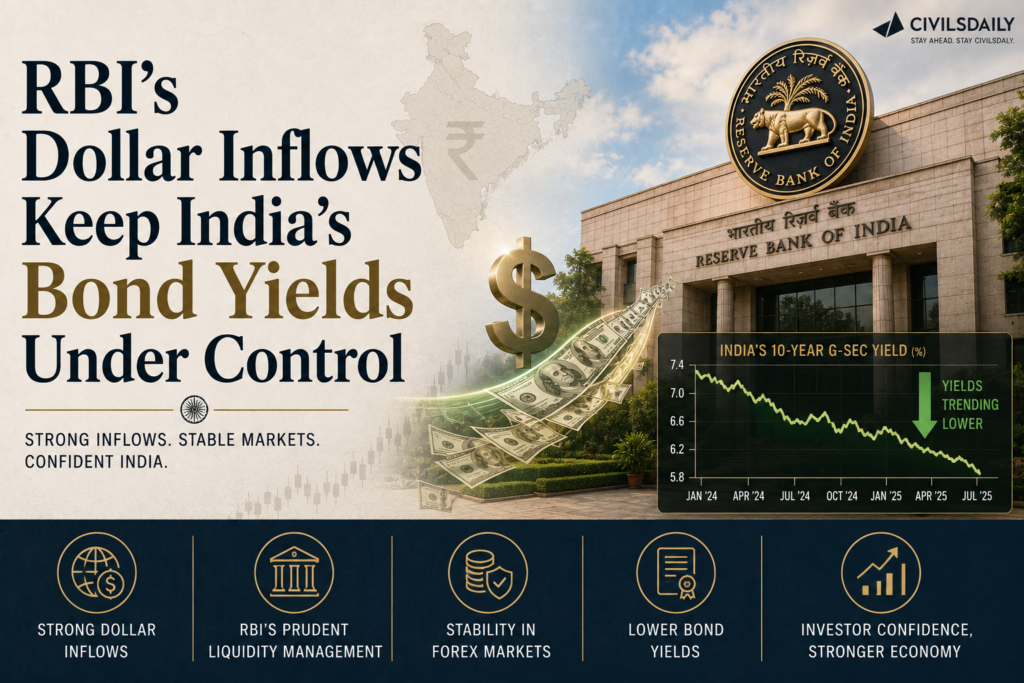
    India’s 10-year government bond yield rose only 8 basis points in six months, compared with much larger increases in major advanced and emerging economies. The RBI relied more on foreign exchange and liquidity management than policy-rate hikes.

    Key Concepts

    1. FCNR(B) Deposits

    • FCNR(B) = Foreign Currency Non-Resident (Bank) deposits.
    • Term deposits held by NRIs in permitted foreign currencies.
    • Principal and interest are repaid in the same foreign currency, protecting depositors from exchange-rate risk.
    • Banks can bring these foreign currency funds into India and swap them with the RBI.
    • This increases forex reserves and rupee liquidity.
    • It is a borrowed inflow with fixed maturity, not permanent capital.

    2. 10-Year Benchmark Bond Yield

    • Return earned on the most actively traded 10-year government security.
    • Bond price and yield move inversely:
      • Bond price ↓ → Yield ↑
      • Bond price ↑ → Yield ↓
    • It influences pricing of corporate bonds and long-term loans.
    • 1 basis point = 0.01 percentage point.

    3. RBI’s Policy Corridor

    The overnight money-market rate operates within a corridor around the repo rate.

    • MSF → Upper ceiling; banks borrow from RBI.
    • SDF → Lower floor; banks park surplus funds with RBI.
    • The corridor is 25 basis points on either side of the repo rate.

    4. Certificate of Deposit

    • A short-tenor negotiable money-market instrument issued by banks to raise funds.
    • Rising CD issuance can indicate credit growth exceeding deposit growth.
    • Falling issuance suggests deposits are sufficient to finance lending.

    5. Bloomberg Global Aggregate Index

    • A global benchmark bond index tracked by passive funds.
    • Inclusion of Indian government bonds would lead index-tracking funds to purchase Indian bonds.
    • India’s inclusion was deferred, postponing potential index-driven inflows.

    What Did the RBI Do?

    • Instead of aggressively raising the policy rate, the RBI used targeted measures to attract foreign currency:
      • FCNR(B) deposits
      • External Commercial Borrowings
      • Overseas foreign-currency borrowings
    • These measures attracted about $56.8 billion between 8 June and 13 August, with $52.3 billion through FCNR(B).

    Impact on Banking Liquidity

    • Overnight rates moved below the repo rate towards the SDF floor.
    • Deposits increased.
    • Banks relied less on market borrowing.
    • Certificate of Deposit issuance declined.
    • Banking-system surplus liquidity increased.

    “[2022] With reference to the Indian economy, consider the following statements:
    1. If the inflation is too high, Reserve Bank of India (RBI) is likely to buy government securities.
    2. If the rupee is rapidly depreciating, RBI is likely to sell dollars in the market.
    3. If interest rates in the USA or European Union were to fall, that is likely to induce RBI to buy dollars.
    Which of the statements given above are correct?
    (a) 1 and 2 only
    (b) 2 and 3 only
    (c) 1 and 3 only
    (d) 1, 2 and 3

  • As Govt. mulls MDR on UPI, data shows cash usage quickening

    Why in the News

    The Taxation and Other Laws (Amendment) Act, 2026, passed in the concluded Monsoon Session, enables a Merchant Discount Rate on Unified Payments Interface and RuPay debit card transactions that are currently free. Data over the same period shows digital transaction growth decelerating while cash with the public rose to Rs 41.8 lakh crore. The tension is between making the payments system financially self sustaining and preserving the zero cost design that drove its adoption.

    What is the Merchant Discount Rate?

    1. About: The Merchant Discount Rate (MDR) is the charge a bank levies on a merchant for accepting a customer payment through a card or a digital payment instrument.
    2. How it is split: The charge is shared between the card issuing bank, the acquiring bank and the network operator.
    3. Current position in India: MDR on UPI and RuPay debit card transactions was set at zero in 2020, making the rails free at the point of acceptance.
    4. What the Act changes: The amendment enables the government to permit an MDR on these instruments, reversing the zero charge position.

    What do the payment and cash numbers actually show?

    1. UPI value growth, decelerating: Growth fell from 133 per cent in 2019-20 to 95 per cent in 2020-21, 105 per cent in 2021-22, 20.3 per cent in 2025-26 and 18.7 per cent so far in 2026-27.
    2. Cash growth, accelerating: Growth in cash with the public fell to about 4 per cent in 2023-24, then rose to 6.5 per cent in 2024-25, 12 per cent in 2025-26 and about 13 per cent in 2026-27.
    3. Absolute cash level: Cash with the public stood at Rs 41.8 lakh crore as on 31 July 2026.
    4. The anomaly: Digital payments and cash holdings are growing together, which contradicts the substitution assumption behind the zero MDR policy.

    Why are digital payments and cash rising together?

    1. Under counted inflation: If nominal transactions require more cash than measured inflation implies, the price index is understating actual price growth. Retail inflation was 4.45 per cent in July 2026 while wholesale inflation stood at 9.8 per cent.
    2. Real growth explanation: A rate of real growth above 7 per cent expands nominal transaction demand for both cash and digital instruments at once.
    3. Distress explanation: Rising cash holding is read as precautionary balances accumulating under high youth unemployment.
    4. Measurement gap: The wholesale and retail inflation series have diverged by more than five percentage points, which is itself the evidence the competing explanations turn on.

    What is contested about charging for UPI?

    1. Government position: The charge will not fall on the general public and will apply only to certain high value transactions.
    2. Opposition position: Merchants will pass the charge on to customers, so the incidence reaches the consumer regardless of who is billed.
    3. Underlying fiscal problem: Zero MDR shifted the cost of running the rails onto banks and the exchequer through incentive payments, which is not indefinitely sustainable.
    4. Adoption risk: Small merchants accepted UPI precisely because acceptance was costless, so a charge changes the acceptance calculation at the margin.

    Challenges to the digital payments system

    1. Cost recovery without an acceptance charge: Banks carry infrastructure costs with no transaction revenue on UPI. e.g. the annual incentive outlay the government has budgeted to compensate banks for zero MDR.
    2. Concentration risk: Two applications account for the overwhelming majority of UPI volume. e.g. the National Payments Corporation of India repeatedly deferring its 30 per cent market share cap.
    3. Fraud and mule accounts: Instant irreversible settlement makes recovery difficult once a payment is made. e.g. the rise in digital arrest and investment fraud cases routed through UPI collect requests.
    4. Outage exposure: A single operator running the rails concentrates systemic failure risk. e.g. the intermittent UPI outages that halted merchant acceptance across the country in 2025.
    5. Rural acceptance gap: Feature phone and low connectivity users remain outside the mainstream flow. e.g. limited uptake of UPI123Pay against smartphone based volumes.
    6. Cash persistence in the informal economy: Cash remains preferred where transactions are deliberately unrecorded. e.g. cash with the public rising to Rs 41.8 lakh crore alongside record digital volumes.

    Conclusion

    The amendment converts a policy question about who pays for the payments system into an operative legal power, and the answer will determine whether acceptance keeps widening. The simultaneous rise in cash is the more important signal, since it suggests digital adoption has been additive rather than substitutive. The next milestone is the notification specifying which transaction categories will attract the charge and at what rate.

    Back2Basics: National Payments Corporation of India

    1. Set up in 2008 as an umbrella organisation for retail payments and settlement systems in India.
    2. Incorporated as a not for profit company under Section 8 of the Companies Act, 2013, promoted by public and private sector banks.
    3. Operates under the regulatory authority of the Reserve Bank of India, which draws its powers from the Payment and Settlement Systems Act, 2007.
    4. Runs UPI, RuPay, Immediate Payment Service, National Automated Clearing House, National Electronic Toll Collection and Bharat Bill Payment System.
    5. Established NPCI International Payments Limited in 2020 to take UPI and RuPay to overseas markets.

    Way Forward

    1. Define the threshold in the notification: State the transaction value above which the charge applies, so small merchant acceptance is not affected by ambiguity.
    2. Cap the pass through: Prohibit merchant surcharging on transactions below the threshold, since incidence rather than billing decides the consumer effect.
    3. Reconcile the inflation series: Investigate the divergence between retail and wholesale inflation before treating cash growth as evidence of either strength or distress.
    4. Enforce the market share cap: Implement the volume cap on individual UPI applications to reduce concentration risk.
    5. Fund the rails transparently: Publish the annual cost of running the zero charge system, so the trade off between an explicit charge and a budgetary subsidy is visible.

    Matching Previous Year Question

    “[2018] Which one of the following best describes the term Merchant Discount Rate sometimes seen in news? (a) The incentive given by a bank to a merchant for accepting payments through debit cards pertaining to that bank. (b) The amount paid back by banks to their customers when they use debit cards for financial transactions for purchasing goods or services. (c) The charge to a merchant by a bank for accepting payments from his customers through the bank’s debit cards. (d) The incentive given by the Government to merchants for promoting digital payments by their customers through Point of Sale (PoS) machines and debit cards. Answer: (c)”

  • Modi pitches reforms, reaches out to Gen Z

    Why in the News

    The 80th Independence Day address from the Red Fort organised the government’s economic agenda into a seven stream framework named Saptadhara, alongside a 100 GW nuclear capacity target and eight semiconductor units by 2047. The framework restates ambition at a moment when three semiconductor plants are already exporting and 88 per cent of India’s crude oil is still imported. The tension is between a widening list of strategic sectors and the fiscal and execution capacity to carry all seven at once.

    What is the Saptadhara framework?

    1. About: Saptadhara is the seven stream articulation of the government’s next phase reform agenda, announced as the organising structure for the Viksit Bharat 2047 goal.
    2. The seven streams: Manufacturing quality, agriculture and food processing, technology and innovation, logistics and connectivity, defence and security, the green and blue economy, and soft power.
    3. Design logic: Each stream pairs a production target with an import substitution objective, rather than a single sectoral subsidy.
    4. Status: The framework is a policy statement of direction, not a notified scheme with its own outlay.

    What is Mission Sudarshan Chakra?

    1. About: Mission Sudarshan Chakra is a multi layered national defence shield combining air defence, ballistic missile defence and aerial offensive capability.
    2. Design features: It integrates artificial intelligence and cyber security components into a single detection and response architecture.
    3. Coverage goal: The stated aim is a nationwide security shield extending to public places by 2035.

    What did the address actually commit to?

    1. Semiconductors: Three plants are already in production and exporting, with five to eight more expected over the next seven to eight years.
    2. Nuclear capacity: A target of 100 GW of nuclear power, against the present operational base of 8.7 GWe from 25 reactors.
    3. Hydrocarbons: 99 per cent of India’s coastline, previously classified as a no go area for exploration, has been opened to upstream oil and gas activity.
    4. Skilling: Artificial intelligence skilling for over one crore youth within a year, delivered in mission mode.
    5. Public examination access: Free online coaching for competitive examination aspirants routed through India’s digital public infrastructure.
    6. Sport: A national talent hunt for ages five to sixteen, tied to the bid to host the 2036 Olympics.

    Why does energy security dominate the economic streams?

    1. Import dependence: India imports over 88 per cent of its crude oil and about half its natural gas.
    2. Chokepoint concentration: Roughly 40 per cent of oil imports, over 50 per cent of gas and 90 per cent of liquefied petroleum gas transit the Strait of Hormuz.
    3. Current disruption: Transit through the Strait has collapsed to a handful of vessels a day, converting a theoretical vulnerability into a live supply shock.
    4. Policy response: The nuclear target and the coastline opening are both framed as reducing exposure to a single maritime corridor.
    5. Critical minerals: Bilateral critical minerals pacts are named as the input security leg of the same strategy.

    What does the reform list leave unresolved?

    1. Sequencing: Seven streams compete for the same administrative bandwidth and the same capital budget, with no stated priority order.
    2. Women’s reservation: The Nari Shakti Vandan Adhiniyam, 2023 was pressed on all parties for implementation, while its rollout stays tied to the completion of the Census and the delimitation exercise that follows.
    3. Employment gap: Skilling targets are stated in numbers trained, not in jobs created or wages earned.
    4. Semiconductor arithmetic: Eight units by 2047 depends on fabrication grade water, uninterrupted power and a materials supply chain that no announcement can compress.
    5. Statistical base: The address urged public participation in the Census, the exercise that itself gates delimitation and the women’s quota.

    Challenges to the Saptadhara agenda

    1. Capital intensity of chips: A single fabrication unit costs several billion dollars and takes three to five years to reach yield. e.g. the Dholera fabrication unit’s phased ramp against its original commissioning date.
    2. Nuclear liability overhang: Supplier liability under the civil nuclear liability framework has deterred foreign vendors for over a decade. e.g. the Jaitapur project’s prolonged commercial negotiation with the French vendor.
    3. Land and water for the green economy: Solar and green hydrogen capacity needs contiguous land and demineralised water in the same arid states. e.g. Kutch and Barmer hosting both renewable parks and acute groundwater stress.
    4. Skilling absorption: Training throughput has historically outrun placement, leaving certified candidates without matching vacancies. e.g. the gap between Skill India certification volumes and reported placement rates.
    5. Blue economy governance: Coastal exploration opening collides with coastal regulation zone protections and fisher livelihoods. e.g. the sustained opposition to hydrocarbon exploration off the Tamil Nadu delta districts.
    6. Import content in exports: Assembly led manufacturing can raise export value without raising domestic value addition. e.g. mobile handset exports rising faster than the domestic component base supplying them.

    Conclusion

    The address converts a scattered set of sectoral pushes into one named framework, which makes the ambition legible but does not resolve which stream gets first claim on capital and administrative attention. Energy security is the binding constraint underneath most of the seven streams, and it is the one the government has least unilateral control over. The next milestone is the movement of the semiconductor units from announcement to commissioning, and of the nuclear target from a headline number into notified private participation rules.

    Manufacturing in India

    1. Sectoral share: Manufacturing contributes roughly 17 per cent of gross value added, against the long standing policy target of 25 per cent.
    2. Policy vehicles: The Production Linked Incentive (PLI) scheme covers 14 sectors, tying disbursement to incremental sales rather than to capital investment alone.
    3. Semiconductor position: India entered fabrication only after the India Semiconductor Mission was approved in 2021, with an initial outlay of Rs 76,000 crore.
    4. Structural weakness: The sector remains capital intensive rather than labour intensive, so output growth has not translated into proportional employment.
    5. Global standing: India is the second largest mobile handset manufacturer by volume, largely through final assembly.

    Government Initiatives

    1. Production Linked Incentive scheme: Pays incentives on incremental sales across 14 sectors, targeting large scale domestic manufacturers and their supply chains.
    2. India Semiconductor Mission: Provides fiscal support for fabrication, display fabrication, assembly and testing units, targeting global and domestic chip makers.
    3. PM GatiShakti National Master Plan: A geographic information system based platform integrating infrastructure ministries’ project planning to cut logistics cost.
    4. National Green Hydrogen Mission: Targets 5 million metric tonnes of annual green hydrogen production capacity by 2030.
    5. National Critical Mineral Mission: Covers exploration, overseas acquisition and recycling of minerals essential to batteries, magnets and semiconductors.

    Way Forward

    1. Publish a sequencing order: State which of the seven streams carries first claim on budgetary support in each year of the framework.
    2. Tie skilling to placement: Report skilling outcomes as verified placements and wage levels, not as enrolment counts.
    3. Deepen component manufacturing: Shift incentive design from assembly output to domestic value addition thresholds.
    4. Resolve nuclear liability: Notify the private participation and liability rules so the 100 GW target has a legal pathway.
    5. Diversify crude sourcing: Expand term contracts outside the Persian Gulf and enlarge strategic petroleum reserve coverage beyond the current few days of imports.

    Matching Previous Year Question

    “[2025, GS3, 15 marks] India aims to become a semiconductor manufacturing hub. What are the challenges faced by the semiconductor industry in India? Mention the salient features of the India Semiconductor Mission.”

  • WPI inflation eases to 9.78% in July, first month-on-month softening since October 2025

    Why in the News

    Wholesale Price Index (WPI) inflation eased to 9.78% in July 2026 from 9.87% in June, mainly due to lower fuel and power inflation.

    What is WPI?

    • Measures price changes of goods traded in bulk between businesses.
    • Covers only goods, not services.
    • Three groups: Primary Articles, Fuel & Power, Manufactured Products.
    • Base year: 2011-12.
    • Released by the Office of the Economic Adviser, Ministry of Commerce and Industry.
    • Weights: Manufactured Products 64.23%, Primary Articles 22.62%, Fuel & Power 13.15%.

    July 2026 Trends

    • Fuel & Power: 20.05%, down from 27.41%.
    • Manufactured Products: 8.29%, up from 7.48%.
    • Food Articles: 5.44%, marginally down from 5.49%.
    • PPI: Producer Price Index remained at 9.6%.

    WPI vs CPI

    • WPI: Wholesale prices of goods; excludes services.
    • CPI: Retail prices of goods and services; used as India’s inflation-targeting anchor.
    • CPI target: 4% with a tolerance band of ±2%.

    Why is inflation a concern?

    • Imported crude oil shocks
    • Food price volatility
    • Supply-chain constraints
    • Fertiliser import dependence
    • Input cost pressures

    “[2010] With reference to India, consider the following Statements:

    1. The Wholesale Price Index (WPI) in India is available on a monthly basis only

    2. As compared to Consumer Price Index for Industrial Workers (CPI (IW)), the WPI gives less weight to food articles.

    Which of the statements given above is/are correct?

    (a) 1 only

    (b) 2 only

    (c) Both 1 and 2

    (d) Neither 1 nor 2.

  • RBI shuts FCNR(B) dollar-rupee swap window early after $52.3 billion inflow

    Why in the News

    The Reserve Bank of India (RBI) will close its special US dollar-rupee swap window for fresh Foreign Currency Non-Resident (Bank) [FCNR(B)] deposits on 31 August 2026, after attracting $52.3 billion.

    What is the FCNR(B) Swap Window?

    1. Banks mobilise fresh 3 to 5 year FCNR(B) deposits in foreign currency.
    2. Banks swap the dollars with the RBI for rupees at a concessional rate.
    3. The RBI returns the dollars when the swap matures.
    4. The concessional rate covers the bank’s hedging cost.

    Key Definitions

    • FCNR(B): Foreign Currency Non-Resident (Bank) term deposit held by NRIs or Persons of Indian Origin in foreign currency.
    • Hedging Cost: Cost incurred to protect against exchange-rate fluctuations.
    • ECB: External Commercial Borrowing, or loans raised by eligible Indian entities from non-resident lenders.
    • OFCB: Overseas Foreign Currency Borrowing, or foreign currency funds borrowed by Indian banks from overseas markets.
    • Balance of Payments (BoP): Record of all economic transactions between residents of a country and the rest of the world during a period.

    Why was the window closed early?

    • FCNR(B) route attracted $52.3 billion.
    • Total inflows through the three components reached $56.846 billion by 13 August.
    • High mobilisation indicated strong response.
    • Swaps against already mobilised deposits remain possible until 11 September.

    Impact on Forex Reserves

    • India’s foreign exchange reserves reached around $707 billion as of 7 August, with foreign currency assets driving much of the increase.
    • However, FCNR(B) inflows are debt creating and will eventually require repayment in foreign currency.

    “[2021] Consider the following:

    1. Foreign currency convertible bonds

    2. Foreign institutional investment with certain conditions

    3. Global depository receipts

    4. Non-resident external deposits.

    Which of the above can be included in Foreign Direct Investments?

    (a) 1, 2 and 3

    (b) 3 only

    (c) 2 and 4

    (d) 1 and 4.

  • NITI Aayog wants manufacturing to move beyond assembly

    Why in the News?

    A NITI Aayog report titled Key Sectors to Position India as a Global Manufacturing Hub calls for deeper localisation and value addition across four sectors. It argues that India’s manufacturing remains stuck at assembly, with high import dependence for inputs.

    What does the report cover?

    1. Four focus sectors: Chemicals, telecom and networking equipment, textiles, and solar photovoltaic (PV).
    2. Central diagnosis: India assembles finished goods but imports the high-value inputs, capping domestic value addition.

    What are the sector-specific findings?

    1. Chemicals: The industry stood at $200-220 billion in FY25, roughly 3% to 3.5% of the global market, growing 6% to 8%.
    2. Textiles: About 80% of textile and apparel producers are MSMEs, limiting scale and technology adoption.
    3. Import reliance: Around 35% of mono-ethylene glycol, a key textile input, is imported.
    4. Solar PV: Domestic capacity depends on imported cells and wafers.

    Why does deeper localisation matter?

    1. Value capture: Assembly adds little domestic value, so moving up the chain raises incomes and jobs.
    2. Strategic resilience: Import dependence for inputs exposes India to supply shocks and price volatility.
    3. Trade balance: Substituting imported inputs narrows the manufacturing trade deficit.

    What are the challenges to a manufacturing hub strategy

    1. Scale deficit: An MSME-heavy base struggles to achieve globally competitive scale.
    2. Technology gap: Weak research and development limits movement into complex components.
    3. Logistics cost: High freight and power costs erode cost competitiveness.
    4. Skilling shortfall: A shortage of trained industrial labour slows productivity gains.
    5. Input ecosystem: Absence of a domestic supplier base for critical inputs keeps assembly dependent on imports.

    Conclusion

    The report reframes the manufacturing goal from output volume to domestic value addition. Its recommendations depend on building an input-supplier ecosystem, which the Production Linked Incentive (PLI) scheme alone has not delivered.

    Back2Basics

    Government Initiatives for manufacturing

    1. Make in India: Umbrella programme to raise manufacturing’s share of GDP.
    2. Production Linked Incentive (PLI) scheme: Output-linked incentives across 14 sectors.
    3. National Manufacturing Mission: Announced to coordinate sectoral manufacturing push.
    4. MUDRA & Credit Guarantee Scheme: Improve access to institutional credit for MSMEs, supporting investment, expansion and employment generation.
    5. Semicon India Programme: Supports semiconductor fabrication, packaging and related ecosystems to build strategic manufacturing capabilities and reduce import dependence.

    Key Concepts

    Assembly vs. Value Addition

    1. Assembly-led model: Importing components and assembling finished products in India.
    2. Value-added manufacturing: Domestic production of components, intermediate goods, technology and final products.
    3. Key concern: High domestic output does not necessarily mean high domestic value capture.

    China+1 Strategy

    1. Global firms are diversifying supply chains beyond China.
    2. India can leverage this opportunity, but competitive costs, reliable infrastructure and deeper localisation are essential.

    PYQ Relevance

    [UPSC 2025] Discuss the rationale of the Production Linked Incentive (PLI) scheme. What are its achievements? In what way can the functioning and outcomes of the scheme be improved?

    Linkage: The 2025 PYQ examines the role and effectiveness of the PLI scheme in strengthening India’s manufacturing sector. The report highlights the need to move beyond assembly towards deeper localisation, domestic value addition and stronger supplier ecosystems.

  • A predictable rise: retail inflation climbs to a 19-month high

    Why in the News

    Retail inflation rose to 4.45% in July 2026, its highest reading in 19 months. The number stayed above the Reserve Bank of India (RBI) target of 4% for a second straight month, even as the central bank held its policy rate.

    What is the Consumer Price Index (CPI) inflation target framework?

    1. Flexible inflation targeting: The RBI is mandated to keep CPI inflation at 4%, within a tolerance band of 2% to 6%.
    2. Monetary Policy Committee (MPC): A six-member committee sets the repo rate to steer inflation toward that target.
    3. Mandate basis: The framework flows from the amended Reserve Bank of India Act, 1934, and a 2016 agreement between the government and the RBI.

    What is driving the price rise?

    1. Food inflation: Vegetables led the increase, with sharp jumps in onion, garlic and ginger prices.
    2. Fuel and transport: Higher energy costs fed into the headline number.
    3. Rural stress: Rural food inflation ran ahead of the national average.
    4. Imported pressure: A depreciating rupee and disrupted West Asian crude supply raised input costs.

    Why does core inflation tell a calmer story?

    1. Core below 3%: Inflation excluding food and fuel stayed under 3%, showing weak underlying demand pressure.
    2. Divergence: The gap between headline and core inflation points to a supply-side food shock rather than broad overheating.

    Why did the RBI hold the repo rate?

    1. Rate on hold: The MPC kept the repo rate at 5.25% for a fourth straight meeting.
    2. Balancing act: A food-driven spike is not easily controlled by interest rates, so the RBI avoided tightening into a supply shock.

    Conclusion

    Headline inflation is being pushed by food and fuel, not by demand. The RBI has chosen to hold rates, and the trajectory depends on whether the monsoon eases vegetable prices in the coming months.

    Back2Basics

    What is Fiscal versus Monetary control of inflation?

    1. Monetary tools: Repo rate, cash reserve ratio, and open market operations, used by the RBI to manage demand-side inflation.
    2. Fiscal and supply tools: Buffer stocks, import duty cuts, and export curbs, used by the government to tackle food-supply shocks.

    Types of Inflation

    1. Headline Inflation: Overall CPI inflation, including food and fuel.
    2. Core Inflation: Inflation excluding volatile food and fuel prices.
    3. Food Inflation: Rise in prices of food items such as cereals, vegetables, pulses and edible oils.
    4. Demand-Pull Inflation: Caused by aggregate demand growing faster than supply.
    5. Cost-Push Inflation: Results from rising input costs such as fuel, wages and raw materials.
    6. Imported Inflation: Domestic prices rise due to higher global commodity prices or currency depreciation.
    7. Built-in Inflation: Persistent inflation arising from wage-price expectations and indexation.

    Why Food Inflation Matters in India

    1. Policy Challenge: Food inflation is largely supply-driven, limiting the effectiveness of monetary policy alone.
    2. High CPI Weight: Food has a large weight in the CPI basket, making food-price changes strongly influence headline inflation.
    3. Household Impact: Food inflation directly erodes purchasing power, especially for low-income households.
    4. Rural Vulnerability: Rural households spend a larger share of income on food, making them more exposed to food-price shocks.
    5. Inflation Expectations: Persistent food inflation can raise wage and price expectations, creating second-round effects. (Secod Round Effect: Persistent food inflation can spill over into wages, input costs and inflation expectations, turning a temporary supply shock into broader inflation.)

    PYQ Relevance

    [UPSC 2024] What are the causes of persistent high food inflation in India? Comment on the effectiveness of the monetary policy of the RBI to control this type of inflation.

    Linkage: The PYQ talks about food inflation and limits of RBI monetary policy. Current inflation shows how supply-side food shocks can persist despite subdued core inflation.