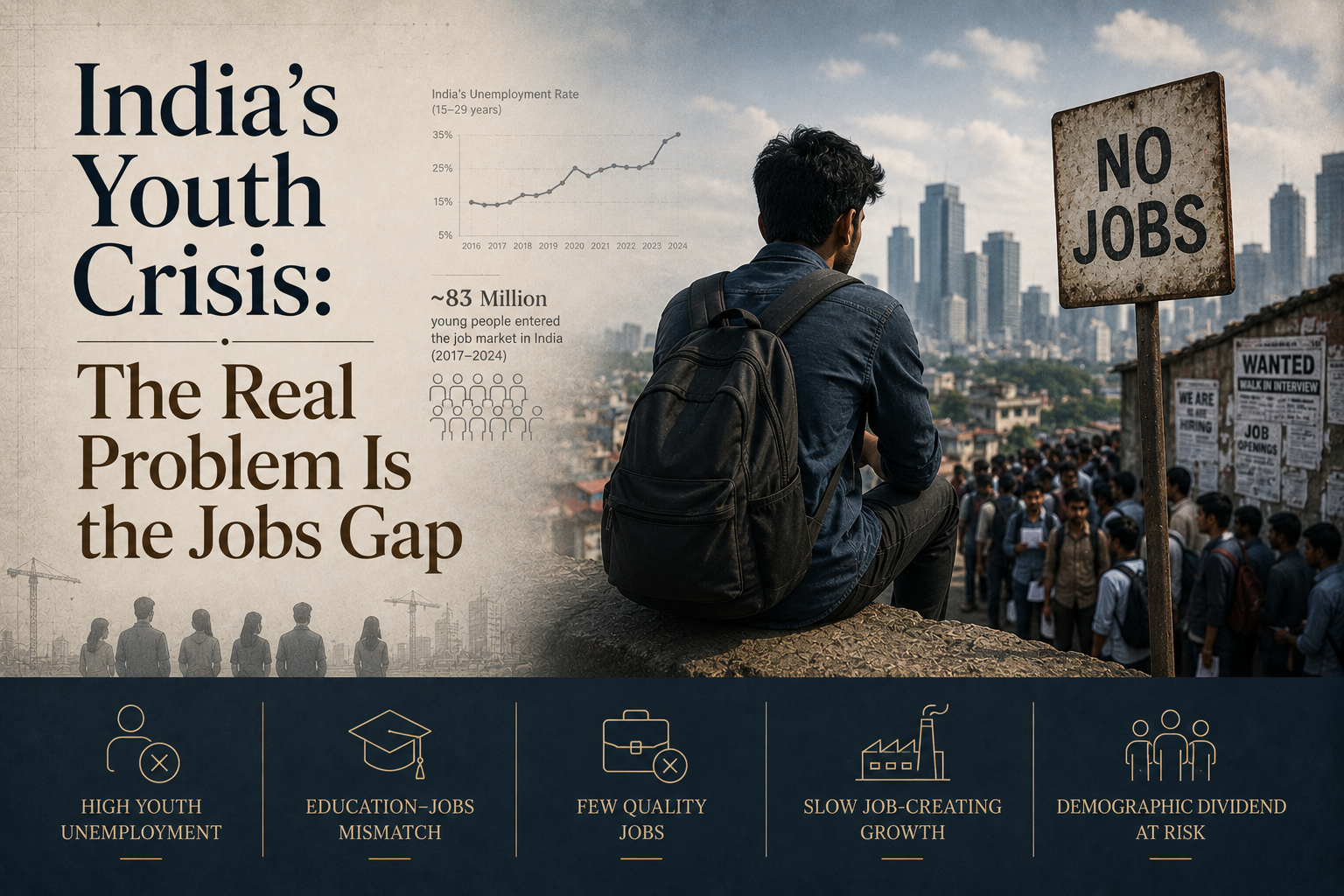
| Question (2023, GS3): Most of the unemployment in India is structural in nature. Examine the methodology adopted to compute unemployment in the country and suggest improvements. Linkage: The editorial contends that youth agitations and demand for cheaper coaching address only the symptoms of the crisis, whereas the foundational issue is structural unemployment—the deep-seated absence of final job opportunities for qualified youths at the end of their preparation. |
Mentor comment
The Hindu’s editorial argues that India’s youth unemployment problem is a jobs crisis, not merely an examination reform problem. The youth agitation that forced the resignation of the then Union Education Minister produced a government commitment to examination reform, including free online coaching for competitive examinations using India’s Digital Public Infrastructure. The editorial contends that cheaper coaching addresses only the preparation stage of the crisis, while the deeper problem is the absence of jobs at the end of that preparation.
What does the data show about the scale of the crisis?
- Coaching costs have risen, not fallen: Private coaching now costs 16% of what an average Indian family spends on a child’s education, up from 12.5% in 2018. Nearly a quarter of that spending occurs during the higher secondary years, when students prepare for competitive examinations.
- Seat scarcity dwarfs coaching costs: Over 22 lakh candidates appeared for this year’s medical entrance examination for about 1.4 lakh undergraduate seats, with fewer than 10,000 of those seats at the top 50 colleges. The Joint Entrance Examination for engineering colleges shows a similar pattern.
- Undergraduate enrolment has fallen for the first time: For the first time since the All India Survey on Higher Education began in 2011, undergraduate enrolment fell by 93,322 in 2023-24, sharpest among young men.
- The fall is regionally concentrated: Uttar Pradesh recorded the steepest decline, with undergraduate enrolment down 1.53 lakh even as diploma enrolment rose 1.38 lakh, suggesting students are substituting away from degrees that do not lead to jobs.
- Formal, secure jobs remain rare among graduates: Periodic Labour Force Survey unit level data shows that of every 100 graduates aged 15 to 29 in 2025, only 26 held regular salaried employment, and only four held a salaried job with both a contract and social security.
Why has growth not translated into jobs?
- Manufacturing has not absorbed graduates: Manufacturing, the sector best placed to absorb India’s college graduates, remains at around a sixth of gross value added, well short of the quarter of the economy the government has long promised.
- Private investment has retreated: Corporate investment fell from 17.3% of GDP in 2007-08 to 10.3% in 2024-25, unmoved by the cut in the corporate tax rate from 30% to 22% in 2019.
- Regulatory enforcement has turned selective: The editorial states that a regulatory and enforcement zeal that selectively targets enterprises has disproportionately affected medium sized companies, the segment best placed to generate jobs.
Conclusion
The youth employment crisis has two distinct ends: preparation for jobs, and the jobs themselves. Free coaching addresses only the first. The editorial’s position is that public investment in industrial capacity, export-disciplined industrial support, and a less selective regulatory posture toward medium sized enterprises would do more for youth employment than examination reform alone, citing Vietnam as a comparator that has used this route.
