Mains Ready By December. Smash Mains & Smash PYQ Admissions Open

GS Paper: GS2-20.Important International institutions, agencies and fora- their structure, mandate.

  • [30th September 2026] The Hindu OpED: The United Nations’ long road to restoring trust

    [30th September 2026] The Hindu OpED: The United Nations’ long road to restoring trust

    Question (2025, GS2 – 15 Marks): “The reform process in the United Nations remains unresolved, because of the delicate imbalance of East and West and entanglement of the USA vs. Russo-Chinese alliance.” Examine and critically evaluate the East-West policy confrontations in this regard.
    Linkage: Directly addresses why comprehensive UN structural reform remains stalled—attributing the paralysis to major-power rivalry, veto misuse, and the unwillingness of the P5 to concede influence.


    [2026] Which of the following international conventions have NOT been ratified by India?
    1. Employment Policy Convention
    2. Abolition of Forced Labour Convention
    3. International Convention on the Protection of the Rights of All Migrant Workers and Members of Their Families
    4. Geneva Convention Relative to the Protection of Civilian Persons in Time of War
    5. Convention on Reduction of Statelessness
    (a) 2 and 4 (b) 1 and 2 (c) 3 and 4 only (d) 3, 4 and 5

    Mentor’s Comment

    The UN was built to create trust between states, and it now has to earn trust from the people it serves. Delivery is not the problem, since 98 million people were reached. The problem is that funding power, opaque oversight and skewed leadership make delivery look partisan. Each reform the article implies shifts power away from those who hold it. Donors would lose influence over recruitment and programmes. Permanent members would lose freedom on the veto. Headquarters cities would lose posts. Restoring trust therefore depends on the actors who benefit from the current arrangement agreeing to constrain themselves.

    Why in the News

    The 81st United Nations General Assembly (UNGA) held its high-level week under the theme “Restoring Trust, Managing Transformation: a UN that delivers for all”. The word “restoring” concedes that trust in the UN has collapsed, and global surveys confirm the fall.

    Why does trust matter to the UN, and how far has it fallen?

    1. Why the UN exists: Set up after the Second World War, the UN makes states’ conduct more predictable through dialogue and international law, like agreed rules in a game rivals play.
    2. What went wrong: Over three decades, the UN went from building trust between parties in peacebuilding to needing to restore trust in itself.
    3. Falling confidence: Edelman Trust and Pew surveys found declining trust. In a UN Foundation poll, 52 per cent want deep structural reform, saying the UN struggles to deliver.
    4. Doubts on leadership: Only 58 per cent think the UN can lead on global problems (Rockefeller Foundation and Focaldata poll), possibly a historic low.
    5. The takeaway: The UN’s authority rests on states and publics trusting it, so falling trust weakens its ability to broker peace.

    What are the four reasons for the loss of trust?

    1. Security Council deadlock: UN Security Council (UNSC) paralysis eroded the Assembly’s trust, so it passed resolution A/76/262 requiring permanent members to explain each veto.
    2. Integrity and oversight gaps: Scandals were blamed on individuals, and systemic accountability was seldom addressed:
      • a procurement scandal in Afghanistan (2013);
      • sexual exploitation and abuse cases involving peacekeepers (2017);
      • contracts for non-existent housing projects in Ghana and India (2021).
    3. Donor capture: A few countries give extra-budgetary grants, voluntary money outside the regular budget, and use them to place their nationals and back cherry-picked programmes:
      • the Advisory Committee on Administrative and Budgetary Questions (ACABQ), the UN’s top financial watchdog, found one government sponsoring eight of nine experts in one agency;
      • spending data reach donor governments, not beneficiary publics;
      • fear of upsetting donors has made staff risk-averse on conflict prevention.
    4. Global South under-representation: Most programmes run in the Global South, where trust is higher, but power sits elsewhere:
      • developing nations hold 84 per cent of the world’s population but 44 per cent of UN civil service leadership posts;
      • only a third of UN leaders in Africa are African, and two-fifths of UN headquarters cities are in the Global South;
      • posts moved out of New York and Geneva in 2025 to cut costs largely bypassed Global South cities.

    Where does the UN still deliver, and where does it fall short?

    1. Humanitarian reach: The UN aided and protected 98 million people in 2025-26. Aid quality and funds reaching local actors remain weak.
    2. Tactical wins: In the wars in Ukraine, Gaza and Iran, the UN kept Black Sea grain exports flowing and prevented a Red Sea oil spill.
    3. Peacemaking gap: It could not turn that goodwill into mechanisms for belligerents to talk, because peacemaking initiative is centralised at the top of the bureaucracy.

    Challenges

    1. Costless vetoes: Explaining a veto carries no penalty, so permanent members keep blocking action. Eg. Ukraine and Gaza.
    2. Liquidity crisis: Unpaid assessed contributions, members’ compulsory dues, deepen dependence on earmarked donor funds.
    3. Weak accountability: No independent system holds senior managers answerable for systemic failures.
    4. Minilateralism: States bypass the UN for smaller groupings. Eg. the Quad, BRICS.

    Way Forward

    1. Public transparency: UN entities should publish programme spending to beneficiary publics, not only to donors.
    2. People-centred ties: The UN should rebuild ties with people, not only governments.
    3. Equitable staffing: The Secretariat should set Global South leadership targets and relocate posts to Global South hubs.
    4. Decentralised peacemaking: The Secretary-General should let field envoys open talks without waiting for headquarters.

    Conclusion

    The UN’s crisis of trust stems less from failed delivery than from how it is governed: who decides, who pays and who answers for failure. Whether the promised “transformation” opens UN leadership and finances to the Global South will decide if trust returns.

    About UN Security Council reform

    1. G4 bid: India, Brazil, Japan and Germany seek expansion of both permanent and non-permanent seats.
    2. Amendment hurdle (Article 108): An amendment needs two-thirds of the Assembly and ratification by two-thirds of members, including all five permanent members.
    3. Rival blocs: The Uniting for Consensus group, including Pakistan, Italy and Mexico, wants only non-permanent seats added. Africa’s Ezulwini Consensus seeks at least two permanent seats with veto.
    4. Stalled talks: The 2026 session of the Intergovernmental Negotiations (IGN) ended without consensus on a framework for expansion.
  • A declining United Nations is not good news for a rising India

    Why in the News

    India’s standing is rising while the authority of the United Nations (UN) falls, and the second movement works against the first. Rivalry among major powers opens room for manoeuvre and makes agreements harder to trust at the same time, which is a poor bargain for a power that needs commitments to hold when relations sour. This year’s General Assembly session will not resolve that, because the governments whose consent the UN needs are often pursuing the very objectives it was established to restrain. Indian diplomacy therefore carries two tasks at once. It must win more influence over UN decisions, and it must help make those decisions matter, and the two pull against each other when the organisation’s own members are the ones weakening it.

    Why does a weakening United Nations hurt a rising India rather than free it?

    1. Durability of agreements: India needs arrangements that hold when relations sour, and an organisation that cannot enforce its own decisions cannot supply them.
    2. Sovereignty and rule making: New Delhi has long defended sovereignty and resisted intrusive international rule making. Constraints imposed by powerful countries can leave it with even less say than a negotiated rule would.
    3. Who writes the rules: The operative question is not India’s size but its influence over who sets the rules it will have to live under.
    4. Multilateral arrangements as leverage: They give India a voice in those negotiations and room to cooperate with countries it disagrees with elsewhere.
    5. Limits of economic weight: A larger economy will not by itself remove the vulnerability. In a world split into rival financial and technological systems, access to a market or a technology could increasingly require accepting the conditions of one camp.

    What has left the Security Council unable to restrain its strongest members?

    1. The design assumption: The Council was built to work when the major powers could agree, and the veto gives each permanent member the means to block action when they cannot.
    2. Live conflicts: Ukraine, Gaza and the war involving Iran and the Gulf expose the Council’s inability to restrain its strongest members and their clients.
    3. The cost of neglect: Sudan demonstrates what follows where the Council does not engage at all.
    4. Charter enforcement: Appeals to the UN Charter have little effect when the states expected to uphold it can prevent its enforcement.

    How does economic coercion reach Indian businesses without a Council decision?

    1. Unilateral coercive measures: Restrictions imposed by one state extend the problem out of the diplomatic arena and into everyday commerce.
    2. The commercial chokepoint: An Indian company may be free to trade under Indian law and still find that a foreign bank will not process its payment or an insurer will not cover its cargo.
    3. Weaponised interdependence: Control over financial, insurance and technology networks lets powerful states project national restrictions far beyond their borders without authorisation from the Security Council, which leaves Indian businesses exposed to rules their government had no part in writing.

    What does the United Nations still deliver, and who is hollowing it out?

    1. Universal membership: It gives smaller countries a claim to be heard without a major power’s invitation, which no plurilateral grouping replicates.
    2. Agency work: UN agencies deliver relief, document the human cost of crises and organise the scientific assessments used in climate negotiations.
    3. A forum for the strained: As climate shocks and widening inequalities press on developing countries, the UN gives them a place to press claims on climate finance and sustainable development.
    4. Secretariat inefficiency: The organisation still falls short too often, and the Secretariat must simplify procedures, cut duplication and spend carefully.
    5. Member state behaviour: Governments weaken the organisation they invoke when convenient. They assign tasks they do not fund, delay payments they owe and cut assistance while expecting the UN to absorb the damage.
    6. Mandate against resources: A peace operation given an ambitious mandate and inadequate resources is being set up to fail.

    Why is artificial intelligence a test of who writes the rules that matter?

    1. Warning from the scientific panel: The UN’s independent scientific panel has warned that Artificial Intelligence (AI) agents could become harder for humans to control.
    2. Industry at the Council table: Technology executives briefed the Security Council on the risks of AI on 23 September, and the Council has a role wherever AI threatens international security.
    3. Limits of that table: Companies bring essential expertise and commercial interests together, and the reach of AI into employment, education and development needs wider consideration than a security body can give it.
    4. India’s stated position: Safety standards and access to technology should be negotiated where developing countries have a voice, because permanent members and a few technology firms cannot represent everyone whose future those rules will shape.

    How can India widen its influence before Council reform arrives?

    1. Partners for Multilateralism: India helped launch this coalition, known as P4M, with Brazil, Canada, Kenya, the European Union, Australia and Barbados, a group that deliberately spans different diplomatic camps.
    2. The coalition’s declaration: It records that economic interdependence is being used to exert pressure, disrupting trade, supply chains and development finance.
    3. Value of mixed partners: Each partner holds relationships that could help India persuade countries it might not otherwise persuade. Joint proposals on climate finance or on protection against economic coercion could attract wider support without waiting for agreement on the more contentious questions of reform.
    4. The permanent membership claim: India rests its case on being the world’s most populous democracy and a major economy, and Africa’s exclusion from permanent membership makes the case for Council reform harder to ignore.
    5. Why the claim stalls: Regional rivalries obstruct agreement on expansion, and Charter amendments require ratification by all five permanent members.
    6. The elected seat: India is seeking support at this Assembly for an elected Security Council seat for the 2028 to 2029 term, against Tajikistan, which has never served on the Council, in the June 2027 election.
    7. The peacekeeping record: A founding member in 1945, India has contributed more than 275,000 personnel to UN peacekeeping, and can use that record to argue for mandates troops can carry out and for affected countries to be heard before the Council acts.

    Challenges to India’s bid for a larger role at the Security Council

    1. China’s withheld endorsement: China is the only permanent member that has not backed India’s candidature for a permanent seat with a clear commitment. Eg. It has also blocked India’s entry into the Nuclear Suppliers Group (NSG).
      The Fix: Pursue issue specific bargains where Indian and Chinese positions already converge, so the reform bid is not the only channel through which the relationship is tested.
    2. Organised opposition from the Uniting for Consensus group: A bloc of middle powers lobbies for expansion in the non permanent category alone, which keeps regional competitors out of a permanent seat. Eg. Pakistan, Italy and Mexico have consistently pressed that position.
      The Fix: Build the General Assembly numbers first, since any expansion needs a two thirds majority there before ratification is even reached.
    3. Negotiations without a text: The Intergovernmental Negotiations (IGN) on Council reform have run for over a decade without producing a single negotiating text to amend. Eg. The 2026 session ended without consensus even on the framework for expansion.
      The Fix: Press for one consolidated negotiating text carrying a fixed review date, so the process yields a document rather than another round of statements.
    4. Standing outside the non proliferation treaties: Critics cite India’s position outside the two central nuclear treaties as a disqualifier for permanent membership. Eg. India has stayed out of the Nuclear Non Proliferation Treaty (NPT) and the Comprehensive Nuclear Test Ban Treaty (CTBT) while maintaining a voluntary moratorium on further nuclear explosive testing.
      The Fix: Anchor the bid in the non proliferation record and the peacekeeping record rather than in treaty signatures, and press for criteria based rather than membership based tests.

    Conclusion

    India’s stake in the United Nations is not sentimental, it is contractual. A rising power that cannot make its agreements hold gains freedom of manoeuvre and loses predictability, and predictability is the scarcer of the two. The unresolved question is whether India’s growing weight can be converted into influence over who writes the rules, or whether it will keep being governed by rules made where it has no vote. The test will come when a rule India helped write obstructs the choices of a state powerful enough to ignore it.

    About United Nations Reform

    1. Expansion of the Security Council: Reform proposals seek to increase both permanent and non permanent seats to bring in India, Brazil, Japan, Germany and African representation.
    2. Veto restructuring: A voluntary code of conduct would limit use of the veto in cases of mass atrocities or genocide.
    3. Empowering the General Assembly: The Assembly’s role in security matters would be strengthened for occasions when the Council is deadlocked.
    4. Inclusive multilateralism: Regional blocs such as the African Union would be formally institutionalised within the UN Charter.

    Government Initiatives for United Nations Reform

    1. The G4 grouping: India, Brazil, Germany and Japan support each other’s bids for permanent seats and press a common reform model.
    2. The L.69 Group: A cross regional grouping of developing countries from Asia, Africa, Latin America and the Caribbean, including small island developing states, which India leads in pressing for expansion in both membership categories.
    3. Voice of Global South Summit: Convened by India since 2023 to aggregate developing country positions and carry them into the G20 and other bodies. It is a consultation mechanism rather than an institution.

    Back2Basics: Elected Seats on the UN Security Council

    1. Composition: The Council has 15 members, five permanent and ten elected.
    2. Election and term: Elected members serve two year terms and are chosen by the General Assembly by a two thirds majority, with the ten seats distributed across regional groups.
    3. Voting weight: An elected member votes on every resolution but holds no veto, and a substantive resolution needs nine votes in favour with no permanent member voting against.
    4. India’s record: India has served eight terms as an elected member, most recently in 2021 and 2022.

    Matching Previous Year Question

    “[2025, GS2, 15 marks] “The reform process in the United Nations remains unresolved, because of the delicate imbalance of East and West and entanglement of the USA vs. Russo-Chinese alliance.” Examine and critically evaluate the East-West policy confrontations in this regard.”

  • Should permanent membership, veto powers of the UNSC be abolished?

    Should permanent membership, veto powers of the UNSC be abolished?

    Why in the News

    A proposal at the current session of the United Nations General Assembly (UNGA) would have the use of the veto in the United Nations Security Council (UNSC) “regulated” in humanitarian crises and in cases of genocide. It presents the veto as a matter of “responsibility” rather than of “privilege”. The proposal revives the French Mexican initiative of 2015, under which permanent members would voluntarily refrain from using the veto in mass atrocity situations. That initiative itself grew out of a 2013 proposal for a code of good conduct, made after Chinese and Russian vetoes blocked any Security Council resolution on the Syrian civil war. The contested point is that voluntary restraint leaves the veto itself untouched, so the privilege survives the reform meant to discipline it.

    What is the French Mexican initiative on veto restraint?

    1. The commitment: First launched in 2015, the initiative has permanent members voluntarily refrain from using the veto in situations involving genocide, crimes against humanity and large scale war crimes.
    2. Legal character: It is not an attempt to abolish the veto or to amend the United Nations Charter. It is an exercise in self restraint by the P5, the five permanent members of the Security Council: the United States, the United Kingdom, France, China and Russia.
    3. Support base: France and Mexico have announced that 128 states now support the declaration, with 21 joining in the last four months. The United Kingdom has joined France in accepting the principle, so two of the five permanent members have now committed to this form of restraint.

    Which three questions does the veto debate conflate?

    1. Use of the veto: Whether a permanent member casts a veto at all in a given situation.
    2. Accountability for the veto: Whether a permanent member must explain and defend a veto it has already cast.
    3. Reform of the Security Council: Whether the Council’s size, its membership categories and its decision rules should change.
    4. What the current proposal reaches: The initiative addresses only the first of the three. Its claim is that even where the veto remains, there must be circumstances of exceptional human suffering in which a permanent member agrees not to exercise it.

    Why did the Syrian deadlock produce the first restraint proposal?

    1. Paralysis in 2013: Chinese and Russian vetoes made it impossible for the Security Council to pass any resolution condemning Syria during the civil war there.
    2. The Ghouta trigger: A chemical weapons attack at Ghouta in August 2013 was followed in September by the then President of France proposing a “code of good conduct” for the Council.
    3. Design intent: That was the first proposition that the permanent members could voluntarily restrain veto use in cases of genocide, crimes against humanity or larger war crimes. The attempt was to skirt amending the United Nations Charter and still make the Council more contemporaneous.

    What other mechanisms exist short of Charter amendment?

    1. Liechtenstein initiative, adopted by the UNGA in 2022: It does not prevent a permanent member exercising the veto. Whenever a veto is cast the General Assembly is convened within 10 working days to debate the issue, so the member concerned must explain and defend its action on the Assembly floor.
    2. Accountability, Coherence and Transparency code of conduct: The Accountability, Coherence and Transparency (ACT) Initiative reaches beyond the permanent members. It asks all members of the Security Council, including the non permanent members, not to vote against credible action designed to prevent or halt genocide, crimes against humanity and war crimes.
    3. Nature of their force: The strength of both instruments is moral and political rather than legally coercive.

    Why will the permanent members not go beyond voluntary restraint?

    1. Charter amendment requirement: Formal abolition of the veto would require an amendment of the United Nations Charter and the consent of the very permanent members whose privilege is being removed.
    2. Relative weight inside the P5: The United Kingdom and France are not the heavyweights among the permanent members, so a principled position on regulating the power costs them least.
    3. Stated purpose of regulation: Better management of how the power is used is presented as the way to keep the Council from being paralysed and to let it act.
    4. No permanent member proposes elimination: None of the five is talking of eliminating the veto power it holds. There are multiple versions among them of how the Council should be reformed.
    5. Five overlapping approaches, not a binary: The debate is not simply retain or abolish. It runs across abolition, extension of the veto to new permanent members in the name of equality, voluntary restraint in mass atrocity cases, political accountability after a veto is cast, and broader structural reform of the Council itself.
    6. Why the pragmatic route is preferred: The current proposal seeks to change the political behaviour of the five without rewriting the Charter, which makes it reformist rather than revolutionary.
    7. Accountability as the achievable discipline: Requiring a permanent member to justify a veto on the Assembly floor would not prevent action where real national self interest is at stake. It would make that member more cautious, since it would know it must account for the decision.

    Can sovereign equality survive the way power is actually distributed?

    1. The stated ideal: The world is held to be one of sovereign equality among states.
    2. The survival constraint: Because of the way power is distributed, no international organisation can survive, let alone become effective, if it takes a decision against the fundamental interests of a major power.
    3. The veto’s textual status: The word veto is not mentioned in the United Nations Charter. It was created through a separate mechanism.
    4. Word against spirit: Every United Nations member brings its own interpretation of each conflict to the Assembly and to the Council, which leaves a standing gap between the words of international law regimes and their spirit.

    Challenges to voluntary veto restraint

    1. A political commitment binds no one: A declaration of restraint carries no legal obligation, so a member can endorse it and still cast a veto. Eg. Russia vetoed the renewal of the Security Council panel of experts monitoring sanctions on North Korea in March 2024.
      The Fix: Require a permanent member that vetoes inside the declared categories to file a written justification recorded in the Council’s official proceedings.
    2. Classification of an atrocity is unsettled: Restraint applies only to named categories of atrocity, and the Council itself decides whether a situation falls inside them. Eg. Myanmar’s treatment of the Rohingya was taken to the International Court of Justice by The Gambia in 2019 rather than characterised by the Council.
      The Fix: Route the classification question to a standing determination by the United Nations High Commissioner for Human Rights, so the trigger does not rest with the body being restrained.
    3. The Assembly’s response carries no enforcement: Debating a veto in the General Assembly produces a recommendation and nothing that binds. Eg. Emergency Special Session resolutions on Ukraine from 2022 onward carried large majorities and no enforcement power.
      The Fix: Pair each post veto debate with a named follow up instrument, such as a commission of inquiry with a reporting deadline.
    4. Expansion without restraint multiplies the block: Extending the veto to new permanent members in the name of equality would raise the number of states able to stop the Council acting. Eg. The Group of Four, India, Brazil, Germany and Japan, seeks permanent seats, and the Uniting for Consensus group opposes new permanent seats altogether.
      The Fix: Settle the veto question before the membership question, so an enlarged Council does not inherit a larger number of vetoes.

    Conclusion

    The question has moved from whether the veto should exist to whether its use can be disciplined without touching the Charter. Restraint pledges and post veto debates change the political cost of blocking action, and they leave the legal power exactly where the Charter placed it. The unreconciled point is that the only route to abolition runs through the consent of the states whose privilege would be abolished. The marker to watch is whether a permanent member that has endorsed the restraint declaration casts a veto inside the declared categories, since that is the test the pledge has not yet faced.

    About Reform of the United Nations Security Council

    1. About: Reform of the Security Council covers changes to its size, to its categories of membership and to the veto, so that a body designed at the founding of the United Nations reflects the present distribution of states and power.
    2. Composition: The Council has 15 members. Five are permanent and hold the veto, and ten are non permanent, elected by the General Assembly for two year terms without a veto.
    3. The amendment route: Article 108 of the United Nations Charter requires an amendment to be adopted by two thirds of the General Assembly and then ratified by two thirds of the members, including all five permanent members.
    4. The record of change: The Council’s size has been changed once, from 1965, when the non permanent seats were raised from six to ten. Talks on further change have run in the Assembly’s Intergovernmental Negotiations process since 2009.

    Government Initiatives

    1. Group of Four: India coordinates with Brazil, Germany and Japan on a joint claim to permanent seats, with each supporting the others’ candidature.
    2. L.69 group: India works with this grouping of developing countries from Asia, Africa, Latin America and the Caribbean, together with small island developing states, which presses for expansion in both membership categories.
    3. Text based negotiations: India has pressed for the Intergovernmental Negotiations to work from a single consolidated negotiating text rather than from open ended discussion.
    4. Non permanent membership: India has served eight terms as a non permanent member, most recently in 2021 and 2022, chairing the Council’s Taliban sanctions and counter terrorism committees during that term.

    Matching Previous Year Question

    “[2015, GS2, 12 marks] Discuss the impediments India is facing in its pursuit of a permanent seat in UN Security Council.”

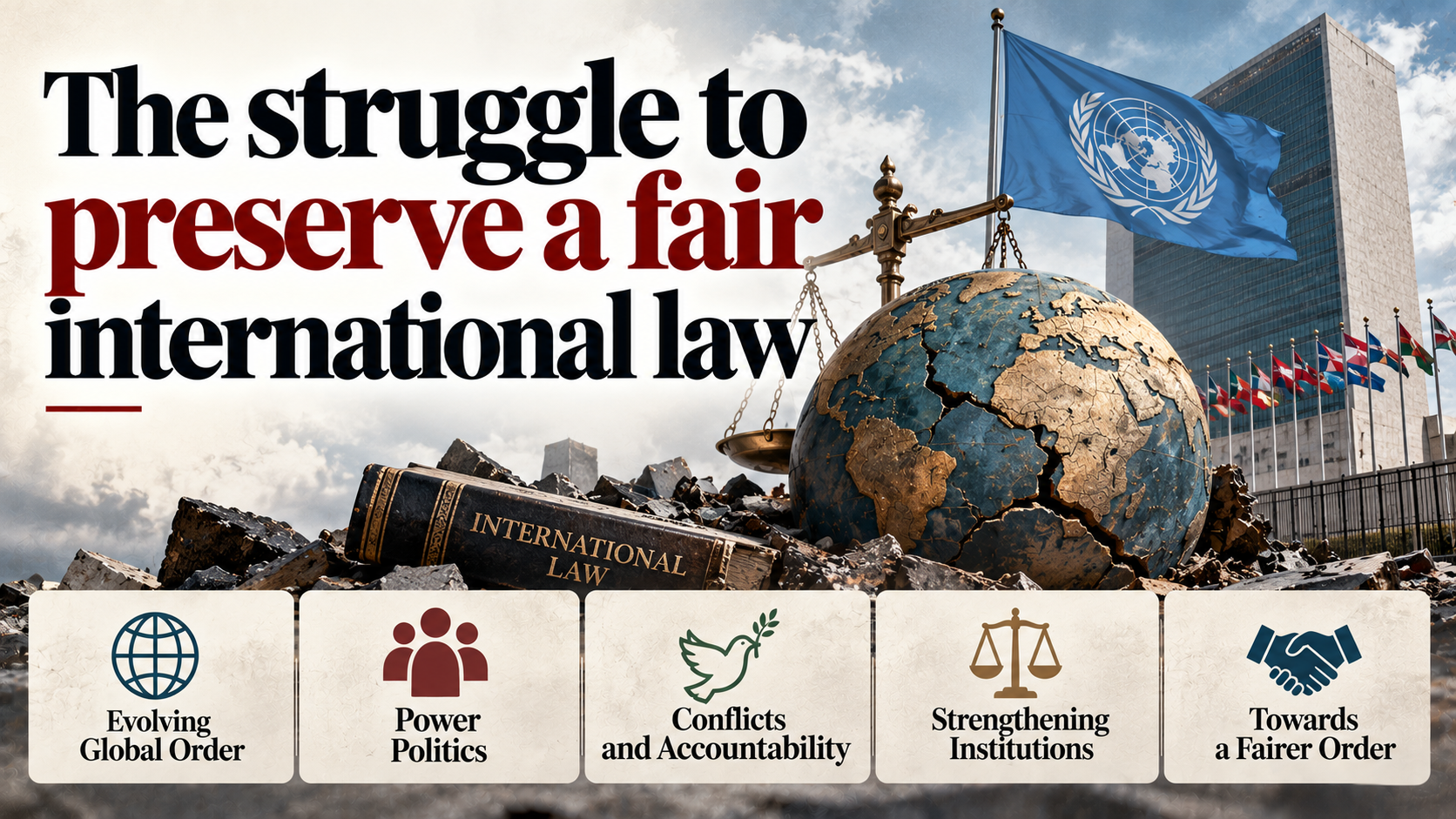
  • Global order is under stress, we need reformed multilateralism: Jaishankar
    Why in the News

    India has called for “reformed multilateralism”, stating that the global order is “under stress” from extreme competition and geopolitical tensions, and that the “4F crisis of fuel, food, fertiliser and finance” needs “frameworks and guardrails”. The External Affairs Minister said this at the first-ever Partners for Multilateralism, International Law, Peace & Prosperity (P4M) Summit, held on the margins of the 81st session of the UN General Assembly (UNGA). The call comes days after the US President signed the Russia sanctions Bill, taking the authority to impose tariffs of up to 100 per cent on countries that continue to buy Russian oil and gas, India and China among them. The position therefore asks for rules-based cooperation at the moment a leading power has armed itself with a unilateral tariff instrument aimed partly at India.

    What is the P4M Summit?

    1. What it is: The inaugural summit of Partners for Multilateralism, International Law, Peace & Prosperity, a grouping formed around the defence of international law and multilateral practice.
    2. Co-sponsors: India co-sponsored it along with Australia, Barbados, Brazil, Canada, the European Union and Kenya.
    3. Where it sat: It was held on the margins of the 81st session of the UNGA, which put it alongside the annual gathering of world leaders rather than inside the UN’s own machinery.
    4. Who attended: The co-sponsors were represented at the level of the President of the European Council, the President of Kenya, and the Prime Ministers of Australia and Barbados.

    What case did India make for reformed multilateralism?

    1. Rebalancing versus rupture: For some decades the world has witnessed a steady rebalancing, described as a long-expected structural evolution. Extreme competition, geopolitical tensions and actual conflicts have given that rebalancing an entirely different character.
    2. The stated consequence of inaction: Left unchecked, this would call into question the very spirit of international cooperation, which is why multilateralism must assert itself strongly at this juncture.
    3. Observance of law as the precondition: Multilateralism is best served when international law, rules and norms are scrupulously observed.
    4. Two named reforms: More participative deliberations and more transparent decision-making were both described as overdue.
    5. Advocacy and practice together: For multilateralism to move ahead, both its advocacy and its practice have to be strengthened, so reform is put as an institutional task and not only a rhetorical one.

    Why does the ‘4F crisis’ need frameworks and guardrails?

    1. Nature of the risk: The crisis of fuel, food, fertiliser and finance cannot be left to itself, and where new capabilities and concerns arise there is a powerful case for frameworks and guardrails.
    2. Chokepoint dominance: Where there is a threat of chokepoint dominance and disruption, de-risking and diversifying must be encouraged.
    3. Coalitions of the like-minded: Where there is a compelling cause, the like-minded must have the confidence to come together, which accepts smaller groupings as a route when the universal body is blocked.
    4. Conflicts addressed in parts: Specific dimensions of ongoing conflicts can be addressed in parallel with the search for a broader peace.
    5. What is at stake: The issues named as real were the future of peace and international security, climate justice, countering terrorism and strengthening supply chains, all of which depend on a “will to cooperate”.

    Where does the Security Council reform question stand?

    1. A polarised Council: The 15-nation UN Security Council (UNSC) remains deeply polarised, with sharp divisions among its five permanent, veto-wielding members, China, France, Russia, the United Kingdom and the United States.
    2. India’s claim: New Delhi has been pitching for a seat on the Council to reflect the realities of today’s world.
    3. Support from Central Europe: The Visegrad Group backed India’s inclusion as a permanent member, with Slovakia’s Foreign Minister saying India “must be at the table” as a permanent member.
    4. Reform on the bilateral agenda: Council reform was among the multilateral issues taken up with the French Foreign Minister.

    What did the India-Visegrad meeting and the bilaterals produce?

    1. A first meeting: India held its first foreign ministers’ meeting with the four-member Visegrad Group of Central European countries, which was described as a “new historic occasion”.
    2. What the group is: The Visegrad Group (V4) is a cultural and political alliance of the Czech Republic, Hungary, Poland and Slovakia that aims to advance cooperation in military, economic, cultural and energy affairs.
    3. Agreed outcome: India and the group agreed to step up political, economic and defence cooperation.
    4. Bilaterals held: Separate meetings were held with the counterparts from Ukraine, France, Moldova and Hungary.
    5. Substance with France: Regional and global issues were discussed, specifically the Ukraine and Gulf crises, along with multilateral issues.
    6. Substance with Ukraine: The discussion covered peace efforts and the situation in the Black Sea, with restoring freedom of navigation identified as critical for global food security.

    Challenges to reformed multilateralism

    1. The amendment threshold: Changing the Council’s composition requires a UN Charter amendment ratified by two-thirds of the membership including every permanent member, so each of them holds a veto over reform itself. Eg. The Council has been enlarged only once, in 1965, when the elected seats went from six to ten.
      The Fix: Pursue an interim category of longer-term renewable elected seats, which enlarges participation without touching the veto.
    2. Incompatible claimant blocs: Rival groupings press models that cannot both be adopted, so the negotiation has no single text to amend. Eg. The G4 of India, Brazil, Germany and Japan seeks new permanent seats, and the Uniting for Consensus group opposes any new permanent members.
      The Fix: Move the Intergovernmental Negotiations onto a single negotiating text with positions recorded against each clause, so movement between sessions is visible.
    3. Financing concentrated in a few states: Assessed contributions are concentrated among a handful of members and arrears interrupt operations, so budget leverage substitutes for votes. Eg. The UN has run repeated liquidity crises from unpaid assessed contributions, forcing hiring and spending freezes at the Secretariat.
      The Fix: Shift a larger share of the regular budget onto multi-year assessed commitments, so operations do not turn on the timing of one member’s payment.
    4. Enforcement resting on the states to be restrained: Council decisions bind all members, and implementation rests with the same powers whose own conduct is contested. Eg. Draft resolutions on the war in Ukraine were blocked in the Council and moved to the General Assembly, whose resolutions are recommendatory.
      The Fix: Build on the requirement that a vetoing member explain itself before the General Assembly, making the Assembly’s recourse automatic whenever a veto blocks action.

    Conclusion

    India’s argument rests on two claims. The first is that the existing order cannot absorb the competition now running through it. The second is that energy, food and supply risks need standing frameworks rather than case-by-case responses, which is a demand for machinery and not only for representation. Backing from a group of Central European states adds a voice to the reform demand without altering the arithmetic that governs it. The External Affairs Minister addresses the General Debate on September 26, which is where the case is put to the full membership rather than to co-sponsors.

    Back2Basics: UN Security Council

    1. Founding: It was created under the UN Charter in 1945 as the organ carrying primary responsibility for the maintenance of international peace and security.
    2. Elected members: Ten non-permanent members are elected by the General Assembly for two-year terms, with no immediate re-election.
    3. Binding force: Its decisions are binding on all UN members, which distinguishes them from General Assembly resolutions.
    4. India’s record: India has served eight terms as a non-permanent member, most recently in 2021-22.

    Matching Previous Year Question

    “[2015, GS2, 12.5 marks] Discuss the impediments India is facing in its pursuit of a permanent seat in UN Security Council.”

  • Why India’s stance on WTO plurilateral deals may be shifting

    Why in the News

    The BRICS Delhi Declaration 2026 has asked members to identify appropriate pathways for plurilateral initiatives into the World Trade Organization (WTO) legal framework, including on development oriented issues. India opposed exactly that route at the WTO’s 14th Ministerial Conference (MC14) in Cameroon in March, where it alone blocked incorporation of the China backed Investment Facilitation for Development (IFD) agreement. India pressed there for guardrails, meaning agreed legal safeguards applying to plurilateral pacts as a class before any single one is brought into the rule book. That term does not appear in the Delhi text, which India chaired. The contested point is whether a member that treats plurilateral deals as a systemic threat to the WTO can simultaneously help design their entry into it.

    What is a plurilateral agreement in the WTO?

    1. Plurilateral agreement: It is negotiated and implemented by an exclusive group of members rather than by the full membership.
    2. Binding on signatories only: Its obligations apply to the members that sign it, and the rest of the membership takes on nothing.
    3. Consensus is the gate: A plurilateral agreement enters the WTO family of agreements exclusively by consensus, so a single member can keep it out indefinitely.
    4. Why they are in demand now: Plurilaterals feature prominently in proposals for WTO reform, as a route around the difficulty of agreeing anything among the full membership.

    What is the Investment Facilitation for Development agreement?

    1. Investment Facilitation for Development: It is a plurilateral initiative launched at the WTO in 2017 with the stated aim of increasing foreign direct investment flows.
    2. What it covers: It addresses the administrative side of investment, such as transparency of rules and the speed of approvals, rather than market access or investor protection.
    3. Its legal status: It is not a WTO agreement. It enters the WTO system only if the full membership agrees to incorporate it.

    What did India argue against the pact at MC14?

    1. The systemic objection: India’s stated position was that incorporating the IFD risks eroding the foundational principles and the functional limits of the WTO.
    2. Investment is not a trade issue: India argued that investment does not belong in an organisation built to negotiate trade rules.
    3. India stood alone: It was the only member opposing incorporation.
    4. What it refused specifically: India did not agree to incorporation of the IFD as an Annex 4 agreement, Annex 4 being the schedule of the agreement establishing the WTO that lists plurilateral agreements binding on their signatories alone.
    5. What it offered instead: The Union Ministry of Commerce and Industry recorded in March an openness to comprehensive good faith discussion under the WTO Reform Agenda first.
    6. The general demand behind the specific refusal: India sought safeguards for plurilaterals as a class before any specific plurilateral outcome was integrated, which is a rule about method rather than an objection to one pact.

    What has changed in the BRICS Delhi Declaration 2026?

    1. The operative sentence: The declaration records that it is important to identify appropriate pathways for plurilateral initiatives into the WTO legal framework, including on development oriented issues.
    2. The wider commitment: It also commits members to implement the MC14 outcomes and to engage in WTO reform to enhance the organisation’s authority, effectiveness, inclusiveness and relevance.
    3. The missing word: The guardrails formulation India pressed in March does not appear anywhere in the text, and India held the chair at the summit that adopted it.
    4. Forward looking rules: The text additionally asks members to explore the formulation of forward looking rules in the WTO.
    5. The direct implication: Identifying pathways for plurilaterals points towards India lifting its reservation on the IFD, which would be a significant change in a position it has held alone.

    Why is the plurilateral route contested for development issues?

    1. The carve out is the problem: The declaration applies the plurilateral route to development oriented issues, which are precisely the issues on which developing members need the developed membership to be bound.
    2. Food security: A permanent solution on public stockholding delivers nothing if it is negotiated among members who were never the ones objecting to it.
    3. Farm subsidies: A reduction in developed country farm support cannot be obtained inside a group those countries decline to join.
    4. The structural point: An agreement binding only its signatories cannot change the conduct of a member that stays outside it, so development demands run through the multilateral route or they do not run at all.

    Challenges to bringing plurilateral agreements into the WTO

    1. Consensus is absolute and cuts both ways: A single objecting member keeps a plurilateral out however many support it, and the same veto blocks the reform of the system itself. Eg. The WTO’s Appellate Body has been unable to hear appeals since 2019 because one member has blocked appointments to it.
      The Fix: Agree a standing procedure for admitting plurilaterals, with published criteria, so each proposal is judged against a rule instead of renegotiated from scratch.
    2. Free riding on most favoured nation treatment: Benefits conceded inside a plurilateral often have to be extended to the whole membership, so signatories carry obligations that non signatories enjoy without cost. Eg. Tariff concessions under the Information Technology Agreement are made by its participants and extended to all members.
      The Fix: Require every plurilateral to state at the outset whether its benefits extend on a most favoured nation basis, so the question is settled before signature rather than after.
    3. Erosion of the single undertaking: The WTO’s founding bargain was that members accepted the agreements as one package, and a shift to opt in deals lets the strongest members choose what they take on. Eg. The Doha Round stalled precisely because members would not accept its package as a whole.
      The Fix: Tie any plurilateral admission to a parallel deliverable on an outstanding multilateral issue, so the package logic survives in practice.
    4. Negotiating capacity decides participation: Small delegations cannot staff several simultaneous negotiations, so the members with the largest missions in Geneva shape the text. Eg. A number of least developed country members maintain no permanent mission in Geneva at all.
      The Fix: Fund shared negotiating support for members without a Geneva mission, so a seat at a plurilateral does not depend on delegation size.
    5. Scope creep into subjects outside the mandate: Admitting investment facilitation brings a subject the membership once removed from the negotiating agenda back in, and with it the organisation’s dispute settlement machinery. Eg. Investment was among the Singapore issues dropped from the Doha agenda in 2004 after developing members objected.
      The Fix: Settle the scope question inside the WTO Reform Agenda first, so the mandate is defined before any specific pact is admitted under it.

    Conclusion

    India’s objection was never confined to one investment pact. It was to a method of making rules that lets willing members legislate around unwilling ones, inside an organisation whose authority rests on the full membership carrying the same obligations. That objection is unresolved, and the declaration India chaired now records an interest in finding a route for exactly that method. The marker to watch is whether India moves its reservation when incorporation next comes before the WTO General Council, or holds out for safeguards that apply to plurilaterals as a class.

    Back2Basics: WTO Ministerial Conference

    1. Nature: It is the highest decision making body of the World Trade Organization.
    2. Composition and frequency: It brings together all members and is required to meet at least once every two years.
    3. Powers: It can take decisions on all matters arising under any of the multilateral trade agreements.
    4. Recent editions: MC12 was held in Geneva in 2022, MC13 in Abu Dhabi in 2024, and MC14 in Cameroon in 2026.

    Matching Previous Year Question

    “What are the key areas of reform if the WTO has to survive in the present context of ‘Trade War’, especially keeping in mind the interest of India?”

  • Members call for cooperation over pathogen research, access

    Why in the News

    The New Delhi Declaration adopted at the 18th BRICS Summit calls for constructive engagement in negotiations for the Pathogen Access and Benefit Sharing (PABS) Annex to the World Health Organization (WHO) pandemic agreement. The Declaration attaches a condition to that call, reaffirming the sovereign rights of States over their biological resources and the sovereign right to legislate and implement laws, including national access and benefit sharing legislation. The pandemic agreement itself was adopted at last year’s World Health Assembly, and this one annex is what still holds it short of ratification. The unresolved question is whether a country that shares a dangerous pathogen sample must be guaranteed a share of whatever is developed from it.

    What is the Pathogen Access and Benefit Sharing Annex?

    1. Purpose of the Annex: The PABS Annex will set out a roadmap for the sharing of dangerous pathogens and of the medicines, diagnostics or vaccines developed from them.
    2. Status as an annex to the pandemic agreement: It is an annex to the WHO pandemic agreement rather than a standalone instrument, so it has no effect independent of that agreement.
    3. The remaining bar to ratification: Once agreement is reached on the PABS Annex, the pandemic agreement can be approved or ratified by member states.

    Why is one annex holding up an adopted agreement?

    1. The parent agreement was already negotiated: Amid the Covid-19 pandemic the WHO planned a legally binding pandemic agreement for better response to any future pandemic, and it was adopted during last year’s World Health Assembly.
    2. Adoption is not ratification: One annex continues to hold the agreement hostage, and member states cannot approve or ratify until it is settled.
    3. The single disputed question: Countries are yet to agree on whether the sharing of pathogen samples should be linked mandatorily with the sharing of the benefits developed.

    What position did the New Delhi Declaration take?

    1. Call for constructive engagement: The Declaration calls for constructive engagement in the PABS negotiations rather than endorsing either side of the mandatory linkage question.
    2. Sovereign rights over biological resources: It reaffirms the sovereign rights of States over their biological resources.
    3. The right to national access and benefit sharing law: It reaffirms the sovereign right of States to legislate and implement laws, including national access and benefit sharing legislation.
    4. Effect of the combined position: A call for engagement paired with an assertion of sovereign control keeps the option of conditioning sample sharing on domestic law open.

    Challenges to the Pathogen Access and Benefit Sharing Annex

    1. Sharing and benefit are separated in time: A sample is needed within days of an outbreak while a vaccine takes many months, so a country is asked to give first and trust later. Eg. Indonesia withheld H5N1 avian influenza samples from the WHO network in 2007 after finding that vaccines developed from them were priced beyond its reach.
      The Fix: Write a pre agreed allocation percentage of real time production into the Annex itself, so entitlement is fixed before the sample is shared rather than negotiated after a product exists.
    2. Genetic sequence data escapes any physical sharing rule: A pathogen’s genome can be uploaded and used to design a product without the physical sample ever changing hands, which makes a sample based obligation easy to bypass. Eg. Covid-19 vaccine design began from a published genome sequence rather than from a transferred isolate.
      The Fix: Bring genetic sequence information expressly within the Annex’s definition of pathogen material, with database access conditioned on the same benefit sharing terms.
    3. Manufacturing capacity is concentrated in a few countries: A guaranteed share of output is worth little to a state that cannot produce, fill or distribute the product it is promised. Eg. Most African countries imported nearly all Covid-19 vaccines rather than producing any.
      The Fix: Pair the benefit share with a technology transfer obligation through the WHO mRNA technology transfer hub model, so capacity is built alongside the entitlement.
    4. A sovereignty first reading can slow outbreak response: Treating pathogens as national property lets a state delay sharing while it negotiates terms, and an outbreak does not wait for that negotiation. Eg. The Nagoya Protocol on access and benefit sharing was drafted for genetic resources generally and its permit procedures were not designed for an epidemic timeline.
      The Fix: Create a standing fast track permit under the Annex, valid on notification of a public health emergency, so sharing proceeds while the commercial terms are settled separately.
    5. Compliance rests on no enforcement mechanism: A treaty annex binds only those who ratify it, and a manufacturer outside a ratifying state carries no obligation at all. Eg. The pandemic agreement takes effect only once member states ratify it, and ratification is voluntary.
      The Fix: Route access to the WHO coordinated laboratory network through a binding contract with each participating manufacturer, so the obligation attaches to the user of the sample rather than only to its government.

    Conclusion

    The agreement is complete except for the one question that decides who benefits from it, which is why the annex and not the treaty is where the negotiation now sits. The grouping’s formal position does not resolve that question, since a call for constructive engagement alongside an assertion of sovereign control over biological resources is compatible with either outcome. What it does record is that a large bloc of developing countries will not accept an unconditional sharing obligation. The marker to watch is the next World Health Assembly, since the annex has to be settled there before any state can ratify the pandemic agreement.

    Back2Basics: World Health Assembly

    1. The WHO’s decision making body: The decision making body of the World Health Organization, attended by delegations from all WHO member states.
    2. Meeting schedule and venue: It meets annually, usually in May, at Geneva.
    3. Functions of the Assembly: It determines WHO policies, appoints the Director General, supervises financial policies and reviews and approves the programme budget.
    4. Relevance to the PABS Annex: It is the forum that adopted the pandemic agreement and the forum in which the PABS Annex has to be settled.

    Matching Previous Year Question

    “[2020, GS2, 10 marks] Critically examine the role of WHO in providing global health security during the Covid-19 pandemic.”

  • At BRICS, India must bank on the NDB

    Why in the News

    The 18th BRICS Summit, chaired by India at Bharat Mandapam in New Delhi on 12 September, closed without a meaningful agreement on mobilising the New Development Bank (NDB), the grouping’s one tangible financial instrument and one that has under delivered for a decade. The grouping’s economic weight has grown without its institutional weight following. When BRICS came together in 2011 its five members contributed 20% of global GDP but held just 11% of the voting share at the International Monetary Fund (IMF). The expanded grouping now accounts for nearly 40% of global GDP and 55% of the world’s population, and the voting share has barely expanded. The contest is over what India should do with that gap. Russia and China press a de dollarisation agenda that India cannot join without damaging its ties with Washington.

    What is the New Development Bank?

    1. The New Development Bank: The NDB was established by the BRICS countries in 2015 to “mobilise resources for infrastructure and sustainable development projects in BRICS and other emerging markets and developing countries”.
    2. Headquarters in Shanghai: It is headquartered in Shanghai.
    3. Equal voting among the five founders: The bank’s rules mandate equal voting shares among the five founders, so no founder can outvote another whatever it contributes.
    4. The floor on founder control: The bank has opened its doors to new members, and the founders’ collective voting share cannot fall below 55%.

    Why can India not join the de dollarisation push?

    1. The grouping has no single geopolitical identity: Russia, China and Iran would like BRICS to be anti West, while India, Brazil and South Africa insist it is better understood as non West.
    2. India United States ties: Lending itself to the Beijing and Moscow de dollarisation campaign would add to strain in India United States ties at a moment when those ties are already strained.
    3. Medium term sustainability of the position: De dollarisation is an unsustainable proposition to advocate in the medium term.
    4. Maximising the grouping without strengthening Beijing: India’s approach has to maximise the grouping’s potential without strengthening Beijing’s overall strategic position.

    What is de dollarisation?

    1. What the term claims: De dollarisation is the effort to cut the dollar’s role as the currency in which trade is invoiced, cross border payments are settled and reserves are held, and to move that role to another currency or to a basket of them.
    2. What displacing the dollar would require: A substitute has to be fully convertible, deep enough to absorb reserve holdings, and served by a clearing system that sits outside dollar correspondent banking, and no member currency of the grouping meets all three conditions.
    3. Why sanctioned economies press it hardest: A settlement route outside dollar clearing removes the leverage sanctions exercise through correspondent banks, which is what makes the campaign valuable to Moscow and Beijing. Eg. The NDB itself has extended no new credit to Russia since March 2022 in order to protect its own credit rating and dollar funding costs.
    4. Contrast with local currency lending: Local currency lending denominates a loan in the borrower’s own currency to cut exchange rate risk, and it leaves the dollar’s invoicing role intact, so a member that will not join a displacement campaign can still use it.

    How far behind its counterpart is the NDB, and where does its money go?

    1. A decade of approvals: The NDB has approved only 139 projects worth about $43 billion since 2015, distributed mostly among its core members.
    2. The Asian Infrastructure Investment Bank comparison: The Asian Infrastructure Investment Bank (AIIB), established around the same time, has gathered 111 approved members and committed about $69 billion across 350 projects.
    3. The credit rating gap: The AIIB is backed by a AAA credit rating that the NDB cannot easily attain.
    4. Money approved is not money moved: Only about $20 billion of approved loans had been disbursed, according to the bank’s own count.
    5. The balance sheet is not growing: Stagnant asset growth continues to restrict the bank’s lending capacity.
    6. The active portfolio: The active portfolio stands at $35.6 billion across 115 projects, since 24 projects and about $7.4 billion have been fully repaid or cancelled.
    7. China and India as the two largest borrowers: China holds $9.41 billion at 26% and India $8.86 billion at 25%, together 51% of the active portfolio.
    8. The remaining founders: Brazil holds $6.69 billion at 19%, South Africa $6.41 billion at 18% and Russia $3.78 billion at 11%, with Bangladesh the only non founder at $445 million.
    9. Transport infrastructure and COVID-19 assistance: Transport infrastructure takes $13.5 billion at 38%, followed by COVID-19 emergency assistance at $9.00 billion and 25%.
    10. The clean energy, water and digital shares: Clean energy and energy efficiency accounts for $3.69 billion at 10%, water and sanitation $3.22 billion at 9.1%, social infrastructure $1.28 billion at 3.6% and digital infrastructure $300 million at 0.8%.

    Why can the founders not simply put in more capital?

    1. Paid up capital as the route: Breaking the asset bottleneck would require the five founders to increase their paid up capital.
    2. Russia’s constrained contribution: Severe domestic and geopolitical constraints mean not all founders can match higher commitments, most notably Russia, which is heavily sanctioned.
    3. Sanctions reach the bank itself: Sanctions have strained the bank’s credit standing and its dollar funding costs.
    4. Suspension of new credit to Russia: The NDB has extended no new credit to Russia since March 2022 to protect its AA/AA+ credit rating, even as Moscow and Beijing champion de dollarisation through the bank.
    5. Equal voting as a veto on capital expansion: Any capital expansion is effectively held hostage by the financially weakest founder, because of the bank’s equal voting rule.

    What has the NDB delivered for India?

    1. The scale of commitments: The bank has secured commitments of nearly $10 billion across 32 projects for India.
    2. Metro rail and the RRTS corridor: These include metro rail systems and the Delhi Ghaziabad Meerut Regional Rapid Transit System (RRTS) corridor.
    3. The case for a wider borrower base: Expanding the bank’s operations to be on par with other multilateral lenders requires extending the same bargain to many more emerging markets and developing countries.

    Why is local currency lending the more practical goal, and what does the rupee bond show?

    1. The bank’s declared preference: The NDB has a marked preference for local currency lending, which appeals to emerging economies while volatility in foreign exchange markets is sustained by wars that are both military and economic.
    2. Local currency lending against dollar replacement: Local currency lending reduces reliance on the dollar without replacing it as the currency for trade invoicing.
    3. The 30% local currency target: The bank’s 2022-26 General Strategy commits 30% of its lending and borrowing to member countries’ local currencies, and the bulk of both still remains in dollars.
    4. Renminbi skew in the local currency book: What local currency lending exists is skewed heavily in favour of the Renminbi.
    5. The ¥7 billion Panda bond: The NDB priced a ¥7 billion three year Panda bond, meaning a Renminbi denominated bond issued in China by a foreign issuer, in the China Interbank bond market, and issuance of such bonds in 2026 has risen approximately 91% year on year.
    6. A rupee bond deferred since 2016: The rupee bond was first discussed in 2016, then slated for October 2023 and then for end March 2026, and has still not been issued.
    7. The Rs 25,000 crore rupee bond programme: The bank floated a rupee bond programme to mobilise around Rs 25,000 crore over five years, and the NDB President described the debut issuance in May as being at its “final stage”.
    8. The 2026 New Delhi Declaration: The 2026 New Delhi Declaration did not feature a meaningful agreement on mobilising the NDB.
    9. India’s focus on simpler local currency fixes: India’s focus in BRICS next year should be on simpler fixes to local currency challenges rather than on a currency project.

    Challenges to the New Development Bank

    1. Most of its capital cannot be lent: The bank’s authorised capital is largely callable rather than paid in, so its usable balance sheet is a fraction of the headline figure. Eg. Of an initial subscribed capital of $50 billion, only $10 billion was paid in, phased over seven years.
      The Fix: Fix a dated schedule for the remaining paid in tranches, so the lending capacity is set by a calendar rather than by each founder’s fiscal position in a given year.
    2. Absence of a concessional window: The bank lends on near market terms, which prices out the low income borrowers a development bank exists to reach. Eg. The World Bank runs the International Development Association as a separate concessional arm, and the NDB has no equivalent.
      The Fix: Create a concessional facility inside the bank, funded by grant contributions from its larger members, so the poorest borrowers have a window they can actually use.
    3. Membership growth has been slow and shallow: A narrow membership keeps both the capital base and the political constituency small, which is what limits a multilateral lender’s reach. Eg. Only Bangladesh, the United Arab Emirates, Egypt and Algeria have been admitted beyond the five founders.
      The Fix: Publish an accession timetable with stated capital subscription terms, so a prospective member can plan its entry instead of waiting on a founders’ decision.
    4. Borrowers outside the founding five have no voice: New members join without altering founder control, so a borrowing country cannot shape the terms on which it borrows. Eg. The AIIB scales voting power to capital subscription, so a new member’s stake translates into influence.
      The Fix: Reserve a fixed bloc of Board seats for non founder borrowing members, so the terms of lending are set with the borrowers in the room.

    Conclusion

    The grouping’s problem is not that it lacks instruments but that its most usable one has been left idle. A bank whose disbursement runs at under half its approvals, and whose capital expansion is blocked by its own voting rule, is not a challenge to anyone’s financial order. India chairs the grouping and holds a quarter of the bank’s active book, which is the position from which a governance change can be pressed. The marker to watch is the debut rupee issuance, since a programme deferred three times will only be believable once the paper is priced.

    About BRICS

    1. Origins of the grouping: The acronym BRIC was coined in 2001 by a Goldman Sachs economist to identify high growth emerging economies, the first meeting of Foreign Ministers took place on the United Nations General Assembly margins in 2006, and the first formal Leaders’ Summit was held in Yekaterinburg, Russia in 2009.
    2. Expansion and the Partner Country category: South Africa joined in 2011, expansion was decided at the 2023 Johannesburg Summit with Egypt, Ethiopia, Iran and the UAE joining in 2024 and Indonesia in 2025, and a Partner Country category was introduced in 2024 for states such as Malaysia, Thailand and Nigeria.
    3. Stated objectives: Its stated objectives are reform of the UNSC, IMF and World Bank for equitable representation, a multipolar order, financial autonomy from the dollar and SWIFT, sustainable development and synchronised stances on counter terrorism and cybersecurity.
    4. The Contingent Reserve Arrangement and BRICS Pay: Beyond the NDB, the grouping runs the Contingent Reserve Arrangement, a $100 billion short term liquidity backstop, BRICS Pay as a cross border payments pilot, a remote sensing satellite constellation and the Partnership on New Industrial Revolution.

    Back2Basics: Asian Infrastructure Investment Bank

    1. The Asian Infrastructure Investment Bank: A multilateral development bank that finances infrastructure and other productive sectors across Asia and beyond.
    2. Proposed 2013, operational January 2016: It was proposed in 2013 and began operations in January 2016, with its headquarters in Beijing.
    3. India’s shareholding: India is a founding member and its second largest shareholder after China.
    4. AIIB as the benchmark for the NDB: It was established at the same time as the NDB and is the standard against which the NDB’s approvals, membership and credit rating are measured.

    Matching Previous Year Question

    “[2014, GS2, 12 marks] India has recently signed to become founding a New Development Bank (NDB) and also the Asian Infrastructure Investment Bank (AIIB) .How will the role of the two Banks be different? Discuss the significance of these two Banks for India.”

  • ‘Distorted power relations in the world make Security Council non-operational’

    Why in the News

    The United Nations Secretary General has stated that distorted power relations have rendered the Security Council completely non operational, and that global superpowers have not recognised that there are limits to their power. The same assessment was extended to the Bretton Woods institutions, on the ground that the World Bank and the International Monetary Fund (IMF) do not correspond to the reality of emerging economies that remain underrepresented in them. The prescription put on record is not reform but an overhaul, meaning a readjustment of the power systems and governance mechanisms of the world to the reality of today rather than that of 1945. The tension is that the officeholder making the diagnosis also holds that the organisation is not broken, since its humanitarian machinery continues to function, so the failure is located precisely in the one organ with coercive authority.

    What is the Secretary General’s diagnosis of the Security Council?

    1. Eighty one years without a world war: The United Nations has guaranteed that there has been no third World War in 81 years, and the absence of two superpowers fighting each other is attributed largely to its work.
    2. The geopolitical divide inside the organisation: A strong geopolitical divide now runs through the organisation, and superpowers that have not accepted the limits of their power enter adventures that produce damaging results.
    3. Legitimacy and effectiveness as separate failures: A Council that no longer corresponds to the world of today creates a problem of legitimacy and a separate problem of effectiveness.
    4. Distorted power relations: The question is power, and power relations in the world being distorted is what makes the Council, the central entity for the preservation of peace and security, completely non operational.

    Why is the prescription an overhaul rather than reform?

    1. Operational reform is already under way: A significant amount of reform is being carried out in the operational aspects of the organisation, which is not what is at issue.
    2. Bretton Woods representation of emerging economies: The Bretton Woods system does not correspond to the reality of the emerging economies, which remain underrepresented in the World Bank, the IMF and several other institutions.
    3. Governance mechanisms still set to 1945: Power systems and governance mechanisms need to be readjusted to the reality of today’s world instead of the reality of 1945.
    4. Overhaul against reform: What is being recommended is described as more than a simple reform, and as an overhaul, meaning a change to the distribution of authority rather than to procedures inside it.

    What does the organisation still do?

    1. Institutional survival after the funding cuts: No United Nations institution has collapsed, even with fewer resources and after the funding cuts that were made.
    2. Humanitarian delivery continues: Its agencies go on working and supporting people in the most dangerous places in the world.
    3. Self reform of working methods and structures: The organisation is described as able to inclusively reform its own ways of work and its own structures, which is precisely what it cannot do to the Council.

    Where does the enforcement gap lie?

    1. Absence of a punishment mechanism: No instrument exists in the international community to guarantee that violations of international law are effectively punished.
    2. Divided major powers and state calculation: With the major powers divided, individual states calculate that they can act without consequence.
    3. No power to stop the exclusion of officials: Asked what happens when a state excludes United Nations officials and tens of thousands die, including large numbers of children, the stated position is that the organisation does not have the power to stop it.
    4. Israel’s exit and the persona non grata declaration: Israel has exited many United Nations institutions and declared the Secretary General persona non grata, which means no visa would be issued to him, and he did not request one.
    5. Genocide as a determination for the courts: Genocide is a legal definition belonging to the courts and in principle to the International Criminal Court (ICC), so the organisation describes events in Gaza as a dramatic violation of all principles under international law without offering that legal definition itself.

    What is being attempted on freedom of navigation?

    1. Capture of the Bab el-Mandeb Strait: Houthi and other groups have captured the Bab el-Mandeb Strait, and oil prices are expected to rise sharply as a result.
    2. Freedom of navigation: Freedom of navigation is fundamental and must be respected.
    3. The Black Sea Grain Initiative precedent: The organisation has proposed mechanisms under which a blockade makes exceptions at least for the transport of food and fertilizers, as was done through the Black Sea Grain Initiative in the Russia Ukraine conflict.
    4. The Strait of Hormuz fertilizer offer: A similar offer has been made for the Strait of Hormuz to allow fertilizers through, and Iran has not accepted it.

    Where does India figure in this assessment?

    1. Ukraine and the Gulf in the India discussion: Both the war in Ukraine and the situation in the Gulf were discussed with the Indian Prime Minister, on a common perspective that peace and absolute freedom of navigation are needed.
    2. The assessment of India’s mediation: India’s mediation efforts and its contacts with Moscow and Kyiv, aimed at creating conditions for trust to be re established, were described as valuable, with the position taken that no country is better placed to act as a bridge builder.
    3. No mediation between India and Pakistan: The organisation is not directly involved in any mediation process between India and Pakistan, since mediation requires the agreement of both parties and that agreement does not exist.

    What was said about the United Nations map controversy?

    1. The disclaimer on United Nations maps: There is no such thing as a United Nations map with borders, and it is not for the organisation to define borders.
    2. The “Correct the Map” resolution: The “Correct the Map” resolution passed by the United Nations General Assembly (UNGA) on 3 September is not a map. It records that there are distortions in the representation of landmasses, traces those distortions to power relations of the past, and seeks to replace the Mercator projection with maps following the “equal area” principle.
    3. The status of the disputed document: The map published by UN Geospatial on 1 July and later discussed at the General Assembly remains on the organisation’s website, and is described as not an official map but the contribution of a non governmental organisation, indicative rather than definitional.
    4. The Line of Control and Aksai Chin depiction: That map showed the Line of Control in Jammu and Kashmir as a dotted line with an explanatory note, while depicting Arunachal Pradesh and Aksai Chin without the Indian and Chinese claim lines that earlier maps carried, and with no note explaining the omission.
    5. India’s recorded position: India voted for the resolution in support of the principle of equal area representation, has taken note of the anomaly in the map, and is taking it up with the organisation.

    Challenges to reform of the United Nations Security Council

    1. The permanent members hold a veto over their own dilution: Any change to the Council’s composition requires an amendment to the Charter ratified by all five permanent members, so the beneficiaries of the current structure control the exit from it. Eg. Charter amendment under Articles 108 and 109 requires ratification by all permanent members.
      The Fix: Pursue working method reform inside the existing Charter first, such as a binding commitment to withhold the veto in mass atrocity situations, since that route does not require ratification.
    2. The claimants cannot agree among themselves: Aspirants for permanent seats are blocked as much by regional rivals as by the incumbents. Eg. The Uniting for Consensus group opposes new permanent seats in the same round in which the G4 countries press for them.
      The Fix: Negotiate on an intermediate model of longer term renewable seats without veto, which separates the question of representation from the question of privilege.
    3. Text based negotiation has never begun: The Intergovernmental Negotiations process has run for over a decade without producing a single negotiating text to amend. Eg. The process continues to operate on convened position papers rather than on a draft resolution.
      The Fix: Fix a deadline by which the General Assembly President must table a consolidated single negotiating text, so positions are recorded against clauses rather than restated annually.
    4. Regional representation gaps are structural, not incidental: Africa and Latin America have no permanent seat, which is the specific defect the 1945 composition has carried forward. Eg. The Ezulwini Consensus records Africa’s claim to two permanent seats with veto and five non permanent seats, and has been outstanding since 2005.
      The Fix: Settle the African allocation first as a distinct package, since it is the one claim with an agreed continental position behind it.
    5. A reformed Council changes nothing without an enforcement instrument: Enlarging the membership does not create any means of penalising a state that ignores a Council decision. Eg. There is no instrument in the international community to guarantee that violations of international law are punished.
      The Fix: Strengthen the General Assembly’s residual authority through the Uniting for Peace route and link non compliance to automatic referral to the International Criminal Court.
    6. Financial leverage sits with the states least interested in change: Assessed contributions are concentrated among a few members, so budget pressure can be applied against reform. Eg. Cuts to the organisation’s resources have already forced its agencies to operate on reduced funding.
      The Fix: Broaden the assessed contribution base and build a reserve fund from voluntary contributions by emerging economies, so operational continuity is not hostage to a single contributor.

    Conclusion

    The assessment on record separates two things that are usually argued together: the organisation’s capacity to deliver, which is defended, and the Council’s capacity to decide, which is written off. That separation narrows the reform question from the institution as a whole to the single organ where authority and legitimacy have come apart. An outgoing officeholder’s recommendation carries no procedural weight, and the change he describes requires the assent of the states it would constrain. The thing to watch is the selection of the next Secretary General, since the terms on which that appointment is settled will show whether the membership treats the Council’s composition as a live question or a closed one.

    Back2Basics: Black Sea Grain Initiative

    1. The Black Sea Grain Initiative: An arrangement permitting the export of grain and foodstuffs from Ukrainian Black Sea ports during the Russia Ukraine conflict, negotiated in July 2022.
    2. United Nations and Turkey as brokers: It was agreed through the United Nations and Turkey, with Russia and Ukraine signing parallel agreements rather than a single joint text.
    3. The Istanbul joint coordination centre: A joint coordination centre in Istanbul inspected vessels in both directions along an agreed maritime corridor, so cargo could move without either party treating the ships as combatants.
    4. Precedent for a humanitarian exception to a blockade: It is the working precedent for carving a humanitarian exception out of a blockade, and it is the model behind the offer made for the Strait of Hormuz.

    Matching Previous Year Question

    “[2015, GS2, 12 marks] Discuss the impediments India is facing in its pursuit of a permanent seat in UN Security Council.”

  • BRICS Finance Ministers, bank heads flag ‘unilateral imposition’ of tariffs

    Why in the News

    The Finance Ministers and Central Bank Governors (FMCBG) of the BRICS countries have issued a joint statement recording “serious concerns with the unilateral imposition” of tariffs and non-tariff measures, on the ground that they distort trade and are inconsistent with World Trade Organization (WTO) rules. The statement holds that these pressures weigh most heavily on Emerging Markets and Developing Economies (EMDEs), meaning economies outside the advanced group that depend on external capital and on open export markets. It names no country, and the United States is the only country currently levying extraordinary tariffs on its trade partners. The statement also calls for practical solutions on cross-border payments in local currencies, while recording that national priorities come first and that there is no “one-size-fits-all approach”. The bloc’s diagnosis is therefore collective and its remedy is left to each member to adopt at its own pace.

    What is the FMCBG track within BRICS?

    1. Who it brings together: The FMCBG is the channel through which BRICS members’ finance ministries and central banks meet, separately from the leaders’ summit and from the foreign ministers’ track.
    2. When it met this year: The first FMCBG meeting under India’s chairmanship of BRICS was held on 12 August in Jaipur. The second was held on 9 and 10 September in Mumbai.
    3. What it produces: Its output is a joint statement agreed by every member, issued ahead of the leaders’ summit.

    What did the statement say on tariffs and the trading system?

    1. Two grounds are given, not one: The measures are objected to because they distort trade, and separately because they are inconsistent with WTO rules. The second is a legal claim rather than an economic one.
    2. Non-tariff measures carry equal weight: The objection covers non-tariff measures alongside tariffs, meaning licensing requirements, standards and quotas that restrict imports without a duty being levied.
    3. The remedy sought is the existing system: The ministers reiterated their support for an “open, transparent, inclusive, non-discriminatory, and rules-based” multilateral trading system with the WTO at its core.
    4. The unnamed target limits what the statement can do: A finding that a measure breaks WTO rules carries no consequence until a member brings a dispute against a named respondent.

    What was agreed on cross-border payments and local currencies?

    1. The task force behind it: The statement acknowledges the work of the BRICS Payment Task Force (BPTF) in exploring “pragmatic solutions” for efficient cross-border payment mechanisms.
    2. The specific work acknowledged: The task force has studied the cross-border interoperability of payment and messaging channels, meaning whether one member’s payment system can instruct and settle against another’s.
    3. What local currency settlement covers: The discussions extend to promoting trade settlements and investments using BRICS local currencies, not only retail payments.
    4. The standard the ministers set for it: The task force was encouraged to continue work toward cross-border payments that are “fast, low-cost, more accessible, efficient, transparent, and safe”.

    What else did the ministers take up?

    1. A new task force under India’s chairship: India used its chairship to establish a BRICS Task Force on Growth and Development, as a dedicated platform for the growth and development challenges shared by BRICS and other emerging market and developing economies.
    2. How it is organised: The task force is structured into two workstreams. One covers the Resilience, Innovation and Cooperation pillars, and the other the Sustainability pillar.
    3. What it is meant to do: The ministers recognised it as a space to discuss growth models suited to members’ own national contexts and development priorities, aligned with the workstreams of finance ministries and central banks.
    4. Reform of the lending institutions: The statement also covered the reform of multilateral lending institutions, naming the World Bank and the International Monetary Fund (IMF).

    Challenges to BRICS local currency settlement

    1. Trade imbalances leave one side holding a currency it cannot spend: Settlement in national currencies works where trade between two members is roughly balanced, and a surplus partner otherwise accumulates a currency with no use. Eg. The special rupee vostro accounts opened for Russian oil payments built up rupee balances Russian sellers had limited use for.
      The Fix: Pair each local currency arrangement with an agreed list of goods and assets the surplus balance may be invested in, so the balance has a stated exit.
    2. Convertibility limits sit outside the payment system: A currency that is not fully convertible on the capital account cannot be held freely by a foreign exporter, whatever messaging channel carries the instruction. Eg. The rupee remains subject to capital account restrictions, so a non resident holder needs a specific permitted route for each use of its balance.
      The Fix: Convert the bilateral vostro approvals into a standing settlement facility with defined investment windows, rather than clearing arrangements bank by bank.
    3. Interoperability is a legal problem before it is a technical one: Linking two fast payment systems requires each regulator to accept the other’s customer identification and sanctions screening, which no task force can decide for them. Eg. Each link of the Unified Payments Interface (UPI) with a foreign system has needed its own bilateral arrangement, as with Singapore’s PayNow.
      The Fix: Agree one BRICS standard for customer identification and transaction messaging, so each bilateral link implements a common rulebook instead of negotiating a new one.
    4. Secondary sanctions reach the members’ own banks: A bank settling a transaction for a sanctioned counterparty risks its own dollar clearing access, which is a larger loss than the trade being settled. Eg. Indian banks and refiners curtailed dealings with sanctioned Russian entities even where a rupee route was available.
      The Fix: Route sanctioned trade through designated institutions carrying no dollar clearing exposure, so the risk sits with an entity that has nothing to lose in dollars.
    5. A payment rail does not remove exchange rate risk: Interoperable payments cut transaction cost and leave the currency risk with the trading parties, which is the problem a single unit of account would address. Eg. The task force’s own mandate covers settlement and messaging, and stops short of any common unit of account.
      The Fix: Publish reference rates for the major BRICS currency pairs through a shared platform, so a smaller exporter can price and hedge without routing through the dollar.

    Conclusion

    The bloc has agreed a common description of the problem and has not agreed a common instrument to answer it. On tariffs it asks for the WTO to work as designed, which depends on members it has declined to name. On payments it has commissioned study rather than commitment, and the qualifier protecting national priorities leaves each member to decide how far to go. The leaders meet at the Bharat Mandapam over Saturday and Sunday, and the test of this statement is whether their declaration converts the task force’s study of interoperability into a dated commitment or carries it forward again.

    Back2Basics: the WTO’s Most Favoured Nation rule

    1. What Most Favoured Nation means: Article I of the General Agreement on Tariffs and Trade (GATT) requires a member to extend any trade advantage it gives one member to every other member, so it cannot charge different tariffs to different WTO members on the same product.
    2. Bound rates are the second constraint: Article II binds each member’s tariffs to a ceiling recorded in its schedule of concessions, so a duty raised above that ceiling breaches the commitment whether or not it discriminates.
    3. The permitted exceptions: Article XXIV allows a free trade area or a customs union to give its own parties better terms than Most Favoured Nation, and the Enabling Clause allows preferences in favour of developing countries.
    4. Why the rule is hard to enforce now: A breach is established through the WTO’s dispute settlement system, whose Appellate Body has been unable to hear appeals since 2019 because appointments to it have been blocked.

    Matching Previous Year Question

    “[2018, GS2, 15 marks] What are the key areas of reform if the WTO has to survive in the present context of ‘Trade War’, especially keeping in mind the interest of India?”

  • IAEA’s board reports Iran to UN Security Council for ‘failure to cooperate in probe’

    Why in the News

    The Board of Governors of the International Atomic Energy Agency (IAEA), the UN nuclear watchdog, has reported Iran to the UN Security Council. The referral cites Iran’s failure to cooperate with a long-running investigation into uranium traces that inspectors detected at undeclared sites. This is the first such referral in 20 years. The step had been under consideration since June 2025, when the Board found Iran officially in non-compliance with its non-proliferation obligations over the same lack of cooperation. Referral opens Iran to sanctions and asset freezes, and Iran’s allies on the Council hold vetoes that make such measures unlikely.

    How did the Board vote?

    1. The margin: Twenty-three of the 35 members of the Board of Governors voted for the resolution at the Agency’s headquarters in Vienna, in a closed-door session.
    2. The opposition: China, Russia and Niger voted against. Eight members abstained and one did not vote because it was in arrears.
    3. The movers: The resolution was put forward by the United States, Britain, France and Germany.

    What is the investigation actually about?

    1. The finding: Inspectors detected uranium traces at sites that Iran had not declared to the Agency.
    2. The Western reading: Western officials suspect the traces could evidence a secret nuclear weapons programme that ran until 2003.
    3. Iran’s stated position: Iran says it is not pursuing nuclear weapons and that its programme is entirely peaceful.

    What does a Security Council referral change?

    1. The formal consequence: Referral opens Iran to possible sanctions and asset freezes decided by the Council.
    2. The practical limit: Russia and China are allies of Iran and hold veto power on the Council, so punitive measures are unlikely to pass.
    3. What it does accomplish: The referral moves a technical safeguards finding onto the agenda of the UN’s political enforcement body.

    How has Iran responded?

    1. Rejection of the resolution: Iran’s Ambassador to the UN in Vienna described the resolution as a “political tool”.
    2. A charge against the Agency: The same response said the resolution ruined confidence in the IAEA’s “independence, impartiality and credibility”.
    3. Access ruled out for the present: Iran indicated that compliance with any obligation to allow UN inspections of nuclear sites inside the country is impossible at the moment.

    Challenges to the IAEA safeguards system

    1. Verification depends on the cooperation of the state being verified: Inspectors reach only what the safeguards agreement and the host state permit. Eg. Iran stopped implementing the Additional Protocol, its expanded access arrangement, in February 2021 and removed Agency surveillance cameras from declared sites in June 2022.
      The Fix: Make continued Additional Protocol implementation a standing condition of any sanctions relief, so access is not the first item traded away.
    2. The Additional Protocol is voluntary: Detection of undeclared activity rests on an instrument states join at their own choice. Eg. Additional Protocols are in force for over 130 states, and several with significant nuclear programmes have never brought one into effect.
      The Fix: Tie nuclear fuel and technology supply to an Additional Protocol in force, so the instrument becomes a condition of trade rather than a favour.
    3. Enforcement stops at the Security Council: The Board can find non-compliance and refer, and only the Council can impose a consequence. Eg. Iran was referred to the Council in 2006 and the sanctions that followed did not end enrichment.
      The Fix: Build graduated Agency-level consequences, such as suspension of technical cooperation and of Board voting rights, that do not require a Council vote.
    4. Referral turns a technical file into a political one: A state that reads a safeguards finding as coercion withdraws the access the finding was meant to secure. Eg. North Korea expelled inspectors in December 2002 and announced withdrawal from the Nuclear Non-Proliferation Treaty (NPT) in January 2003 as its safeguards dispute escalated.
      The Fix: Keep a standing technical channel open alongside the political track, so the inspection relationship survives the escalation.

    Conclusion

    The Board has taken the file as far as its own authority extends. The Council can now take it up and is unlikely to act on it. That leaves an investigation with no route to completion and an inspection relationship that Iran now says it cannot honour. The marker to watch is whether the Agency retains any access inside Iran during the period the matter sits with the Council.

    Back2Basics: International Atomic Energy Agency

    1. Establishment: Set up in 1957 under its own Statute, following the “Atoms for Peace” address to the UN General Assembly in 1953.
    2. Status and reporting: An autonomous organisation within the UN system, headquartered in Vienna, reporting annually to the General Assembly and to the Security Council where required.
    3. Mandate: Promotes peaceful uses of nuclear technology and applies safeguards to verify that nuclear material is not diverted to weapons use.
    4. Safeguards instruments: Comprehensive Safeguards Agreements are required of non-nuclear-weapon states party to the NPT. The Additional Protocol adds inspector access to undeclared locations.

    Matching Previous Year Question

    “[2020] In India, why are some nuclear reactors kept ‘IAEA Safeguards’ while others are not? (a) Some use uranium and others use thorium (b) Some use imported uranium and others use domestic supplies (c) Some are operated by foreign enterprises and others are operated by domestic (d) Some are State-owned and others are privately-owned ANSWER: (b)”