💥Join UPSC 2027,2028 Mentorship (August Batch) + XFactor Notes & Microthemes PDF

GS Paper: India & Its Neighborhood – Relations

  • Kokrajhar-Gelephu and Banarhat-Samtse Railway Lines to Bhutan

    Why in the News?

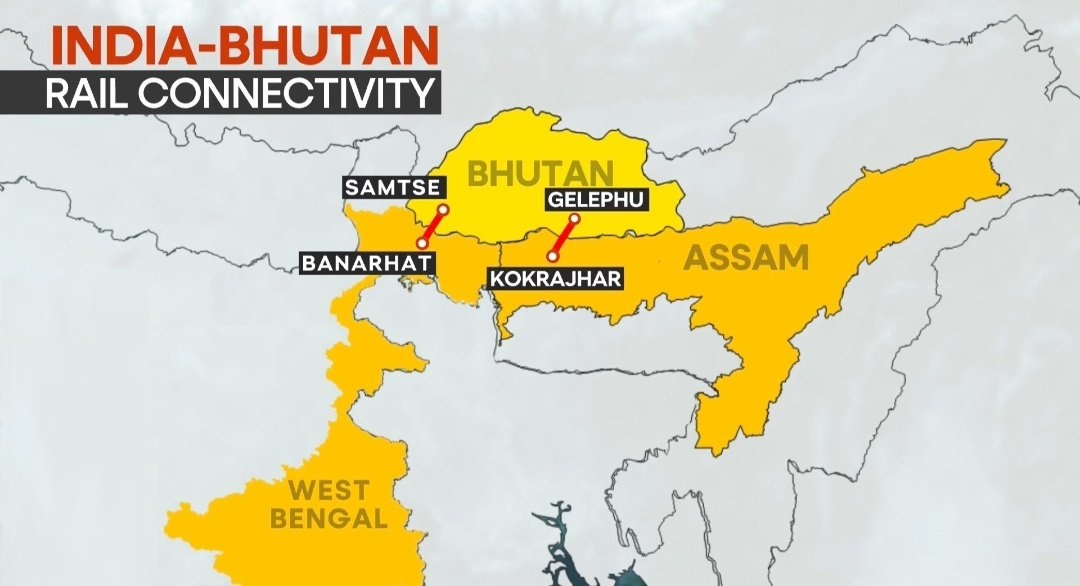
    India and Bhutan have launched their first-ever rail links, connecting Kokrajhar–Gelephu (69 km, Assam–Bhutan) and Banarhat–Samtse (20 km, West Bengal–Bhutan).

    Kokrajhar-Gelephu and Banarhat-Samtse Railway Lines to Bhutan

    About India–Bhutan Railway Connectivity:

    • Overview: Agreements were signed during PM Modi’s visit to Bhutan (March 2024) and formalised in 2025.
    • Projects:
      1. Kokrajhar–Gelephu line: 6 stations, multiple bridges, viaducts, designed for Vande Bharat trains; expected completion in 4 years.
      2. Banarhat–Samtse line: 2 stations, major & minor bridges, flyovers, underpasses; expected completion in 3 years.
    • Both lines will be fully electrified, giving Bhutan direct access to India’s 1,50,000 km railway network, boosting passenger and goods transport.

    Significance of the Project for India:

    • Bilateral Relations: Strengthens ties with Bhutan, India’s closest neighbour and largest recipient of Indian development assistance.
    • Strategic Security: Enhances regional security and serves as a counterbalance to China’s influence in South Asia.
    • Economic Integration: Supports Bhutan’s trade (80% with India), boosts hydropower exports, and aids industrial development.
    • Tourism & Culture: Improves people-to-people exchanges, especially linking Gelephu’s Mindfulness City and Samtse’s industrial hub.
    • Act East Policy: Advances India’s policy through cross-border infrastructure in the eastern and northeastern region.
    • Rail Diplomacy: Positions Indian Railways as a strategic enabler of diplomacy and connectivity in the neighbourhood.
    [UPSC 2023] With reference to India’s projects on connectivity, consider the following statements:

    1. East-West Corridor under Golden Quadrilateral Project connects Dibrugarh and Surat.

    2. Trilateral Highway connects Moreh in Manipur and Chiang Mai in Thailand via Myanmar.

    3. Bangladesh-China-India-Myanmar Economic Corridor connects Varanasi in Uttar Pradesh with Kunming in China.

    How many of the above statements are correct?

    Options: (a) Only one (b) Only two (c) All three (d) None*


  • Turmoil, tragedy, and tenacity in Nepal

    Introduction

    In early September 2025, Nepal was rocked by its most intense youth uprising since the end of monarchy in 2008. Peaceful demonstrations against corruption and inequality, largely organised online, escalated into violent clashes, leaving 73 dead and vital government institutions in flames. The resignation of Oli and the appointment of Sushila Karki as interim Prime Minister has opened a critical transition. The protests underscore the growing role of Gen Z digital activism in reshaping political landscapes.

    Timeline of the protests

    1. 4 Sept 2025: Government orders registration/ban of 26 social media platforms (trigger).
    2. Early Sept (pre-8): Weeks of online organising; #NepoBabies and related trends circulate.
    3. 8 Sept 2025 (Day 1): Large peaceful gatherings at Maitighar Mandala; clashes erupt; official reports of first deaths (≈19 reported that night).
    4. 9 Sept 2025 (Day 2): Violence spreads; Parliament, Supreme Court, Singha Durbar attacked and some set on fire; casualty and injury figures climb.
    5. 10–12 Sept 2025: Army deployed to secure cities; Home Minister and Oli resign; negotiations with youth representatives begin.
    6. 12–14 Sept 2025: Sushila Karki sworn in as interim prime minister; Parliament dissolved; elections scheduled for March (caretaker mandate announced).

    How did legal restraints on digital space ignite a national revolt?

    1. Trigger — Social Media Ban: On 4 September 2025, the government ordered the blocking/registration of 26 social media platforms, including X, Facebook, and Instagram.
    2. Impact: This cut off Gen-Z’s primary space for organisation, expression, and economic activity, seen as a direct assault on civic freedom.
    3. Outcome: Scattered anger was transformed into coordinated protests.
    4. Example: Youth groups used Discord and TikTok to plan assemblies at Maitighar Mandala and coordinate marches towards Parliament.

    What were the structural grievances behind the uprising?

    1. Corruption & Elitism: Perceptions of elite capture, misuse of resources, and impunity fuelled resentment.
    2. Symbol of Rage: The #NepoKids / #NepoBabies campaign exposed politicians’ children flaunting luxury while ordinary youth faced precarity.
    3. Example: Viral clips contrasting lavish lifestyles with student unemployment intensified outrage.
    4. Data: Transparency International (2025): Nepal ranked 107/180 on the Corruption Perceptions Index (CPI score: 34).

    Why did peaceful protests become deadly and destructive?

    1. Escalation: Initially peaceful gatherings on 8 September were dispersed using tear gas and reportedly live ammunition.
    2. Violence: Retaliatory riots followed; demonstrators targeted symbols of state power.
    3. Example: On 9 September, Parliament, Supreme Court, and Singha Durbar were set ablaze; crucial judicial records were damaged.
    4. Data: 72–73 deaths reported, with hundreds injured, mostly between ages 19–24.

    What immediate political fallout followed the unrest?

    1. Leadership Change: Home Minister resigned on 8 Sept; PM K.P. Sharma Oli stepped down on 9 Sept.
    2. Caretaker Transition: The Army mediated negotiations; Parliament was dissolved.
    3. Interim PM: Sushila Karki, former Chief Justice, sworn in on 12 Sept 2025, mandated to hold elections within six months.
      • Karki visited hospitals, assured investigations, and pledged accountability and timely polls.

    How did digital tools shape both mobilisation and misinformation?

    1. Mobilisation: Platforms like Discord, TikTok, and hashtags enabled rapid outreach, meme-culture, and youth identity in protests.
    2. Creativity: Anime/manga flags and viral videos energised Gen-Z demonstrations.
    3. Misinformation: False reports and AI-generated images (e.g., Pashupati Temple “burning”) created panic and confusion.
    4. Example: Fake claims about a senior politician’s family being killed circulated widely before being disproved.

    What are the main challenges facing Nepal’s interim rulers?

    1. Legitimacy Concerns: Traditional political parties, deposed MPs, and royalist factions question the constitutional mandate of the interim set-up.
    2. Balancing Act: The government must address youth expectations of anti-corruption and inclusivity while ensuring political buy-in from entrenched elites.
    3. Stability: Conducting free and fair elections by March 2026 without undermining the democratic spirit of Gen-Z protests remains the foremost task.
    4. Example: Political parties and royalists have already raised doubts over Karki’s legitimacy despite broad youth support.

    Implications for Nepal (domestic)

    • Political Legitimacy and Party Renewal
      • The protests revealed a deep erosion of trust in established parties.
      • Unless political parties reform and integrate youth aspirations into institutional politics, cycles of protest could continue.
      • Revamping youth wings and embracing inclusivity may be crucial for long-term stability.
      • (Echoes analysts’ calls for parties to redefine themselves in light of 1990 and 2006 lessons.)
    • Rule of Law and Accountability
      • Strong demands exist for independent investigations into the use of excessive force and arson during protests.
      • The credibility of Nepal’s democracy depends on whether security forces and political elites are held accountable.
      • Sushila Karki’s pledge to investigate abuses and compensate victims sets both a legal and moral benchmark.
    • Economic and Social Policy Pressure
      • With youth unemployment at 20%, migration pressures, and widening inequality, socio-economic grievances remain central.
      • The interim government faces urgent pressure to deliver short-term relief (jobs, anti-corruption crackdowns) while laying the groundwork for structural reforms in education, employment, and inclusivity.
      • Failure to deliver may reignite unrest and deepen distrust in democratic institutions.

    Implications for South Asia (regional)

    • Contagion Risk and Inspiration:
      • The Nepali uprising reflects a wider Gen-Z dissent pattern in Asia.
      • Similar youth-led movements in Sri Lanka (2022), Bangladesh, Indonesia, Philippines have challenged entrenched elites.
      • Nepal’s protests may inspire emulation across borders, intensifying regional instability.
    • Cross-Border Diplomacy & Stability:
      • Political turbulence in Kathmandu could strain bilateral relations with neighbours.
      • Instability may disrupt migration flows, remittances, and border trade.
      • Governments in South Asia may reassess youth policy, unemployment measures, and digital freedoms to preempt unrest.
    • Policy Lessons on Digital Platforms:
      • Nepal’s ban highlights the risks of hard regulation of social media.
      • Neighbouring states will closely observe whether bans quell dissent or provoke backlash.
      • The episode may shape future regional digital governance frameworks balancing free expression with misinformation control.

    Conclusion

    Nepal’s Gen Z uprising is both tragic and transformative. It highlights the power of digital natives to hold governments accountable, but also the dangers of violence and misinformation. The coming months will test whether Nepal can channel this energy into transparent, inclusive governance or relapse into instability.

    PYQ Linkage:

    [UPSC 2012] Discuss the contentious issues that have caused the prolonged

    constitutional logjam in Nepal.

    Linkage: The 2025 Gen Z protests in Nepal show that unresolved constitutional questions of inclusiveness, accountability, and representation remain central even after the 2015 Constitution. The uprising exposed youth anger at elite capture and exclusion of caste, ethnic, and gender groups — echoing the very fault lines that prolonged Nepal’s constitutional logjam post-2008 monarchy abolition. Thus, the recent turmoil is a continuation of the older struggle for a truly inclusive and accountable Nepali state.

  • Should India overlook boundary issues while normalizing ties with China?

    Introduction

    The India-China relationship has historically oscillated between cautious cooperation and sharp confrontation. The latest Modi–Xi meeting on the sidelines of the SCO Summit reopened bilateral trade, air connectivity, and emphasised peace at the border. Yet, the memory of the 2020 Galwan clashes looms large. At stake is the central question: Can India afford to set aside the boundary dispute for the sake of wider cooperation, or would that compromise its strategic autonomy and long-term security?

    Why is this debate in the news?

    Prime Minister Narendra Modi’s China visit marks the first high-level attempt in five years to restore normalcy after Galwan. The move is significant as it reflects India’s willingness to restart engagement despite recent military tensions and China’s continued strategic partnership with Pakistan. The revival of trade and connectivity signals pragmatism, but it raises the question of whether unresolved boundary tensions can remain compartmentalised. This sharp contrast with the hostility of recent years makes the issue both urgent and unprecedented.

    Can India normalise ties without resolving the boundary issue?

    1. Historical Precedent (1988, 1990s): Rajiv Gandhi’s visit to Beijing in 1988 initiated the idea of cooperation in other domains while border talks continued separately. Both sides agreed to maintain peace and tranquility along the LAC despite unresolved sovereignty disputes.
    2. Galwan Disruption (2020): The deadly clash exposed the fragility of this arrangement and highlighted China’s aggressive posture, a setback far greater than earlier skirmishes.
    3. Current Diplomatic Push: Since 2020, both countries have restored disengagement through buffer zones, with the 2024 Border Patrol Agreement marking an important breakthrough, including restoration of patrol rights in Demchok and Depsang.

    What explains China’s actions and insecurities?

    1. Article 370 Effect: Chinese analysts linked Galwan to India’s constitutional move in Jammu & Kashmir, which Beijing opposed.
    2. Economic Competition: During the U.S.-China trade war, Beijing feared India aligning with Washington to grab supply-chain opportunities.
    3. India’s Growth Factor: China increasingly perceives India’s demographic dividend and economic rise as a potential threat, at a time when its own population is shrinking.
    4. Manufacturing Prowess: Despite insecurities, China’s dominance is overwhelming—accounting for 45% of global manufacturing output, highlighted by India’s Economic Survey 2024-25.

    How fragile is the current normalisation?

    1. Possibility of Galwan-2: Any fresh military clash could derail progress entirely, as mistrust remains deep-rooted.
    2. Chinese Perception of India: Beijing no longer treats India as a peer but as a regional player to be managed, often subordinated to its ties with Pakistan.
    3. Infrastructure Build-up: China continues rapid military expansion on the Tibetan plateau, forcing India to invest heavily in its own LAC infrastructure.
    4. Diplomatic Asymmetry: Even as dialogue continues, China shows little real interest in a final border settlement.

    Can India-China cooperation coexist with China’s South Asia strategy?

    1. China’s Trilateral Mechanisms: Beijing is building frameworks like Pakistan-China-Afghanistan and Pakistan-China-Bangladesh, which aim to sideline India.
    2. Strategic Rivalry: China views India as a long-term competitor; India counters with its own diplomatic cards.
    3. Interdependence Factor: Despite rivalry, both economies remain connected—India dependent on China’s manufacturing, and China wary of India’s market potential.

    Conclusion

    India cannot afford to overlook the boundary issue entirely, as sovereignty and security form the bedrock of foreign policy. Yet, pragmatic engagement, through trade, connectivity, and multilateral platforms, remains equally important. A calibrated approach that safeguards territorial integrity while leveraging cooperation where possible may be the most realistic path forward.

    PYQ Relevance:

    [UPSC 2014] With respect to the South China Sea, maritime territorial disputes and rising tension affirm the need for safeguarding maritime security to ensure freedom of navigation and ever flight throughout the region. In this context, discuss the bilateral issues between India and China.

    Linkage: The South China Sea tensions highlight China’s assertive behaviour in territorial disputes, which parallels its aggressive stance on the India-China boundary issue, especially after Galwan. Just as freedom of navigation is contested in the maritime domain, peace and tranquility along the LAC is fragile despite agreements like the 2024 Border Patrol pact. Thus, bilateral issues centre on sovereignty, security dilemmas, and China’s attempts to limit India’s strategic space in both continental and regional contexts.

  • [11th September 2025] The Hindu Op-ed: The Way Forward on Katchatheevu, Palk Strait disputes

    PYQ Relevance

    [UPSC 2013] In respect of India — Sri Lanka relations, discuss how domestic factors influence foreign policy.

    Linkage: The Katchatheevu and Palk Strait disputes show how domestic pressures from Tamil Nadu, fishing community demands, political rhetoric, and cultural ties with Sri Lankan Tamils, directly shape India’s diplomatic posture with Colombo. Balancing these domestic concerns with treaty obligations and ecological imperatives defines the contours of India’s foreign policy. This reflects how internal politics often intersect with external relations in South Asia.

    Mentor’s Comment

    The Katchatheevu and Palk Straits disputes highlight the fine balance India must strike between diplomacy, livelihood, and ecological sustainability. While political rhetoric often overshadows the nuanced reality, the recent revival of dialogue between India and Sri Lanka offers an opportunity to convert conflict into cooperation. This article unpacks the legal, ecological, and humanitarian dimensions of the issue and offers insights useful for UPSC Mains aspirants.

    Introduction

    India’s neighbourhood diplomacy has been historically guided by Panchsheel, the Non-Aligned Movement, SAARC, and now the Neighbourhood First Policy. Yet, challenges with Sri Lanka, notably the fisheries dispute in the Palk Straits and the sovereignty of Katchatheevu island, continue to test this vision. Prime Minister Modi’s April 2025 visit to Colombo revived discussions on these long-standing issues, calling for a “humane approach” that reconciles livelihoods and ecological imperatives. The stakes are high: peace in the Palk Straits is not just about maritime boundaries but about human security, sustainability, and regional goodwill.

    The Katchatheevu and Palk Strait Issue

    Katchatheevu Island Dispute

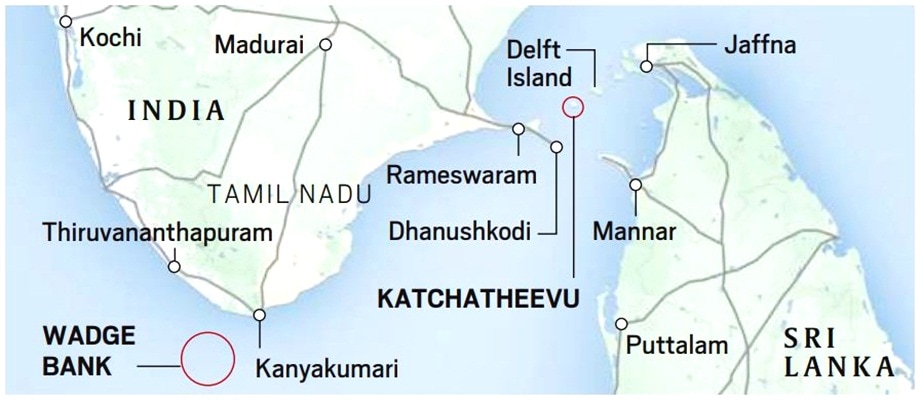
    • Katchatheevu island: A tiny, uninhabited islet (under 0.5 sq. miles) situated in the Palk Strait, legally ceded to Sri Lanka under the 1974 India-Sri Lanka Maritime Boundary Treaty.
      • Fishing rights vs sovereignty: While sovereignty is settled in Sri Lanka’s favour, Indian fishers, especially from Tamil Nadu, continue to demand access, leading to periodic clashes.
    • Palk Strait: A narrow stretch of sea separating Tamil Nadu from Sri Lanka’s Northern Province, rich in marine resources but ecologically fragile.
      • Conflict drivers: Indian bottom trawlers crossing the maritime boundary deplete fish stocks, harming both Indian artisanal fishers and Sri Lankan Tamil fishers.
      • Core issue: More than territory, it is a livelihood and ecological crisis, complicated by political rhetoric around Katchatheevu’s status.

    Livelihood and conservation at odds

    1. Shared history: Fishing communities of Tamil Nadu and Northern Sri Lanka have relied on the Palk Straits for centuries.
    2. Destructive practices: Indian mechanised bottom trawlers enter Sri Lankan waters, violating conservation norms.
    3. Legal framework: UNCLOS and FAO’s 1995 Code of Conduct prohibit destructive fishing; Sri Lanka banned bottom trawling in 2017.
    4. Ecological damage: Coral beds and shrimp habitats are destroyed; fish stocks are depleted.
    5. Internal conflict: Traditional Tamil Nadu artisanal fishers also lose out, creating intra-community livelihood clashes.

    Clearing the misconceptions around Katchatheevu

    1. Tiny territory: Katchatheevu is less than half a square mile, barren except for St. Anthony’s church.
    2. Treaty status: The 1974 India-Sri Lanka Maritime Boundary Treaty gave it to Sri Lanka; under international law, such treaties are binding.
    3. Legal precedents: Minquiers and Ecrehos (UK vs France, 1953) and Rann of Kutch (India-Pakistan, 1968) show administrative control outweighs historical claims.
    4. Clarification: Myths such as “Indira Gandhi gifting the island” are misleading; historical records supported Sri Lanka’s claim.
    5. Key point: Fishing rights are separate from sovereignty, and Katchatheevu is not the root of the dispute.

    Towards cooperative fisheries management

    1. Historic waters: Indian and Sri Lankan law recognise the Palk Straits as historic waters, giving stronger sovereign rights.
    2. UNCLOS Article 123: Mandates cooperation in semi-enclosed seas.
    3. Models for India-Sri Lanka:
      1. Baltic Sea Fisheries Convention (quota-sharing).
      2. Possible steps: Joint research station on Katchatheevu, regulated quotas, seasonal access, promotion of deep-sea fishing in India’s EEZ.

    Building empathy and fraternity

    1. Shared suffering: Sri Lankan Tamil fishers lost decades of livelihood during the civil war due to military restrictions.
    2. Goodwill memory: Tamil refugees were welcomed in Tamil Nadu during the conflict.
    3. Role of Tamil leaders: MPs and media in Sri Lanka can sensitise Tamil Nadu fishers to hardships across the strait.
    4. Narrative shift: Sri Lankan Tamils are not aggressors but fellow victims of history.

    India’s neighbourhood policy in action

    1. Diplomatic tradition: Panchsheel, NAM, SAARC, Neighbourhood First Policy.
    2. Way forward: Prioritise livelihood security, ecological sustainability, and treaty respect over populism.
    3. Multi-level engagement: Government-to-government, State/Provincial dialogue, community interaction.
    4. Larger vision: Transform Palk Straits from a zone of conflict to a symbol of cooperation.

    Conclusion

    The Katchatheevu issue is legally settled and should not distract from the real crisis, sustainable fisheries management in the Palk Straits. Balancing artisanal livelihoods, ecological imperatives, and regional goodwill requires cooperative frameworks and empathy. If pursued with prudence, India and Sri Lanka can convert disputes into opportunities, strengthening the Neighbourhood First Policy and ensuring that smaller conflicts do not overshadow South Asia’s collective future of peace and prosperity.

  • Why is Kathmandu Burning

    Introduction

    On September 8–9, 2025, Nepal plunged into chaos as protests led by Generation Z escalated into violent clashes with security forces. What began as outrage against corruption and a controversial ban on 26 social media platforms quickly spiraled into a mass uprising that engulfed Kathmandu in flames. Former Prime Ministers’ homes were torched, ministers stripped and paraded, and jails broken open. With PM K P Sharma Oli’s resignation and President Ram Chandra Poudel in hiding, the nation faced a constitutional vacuum, raising concerns about the Army’s role and India’s strategic interests. This is the first major political uprising in Nepal led entirely by Gen Z — teenagers and youth born between 1996–2012. Unlike the Maoist insurgency of the past, this revolt was spontaneous, digitally mobilized, and directed against all senior political leaders.

    Generation Z and the Rise of Political Discontent

    1. Generation Z Mobilisation: The uprising was driven by youth anger at corruption, lack of jobs, and entrenched political elites since 2008.
    2. Digital Trigger: Outrage exploded after the government banned 26 social media platforms (Facebook, WhatsApp, Instagram, YouTube, X, etc.), cutting off their main channel of solidarity.
    3. Symbolic Rage: Anger was also directed at “Nepo Kids” — the privileged lifestyles of politicians’ children.
    4. Immediate Demands: Reinstatement of social media (achieved), broader demand for accountability and jobs.

    The Escalation of Protests into Violence

    1. State Response: Security forces fired on protesters, killing 19 young people, triggering mass fury.
    2. Attack on Leaders: Houses of five former Prime Ministers were torched (Oli, Prachanda, Madhav Kumar Nepal, Jhala Nath Khanal, Sher Bahadur Deuba).
    3. Fatalities: Rajyalaxmi Chitrakar (wife of ex-PM Khanal) died from burns; former PM Deuba and his wife (Foreign Minister Arzu Deuba) were assaulted.
    4. Dramatic Incidents: Protesters freed Rabi Lamichhane, a jailed critic of Oli, by burning Nakkhu Jail.
    5. Humiliation of Ministers: Finance Minister Bishnu Prasad Paudel and MP Eknath Dhakal were stripped and paraded.

    Leadership Vacuum and Constitutional Crisis

    1. PM’s Resignation: K P Sharma Oli resigned; President Poudel went into hiding.
    2. Army’s Stance: Army Chief Gen. Ashok Raj Sigdel urged calm, took charge of security, but avoided assuming political power.
    3. Possibility of Interim Government: Likely after negotiations with figures like Kathmandu Mayor Balen Shah, a Gen Z icon.
    4. Constitutional Crisis: Possibility of Parliament dissolution and collapse of 2015 Constitution.

    The Expanding Role of the Nepal Army

    1. Security Role: The Army has assumed charge of law and order.
    2. Political Caution: Unlike in past coups, the Army seems hesitant to directly seize political power.
    3. Facilitator Role: Likely to mediate between political leaders, ensure reconciliation, and protect civilian lives.

    Opposition in Disarray Amidst Youth Revolt

    1. Targeted Equally: All senior leaders, across party lines, faced wrath of protesters.
    2. Rising Leaders: Balen Shah (Mayor of Kathmandu, ex-rapper) and Rabi Lamichhane (RSP leader, ex-TV anchor) emerged as youth-backed alternatives.
    3. Monarchy Revival?: Former King Gyanendra Shah offered condolences, appealed for dialogue, subtly signaling a willingness to return to relevance.

    India’s Strategic Concerns Amidst Nepal’s Crisis

    1. Strategic Concern: India is deeply worried, given historical ties, open border, and Nepali diaspora in India.
    2. Delicate Position: India is seen as partisan since it backed Maoists and republicanism in 2008.
    3. Official Statement: PM Narendra Modi chaired the CCS meeting, stressing “stability, peace, and prosperity of Nepal” as vital for India.

    Conclusion

    Nepal’s Gen Z uprising marks the collapse of public trust in traditional politics and signals a generational shift. The combination of digital mobilization, corruption fatigue, and joblessness has produced an explosion that could reshape Nepal’s political order. For India, the crisis is both a challenge and an opportunity, a chance to rebuild goodwill through balanced diplomacy, while avoiding the mistakes of the past. The coming weeks will determine whether Nepal stabilizes through reconciliation or descends into prolonged instability.

    Value Addition

    Similarities between the recent Nepal Gen Z uprising (2025) and the Bangladesh student–youth revolution (July 2024) that toppled Sheikh Hasina’s government

    • Youth at the Centre
      1. Nepal: Led by Gen Z (born 1996–2012), angry at corruption, nepotism, and joblessness.
      2. Bangladesh: Led by students and young professionals, who launched protests against the quota system in government jobs, symbolising a deeper anger at authoritarianism.
      3. Similarity: In both, young people with no political baggage spearheaded the movement, showing a generational rejection of “old guard” politics.
    • Trigger through State Suppression
      1. Nepal: Anger exploded after government banned 26 social media platforms, silencing digital expression. Police firing killed 19 protesters, escalating violence.
      2. Bangladesh: Crackdowns on student protests with police brutality, tear gas, and arrests deepened the rage, leading to street battles.
      3. Similarity: In both cases, excessive state repression transformed peaceful protests into mass uprisings.
    • Anti-Elite and Anti-Nepotism Sentiment
      1. Nepal: Rage directed at “Nepo Kids”, children of politicians flaunting wealth and privilege.
      2. Bangladesh: Rage at the dynastic, 15-year-long rule of Sheikh Hasina, seen as nepotistic and authoritarian.
      3. Similarity: Both were anti-nepotism revolts, targeting corruption and political entrenchment.
    • Use of Digital Platforms for Mobilisation
      1. Nepal: Movement grew around Facebook pages like Next Generation Nepal, until banned.
      2. Bangladesh: Students used Facebook, X, and YouTube to coordinate protests, live-stream crackdowns, and rally global support.
      3. Similarity: Social media was the fuel of mobilisation, and attempts to suppress it only intensified anger.
    • Collapse of Established Order
      1. Nepal: PM K P Sharma Oli resigned, President went into hiding, houses of former PMs burned, Parliament dysfunctional.
      2. Bangladesh: PM Sheikh Hasina fled the country, Awami League leaders attacked, and Parliament dissolved.
      3. Similarity: Both witnessed a sudden collapse of political order, with leadership vacuum and uncertainty about interim arrangements.
    • Regional & International Concerns
      1. Nepal: India held a CCS meeting, worried about instability on its borders; China also watching closely.
      2. Bangladesh: India was concerned due to historic ties with Hasina, while the West pushed for democratic restoration.
      3. Similarity: In both, India was caught in a delicate diplomatic dilemma — balancing neutrality while protecting its strategic interests.

    Conclusion

    Both revolutions represent a South Asian pattern of youth-led, anti-elite uprisings, where corruption, joblessness, authoritarianism, and digital repression pushed Gen Z to revolt. They show that in fragile democracies, youth disillusionment can quickly destabilize entrenched regimes. For India, these crises in its immediate neighbourhood are warnings: political stability next door is fragile, and managing relations requires delicate, balanced diplomacy.

    Value Addition (II)

    • Comparative Lens: Similar to Arab Spring (2011) — youth-led, social media-driven protests.
    • Theory: Youth Bulge Hypothesis — large unemployed youth populations often drive political instability.
    • Reports: UNDP South Asia Human Development Report highlights youth aspirations and governance deficits.
    • Ethics (GS4): Crisis of legitimacy in governance when corruption and inequality erode public trust.

    PYQ Relevance

    [UPSC 2012] Discuss the contentious issues that have caused the prolonged constitutional logjam in Nepal.

    Linkage: The 2012 question on Nepal’s constitutional logjam highlighted elite disputes over federalism and governance. The 2025 Gen Z uprising reflects how these unresolved issues have now spilled onto the streets, creating a constitutional vacuum. What was once a parliamentary deadlock has transformed into a popular revolt against the entire political class, deepening Nepal’s democratic fragility.

  • [9th September 2025] The Hindu Op-ed: Iran and India, ancient civilizations and new horizons

    PYQ Relevance

    [UPSC 2018] In what ways would the ongoing US-Iran Nuclear Pact controversy affect the national interest of India? How should India respond to this situation?

    Linkage: The article’s emphasis on Iran’s resilience against Western domination, its right to peaceful nuclear energy, and India–Iran civilisational partnership directly connects to the US–Iran Nuclear Pact controversy. Sanctions and U.S. pressure affect India’s energy security, INSTC access, and strategic autonomy. Thus, India’s calibrated diplomacy in balancing ties with both Iran and the West becomes central to safeguarding its national interest.

    Mentor’s Comment

    In the midst of global flux, Ambassador Iraj Elahi’s reflections on Iran–India relations remind us that ancient civilisations have the potential to shape modern geopolitics in profound ways. This piece dissects his arguments, from the erosion of Western dominance to the rise of South-South cooperation, and places them in the larger canvas of India’s foreign policy and civilisational outreach. For UPSC aspirants, it offers deep insights into international relations, civilisation studies, and contemporary global order debates.

    Introduction

    The global order is in transition. Once dominated by Western powers, especially the United States, the world now witnesses a shift toward multipolarity. The unchecked use of force, sanctions, and manipulation of global institutions by the West has weakened its legitimacy. In this changing landscape, ancient civilisations such as India and Iran are being called upon to offer not only an alternative but a humane, participatory and just global order. Their shared values of spirituality, peace, and cultural resilience form the foundation of this partnership.

    The Crisis of the Western-led Order

    1. Declining dominance: The West, especially the U.S., is losing control over its classic instruments, global finance, technological monopoly, human rights discourse, and global media.
    2. Crisis indicators: Blatant violations of international law, unchecked use of force, trade wars, and environmental destruction signal deep systemic decay.

    Why the Global South is Rising

    1. Civilisational awakening: Countries are resisting domination and discrimination by relying on local models and indigenous technology.
    2. Strategic autonomy: Defence and security strengthening in Global South nations marks a push against dependence on external powers.
    3. India and Iran as torchbearers: Both ancient civilisations embody resilience — from India’s Non-Aligned Movement to Iran’s Islamic Revolution.

    Civilisational Wisdom and Shared Values

    1. Cultural resilience: Despite military defeats, both India and Iran influenced their conquerors with governance, literature, and art.
    2. Shared ethos: Belief in the triumph of good over evil, respect for diversity, spiritual growth, and commitment to peace.
    3. Historical struggles: India’s anti-colonial resistance and Iran’s oil nationalisation highlight their fight against domination.

    Palestine and the Question of Justice

    1. Central issue: The Palestinian struggle is projected as the frontline battle of the Global South against Western hypocrisy.
    2. Iran’s stance: Defence of Palestine and its right to nuclear energy are framed as defences of sovereignty and law.
    3. Global South solidarity: Palestine becomes a metaphor for resistance against occupation and expansionism.

    India–Iran in Multilateral and Regional Frameworks

    1. BRICS potential: Seen as a counterweight to Western economic dominance, sanctions, and dollar hegemony.
    2. INSTC: More than a trade corridor; envisioned as a civilisational bridge linking Eurasia, Africa, and South Asia, with stabilising effects on West Asia.
    3. Opposition to U.S. role: Iran critiques American interventions in West Asia and South Asia for fuelling instability and terrorism.

    Conclusion

    As the world transitions into multipolarity, the call for civilisational powers such as India and Iran to lead is both symbolic and strategic. Their partnership, rooted in resilience, peace, and spiritual values, has the potential to redefine the Global South’s trajectory. By working through BRICS, INSTC, and other platforms, they can craft a participatory global order, one that replaces domination with dignity, and hierarchy with equality.

    Value Addition

    India-Iran Relations

    Historical & Civilisational Links

    1. Ancient ties: Both are among the world’s oldest civilisations, with exchanges in philosophy, art, architecture, and literature.
    2. Cultural influence: Persian language, miniature painting, Sufi traditions, and Mughal architecture in India reflect deep Iranian impact.
    3. Shared values: Spirituality, diversity, peace, and civilisational resilience.

    Strategic & Economic Cooperation

    1. Energy security:
      • Iran was once India’s second-largest crude oil supplier.
      • Post-U.S. sanctions, imports dropped, but Iran remains vital for India’s energy diversification.
    2. Chabahar Port:
      1. India’s first overseas port project.
      2. Provides access to Afghanistan and Central Asia, bypassing Pakistan.
      3. Part of the larger International North-South Transport Corridor (INSTC).
    3. INSTC:
      1. Connects India to Russia and Europe via Iran.
      2. Cuts transport cost by ~30% and time by ~40%.

    Geopolitical & Regional Significance

    1. Balancing act: India walks a fine line between the U.S.–Iran rivalry and its ties with Israel and the Gulf States.
    2. Afghanistan: India and Iran cooperated closely for stability, particularly post-U.S. withdrawal.
    3. West Asia: Iran acts as a counterbalance to Sunni-dominated Gulf powers; India’s diaspora and trade interests lie across the region.

    Multilateral Engagement

    1. BRICS: Iran is a member of BRICS and became a full member along with other countries starting January 1, 2024, following an expansion agreement at the 2023 Johannesburg Summit.
    2. SCO membership: Both nations share platforms for regional security and connectivity.
    3. NAM legacy: Shared anti-colonial and non-aligned credentials.

    Challenges in the Relationship

    1. U.S. sanctions: Reduced oil imports, halted investments in Chabahar and other projects.
    2. Strategic competition: Iran–China 25-year pact and deepening Tehran–Beijing ties raise concerns for India.
    3. Regional volatility: Palestine, Syria, Yemen conflicts complicate India’s balancing approach.

    Ethical & Civilisational Diplomacy Dimension

    1. Civilisational diplomacy: Both countries advocate a just, humane, participatory order in contrast to Western domination.
    2. Palestine issue: Shared concern in Global South solidarity, though India has nuanced its position due to ties with Israel.
    3. Spiritual diplomacy: Shared heritage in Sufi and mystical traditions strengthens people-to-people bonds.
  • Katchatheevu Island Dispute

    Why in the News?

    Sri Lankan President Dissanayake’s visit to Katchatheevu Island, the first ever visit by a head of state, revived debates on the island’s history and ownership.

    Katchatheevu Island Dispute

    About Katchatheevu Island:

    • Overview: Small uninhabited island of about 285 acres in the Palk Strait, ~33 nautical miles from Jaffna (Sri Lanka) and close to Ramanathapuram (Tamil Nadu).
    • History: Once under the Raja of Ramnad (TN), later became disputed during British rule.
    • Agreements: Under 1974 and 1976 pacts, India (under Indira Gandhi govt.) recognised Sri Lanka’s sovereignty and gave up traditional fishing rights.
    • Religious Site: Home to St. Anthony’s Catholic Shrine, visited annually by Indian and Sri Lankan fishermen during a joint festival with visa waiver.
    • Ecology: Though barren and unsettled, serves as a resting point for fishermen and supports marine biodiversity.

    Disputes around Katchatheevu:

    • Fishing Conflicts: Tamil Nadu fishermen often cross into Sri Lankan waters due to declining catch in Indian waters, leading to frequent arrests by the Sri Lankan Navy.
    • Bottom-Trawling Issue: Indian trawlers use bottom-trawling, banned in Sri Lanka, which damages marine ecosystems and escalates tensions.
    • Political Demands: All TN political parties have demanded retrieval of the island.
    • National Politics: Issue often resurfaces during elections, with claims that earlier governments “easily gave away” Katchatheevu.
    • Official Position: India clarified in 2013–14 that no sovereign territory was ceded since the island was disputed, not fully under India’s control.
    • Core Problem: Lies not in sovereignty but in unsustainable bottom-trawling practices and the livelihood crisis faced by Tamil Nadu fishermen.
    [UPSC 2020] Consider the following statements:

    1. The value of Indo-Sri Lanka trade has consistently increased in the last decade.

    2. “Textile and textile articles” constitute an important item of trade between India and Bangladesh.

    3. In the last five years, Nepal has been the largest trading partner of India in South Asia.

    Which of the statements given above is/are correct? (2020)

    Options: (a) 1 and 2 only (b) 2 only* (c) 2 only (d) 3 only


  • India-China: the making of a border

    Introduction

    The India–China boundary, stretching for about 3,488 km, is one of the longest disputed borders in the world. Unlike clearly demarcated international frontiers, this boundary runs through the Himalayas and remains unsettled in large parts. The two major areas of dispute are Aksai Chin in the western sector, occupied by China but claimed by India, and Arunachal Pradesh (particularly the Tawang tract) in the eastern sector, claimed by China but under Indian control. Rooted in the legacies of the British and Manchu empires, the boundary was never precisely defined. After independence, India relied on British-era maps while China pressed for historical and strategic claims. This divergence led to the 1962 war and continues to shape relations between the two Asian powers.

    Why the India–China border issue matters

    The unresolved India–China border remains a major geopolitical challenge in Asia. Unlike other international boundaries, this border runs through inhospitable Himalayan terrain where neither country historically maintained a permanent presence. The 1962 war, following India’s rejection of Chinese proposals, left scars of mistrust. Later attempts, such as Rajiv Gandhi’s 1988 Beijing visit, restored engagement but not resolution. The dispute is about sovereignty, strategy, and national prestige, making it a flashpoint with global implications.

    The imperial legacy and a contested border

    1. Colonial inheritance: The India–China border was a product of the British and Manchu empires, drawn imprecisely through the Himalayas.
    2. Absence of settlement: After independence, India relied on colonial maps and dismissed Chinese calls for negotiations.
    3. Strategic miscalculation: India’s faith in maps was not supported by control on the ground, leaving space for China’s proactive steps in Aksai Chin.

    The emergence of conflict in Aksai Chin and Arunachal Pradesh

    1. Chinese presence in Aksai Chin: China constructed a highway from Xinjiang to Tibet through Aksai Chin, asserting de facto control.
    2. Indian assertion in Tawang: India occupied Tawang citing the 1914 Simla Convention and the McMahon Line signed with an independent Tibet.
    3. Proposals for compromise: In 1959, Beijing suggested a Line of Actual Control (LAC) with a 20 km troop pullback; in 1960, Zhou Enlai proposed a swap—Aksai Chin for Arunachal recognition.
    4. Breakdown and war: India rejected these offers; attempts to reclaim Aksai Chin triggered the 1962 war, where India lost ground in Ladakh but retained the McMahon Line in the east.

    Post-war developments and early engagement

    1. Dormancy period: After 1962, both sides avoided border contact for more than a decade.
    2. China Study Group: In 1975, India formed this high-level body to map the border with satellite imagery and direct patrolling.
    3. Atal Bihari Vajpayee’s outreach: In 1979, Vajpayee visited Beijing, the first senior Indian leader to do so since 1962, initiating cautious normalisation.
    4. Revival of Chinese proposals: Deng Xiaoping in 1980 reiterated Zhou’s swap idea, but India, led by Indira Gandhi, rejected it due to mistrust.

    The stalemate in negotiations during the 1980s

    1. Unproductive talks: From 1981, both sides engaged in negotiations—India sought sector-wise talks, while China insisted on a package deal.
    2. Demand for Tawang: By 1985, Beijing linked concessions in Ladakh with Indian concessions over Tawang, central to China’s Tibet policy.
    3. Operation Falcon: In 1986, India forward-deployed troops at Namka Chu, displaying improved military preparedness since 1962.
    4. De-escalation: Both sides eventually pulled back, but the demand for Tawang revealed fundamental divergence.

    Rajiv Gandhi’s 1988 visit and a new framework

    1. Strategic reset: Rajiv Gandhi’s visit to Beijing marked a shift from linking normalisation to border resolution.
    2. Framework for dialogue: Both sides agreed to restore relations while deferring the border issue to a Joint Working Group (JWG).
    3. Principle of accommodation: Premier Li Peng emphasised “mutual understanding and mutual accommodation (MUMA),” while Gandhi sought a “fair and reasonable” settlement.
    4. Peace as priority: Peace and tranquillity were prioritised, enabling cooperation in other fields despite the unsettled boundary.

    Conclusion

    The India–China border dispute is a story of missed chances, mistrust, and strategic recalibration. From Aksai Chin to Tawang, an imperial legacy evolved into a sovereignty dilemma. While Deng Xiaoping and Rajiv Gandhi shifted the relationship towards peace, fundamental differences endure. History shows that strategic patience, military preparedness, and calibrated diplomacy remain the keys to managing this difficult relationship.

    Value Addition

    Institutional Mechanisms

    1. China Study Group (1975): Established by India to monitor the border with satellite mapping and patrolling points.
    2. Joint Working Group (1988): Created after Rajiv Gandhi’s visit to sustain structured dialogue on the boundary issue.
    3. Later confidence-building agreements (1993, 1996, 2005): Though not in this article, they flowed from this trajectory and institutionalised border management.

    Policy Evolution

    1. Jawaharlal Nehru: Over-reliance on colonial maps and dismissal of negotiations.
    2. Atal Bihari Vajpayee: Cautious outreach to normalise ties in 1979 despite tensions.
    3. Indira Gandhi: Strong mistrust post-1962, refusal to accept “territorial swaps.”
    4. Rajiv Gandhi: Pragmatic reset in 1988, separating normalisation from boundary resolution.

    Line of Actual Control (LAC)

    1. Definition: The de facto boundary separating Indian and Chinese forces, first formally acknowledged in 1959 by China.
    2. Nature: Not mutually agreed or demarcated on the ground, leading to “differing perceptions.”
    3. Relevance: Key to understanding recurring standoffs such as Galwan (2020), though beyond this article’s timeframe.

    Case Study Relevance

    1. Aksai Chin: Illustrates how geography and strategic imperatives (road connectivity to Tibet) drive China’s claims.
    2. Tawang: Demonstrates cultural and religious dimensions (Tibetan Buddhism, Dalai Lama’s birthplace links).
    3. Operation Falcon (1986): A case study in how improved military readiness altered China’s calculus.
    4. Rajiv Gandhi’s 1988 visit: A model of pragmatic diplomacy—normalisation without immediate resolution.

    Way Forward

    1. Institutional strengthening: Reviving and empowering mechanisms like the Joint Working Group and Special Representatives dialogue.
    2. Confidence-building: Expanding agreements on patrolling norms, hotlines, and disengagement to avoid clashes.
    3. Strategic balance: Maintaining military preparedness (as shown in Operation Falcon) while keeping diplomacy open.
    4. Engagement beyond the border: Deepening cooperation in trade, technology, and multilateral forums to build trust.
    5. Mutual accommodation: Drawing from Deng Xiaoping and Rajiv Gandhi’s vision of a “fair, reasonable, mutually acceptable” settlement to guide long-term resolution.

    PYQ Relevance

    [UPSC 2017] ‘China is using its economic relations and positive trade surplus as tools to develop potential military power status in Asia’, In the light of this statement, discuss its impact on India as her neighbor.

    Linkage: China’s occupation of Aksai Chin and insistence on Tawang show how strategic control is tied to economic leverage, such as road connectivity and infrastructure. Its trade surplus with India fuels military modernisation along the Line of Actual Control (LAC). For India, this creates a dual challenge of managing unresolved borders while countering China’s economic–military power projection in Asia.
  • In news: Strait of Malacca

    Why in the News?

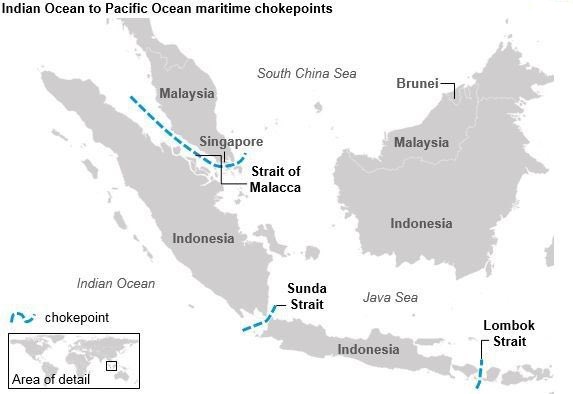
    Singapore’s PM has acknowledged India’s intent to join the Malacca Straits Patrol (currently undertaken by Malaysia, Indonesia, Thailand, and Singapore).

    In news: Strait of Malacca

    About Strait of Malacca:

    • Location: Narrow waterway in Southeast Asia, between the Malay Peninsula (northeast) and Sumatra, Indonesia (southwest).
    • Length & Width: Extends about 800–900 km; width varies from 65 km in the south to 250 km in the north.
    • Depth: The southern end is narrow and shallow, usually less than 37 m deep, posing navigational challenges.
    • Geological Setting: Part of the Sunda Shelf formation, created after post-glacial sea level rise around 2.6 million years ago.
    • Key Ports: Hosts major hubs like Singapore, Port Klang, Penang, and Melaka, making it one of the busiest shipping lanes globally.

    Strategic and Economic Importance:

    • Global Chokepoint: Links the Indian Ocean (Andaman Sea) with the Pacific Ocean (South China Sea), forming a vital maritime chokepoint.
    • Trade Corridor: The shortest sea route between the Middle East/Africa and East Asia, critical for global commerce.
    • Volume of Trade: Handles about 60% of world maritime trade, including large-scale oil shipments from the Middle East to China, Japan, and Southeast Asia.
    • Economic Impact: Any disruption could severely affect supply chains and energy security worldwide.
    • Geopolitical Significance: Attracts competing interests of India, China, the US, and ASEAN states, making it a hotspot for regional and global strategic rivalry.
    [UPSC 2010] Which one of the following can one come across if one travels through the Strait of Malacca ?

    Options: (a) Bali (b) Brunei (c) Java (d) Singapore*


  • In news: Lipulekh Pass

    Why in the News?

    India has rejected Nepal’s objection to resumption of India–China border trade through the Lipulekh Pass in Uttarakhand.

    About Lipulekh Pass:

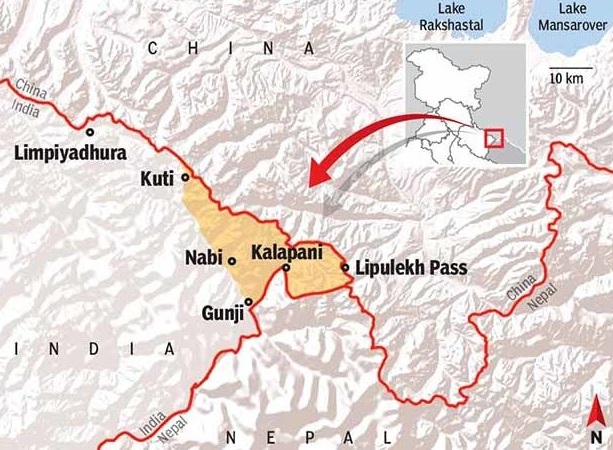
    • Location: High-altitude Himalayan pass (~17,000 ft) near the trijunction of India, Nepal, and China (Tibet).
    • Connectivity: Links Uttarakhand’s Kumaon region with Taklakot in Tibet.
    • Cultural Role: Serves as the shortest route for the Kailash Mansarovar Yatra.
    • Trade Importance: Historic India–China trade route since 1954; disrupted during COVID-19 but later resumed.
    • Strategic Significance: Crucial for India due to its proximity to the India–China–Nepal border.

    What is Limpiyadhura–Lipulekh–Kalapani Dispute?

    • Origin: Rooted in the 1815 Treaty of Sugauli (Nepal–British East India Company), fixing Nepal’s western boundary at the Kali (Mahakali) River.
    • India’s Position: Claims Kali River originates near Lipulekh, placing Lipulekh and Kalapani within India.
    • Nepal’s Position: Claims Kali River originates at Limpiyadhura, extending Nepal’s boundary east to include Lipulekh and Kalapani.
    • Disputed Area: About 370 sq. km., under Indian administration since the 19th century.
    • Recent Development: In 2020, Nepal issued a new map showing Limpiyadhura, Lipulekh, and Kalapani as its territory; India rejected the claim citing lack of historical basis.

    Back2Basics: India–Nepal Border Disputes

    • Border Length: India and Nepal share a 1,770 km long open border across five Indian states – Uttarakhand, Uttar Pradesh, Bihar, West Bengal, and Sikkim.
    • Key Disputes:
      • Kalapani–Lipulekh–Limpiyadhura (Uttarakhand): Discussed above.
      • Susta (Uttar Pradesh–Nepal border): Caused by Gandak River’s shifting course, leading to encroachments and overlapping claims.
    • Tensions: Despite close ties, disputes often cause diplomatic strains.
    • Positions: India relies on historical treaties and long-standing administration, while Nepal asserts sovereignty and constitutional recognition of disputed territories.


    [UPSC 2007] Which one of the following Himalayan passes was reopened around in the middle of the year 2006 to facilitate trade between India and China?

    Options : (a) Chang La (b) Jara La (c) Nathu La* (d) Shipki La