Mains Ready By December. Smash Mains & Smash PYQ Admissions Open

GS Paper: GS2-01.Indian Constitution-Historical underpinnings & evolution; Features, amendments, significant provisions, basic structure of Constitution

  • Uttarakhand readies Final UCC draft

    ucc

    Introduction

    • Uttarakhand is taking important steps to implement a Uniform Civil Code (UCC).
    • The state has received the final report from a committee, which is a significant move towards fulfilling its commitment to equality and justice.

    Tap to read everything about Uniform Civil Code:

    India needs a Uniform Civil Code: PM

    Uttarakhand UCC

    • Expert Committee: Uttarakhand appointed a committee, led by retired Justice Ranjana Prakash Desai, to draft the UCC.
    • In the State Assembly: The UCC report will be presented in the State Assembly on February 5 for discussion. It will go through a detailed review before becoming law.

    Key Recommendations

    • Gender Equality: The final UCC draft focuses on achieving gender equality and removing unfairness in various areas, including property rights and adoption rules.
    • Language Choice: Notably, the UCC draft is around 750 pages long, entirely written in Hindi, without any Urdu or other languages.
    • Protection of Tribal Community: The report suggests that the tribal community should not be included in the UCC. Their specific needs and concerns will be addressed separately.

    Ensuring Equal Rights

    • Ban on Regressive Practices: The UCC draft recommends strong punishments for practices like triple talaq, iddat, and halala, which relate to marriage and divorce in Muslim personal law. It also proposes banning polygamy and polyandry.
    • Legalizing Live-In Relationships: The draft suggests making live-in relationships legal, with mandatory registration for such couples.
    • Equal Inheritance Rights: Women are granted the same rights as men when it comes to inheritance under the proposed UCC.
    • Minimum Marriage Age: The UCC draft suggests setting the minimum age for women’s marriage at 21 years.

    Conclusion

    • Uttarakhand’s efforts to establish a Uniform Civil Code demonstrate its commitment to ensuring equal rights and justice for all.
    • The careful drafting process, inclusive approach, and strong recommendations underscore the state’s determination to promote gender equality and eliminate regressive practices.
  • 22nd Law Commission recommends retaining Criminal Defamation

    defamation

    Introduction

    • The 22nd Law Commission has recommended retaining criminal defamation as an offence in the new legal framework of Bharatiya Nyaya Sanhita.
    • The Law Commission’s report highlights the importance of protecting an individual’s reputation, grounded in Article 21 of the Constitution, which safeguards the right to life and personal liberty.

    Key Recommendations: Upholding Reputation

    • Invisible Asset: Reputation, a valuable asset, cannot be seen but is diligently built over a lifetime and can be tarnished in an instant.
    • Essence of Protection: The jurisprudence around criminal defamation laws is rooted in the essence of safeguarding one’s reputation.
    • Balancing Act: While acknowledging that criminal defamation might seem contradictory to freedom of speech and expression, the Law Commission suggests treading carefully.
    • Harmful Speech: The Commission advises that speech should only be deemed illegal when it intends substantial harm, and when such harm becomes a reality.

    What is Criminal Defamation?

    • Defamation: Defamation entails the act of publishing damaging content that diminishes an individual’s or entity’s reputation, from the viewpoint of an ordinary person. In India, defamation is both a civil and criminal offense.
    • Sections 499 and 500: These sections in the Indian Penal Code address criminal defamation. Section 499 defines the offense, while Section 500 outlines the associated punishment.

    Arguments in Favor of Retaining Criminal Defamation

    • Protection of Reputation: An individual’s reputation, an integral part of Article 21, is as vital as free speech.
    • Balancing Act: The right to free speech (Article 19(1)(a)) must be balanced against the right to reputation (Article 21).
    • Inadequate Compensation: Monetary compensation in civil defamation may not proportionately compensate for reputation harm.
    • Editorial Responsibility: Editors bear the responsibility for published content, with significant consequences for individuals and the nation.
    • Counteracting Online Defamation: In the absence of an effective internet censorship mechanism, criminalizing defamation is a necessary safeguard.
    • State’s Interest: Criminalizing defamation is part of the state’s compelling interest to protect citizens’ dignity and reputation.

    Arguments against Retaining  

    • Chilling Effect: Criminal defamation may have a chilling effect on free speech, with a lower threshold for prosecution than civil damages.
    • Media Freedom: Freedom of speech and media expression is crucial for vibrant democracies, and the threat of prosecution can stifle truth.
    • Misinterpretation of Dissent: Dissent may be misconstrued as unpalatable criticism, leading to imprisonment under Sections 499 and 500 of IPC.
    • Collective Reputation: The right to reputation cannot extend to collectives like the government, which can rectify reputational damage.
    • Redundancy: Since civil defamation remedies exist, retaining criminal defamation may serve little purpose except coercion and harassment.
    • Global Trend: Many nations, including neighbouring Sri Lanka and the UK, have decriminalized defamation.
    • International Perspective: The International Covenant on Civil and Political Rights urges states to abolish criminal defamation as it intimidates citizens and deters exposing wrongdoing.

    Conclusion

    • Criminal defamation cases have been used to suppress investigative journalism, hindering democratic accountability.
    • Criminal defamation should not be misused by the state, especially as the Code of Criminal Procedure gives public servants an advantage.
    • Interim measures can ensure fair proceedings and prevent excessive penalties.

    Back2Basics: Law Commission of India

    Details
    Establishment An executive body established by the Government of India, with the first commission established in 1955.
    Tenure Each Law Commission serves a term of three years.
    Function Acts as an advisory body to the Ministry of Law and Justice for legal reforms in India.
    Recommendations The recommendations made by the Law Commission are not binding.
    Historical Background The first Law Commission was established during the British Raj in 1834 by the Charter Act of 1833.
    First Chairman The first Chairman of the Law Commission was Macaulay, who recommended the codification of laws.
    Composition Typically consists of a full-time Chairperson, full-time Members, ex-officio Members, and part-time Members.
    Terms of Reference Undertakes research and reviews of existing laws, recommends reforms, and studies justice delivery systems.
    Major Reforms The Law Commission played a pivotal role in suggesting key enactments like the Indian Penal Code and Criminal Procedure Code.
    Role in Legal Reforms Serves as both an advisory and critical body, with its recommendations often influencing legal reforms in India.
    Supreme Court References The Supreme Court has referred to the work of the Law Commission and followed its recommendations in various cases.
    Promotion of Accountability Aims to promote an accountable and citizen-friendly government, transparency, and the right to information.
  • Significance of Deputy CM in Indian Politics

    Deputy CM

    Introduction

    • Deputy Chief Ministers (Deputy CMs) have become prominent figures in Indian politics, serving as political compromises and often following coalition governments or a lack of single-party dominance.
    • The role and prevalence of Deputy CMs vary across states and regions.

    Role of Deputy CM

    • Political Compromise: Deputy CMs are appointed to strike a political compromise, especially in coalition governments or when no single leader commands undisputed authority.
    • Representation: Deputy CMs represent various regions, communities, or interest groups within a state, promoting inclusivity.
    • Constitutional Basis: The Constitution does not explicitly mention the position of Deputy CM; however, it is understood to be equivalent in rank to a Cabinet Minister.
    1. Article 163(1): This article outlines the existence of a Council of Ministers in each state, with the Chief Minister at its head, to aid and advise the Governor in the exercise of his functions. While it doesn’t mention Deputy CMs, they are a part of the Council of Ministers, akin to Cabinet Ministers.
    2. Article 164(1): This article states that the Chief Minister shall be appointed by the Governor, and other Ministers shall be appointed by the Governor on the advice of the Chief Minister. It establishes the authority of the Chief Minister in appointing Deputy CMs.

    Prevalence of Deputy Chief Ministers

    • Growing Prominence: Deputy CMs are increasingly common in Indian states, with four of the five states that went to polls in November 2021 having Deputy CMs.
    • National Presence: Most major states, except Tamil Nadu and Kerala, have the position of Deputy CM.
    • Varied Contexts: States like Andhra Pradesh, Maharashtra, and Haryana have multiple Deputy CMs, often reflecting coalition governments or diverse political considerations.

    Historical Overview

    • Pioneering Deputy CM: Anugrah Narayan Sinha was one of the earliest Deputy CMs in India, representing Bihar.
    • Post-1967 Increase: The prevalence of Deputy CMs expanded after the decline of Congress’s dominance in national politics in 1967.
    • Examples: States like Bihar, Uttar Pradesh, Madhya Pradesh, and Haryana have a history of Deputy CMs from various political backgrounds.

    Deputy Prime Ministers

    • Higher Position: India has also seen Deputy Prime Ministers, who held positions of significance at the national level.
    • Notable Figures: Sardar Vallabhbhai Patel, Morarji Desai, Charan Singh, Chaudhary Devi Lal, and Lal Krishna Advani have served as Deputy Prime Ministers.
    • Constitutional Aspects: The role of the Deputy Prime Minister has been debated in court, with the Supreme Court emphasizing that it does not confer additional powers on the Deputy Prime Minister.

    Conclusion

    • Deputy Chief Ministers play a vital role in Indian politics, facilitating political stability and representation.
    • Their prevalence has increased over the years, and they continue to hold significant positions in state governments.
  • Internet Shutdowns in India: Upholding Constitutional Rights

    Introduction

    • The Internet serves as a vital source of information, entertainment, healthcare, education, and livelihood.
    • However, the rampant instances of Internet suspension in India, often without public disclosure, raise concerns about constitutional rights and economic losses.

    Constitutional Provisions for Right to Internet

    Landmark Case Constitutional Provision Explanation
    Anuradha Bhasin vs. Union of India and Ors. (2020) Right to Freedom of Speech and Expression under Article 19(1)(a) Grants the right to freedom of speech and expression, which encompasses access to information and the Internet.
    Faheema Shirin RK vs. State of Kerala and others (2019) Right to Education under Article 21A Guarantees the right to education for children aged 6 to 14;

    Internet access is crucial for modern education.

    K.S. Puttaswamy (Privacy) vs. Union of India (2017) Right to Privacy under Article 21 Protects the fundamental right to privacy, and Internet access is often used for secure communication.
    Anuradha Bhasin vs. Union of India and Ors. Freedom to Practice Any Profession or Carry on Any Trade, Business, or Occupation under Article 19(1)(g) Ensures the freedom to conduct various trades, businesses, and professions, often requiring Internet access.


    Mechanisms allowing Internet Shut-downs

    Mechanism Authorities Purpose
    Temporary Suspension of Telecom Services (Public Emergency or Public Safety) Rules, 2017 Home Departments in the states, state government review committee, central government (under this law, but rarely used) Enforces shutdowns for public emergency or safety reasons.
    Section 144 of the CrPC Local law enforcement authorities Enables shutdowns, particularly before 2017, to maintain public order and safety.
    The Indian Telegraph Act, 1885, Section 5(2) Home Secretary of the Union or state governments Allows blocking of messaging during a public emergency, safeguarding public safety, or protecting sovereignty and integrity.

    Landmark Precedence: Anuradha Bhasin Judgment (2020)

    • Supreme Court’s Ruling: In January 2020, the Supreme Court of India recognized access to the Internet as a fundamental right under the Indian Constitution.
    • Restrictions Guidelines: The Court mandated that any government-imposed Internet restrictions must be temporary, limited, lawful, necessary, and proportionate. It also emphasized judicial review.

    Unfulfilled Promises and Ongoing Restrictions

    • Broken Promises: Despite the Anuradha Bhasin judgment, Internet shutdowns increased in India, making it the leader in global Internet suspensions.
    • Recent Examples: The Union Territory of Jammu and Kashmir (J&K) and Haryana have imposed Internet restrictions without timely publication of orders.
    • Compliance Issues: Lack of publication erodes public trust and limits the ability to challenge the legality of restrictions.

    Need for Transparency

    • Publication’s Significance: Non-disclosure of orders hinders legal challenges and perpetuates illegal restrictions.
    • Statutory Recognition: The government’s failure to give statutory recognition to the Supreme Court’s directions creates awareness issues.
    • Economic Impact: In 2020, India suffered $2.8 billion in losses due to 129 Internet shutdowns affecting 10.3 million individuals.

    Widespread Impact

    • Economic, Psychological, and Social Harm: Internet suspensions harm the economy and disrupt daily life, education, healthcare, and communication.
    • Democratic Right to Protest: Restrictions on Internet access hinder the democratic exercise of the right to protest.
    • Verifying Information: The Internet helps verify rumors and disseminate the truth during emergencies.

    Socio-economic Disparities

    • Mobile-Dependent Users: The majority of Internet users rely on mobile data services, making Internet restrictions detrimental to lower socio-economic groups.
    • Broadband Accessibility: Limited access to broadband Internet exacerbates the impact of shutdowns.

    Conclusion

    • To uphold constitutional rights and unlock the full potential of Digital India, the government must adhere to the Supreme Court’s guidelines, ensuring transparency and legality in Internet shutdowns.
    • Addressing compliance issues and minimizing restrictions can benefit the nation’s economic and social well-being.
  • Explained: Rajya Sabha Election Process

    Introduction

    • The Election Commission notified elections to 56 Rajya Sabha seats that will be held on February 27.

    Uniqueness of Rajya Sabha Elections

    • Retirement Cycle: One-third of Rajya Sabha members from each State retire every two years, necessitating elections to fill vacancies.
    • Eligible Voters: Only elected members of State Legislative Assemblies are eligible to vote in Rajya Sabha elections.
    • Six-Year Term: Newly elected members serve a six-year term, with vacancies arising due to resignation, death, or disqualification filled through by-polls.

    Election of Rajya Sabha Members

    • Blocs and Elections: A group of MPs from one or more parties can elect a member if they possess the required numbers.
    • Avoiding Majority Rule: This approach ensures that ruling party candidates do not monopolize elections.
    • Union Territories Representation: Delhi and Puducherry Assemblies elect members to Rajya Sabha to represent the respective Union Territories.

    Electoral Process

    • Polling Condition: A Rajya Sabha election requires polling only when the number of candidates surpasses the available vacancies.
    • Predictable Strength: Parties estimate their potential seats based on their strength in the Assembly.
    • Contesting Candidates: Parties field candidates based on their strength; additional candidates trigger a contest.
    • Candidate Nomination: Political party candidates must be proposed by at least 10 Assembly members or 10% of the party’s House strength, whichever is lower.
    • Independent Candidates: Independents require 10 proposers, all Assembly members.

    Voting Procedure

    • Single Transferable Vote: Rajya Sabha elections employ the single transferable vote system, based on proportional representation.
    • Preferences Voting: Electors can vote for multiple candidates in order of preference.
    • Winning Requirement: Candidates need a specific number of first preference votes to win, with each first choice vote valued at 100 in the initial round.
    • Qualification: To qualify, a candidate must secure one point more than the quotient obtained by dividing the total value of seats available in the election plus one.

    Transparency in RS Elections

    • Open Ballot System: Rajya Sabha elections employ an open ballot system with limited transparency.
    • Preventing Cross-Voting: Showing marked ballots to the party’s authorized agent (Whip) is mandatory; not following this rule renders the vote invalid.
    • Secrecy for Independents: Independent candidates are prohibited from showing their ballots to anyone.
    • NOTA in Rajya Sabha: Initially, Rajya Sabha members had the option to use the NOTA (None of the Above) button during elections, as per circulars issued by the Election Commission.
    • Supreme Court Ruling: However, in 2018, the Supreme Court ruled that NOTA is only applicable in general elections and cannot be used in indirect elections based on proportional representation.

    Consequences of Cross-Voting

    • Supreme Court’s Stand: The Supreme Court clarified that not voting for the party candidate in Rajya Sabha elections does not trigger disqualification under the anti-defection law.
    • Legislators’ Freedom: MLAs retain the freedom to vote for a candidate of their choice.
    • Party Action: Parties are free to take disciplinary action against legislators who vote against their candidate.

    Voting Eligibility before Taking Oath

    • Voting Without Oath: The Supreme Court ruled that members can participate in Rajya Sabha elections even before taking the oath as legislators.
    • Non-Legislative Activity: Rajya Sabha voting is considered a non-legislative activity, allowing members to vote without taking the oath.
    • Membership Status: A person becomes a member as soon as the Election Commission notifies the list of elected members.
    • Proposal Rights: Members can also propose a candidate before taking the oath of office.

    Other facts

    • Limited Union Territories (UTs): Only two Union Territories participate in Rajya Sabha elections, not all of them.
    • Conditional Polling: Polling occurs only if the number of candidates exceeds the available vacancies.
    • Independent Members: Independent candidates can also be elected to Rajya Sabha.
  • CAA Implementation within a Week

    Introduction

    Citizenship (Amendment) Act (CAA), 2019: Key Provisions

    • Basic idea: CAA, 2019, aims to amend the Citizenship Act, 1955, to grant Indian citizenship to specific categories of illegal migrants.
    • Eligible Religions: CAA targets Hindu, Sikh, Buddhist, Jain, Parsi, and Christian illegal migrants from Afghanistan, Bangladesh, and Pakistan, making them eligible for Indian citizenship.
    • Objective: The primary objective is to facilitate citizenship for non-Muslim immigrants from India’s three Muslim-majority neighboring countries.
    • Residence Requirement: The Citizenship Act, 1955, normally requires 11 of the previous 14 years of residence in India as a condition for naturalization.
    • Amendment: CAA reduces this requirement to 6 years for applicants belonging to the specified religions and countries.
    • Exemption from Criminal Cases: Members of the designated communities are exempted from criminal cases under the Foreigners Act, 1946, and the Passport Act, 1920, if they entered India before December 31, 2014.

    Defining Illegal Migrants

    • Status Under Present Laws: Existing laws prohibit illegal migrants from acquiring Indian citizenship.
    • CAA’s Definition: CAA classifies an illegal migrant as a foreigner who enters India without valid travel documents (passport and visa) or overstays beyond the allowed period.
    • Penalties: Illegal migrants can face imprisonment or deportation under the Foreigners Act, 1946, and The Passport (Entry into India) Act, 1920.

    Exceptions under CAA

    • Conditions for Exemption: CAA outlines four conditions that, if met, exempt certain individuals from being treated as illegal migrants:
      1. They belong to the specified religions (Hindu, Sikh, Buddhist, Jain, Parsi, or Christian).
      2. They hail from Afghanistan, Bangladesh, or Pakistan.
      3. They entered India on or before December 31, 2014.
      4. They are not in certain tribal areas of Assam, Meghalaya, Mizoram, or Tripura (Sixth Schedule) or “Inner Line” permit areas (Arunachal Pradesh, Mizoram, and Nagaland).

    Controversies Surrounding CAA

    • Country of Origin: CAA categorizes migrants based on their country of origin, specifically Afghanistan, Pakistan, and Bangladesh.
    • Religious Exclusivity: It raises questions about why only six specified religious minorities have been considered in the Act.
    • Omission of Rohingya: The Act doesn’t address the Rohingya Muslims from Myanmar, who have faced persecution.
    • Entry Date Differentiation: The differential treatment of migrants based on their entry date, i.e., before or after December 31, 2014, has generated debate.
    • Secularism Concerns: Critics argue that granting citizenship based on religion contradicts the secular principles of India’s Constitution, considered part of the unalterable basic structure.
  • What is Ladakh’s demand on Gilgit-Baltistan?

    ladakh

    Introduction

    • The socio-political landscape of Ladakh is witnessing ongoing dialogues and demands on Gilgit-Baltistan, primarily presented by the Leh Apex Body (LAB) and Kargil Democratic Alliance (KDA) to the Ministry of Home Affairs (MHA).
    • The demands encompass a range of issues, including territorial control expansion, restoration of statehood, special status under the Sixth Schedule and Article 371, and exclusive rights over recruitment.

    Ladakh’s Current Status

    • Formation as Union Territory: Ladakh, spanning 59,146 square kilometers, became a Union Territory on August 5, 2019, following the abrogation of Article 370.
    • Governance: Unlike Jammu and Kashmir, Ladakh does not have a legislature but is governed by two elected hill councils, LAHDC-Kargil and LAHDC-Leh.
    • Population and Demographics: Ladakh, with a population of 2.74 lakh (2011 census), is a Muslim-majority UT, with Buddhists dominating Leh district and Shia Muslims in Kargil. The region witnessed varied reactions to the abrogation of Article 370, with Leh supporting UT status and Kargil expressing a desire for reunification with Kashmir.

    Latest Demands of the Region

    • Protests against UT Status: Over the past two years, both Leh and Kargil initiated protests against the UT status without a legislature, advocating for the restoration of statehood.
    • Special Status under Sixth Schedule: There is a collective demand for special status under the Sixth Schedule and Article 371, similar to other northeastern states, to preserve the region’s ecological fragility and limit external influences.
    • Exclusive Recruitment Rights: Ladakh seeks exclusive rights over recruitment, proposing the establishment of the Ladakh Public Service Commission for gazetted jobs and empowering hill councils for lower rung staff recruitment.

    Territorial Control Expansion

    • Historical Context: The memorandum underlines Ladakh’s historical connection to Gilgit-Baltistan, part of the pre-1947 Ladakh district now under Pakistan’s occupation.
    • Territorial Control Demand: Ladakh demands an extension of territorial control up to Gilgit-Baltistan, advocating for attempts to include this area into Ladakh. Reservation of seats for Gilgit-Baltistan is sought once a legislature is granted.
    • Strategic and Stability Considerations: The memorandum emphasizes that empowering locals will enhance stability in the region, especially in the context of Ladakh’s volatile Line of Actual Control (LAC) with China.

    Centre’s Response and Committees Formed

    • Committees Formed: In response to street protests, the Centre formed committees in 2022 and 2024, led by Ministers G. Kishan Reddy and Nityanand Rai, respectively, to engage with LAB and KDA members.
    • Assurance and Ongoing Talks: The Centre assured finding appropriate solutions to language, culture, and land conservation issues in Ladakh. Ongoing talks are aimed at addressing the demands and fostering a structured dialogue between New Delhi and Ladakh.

    Conclusion

    • Ladakh’s socio-political dialogue continues, reflecting the diverse sentiments and demands of its residents.
    • The region’s historical context, strategic considerations, and ecological concerns play a crucial role in shaping the ongoing negotiations.
    • As Ladakh awaits resolutions to its demands, the dialogue remains a critical component in navigating the complex dynamics between the Centre and this unique Union Territory.
  • How Basic Structure doctrine became one of the strongest safeguards for Indian democracy

    The Basic Structure Doctrine - UNITED LIBERAL FOUNDATION


    Central Idea:

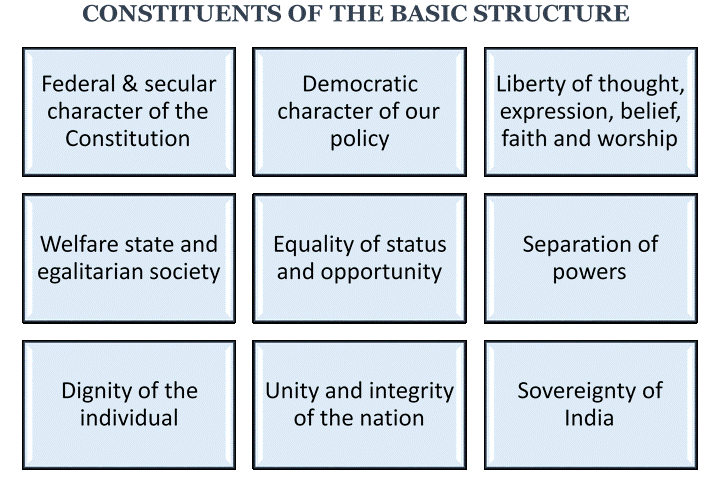
    The article underscores the significance of the Kesavananda Bharati case in Indian constitutional history, highlighting how it established a crucial safeguard against potential tyranny and dictatorship. The case introduced the concept of the Basic Structure doctrine, asserting that even constitutional amendments passed by a parliamentary majority could be declared unconstitutional if they violated the fundamental principles integral to the Indian Constitution.

    Key Highlights:

    • The Kesavananda Bharati case marked a turning point by introducing the Basic Structure doctrine, preventing the constitutionalization of gross aberrations or tyranny through amendments.
    • The Basic Structure doctrine empowers the judiciary to act as a check against potential misuse of power by the majority, safeguarding democracy.
    • The article traces the evolution of this doctrine from earlier cases, such as Shankari Prasad, Sajjan Singh, and Golaknath, leading up to the Kesavananda Bharati judgment.

    Key Challenges:

    • The Basic Structure doctrine has faced challenges from those seeking to dilute or ignore its significance, posing a threat to the enduring democratic principles it upholds.
    • The potential for misuse or misinterpretation of the Basic Structure doctrine could lead to controversies and confrontations in politics and governance.

    Key Terms:

    • Basic Structure: The fundamental principles and core features of the Indian Constitution that cannot be altered by constitutional amendments.
    • Parliamentary Majority: The voting majority in the Parliament required to pass constitutional amendments.
    • Constitutional Amendments: Changes made to the constitution, often requiring a special majority in the Parliament.

    Key Phrases:

    • “Basic Structure makes it impossible to constitutionalize gross aberrations.”
    • “Anti-majoritarian safeguards”: Mechanisms in place to protect against the potential tyranny of the majority in a democracy.

    Key Quotes:

    • “Even a constitutional amendment can be declared unconstitutional if it violates the Basic Structure.”
    • “The power of amendment… does not include the power to abrogate the Constitution.”

    Anecdotes:

    • The unsavoury episode of Chief Justice A N Ray attempting to unilaterally review the Kesavananda Bharati judgment in 1975 is highlighted, adding drama to the historical significance of the case.
    • The description of Nani Palkhivala’s arguments as “divinity speaking through him” during the case adds a personal touch to the historical narrative.

    Key Statements:

    • “The highest bulwark of such safeguards is the Indian Constitution.”
    • “Long live Basic Structure, despite the attempt of constitutional pygmies to jettison, dilute or ignore it.”

    Key Examples and References:

    • Reference to the Shankari Prasad, Sajjan Singh, and Golaknath cases to illustrate the evolution of the Basic Structure doctrine.
    • Mention of the 24th to 26th constitutional amendments enacted in 1971 to overrule specific judgments and provide context to the Kesavananda Bharati case.

    Key Facts and Data:

    • The Kesavananda Bharati case involved 703 pages of judgment spread over 11 judicial opinions, making it India’s longest argued case with the largest bench.
    • The Golaknath case in 1967 had a 6-5 majority holding the entire Part 3 of the Constitution unamendable.

    Critical Analysis:

    The article presents a critical analysis of the Kesavananda Bharati case, highlighting its significance as a safeguard against potential misuse of power. It underscores the importance of the Basic Structure doctrine in preserving democratic principles and preventing constitutional aberrations.

    Way Forward:

    • Emphasize the continued relevance and importance of the Basic Structure doctrine in maintaining a balance of power in a democracy.
    • Advocate for a nuanced understanding and application of the doctrine to ensure its integrity while addressing any legitimate concerns about its misuse.
  • Farsi to be one of India’s nine Classical Languages

    Introduction

    • In a significant move to deepen cultural ties, External Affairs Minister S Jaishankar announced that the Centre has decided to include Farsi (Persian) as one of the nine classical languages in India under the New Education Policy.

    Classical Languages in India

    • As of now, India recognizes six languages as classical, including Tamil (2004), Sanskrit (2005), Kannada (2008), Telugu (2008), Malayalam (2013), and Odia (2014).
    • In addition to these classical languages Pali, Persian, and Prakrit and their works of literature are to be preserved according to India’s National Education Policy-2020.
    • The addition of Farsi (Persian) brings the total to nine classical languages (Needs more clarification).

    Criteria for Classical Language Status

    The Ministry of Culture in the Rajya Sabha outlined the criteria for declaring a language as ‘Classical’:

    • High Antiquity: The language must have a recorded history spanning 1500-2000 years.
    • Valuable Heritage: It should possess a body of ancient literature and texts cherished by generations.
    • Originality: The literary tradition must be unique and not borrowed from another linguistic community.
    • Distinctness: The classical language and its literature should be distinct from modern forms or offshoots.

    Promotion of Classical Languages

    Upon being recognized as a classical language, the HRD Ministry provides various benefits, including:

    • International Awards: Two major international awards for eminent scholars in classical Indian languages.
    • Centre of Excellence: Establishment of a Centre of Excellence for studies in Classical Languages.
    • Professional Chairs: Requesting the University Grants Commission (UGC) to create Professional Chairs for Classical Languages, initially in Central Universities.

    The Eighth Schedule

    The Eighth Schedule of the Indian Constitution outlines the official languages of the Republic of India. It is governed by Articles 344(1) and 351 of the Constitution.

    • Purpose: Originally created to grant representation on the Official Languages Commission and enrich Hindi and English, the official languages of the Union.
    • Medium for Examinations: Candidates appearing for public service examinations have the privilege of using any language from the Eighth Schedule as a medium to answer exam papers.
    • Languages Included: Currently, the Eighth Schedule includes 22 languages, including Assamese, Bengali, Bodo, Dogri, Gujarati, Hindi, Kannada, Kashmiri, Konkani, Maithili, Malayalam, Manipuri, Marathi, Nepali, Odia, Punjabi, Sanskrit, Santali, Sindhi, Tamil, Telugu, and Urdu.

    Chronological Additions

    The chronological additions to the Eighth Schedule are as follows:

    • 1950: Initially included 14 languages.
    • 1967: Sindhi was added through the 21st Constitutional Amendment Act.
    • 1992: Konkani, Manipuri (Meitei), and Nepali were included through the 71st Constitutional Amendment Act.
    • 2003: Bodo, Dogri, Maithili, and Santali were added through the 92nd Constitutional Amendment Act.
    • 2011: The spelling “Oriya” was replaced with “Odia” through the 96th Constitutional Amendment Act.

    Try this PYQ:

    Consider the following languages:

    1. Gujarati
    2. Kannada
    3. Telugu

    Which of the above has/have been declared as ‘Classical Language / Languages’ by the Government?

    (a) 1 and 2 only

    (b) 3 only

    (c) 2 and 3 only

    (d) 1, 2 and 3

    [wpdiscuz-feedback id=”zd3km5etnb” question=”Please leave a feedback on this” opened=”1″]Post your answers here.[/wpdiscuz-feedback]

  • Political Split and Maharashtra Assembly Speaker’s Ruling

    Introduction

    • Maharashtra Assembly Speaker ruled that the ruling faction of a political party was the legitimate and real, having the support of the majority of the party’s MLAs.

    Anti-Defection Law in India

    • Rise of Political Instability: The late 1970s saw rampant floor-crossing by legislators, epitomized by the phrase “Aaya Ram Gaya Ram” after MLA Gaya Lal’s frequent party changes in 1967.
    • Legislative Efforts: Various bills, including the 32nd and 48th Constitution Amendment Bills, were introduced to address defections but lapsed or were not passed.
    • Enactment of the Law: The 52nd Amendment in 1985, under Prime Minister Rajiv Gandhi, introduced the Tenth Schedule to the Constitution, embedding the anti-defection law.

    Features of the Anti-Defection Law

    [A] Disqualification Criteria:

    • Members of Political Parties: Disqualification occurs if a member voluntarily gives up their party membership or defies the party’s directive without prior permission, which is not condoned within 15 days.
    • Independent Members: Disqualification occurs if they join a political party after election.
    • Nominated Members: Disqualification occurs if they join a political party after six months from taking their seat in the House.

    [B] Exceptions:

    • Merger: A member is not disqualified if their original party merges with another party, and at least two-thirds of its members agree to the merger.
    • Presiding Officers: Members who become presiding officers can relinquish party membership and rejoin it after their term without facing disqualification.

    [C] Decision Makin:

    • Deciding Authority: The presiding officer of the respective House is the authority to decide on disqualification matters, subject to judicial review as established in the Kihoto Hollohan case (1991).
    • Rule-making Power: The presiding officer can formulate rules for implementing the Tenth Schedule, subject to the approval of the House.
    • Procedure for Disqualification: The presiding officer acts upon a defection case upon receiving a complaint. The accused member must be given a chance to explain, and the matter can be referred to a committee for inquiry.
    • Position of Speaker: Party whips do not apply to the Speaker. However, questions of disqualification under the law concerning the Speaker or Chairman are decided by a member elected by the House.

    Judicial Interpretations and Election Commission’s Role

    • Key Judgments: The Kihoto Hollohan case (1991) made the Speaker’s decision on defection subject to judicial review. Other significant cases include Ravi Naik vs Union of India and G. Viswanathan Vs. The Hon’ble Speaker, Tamil Nadu, which clarified aspects of voluntary membership relinquishment and expulsion.
    • Election Commission’s Guidelines: The EC resolves intra-party disputes based on majority support in both organizational and legislative wings and may freeze party symbols in unresolved cases.

    Challenges and Criticisms

    • Discriminatory Features: The law is criticized for not differentiating between dissent and defection and for its approach to individual versus group defections.
    • Absence of Time Limit: The lack of a mandated timeframe for decisions on defection cases has led to manipulation and delays.
    • Impact on Democratic Functioning: Critics argue that the law restricts legislators’ freedom and weakens legislative checks on the executive.

    Debate on Repeal or Amendment

    • Arguments for Repeal: Some argue for the law’s repeal, citing its failure to prevent defections and its hindrance to representative democracy.
    • Arguments against Repeal: Proponents believe it ensures government stability, recognizes party systems, and reduces corruption.
    • Suggested Amendments: Recommendations for amendments include limiting the law’s scope, enhancing decision-making processes, and promoting intra-party democracy.

    Expert Recommendations

    • Dinesh Goswami Committee (1990) and Law Commission (170th Report, 1999): Suggested amendments include limiting disqualification and involving the President/Governor and EC in decision-making.
    • Constitution Review Commission (2002): Proposed barring defectors from holding public office and invalidating their votes in toppling governments.
    • Election Commission’s Proposal: Recommended that decisions under the Tenth Schedule should be made by the President/Governor based on the EC’s binding advice.

    Way Forward

    • Amending the Law: Amendments should address existing shortcomings, such as defining “voluntarily giving up membership” and removing distinctions in disqualification criteria.
    • Enhancing Democratic Functioning: Reforms should focus on promoting intra-party democracy and regulating the use of whips.
    • Voter Responsibility: The electorate’s role in holding defectors accountable through the ballot remains crucial.

    Conclusion

    • Navigating Political Stability and Democracy: The anti-defection law seeks to balance political stability with democratic representation and legislative accountability.
    • Adapting to Contemporary Politics: As political dynamics evolve, so must the legal frameworks, ensuring their relevance and effectiveness.